

Pollinator Post 9/10/25 (2)
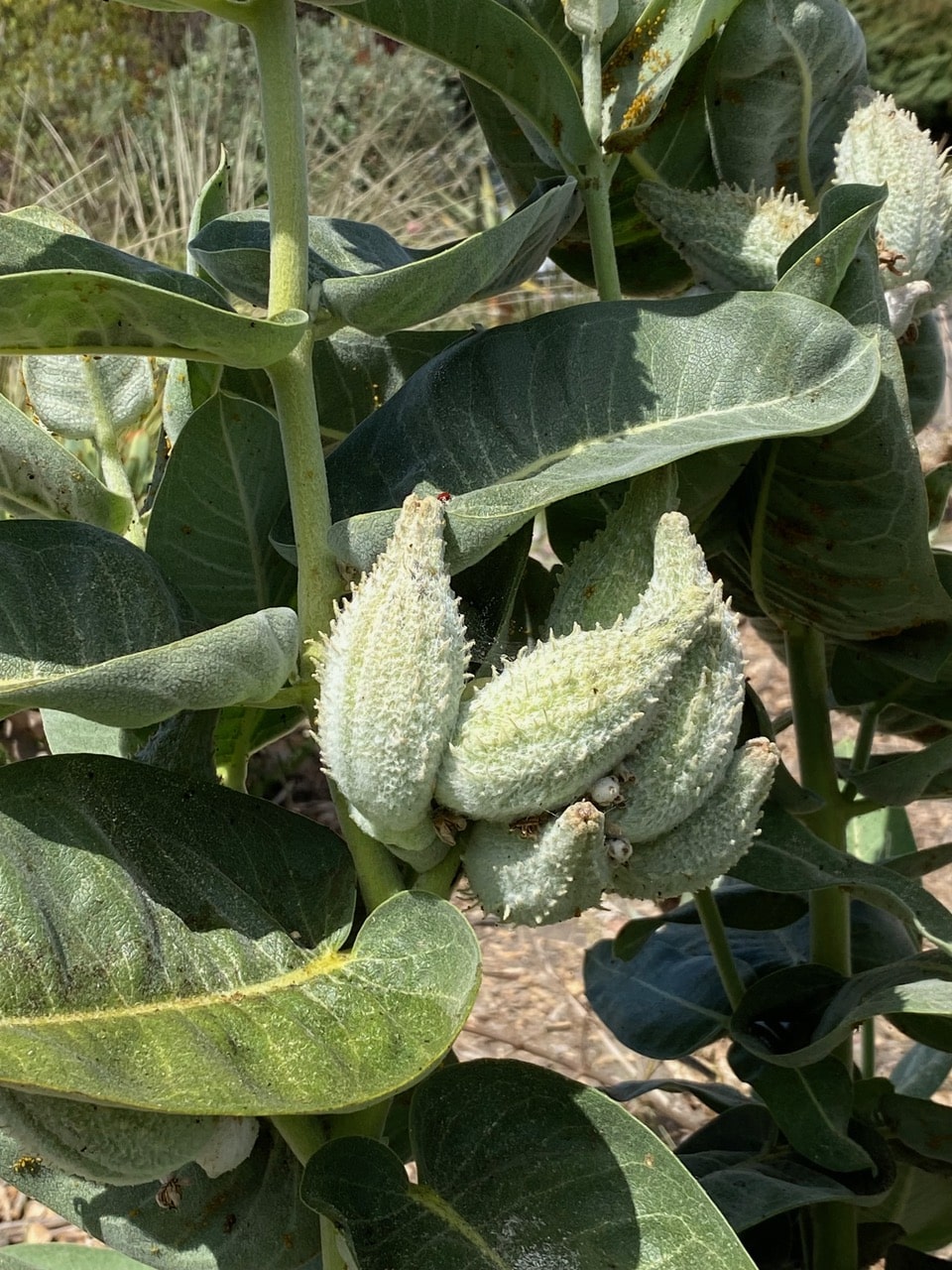
Merle, Mia and I walk over next door to explore Mia’s relatively new native garden. Since it is still being irrigated, many of the young plants are still in bloom.
I stop to admire the prolific fruit set on the Showy Milkweed, Asclepias speciosa. It appears pollination has been very successful, resulting in multiple fruits developing from each cluster of flowers.
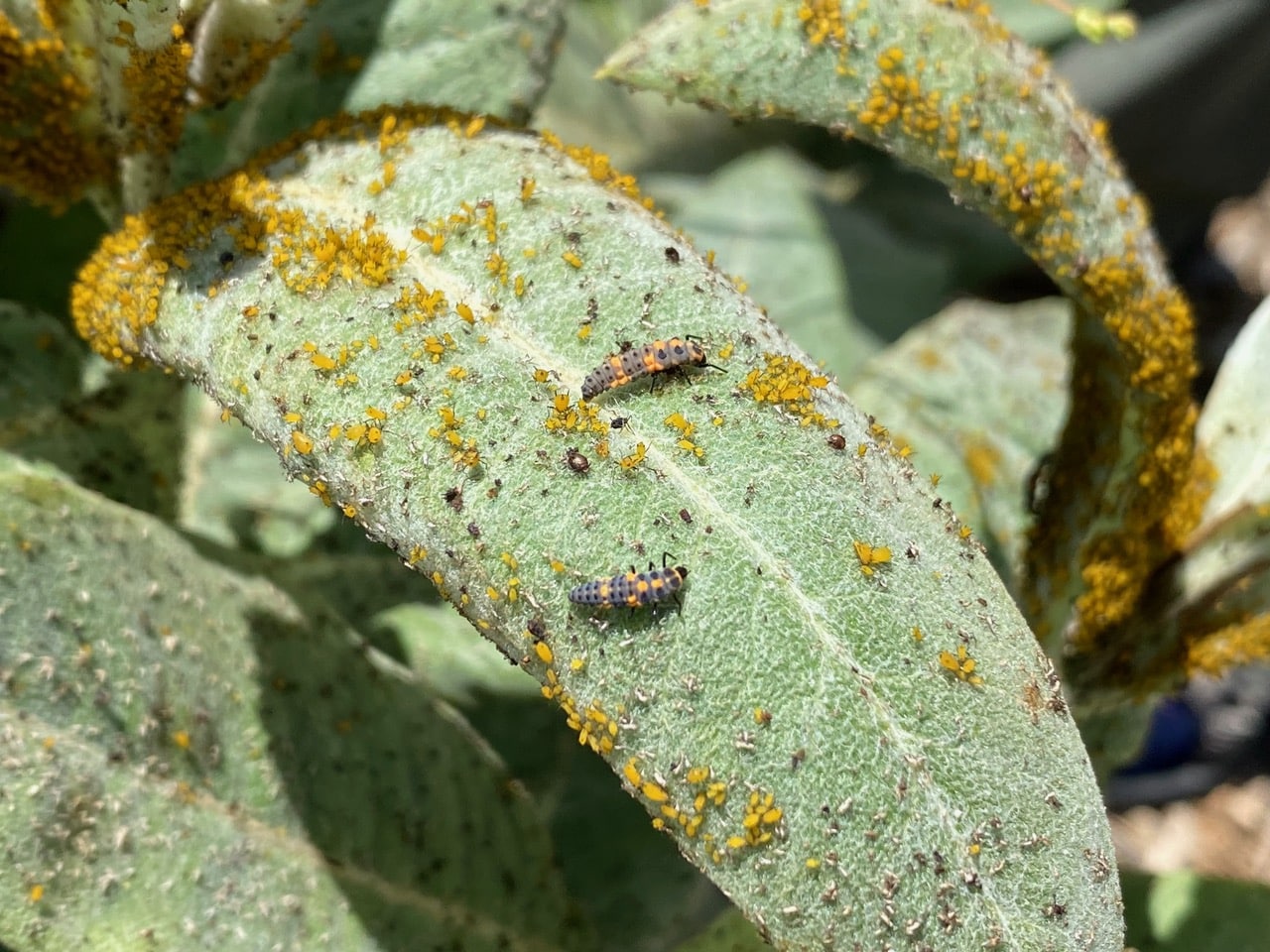
Wow, there’s a lot of activity on that adjacent milkweed! The felty leaves are covered with tiny yellow aphids as well as their predators and parasitoids. Two Lady Beetle larvae are hunting the aphids, and there are aphid mummies scattered over the leaf.
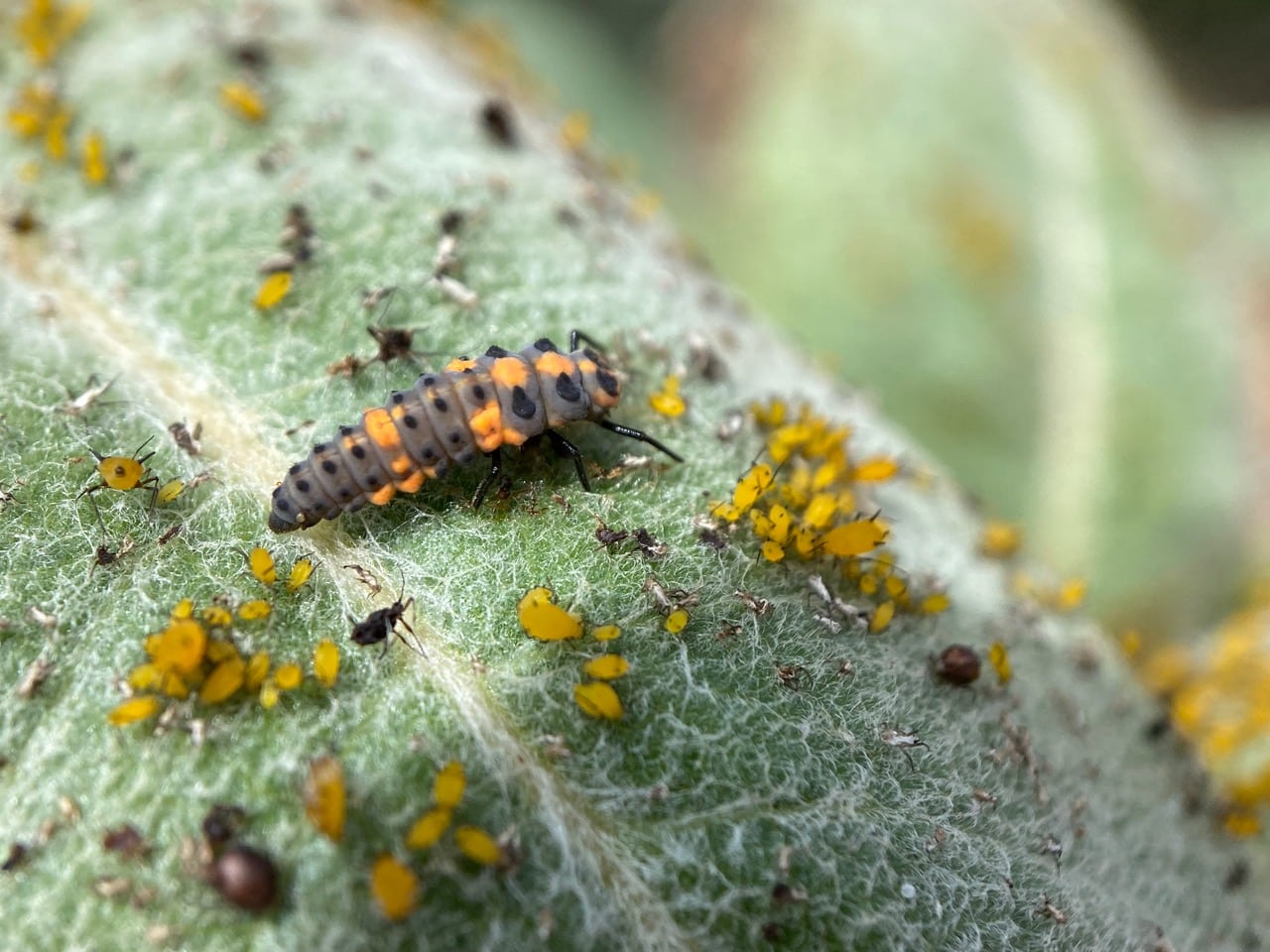
Close-up of a Lady Beetle larva (family Coccinelidae).
Lady beetles go through complete metamorphosis, which comprises four stages: eggs, larva, pupa and adult. The larva goes through four molts during their development. Often described as miniature alligators with six legs, the larvae are voracious predators of aphids. Each larva can eat about 400 aphids in the three weeks before it pupates. Besides aphids, they also feed on soft scales, whitefly pupae, thrips, and spider mites.
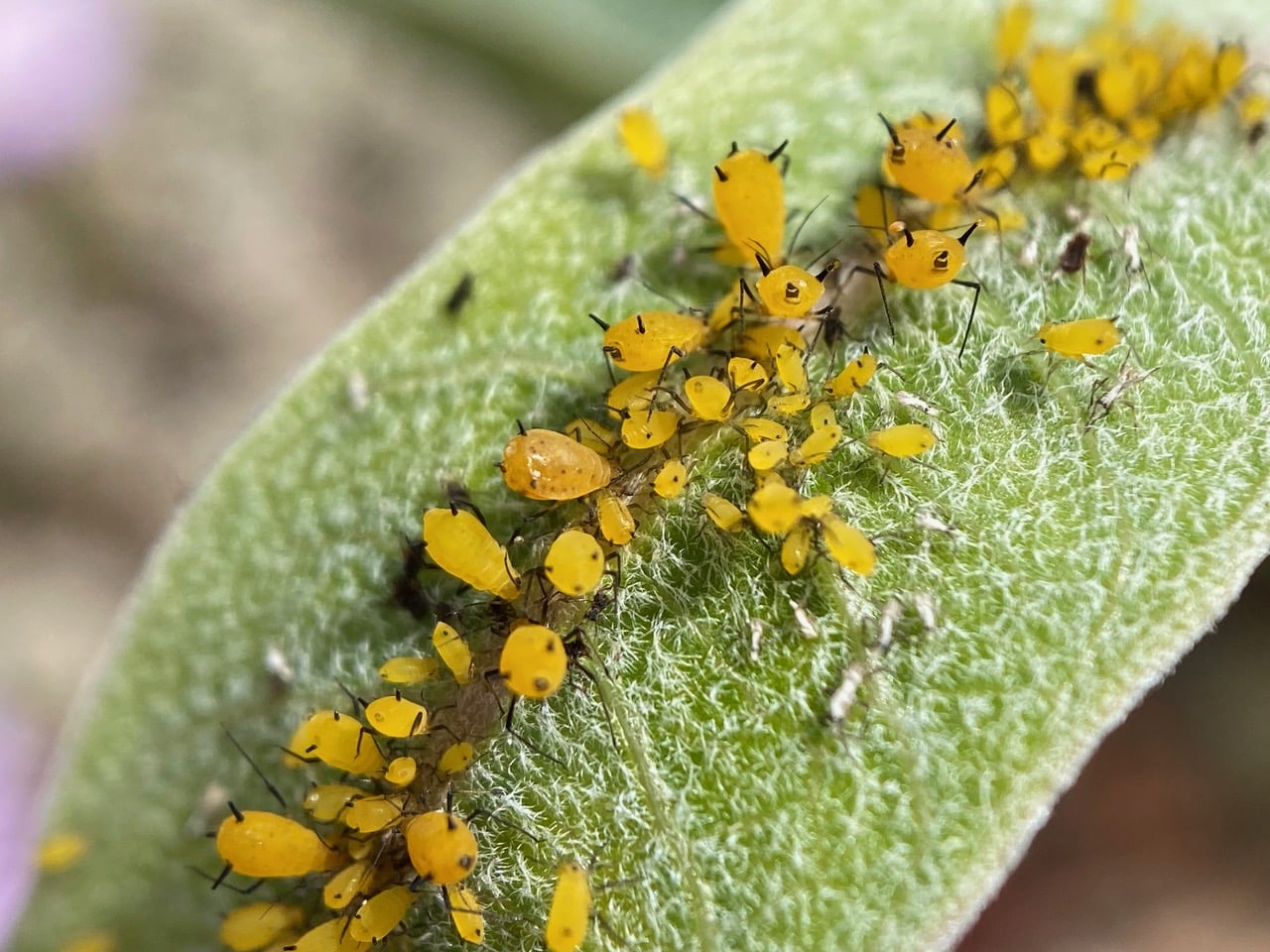
A thriving colony of the Oleander Aphids, Aphis nerii (family Aphididae) consisting of various sizes and ages.
Aphis nerii is also known as Milkweed Aphid. The species is widespread in regions with tropical and Mediterranean climates. The species probably originated in the Mediterranean region, the origin of its principal host plant, oleander. This bright yellow aphid, measuring 1.5-2.6 mm, has black legs, antennae and cornicles (“tail pipes”). The aphids feed primarily on the sap of plants in the dogbane family, Apocynaceae, including Milkweeds, Oleander and Vinca.
Females are viviparous and parthenogenetic, meaning that they give birth to live young instead of laying eggs, and that the progeny are produced by the adult female without mating. The nymphs feed gregariously on the plant terminal in a colony that can become quite large. Nymphs progress through five nymphal instars without a pupal stage. Normally wingless adults are produced but alate adults occur under conditions of overcrowding and when plants are senescing, allowing the aphids to migrate to new host plants. The parthenogenetic mode of reproduction, high fecundity, and short generation time allow large colonies of Oleander Aphids to build quickly on infested plants.
The Oleander Aphid ingests sap from the phloem of its host plant. The damage caused by aphid colonies is mainly aesthetic due to the large amounts of sticky honeydew produced by the aphids and the resulting black sooty mold that grows on the honeydew. The terminal growths of host plants may be deformed, resulting in stunted growth in heavy infestation.
Oleander Aphids sequester cardiac glycosides, a toxin from their host plants. They also fortify their cornicle secretions with these bitter, poisonous chemicals. Their bright aposematic (warning) coloration and possession of toxins protect them from predation by certain species of birds and spiders. Aphid populations are usually kept under control by natural biological agents such as parasitoid wasps, and predators such as Syrphid larvae, Lacewing larvae, and Lady Beetles.
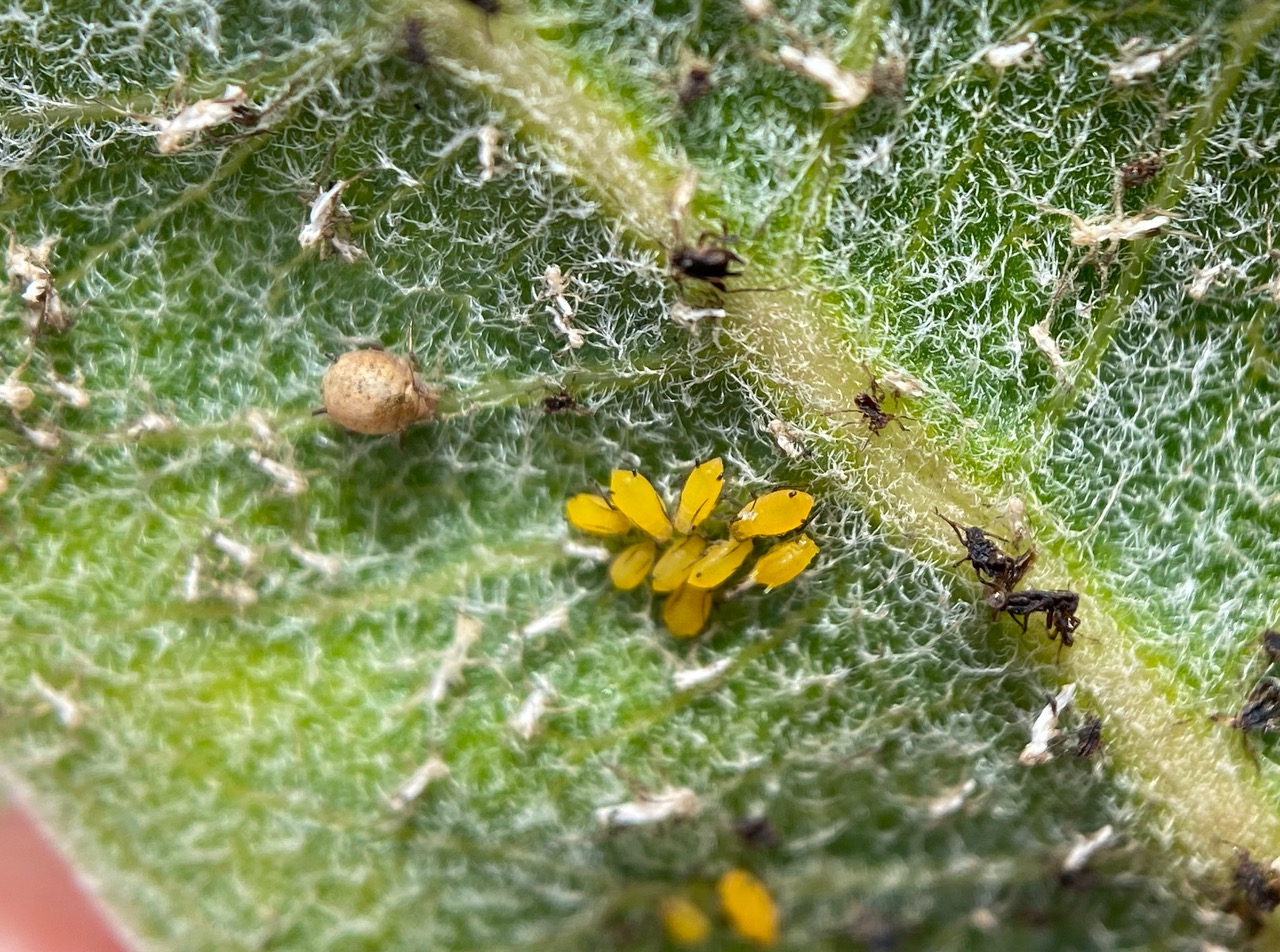
See that straw-colored critter next to the cluster of normal yellow aphids? It is an “aphid mummy” – an aphid that has been parasitized by an Aphid Mummy Wasp.
Aphid Mummy Wasps, Aphidius sp. (family Braconidae) are small wasps, typically less than 1/8 in. long. The female wasp lays a single egg in an aphid. When the egg hatches, the wasp larva feeds inside the aphid. As the larva matures the aphid is killed and becomes bloated and mummified, usually turning tan or golden in color. The adult wasp chews its way out of the mummy leaving a circular hole.
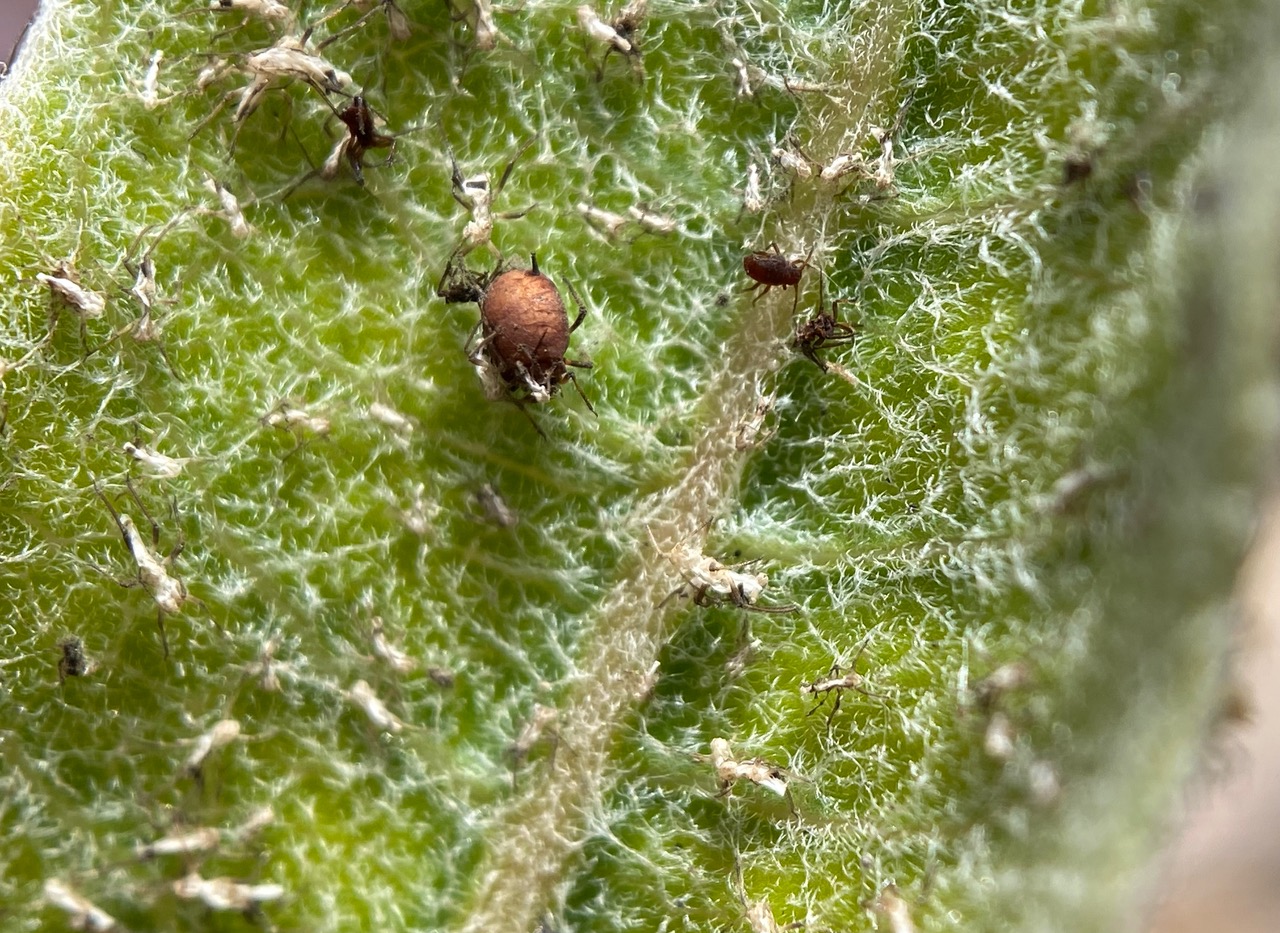
Here’s another aphid mummy, a darker one. See the white flakes strewn around the leaf? Those are aphid exuviae, the shed exoskeletons left by the aphids when they molt. The black aphids are the dead ones.
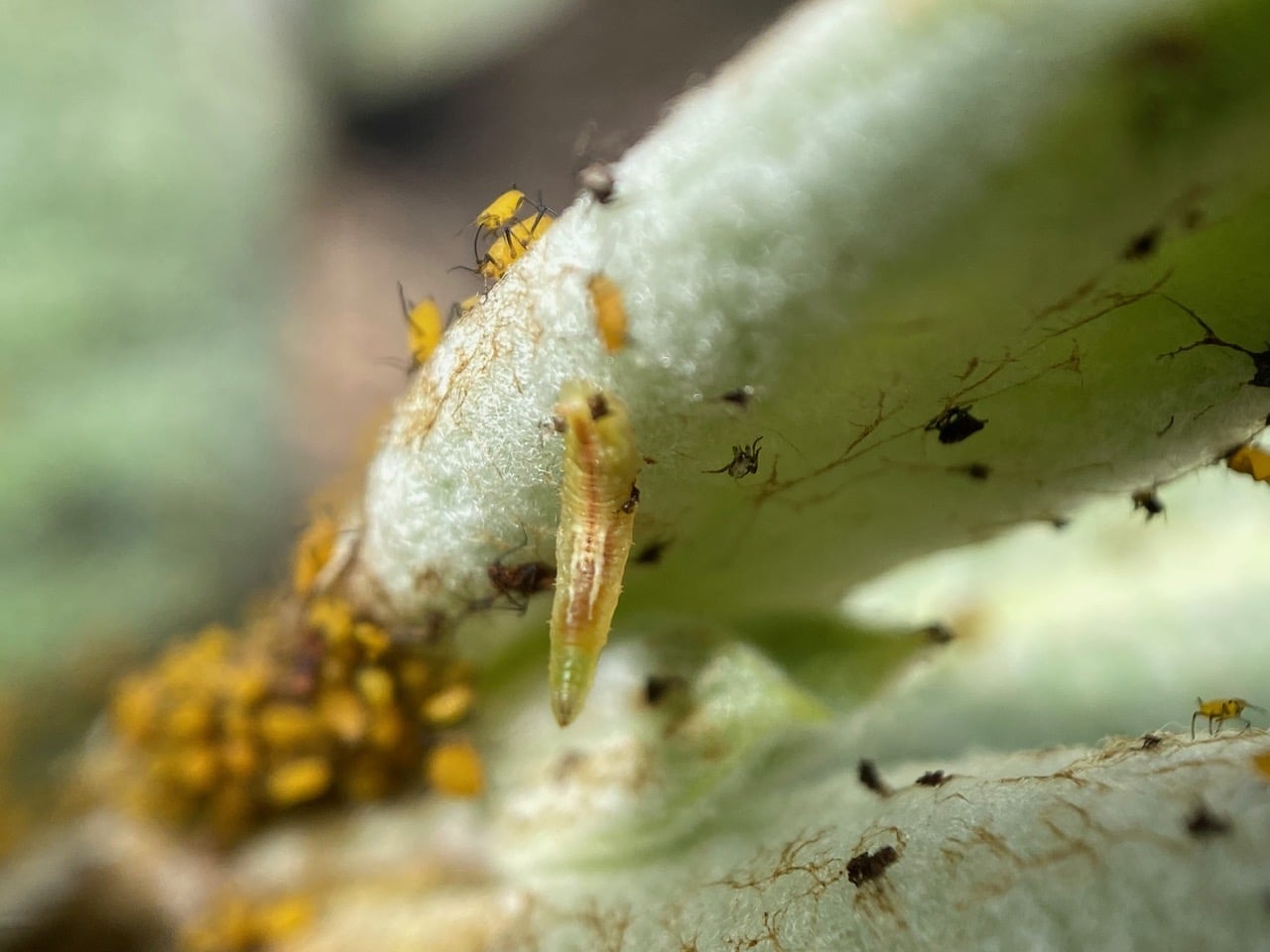
Mia calls my attention to a tiny, translucent, slug-like creature moving among the aphids. It is a hover fly larva on the hunt! It is thrashing its pointed head around, probing for food – aphids. Note the dead aphids around it.
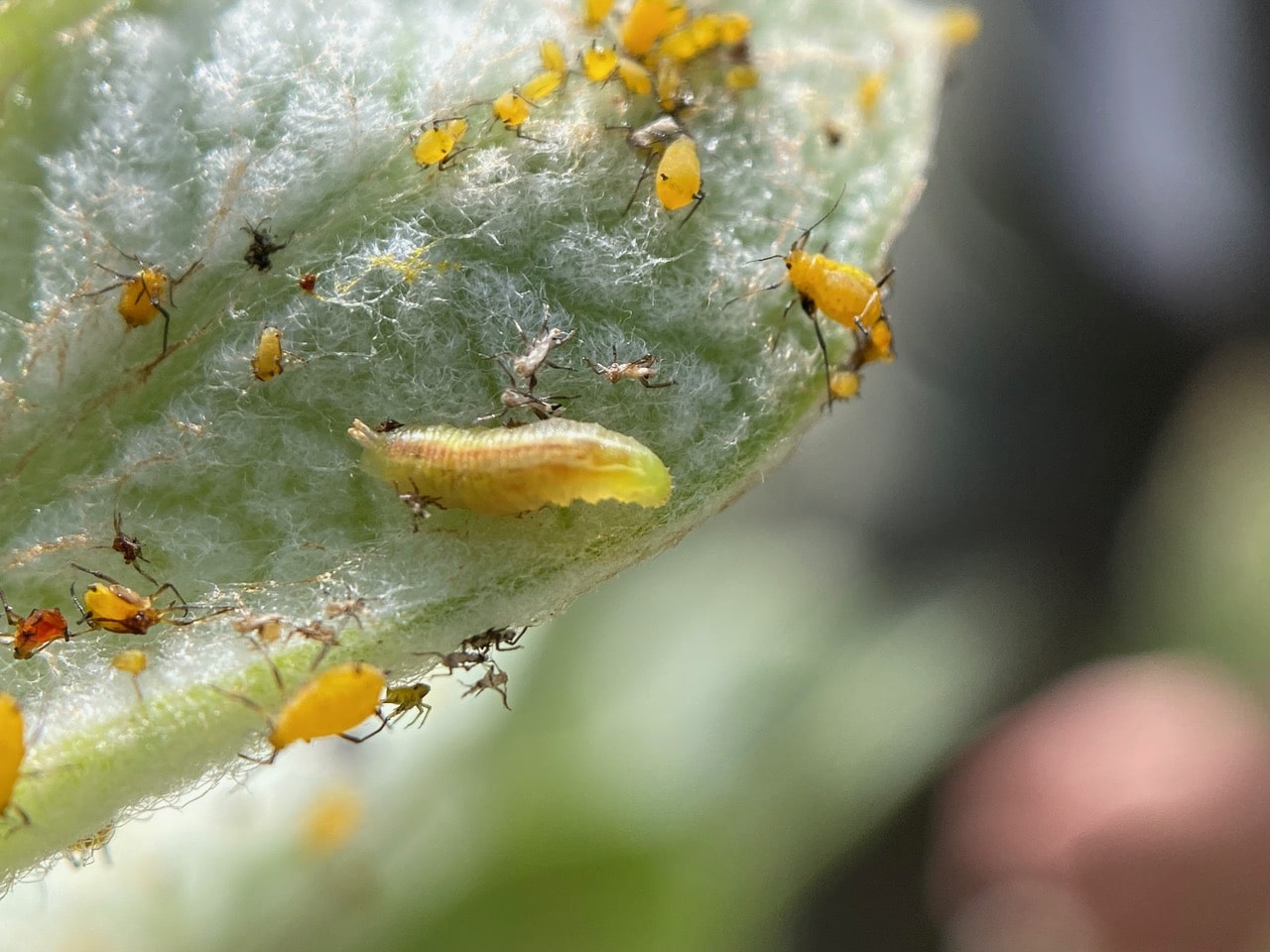
The Syrphid larva is ploughing through the aphid colony, leaving mayhem and dead aphids in its wake. The pair of tube-like structures on the rear end of the larva are its posterior spiracles. These are breathing tubes that contain the openings to the larva’s respiratory system.
Many species of hover flies have larvae that feed on aphids and other soft-bodied insects. The females seek out aphid colonies on plants to lay their eggs, to ensure that their offspring will have plenty to eat.
Syrphid larvae have no eyes and no legs. They swing their tapered head from side to side in search of prey. When they make contact with a prey, they grab hold of it with their mouthpart, then suck out the victim’s body contents. Depending on species, a Syrphid larva can feed on 100 to 400 aphids before it pupates.

A Convergent Lady Beetle, Hippodamia convergens (family Coccinellidae) is perched motionless on a milkweed leaf. The species is easily distinguished by the two converging white lines on the black pronotum. Both adults and larvae of the species are voracious predators of aphids and other soft-bodied insects.
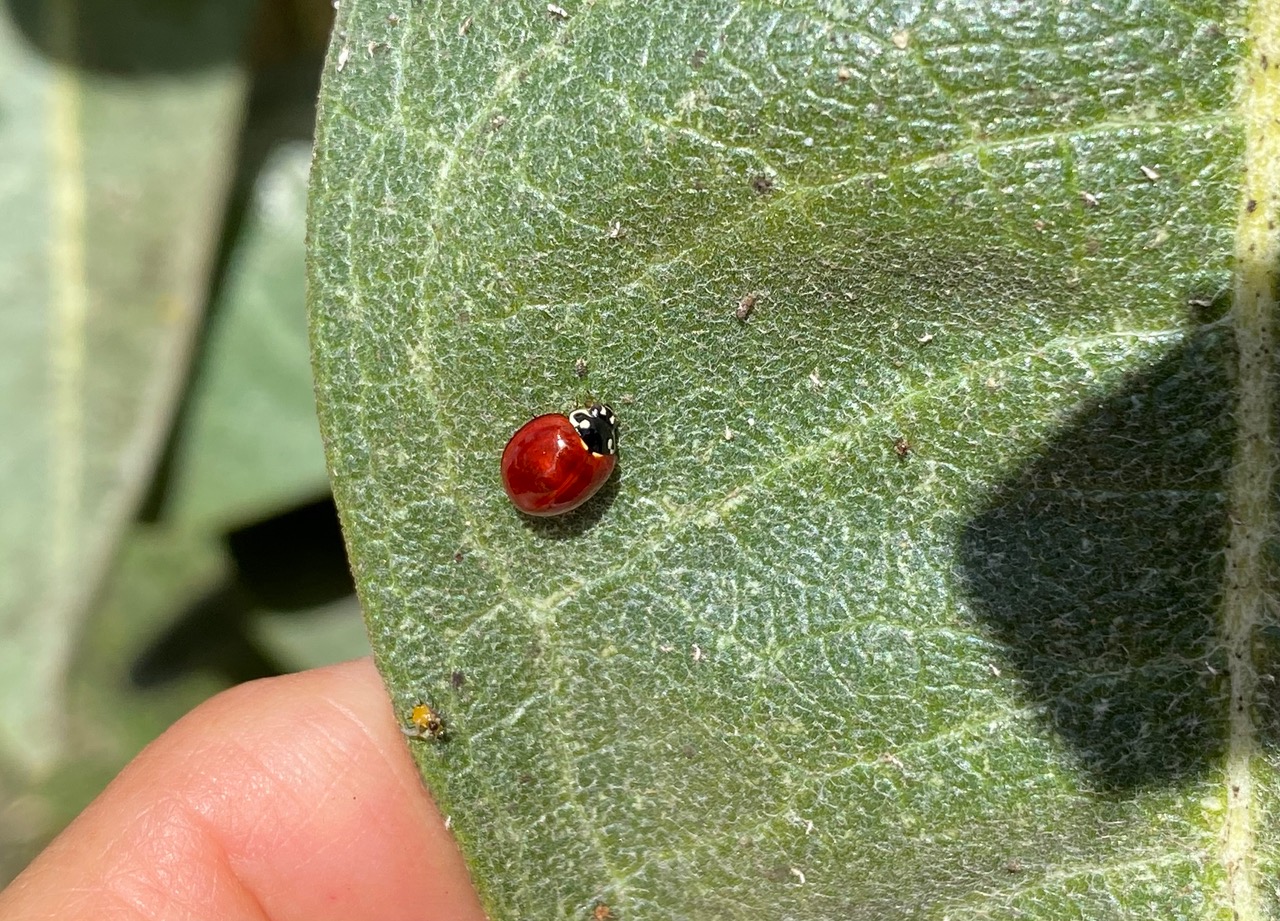
Ooh, here’s a different species of Lady Beetle on another milkweed leaf. It is a female Spotless Lady Beetle, Cycloneda sanguinea (family Coccinellidae). The abundance of aphids have brought in all their predators.
The Spotless Lady Beetle, Cycloneda sanguinea (family Coccinellidae) is a widespread species of lady beetle in the Americas. It is is large lady beetle with red, unspotted elytra (wing covers) ranging from 4-6.5 mm long. The black and white marks on the head and pronotum are very distinctive, and they are also gender-specific. Both adult and larvae of Spotless Lady Beetles are voracious predators of aphids. They are very often found feeding on aphids on milkweeds, but also occur on a number of other plants.
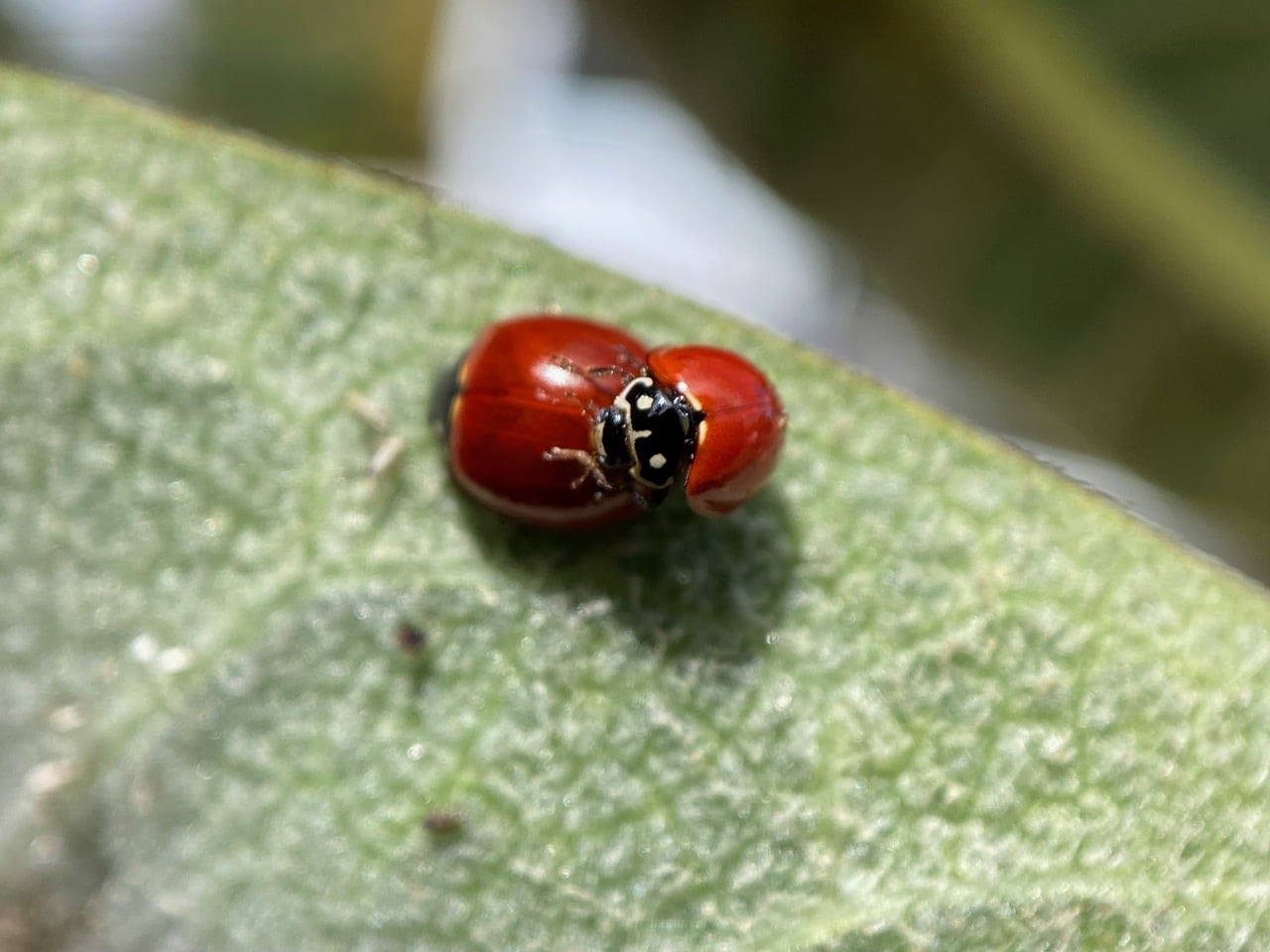
Mia’s joyful squeal draws our attention to a mating pair of the Spotless Lady Beetles, Cycloneda sanguinea (family Coccinellidae). The species is sexually dimorphic, but only subtly so. Note the pronotum of the smaller male on top – it has a short white line between the pair of white spots. The female (as seen in the previous image) lacks this line.
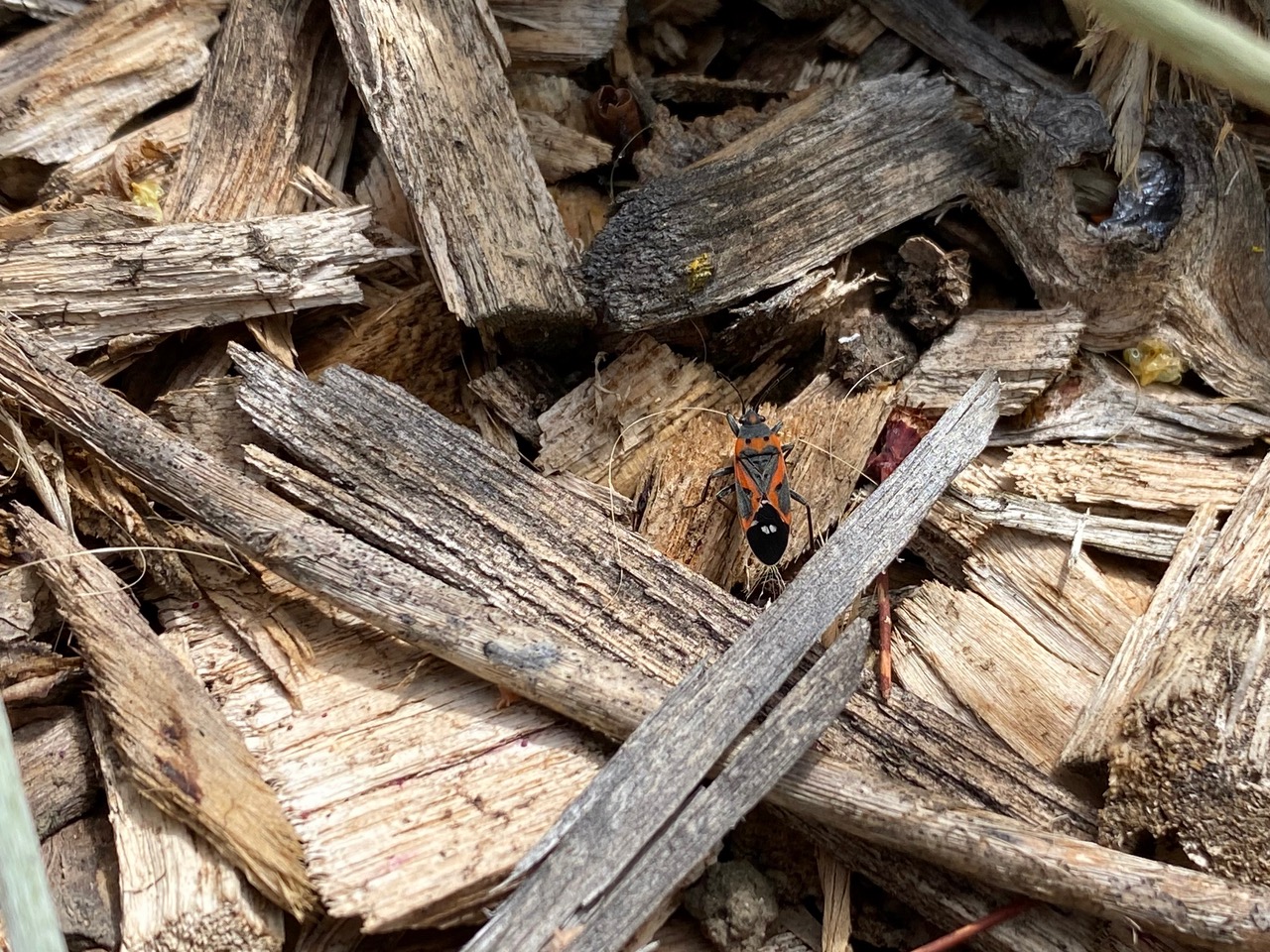
A Small Milkweed Bug, Lygaeus kalmii (family Lygaeidae) is wandering through the wood chip mulch near the milkweed plants.
The Small Milkweed Bug, Lygaeus kalmii belongs to the family Lygaeidae, collectively known as “seed bugs”. Through their piercing-sucking mouthparts, they secrete saliva and digestive enzymes to predigest their food before sucking up the slurry. Milkweed seeds make up the diet of the nymphs, but adults are generalists, feeding on the seeds of various plants and the nectar of flowers. The adults are not even strictly herbivorous; they are opportunistic scavengers on dead insects, and are known to feed on the eggs, larvae or pupae of other insects. The adult bugs overwinter and often emerge from cracks and crevices on warm spring days. They are found at virtually any time of the year in our gardens.
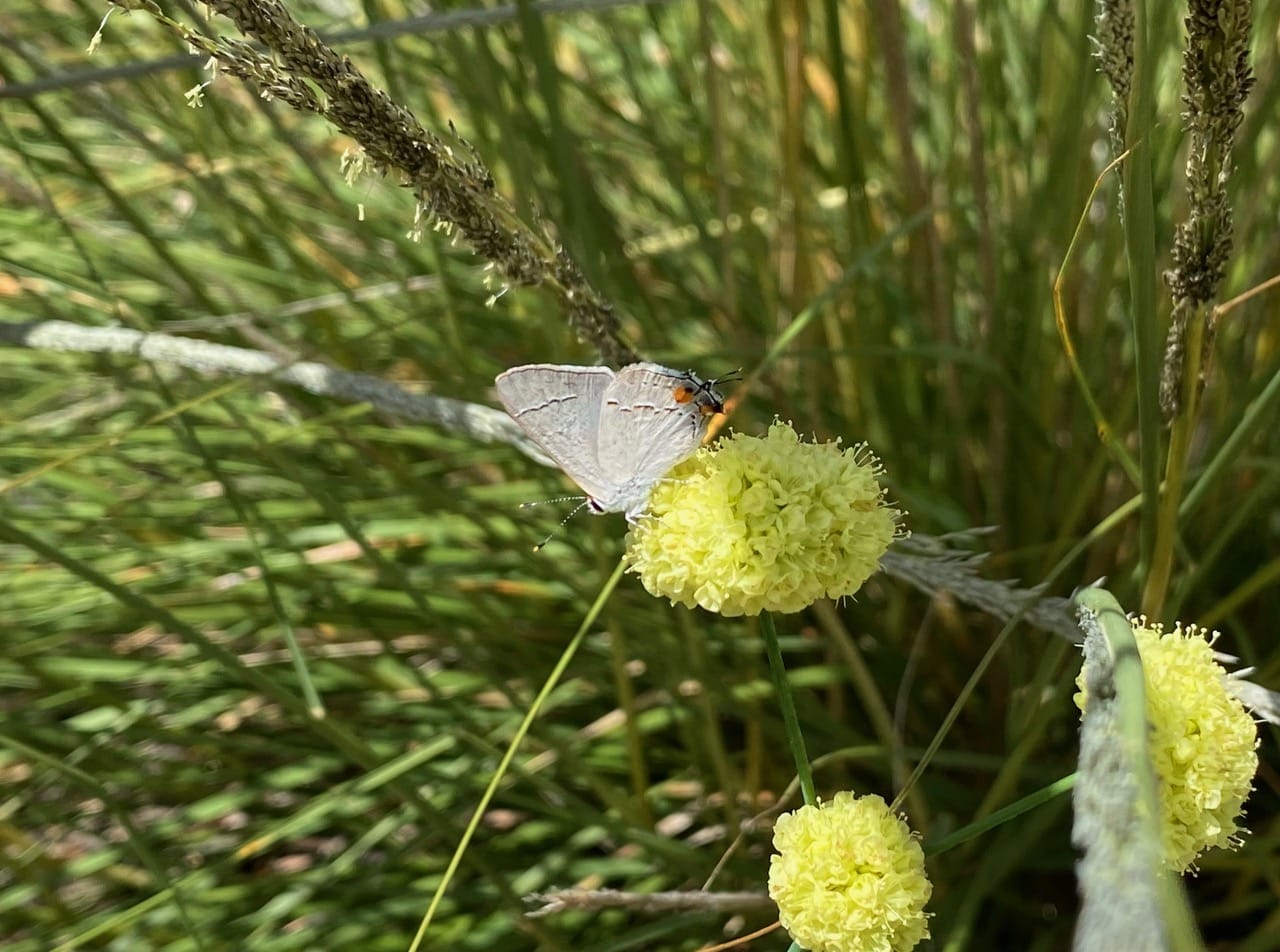
A Gray Hairstreak, Strymon melinus (family Lycaenidae) is perched on an inflorescence of Sulphur Buckwheat, Eriogonum umbellatum. The butterfly is slowly rubbing its hind wings together.
Why the name “hairstreak”? These small butterflies have a slim, hair-like tail on the lower corner of each hindwing. Gray Hairstreak also has colorful false eyespots near the base of each tail. The eyespots and antenna-like tails are believed to fool predators into mistaking its tail for its head. Hairstreaks even add a behavioral component – a nectaring hairstreak often rubs its wings up and down, simulating the movement of twitchy antennae. This may fool birds, lizards, and spiders into attacking the wrong end, sparing the life of the butterfly.
Female Gray Hairstreaks lay eggs singly on the flowers, flower buds, young fruits and nearby leaves of a host plant. Host plants include a wide variety of plants, notably from the pea (Fabaceae) and mallow (Malvaceae) families. The caterpillars are greenish at the start, but older individuals range in color from gray to pink. As in many species of Lycaenidae, Gray Hairstreak larvae are myrmecophiles (ant-lovers) – often tended by ants. Ants harvest a sweet liquid from the caterpillar’s dorsal nectary organ (“honey gland”) and in exchange may protect them from predators. Larvae of many Lycaenidae species also communicate with ants via ant-like sounds (clicks and hums) or by sending vibrations through the substrate.
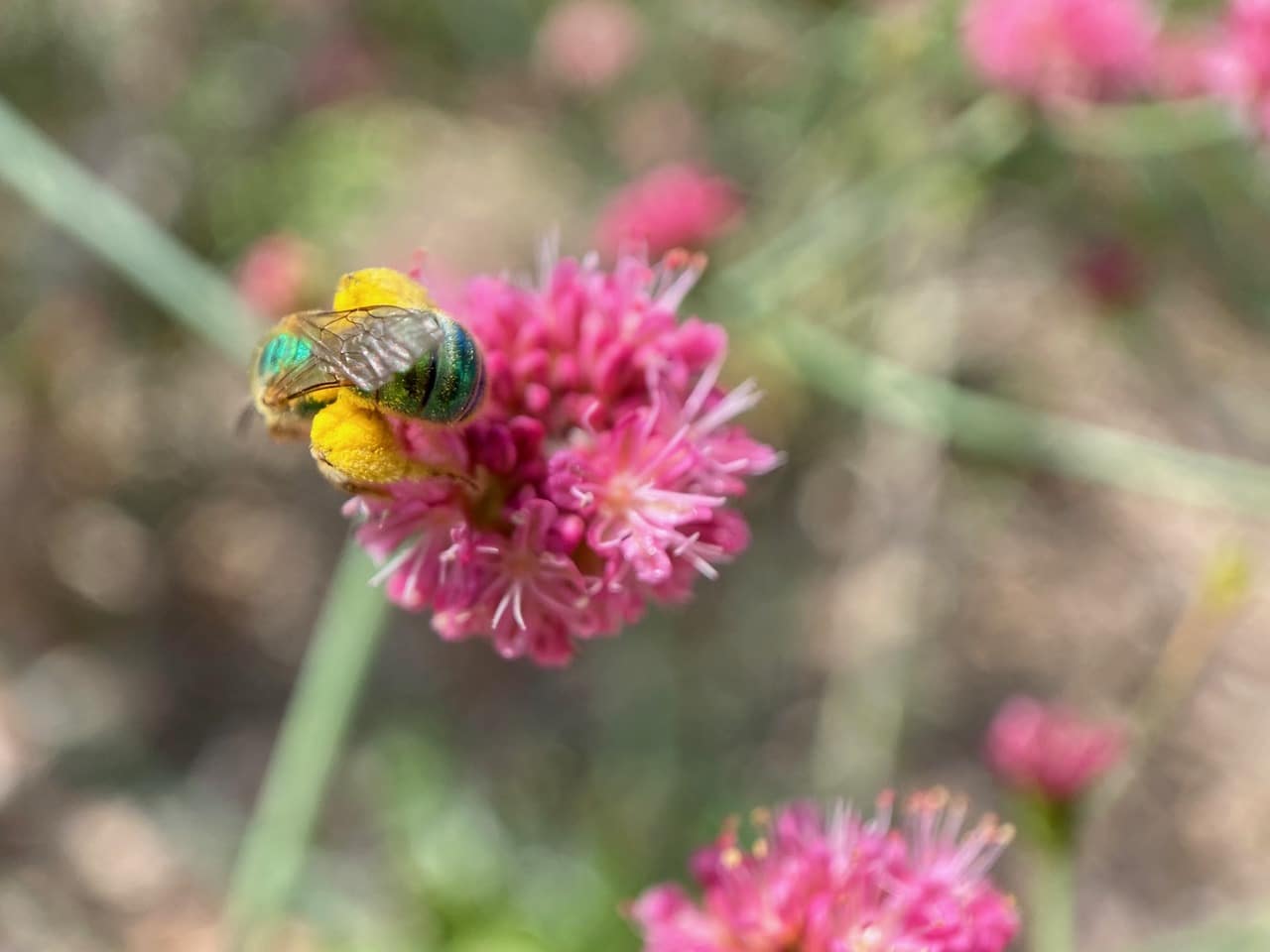
An ambitious female Fine Striped Sweat Bee, Agapostemon subtilior (family Halictidae) with a bulging load of pollen on its hind legs continues to forage on a cluster of Red-flowered Buckwheat, Eriogonum grande ssp. rubescens.
Agapostemon are brightly colored metallic green or blue bees measuring 7 to 14.5 mm long. Most species have a metallic green head and thorax, and black-and-yellow striped abdomen; some females are entirely bright green or blue. Females carry pollen on scopal hairs located on their hind legs. Agapostemon are ground-nesters and generalist foragers. Like other members of the family Halictidae, they are short-tongued and thus have difficulty extracting nectar from deep flowers. Males are often seen flying slowly around flowers looking for females. The bees favor flowers with high densities.
Agapostemon females dig deep vertical burrows in flat or sloping soil, or sometimes in banks. Most species are solitary, but some species nest communally. Up to two dozen females may share a single nest entrance, but each individual builds and provisions its own cluster of brood cells. Where a communal nest gallery shares a single entrance, one bee usually guards the hole, with only her head visible from above ground. Unlike other social bees, in communal bees there is no reproductive division of labor. In cool temperate regions, there is one generation per year, with females active in the early summer and males and pre-diapausing females active in the late summer. Only mated females survive the winter. This is probably because unmated females cannot enter diapause (insect version of hibernation).