

Pollinator Post 9/10/25 (1)

I have been invited to visit a home garden in the outskirts of Richmond, in the May Valley neighborhood. We’ve had some morning showers in the Bay Area – the temperatures have cooled down and the air is clean. My heart sings! The sky is still cloudy at 10 am when I arrive at Merle’s. She gives me a guided tour of her mature garden (30 years) filled with almost 100% native plants.
Many leaves of this Western Redbud, Cercis occidentalis in the front yard have had circular pieces cut from the edges – a sure sign of Leafcutter bees activity. How exciting!
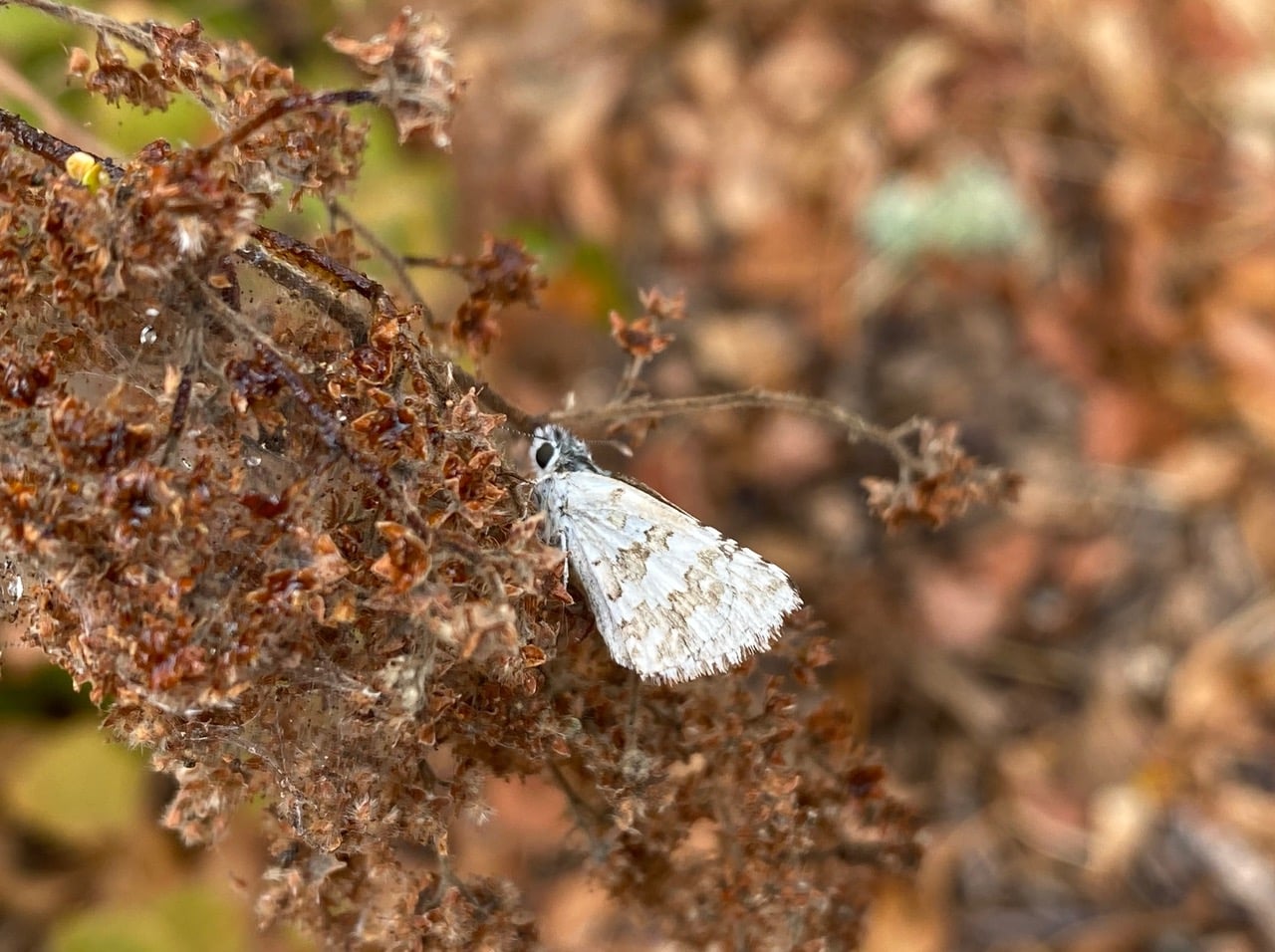
A Common Checkered Skipper, Burnsius communis (family Herperiidae) is perched motionless on a spent inflorescence of Ocean Spray, Holodiscus discolor. The little butterfly is still asleep, although its eyes are wide open. (Insects have no eyelids!)
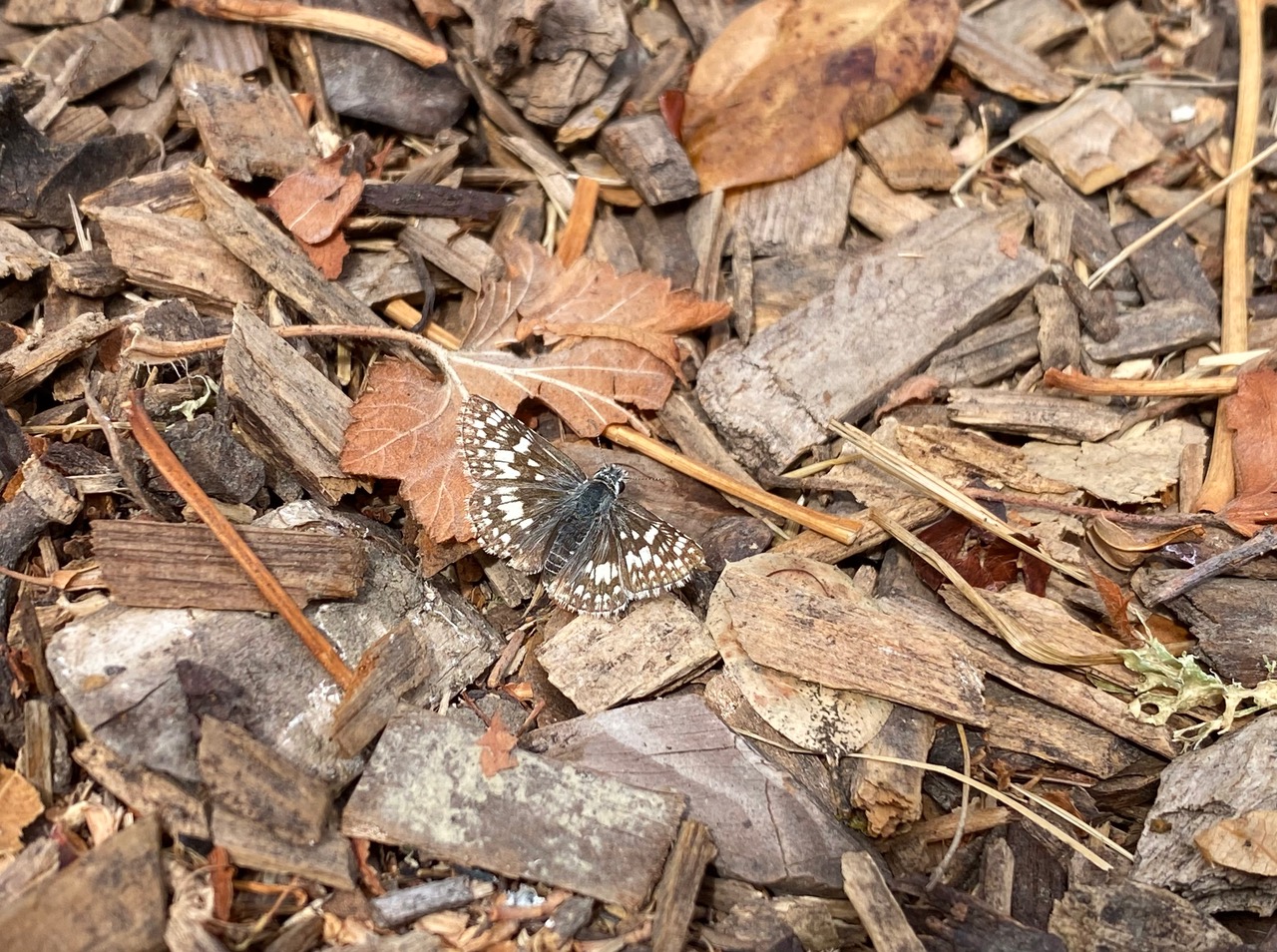
A couple of hours later when I pass the same plant, the Common Checkered Skipper lifts off from the plant and lands on the mulch on the path.
Because of its small size, bluish color, and spread-wing posture, the butterfly is often mistaken for one of the “Blues” in the family Lycaenidae. Skippers have the antennae clubs hooked backward like a crochet hook, while the typical butterflies have club-like tips to their antennae. Skippers also have generally stockier bodies and larger compound eyes.
Checkered Skippers belong to the subfamily Pyrginae, commonly known as spread-wing skippers, in the family Hesperiidae. Spread-wing skippers bask with their wings held wide open. The wings are held closed when they are at rest. Caterpillars make folded-leaf nests in which they live and feed on several plants in the mallow family, Malvaceae.
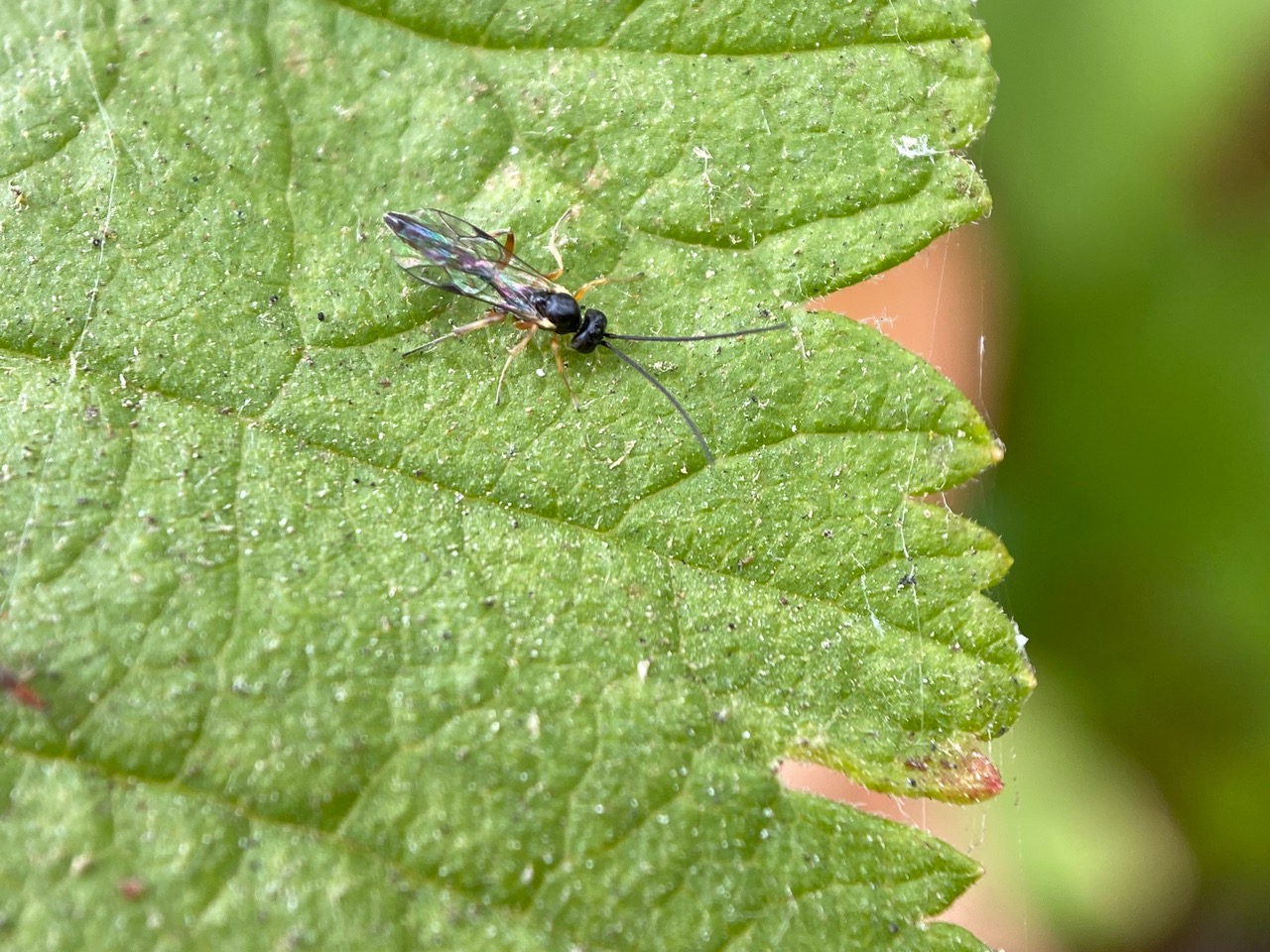
A tiny wasp with long antennae has landed on a leaf of Ocean Spray. From its size I surmise that it is a parasitoid wasp. iNaturalist has helped identify it as an Ichneumonid Wasp, Dusona sp. (family Ichneumonidae).
The Ichneumonidae, also known as the Ichneumon Wasps, or Ichneumonids, are a family of parasitoid wasps. They are one of the most diverse groups within the Hymenoptera (the order that includes the ants, wasps and bees) with about 25,000 species and counting. Ichneumon Wasps attack the immature stages of insects and spiders, eventually killing their hosts. They play an important role in the ecosystem as regulators of insect populations.
The Ichneumon Wasps have longer antennae than typical wasps, with 16 segments or more as opposed to 13 or fewer. Ichneumonid females have an unmodified ovipositor for laying eggs. They generally inject eggs either directly into their host’s body or onto its surface, and the process may require penetration of wood. After hatching, the Ichneumonid larva consumes its still living host. The most common hosts are larvae or pupae of Lepidoptera (butterflies and moths), Coleoptera (beetles) and Hymenoptera. Adult Ichneumonids feed on plant sap and nectar. Females spend much of their active time searching for hosts while the males are constantly on the look out for females. Many Ichneumonids are associated with specific prey, and Ichneumonids are considered effective biological controls of some pest species.
The genus Dusona has a cosmopolitan distribution. All species of Dusona are parasitoids, with the main hosts being the larvae of Lepidopterans (moths and butterflies). The host is usually killed as a prepupa, in a few cases as a pupa.
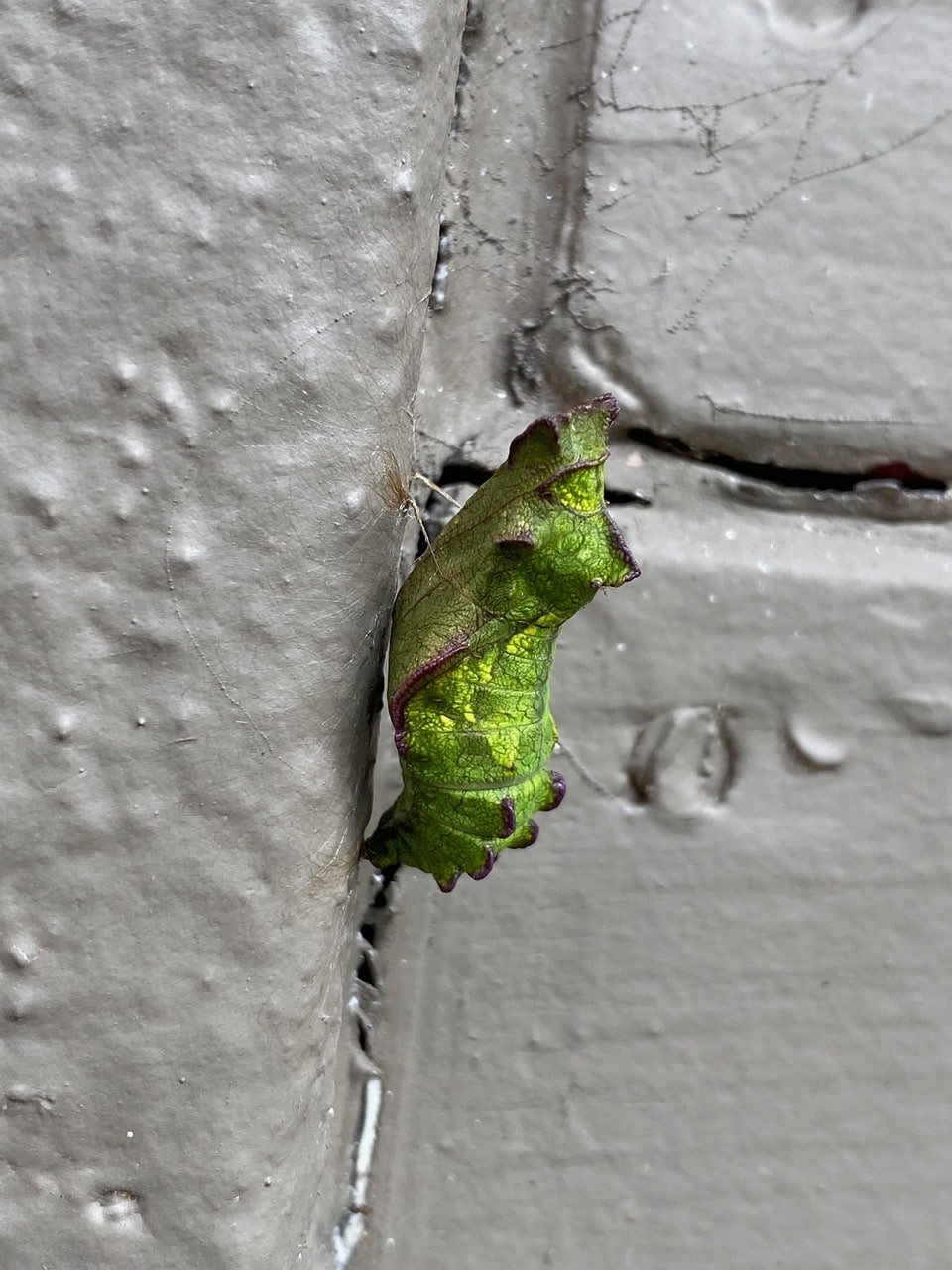
There is a nice patch of California Pipevine in the backyard, but the plants are senescing and there are no longer any caterpillars feeding on the leaves. Merle proudly leads me to the back wall of the house where a Pipevine Swallowtail chrysalis is hanging. What a stunning beauty! Although her pipevines have hosted numerous caterpillars earlier, this is the only chrysalis Merle could find this year. Note the silk harness with which the chrysalis is secured to the wall. Merle was lucky enough to have observed the caterpillar transform into this chrysalis!
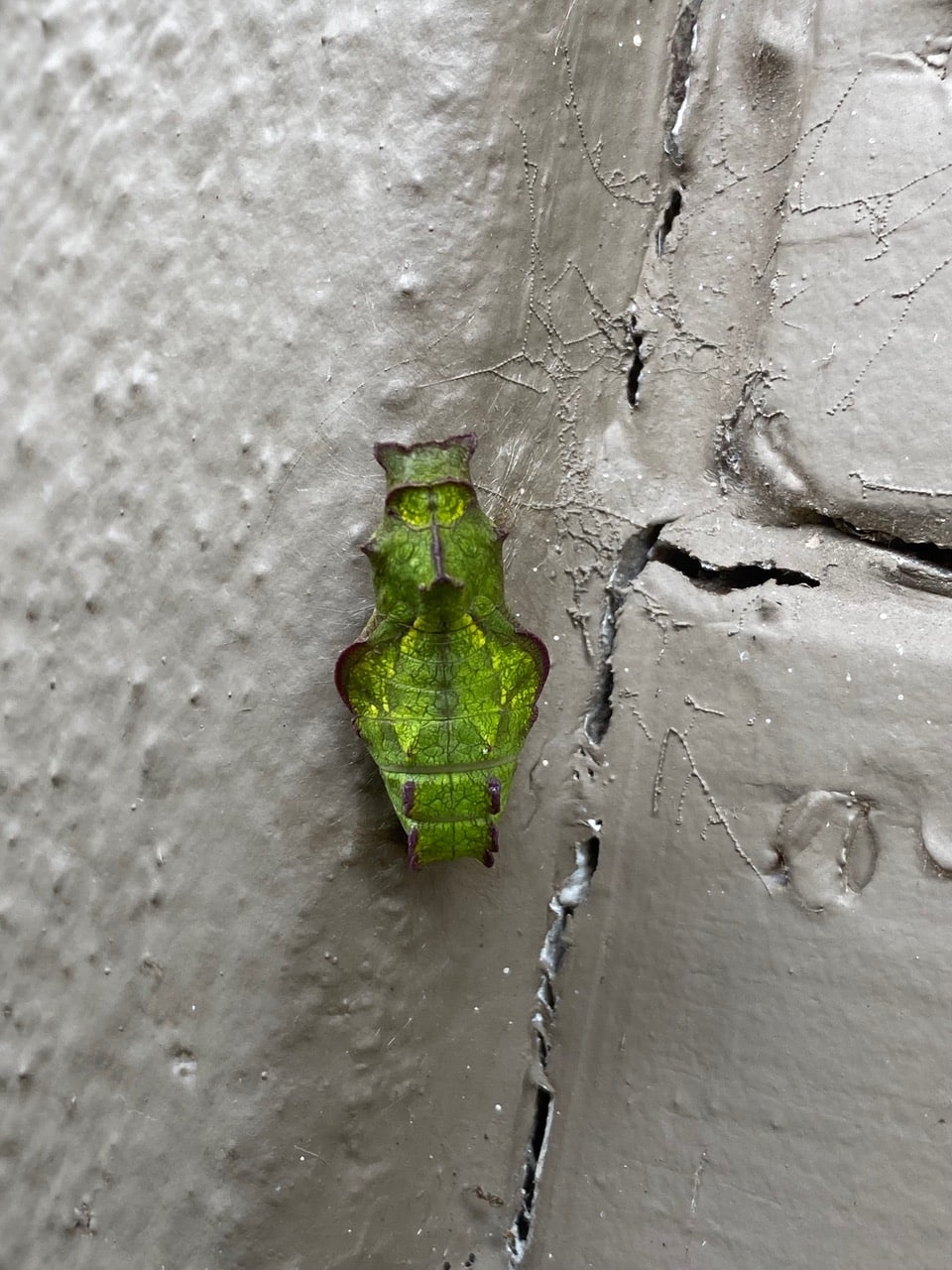
Back view of the chrysalis.
Pipevine Swallowtail adults have a wingspan from 2.75 to 5 inches. The dorsal wings of an adult male are black with vibrant blue iridescence on the hind wings. Female iridescence is duller in appearance. Bright orange spots are visible on the back end of the ventral wings. Adult males spend most of their time feeding and searching for mates. Females lay clusters of orange eggs on or under pipevine leaves (Aristolochia sp.) which contain aristolochic acids toxic to many vertebrate animals. The larvae feed on the leaves and sequester the toxins which are passed on to future pupa and adult butterflies. The bright orange spots present on larvae and adult butterflies are thought to serve as warnings to potential predators. Adult Pipevine Swallowtail butterflies feed on the nectar of a variety of flowers.
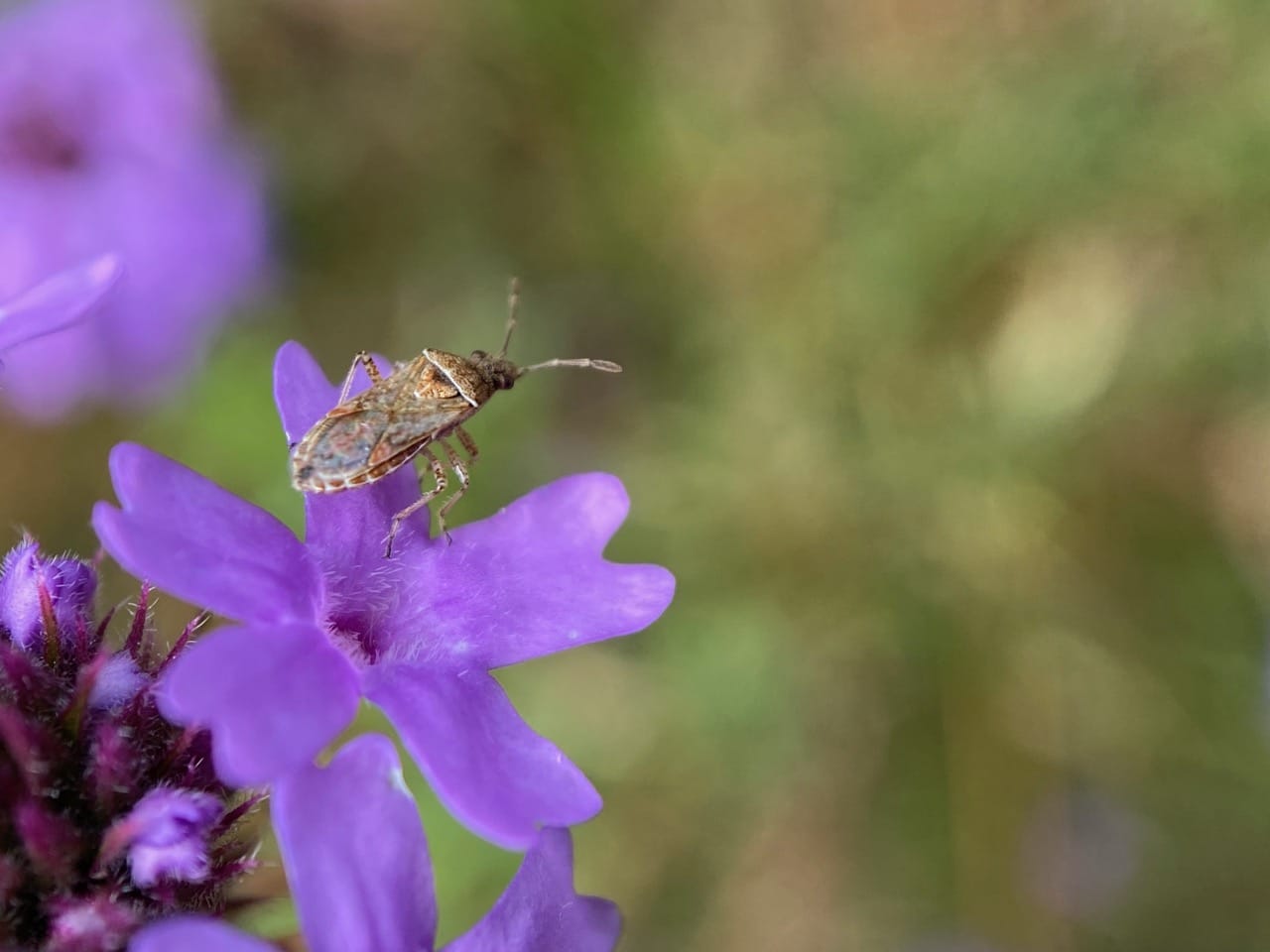
A Scentless Plant Bug, Arhyssus sp. (family Rhopalidae) is lurking among the small lavender flowers of De La Mina Verbena, Verbena lilacina.
Most species of Arhyssus are found in the western states, often in fields, weedy areas and savanna. The Rhopalidae are distinguished by many veins on the membranous portion of the forewings. They differ from coreids and other hemipterans in lacking functional scent glands. All are plant-feeders, usually on ripe seeds. Like other “true bugs” in the order Hemiptera, Rhopalids have piercing-sucking mouthparts that they use to extract plant tissues. They are able to feed on seeds by injecting digestive juices into the seeds and sucking up the digested contents as a liquid. The mouthparts, collectively called a rostrum, is folded under the body when not in use.
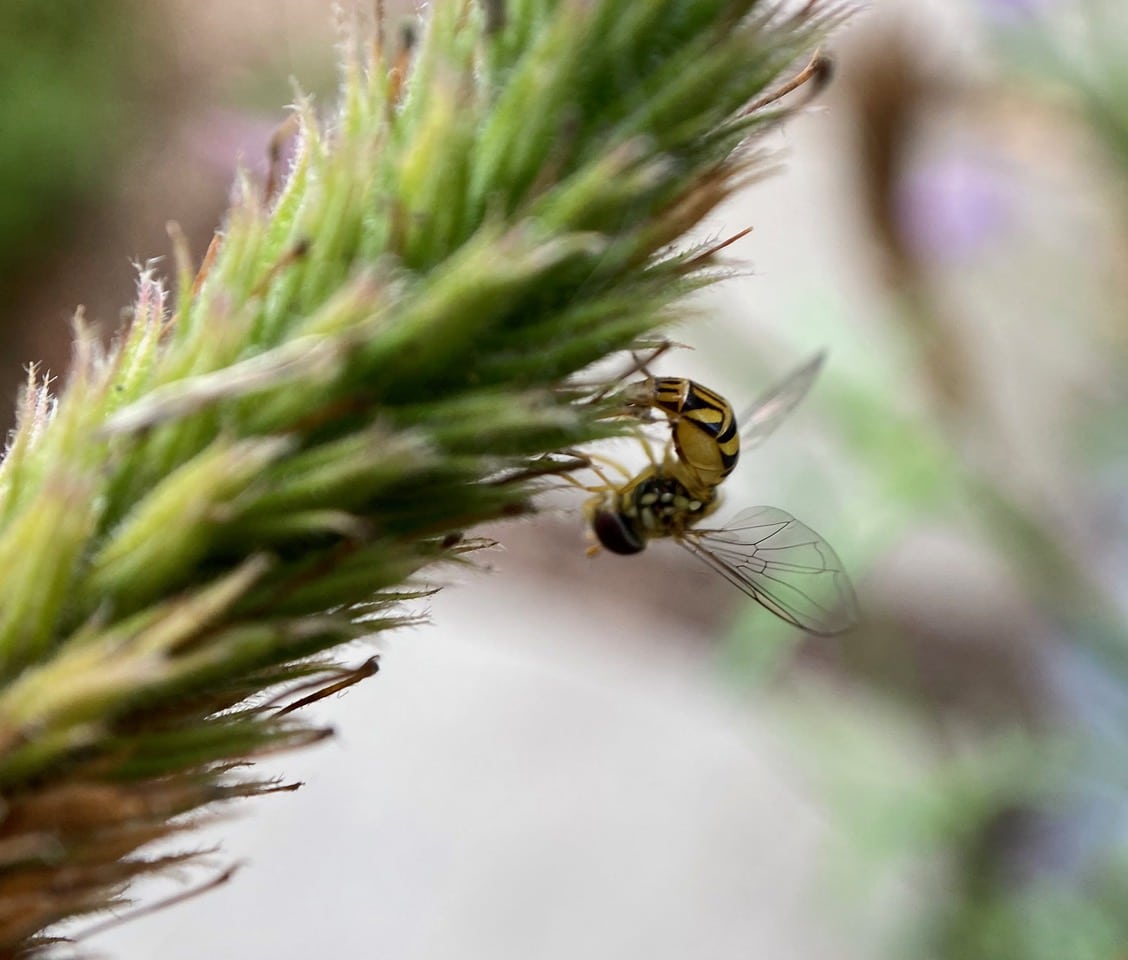
A small hover fly is hovering over the flower spikes of the De La Mina Verbena, Verbena lilacina. Instead of landing on the flowers, it makes extended stops on the spent flowers below. It is obviously not seeking nectar or pollen. A female laying eggs? Closing in with the macro lens, I find a female Oblique Streaktail, Allograpta obliqua (family Syrphidae) with her pointed abdomen curled forward in the process of depositing an egg among the spent flowers.
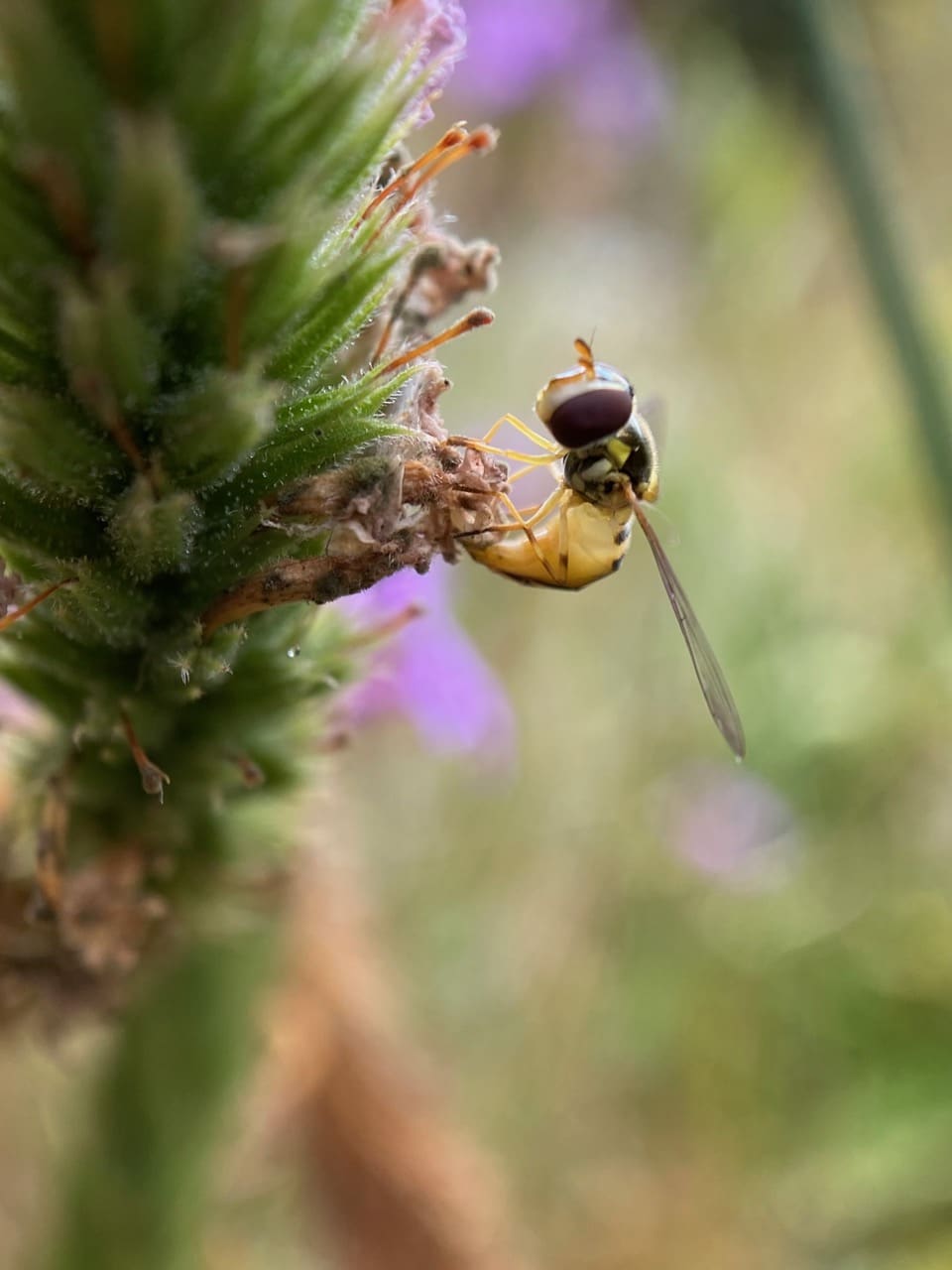
The female Oblique Streaktail stops at several flower spikes of Verbena lilacina to lay her eggs among the withered flowers.
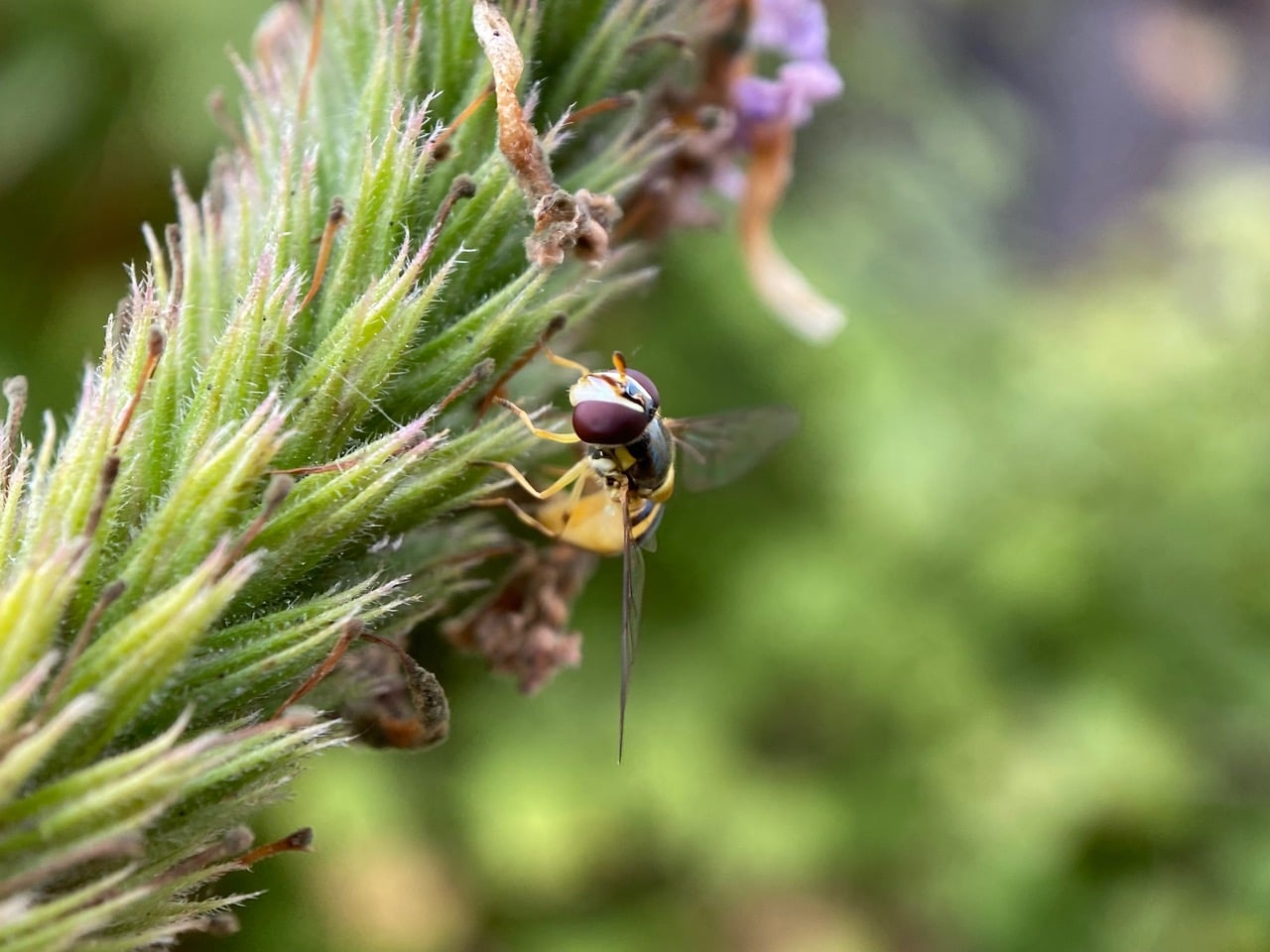
Although small in size (6-7 mm long), the Oblique Streaktail is easily recognizable for the unique pattern on its black-and-yellow abdomen. It is a common North American species of hover fly. Adults visit flowers for nectar and pollen, and are pollinators. Females lay eggs on plant surfaces near aphids. Larvae feed on the aphids.
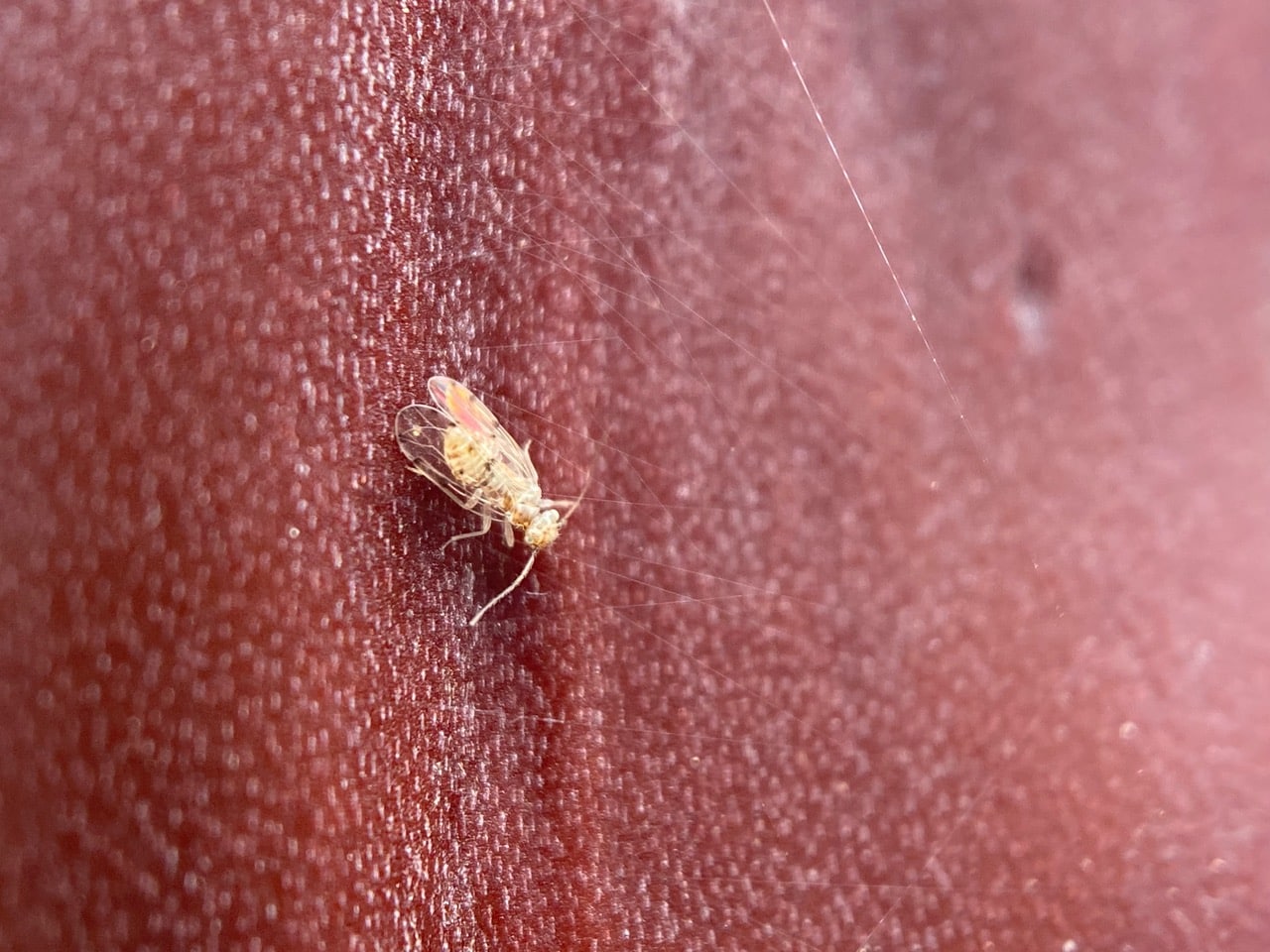
In the front yard, I close in on a tiny insect on the maroon bark of the large Manzanita. Ah, it is a Barklouse. Do you see the network of criss-crossing fine silk strands just above the insect? iNaturalist has helped refine the ID to the species Ectopsocus californicus (family Ectopsocidae).
Ectopsocus californicus is a species of Outer Bark Louse found in Australia, Central America, and North America. Ectopsocidae is a family of insects in the order Psocodea (book lice or bark lice). Found worldwide, the family includes fewer than 200 species, most of them in the genus Ectopsocus. The Ectopsocids are tiny (2 mm long) insects with a bulbous head that is wider than the pronotum and both fore- and hindwing with distinct dashes along the margins. Forewings are short, broad, and held in horizontal position. Barklice are found on living or dead foliage of a wide variety of trees, including both deciduous trees and conifers. They are harmless grazers of algae, mold, lichens, and decaying organic material, effectively cleaning the tree. For this reason, they are considered a beneficial insect. Members of genus Ectopsocus are only found on trees. Eggs are laid in webbed groups on leaf surfaces. Due to their presence in the feathers of birds it has been speculated that many species of Ectopsocids disperse by phoresy, hitchhiking rides on migrant birds. Many species of barklice use silk strands to form protective, communal webs on tree trunks. These webs are harmless to the tree and serve multiple purposes for the bark louse colony. The silk webbing shields the soft-bodied bark lice and their eggs from natural enemies such as birds and predatory insects. The webs also protect bark lice from wind and rain. The silken sheets create a protective, defined space for the nymphs and adults to move around the tree trunk as they forage for food.
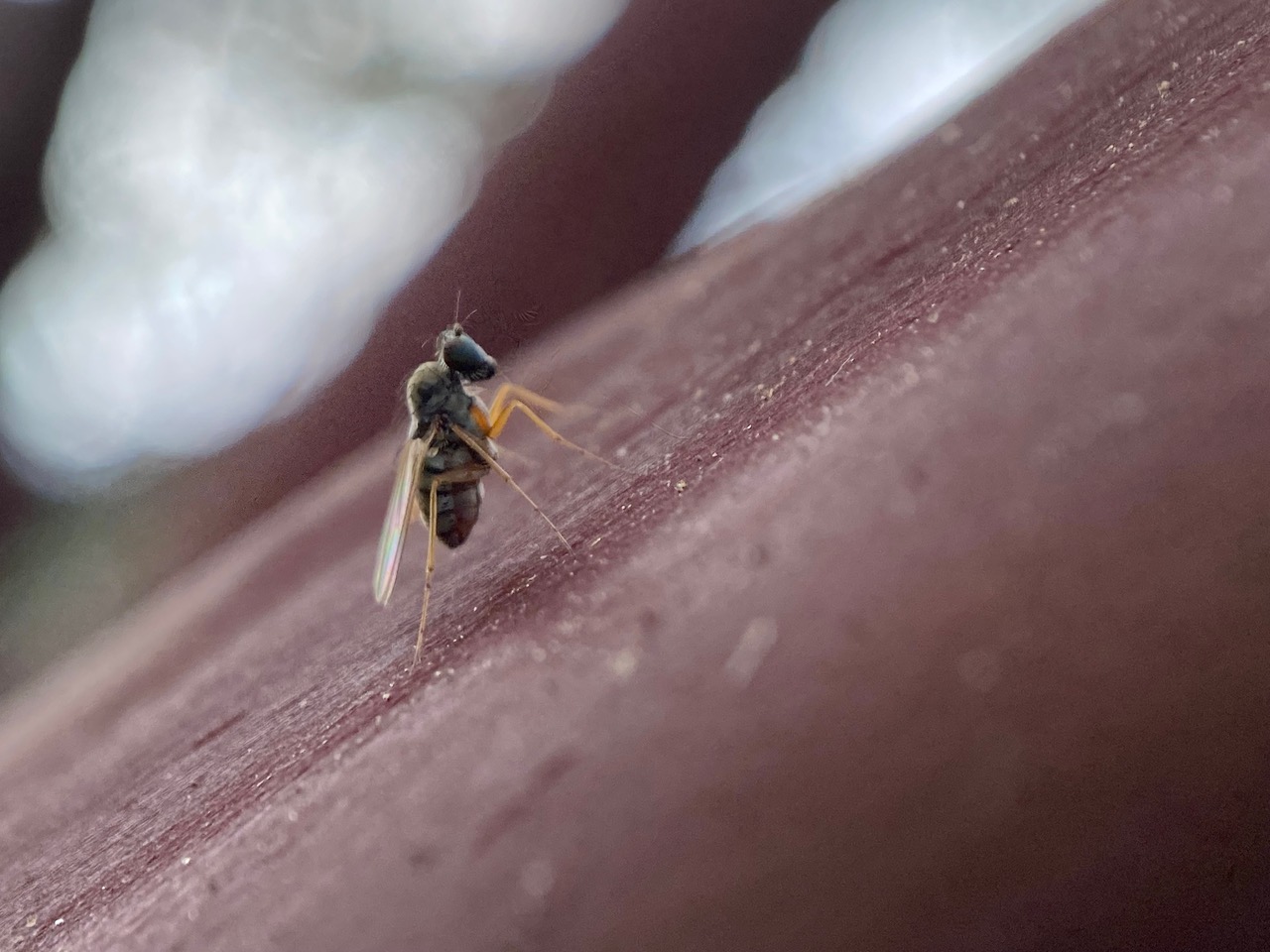
A small fly sidles to the other side of the Manzanita trunk as I approach with the camera. From its upright stance, long legs and large mouthparts, I recognize it instantly as a Woodpecker Fly, Medetera sp. (family Dolichopodidae).
The Woodpecker Fly, Medetera is a large genus in the family of long-legged flies Dolichopodidae. The adults are commonly found resting on vertical surfaces such as tree trunks, on which they have a characteristic vertical upright stance reminiscent of the woodpecker bird. They have heavily sclerotized proboscis. Medetera adults are predators of soft-bodied arthropods, while the larvae are predators of bark beetle larvae.

Mia, Merle’s next-door neighbor joins us at the front yard. She spots a jumping spider which somehow makes its way to her shoulder, much to her distress. She obligingly holds still for me to take some close-up pictures of the spider. It is a female Johnson’s Jumping Spider, Phidippus johnsoni (family Salticidae).
Also known as the Red-backed Jumping Spider, the species is one of the largest and most commonly encountered jumping spiders in western North America. This individual is a female. Males have an all-red abdomen. Salticids are free-roaming hunters. They do not weave a web to catch prey. They stalk, then pounce on their prey. Just before jumping, the spider fastens a safety line to the substrate. It can leap 10-20 times their body length to capture prey. Their movement is achieved by rapid changes in hydraulic pressure of the blood. Muscular contractions force fluids into the hind legs, which cause them to extend extremely quickly.
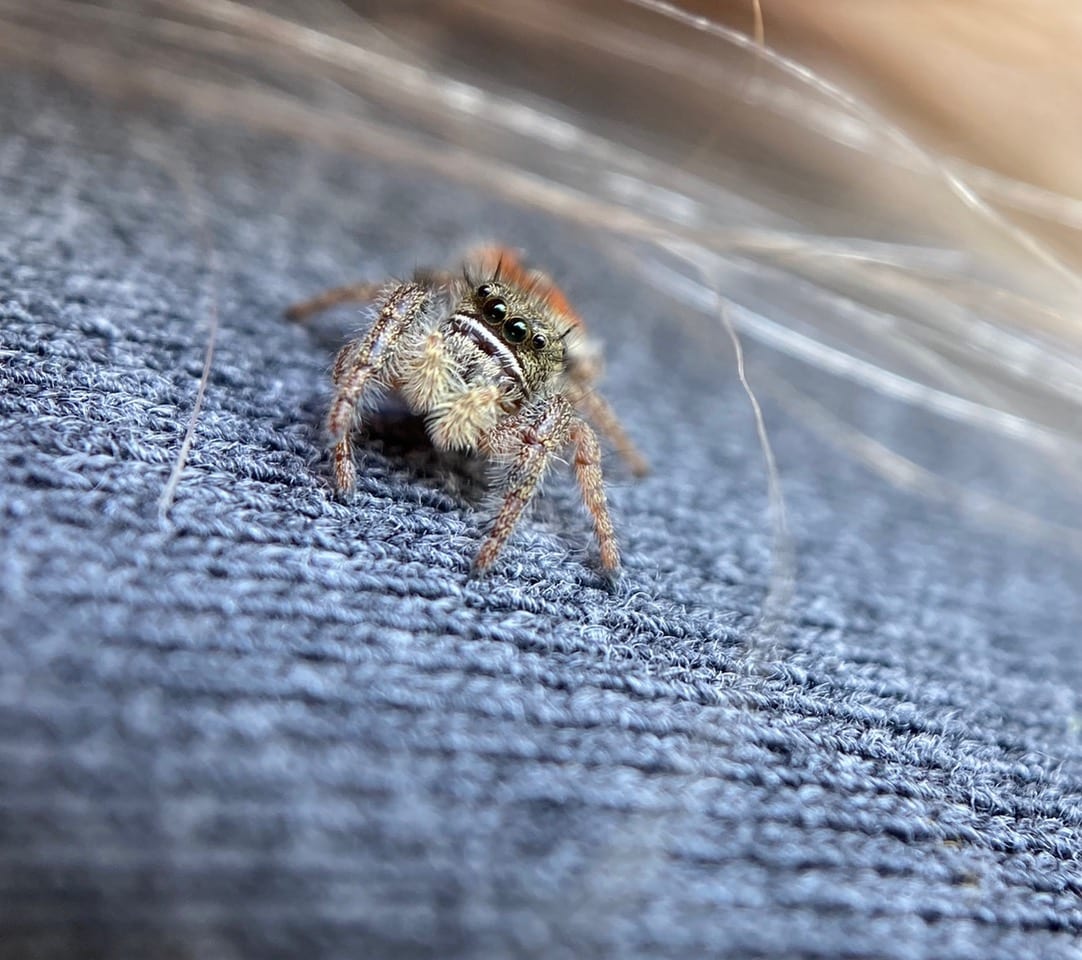
The spider spins around to face me, her hairy pedipalps moving nervously below her face.
The pedipalps are jointed appendages, much like small legs. They are used by the spider to sense objects, shape their webs, and to aid in prey capture and feeding. In male spiders, the pedipalps are also used to deliver sperm during mating.
Jumping spiders have excellent vision, with among the highest acuities in invertebrates. The 8 eyes are grouped four on the face (the two big Anterior Median Eyes in the middle, and two smaller Anterior Lateral eyes to the side), and four on top of the carapace. The anterior median eyes provide high acuity but small field of view, while the other six eyes act like our peripheral vision, with lower resolution but broad field of view. Since all eight eyes are fixed in place and can’t pivot independently from the body like human eyes can, jumping spiders must turn to face whatever they want to see well. This includes moving their cephalothorax up and down, an endearing behavior.
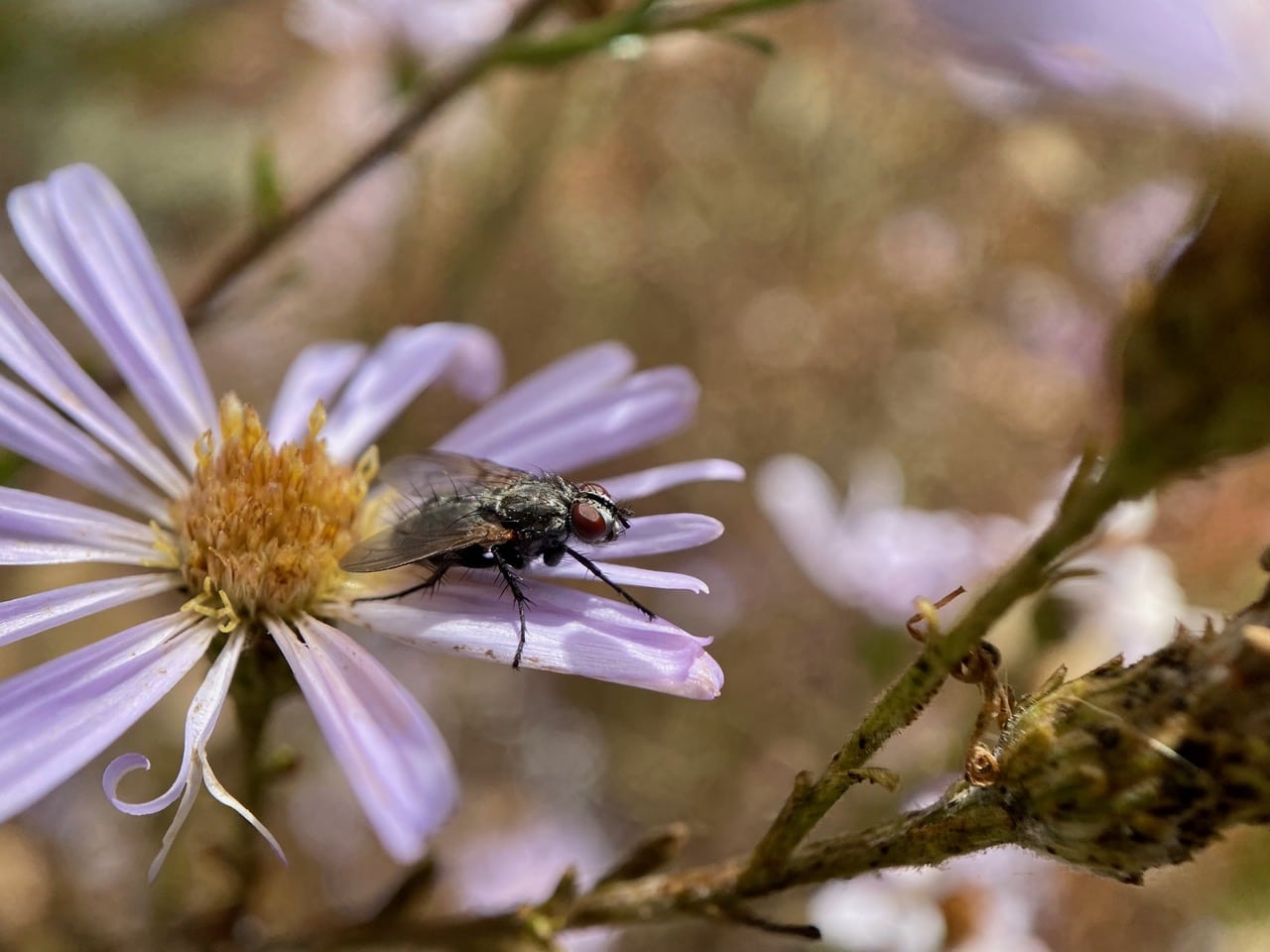
A small, dark, bristly fly is perched on a flowerhead of Pacific Aster, Symphyotrichum chilense. It appears to be a Woodlouse Fly, Stevenia deceptoria (family Rhinophoridae).
These small, black, bristly flies are somewhat related to the Tachinidae. The larvae are mostly parasitoids of woodlice (pill bugs), beetles, spiders and other arthropods, and occasionally snails. Adult female deposits the eggs near woodlice. The first instar larva attaches itself to a passing woodlouse and enters the body of the freshly molted host. The larva feeds on the hemolymph and organs of the host until pupation, leading to the death of the host. Adult fly emerges from the pupa from inside the empty exoskeleton of the host. Adult Woodlouse Flies primarily feed on nectar and plant juices.

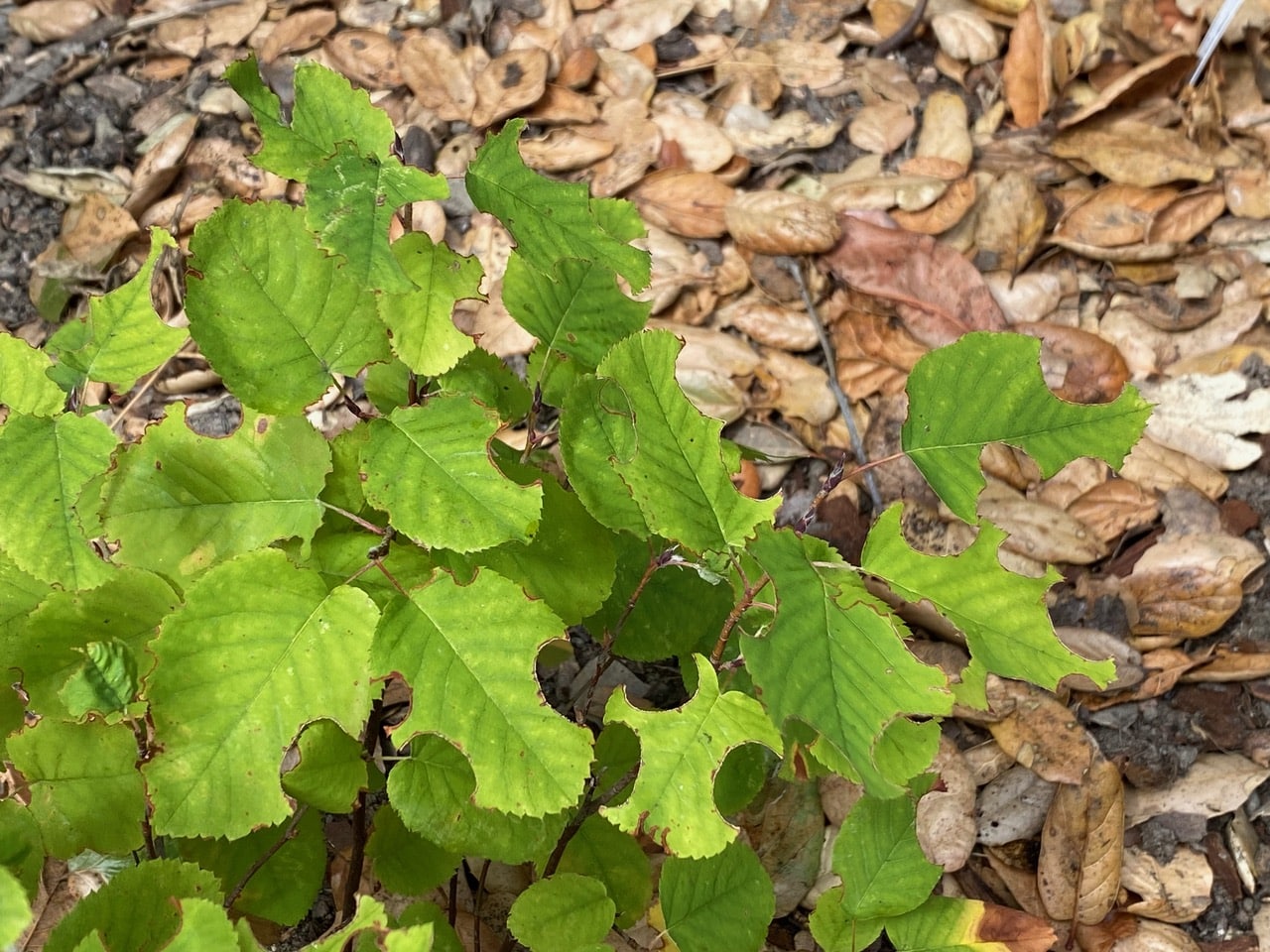
The leaves of this Serviceberry, Amelanchier sp. (family Rosaceae) have been extensively cut by Leafcutter Bees! Leafcutter females are known to favor the leaves of plants in the rose family for lining their brood cells.
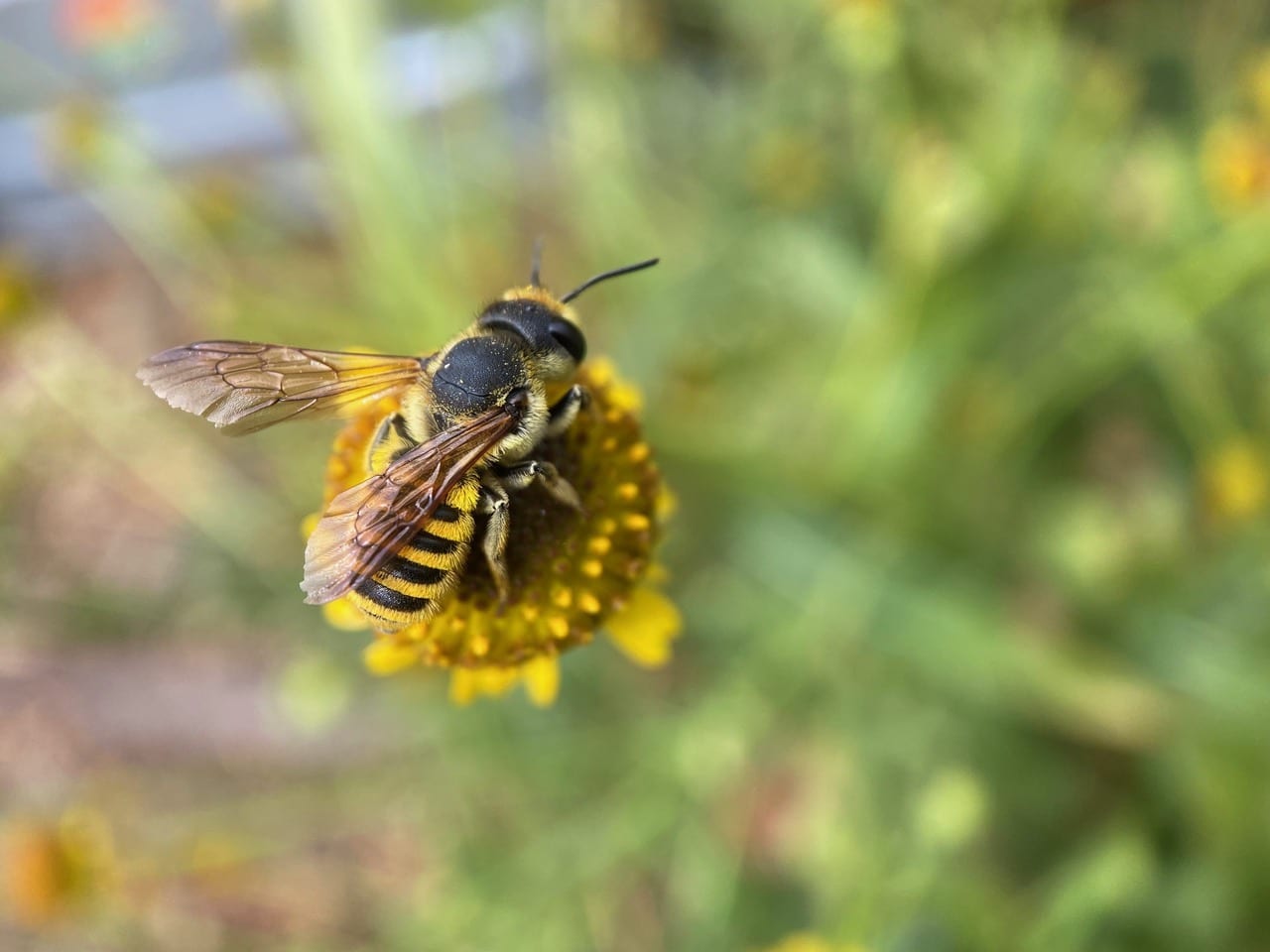
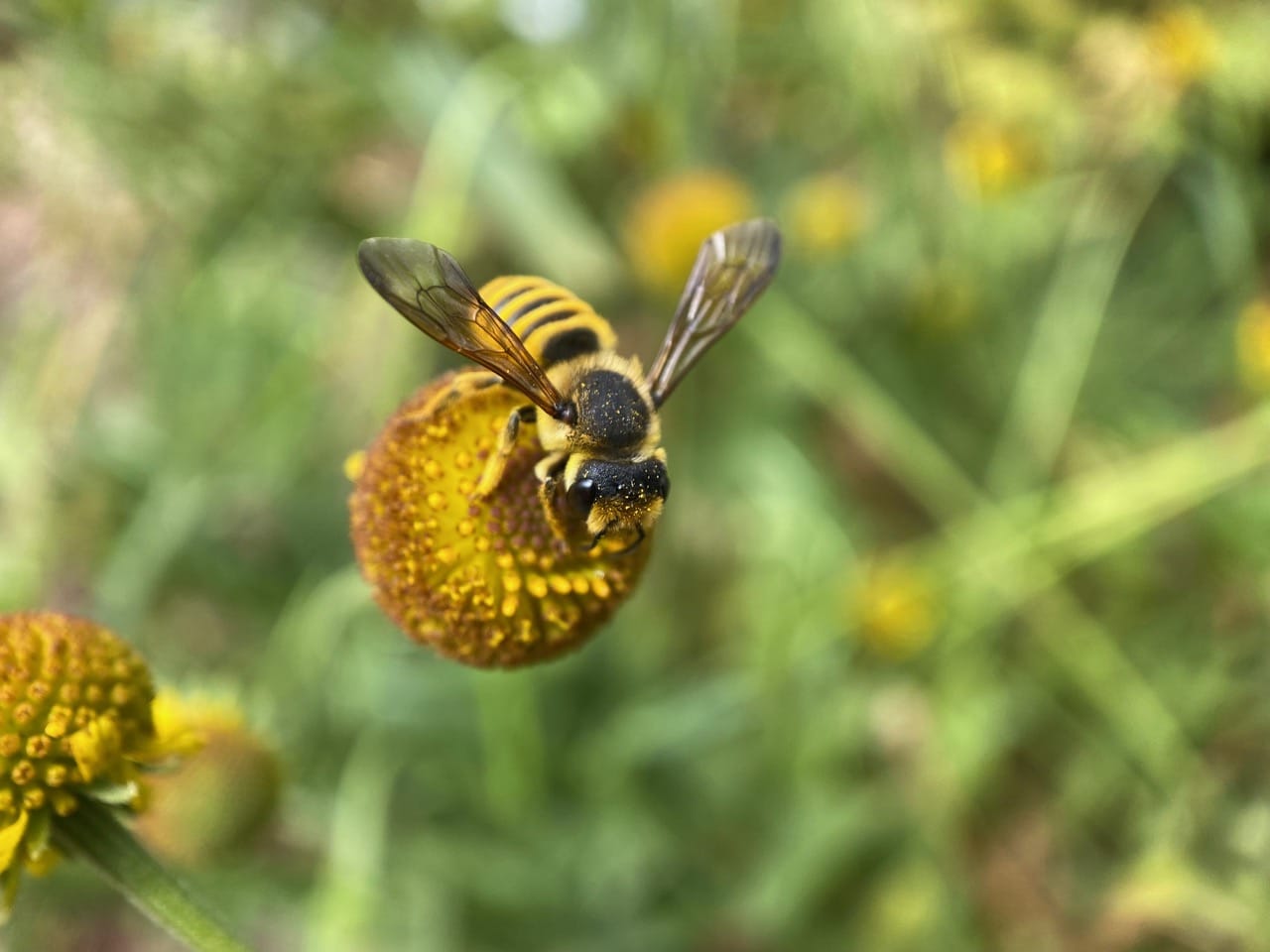
What a beautiful bee on the Sneezeweed flowerhead! The neat bands of golden yellow hairs on the abdomen readily identify the bee as the Horn-faced Leafcutter Bee, Megachile fidelis (family Megachilidae).
The Horn-faced Leafcutter Bee, also known as the Faithful Leafcutter Bee, Megachile fidelis (family Megachilidae) is found in the western United States. The species inhabits meadows and gardens. The species is a robust-sized bee, with females measuring 11-13 mm in length, and males 10-12 mm. The bee is black, but covered by golden/yellow hair on its face, behind its eyes, on its thorax, below its wings and on its legs. As with other members of the Leafcutter family, the pollen collecting scopa is located under the female’s abdomen. This species seems to prefer plants in the Asteraceae family, including Aster, Erigeron, Rudbeckia, Cosmos, and Helenium. Females are known to cut petal discs from Clarkia flowers. The bees are opportunist cavity-nesters and will habit a variety of sites such as abandoned beetle tunnels or hollow plant stems, garden hoses, and cracks in a wall.
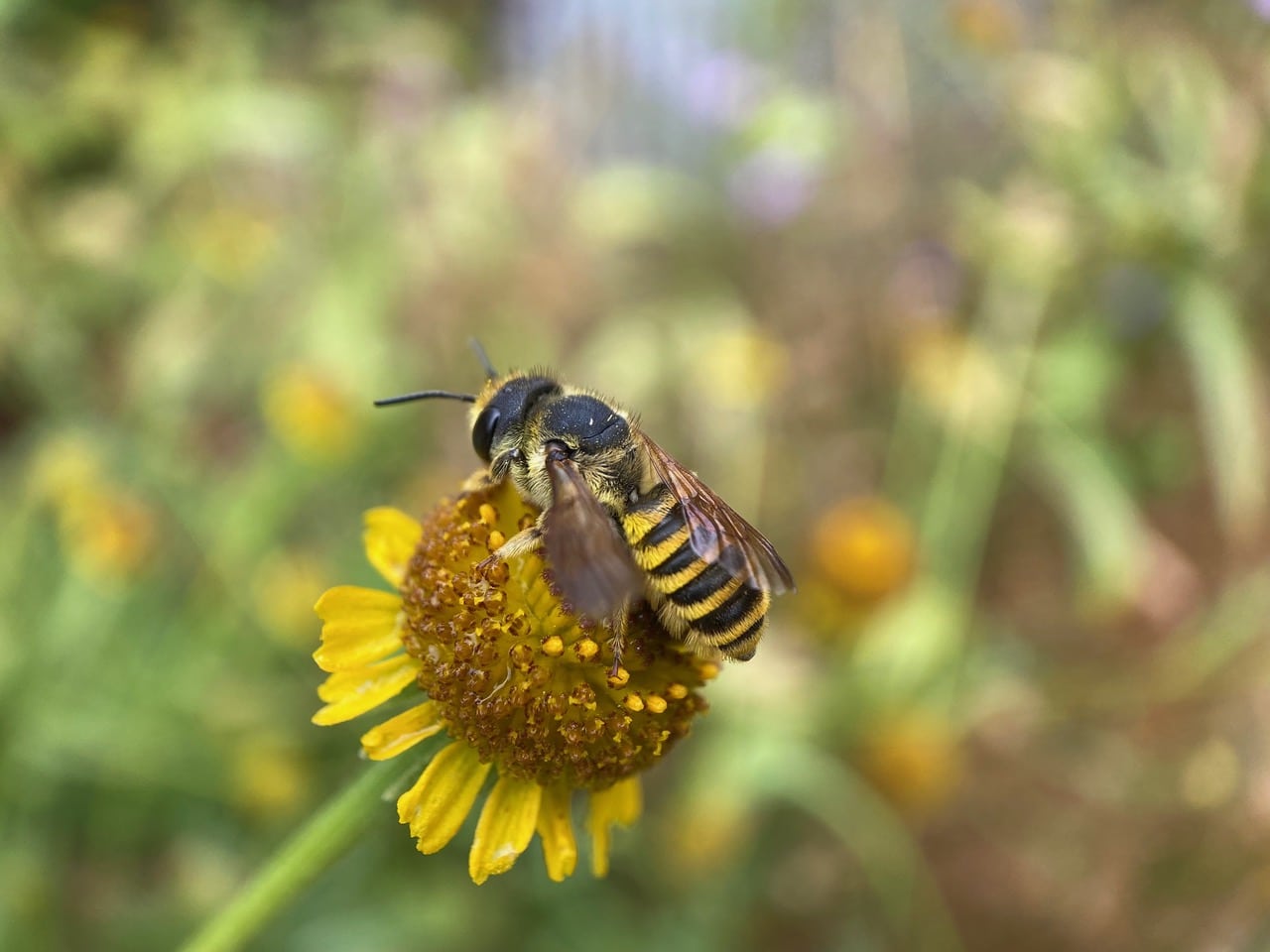
This side view of the bee hints of rows of bristle-like hairs on the underside of its abdomen. They are part of the bee’s abdominal scopa or pollen collecting hairs, characteristic of all members of the family Megachilidae. Females transport pollen on their bellies to provision their nests. They are excellent pollinators of plants in the sunflower family among others as they tend to “swim” through a flower, depositing pollen along the way.
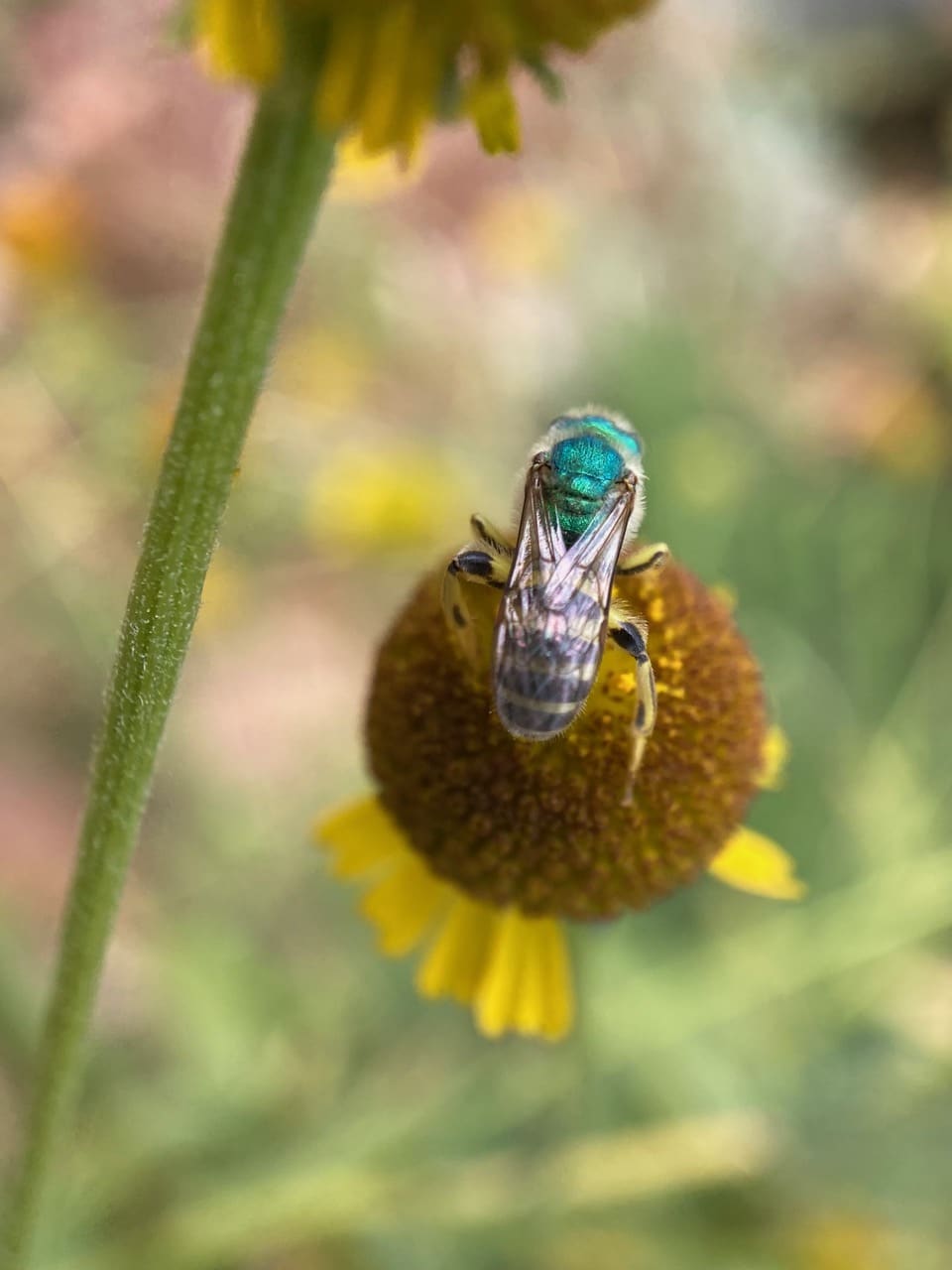
A male Fine Striped Sweat Bee, Agapostemon subtilior (family Halictidae) is foraging on a Sneezeweed flowerhead. Unlike the females of the species which are entirely green, the male has a yellow-and-black striped abdomen.
Agapostemon are brightly colored metallic green or blue bees measuring 7 to 14.5 mm long. Most species have a metallic green head and thorax, and black-and-yellow striped abdomen; some females are entirely bright green or blue. Females carry pollen on scopal hairs located on their hind legs. Agapostemon are ground-nesters and generalist foragers. Like other members of the family Halictidae, they are short-tongued and thus have difficulty extracting nectar from deep flowers. Males are often seen flying slowly around flowers looking for females. The bees favor flowers with high densities.
Agapostemon females dig deep vertical burrows in flat or sloping soil, or sometimes in banks. Most species are solitary, but some species nest communally. Up to two dozen females may share a single nest entrance, but each individual builds and provisions its own cluster of brood cells. Where a communal nest gallery shares a single entrance, one bee usually guards the hole, with only her head visible from above ground. Unlike other social bees, in communal bees there is no reproductive division of labor. In cool temperate regions, there is one generation per year, with females active in the early summer and males and pre-diapausing females active in the late summer. Only mated females survive the winter. This is probably because unmated females cannot enter diapause (insect version of hibernation).
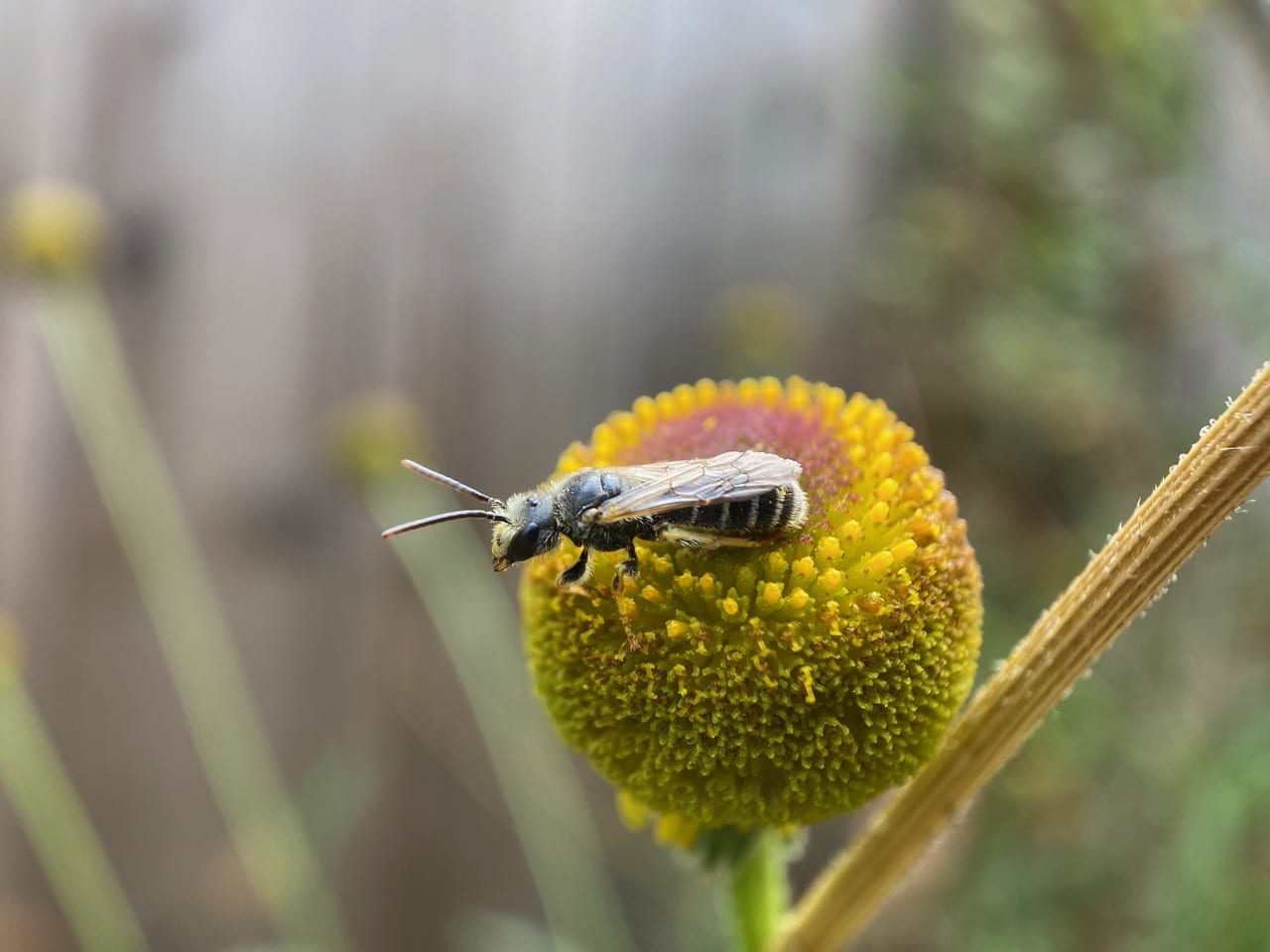
A Furrow Bee, Halictus sp. (family Halictidae) is perched on a Sneezeweed flowerhead.
Halictus is found worldwide; they are most common in the Northern Hemisphere. All are generalists, foraging from a wide variety of flowering plants. Many species are social and produce several generations per year. This is not surprising as most blooming plants are season-specific; a bee that requires pollen and nectar across multiple seasons would not thrive as a specialist. All Halictus in North America nest in the ground, often in aggregations; and they may nest in the same area for decades. Many species in the genus are eusocial, with colony sizes ranging from very small (two to four bees) to large (>200). Nests are typically burrows in the soil, with several ovoid cells in which pollen mixed with nectar is provided as food for the developing larvae; a single egg is laid on a pollen mass, and the cell is sealed. Like most ground-nesting bees, the brood cells are lined internally with a waterproofing secretion.

A Sun Jumping Spider, Heliophanus apiatus (family Salticidae) is hunting on the stem of Sneezeweed.
The genus Heliophanus is one of the largest genera of jumping spiders with over 150 species, widespread in the Palearctic and Africa, with one center of diversity in the Mediterranean region. Heliophanus apiatus was first reported in the San Francisco Bay Area in 2015. Since then the species has established in three counties – Alameda, Santa Clara and San Mateo – surrounding the southern arm of San Francisco Bay. H. apiatus is a small salticid, male measuring 3.5-4.0 mm, and females 4.0-4.5 mm in body length. Mature males and females are similar in appearance, but only the females have yellow pedipalps. These spiders are found on low vegetation and on hard structures on or near the ground. They are capable of taking prey their own size.
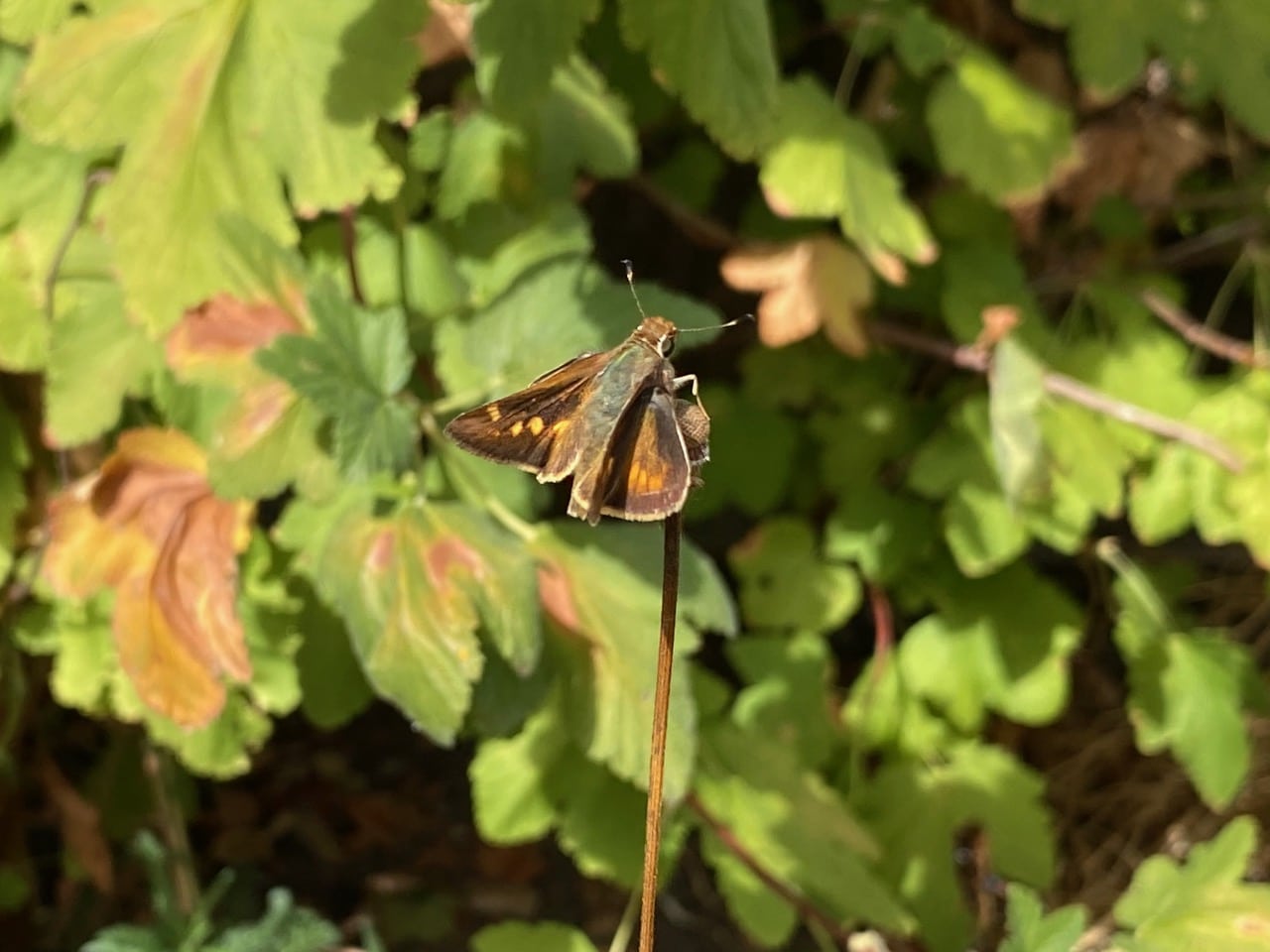
An Umber Skipper, Lon melane (family Hesperiidae) lands on a spent Sneezeweed seed head.
The Umber Skipper is a member of the subfamily Hesperiinae or grass skippers. They are usually orange, rust, or brown in color and have pointed forewings. The antennae generally has a sharp bend. Hesperiinae larvae feed on many different types of grasses and sedges, hence the name “grass skippers”; they live in shelters made of rolled or tied leaves. Adults typically visit flowers for nectar. Hesperiinae are unique in that they hold their wings partially open while resting, with the forewings and hindwing held at different angles. This is known as the “jet-plane position”.
The Umber Skipper is found primarily in California, west of the Sierra Nevada divide, but is also seen in southern Arizona, Baja California, the highlands of Mexico and Central America. It is a small butterfly, with a wingspan of 1.25-1.375 in. In our area, there are two peaks per year – one from May and then another one in September-October. It is a common species in the urban areas, thanks to the ubiquity of the Great American Lawn.
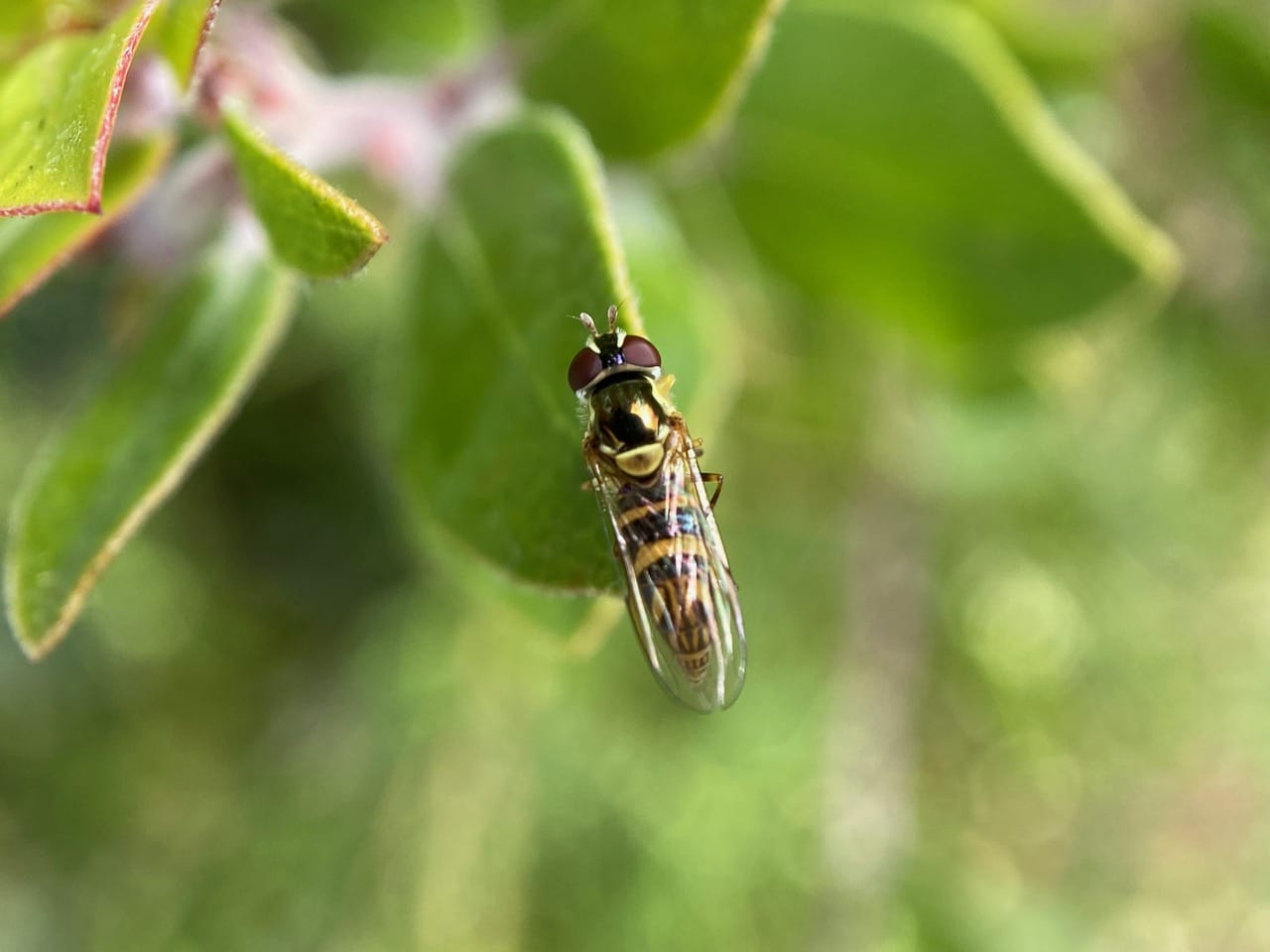
A hover fly is perched with its wings closed on a Manzanita leaf. Although its wings are closed, they are transparent enough to show the abdominal patterns below. The fly is a female Oblique Streaktail, Allograpta obliqua (family Syrphidae).
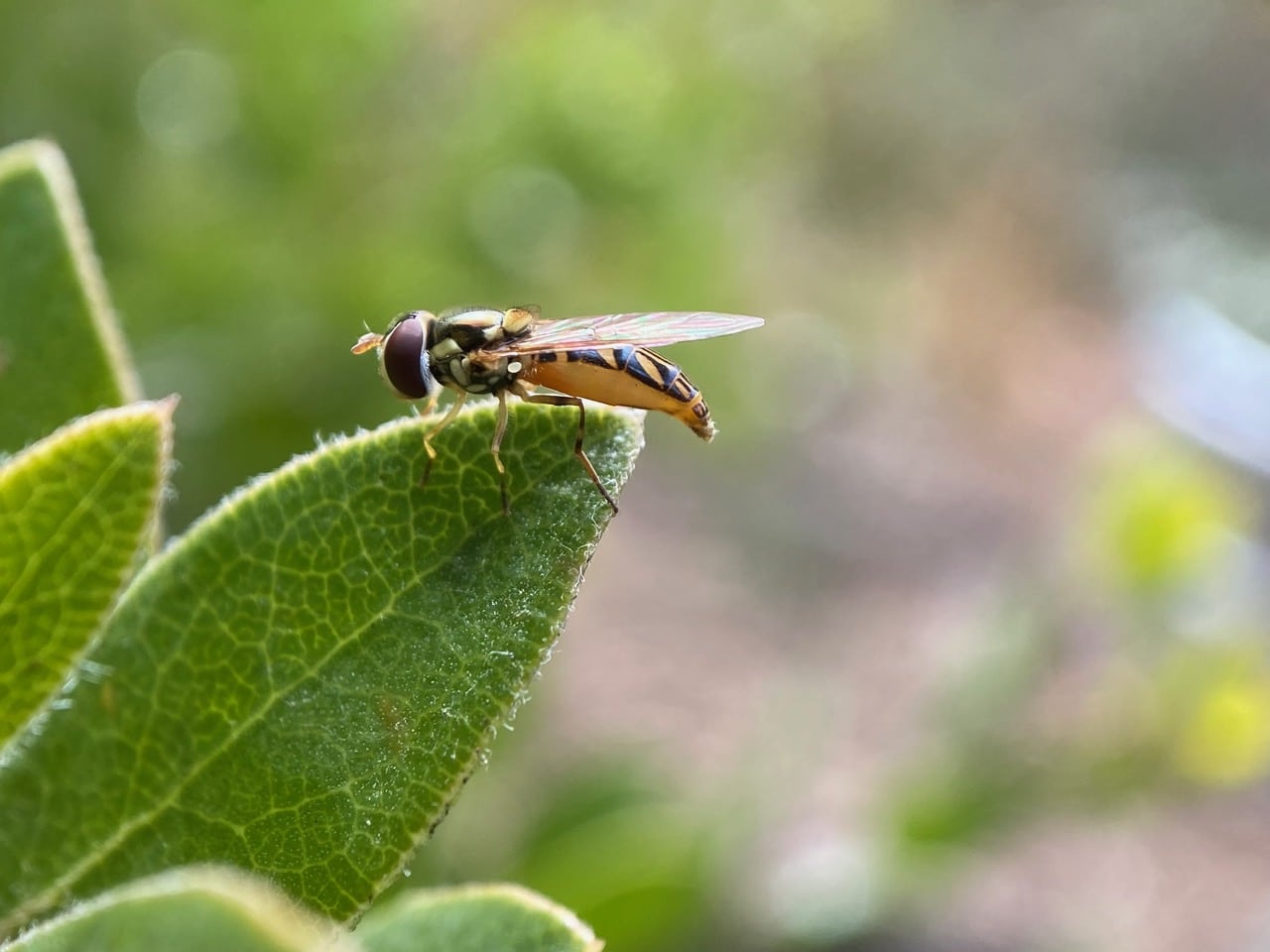
A side view reveals that the hover fly is gravid, probably ready to lay her eggs.
Although small in size (6-7 mm long), the Oblique Streaktail is easily recognizable for the unique pattern on its black-and-yellow abdomen. It is a common North American species of hover fly. Adults visit flowers for nectar and pollen, and are pollinators. Females lay eggs on plant surfaces near aphids. Larvae feed on the aphids.