

Pollinator Post 9/1/26 (1)

The air has finally cleared this morning, and I can breathe easy again as I take my walk along the shoreline of Bay Farm.
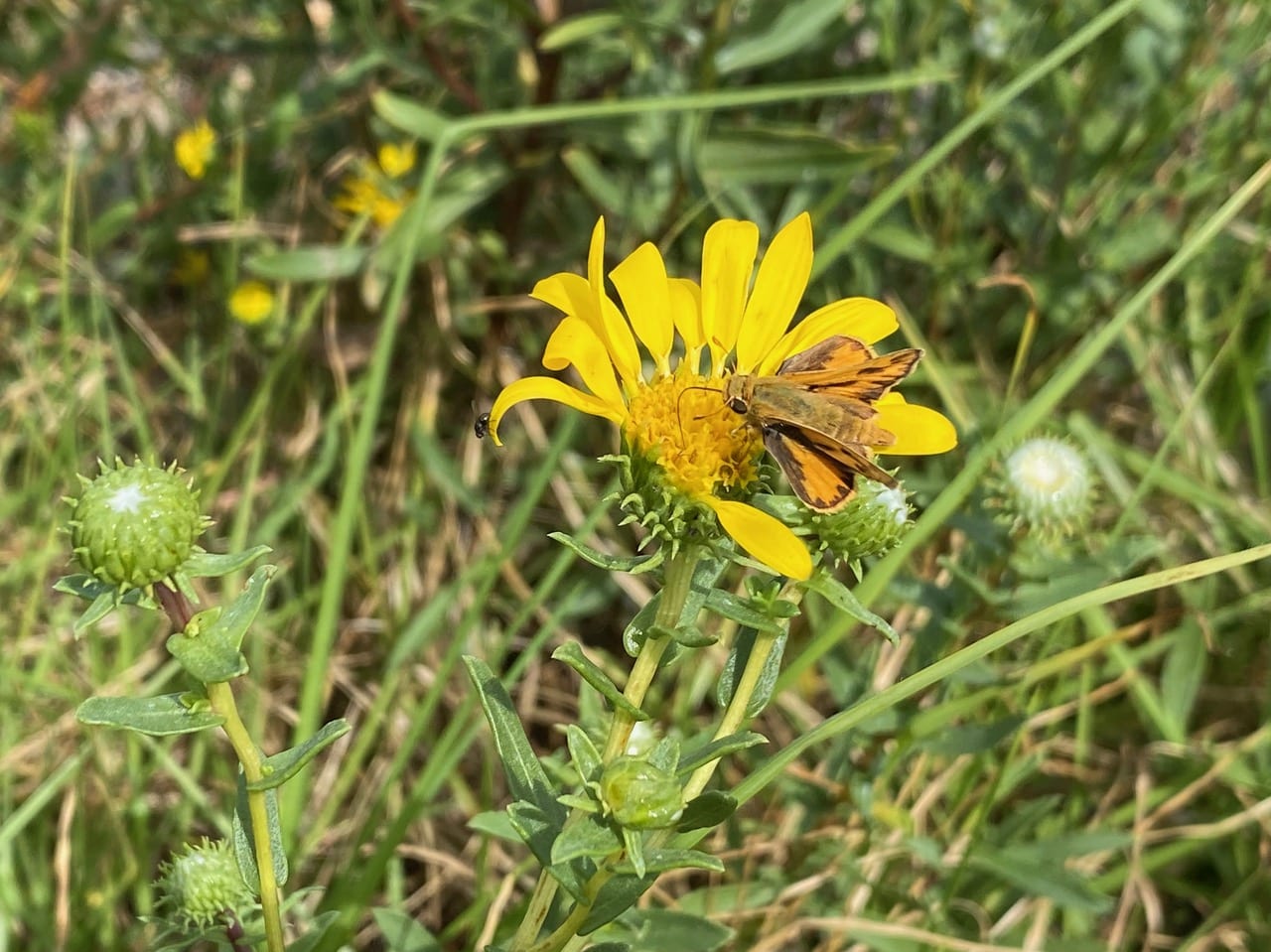
A Fiery Skipper, Hylephila phyleus (family Hesperiidae) has landed to take nectar on a flowerhead of Oregon Gumweed, Grindelia stricta.
Skippers are a family, the Hesperiidae, of the order Lepidoptera (butterflies and moths). They are named for their quick, darting flight habits. Most have the antenna clubs hooked backwards like a crochet hook. They also have generally stockier bodies and larger compound eyes than the other butterflies. Their wings are usually small in proportion to their bodies. When at rest, skippers keep their wings usually angled upwards or spread out, and only rarely fold them up completely. Californian species are mostly brown or tan, with black, orange, or yellow markings.
Skipper caterpillars are usually green or brown, sometimes yellowish, never brightly colored. They have a distinctive “collar”, a narrow ring around the body right behind the head. Caterpillars are camouflaged and often hide during the day. Many species make nests of leaves and silk for additional protection. Most North American species feed on grasses, but some common species eat shrubs and trees, especially in the bean family. Most species are limited to a single group of food plants. Adult skippers are only active during the day, but Skipper caterpillars feed mainly when it is dark or partly light.
Fiery Skippers, Hylephila phyleus (family Hesperiidae) is a small butterfly, with a wingspan of 1.25 to 1.5 in. It can be seen from March to November. Host plants include various species of grasses. Fiery Skipper is the most abundant grass skipper in California, mostly due to its dominance in urban areas, thanks to the ubiquity of the Great American Lawn. Originally found only in North and South America, it has been introduced into Hawaii and Bali.
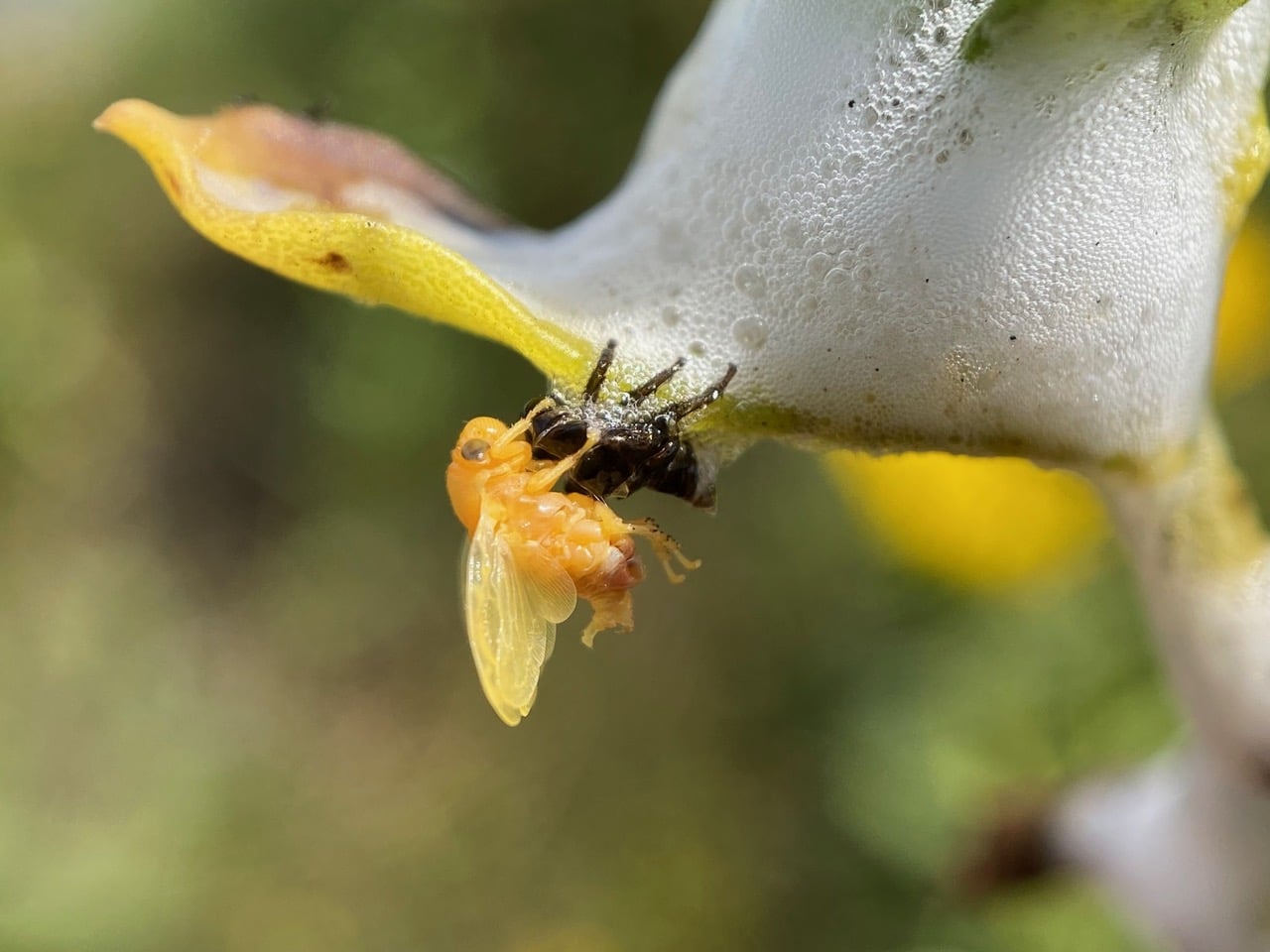
11:52:10 am Look, a fresh adult Spittlebug has fully emerged from its exuvia at the edge of a foam mass on a Grindelia leaf. Still clinging to the wet shell, the teneral is in the process of inflating its wings. Before moving on, I mark the plant with a piece of red yarn so I would be able to find the 3 mm bug again later today to check on its developmental progress.
Why the common name of “spittlebug”? The nymphs (immatures) of these bugs create foam masses on plants in which they live and feed. Like the adults, the nymphs use their piercing, sucking mouthparts to feed on plant juices. The nymph produces a cover of foamed-up plant sap reminiscent of saliva, hence the common name of spittlebug. Whereas most insects that feed on sap feed on the nutrient-rich fluid from the phloem, Spittlebugs tap into the much more dilute sap flowing upward via the xylem. The large amount of excess water that must be excreted and the evolution of special breathing tubes allow the young spittlebug nymphs to grow in the relatively protective environment of the spittle. Symbiotic bacteria in the insects’ digestive system provides them with the essential amino acids that their diet lacks. The foam serves a number of purposes. It hides the nymph from the view of predators and parasites, and it insulates against heat and cold, and protects the delicate nymphs from desiccation. Moreover, the foam has an acrid taste that deters predators.
Unlike their young, adult spittlebugs (also known as Froghoppers) are efficient flyers and hoppers, feeding on diverse plant species. They pierce plant stems to feed on xylem. To get enough nutrients, they consume massive quantities of sap, drinking up to 280 times their body weight daily, resulting in high waste excretion. Froghoppers can cause damage by distorting plant leaves and causing shoot tips to die back.
A teneral insect is a young insect that has just molted (emerged from its final nymphal skin) but has not yet hardened its exoskeleton or achieved its final coloration. Teneral insects typically have paler or different colors than their mature counterparts. Over a short period (often hours), the insect’s exoskeleton hardens and darkens, a process similar to the tanning of leather. This period allows the insect to expand its body and limbs. Being soft, and unable to move much, tenerals are more susceptible to injury and predation.
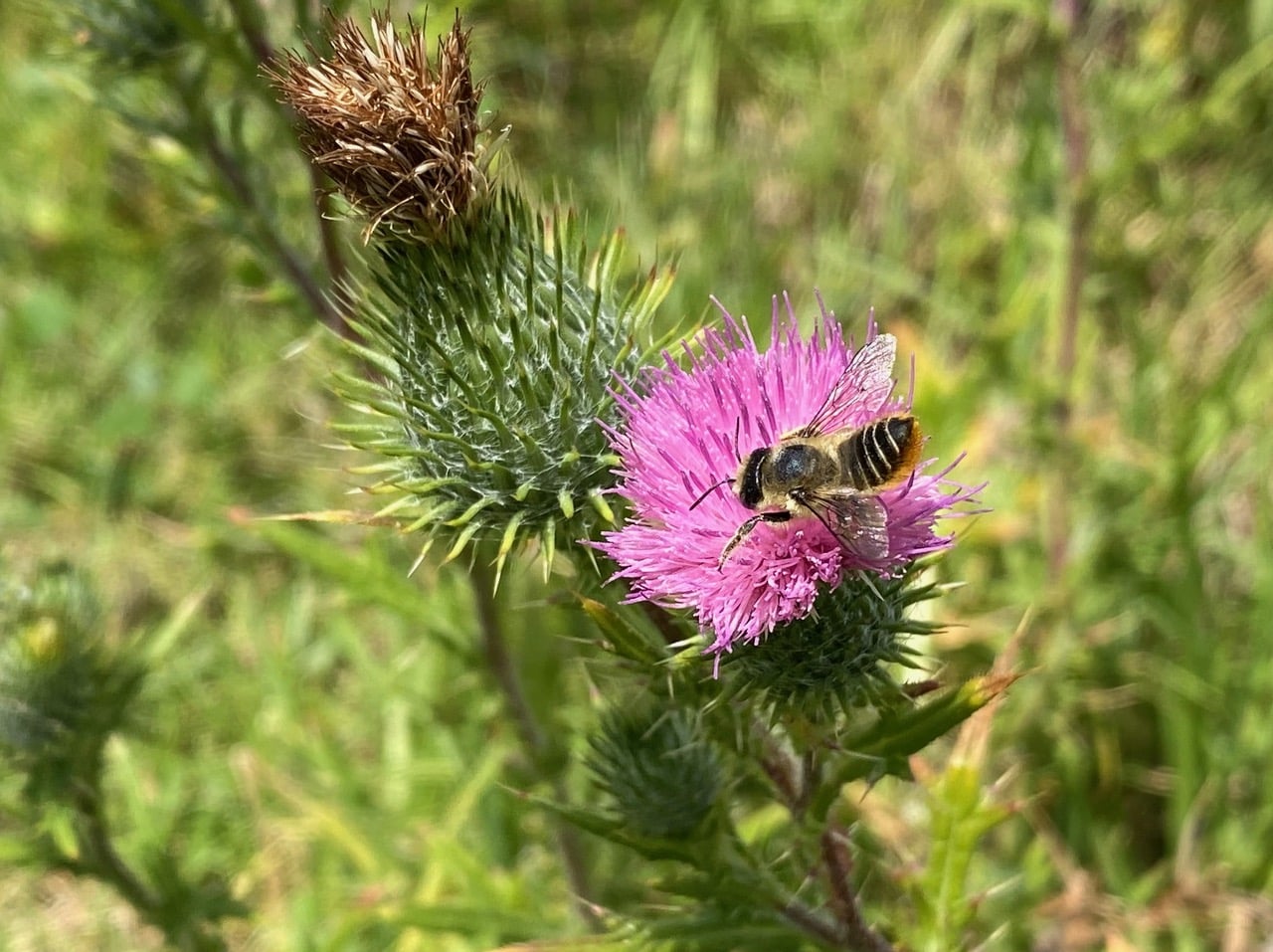
The Western Leafcutter Bees, Megachile perihirta (family Megachilidae) are out in force today. This female is foraging on a flowerhead of Bull Thistle, Cirsium vulgare. The orange scopal hairs on the underside of her abdomen are visible, still not filled with pollen.
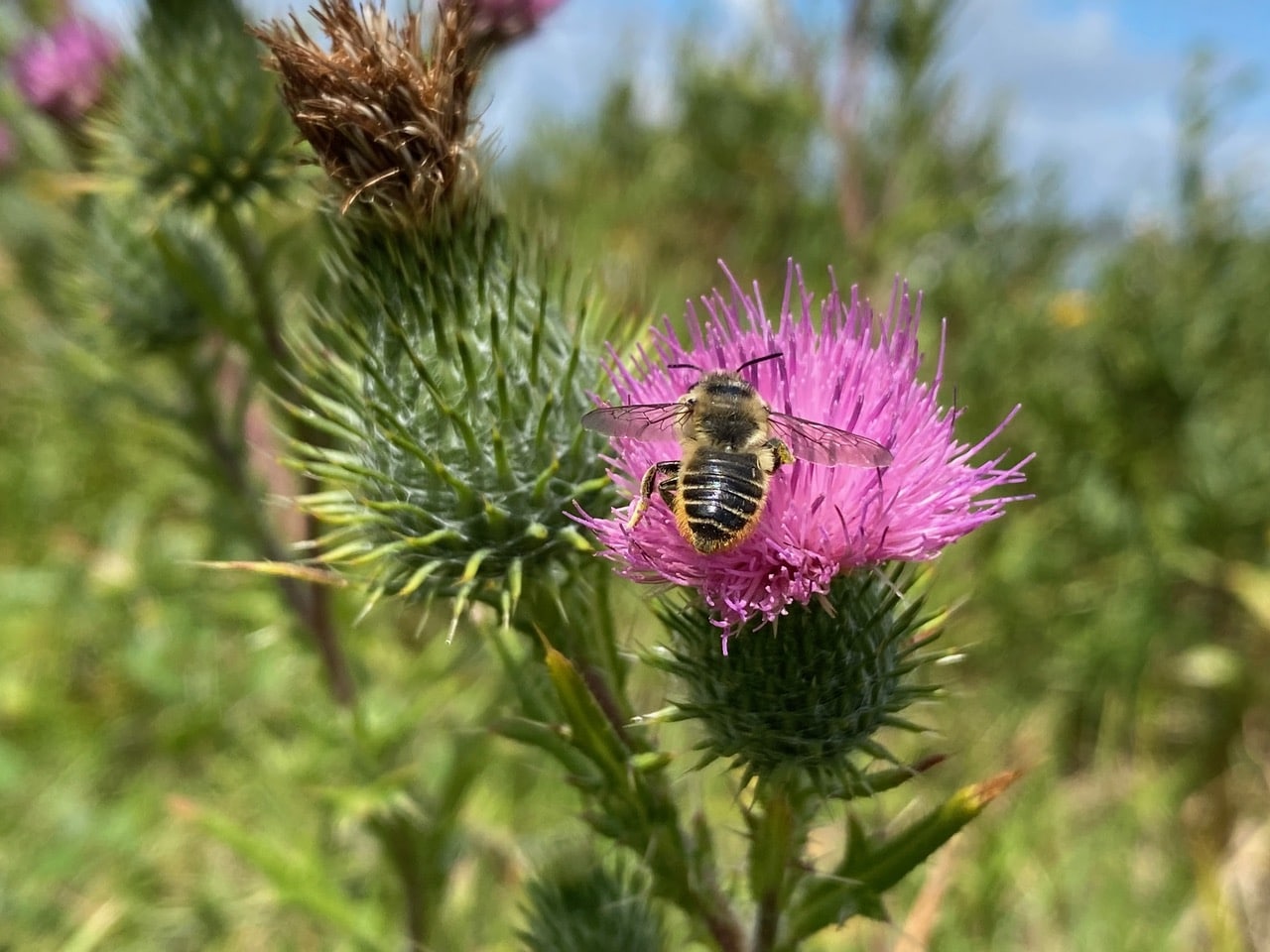
Leaf-cutter Bees, Megachile sp. (family Megachilidae) are stout-bodied, usually with pale hair on the thorax and stripes of white hairs on the abdomen. Females usually have a triangular abdomen with a pointed tip, and males’ faces are covered with dense, pale hair. Flight season is from May into September, with peak activity from June to August. Solitary females construct nests in tubular cavities, including hollow stems, tree holes, and abandoned beetle burrows in wood. Many use holes drilled into wood, straws, or other manufactured tunnels. Females cut pieces from leaves or flower petals for use in the construction of brood cells. Most Megachile females are generalist foragers, but prefer flowers in the family Asteraceae.
North America is home to many leafcutter bees, but the Western Leafcutter, Megachile perihirta is one of the largest. The species ranges on the west coast from British Columbia south to northern Mexico. From a distance, the female can be mistaken for a honey bee. She is about the same size as a worker honey bee and enjoys many of the same flowers, but her head is disproportionately large because it houses the bulky muscles that operate her large mandibles. While most leafcutter bees nest above ground in tubes and tunnels, the Western Leafcutter nests underground. Often a small group of females live in a community and burrow into soil, gravel, or sand.

A male Western Leafcutter Bee, Megachile perihirta (family Megachilidae) has landed on a Grindelia flowerhead to take nectar. Note that unlike the females, his abdomen has a rounded tip.

Male Western Leafcutter Bees, Megachile perihirta (family Megachilidae) feature enlarged, modified front legs lined with a dense fringe of long, feathery hairs. They use these hair-lined forelegs during courtship to partially cover the female’s eyes, while using hidden odor glands near their front legs to emit pheromones close to her antennae, purportedly to pacify the female and to render her more receptive.

Here’s another view of the white “mitten” on the male’s front leg.
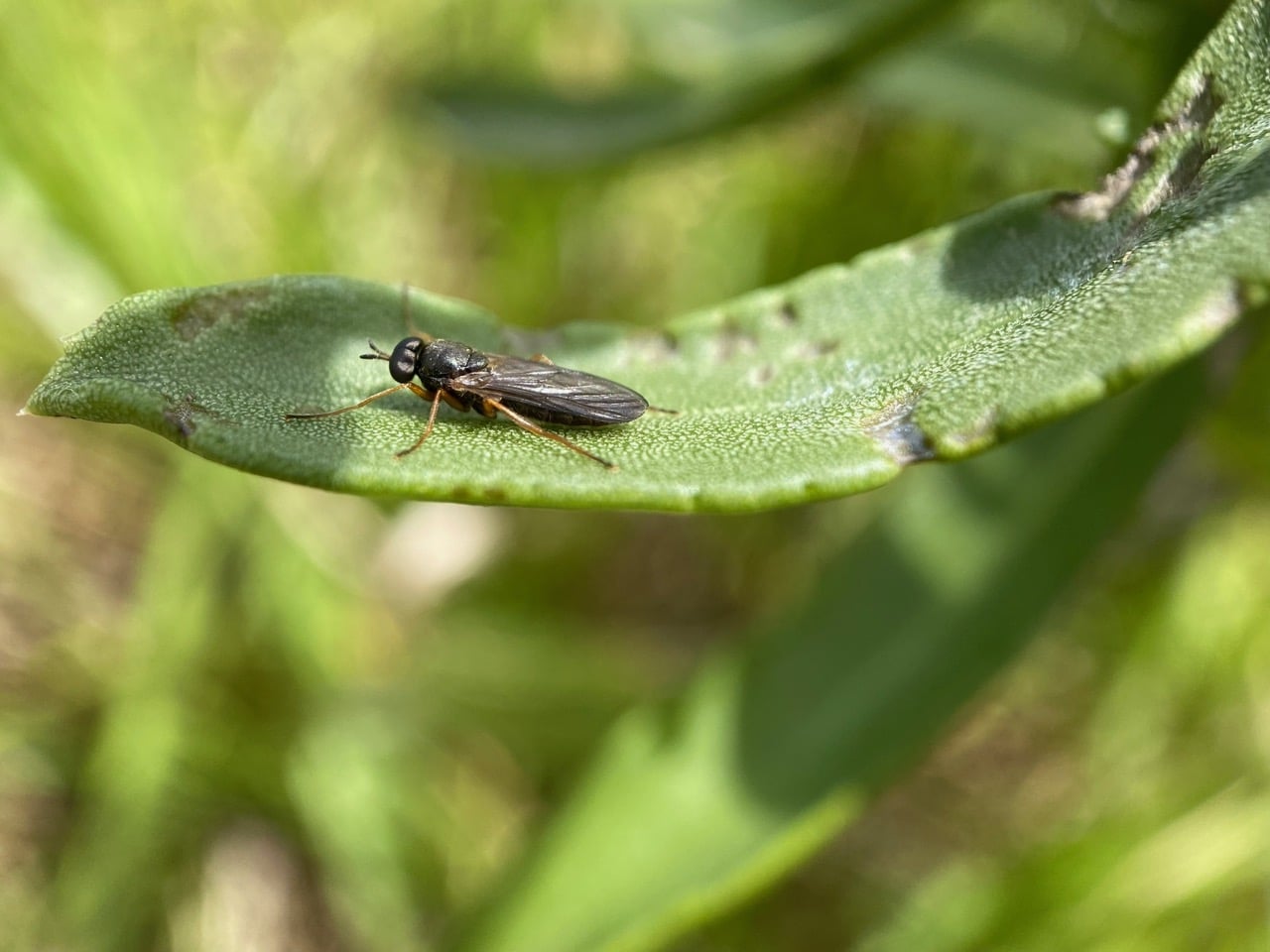
A small, slim insect is resting on a Grindelia leaf. iNaturalist has helped identify it as a Sugarcane Soldier Fly, Inopus rubiceps. It is a male of the sexually dimorphic species.
The Sugarcane Soldier Fly, Inopus rubriceps (family Stratiomyidae) is native to eastern Australia where it infests such crops as corn, pastures, and sugarcane. The fly was accidentally introduced into California over 50 years ago. It is now infesting lawns in San Francisco and other Bay Area counties. Damage to turf and other members of the grass family results from withdrawal of sap from roots of host plants by the larvae and possibly, injection of a toxin into the plant.
In California adults occur in large numbers from late September to early November each year. Eggs are deposited in crevices in the soil. The adults are sexually dimorphic. Females have tiny red heads with eyes set far apart. The smaller males have large eyes that occupy the whole surface of the head. Adults are non-feeding or drink only liquids such as flower nectar and honeydew. They are strictly focused on mating and laying eggs during their short, few-day lifespan.
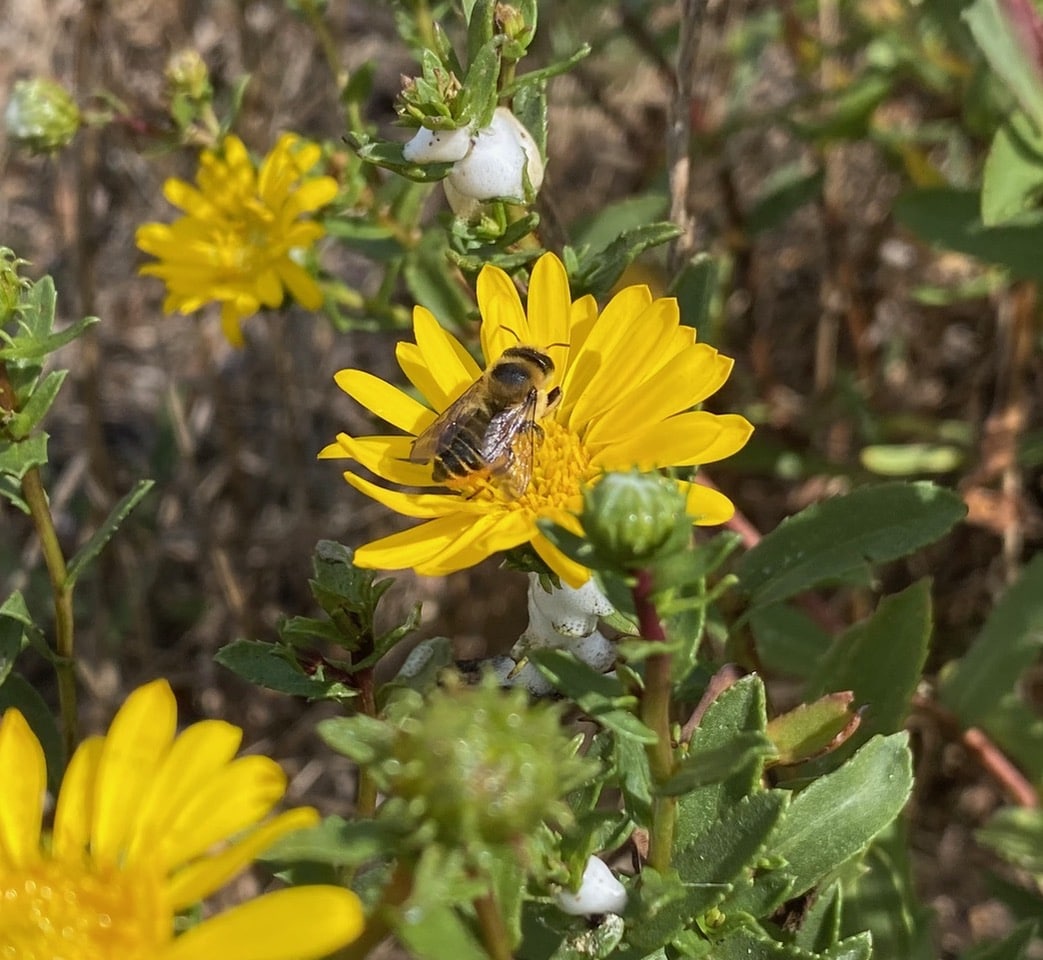
A female Western Leafcutter Bee, Megachile perihirta (family Megachilidae) is foraging on a Grindelia flowerhead.
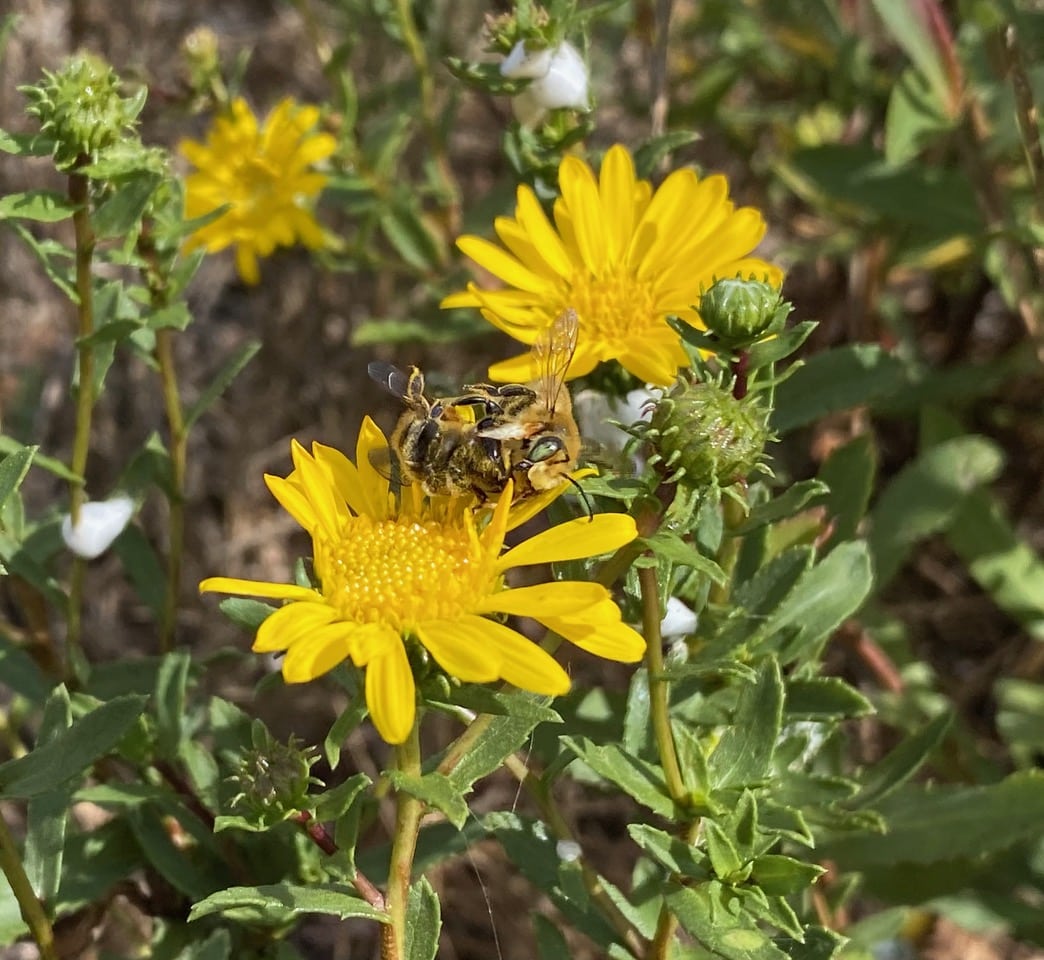
With an audible thud, a male Western Leafcutter Bee suddenly lands on the female in a brutish attempt to mate with her. The mad scuffle lasts about 2 seconds before the pair scatters. I think the female was as surprised as I was. Most of the mating attempts in solitary bees I have witnessed tended to be chaotic hit-and-miss with unwilling females putting up a fight. I wonder why the reproductive behavior in these insects has taken on this evolutionary trajectory.

The patch of Oregon Gumweed, Grindelia stricta at the end of Aughinbaugh Way is severely infested with Spittlebugs. This has been the situation over the past couple of summers I have been observing them. Sadly the patch is in dire condition this year. The plants here are scattered, stunted, and already fading even before most of the bugs have transformed into adults. Some have failed to produce flowers all together. I settle down next to this plant, knowing that I am likely to find some adult Spittlebugs on it.
Spittlebugs, also known as Froghoppers belong to the superfamily Cercopoidea within the order Hemiptera (true bugs). While sometimes generally referred to as the family Cercopidae, they are scientifically divided into several families, primarily Aphrophoridae (common spittlebugs), Cercopidae (froghopper), and Clastopteridae.
Why the common name of “spittlebug”? The nymphs (immatures) of these bugs create foam masses on plants in which they live and feed. Like the adults, the nymphs use their piercing, sucking mouthparts to feed on plant juices. The nymph produces a cover of foamed-up plant sap reminiscent of saliva, hence the common name of spittlebug. Whereas most insects that feed on sap feed on the nutrient-rich fluid from the phloem, Spittlebugs tap into the much more dilute sap flowing upward via the xylem. The large amount of excess water that must be excreted and the evolution of special breathing tubes allow the young spittlebug nymphs to grow in the relatively protective environment of the spittle. Symbiotic bacteria in the insects’ digestive system provides them with the essential amino acids that their diet lacks. The foam serves a number of purposes. It hides the nymph from the view of predators and parasites, and it insulates against heat and cold, and protects the delicate nymphs from desiccation. Moreover, the foam has an acrid taste that deters predators.
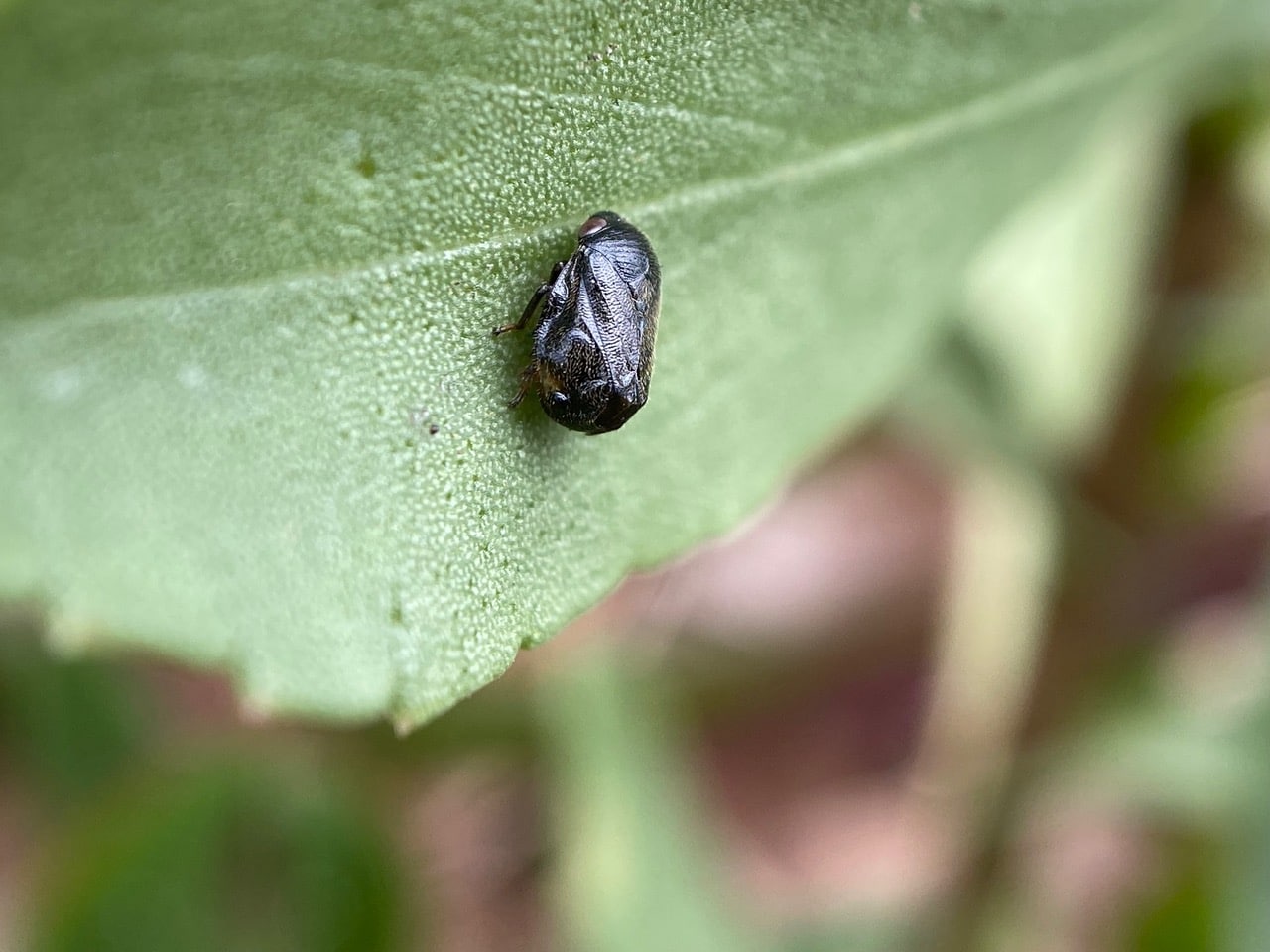
An adult male Spittlebug, Complex Clastoptera lineatocollis (family Clastopteridae) is resting on a Grindelia leaf. It is predominantly black with dull reddish-purple eyes.
Unlike their young, adult spittlebugs (also known as Froghoppers) are efficient flyers and hoppers, feeding on diverse plant species. Using their piercing-sucking mouthparts, they pierce plant stems to feed on xylem. To get enough nutrients, they consume massive quantities of sap, drinking up to 280 times their body weight daily, resulting in high waste excretion. Froghoppers can cause damage by distorting plant leaves and causing shoot tips to die back. Froghoppers are champion jumpers among insects, out-performing even the fleas. The bug can leap the human equivalent of a skyscraper without a running start. It is the highest jumping insect proportional to body size. The muscles in its hind legs act like a “catapult” to release energy explosively.
The Spittlebug, Complex Clastoptera lineatocollis (family Clastopteridae) is found in western United States. The bugs feed mostly on Asteraceae, although other hosts have been reported. Females are brownish (3.3-3.8 mm), while the smaller males (3.0-3.2 mm) are mostly black.

A mature Spittlebug nymph is crawling out of its foam mass, probably ready to undergo its final molt into an adult. Mature nymphs have a black front, and a cream or light orange abdomen.

Here’s another one who has just gotten out of a bubble bath.
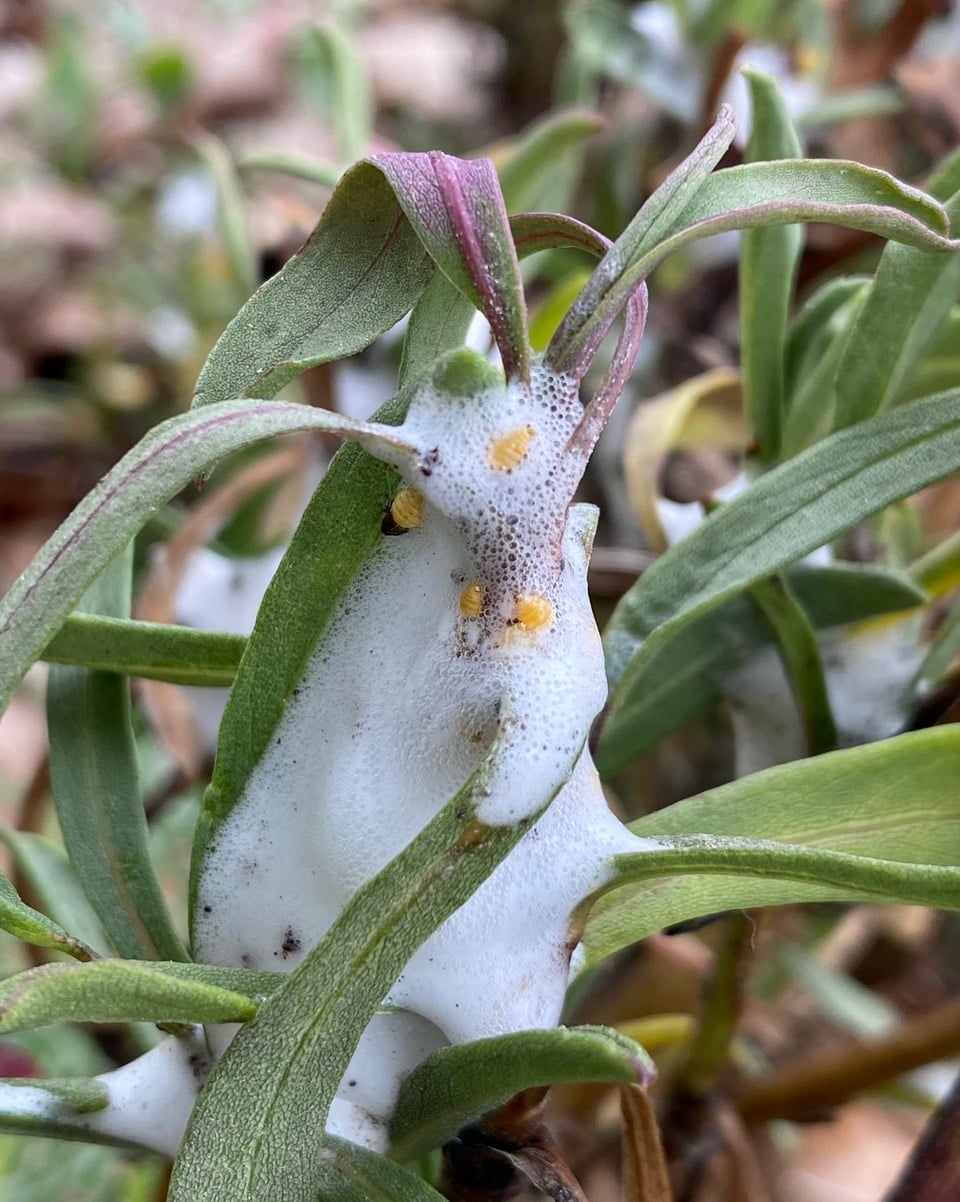
There are several Spittlebug nymphs in that foam mass. As adjacent foam masses grow, they meld together, enabling the neighboring nymphs to share a giant foam mass. I have not seen much of this phenomenon before. In less severe infestations, the individual nymphs stay in their own separate foam masses.
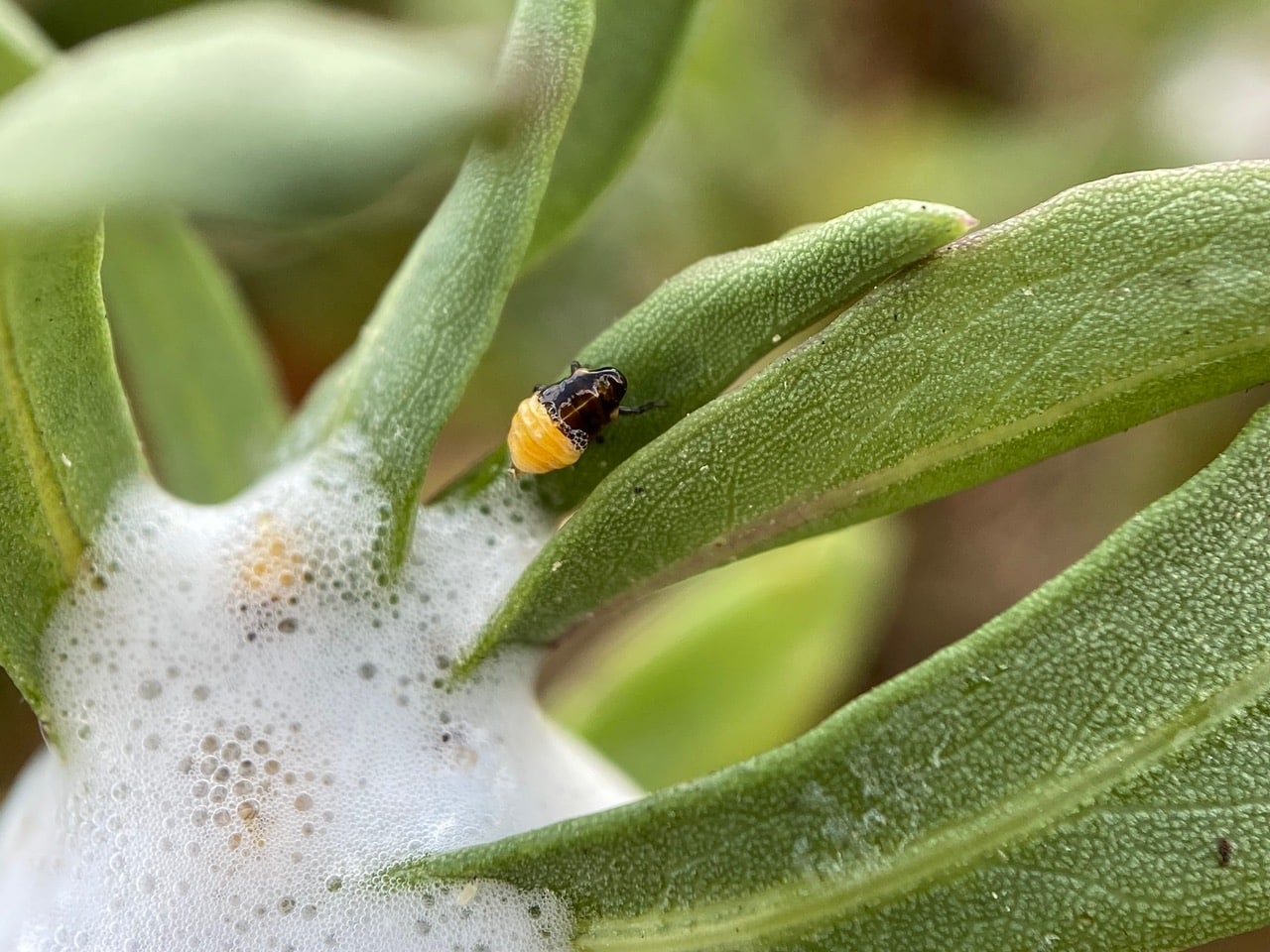
The exoskeleton of this nymph has started to split apart longitudinally on the black thorax. Soon the new adult will emerge through this opening.
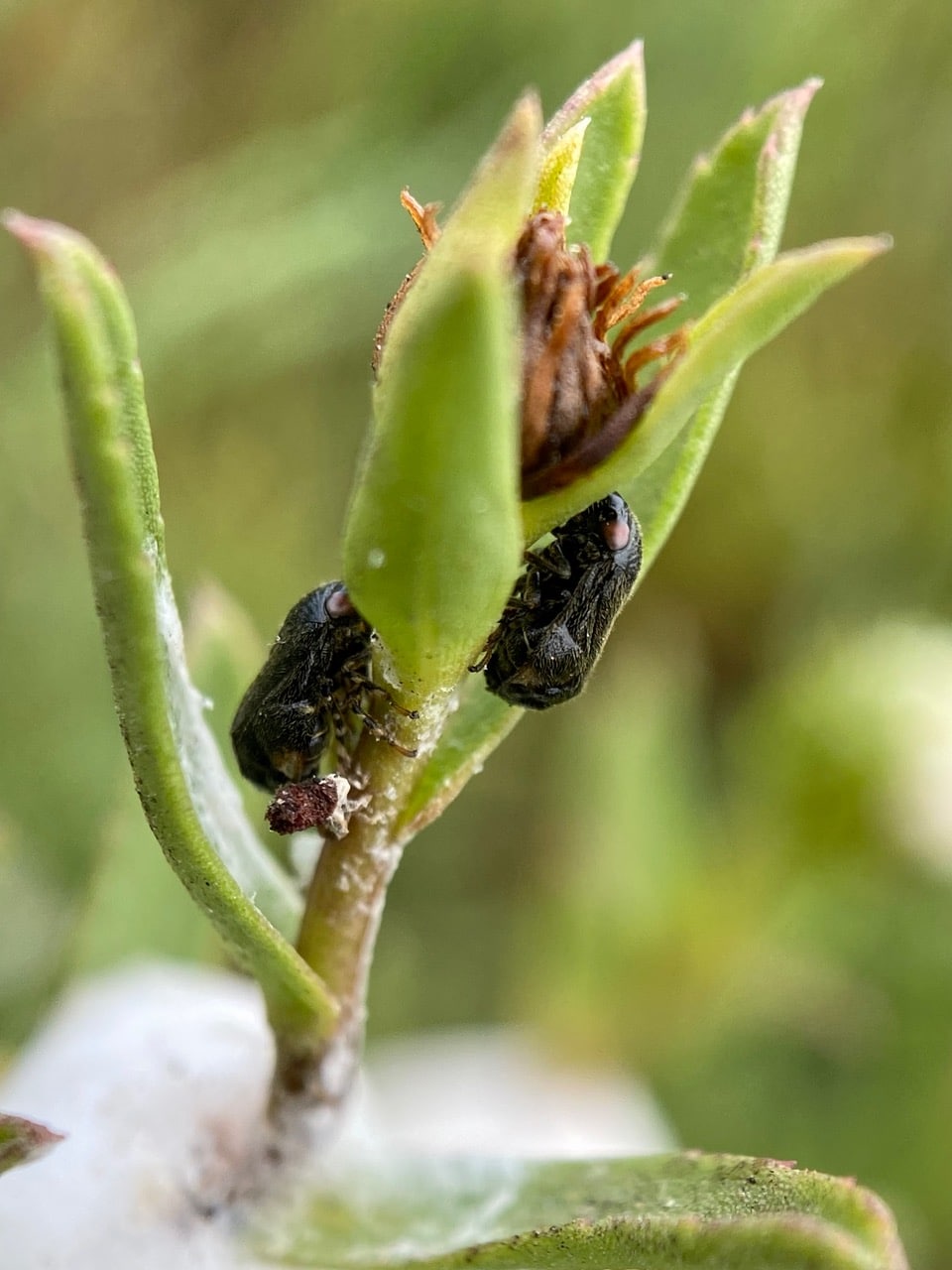
Two male Spittlebugs are resting on the terminal leaves of Grindelia above their foam masses.

Yet another adult male Spittlebug. I find a dozen of these males in this patch of Grindelia, but not a single female today.

I spot the faint outline of a Lace Bug, Corythucha sp. (family Tingidae) on a Grindelia leaf. Wow, it’s no wonder that the plants here are so sick. They are being simultaneously attacked by Spittlebugs and Lace Bugs.
The Tingidae are a family of very small (2-10 mm) insects in the order Hemiptera that are commonly referred to as lace bugs. The genus Corythucha is primarily distributed in the northern hemisphere, including Europe, North America and eastern Asia. They are called lace bugs because the pronotum and fore wings of the adult have a delicate and intricate network of divided areas that resemble lace. Their body is flattened dorsoventrally, and the head is often concealed under the hood-like pronotum. Unlike most bugs that suck xylem or phloem from plants, Lace Bugs puncture and feed on the leaf mesophyll cells. They insert their needle-like mouthparts into the mesophyll layer located between the upper and lower leaf epidermis. They inject saliva that contains digestive enzymes to break down the cell contents, then suck out the liquified chlorophyll and cell fluids. The most common symptom of feeding is the stippled and mottled yellowish foliage. In heavy infestations, black sooty mold may develop on the puncture wounds, impairing photosynthesis by the plant. This may result in some dieback of twigs and branches and a reduction in flowering the following year. Tingids are usually host-specific and can be very destructive to plants. Each individual usually completes its entire lifecycle on the same plant, if not the same part of the plant.
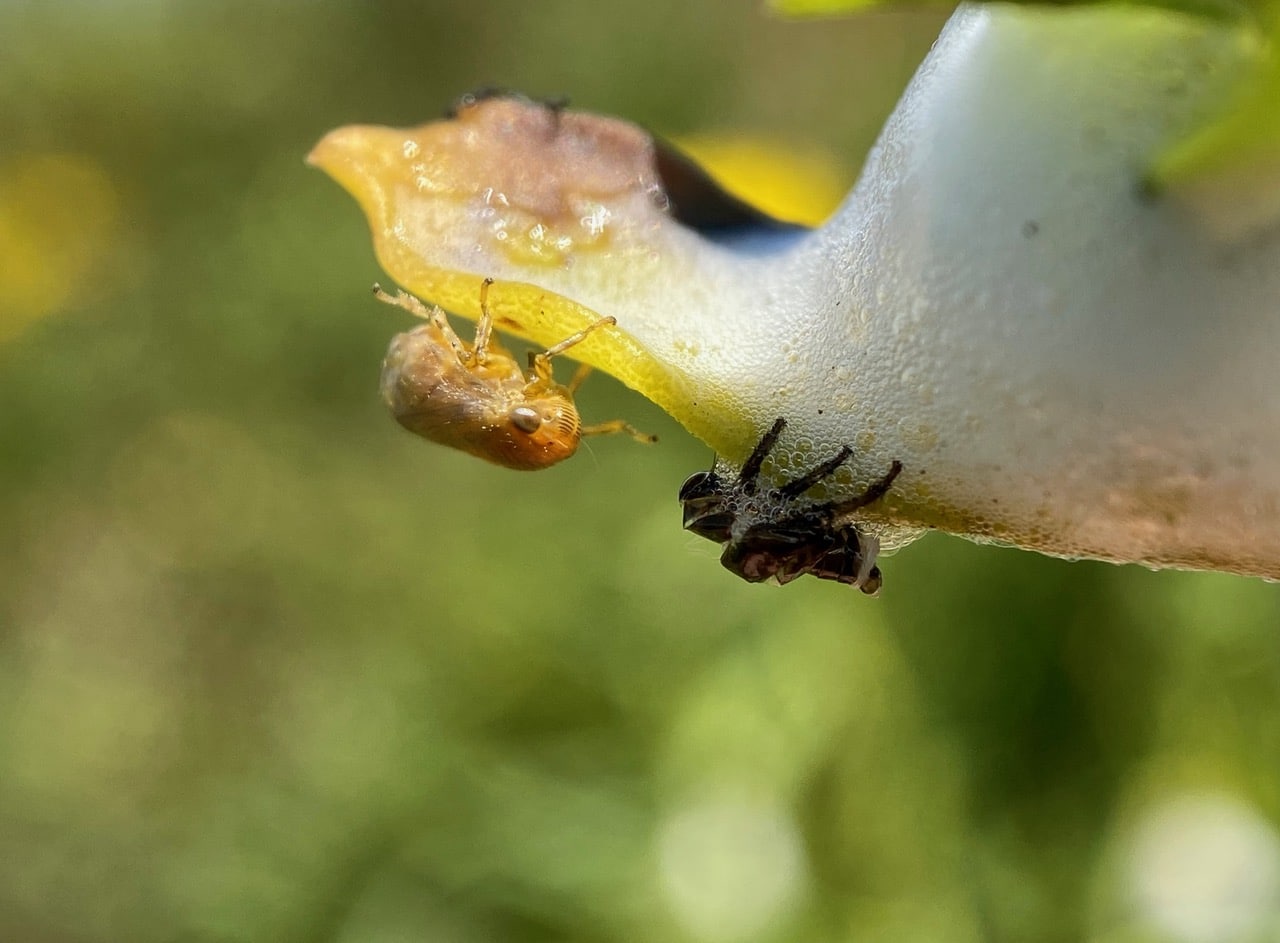
1:05:28 pm Stopping by the teneral Spittlebug I saw earlier (about 1 hr 13 min. ago), I find that it has moved away from its shed skin, and its wings are now folded over its body.
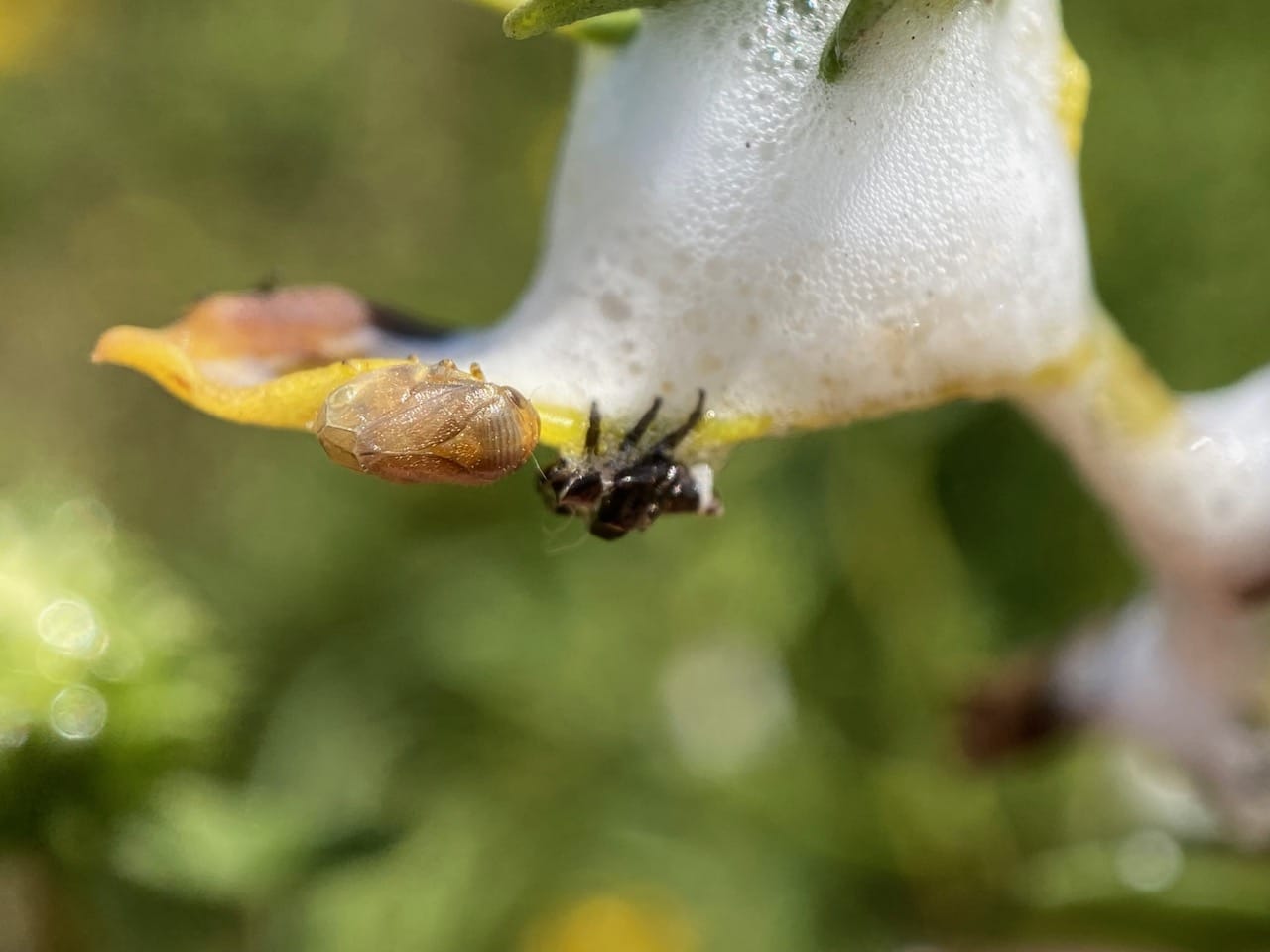
The pale and translucent little bug will need more time for full coloration to develop. Growing up is a slow process, even for a bug less than 4 mm long.