

Pollinator Post 8/9/25

Back at Shoreline Park on Bay Farm Island this calm morning, I am excited to explore the insect life of the Oregon Gumweed, Grindelia stricta again.
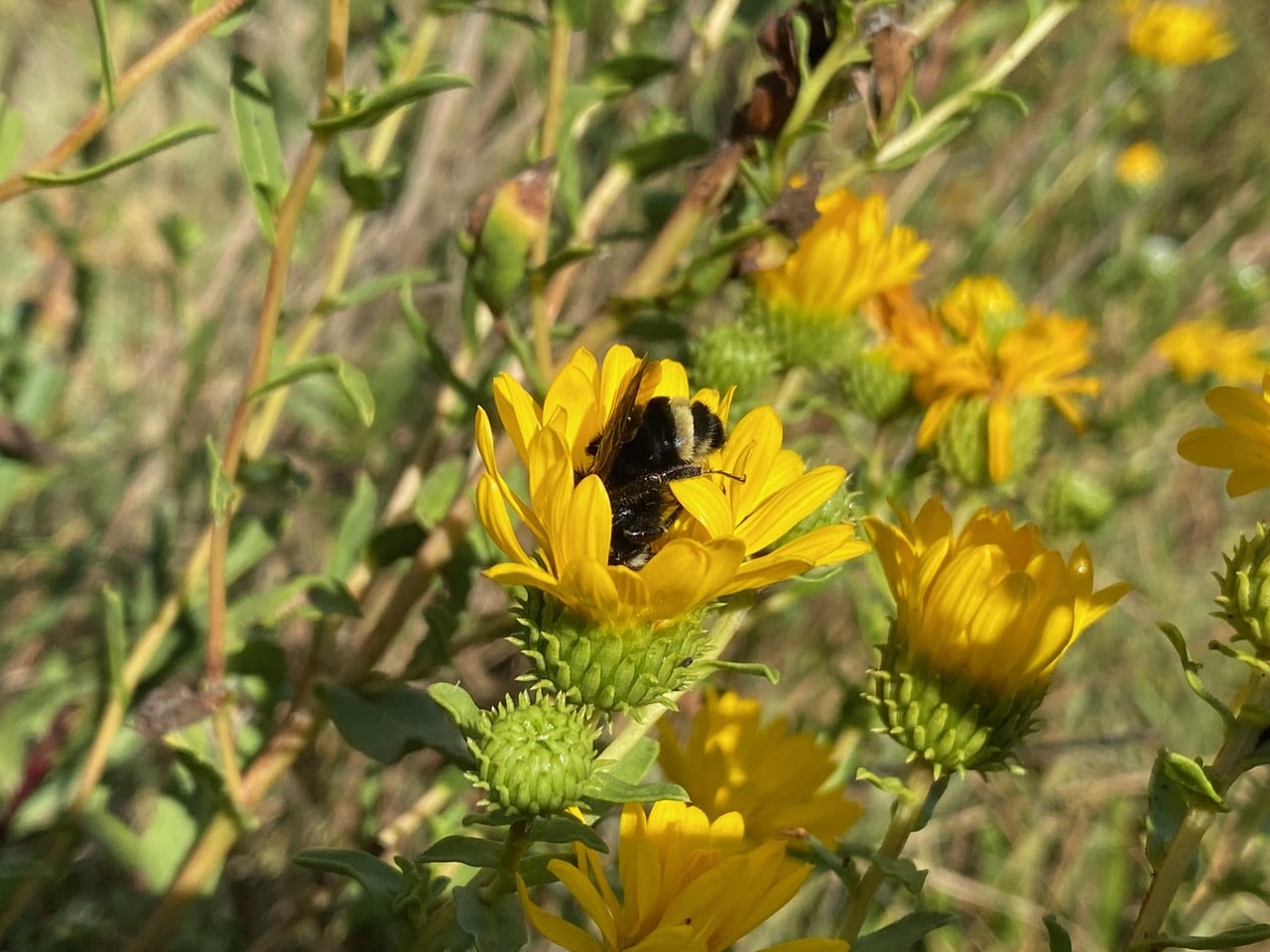



A large bumble bee is resting head down on a Grindelia flowerhead, motionless. I am ready to call it a queen until I notice that it has an extra yellow band (partial) on its abdomen, and skinny hind legs without a corbicula (pollen basket). I can’t see its face, but it is most likely a male Yellow-faced Bumble Bee, subgenus Pyrobombus (genus Bombus, family Apidae).
Throughout most of their nesting season starting from early spring, bumble bee colonies usually produce only female workers who help maintain and extend the nests, take care of the young, and forage for nectar and pollen. In late summer and early fall, the queen begins to produce drones (males) and new queens. These will mate, and the mated new queens will find a safe site to hibernate through the winter. The drones, and the rest of the colony, including the old queen will die. When the new queens emerge from hibernation next spring, they will establish new colonies to start the annual cycle all over again.
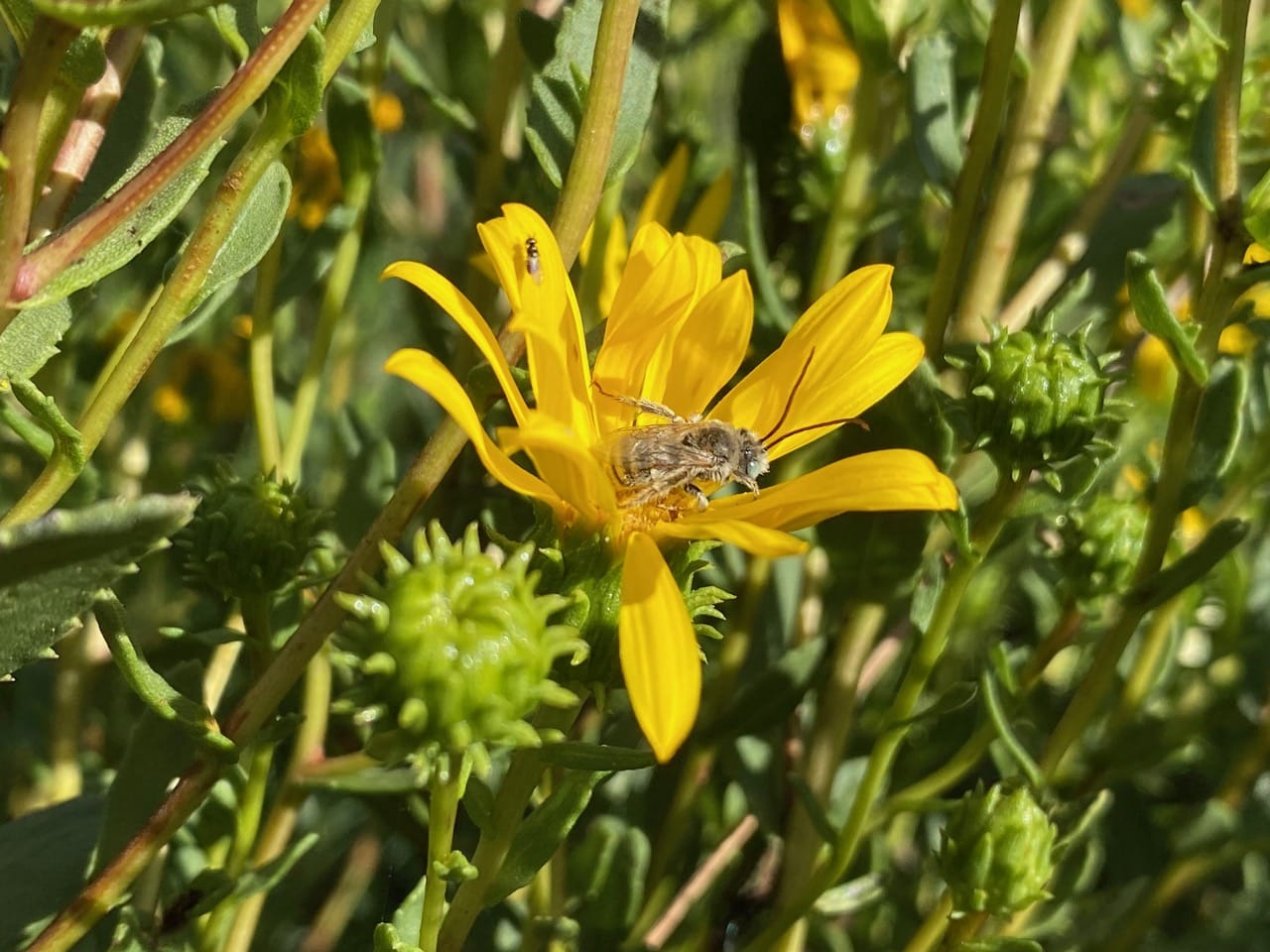
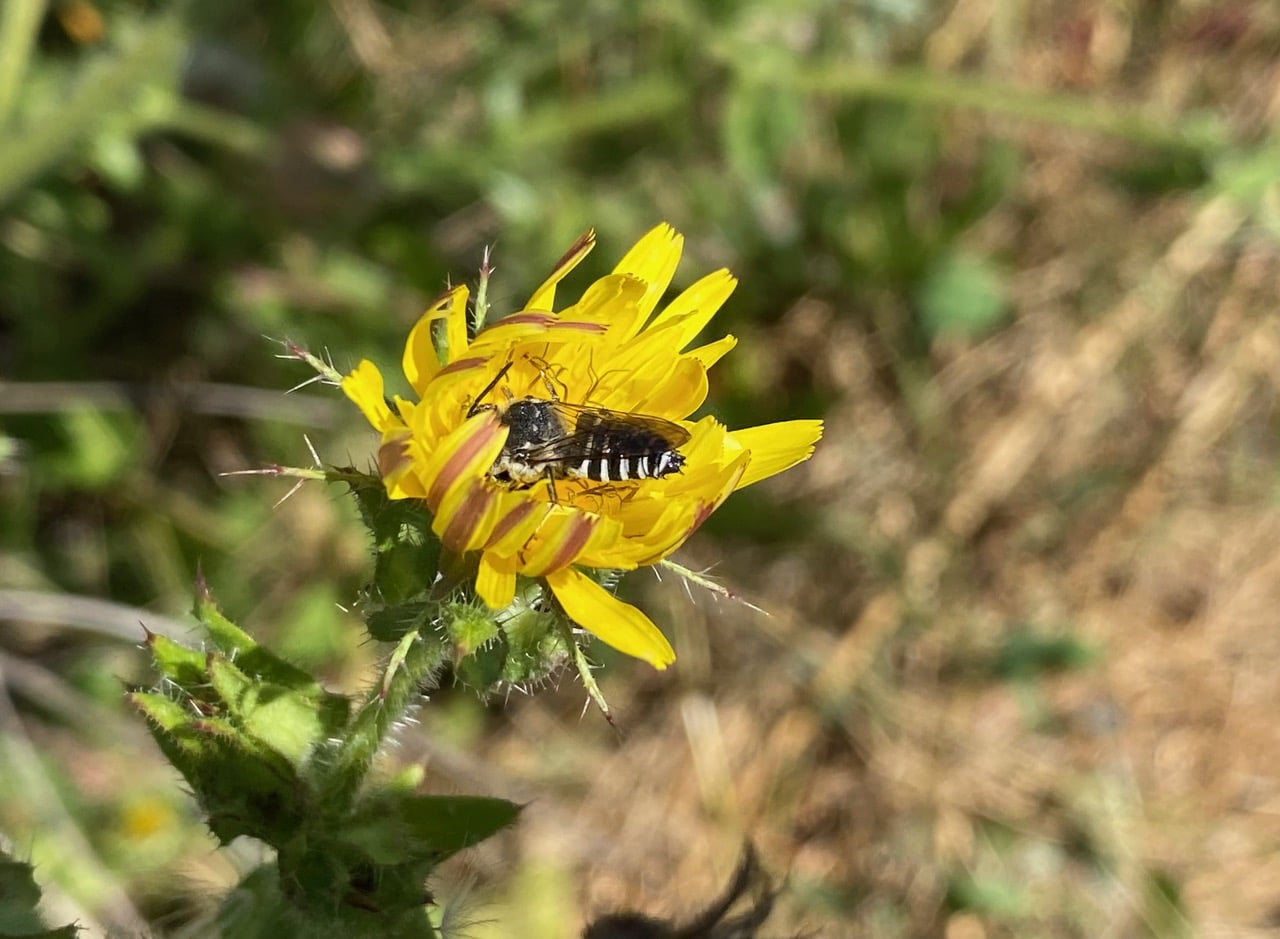
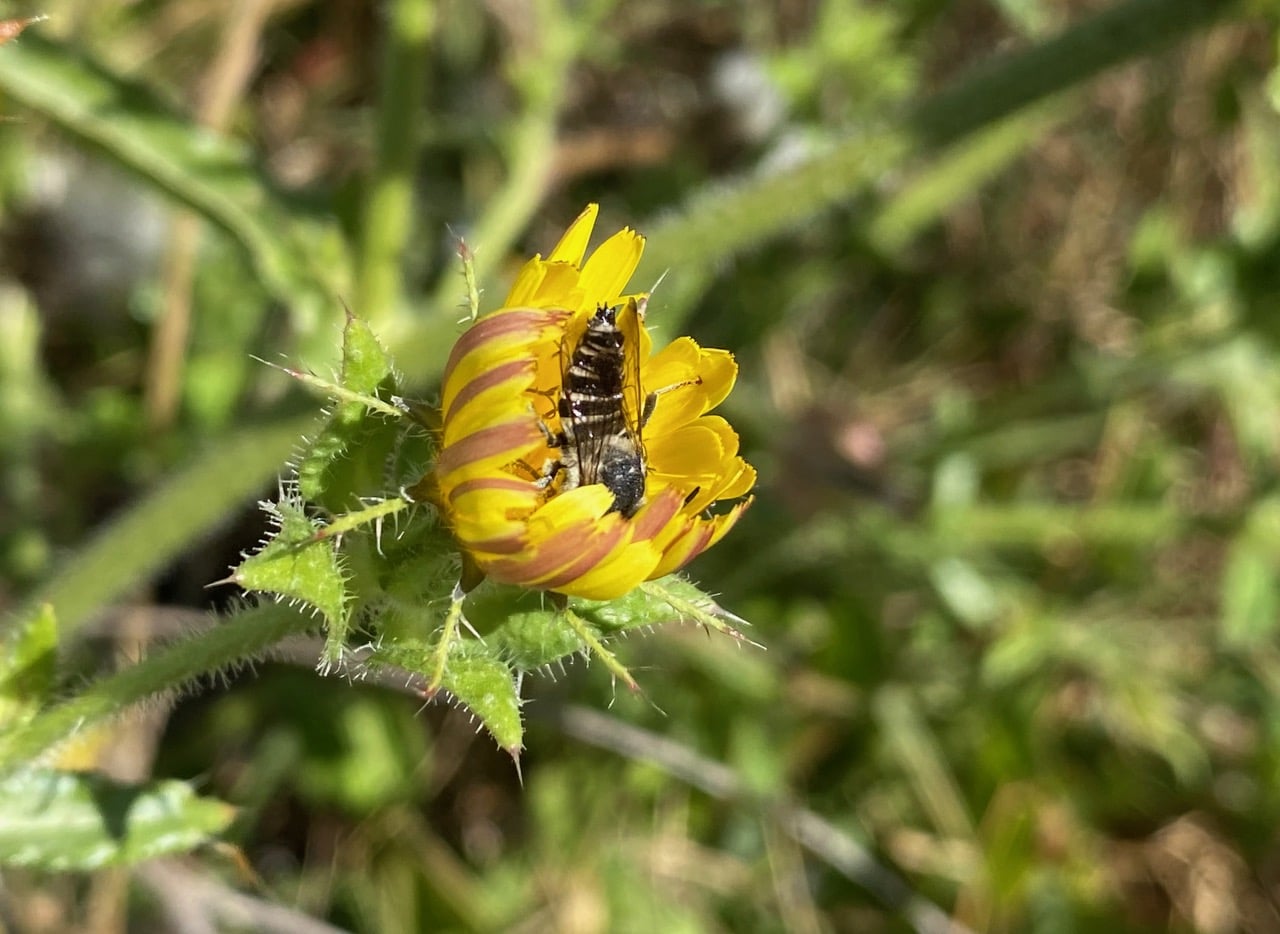
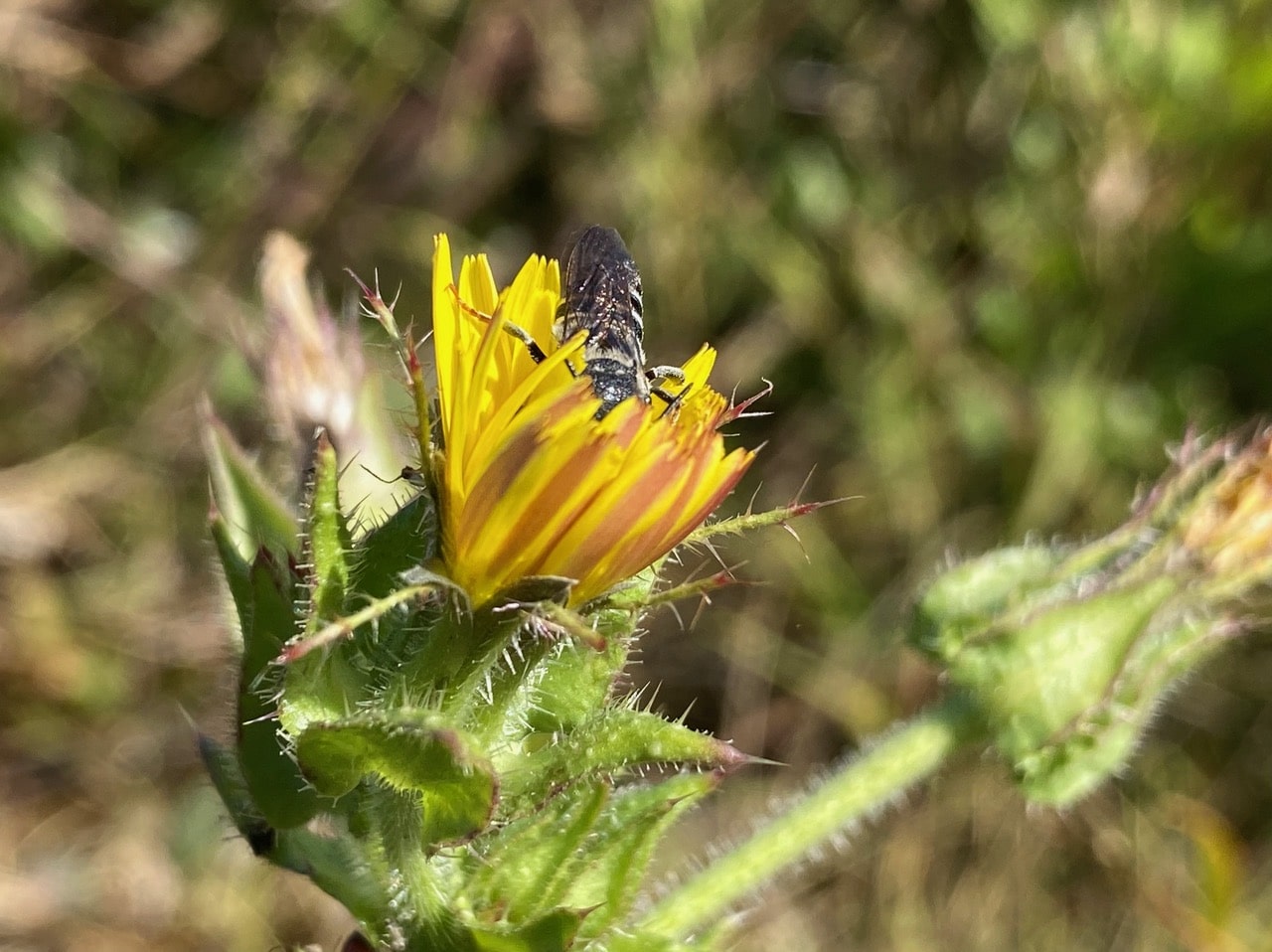
Many male Summer Longhorn Bees, Melissodes sp. (family Apidae) are zipping around, bumping each other off the Grindelia flowerheads. I have yet to see a female here.
The Summer Longhorn Bees, Melissodes sp. (family Apidae) are medium to large bees, stout-bodied, usually with gray hair on the thorax and pale hair bands on the abdomen. Males usually have yellow markings on their faces and have very long antennae from which their common name is derived. They are active May to September, with peak flight in late June to early August. The females prefer flat, bare ground for digging their solitary nests, though they sometimes nest in aggregations. Pollen is transported in scopae on the hind legs. Pollen loads are often copious and brightly colored and thus very distinguishable. Melissodes are specialists on Asteraceae – females gather pollen from flowers of Aster, Bidens, Coreopsis, Cosmos, Encelia, Gaillardia, Helianthus, and Rudbeckia ssp.
Here’s a male Melissodes taking shelter in a partially opened Grindelia flowerhead. Did he spend the night sleeping in this flowerhead, and hasn’t woken up?
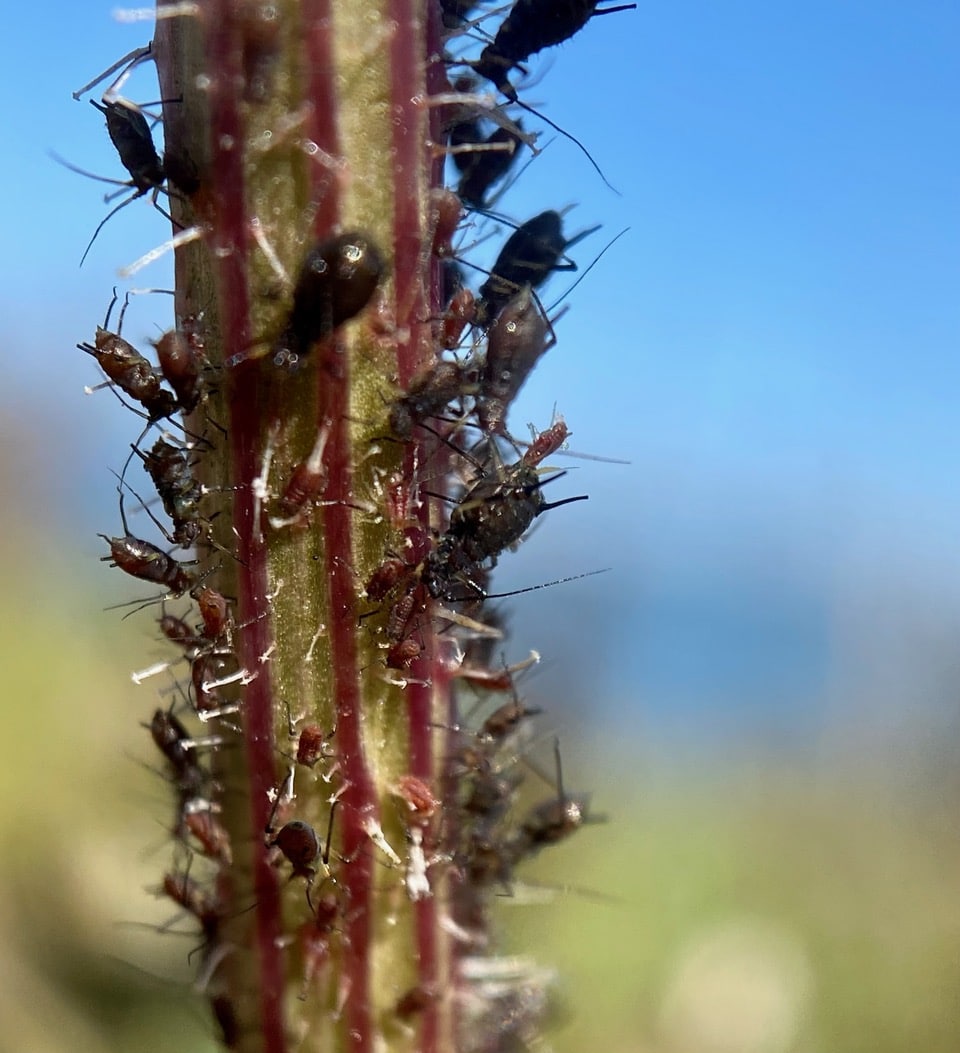
On the stem of a Bristly Oxtongue, Helminthotheca echioides crowded with Large Daisy Aphids, Uroleucon sp. (family Aphididae) I spot a mama aphid giving birth to live young. The female is a dark greenish color, while her baby is a dark mauve color.
Aphids are small sap-sucking insects in the order Hemiptera. A typical life cycle involves flightless females reproducing parthenogenetically. They give live birth to female nymphs without having to mate, – who may also be already pregnant, an adaptation called telescoping generations. Maturing rapidly, females breed profusely so that the population multiplies quickly. Winged females may develop later in the season, allowing the insects to colonize new plants. In temperate regions, a phase of sexual reproduction occurs in the autumn, with the insects often overwintering as eggs.
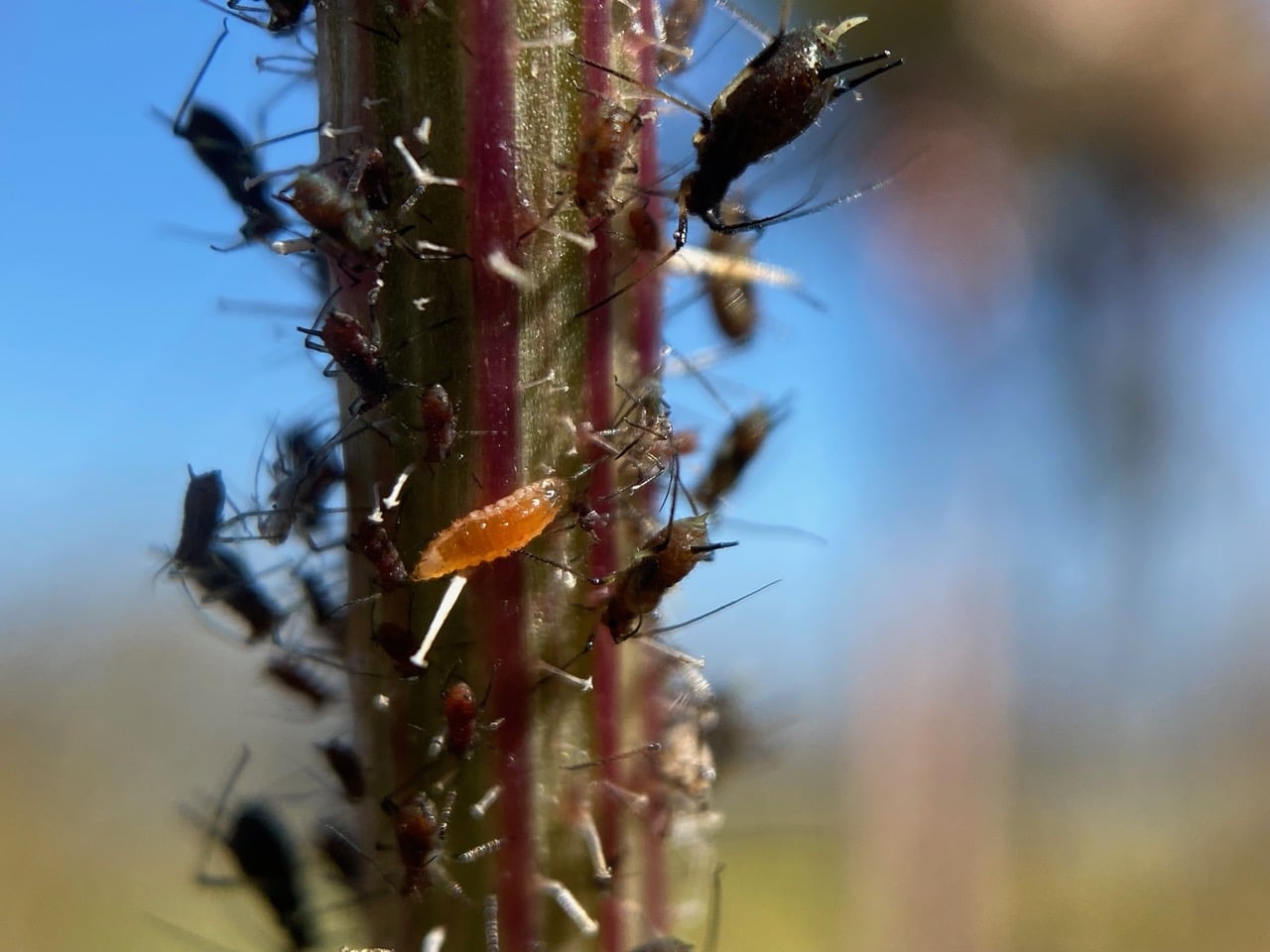
See that orange slug-like creature among the aphids? It is an Aphid Midge, Aphidoletes aphidimyza (family Cecidomyiidae). Cecidomyiidae are usually known as gall midges, with larvae that live and feed within plant galls. The Aphid Midge is sort of an oddball within the family. Instead of growing up in a gall, it is a free-roaming aphid hunter.
The Aphid Midge, Aphidoletes aphidimyza is a midge whose larvae feed on over 80 aphid species. The adults are small, less than 3.2 mm long, black, delicate, short-lived flies that feed on aphid honeydew. They hide beneath the leaves during the day, and are active at night. Females deposit 100-250 tiny shiny orange eggs among aphid colonies that hatch in 2-3 days. After 3-7 days the larvae drop to the ground to pupate in the soil. The small, bright orange, slug-like larvae inject a toxin into aphids’ leg joints to paralyze them and then suck out the aphid body contents through a hole bitten in the thorax. Larvae can consume aphids much larger than themselves and may kill more aphids than they eat when aphid populations are high. A single larva grows up to 3.2 mm long and kills 4-65 aphids a day. The life cycle from egg to adult can be completed in about 3 weeks, with multiple generations per year.
The Aphid Midge is commercially available, widely used in biological control programs for greenhouse crops and orchards.
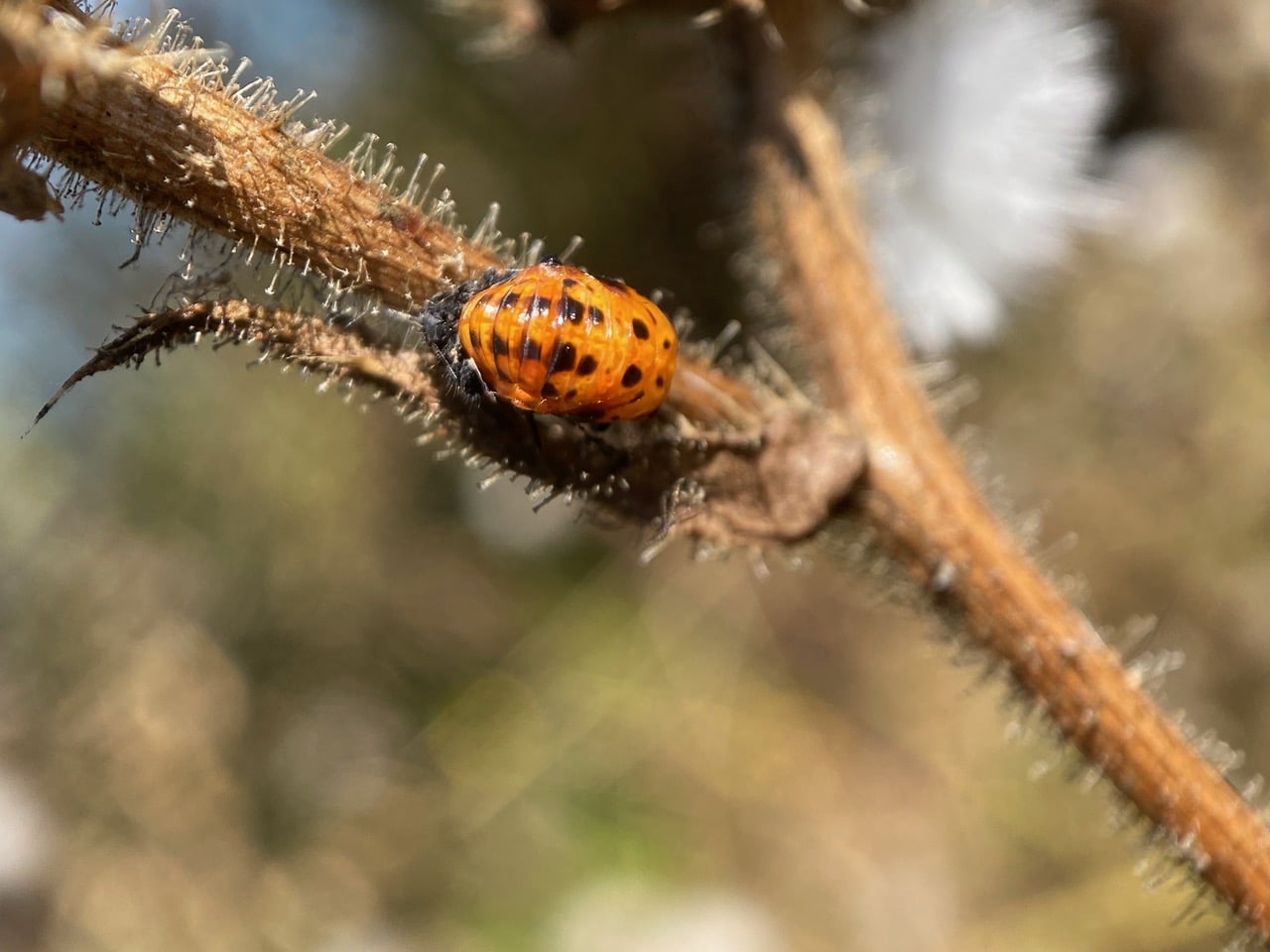
Hey, another potential predator of the aphids – a pupa of a Lady Beetle (family Coccinellidae).
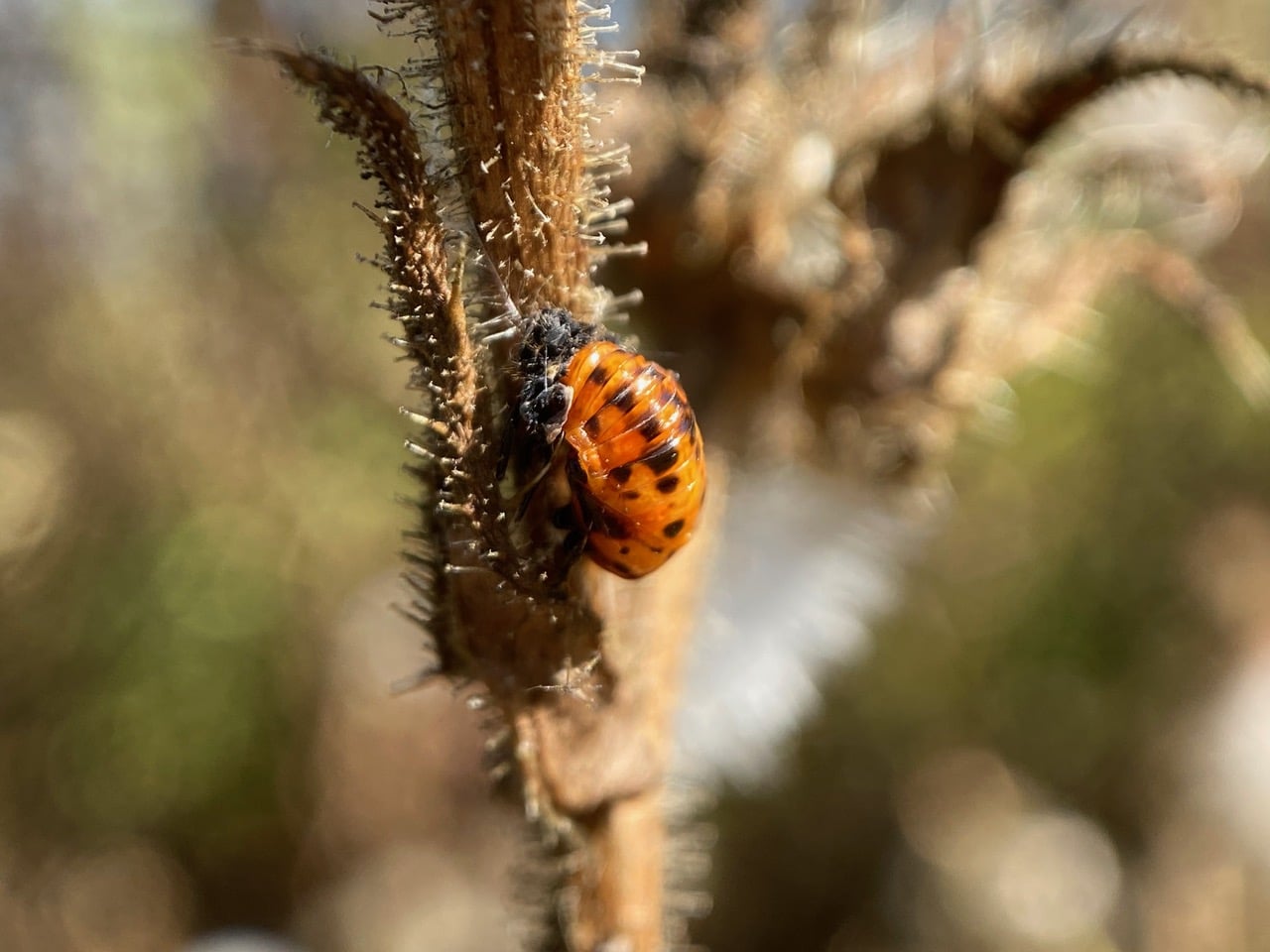
Side view of the Lady Beetle pupa. It has attached itself head-down on a dried stem of Bristly Oxtongue. The bunched-up black material under its rear is the larval skin shed after its last molt.
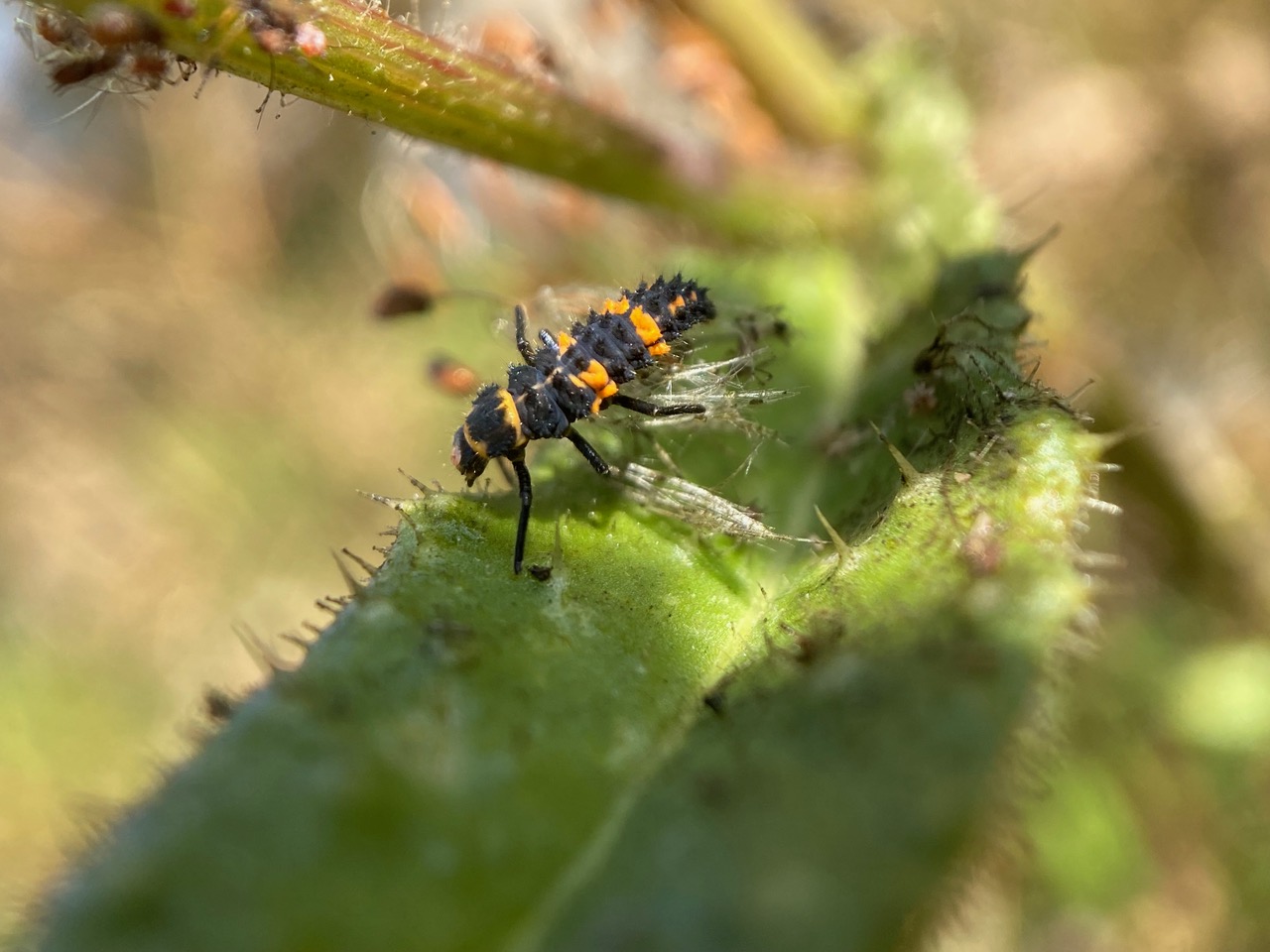
A young Lady Beetle larva is crawling up a leaf.
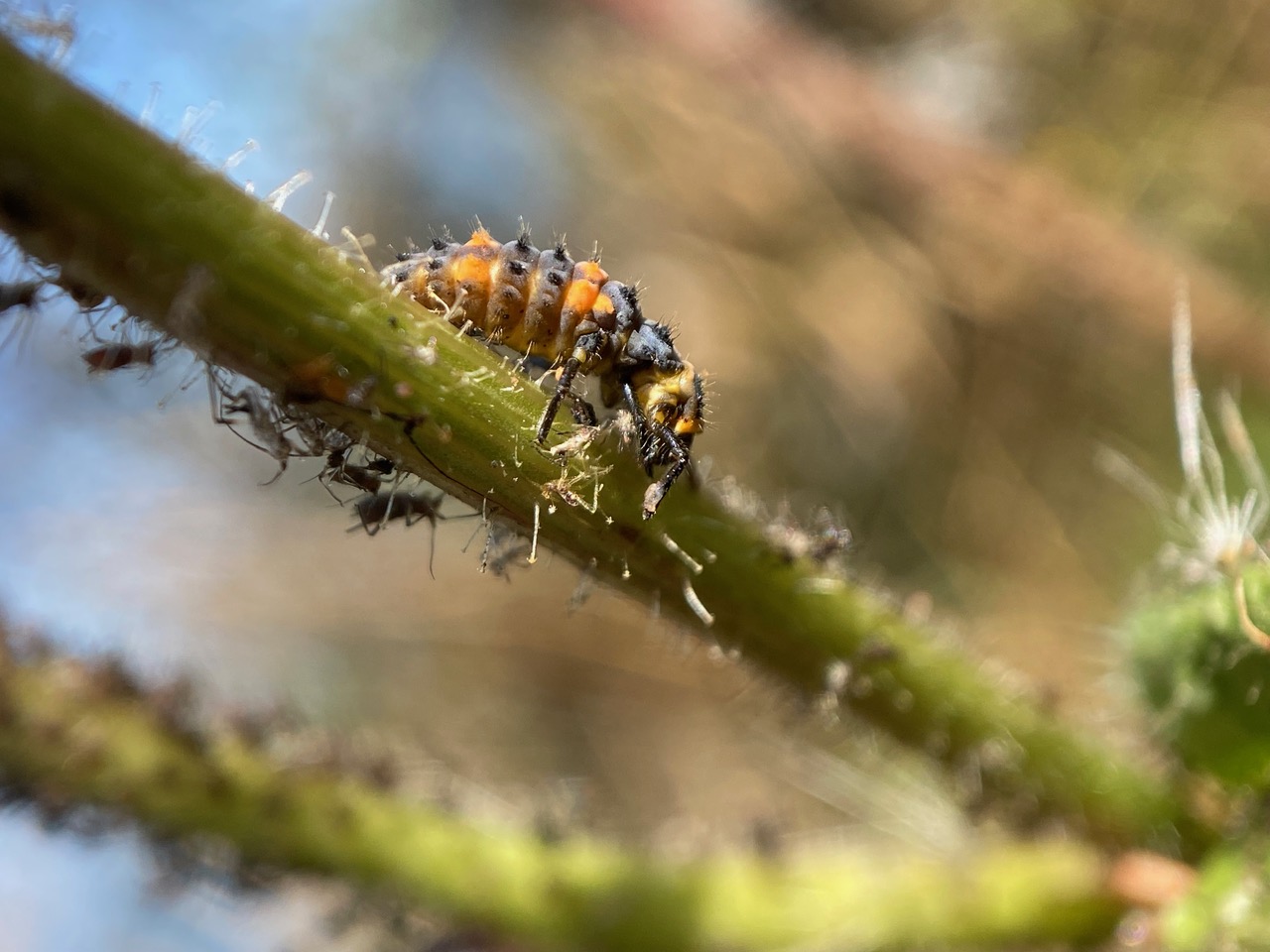
A more mature Lady Beetle larva is feeding on aphids as it descends the stem of Bristly Oxtongue. This is a great place to grow up for a Lady Beetle larva – there’s an abundance of aphids on the plant.
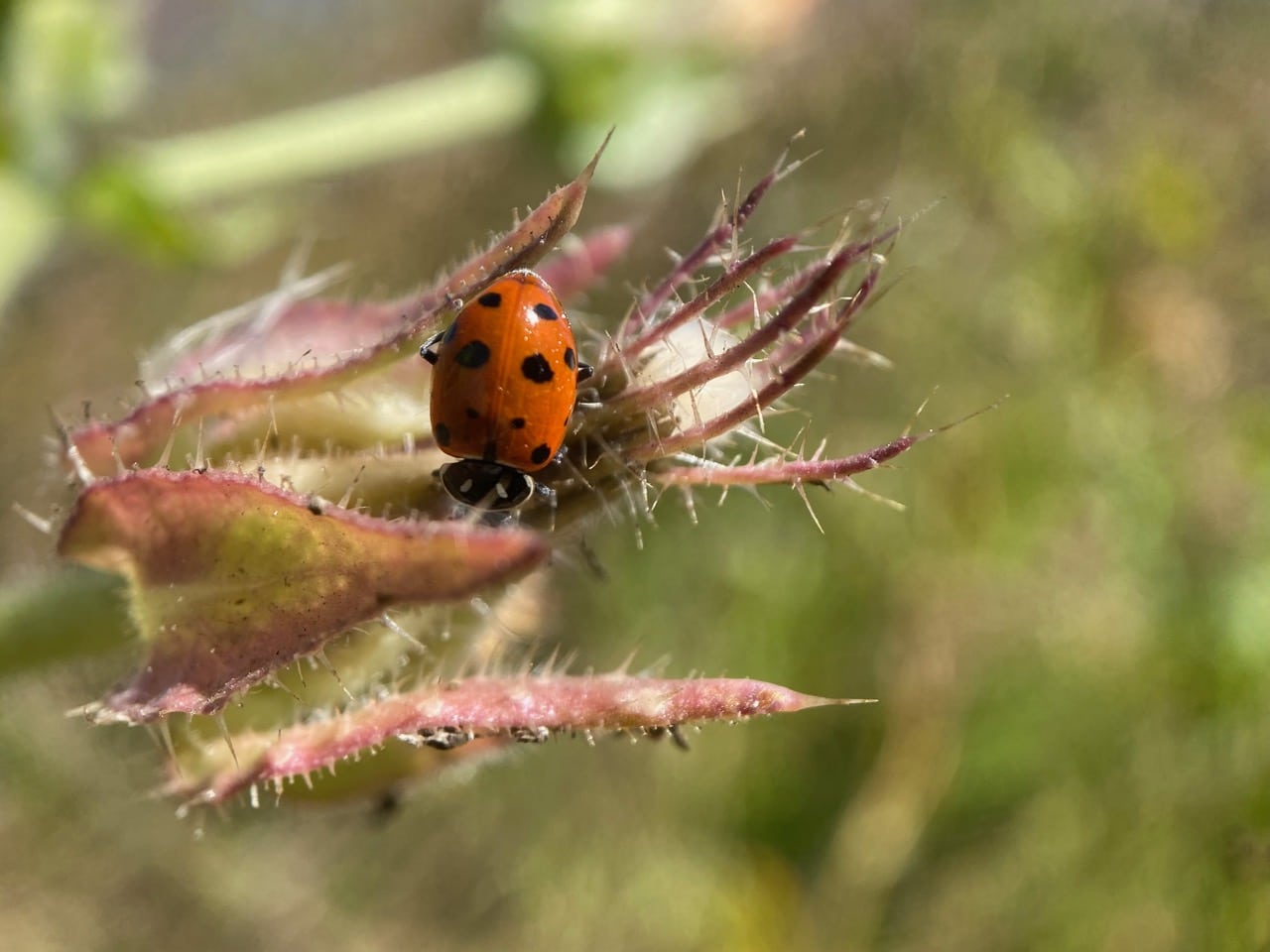
A Convergent Lady Beetle, Hippodamia convergens (family Coccinellidae) is hunting aphids on a developing Grindelia seed head. Both the adults and larvae are voracious predators of aphids.
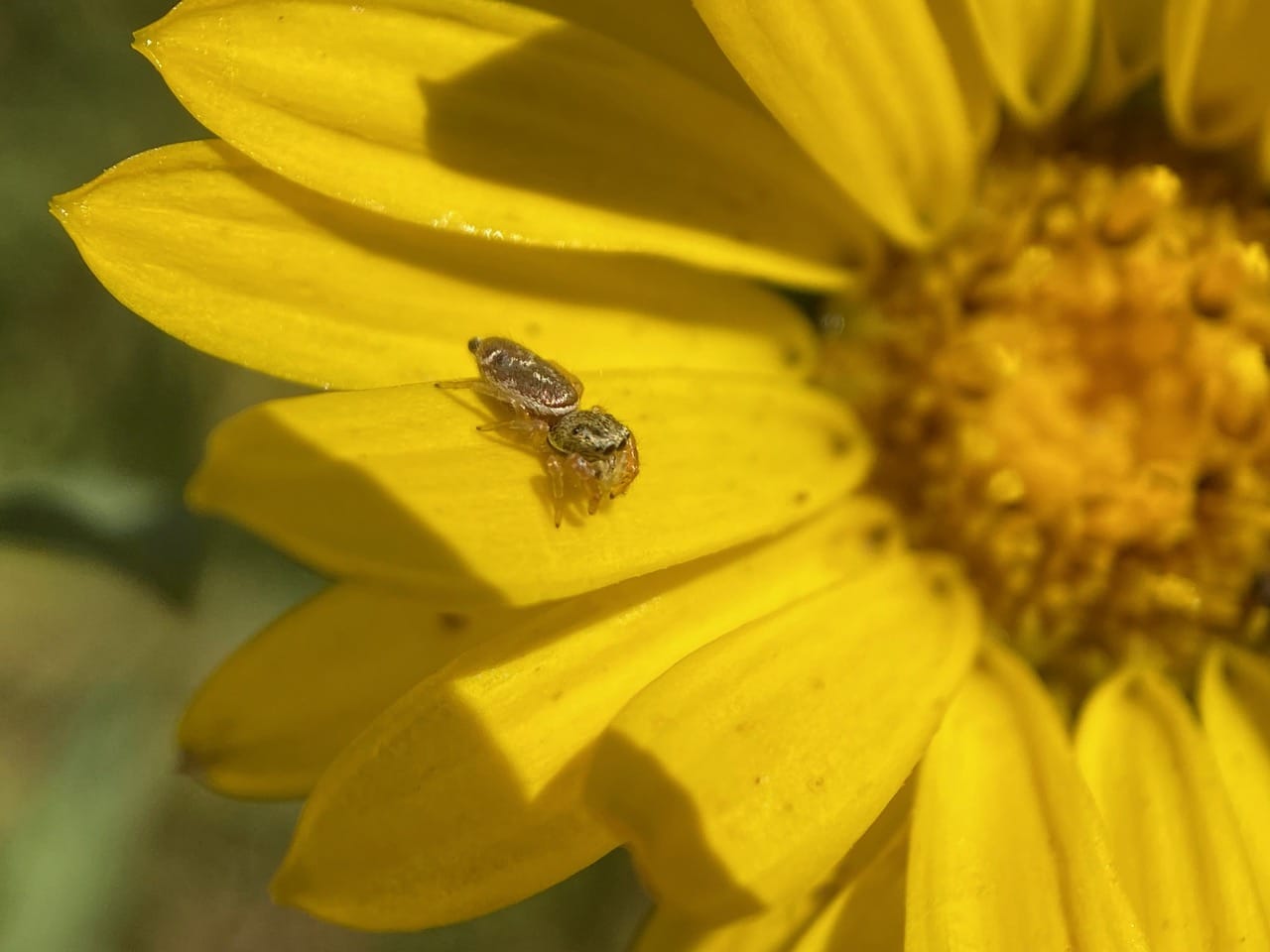
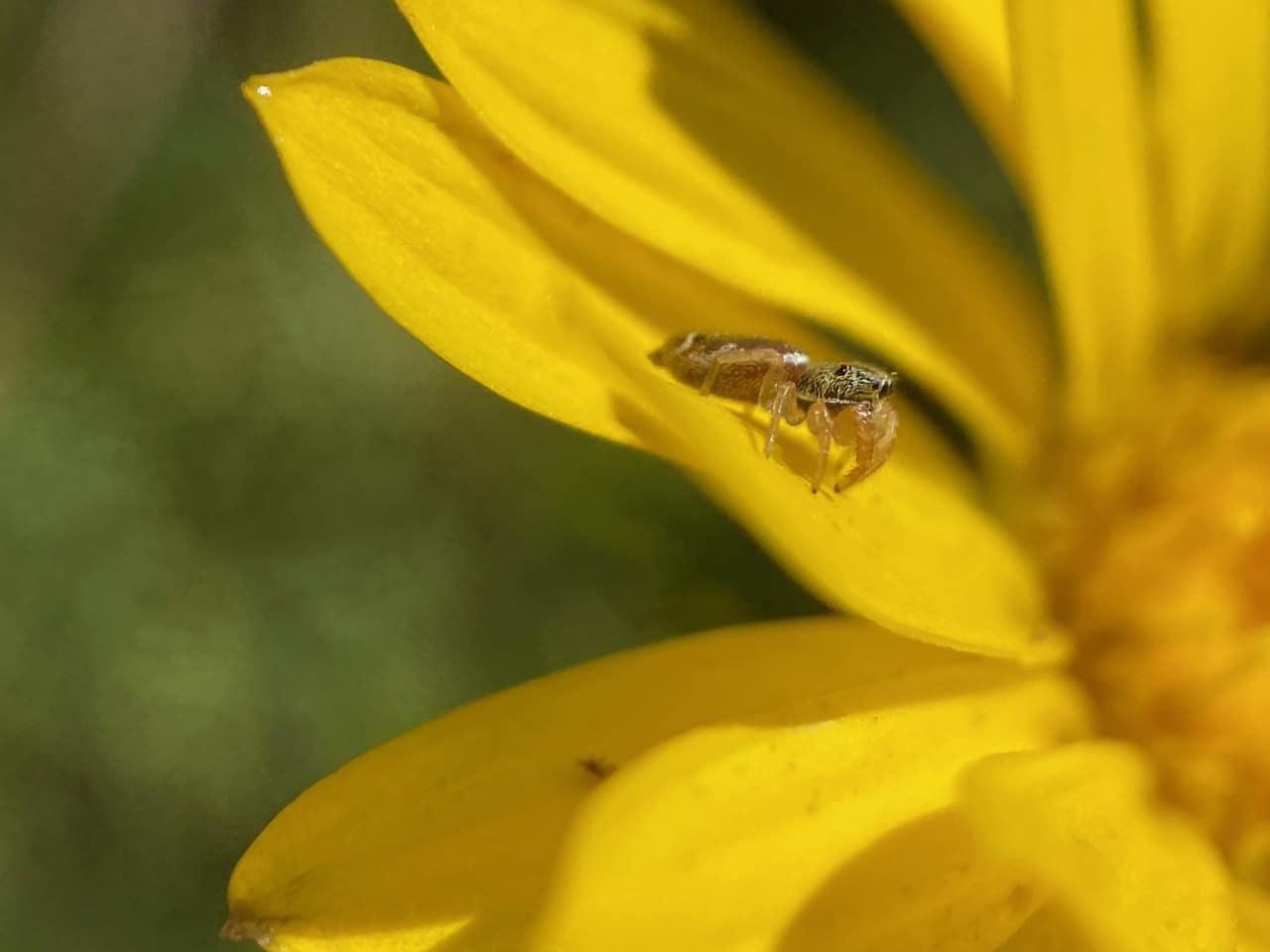
A brilliant golden glint on a ray petal of Grindelia turns out to be a tiny Buttonhook Leafbeetle Jumping Spider, Sassacus vitis (family Salticidae).
Jumping spiders (family Salticidae) are free-roaming hunting spiders. They do not weave a web to catch prey. They stalk, then pounce on their prey. Just before jumping, the spider fastens a safety line to the substrate. It can leap 10-20 times their body length to capture prey. Their movement is achieved by rapid changes in hydraulic pressure of the blood. Muscular contractions force fluids into the hind legs, which cause them to extend extremely quickly. Jumping spiders are visual hunters. Their excellent vision has among the highest acuities in invertebrates. Since all their 8 eyes are fixed in place and cannot pivot independently from the body like human eyes can, jumping spiders must turn to face whatever they want to see well. This includes moving their cephalothorax up and down, an endearing behavior.
It is often difficult to tell whether a particular spider is an adult or an immature, judging by size alone. In the jumping spiders in the genus Sassacus, the adults are only about 3-5 mm. The genus name Sassacus was the last chief of the Pequot Indians, a Native American tribe of the Connecticut Valley that was vanquished in a war with English settlers in 1637. The iridescent color and very compact appearance of these spiders leads scientists to suspect that they are mimics of certain leaf beetles in the family Chrysomelidae. Many Chrysomelids don’t taste good, as they feed on poisonous plants and sequester those plant toxins for their own defense. They advertise their distastefulness to predators with bold black and white, yellow, orange, or red color patterns, or with brilliant metallic colors. One of the defining characteristics of the genus is the very short legs. The fourth pair of legs is still the thickest, with one or two pairs of spines, used in tackling prey. Like most jumping spiders, Sassacus engages in visual courtship displays. The twitching abdomen also produces an auditory stimulus as the male waves his front legs to garner the female’s attention.
Sassacus vitis is native to North America, with a range spanning from Canada to Panama. It is a small jumping spider with iridescent gold abdomen and white ring around the anterior surface of abdomen. Body is covered with golden scales. Males are 3.5 mm long, females 4.5 mm. The name vitis is Latin for “grapevine”. The spider is commonly found on shrubs and vines and in fields. Best known as a common resident of vineyards.
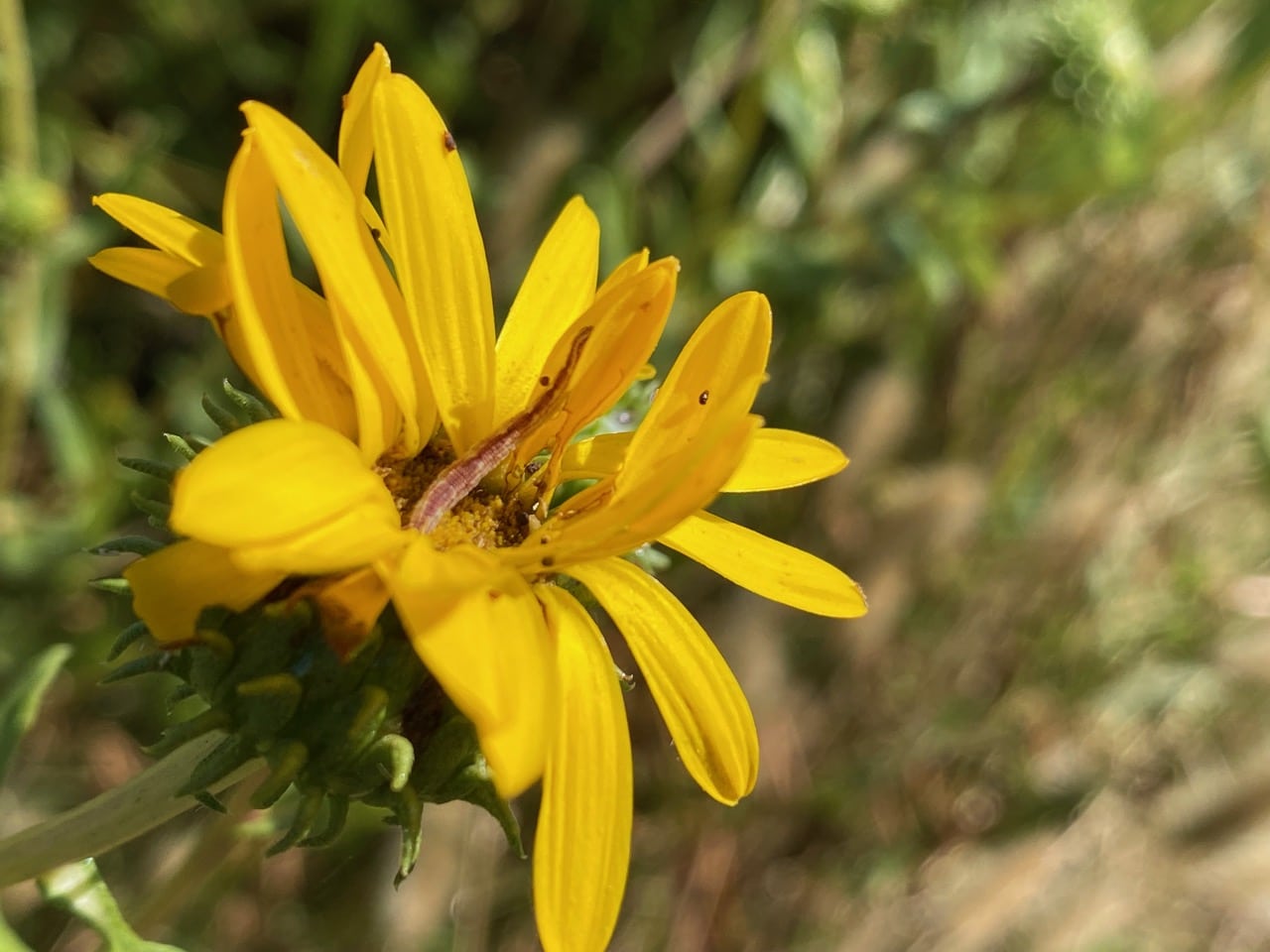
With its head buried in the florets, an inchworm caterpillar of the Common Eupithecia Moth, Eupithecia miserulata (family Geometridae) is feeding on a Grindelia flowerhead.
Eupithelia is the largest genus of moths of the family Geometridae. Occurring worldwide except for Australasia, species in the genus are commonly known as pugs. Adults are typically small, 12 – 35 mm, with muted colors. Most species rest with forewings held flat at right angles to the body, while the hindwing are largely covered by the forewings. They are generally nocturnal. Larvae mostly feed from the flowers and seeds of their food plants rather than the foliage. Many species have a very specific food plant.
Eupithecia miserulata, the Common Eupithecia Moth is found in North America. The adult wingspan is 12-20 mm. The larvae feed on a wide range of plants, including coneflower, asters, willow, cherry, juniper and clover.
A bee with black-and-white striped abdomen is foraging on a Bristly Oxtongue flowerhead. While black-and-white is a common theme in bees, the conical shape of this bee’s abdomen catches my attention. It is a Cuckoo Bee, specifically a Sharp-tailed bee in the genus Coelioxys (family Megachilidae). Judging by the spikes on the tip of its abdomen, it is a male. It is hard to focus on the other bees after this. The sinister life style of the cuckoo bees never fails to monopolize our attention. iNaturalist has since refined the ID to the Red-footed Cuckoo Leafcutter, Coelioxys rufitarsis (family Megachilidae).
The term cuckoo bee refers to a variety of different bee lineages which have evolved the kleptoparasitic behavior of laying their eggs in the nests of other bees, similar to the behavior of cuckoo birds. Female cuckoo bees lack pollen-collecting structures and do not construct their own nests. Cuckoo bees typically enter the nests of pollen-collecting species, and lay their eggs in cells provisioned by the host bee. When the cuckoo bee larva hatches, it consumes the provision in the nest, and kills the host larva. Many cuckoo bees are closely related to their hosts, and may bear similarities in appearance reflecting this relationship. Others parasitize bees in families different from their own.
The Cuckoo Leafcutter Bees belong to the genus Coelioxys, in the same family as their hosts, Megachilidae. Members of the genus Coelioxys share the distinctive trait of having hairs on their eyes. In addition, the back rim of the bee’s scutellum (the second segment of the thorax) has prominent toothlike protrusions called axillae. In Greek, Coelioxys means “sharp belly”, referring to the tapered, pointed abdomens of cuckoo leaf cutters. The bees have dark abdomens banded by short pale hairs; thorax with prominent axillae; red, black or red-and-black legs; and green eyes. Female Coelioxys have pointed, conical abdomens with spearlike tips. The spade-shaped abdominal tips allow the female cuckoos to break through the brood-cell walls that leafcullters construct with leaves, petals and other materials. Males have abdomens armed with multiple pronged tips.
These bees are known to sometimes sleep upside down on vegetation, holding on with their mandibles.
Note the extended red foot, which conveniently helps determine the bee’s species, the Red-footed Cuckoo Leafcutter, Coelioxys rufitarsis (family Megachilidae).
The Red-footed Cuckoo Leafcutter Bee, Coelioxys rufitarsis (family Megachilidae) is native to North America. The species is one of the most common cuckoo bees, found frequenting gardens where members of its host species, Megachile are present. As a cuckoo bee, it invades the nests of leafcutter bees and deposits its eggs inside. When the cuckoo larvae hatch, they eat the host’s eggs and devour the stores of nectar and pollen left by the mother leafcutter for her offspring. Red-footed Cuckoo Leafcutters lack pollen-collecting scopal hairs, because they do not collect pollen. They do however drink nectar from flowers.