

Pollinator Post 8/8/23 (1)
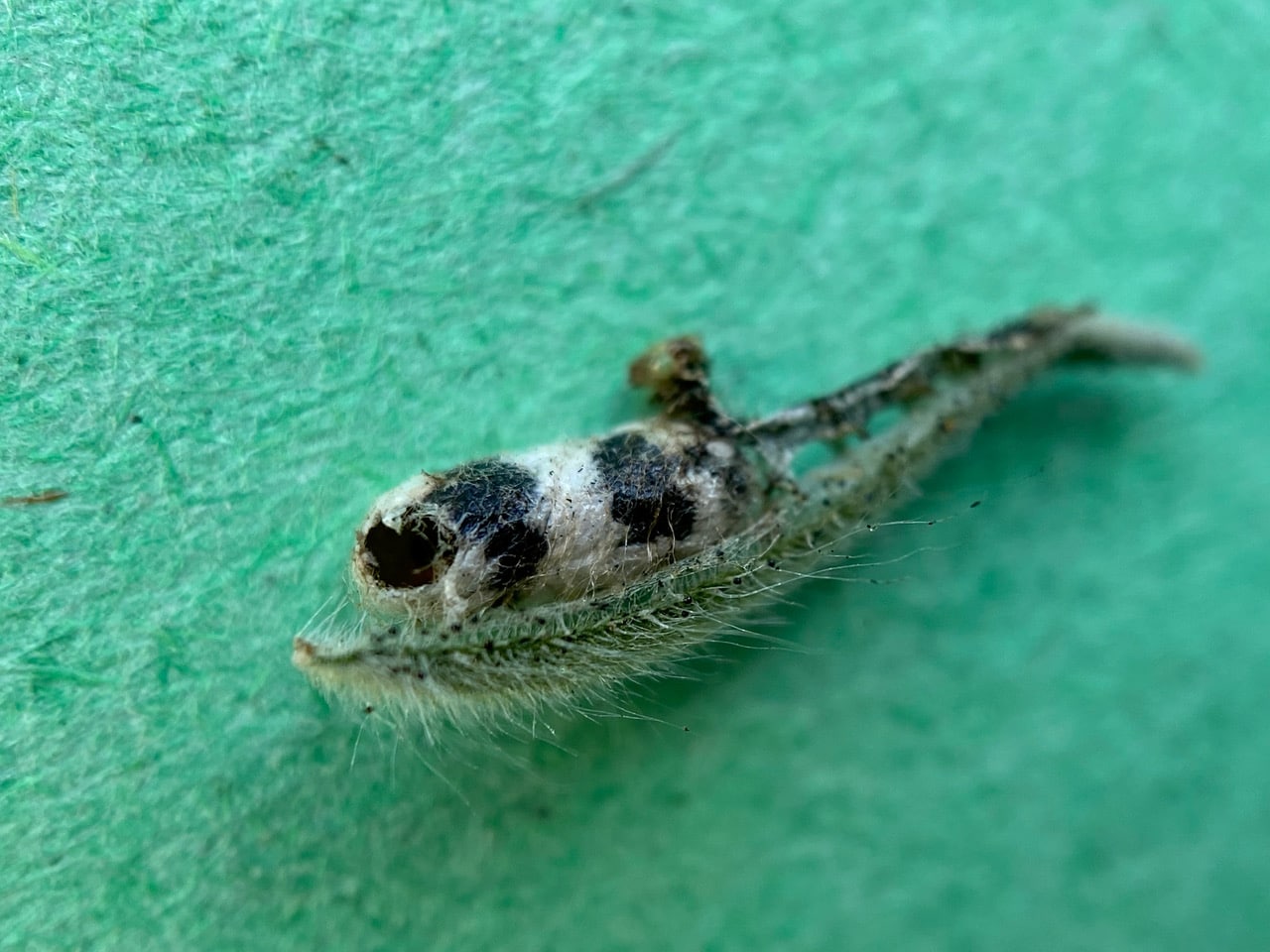
A big round hole has appeared on one end of the wasp cocoon I have kept in a ventilated glass vial since 7/28/23. Apparently the parasitoid wasp, Hyposoter sp. (family Ichneumonidae) has emerged, but it’s nowhere to be found in the vial. It has escaped, probably because the gauze plug had a gap. Bummer! Time to collect another cocoon!
Hyposoter is a large cosmopolitan genus of parasitoid wasps belonging to the family Ichneumonidae. Obvious evidence that Hyposoter is present is its black-and-white pupal cocoon. These commonly occur on foliage attached to the shriveled skin of the caterpillar in which the parasitoid fed during its larval stage.
Hyposoter undergoes complete metamorphosis. The adult wasp lays its egg in the caterpillar. After hatching, the larva feeds inside on the caterpillar’s hemolymph (blood) while developing through three, increasingly larger instars. The wasp larva then feeds on the caterpillar’s tissues consuming the entire body except for the skin and head capsule. The host caterpillar shrinks and becomes a hard and brittle, shriveled skin. The parasitoid emerges from the host skin as a mature third instar (prepupa). The wasp then spins a silken cocoon commonly attached to the dead caterpillar’s skin. The cocoon is about 1/4 in. long, oblong with dense white silk and blackish patches. Parasite development time from oviposition until adult emergence is about one month. There may be several generations per year. Hyposoter is used in the biological control of caterpillars in many crops.
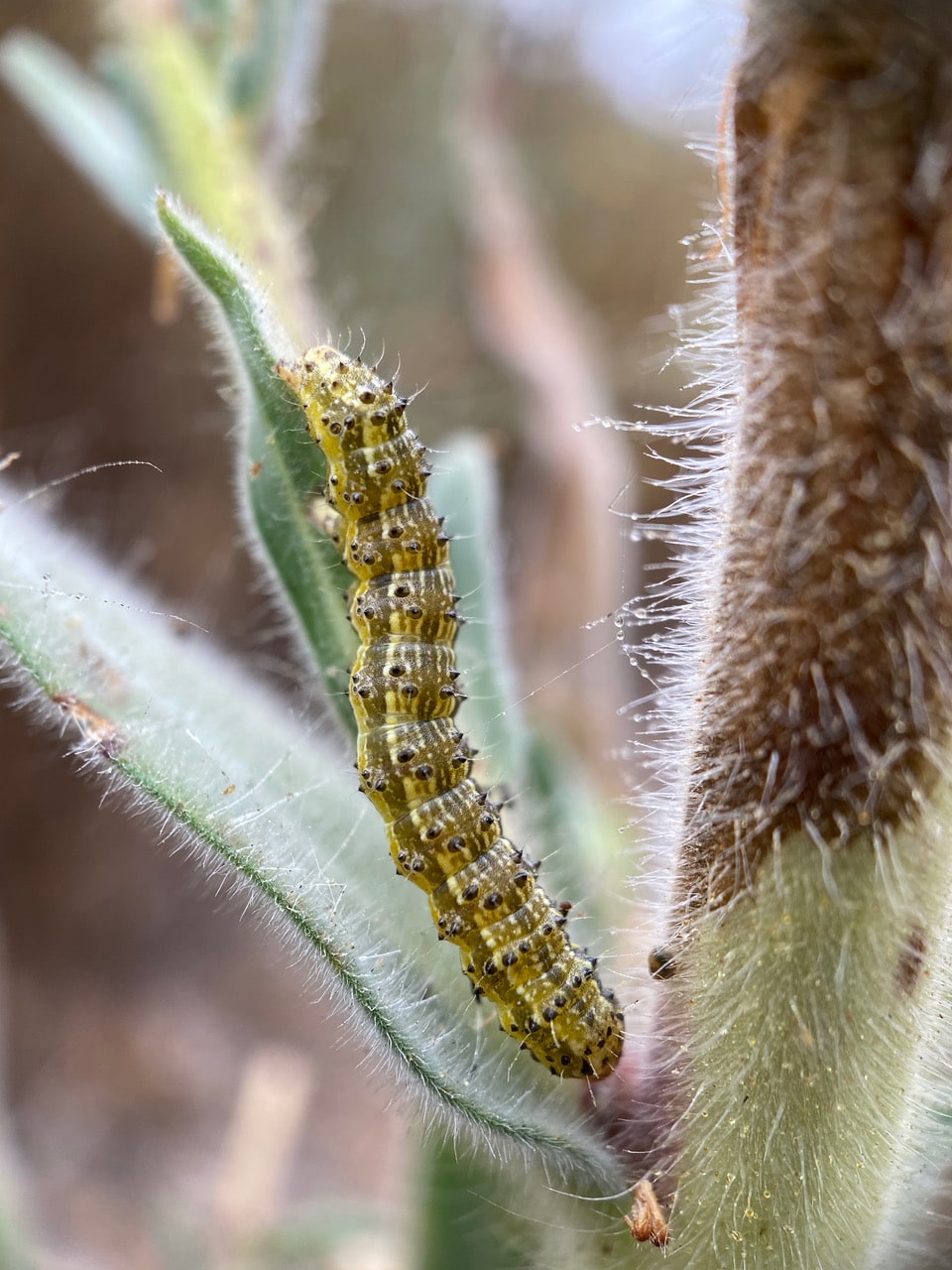
Another sticky venture into the tarweed patch at Siesta Gate. There are still plenty of caterpillars on the tarweed, but much fewer than before. The wasp cocoons prove to be a challenge to find today. Maybe most of the wasps have emerged, and the spent cocoons have dropped off the plants?
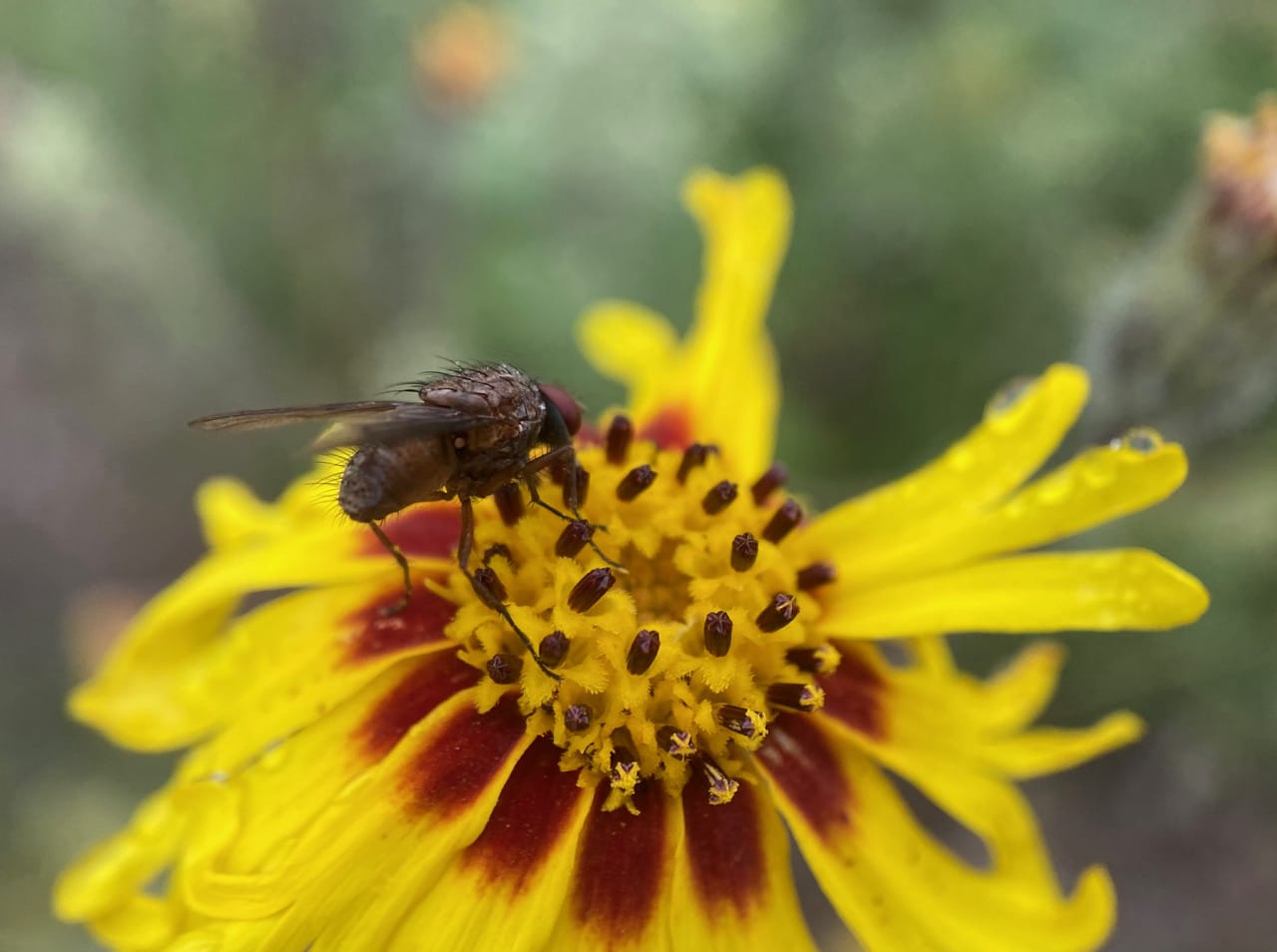
A dark brown fly lands on an Elegant Tarweed flowerhead to feed.
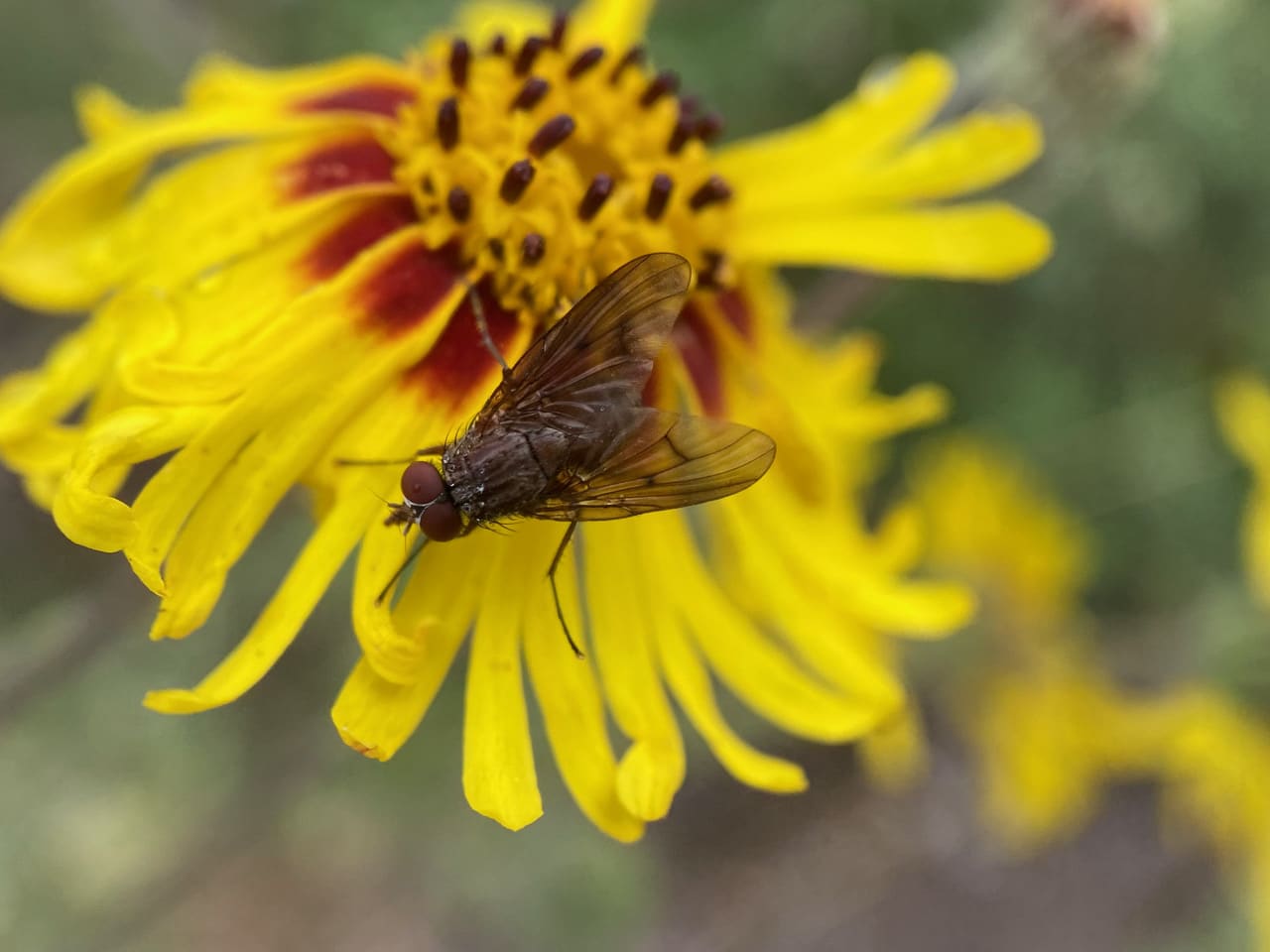
Everything about the fly is dark, including its wings.
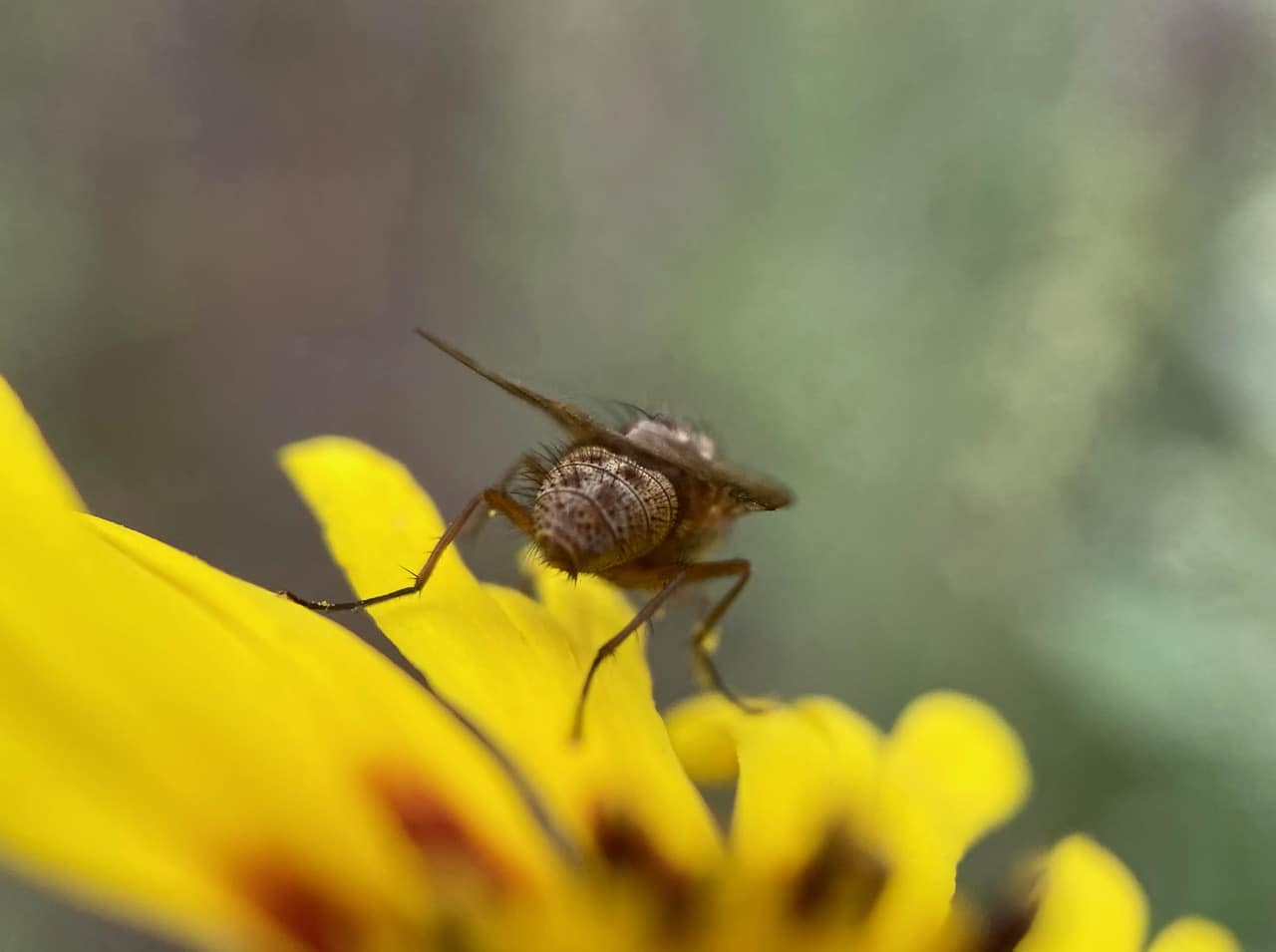
As is the usual case with flies, this one can only be identified to the superfamily level – Muscoid Fly (superfamily Muscoidea).
Muscoidea are calyptrate (possessing calyptra). Muscoidea, with about 7,000 described species, is nearly 5% of the known species level diversity of the Diptera, the true flies. Most larvae of muscoid flies are saprophagous (feeding on decaying matter), coprophagous (feeding on dung) or necrophagous (feeding on carrion). They are the unsung heroes – the decomposers/recyclers of organic matter in the ecosystem.
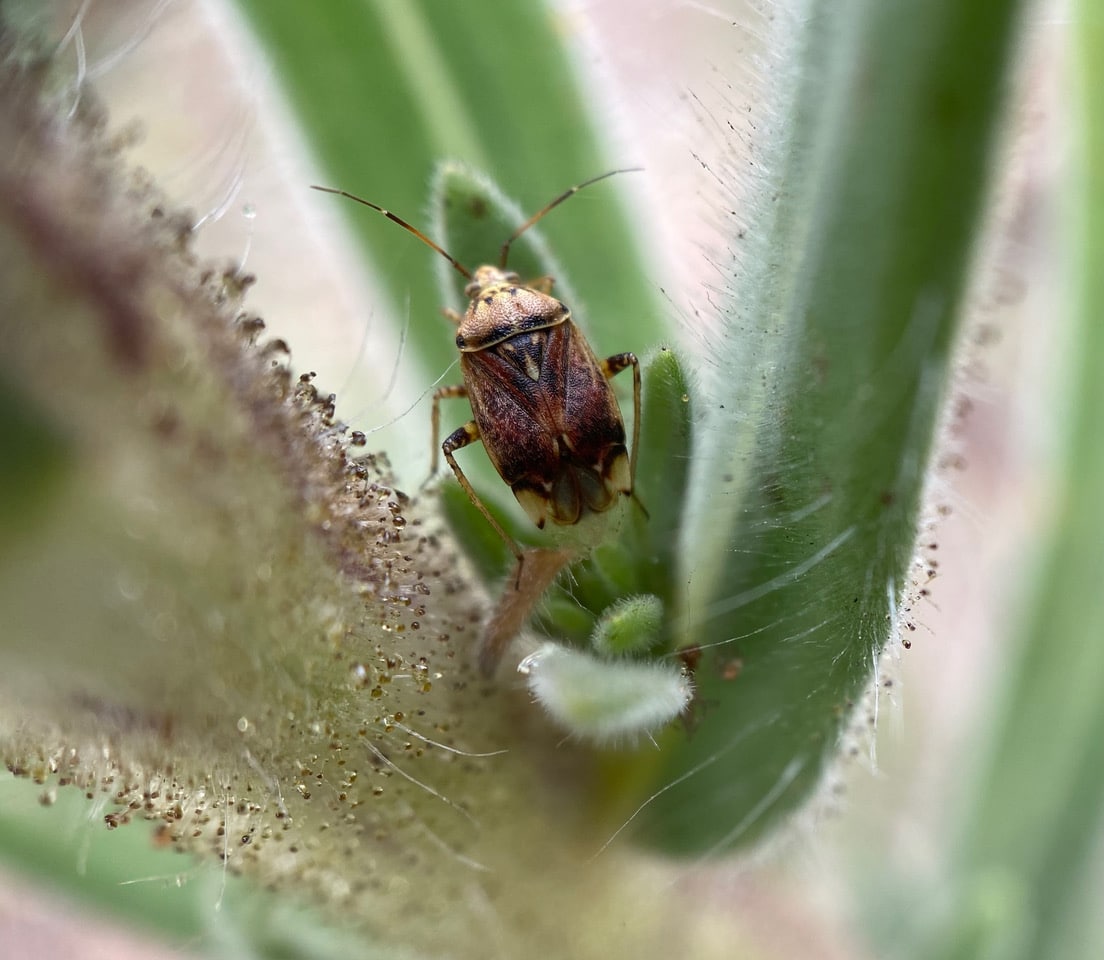
That looks like an unusual Lygus Bug! It is a European Tarnished Plant Bug, Lygus rugulipennis (family Miridae).
The term lygus bug is used for any member of the genus Lygus, in the family of plant bugs, Miridae. Adult lygus are approximately 3 mm wide and 6 mm long, colored from pale green to reddish brown or black. They have a distinctive triangle or V-shape on their backs. Lygus bugs are known for their destructive feeding habits – they puncture plant tissues with their piercing mouthparts, and feed by sucking sap. Both the physical injury and the plant’s own reaction to the bug’s saliva cause damage to the plant. Many lygus bugs are well-known agricultural pests.
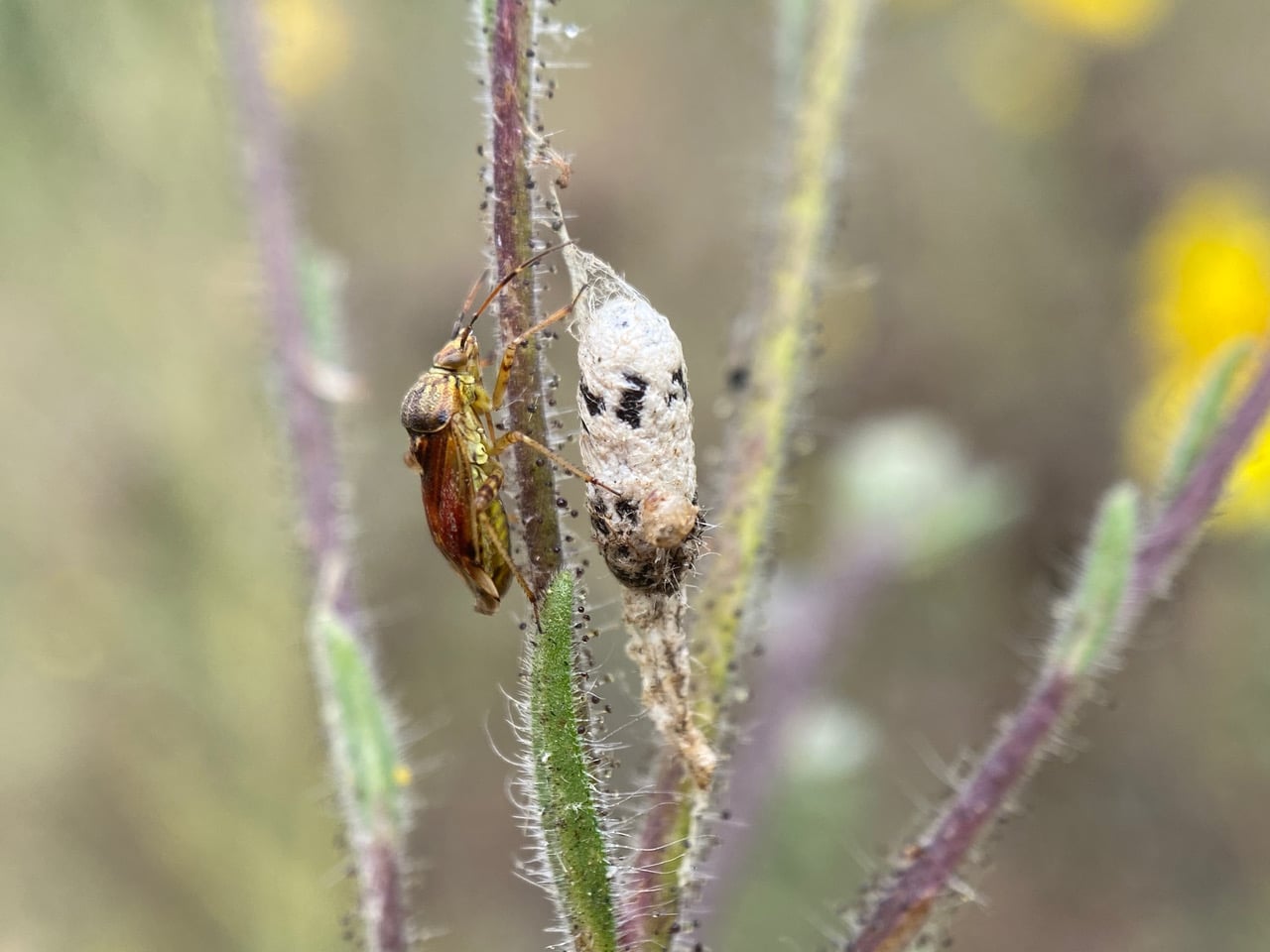
Ha, here’s a Hyposoter cocoon! But what’s that Lygus Bug doing standing over it? Lygus Bugs are plant bugs that feed on plant sap.
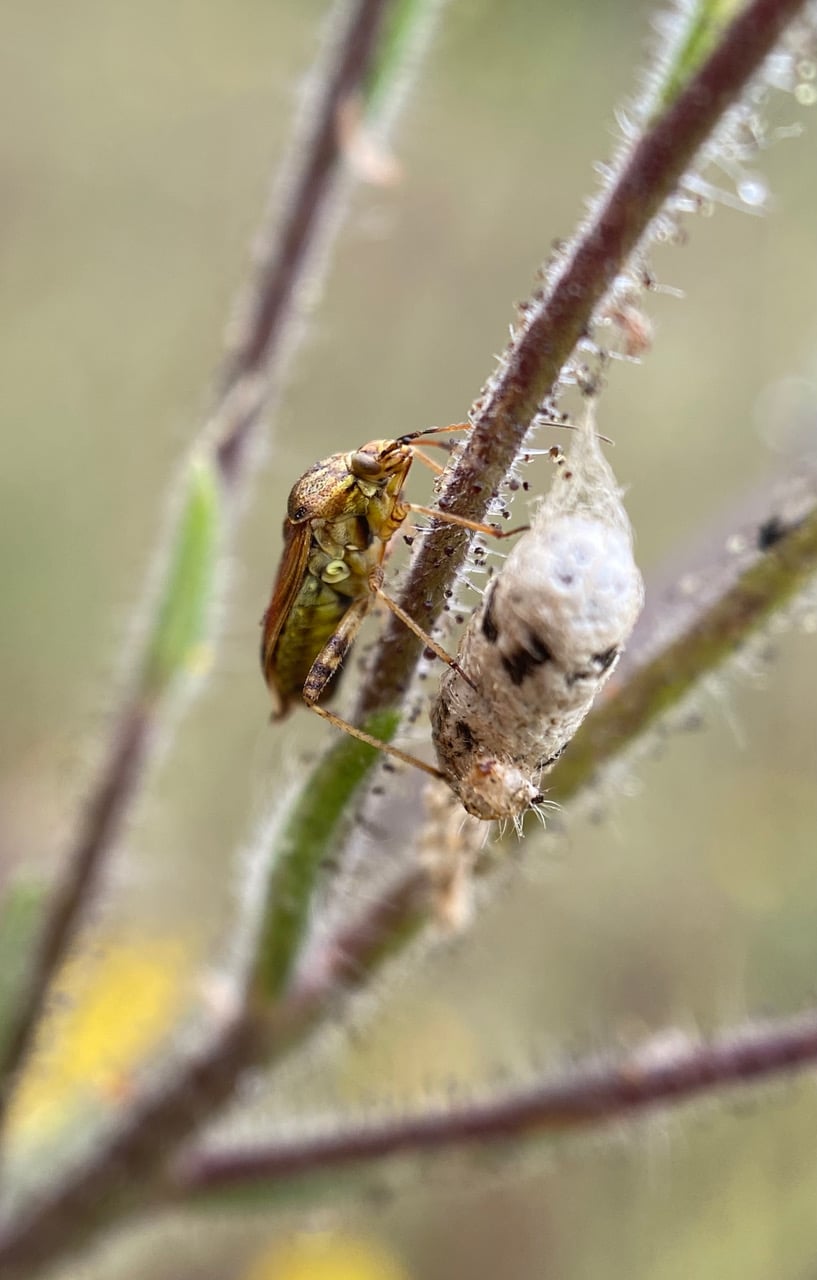
I take a closer look to ascertain that the bug is not feeding on the wasp pupa. Indeed it is not, as its rostrum (piercing-sucking mouthpart) is folded under its body. Most Lygus Bugs I find on the tarweeds are very skittish, but this one stands its ground and would not leave the wasp cocoon. I have to nudge it away with a piece of grass before I can collect the pupa. Such puzzling behavior!
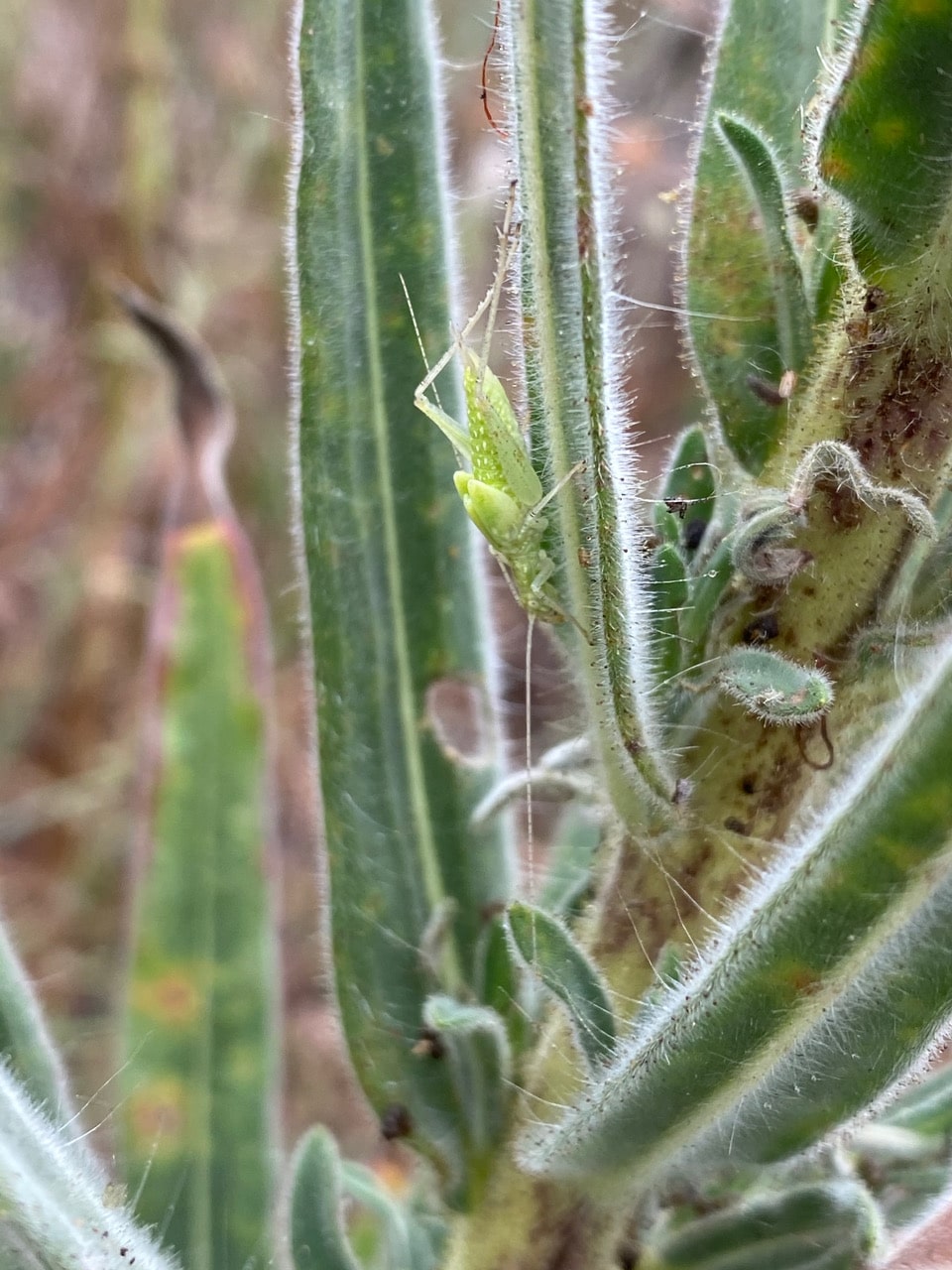
Wait, there’s something light green that stands out among the darker leaves of Elegant Tarweed. It is a nymphal Common Tree Cricket, Oecanthus sp. (family Gryllidae). Note the prominent wing pads of this juvenile.
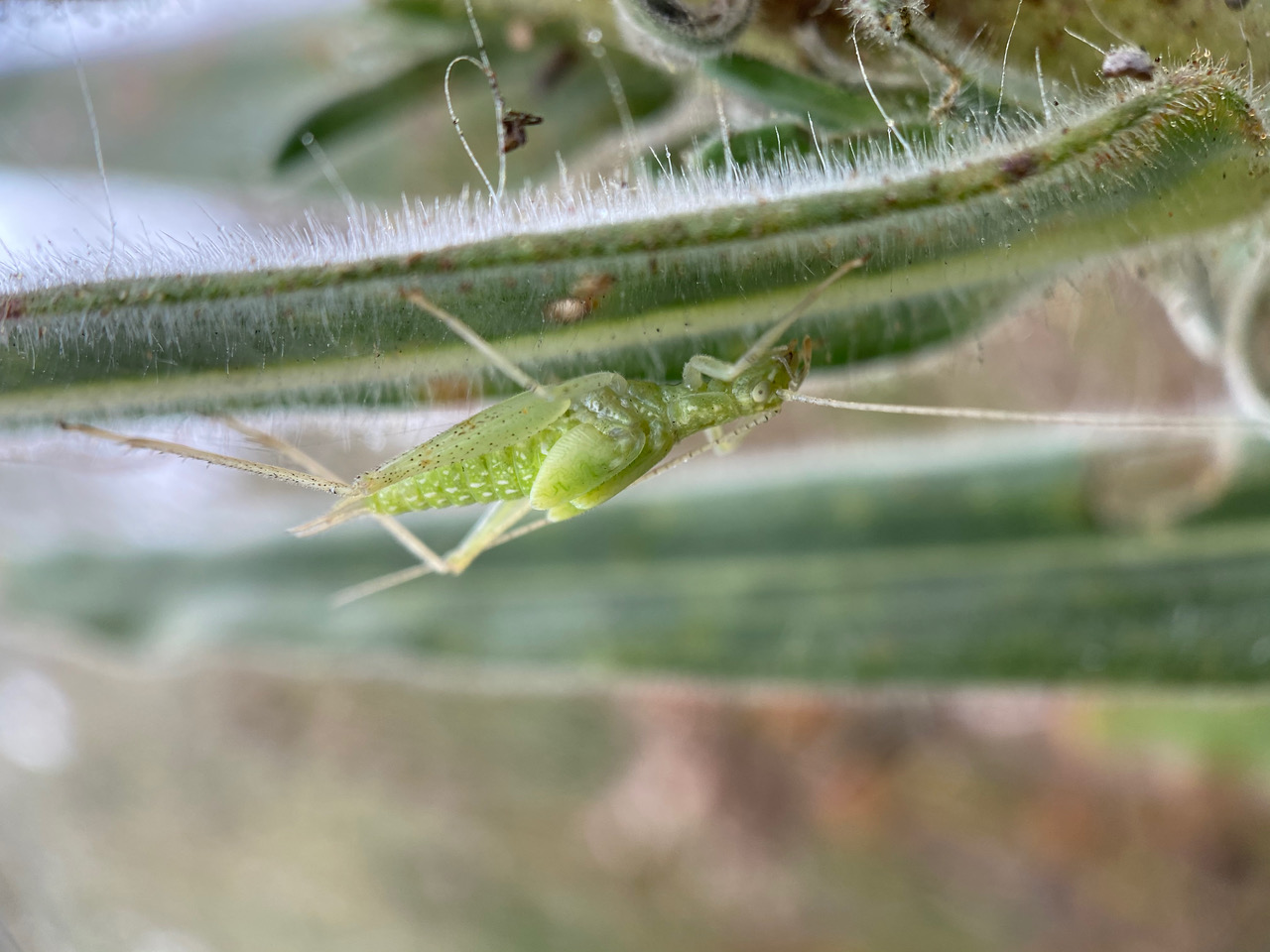
Common Tree Crickets, Oecanthus sp. (family Gryllidae, order Orthoptera) are delicate whitish or pale green insects with slender bodies, long antennae and transparent forewings. More often heard than seen, tree crickets are active at dusk and at night. In late summer, males produce a high-pitched whine or “song”, a prelude to courtship and mating. Sound is produced by stridulation; the basal edge of one forewing (scraper) is rubbed along a filelike ridge (file) on the ventral side of the other forewing. Other members of the Orthoptera, including katydids and horned grasshoppers also produce sound by the file and scraper method.
These insects are called tree crickets because many species hang out in trees. They are in the order Orthoptera (crickets, katydids, grasshoppers, etc.) and in the “true cricket” family Gryllidae. The tree crickets undergo a paurometabolous development (gradual metamorphosis). Nymphs resemble small adults and gradually develop external wing buds.
Tree Crickets inhabit trees, shrubs and tall weeds, feeding on plant parts, some insects (e.g., aphids, scales) and other materials (e.g., fungi, pollen). Egg laying activities can affect plant health by injuring growth on twigs and branches or introducing plant pathogens.
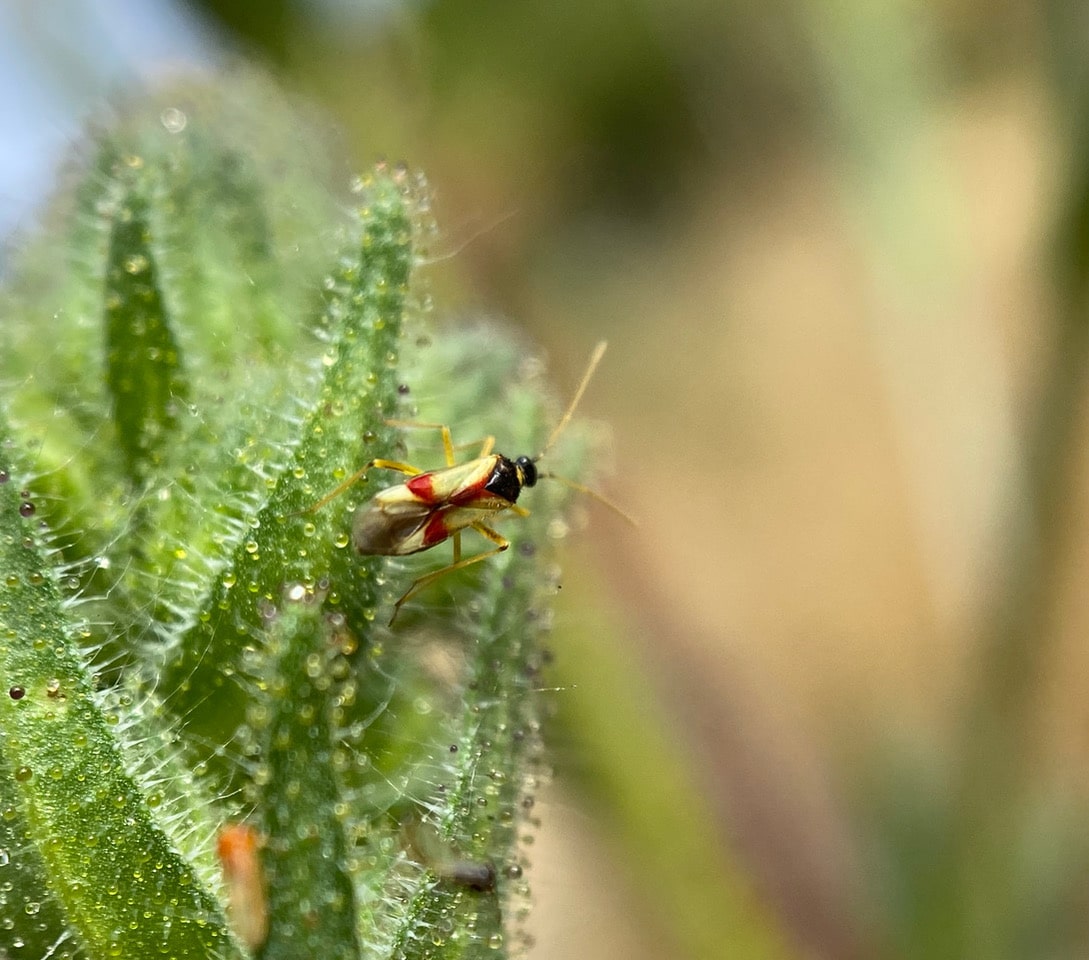
Ooh, here’s a Phacelia Plant Bug, Tupiocoris californicus (family Miridae) walking on the bracts of a flowerhead of Coast Tarweed, Madia sativa. Sometimes I wonder if the common name isn’t a misnomer. I have never seen this bug on Phacelia, but have only found it on the tarweeds. In fact, it is one of the guild of bugs that are specialized for living on sticky plants. It can navigate the glandular hairs with the greatest of ease.
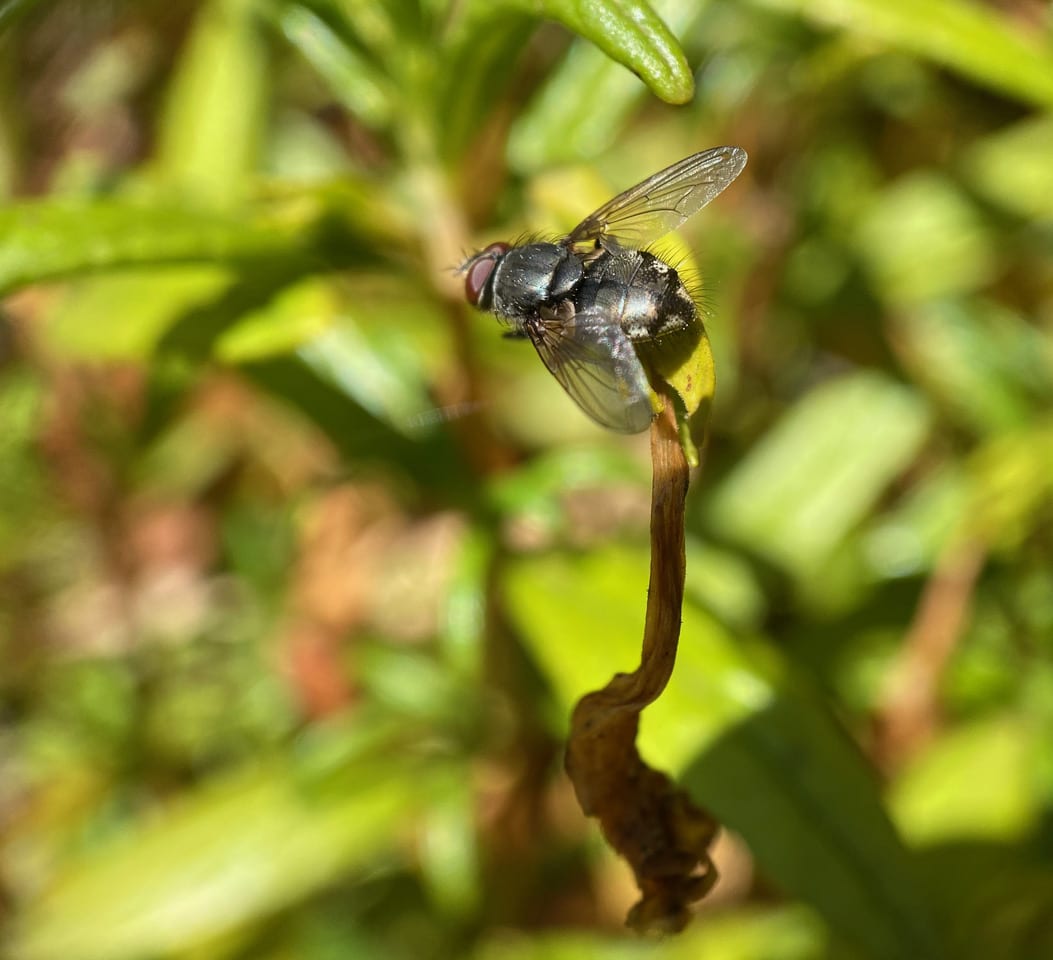
A Cluster Fly (family Polleniidae) lands on a spent flower of Sticky Monkeyflower, its exoskeleton shining like a medieval armor. The large fly is still recognizable by its size and rounded abdomen, even though it has lost all the golden hairs on its thorax.
Called the Common Cluster Fly, Pollenia rudis (family Polleniidae) is slightly larger than house flies. It is dull gray with checkered black and silvery-black abdomens. A newly emerged fly has many golden hairs on its thorax which may be lost throughout the life of the fly. The common name comes from the tendency of the flies to aggregate near windows when they are trapped in human dwellings. The immature stages – eggs and larvae – are seldom seen because they are deposited on the soil where they burrow into earthworms which they parasitize. The Cluster Fly is a European species. They may have found their way to America in the ballast of ships containing soil, probably along with introduced earthworms.
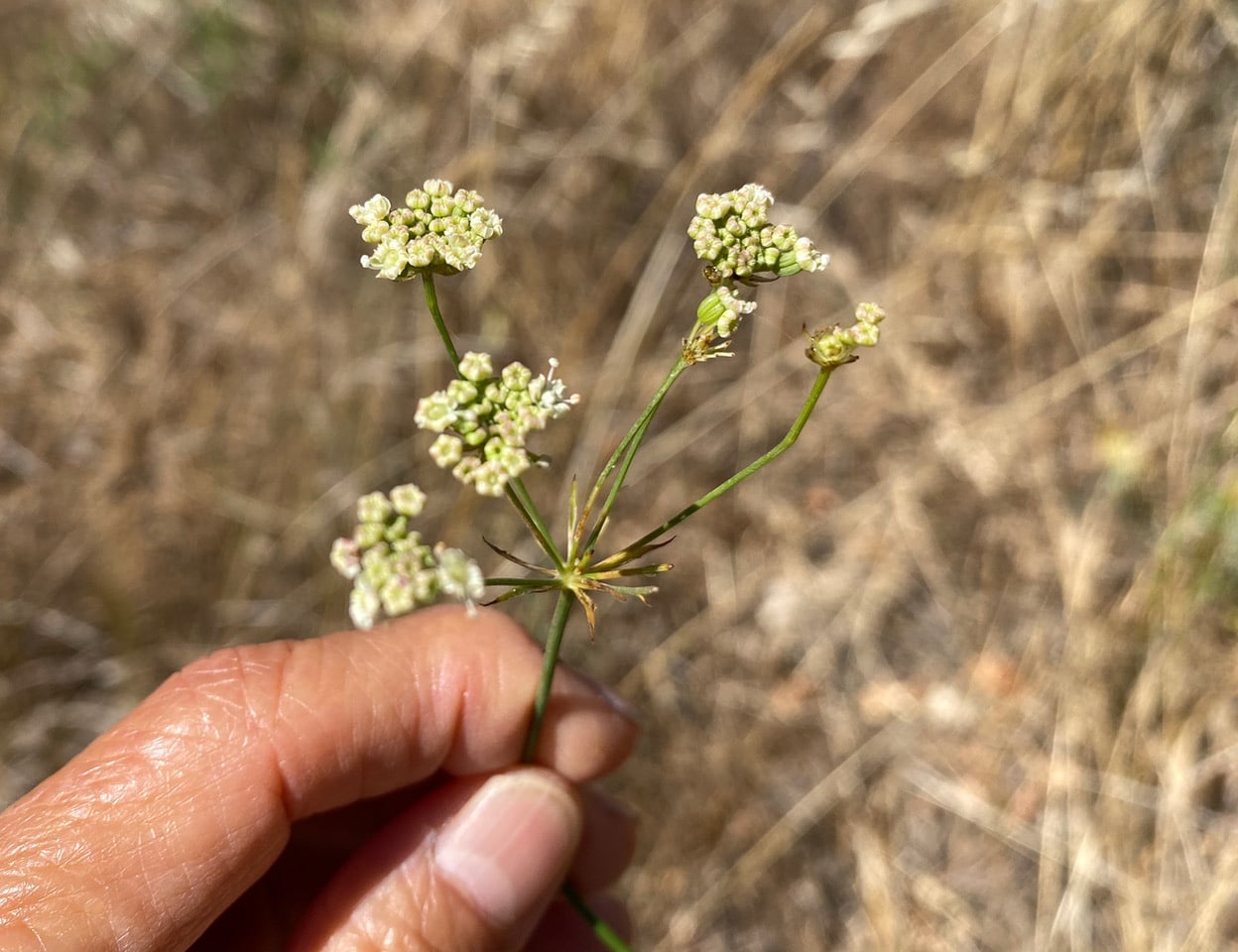
At Yampah Bowl, I stop to check for the little Anise Swallowtail caterpillar. Alas, it is no longer on its Yampah umbel. It has eaten a few of the smaller clusters, but there’s still more flowers left. The caterpillar is nowhere to be found. There’s no reason for the caterpillar to leave this plant while there’s still food for it. It must have been taken by a predator, such as a Yellowjacket.

Yellowjacket wasps are frequently seen on the Yampah, Perideridia californica, either taking nectar, or hunting for prey.
Yellowjacket is the common name for predatory social wasps of the genera Vespula and Dolicovespula. Yellowjackets are social hunters living in colonies containing workers, queens, and males (drones). Colonies are annual with only inseminated queens overwintering. Queens emerge during the warm days of late spring or early summer, select a nest site, and build a small paper nest in which they lay eggs. They raise the first brood of workers single-handedly. Henceforth the workers take over caring for the larvae and queen, nest expansion, foraging for food, and colony defense. The queen remains in the nest, laying eggs. Later in the summer, males and queens are produced. They leave the parent colony to mate, after which the males quickly die, while fertilized queens seek protected places to overwinter. Parent colony workers dwindle, usually leaving the nest to die, as does the founding queen. In the spring, the cycle is repeated.
Yellowjackets have lance-like stingers with small barbs, and typically sting repeatedly. Their mouthparts are well-developed with strong mandibles for capturing and chewing insects, with probosces for sucking nectar, fruit, and other juices. The Western Yellowjackets typically build nests underground, often using abandoned rodent burrows. The nests are made from wood fiber that the wasps chew into a paper-like pulp. The nests are completely enclosed except for a small entrance at the bottom. The nests contain multiple, horizontal tiers of combs within. Larvae hang within the combs.
 A Sweat Bee (family Halictidae) is foraging on a cluster of Yampah flowers. Note the three ocelli or simple eyes on top of her head.
 Many insects have two kinds of eyes – simple and compound. Simple eyes – ocelli (singular – “ocellus”) are “stand-alone” eyes made up of a single lens. They detect motion and light (including UV light) but do not form images. Ocelli help the insect orient in flight, enabling it to find the direction they want to go, relative to the sun.
The two large eyes are the compound eyes. Compound eyes are essentially a bundle of narrow, wedge-shaped tubes called ommatidia (seen on the surface as facets), each with a lens/cornea and photoreceptors. As with human eyes, information from each eye is resolved into a single image in the brain.
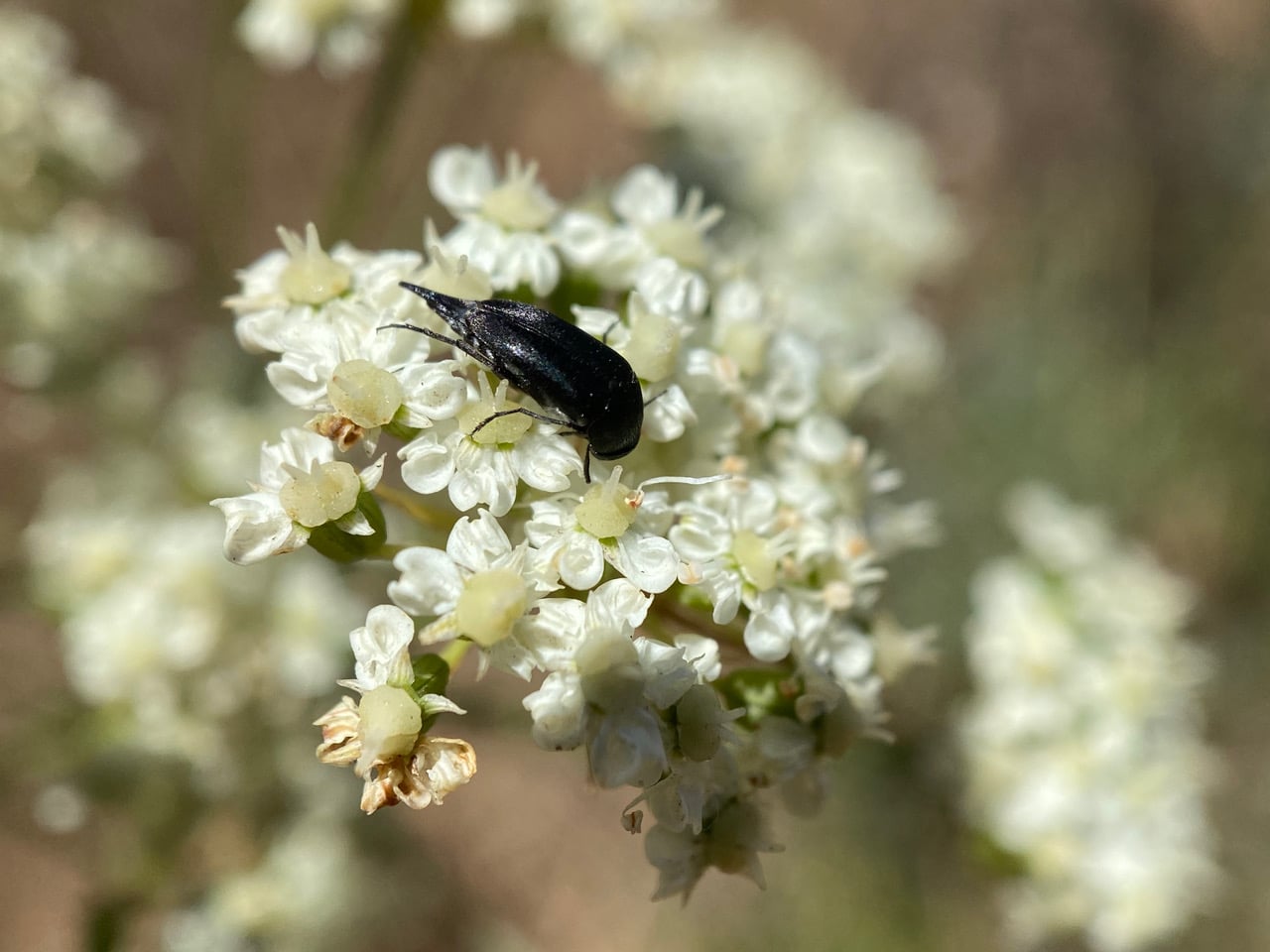
The ubiquitous Tumbling Flower Beetles (family Mordellidae) is commonly found wherever there’s a concentration of pollen. Small, tightly clustered flowers that offer generous pollen are their favorite. Yampah fits the bill. So do Buckwheats, Yarrow, Milkweeds….
The Tumbling Flower Beetles (family Mordellidae) are named for the characteristic irregular movements they make when escaping predators. They are also sometimes called Pintail Beetles for their abdominal tip which aids them in performing these tumbling movements. Mordellids are small, wedge-shaped, hump-backed beetles with head bent downward. The body is densely covered with fine silky hairs, usually black, but often very prettily spotted or banded with silvery hues. The adults feed on pollen, occurring on flowers or on dead trees, flying or running with rapidity. The larvae live in old wood or in the pith of plants, and those of some species are said to be carnivorous, feeding on the young of Lepidopterans and Diptera which they find in the plant stems.
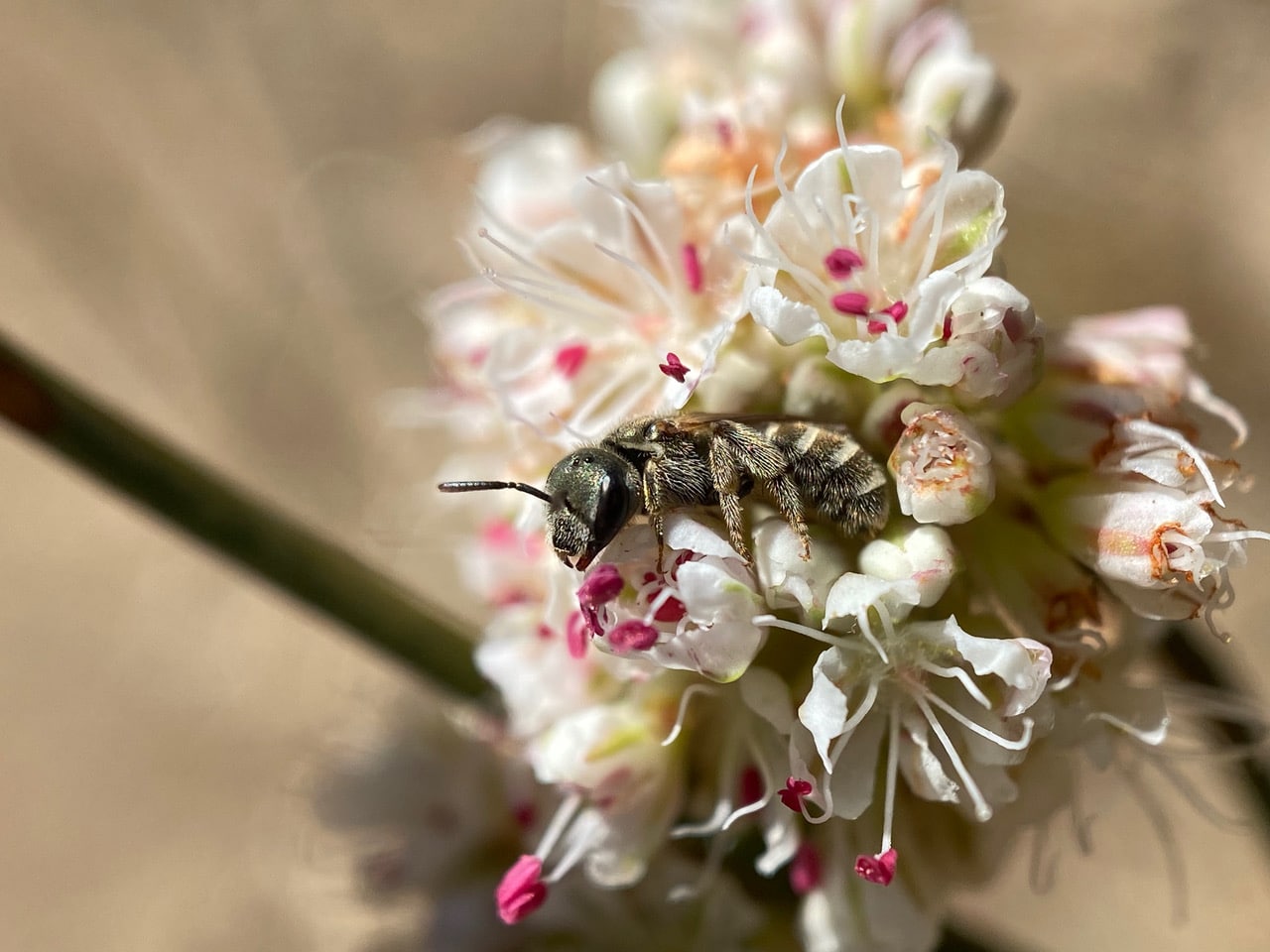
A Sweat Bee, Halictus sp. (family Halictidae) is resting motionless among the flowers of a Nude Buckwheat, Eriogonum nudum. She has not been collecting pollen – her scopae are empty. Not a hair out of place, she looks pristine. Is she freshly emerged? Halictidae exhibit a wide range of life histories and social behaviors. The social species are mostly generalists that enjoy a long season, continuously producing new workers through the seasons.
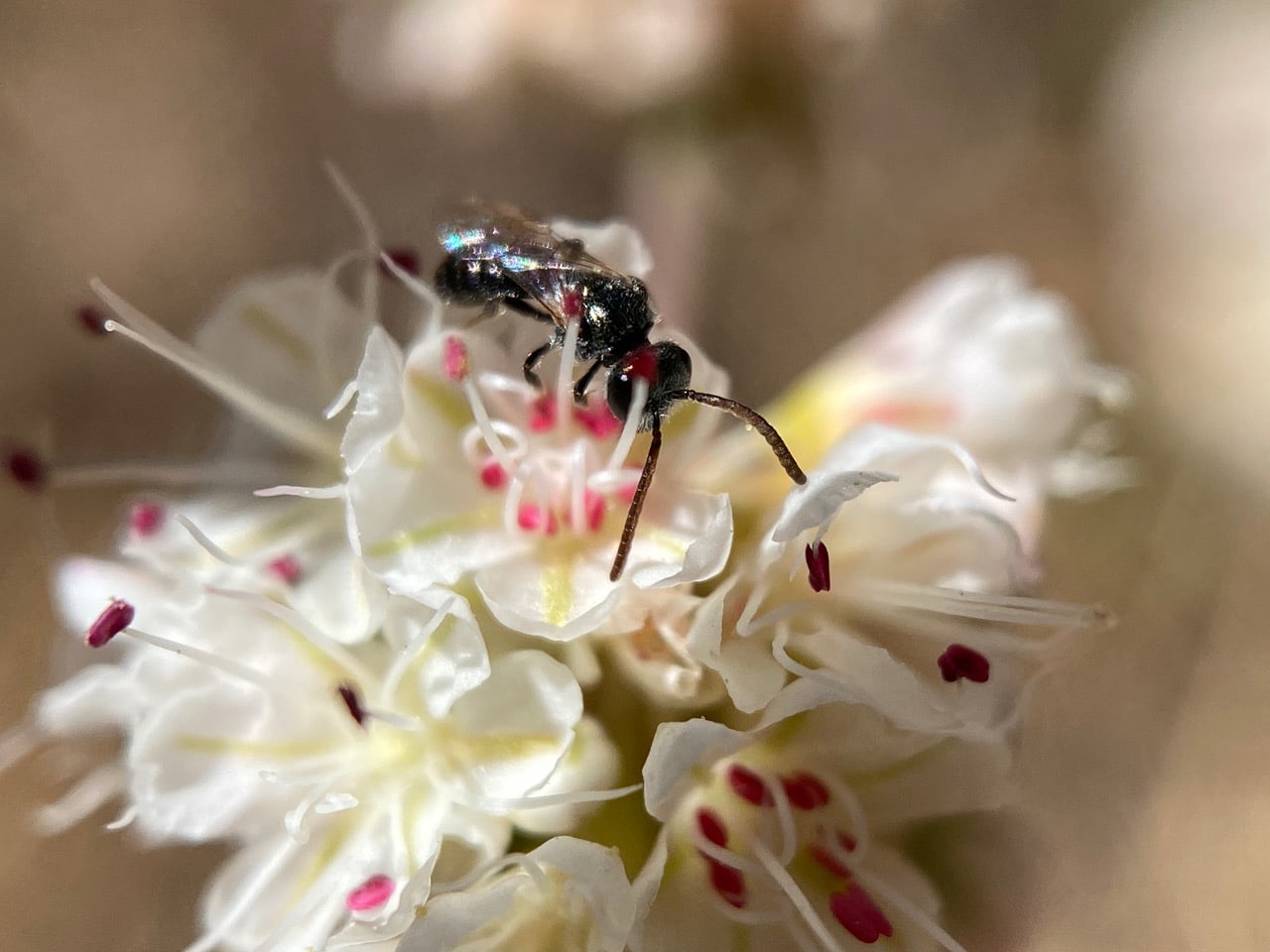
Ooh, here’s another, much smaller Sweat Bee! The diminutive size and the high shine are suggestive of the Metallic Sweat Bee, Lasioglossum (Dialictus) sp. (family Halictidae). This individual with extra long antennae is probably a male.
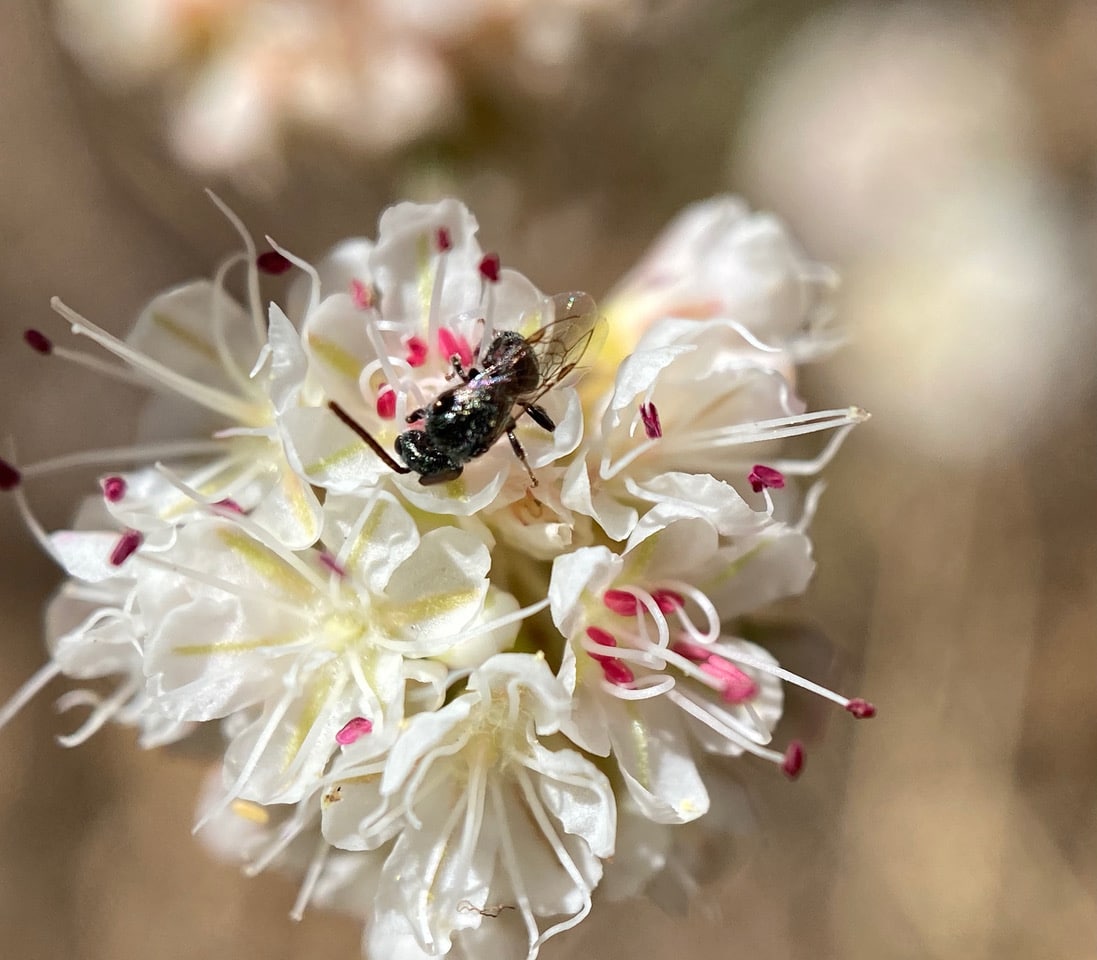
Lasioglossum species are found worldwide, and they constitute the largest bee genus. The subgenus Dialictus are the most likely to be seen in the U.S., with over 300 species of these tiny metallic bees. The majority of Lasioglossum are generalists. Because they are so abundant throughout the flowering season, the bees are often important pollinators. Their sheer numbers are enough to achieve excellent pollination of many wild flowers, especially of plants in the Asteraceae, which have shallow floral tubes that are easily accessed by these minute bees.

Hunched over an open flowerhead of California Everlasting, Pseudognaphalium californicum, a Black-backed Grass Skimmer, Paragus haemorrhous (family Syrphidae) is feeding on the flowers.
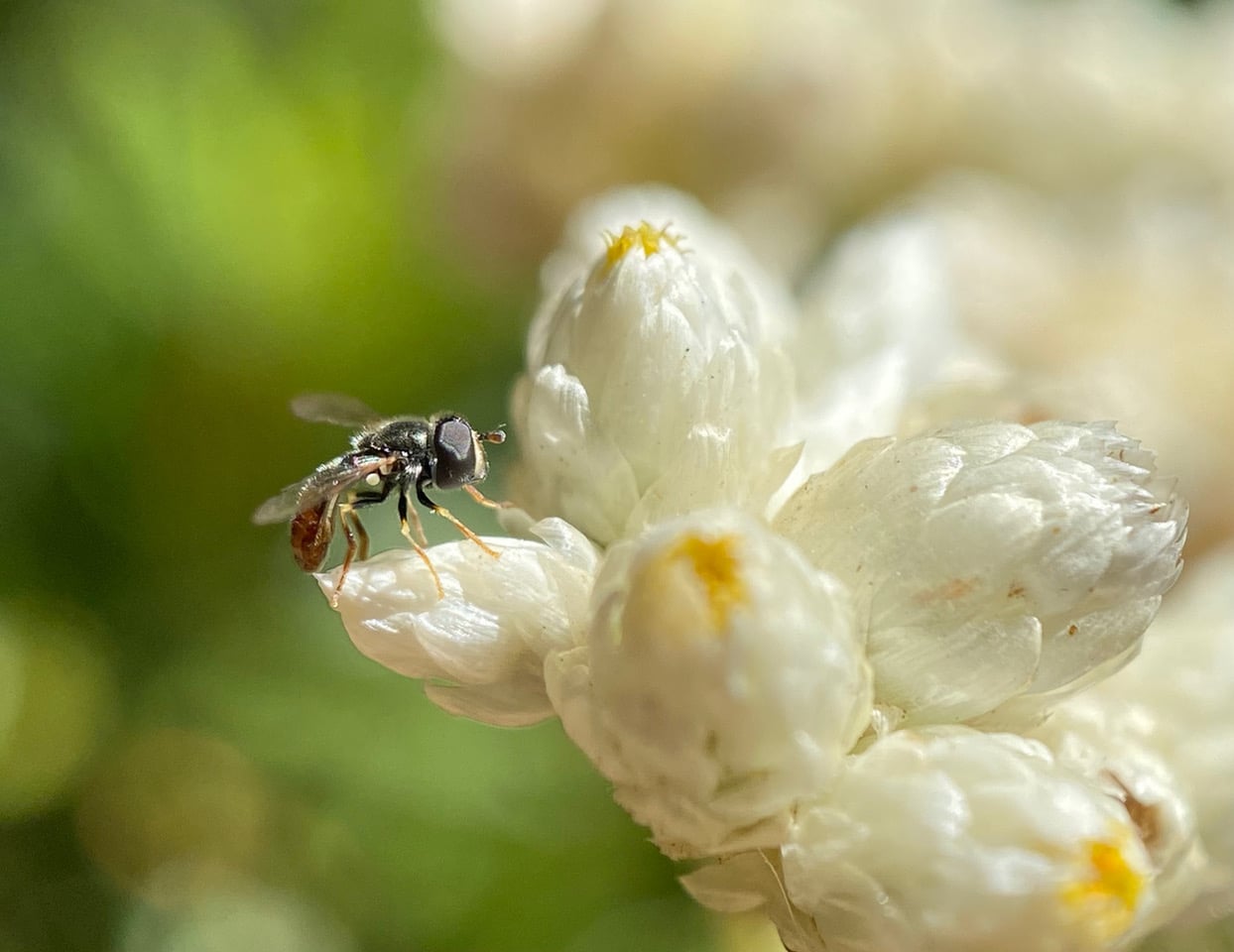
Paragus haemorrhous (family Syrphidae) is the smallest hover fly species in the garden, measuring only 4 mm in length. The species has a world-wide distribution, found in unimproved grassland, dune grass, open areas and pathsides in forest, and meadows. Adults visit flowers for nectar and pollen. Larvae feed on aphids on low herbaceous plants.
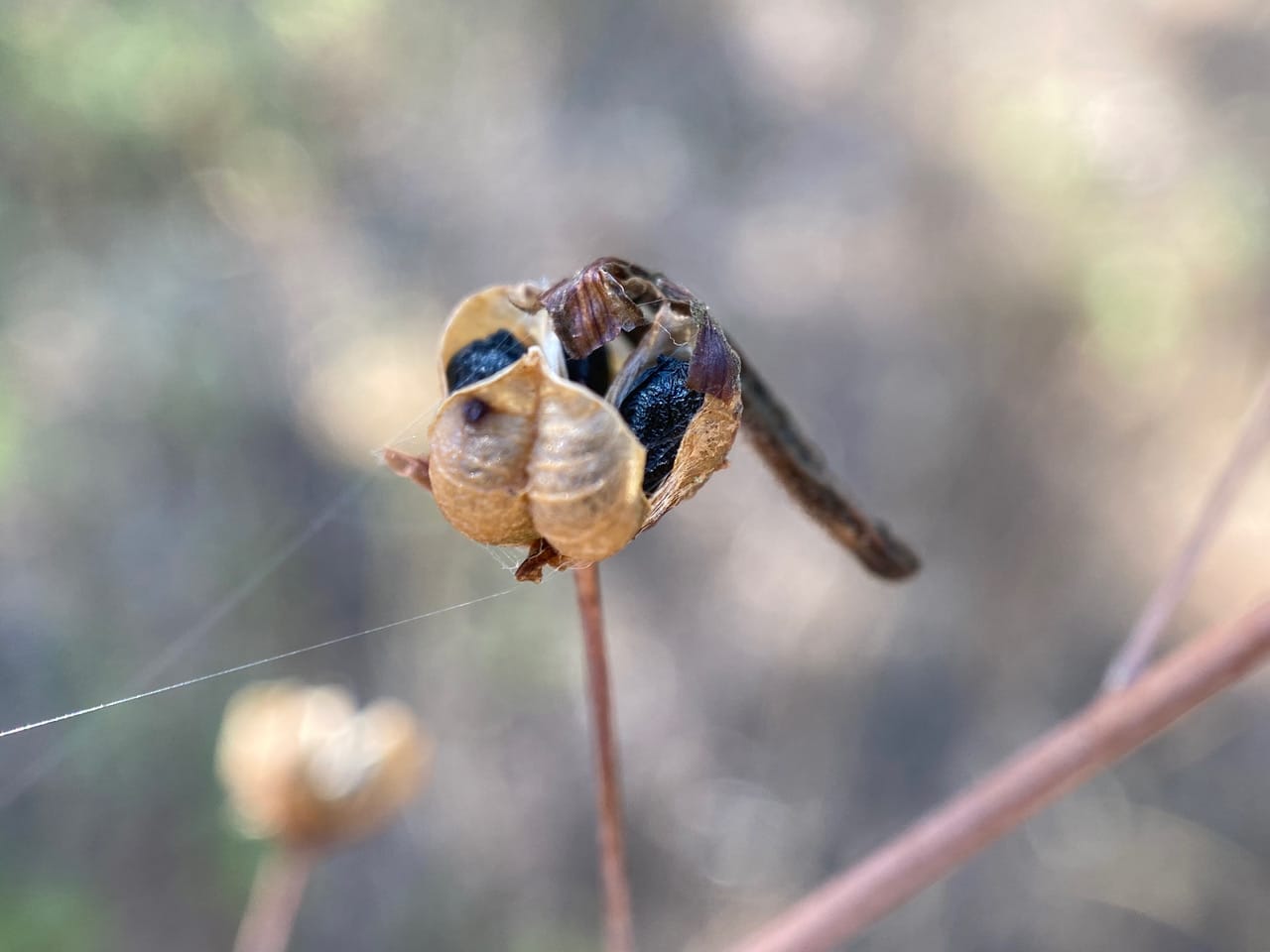
Passing the tall Soap Plant, Chlorogalum pomeridianum, I pause to say hello to the Two-tubercled Orb-weaver Spider. Alas, she’s no longer on her seed capsule, or any other seed capsule today. She must have gone off to lay her eggs, as most female spiders do at the end of their life. I miss her already.
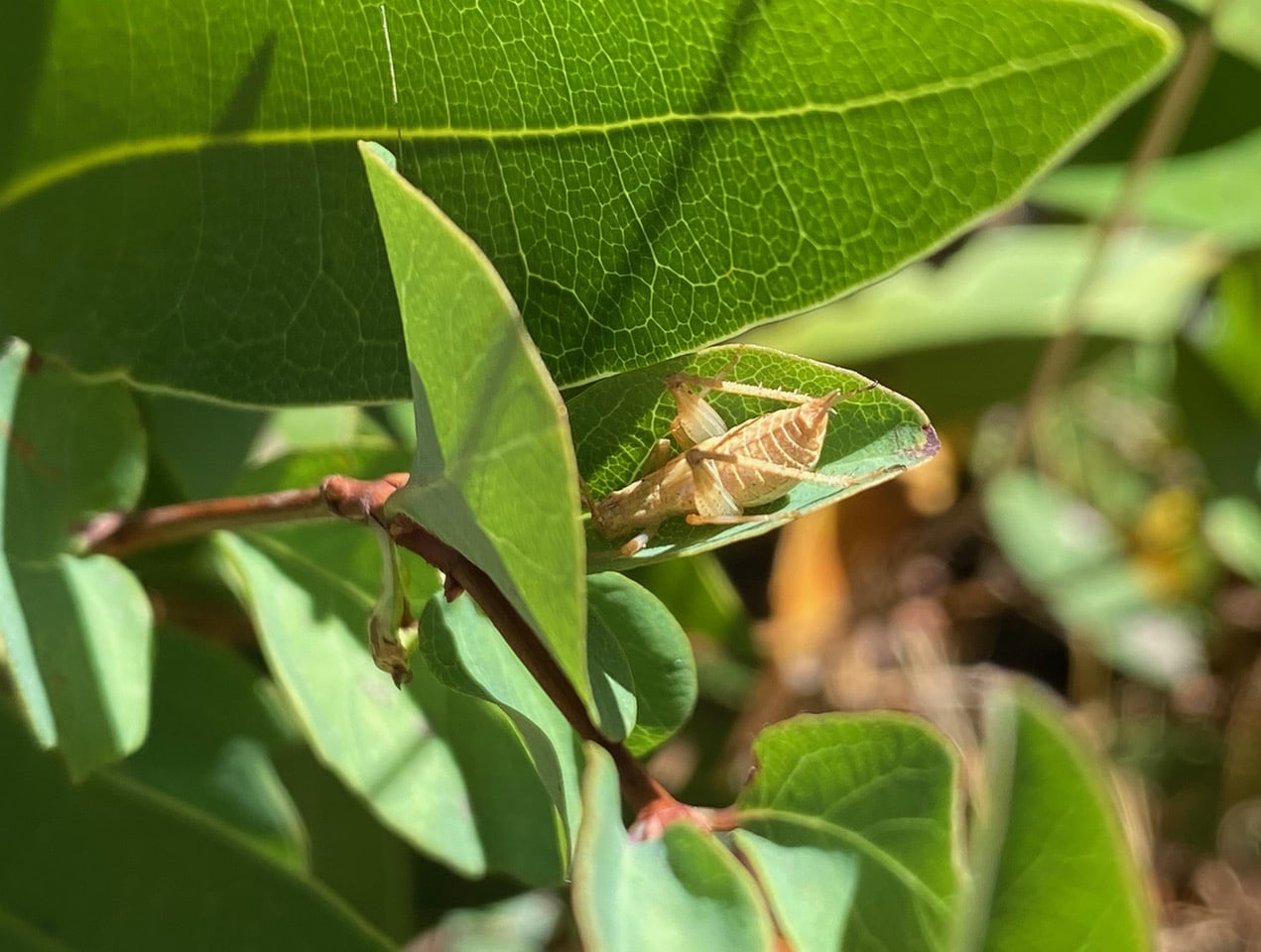
Ooh, under a Bay Tree, a Common Tree Cricket, Oecanthus sp. (family Gryllidae) is resting on a leaf of Snowberry, Symphoricarpos albus.

The Tree Cricket suddenly leaps off the leaf onto the ground. It is a juvenile Western Tree Cricket, Oecanthus californicus (family Gryllidae), still sporting wing buds.
Common Tree Crickets, Oecanthus sp. are delicate whitish or pale green insects with slender bodies, long antennae and transparent forewings. They are in the order Orthoptera (crickets, katydids, grasshoppers, etc.) and in the “true cricket” family Gryllidae. The tree crickets undergo a paurometabolous development (gradual metamorphosis). Nymphs resemble small adults and gradually develop external wing buds. They live in the same habitat as adults, and typically take the same food. Tree Crickets inhabit trees, shrubs and tall weeds, feeding on plant parts, some insects (e.g., aphids, scales) and other materials (e.g., fungi, pollen). Egg laying activities can affect plant health by injuring growth on twigs and branches or introducing plant pathogens.
More often heard than seen, tree crickets are active at dusk and at night. In late summer, males produce a high-pitched whine or “song”, a prelude to courtship and mating. Sound is produced by stridulation; the basal edge of one forewing (scraper) is rubbed along a filelike ridge (file) on the ventral side of the other forewing. Other members of the Orthoptera, including katydids and horned grasshoppers also produce sound by the file and scraper method.

A Silver-banded Hover Fly, Pseudoscaeva diversifasciata (family Syrphidae) is feeding on pollen on a flowerhead of weedy Bristly Oxtongue, Picris echioides.
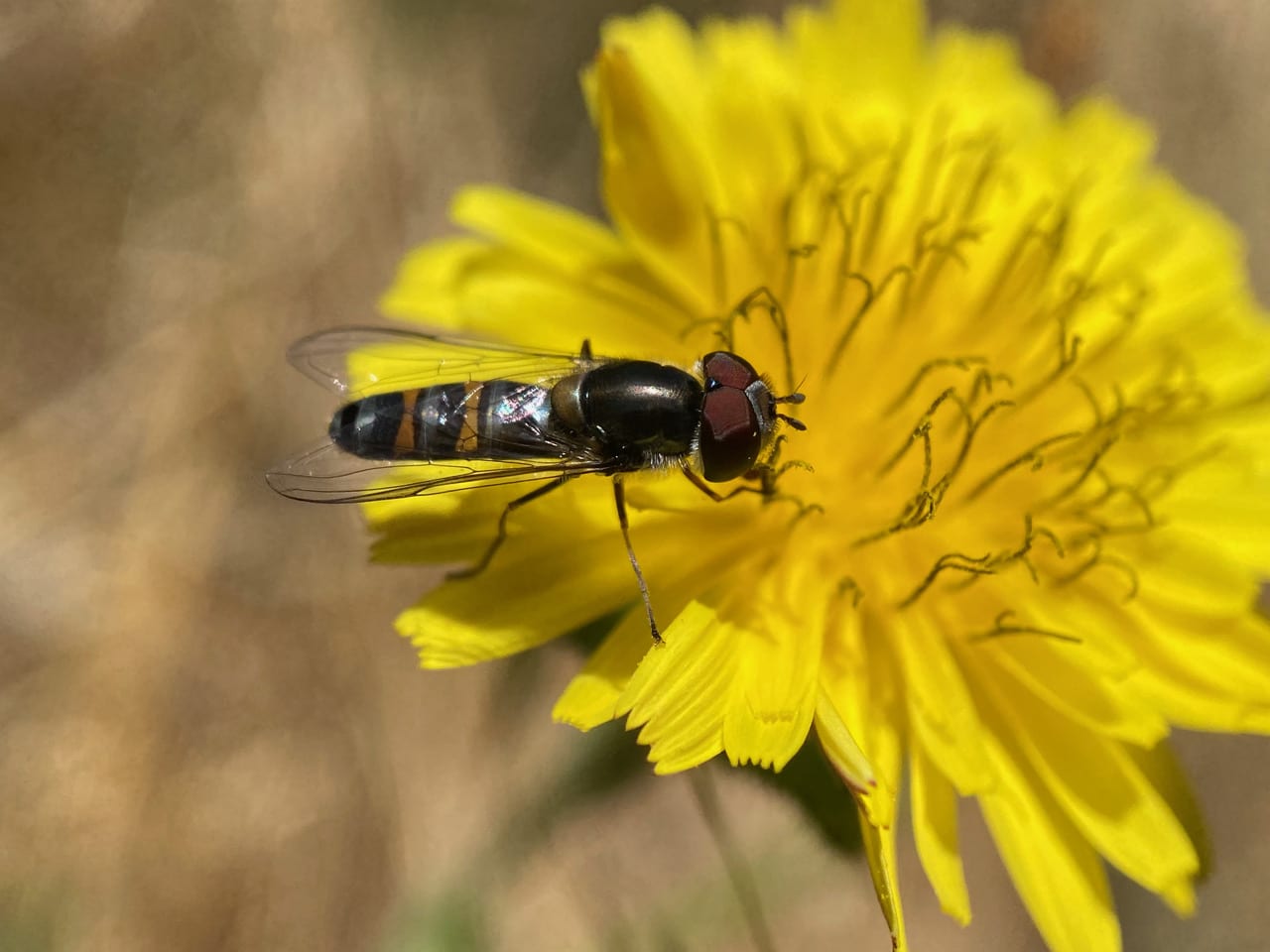
The Silver-banded Hover Fly, Pseudoscaeva diversifasciata is found in western North America. Unfortunately there’s hardly any information out there on the natural history of the species. Since it is in the subfamily Syrphinae, I would assume that the larvae are aphidophagous (feeding on aphids)?