

Pollinator Post 8/7/25

Air quality has improved significantly this morning, and I feel comfortable exploring the shoreline of Bay Farm Island again.
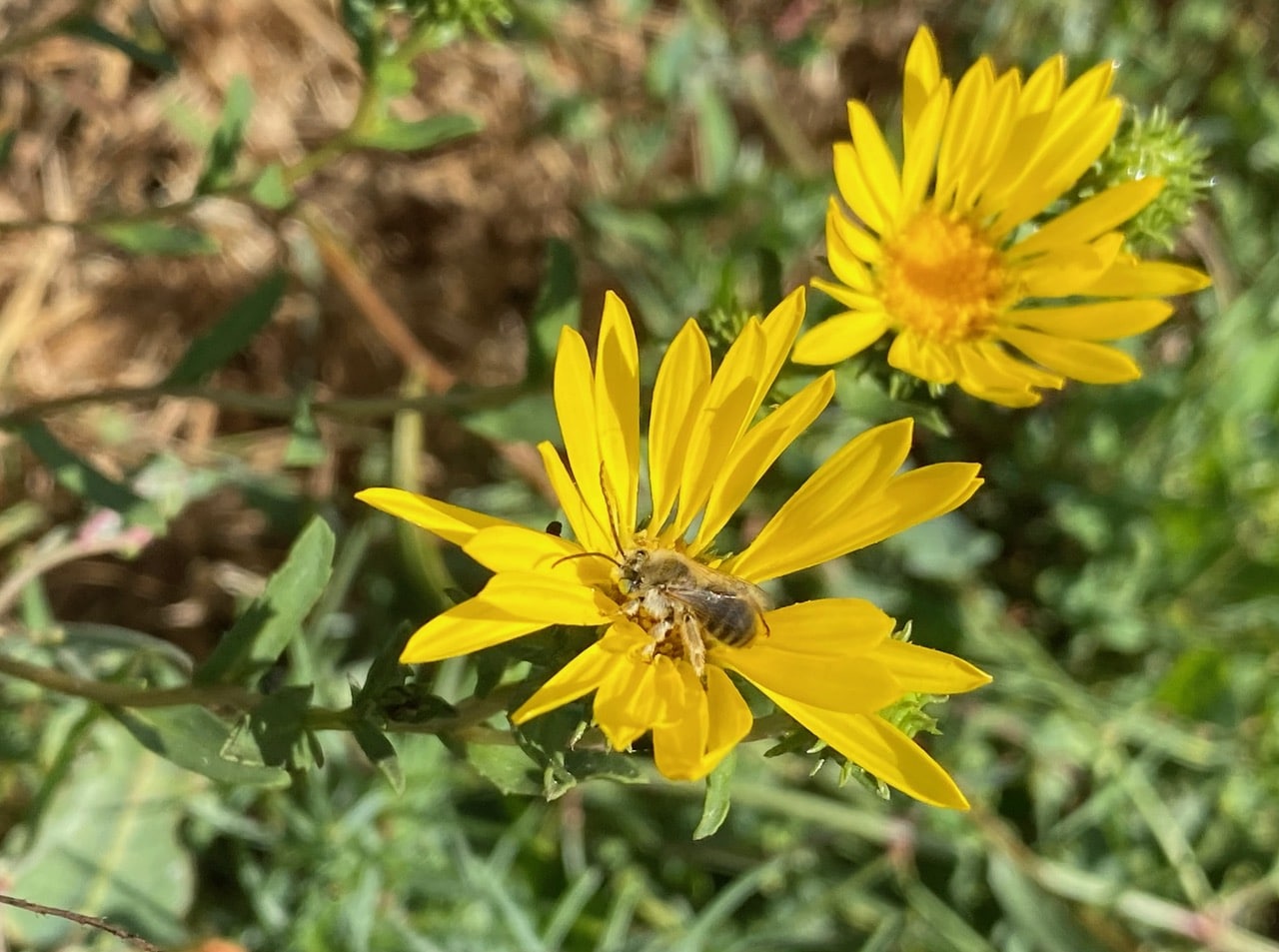
The Summer Longhorn Bees, Melissodes sp. (family Apidae) are swarming over the Oregon Gumweed, Grindelia stricta in glorious bloom. They are mostly males with the characteristic long antennae. Perhaps the females will follow soon? In solitary bees, the males usually develop faster and emerge before their sisters.
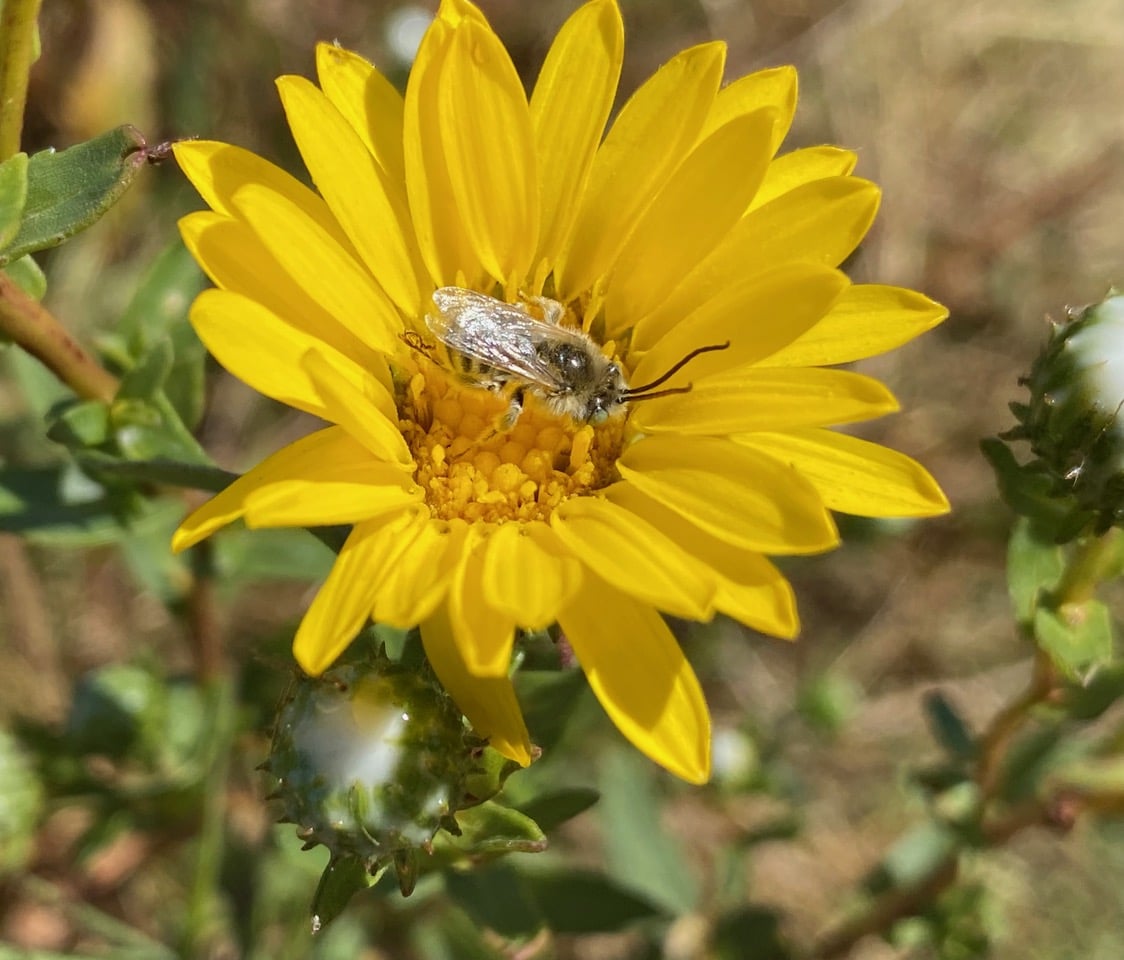
The Summer Longhorn Bees, Melissodes sp. (family Apidae) are medium to large bees, stout-bodied, usually with gray hair on the thorax and pale hair bands on the abdomen. Males usually have yellow markings on their faces and have very long antennae from which their common name is derived. They are active May to September, with peak flight in late June to early August. The females prefer flat, bare ground for digging their solitary nests, though they sometimes nest in aggregations. The nests appear as distinctive round holes about the diameter of a pencil or slightly smaller, sometimes with small piles of dirt around them looking like mini-volcanos. Pollen is transported in scopae on the hind legs. Pollen loads are often copious and brightly colored and thus very distinguishable. Melissodes are specialists on Asteraceae – females gather pollen from flowers of Aster, Bidens, Coreopsis, Cosmos, Encelia, Gaillardia, Helianthus, and Rudbeckia ssp.
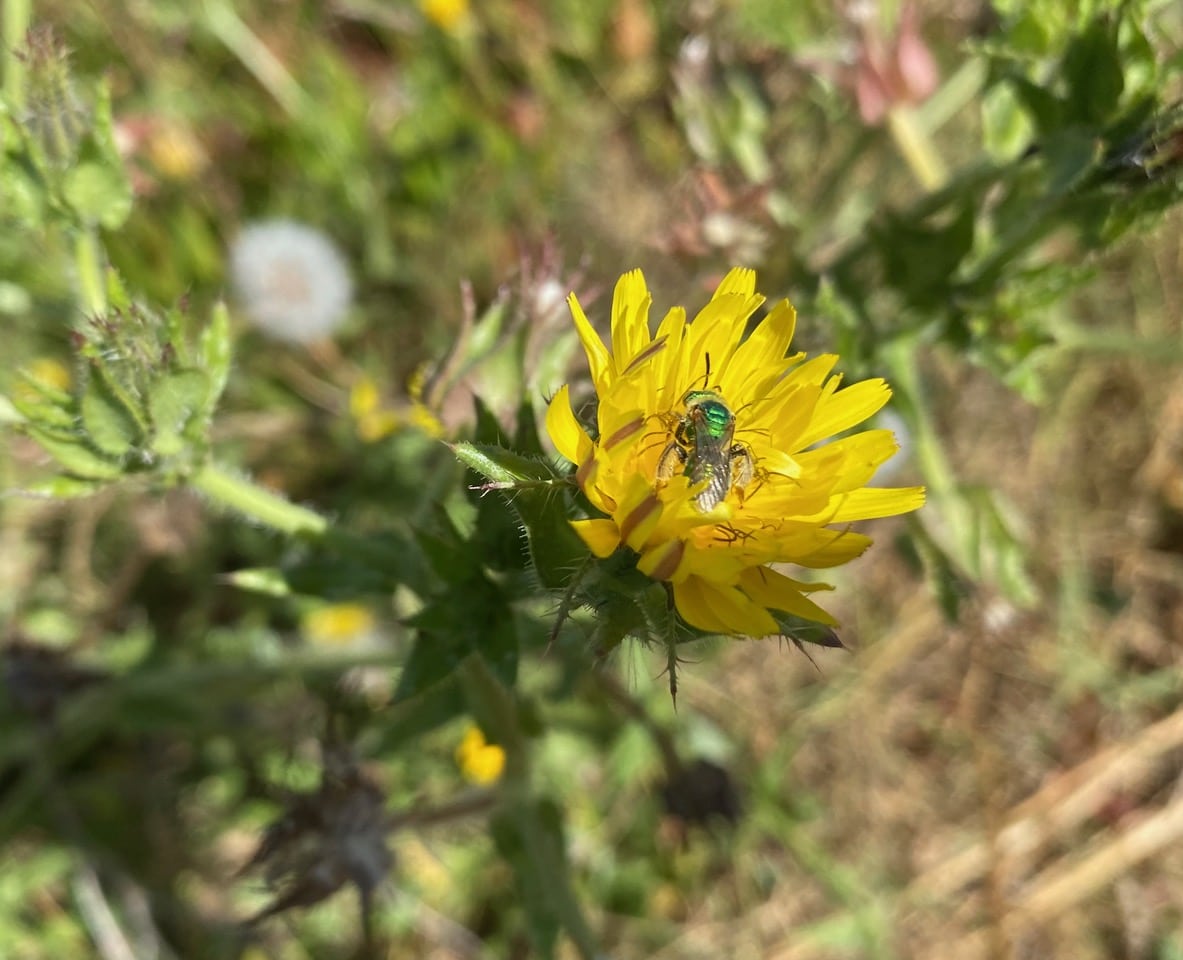
A female Fine Striped Sweat Bee, Agapostemon subtilior (family Megachilidae) is foraging on a flowerhead of Bristly Oxtongue, Helminthotheca echioides.
Agapostemon are brightly colored metallic green or blue bees measuring 7 to 14.5 mm long. Most species have a metallic green head and thorax, and black-and-yellow striped abdomen; some females are entirely bright green or blue. Females carry pollen on scopal hairs located on their hind legs. Agapostemon are generalists. Like other members of the family Halictidae, they are short-tongued and thus have difficulty extracting nectar from deep flowers. Males are often seen flying slowly around flowers looking for females. The bees favor flowers with high densities. Females excavate nests in the ground. These bees are active summer through fall.
Fine striped sweat bee (Agapostemon subtilior) · iNaturalist
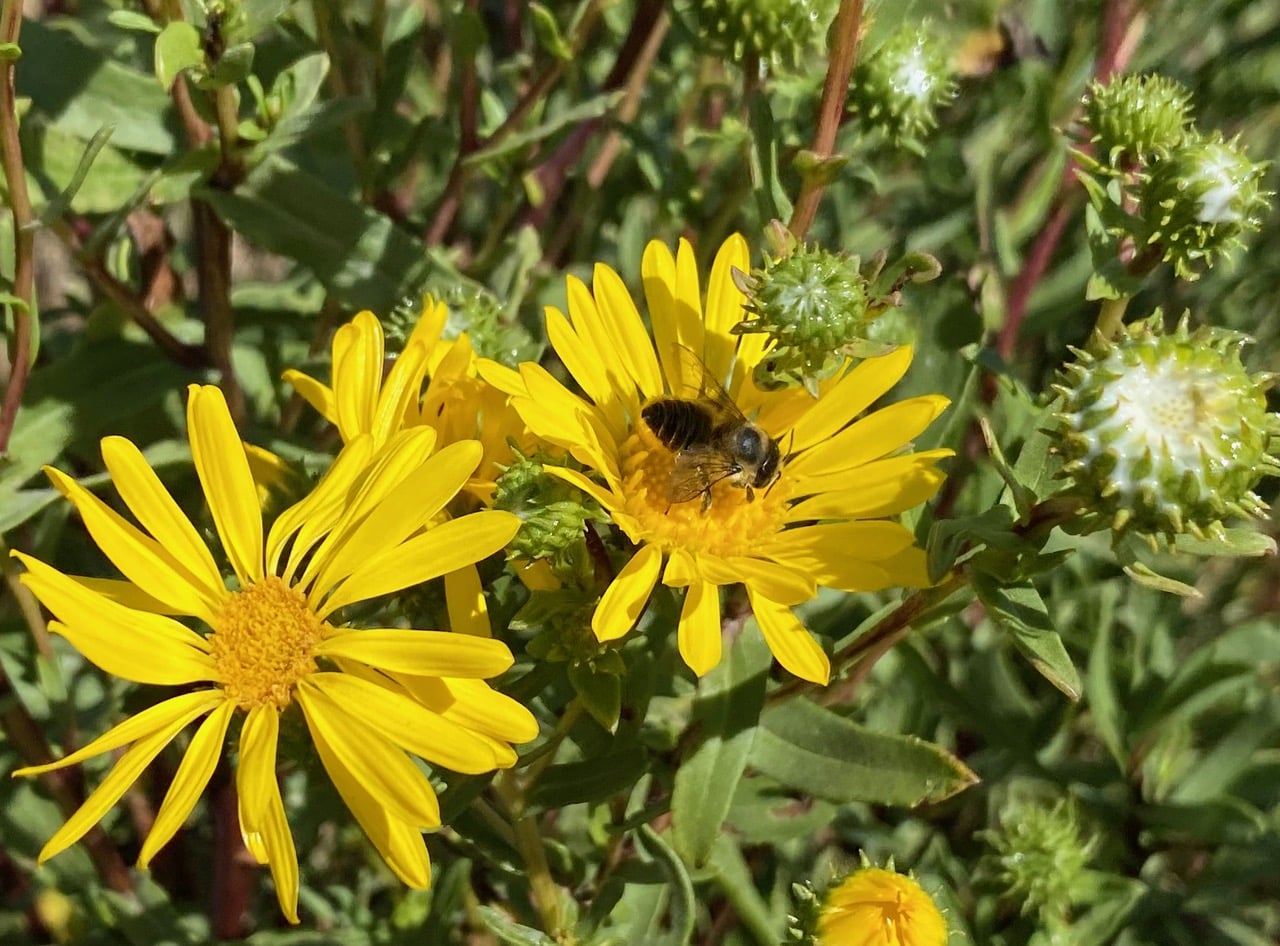
A female Western Leafcutter Bee, Megachile perihirta (family Megachilidae) has landed on a Grindelia flowerhead to collect pollen.
Leaf-cutter Bees, Megachile sp. (family Megachilidae) are stout-bodied, usually with pale hair on the thorax and stripes of white hairs on the abdomen. Females usually have a triangular abdomen with a pointed tip, and males’ faces are covered with dense, pale hair. Flight season is from May into September, with peak activity from June to August.
Solitary females construct nests in tubular cavities, including hollow stems, tree holes, and abandoned beetle burrows in wood. Many use holes drilled into wood, straws, or other manufactured tunnels. Females cut pieces from leaves or flower petals for use in the construction of brood cells. Most Megachile females are generalists when foraging for pollen. Pollen is transported in dense scopae on the underside of the abdomen.
Photos of Western Leafcutter Bee (Megachile perihirta) · iNaturalist
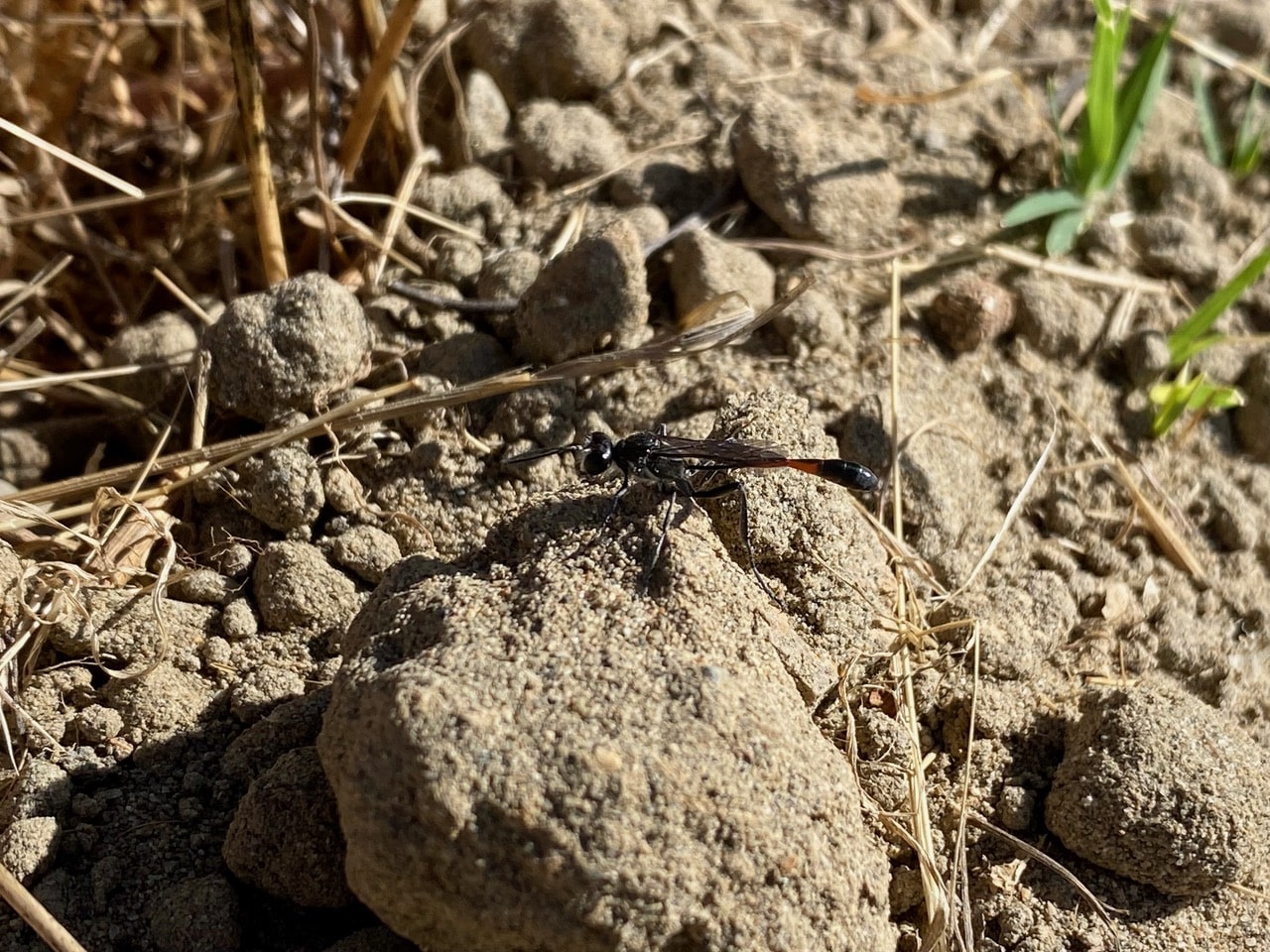
A small, slender wasp lands on the dried grass litter on the ground. I despair as my camera has difficulty focusing on the small subject in such a busy background. The wasp finally crawls onto some compacted sandy soil that has been excavated by ground squirrels. Ah, now I can see that it is a Thread-waisted Wasp (family Sphecidae). The wasp lingers for a while in the small area, and I have hopes that it might start to excavate a nest burrow. But aware of my presence, it eventually flies away. iNaturalist has helped identify the wasp as Abert’s Thread-waisted Wasp, Ammophila aberti (family Sphecidae).
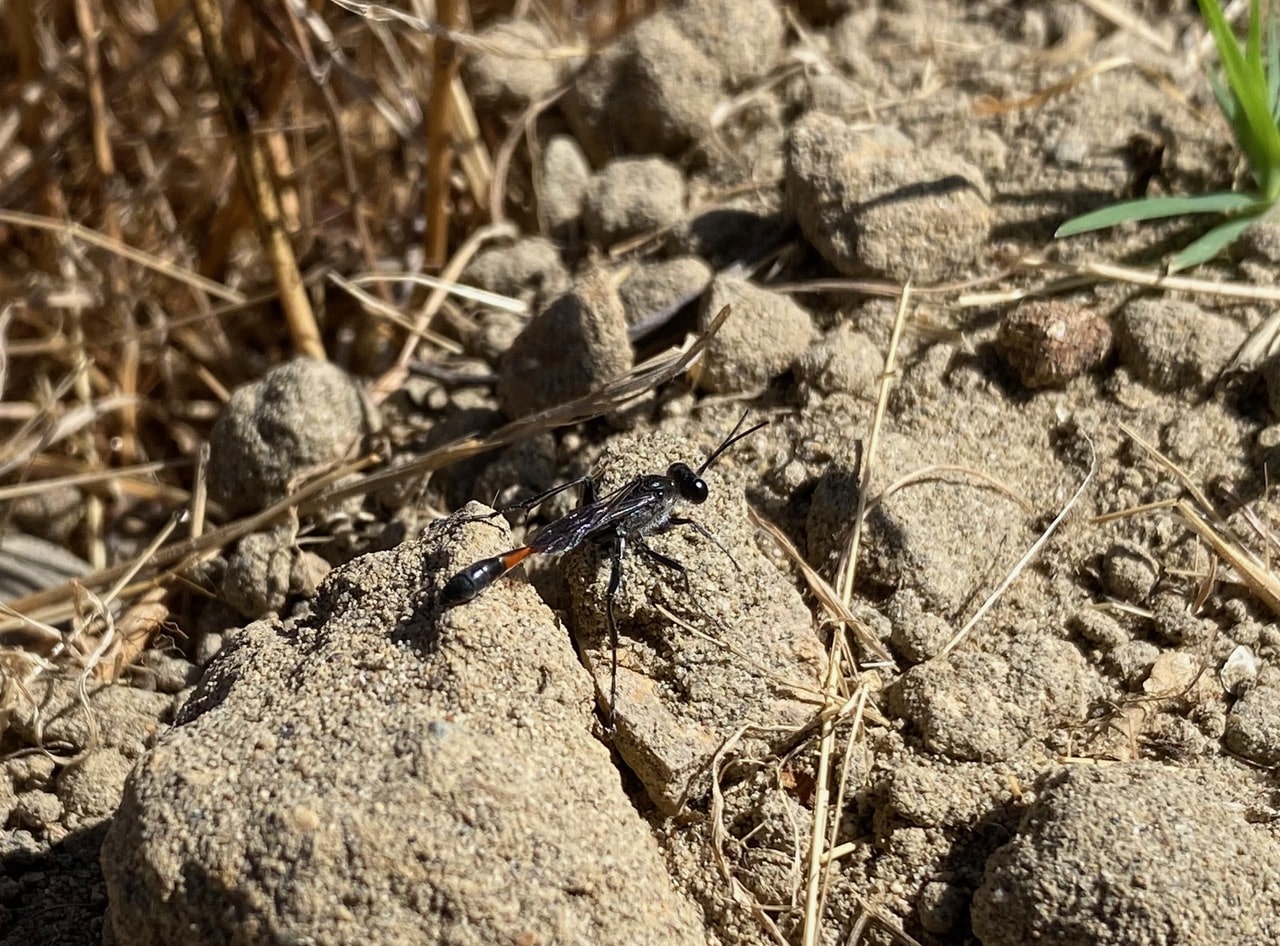
Ammophila aberti is a species of Thread-waisted Wasp in the family Sphecidae. It is found in western and central North America, from southern Canada to Mexico, in open, semi-arid locations. The female digs its nest in firm sand or muddy areas. While digging, the wasp emits a buzz that can be heard from over four meters away. It flies the excavated soil away from the burrow. Tunnels are several centimeters long, usually straight, sometimes slightly curved or angled. Ammophila aberti prey mainly on Geometrid moth larvae, providing up to 10 per nest. Other caterpillars are sometimes used, such as Noctuidae, Pyralidae, Hesperiidae, and Pieridae. The female wasp stings to paralyze the caterpillar, then carries it to the prepared burrow. A single egg is laid on the first caterpillar to be stored in the cell at the end of the vertical or angled burrow. Gathering enough prey for their young takes over two days. During this time it will temporarily close the entrance, open it to deposit prey, and then close it again. She closes the burrow by pulling a pebble over the opening and pushing sand over it. After the nest has been fully provisioned, the wasp will close the burrow again by jamming pebbles inside it and kicking dirt and sand down. Once the fill material has reached the surface, it will use a rock or some other hard material to compact the soil.
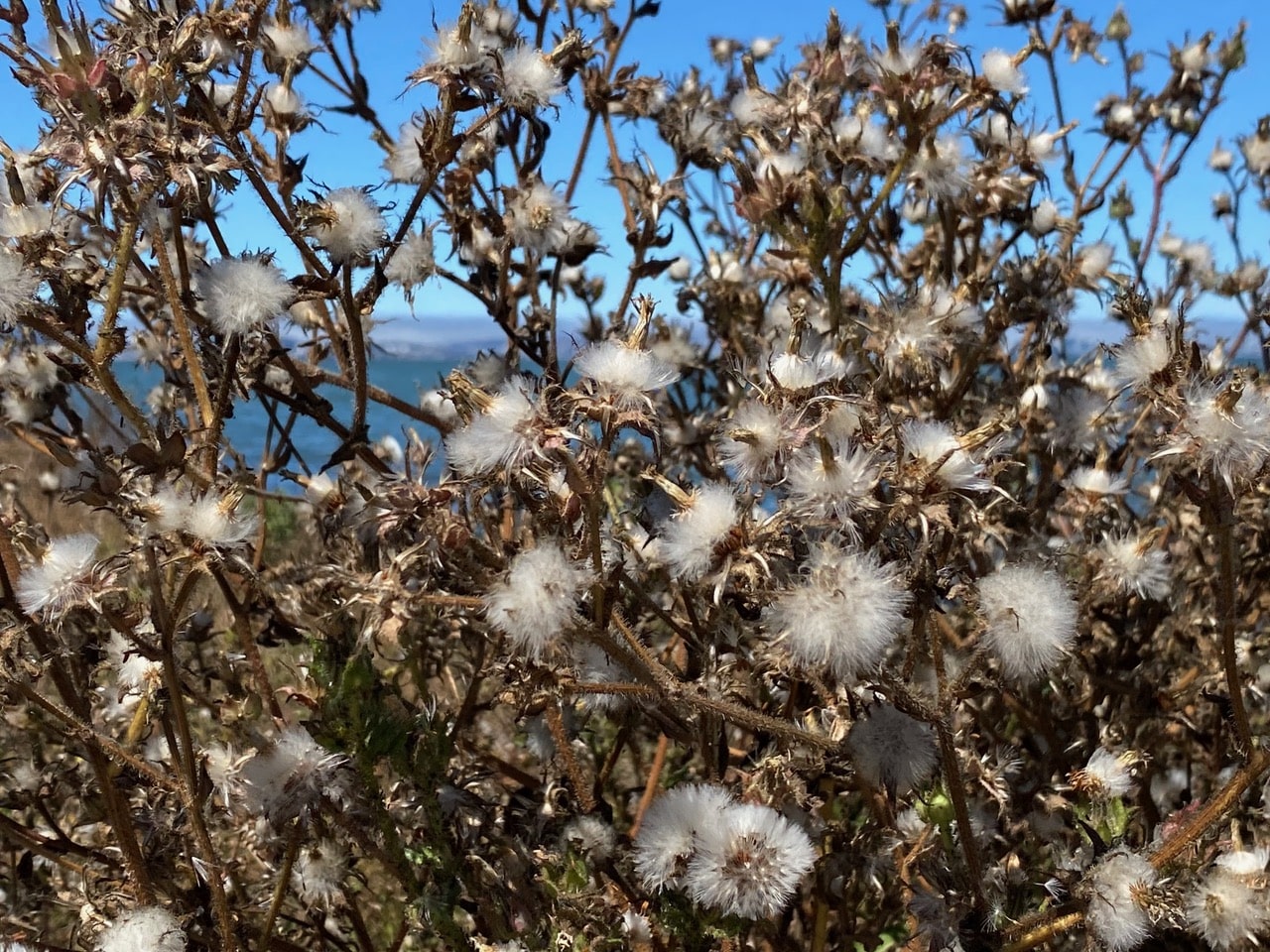
Most of the Bristly Oxtongue have gone to seed, their white fluffy seed heads decorating the dried plants like little dandelion puffballs.
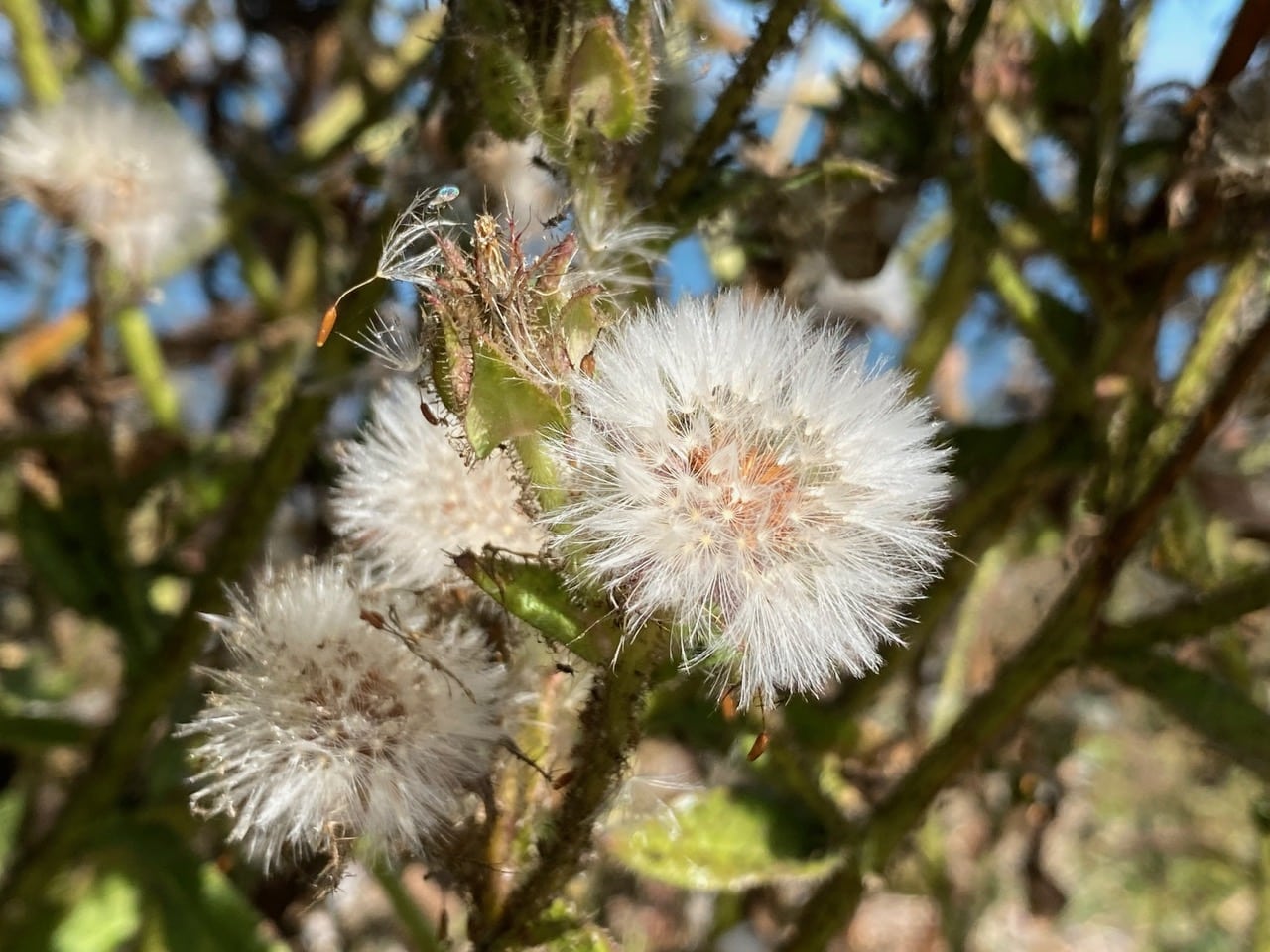
The seed heads of Bristly Oxtongue are similar to dandelion puffballs.
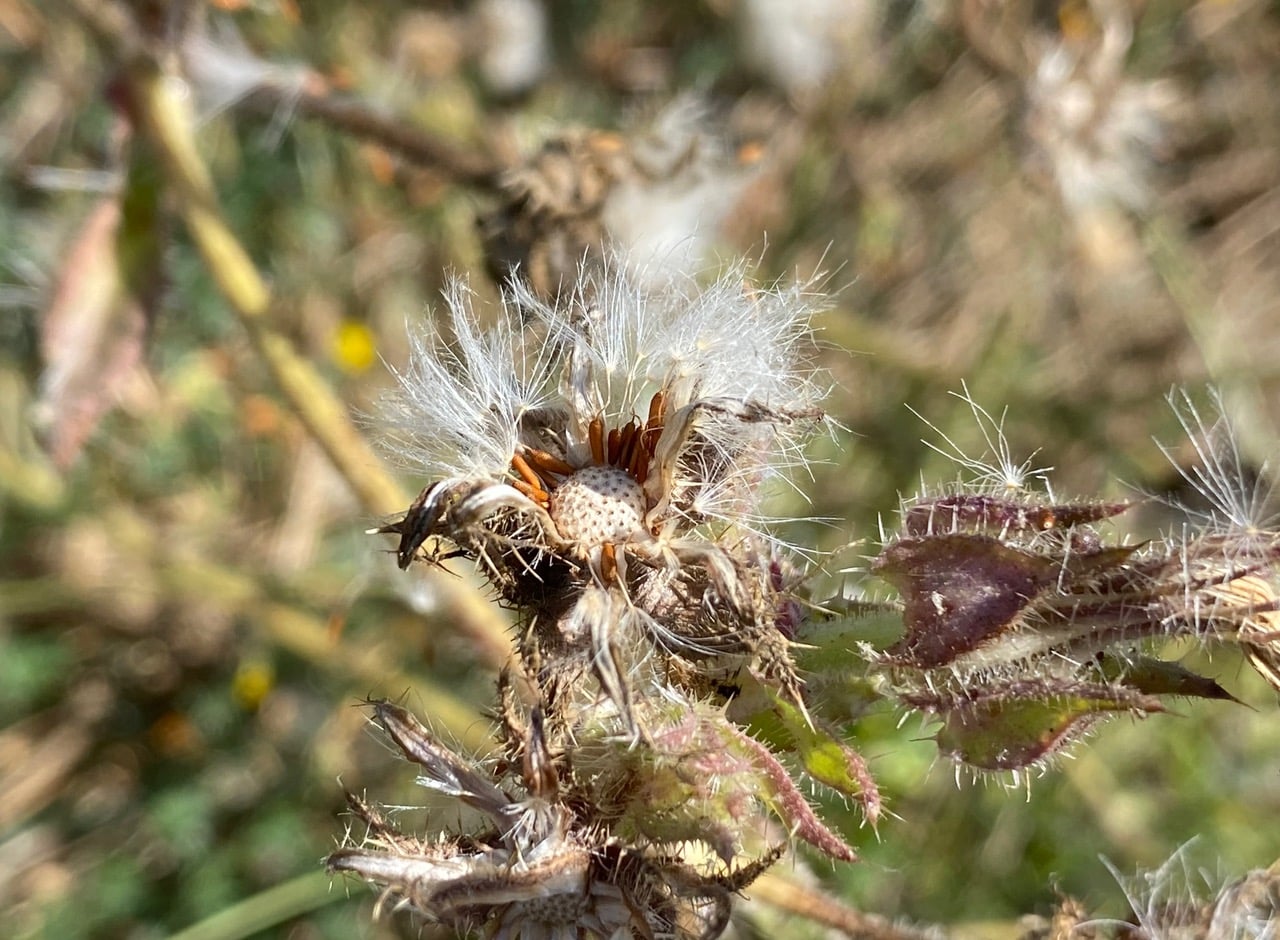
Most of the plumed seeds on this puff ball have been dislodged by the wind. Essentially puff balls of the Bristly Oxtongue and the Dandelion are structurally and aerodynamically similar. The two plants are both in the sunflower family Asteraceae. Their seeds use a bundle of filaments known as pappus. Pappuses are characteristic of plants in the sunflower family, Asteraceae. The pappus is the modified calyx, the part of an individual floret that surrounds the base of the corolla tube in a flower. It functions as a wind-dispersal mechanism for the seeds. The pappus enhances the drag on a seed as it falls and thereby slows its descent. This allows the seed to travel a longer distance before landing.
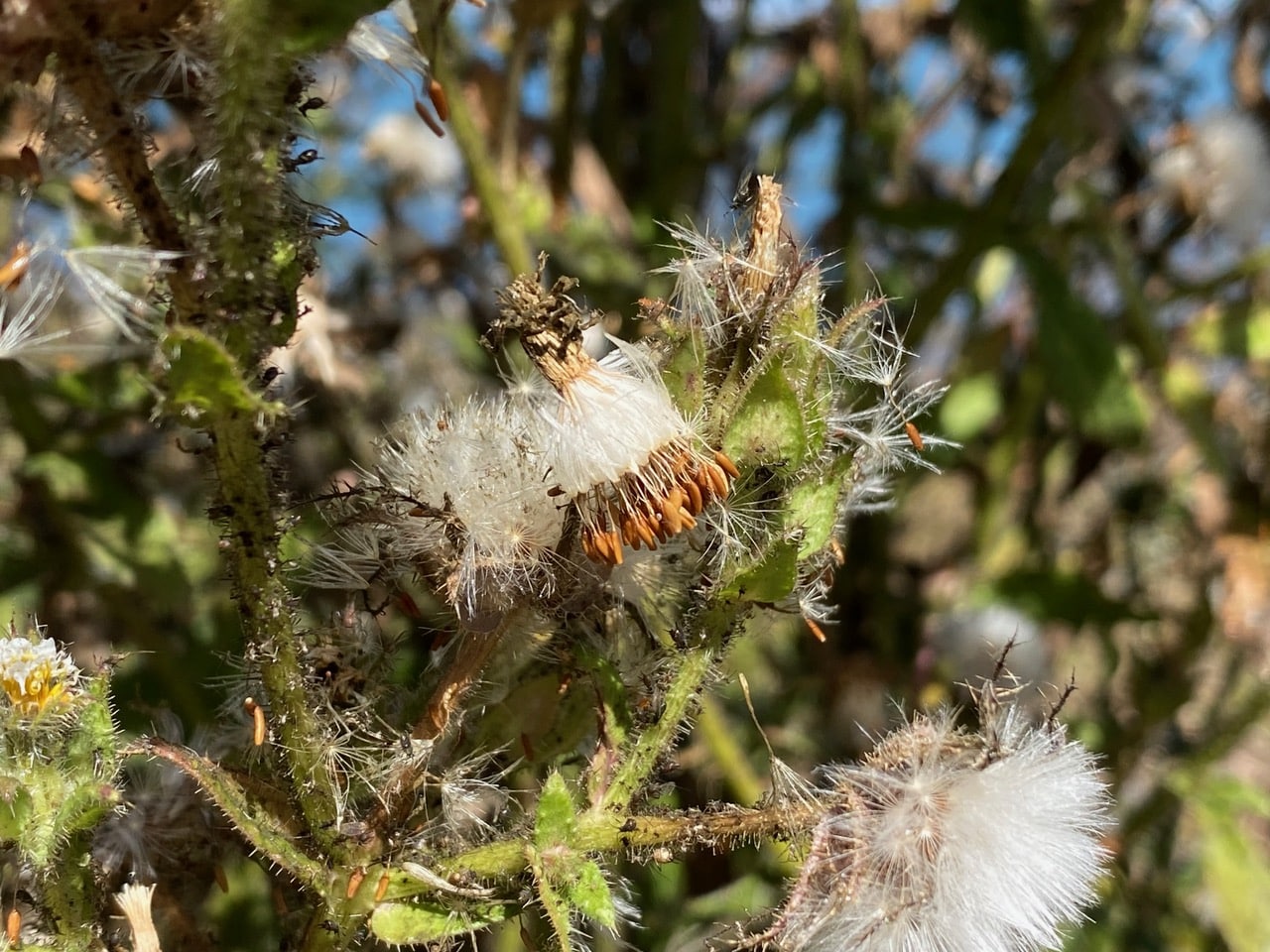
Interestingly, many of the plumed seeds are lifted en mass from the seed heads when the dried flower parts detach. These will not travel far on the wind, but will probably settle close to the mother plant.

Dark, purplish-brown aphids abound on the stems of the Bristly Oxtongue, Helminthotheca echioides. iNaturalist has helped identify them as the Large Daisy Aphids in the genus Uroleucon (family Aphididae).
Aphids are small sap-sucking insects in the order Hemiptera. A typical life cycle involves flightless females giving live birth to female nymphs, – who may also be already pregnant, an adaptation called telescoping generations – without the involvement of males. Maturing rapidly, females breed profusely so that the population multiplies quickly. Winged females may develop later in the season, allowing the insects to colonize new plants. In temperate regions, a phase of sexual reproduction occurs in the autumn, with the insects often overwintering as eggs.
The life cycle of some species involves an alternation between two species of host plants. Some species feed on only one type of plant, while others are generalists, colonizing many plant groups. Some ants have a mutualistic relationship with aphids, tending them for their honeydew and protecting them from predators.
Aphids usually feed passively on phloem of plants. Once the phloem vessel is punctured, the sap, which is under pressure, is forced into the aphid’s food canal. Aphids produce large amounts of a sugary liquid waste called “honeydew”. A fungus called sooty mold can grow on honeydew deposits that accumulate on leaves and branches, turning them black.
Uroleucon is a large genus, with worldwide distribution associated entirely with the sunflower family (Asteraceae) and bellflower family (Campanulaceae). Uroleucon are medium-sized to rather large aphids which may be shiny red, reddish brown or blackish brown. The antennae are about as long as the body. The siphunculi (“tail pipes”) are black and long. These aphids do not host alternate. They usually have a sexual stage in their life cycle and overwinter as eggs. Uroleucon are not usually attended by ants.

This colony of aphids has started to produce alates (winged reproductives). There is an alate in this picture, in the company of many immatures. Note the swollen, greenish wing pads on the developing alates.
Aphids have many generations a year. Most aphids in California’s mild climate reproduce asexually throughout most or all of the year with adult females giving birth to live offspring – often as many as 12 per day – all clones of the mother. The young aphids or nymphs molt, shedding their skin about four times before becoming adults. When the weather is warm, many species can develop from newborn to reproductive adult in 7-8 days. Because each adult aphid can produce up to 80 offspring in a matter of a week, aphid populations can increase in staggering speed.
Generally adult aphids are wingless, but most species also occur in winged forms, especially when populations are high or during spring and fall. The ability to produce winged individuals provides the aphids with a way to disperse to other plants when the quality of the food source deteriorates, or when predation pressure is high.
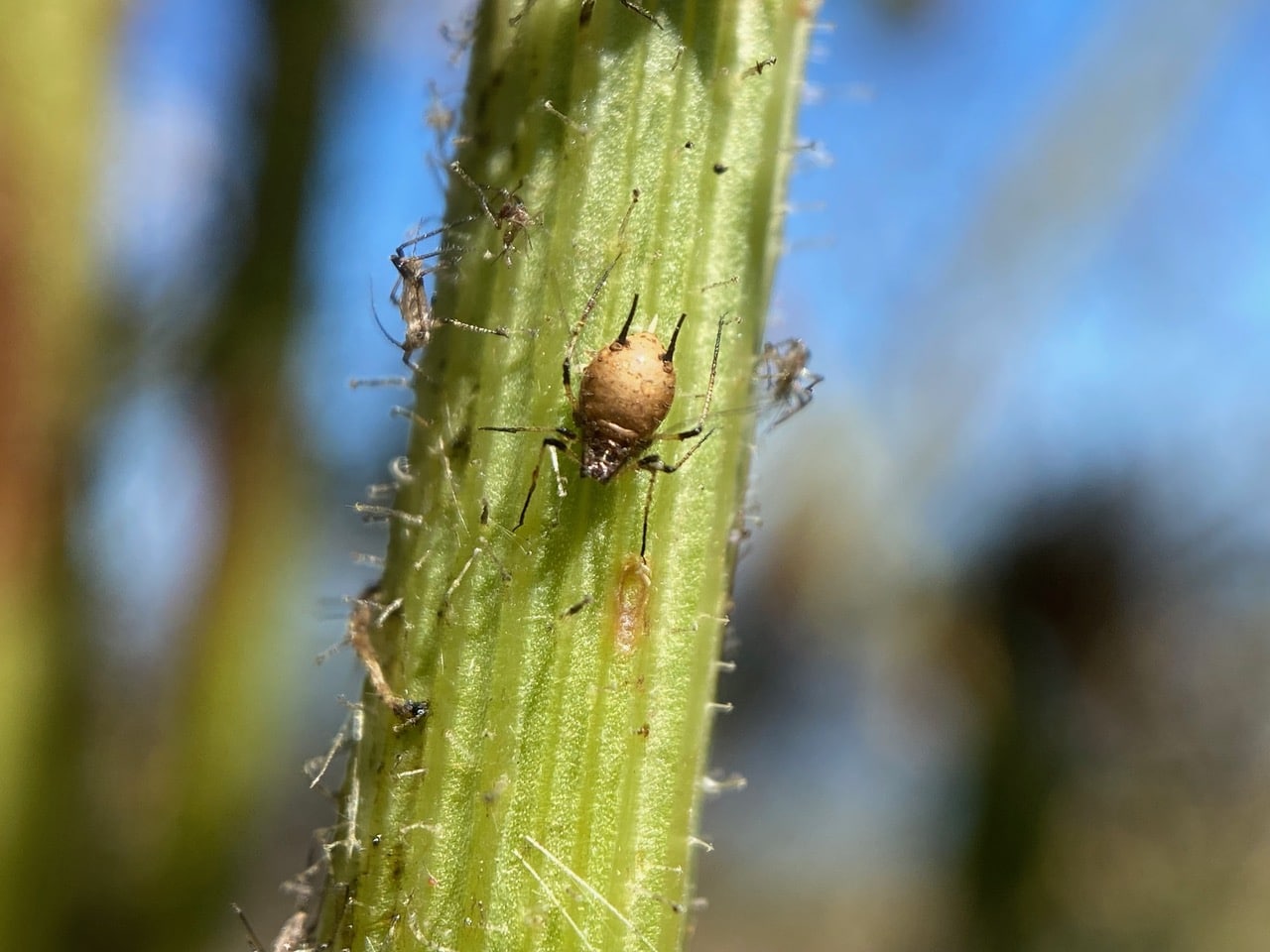
This “aphid mummy” looks quite different from its normal kin. It has been parasitized and physically altered by a parasitoid wasp, the Aphid Mummy Wasp.
Aphid Mummy Wasps, Aphidius sp. (family Braconidae) are small wasps, typically less than 1/8 in. long. The female wasp lays a single egg in an aphid. When the egg hatches, the wasp larva feeds inside the aphid. As the larva matures the aphid is killed and becomes bloated and mummified, usually turning tan or golden in color. The adult parasitoid chews its way out of the mummy leaving a hole.
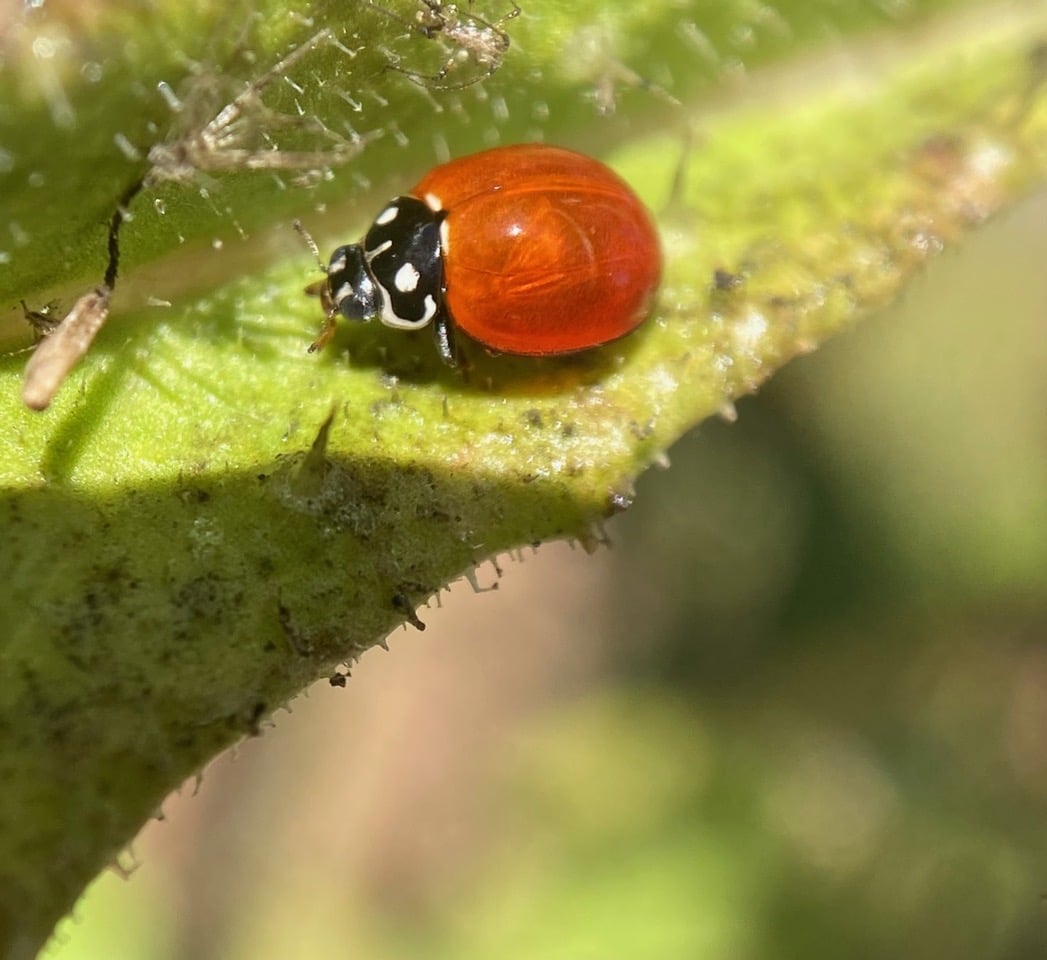
A male Spotless Lady Beetle, Cycloneda sanguinea (family Coccinellidae) is resting on a leaf of Bristly Oxtongue.
The Spotless Lady Beetle, Cycloneda sanguinea (family Coccinellidae) is a widespread species of lady beetle in the Americas. It is is large lady beetle with red, unspotted elytra (wing covers) ranging from 4-6.5 mm long. The black and white marks on the head and pronotum are very distinctive, and they are also gender-specific. Both adult and larvae of Spotless Lady Beetles are voracious predators of aphids. They are very often found feeding on aphids on milkweeds, but also occur on a number of other plants.

Here’s a different species of Lady Beetle on the same aphid-infested Bristly Oxtongue. It is the California Lady Beetle, Coccinella californica (family Coccinellidae).
The California Lady Beetle, Coccinella californica has a red elytra that is usually spotless. Pronotum is black with a white patch on each side. Head is black with two small white spots between the eyes. There is a black suture (where the wings meet, down the middle of the back). The species’ range is the coastal counties north of the Transverse Ranges.
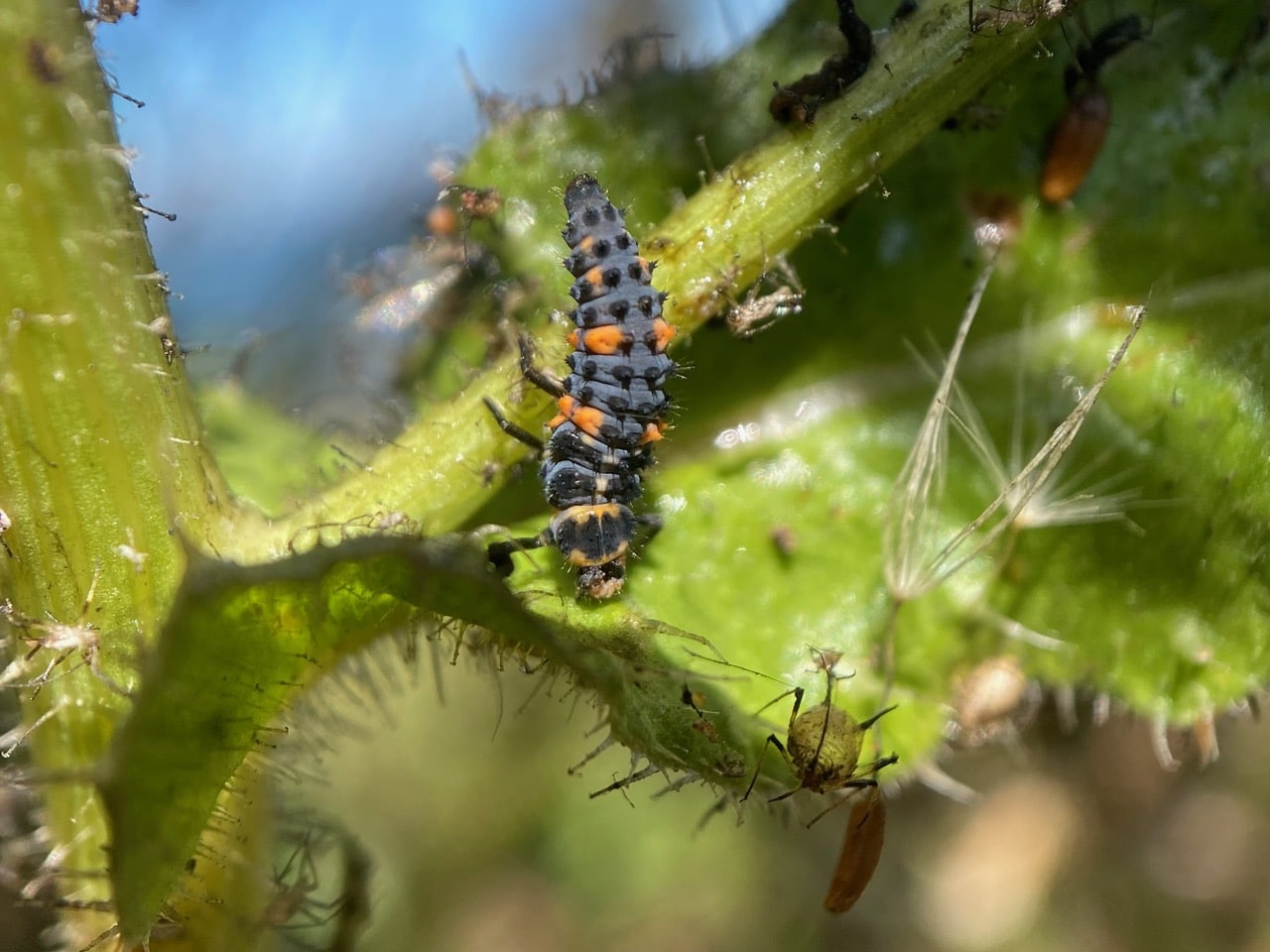
A Lady Beetle larva is hunting on the aphid-infested Bristly Oxtongue.
Lady beetles go through complete metamorphosis, which comprises four stages: eggs, larva, pupa and adult. The larva goes through four molts during their development. Often described as miniature alligators with six legs, the larvae are voracious predators of aphids. Each larva can eat about 400 aphids in the three weeks before it pupates. Besides aphids, they also feed on soft scales, whitefly pupae, thrips, and spider mites.
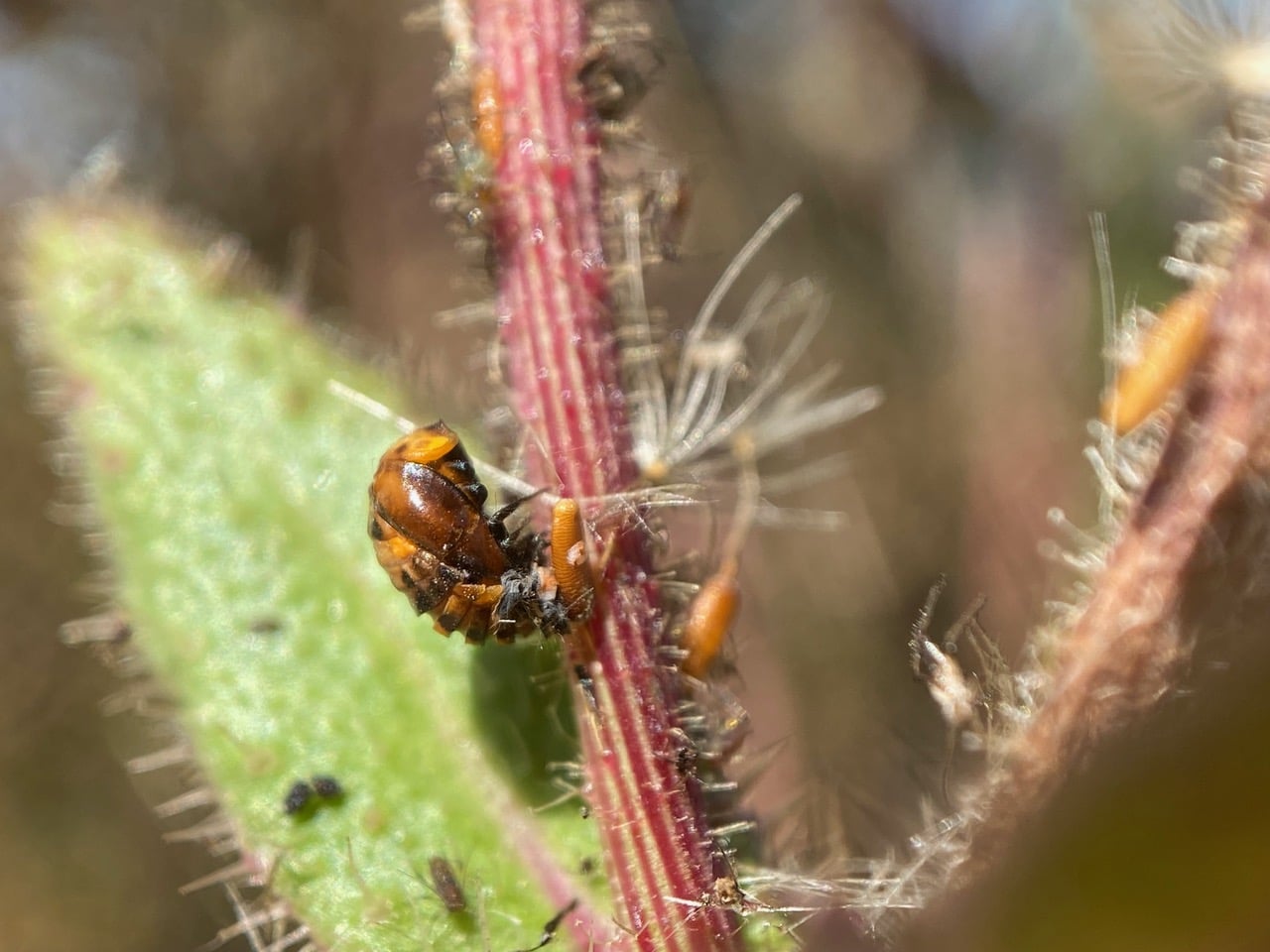
A Lady Beetle pupa appears ready to eclose on the stem of Bristly Oxtongue.
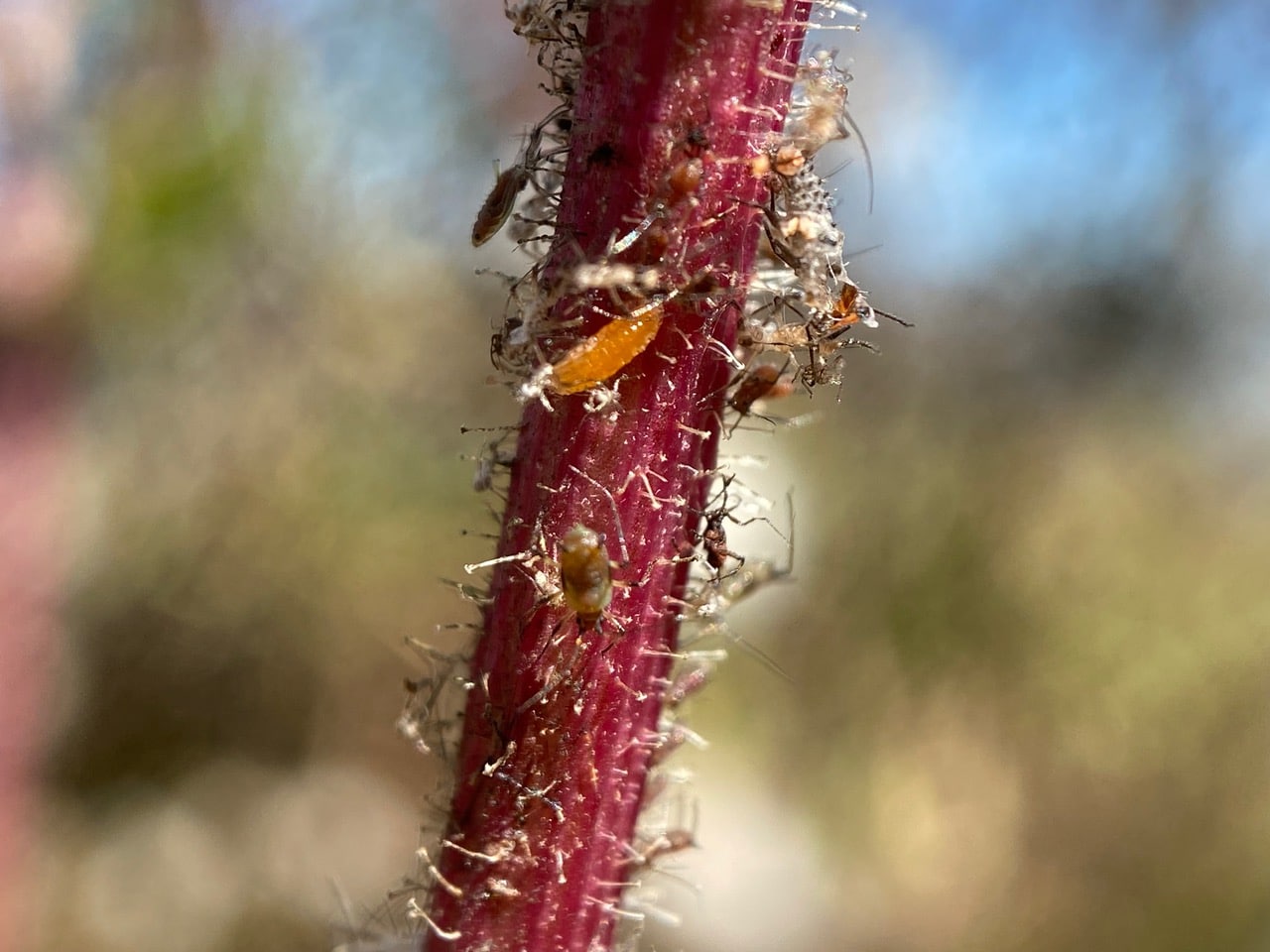
Hey, here’s a miniature aphid hunter, not much bigger than its prey. See that orange, slug-like creature among the aphid debris? It is an Aphid Midge, Aphidoletes aphidimyza (family Cecidomyiidae). It even has aphids written all over its name! Cecidomyiidae are usually called Gall Midges – the larvae live and feed within plant galls. The Aphid Midge is an oddball in the family – instead of growing up in a gall, it roams freely hunting aphids.
The Aphid Midge, Aphidoletes aphidimyza is a midge whose larvae feed on over 80 aphid species. The adults are small, less than 3.2 mm long, black, delicate, short-lived flies that feed on aphid honeydew. They hide beneath the leaves during the day, and are active at night. Females deposit 100-250 tiny shiny orange eggs among aphid colonies that hatch in 2-3 days. After 3-7 days the larvae drop to the ground to pupate in the soil. The small, bright orange, slug-like larvae inject a toxin into aphids’ leg joints to paralyze them and then suck out the aphid body contents through a hole bitten in the thorax. Larvae can consume aphids much larger than themselves and may kill more aphids than they eat when aphid populations are high. A single larva grows up to 3.2 mm long and kills 4-65 aphids a day. The life cycle from egg to adult can be completed in about 3 weeks, with multiple generations per year.
The Aphid Midge is commercially available, widely used in biological control programs for greenhouse crops and orchards.
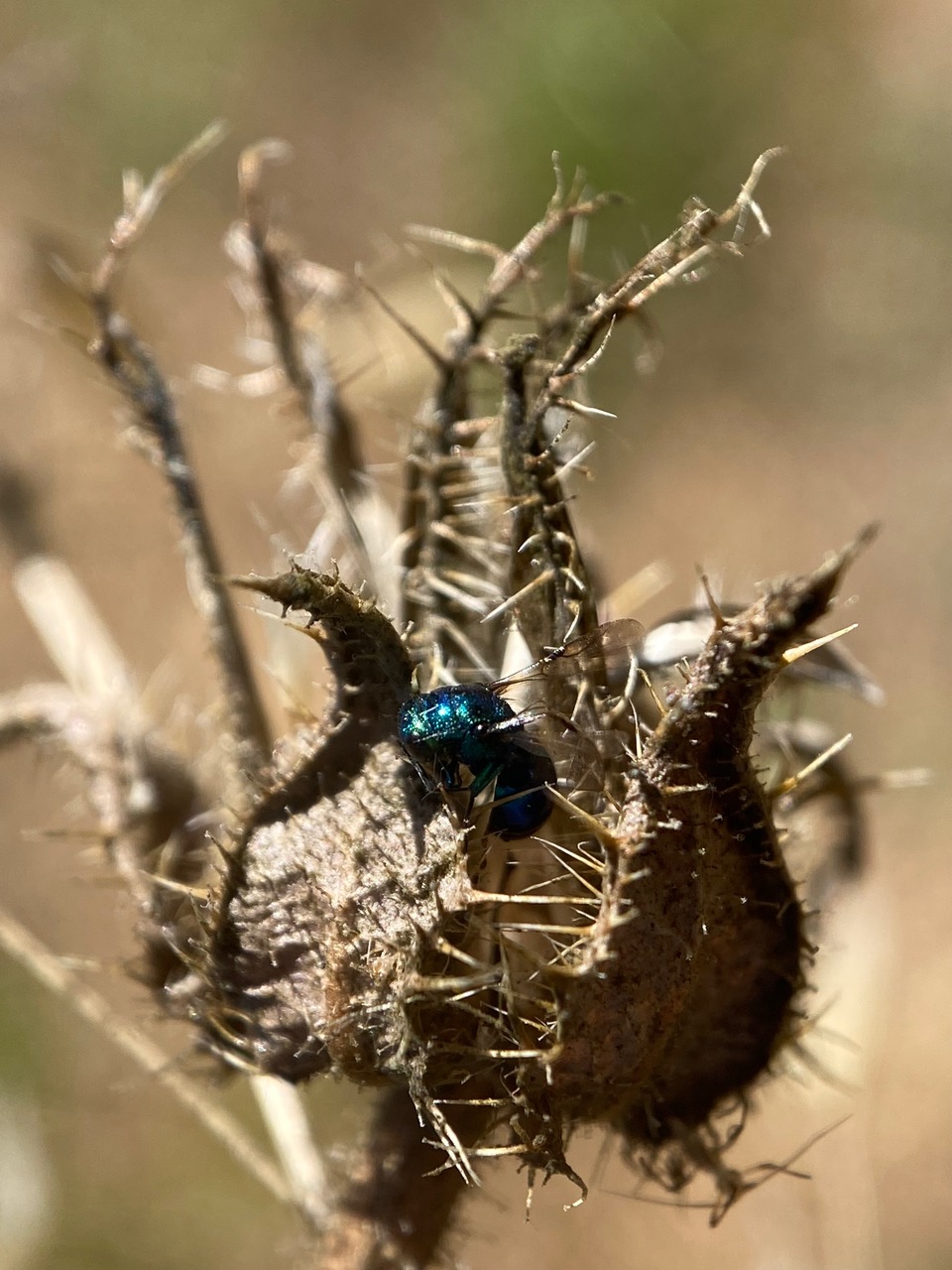
What is glinting blue iridescence on that dried flowerhead of Bristly Oxtongue? A Cuckoo Wasp? It is not moving at all. Is it laying eggs?
Commonly known as Cuckoo Wasps or Emerald Wasps, the wasp family Chrysididae is a very large cosmopolitan group of parasitoid or kleptoparasitic wasps. They are often highly sculptured (“pitted), with brilliant metallic colors created by structural coloration. They are most diverse in desert regions of the world, as they are typically associated with solitary bee and wasp species, which are also most diverse in such areas. The term “cuckoo wasp” refers to the cuckoo-like way in which these wasps lay eggs in the nest of unrelated host species. Chrysidids are always solitary, and are active mainly in the hottest and driest months of summer in Mediterranean climates. They are found in habitats where the adults can find hosts to parasitize. Some species visit flowers such as the Apiaceae, Asteraceae and Euphorbiaceae.
Members of the largest subfamily, Chrysidinae, are generally kleptoparasites, laying their eggs in host nests, where their larvae consume the host egg or larva, then the food provided by the host for its own young.

I carefully rotate the flowerhead to get a better look. The insect is indeed a Cuckoo Wasp (family Chrysididae). It is dead. iNaturalist has helped identify it to the genus Omalus (family Chrysididae). I think I know why it is here on an aphid-infested plant.
Like most Cuckoo Wasps in the subfamily Chrysidinae, Omalus has flattened or concave lower abdomens and can curl into a defensive ball (“volvation”) when attacked by a potential host, in the manner of a pill bug. The hosts for Omalus are Aphid Wasps (family Crabronidae, subfamily Pemphredoninae) which hunt for aphids to provision for their young. Omalus lays eggs on aphids so they get carried to the nest by the wasp’s host. This “Trojan Horse” strategy is a remarkable adaptation that allows Omalus wasps to successfully parasitize their hosts while minimizing the risks of being attacked or injured by the host wasp.
Aphid Wasps (Subfamily Pemphredoninae) · iNaturalist