

Pollinator Post 8/6/25

I wander the restored upper dunes of Alameda Beach this fine morning. The place is ablaze with blooming Buckwheats (Eriogonum) and Coastal Sagewort (Artemisia pycnocephala). Despite the profusion of flowers, the diversity of insects visiting them is disappointingly low, consisting of mainly of Honey Bees, Apis mellifera (family Apidae) and Bumble Bees, Bombus sp. (family Apidae). I decide to move on to more productive grounds.
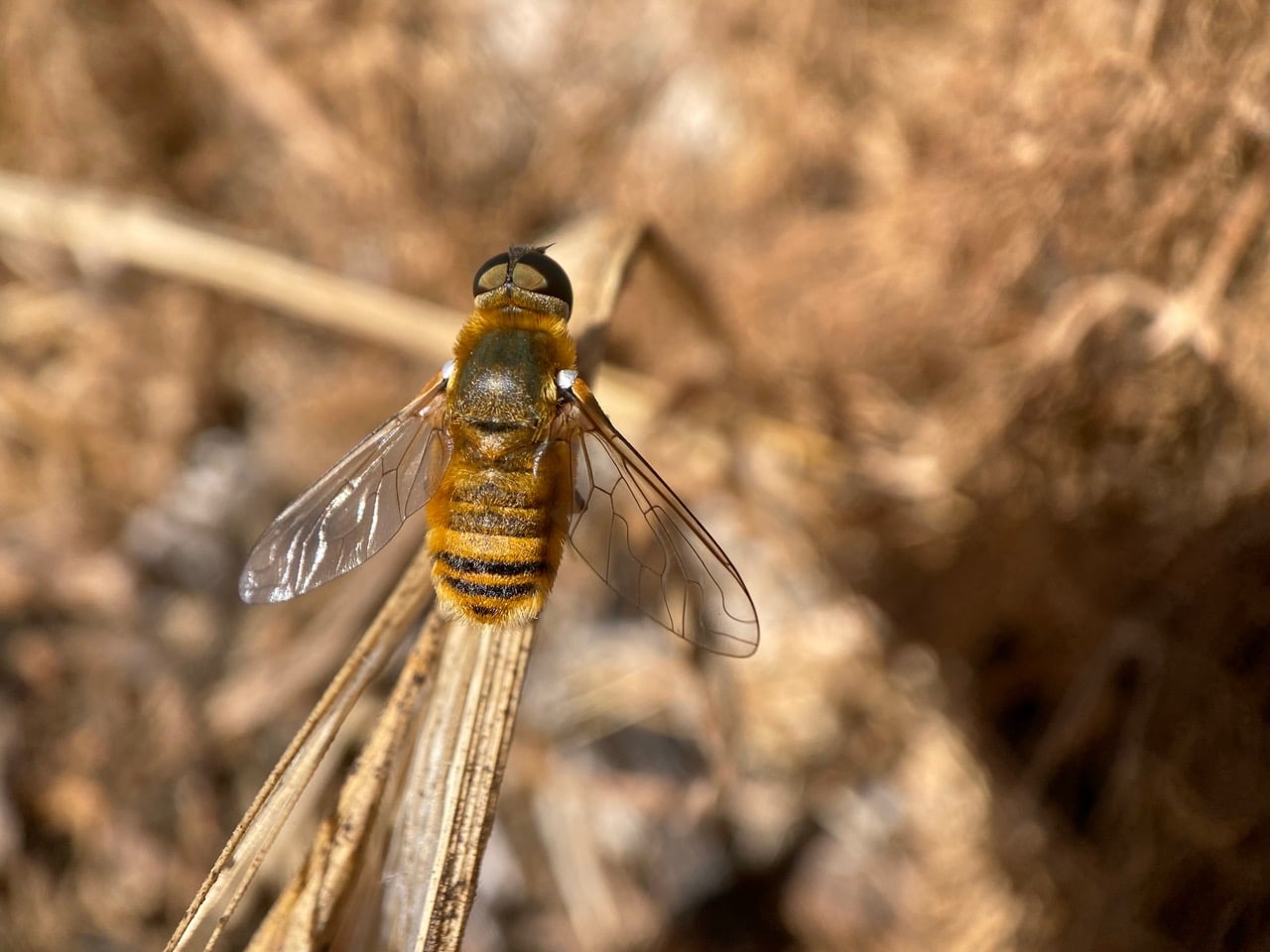

Hey, look, there’s a Bee Fly, Villa sp. (family Bombyliidae). After eluding me for a while, it finally settles on a piece of dried grass close to the ground.
The Bee Flies belong to the family Bombyliidae. Adults generally visit flowers for nectar and pollen, some being important pollinators. Larvae generally are parasitoids of other insects. When at rest, many species of bee flies hold their wings at a characteristic “swept back” angle. The adult females usually deposit eggs in the vicinity of possible hosts, quite often in the burrows of beetles or ground-nesting bees/wasps. Bombyliidae parasitism is not host-specific, but rather opportunistic, using a variety of hosts. Adult females of the genus Villa lay eggs in mid-air and flick them towards the nest entrances of their hosts. They typically have an eversible pouch near the tip of their abdomen known as a sand chamber, which is filled with sand grains gathered before egg laying. These sand grains are used to coat each egg just before their aerial release, presumably to improve the female’s aim by adding weight.
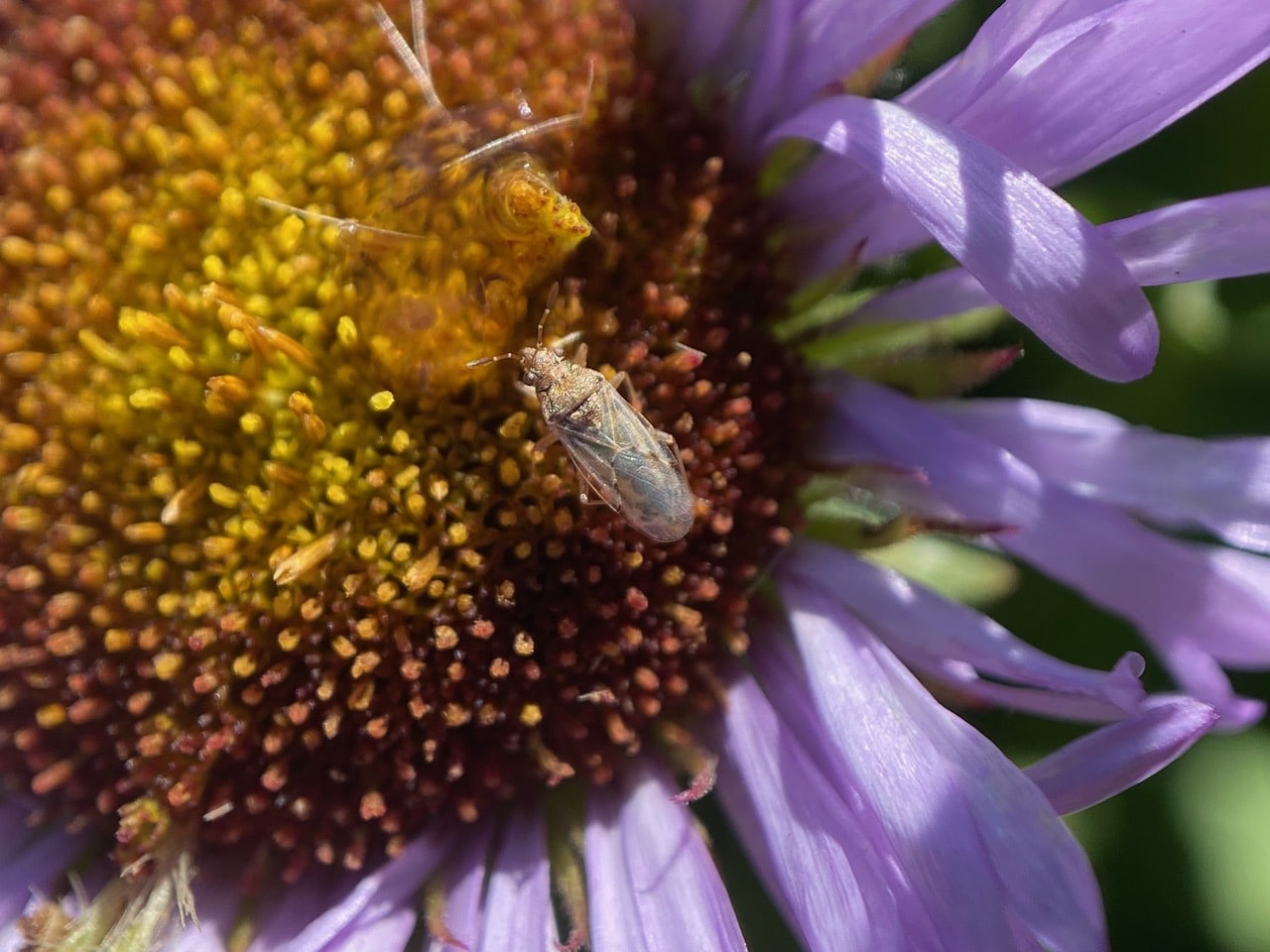
I next visit Jenny and Craig’s native garden in south-eastern Alameda. Not wanting to intrude without prior notice, I limit my exploration to the front garden. A Hyaline Grass Bug, Liorhyssus hyalinus (family Rhopalidae) is perched on a flowerhead of Pacific Aster, Symphyotrichum chilense.
The Hyaline Grass Bug, Liorhyssus hyalinus is a species of Scentless Plant Bugs belonging to the family Rhopalidae. It is characterized by its hyaline (clear or translucent) wing membrane extending beyond the dark upper side of the abdomen. The bug is commonly found in hemp fields, where they feed on flowers, developing seeds, and foliage. These bugs are known to migrate from various weed hosts into hemp fields, especially when seeds are developing. They use piercing-sucking mouthparts to extract plant tissues. They are able to feed on seeds by injecting digestive juices into the seeds and sucking up the digested contents as a liquid. The mouthparts, collectively called a rostrum, is folded under the body when not in use.
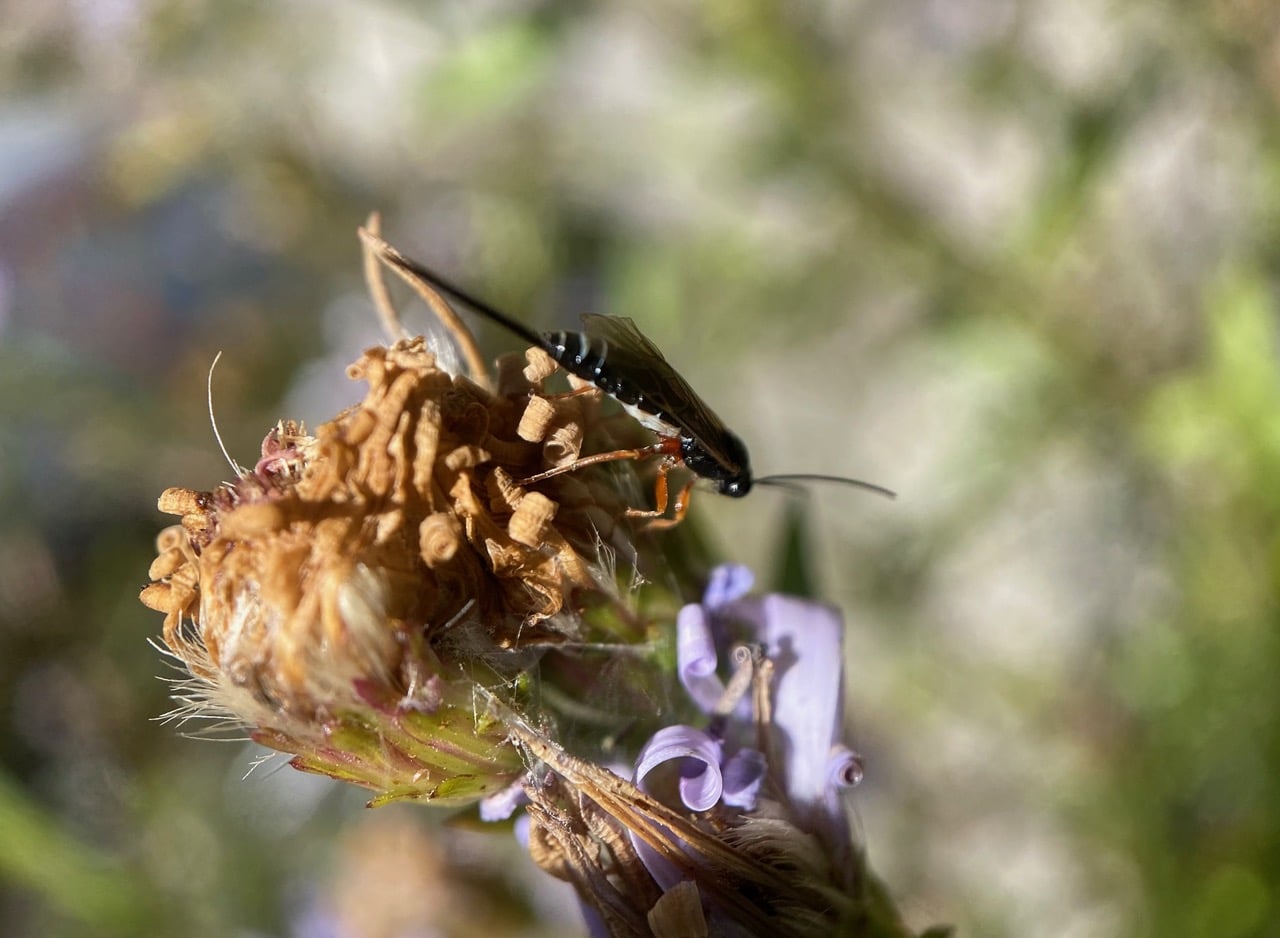
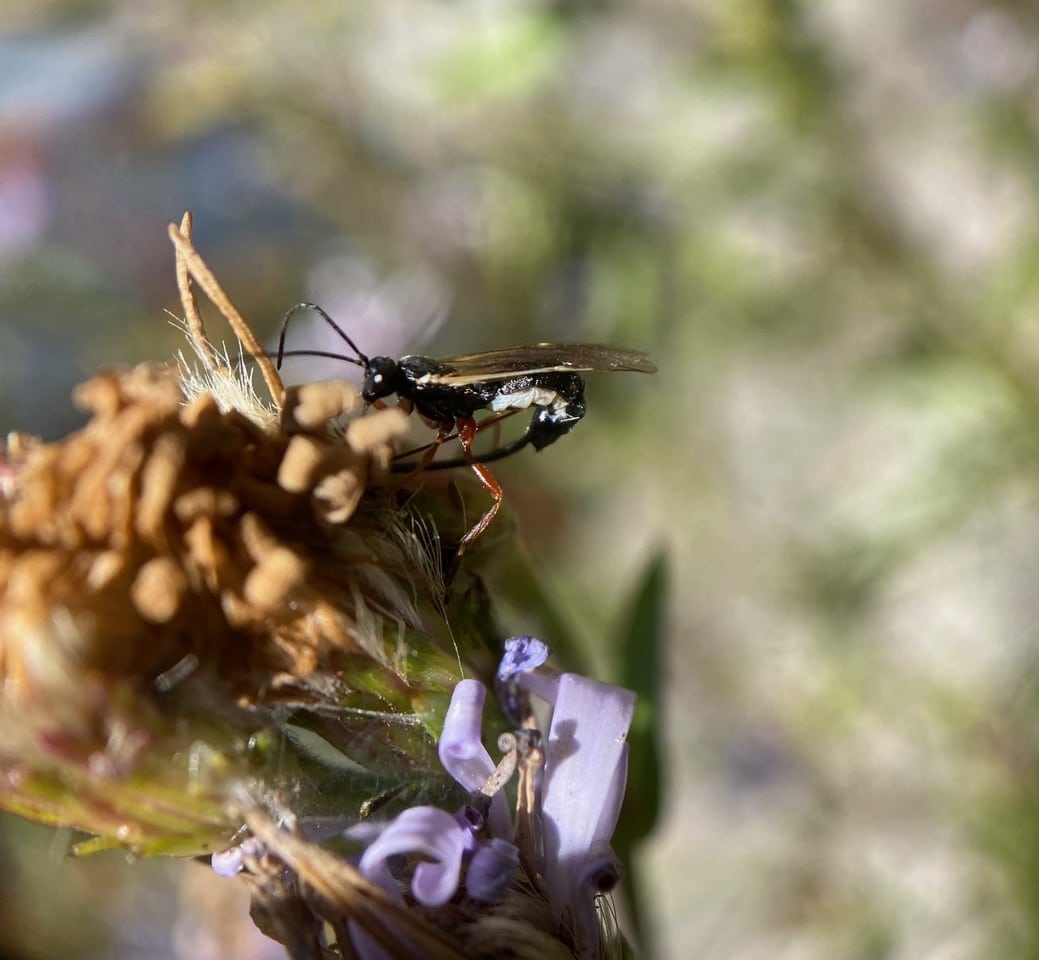
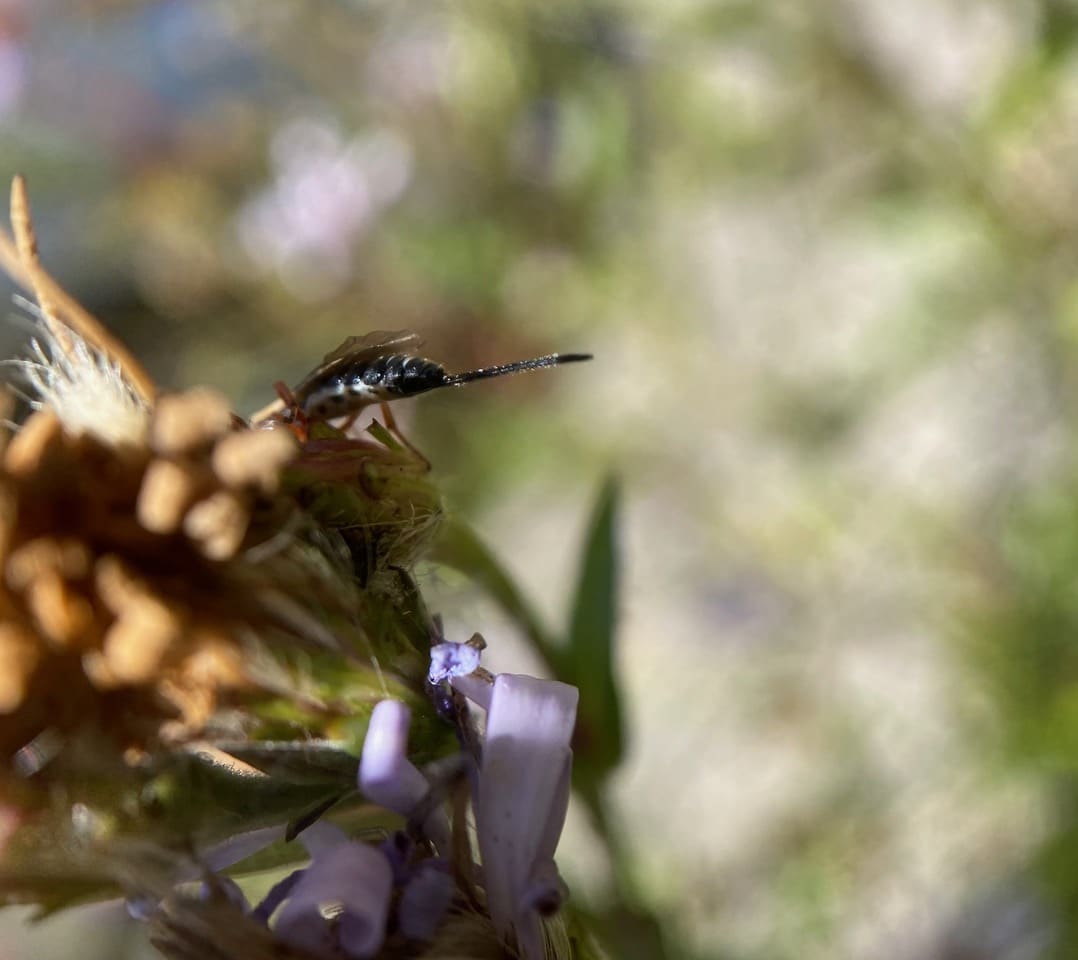
A tiny insect is exploring a dried flowerhead of Pacific Aster. It has an elongated body, long antennae and a long, sturdy ovipositor. A female parasitoid wasp looking to lay her eggs? iNaturalist has helped to identify it as an Ichneumonid Wasp, Itoplectis sp. (family Ichneumonidae).
The Ichneumonidae, also known as the Ichneumon Wasps, or Ichneumonids, are a family of parasitoid wasps. They are one of the most diverse groups within the Hymenoptera (the order that includes the ants, wasps and bees) with about 25,000 species and counting. Ichneumon Wasps attack the immature stages of insects and spiders, eventually killing their hosts. They play an important role in the ecosystem as regulators of insect populations.
The Ichneumon Wasps have longer antennae than typical wasps, with 16 segments or more as opposed to 13 or fewer. Ichneumonid females have an unmodified ovipositor for laying eggs. They generally inject eggs either directly into their host’s body or onto its surface, and the process may require penetration of wood. After hatching, the Ichneumonid larva consumes its still living host. The most common hosts are larvae or pupae of Lepidoptera (butterflies and moths), Coleoptera (beetles) and Hymenoptera. Adult Ichneumonids feed on plant sap and nectar. Females spend much of their active time searching for hosts while the males are constantly on the look out for females. Many Ichneumonids are associated with specific prey, and Ichneumonids are considered effective biological controls of some pest species.
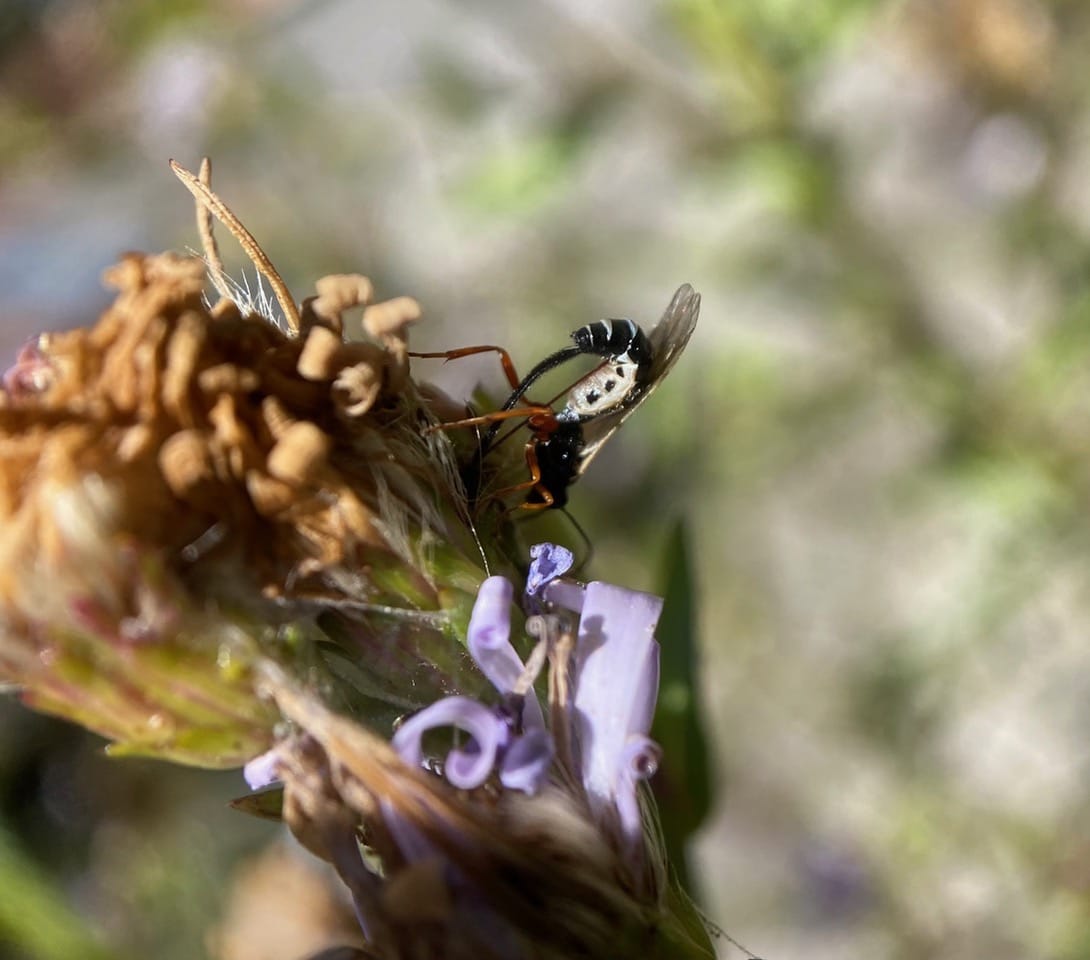
The female wasp must have detected a host among the dried florets. Raising and curling her abdomen, she has unsheathed her needle-like ovipositor, aiming it into the flowerhead. The sheath is the heavy black structure at the tip of her abdomen that houses and protects the ovipositor when not in use.
Itoplectis are some of the most common of all North American Ichneumonid wasps. Their hosts are numerous and include many species of Lepidoptera (moths and butterflies). Some species are hyperparasites (parasites of parasites), parasitizing other species of Itoplectis.
The wasp turns around and inserts her ovipositor into an adjacent spot on the flowerhead.
Her ovipositor safely back in its sheath, the wasp moves on. I congratulate myself for being extremely lucky to have witnessed the egg laying process.
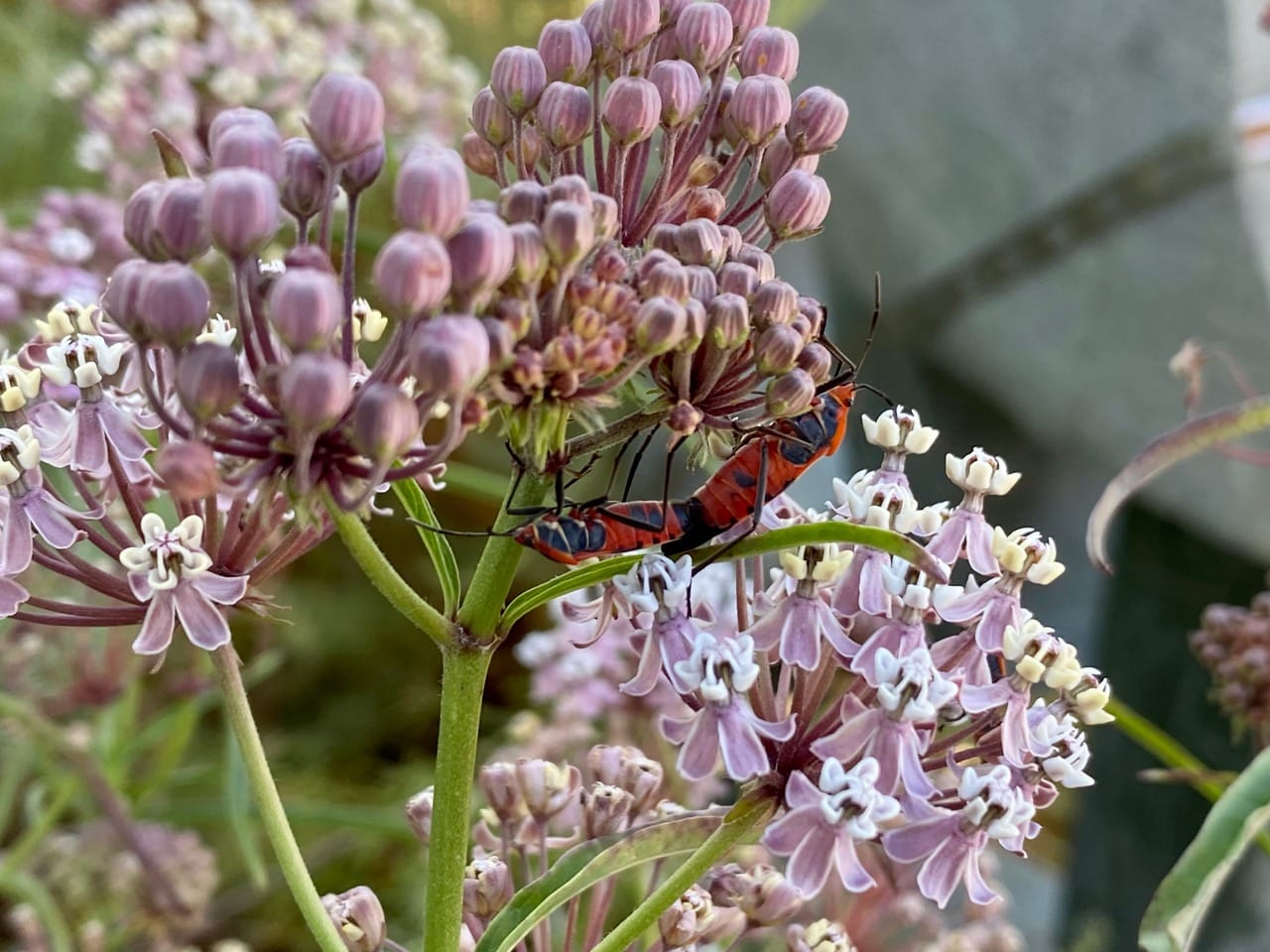
A Large Milkweed Bug, Oncopeltus fasciatus (family Lygaeidae) in resting on the foliage of Narrow-leaf Milkweed, Asclepias fascicularis .
Milkweed Bugs are Seed Bugs (family Lygaeidae) in the insect order of “true bugs”, Hemiptera. The defining feature of Hemipterans is their “beak” or rostrum, a piercing-sucking mouthpart. The Large Milkweed Bug, Oncopeltus fasciatus is a specialist herbivore that frequently consumes milkweed and oleander seeds. Toxic compounds in these plants are sequestered, giving the bugs its toxicity. Their bright aposematic coloration is a warning to potential predators of their toxicity. In addition to its plant-based diet, O. fasciatus has been observed feeding on aphids, monarch caterpillar eggs and larvae, displaying opportunistic behavior.
Adults wander during the daytime in search of milkweeds. When a follicle is found, they inject saliva into it through their long rostrums. This pre-digests the seed and allows the bug to suck it up through their anterior pump and pharynx. Often, multiple individuals feed on one follicle, suggesting that a signal is released by feeding individuals that indicates a good food source.
Juveniles of O. fasciatus require the seeds of milkweed plants for development and growth. Adults can survive on other types of seeds, such as sunflower, watermelon, almond and cashew.

A pair of Large Milkweed Bugs is mating under a a cluster of Narrow-leaf Milkweed flowers.
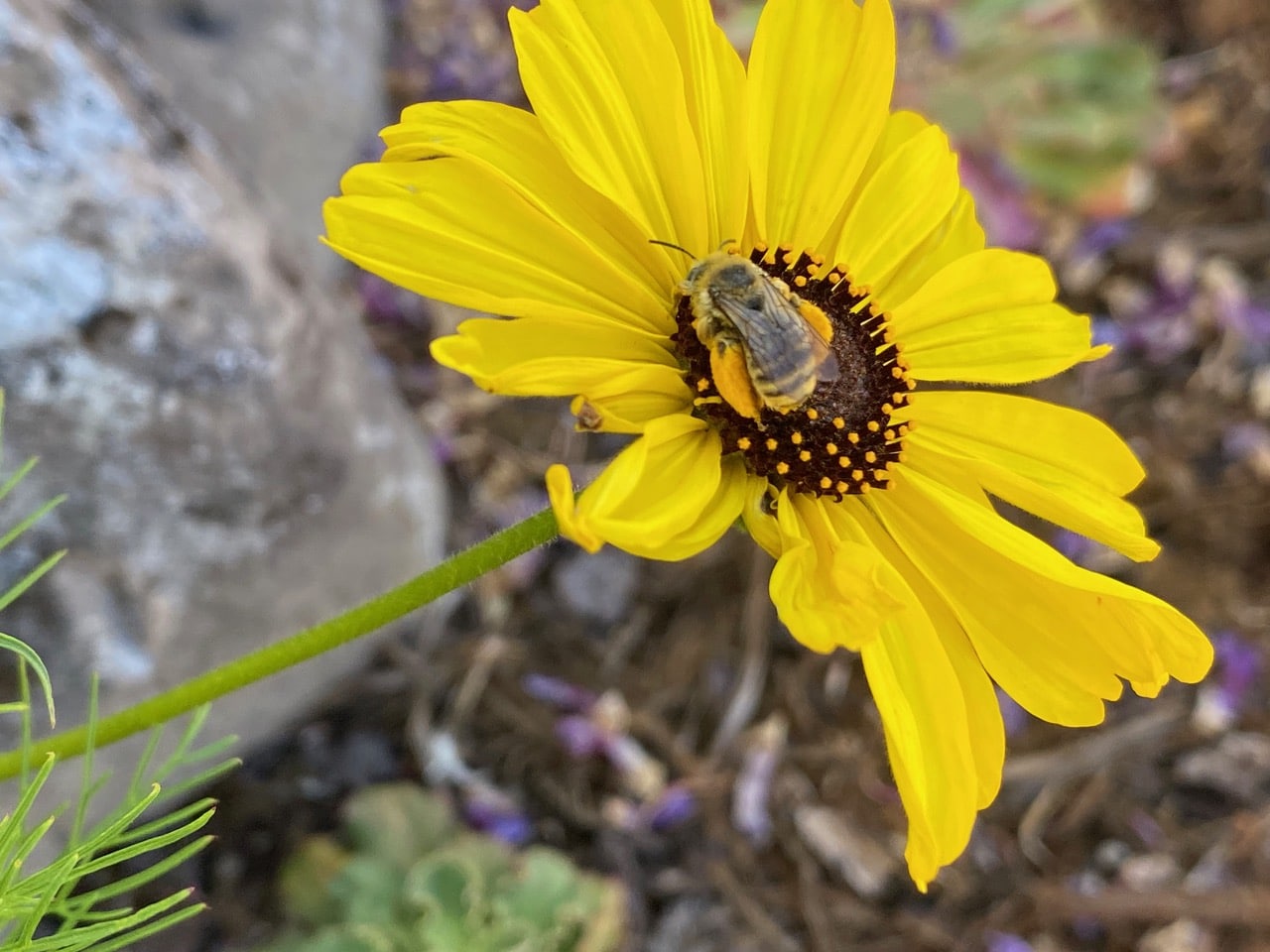
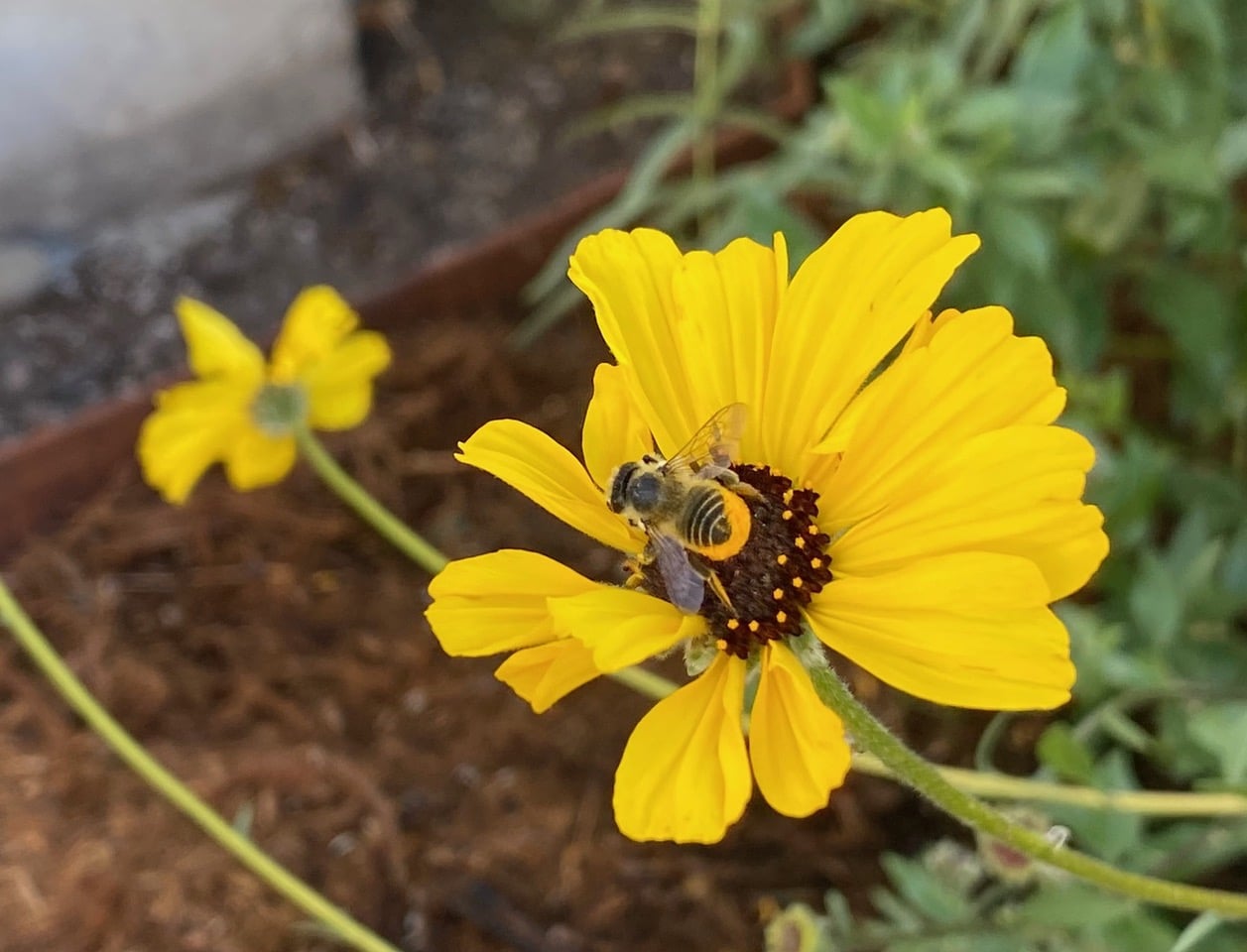
Her prodigious scopae loaded with pollen, a female Summer Longhorn Bee, Melissodes sp. (family Apidae) is foraging on a flowerhead of Bush Sunflower, Encelia californica.
The Summer Longhorn Bees, Melissodes sp. (family Apidae) are medium to large bees, stout-bodied, usually with gray hair on the thorax and pale hair bands on the abdomen. Males usually have yellow markings on their faces and have very long antennae from which their common name is derived. They are active May to September, with peak flight in late June to early August. The females prefer flat, bare ground for digging their solitary nests, though they sometimes nest in aggregations. Pollen is transported in scopae on the hind legs. Pollen loads are often copious and brightly colored and thus very distinguishable. Melissodes are specialists on Asteraceae – females gather pollen from flowers of Aster, Bidens, Coreopsis, Cosmos, Encelia, Gaillardia, Helianthus, and Rudbeckia ssp.
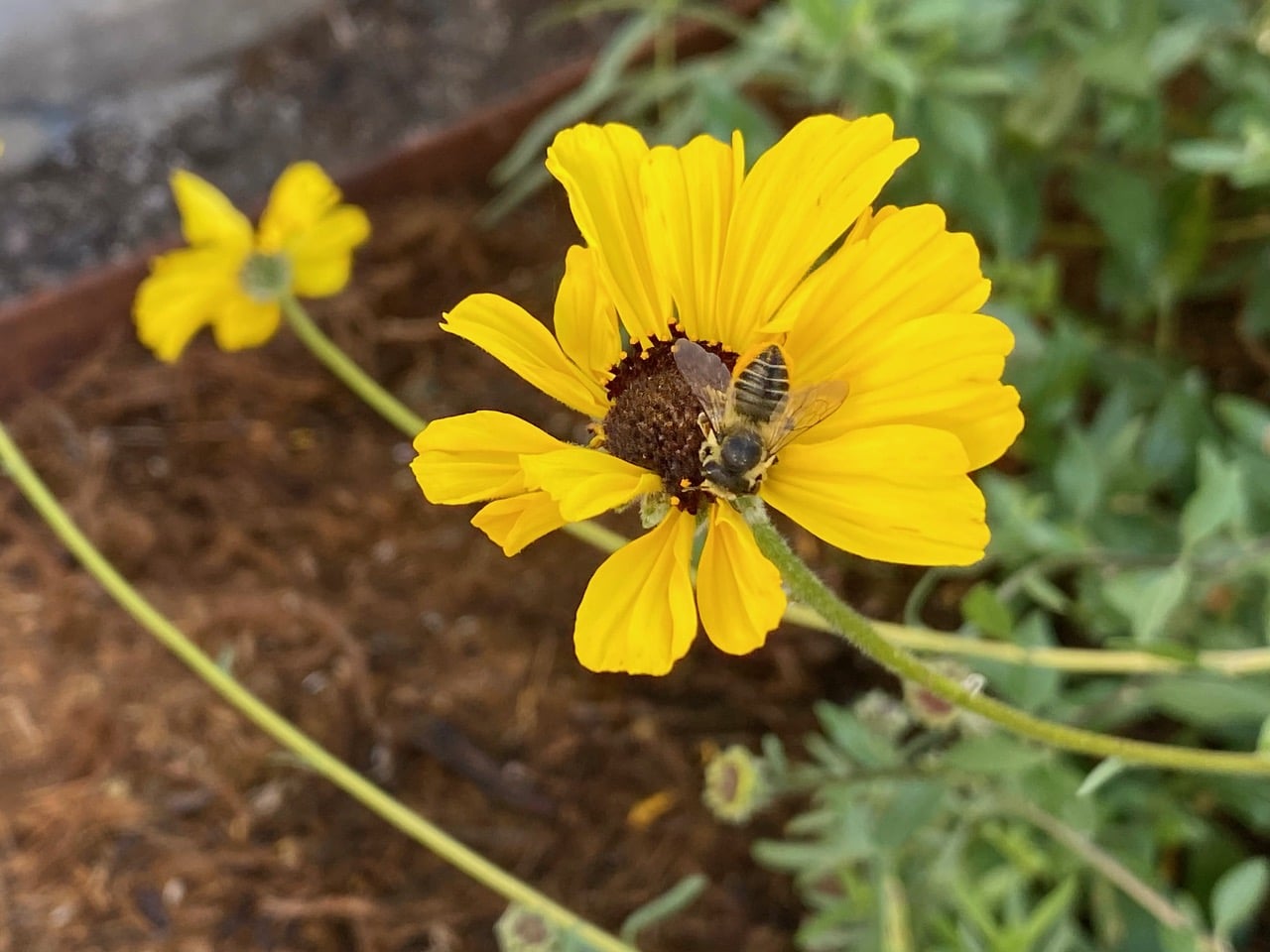
Hey, look, a female Western Leafcutter Bee, Megachile perihirta (family Megachilidae) has landed on a flowerhead of Bush Sunflower, Encelia californica. She too has been productive – you can see the yellow pollen peeking from the scopae on the underside of her abdomen.
The Western Leafcutter Bee, Megachile perihirta is native to western North America, often inhabiting meadows and orchards. The species name “perihirta” refers to the large extent of hairs on the bee. It is one of the most conspicuous native leafcutters in Western North America, especially along the Pacific Coast. It is a stout-bodied bee, about the size of a honey bee; females typically measure 11-13 mm in length, while males are slightly smaller, ranging from 10-12 mm. The females’ abdomen has a pointed tip, while the males’ are rounded. The bees are generalists, visiting flowers from numerous plant families, but tend to favor plants in the sunflower family, Asteraceae.
Megachilids are unusual among bees in the way the females carry pollen. While most bees have scopae (Latin for “broom”, dense, textured hairs that pollen collects on) on their legs, Megachilids have scopae on the underside of their abdomen. The pollen is held loosely by electrostatic attraction to the hairs. When the Leafcutter Bee scrambles over the flowers it lands on, the pollen on its abdominal scopa dusts each flower the bee visits. This is probably why the Megachilids are considered pollinators extraordinaire.
The Leafcutter Bees are best known, of course, for their leaf-cutting behavior. Solitary females construct nests in tubular cavities, including hollow stems, tree holes, and abandoned beetle burrows in wood. Many use holes drilled into wood, straws, or other manufactured tunnels. Females cut pieces from leaves or flower petals for use in the construction of brood cells.
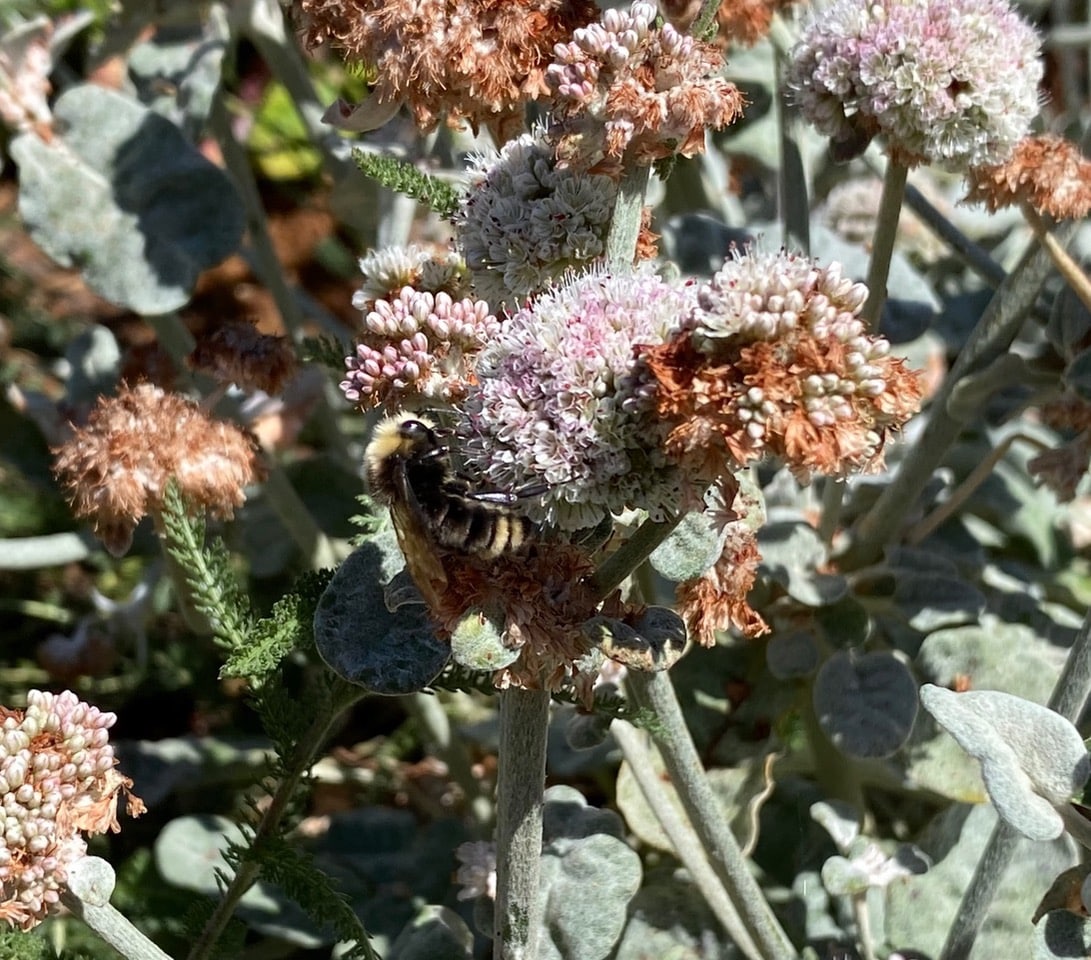
That looks like a male Yellow-faced Bumble Bee, subgenus Pyrobombus (genus Bombus, family Apidae) taking nectar from a Buckwheat inflorescence. Note the extra bands of yellow on his abdomen; he is also slightly larger than a regular worker, and have longer antennae. We are likely to see male bumble bees these days, as we are approaching the end of the bumble bee annual cycle when reproductives (males and new queens) are produced.
Most bumble bees have an annual life cycle which starts with a fertilized queen emerging from diapause (insect version of hibernation) during the late winter or early spring. After emergence and while searching for a nest site, the queen consumes pollen and nectar to replenish her depleted fat reserves and to promote development of her ovaries. Once located, the queen provisions the nest with a ball of pollen mixed with nectar and builds a single nectar pot composed of wax. The queen then lays her first clutch of eggs, and incubates them with her body heat. Newly emerged workers (all females) assume foraging and brood rearing responsibilities, enabling the queen to concentrate on egg laying. During late summer to early fall, the colony switches to producing “reproductives” (i.e. males and gynes). Male offspring develop from unfertilized eggs, and fertilized eggs develop into gynes (new queens). Gynes mate with males from other colonies and, once fertilized, these new queens enter diapause for the winter. Old queens, workers, and males die off at the end of the season, leaving only the newly mated queens to establish new colonies in the following spring.
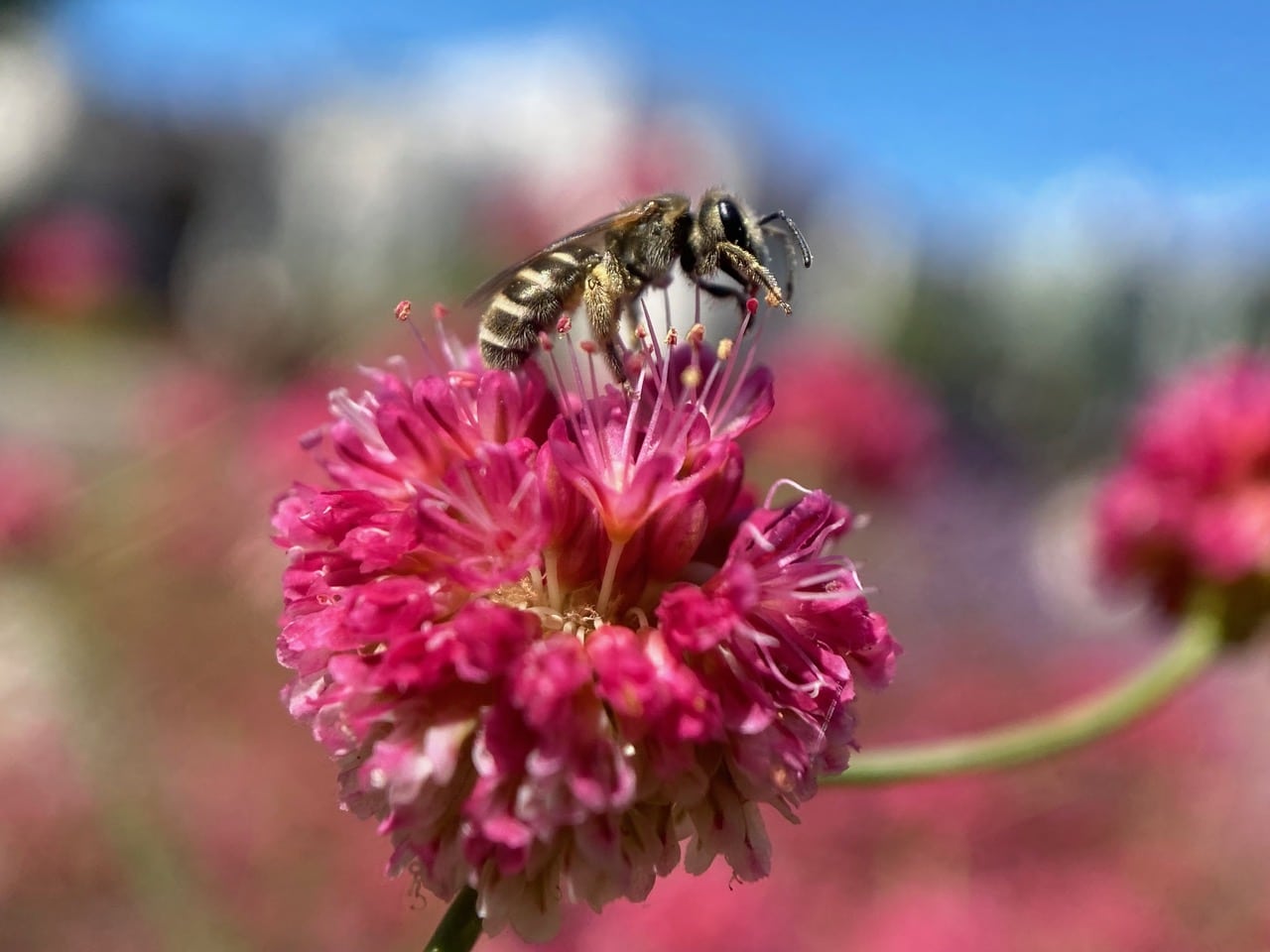
A Tripartite Sweat Bee, Halictus tripartitus (family Halictidae) is gathering pollen from the flowers of Red-flowered Buckwheat, Eriogonum grande ssp. rubescens.
Halictus is found worldwide; they are most common in the Northern Hemisphere. All are generalists, foraging from a wide variety of flowering plants. Many species are social and produce several generations per year. This is not surprising as most blooming plants are season-specific; a bee that requires pollen and nectar across multiple seasons would not thrive as a specialist. All Halictus in North America nest in the ground, often in aggregations; and they may nest in the same area for decades.
The species Halictus tripartitus is primitively eusocial, meaning it has a social structure that is less complex than highly social insects like honey bees, but more advanced than solitary bees. The bees form annual colonies in the soil, where some workers are capable of reproducing. Only potential queens overwinter, then provision a worker brood in the spring, with at least one worker brood produced before males and new queens emerge. These bees are known to nest in aggregations, often in flat, bare ground. They visit and pollinate a wide variety of flowers.
A