

Pollinator Post 8/5/26 (1)

The worst of our heat wave is over, but dirty air still hangs over the Bay Area from the various wildfires burning to the north of us. Having been cooped up for days, I am elated to be able to explore the insect life on the blooming Oregon Gumweed, Grindelia stricta on the shoreline of Bay Farm Island again.

The first insect I photograph this morning, unbelievably, is a cuckoo bee! Even before I see its host bee! I have already seen several female Sharptail Bees, Coelioxys sp. (family Megachilidae) this year, but this is the first male I have come across so far. Note that his abdomen is armed with a multi-pronged tip.
The term cuckoo bee refers to a variety of different bee lineages which have evolved the kleptoparasitic behavior of laying their eggs in the nests of other bees, similar to the behavior of cuckoo birds. Female cuckoo bees lack pollen-collecting structures and do not construct their own nests. Cuckoo bees typically enter the nests of pollen-collecting species, and lay their eggs in cells provisioned by the host bee. When the cuckoo bee larva hatches, it consumes the provision in the nest, and kills the host larva. Many cuckoo bees are closely related to their hosts, and may bear similarities in appearance reflecting this relationship. Others parasitize bees in families different from their own.

The Cuckoo Leafcutter Bees, also known as Sharptail Bees, belong to the genus Coelioxys, in the same family as their hosts, Megachilidae. Members of the genus Coelioxys share the distinctive trait of having hairs on their eyes. In addition, the back rim of the bee’s scutellum (the second segment of the thorax) has prominent toothlike protrusions called axillae. In Greek, Coelioxys means “sharp belly”, referring to the tapered, pointed abdomens of cuckoo leaf cutters. The bees have dark abdomens banded by short pale hairs; thorax with prominent axillae; red, black or red-and-black legs; and green eyes. Female Coelioxys have pointed, conical abdomens with spearlike tips. The spade-shaped abdominal tips allow the female cuckoos to break through the brood-cell walls that leafcullters construct with leaves, petals and other materials. Males have abdomens armed with multiple pronged tips. These bees are known to sometimes sleep upside down on vegetation, holding on with their mandibles.
While we might take offense at the unsavory behavior of cuckoo bees, their presence in the garden or in the wild is a clear indication of a thriving population of their host bees. By parasitizing specific species, cuckoo bees prevent dominant host bees from pushing out less competitive, rarer bee species, allowing for greater biodiversity. The arms race between cuckoo bees and their hosts drives genetic diversity and adaptation. Hosts evolve defenses against parasites, which naturally strengthens the resilience of the bee community. What’s more, although they do not intentionally collect pollen, cuckoo bees must visit flowers to forage for nectar, which sometimes leads to incidental pollen transfer.

A fuzzy little bee is taking nectar from a flower of the low-growing Birdsfoot Trefoil, Lotus corniculatus. It is a male Leafcutter Bee, although too small to be a Western Leafcutter Bee, Megachile perihirta.
Leaf-cutter Bees, Megachile sp. (family Megachilidae) are stout-bodied, usually with pale hair on the thorax and stripes of white hairs on the abdomen. Females usually have a triangular abdomen with a pointed tip, and males’ faces are covered with dense, pale hair. Flight season is from May into September, with peak activity from June to August. Solitary females construct nests in tubular cavities, including hollow stems, tree holes, and abandoned beetle burrows in wood. Many use holes drilled into wood, straws, or other manufactured tunnels. Females cut pieces from leaves or flower petals for use in the construction of brood cells. Most Megachile females are generalist foragers, but prefer flowers in the family Asteraceae. Pollen is transported in dense scopae (special pollen collecting hairs) on the underside of the abdomen.
Meet the Leafcutter Bee – NEW edition – YouTube

Note that the front leg of this male Leafcutter Bee is of an orange color and bears fringes of long pale hair.
In many Megachile species, males have enlarged, brightly colored, and heavily fringed front tarsi equipped with pheromone-producing odor glands. During mating, the male mounts the female, grasps her antennae with his specialized mandibles, and drops these fuzzy front legs over her compound eyes (acting like a blindfold) to calm her and press scent glands close to her antennae.

A Harvestman (order Opiliones) is resting motionless on a leaf axil of Grindelia.
The Opiliones are an order of arachnids commonly known as harvestmen or daddy longlegs. They are known for having exceptionally long legs relative to their body size. They are distinguished from the spiders in several ways. In the harvestmen, the connection between the cephalothorax and abdomen is broad, so the body appears as a single oval structure. Unlike spiders, Opiliones have no venom glands in their chelicerae, so pose no danger to humans. They also lack silk glands and therefore do not build webs.
Most Harvestman species are omnivorous, eating primarily small insects and all kinds of plant material and fungi. Some are scavengers, feeding on dead organisms and fecal material. Because their eyes cannot form images, they use their second pair of legs as antennae to explore their environment.

A European Paper Wasp is foraging on an umbel of faded Fennel flowers. She might be hunting caterpillars instead of seeking nectar. Note her orange-tipped antennae – a good way to distinguish her from the look-alike Yellowjackets who have black antennae.
Native to Europe, the European Paper Wasp, Polistes dominula, is a social insect that produces an annual colony in a paper nest. Individual colonies are established anew each spring. The overwintering stage are mated females (queens). The overwintered queens emerge from sheltered spots in spring and search out sites to establish a new colony. Nests are constructed of paper, produced from chewed wood fibers of weathered fences, porch decks and other similar sources. Larvae are fed crushed insects, usually caterpillars. As the population increases, the original queen increasingly remains in the nest as new workers take over colony activities. A few of the wasps produced later in summer are males and increasing numbers of the females become sexually mature. Mating occurs and the mated females are the surviving overwintering stage. Males and non-reproductive females do not survive winter and the nest is abandoned by late fall. European Paper Wasps will sometimes feed on sweet materials, including honeydew produced by aphids. They may also feed on damaged ripe fruits. Because of their habit of hunting caterpillars, the wasps have become one of the most important natural controls of garden pests.
Often mistaken for Yellowjacket Wasps, the European Paper Wasps can be distinguished by their slender body, and their orange-tipped antennae. Yellowjackets have shorter, thicker bodies, and they have black antennae. Paper wasps dangle their long legs when they fly, while the yellowjackets tuck their legs under their bodies when they fly. Paper wasp nests resemble an open honeycomb or upside-down umbrella. They often build their nests on man-made structures such as eaves or lawn furniture. Yellowjacket nests are covered with a surrounding envelope of paper; the nests have a single opening that is often hard to see because the nest is underground.

This patch of Grindelia is heavily infested with Spittlebugs. I pause every now and then to check for newly emerged adults but find none. Like me, many European Paper Wasps are looking for the Spittlebugs that have emerged from the foamy shelters. Their long legs dangling, the wasps fly slowly between the plants, occasionally stopping to investigate near the foam masses. I seem to be seeing a lot more of the European Paper Wasps than their cousin the Yellowjackets this year. Has there been a crash in the population of the Yellowjackets? In past years, the two species have appeared in almost equal numbers.
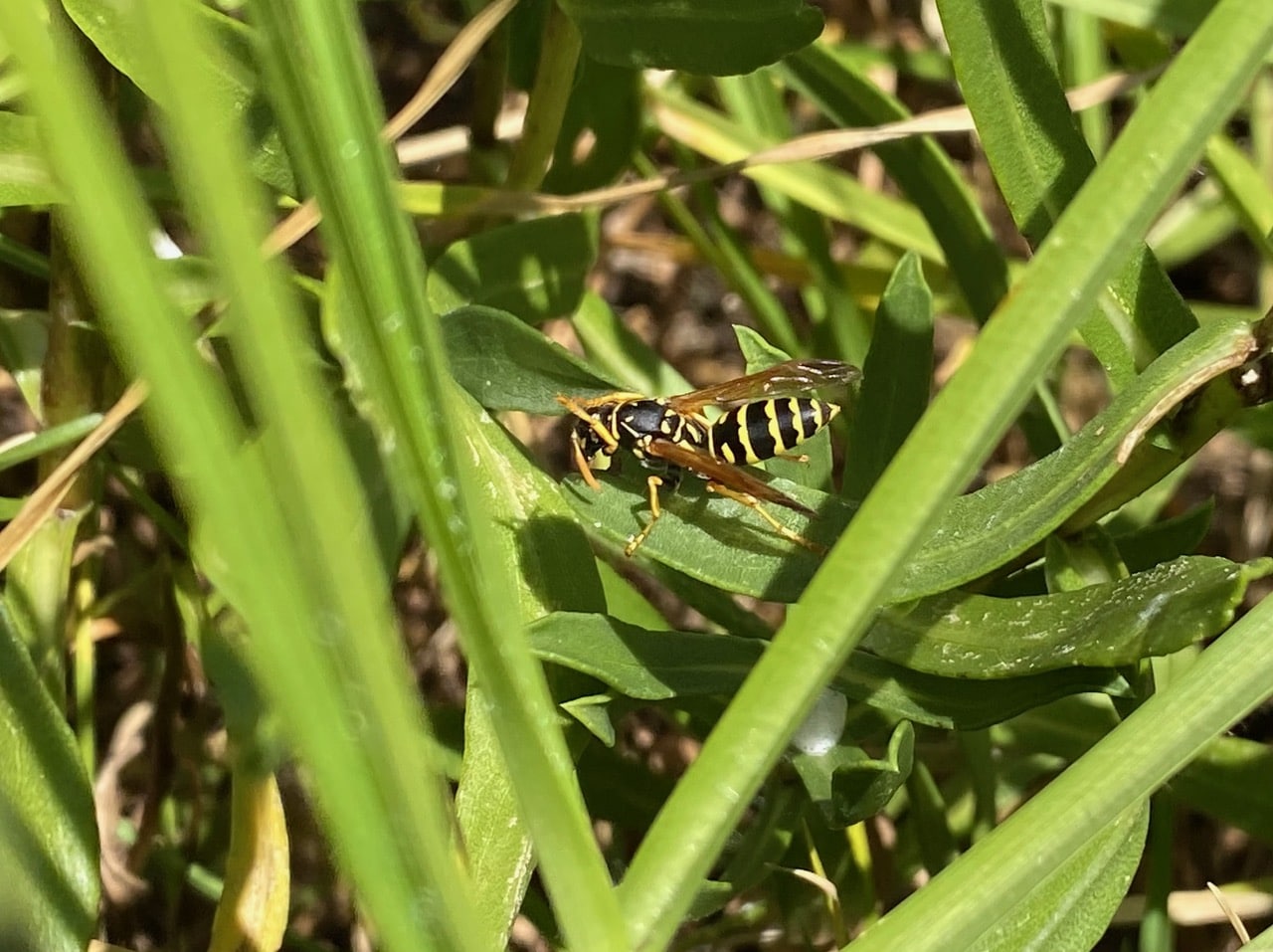
I watch with bemusement as a European Paper Wasp lands on a lower leaf of a Grindelia and furiously grooms herself. What has she contacted that requires such thorough cleaning? Has she been plundering the foam masses of the Spittlebugs? I know from past observations that these wasps hunt the newly emerged Spittlebugs when they are still soft and vulnerable.

A small fly, Stevenia sp. (family Rhinophoridae) is perched on a Grindelia leaf.
Stevenia is a genus of small-to-medium-sized flies belonging to the family Rhinophoridae, commonly known as Woodlouse Flies. These insects are specialized parasitoids targeting terrestrial isopods like sowbugs and pillbugs. Adult female deposits the eggs near woodlice. The first instar larva attaches itself to a passing woodlouse and enters the body of the freshly molted host. The larva feeds on the hemolymph and organs of the host until pupation, leading to the death of the host. Adult fly emerges from the pupa from inside the empty exoskeleton of the host. Adult Woodlouse Flies primarily feed on nectar and plant juices.


A female Western Leafcutter Bee, Megachile perihirta (family Megachilidae) is foraging on a Grindelia flowerhead. Note that she does not have a scopa on her hind legs like most other bees. Instead her scopal hairs for collecting pollen are located on the underside of her abdomen. She has not gathered much pollen so far as her rust-colored scopa has not been covered with yellow pollen.

Leaf-cutter Bees, Megachile sp. (family Megachilidae) are stout-bodied, usually with pale hair on the thorax and stripes of white hairs on the abdomen. Females usually have a triangular abdomen with a pointed tip, and males’ faces are covered with dense, pale hair. Flight season is from May into September, with peak activity from June to August. Solitary females construct nests in tubular cavities, including hollow stems, tree holes, and abandoned beetle burrows in wood. Many use holes drilled into wood, straws, or other manufactured tunnels. Females cut pieces from leaves or flower petals for use in the construction of brood cells. Most Megachile females are generalist foragers, but prefer flowers in the family Asteraceae. Pollen is transported in dense scopae (special pollen collecting hairs) on the underside of the abdomen.
North America is home to many leafcutter bees, but the Western Leafcutter, Megachile perihirta is one of the largest. The species ranges on the west coast from British Columbia south to northern Mexico. From a distance, the female can be mistaken for a honey bee. She is about the same size as a worker honey bee and enjoys many of the same flowers, but her head is disproportionately large because it houses the bulky muscles that operate her large mandibles. While most leafcutter bees nest above ground in tubes and tunnels, the Western Leafcutter nests underground. Often a small group of females live in a community and burrow into soil, gravel, or sand.

A small, black bee with faint white bands on her abdomen is foraging on a Grindelia flowerhead. She is a Kincaid’s Sweat Bee, Lasioglossum kincaidii (family Halictidae).
Sweat Bees (family Halictidae) earn their nickname from their habit of landing on skin to sip salty minerals from human sweat. Lasioglossum species are found worldwide, and they constitute the largest bee genus. The majority of Lasioglossum are generalists. Because they are so abundant throughout the flowering season, the bees are often important pollinators. Their sheer numbers are enough to achieve excellent pollination of many wild flowers, especially of plants in the Asteraceae, which have shallow floral tubes that are easily accessed by these minute bees.
Lasioglossum exhibit a range of social behaviors; the genus includes solitary, communal, semi social, primitively eusocial, and even parasitic species. Almost all Lasioglossum in the U.S. nest in the ground. Generally these nests are built in the spring by fertilized females (called foundresses) that spent the winter in hibernation. In social species, the foundresses behave much like the queen bumble bees – they lay the first batch of eggs that develop into the first generation of female workers. The nest grows with each additional generation of bees. Later broods may consist of both males and females. They mate, and at the end of the season the fertilized females hibernate till the following spring, repeating the life cycle of the colony.

Kincaid’s Sweat Bee, Lasioglossum kincaidii is a small, jet-black solitary bee with black smoky wings and faint white bands on the abdomen. Widely found in urban/suburban gardens and natural habitats in California, they are highly active foragers that emerge as early as spring to pollinate smaller flowers. The bees are polylectic generalists, meaning they will visit a wide variety of flora, and are especially fond of smaller flowers. Like most sweat bees, they are ground-nesting.

Ooh, that looks like an unusual bee! iNaturalist has helped identify it as a Least Cellophane-cuckoo Bee, Epeolus minimus (family Apidae). Not a surprising find, as the shoreline habitat here abounds in their host, the Cellophane Bees, Colletes sp. (family Colletidae).
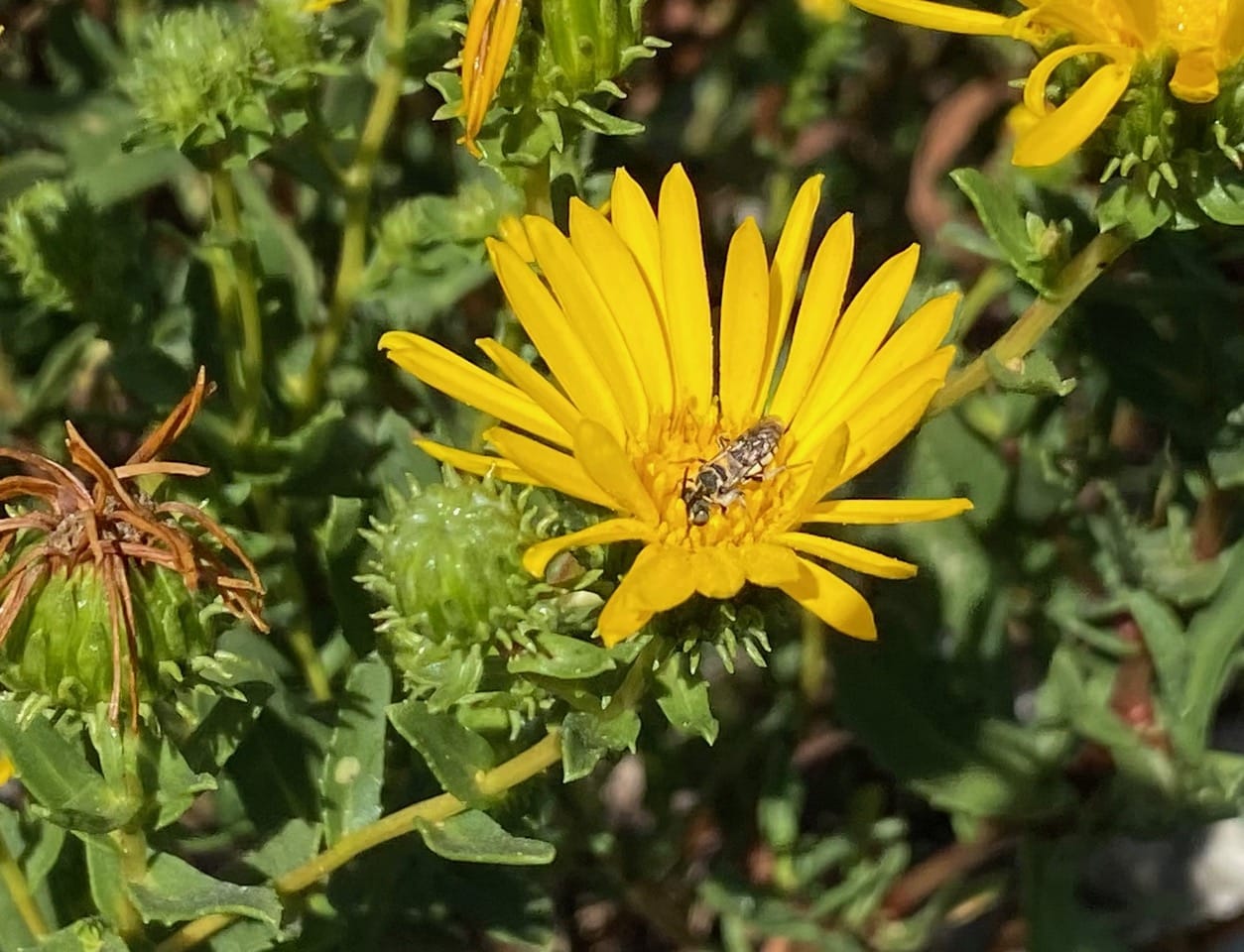
Epeolus is a genus of cuckoo bees in the family Apidae. They are often known as variegated cuckoo bees. The species is uncommon to rare, and has strong patterns of black and white on the thorax and abdomen. These patterns are made of tiny flattened hairs lying flush with the integument or “skin”of the bee. These tiny hairs form striking, velvety black-and-white or yellowish patterns on their thorax and abdomen. All known species of Epeolus are kleptoparasites of ground-nesting Cellophane Bees of the genus Colletes. The female enters the nest excavated by the host and lays an egg in an unsealed cell. The Epeolus larva then consumes the egg of the host bee and then feeds on the pollen the Colletes bee provisioned the cell with for her offspring. Colletes bees line their nest cells with a cellophane like covering which they exude from the Dufour’s gland to protect the cell from moisture and fungal infection. Female Epeolus bees have spines on the end of their abdomens which they use to pierce U-shaped holes in this covering so that she can oviposit between its layers; she also secretes a small amount of glue to attach her egg to the cell.
Epeolus minimus is among the most widespread and commonly collected Epeolus species in North America.
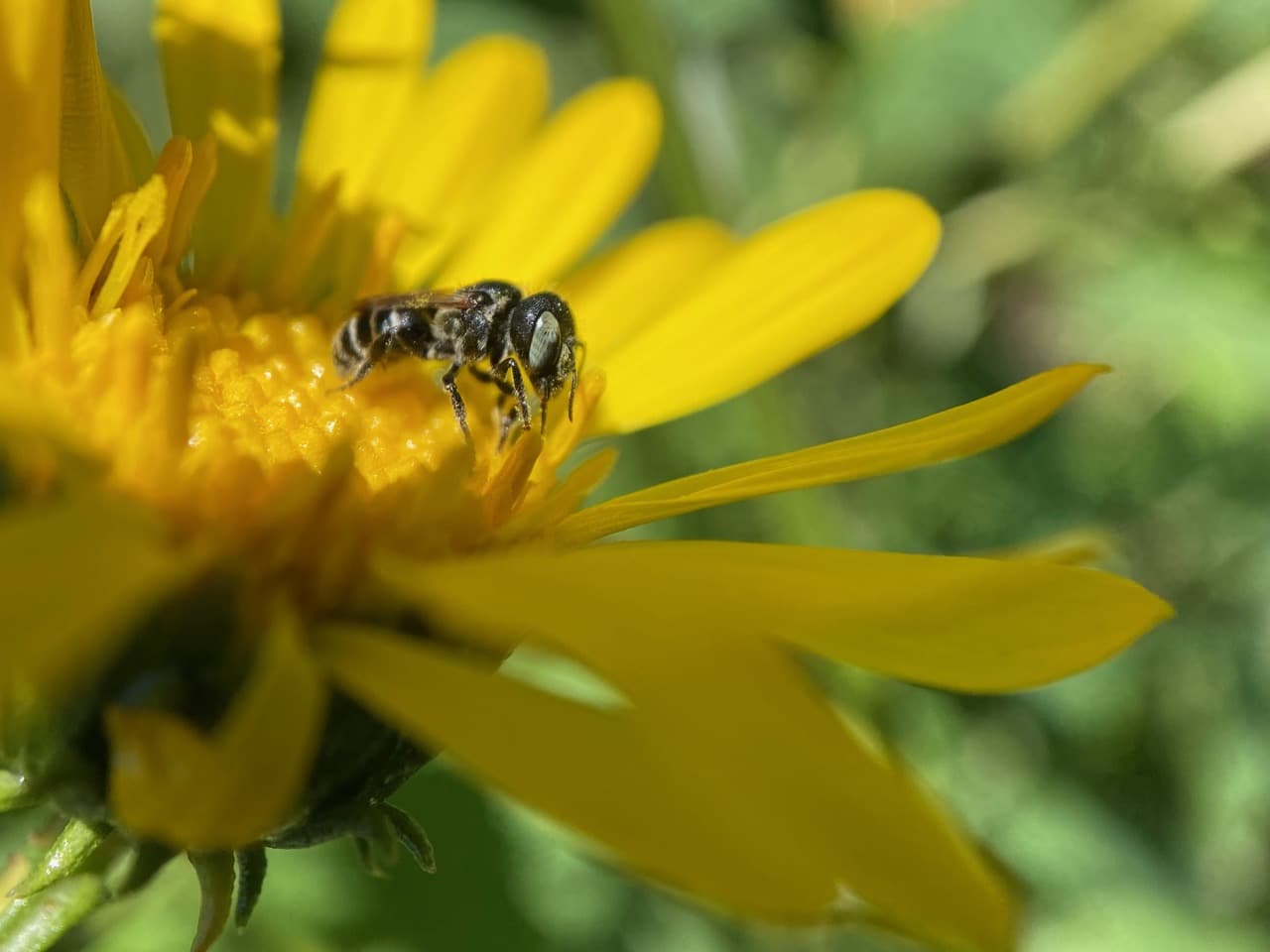
Whoa, who’s that bee with the oversized head? The “bald-headed” look reminds me of a Mason Bee. iNaturalist has helped identify it as a member of the genus Ashmeadiella, a group of solitary mason/leaf-cutter bees in the family Megachilidae. Yay, a new bee for me!

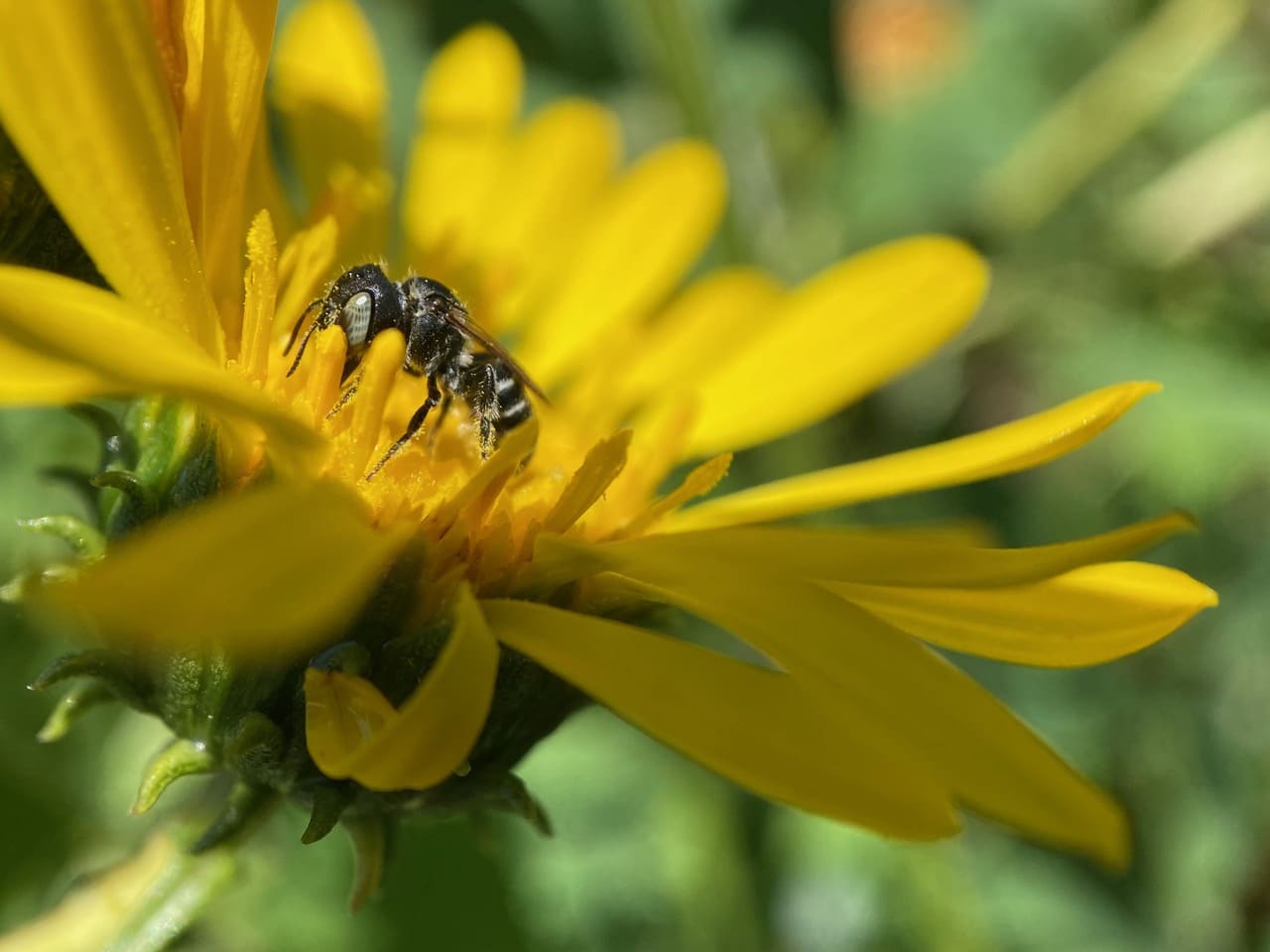
Native to North and Central America, Ashmeadiella is a diverse genus of solitary mason/leafcutter bees in the family Megachilidae, most common in western desert and semi-arid environments. The bees are small, ranging from 3.5 to 9.5 mm in length with robust builds, non-metallic, usually black heads and bodies, and abdomens banded with pale hairs. Males are characterized by four distinct prongs or teeth at the tip of the abdomen. The bees nest in pre-existing cavities like hollow plant stems, abandoned beetle burrows in dead wood, soil, or spaces under rocks. Females divide linear nest tunnels into individual brood cells using chewed-up leaf pulp mixed with resin, sap, gum, or nectar. Many species visit a wide array of wildflowers, while others are floral specialists tied to specific plants.

This view of the bee shows the tufts of scopal hairs on the underside of her abdomen used for collecting pollen. Looking through the photos in Naturalist, I noticed that many of the bees have a vertical dark patch in the front edge of their large, marbled compound eyes, just as my pictures show in this bee. I wonder what that’s about? None of the genus description I can find mentions this feature. Just optical illusion?

It’s been a very productive and exciting morning for me so far: two cuckoo bees and a new bee!