

Pollinator Post 8/4/23 (1)
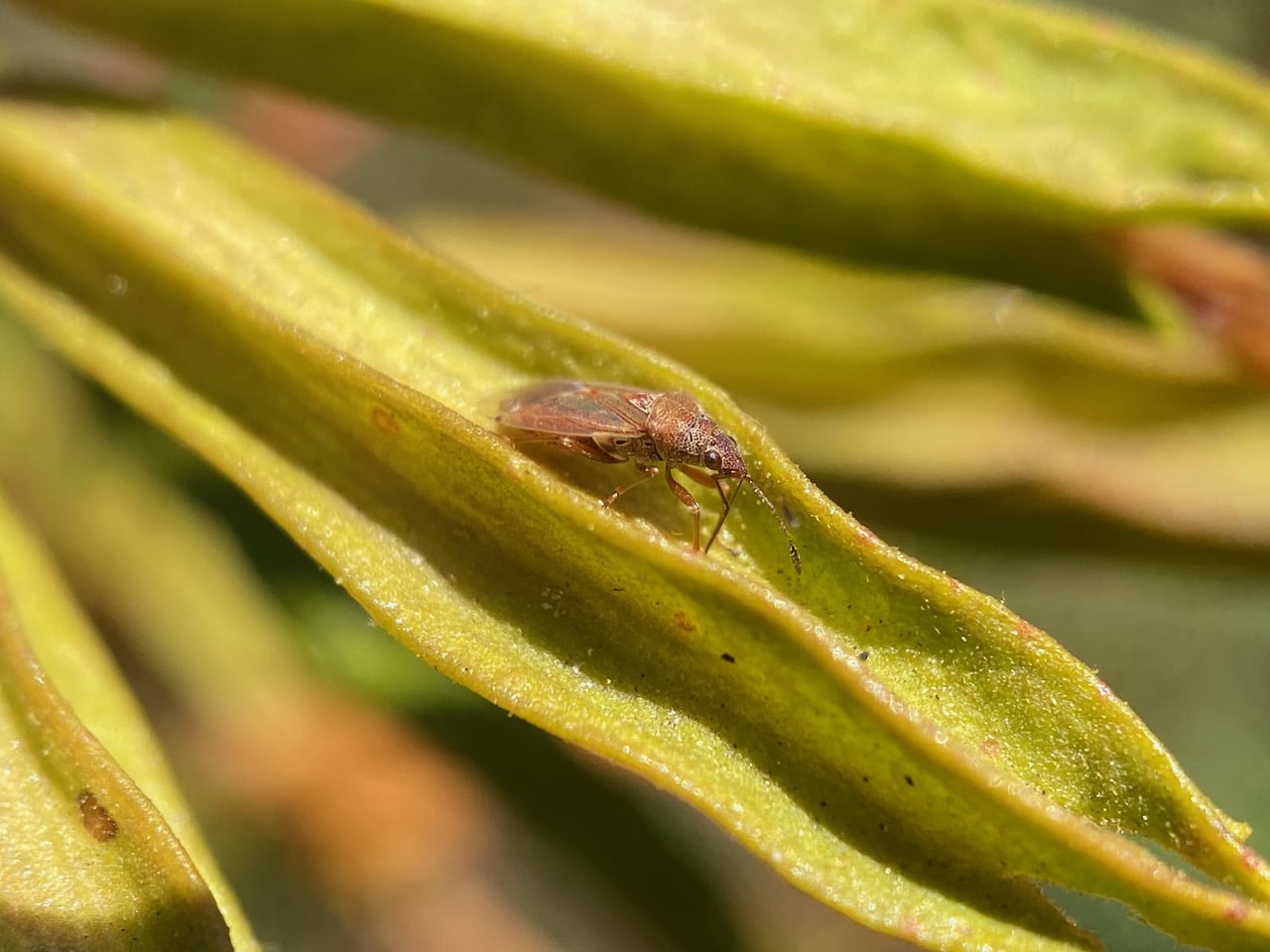
A Seed Bug, Kleidocerys franciscanus (family Lygaeidae) is using its rostrum to feed on the developing seeds in the calyx of a Sticky Monkeyflower.
The defining feature of Hemipterans or “true bugs” is their “beak” or rostrum in which the modified mandibles and maxillae form a “stylet” which is sheathed within a modified labium. The stylet is capable of piercing tissues and sucking liquids, while the labium supports it. The stylet contains a channel for outward movement of saliva and digestive enzymes, and another channel for the inward movement of pre-digested liquid food. The rostrum is usually folded under the body when not in use. Seed bugs are able to feed on seeds by injecting digestive juices into the seeds and sucking up the digested contents as a liquid.

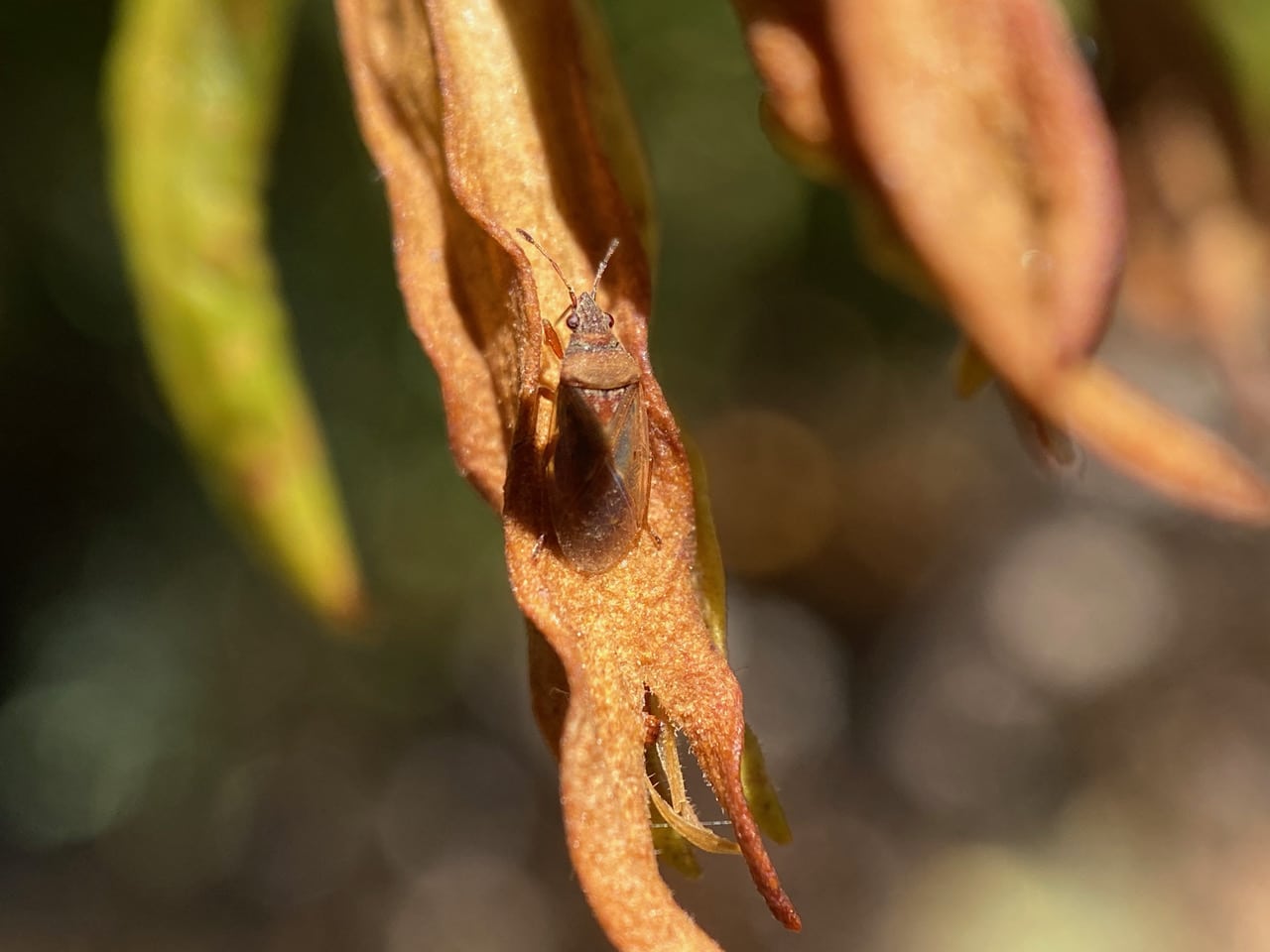
Another Seed Bug of the same species is feeding on a withered calyx. The bug is especially well-camouflaged on this brown seed pod.
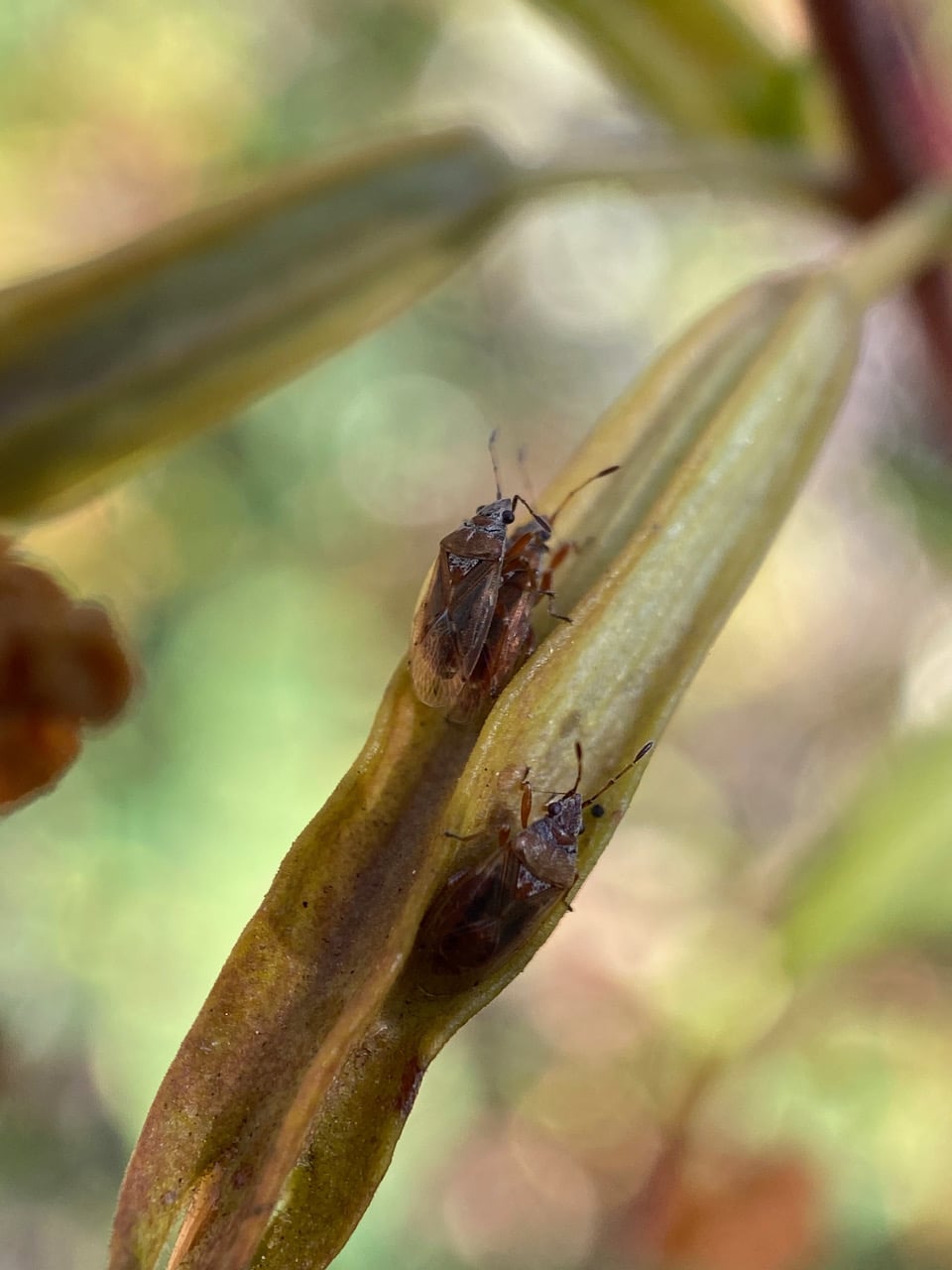
Hidden in the shadows of a Sticky Monkeyflower, more Seed Bugs, Kleidocerys franciscanus (family Lygaeidae) can be seen gathered on a spent calyx. These bugs are almost always found on the calyces (ripening seed capsules), either feeding or mating. A very narrow niche indeed!

A Lacewing larva is roaming the foliage of a Sticky Monkeyflower.
Lacewings are insects in the large family Chrysopidae of the order Neuroptera. Adults are crepuscular or nocturnal. They feed on pollen, nectar and honeydew supplemented with mites, aphids and other small arthropods. Eggs are deposited at night, hung on a slender stalk of silk usually on the underside of a leaf. Immediately after hatching, the larvae molt, then descend the egg stalk to feed. They are voracious predators, attacking most insects of suitable size, especially soft-bodied ones (aphids, caterpillars and other insect larvae, insect eggs). Their maxillae are hollow, allowing a digestive secretion to be injected in the prey. Lacewing larvae are commonly known as “aphid lions” or “aphid wolves”. In some countries, Lacewings are reared for sale as biological control agents of insect and mite pests in agriculture and gardens.

I stop by the tall Soap Plant, Chlorogalum pomeridianum by the trail to check for the Two-tubercled Orb-weaver Spider. She has moved to an adjacent seed capsule that is also cracked open. Her colors match the seed capsule perfectly! Do you see her eyes? Follow the white arrow between the tubercles – you’ll find her narrow head (cephalothorax) and eyes between her folded front legs.
Gibbaranea bituberculata is a species of ‘orbweavers’ belonging to the family Araneidae. They are found in sunny habitats on shrubs, edges and low plants, where they can make their webs near the ground. Their basic color is very variable, but usually it is brownish, with whitish shades. The cephalothorax is covered with lying down hairs.
Orb-weaver spiders are members of the spider family Araneidae. They are the most common group of builders of spiral wheel-shaped webs often found in gardens, fields, and forests. Generally, orb-weavers are three-clawed builders of flat webs with sticky spiral capture silk. The third claw is used to walk on the non-sticky part of the web. Typically, the prey insect that blunders into the sticky lines is stunned by a quick bite, and then wrapped in silk.
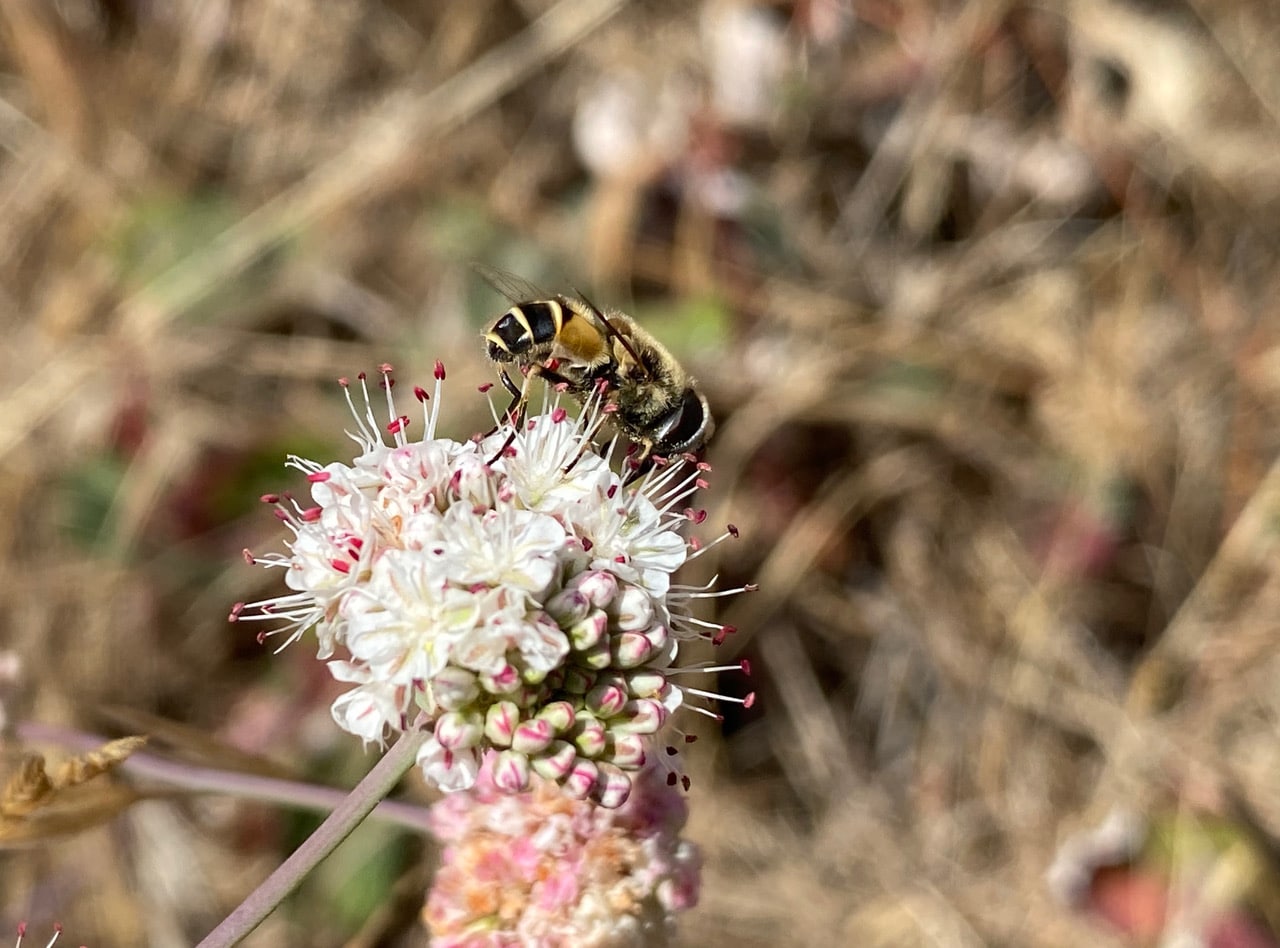
For some reason, there’s almost total failure of the Nude Buckwheat, Eriogonum nudum at Siesta Nose this year. The steep dry slopes were covered with the flowers last summer, but they are hardly there this year. Fortunately some of the plants along the trail are blooming, feeding many insects. A Black-footed Drone Fly, Eristalis hirta (family Syrphidae) is foraging on a fresh inflorescence.
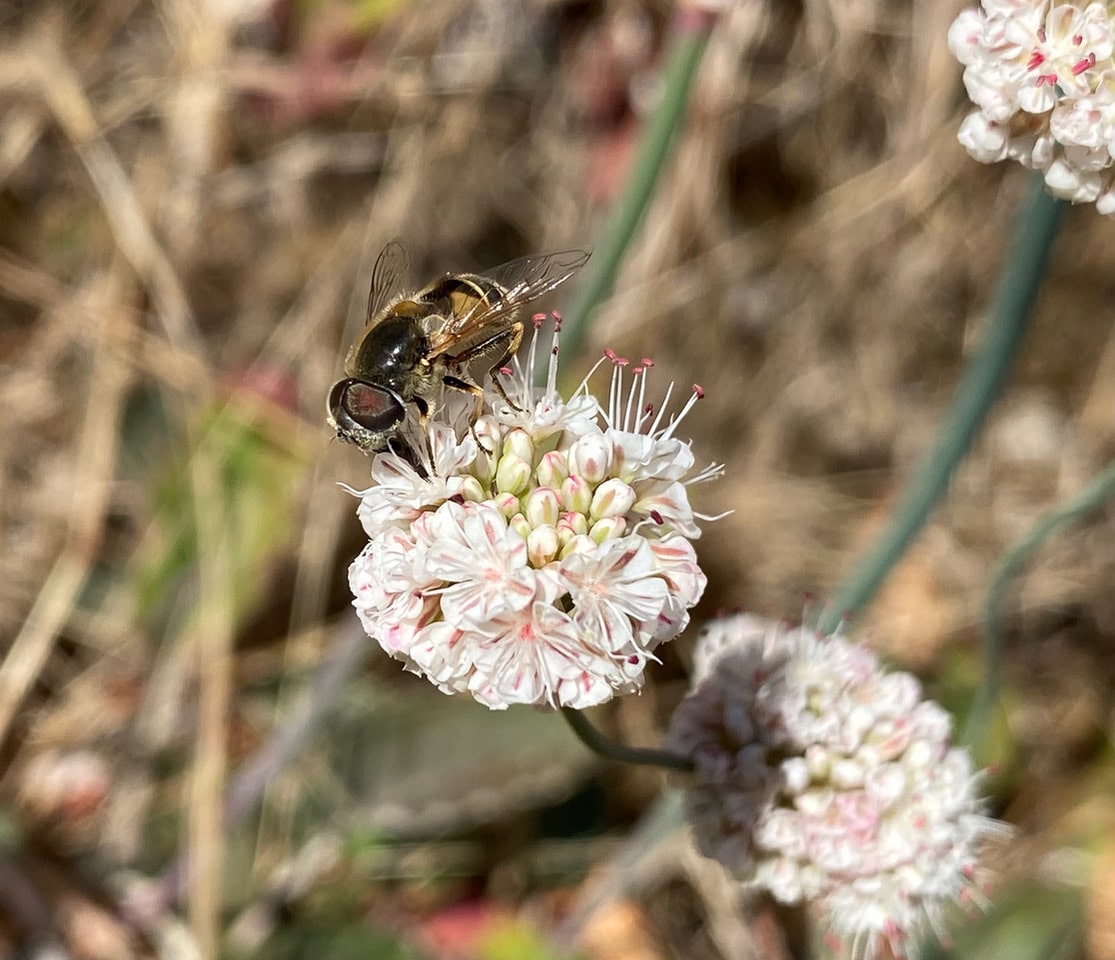
The Black-footed Drone Fly, Eristalis hirta (family Syrphidae) is a common Western North American species of hoverfly. The adults visit flowers for nectar and pollen. Larvae are aquatic filter-feeders of the rat-tailed type.
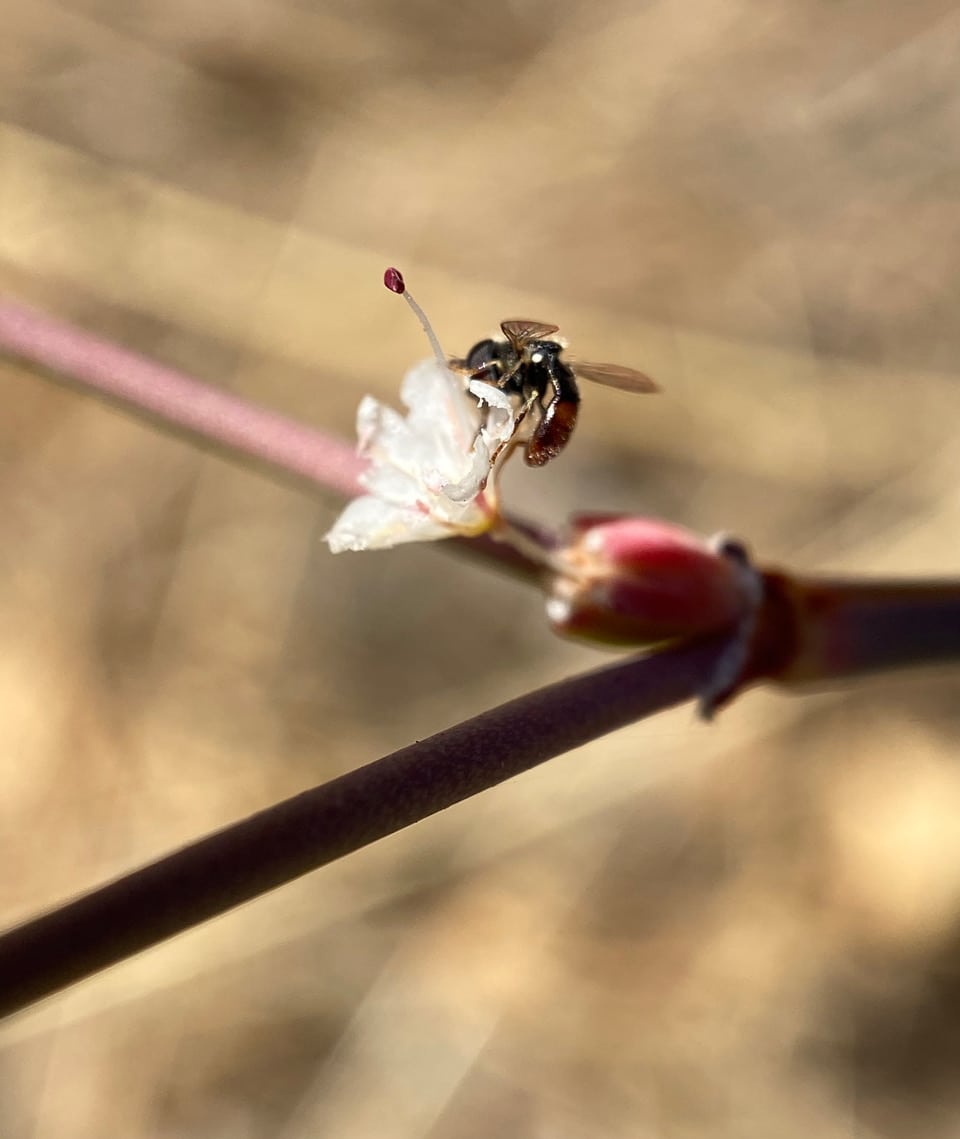
Hey, there’s another hover fly here! Easily recognized by its diminutive size and red abdomen, it is the Black-backed Grass Skimmer, Paragus haemorrhous (family Syrphidae). It is the smallest hover fly species in the garden, measuring only 4 mm in length. The species has a world-wide distribution, found in unimproved grassland, dune grass, open areas and pathsides in forest, and meadows. Adults visit flowers for nectar and pollen. Larvae feed on aphids on low herbaceous plants.
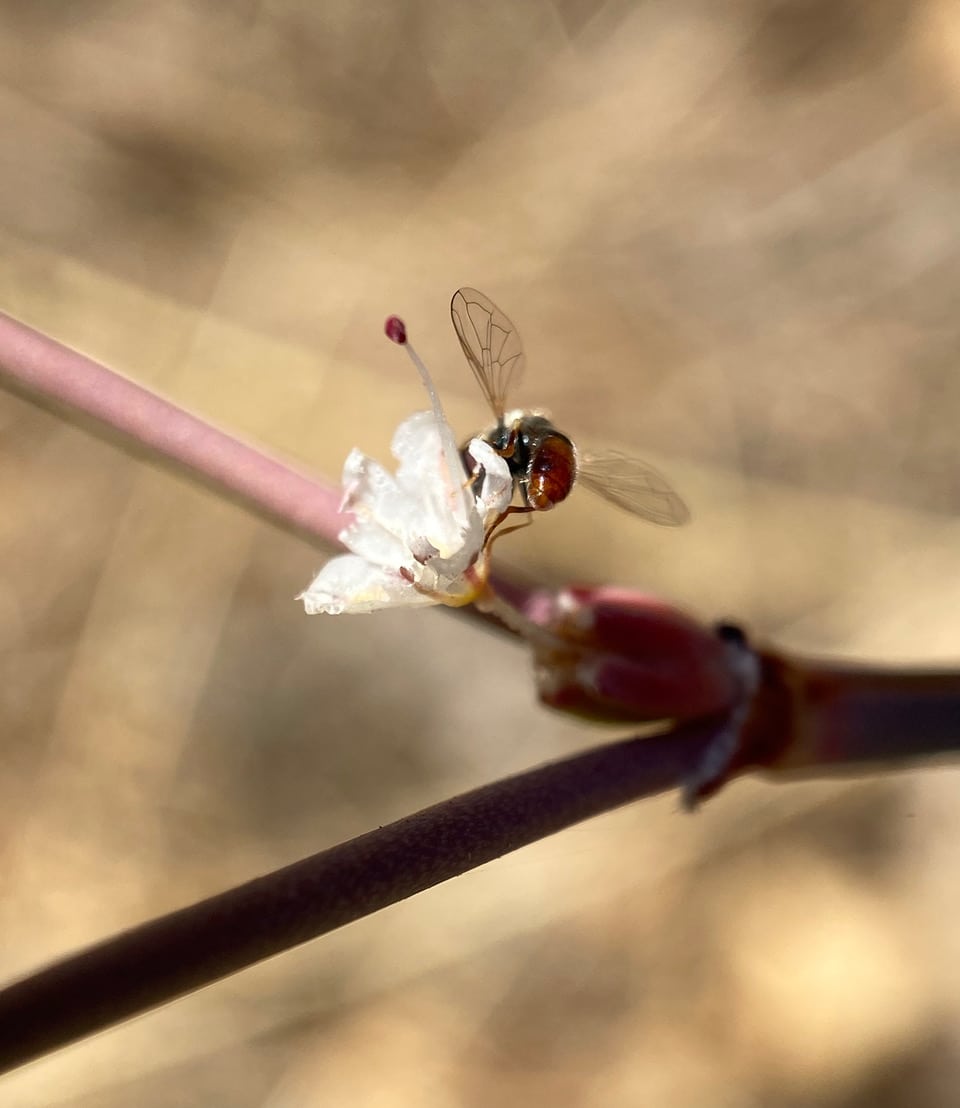
Here’s a better look at its red abdomen.
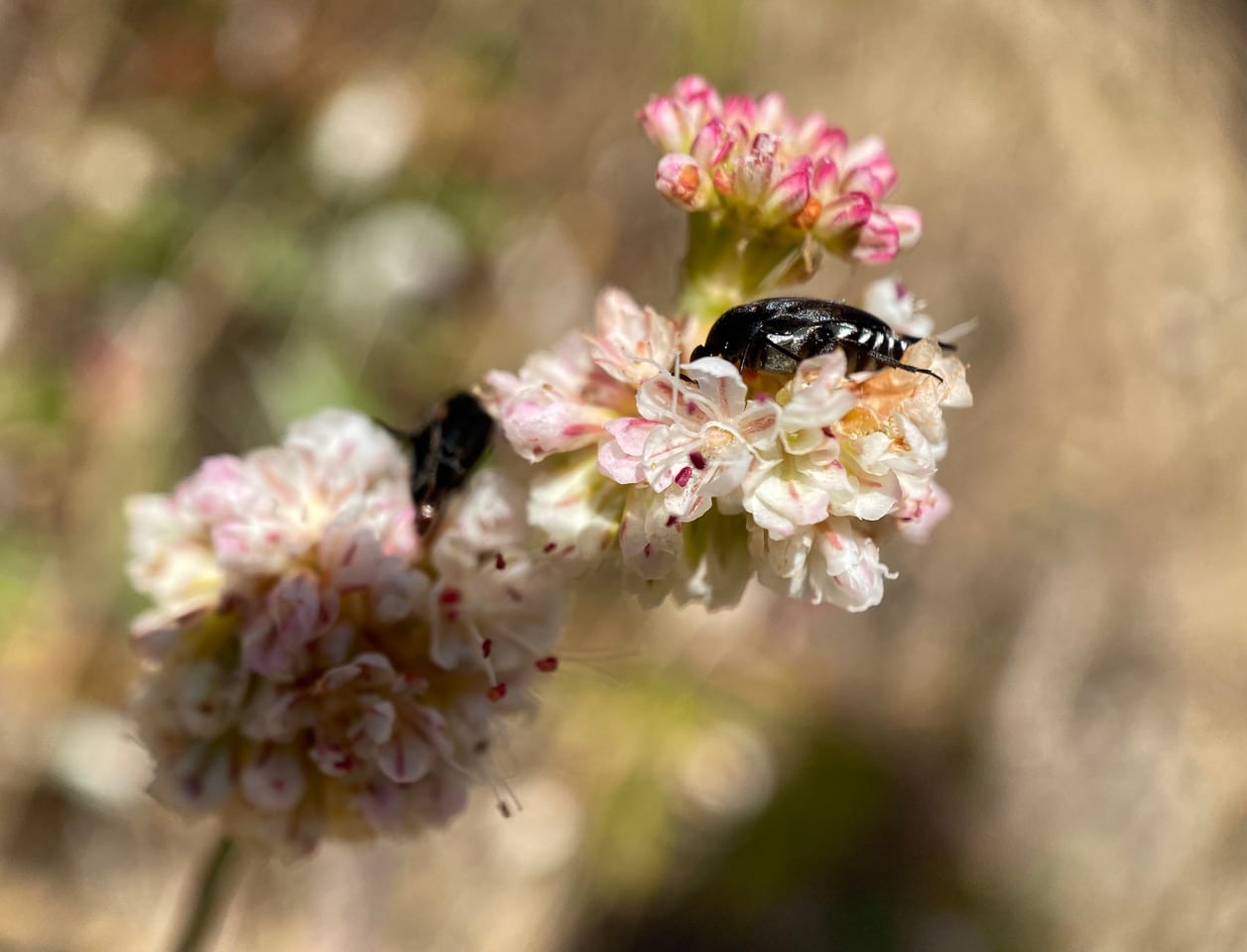
The Tumbling Flower Beetles (family Mordellidae) are regular fixtures on the flowers of Nude Buckwheat this summer.
The Tumbling Flower Beetles (family Mordellidae) are named for the characteristic irregular movements they make when escaping predators. They are also sometimes called Pintail Beetles for their abdominal tip which aids them in performing these tumbling movements. Mordellids are small, wedge-shaped, hump-backed beetles with head bent downward. The body is densely covered with fine silky hairs, usually black, but often very prettily spotted or banded with silvery hues. The adults feed on pollen, occurring on flowers or on dead trees, flying or running with rapidity. The larvae live in old wood or in the pith of plants, and those of some species are said to be carnivorous, feeding on the young of Lepidopterans and Diptera which they find in the plant stems.

A pair of Tumbling Flower Beetles is mating on an inflorescence of Nude Buckwheat, while a neighbor is feeding.
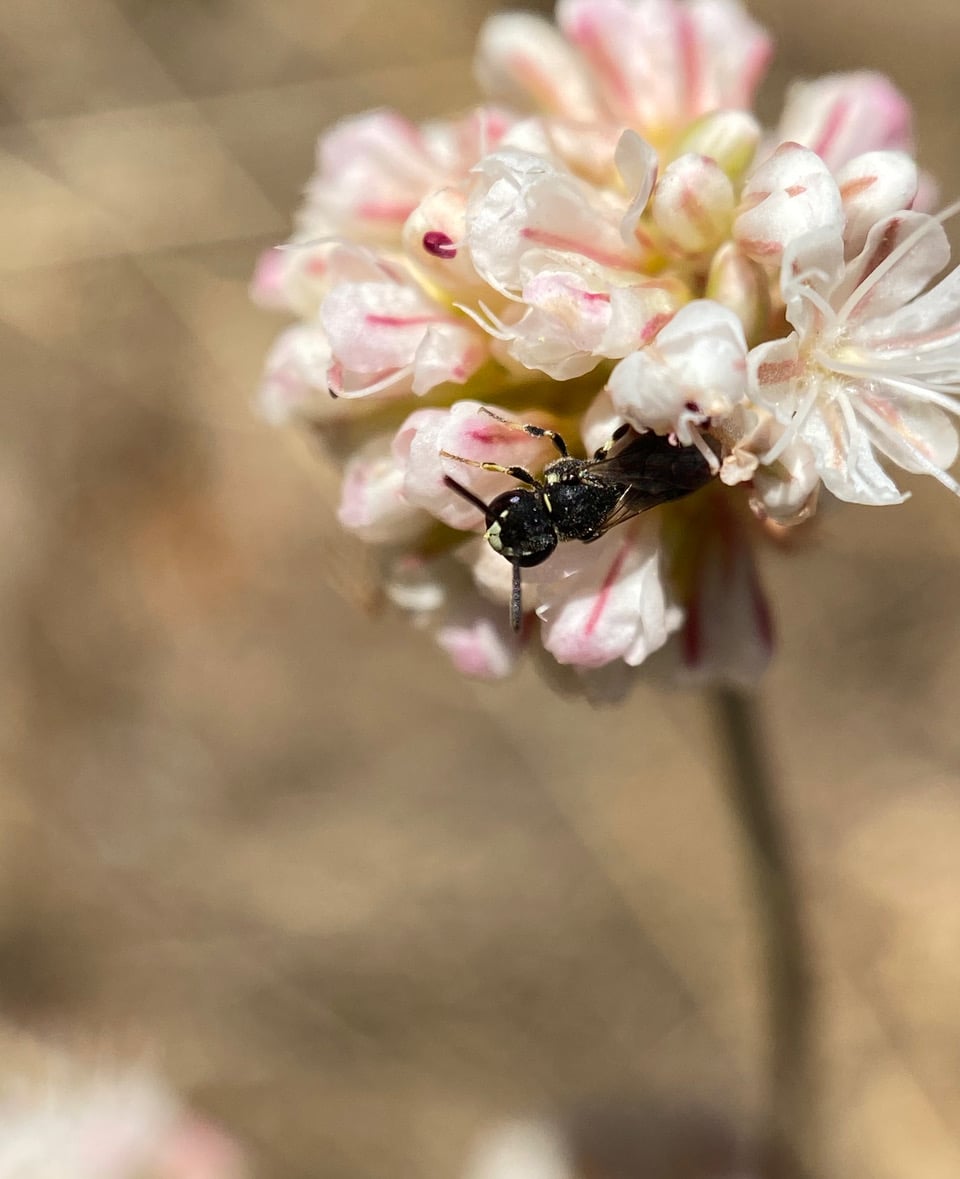
A male Masked Bee, Hylaeus sp. (family Colletidae) is foraging on an inflorescence of Nude Buckwheat. Hylaeus males have more prominent yellow markings on their faces than the females.
Hylaeus (family Colletidae) are shiny, slender, hairless, and superficially wasp-like bees. They are small, 5 to 7 mm long, usually black with bright yellow or white markings on their face and legs. These markings are more pronounced on the males. Hylaeus do not carry pollen and nectar externally, they instead store their food in the crop and regurgitate it upon returning to their nests. They are primarily generalist foragers. Hylaeus are short-tongued, but their small body size enables them to access deep flowers. Hylaeus nest in stems and twigs, lining their brood cells with self-secreted cellophane-like material. They lack strong mandibles and other adaptations for digging, using instead pre-existing cavities made by other insects.
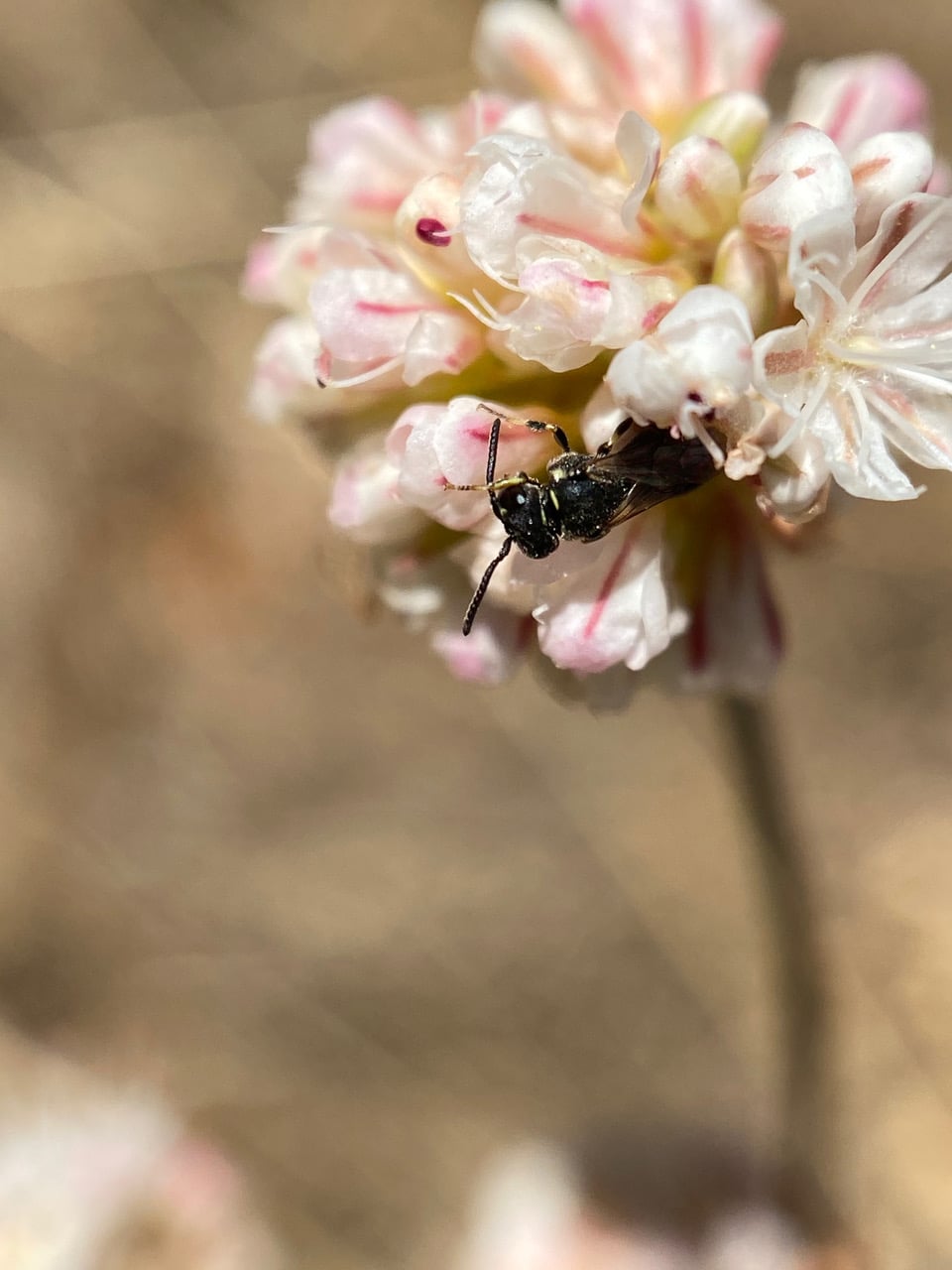
The Hylaeus male proceeds to clean his antennae. This is one of the most endearing of all bee behaviors watchable in real time.
All bees have an antenna cleaner on each of their two forelegs. The antenna cleaners consists of two parts: a notch in the basitarsus, which is fitted with stiff hairs, and a corresponding spur on the tibia. To clean its antenna, the bee raises its foreleg over its antenna and then flexes it tarsus. The action allows the spur to close the notch, forming a ring around the antenna. The bee pulls each antenna through the bristles to clean it of debris such as pollen or dust which might interfere with the many sensory organs within the antenna. A bee’s antennae serve numerous functions: smell, taste, perceive humidity and temperature, feel, monitor gravity and flight speed and even detect sound waves to help guide the bee in its daily activities.

Note the prominent yellow marking on the face of the male Masked Bee, Hylaeus sp. (family Colletidae).
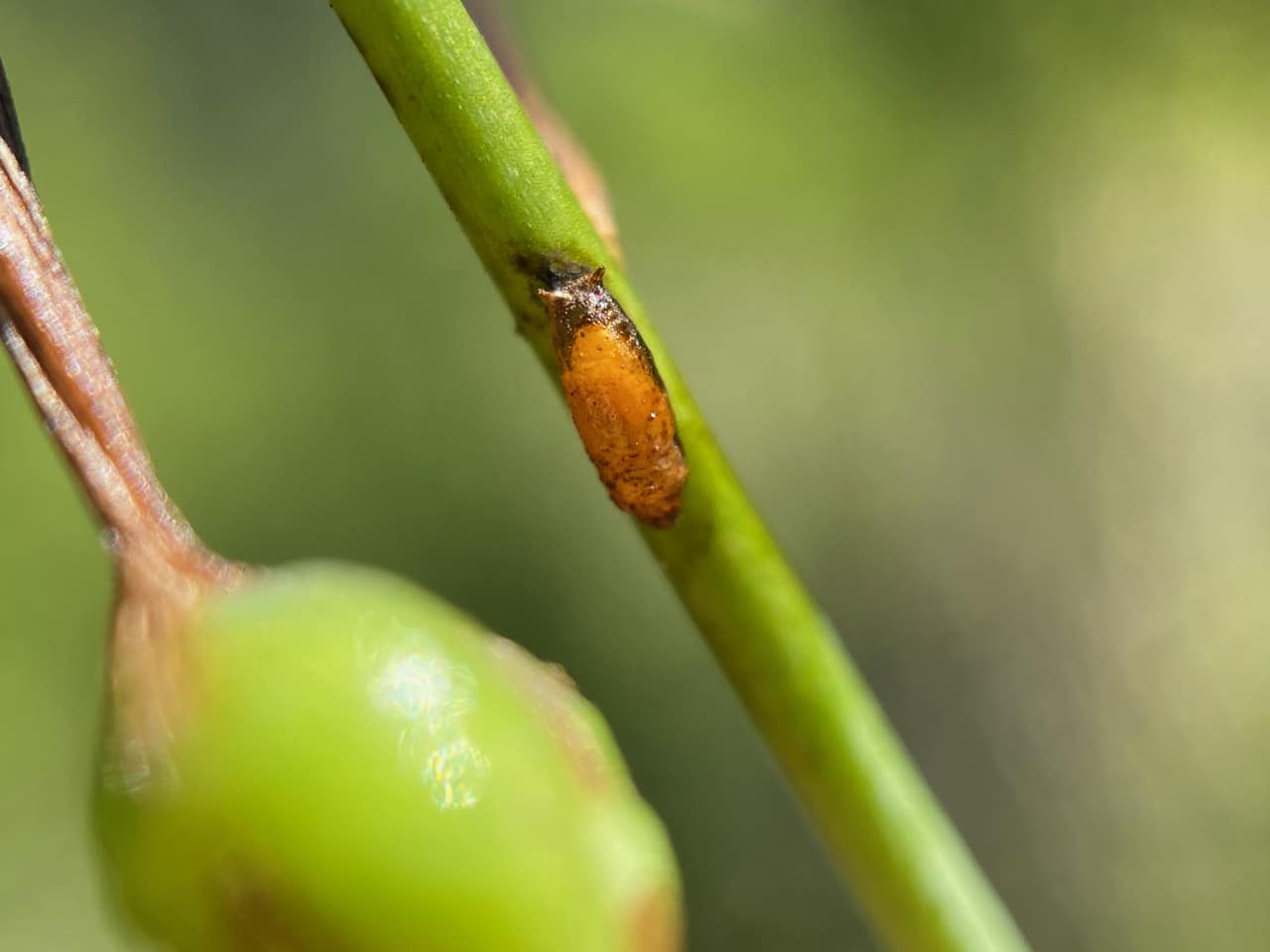
The hover fly pupa on the Soap Plant, Chlorogalum pomeridianum is turning more transparent by the day. Some features of the fly are visible through the amber-colored pupa case. The adult fly should be emerging soon.
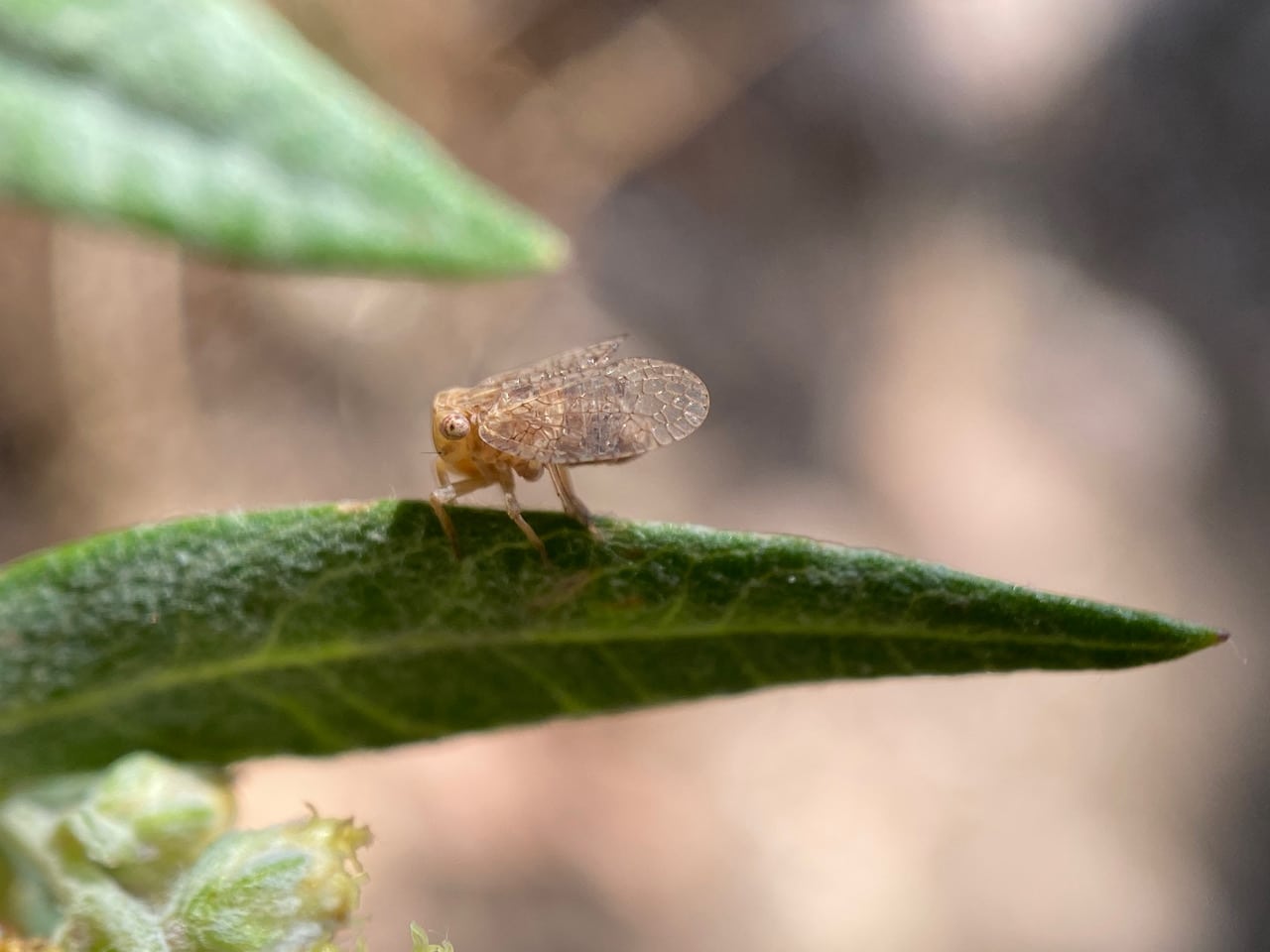
A Planthopper, Neaethus sp. (family Tropiduchidae) is perched on the edge of a leaf of California Mugwort, Artemisia douglasiana.
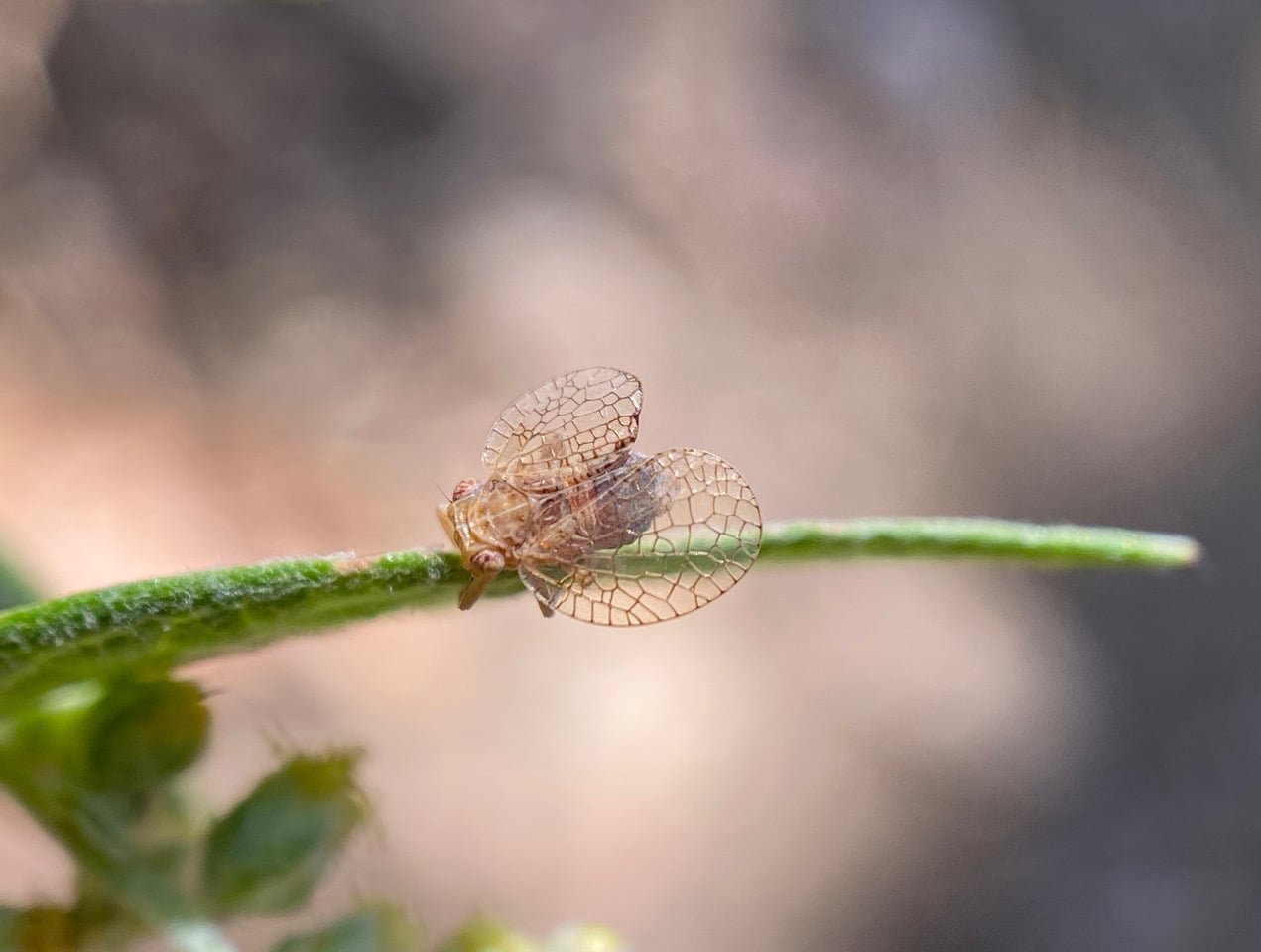
What happened to its right wing? It looks somewhat deformed and much smaller than the left wing. It probably didn’t inflate properly during eclosure. Poor bug – I wonder if it could fly? Come to think of it, I have never seen a Neaethus fly. When disturbed, the bugs would politely sidle to the other side of the leaf or stem, or very rarely they would hop off. How do these bugs get around?
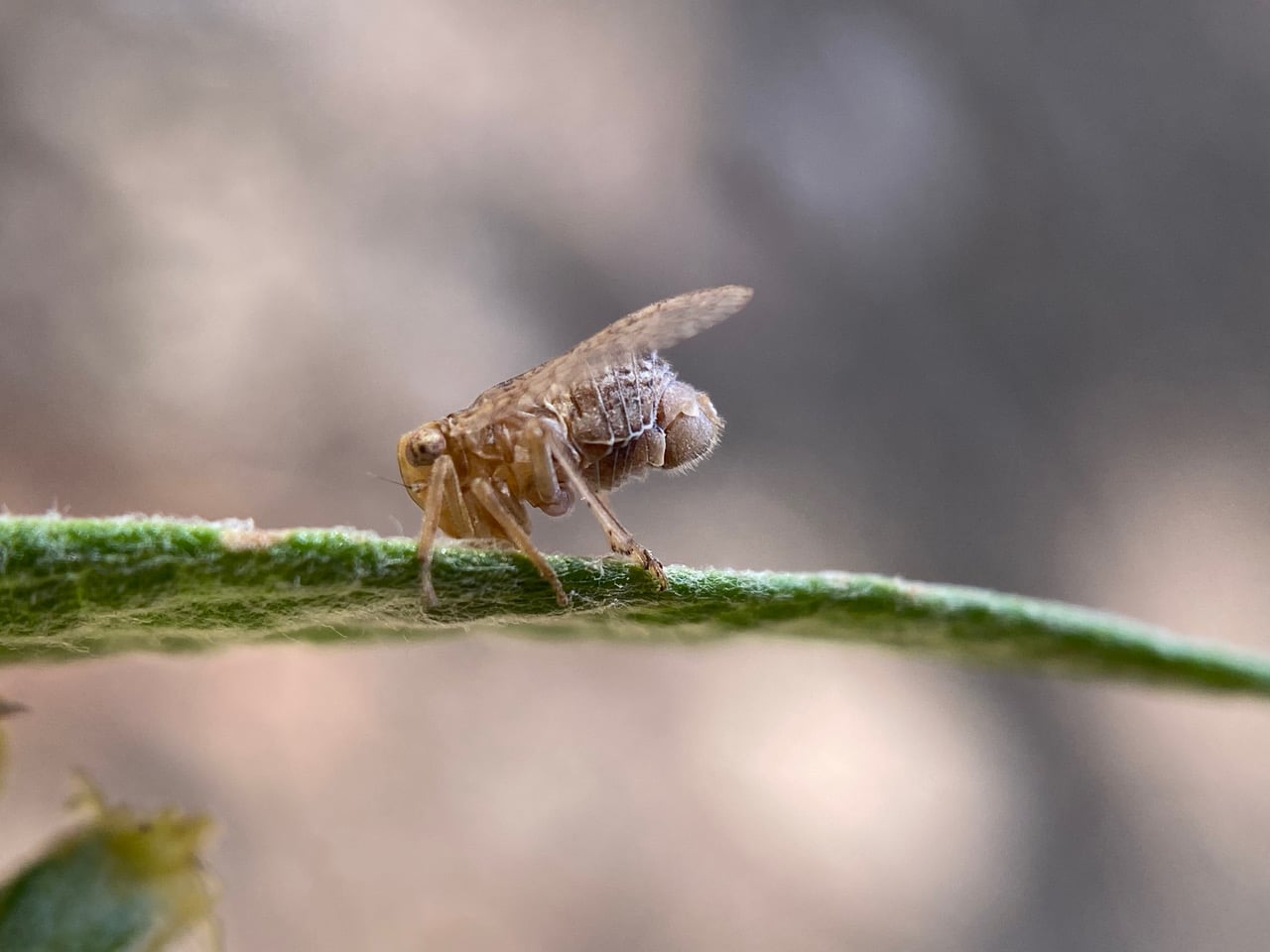
Compared to the top view, the side view of these Planthoppers look almost industrial.
The Planthoppers have the first mechanical gear system ever observed in nature. The tiny bug uses mechanical gears on its joints to precisely synchronize the kicks of its hind legs as it jumps forward.
These sedentary bugs attract mates from afar by sending vibrational calls along plant stems and leaves using fast, rhythmic motions of their abdomen.
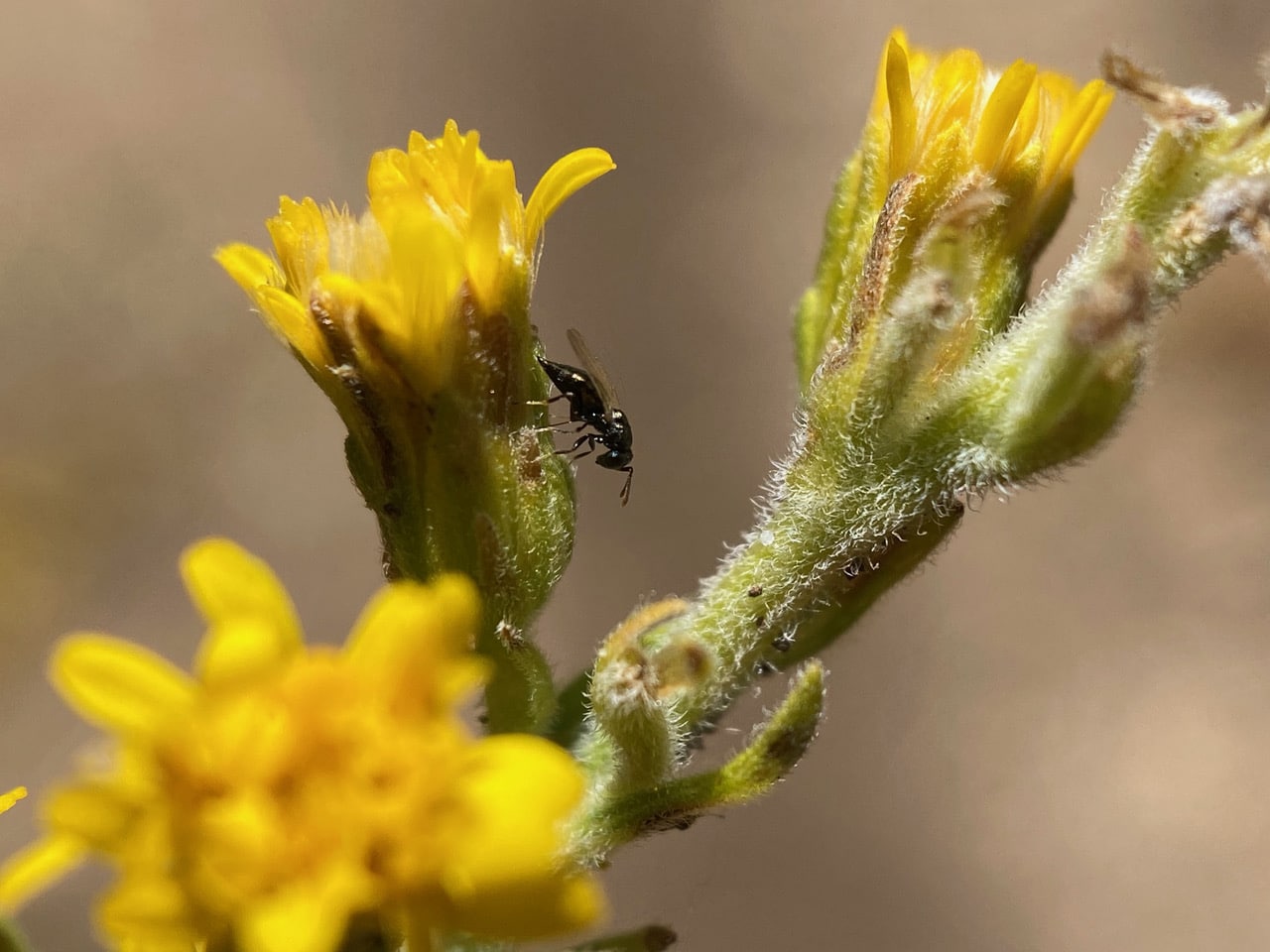
A tiny black wasp is perched motionless on the side of a young flowerhead of California Goldenrod, Solidago velutina ssp. californica. I can’t be sure if it is laying eggs. The wasp appears to belong to the family Pteromalidae, superfamily Chalcidoidea.
The Pteromalidae are a large family of wasps, the majority being parasitoids of other insects. They are found throughout the world in virtually all habitats, and many are important as biological control agents. The wasps are usually metallic chalcidoids of varying body size and build. Their life strategies also vary greatly, depending on the species. There are both solitary and gregarious species, living outside (ectoparasitoid) or inside their prey (endoparasitoid), primary parasitoids and hyperparasitoids and even predators that kill and consume the prey immediately.

A small bee pokes its head out from the flowers of California Goldenrod. From the length of its antennae, one can tell that it is a male. The antennae of male bees are often much longer than their female counterparts. Male antennae have an extra segment and the segments themselves are longer. This is because male antennae are specialized to pick up the subtle scent of female pheromones.

Another clue to the bee’s gender is the absence of scopae (special pollen collecting hairs) on its hind legs. Male bees do not collect pollen to provision the nest, and they lack the equipment for the job. What’s more, the males are usually more slender than the females.
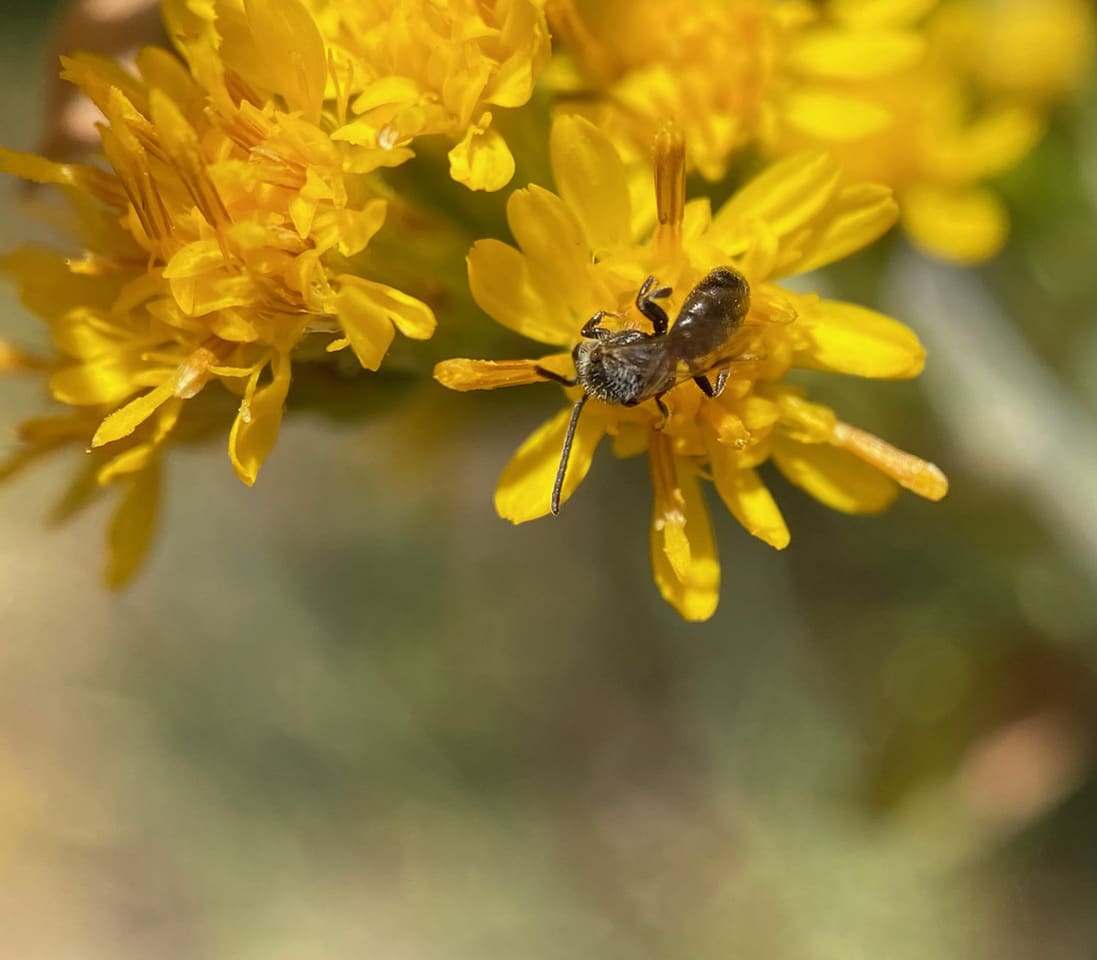
Lasioglossum are closely related to the genera Halictus and Agapostemon. These genera are commonly called “sweat bees” because of their attraction to human sweat, which they drink for its salt content. Lasioglossum are dusky black to brown slender bees with bands of hair on their abdomen.
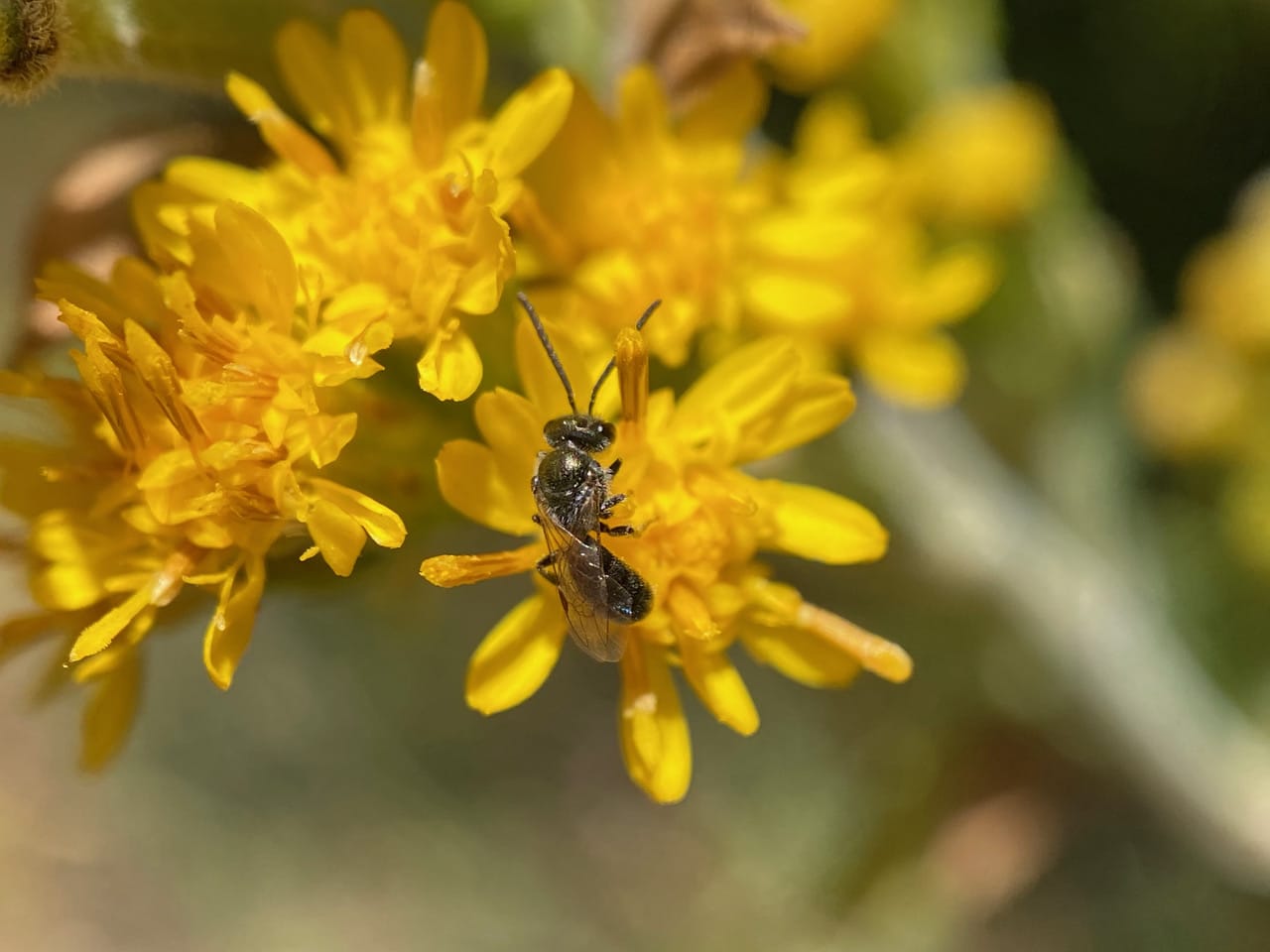
The metallic sheen of its exoskeleton suggests that the bee is probably a Metallic Sweat Bee, Lasioglossum (Dialictus) sp. (family Halictidae).
Dialictus is a subgenus of Sweat Bees belonging to the genus Lasioglossum. Most of the members of this subgenus have a subtly metallic appearance, and are small, about 3.4-8.1 mm in size. They are commonly found in Northern Hemisphere and are found in abundance in North America. As in the other members of the family Halictidae, the bees have very diverse forms of social structure, making them model organisms for studying the social behavior of bees.
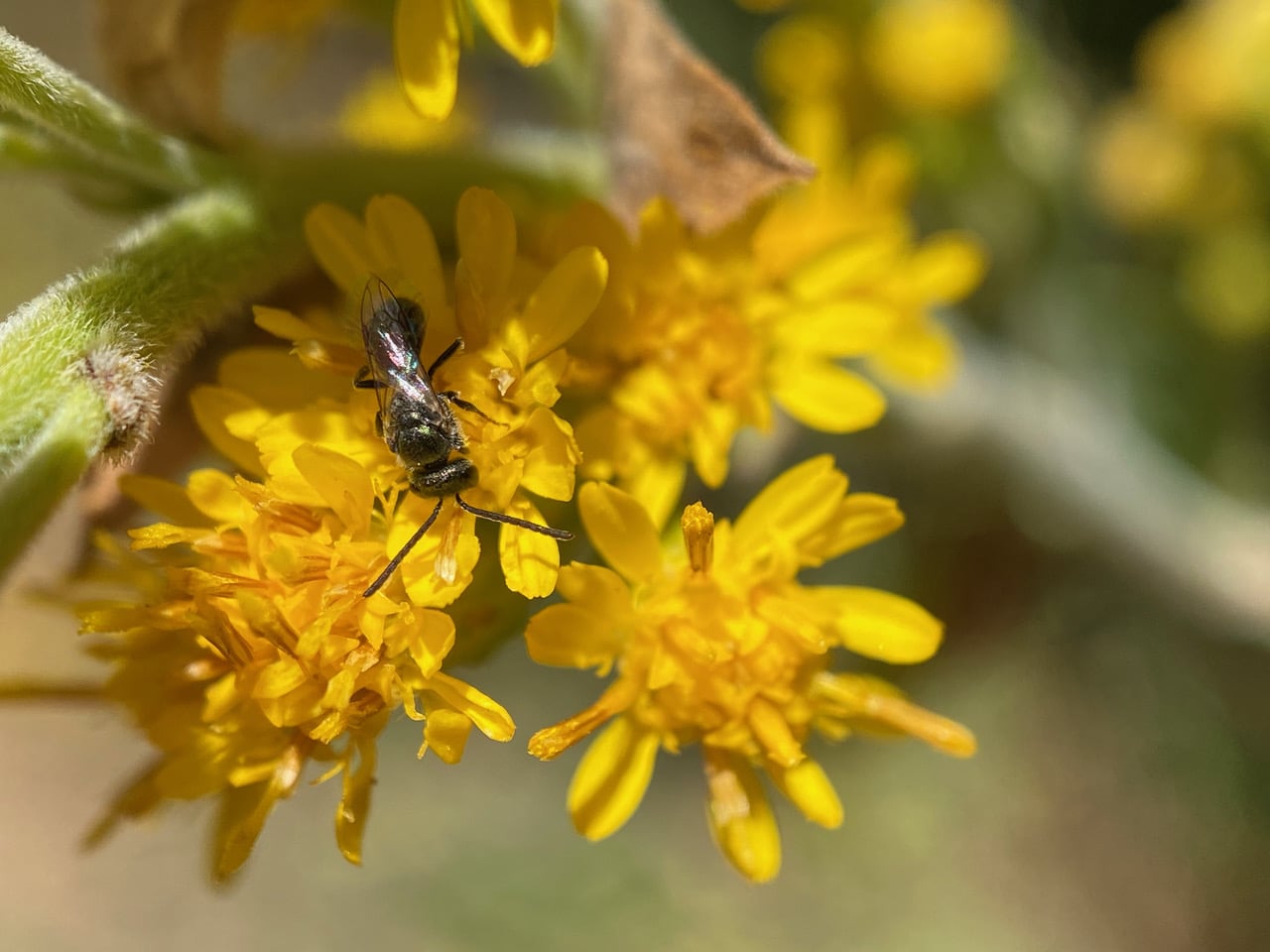
We sure are seeing a lot of male sweat bees lately. This must be the time for reproduction. Male bees of social species are usually produced late in the season, expressly for the purpose of inseminating the females.