

Pollinator Post 8/31/24 (3)
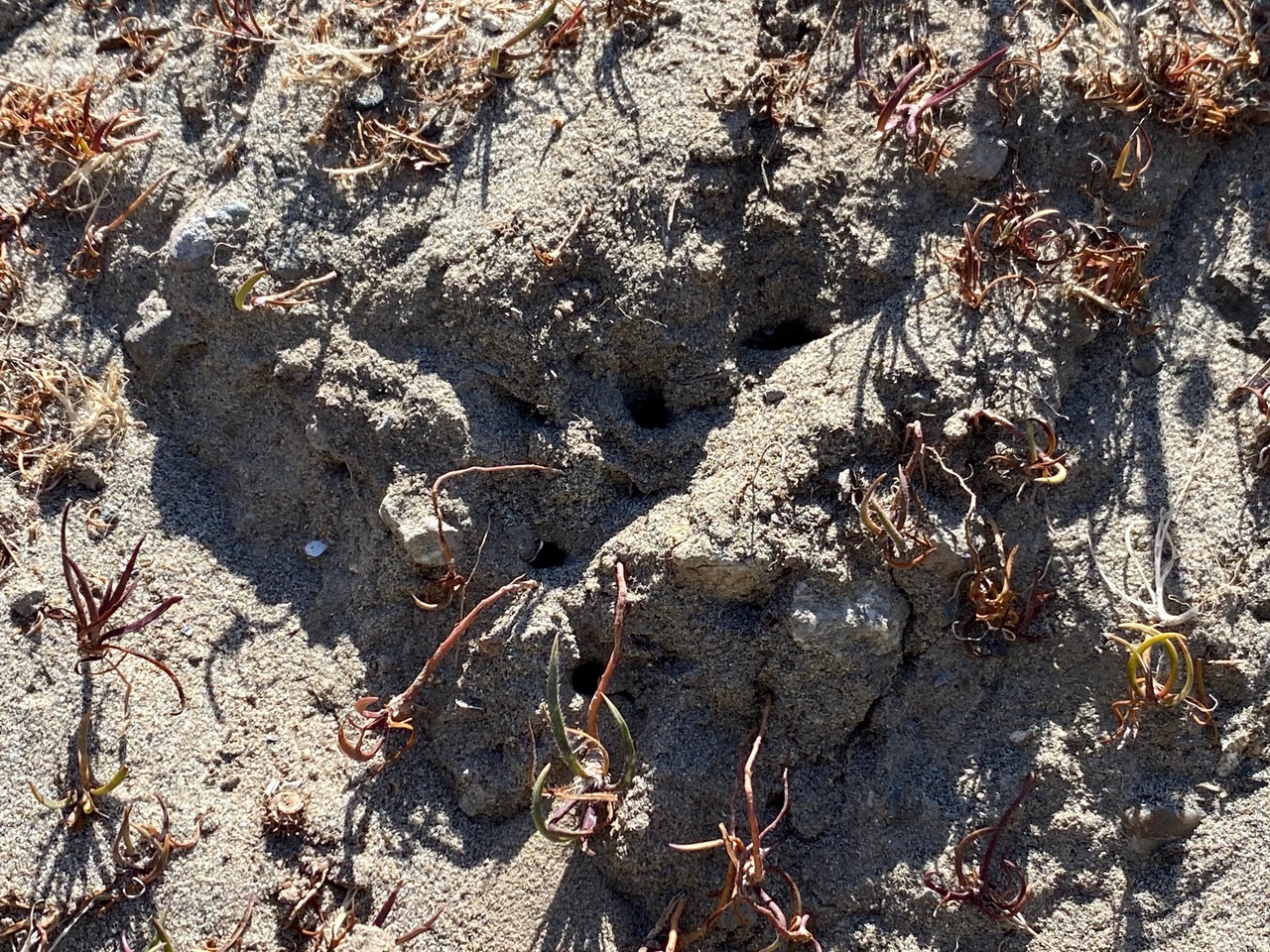
Naomi, Emil and I start our “bugging” adventure on the north eastern part of Bay Farm Island near the bridge. This is where Emil and I have observed nesting activities of Sand Wasps and Summer Longhorn Bees along the sand banks just above the high tide line. I took this video here on 8/23/24.
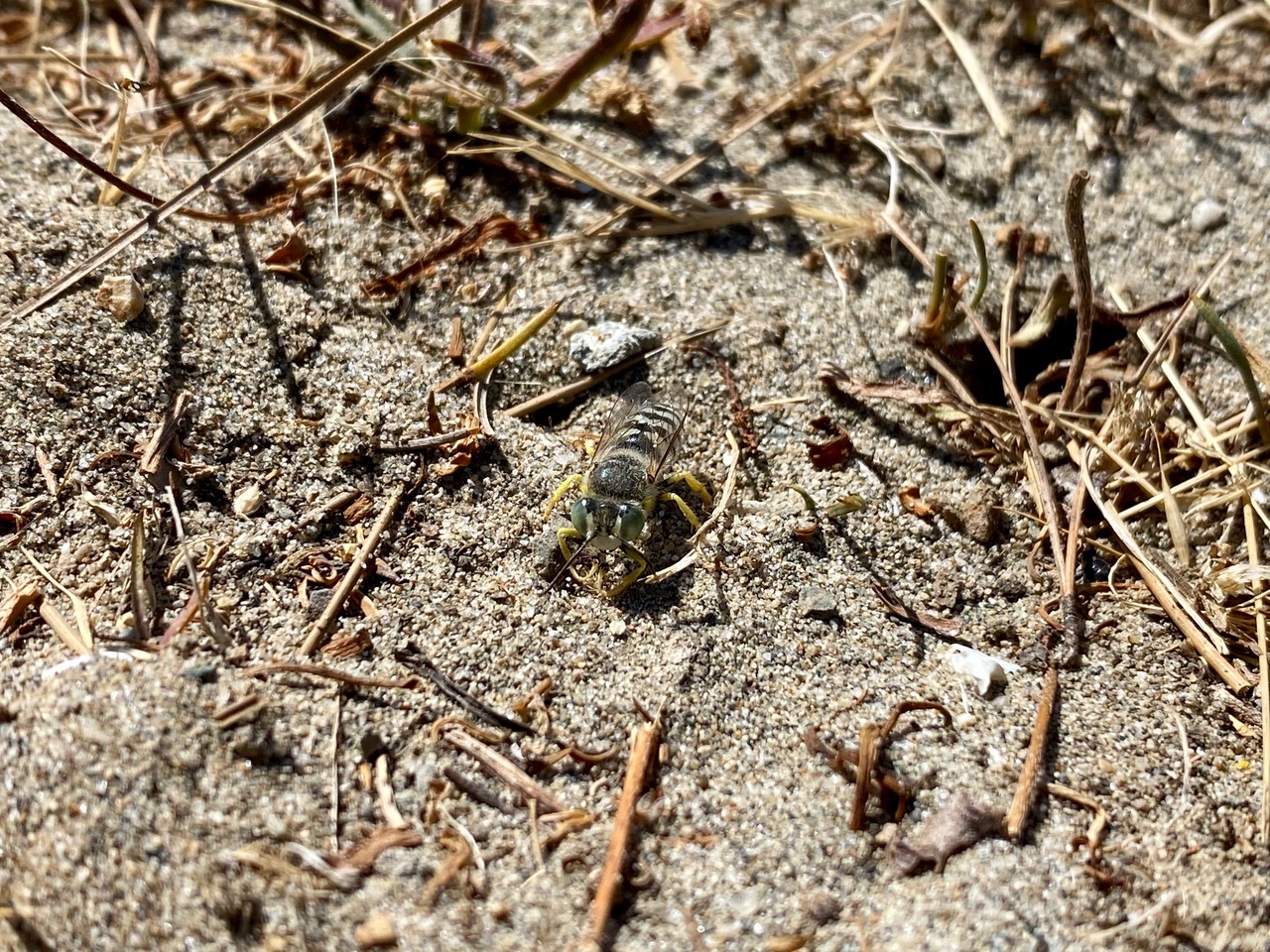
An American Sand Wasp, Bembix americana (family Crabronidae) is digging a burrow in the sand.
Sand wasps in the genus Bembix are familiar and common throughout North America, digging their burrows in dunes, on beaches, and other habitats with loose, deep sand. The female rapidly kicks out large quantities of sand using a “tarsal rake” of spines on each front leg. The burrow is excavated before the wasp goes hunting. Bembix are generalist, opportunistic hunters. True flies in the order Diptera are the usual prey. A victim is paralyzed or killed by the wasp’s sting, and is then flown back to the nest. Most species will lay an egg on the first victim, while some species lay an egg in the empty cell before starting to hunt. Once the egg hatches, mama wasp brings flies to her larva as needed. This “progressive provisioning” is rare in the insect world. When the larva reaches maturity, mama wasp closes the cell. Inside, the larva spins an oblong cocoon, weaving sand grains into the structure and resulting in a hardened capsule. Overwintering takes place as a prepupa inside this cocoon, but there are usually two generations a year.
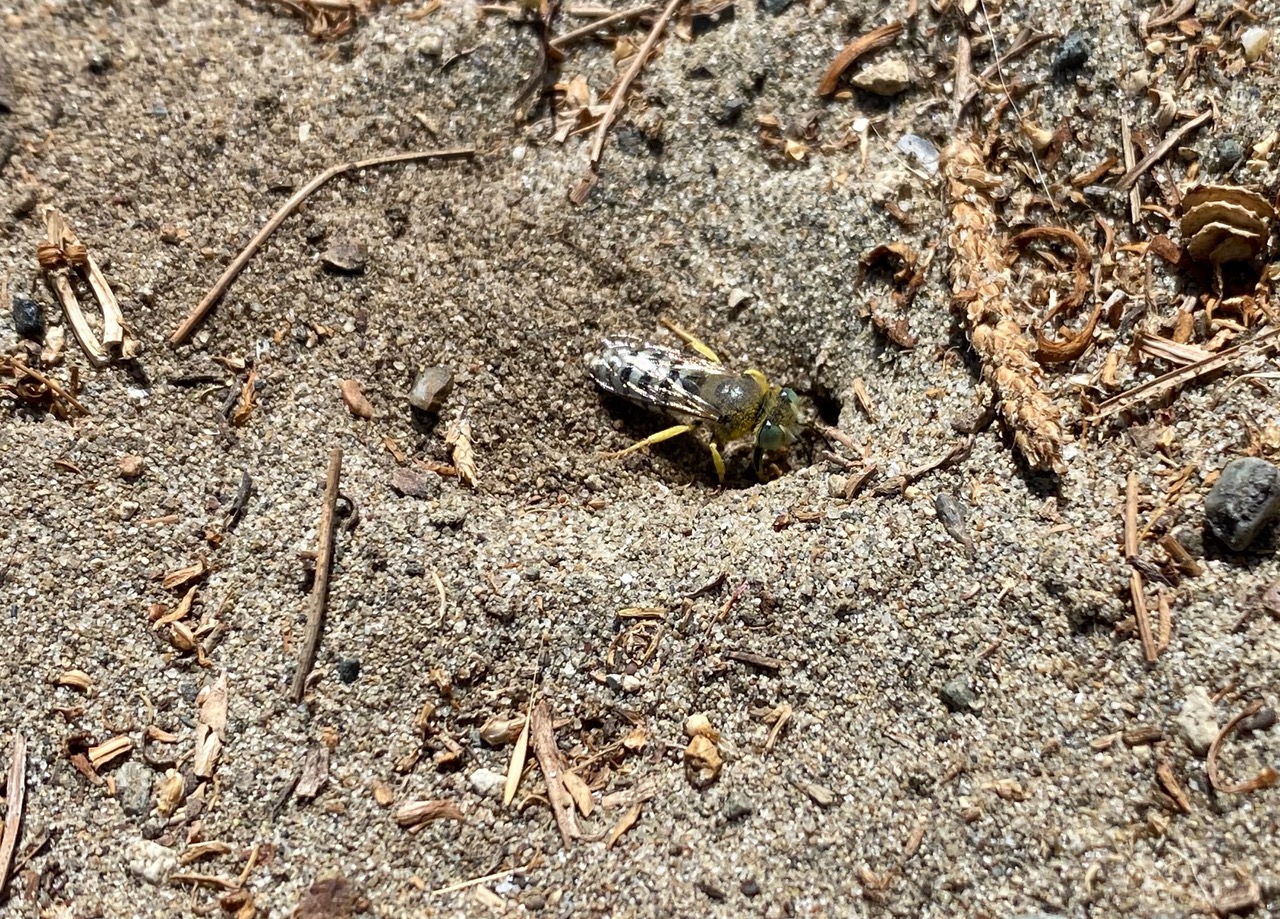
The Sand Wasp excavates her burrow with blinding speed, sending sand flying behind her. It is a busy life for the female practicing progressive provisioning. The single mom has to remember where all her larvae are, their ages and nutritional needs, bringing them fresh provisions as they develop underground. It boggles my mind how she manages that.
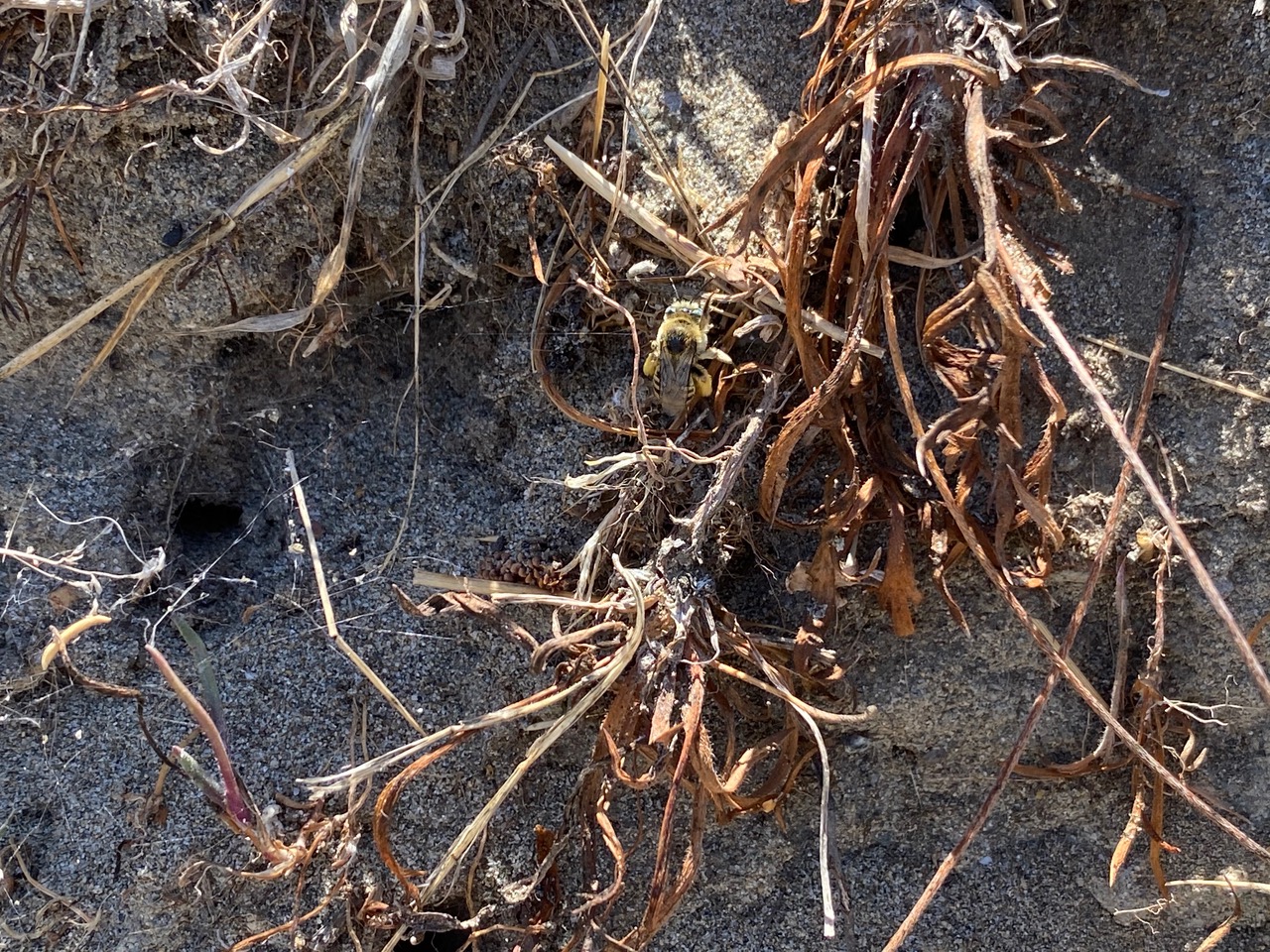
A female Longhorn Bee, Melissodes sp. (family) has landed on the plant debris overlying a sloping sand bank.
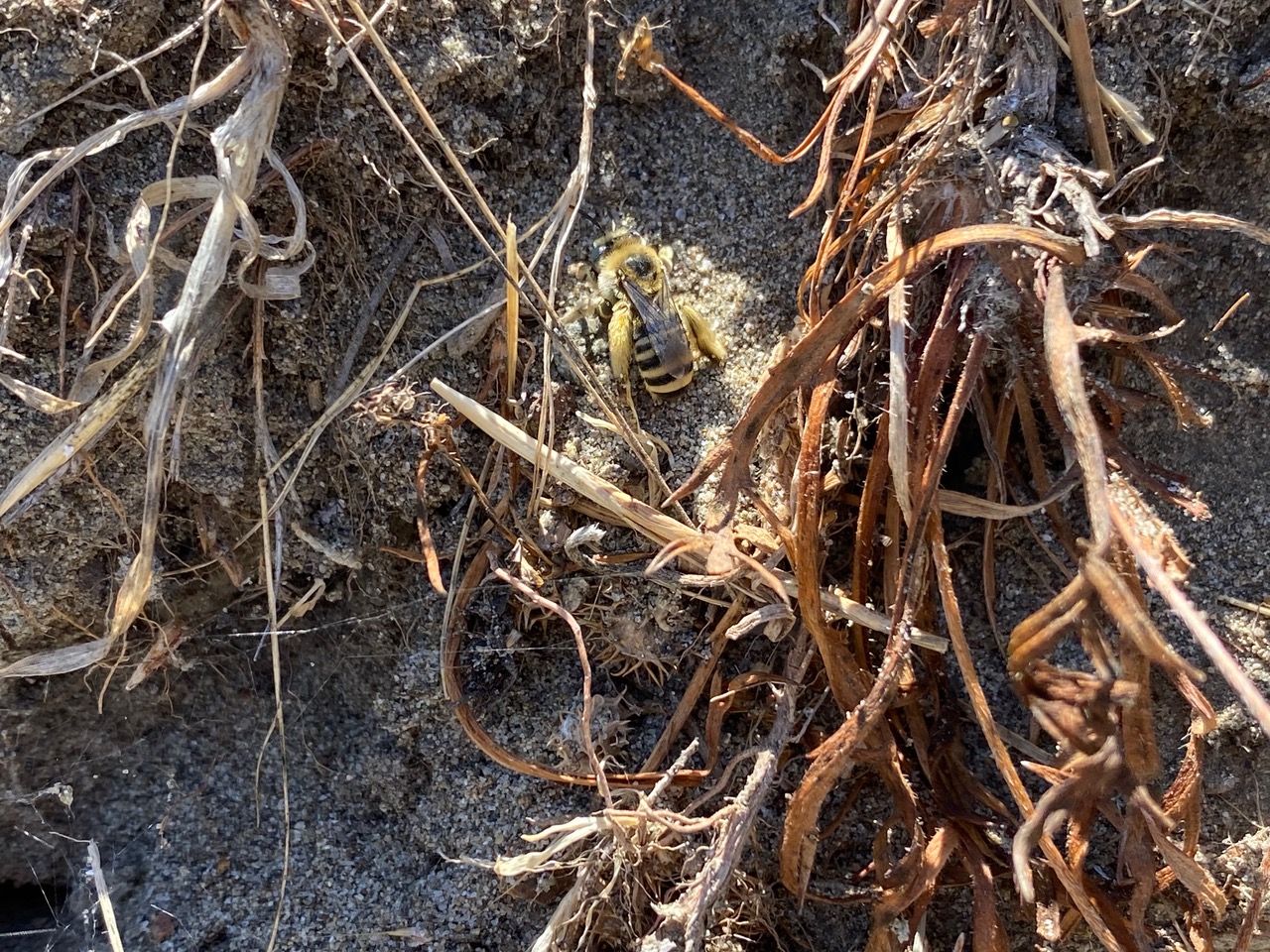
She descends onto the sand. The scopae on her hind legs look empty of pollen.

She appears to look around as if lost. She finally disappears into the tangle of vegetation. Is her nest hidden under the dried vegetation?
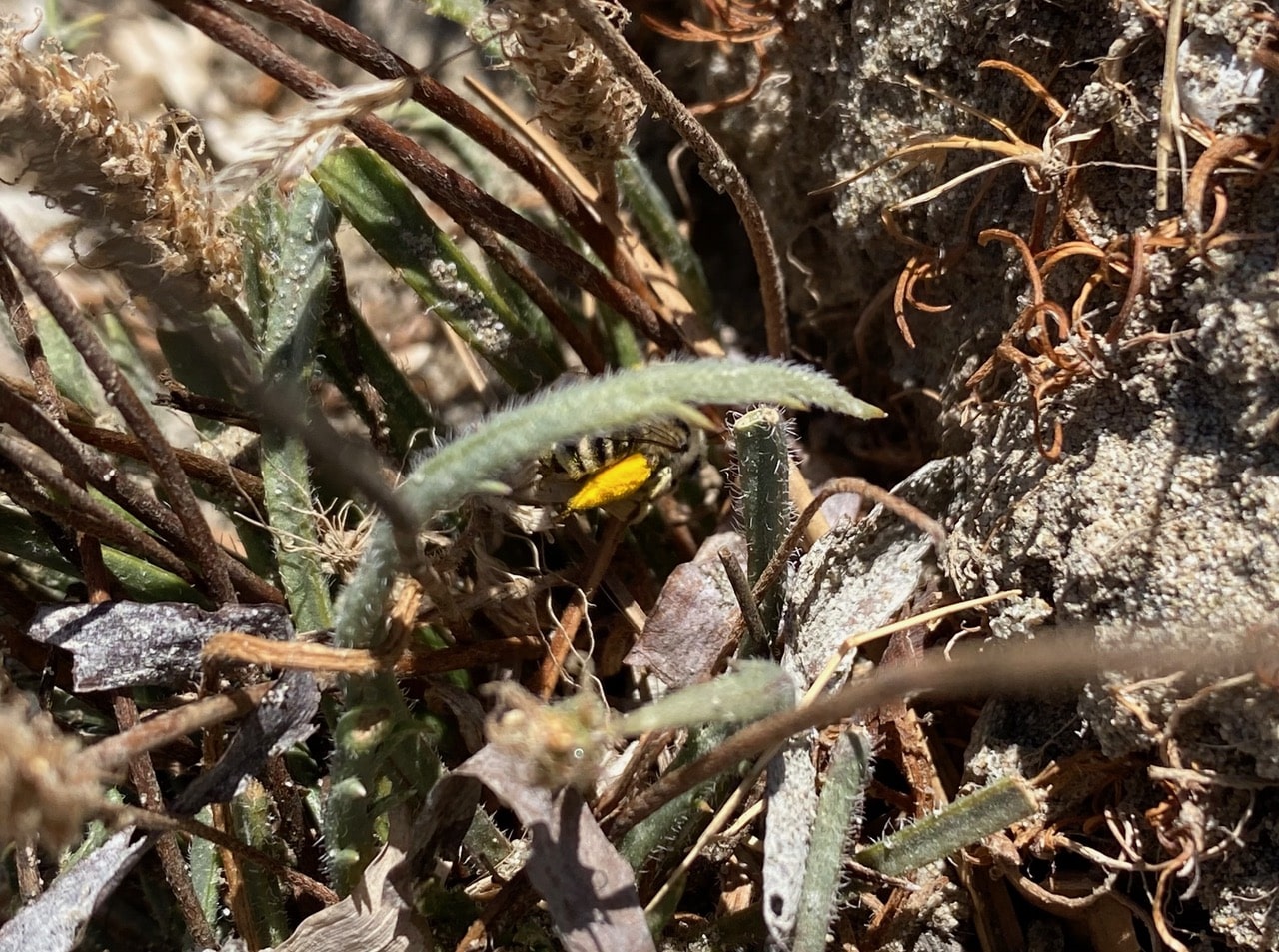
Another female Melissodes lands at the base of a beach plantain. Thanks to the bright yellow pollen in her scopae, I am able to track her movements in the tangle of vegetation. The bee finally disappears as she proceeds downward. She probably has a nest at the base of the plant. She seems to know exactly where she’s heading.
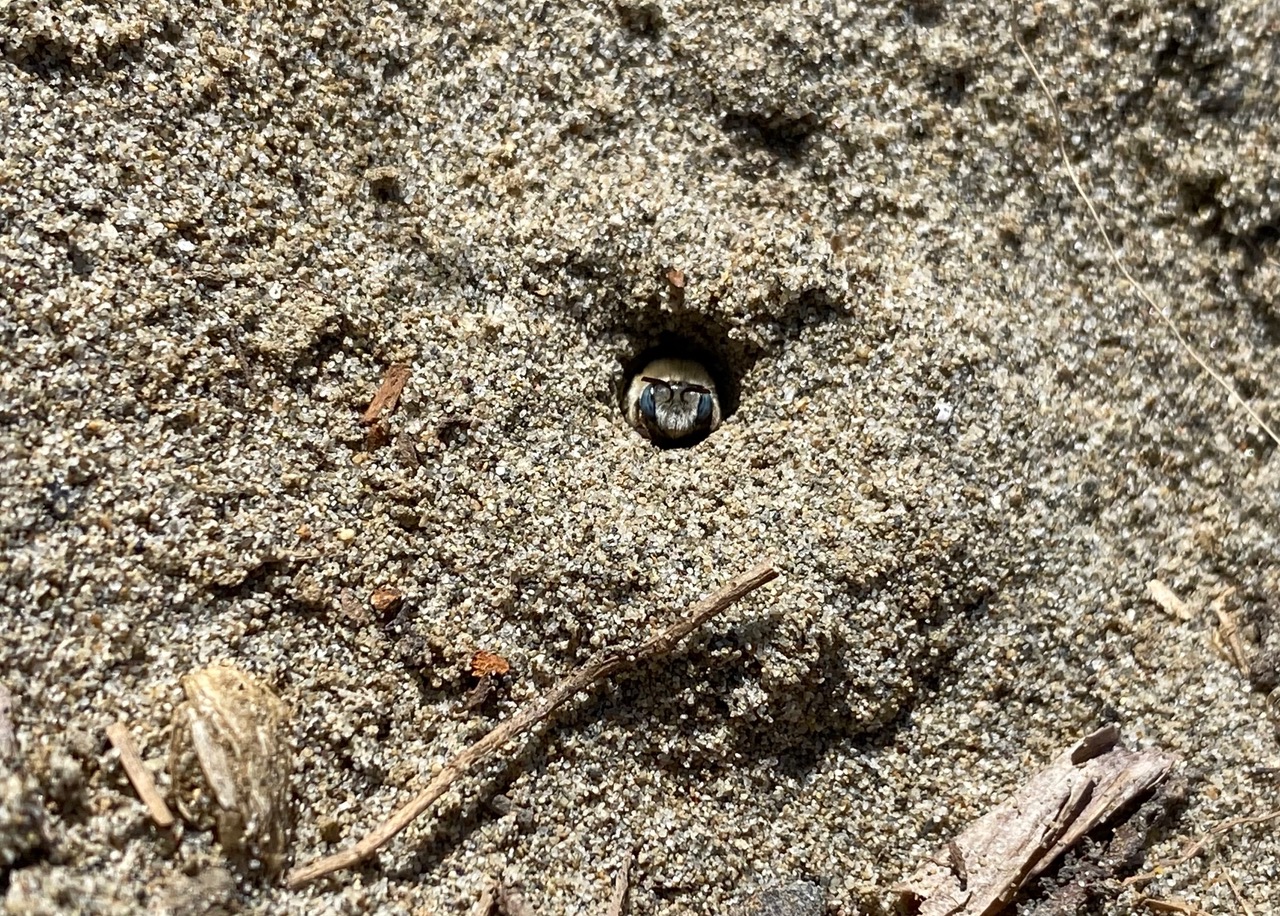
A female Longhorn Bee, Melissodes sp. (family Apidae) peers from the entrance of her burrow on a vertical face of the sand bank. These bees are obviously able to use both horizontal and vertical surfaces for nesting.
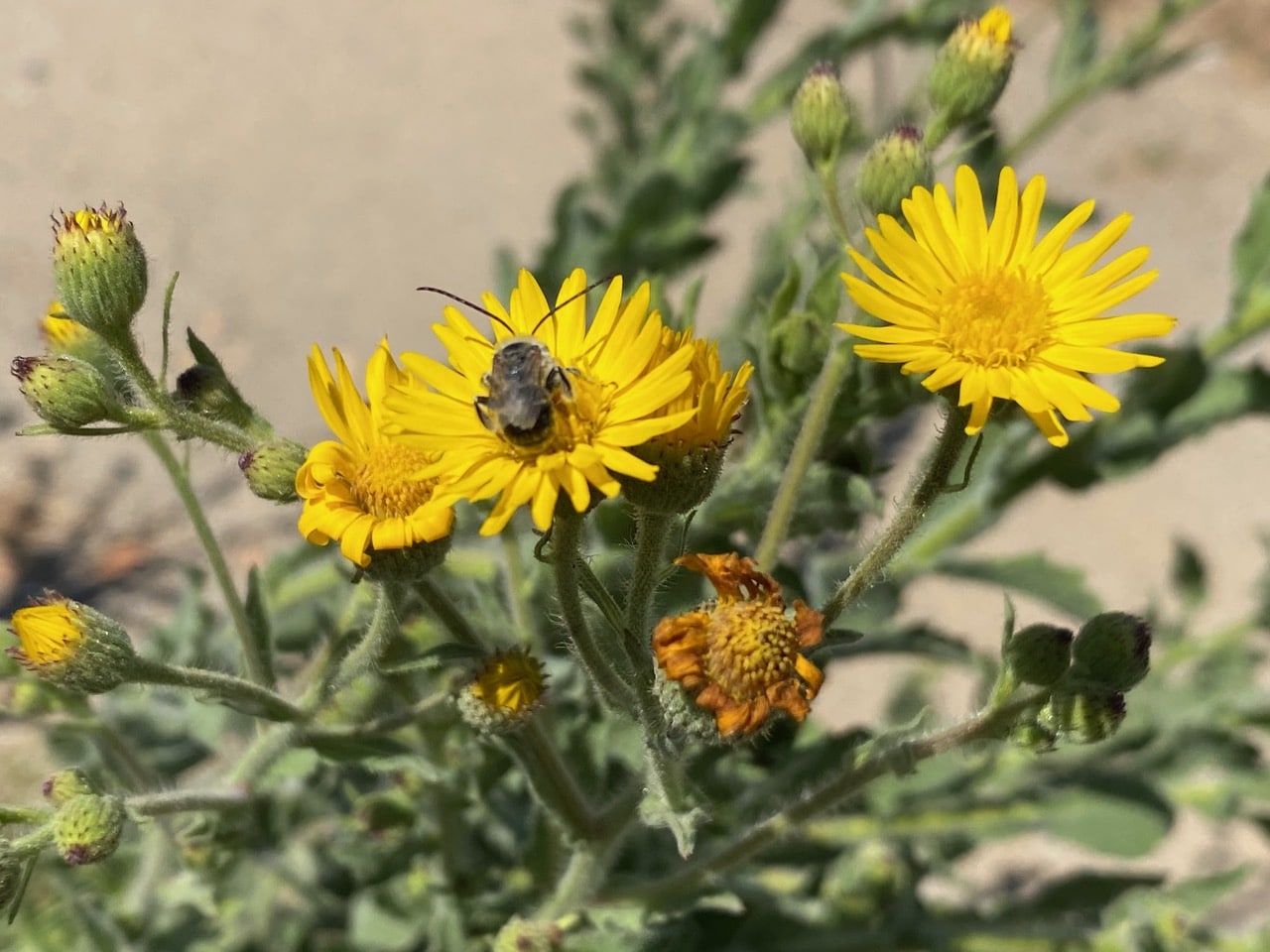
A male Summer Longhorn Bee is foraging on a flowerhead of Telegraphweed, Heterotheca grandiflora.
The Summer Longhorn Bees, Melissodes sp. (family Apidae) are medium to large bees, stout-bodied, usually with gray hair on the thorax and pale hair bands on the abdomen. Males usually have yellow markings on their faces and have very long antennae from which their common name is derived. They are active May to September, with peak flight in late June to early August. The females prefer flat, bare ground for digging their solitary nests, though they sometimes nest in aggregations. Pollen is transported in scopae on the hind legs. Pollen loads are often copious and brightly colored and thus very distinguishable. Melissodes are specialists on Asteraceae – females gather pollen from flowers of Aster, Bidens, Coreopsis, Cosmos, Encelia, Gaillardia, Helianthus, and Rudbeckia ssp.
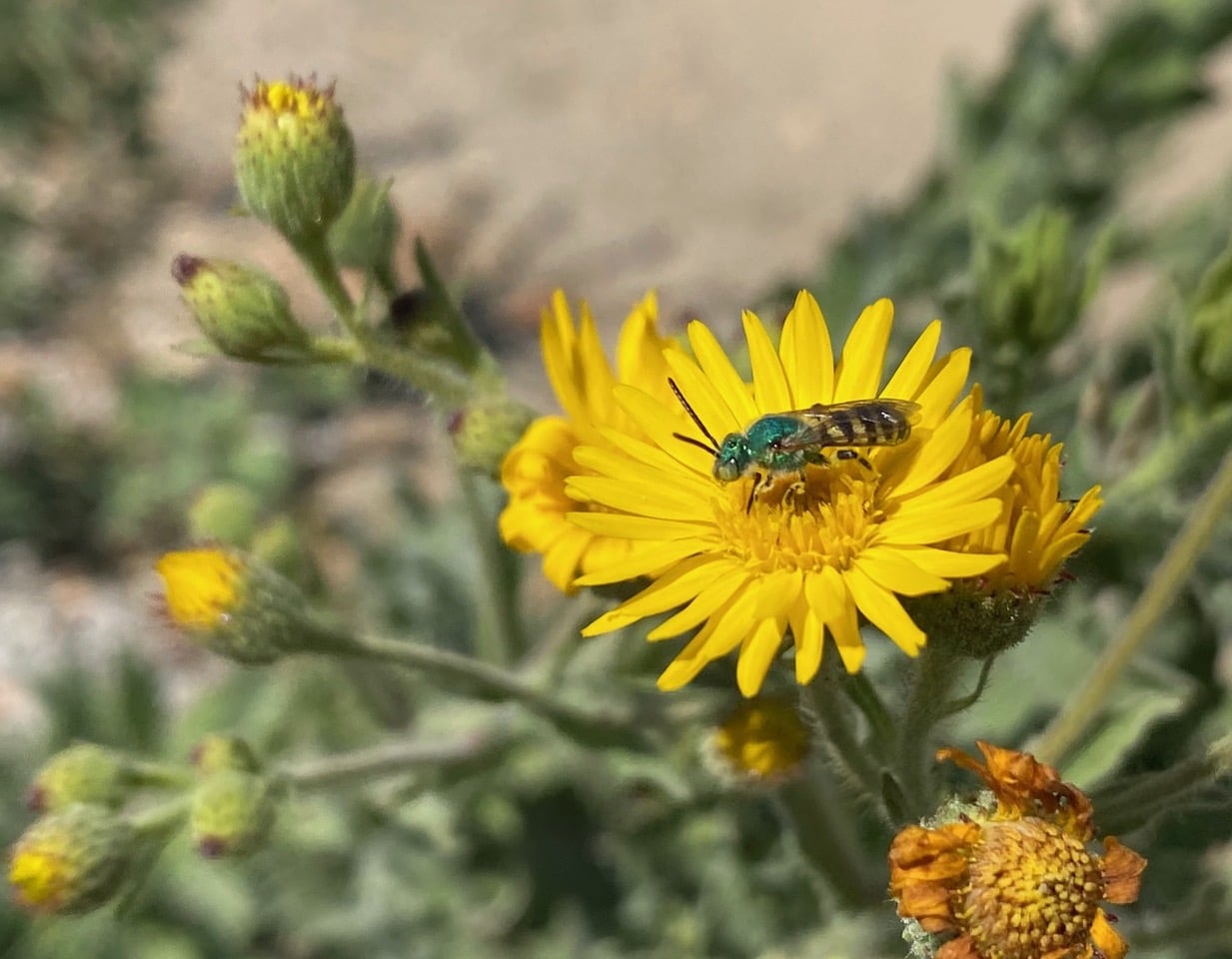
A male Texas Striped Sweat Bee, Agapostemon texanus (family Halictidae) is foraging on a flowerhead of Telegraphweed.
The genus Agapostemon is widespread and abundant throughout North America. They are most diverse and abundant in temperate regions and southwestern U.S. deserts. Agapostemon are commonly called “sweat bees” because they are closely related to, and resemble bees in the Halictus and Lasioglossum genera. Unlike those bees however, Agapostemon are not attracted to human sweat.
Agapostemon are brightly colored metallic green or blue bees measuring 7 to 14.5 mm long. Most species have a metallic green head and thorax, and black-and-yellow striped abdomen; some females are entirely bright green or blue. Females carry pollen on scopal hairs located on their hind legs. Agapostemon are generalists. Like other members of the family Halictidae, they are short-tongued and thus have difficulty extracting nectar from deep flowers. Males are often seen flying slowly around flowers looking for females. The bees favor flowers with high densities.
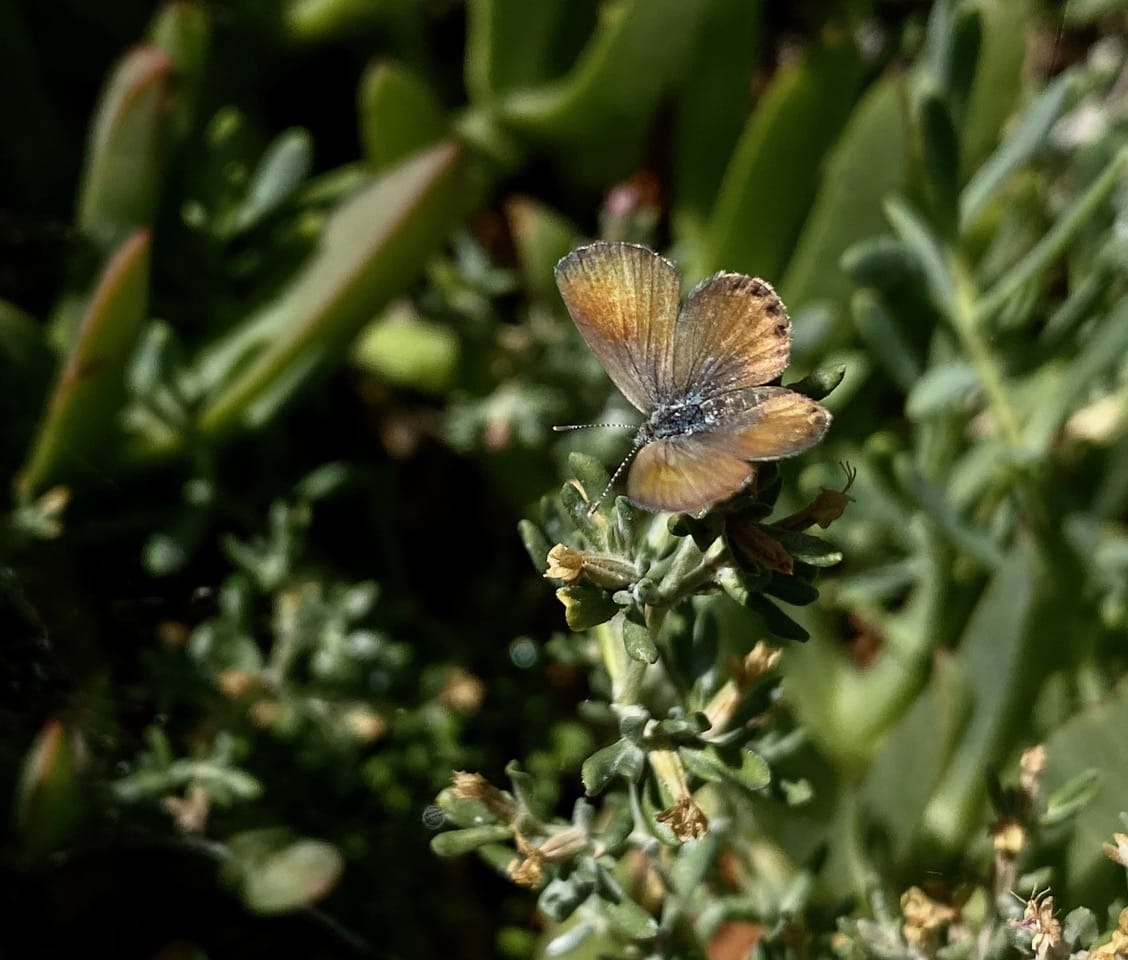
From the boardwalk I watch as a small moth-like insect flies over the salt marsh vegetation. I am thrilled to see it finally land – it is a Western Pygmy Blue! With a wingspan of 12-20 mm, about the size of a thumbnail, Brephidium exilis (family Lycaenidae) is one of the smallest butterflies in the world and the smallest in North America. The butterfly is found in alkaline areas such as deserts and salt marshes. The caterpillars feed on plants in the Goosefoot family Chenopodiaceae, commonly found in salty habitats. Although the species has no set breeding season, mating activity is at its peak during late summer and early fall. (The butterfly is actually more brightly colored than what this photos shows. The exposure of the camera has been lowered to accommodate the reflective glare from the noonday sun.)
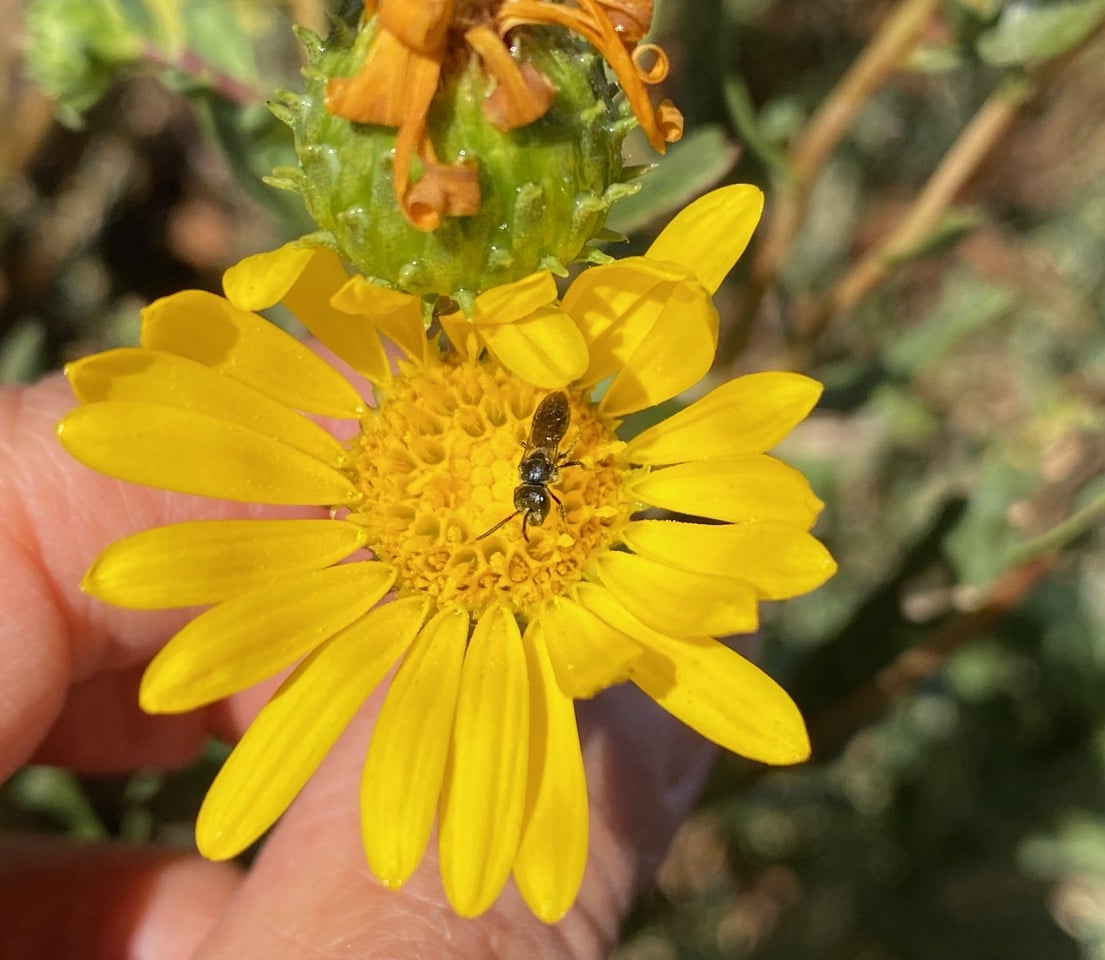
As it is rather breezy, Emil steadies the Grindelia flowerhead for me so I can photograph the tiny black bee on it. It is a Sweat Bee, Lasioglossum (Evylaeus) sp.(family Halictidae).
Lasioglossum species are found worldwide, and they constitute the largest bee genus. The majority of Lasioglossum are generalists. Because they are so abundant throughout the flowering season, the bees are often important pollinators. Their sheer numbers are enough to achieve excellent pollination of many wild flowers, especially of plants in the Asteraceae, which have shallow floral tubes that are easily accessed by these minute bees.
Lasioglossum exhibit a range of social behaviors; the genus includes solitary, communal, semi social, primitively eusocial, and even parasitic species. Almost all Lasioglossum in the U.S. nest in the ground. Generally these nests are built in the spring by fertilized females (called foundresses) that spent the winter in hibernation. In social species, the foundresses behave much like the queen Bumble Bees – they lay the first batch of eggs that develop into the first generation of female workers. The nest grows with each additional generation of bees. Later broods may consist of both males and females. They mate, and at the end of the season the fertilized females hibernate til the following spring, repeating the life cycle of the colony.
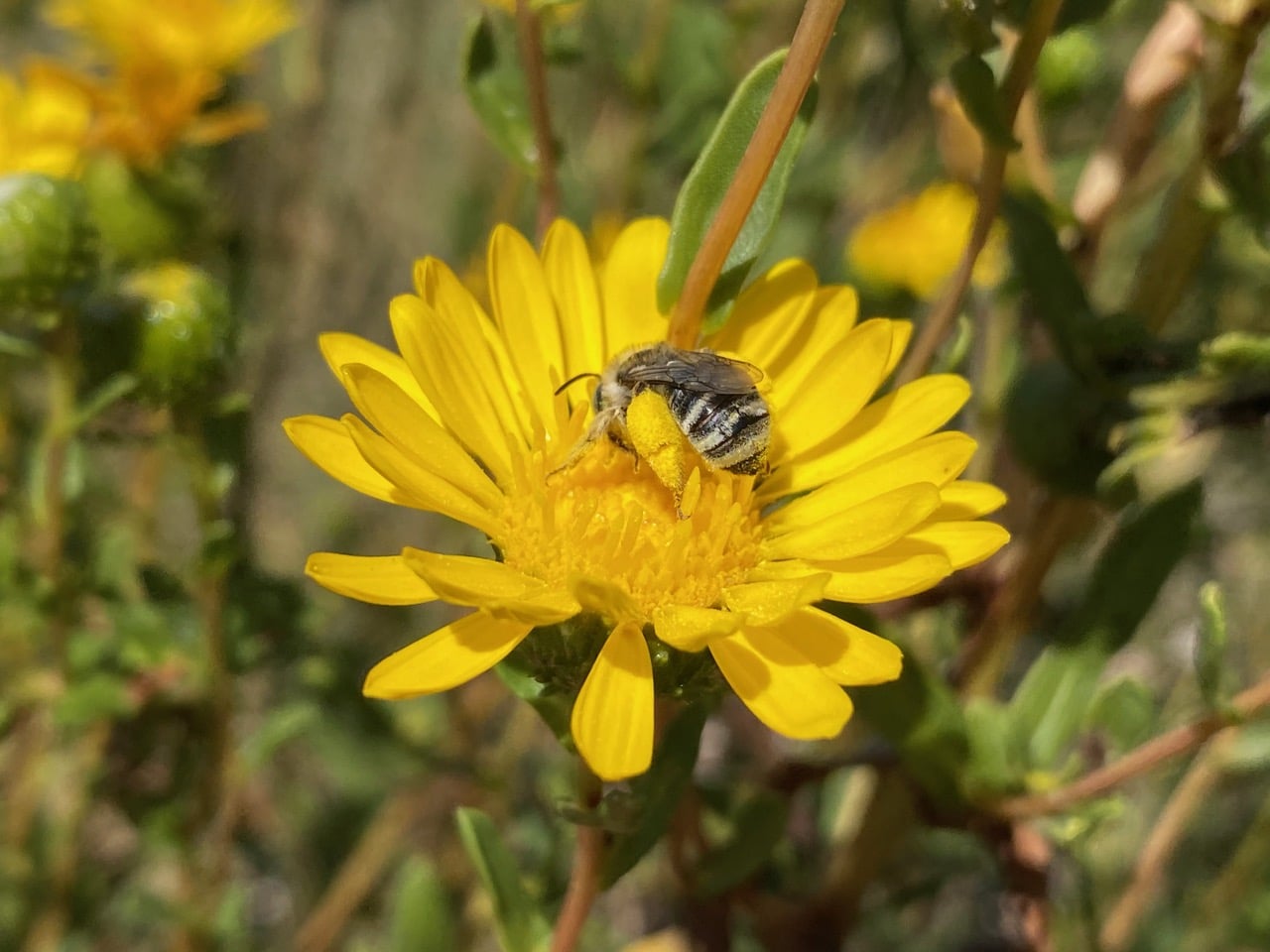
A female Summer Longhorn Bee, Melissodes sp. (family Apidae) has gathered a huge load of Grindelia pollen in her scopae.
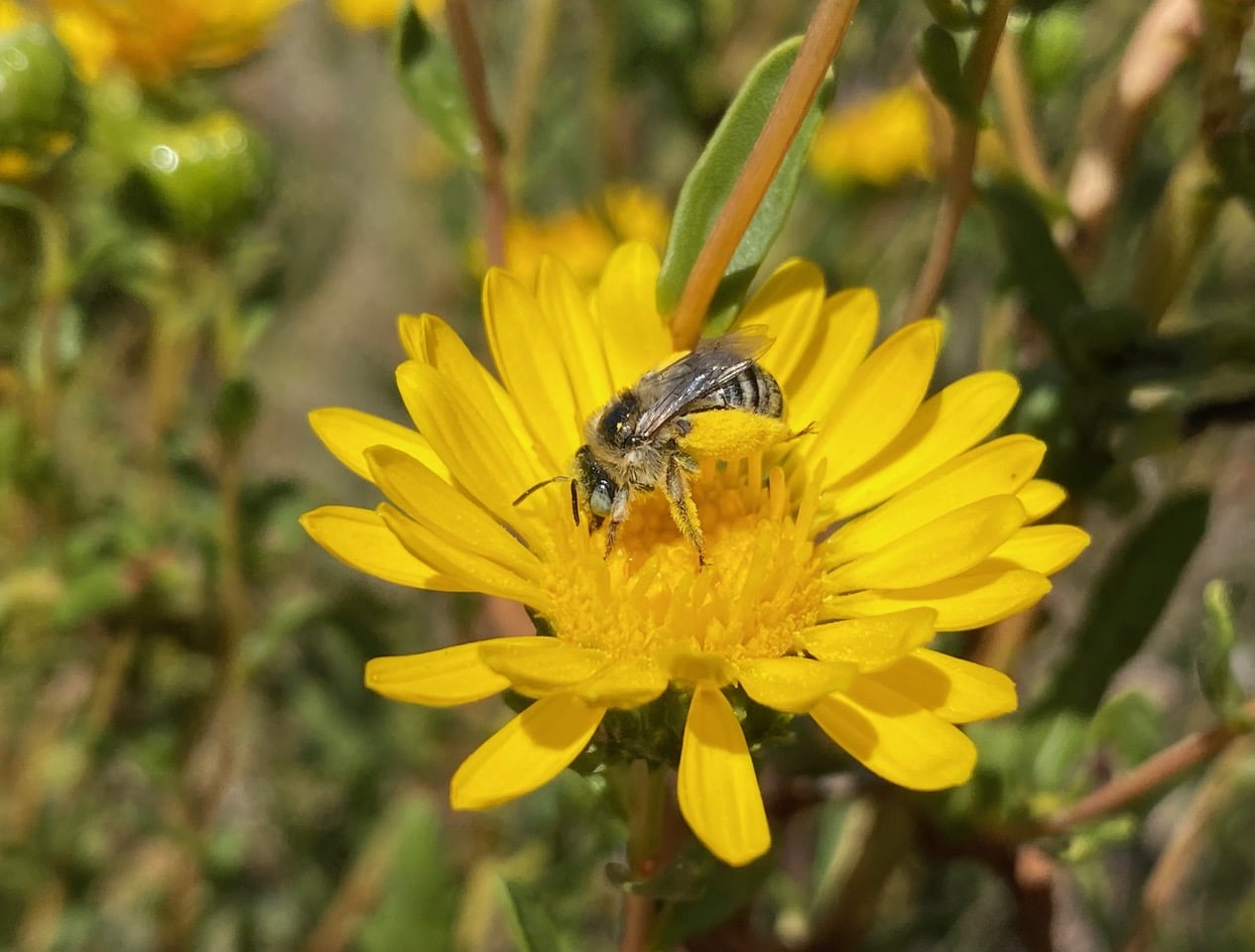
It’s a treat to see her up close while she collects pollen. The pollen is loosely held by electro-static attraction to the hairs of her scopae, not compacted or moistened. It is believed that bees with this kind of pollen carriers (as compared to the bees with “pollen baskets”) are better pollinators because the pollen falls off easily as the bees go about their activities.
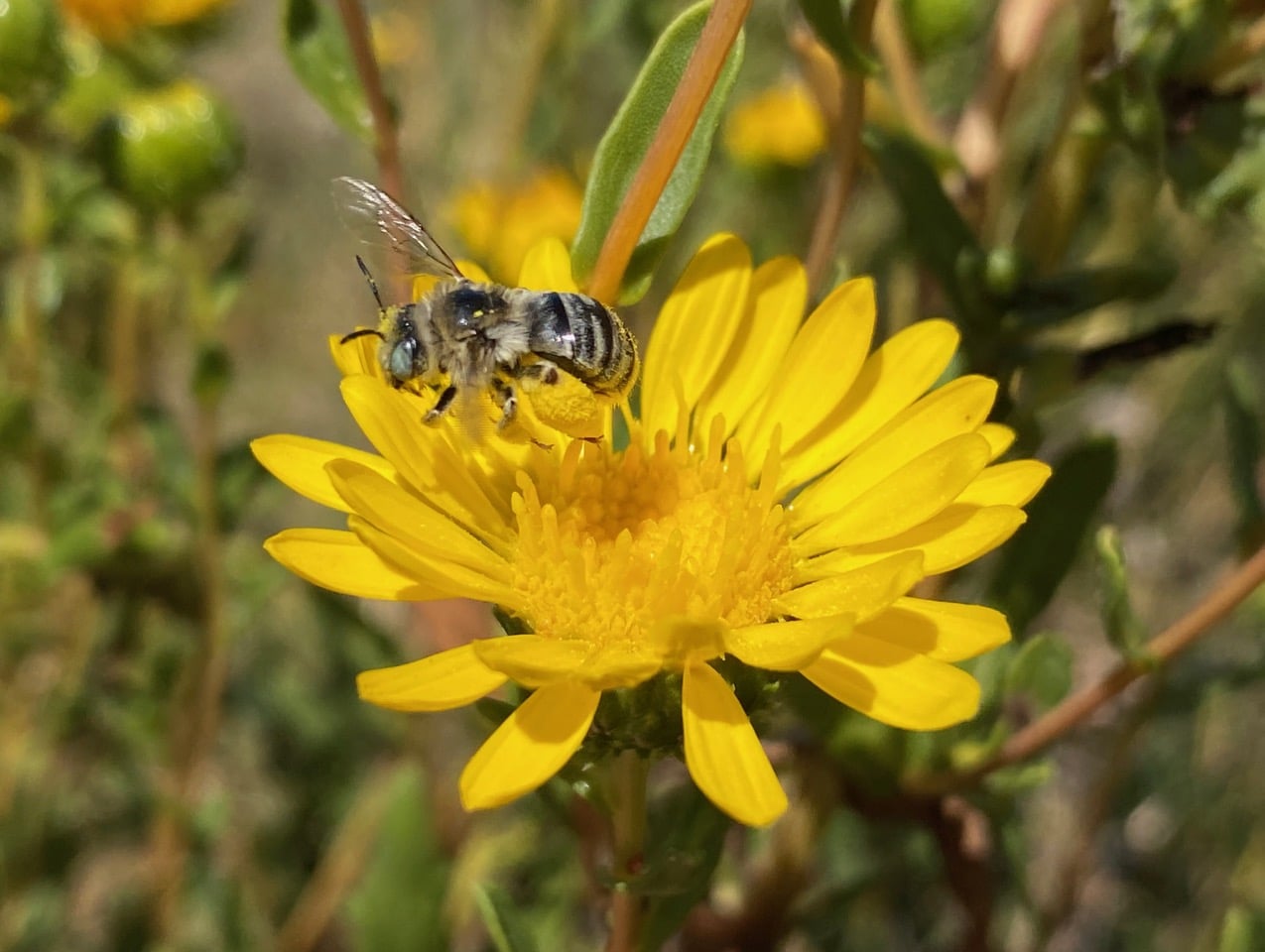
Maybe it’s time to return to the nest to stock the brood chambers. Melissodes are ground nesters. Each nest cell in the tunnel is provisioned with a loaf of “bee bread” made with pollen and nectar, on which an egg is laid. The loaf is sufficient to nourish the larva through its development to pupation.