

Pollinator Post 8/31/24 (2) Resend
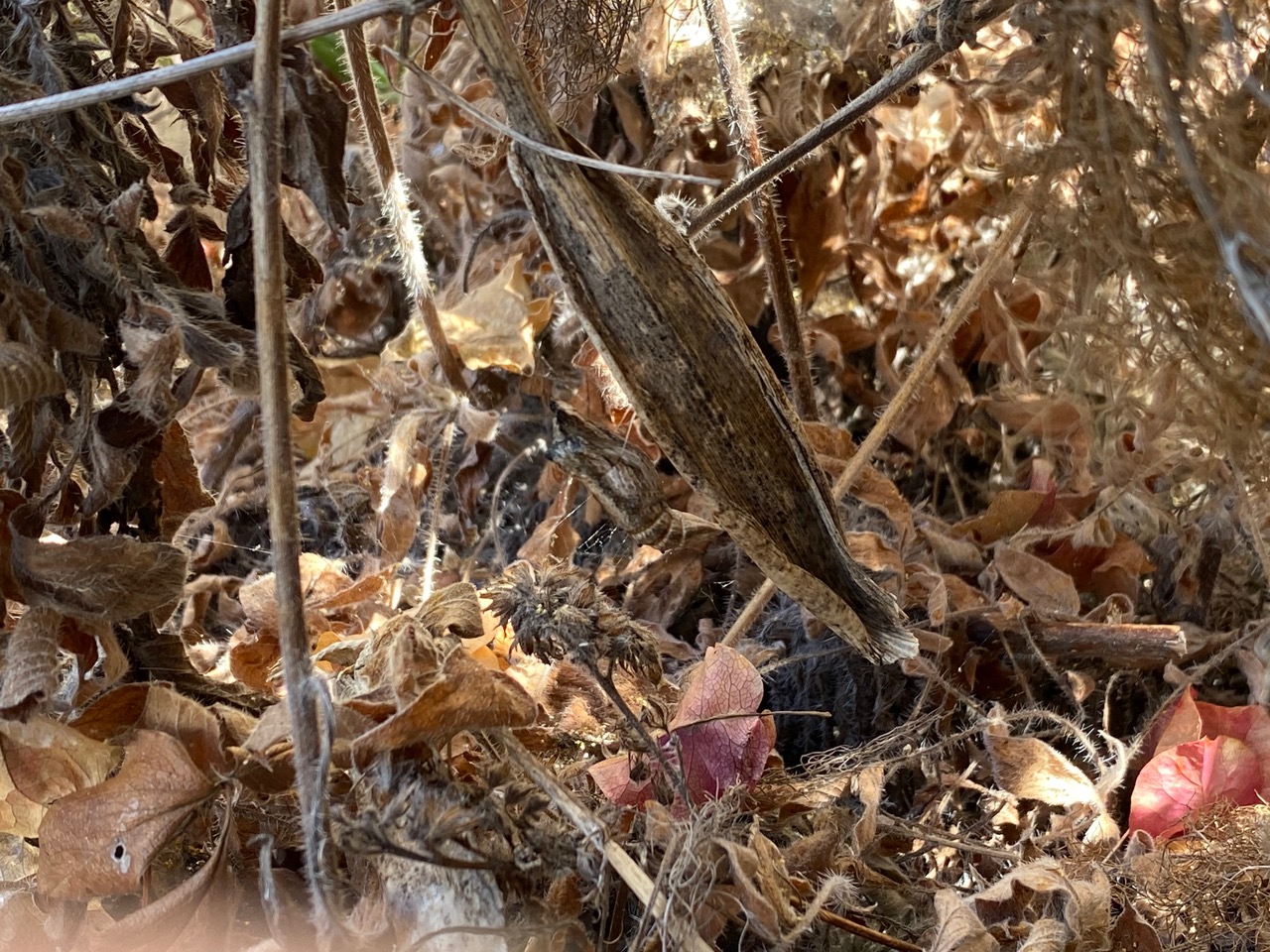
Naomi takes me to her backyard to show me an Anise Swallowtail chrysalis. She proudly points to the plant debris at the base of a robust Fennel, Foeniculum vulgare. Do you see the chrysalis? It takes me a while to spot it, attached to the large brown leaf hanging just above the leaf litter.
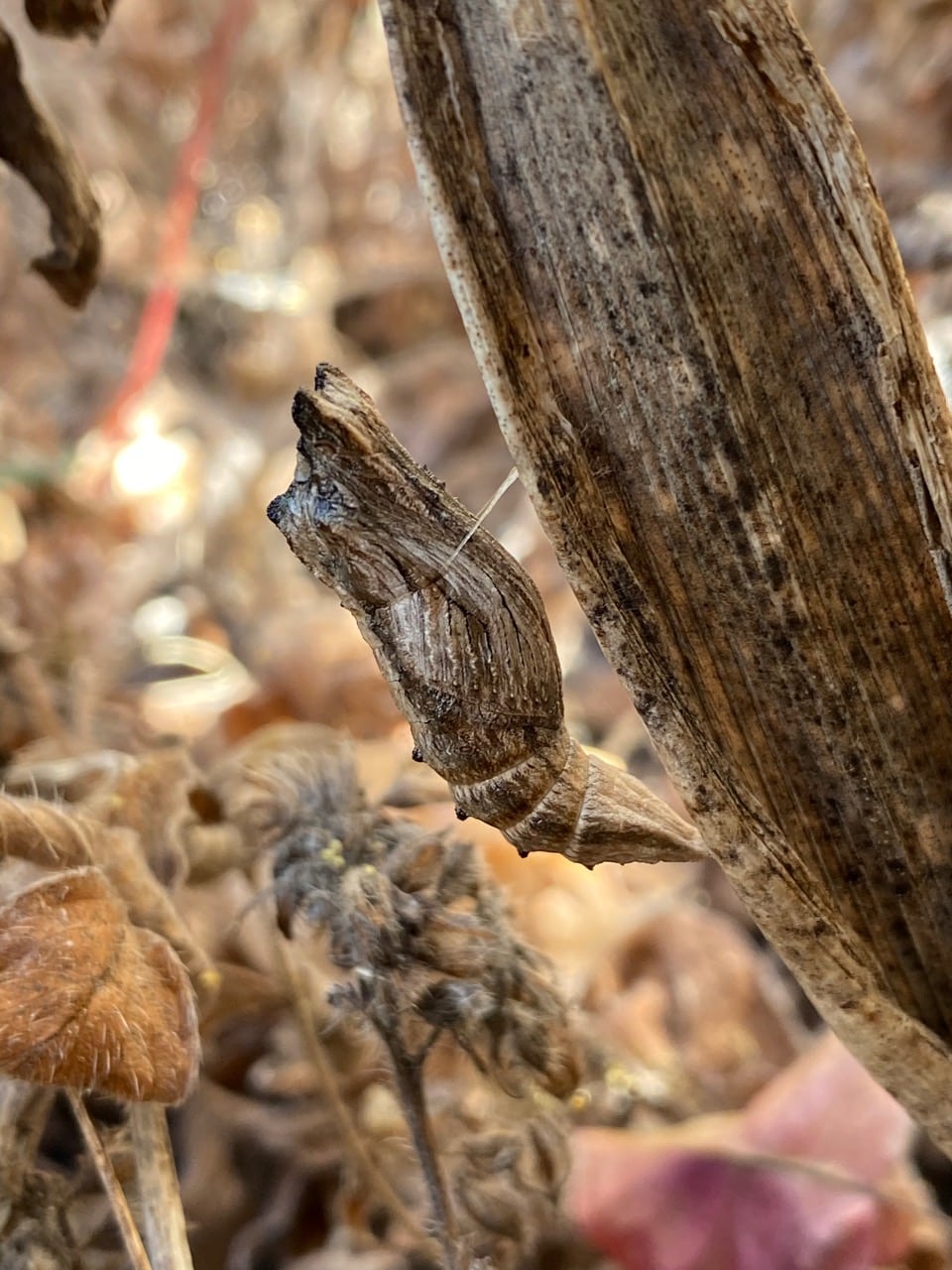
Close-up of the Anise Swallowtail chrysalis. Its camouflage takes my breath away. Attached to the leaf by its silken harness and the cremaster, the colors, patterns and texture of the chrysalis match the leaf so well it is hard to believe that it is not part of the leaf. How did the caterpillar accomplish this feat of camouflage? The chrysalids of this species come in two colors – either green or brown.
A friend who is a butterfly enthusiast just sent me this info:
“Whether a chrysalis turns out green or brown depends on several interacting factors. The color of the surface they are pupating on comes into play. In addition, for some reason, it also matters whether the pupation surface is smooth or rough. Smooth surfaces favor a green chrysalis, rough surfaces favor a brown one. However, when the days get short, that overrides color and texture, and gives rise to a brown chrysalis regardless (since the chrysalis is likely to overwinter, and brown offers the best camouflage over the winter).”
Thanks, Sarab!
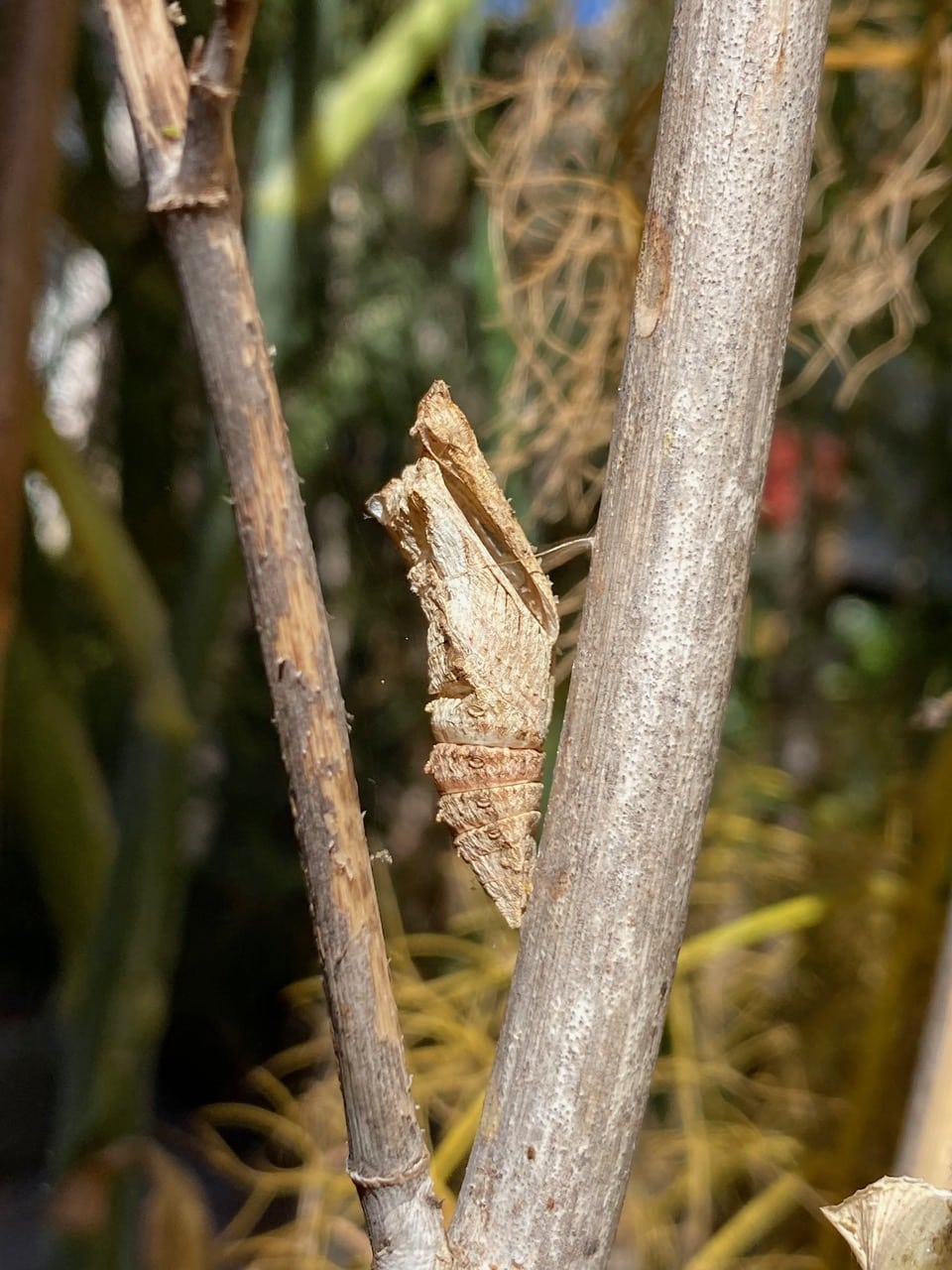
Higher up on an adjacent branch of the same plant is a spent chrysalis from which the butterfly has already emerged. Naomi is surprised – she has completely missed this one while it was in pupation.
It was formerly thought that pupation is a quiescent resting period in a butterfly’s life cycle. Nothing can be further from the truth. The chrysalis is a hotbed of demolition and reconstruction.
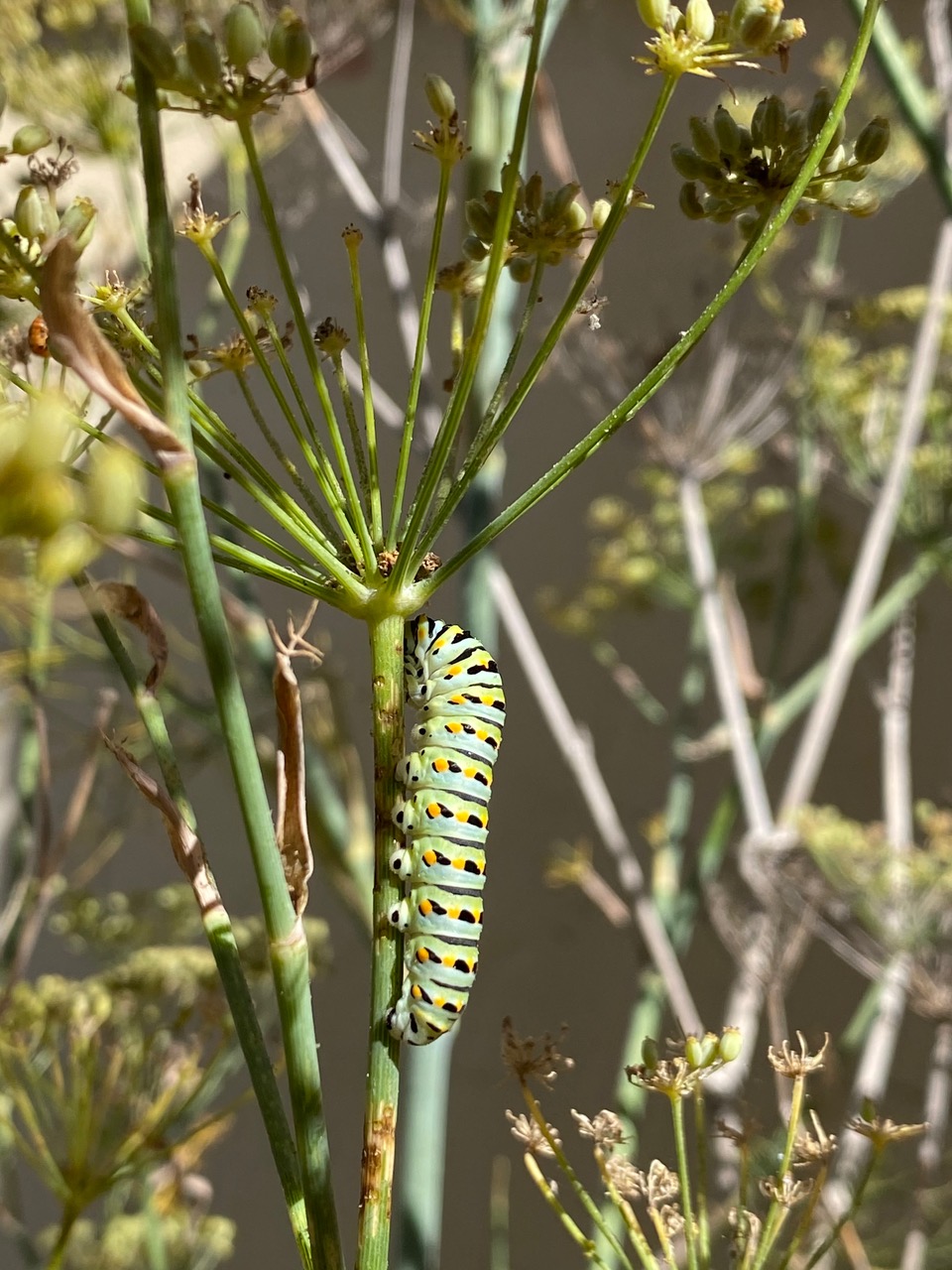
Near the top of the Fennel plant, a near mature Anise Swallowtail caterpillar is feeding at the base of a floral umbel.
SoCal Butterflies- Life-cycle of an Anise Swallowtail

In the dappled shade, a younger caterpillar is hardly detectible.

An adult Mediterranean Katydid is perched on the tangled foliage of Fennel. Because its green coloration is slightly off, and its body shape is ill-matched for the Fennel leaves, the insect stands out like a sore thumb..
Insects in the family Tettigoniidae are commonly called katydids or bush crickets. They are primarily nocturnal in habit with strident mating calls. Many species exhibit mimicry and camouflage, commonly with shapes and colors resembling leaves. The diet of most katydids includes leaves, flowers, bark, and seeds, but many species are predatory, feeding on other insects, snails, or even small vertebrates such as snakes and lizards. Some are considered agricultural pests.
The Mediterranean Katydid is native to Europe, the Near East and North Africa. As an invasive species, it has spread to the San Francisco Bay Area. It mainly inhabits sunny and dry habitats, especially shrubs and low branches of trees. Katydids court acoustically. Phaneroptera nana female sings in response to the male, prompting the male to move towards her. Females chew on the lamina of plants to insert their eggs which usually hatch in summertime. P. nana is commonly found through the summer and fall seasons. The species is known to cause damage in pear orchards, feeding on pears that have not ripened.
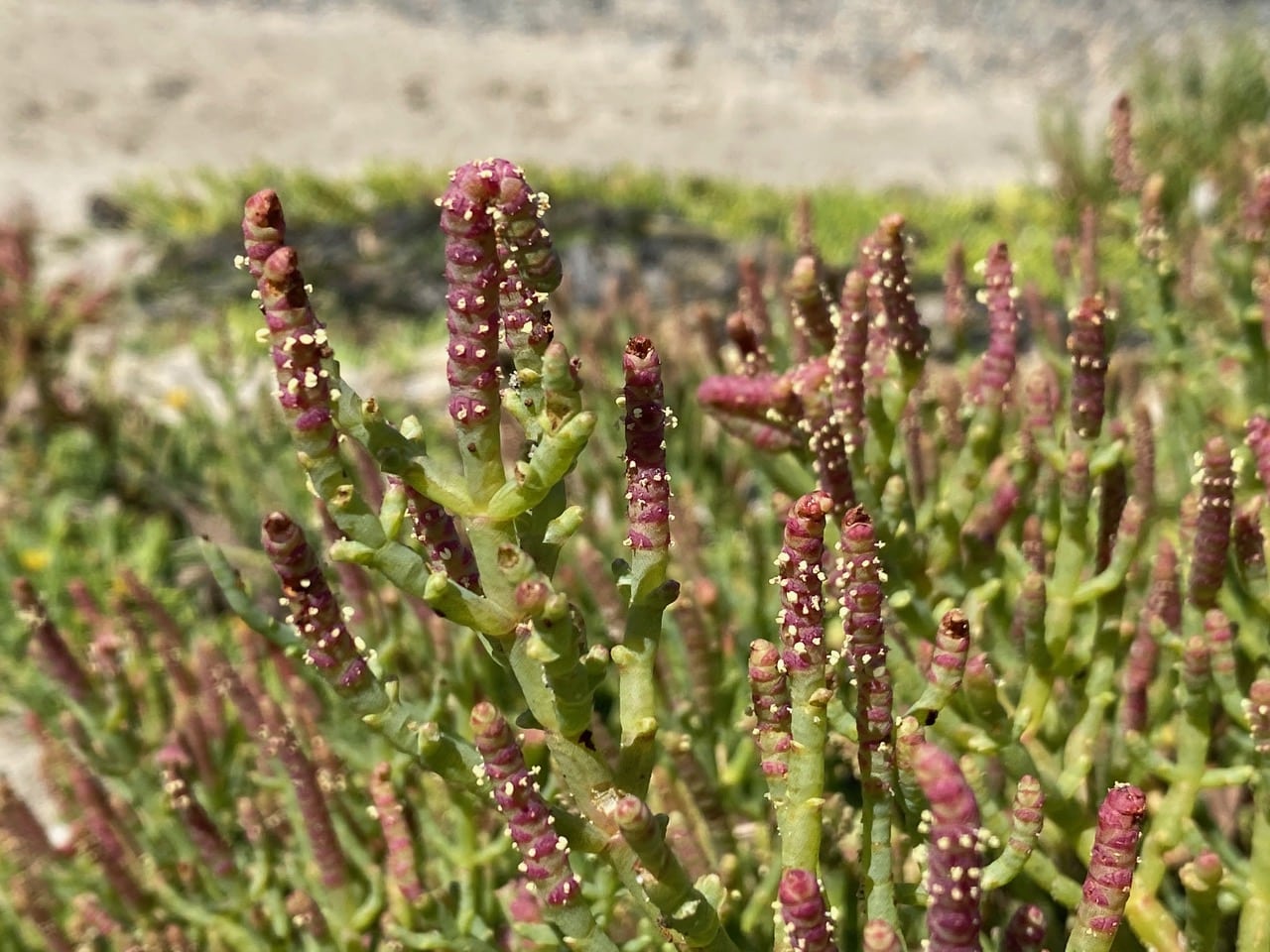
Naomi, Emil and I start our “bugging” adventure on the north eastern part of Bay Farm Island near the bridge, and make our way slowly westward along the shore. We are close to the intertidal zone where the reddening Pacific Pickleweed, Saliconia pacifica dominates the landscape.
Pacific Pickleweed, Saliconia pacifica is a low-growing, succulent, perennial herb, a halophyte found in salt marshes and alkaline soils throughout coastal California. It belongs to the goosefoot family, Chenopodiaceae which consists of many succulent and salt tolerant plants. The main stems are horizontal, the lateral stems vertical. The stems appear jointed, joints are barrel shaped. Leaves are reduced to scale-like structures clasping the stems. The senescent portions of stems turn red, especially in late summer and fall. Pickleweed has special adaptations that allow it to use seawater as a primary source of water. As saltwater is taken up, the salt is removed and stored as concentrated brine solution in the terminal segments of the stems. In late summer and fall, these segments turn red and drop off, removing the salts.
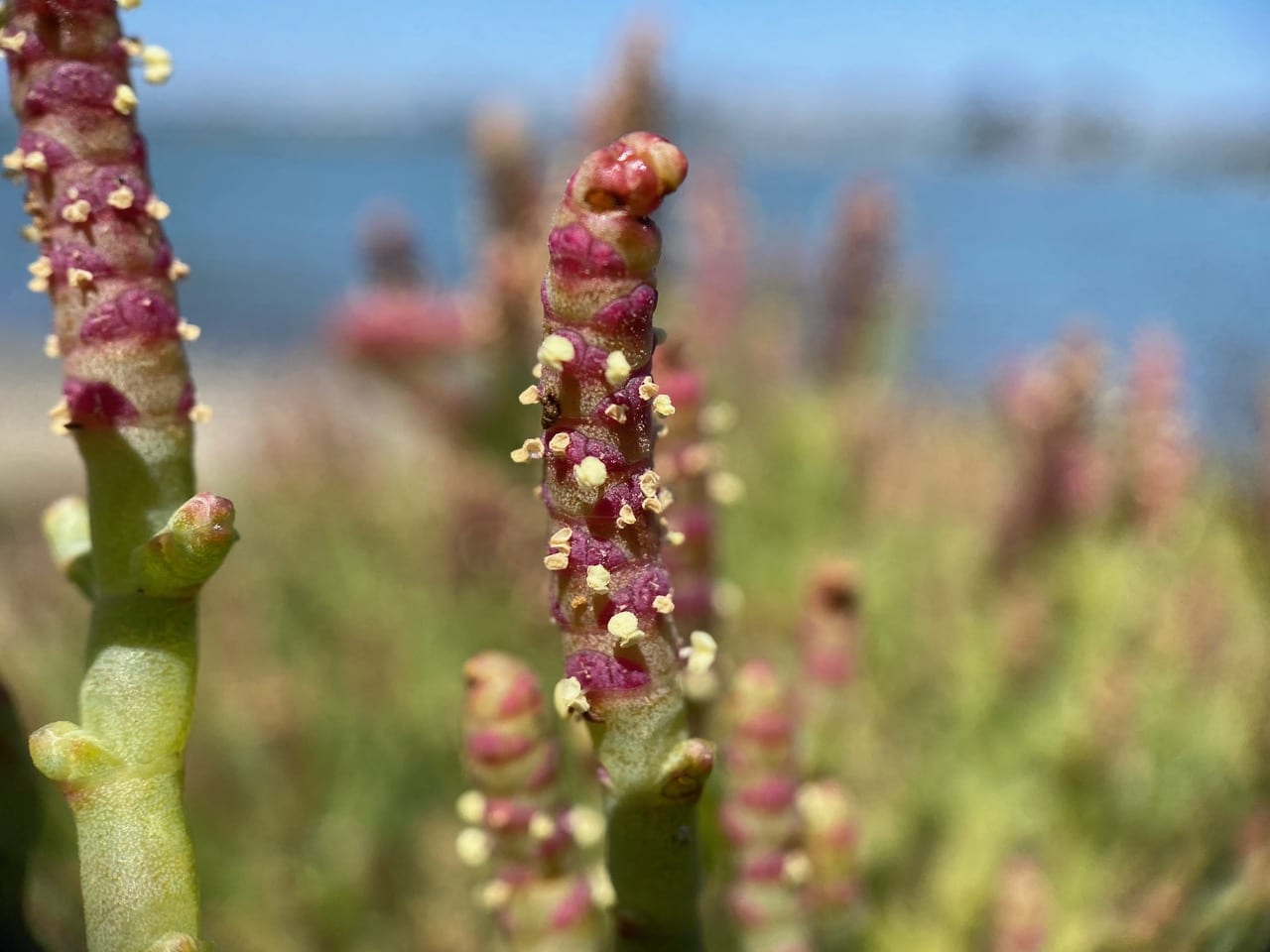
Pickleweed flowers are small and inconspicuous, mostly concealed in the fleshy tissue of the node. The flowers lack petals. Most obvious are the stamens and pistil that look like small flecks of dandruff. These are greenish-white and arise from junctions between stem segments. Saliconia maybe monoecious or dioecious. The population at Bay Farm appears to be dioecious, with male and female flowers borne on separate plants. This plant is apparently male, bearing only stamens.
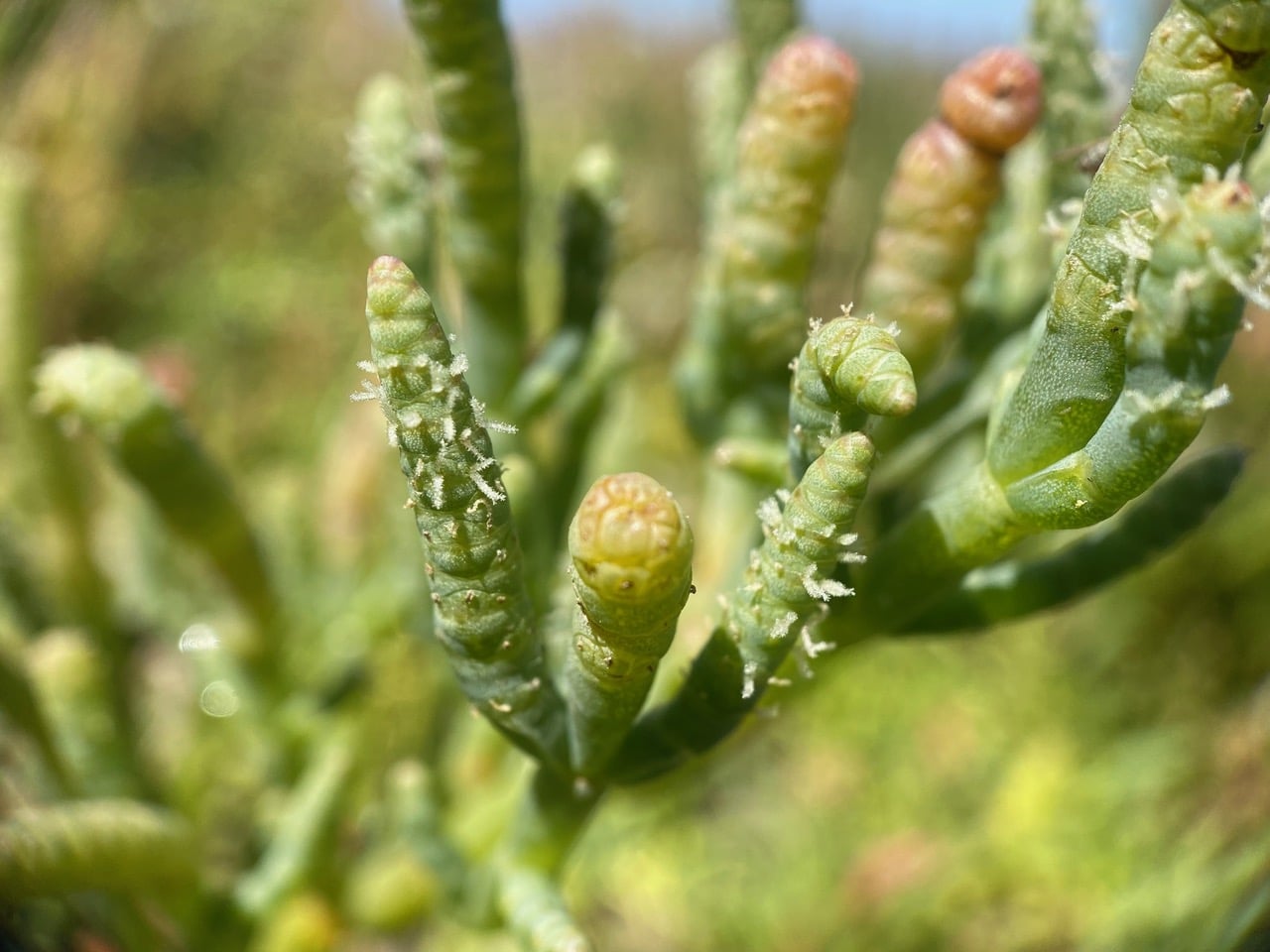
Not far away, another Pickleweed bears only feathery white stigmas at the stem joints. It is obviously a female plant. Pickleweeds are wind-pollinated.
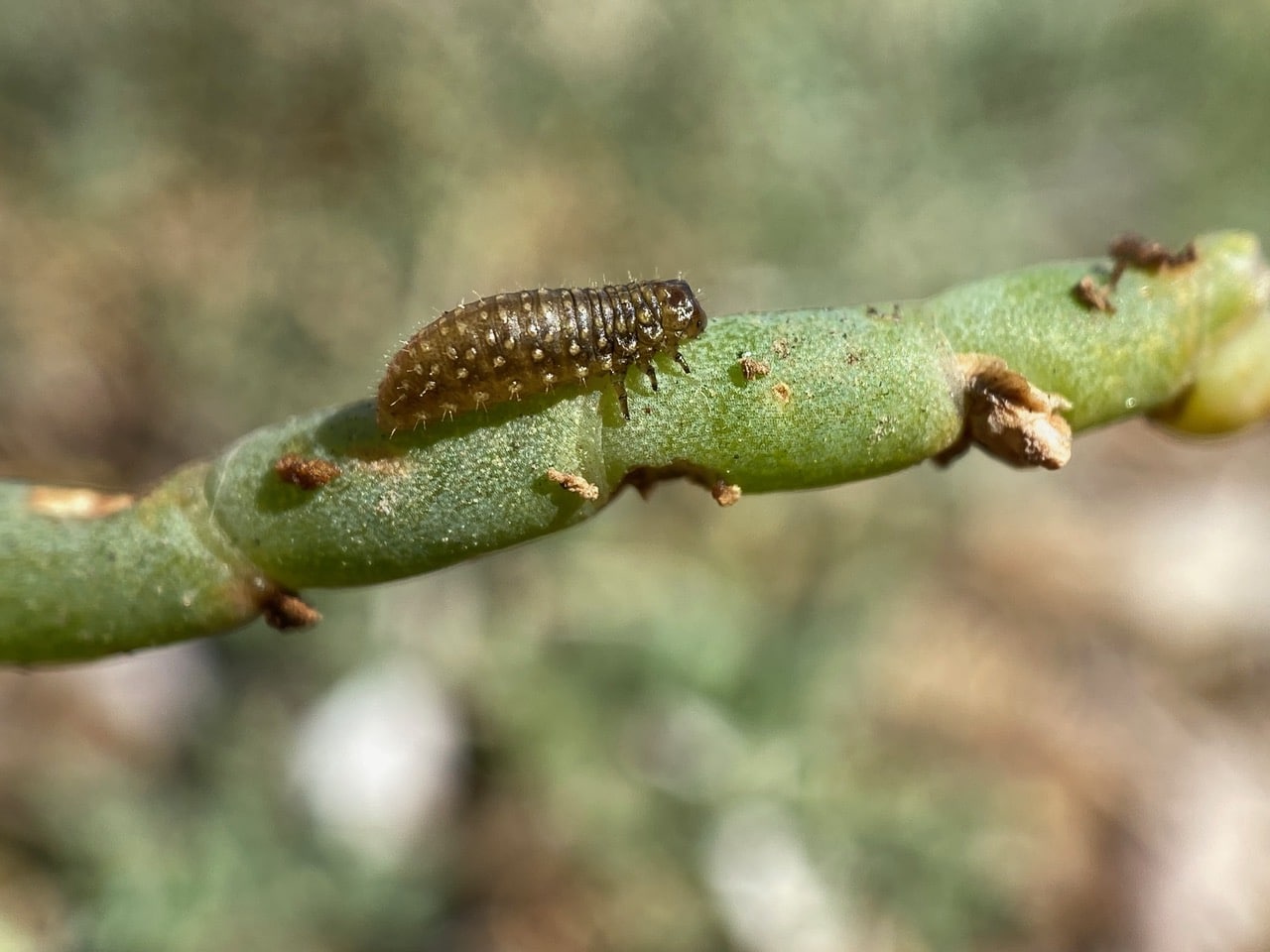
Naomi spots this creature on the jointed stem of Pacific Pickleweed. It is probably the larva of a Leaf Beetle in the family Chrysomelidae. Leaf Beetles in the family Chrysomelidae make up one of the largest and most commonly encountered beetles. They are all phytophagous – both adults and larvae feed on all sorts of plant tissues.