

Pollinator Post 8/31/24 (1)
I have come to Alameda to pick Naomi up for our “bugging” adventure with Emil this afternoon. Naomi has reported seeing 24 male Longhorn Bees, Melissodes sp. (family Apidae) sleeping in aggregation on the Elegant Tarweed, Madia elegans on the sidewalk strip in front of her house. Curious, I have arrived early to spend some time observing the bee acitivities.




 A female Western Leafcutter Bee, Megachile perihirta (family Megachilidae) is foraging on an inflorescence of of California Goldenrod. Note the shaggy hairs on the underside of her pointed abdomen that she uses to carry pollen.




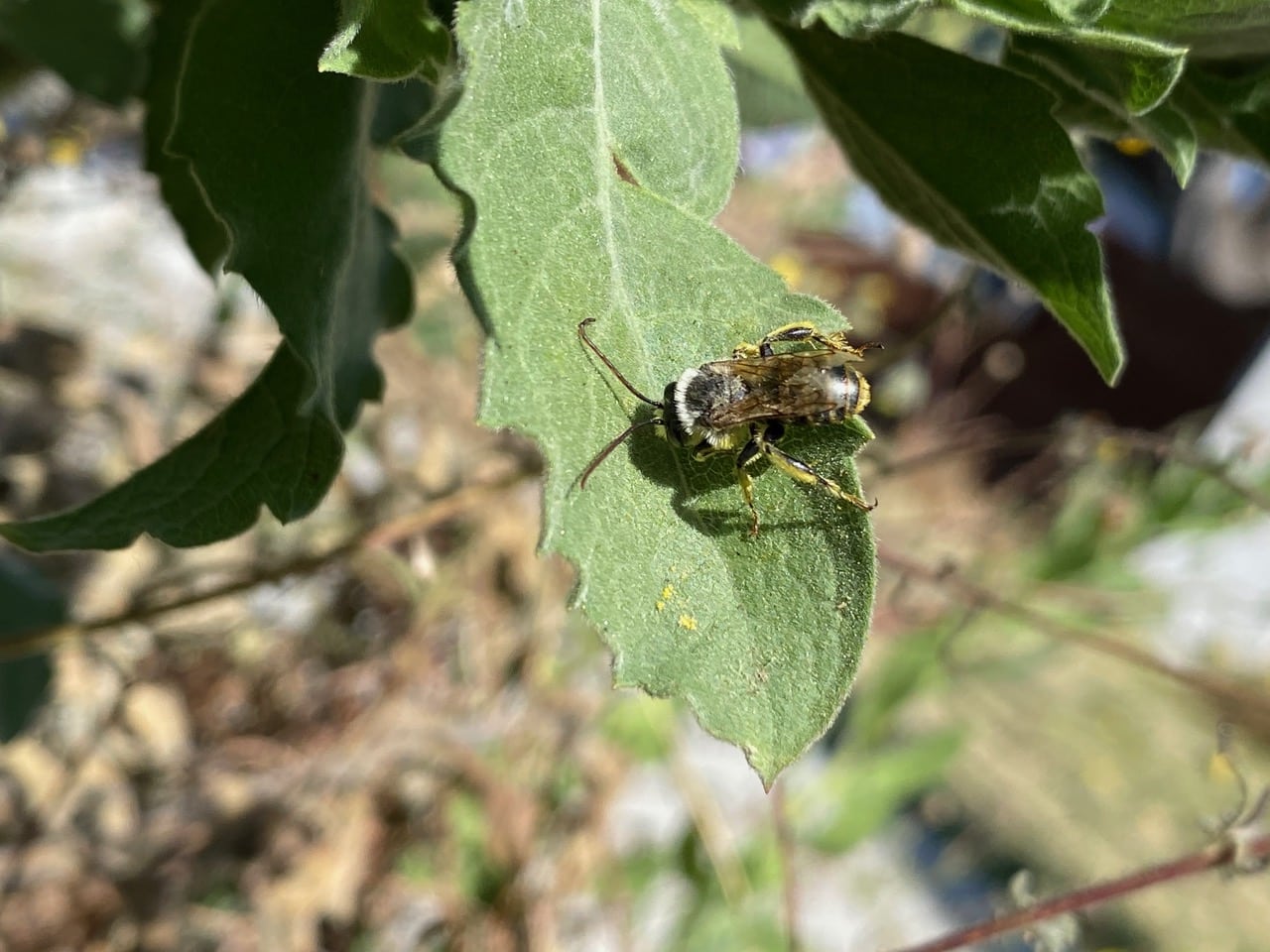
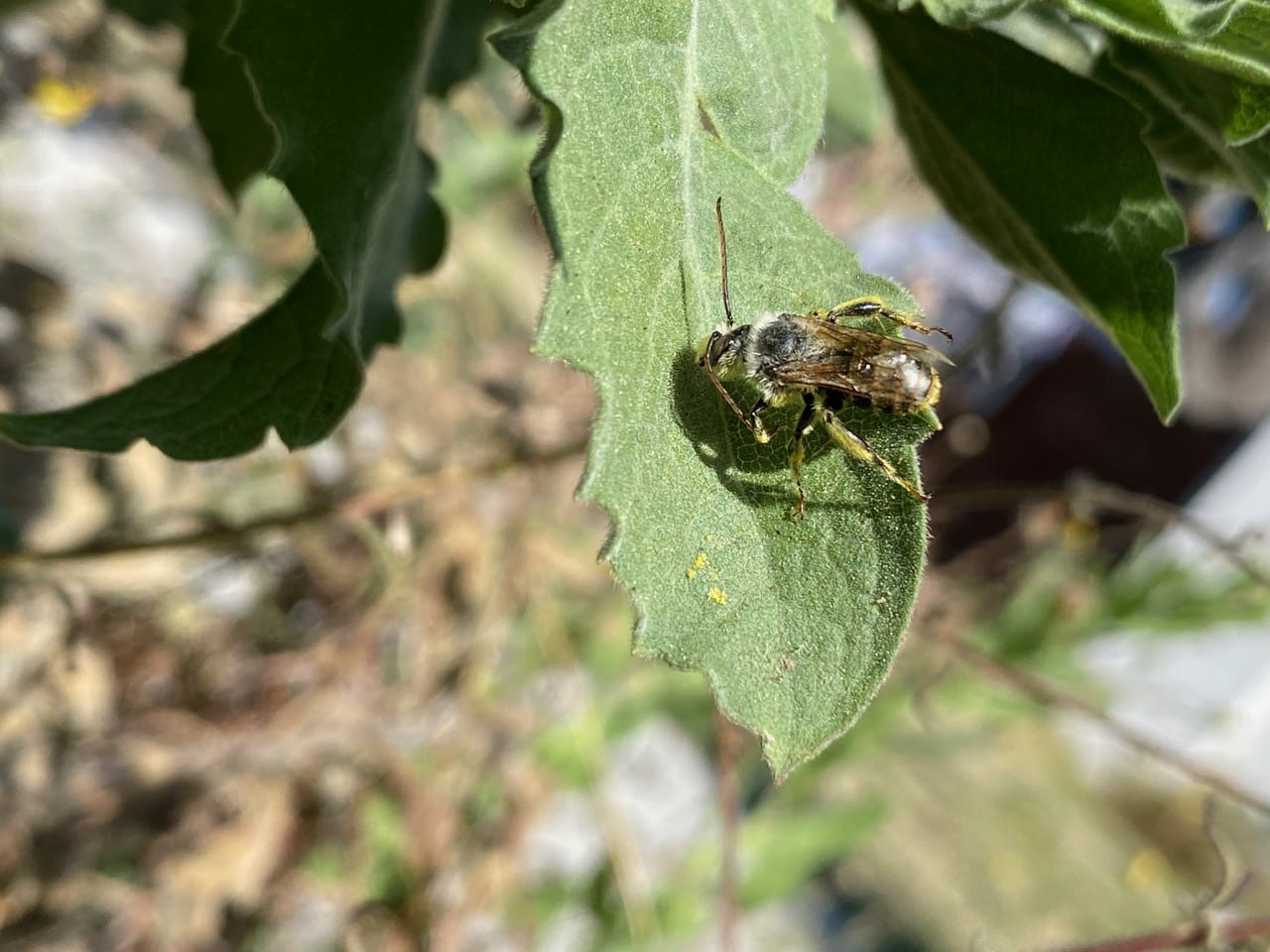
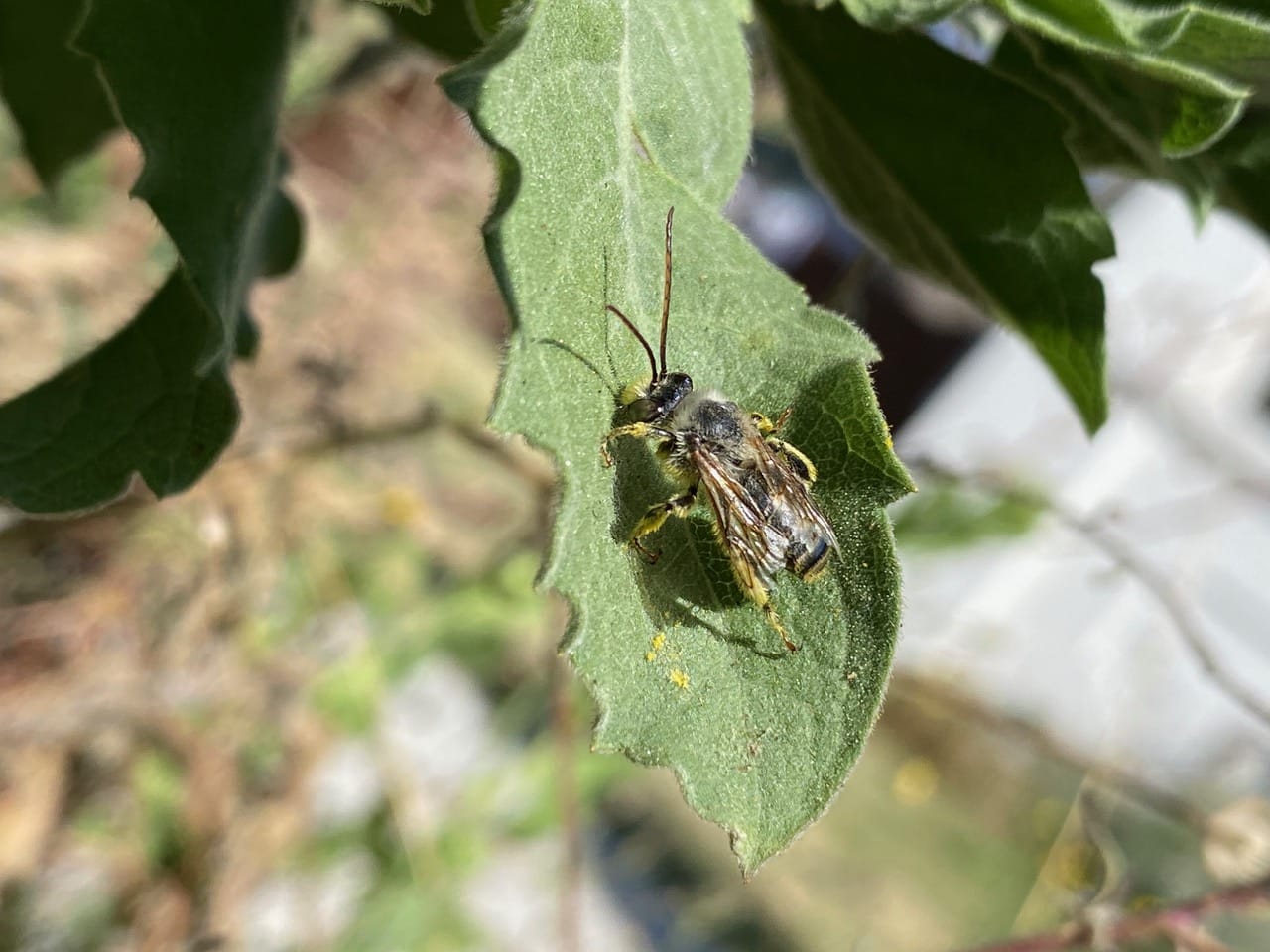
Since it is a warm, sunny morning, all of the male Longhorn Bees have woken up from their regular roost on the Elegant Tarweed. They are already zipping around seeking nectar. There is, however, this lone male resting stock-still on a leaf of the Telegraphweed, Heterotheca grandiflora. Why is he sleeping away from the other boys?
As I photograph it, the bee begins to stir and groom itself. First, a thorough cleaning of his long antennae.
As the bee moves, I notice that his wings are badly tattered. He is probably an old bee.
The bee crosses his hind legs, brushing each other to remove bits of crusted pollen.
A female Summer Longhorn Bee, Melissodes sp. (family Apidae) is collecting pollen from a flowerhead of Elegant Tarweed.
The Summer Longhorn Bees, Melissodes sp. (family Apidae) are medium to large bees, stout-bodied, usually with gray hair on the thorax and pale hair bands on the abdomen. Males usually have yellow markings on their faces and have very long antennae from which their common name is derived. They are active May to September, with peak flight in late June to early August. The females prefer flat, bare ground for digging their solitary nests, though they sometimes nest in aggregations. Pollen is transported in scopae on the hind legs. Pollen loads are often copious and brightly colored and thus very distinguishable. Melissodes are specialists on Asteraceae – females gather pollen from flowers of Aster, Bidens, Coreopsis, Cosmos, Encelia, Gaillardia, Helianthus, and Rudbeckia ssp.
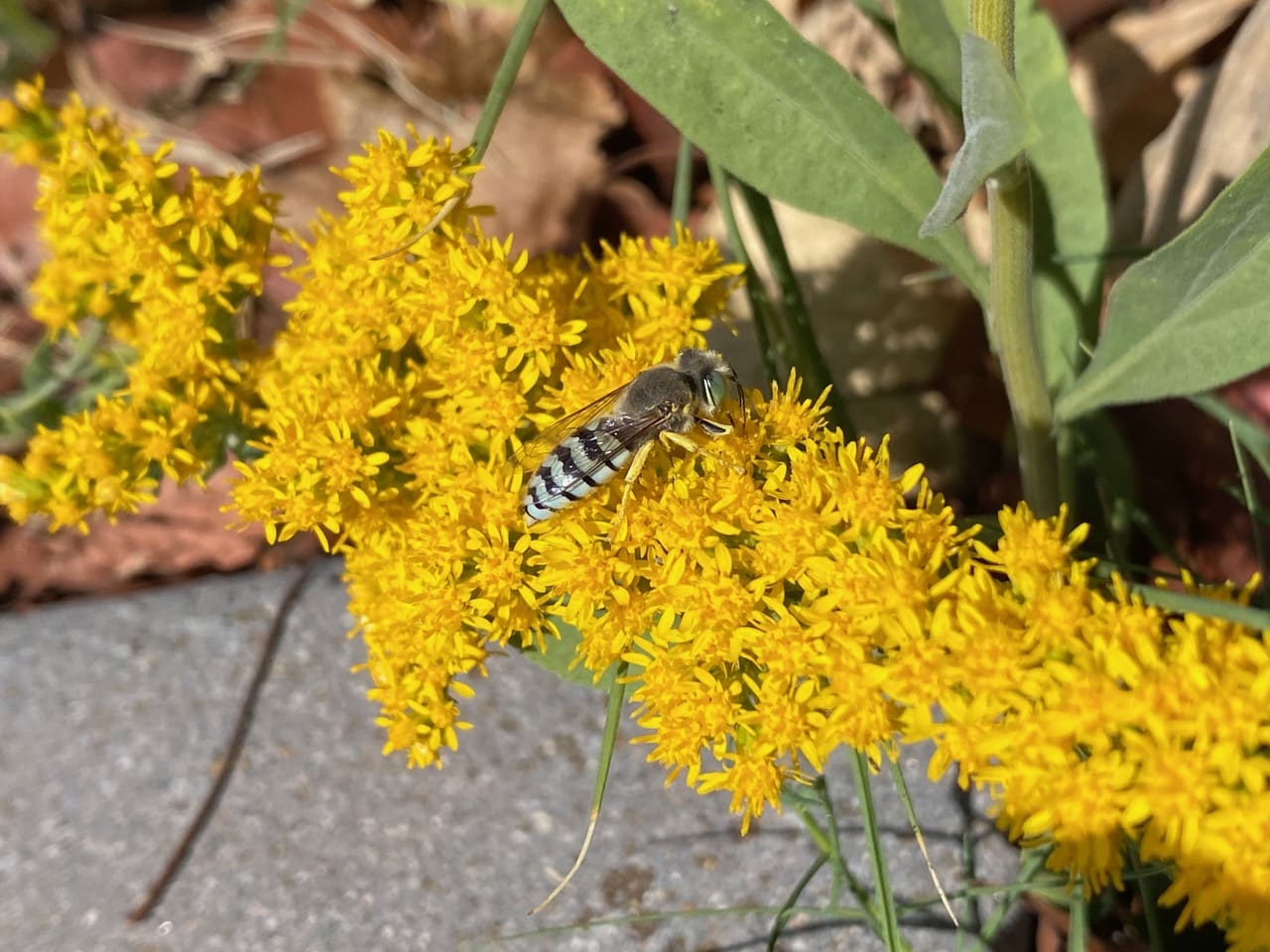
An American Sand Wasp, Bembix americana (family Crabronidae) is foraging on an inflorescence of California Goldenrod, Solidago velutina ssp. californica.
Sand wasps in the genus Bembix are familiar and common throughout North America, digging their burrows in dunes, on beaches, and other habitats with loose, deep sand. The female rapidly kicks out large quantities of sand using a “tarsal rake” of spines on each front leg. The burrow is excavated before the wasp goes hunting. Bembix are generalist, opportunistic hunters. True flies in the order Diptera are the usual prey. A victim is paralyzed or killed by the wasp’s sting, and is then flown back to the nest. Most species will lay an egg on the first victim, while some species lay an egg in the empty cell before starting to hunt. Once the egg hatches, mama wasp brings flies to her larva as needed. This “progressive provisioning” is rare in the insect world. When the larva reaches maturity, mama wasp closes the cell. Inside, the larva spins an oblong cocoon, weaving sand grains into the structure and resulting in a hardened capsule. Overwintering takes place as a prepupa inside this cocoon, but there are usually two generations a year.
A male Longhorn Bee, Melissodes sp. (family Apidae) is seeking nectar from the flowers of California Goldenrod.
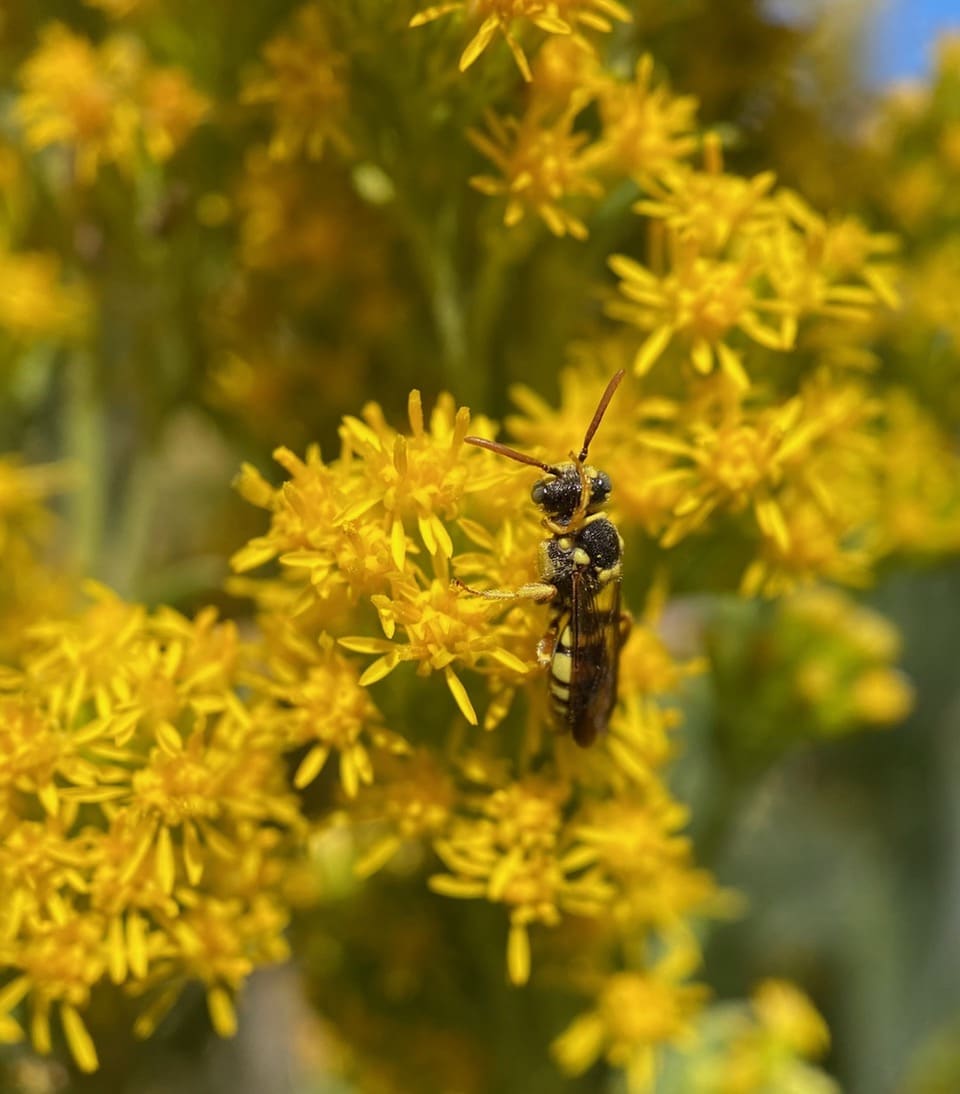
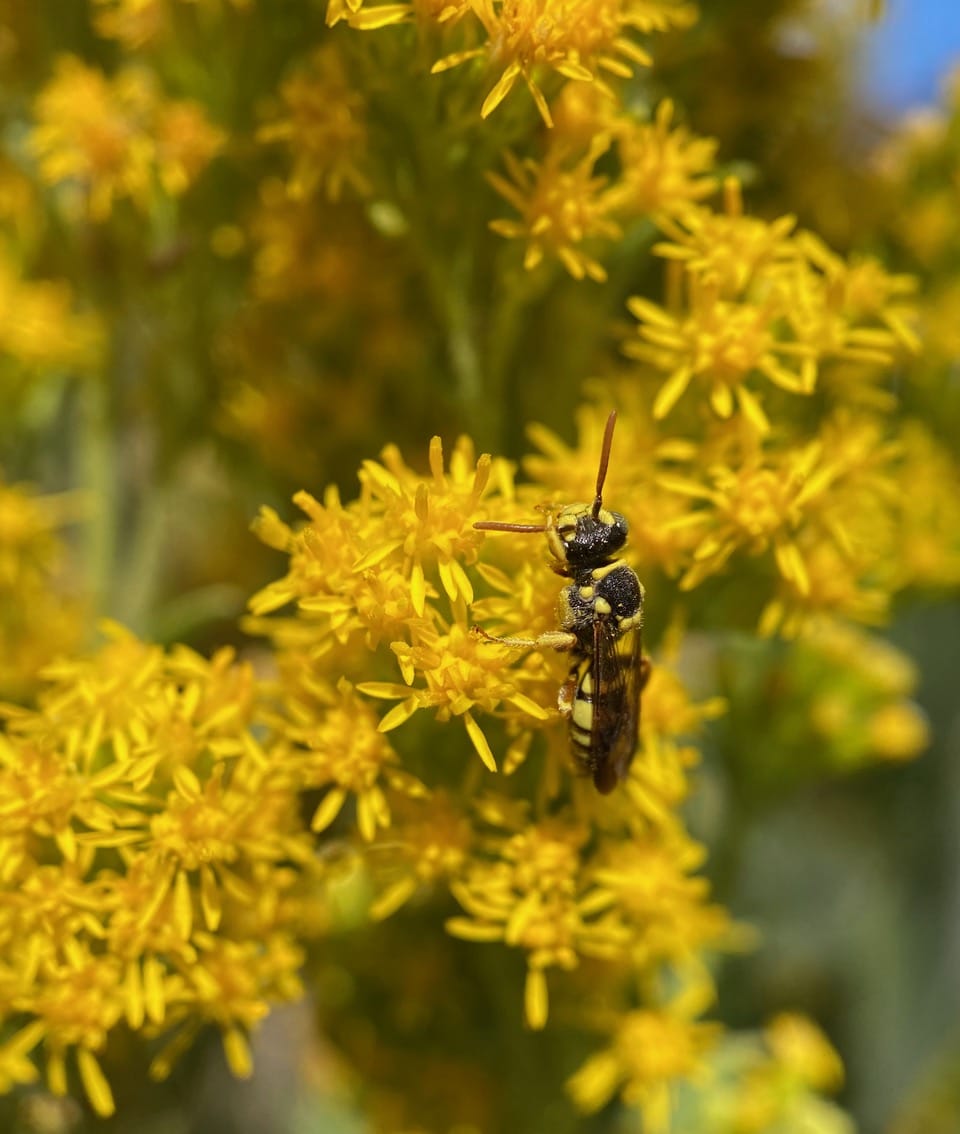
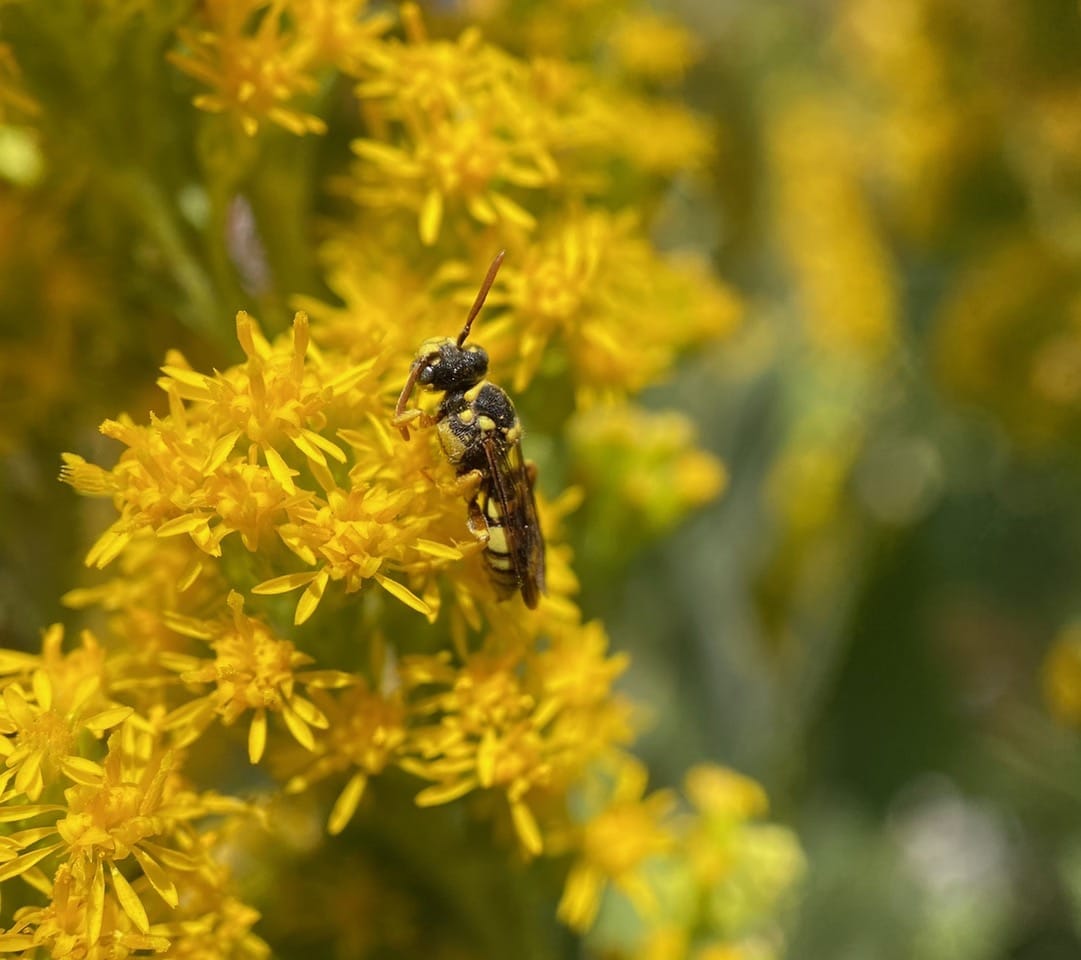
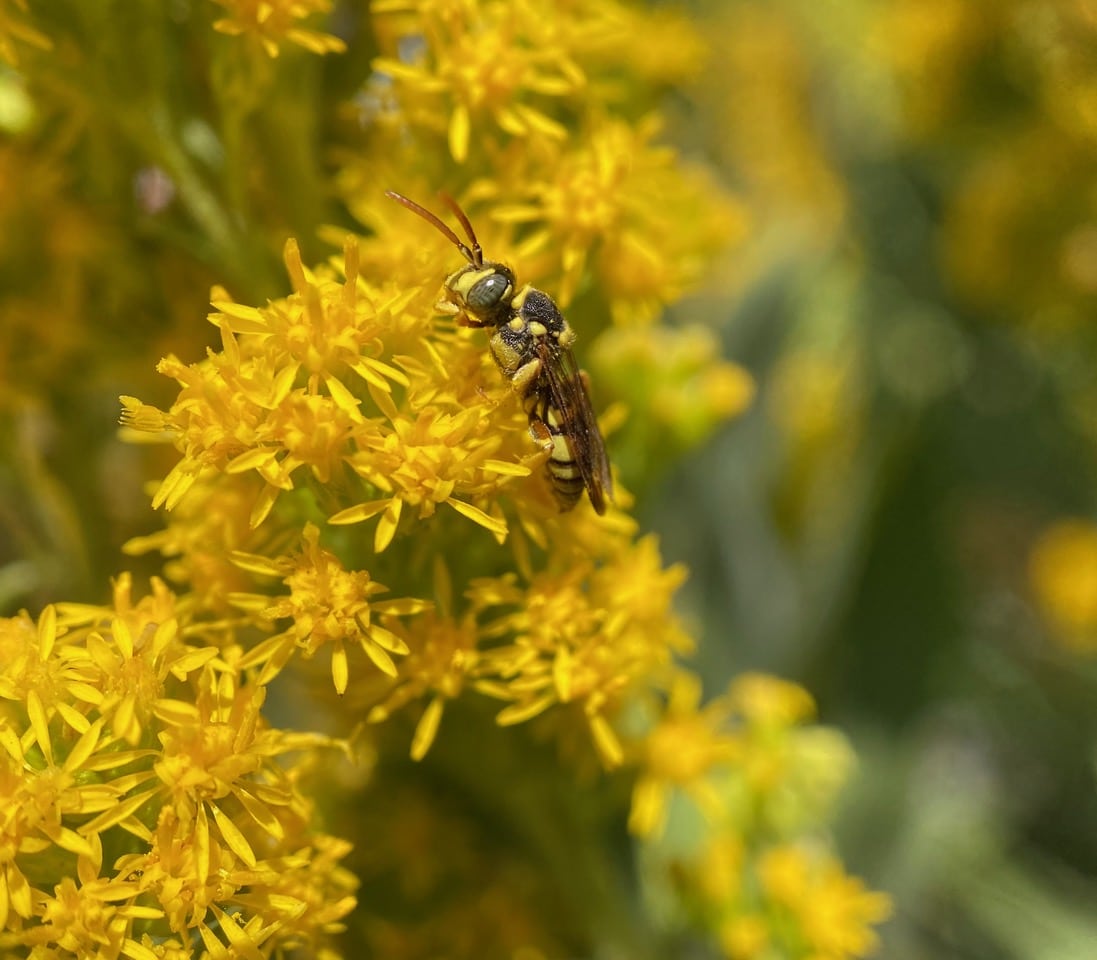
A Nomad Bee, Nomada sp. (family Apidae) is foraging on an inflorescence of California Goldenrod.
Nomad Bees in the genus Nomada is one of the largest genera in the family Apidae, and the largest genus of Cuckoo Bees. Nomada are kleptoparasites of many different types of ground-nesting bees as hosts, primarily the genus Andrena. They lack a pollen-carrying scopa, and are mostly hairless, as they do not collect pollen to feed their offspring. Adults visit flowers for nectar. The bees are extraordinarily wasp-like in appearance, often with yellow or white integumental markings on their abdomen.
Nomad Bees occur worldwide. All known species parasitize ground-nesting bees, and their habitats and seasonality correlate closely with their hosts. In early spring, females scout out their hosts, searching for nests to parasitize. The female Nomada sneaks into the host’s nest while the resident female is out foraging, then lays eggs in the nest. The parasite larva that hatches out kills the host offspring and feeds on the host’s provisions. This type of parasitism is termed brood parasitism. The parasites pupate in the host cell and finally emerge as adults the following season along with the hosts.
A tiny Jumping Spider (family Salticidae) is resting on an flowerhead of California Goldenrod.
A female Western Leafcutter Bee, Megachile perihirta (family Megachilidae) is foraging on an inflorescence of of California Goldenrod. Note the shaggy hairs on the underside of her pointed abdomen that she uses to carry pollen. Leaf-cutter Bees, Megachile sp. (family Megachilidae) are stout-bodied, usually with pale hair on the thorax and stripes of white hairs on the abdomen. Females usually have a triangular abdomen with a pointed tip, and males’ faces are covered with dense, pale hair. Flight season is from May into September, with peak activity from June to August.
Solitary females construct nests in tubular cavities, including hollow stems, tree holes, and abandoned beetle burrows in wood. Many use holes drilled into wood, straws, or other manufactured tunnels. Females cut pieces from leaves or flower petals for use in the construction of brood cells. Most Megachile females are generalists when foraging for pollen. Pollen is transported in dense scopae on the underside of the abdomen.
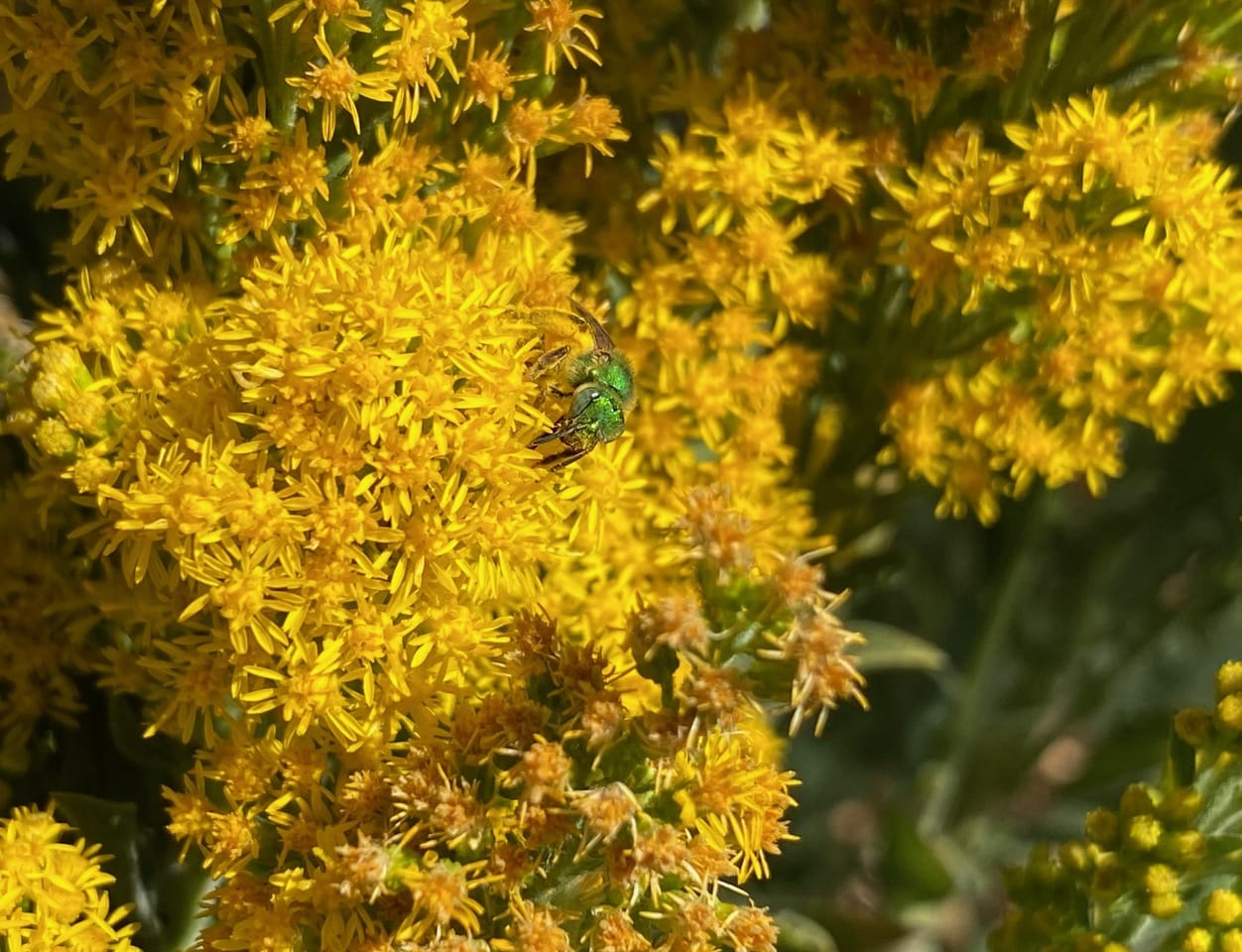
A female Texas Striped Sweat Bee, Agapostemon texanus (family Halictidae) is foraging on California Goldenrod flowers.
The genus Agapostemon is widespread and abundant throughout North America. They are most diverse and abundant in temperate regions and southwestern U.S. deserts. Agapostemon are commonly called “sweat bees” because they are closely related to, and resemble bees in the Halictus and Lasioglossum genera. Unlike those bees however, Agapostemon are not attracted to human sweat.
Agapostemon are brightly colored metallic green or blue bees measuring 7 to 14.5 mm long. Most species have a metallic green head and thorax, and black-and-yellow striped abdomen; some females are entirely bright green or blue. Females carry pollen on scopal hairs located on their hind legs. Agapostemon are generalists. Like other members of the family Halictidae, they are short-tongued and thus have difficulty extracting nectar from deep flowers. Males are often seen flying slowly around flowers looking for females. The bees favor flowers with high densities. They are active summer to fall.
Agapostemon females dig deep vertical burrows in flat or sloping soil, or sometimes in banks. Most species are solitary, but some species nest communally. Up to two dozen females may share a single nest entrance, but each individual builds and provisions its own cluster of brood cells. Where a communal nest gallery shares a single entrance, one bee usually guards the hole, with only her head visible from above ground. Unlike other social bees, in communal bees there is no reproductive division of labor. In cool temperate regions, there is one generation per year, with females active in the early summer and males and pre-diapausing females active in the late summer. Only mated females survive the winter. This is probably because unmated females cannot enter diapause (insect version of hibernation).
A Nomad Bee, Nomada sp. (family Apidae) is grooming itself on the flowers of California Goldenrod.
The bee reaches behind its head with its left front leg…
…grasp its left antennae in the antenna cleaner…
…then pulls the antenna through the antenna cleaner.
All bees have an antenna cleaner on each of their two forelegs. The antenna cleaners consists of two parts: a notch in the basitarsus, which is fitted with stiff hairs, and a corresponding spur on the tibia. To clean its antenna, the bee raises its foreleg over its antenna and then flexes it tarsus. The action allows the spur to close the notch, forming a ring around the antenna. The bee pulls each antenna through the bristles to clean it of debris such as pollen or dust which might interfere with the many sensory organs within the antenna. A bee’s antennae serve numerous functions: smell, taste, perceive humidity and temperature, feel, monitor gravity and flight speed and even detect sound waves to help guide the bee in its daily activities.
A European Paper Wasp, Polistes dominula (family Vespidae) is foraging on California Goldenrod.
Native to Europe, the European Paper Wasp, Polistes dominula, is a social insect that produces an annual colony in a paper nest. Individual colonies are established anew each spring. The overwintering stage are mated females (queens). The overwintered queens emerge from sheltered spots in spring and search out sites to establish a new colony. Nests are constructed of paper, produced from chewed wood fibers of weathered fences, porch decks and other similar sources. Larvae are fed crushed insects, usually caterpillars. As the population increases, the original queen increasingly remains in the nest as new workers take over colony activities. A few of the wasps produced later in summer are males and increasing numbers of the females become sexually mature. Mating occurs and the mated females are the surviving overwintering stage. Males and non-reproductive females do not survive winter and the nest is abandoned by late fall. European Paper Wasps will sometimes feed on sweet materials, including honeydew produced by aphids. They may also feed on damaged ripe fruits. Because of their habit of hunting caterpillars, the wasps have become one of the most important natural controls of garden pests.
Often mistaken for Yellowjacket Wasps, the European Paper Wasps can be distinguished by their slender body, and their orange-tipped antennae. Yellowjackets have shorter, thicker bodies, and they have black antennae. Paper wasps dangle their long legs when they fly, while the yellowjackets tuck their legs under their bodies when they fly. Paper wasp nests resemble an open honeycomb or upside-down umbrella. They often build their nests on man-made structures such as eaves or lawn furniture. Yellowjacket nests are covered with a surrounding envelope of paper; the nests have a single opening that is often hard to see because the nest is underground.
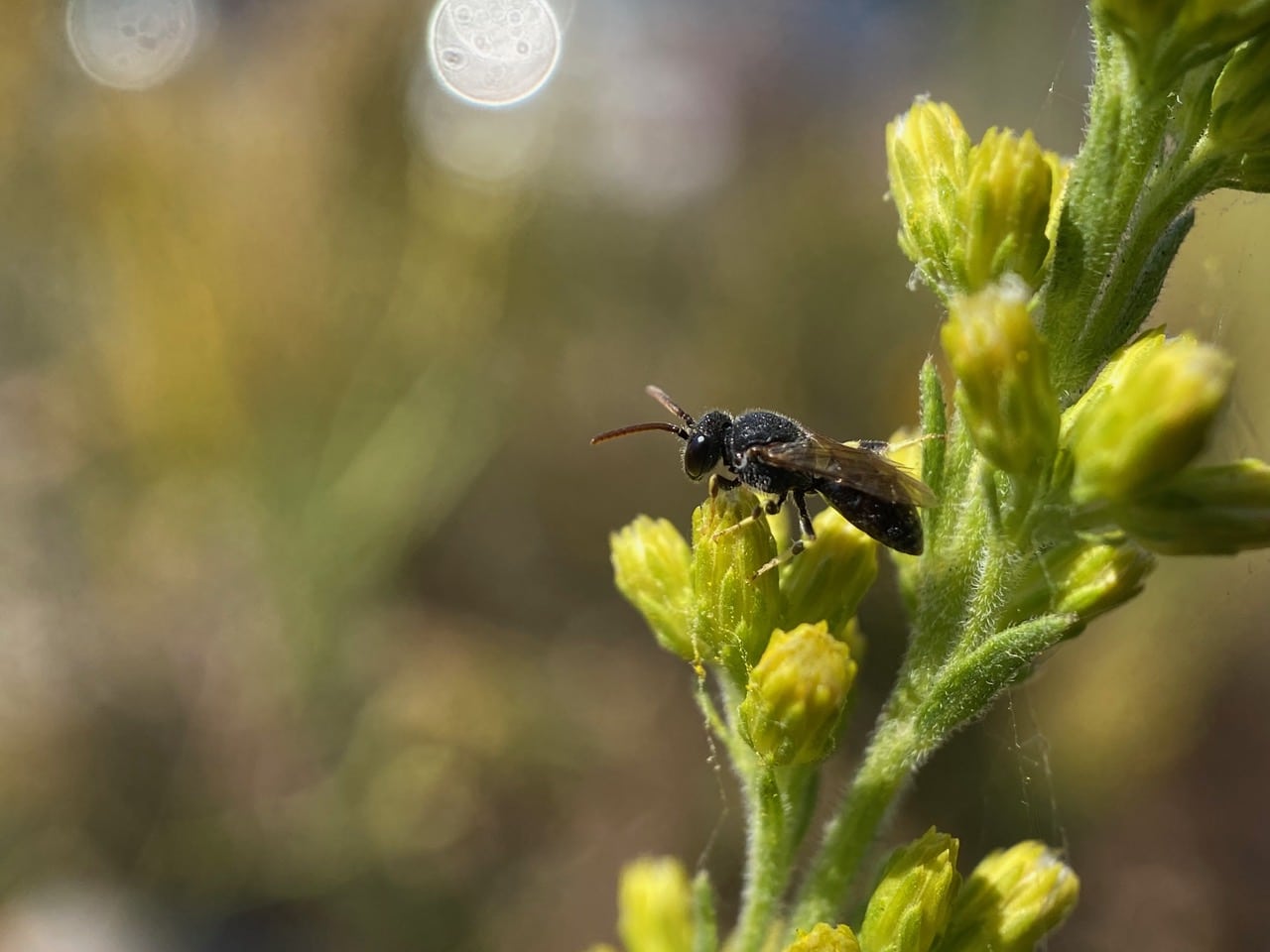
A Masked Bee, Hylaeus sp. (family Colletidae) is perched on the immature flowerheads of California Goldenrod.
Hylaeus (family Colletidae) are shiny, slender, hairless, and superficially wasp-like bees. They are small, 5 to 7 mm long, usually black with bright yellow or white markings on their face and legs. These markings are more pronounced on the males. Hylaeus do not carry pollen and nectar externally, they instead store their food in the crop and regurgitate it upon returning to their nests. They are primarily generalist foragers. Hylaeus are short-tongued, but their small body size enables them to access deep flowers. Hylaeus nest in stems and twigs, lining their brood cells with self-secreted cellophane-like material. They lack strong mandibles and other adaptations for digging, using instead pre-existing cavities made by other insects.
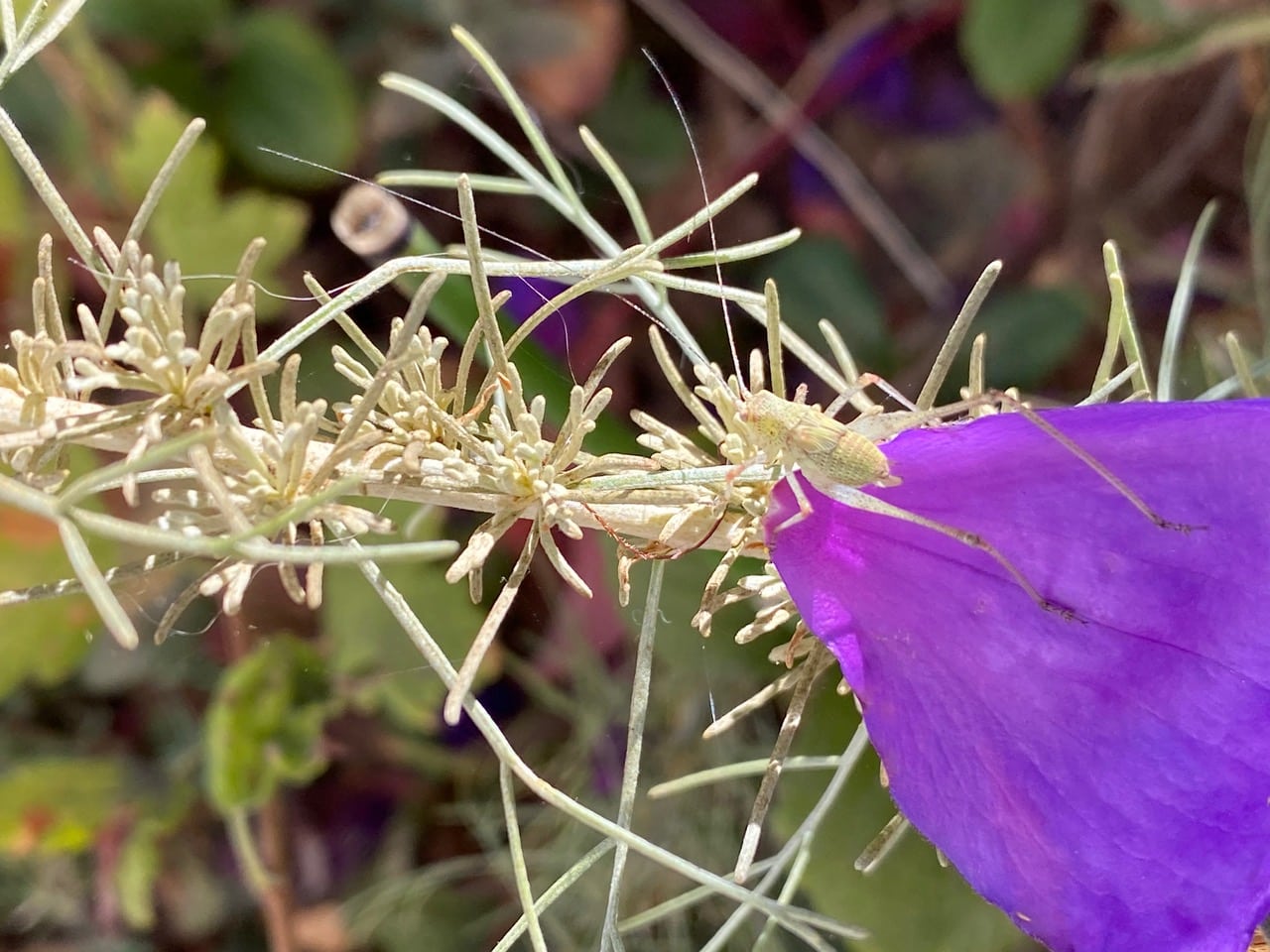
As I walk past a California Sage Brush, Artemisia californica, my eyes are drawn to a tiny, pale insect on a purple petal that has fallen on the shrub. It is a nymph of the Mediterranean Katydid, Phaneroptera nana (family Tettigoniidae).
Insects in the family Tettigoniidae are commonly called katydids or bush crickets. They are primarily nocturnal in habit with strident mating calls. Many species exhibit mimicry and camouflage, commonly with shapes and colors resembling leaves. The diet of most katydids includes leaves, flowers, bark, and seeds, but many species are predatory, feeding on other insects, snails, or even small vertebrates such as snakes and lizards. Some are considered agricultural pests.
The Mediterranean Katydid is native to Europe, the Near East and North Africa. As an invasive species, it has spread to the San Francisco Bay Area. It mainly inhabits sunny and dry habitats, especially shrubs and low branches of trees. Katydids court acoustically. Phaneroptera nana female sings in response to the male, prompting the male to move towards her. Females chew on the lamina of plants to insert their eggs which usually hatch in summertime. P. nana is commonly found through the summer and fall seasons. The species is known to cause damage in pear orchards, feeding on pears that have not ripened.
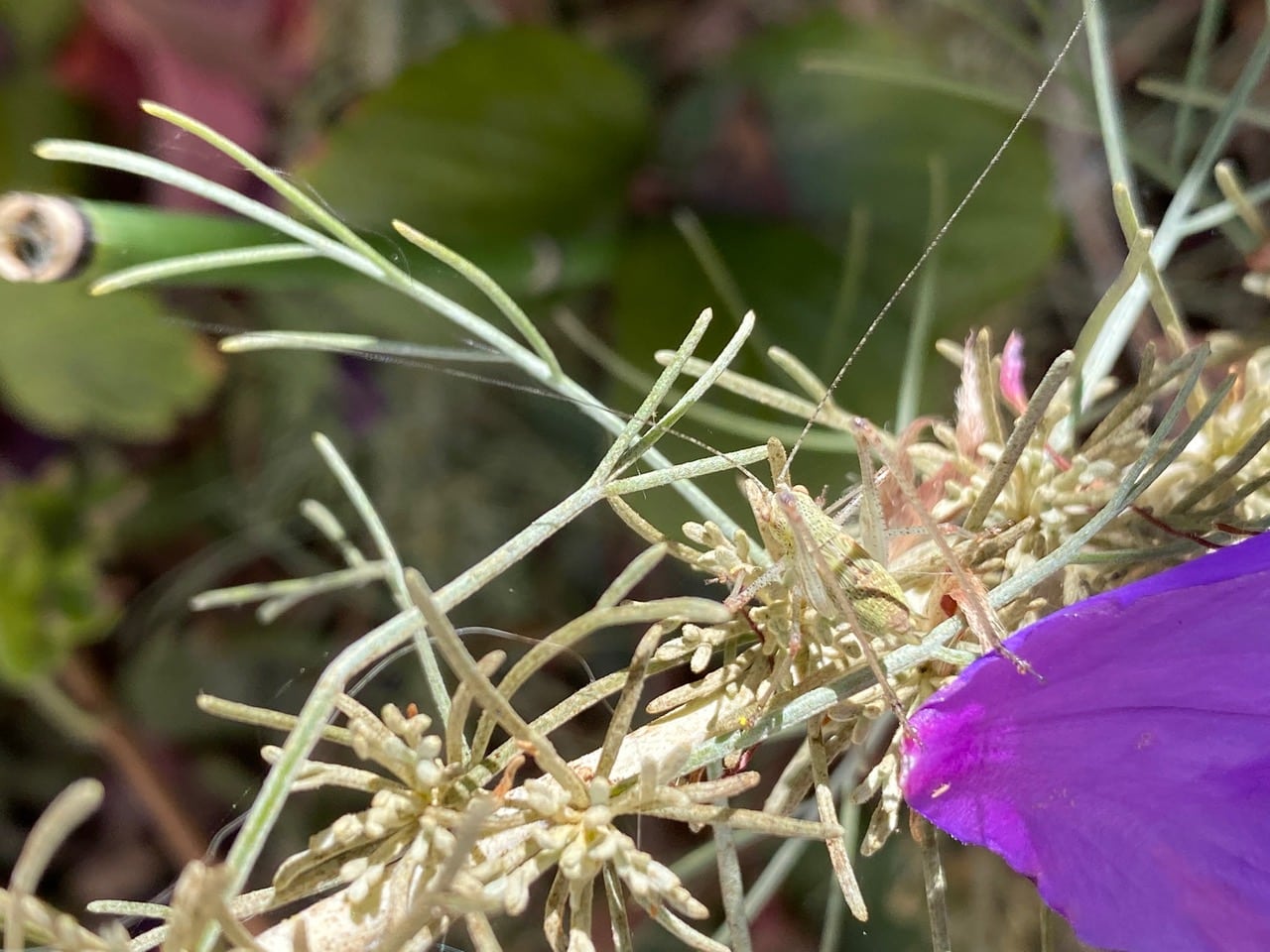
As the Katydid steps off the purple petal, it literally disappears into the foliage of the California Sage Brush. Wow, what remarkable camouflage!