

Pollinator Post 8/29/23 (1)
To avoid today’s forecast heat, I walk the northern section of Skyline Trail from the Steam Train entrance through the woodlands.
 Look, that’s an old California Bay leaf that has been previously folded by a leaf-roller caterpillar. Part of the boxy triangular retreat that the caterpillar created has turned black, and there’s a gaping hole. Did a predator get to the caterpillar?

Lower down on the same tree, there’s another folded caterpillar retreat. I do a quick scan of the whole Bay tree, and find three more. It is interesting that I often find several of these folded retreats on the same Bay trees, and none at all on others. Mama moth is obviously quite selective about which plants she entrusts her young to, and only lays eggs on the ones most likely to nurture her larvae.

A Meadow Froghopper or Spittlebug, Philaenus spumarius (family Aphrophoridae) is resting on a Bay leaf, seeming to be enjoying the morning sun.
The Froghopper is a “true bug” in the order Hemiptera, family Aphrophoridae. Froghoppers are champion jumpers among insects, out-performing even the fleas. The bug can leap the human equivalent of a skyscraper without a running start! The muscles in its hind legs act like a “catapult” to release energy explosively. Its athletic prowess not withstanding, the Froghopper is better known for its young, the “spittle bugs”. The nymphs produce foamy white masses on plants within which they feed on plant sap. Froghoppers have piercing-sucking mouthparts, and feed on plant sap as both nymphs and adults. A recent report claims, “Froghoppers are the super-suckers of the animal world. The tiny insects produce negative pressures equivalent to people sucking a 100-meter-long straw.” So the little bug has two titles under its belt – champion jumper, and super-sucker!
A little bee is foraging in a flowerhead of the weedy Bristly Oxtongue, Picris echioides. In this desperate time of dwindling floral resources, the insects are not discriminating between native and non-native plants.

A view of the bee’s rear end shows her to be a Furrow Bee, Halictus sp. (family Halictidae).
Halictus is found worldwide; they are most common in the Northern Hemisphere. All are generalists, foraging from a wide variety of flowering plants. Many species are social and produce several generations per year. This is not surprising as most blooming plants are season-specific; a bee that requires pollen and nectar across multiple seasons would not thrive as a specialist. All Halictus in North America nest in the ground, often in aggregations; and they may nest in the same area for decades.
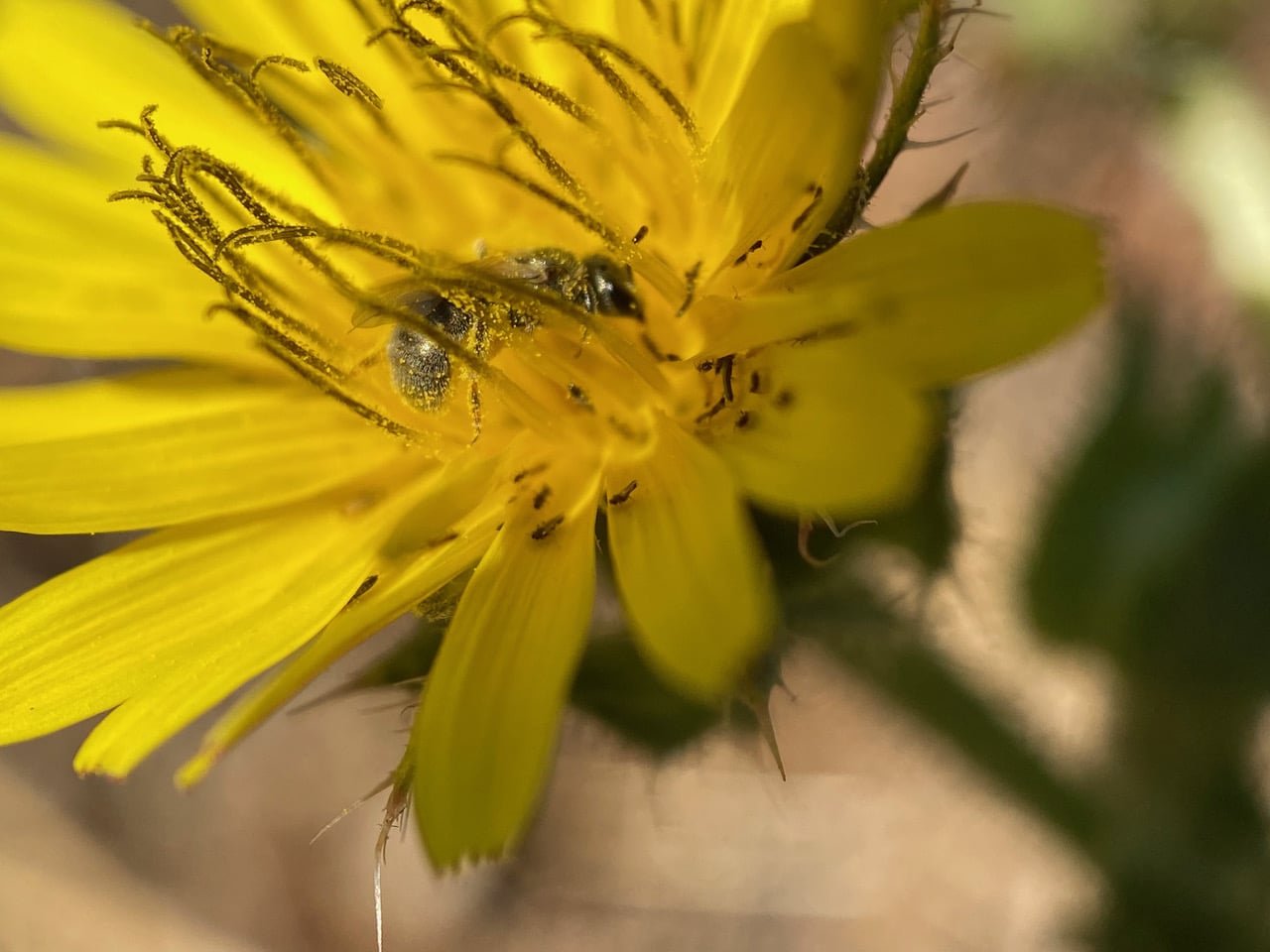
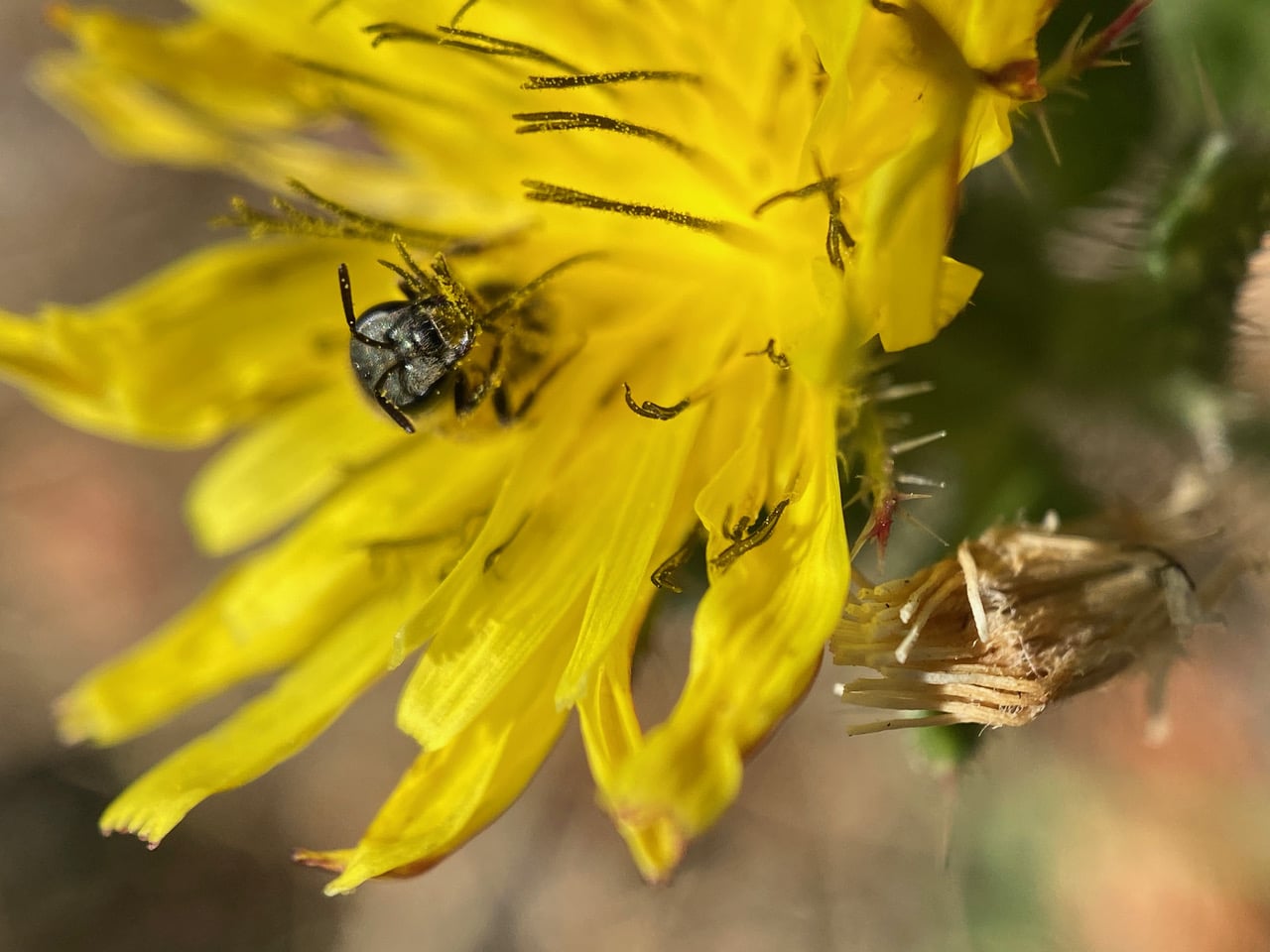
Covered with pollen, an even smaller bee is visiting an adjacent flowerhead of Bristly Oxtongue.
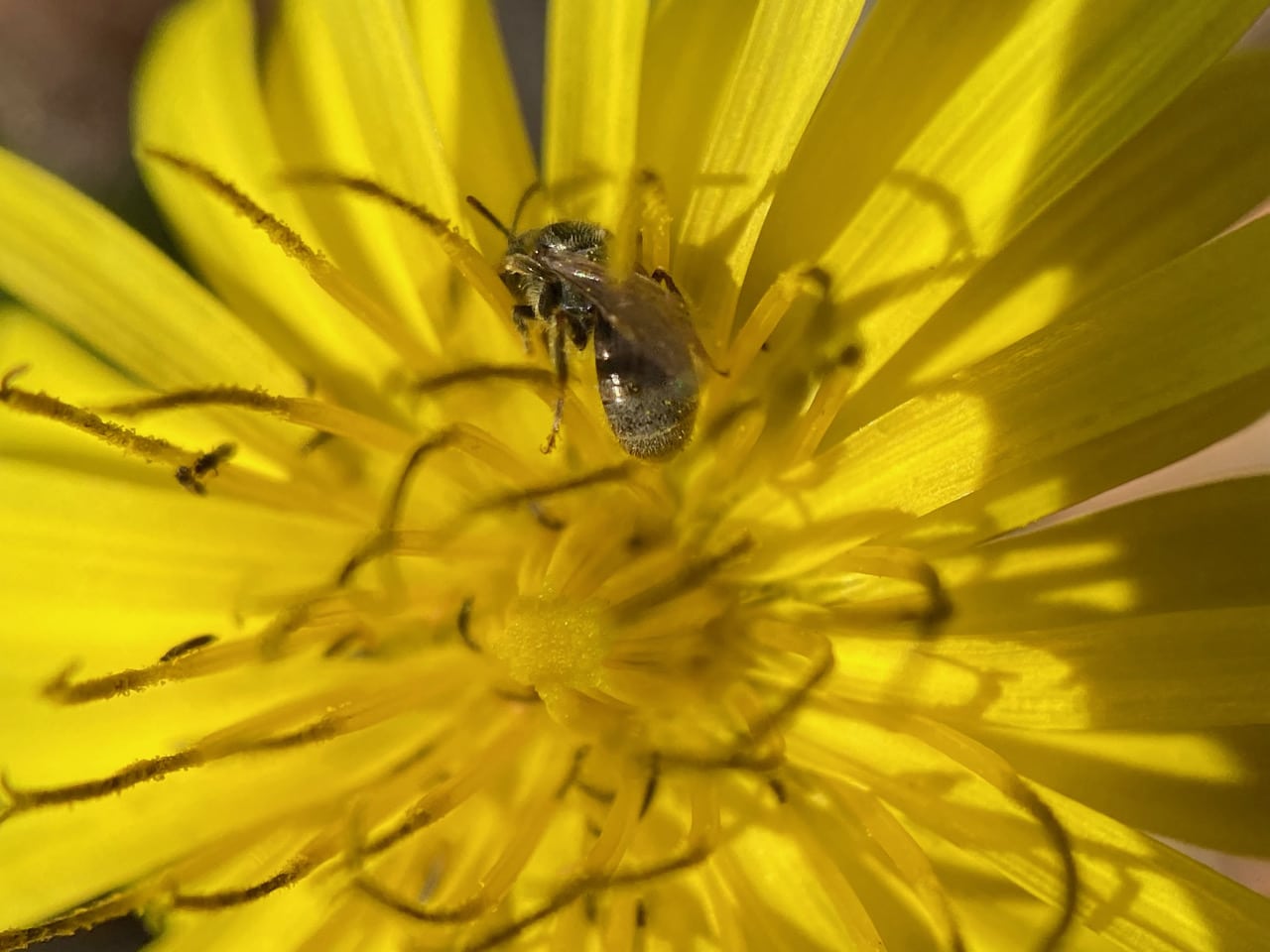
It is a Metallic Sweat Bee, Lasioglossum (Dialictus) sp. (family Halictidae).
Lasioglossum are closely related to the genera Halictus and Agapostemon. These genera are commonly called “sweat bees” because of their attraction to human sweat, which they drink for its salt content. Lasioglossum are dusky black to brown slender bees with bands of hair on their abdomen.
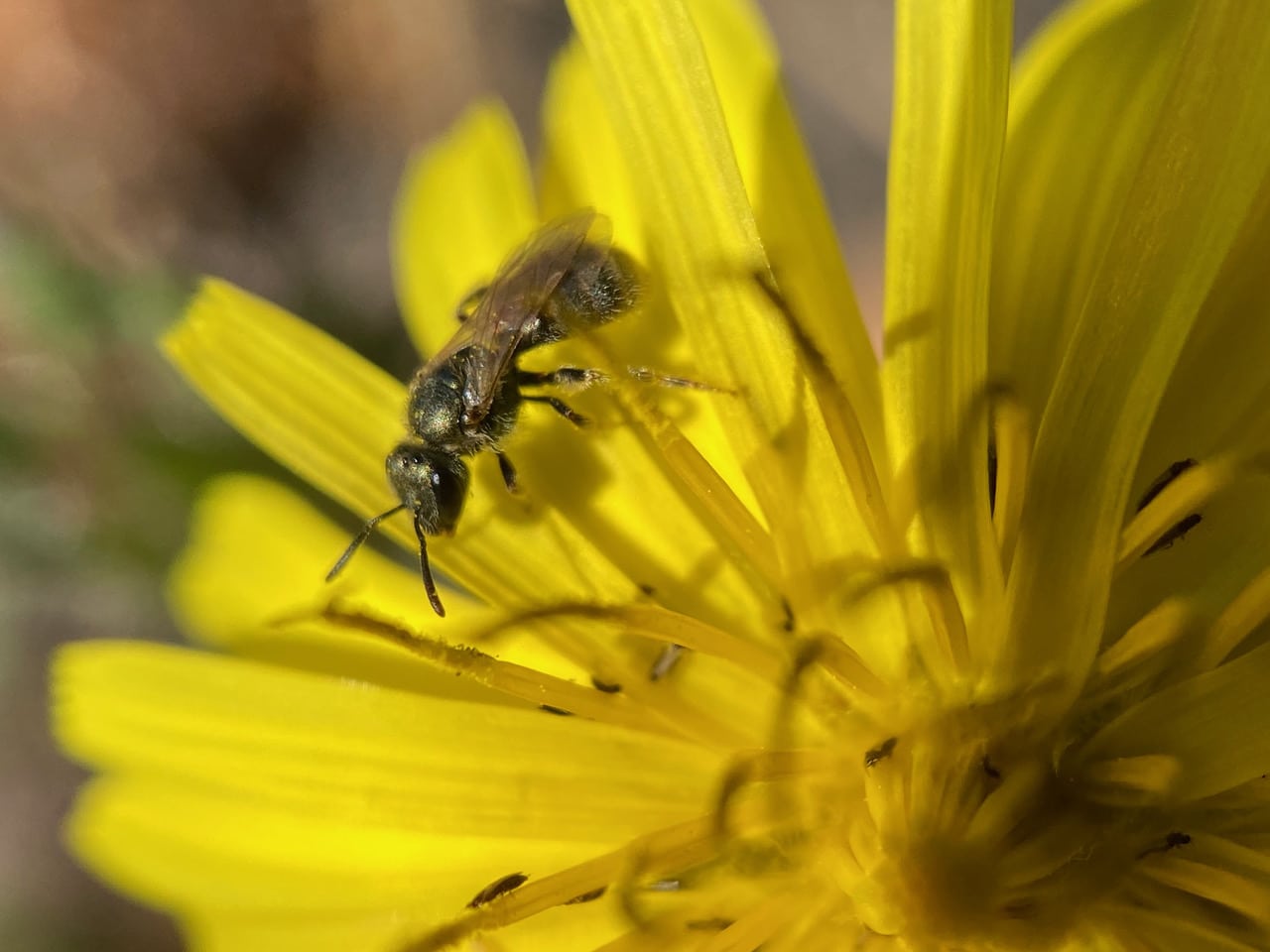
Dialictus is a subgenus of Sweat Bees belonging to the genus Lasioglossum. Most of the members of this subgenus have a subtly metallic appearance, and are small, about 3.4-8.1 mm in size. They are commonly found in Northern Hemisphere and are found in abundance in North America. As in the other members of the family Halictidae, the bees have very diverse forms of social structure, making them model organisms for studying the social behavior of bees.

A robust Bull Thistle, Cirsium vulgare is still blooming nicely on the edge of the trail.
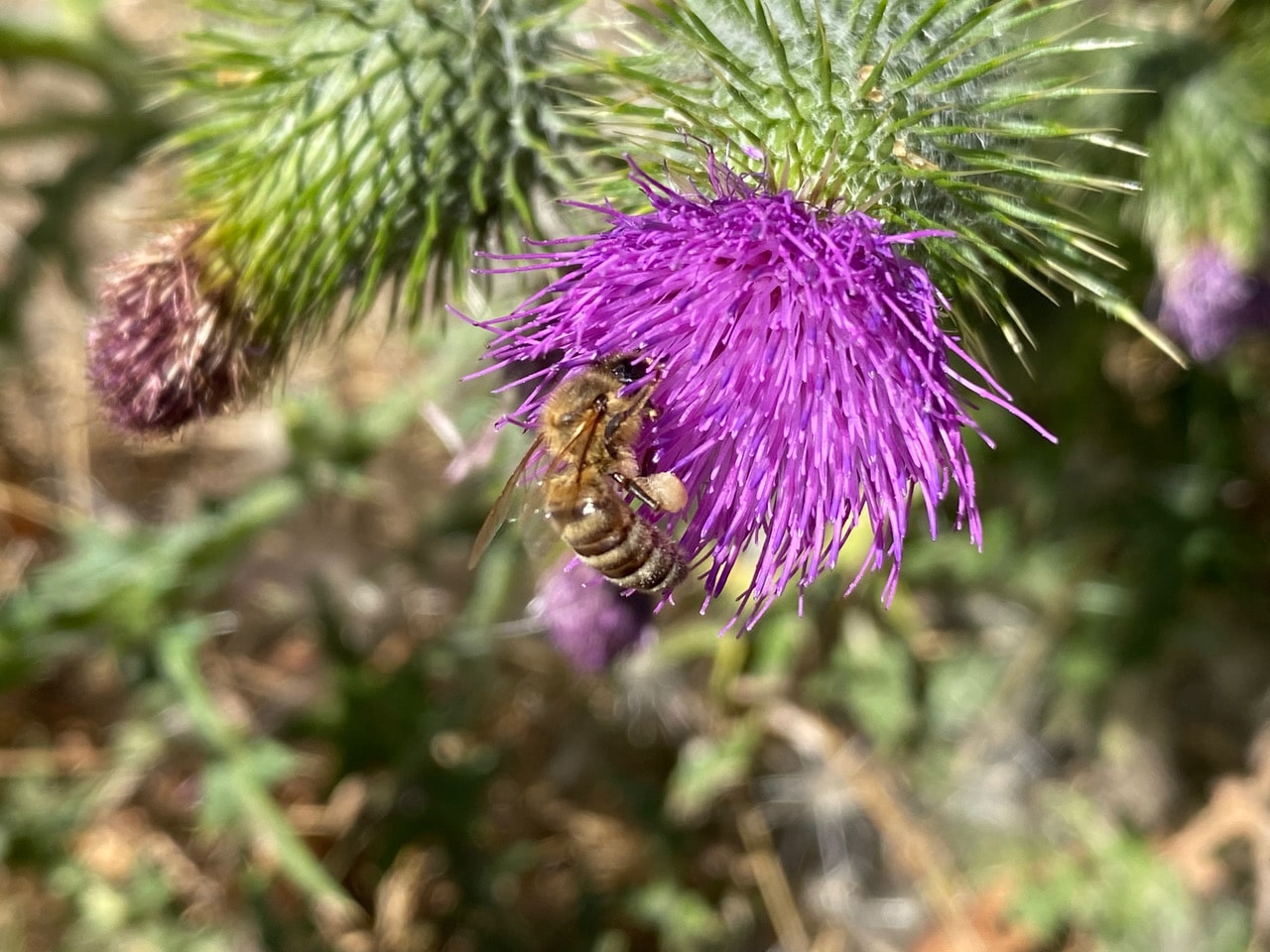
A Honey Bee, Apis mellifera (family Apidae) is taking a nectar break from her foraging efforts. She has already collected some of the cream-colored pollen of the Bull Thistle in her pollen baskets.
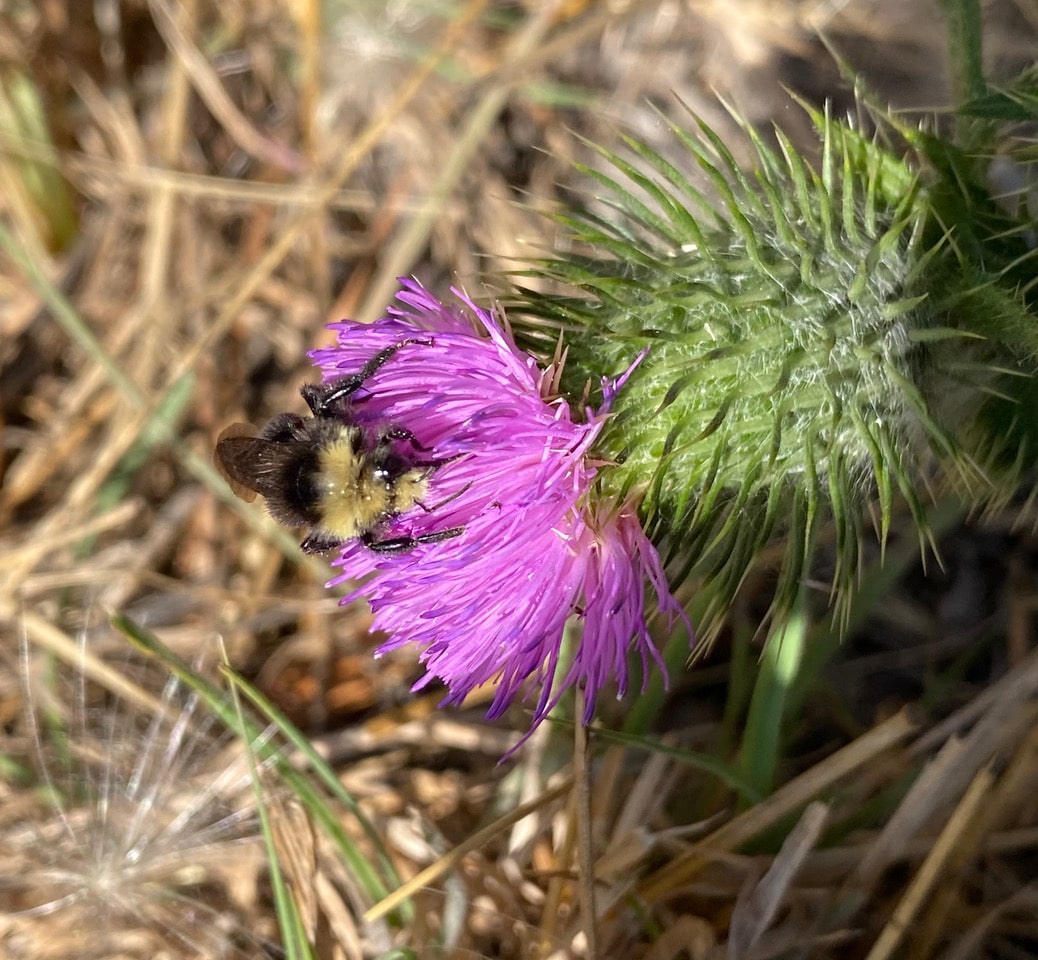
A somewhat disheveled Yellow-faced Bumble Bee, Bombus vosnesenskii is taking nectar from the flowers of Bull Thistle.
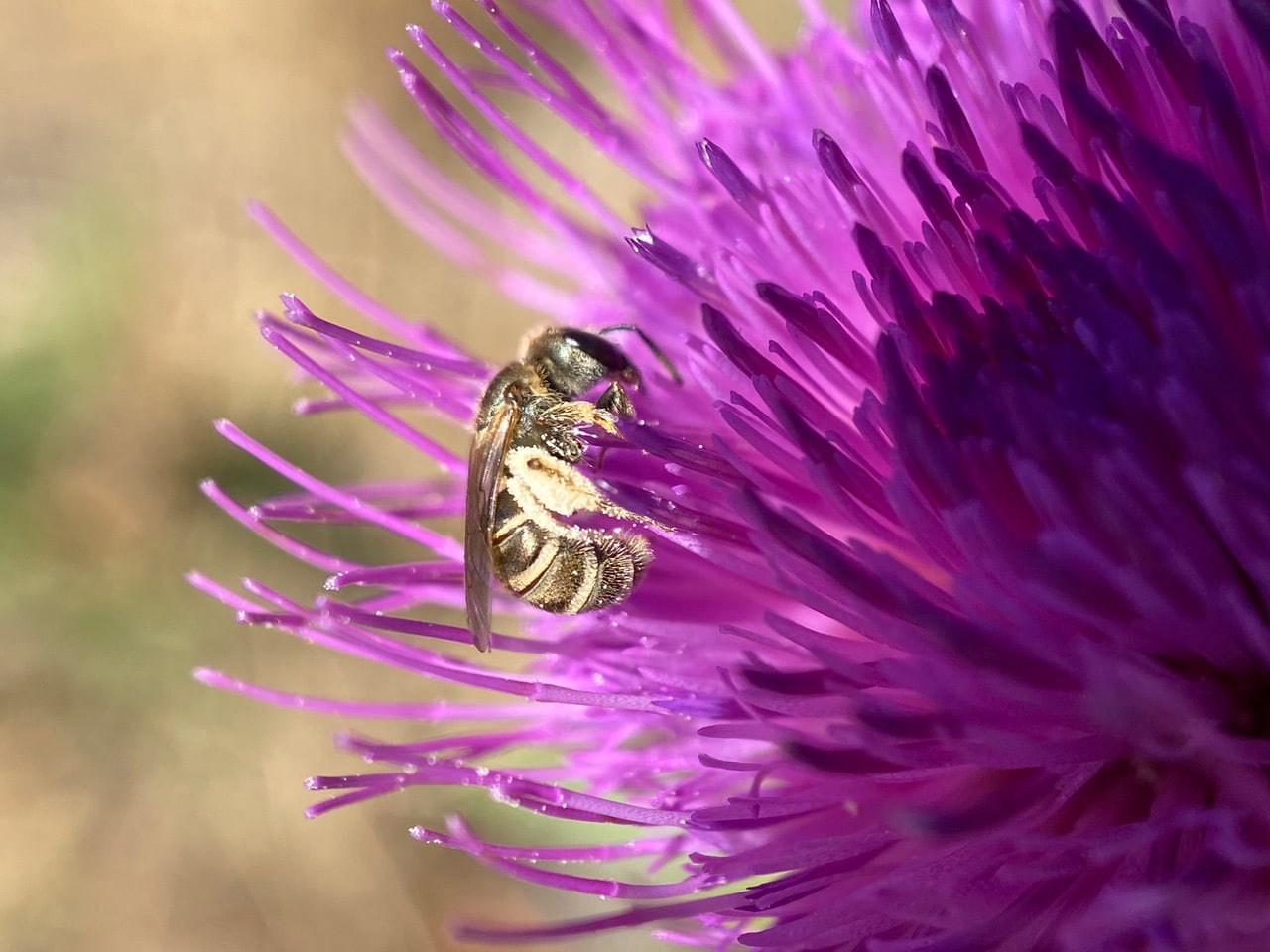
A small bee is working the flowers of Bull Thistle, gathering pollen from the tips of the anther tubes. She is carrying pollen on the scopae on her entire hind legs as well as the underside of her abdomen. This mode of pollen transport is suggestive of the Sweat Bees (family Halictidae).
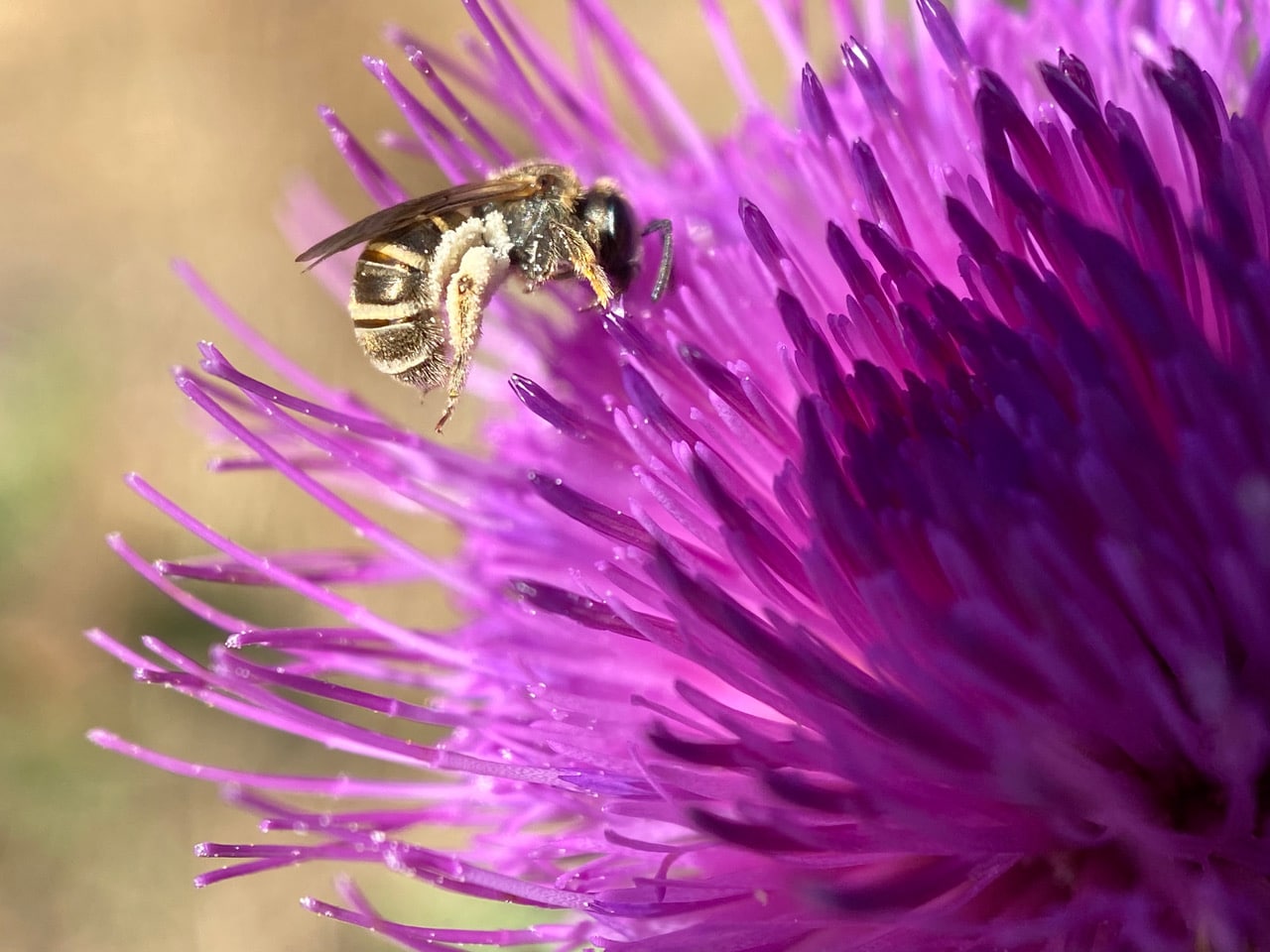
Occasionally the bee lifts up her abdomen to secure the pollen onto her belly with quick wriggling movements of her legs that is fun to watch.
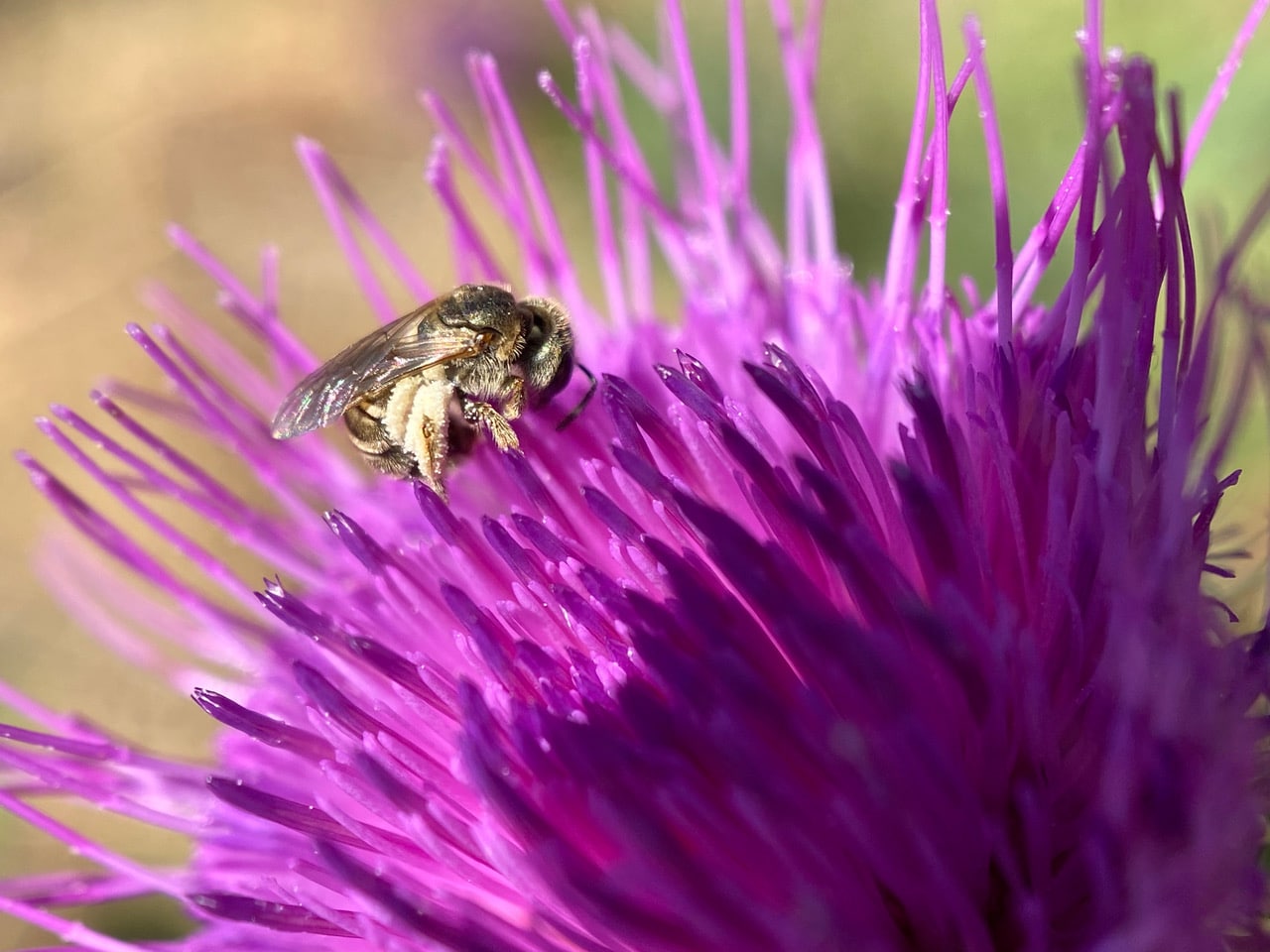
Then she hunkers down to embrace the next anther tube to gather pollen from it. It is a relatively young flowerhead, so the bee has to work hard to coax the pollen out.
The florets of thistles have a special pollination mechanism that responds to insect movements. When an insect walks on a flower it causes the five thread-like filaments at the base of the anther tube to contract, pulling the anther tube down like a sleeve to extrude the pollen.
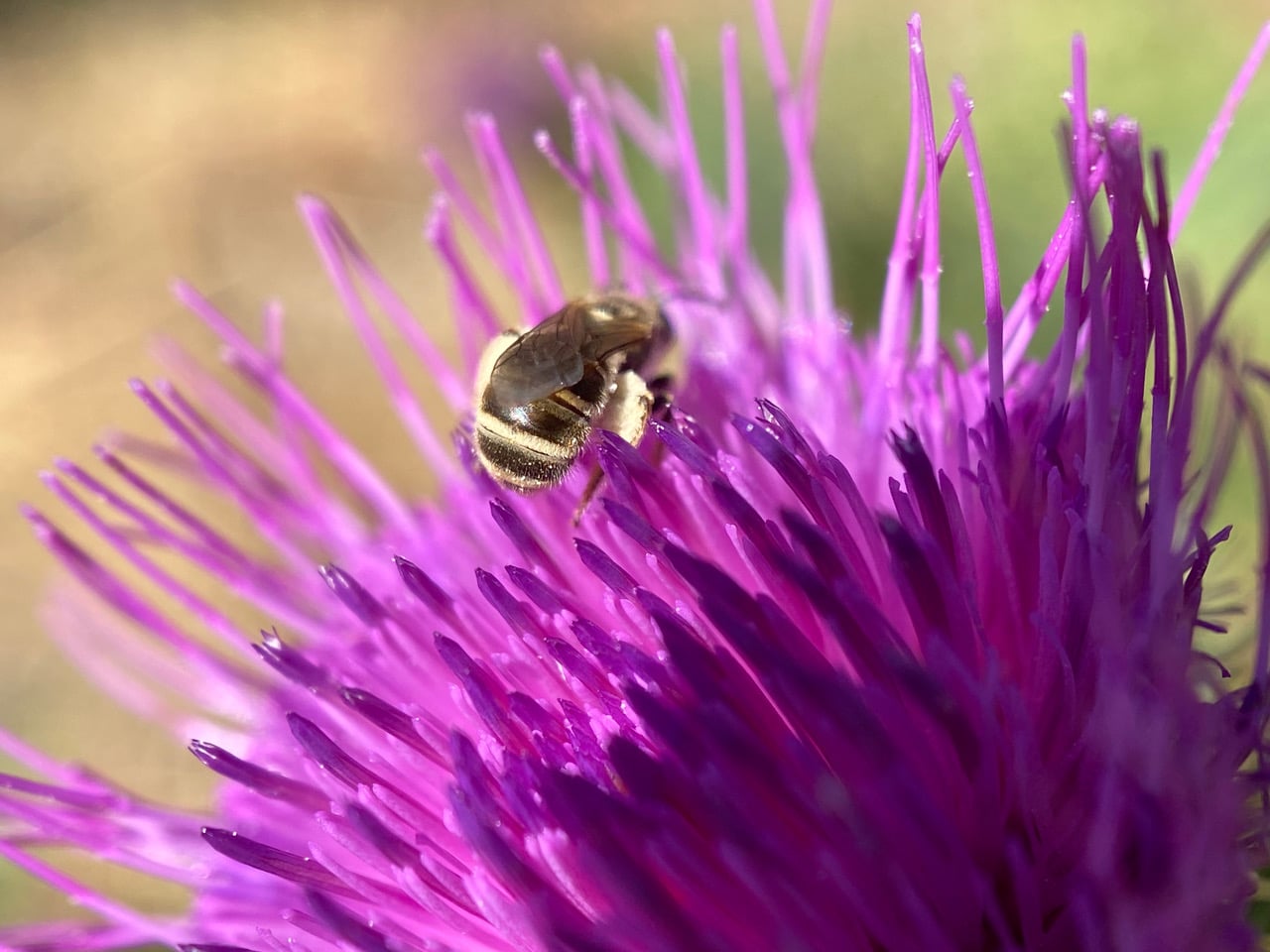
A Furrow Bee, Halictus sp. (family Halictidae)? But I can’t seeing a “furrow” at the tip of her abdomen….
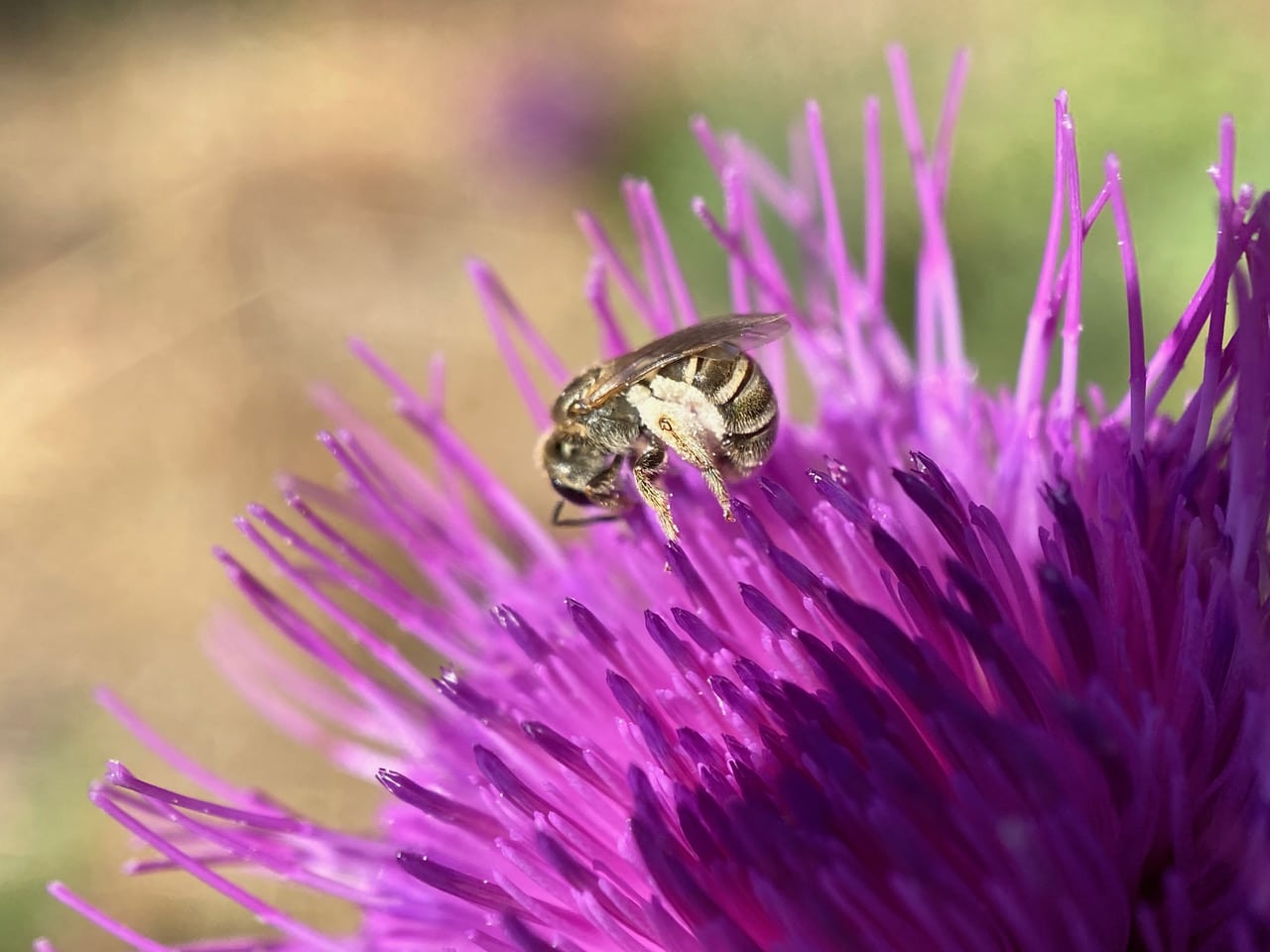
A good look at the hairs on the abdomen is useful in distinguishing between the genus Halictus and the genus Lasioglossum. Halictus bees have hairs at the edge of each tergite as opposed to the base of the tergite, as in Lasioglossum. From this morphological distinction, the bee is identified as a member of the genus Halictus.
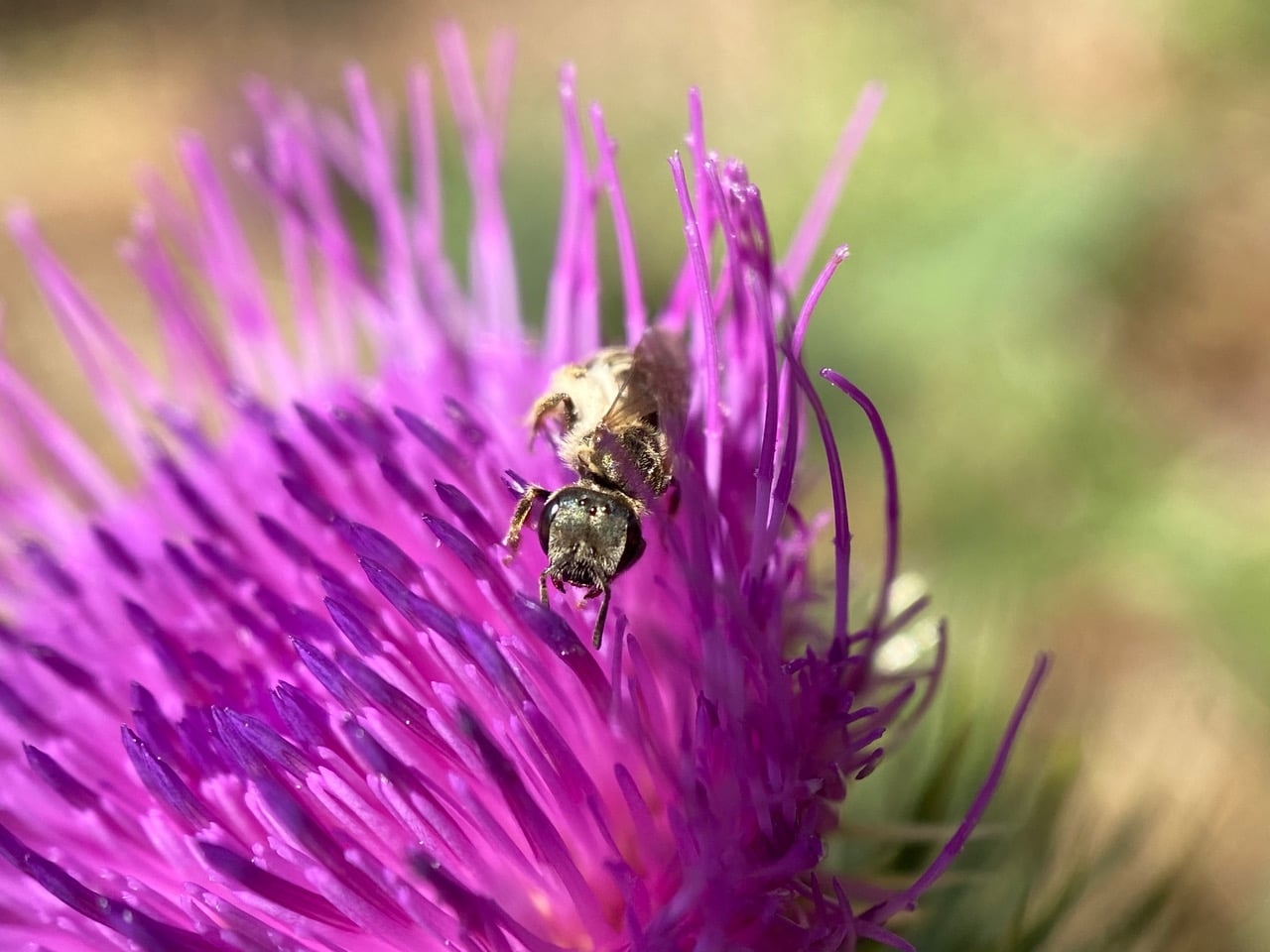
There we have it – a Furrow Bee, Halictus sp. (family Halictidae)!
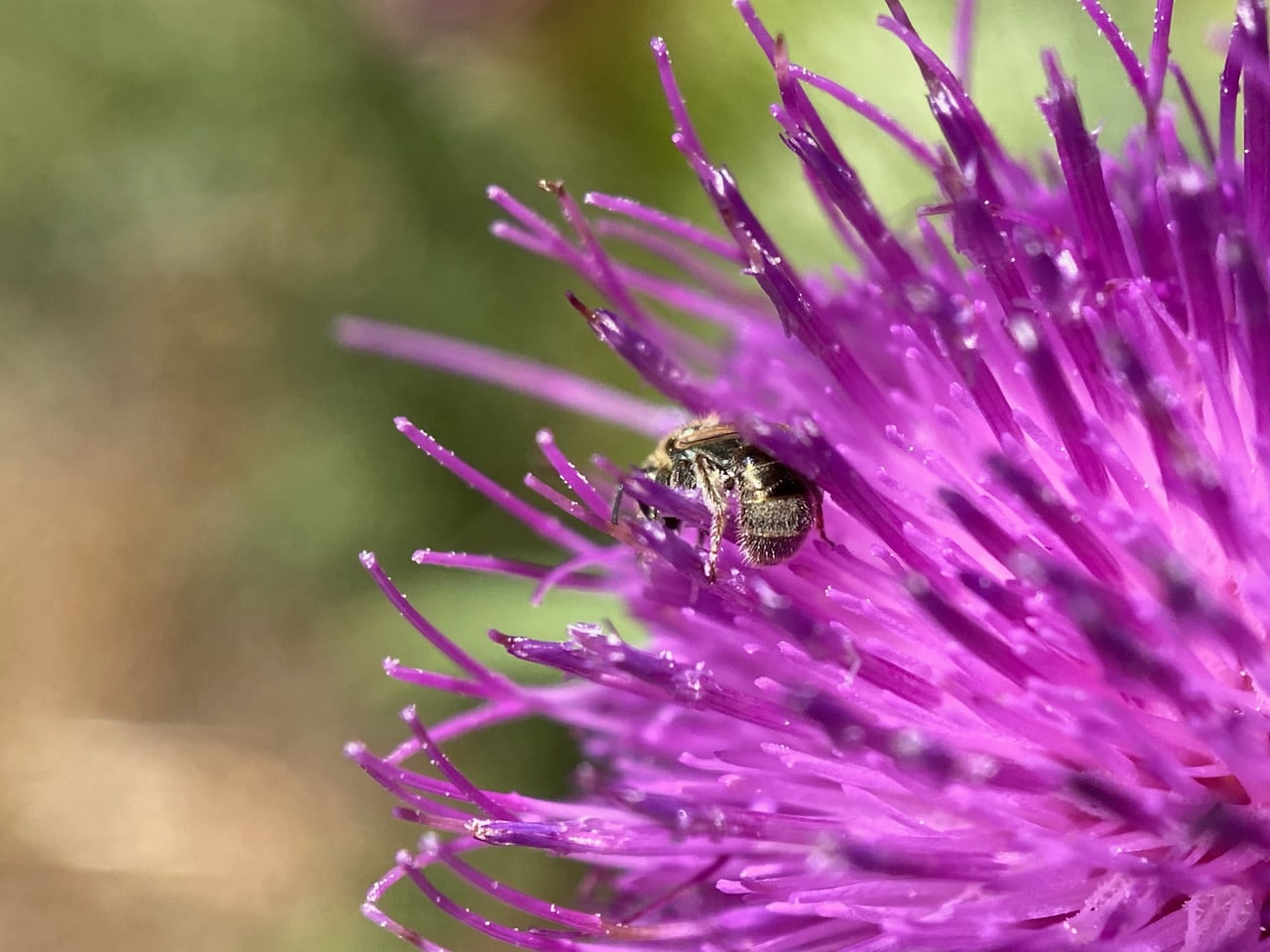
A much smaller bee with a metallic shine is working a different thistle flowerhead. Given its minute size and metallic shine, it is probably a Metallic Sweat Bee, Lasioglossum (Dialictus) sp. (family Halictidae).
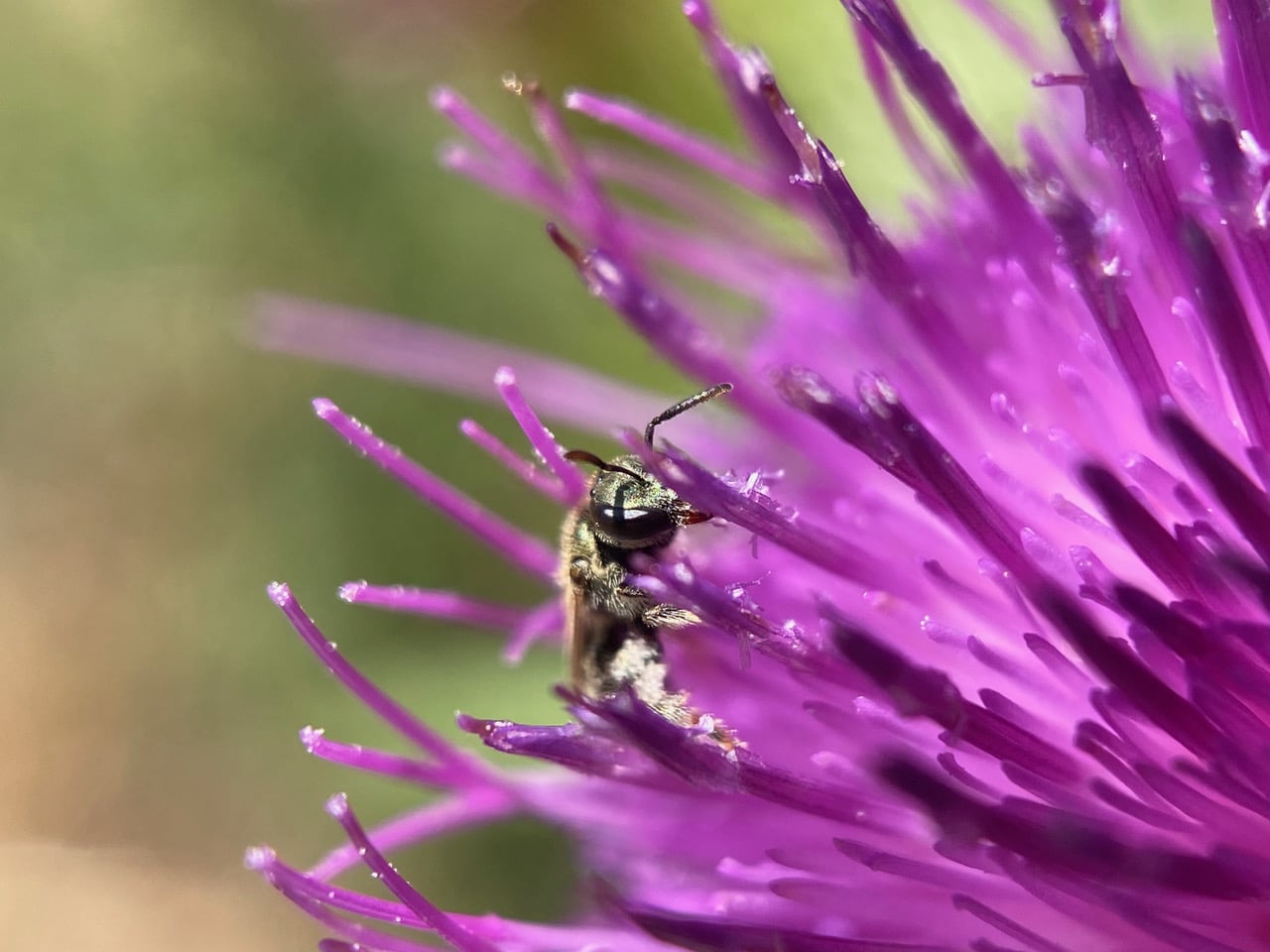
Lasioglossum species are found worldwide, and they constitute the largest bee genus. The subgenus Dialictus are the most likely to be seen in the U.S., with over 300 species of these tiny metallic bees. The majority of Lasioglossum are generalists. Because they are so abundant throughout the flowering season, the bees are often important pollinators. Their sheer numbers are enough to achieve excellent pollination of many wild flowers, especially of plants in the Asteraceae, which have shallow floral tubes that are easily accessed by these minute bees.
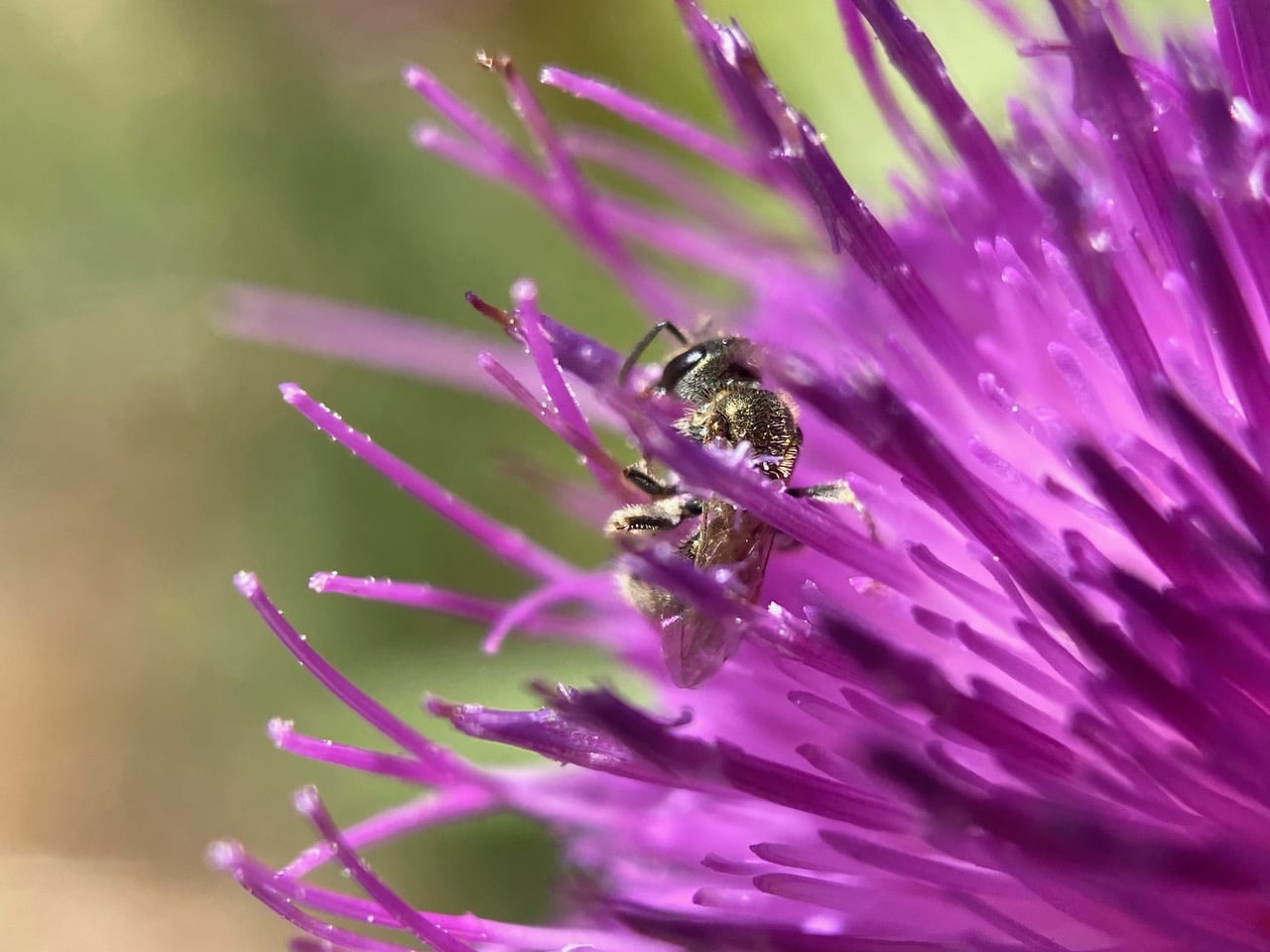
With a jungle of long anther tubes, the thistle is a special case of Asteraceae, not exactly the easiest flowers for the tiny bees to access. But the concentration of pollen in the compact space of a flowerhead is an attractive feature. The sweat bee is gathering pollen, one anther tube at a time. It is laborious work for these tireless bees!