

Pollinator Post 8/27/23 (1)

I have wanted to visit Blue, the Pale Swallowtail caterpillar, but couldn’t do so for the past few days because of poor air quality. (I am asthmatic and can’t risk being outdoors when PM2.5 is high.) I finally make a quick run early this morning.
A young Western Fence Lizard, barely 2 in. long including tail, runs across Skyline Trail and pauses on a dried Mule’s Ear leaf to watch me pass.
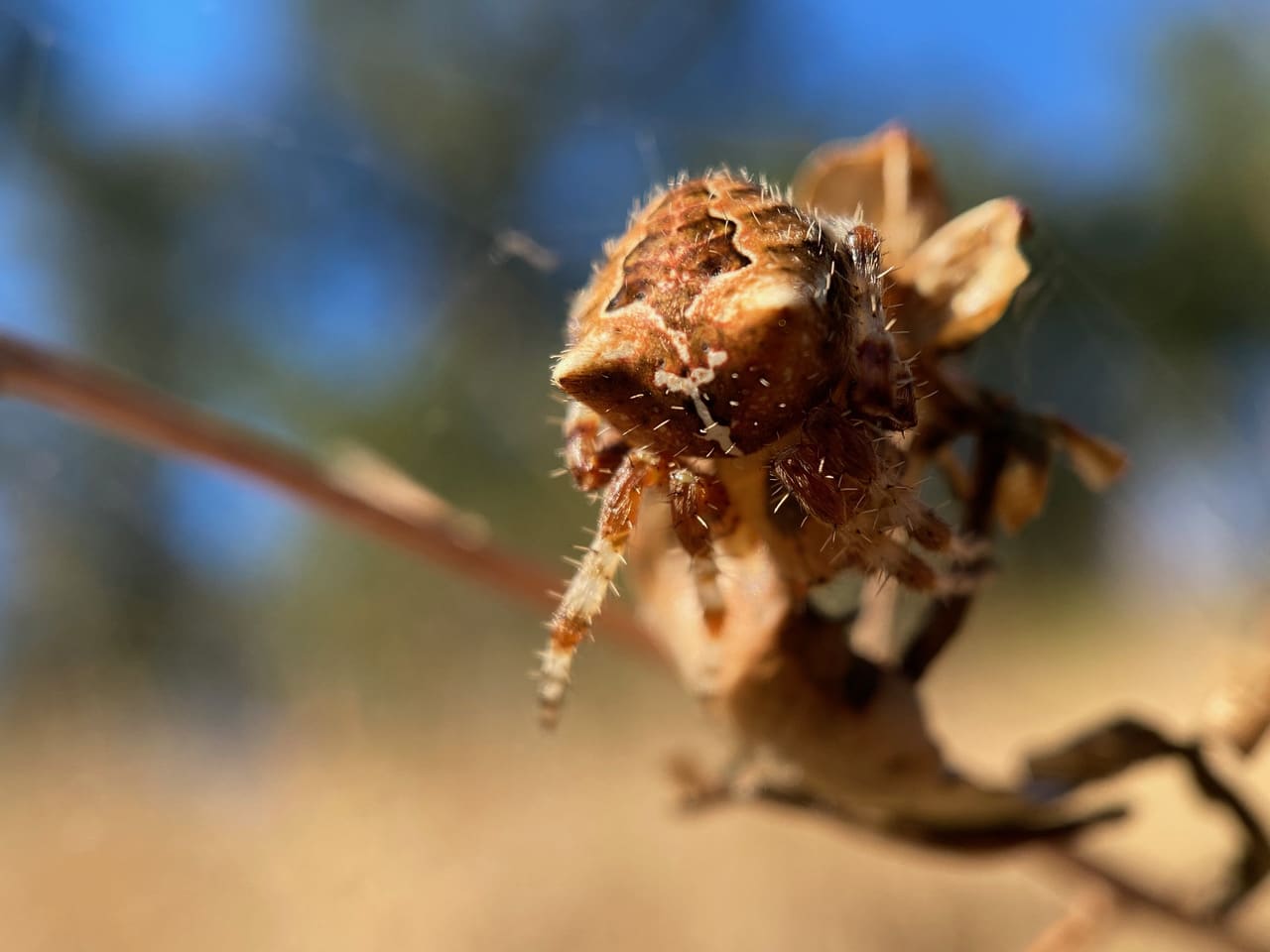
I stop briefly to say hello to the Two-tubercled Orb-weaver Spider, Gibbaranea bituberculata (family Araneidae) on her Soap Plant seed capsule.
Gibbaranea bituberculata is a species of ‘orbweavers’ belonging to the family Araneidae. They are found in sunny habitats on shrubs, edges and low plants, where they can make their webs near the ground. Their basic color is very variable, but usually it is brownish, with whitish shades. The cephalothorax is covered with lying down hairs.
Orb-weaver spiders are members of the spider family Araneidae. They are the most common group of builders of spiral wheel-shaped webs often found in gardens, fields, and forests. Generally, orb-weavers are three-clawed builders of flat webs with sticky spiral capture silk. The third claw is used to walk on the non-sticky part of the web. Typically, the prey insect that blunders into the sticky lines is stunned by a quick bite, and then wrapped in silk.
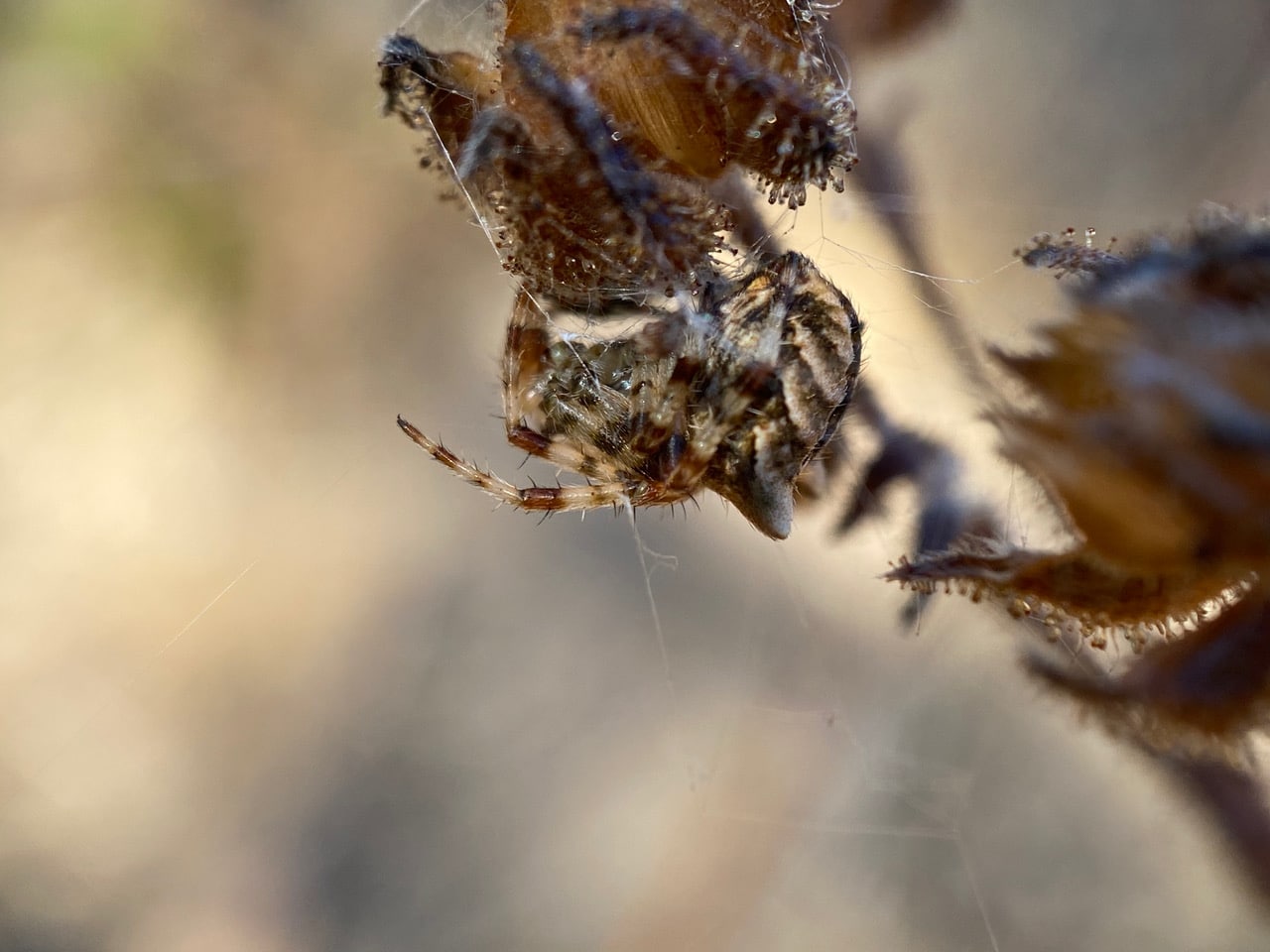
Less than 100 feet further along the trail, morning sunlight reveals an orb web strung between some dried Coast Tarweed stems. The owner is not on the web, but I easily find her below a spent seed head.
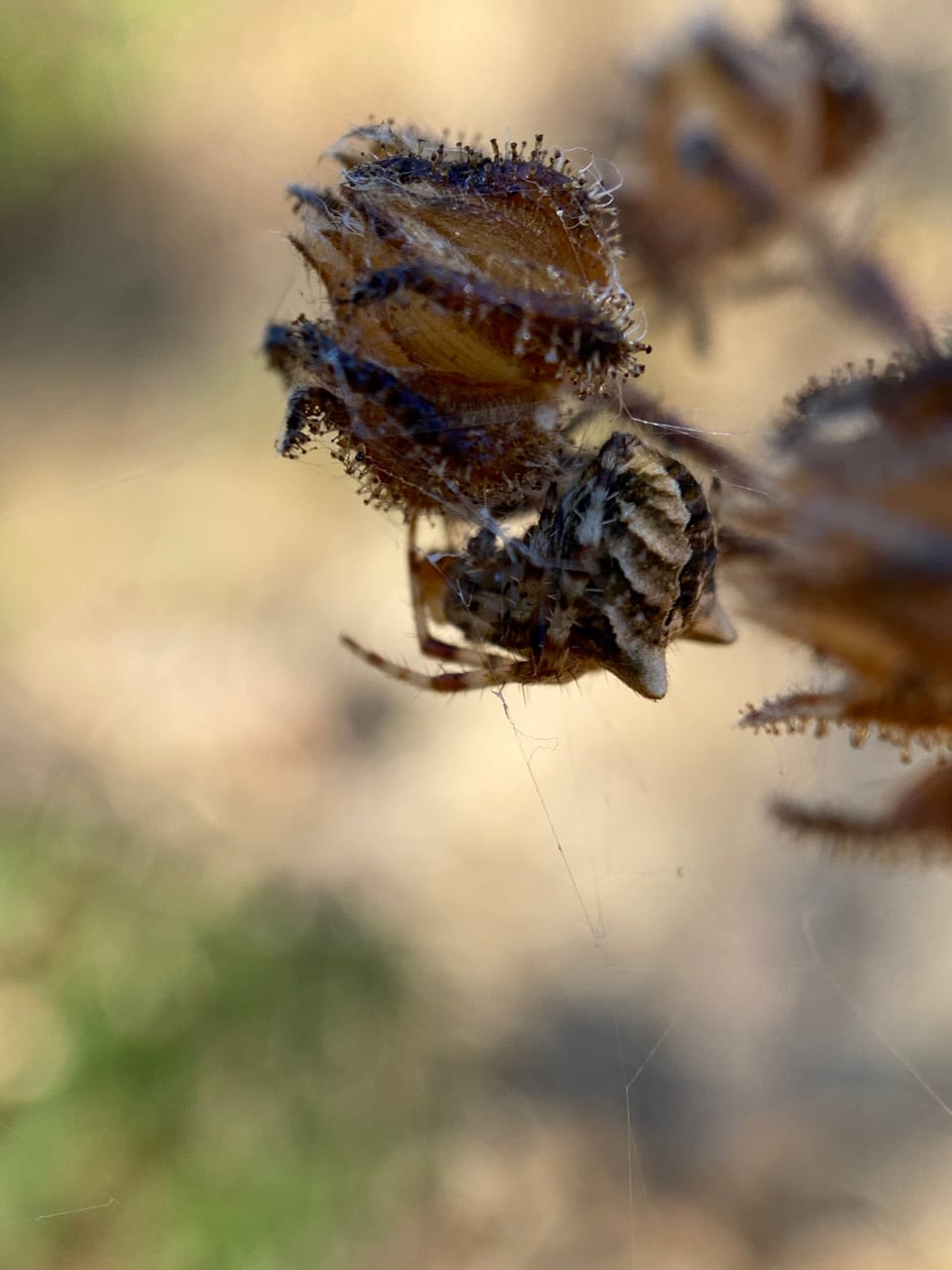
On closer examination, it is another female Two-tubercled Orb-weaver Spider, just like the one on the Soap Plant. The spider is barely 1/4 in., but she has constructed an orb web that is about a foot in diameter. It’s hard to imagine so much silk can come from the little spider!
Spider silk is as strong as steel or in some cases even stronger when it comes to tensile strength, which measures the amount of stress a material is able to withstand before breaking. A strand of spider silk is made up of many smaller strands – thousands to be exact, each 1,000 times thinner than a strand of human hair. These nanostrands are only 20 millionths of a millimeter in diameter. Another key feature of spider silk is its elasticity. Some silk can be stretched up to four times its original length without breaking.
Not all spider silk is the same. Spider silk is a protein fiber spun by spiders. All spiders produce silk, and a single spider can produce up to seven different types of silk for different uses. The most well-known use of spider silk is making intricately designed webs for trapping prey. Spiders also use silk to build nests and cocoons, wrap up their prey, and as anchor lines or drag lines, which they leave trailing behind them as they move around. Some spiders even eat the silk from their old webs to recycle the proteins for making new silk.

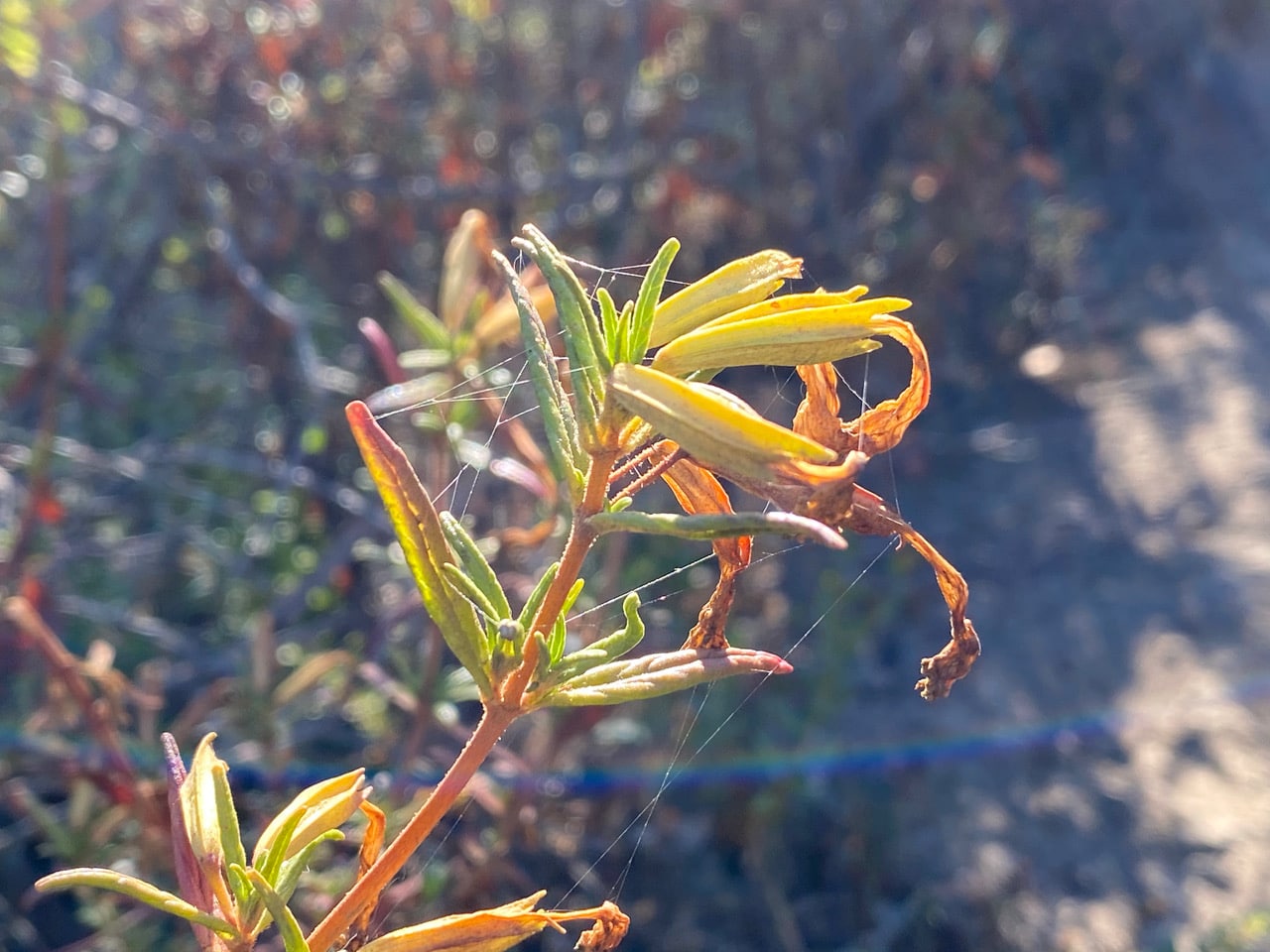
Backlit by the early morning sun, spider webs can be seen strung between the leaves and developing seed capsules of Sticky Monkeyflowers, Diplacus aurantiacus.
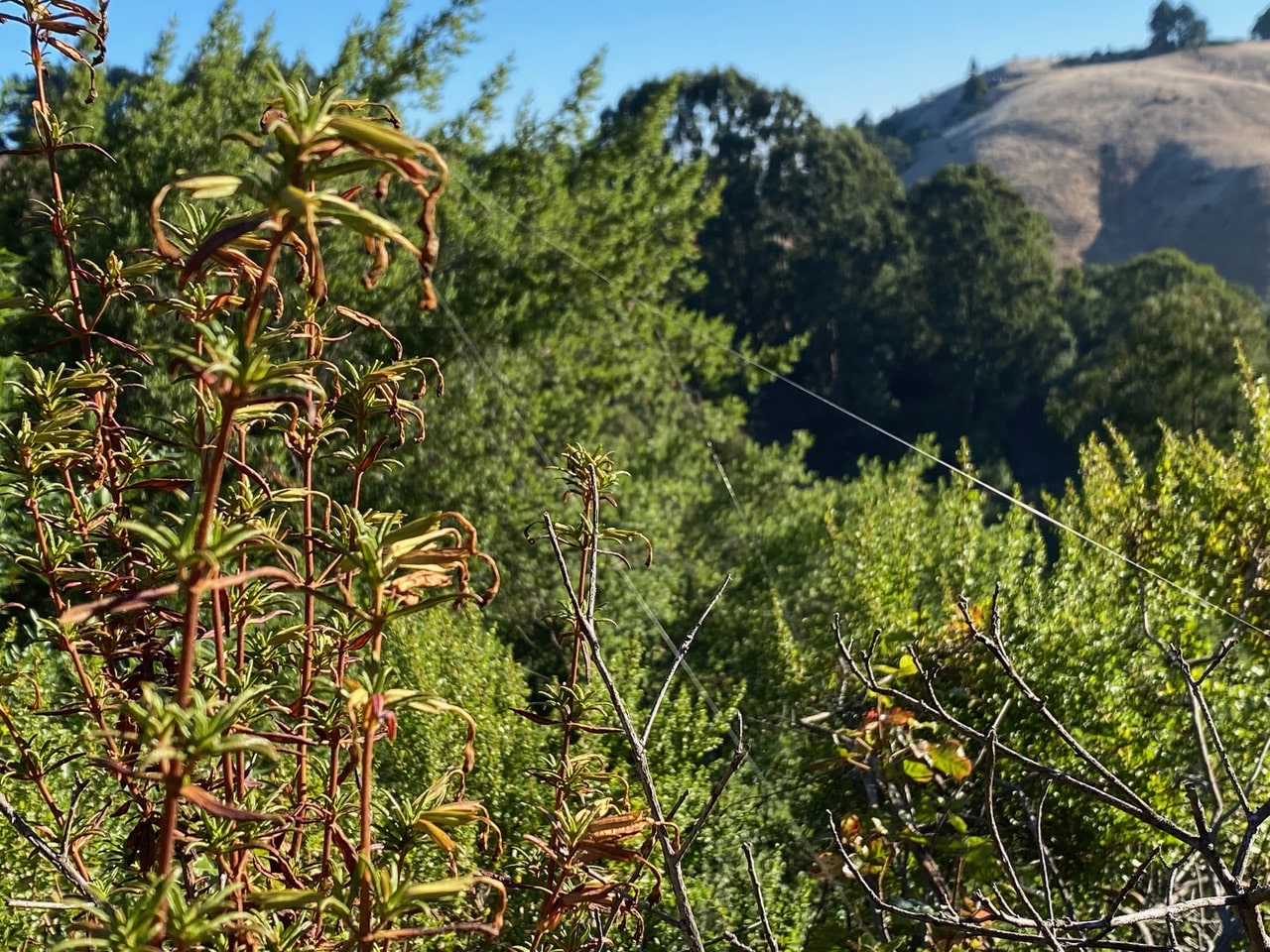 The tangled webs on the tops of the branches are connected by long sturdy strands of silk. Is one single spider responsible for all this?
Blue, the Pale Swallowtail caterpillar is still on its Coffeeberry home leaf. I think it has molted since I last saw it on 8/23. It looks visibly bigger, especially its bulky thorax. It now has a reddish head. Look at those cute prolegs under its abdominal segments!
Like all insects, caterpillars have 6 legs – 3 pairs of jointed true legs, located on their thorax, right behind their head. The remaining structures under the abdomen are prolegs. Prolegs are small, fleshy, stubby structures which are attached to the abdomen; they aid in locomotion. The hindmost pair is called the anal prolegs. At the tip of each proleg is a small circle of gripping hooks, call “crochets”. The tiny barbs work like Velcro to tightly attach the prolegs to the substrate, such as leaves and twigs that the caterpillar is walking on. Prolegs do have limited musculature, but much of their movement is hydraulically powered.
_Fausses_pattes.jpg)
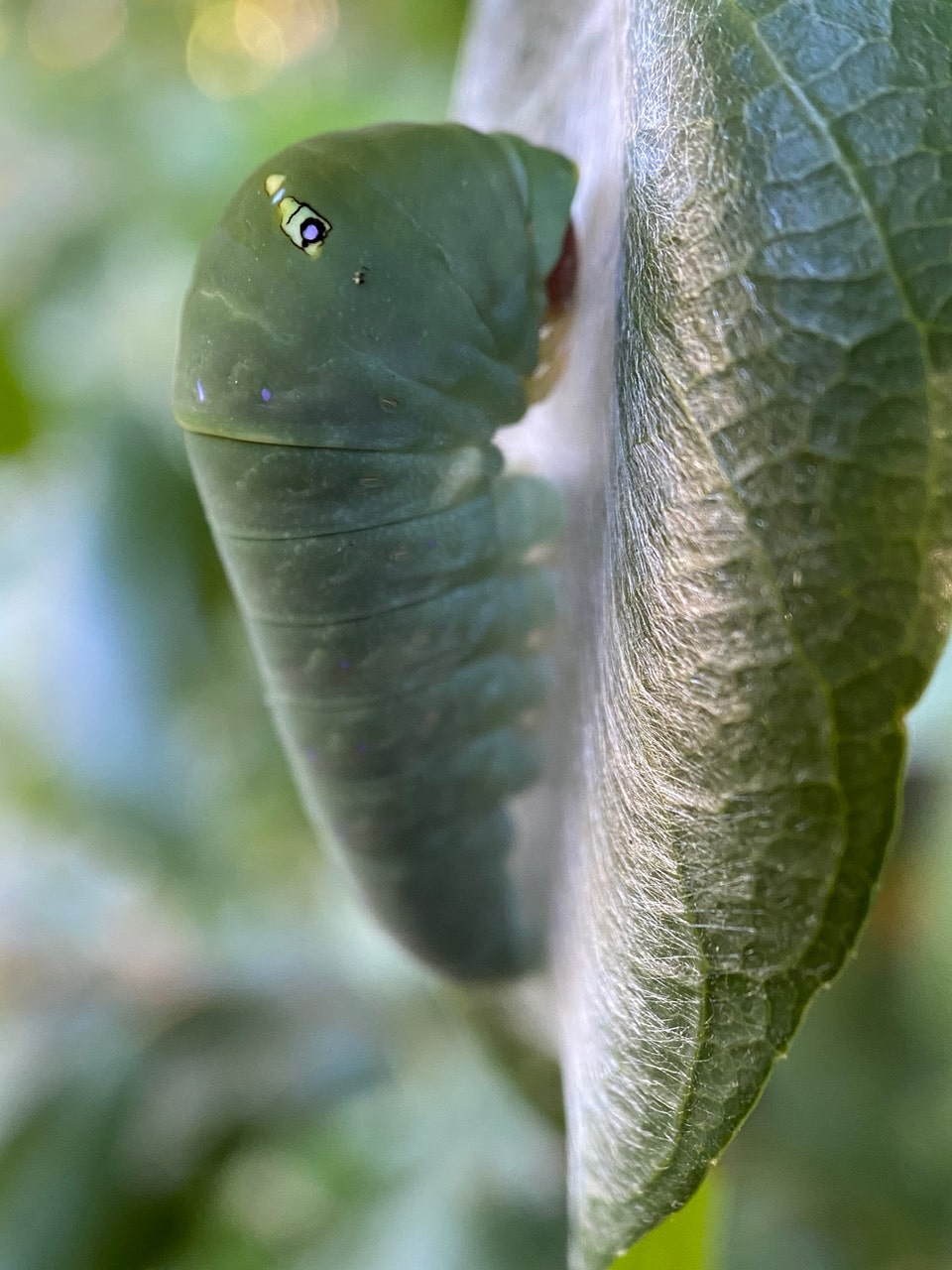
Blue’s false eyespots are more well-defined now.
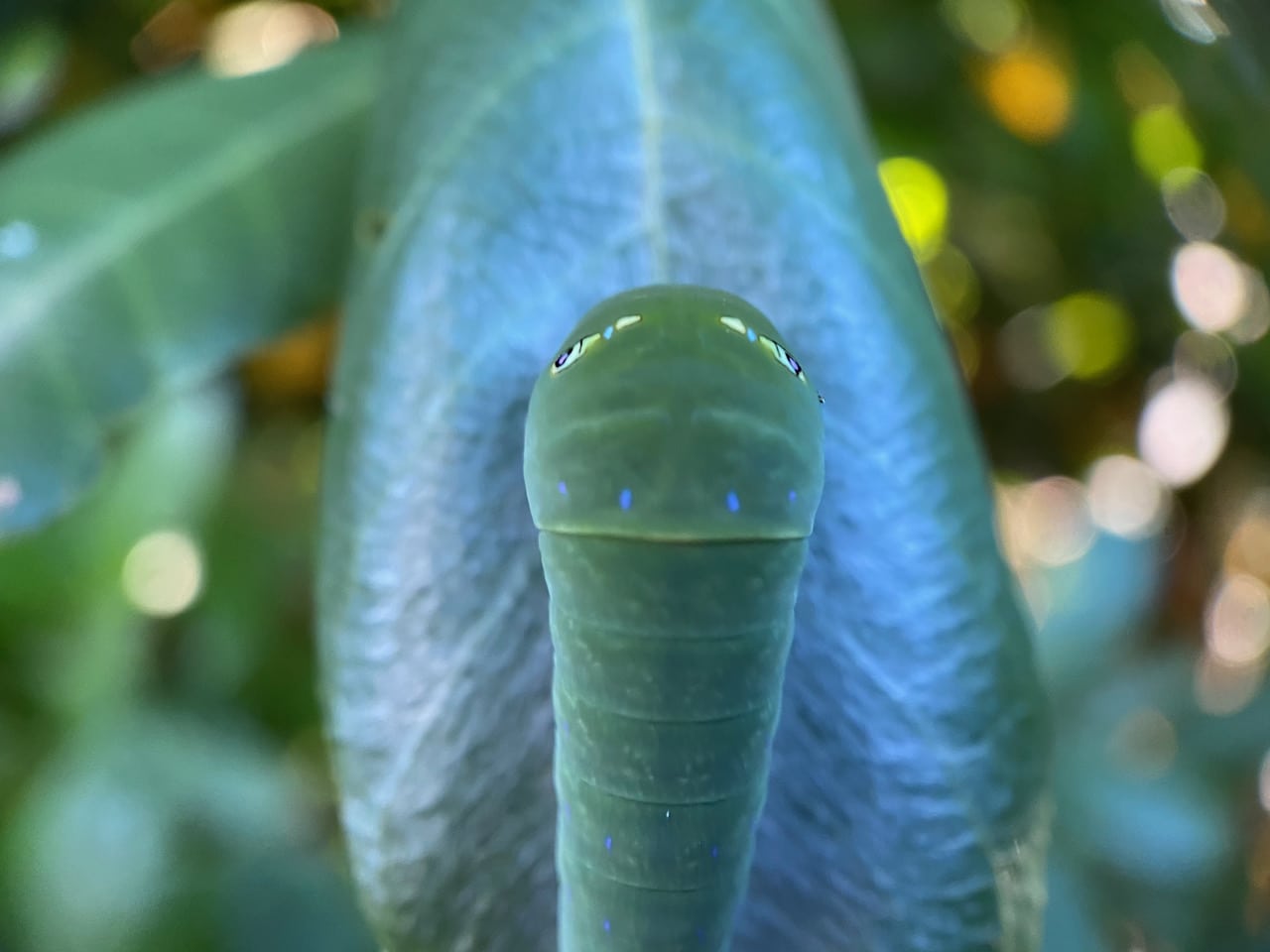
Blue spots have appeared along the rear edge of Blue’s thorax.
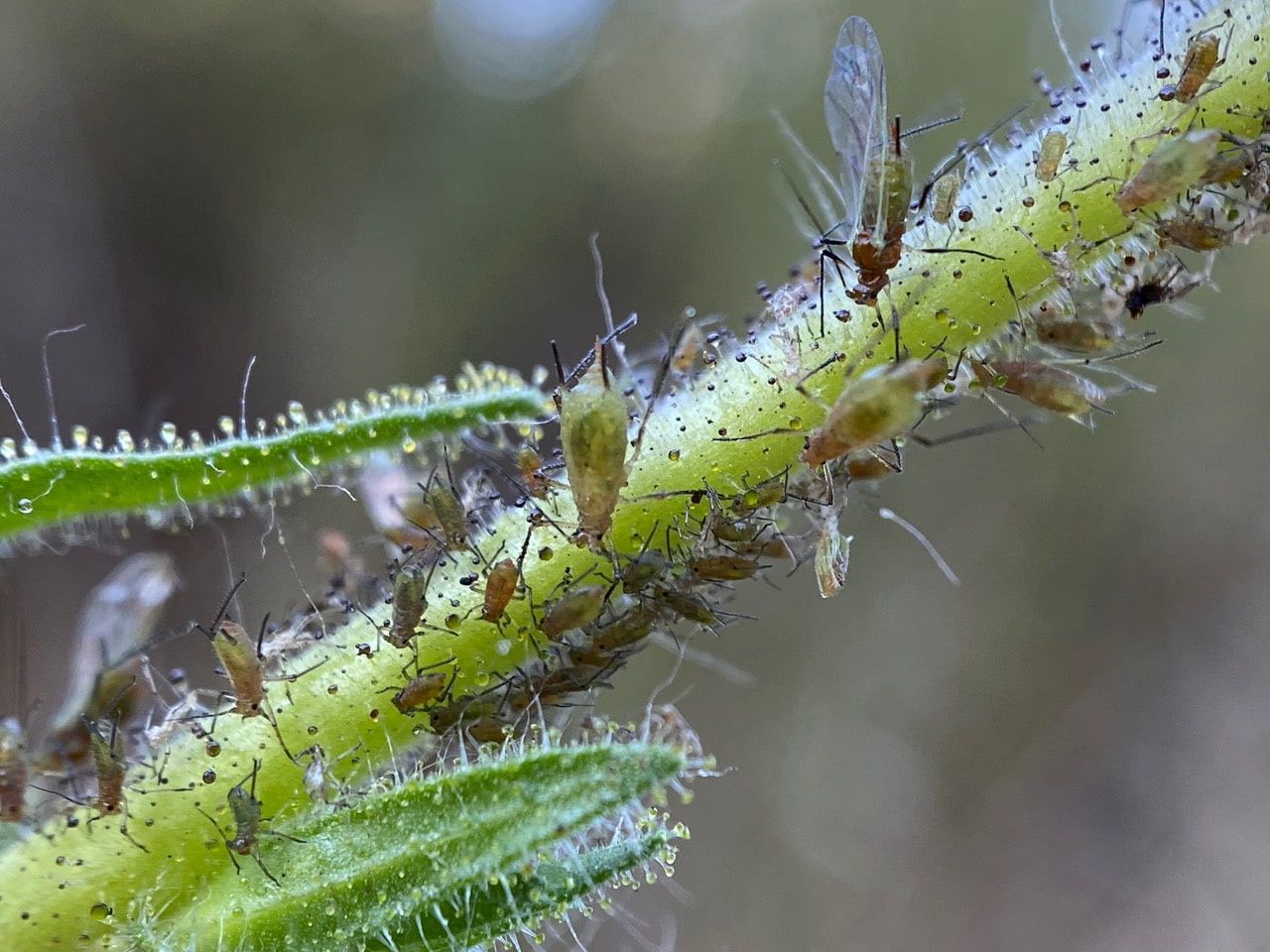 The aphid populations on the Coast Tarweed, Madia sativa under the Water Tank have exploded.
Aphids have many generations a year. Most aphids in California’s mild climate reproduce asexually throughout most or all of the year with adult females giving birth to live offspring – often as many as 12 per day – all clones of the mother. The young aphids or nymphs molt, shedding their skin about four times before becoming adults. When the weather is warm, many species can develop from newborn to reproductive adult in 7-8 days. Because each adult aphid can produce up to 80 offspring in a matter of a week, aphid populations can increase in staggering speed.

The aphids are multiplying in leaps and bounds. See those white things among the aphids? They are the shed exoskeletons left behind when the aphids molt.
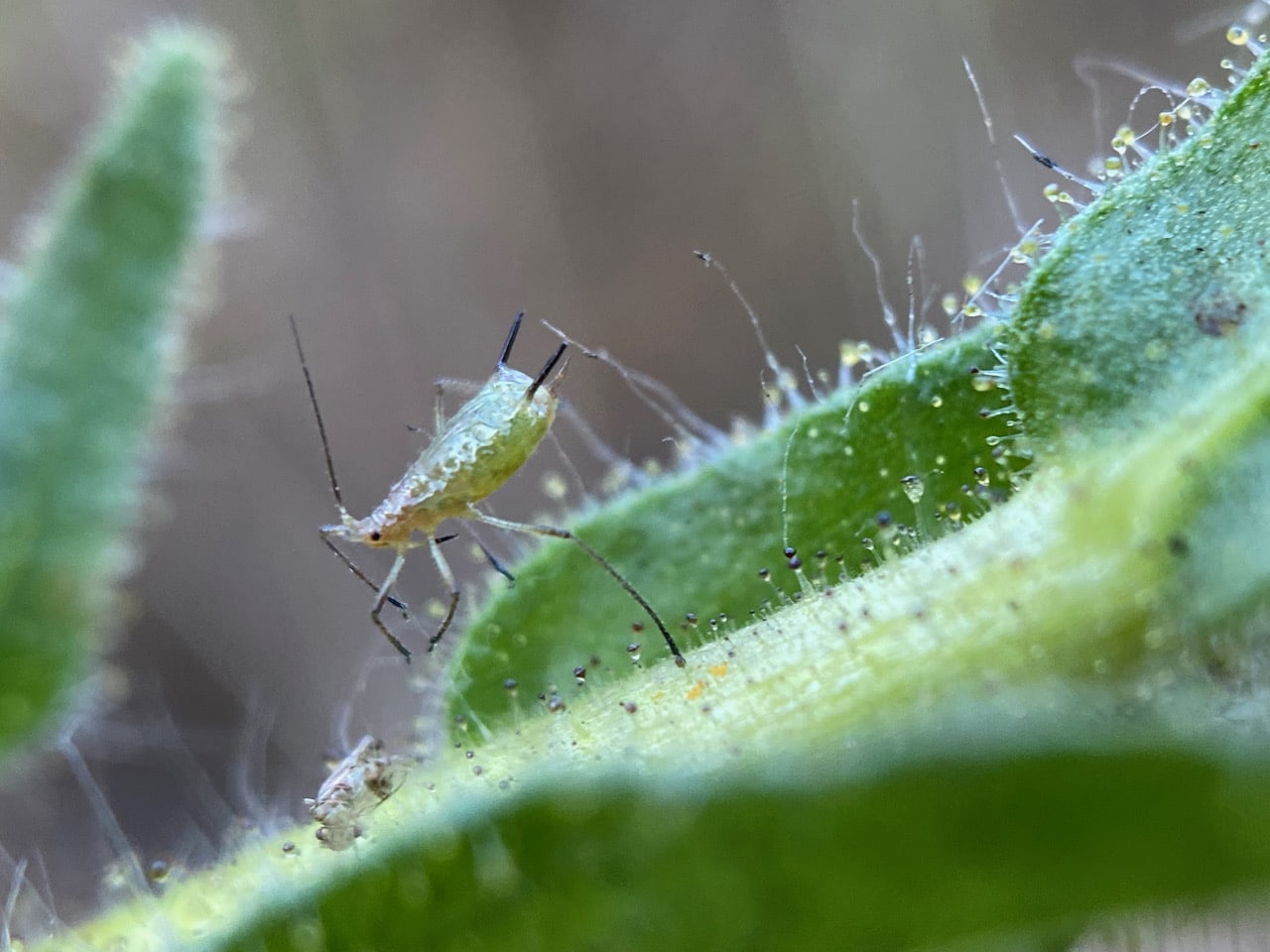
The aphids in the genus Uroleucon (family Aphididae) have long legs and long cornicles. I like to call the cornicles “tail pipes”. They are diagnostic of aphids. Cornicles are tubes that project from the abdomen of an aphid. There are usually a single pair with one on each side of the abdomen. They are used to emit pheromones or defensive secretions. It is often incorrectly believed that honeydew is secreted from the cornicles. Honeydew is actually excreted by the aphid from the rectum.

Hey, here’s a pretty fresh Lacewing egg, still greenish, one of three laid close to each other on adjacent leaves of Coast Tarweed. Smart of mama Lacewing to deposit her eggs here. Her larvae, sometimes called aphid lions, are voracious predators of aphids.
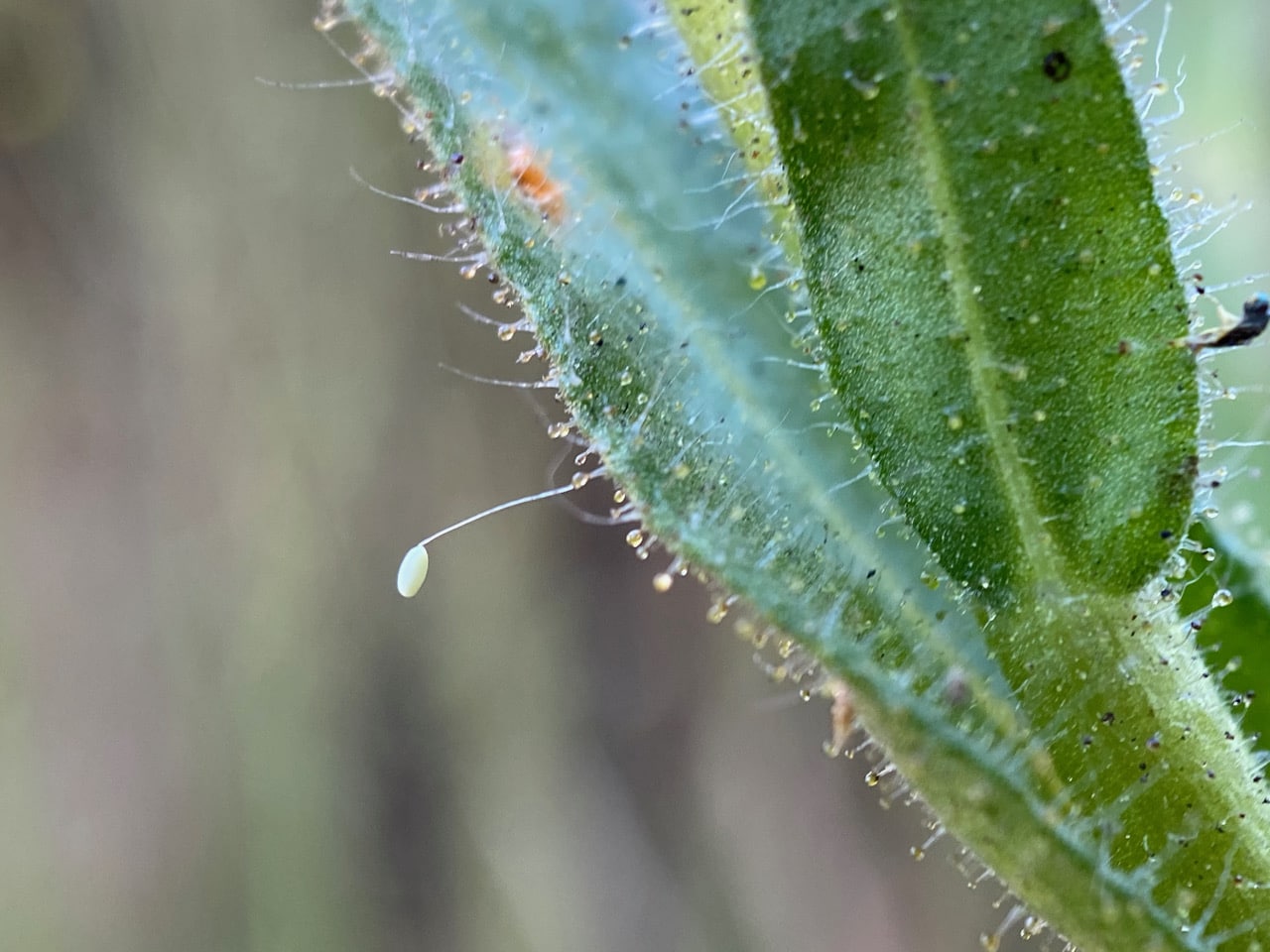
Green Lacewings are insects in the family Chrysopidae of the order Neuroptera. The adult is about 3/4 inch long, light green and has a delicate appearance with lacy wings. The compound eyes are conspicuously golden in many species. The insects are weak fliers, and are commonly found near aphid colonies. The adults feed mostly on nectar pollen, and honeydew but some species feed on insects as well. The eggs are either laid singly or in small groups at night. Each is perched on the tip of a hairlike stalk that is about 1/2 inch long. This helps to reduce cannibalism of the eggs by sibling larvae when they hatch.
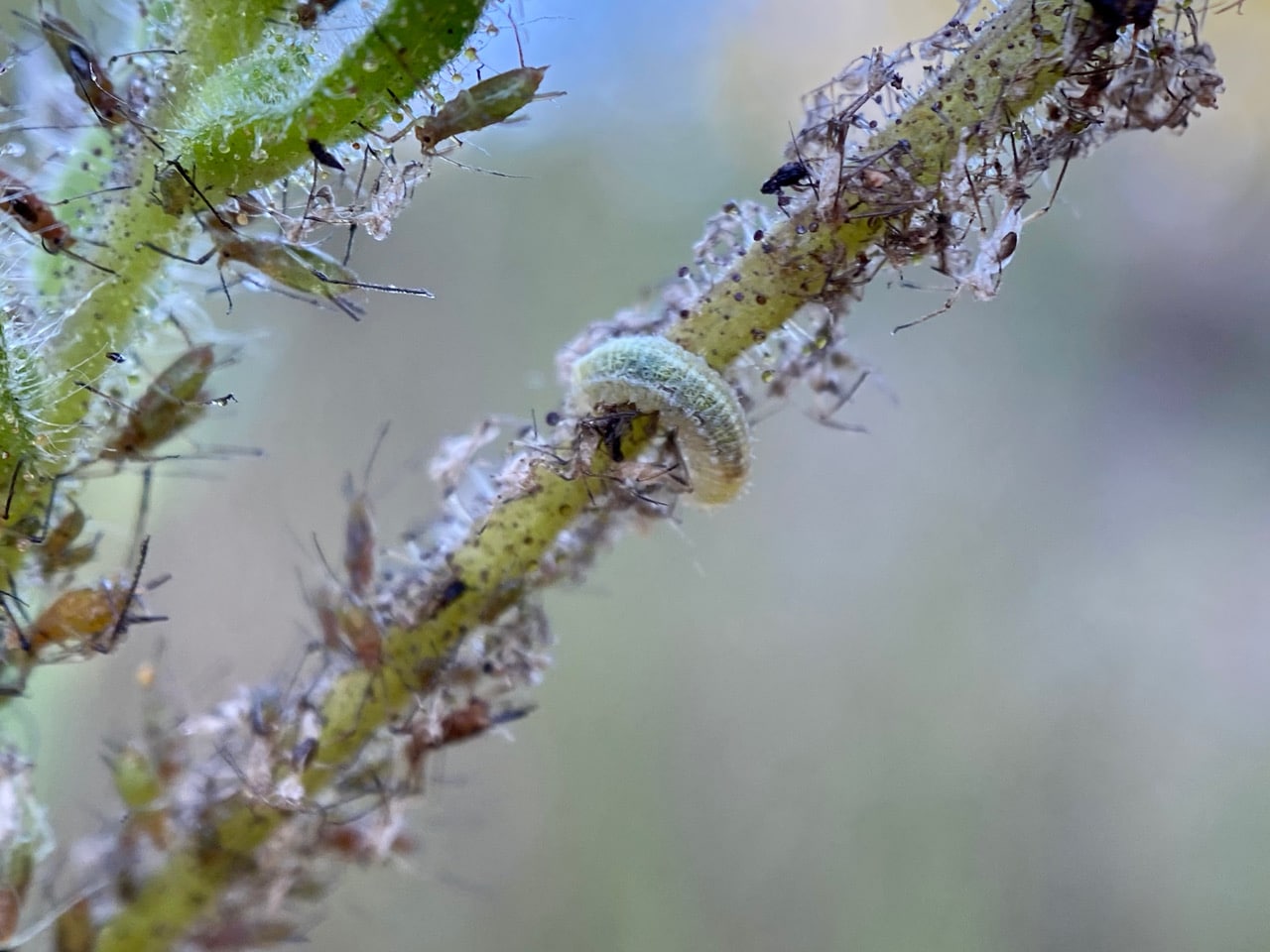
Hey, yet another aphid predator – a Hover Fly larva! The larva is so small it is barely bigger than the aphids it is tackling.
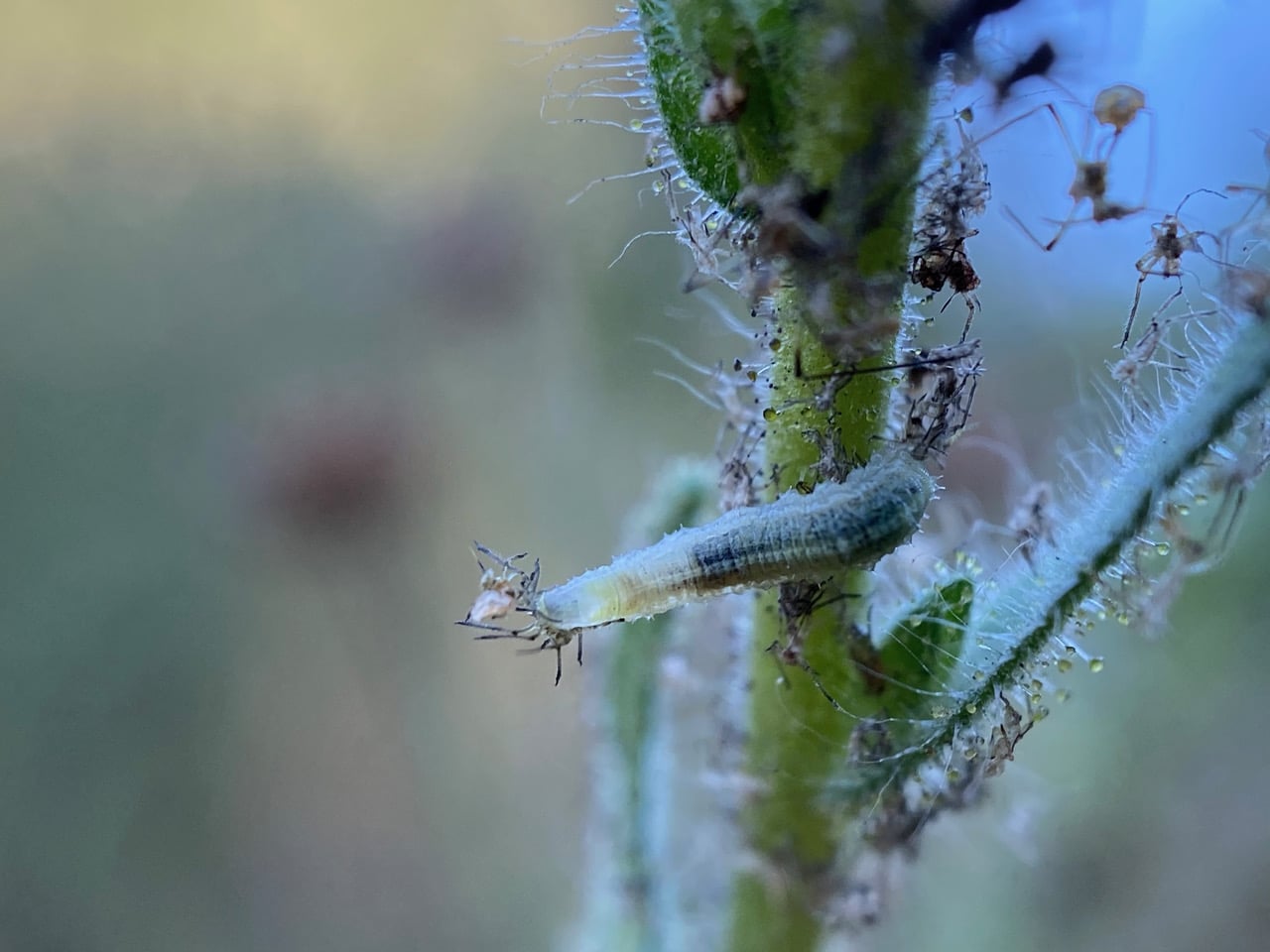
In the shadows, a larger Syrphid larva is feeding on aphids.
The larvae of most Syrphid Fly species are slug like and taper towards the head. Coloration is commonly brown, greenish, pink, or whitish. The Syrphid larvae lack true legs, but the creviced, segmented body can give the appearance of having appendages. They are blind, relying on their sense of touch to navigate and to catch prey. They feed on aphids and other insects and move around on the plants in search of prey. The larvae complete their development in two to three weeks while consuming up to 400 aphids each.

Another Syrphid larva hunting aphids on Coast Tarweed.

A fresh green Syrphid pupa is attached to a leaf axil of Coast Tarweed.
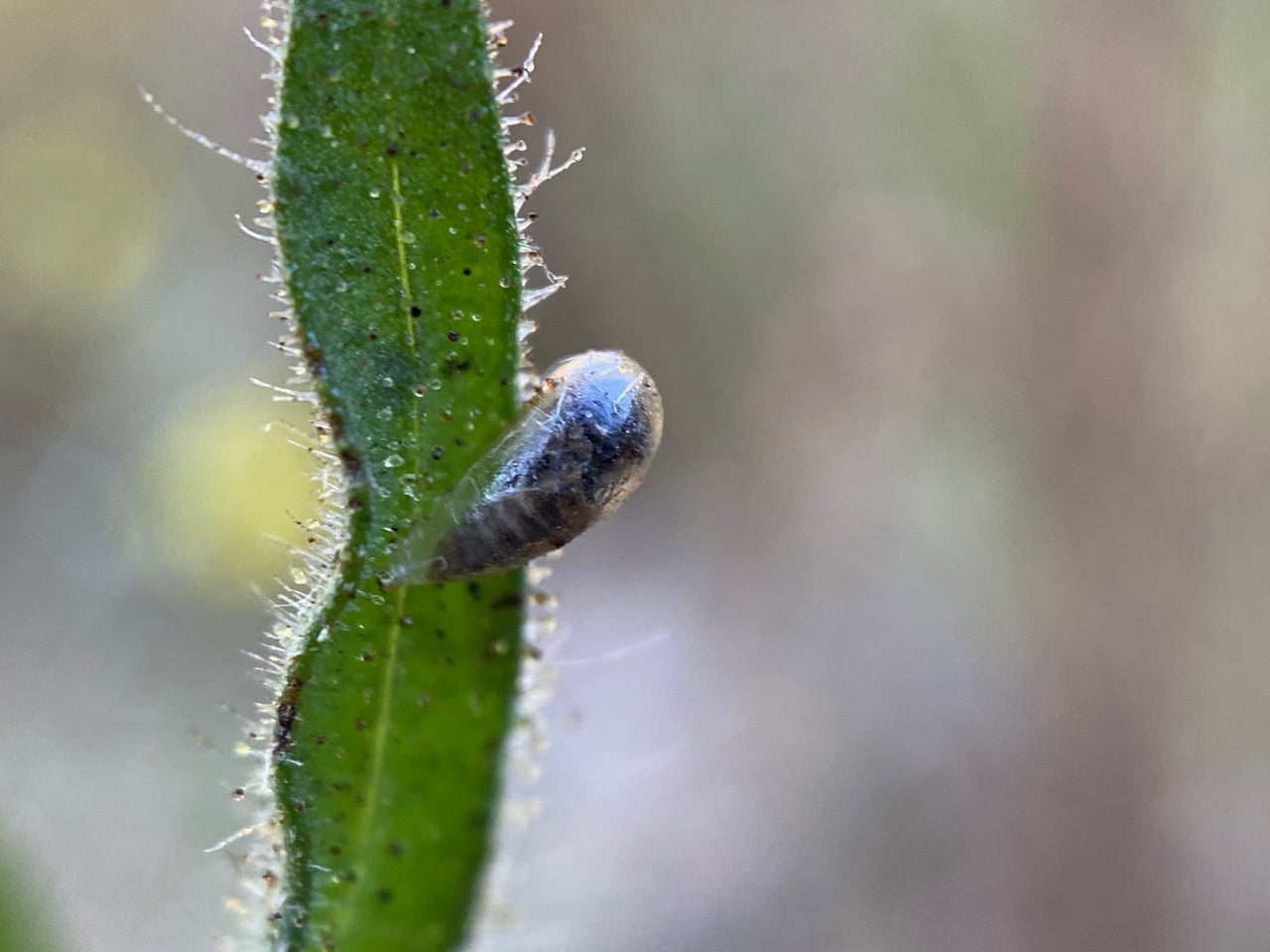
This Syrphid pupa has turned clear. You can see the striped abdomen of the developing adult inside. The hover fly will probably emerge soon.