

Pollinator Post 8/24/26 (2)

Along the shoreline of Bay Farm, extensive patches of the Oregon Gumweed, Grindelia stricta are infested with Spittlebugs whose young create these white spittle-like masses as they feed on the plant.

I train my eyes on the frothy masses hoping to see eclosure of adult Spittlebugs.
Spittlebugs, also known as Froghoppers belong to the superfamily Cercopoidea within the order Hemiptera (true bugs). While sometimes generally referred to as the family Cercopidae, they are scientifically divided into several families, primarily Aphrophoridae (common spittlebugs), Cercopidae (froghopper), and Clastopteridae.
Why the common name of “spittlebug”? The nymphs (immatures) of these bugs create foam masses on plants in which they live and feed. Like the adults, the nymphs use their piercing, sucking mouthparts to feed on plant juices. The nymph produces a cover of foamed-up plant sap reminiscent of saliva, hence the common name of spittlebug. Whereas most insects that feed on sap feed on the nutrient-rich fluid from the phloem, Spittlebugs tap into the much more dilute sap flowing upward via the xylem. The large amount of excess water that must be excreted and the evolution of special breathing tubes allow the young spittlebug nymphs to grow in the relatively protective environment of the spittle. Symbiotic bacteria in the insects’ digestive system provides them with the essential amino acids that their diet lacks. The foam serves a number of purposes. It hides the nymph from the view of predators and parasites, and it insulates against heat and cold, and protects the delicate nymphs from desiccation. Moreover, the foam has an acrid taste that deters predators.
Unlike their young, adult spittlebugs (also known as Froghoppers) are efficient flyers and hoppers, feeding on diverse plant species. They pierce plant stems to feed on xylem. To get enough nutrients, they consume massive quantities of sap, drinking up to 280 times their body weight daily, resulting in high waste excretion. Froghoppers can cause damage by distorting plant leaves and causing shoot tips to die back.
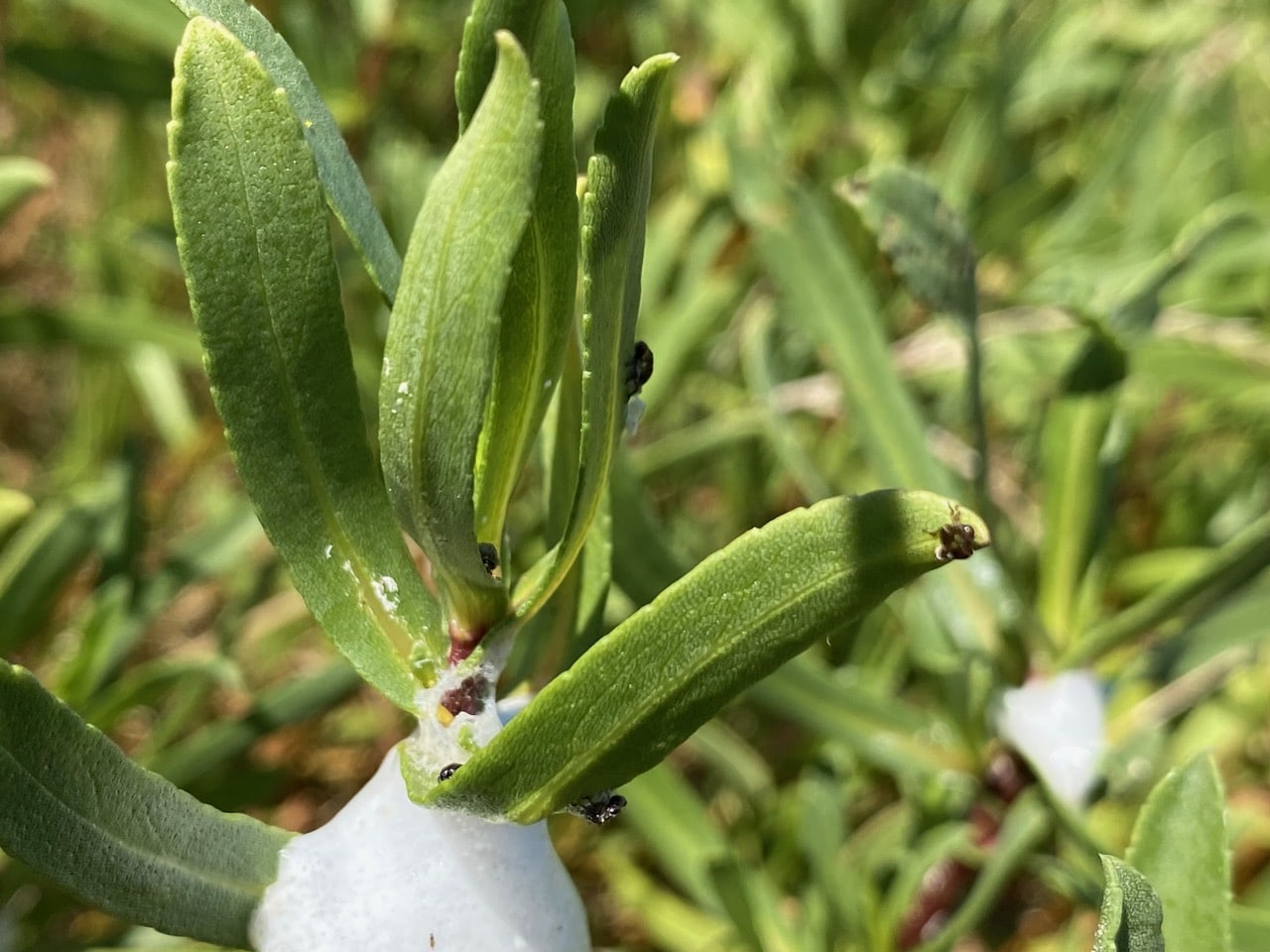
Wait, there seems to be some bug activity here above that big foam mass. There are several exuviae (shed exoskeletons) clinging to the terminal leaves.
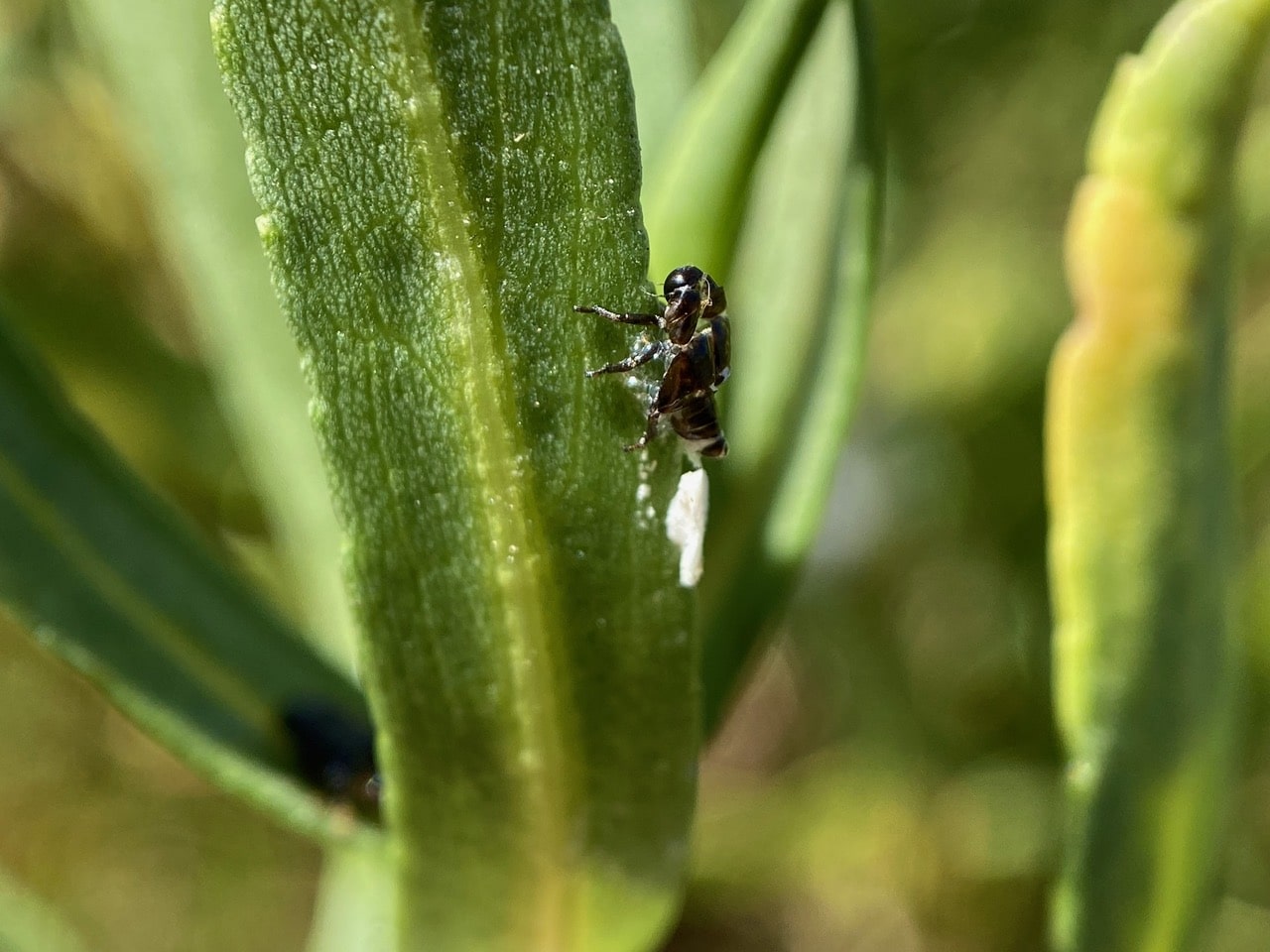
A Spittlebug exuvia clings lifelessly to a Grindelia leaf. Note the rupture of the thorax where the new adult has molted from the final nymphal stage who left the safety of its foam shelter for this event.
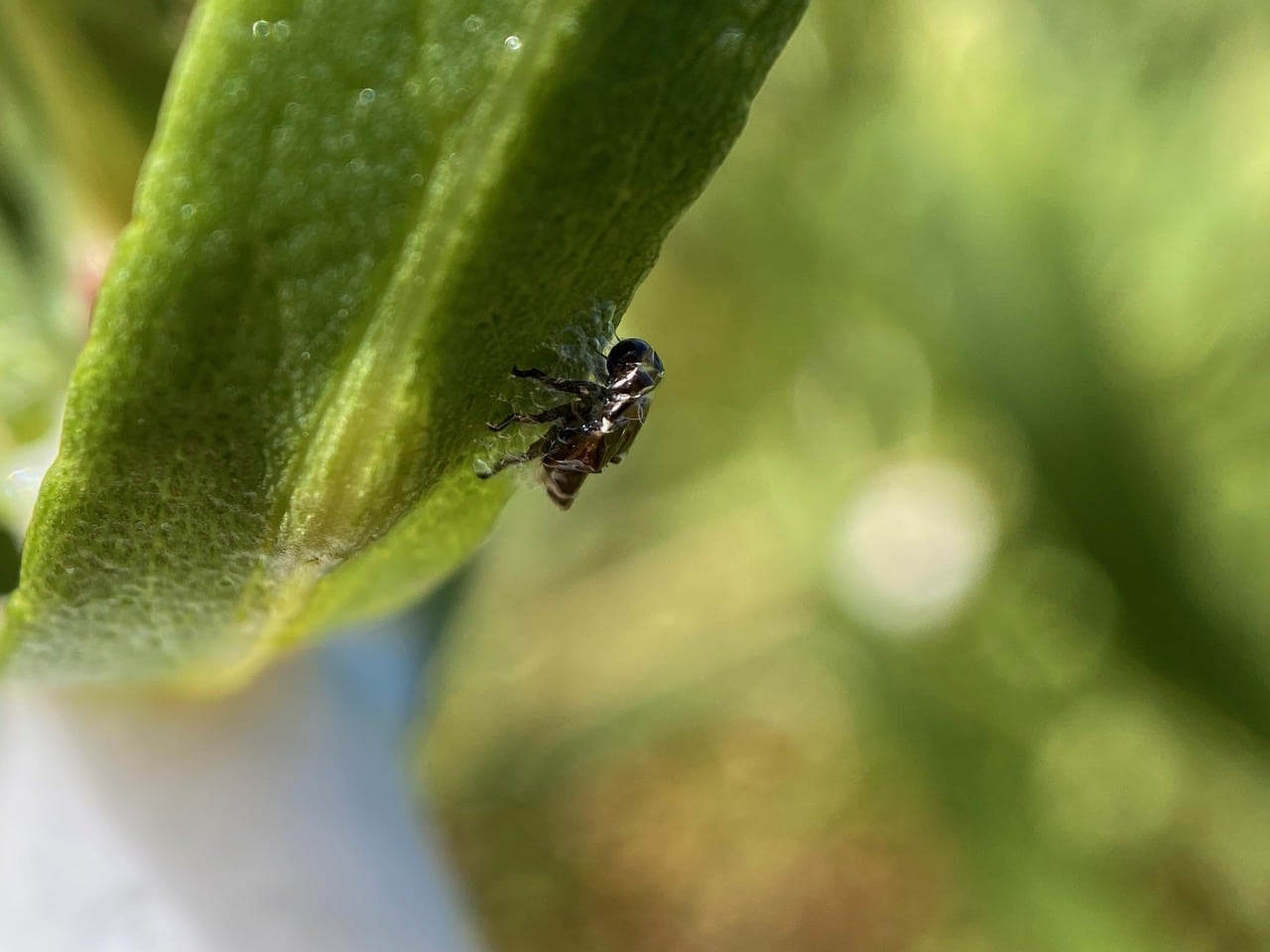
Here’s yet another exuvia, with frothy bubbles drying under it.
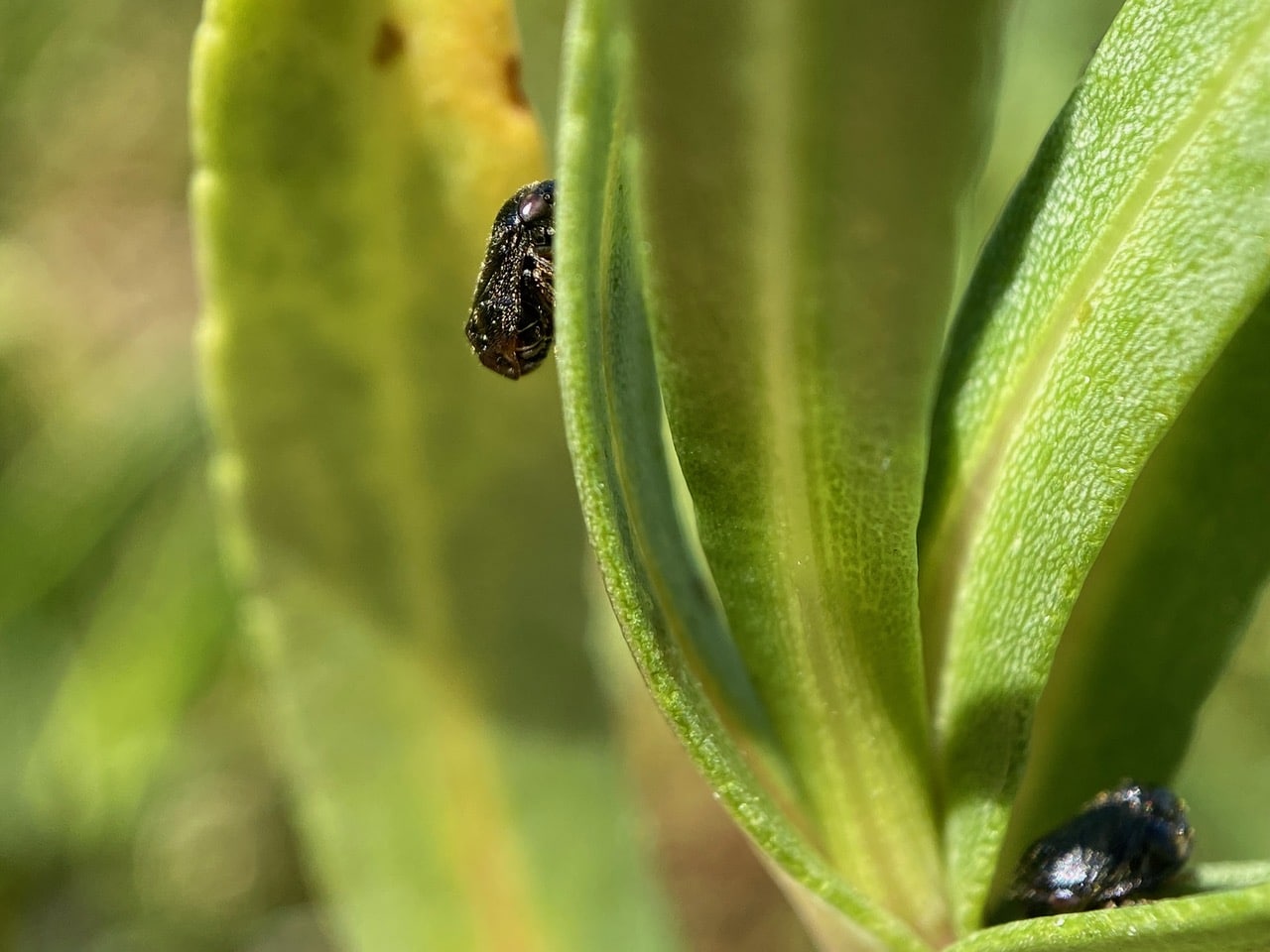
Ah, here’s an adult male Spittlebug clinging to a terminal leaf. He is predominantly black, with reddish-purple eyes. The white flecks on its body are short hairs that reflect in the sunlight.
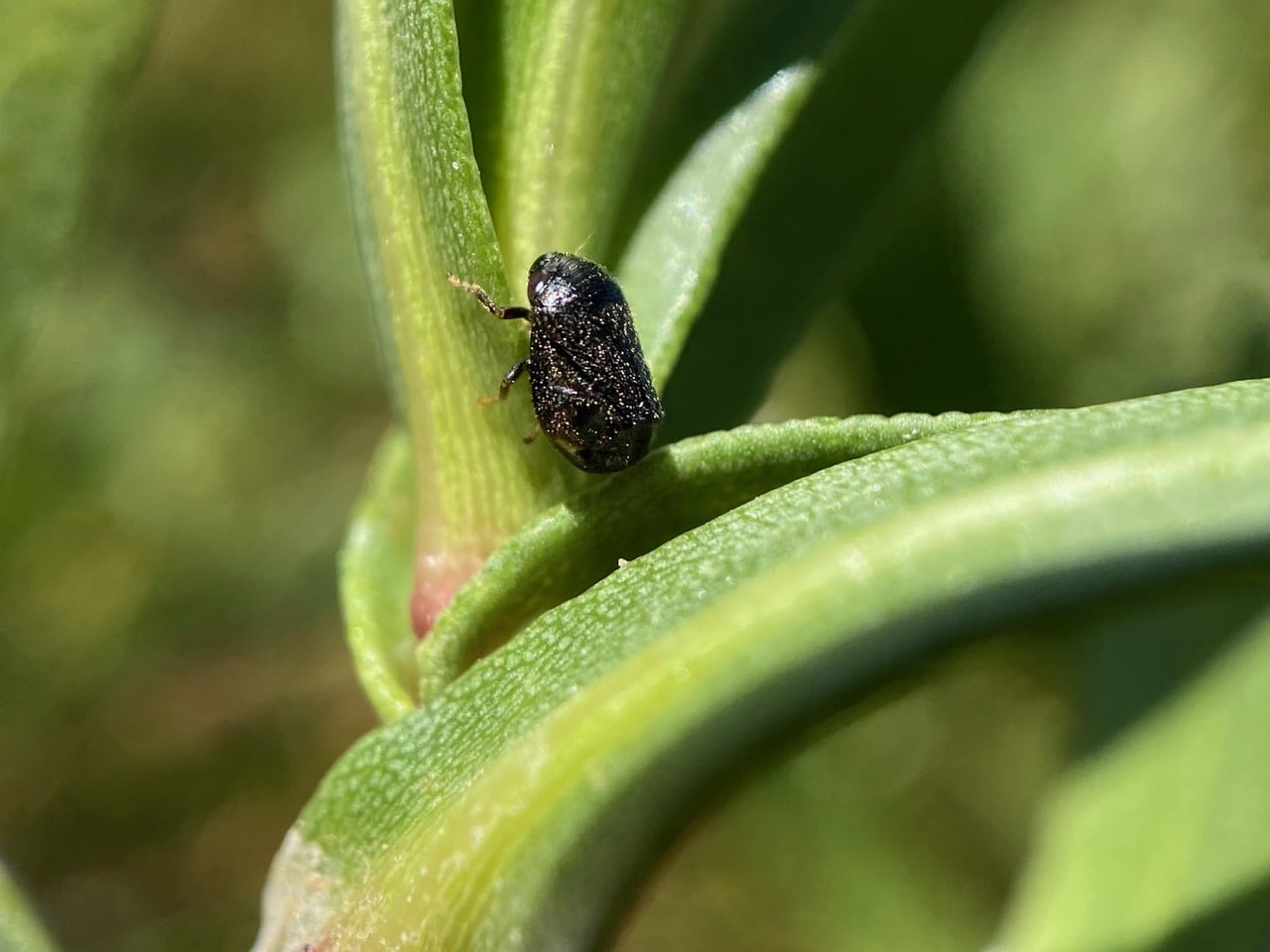
Adult Spittlebugs are froghoppers, ace at jumping. But these are quite sedentary. Instead of leaping away, they typically sidle to the other side of the leaf to avoid my prying camera.
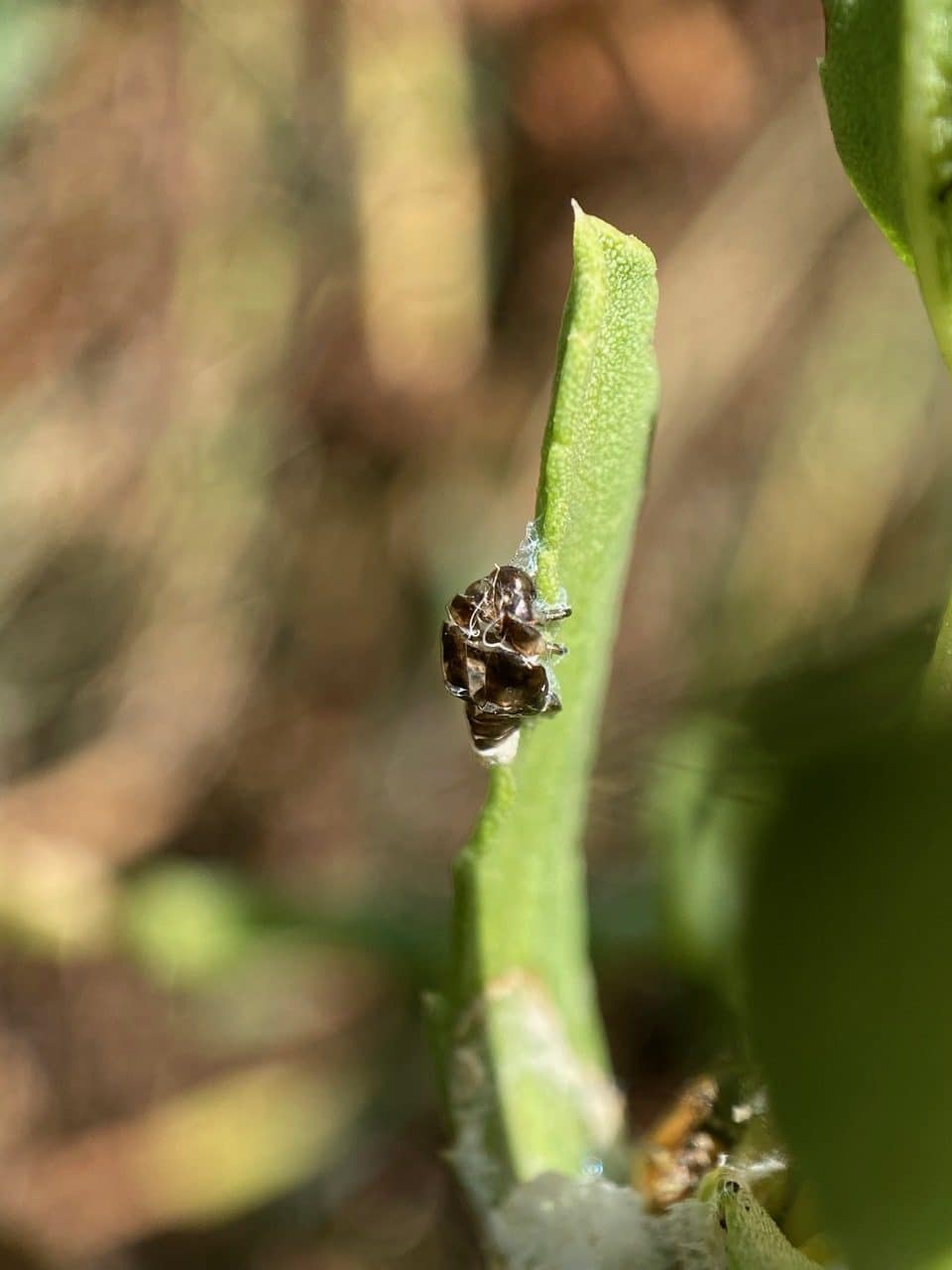
What are those white filaments on the Spittlebug exuvia?
The white, thread-like strands found inside insect exuvia (shed skins) are the cast-off linings of the insect’s tracheae – the hollow tubes that make up their respiratory system.
Insects do not have lungs. Instead, they breathe through tiny external openings along their bodies called spiracles, which lead to an internal branching network of tubes called tracheae that deliver oxygen directly to their cells. Even though these breathing tubes are inside the insect’s body, their inner linings are made of the same chitinous material as the outer shell. When an insect or nymph undergoes ecdysis (molting), it must pull its entire body – including the delicate linings of its breathing tubes – out through the old skin, leaving behind the ghostly white filaments.
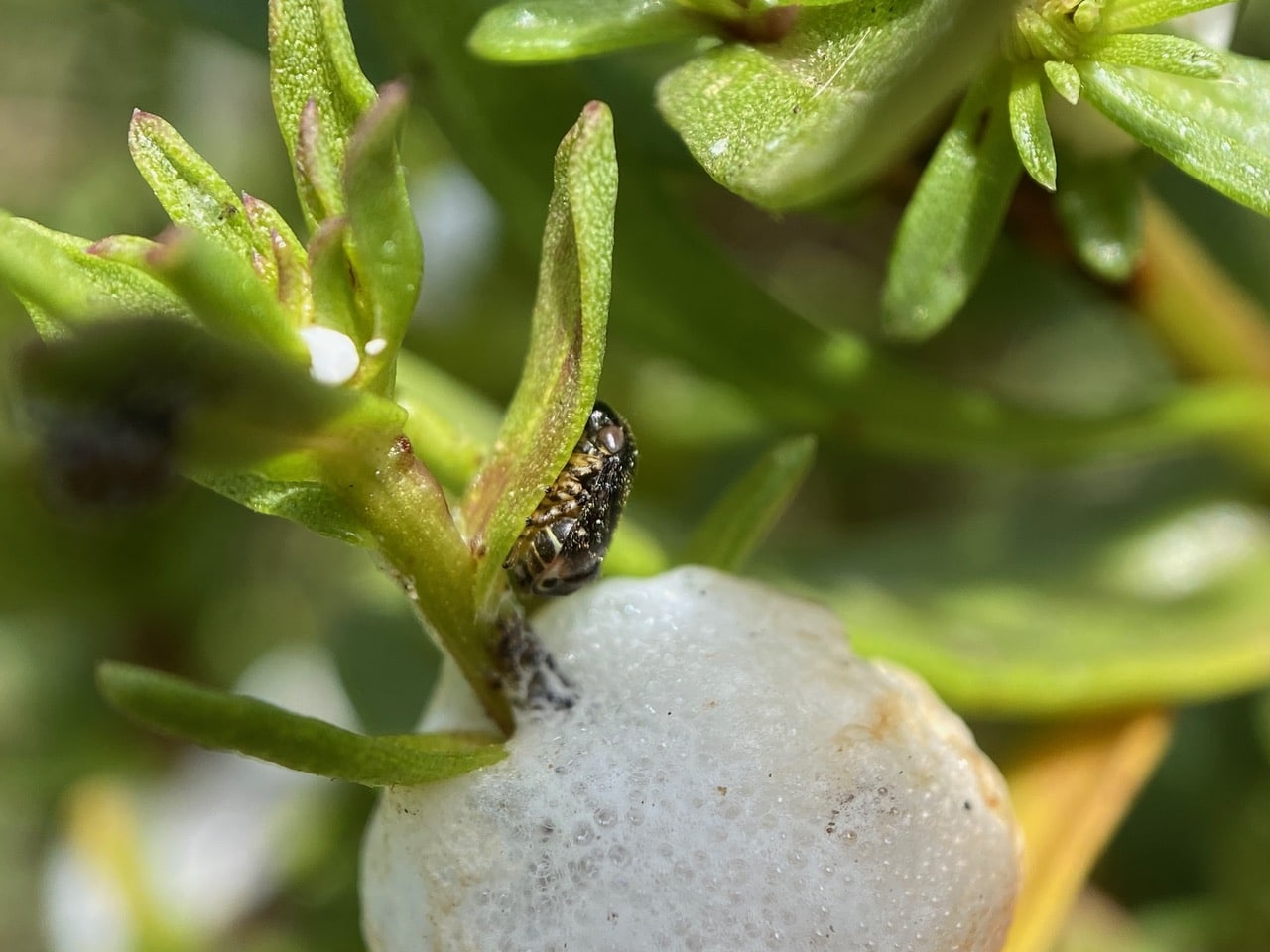
Side view of a male Spittlebug resting on a Grindelia leaf just above a foamy mass.

Dorsal view of the same male. It’s hard to make out any anatomical details on these shiny, black creatures.
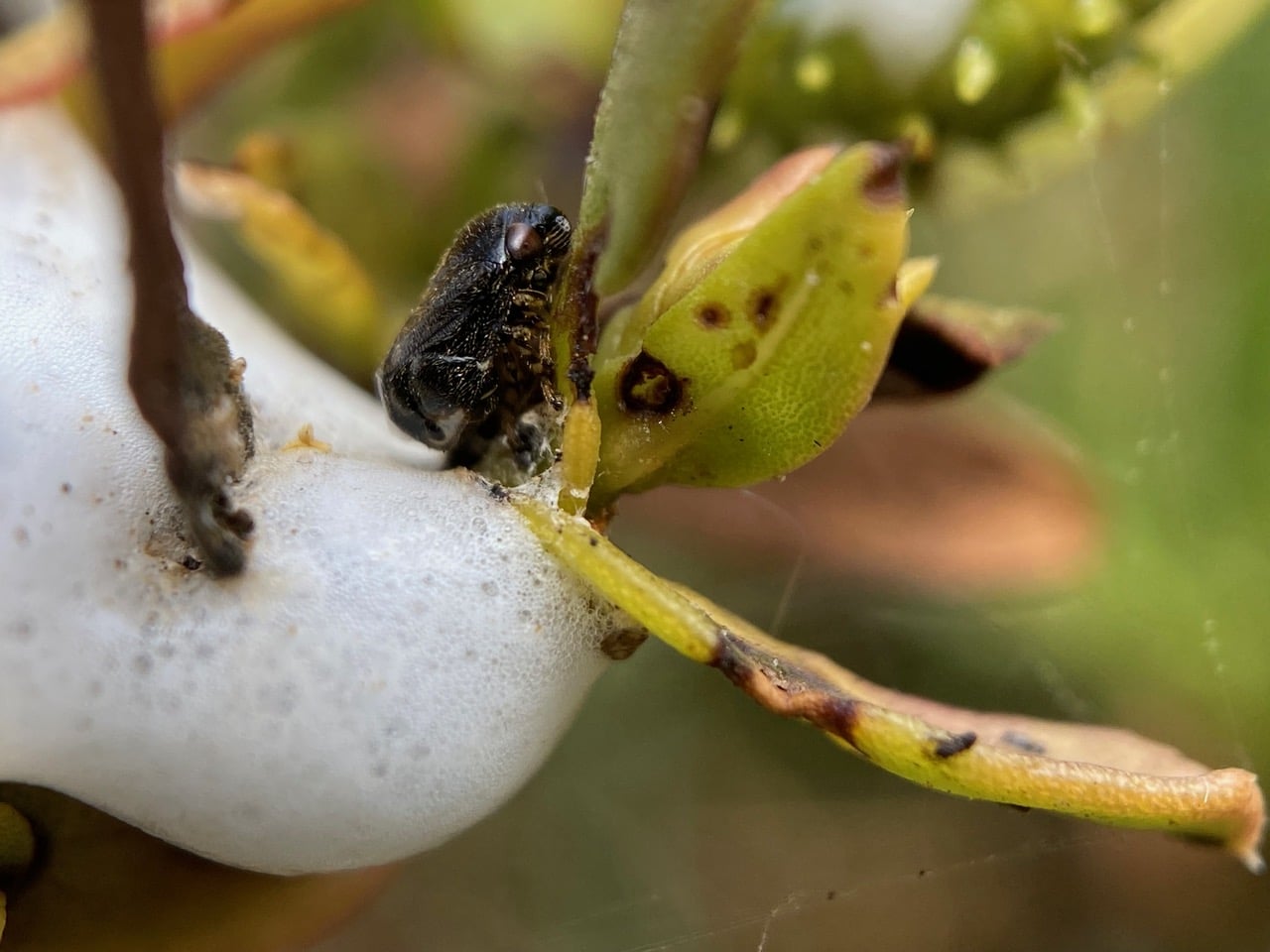
Another male. Where are the females?

Ooh, that adult Spittlebug is a different color from the others. Its wings look somewhat translucent and pale. I think it is probably a teneral that has recently molted, and is waiting for its full coloration to set in.
A teneral insect is a young insect that has just molted (emerged from its final nymphal skin) but has not yet hardened its exoskeleton or achieved its final coloration. Teneral insects typically have paler or different colors than their mature counterparts. Over a short period (often hours), the insect’s exoskeleton hardens and darkens, a process similar to the tanning of leather. This period allows the insect to expand its body and limbs. Being soft, and unable to move much, tenerals are more susceptible to injury and predation.

Another view of the same teneral Spittlebug.
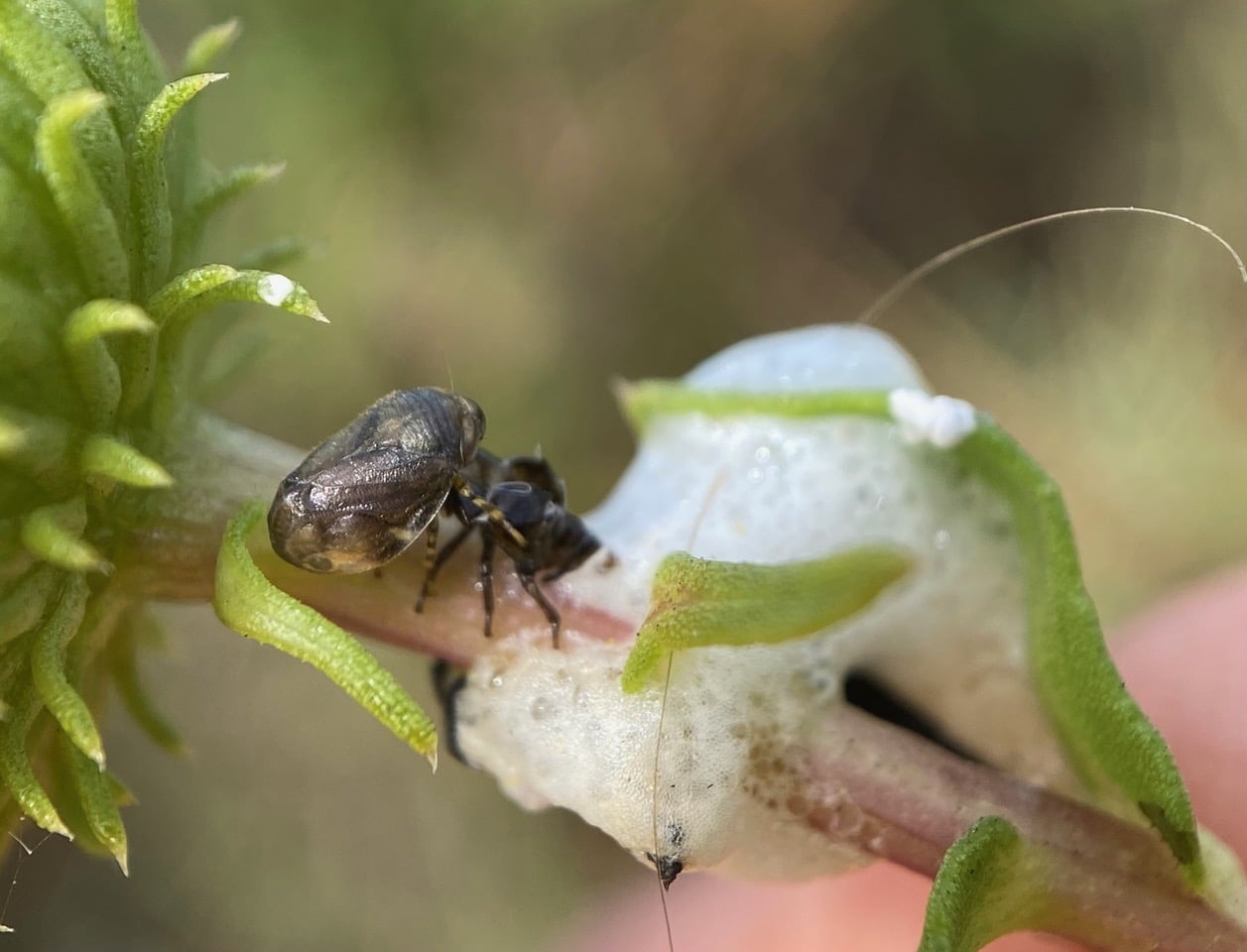
The teneral Spittlebug revisits its own old exoskeleton from which it has emerged. Note the false eyespot near the tip of its wing. The bug’s head is to the right, above the exuvia.

Finally, a mature female Spittlebug, Complex Clastoptera lineatocollis (family Clastopteridae)! She is predominantly brown, slightly bigger than the males, and the elaborate striping on her head and thorax makes her look like she has on a King Tut headdress. Females appear to be much less common than the males in this Spittlebut population, at least for now. Maybe the sexes might balance out as the season progresses?

The presence of the Spittlebugs are taking a toll on the Grindelia. Many of the infested plants are wilting and turning brown, and some of the immature flowerheads are aborted before they open up.
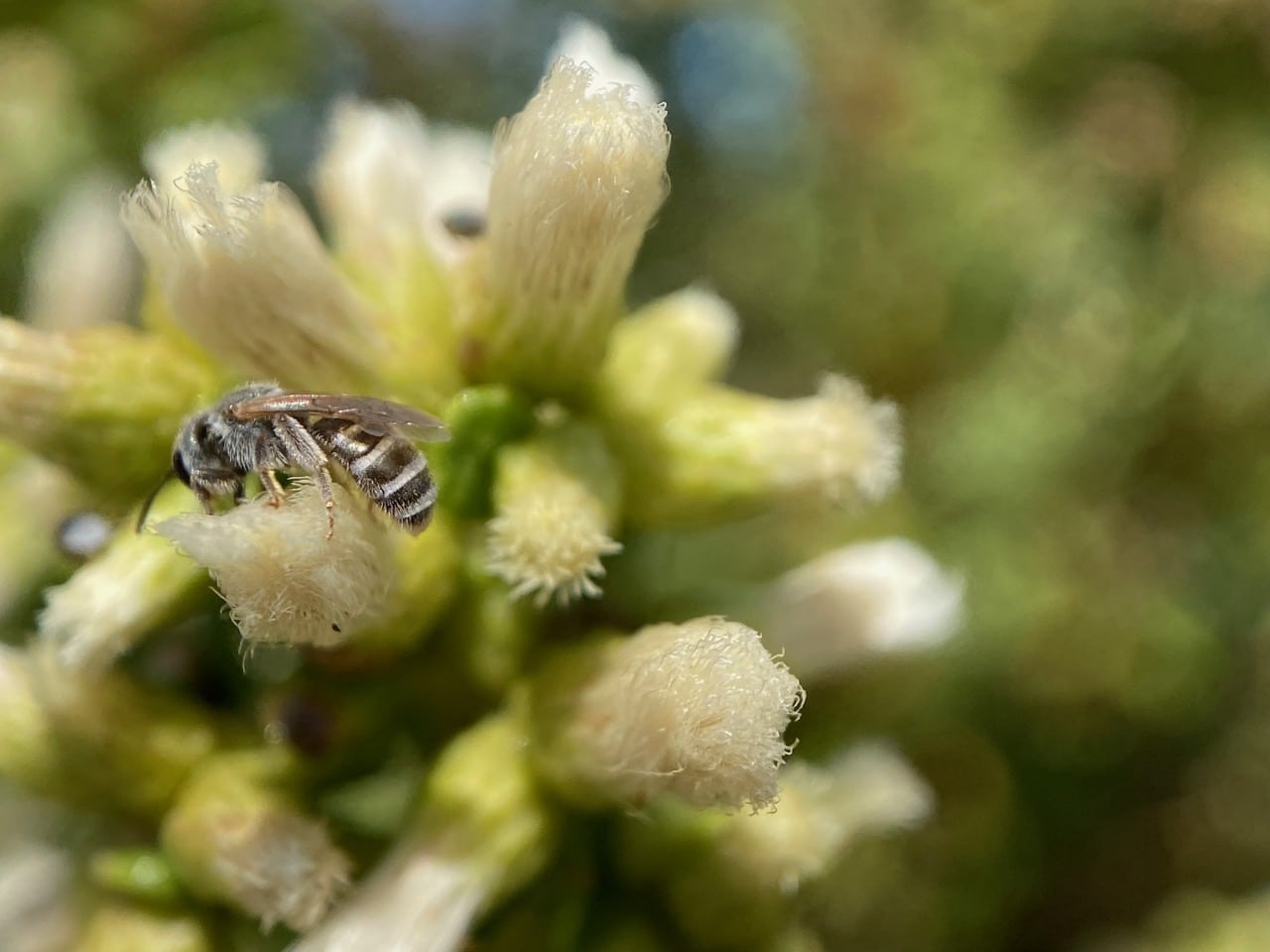
A Tripartite Sweat Bee, Halictus tripartitus (family Halictidae) is foraging on a cluster of female Coyote Brush flowerheads, Baccharis pilularis.
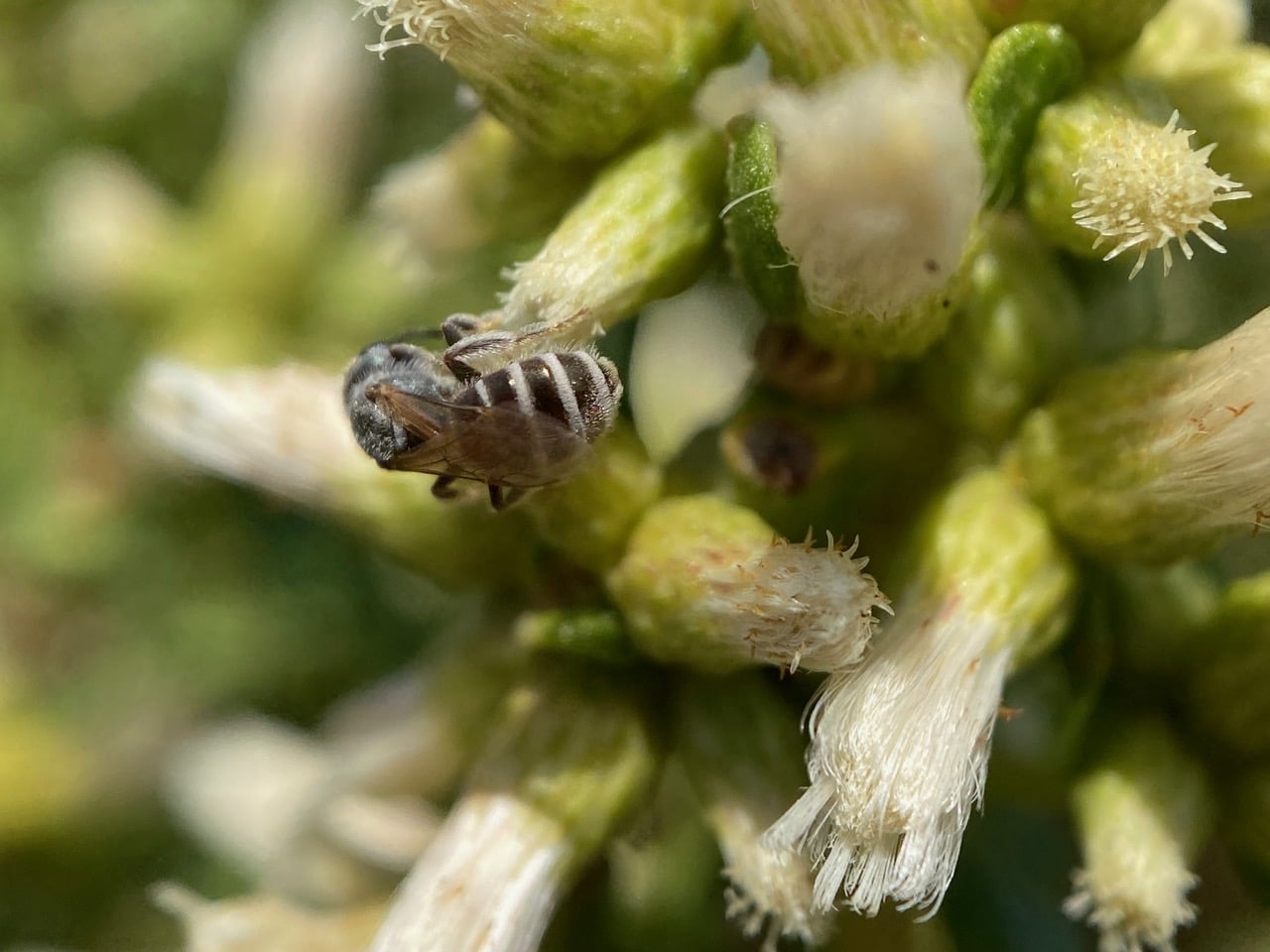
Halictus is found worldwide; they are most common in the Northern Hemisphere. All are generalists, foraging from a wide variety of flowering plants. Many species are social and produce several generations per year. This is not surprising as most blooming plants are season-specific; a bee that requires pollen and nectar across multiple seasons would not thrive as a specialist. All Halictus in North America nest in the ground, often in aggregations; and they may nest in the same area for decades.
Tripartite Sweat Bees, Halictus tripartitus are social, forming annual colonies in the soil where a queen lays eggs and daughter bees act as workers. They are considered a “primitively social” species, meaning they have a social organization with a queen and workers, but with simpler colonies compared to more complex eusocial insects such as honey bees.
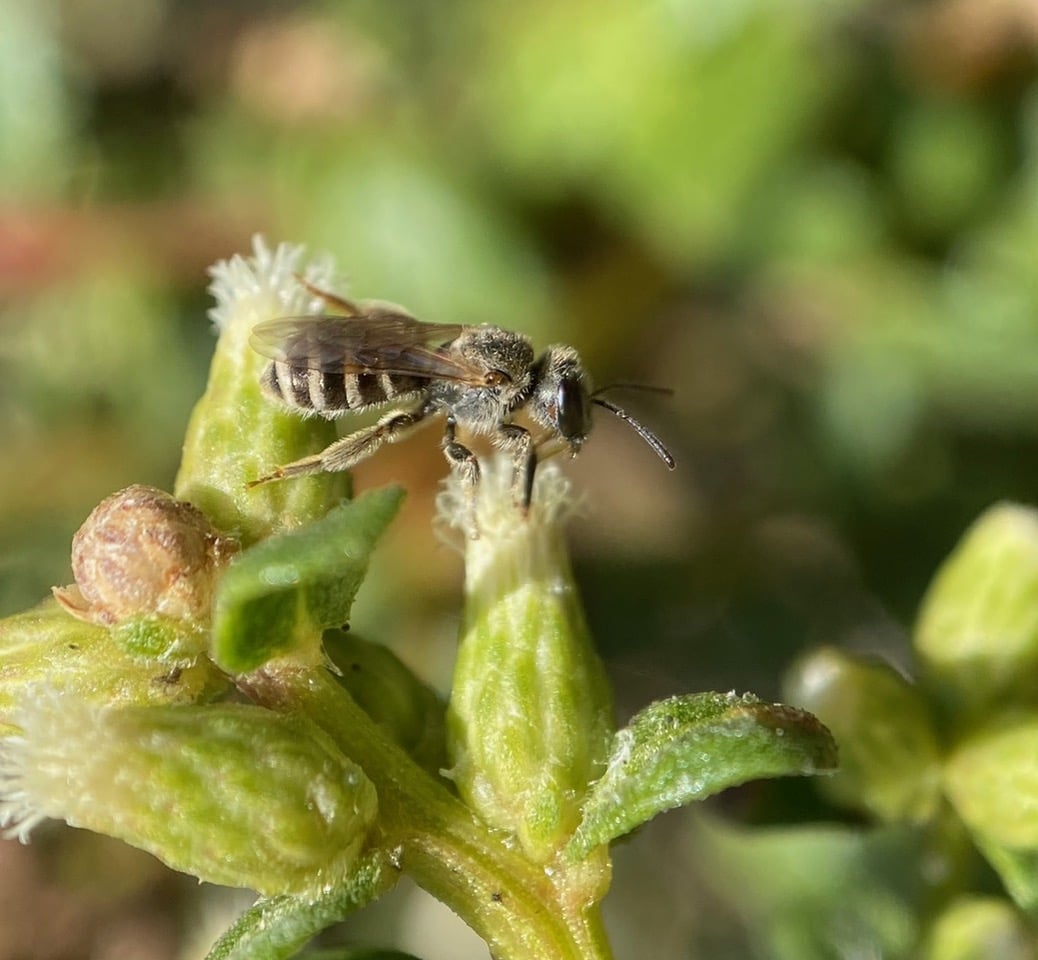
See that brown, aborted flowerhead behind the Tripartite Sweat Bee?
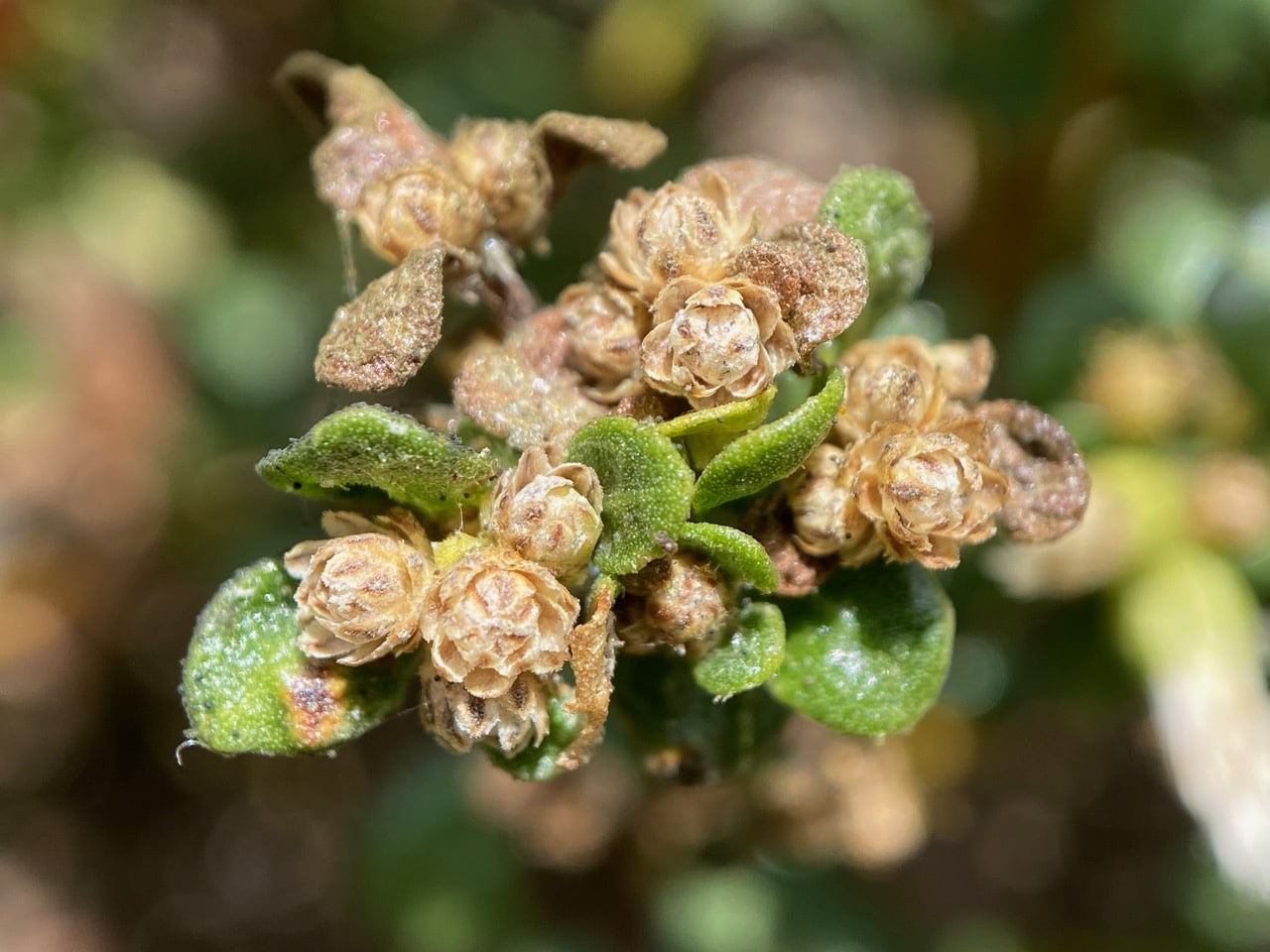
As the dried buds open up, they look like miniature woody roses, as seen here in a large cluster. I recall photographing these a few years ago at Skyline Gardens in the Berkeley hills. I have learned then that they resulted from an interaction with a Fruit Fly, Trephritis californica (family Trephritidae).
Tephritis californica is a small species of fruit flies endemic to California and the western United States. These flies are closely associated with native plants in the Asteraceae family, particularly species of Baccharis. Females target the immature flowerheads and buds of Coyote Brush to lay their eggs. While the larvae feed inside the developing floral tissues, the physical piercing during oviposition and subsequent larval feeding can trigger a hypersensitive response or nutritional drain, occasionally resulting in bud abortion. Localized tissue damage or hormonal disruption causes the plant to abort the compromised buds rather than invest resources into damaged reproductive structures.
The egg laying behavior can be seen in these photos taken at Skyline Gardens:
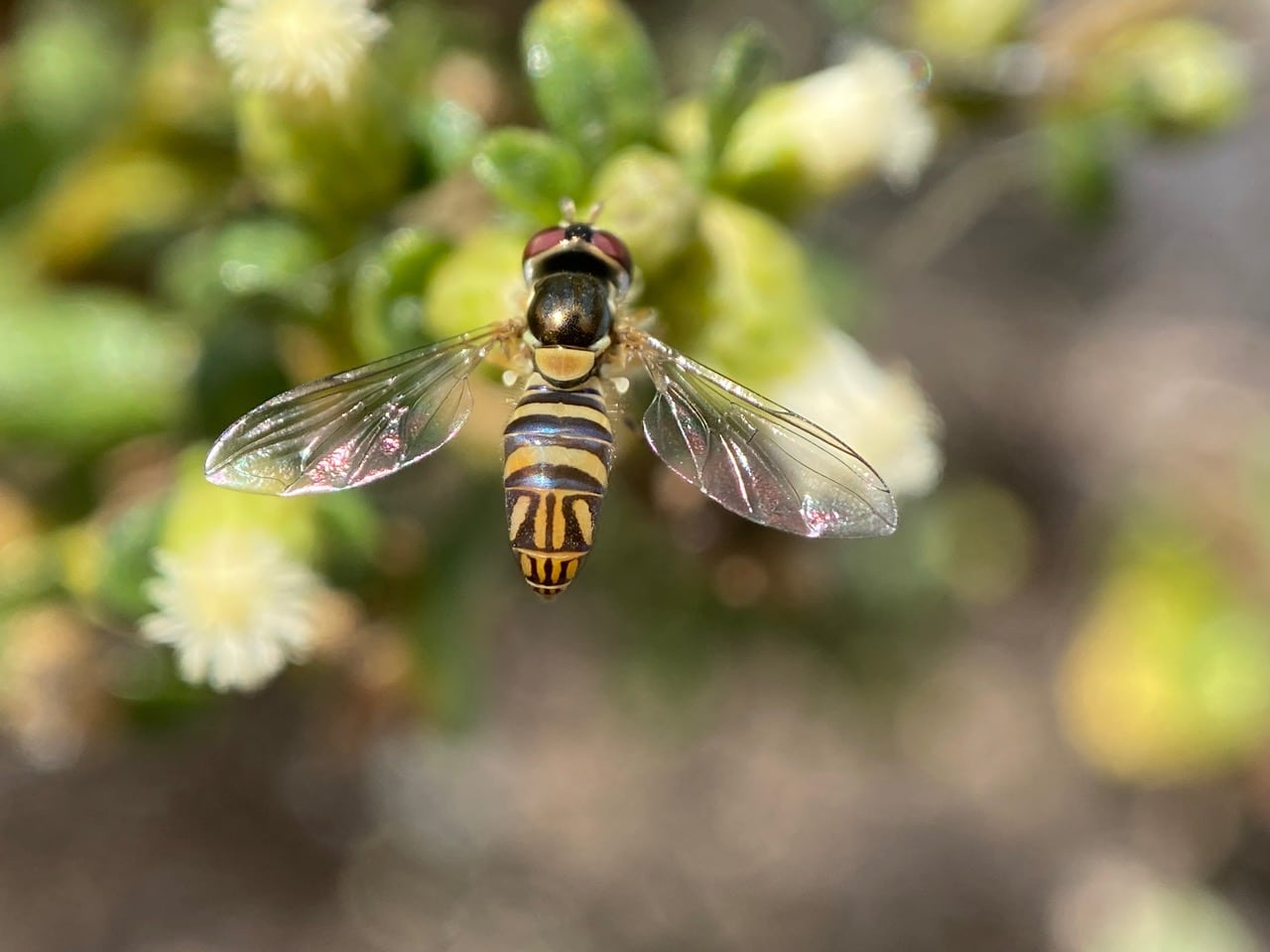
A female Oblique Streaktail, Allograpta obliqua (family Syrphidae) is perched on a Coyote Brush flowerhead taking nectar.
Although small in size (6-7 mm long), the Oblique Streaktail is easily recognizable for the unique pattern on its black-and-yellow abdomen. It is a common North American species of hover fly. Adults visit flowers for nectar and pollen, and are pollinators. Females lay eggs on plant surfaces near aphids. Larvae feed on the aphids.
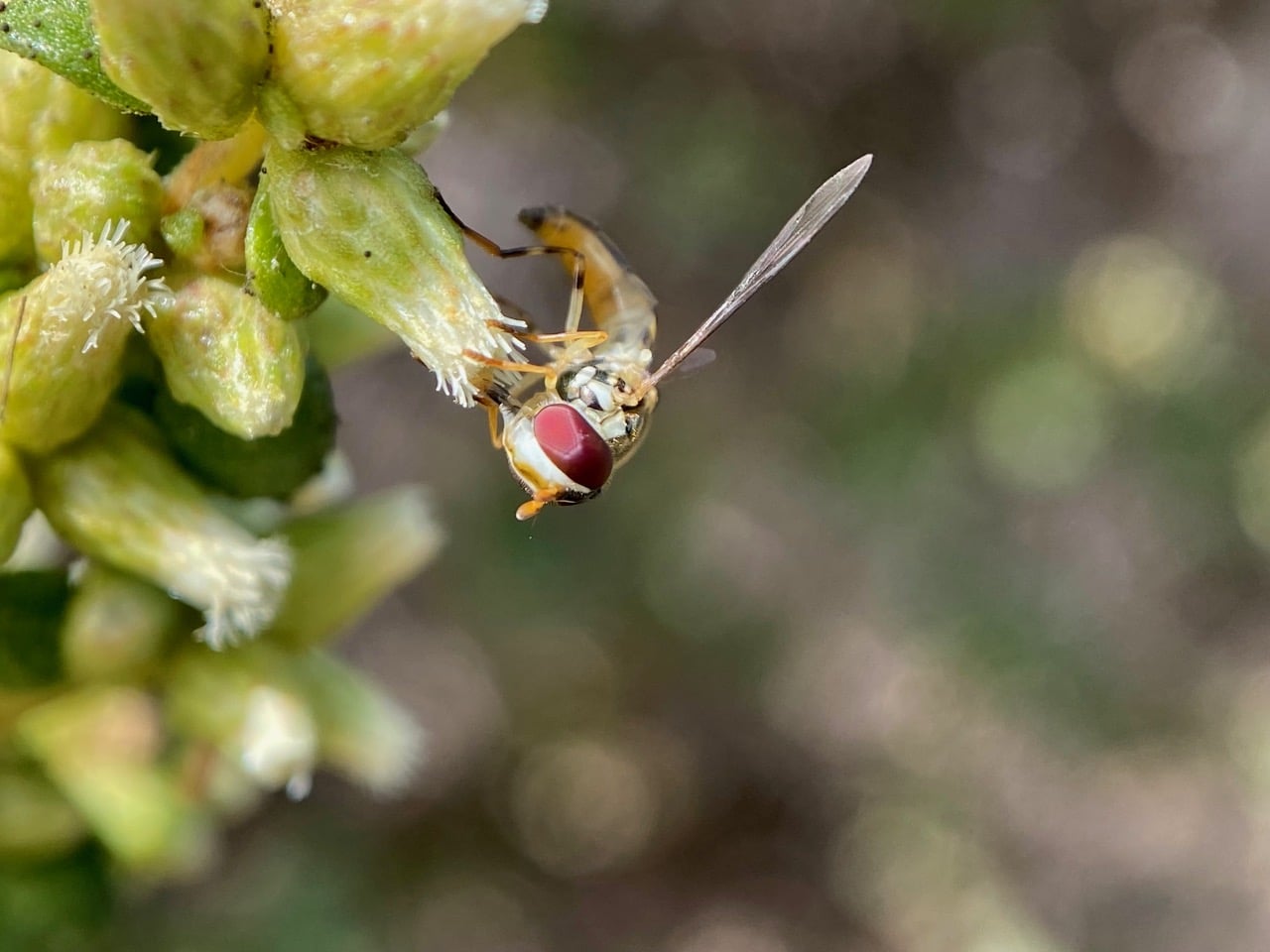
My, what big, red eyes you have!

It is startling to see how flat the abdomen of the hover fly is! And what are those white, irregularly-shaped nubbins on the side of the thorax?

Another way to tell that the hover fly is female, besides her wider abdomen, is her compound eyes. They do not touch on top of the head, like the males’ eye do.

Here’s another black-and-white striped bee on the Coyote Brush. It is bigger than the Tripartite Sweat Bee, and its body is furry.
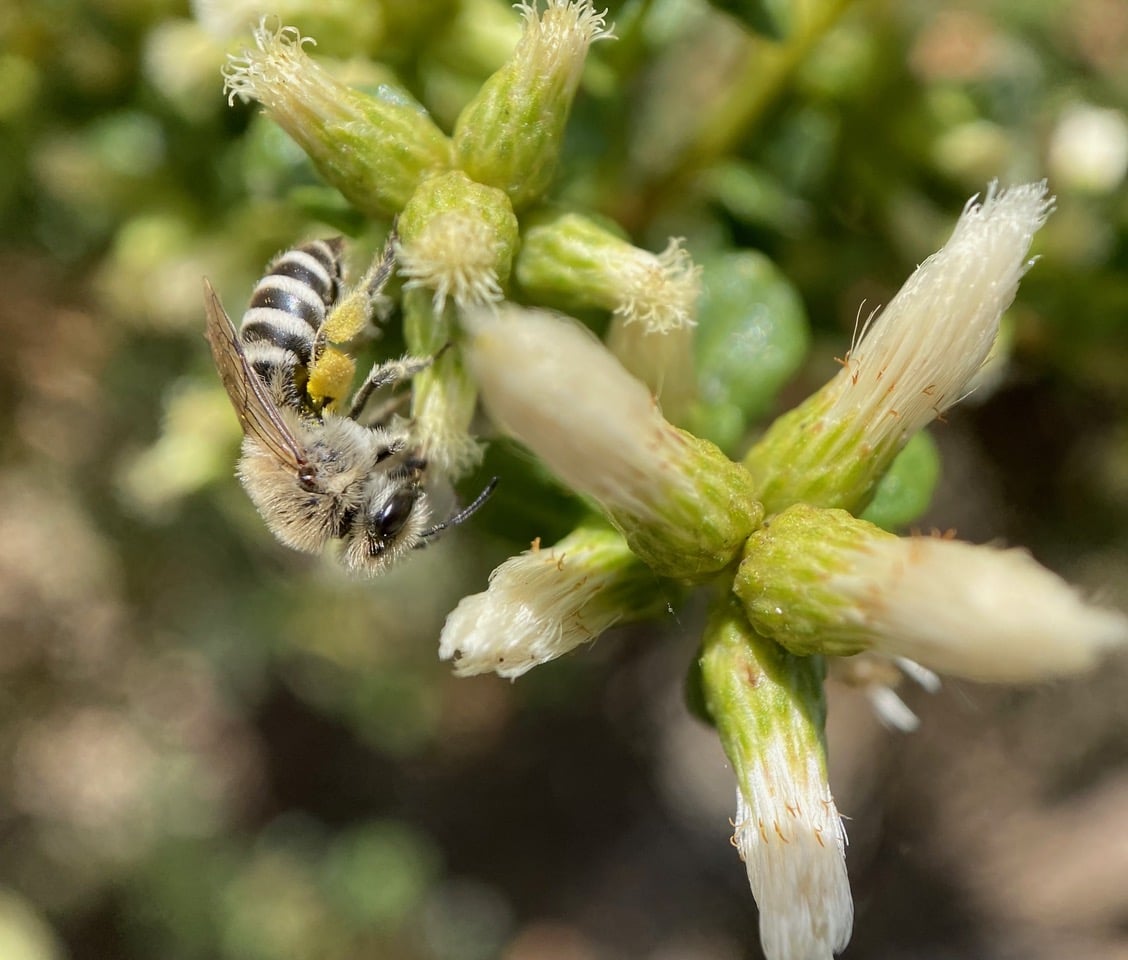
The Cellophane Bee, Colletes sp. (family Colletidae) is foraging on the female flowers of Coyote Brush. From the yellow pollen on her scopa, we can tell that it is female, as male bees do not collect pollen.
The bee family Colletidae includes generalists and specialists, and they are likely important pollinators of many wildflowers. All Colletidae in North America are solitary ground nesters, but some species nest in large aggregations. There are two major genera of Colletidae in North America: the Masked Bees (genus Hylaeus) and Cellophane Bees (genus Colletes). The most obvious shared characteristics of Colletidae is also the hardest to see: their short tongue. Colletes are moderately hairy, slender bees, ranging in size from 7 to 16 mm. Distinct features include a hairy head and thorax, pale bands of hair on the abdomen, and a heart-shaped head. The eyes of Colletes are angled (rather than being parallel), making the face slightly heart-shaped. The eyes of Colletes are angled (rather than being parallel), making the face slightly heart-shaped.
The genus name Colletes means “one who glues”, referring to their habit of applying a glue- or cellophane-like lining to the walls of nest cells, using their specialized tongues. This lining gives rise to their common names: cellophane bees, polyester bees, and plasterer bees. Colletes tongue is unique: short, flat, and forked at the tip. Colletes line their nests with a distinctive cellophane-like substance made from saliva and secretions from the Dufour’s gland on the abdomen. Using their specialized tongue, they paint the walls with saliva, then with secretions from the Dufour’s gland, they add a coat of varnish. This creates a clear covering that is strong, durable, and resistant to mold and water.

A wisp of a wasp lands on the shadowed side of a cluster of Baccharis flowerheads.
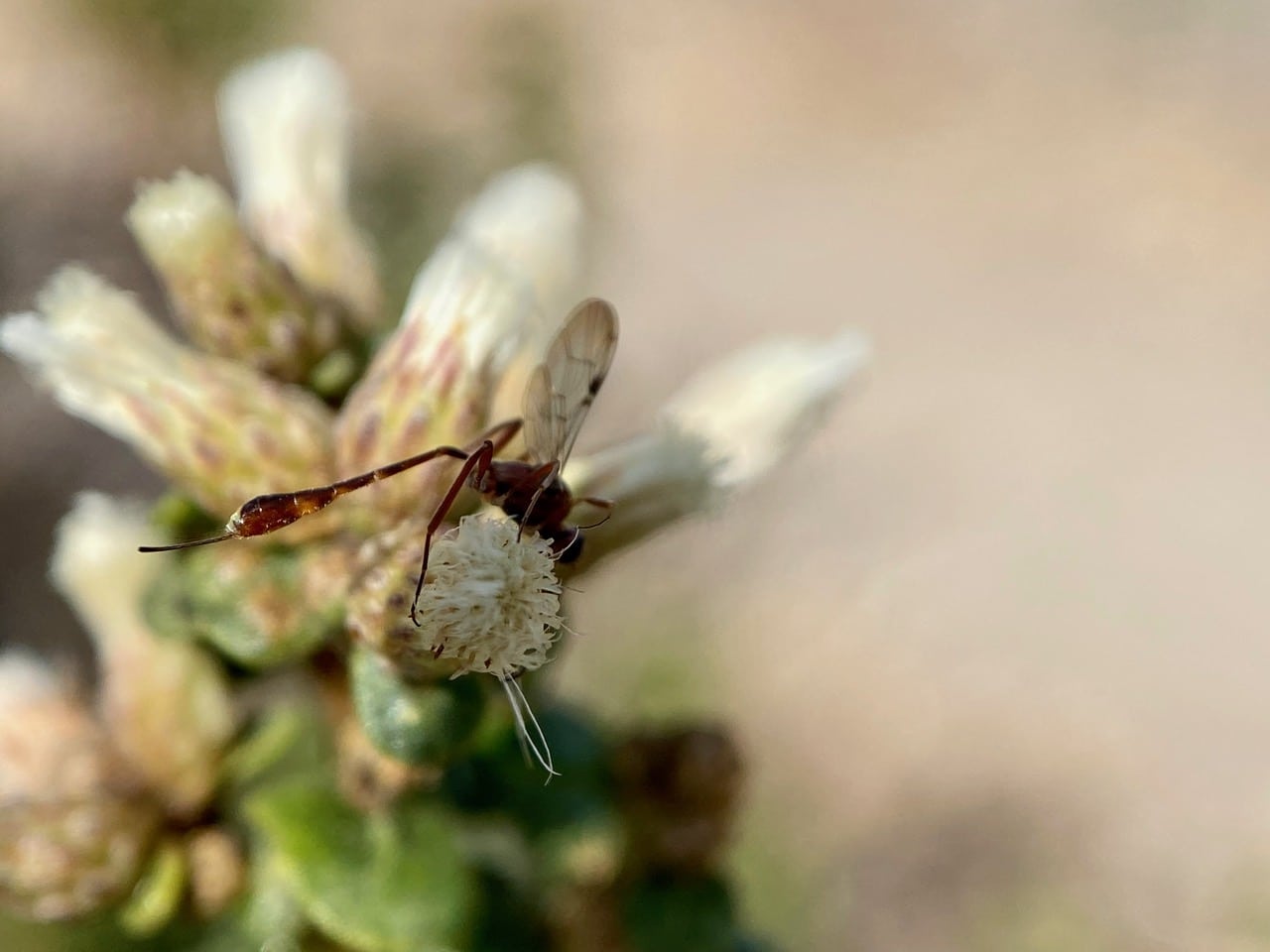
It appears to be a female parasitoid wasp with a distinct ovipositor at the tip of her abdomen.

Ah, she has long antennae and a white ring around her compound eyes. She is a parasitoid wasp, Anomalon sp. (family Ichneumonidae).
The Ichneumonidae, also known as the Ichneumon Wasps, or Ichneumonids, are a family of parasitoid wasps. They are one of the most diverse groups within the Hymenoptera (the order that includes the ants, wasps and bees) with about 25,000 species and counting. Ichneumon Wasps attack the immature stages of insects and spiders, eventually killing their hosts. They play an important role in the ecosystem as regulators of insect populations.
The Ichneumon Wasps have longer antennae than typical wasps, with 16 segments or more as opposed to 13 or fewer. Ichneumonid females have an unmodified ovipositor for laying eggs. They generally inject eggs either directly into their host’s body or onto its surface, and the process may require penetration of wood. After hatching, the Ichneumonid larva consumes its still living host. The most common hosts are larvae or pupae of Lepidoptera (butterflies and moths), Coleoptera (beetles) and Hymenoptera. Adult Ichneumonids feed on plant sap and nectar. Females spend much of their active time searching for hosts while the males are constantly on the look out for females. Many Ichneumonids are associated with specific prey, and Ichneumonids are considered effective biological controls of some pest species.
Anomalon is a large genus of parasitoid wasps in the family Ichneumonidae. The wasps are present worldwide, but most diverse in tropical regions. In the Americas they are mostly found in very wet rain forests. Recorded hosts include tenebrionid (darkling beetle) or elaterid (click beetle) larvae, and noctuid and tortricid moth larvae.