

Pollinator Post 8/22/25
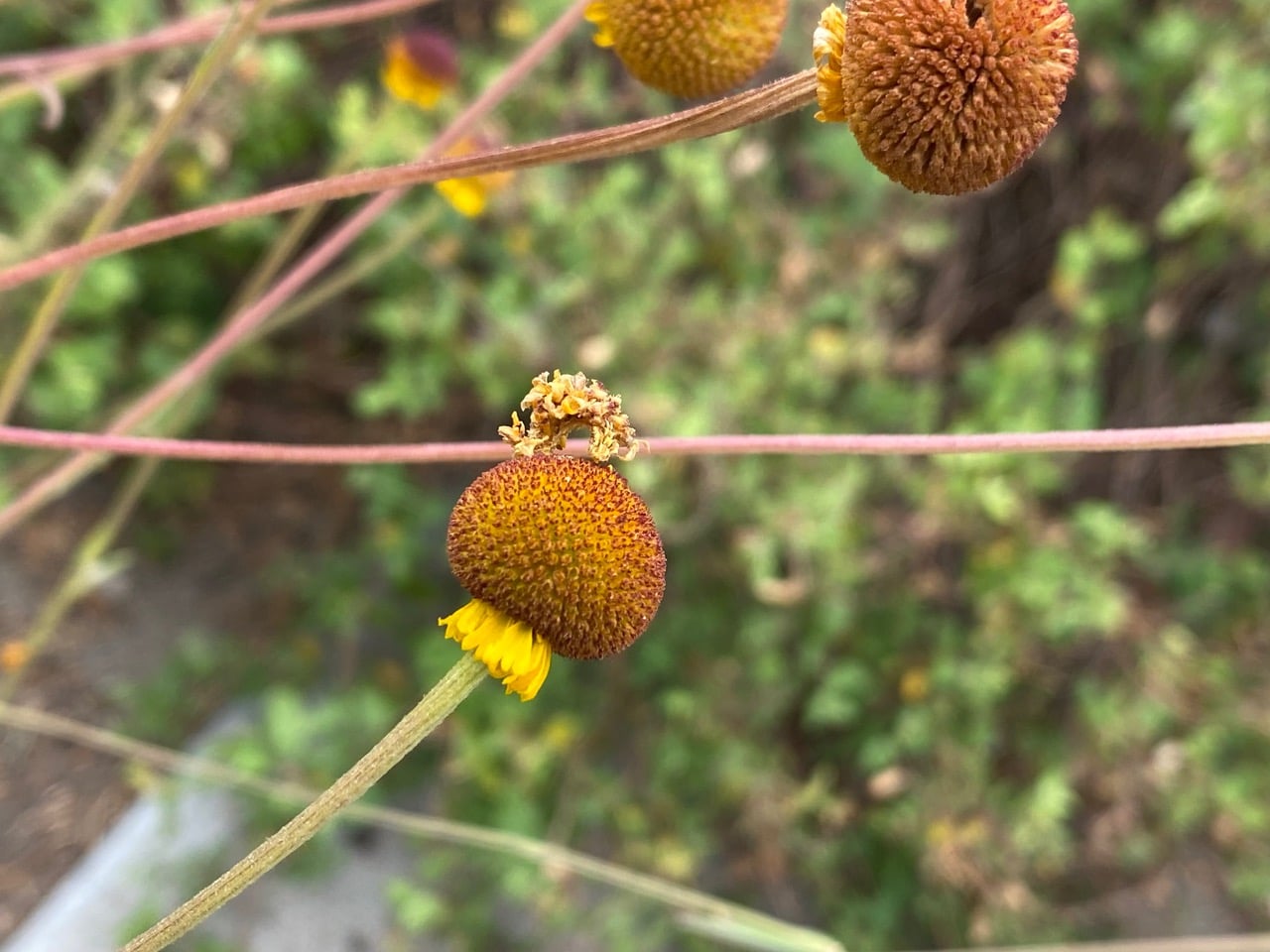
When the air clears a little this morning, I eagerly make my way to Crab Cove for a much needed walk after being house-bound for the last couple of days.
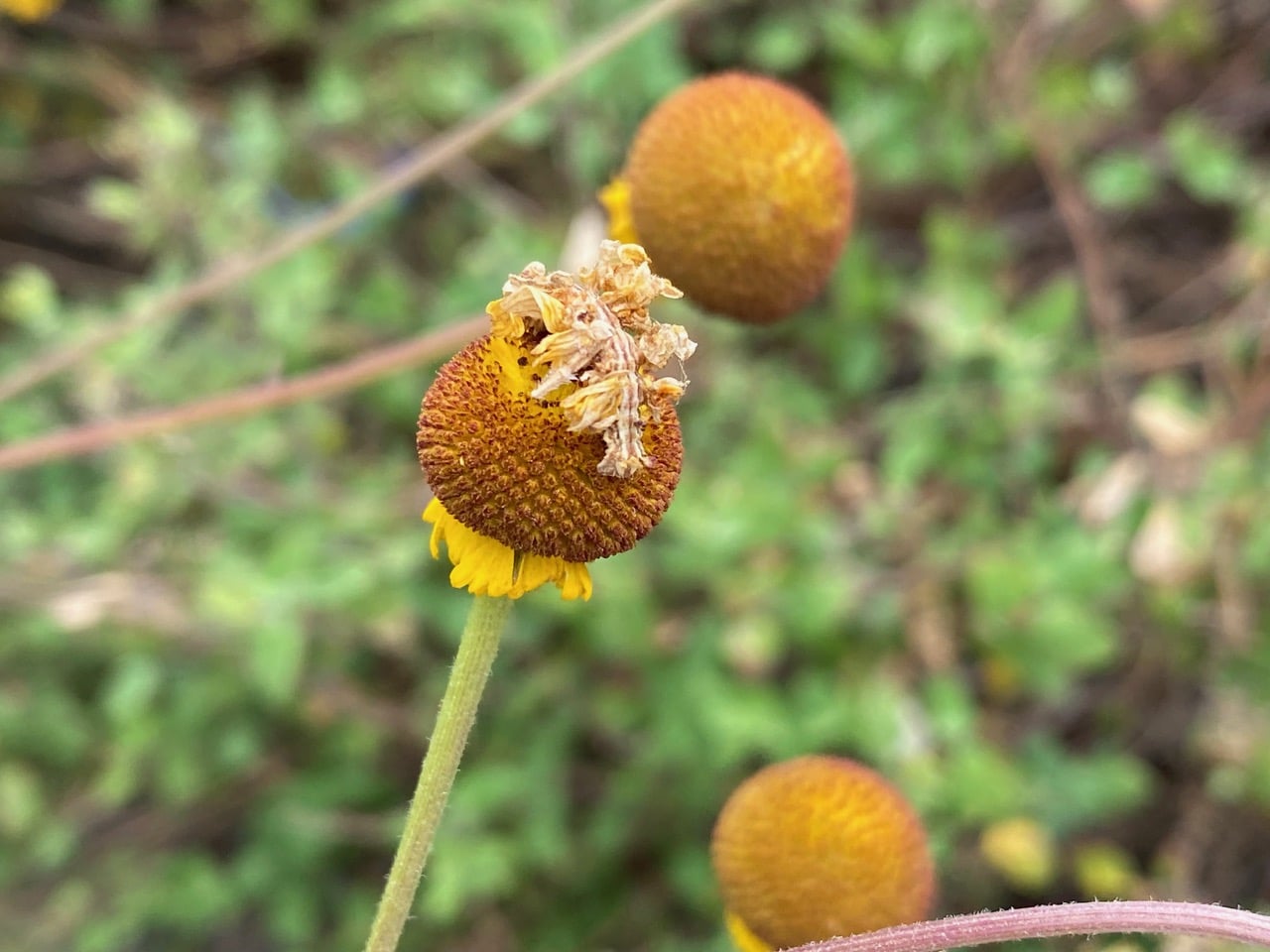
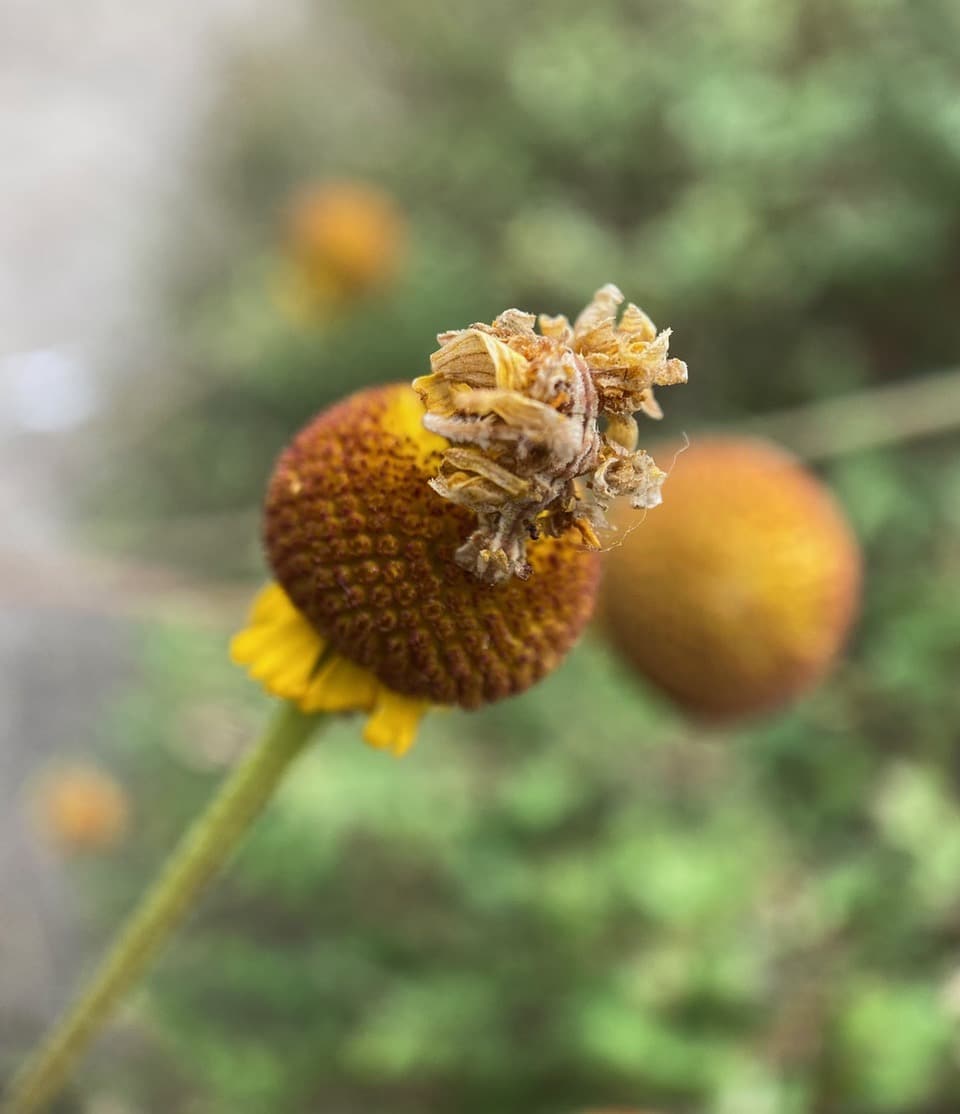
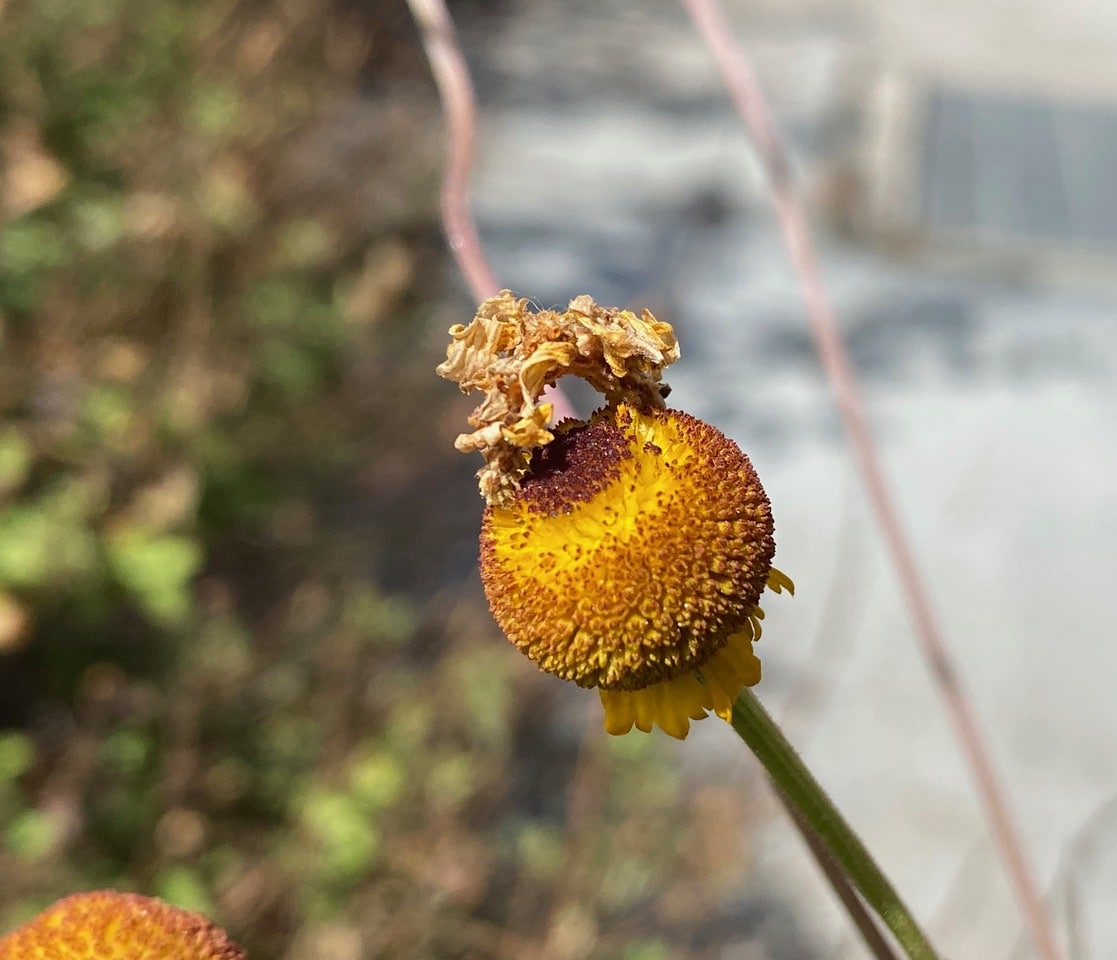
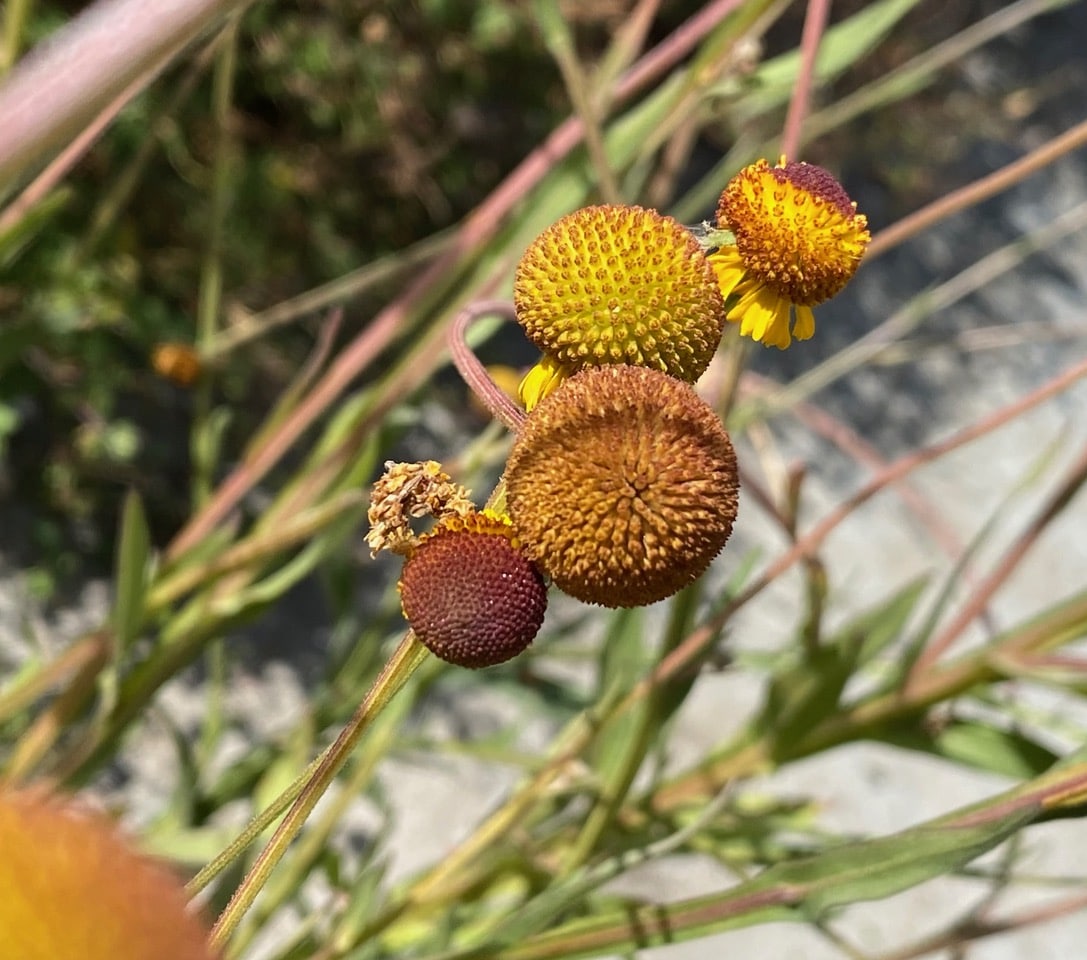
I find myself playing a solo game of Spot-the-Caterpillar in front of the Sneezeweed, Helenium puberulum. It only takes me a minute to find my first Camouflage Looper today, having encountered one here on 8/22.
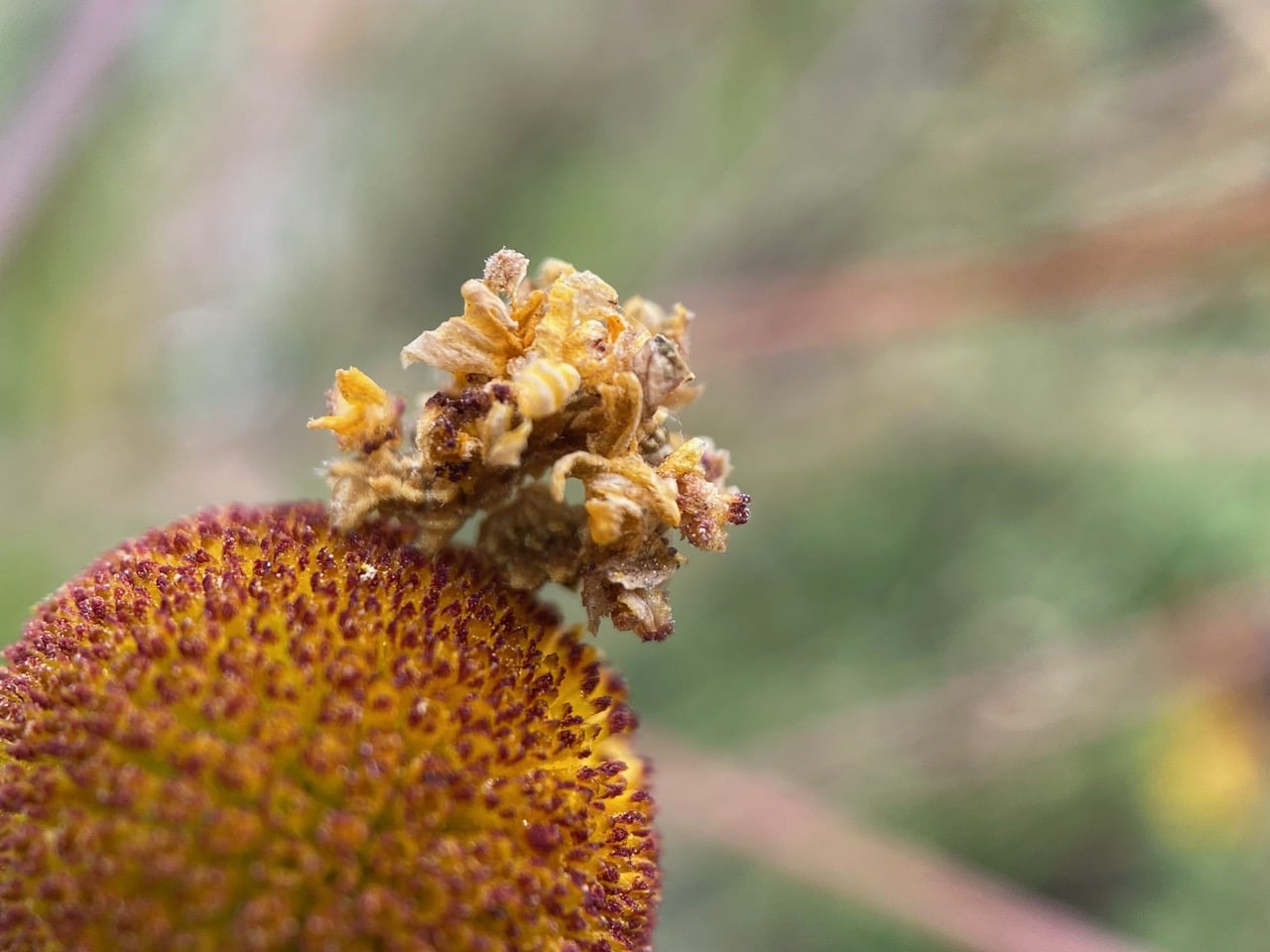
It is impossible to tell head or tail from the jumble of floral debris, but I know there’s a caterpillar in there.
The Camouflage Looper is the inchworm caterpillar of the Wavy-lined Emerald Moth, Synchlora aerata (family Geometridae). While most inchworms are well camouflaged, the Camouflage Looper has taken the charade to a different level. It is able to disguise itself by attaching pieces of plant to its back. The inchworm bites off pieces of the particular flower it is feeding on and uses gelatinous “spit” or liquid silk from its mouth to glue the flower pieces to the spines on its back. The “spit” also helps stiffen the flower parts and keep them looking fresh. When parts fall off or start to dry out, they are replaced. When the caterpillar begins feeding on a different kind of flower, it discards the previous disguise and replaces it with the new flower.
The disguise worn by the Camouflage Looper is an adaptation probably most useful for hiding from hungry birds. Most caterpillars have some level of camouflage; some look like bark, twigs, thorns, and even bird droppings, but very few can alter their appearance over time. Scientists figure the Camouflage Looper’s ability to change disguises allows it to have a much more varied diet than other caterpillars because it isn’t restricted to eating only those flowers or plant parts that it resembles in appearance. The Camouflage Looper feeds on a wide variety of plants, but composite flowers (Asteraceae) are its favorites. The caterpillars also feed on a variety of shrubs and trees.
Although not mentioned anywhere, might the attached flower parts also deter parasitoid wasps from laying eggs in the caterpillars?
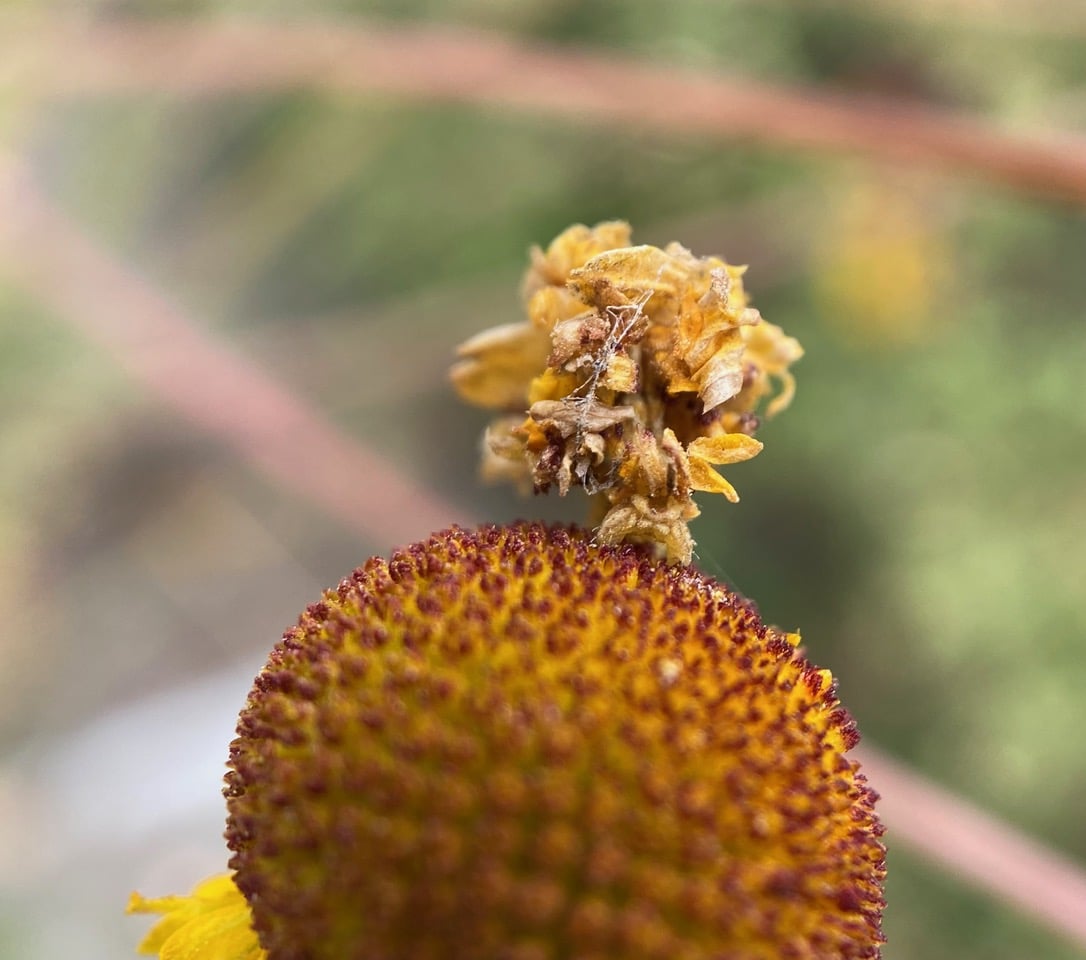
Ah, I think this is the hind end of the looper. It has its anal prolegs firmly planted on the flowerhead. Note the stray strands of silk from its work attaching the bits of flower parts to its body.
All caterpillars have three pairs of jointed legs behind their heads. These legs are called true legs because they will become the six legs of the adult butterfly or moth. There are additional appendages, called prolegs, along their bodies. Prolegs are not true legs, they are just outgrowths of the body wall and will be lost at metamorphosis. They have little hooks on their soles to help the caterpillar walk and grip onto things.
Most caterpillars have five sets of prolegs, four in the middle of the body and one pair at the hind end. Inchworms have the normal six true legs but only two or three pairs of prolegs, all located at the tail end of the body, with none in the middle. When an inchworm walks, it moves its tail-end prolegs up behind its true legs, causing the center of its body to loop upward. Then it stretches its front end forward to take another step.
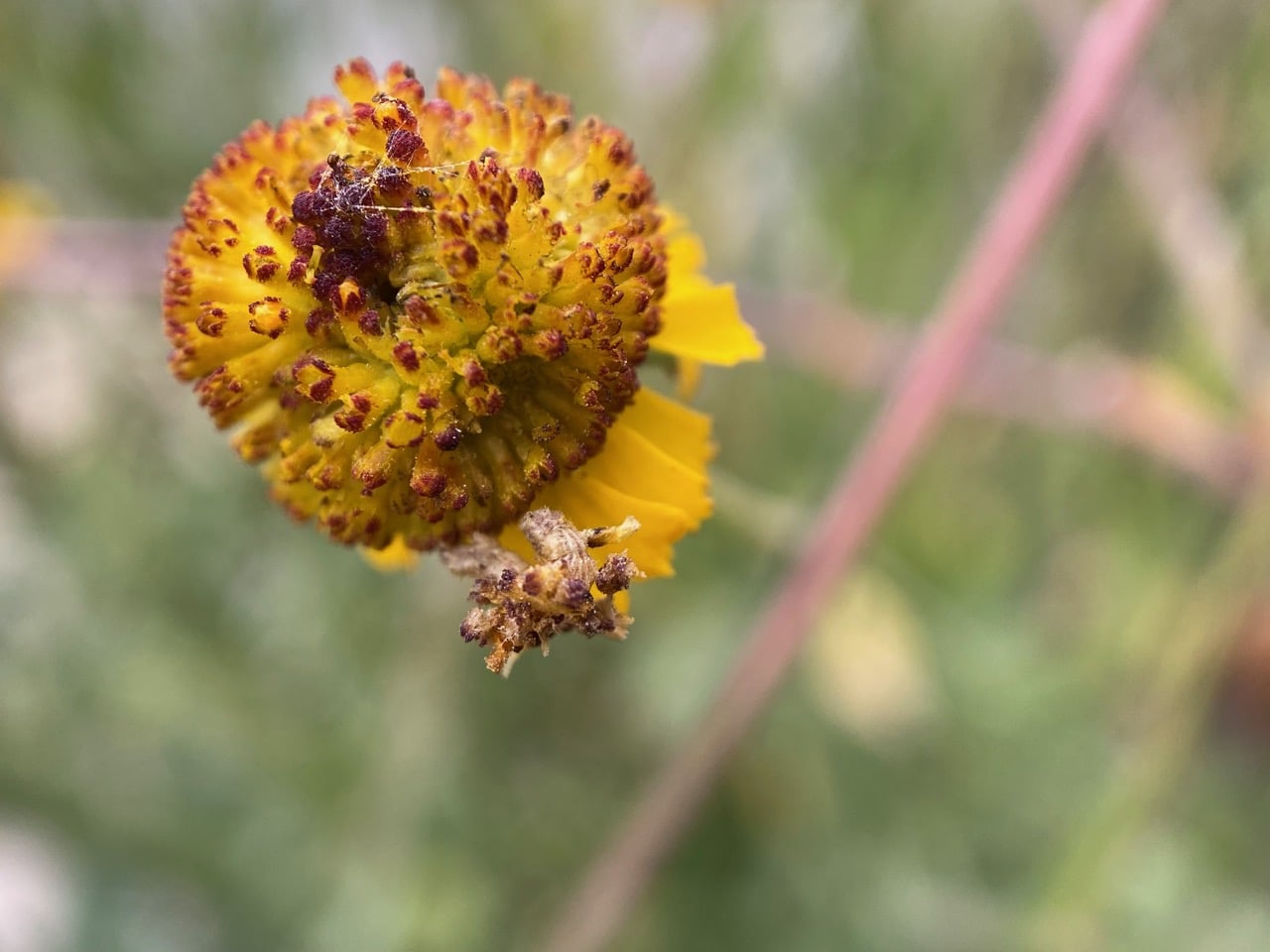
Here’s a smaller Camouflage Looper on a different flowerhead. Its disguise is much less elaborate. Note the missing bits of flowers on the flowerhead from which the caterpillar probably assembled its costume.
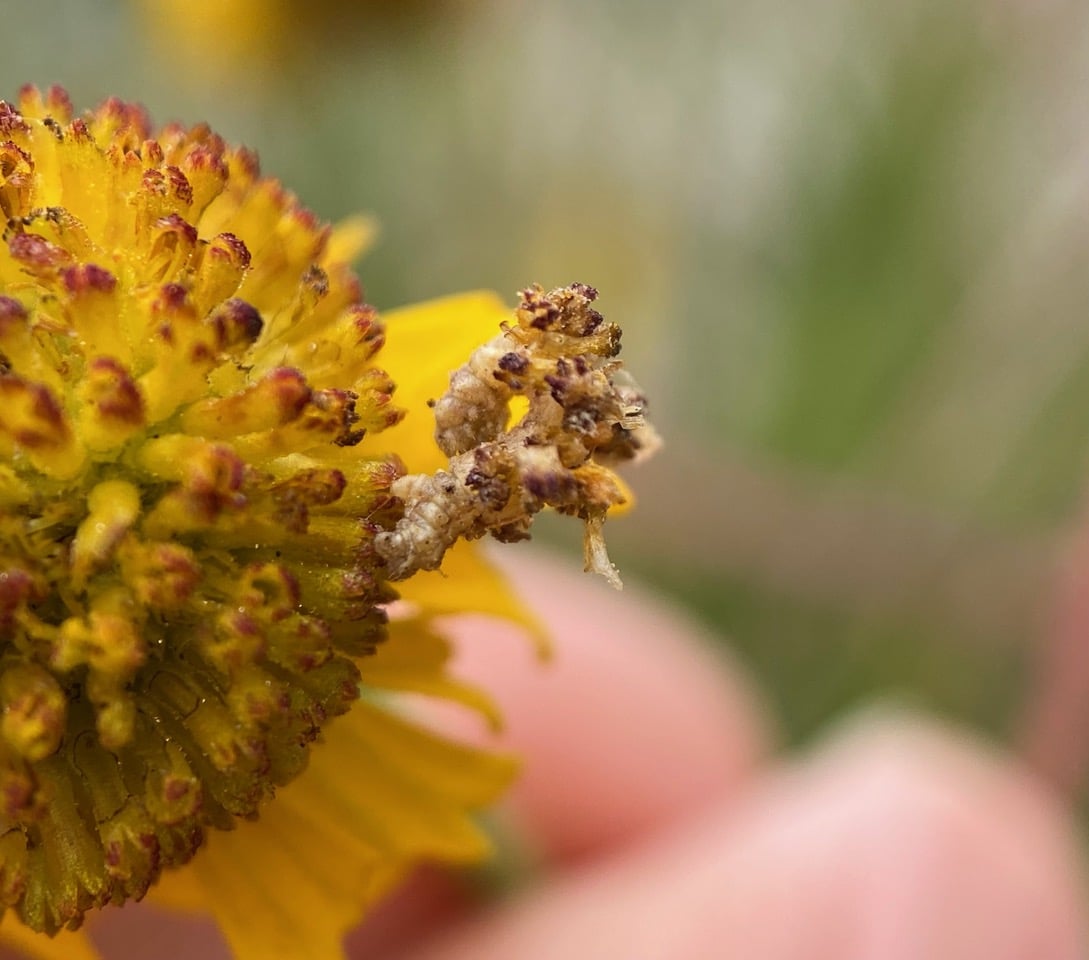

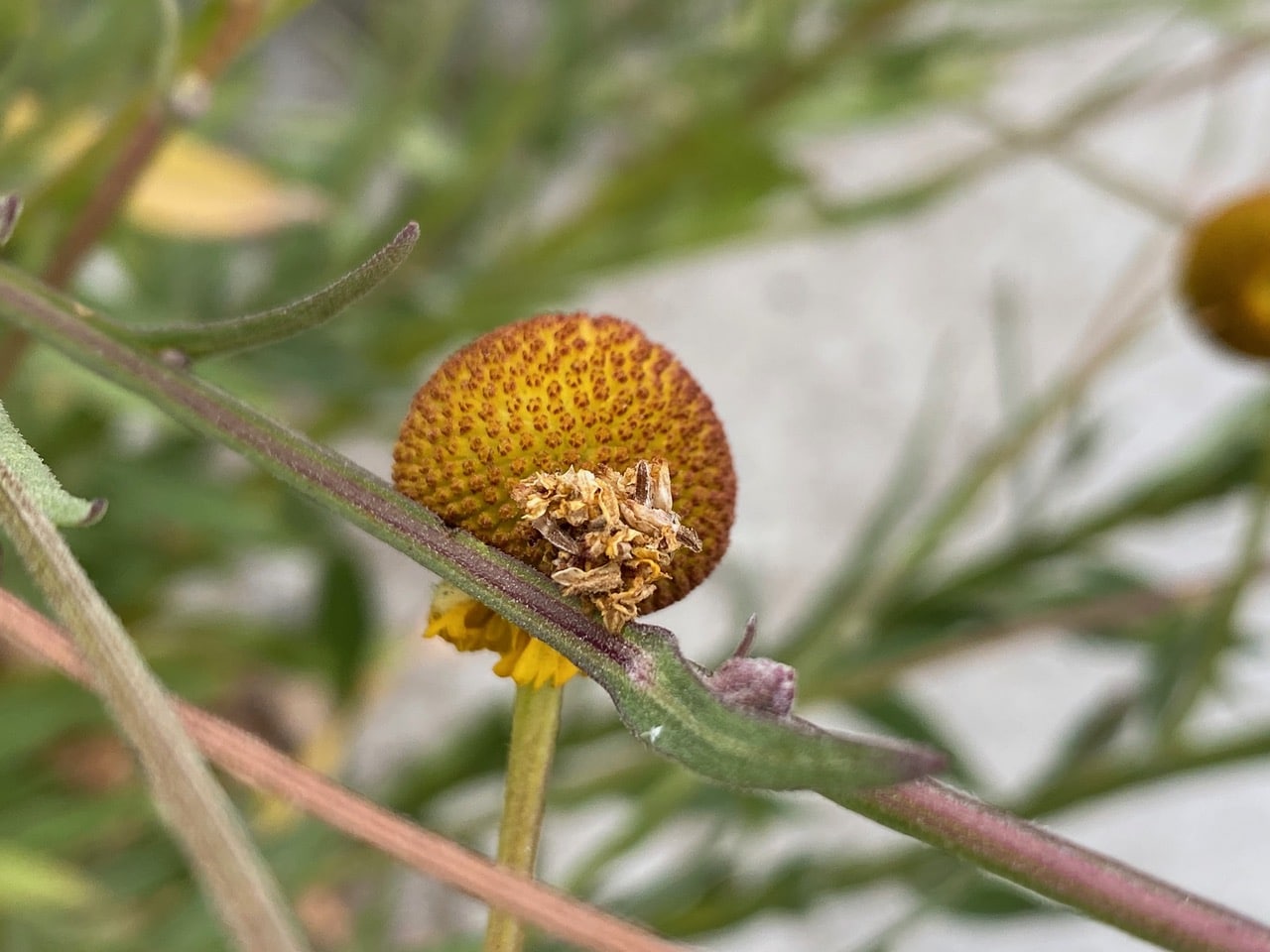
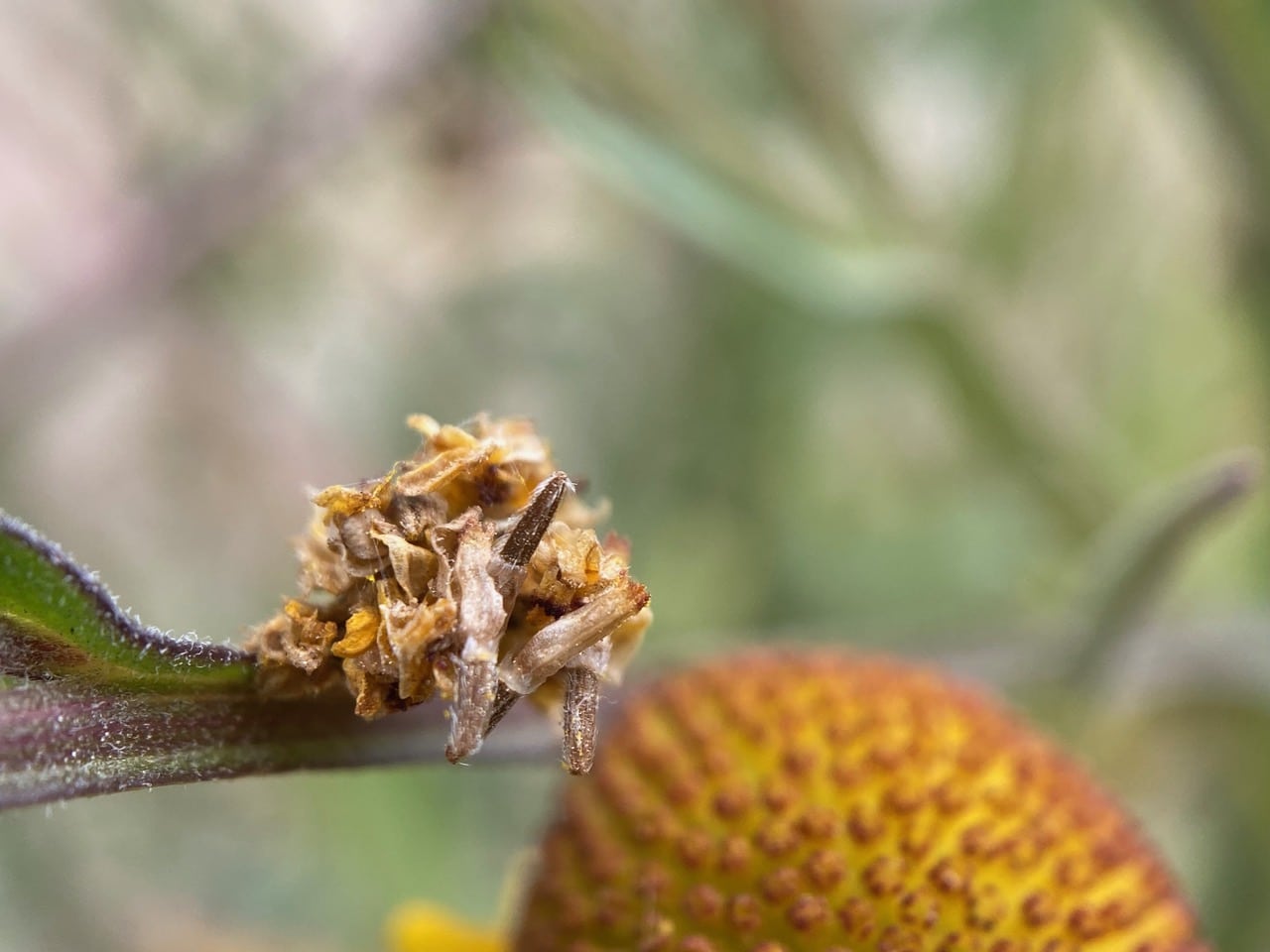




Close-up of the caterpillar shows its bumpy body. Its front end is raised in the manner of an inchworm slowly “inching” its way on the flowerhead.
Ooh, here’s a third Camouflage Looper! You can actually see the longitudinal stripes on its body in this view.
The same caterpillar as it raises the legless middle section of its body.
Extreme close-up of the rear end of the caterpillar shows the rough, bumpy texture and the short spines of its skin – all the better for attaching the flower bits for camouflage.
Here’s a peek at the caterpillar’s head.
These Sneezeweed flowerheads have been entangled, probably by the wind. Do you see a Camouflage Looper on the lowest flowerhead? It’s a mere cake walk for this inchworm to travel from one flowerhead to the next, without having to climb up and down the flower stalks.
Hey, here’s another Camouflage Looper on the Sneezeweed. Fully decked out, this one is not on the flowerhead, but on the stem. Is it moving to another flowerhead, or maybe it’s making its way to pupate in the ground?
A close-up on the other side shows that the caterpillar has been rummaging in a mature flowerhead. It has incorporated several seeds in its disguise. Five Camouflage Loopers on the same plant – it’s been a productive morning already!
I next explore the Oregon Gumweed, Grindelia stricta blooming on the edges of the spit that encloses the marina on Ballena Bay.
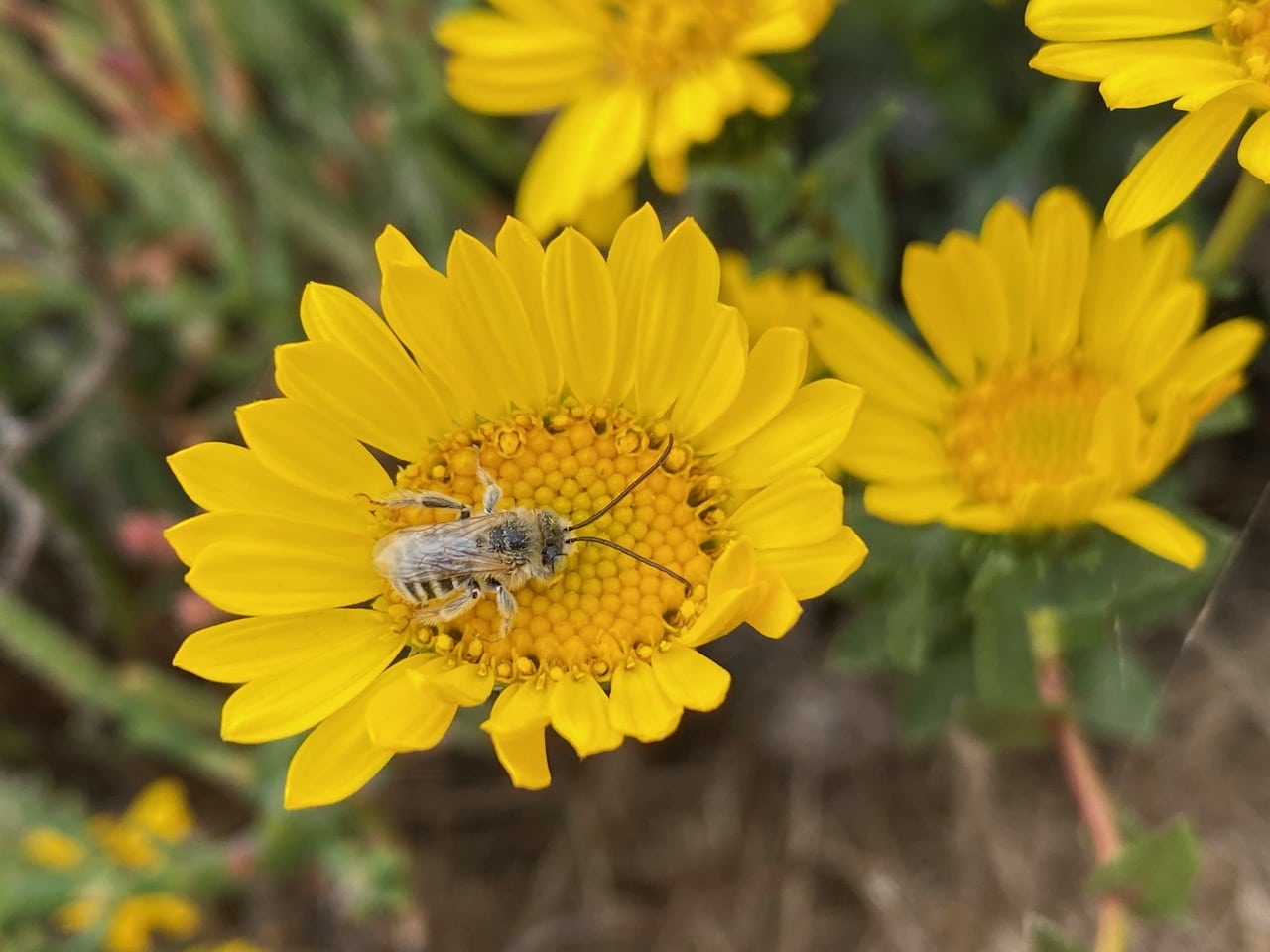
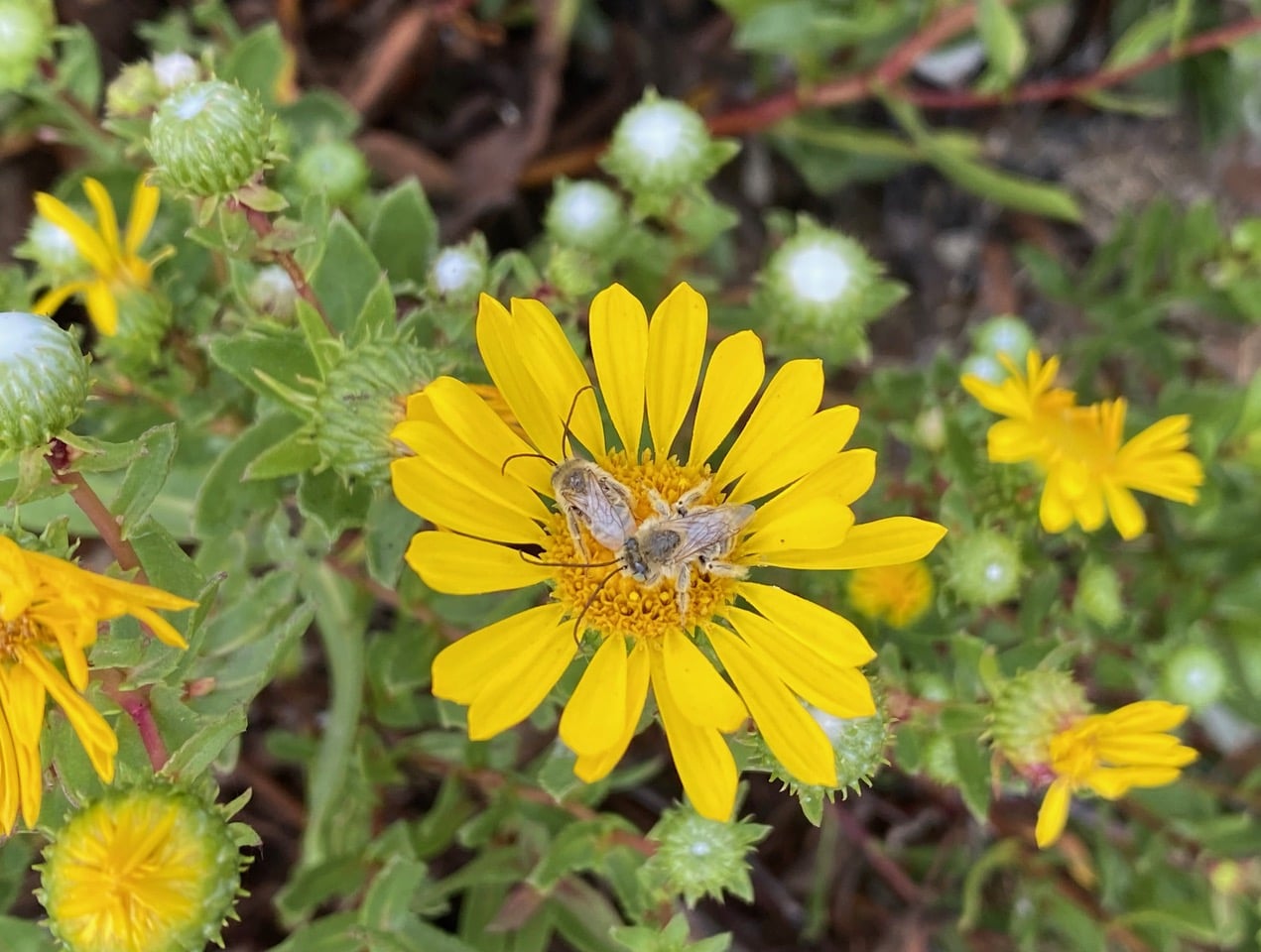
Many male Longhorn Bees, Melissodes sp. (family Apidae) are still asleep on the Grindelia flowerheads. These bees seem to be doing really well this year, seen in abundance everywhere in Alameda.
The Summer Longhorn Bees, Melissodes sp. (family Apidae) are medium to large bees, stout-bodied, usually with gray hair on the thorax and pale hair bands on the abdomen. Males usually have yellow markings on their faces and have very long antennae from which their common name is derived. They are active May to September, with peak flight in late June to early August. The females prefer flat, bare ground for digging their solitary nests, though they sometimes nest in aggregations. Pollen is transported in scopae on the hind legs. Pollen loads are often copious and brightly colored and thus very distinguishable. Melissodes are specialists on Asteraceae – females gather pollen from flowers of Aster, Bidens, Coreopsis, Cosmos, Encelia, Gaillardia, Helianthus, and Rudbeckia ssp.
Aww, how sweet! Two male Longhorn Bees are sleeping together on the same Grindelia flowerhead. Male Longhorn Bees often sleep in aggregations. Sometimes a dozen of more individuals may share the same large flower or flowerhead or inflorescence. Their roosts are not limited to native plants. They are often seen sleeping on non-native garden ornamentals such as Lavender and Cosmos, but always close to plants in the sunflower family, Asteraceae. Female Longhorn Bees are specialists, collecting pollen exclusively from flowers of Asteraceae.
Male Longhorn Bees sleep in aggregations for safety and social benefits, while females sleep alone in nests. Unlike females, which dig and provision underground burrows, males do not have a nest to return to at night. Instead, they exhibit communal roosting behavior, often gripping onto a plant stem of flower with their jaws until morning. When bees gather in groups, they reduce the risk of any single individual being eaten. The “dilution effect” means a predator is less likely to target any specific bee within a large group. Communal roosting can also decrease the individual bee’s need for thermoregulation, as the group helps retain warmth. The male’s sleeping aggregations are often near female nesting sites – the males are essentially waiting for females to emerge.
This male Longhorn Bee, Melissodes sp. (family Apidae) just woke up. He is thoroughly grooming himself before flying off. The male Longhorn Bees have a habit of grooming before they go to sleep and first thing when they wake up.
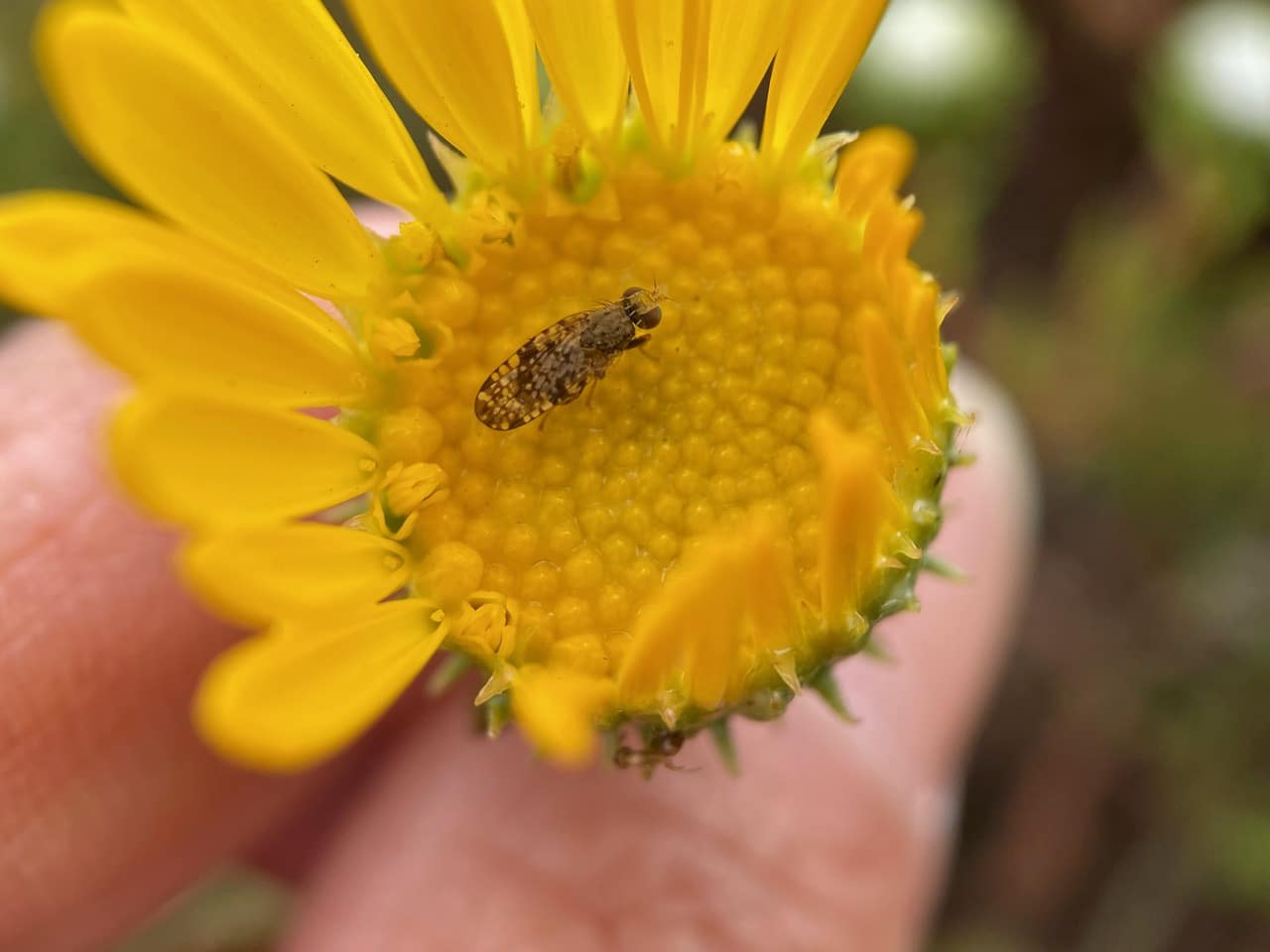
A Fruit Fly, Campiglossa sp. (family Tephritidae) is perched on a fresh Grindelia flowerhead.
Tephritids are small to medium-sized flies that are often colorful, and usually with picture wings. The larvae of almost all Tephritidae are phytophagous. Females deposit eggs in living, healthy plant tissues using their telescopic ovipositors. Here the larvae find their food upon emerging. The larvae develop in leaves, stems, flowers, seeds, fruits, and roots of the host plant, depending on the species. Adults are often found on the host plant and feeding on pollen, nectar, rotting plant debris, or honeydew. Tephritid flies are of major economic importance as they can cause damage to fruit and other plant crops. On the other hand, some Tephritids are used as agents of biological control of noxious weeds.
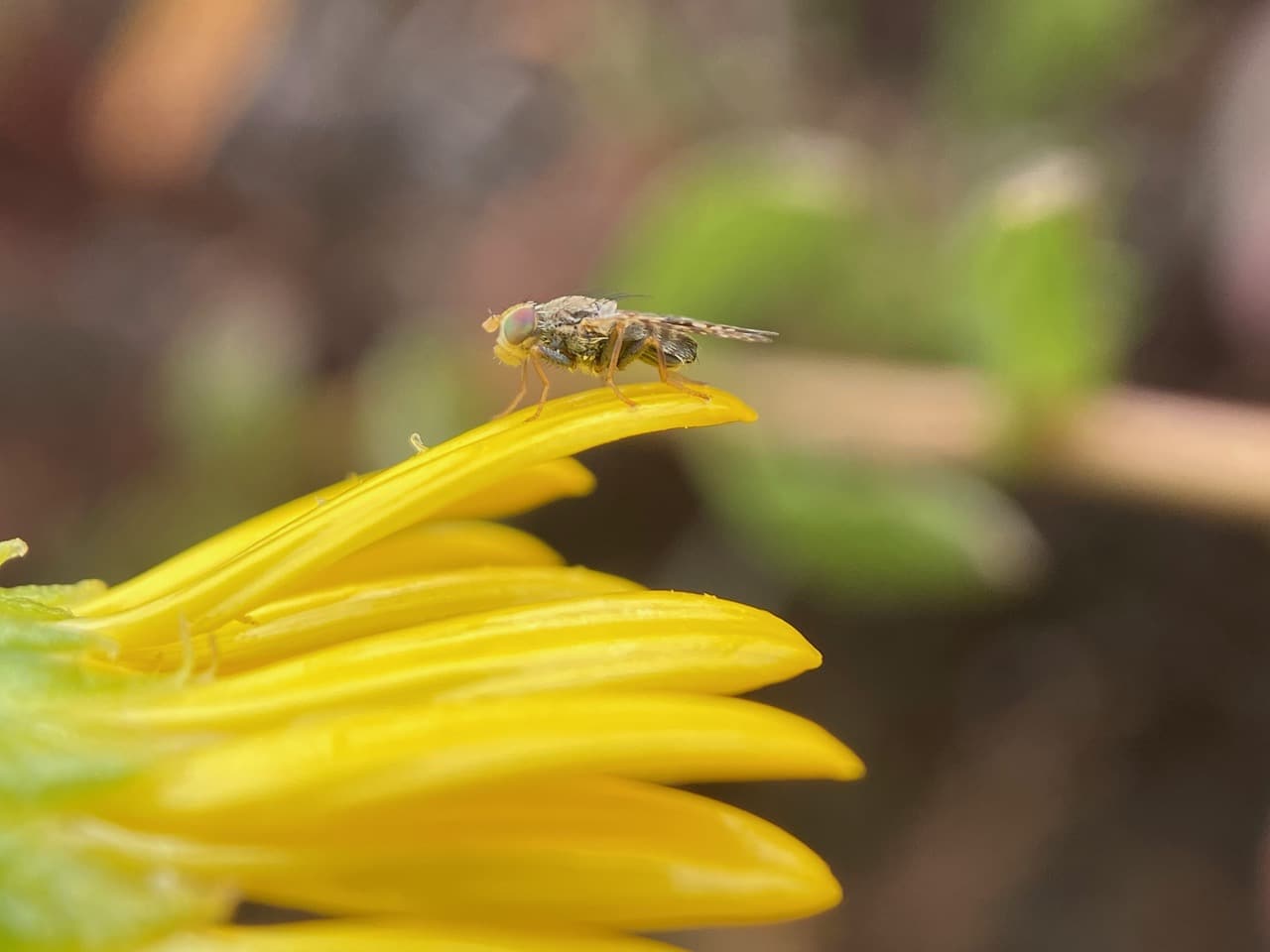
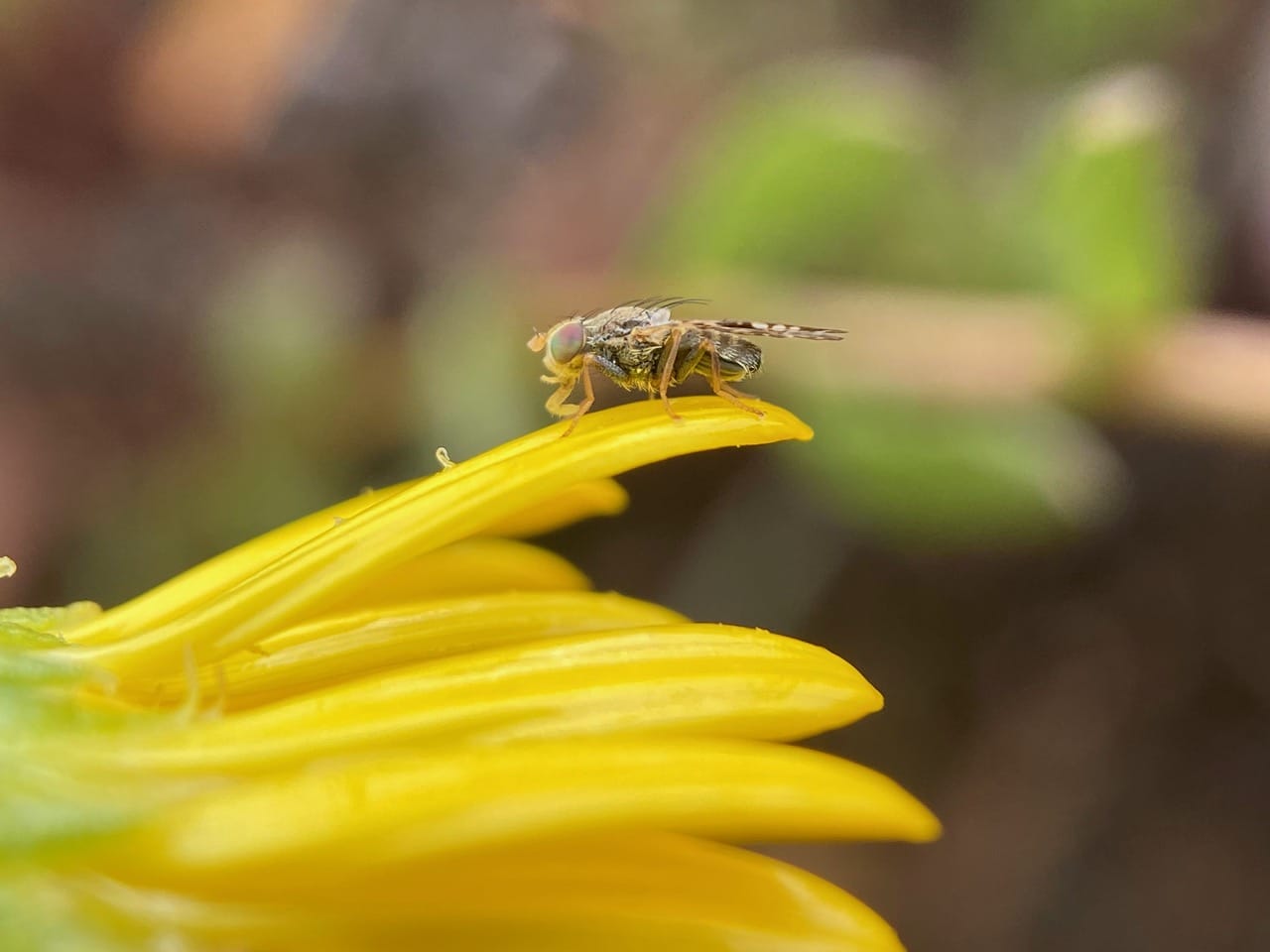
Wary of my approach, the Fruit Fly flees to a ray petal. It appears to be a male, lacking the oviscape at the end of its abdomen. Female Fruits Flies are easily distinguished by the presence of an oviscape – the pointy structure at the tip of their abdomen. The oviscape is the basal part of the ovipositor, the non-retractile sheath that protects the ovipositor. It remains exposed when the ovipositor is withdrawn and not in action.
I wasn’t prepared for what happens next. The fly extends its jointed, sponging mouthparts.
Like many flies, Fruite Flies have sponging mouthparts specifically adapted to liquid feeding, enabling them to regurgitate digestive enzymes onto solid food (such as rotting fruit) and then absorb the liquefied meal through their specialized labella.
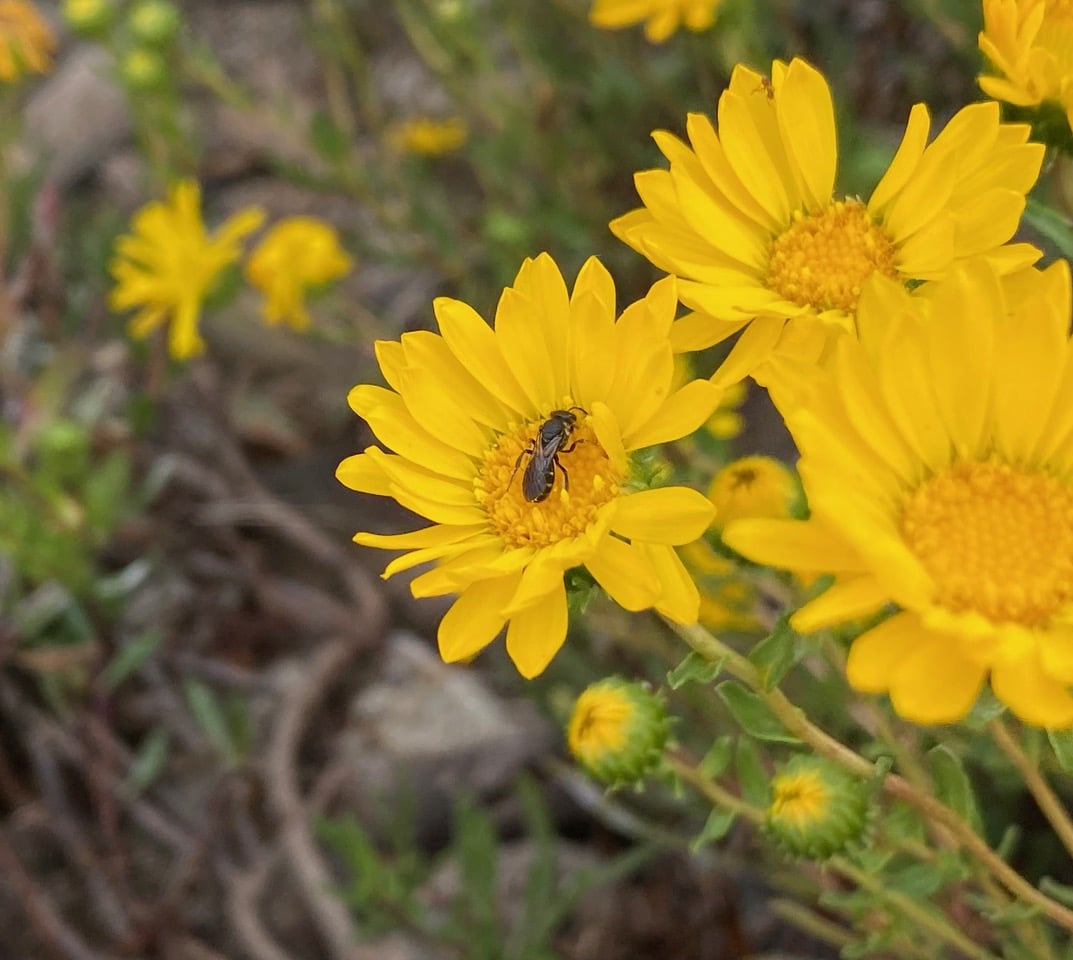
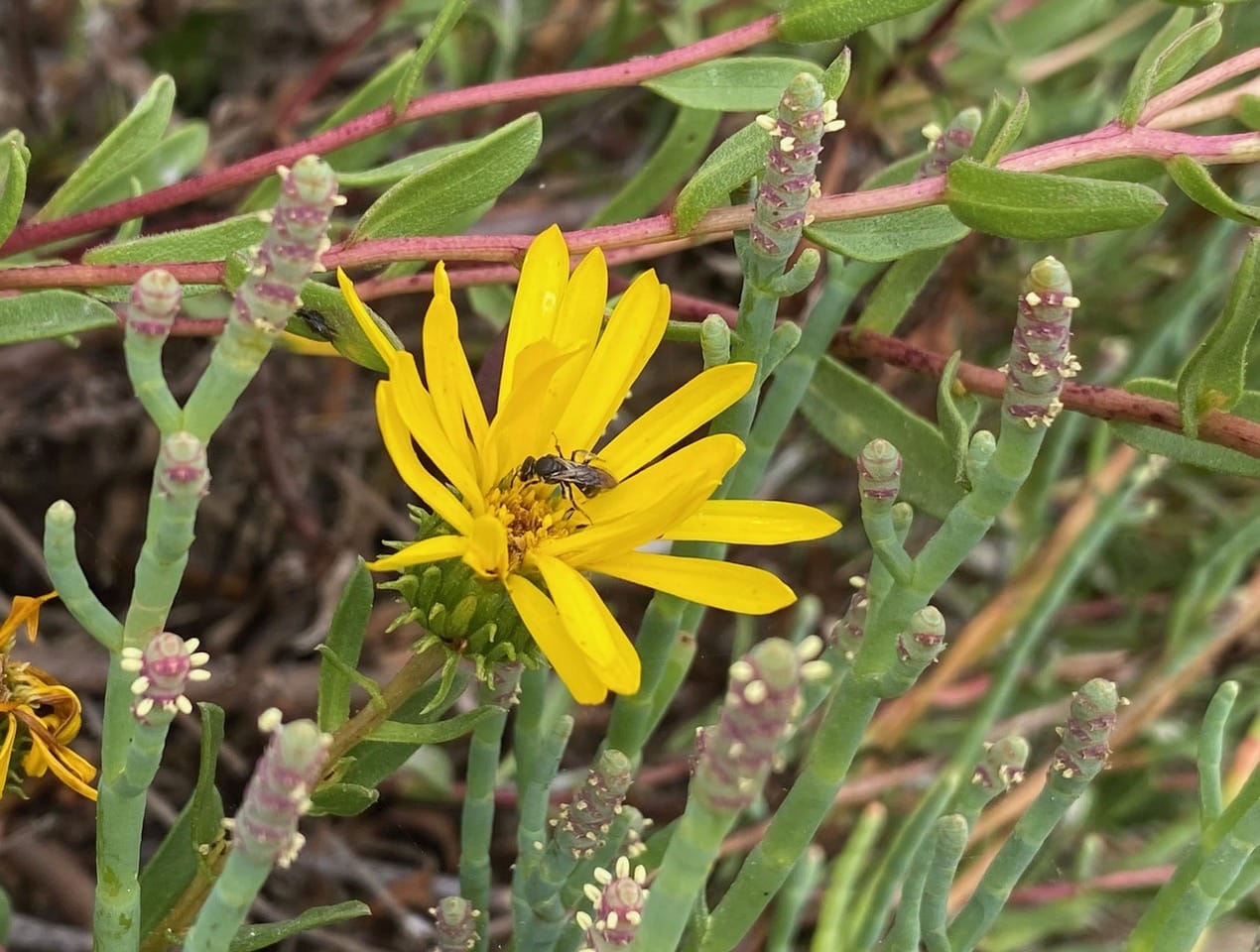
Today I am seeing quite a few of these small black bees foraging on the Grindelia. They are a bit too large to be the Tripartite Sweat Bees. They are black with fine, white stripes on the abdomen under dark, smokey wings.
The black bees are the Kincaid’s Sweat Bees, Lasioglossum kincaidii (family Halictidae).
Lasioglossum species are found worldwide, and they constitute the largest bee genus. The majority of Lasioglossum are generalists. Because they are so abundant throughout the flowering season, the bees are often important pollinators. Their sheer numbers are enough to achieve excellent pollination of many wild flowers, especially of plants in the Asteraceae, which have shallow floral tubes that are easily accessed by these minute bees.
Lasioglossum exhibit a range of social behaviors; the genus includes solitary, communal, semi social, primitively eusocial, and even parasitic species. Almost all Lasioglossum in the U.S. nest in the ground. Generally these nests are built in the spring by fertilized females (called foundresses) that spent the winter in hibernation. In social species, the foundresses behave much like the queen Bumble Bees – they lay the first batch of eggs that develop into the first generation of female workers. The nest grows with each additional generation of bees. Later broods may consist of both males and females. They mate, and at the end of the season the fertilized females hibernate til the following spring, repeating the life cycle of the colony.
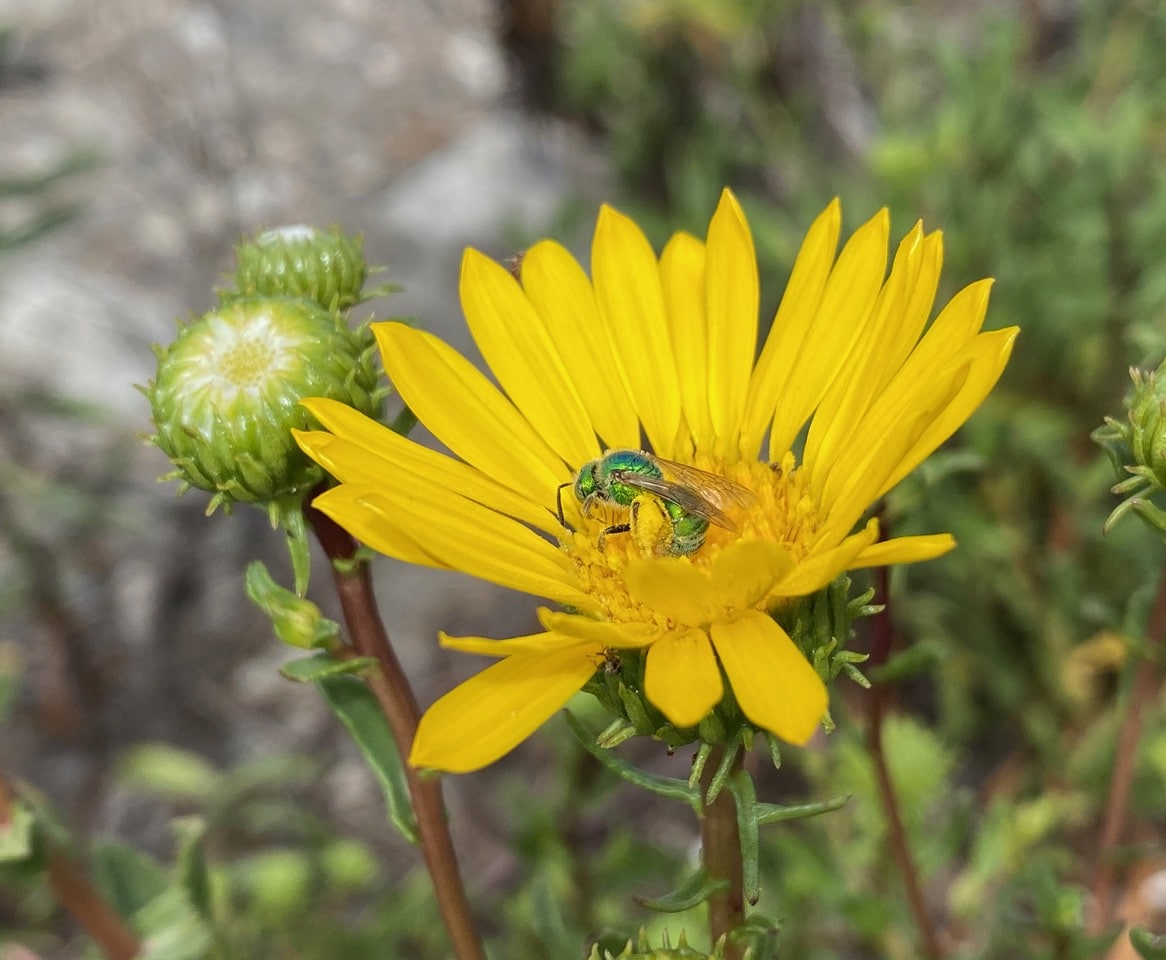
A female Fine Striped Sweat Bee, Agapostemon subtilior (family Halictidae) is collecting pollen on a Grindelia flowerhead.
Agapostemon are brightly colored metallic green or blue bees measuring 7 to 14.5 mm long. Most species have a metallic green head and thorax, and black-and-yellow striped abdomen; some females are entirely bright green or blue. Females carry pollen on scopal hairs located on their hind legs. Agapostemon are generalists. Like other members of the family Halictidae, they are short-tongued and thus have difficulty extracting nectar from deep flowers. Males are often seen flying slowly around flowers looking for females. The bees favor flowers with high densities. Females excavate nests in the ground. These bees are active summer through fall.
Fine striped sweat bee (Agapostemon subtilior) · iNaturalist
What is that Twenty-spotted Lady Beetle doing in the gummy exudate on the immature Grindelia flowerhead? Is it alive? It is not moving. I try to fish it out with a twig, only to find that the sticky white exudate has hardened, trapping the little beetle in its demise.
The sticky, white exudate on immature Grindelia flowerheads is a protective, antimicrobial resin that helps the plant defend itself from insects, herbivores, and pathogens. It is the source of the plant’s common name, “gumweed”. The resin is produced by special glands, called trichomes, that are most abundant on the flowerheads and leaves. Production is highest on the buds right before they open, appearing first as a clear, viscous liquid. As it dries and dehydrates, it becomes the stickier, white substance for which the plant is known. In addition to repelling larger herbivores, the viscous resin can trap smaller insects that come in contact with the buds. The resin in rich in antimicrobial compounds, such as grindelic acid and other diterpenes, that inhibit the growth of bacteria and fungi.
The Twenty-spotted Lady Beetle, Psyllobora vigintimaculata (family Coccinellidae) is found in North America, especially the west coast. It is a small lady beetle, measuring only 2-3 mm in length. The elytra have dark, gold or bicolored spots on a white background. There are four or five distinctive dark spots on the pronotum arranged in an “M” shape. The patterns on the elytra are highly variable. The species is found in early spring, occurring in numbers on the foliage of various shrubs. In summer and fall, they are often found on plants with powdery mildew on which the beetles feed. It has been proposed that the beetles be used as an alternative to fungicides for the control of the fungus in agricultural settings. How about that – a Lady Beetle that doesn’t eat aphids!
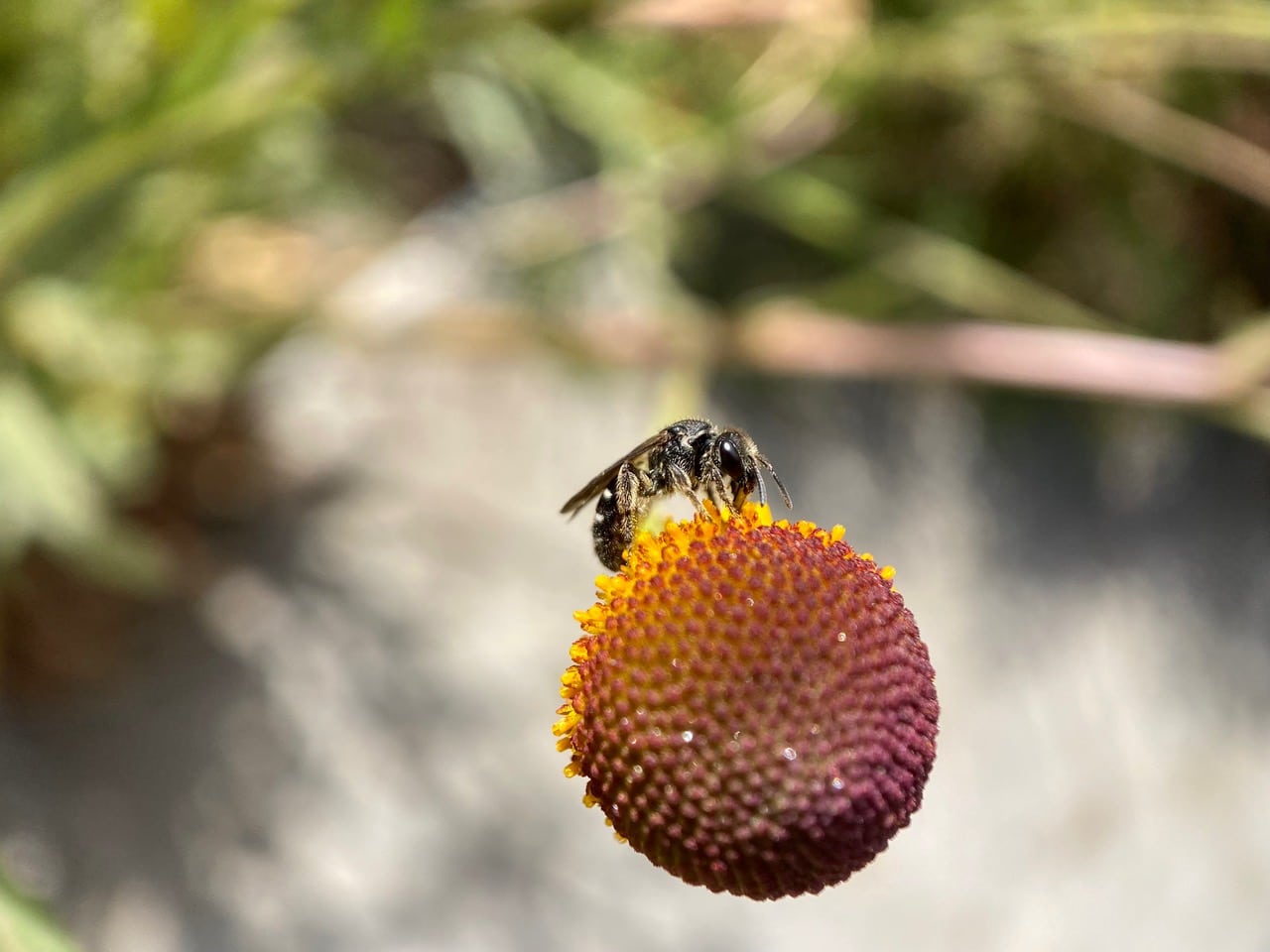
A Kincaid’s Sweat Bee, Lasioglossum kincaidii (family Halictidae) is foraging on a flowerhead of Sneezeweed, Helenium puberulum.
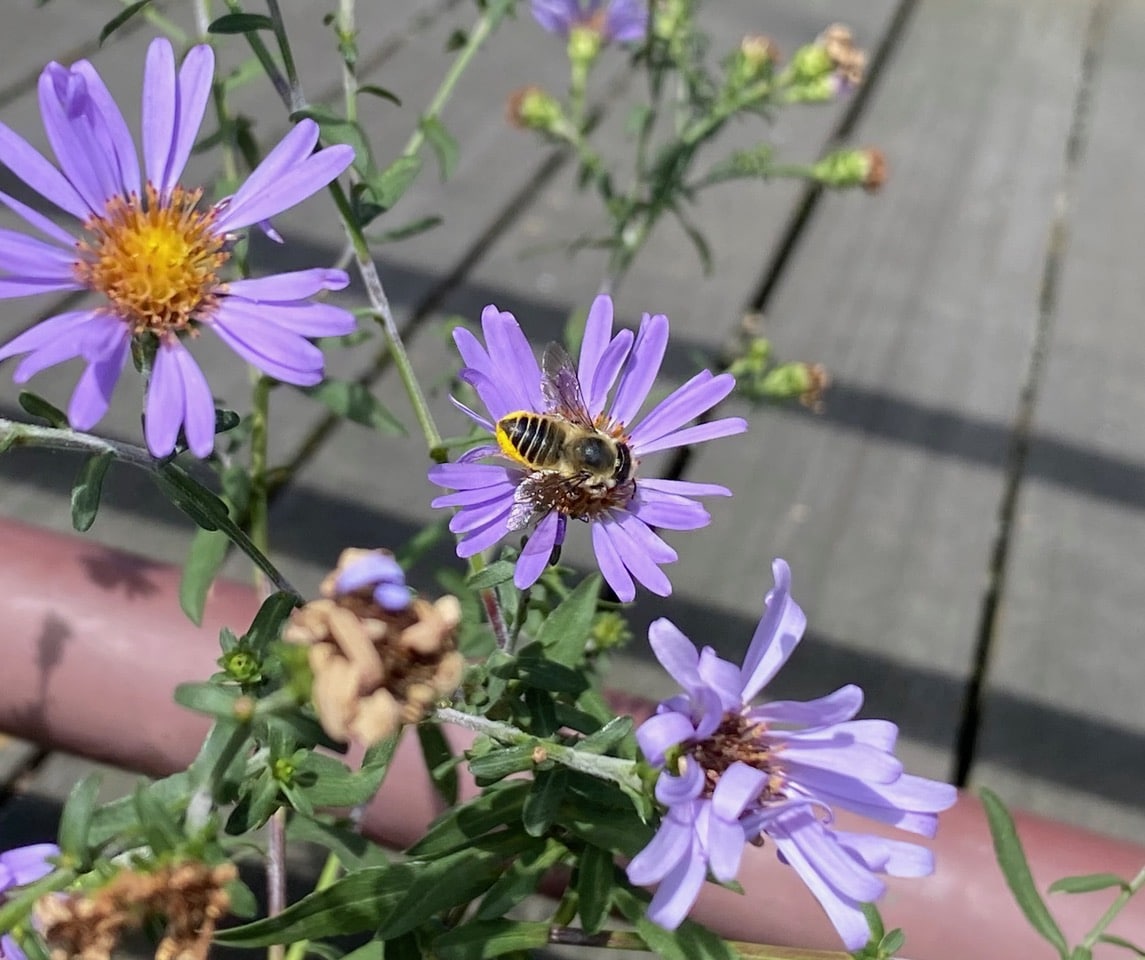
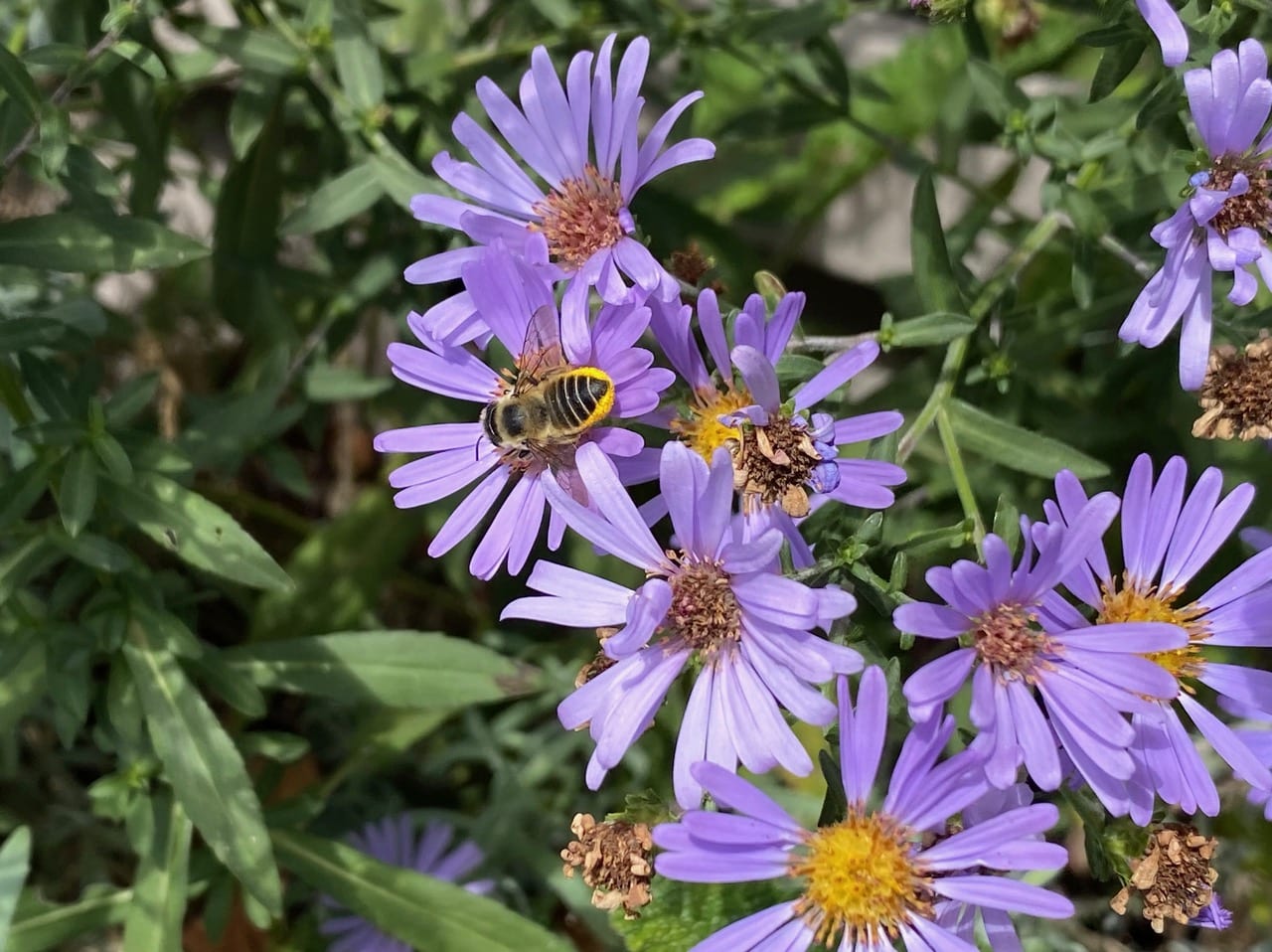
Outside Doug Siden Visitor Center, a female Western Leafcutter Bee, Megachile perihirta (family Megachilidae) is foraging on Pacific Aster flowerheads, Symphyotrichum chilense. Note the bright yellow pollen in the scopa on the underside of her pointed abdomen.
Leaf-cutter Bees, Megachile sp. (family Megachilidae) are stout-bodied, usually with pale hair on the thorax and stripes of white hairs on the abdomen. Females usually have a triangular abdomen with a pointed tip, and males’ faces are covered with dense, pale hair. Flight season is from May into September, with peak activity from June to August.
Solitary females construct nests in tubular cavities, including hollow stems, tree holes, and abandoned beetle burrows in wood. Many use holes drilled into wood, straws, or other manufactured tunnels. Females cut pieces from leaves or flower petals for use in the construction of brood cells. Most Megachile females are generalists when foraging for pollen. Pollen is transported in dense scopae on the underside of the abdomen.
Photos of Western Leafcutter Bee (Megachile perihirta) · iNaturalist