

Pollinator Post 8/20/26 (1)

It’s almost noon, but the skies are still overcast over Bay Farm. At least the air is clean and I can breathe with ease!
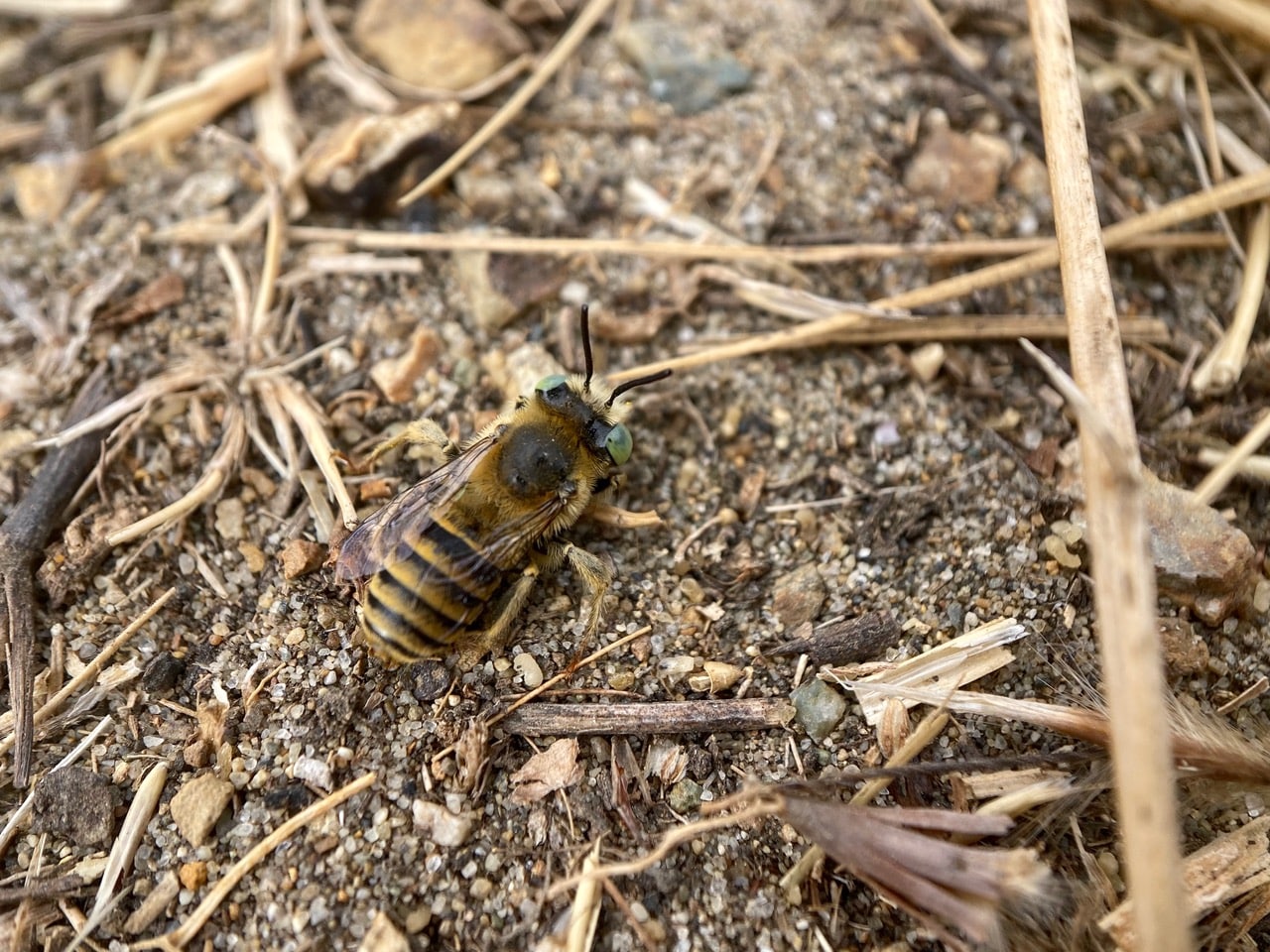










An unfamiliar bee is foraging on some weedy flowers by the trail. It flies away when I close in for a picture, and finally lands on the ground. Ooh, I think it is one of those Mini Digger Bees, subgenus Micranthophora (genus Anthophora, family Apidae) that I first saw on 8/11.
As I attempt for a side view of the bee, it suddenly lifts off into the air. My, what big blue eyes!
Micranthophora is a subgenus of small Digger Bees belonging to the genus Anthophora (family Apidae). Found primarily in the New World (from the southwestern United States down to Honduras), these bees feature distinct yellow facial markings in females and are noticeably smaller than other regional Anthophora species. They are often found thriving in dry, xeric, or desert-like environments.
Anthophora is a large genus of solitary, ground-nesting bees in the family Apidae, commonly known as Digger Bees. They are famous for their fast, darting flight and status as elite generalist pollinators. Their long tongues enable them to effectively pollinate deep, tubular flowers that short-tongued bees cannot reach.
A large Yellow-faced Bumble Bee, subgenus Pyrobombus (genus Bombus, family Apidae) is foraging on a flowerhead of Catsear, Hypochaeris radicata. Not a Dandelion?
I don’t think the bee cares!
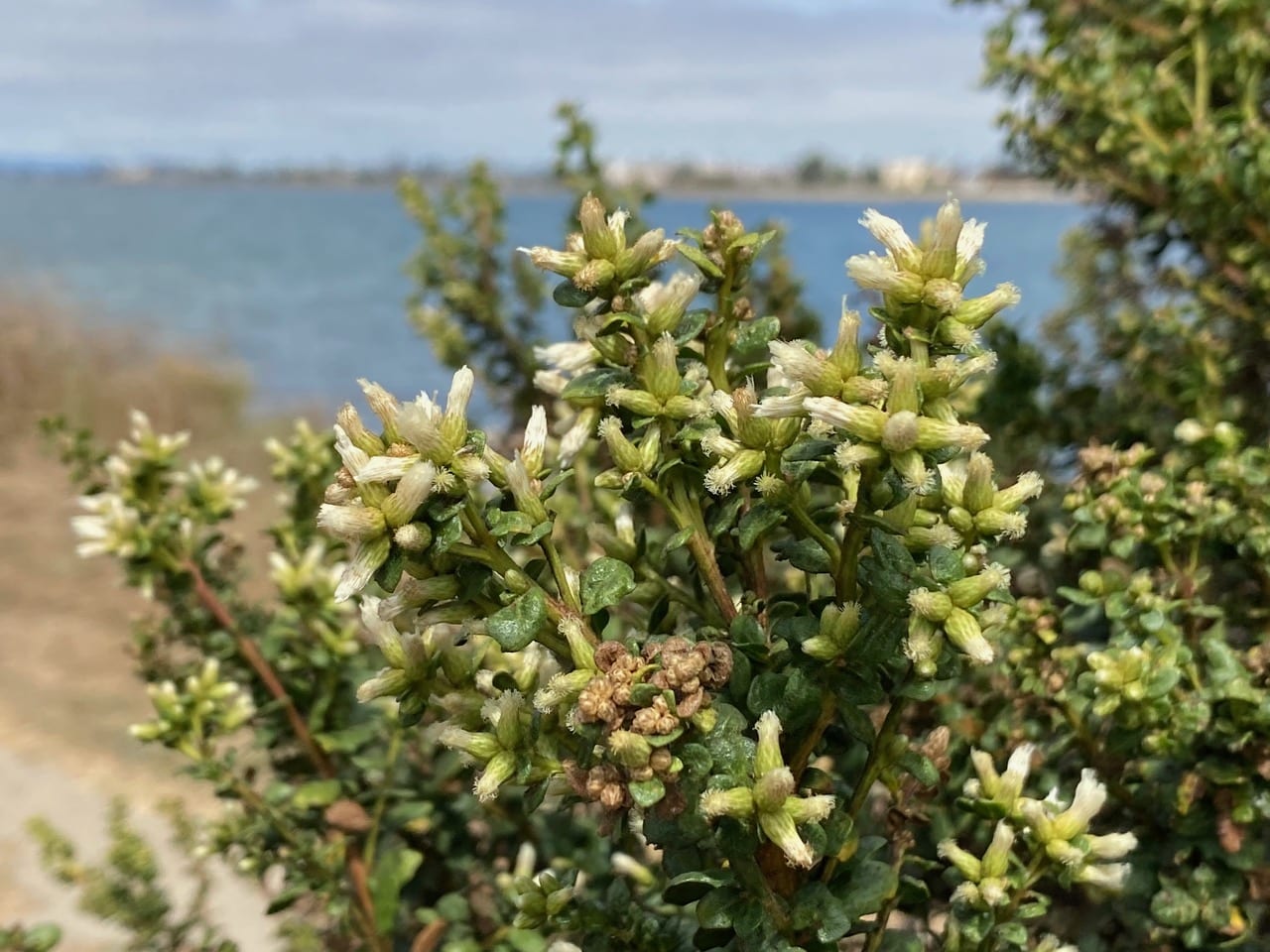
The coast along this stretch of the trail is sparsely vegetated. I am happy to find this lone Coyote Brush. Scraggly as it appears, the female plant is actually in bloom!
The female flowers are showing their delicate styles, while some are already developing long seed plumes.
Coyote Brush, Baccharis pilularis is dioecious, with male and female flowers borne on separate plants. The female flowers are small, white-to-cream, disk like heads with petal-less flowers bearing protruding styles. After blooming from late summer through early winter, they develop into prominent, fluffy white seed clusters that are dispersed by the wind.
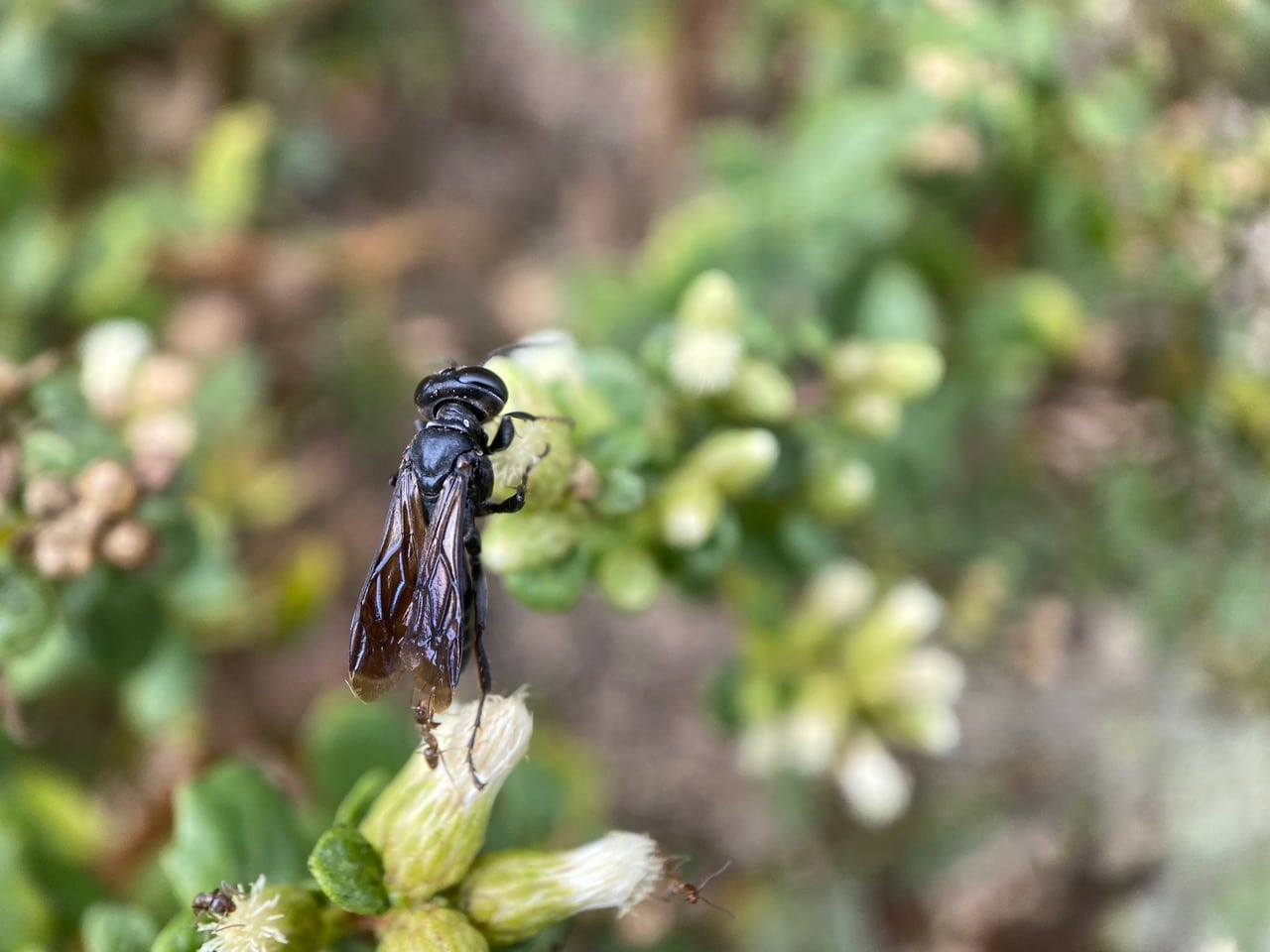
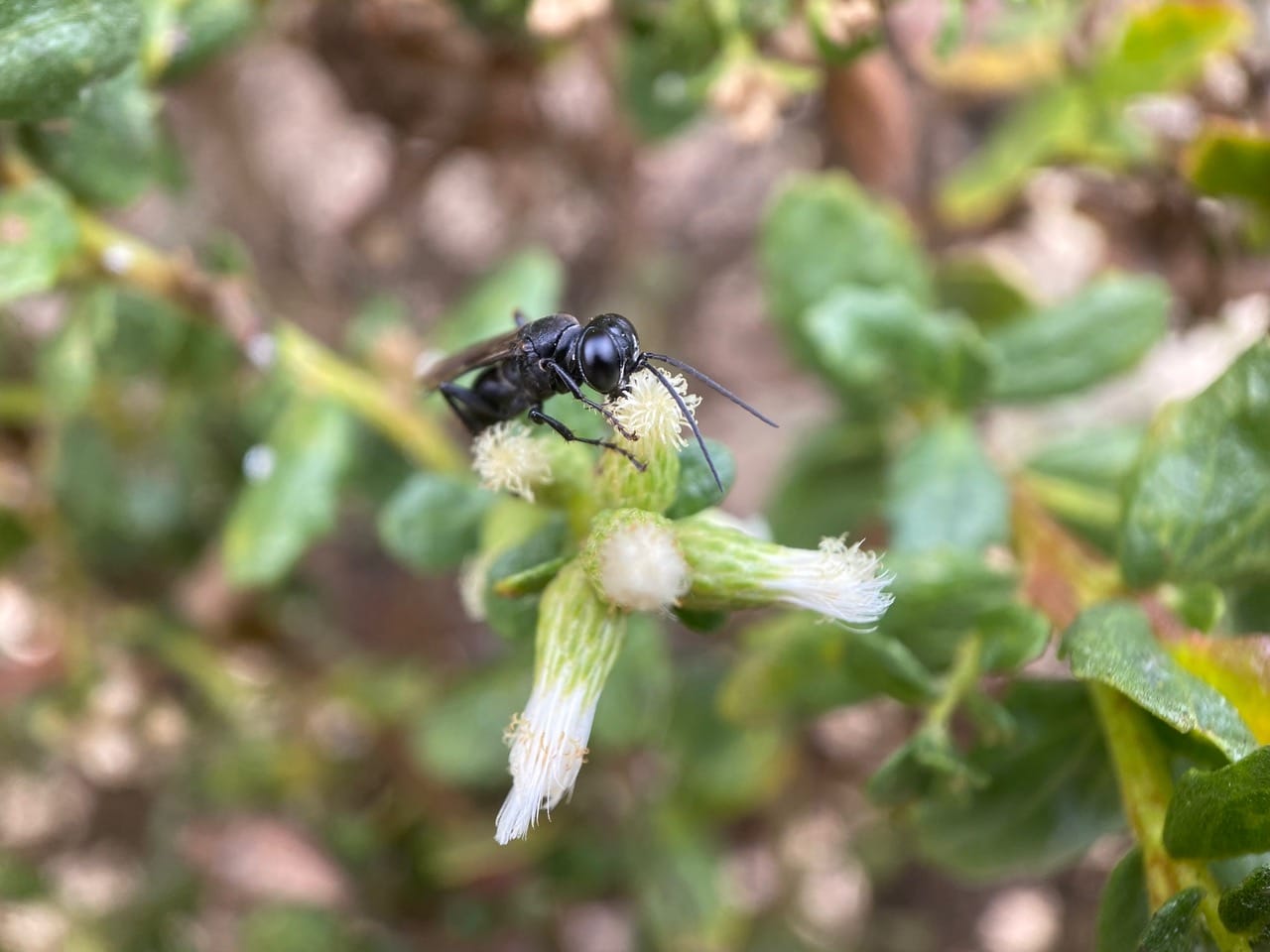
A large, robust black wasp, about 1 inch long is moving around on the Coyote Brush.
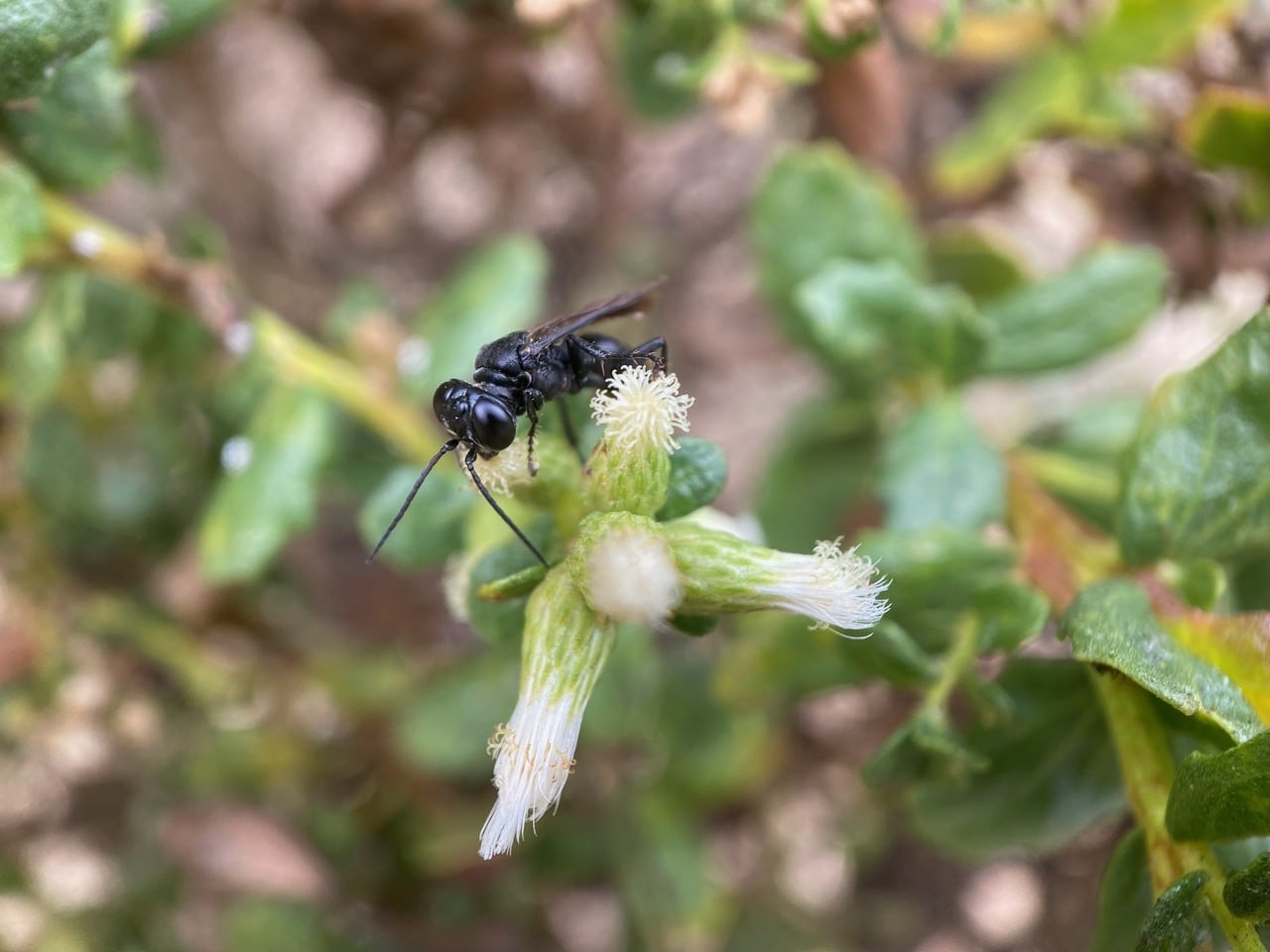
The wasp is taking nectar from the flowers. My, what big, blockish head it has! A Square-headed Wasp (family Crabronidae)?
An Argentine Ant is showing its displeasure as the wasp steps on the flowerhead it is foraging on.
Crabronidae is a huge, diverse family of solitary hunting and digger wasps in the superfamily Apoidea, occurring worldwide. They are known as Square-headed or Sand Wasps. Their head is often broad or squarish when viewed from the front, and they are frequently black with yellow, white, or red markings. They are usually short-necked with a collar-like front segment (pronoun) and low-set antennae. They do not fold their wings flat over the back when resting.
Adults feed exclusively on nectar and pollen from flowers. Females hung specific prey – such as flies, aphids, beetles, cicadas, or spiders – depending on the species, paralyzing them with a sting. The wasps build nests by burrowing in sandy soil, excavating rotten wood, or utilizing hollow plant stems to provision paralyzed prey for their larvae.
iNaturalist has helped identify the wasp as a member of the genus Larropsis (family Crabronidae). Yay, a new wasp for me!
Larropsis wasps provision their underground nests with paralyzed crickets and other orthopteran insects such as grasshoppers.
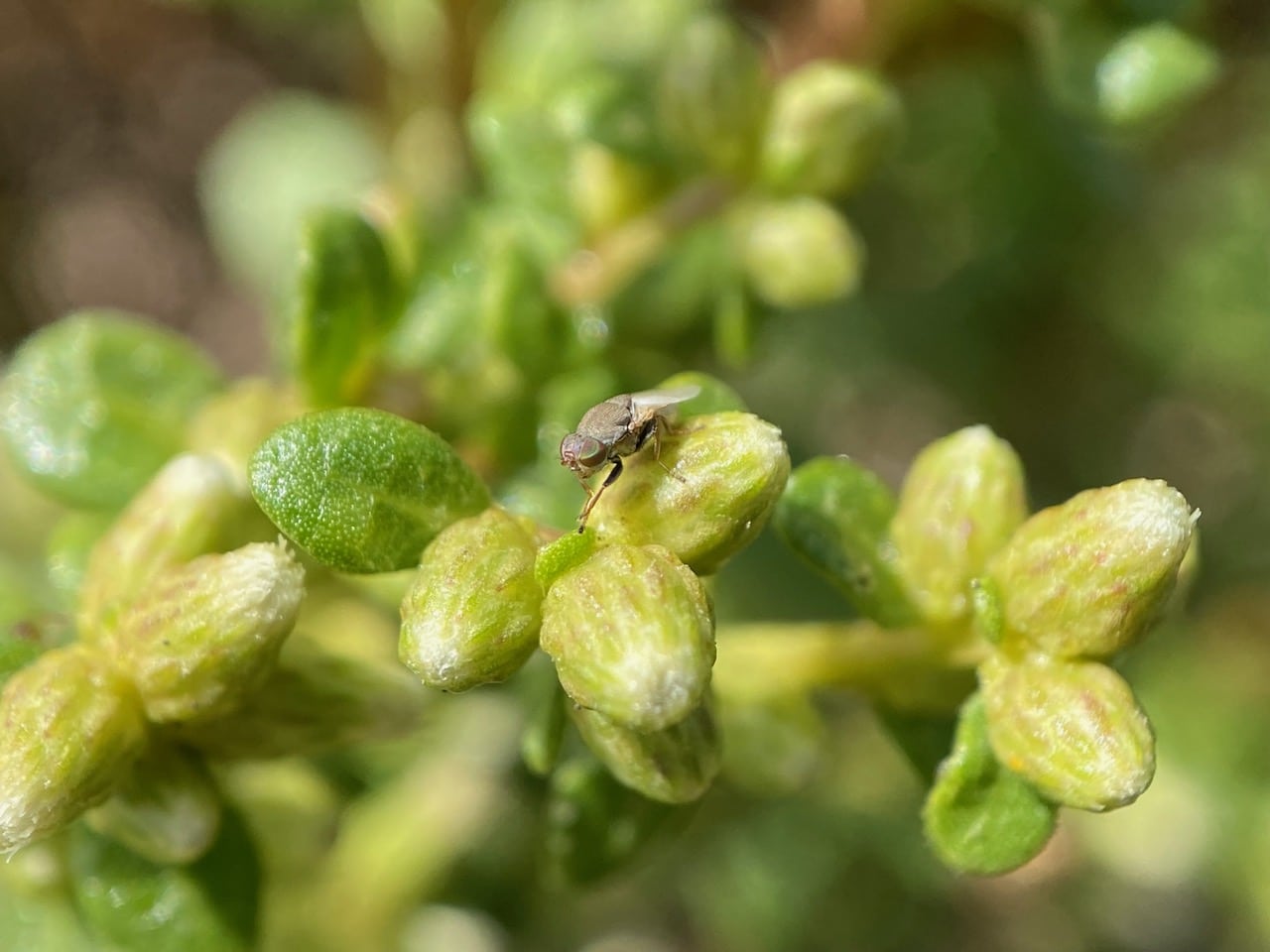
A tiny fly is perched on the involucre of a Coyote Brush flowerhead.
Just from its minute size and the waxy appearance (pruinescence) of its body, I gather that it is a Beach Fly (family Canacidae).
The Beach Flies (family Canacidae) are minute (1.6-5 mm) yellow, gray or gray-brown pruinose flies with whitish to grayish markings. The head is large with small antenna bearing bare to pubescent arista. The “mouth” is a large oval opening. The Canacidae are found along the sea coasts, on the surface of small bodies of water, saline and fresh, in places protected from the wind. They feed on infusoria and other tiny organisms. Infusoria is a word used to describe various freshwater microorganisms, including ciliates, copepods, euglenoids, planktonic crustaceans, protozoa, unicellular algae and small invertebrates.
Pruinescence or pruinosity on an insect is caused by a powdery or waxy “bloom” secreted by the insect’s body that sits on top of its hard outer shell (cuticle). This waxy layer masks the underlying coloration, giving the insect a dusty, frosted, or “hoarfrost” appearance. The waxy coating can serve several functions: it can reflect sunlight and ultraviolet (UV) radiation, helping the insect avoid overheating in hot, sunny environments. The wax is also highly water-repellent (hydrophobic), which prevents the insect from losing moisture and protects against desiccation. In some insects the reflected UV light from waxy coating can serve as a vibrant visual signal for mate recognition, species identification and territorial threat displays.
A small bee is foraging on a Baccharis flowerhead. Its black-and-white striped abdomen tells me it is probably a Tripartite Sweat Bee, Halictus tripartitus (family Halictidae), one of the most common sweat bees around here.
Halictus is found worldwide; they are most common in the Northern Hemisphere. All are generalists, foraging from a wide variety of flowering plants. Many species are social and produce several generations per year. This is not surprising as most blooming plants are season-specific; a bee that requires pollen and nectar across multiple seasons would not thrive as a specialist. All Halictus in North America nest in the ground, often in aggregations; and they may nest in the same area for decades.
Tripartite Sweat Bees, Halictus tripartitus are social, forming annual colonies in the soil where a queen lays eggs and daughter bees act as workers. They are considered a “primitively social” species, meaning they have a social organization with a queen and workers, but with simpler colonies compared to more complex eusocial insects such as honey bees.