

Pollinator Post 8/20/23 (2)
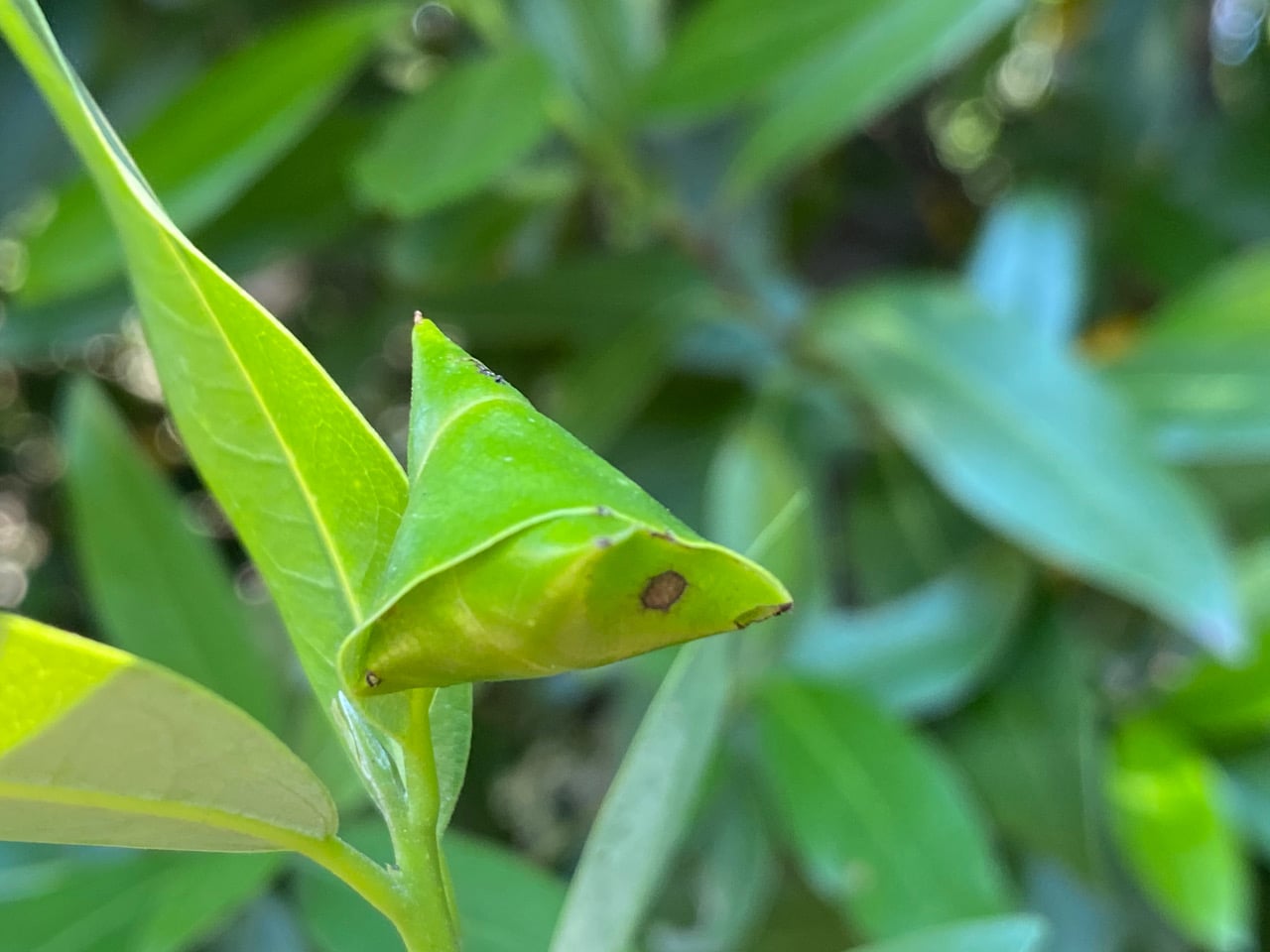
Some of those three-sided folded leaves of California Bay are showing signs of senescence or feeding damage.
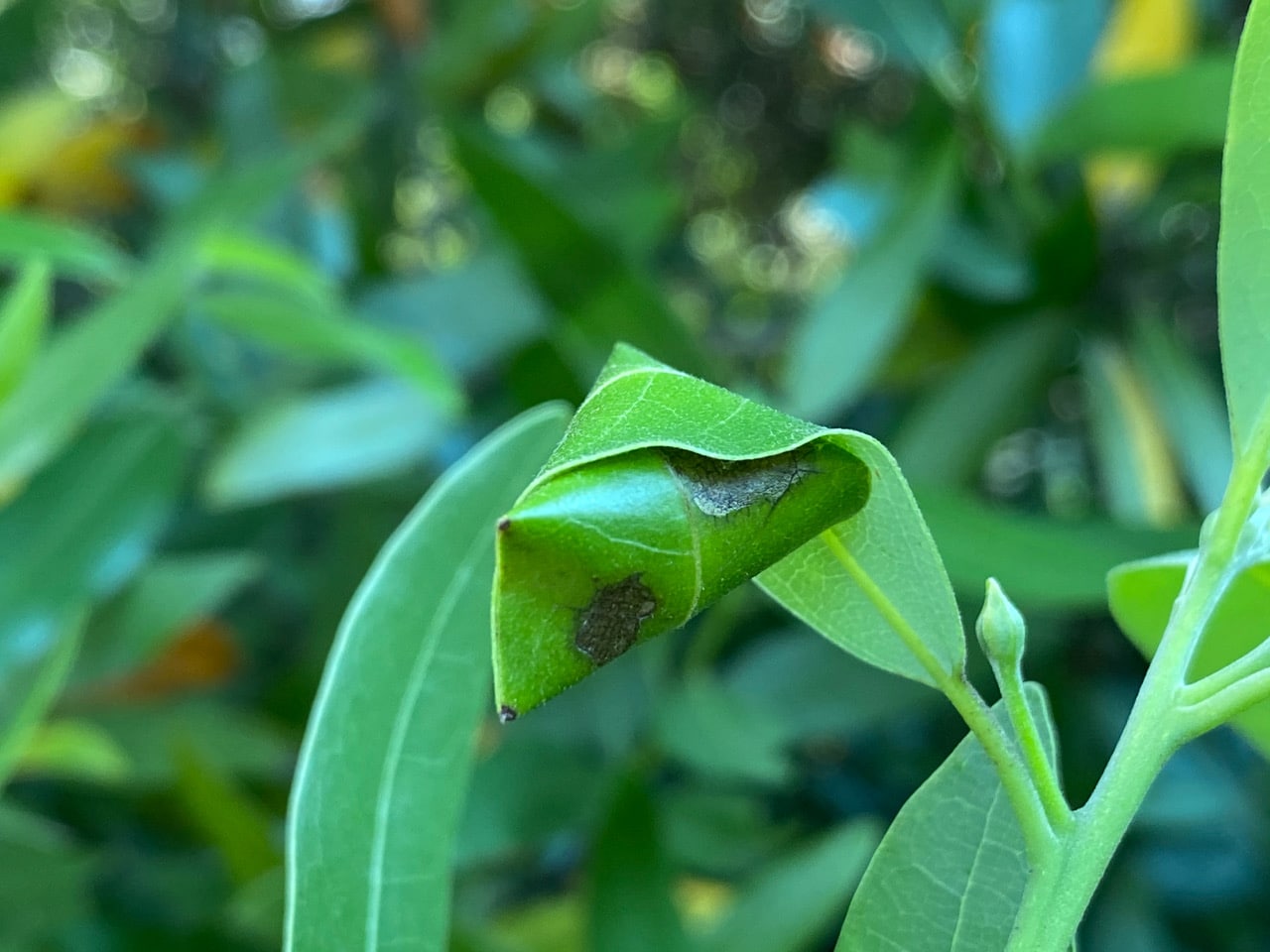
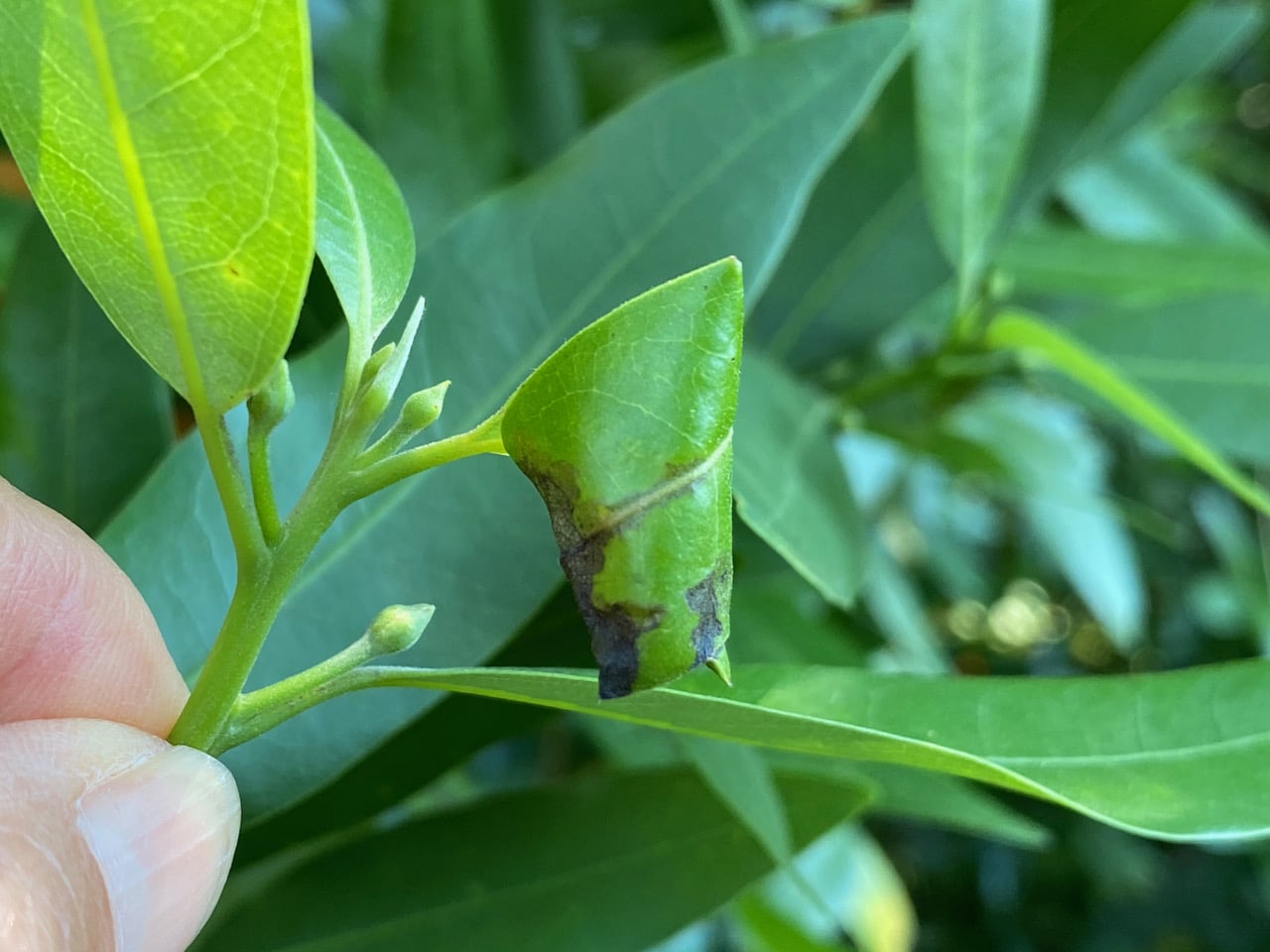

I decide to open one up. All the edges have been seamlessly sealed with silk.
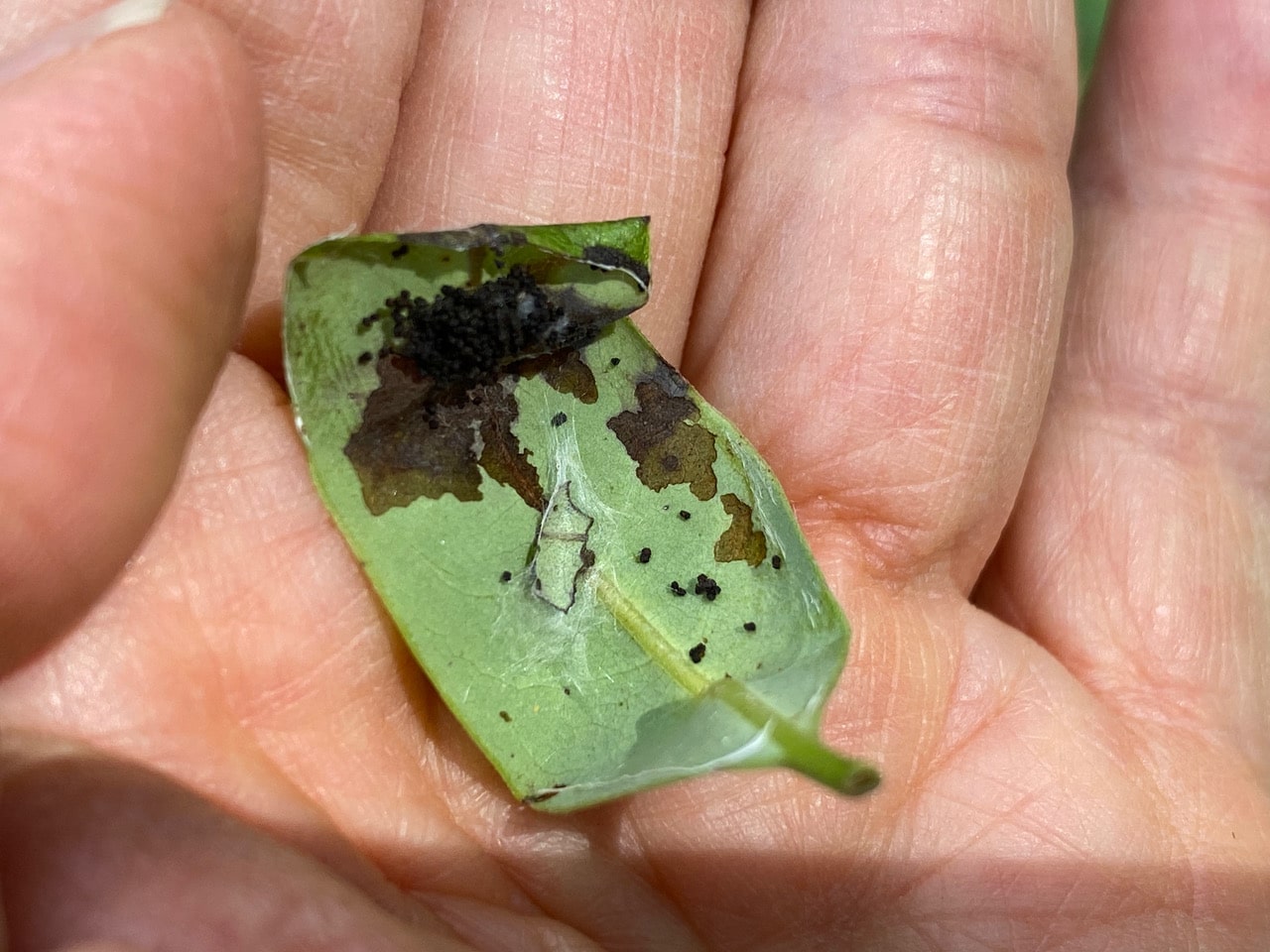
As I have suspected, the caterpillar is no longer inside. There are darkened areas where the leaf has been fed on, a pile of poop near the tip of the leaf, and something attached to silk in the middle.
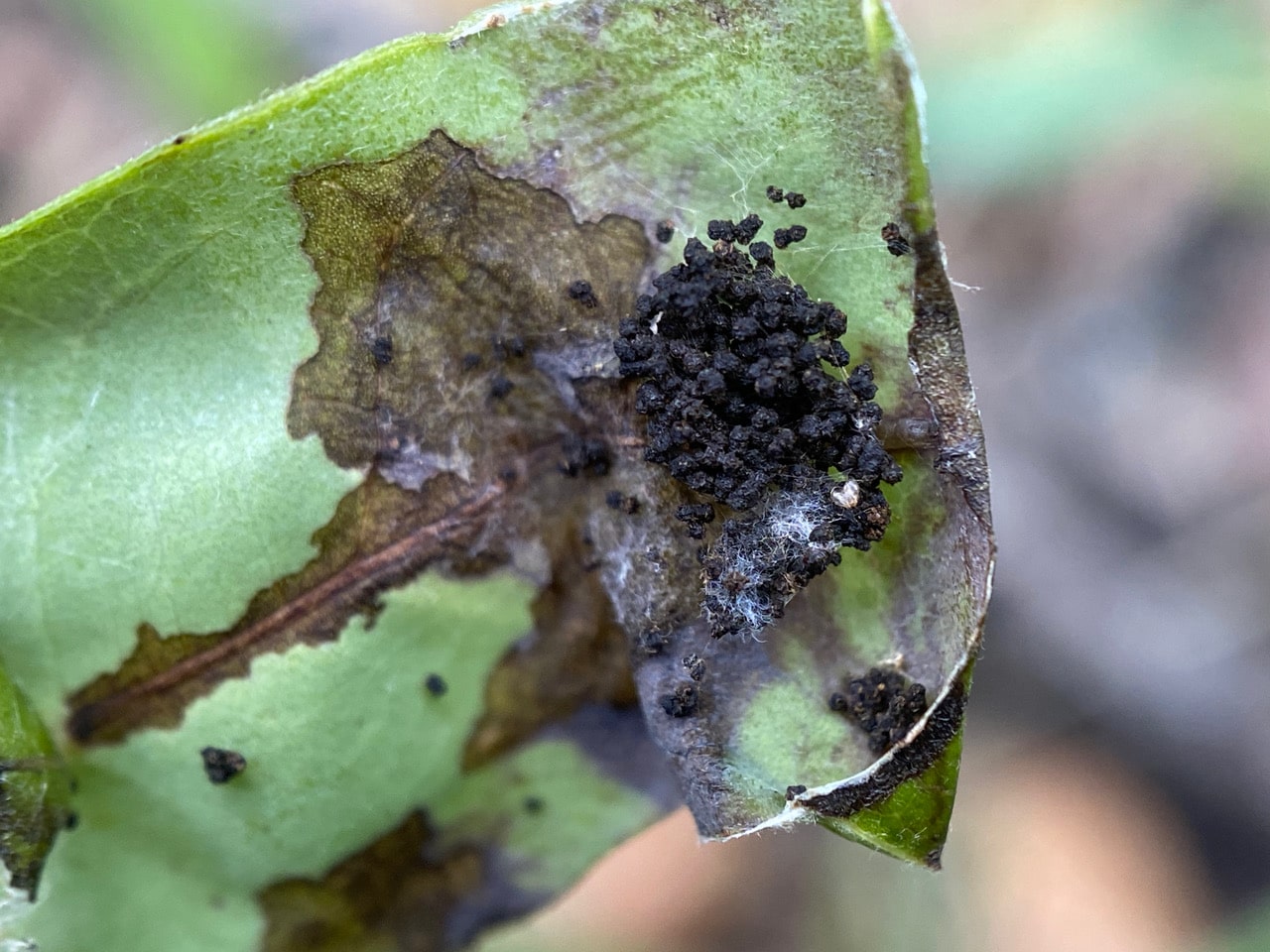
A pile of frass (insect poop) near the tip.

After manipulating the object attached to silk with my finger, I realize that it is actually a torn piece from the rolled tip that the caterpillar has anchored to the middle of the leaf. The caterpillar has apparently been only feeding on this rolled section of the leaf. I have actually witnessed the rolling process a few days ago (recorded on video). Once the rolling is complete, the caterpillar apparently anchors the roll to the underside of the leaf with lots of silk about half way down the length of the leaf, then makes a couple of large folds over the rolled section to complete the boxy retreat. This way the open ends of the roll (presumably the most vulnerable to intrusion) are concealed. See the round hole on the edge of the leaf to the left? That must be where the caterpillar has exit the retreat! It apparently does not pupate in the retreat, but leaves to complete its development elsewhere. Adult moths/butterflies do not have the mouthpart for cutting the exit hole.
Wow, what fun figuring out the modus operandi of a leaf-roller caterpillar! But we are still a long way from unraveling the moth’s life cycle!
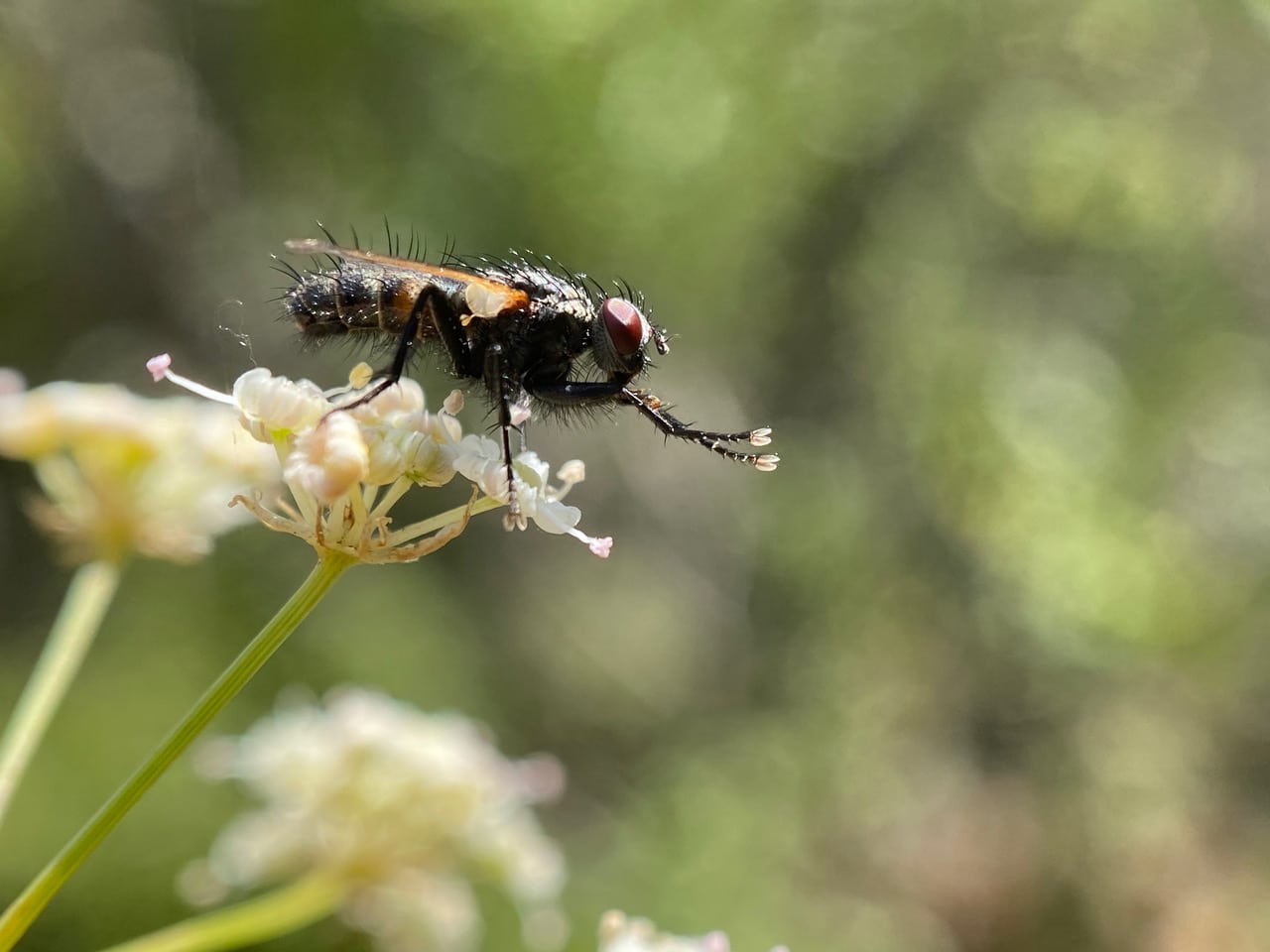
A dark bristly fly is cleaning its proboscis with its front legs after feeding on the flowers of Kellogg’s Yampah. Love those white footpads!
Those paired “footpads” are technically called pulvilli (singular pulvillus). They are soft, cushioned pads on the feet of insects and other arthropods, such as the housefly and ticks. The adhesive pads come equipped with tiny hairs that have spatula-like tips. These hairs are called setae. The setae produce a glue-like substance that allows the insect to move on smooth surfaces as well as on vertical walls, or even upside down.
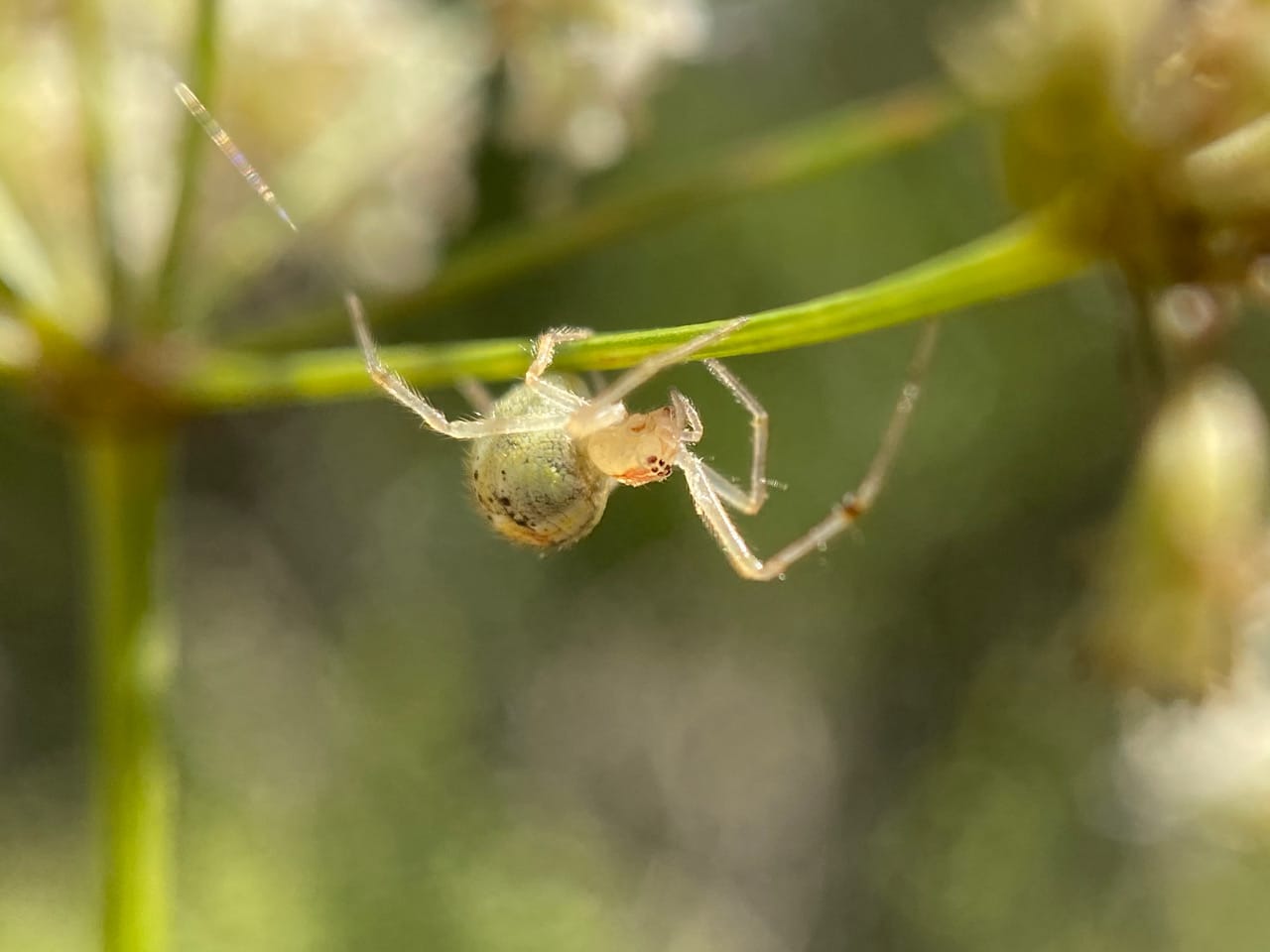
A tiny spider is walking on a stalk of a floral umbel of Kellogg’s Yampah.
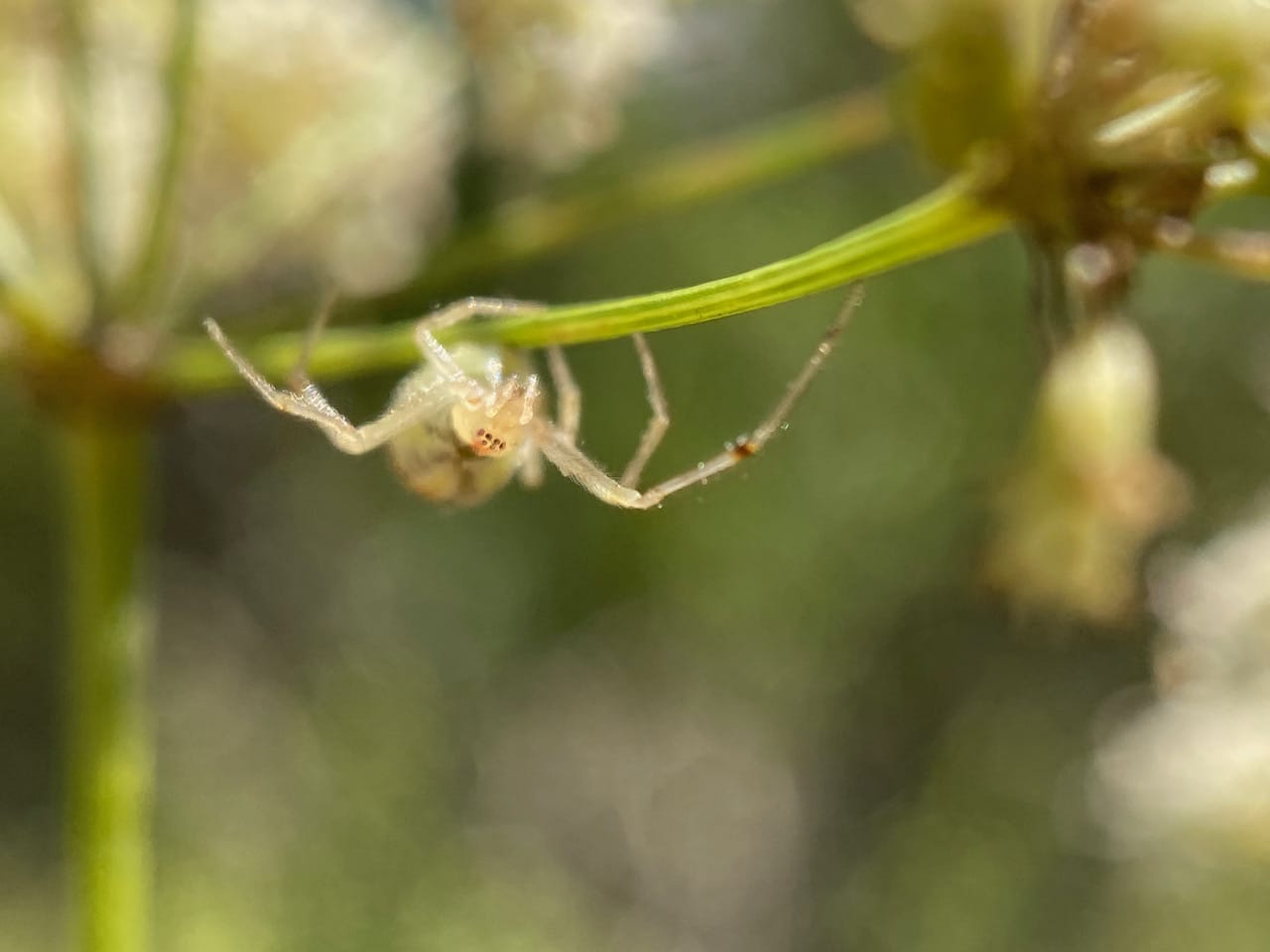
Front view of the spider showing its eyes.
Most spiders have eight eyes, which tend to be arranged into two rows of four eyes on the head region. The exact arrangement of the eyes varies significantly by family, so is often used as a diagnostic feature for identifying and classifying spiders. Spider eyes are simple eyes, or ocelli, each with a single lens rather than multiple units as in the compound eyes of insects.

The spider climbs into a tangled, 3-dimensional silk web constructed between the umbels of Yampah flowers. Its greenish abdomen is well-suited to help the spider blend in with its little habitat.
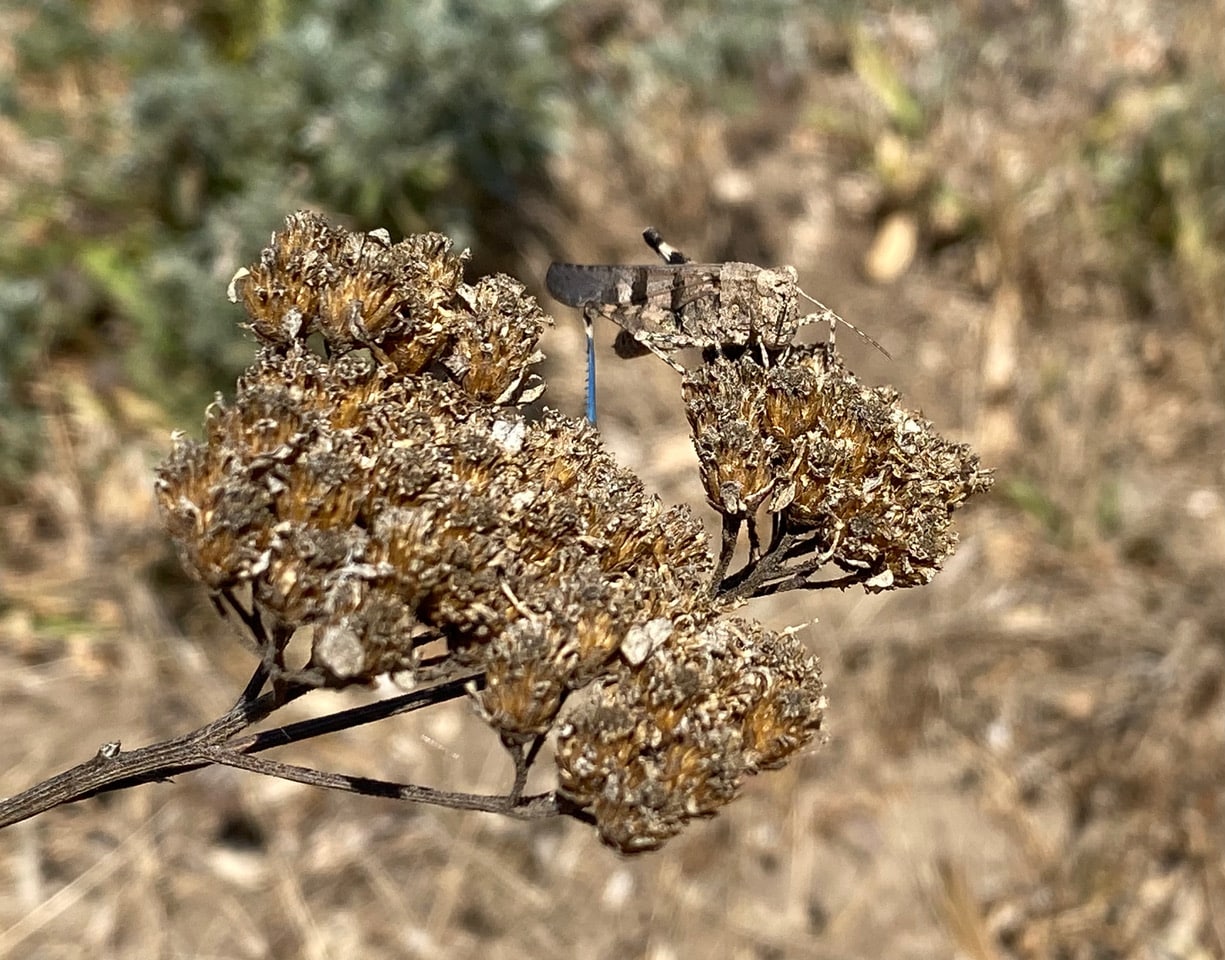 I stop short to watch a Fontana Grasshopper, Trimerotropis fontana (family Acrididae) on a dried inflorescence of Yarrow, Achillea millefolium. I often see these common Band-winged Grasshoppers (subfamily Oedipodinae) land in front of me on the trail with a crackling snap, but I have seldom seen one on vegetation. If it weren’t for the dark vertical bands on its body and wings, it would have been impossible to spot on this busy, brown background. There’s another feature that gives the insect away – those electric blue hind tibia!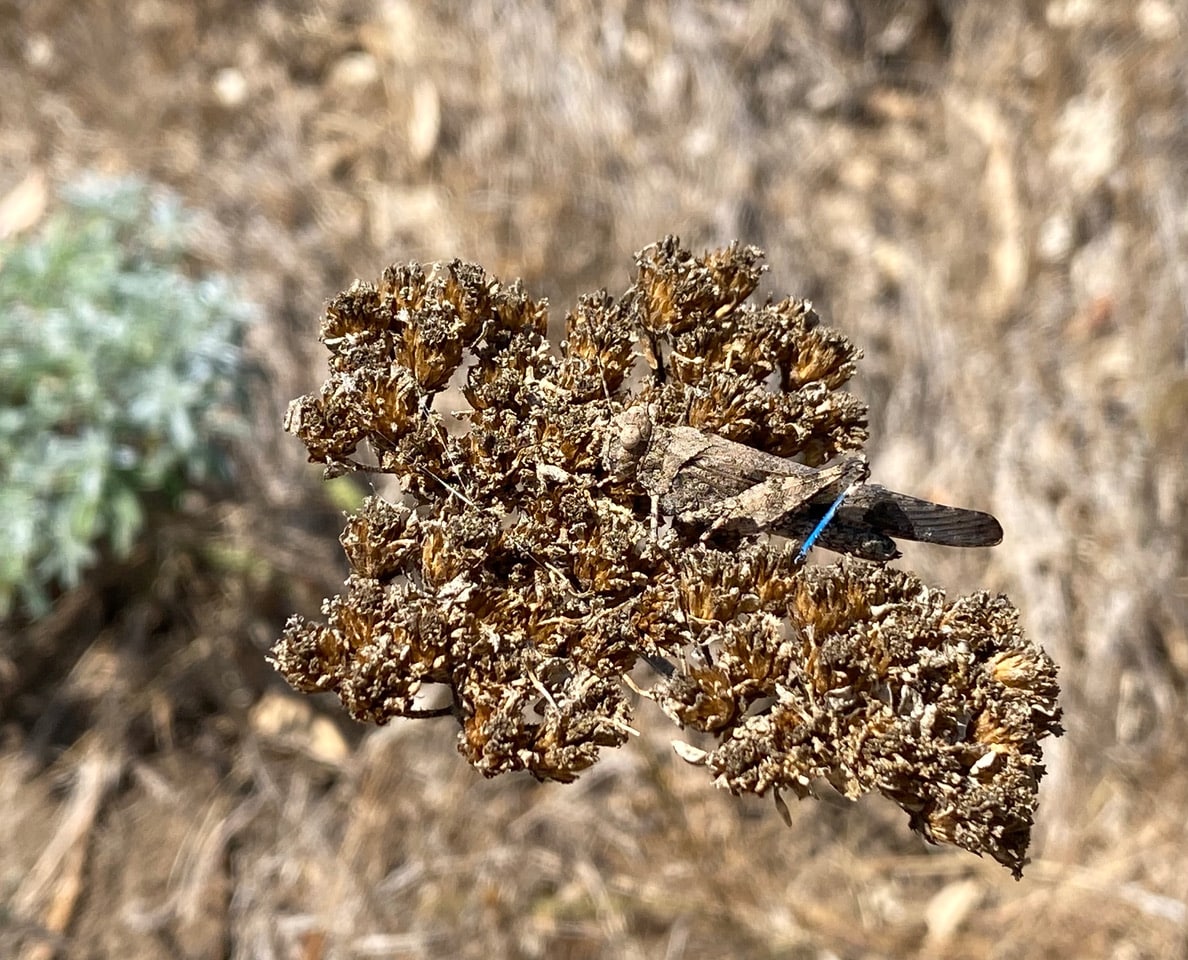
There, another good look at the blue hind tibia.
The function of the blue tibia is not completely clear. In courtship, the males perform femur-shaking, producing a low-pitched humming sound. In male-to-male aggression encounters, only femur-tipping occurs, in which the individual flashes its blue tibia at the opponent at close range.

The grasshopper finally hunkers down, hiding its bright blue tibia. I think it is quite confident in its camouflage, as it does not make an attempt to hop away even as I close in.
Grasshoppers belong to the family Acrididae, suborder Caelifera, order Orthoptera. They are ground-dwelling insects with powerful hind legs which allow them to escape from threats by leaping vigorously. They protect themselves from predators by camouflage; when detected, many species attempt to startle the predator with a brilliantly-colored wing-flash while jumping and launching into the air. A large grasshopper can jump about 20 body lengths, equivalent to a human jumping the length of a football field. Grasshoppers jump by extending their large back legs and pushing against the substrate with high force and high velocity, using a catapult mechanism to amplify the mechanical power produced by their muscle.
Most grasshoppers are polyphagous, eating vegetation from multiple plant sources. In general their preference is for grasses, including many cereals grown as crops. They eat large quantities of foliage both as adults and during their development, and can be serious pests of arid land and prairies. Grasshoppers thrive in warm sunny conditions, so drought stimulates an increase in grasshopper populations.
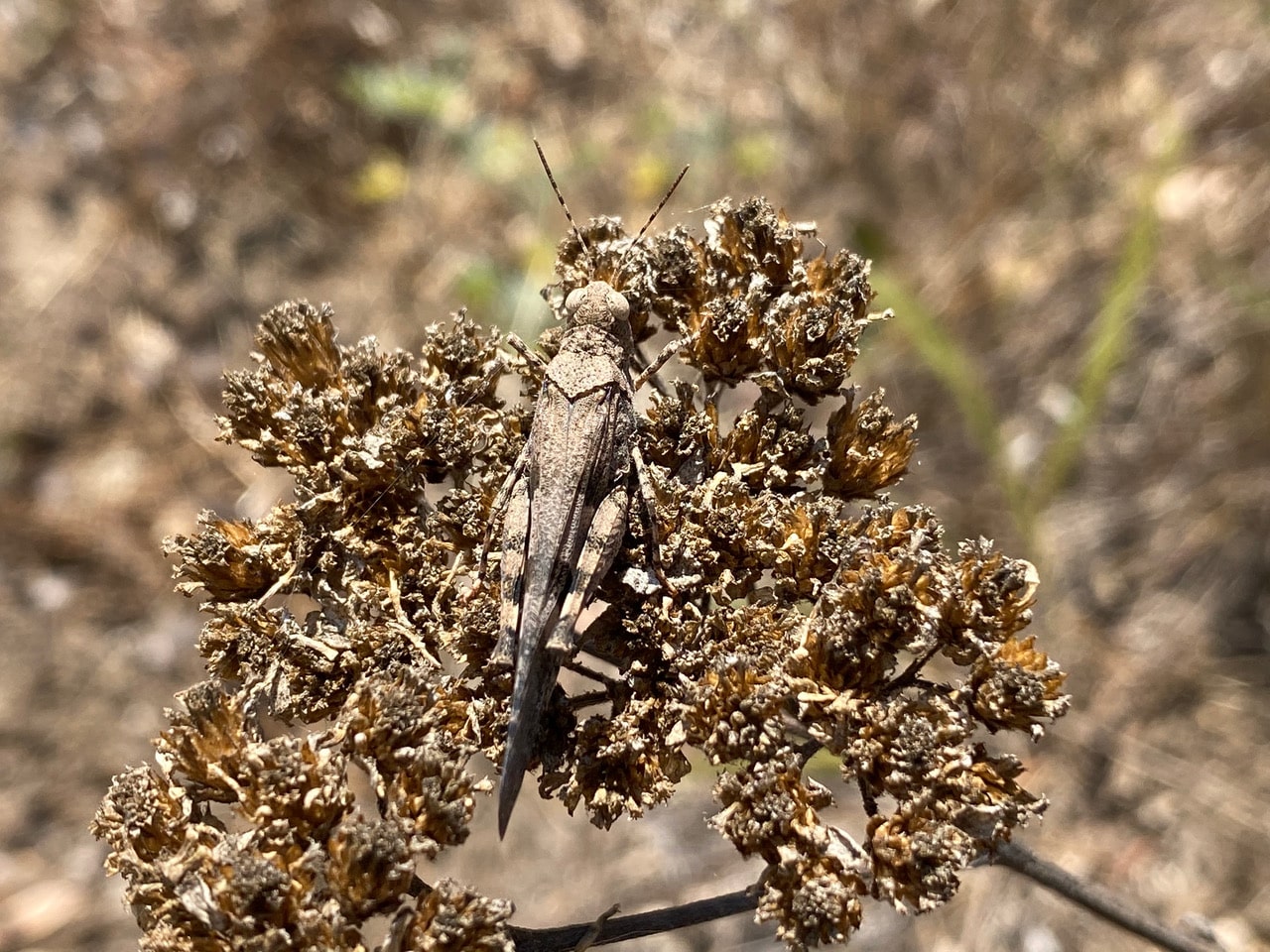
Top view of the Fontana Grasshopper.
Male, and sometimes female Band-winged Grasshoppers make loud snapping or crackling sounds with their wings as they fly. Crepitation can be used for both romance and defense. The sound is created by the wings being snapped taut in mid-flight. During courtship flights, male grasshoppers will make this sound while interested females watch below. When used in defense, it is usually to surprise or scare a potential predator, as the grasshopper flies away trying to escape. Not all grasshoppers can crepitate.