

Pollinator Post 8/2/23 (2)
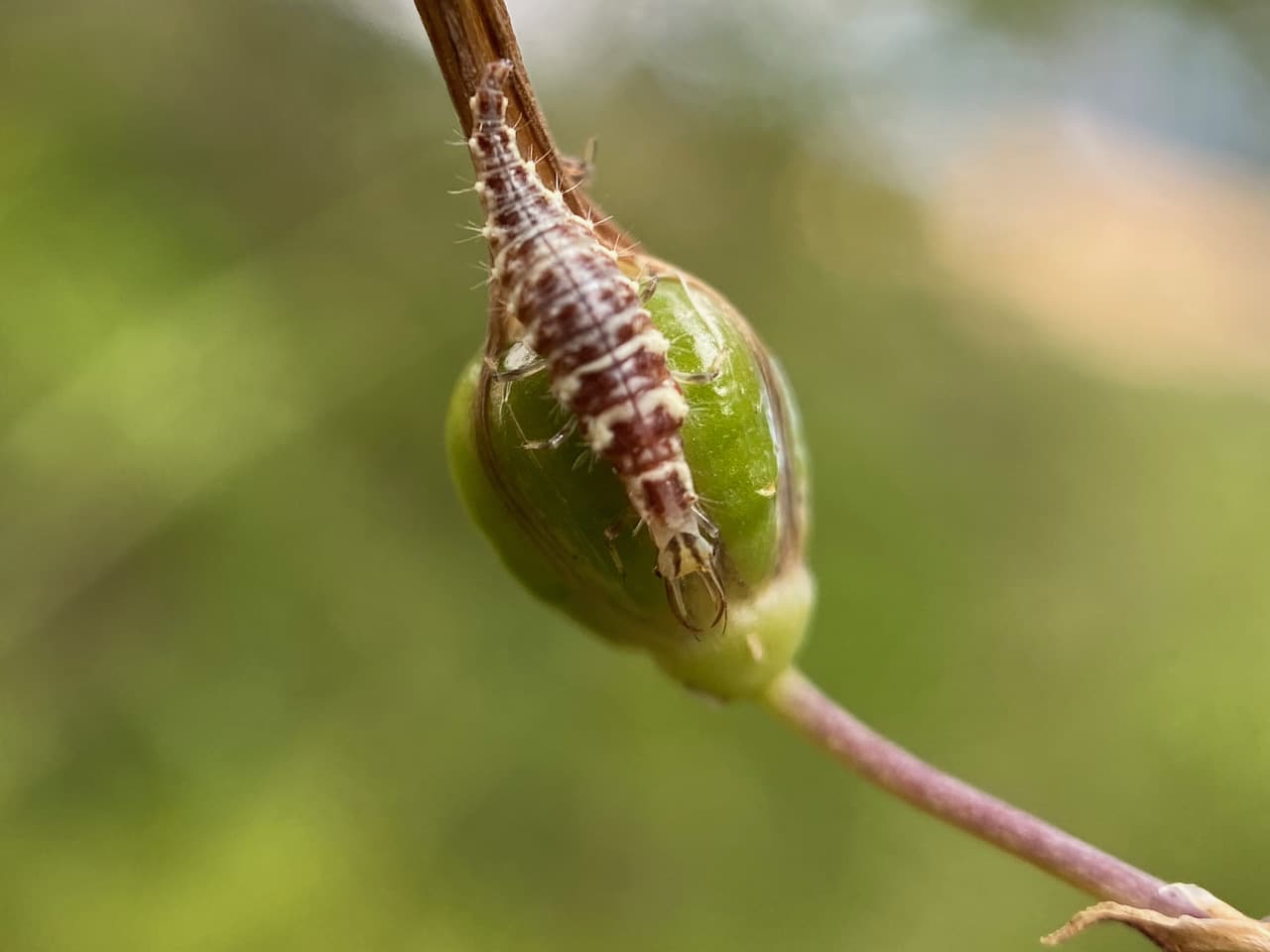
A Lacewing larva is resting on an immature fruit of Soap Plant, Chlorogalum pomeridianum that is infested with aphids.
Lacewings are insects in the large family Chrysopidae of the order Neuroptera. Adults are crepuscular or nocturnal. They feed on pollen, nectar and honeydew supplemented with mites, aphids and other small arthropods. Eggs are deposited at night, hung on a slender stalk of silk usually on the underside of a leaf. Immediately after hatching, the larvae molt, then descend the egg stalk to feed. They are voracious predators, attacking most insects of suitable size, especially soft-bodied ones (aphids, caterpillars and other insect larvae, insect eggs). Their maxillae are hollow, allowing a digestive secretion to be injected in the prey. Lacewing larvae are commonly known as “aphid lions” or “aphid wolves”. In some countries, Lacewings are reared for sale as biological control agents of insect and mite pests in agriculture and gardens.
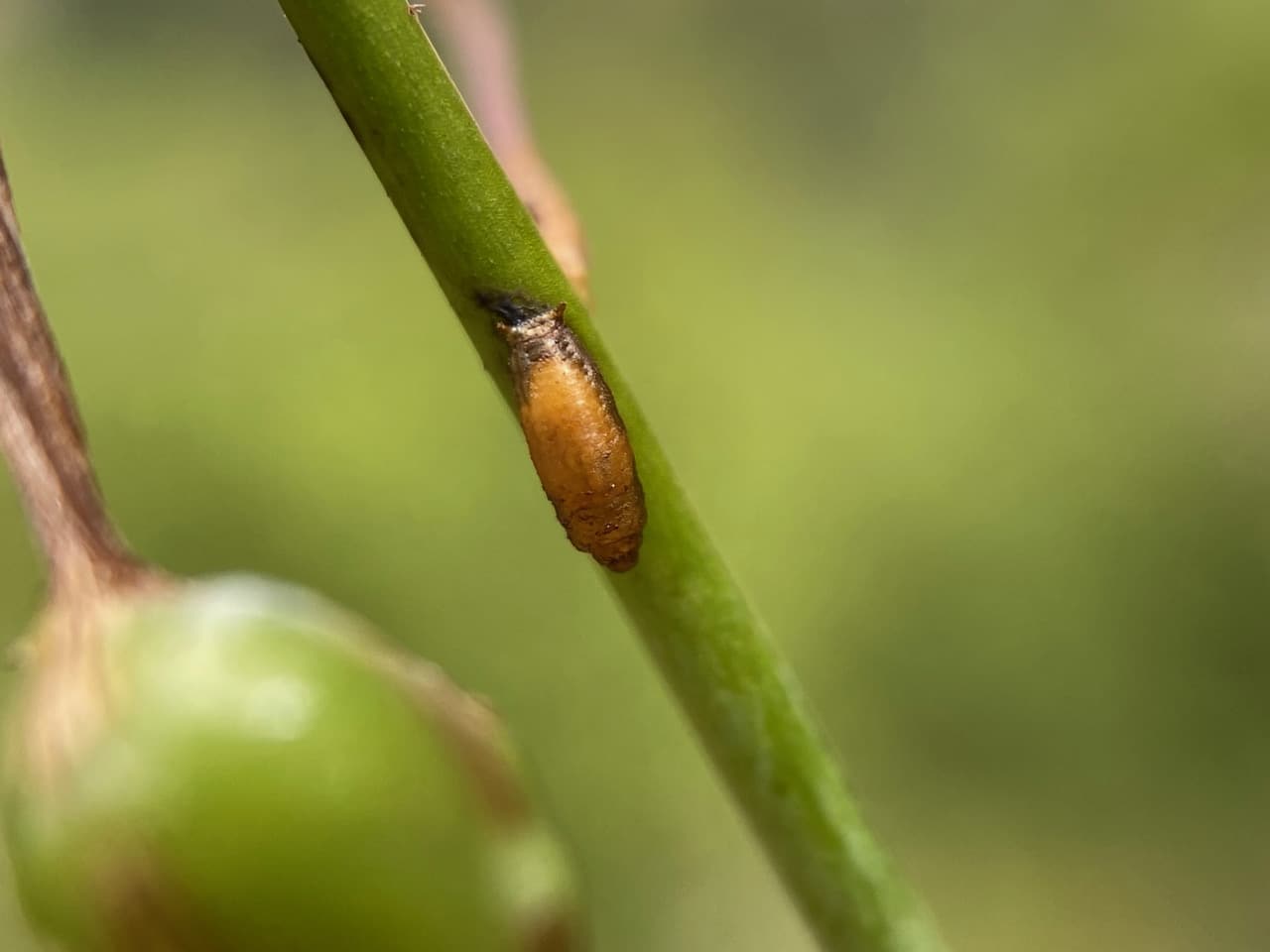
There is another aphid predator on the Soap Plant, but it is no longer active. The hover fly larva is pupating on the stem of the Soap Plant. The pair of snorkel-like tubes at one end marks the tail end of the former larva. The adult fly will eventually emerge from the broad end of the pupa.
Adult hover flies visit flowers for nectar and pollen, and are good pollinators. Females of some species lay eggs singly on plants near or among aphid colonies. The larvae that hatch are small legless maggots that range in color from creamy-white to green to brown. The larvae are voracious predators of aphids, consuming up to 400 aphids each before completing their development and turning into pupae.
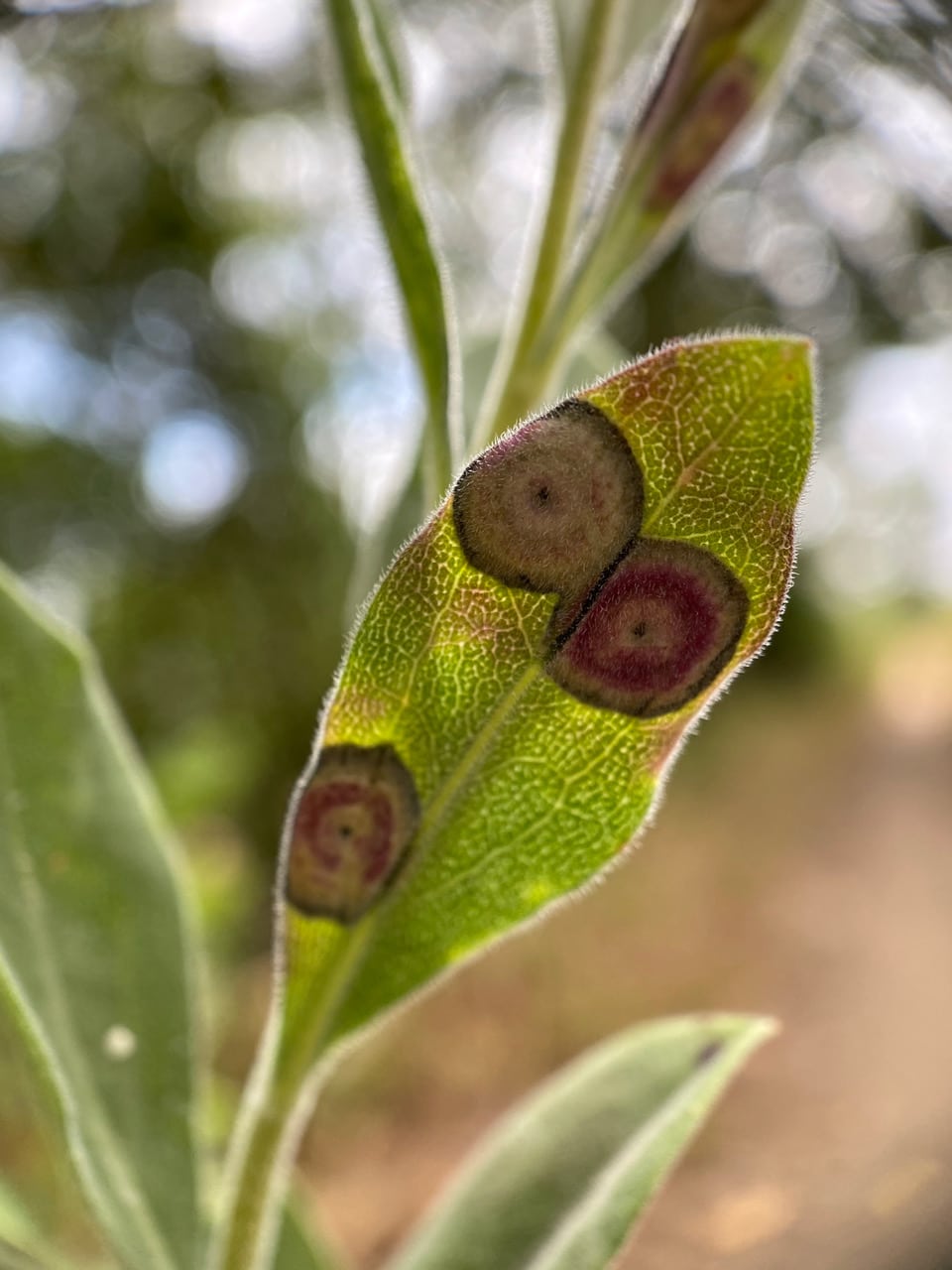
Backlit by the sun, the blister galls on the leaf of California Goldenrod, Solidago velutina ssp. californica appear even more colorful and bizarre.
The blisters are induced by the gall midge Asteromyia carbonifera (family Cecidomyiidae). The midge induces flat, circular galls in the leaves of various goldenrods (Solidago). One to ten or more larvae develop in each gall. Color and size of the gall vary by host species and number of larvae. The galls contain a symbiotic fungus, Botryosphaeria dothidea, which the larva apparently does not eat. The fungus seems to confer some protection against parasitoid wasps. Females carry spores of the fungus.
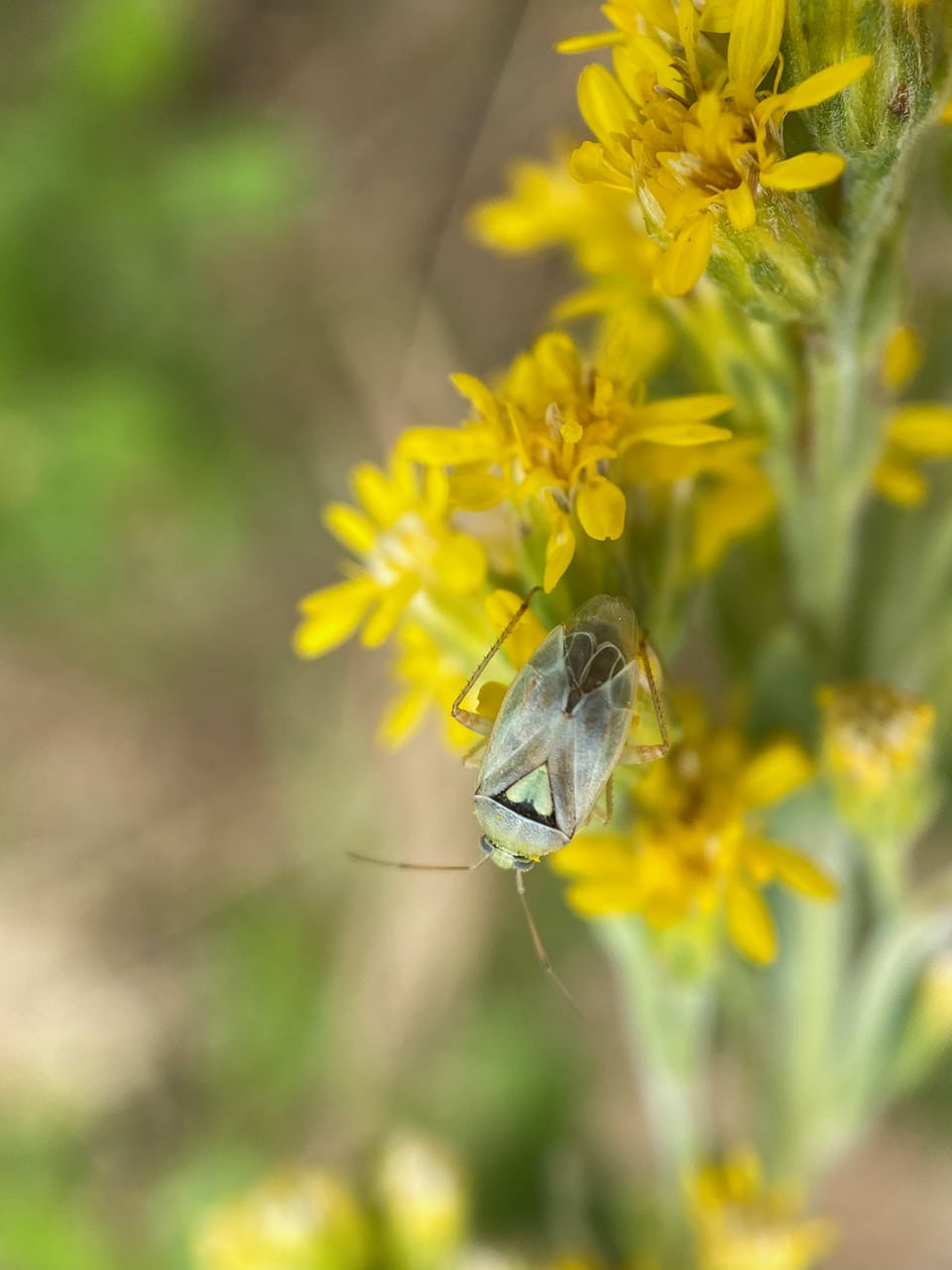
A Lygus Bug (family Miridae) is roaming an inflorescence of California goldenrod.
Commonly referred to as Lygus Bugs, Lygus hesperus is a serious pest on strawberry in the Central Coast of California. Adults are about 6 mm long, oval and rather flattened. They are greenish or brownish and have reddish-brown markings on their wings. In the center of their back is a distinct, but small, yellow or pale green triangle that helps distinguish them from other insects. The cunei (singular cuneus), triangular-shaped areas near the end of the forewings are translucent, blending with the coloration of surrounding body parts. The immature forms are pale green and resemble aphids. They can be distinguished from aphids by their more rapid movements.
In general the Lygus Bug’s abundance is highest after winters of higher rainfall. This causes more lush grows of vegetation such as mustards and other weeds that support a higher abundance and survival of the bugs during the winter and spring. Damage to crops and garden plants are caused by the bugs’ piercing-sucking mouthparts that extract fluids from the plant tissues.
One useful feature in identifying members of the family Miridae or plant bugs is the presence of a cuneus; it is the triangular tip of the corium, the firm, horny part of the forewing, the hemielytron. The cuneus is visible in nearly all Miridae.

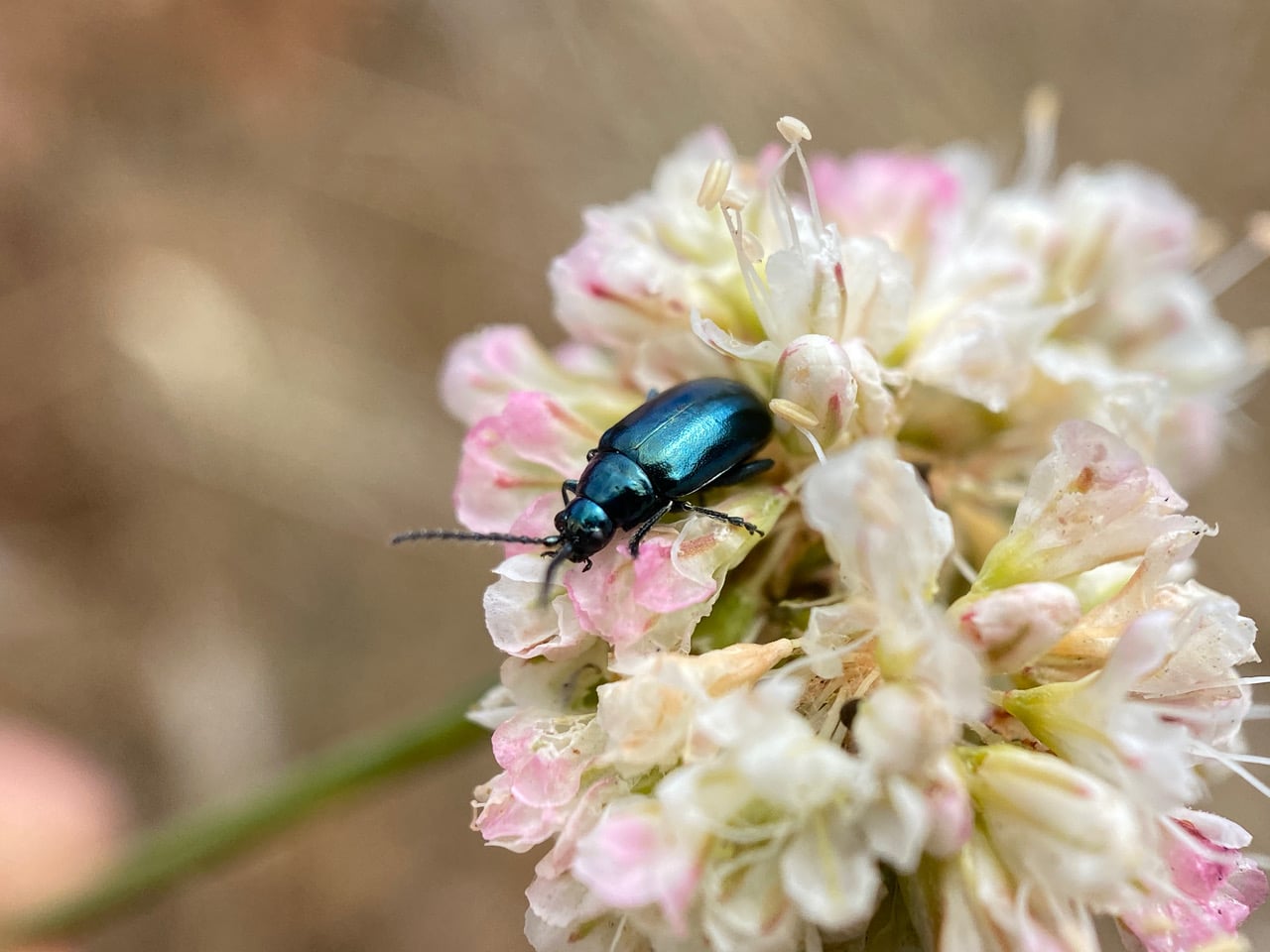
A Flea Beetle, Altica sp. (family Chrysomelidae) is resting on an inflorescence of Naked Buckwheat, Eriogonum nudum.
Flea Beetles are in the largest subfamily (Alticinae) of the family Chrysomelidae, or Leaf Beetles. The name Altica is derived from the Greek word haltikos, meaning good jumpers. The beetles have strong hind legs allowing them to jump long distances like true fleas. Altica flea beetles are 3-9 mm in length. Most Altica beetles have hard outer wings elytra that are metallic blue to green in color that protect similarly colored metallic bodies that reflect purple and bronze colors and are elongate oval in shape.
The life history patterns of common flea beetles are very similar among Altica species with the major difference being host plant preference. Adults and larvae Altica flea beetles feed on all sorts of plant tissues, and all species are fully herbivorous. Many are serious pests of cultivated plants, including food crops. Others are beneficial due to their use in biocontrol of invasive weeds.
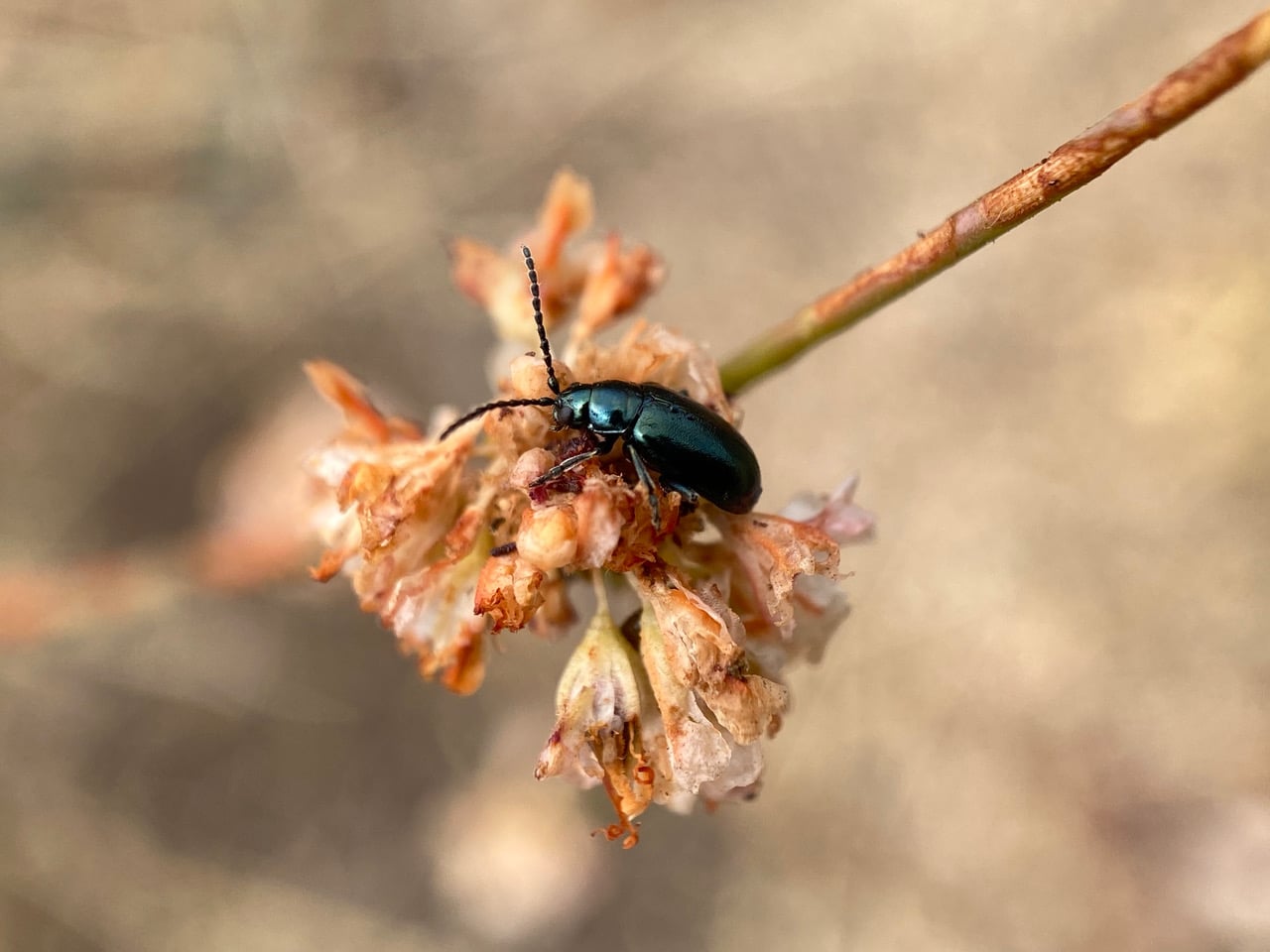
This Altica species seems to be specific for the buckwheat. The beetles arrive when the flowers are still in bud, and stay until all the flowers have turned brown, feeding on every part of the plant. They are never found on other plants in the garden.
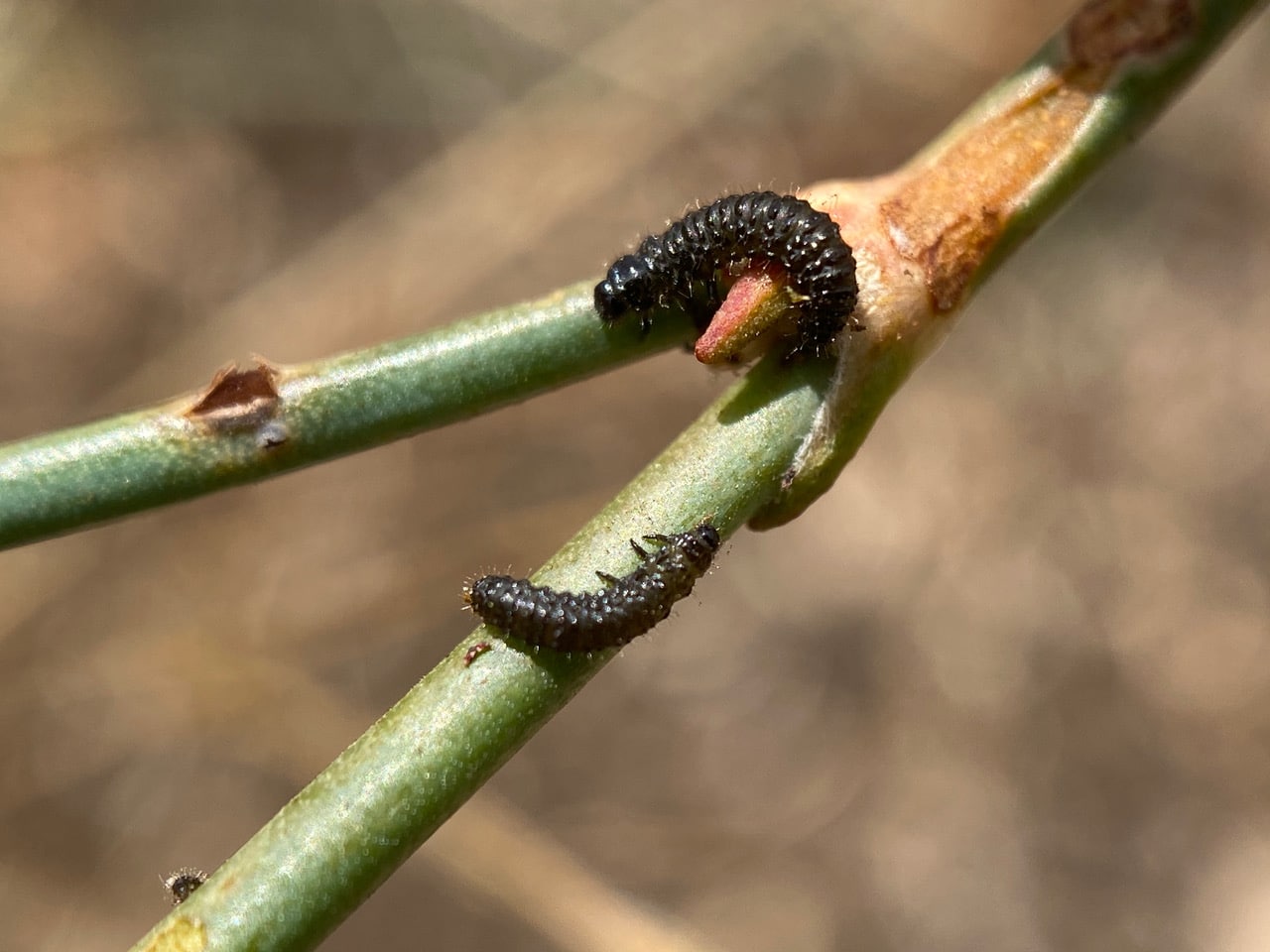
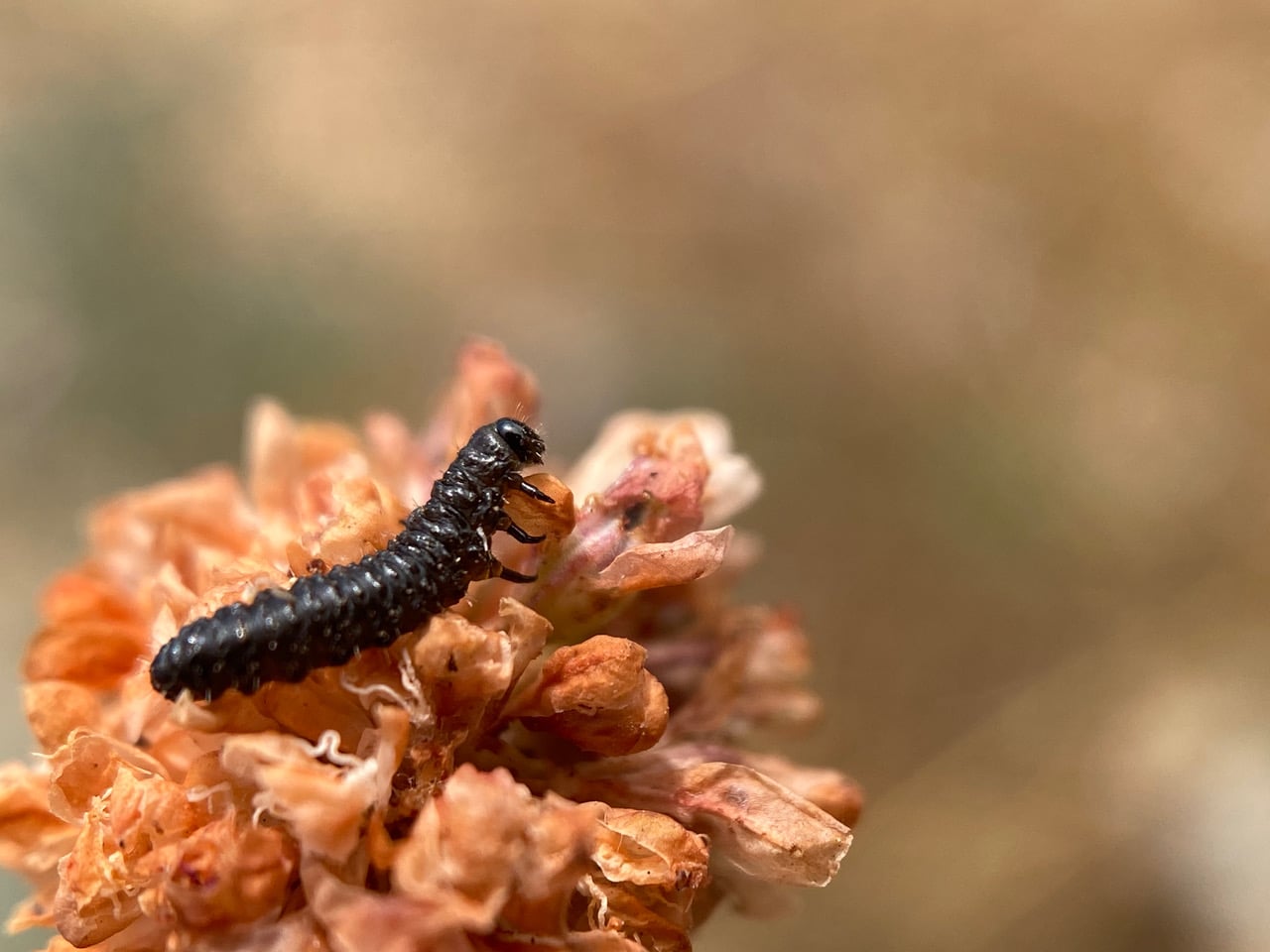 A Flea Beetle larva is moving around on a withered inflorescence of Nude Buckwheat. The shiny, black larvae resemble lepidopteran caterpillars. Like the adults, they feed on the flowers and stems of the plant.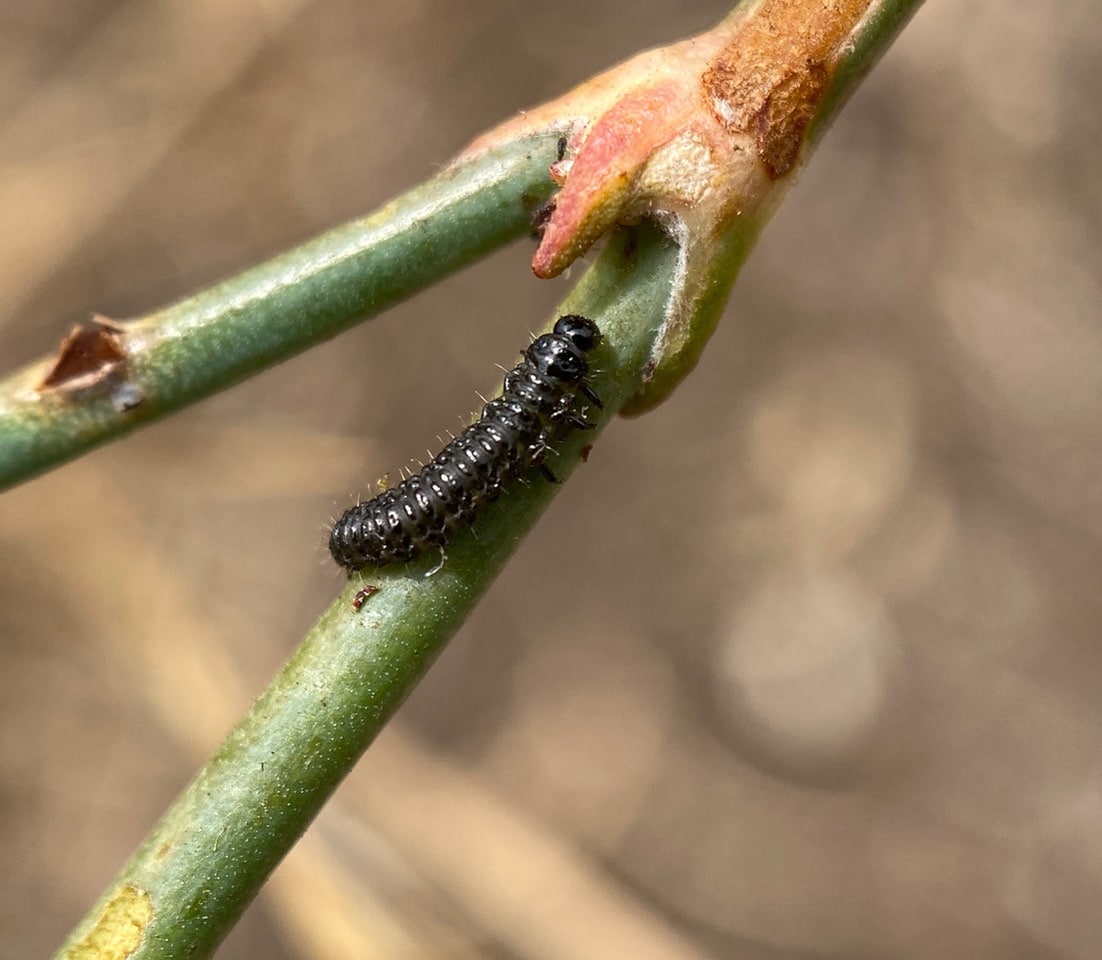
The Flea Beetle larvae are often found feeding on the stems of Nude Buckwheat.

The little Anise Swallowtail caterpillar is still on the same Yampah plant. It does not seem to have molted since I last saw it, but more of the flowers on the umbel have disappeared, apparently devoured by the caterpillar.
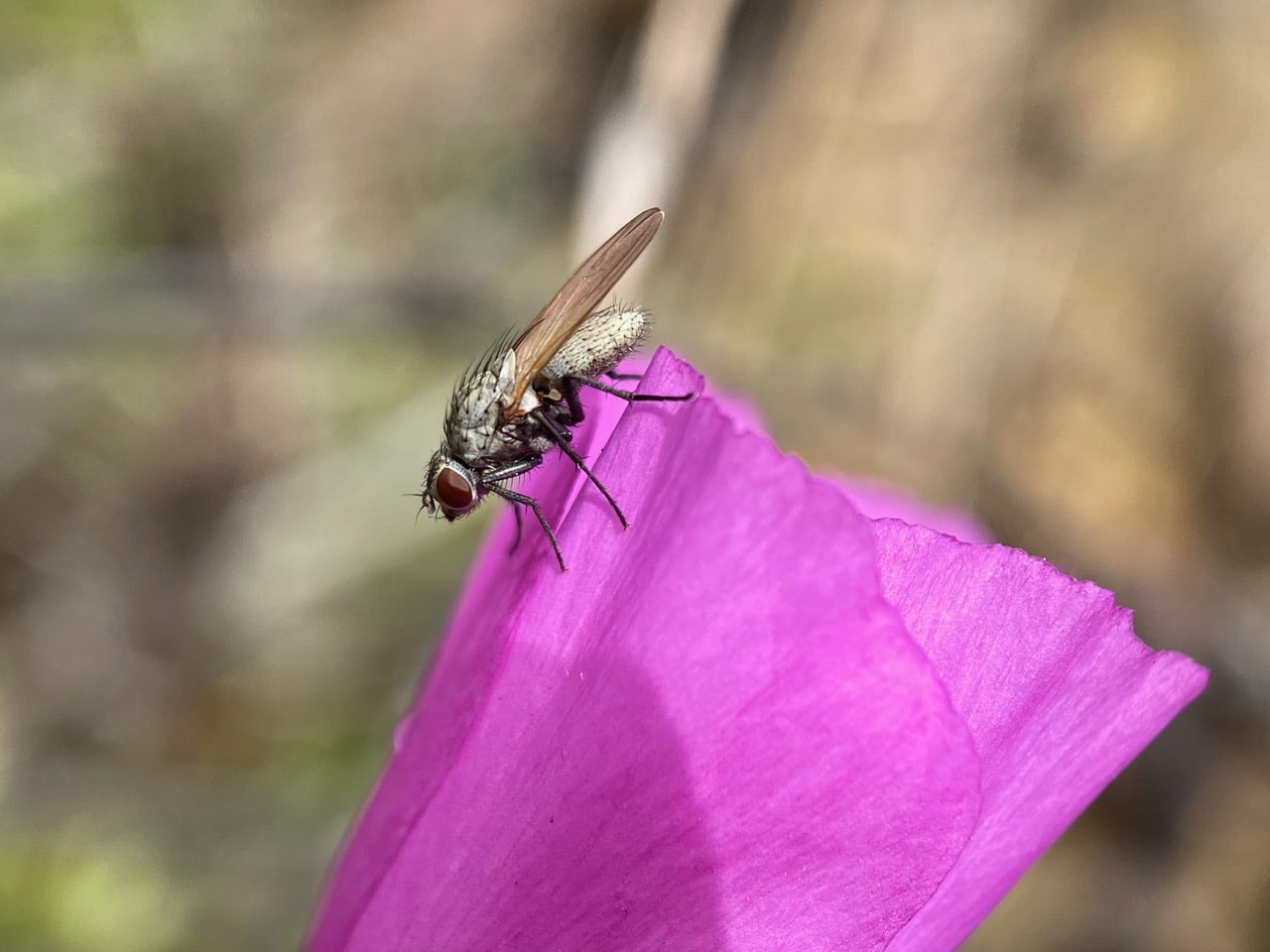
An unidentified fly is perched on a flower of Farewell-to-spring, Clarkia rubicunda.
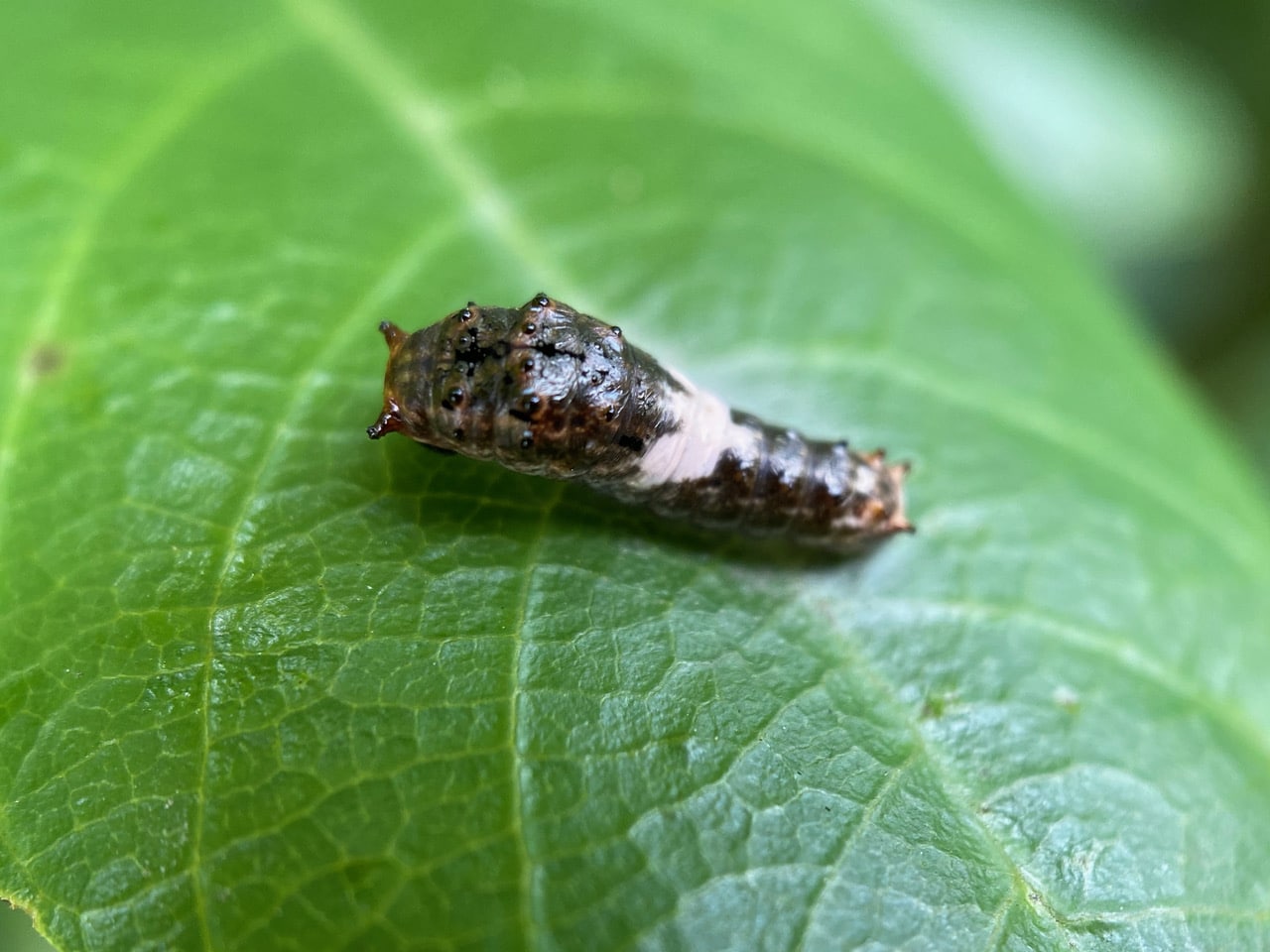
I am anxious to get to the two Pale Swallowtail caterpillars on the Coffeeberry bush. This one hasn’t changed much, looking as it did on 7/29.
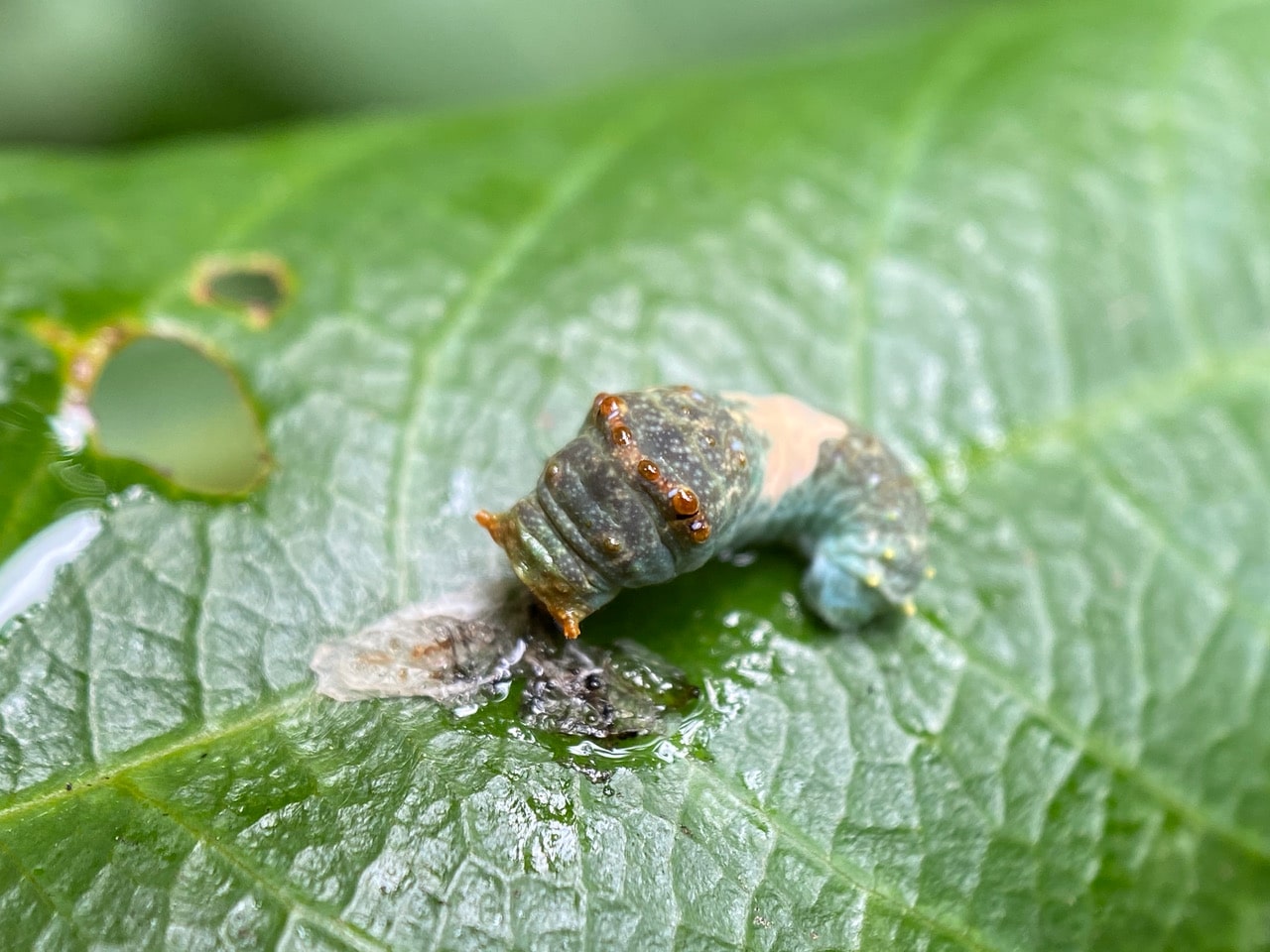
The other caterpillar now looks quite different, with a bluish cast to its skin. It has obviously molted! It is hunched over what looks like its shed skin in a wet puddle, apparently eating it.
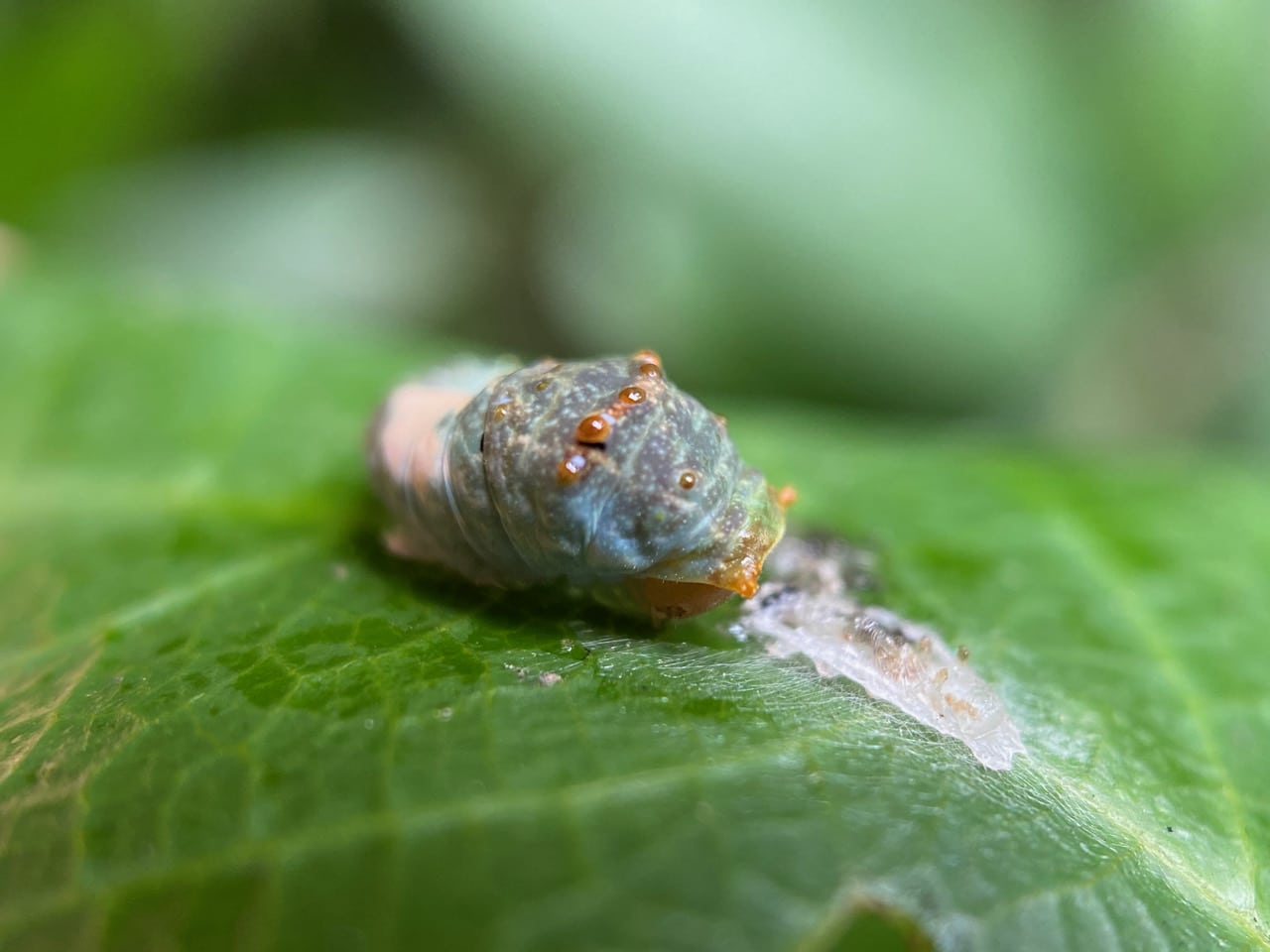
The shiny bumps (scoli) on its thorax have become more prominent.
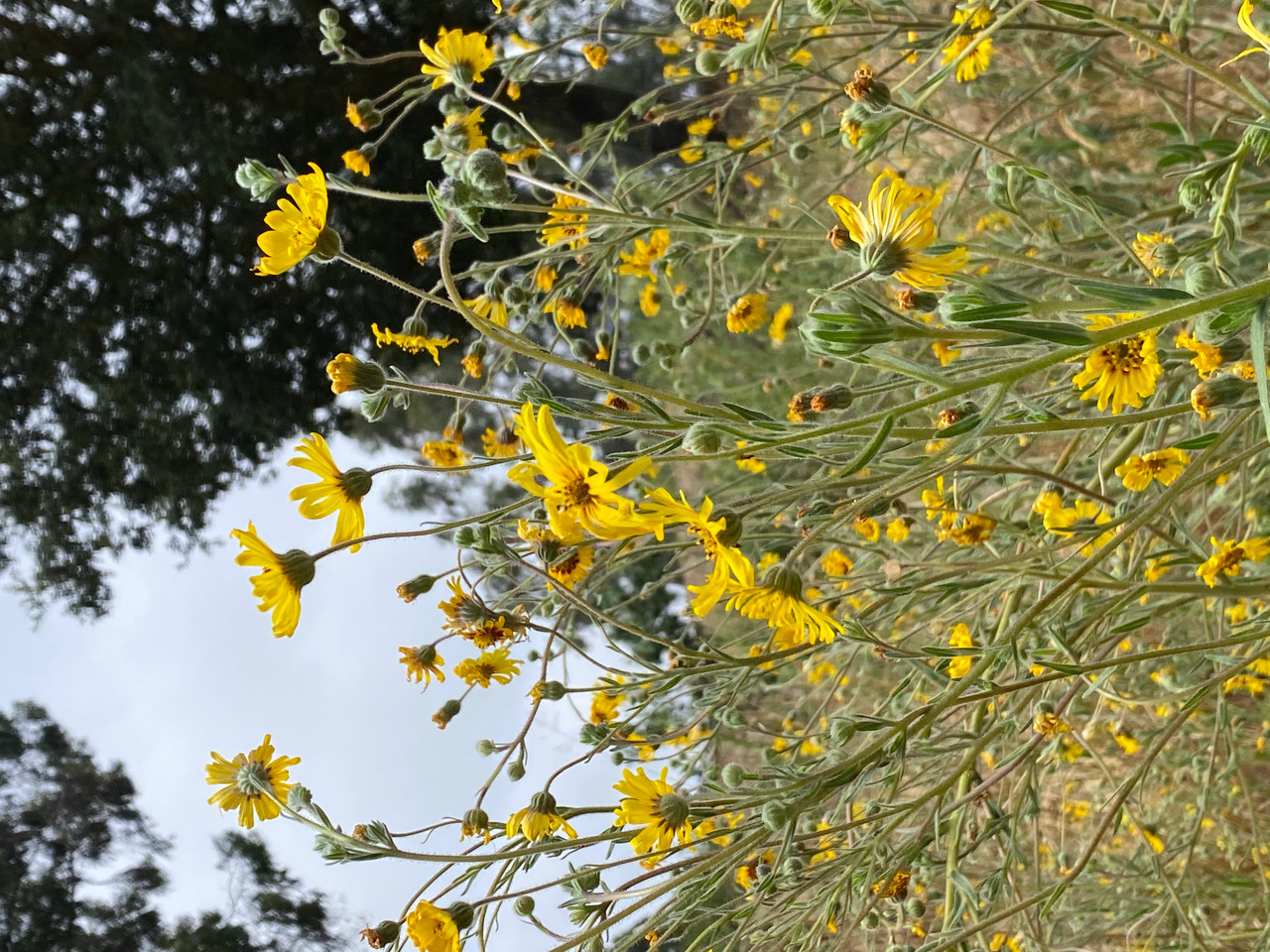
I arrive at the Tarweed patch under the Water Tank to find some of the Elegant Tarweed, Madia elegans flower heads are still open.
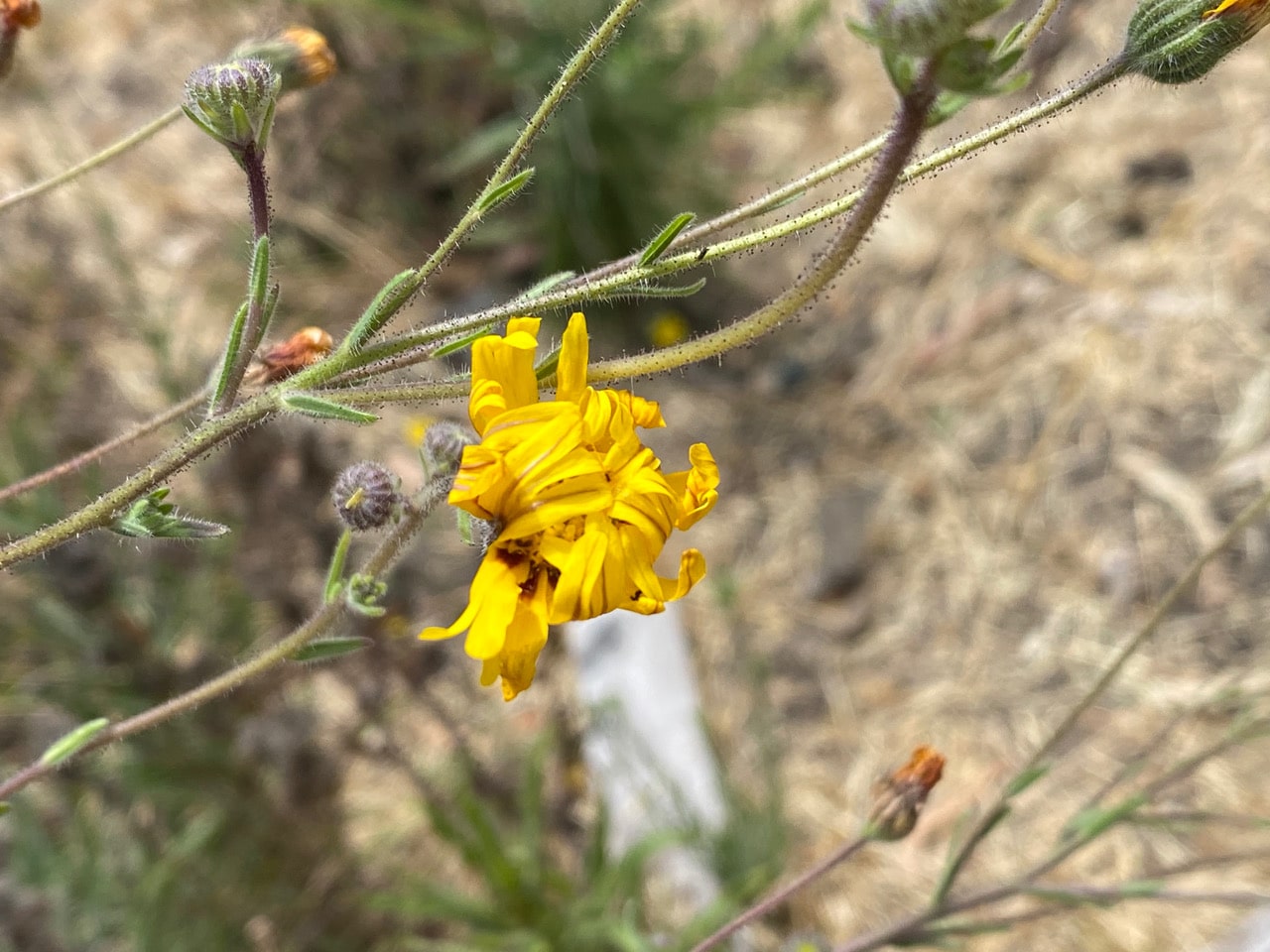
This flowerhead has been sealed closed with silk by a cautious and industrious young Small Owlet Moth, Heliothodes diminutiva (family Noctuidae) caterpillar. An unusual find, as caterpillars are rare in this patch of tarweed in contrast to Siesta Gate. The shelter apparently protects the caterpillar from predators and parasitoids while it feeds on the flowers within.
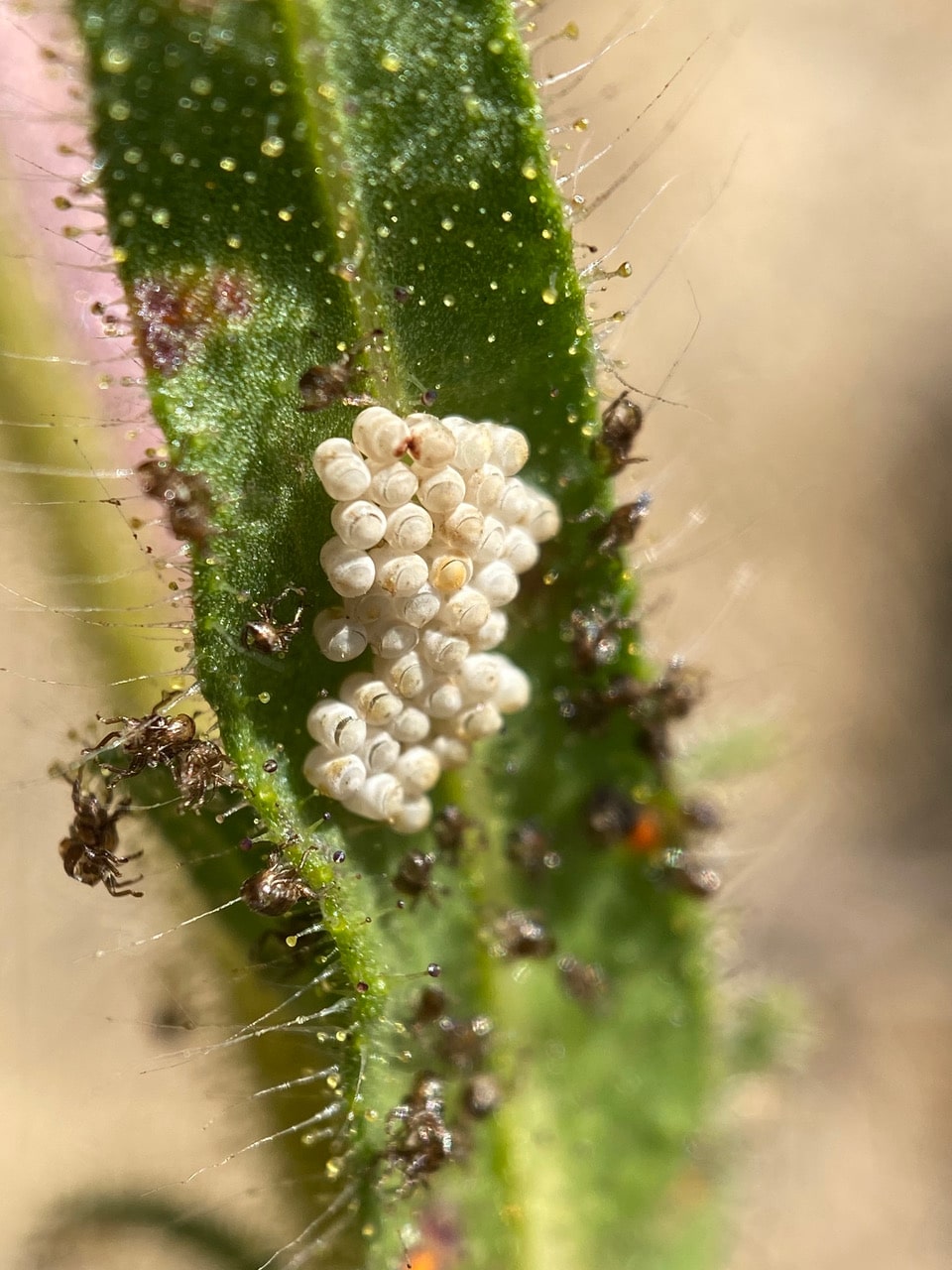
A clutch of Stink Bug eggs (family Pentatomidae) sits empty on a leaf of Coast Tarweed, Madia sativa. The nymphs have hatched synchronously from the barrel-shaped eggs through the pop tops. For the first few days, the nymphs stay together on or around the egg shells until their first molt, after which they begin to disperse. There are exuviae (shed skins) of the nymphs strewn about the eggs. The second instars have all gone their separate ways to explore the world.
Pentatomidae is a family of insects belonging to the order Hemiptera or “true bugs”. As hemipterans, the pentatomids have piercing-sucking mouthparts, and most are phytophagous, including several species that are severe pests on agricultural crops.
All Pentatomids have 5-segmented antennae, and they generally have a large triangular scutellum in the center of the back. The body shape of adults is generally shield-shaped when viewed from above. The common name of Stink Bug refers to their ability to release a pungent defensive spray when threatened, disturbed, or crushed.
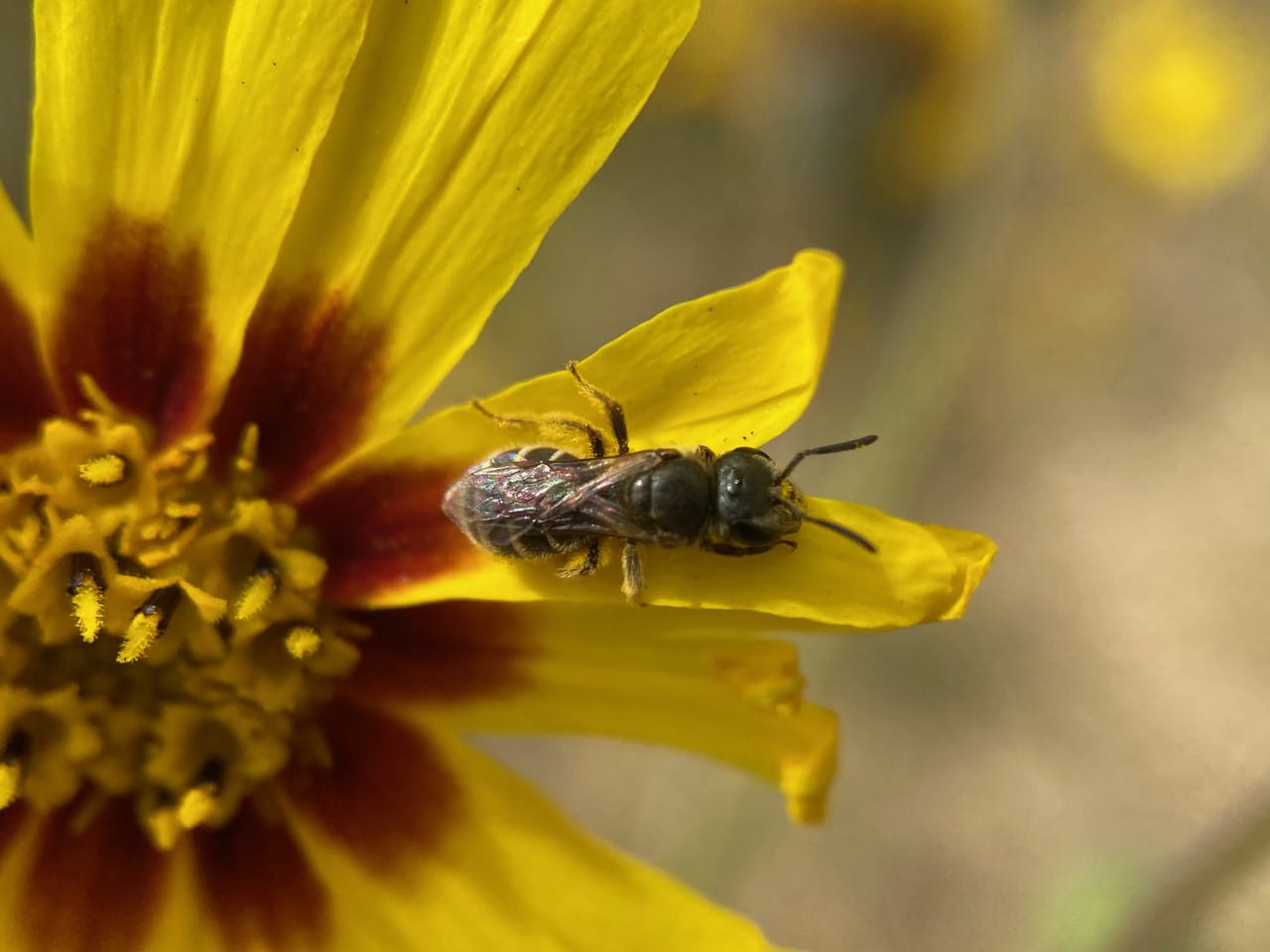
A Sweat Bee, Halictus sp. (family Halictidae) appears to be resting on a ligule of an Elegant Tarweed flowerhead. She has apparently not been collecting pollen as the scopae on her hind legs are empty.

30 minutes after I left the Pale Swallowtail caterpillars, I check on them again on my way back. There is no sign of the messy exuviae – the blue caterpillar has cleaned it all up!
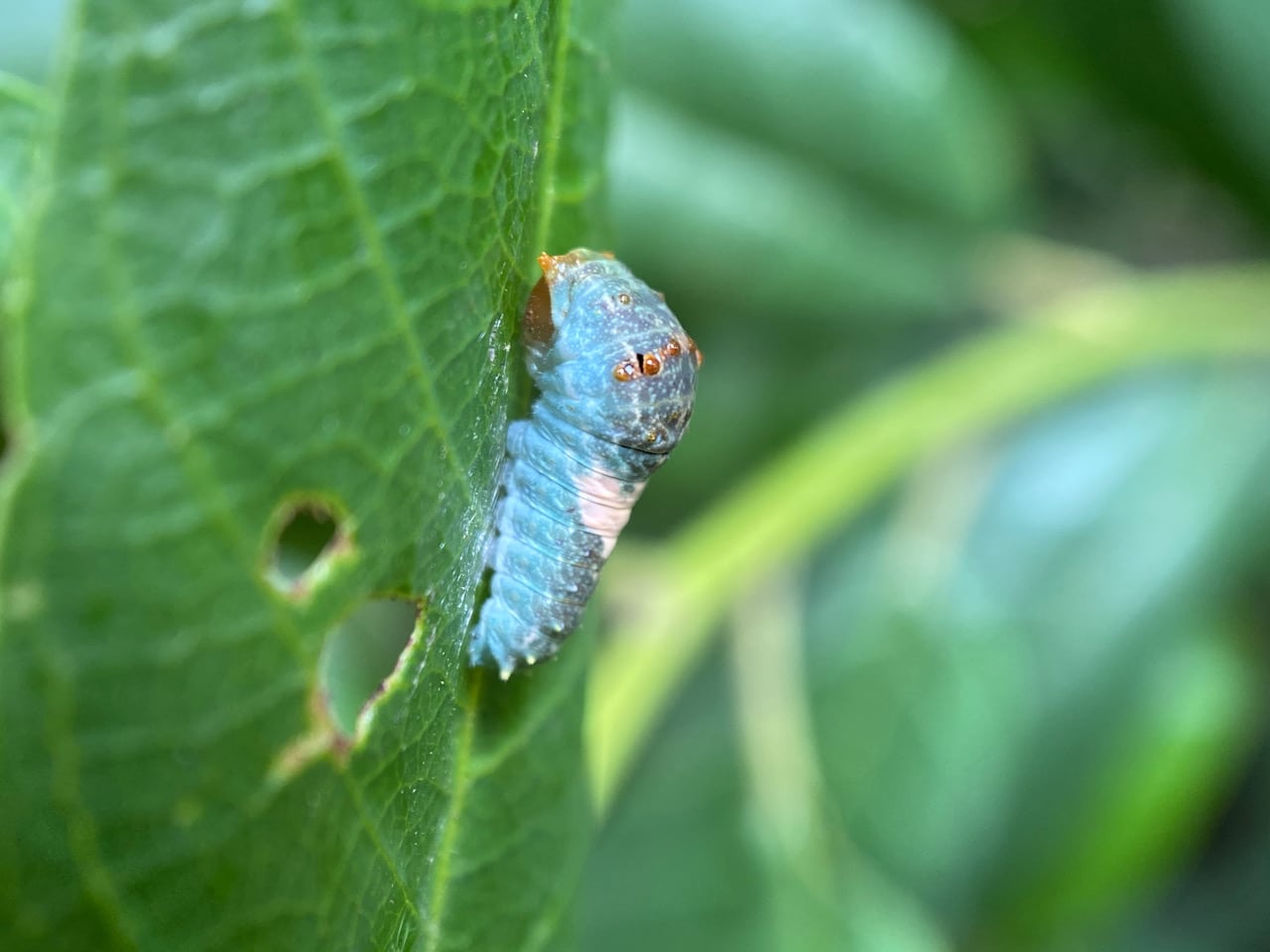
Side ways, the molted caterpillar is resplendent in blue. No longer a bird poop mimic!
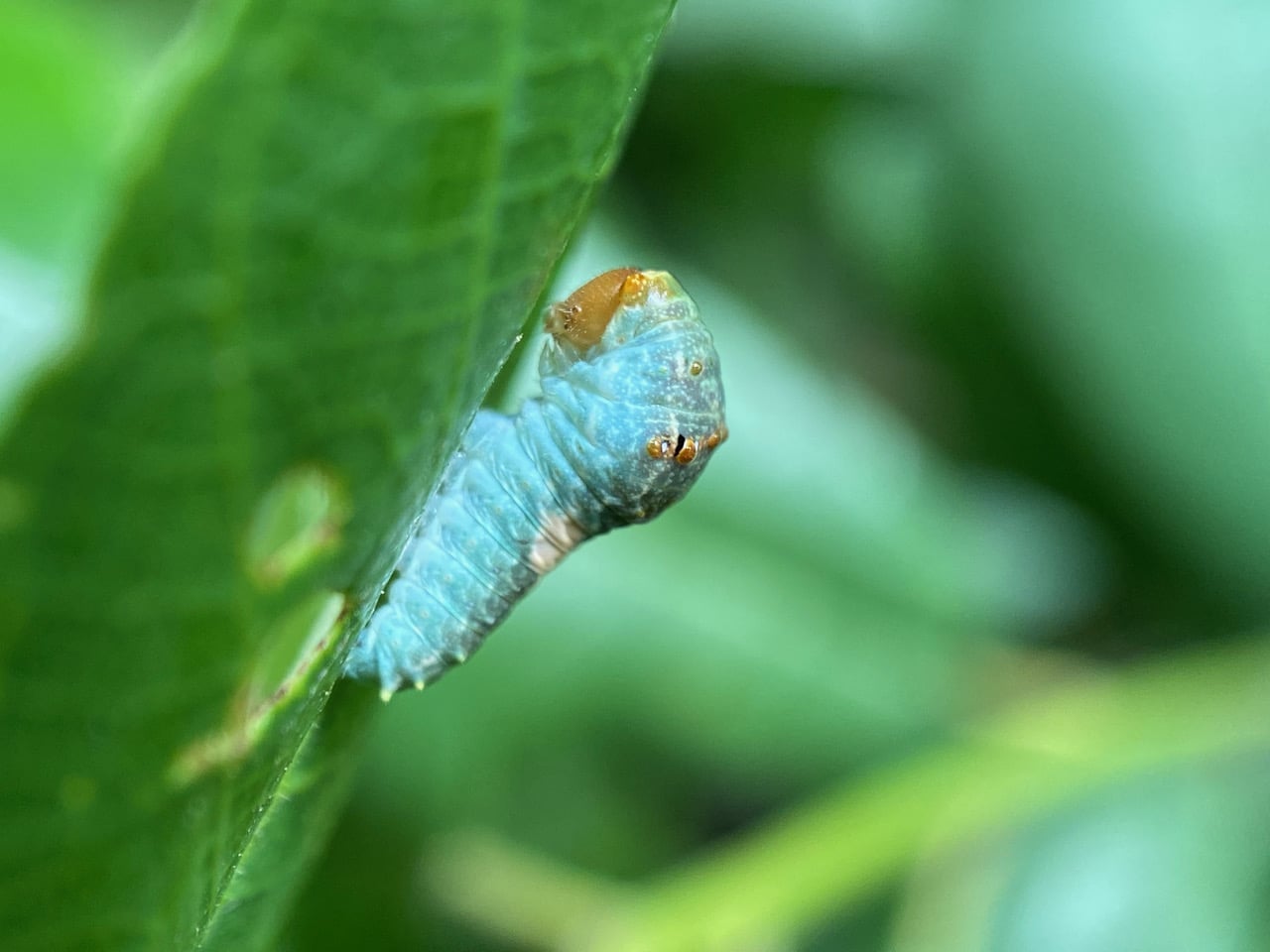
We get a brief glimpse of the yellow head of the caterpillar. The bulky part of the caterpillar is its thorax.
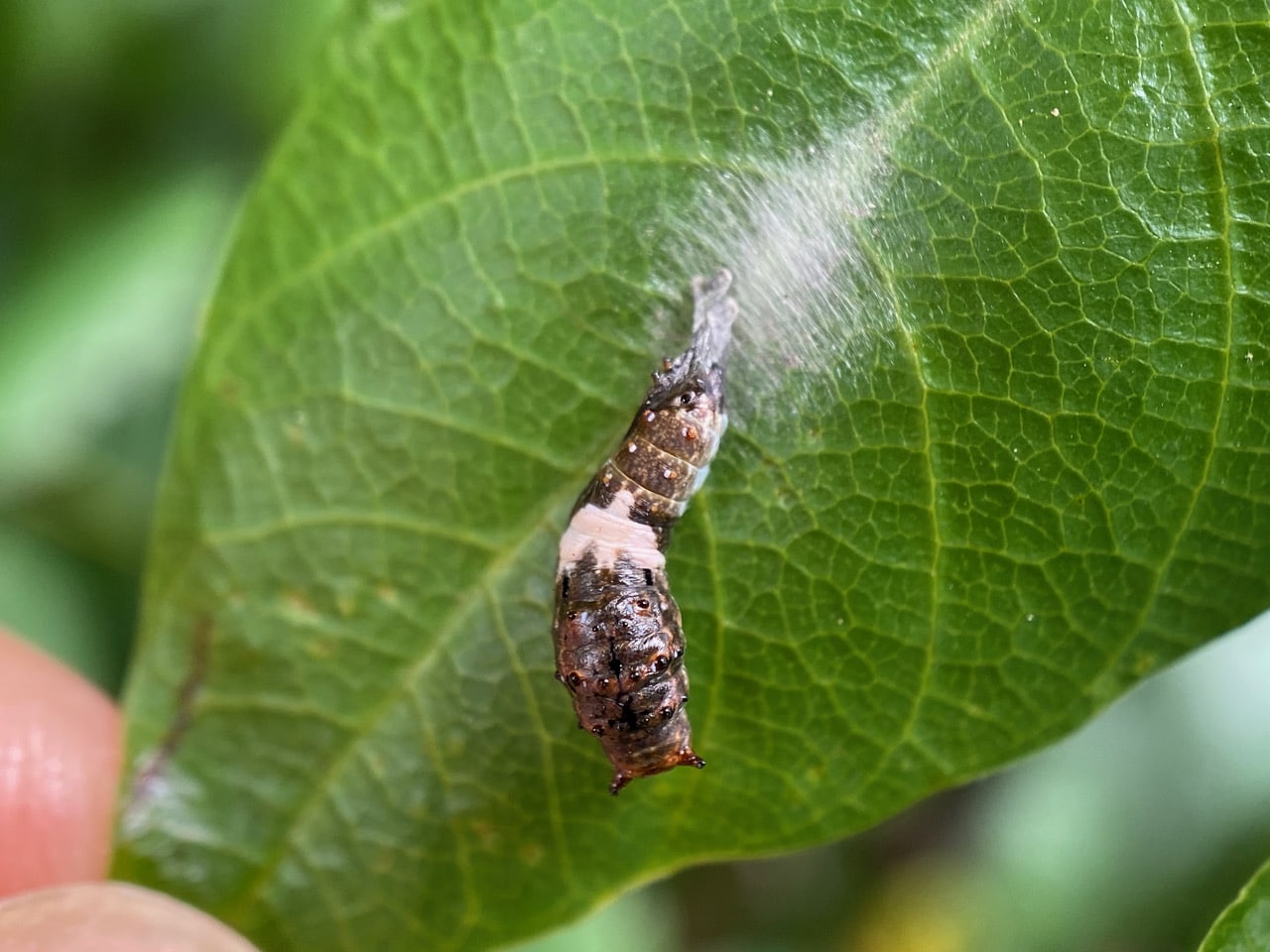
The brown caterpillar is probably close to molting. The two caterpillars are probably siblings, their eggs laid by the same female butterfly on two separate branches of the Coffeeberry. The caterpillar is slowly moving away from its silk pad.
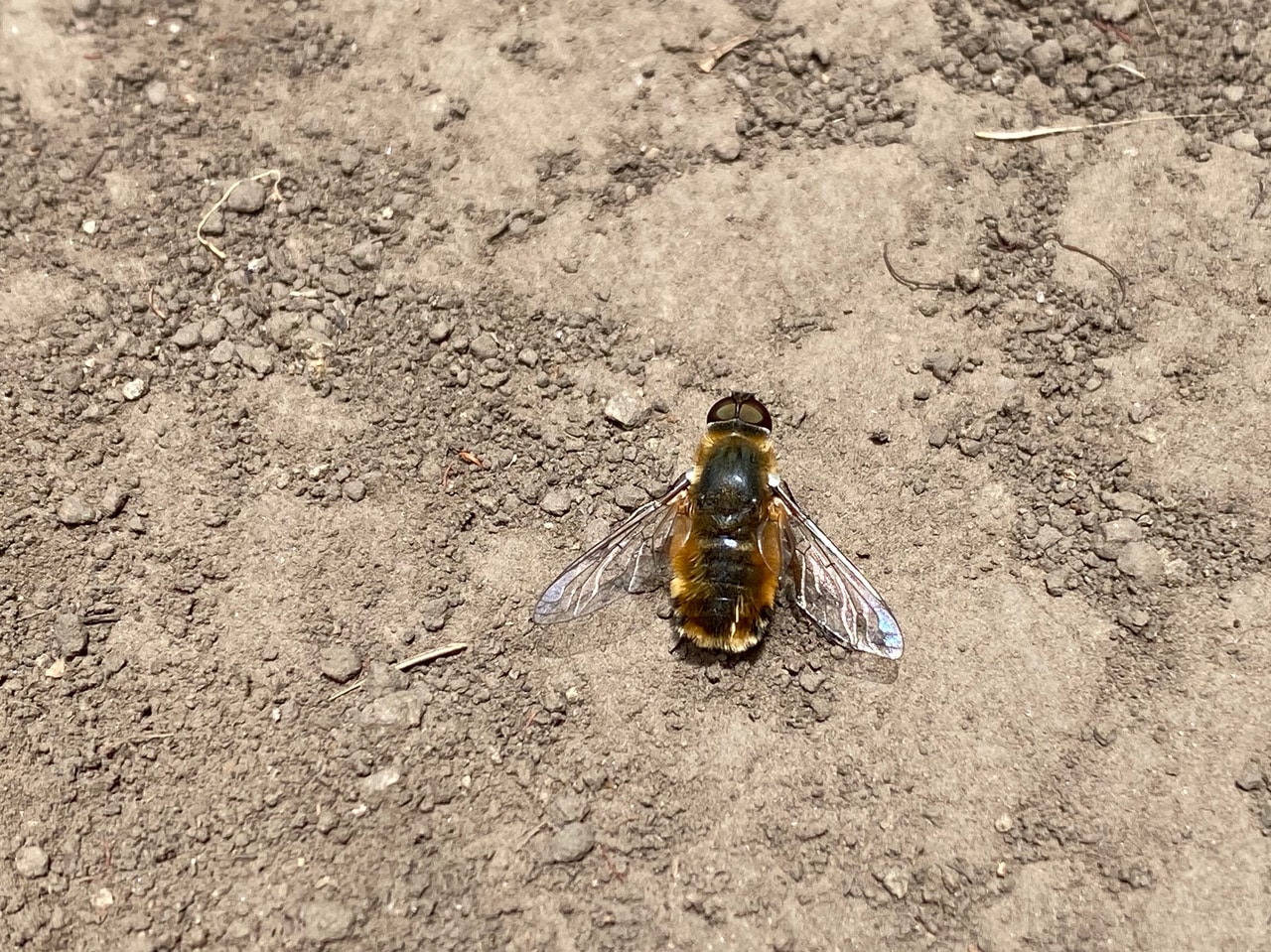
A Bee Fly, Villa sp. (family Bombyliidae) is flying low over the ground ahead of me, occasionally landing on the trail. It is difficult to get close enough to photograph these wary insects.
The Bee Flies belong to the family Bombyliidae. Adults generally visit flowers for nectar and pollen, some being important pollinators. Larvae generally are parasitoids of other insects. When at rest, many species of bee flies hold their wings at a characteristic “swept back” angle. The adult females usually deposit eggs in the vicinity of possible hosts, quite often in the burrows of beetles or ground-nesting bees/wasps. Bombyliidae parasitism is not host-specific, but rather opportunistic, using a variety of hosts. Adult females of the genus Villa lay eggs in mid-air and flick them towards the nest entrances of their hosts. They typically have an eversible pouch near the tip of their abdomen known as a sand chamber, which is filled with sand grains gathered before egg laying. These sand grains are used to coat each egg just before their aerial release, presumably to improve the female’s aim by adding weight.