

Pollinator Post 8/2/23 (1)
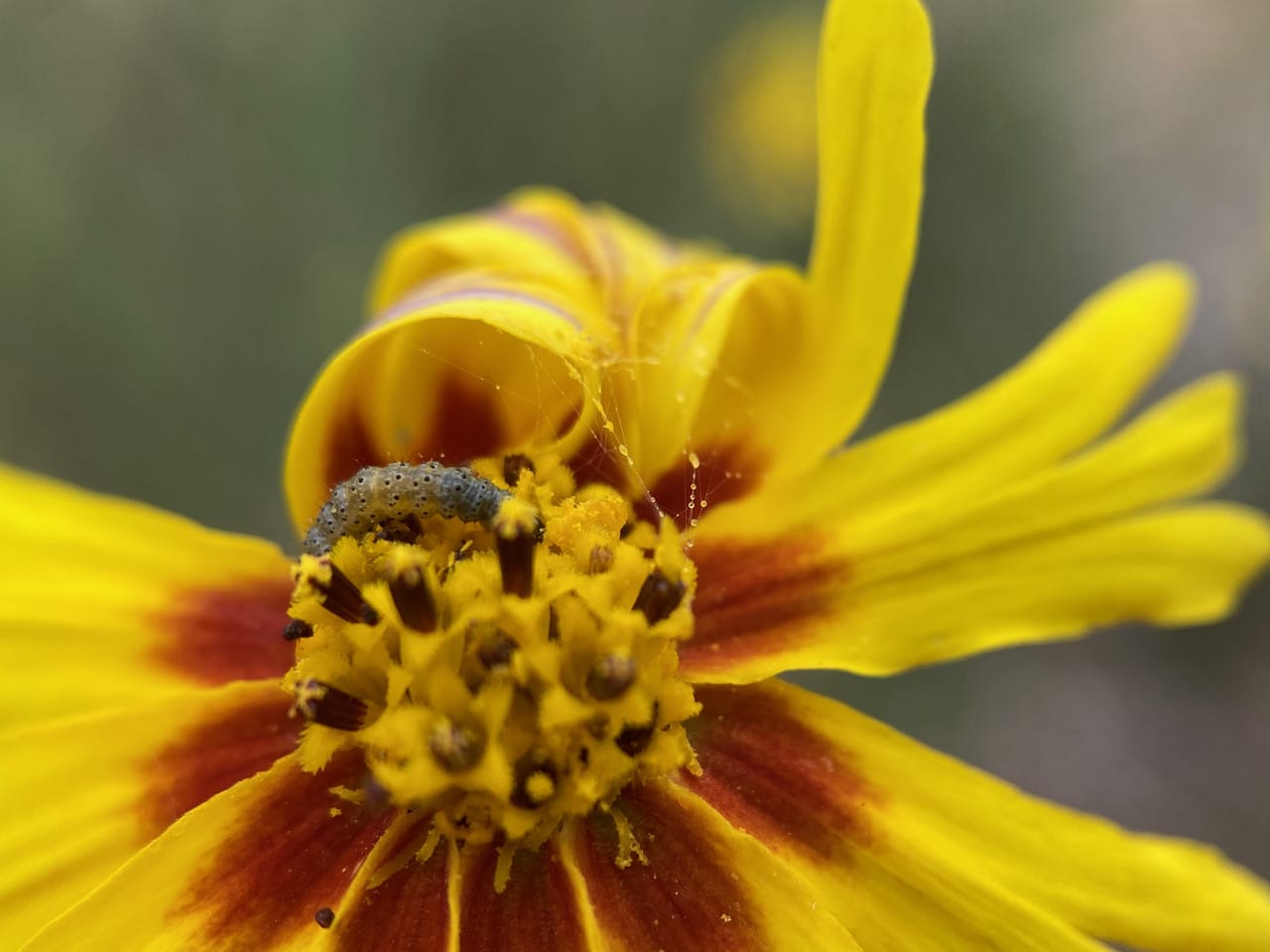
It is a cold, foggy morning. What a delight to be greeted with this at the Siesta Gate tarweed patch! A tiny caterpillar of the Small Owlet Moth, Heliothodes diminutiva (family Noctuidae) is binding the ligules of the ray flowers together with silk to create a shelter for itself on a flowerhead of Elegant Tarweed, Madia elegans. When the shelter is completed, the caterpillar can safely feed on the flowers, protected from predators and parasitoids. Only the very young caterpillars do this.
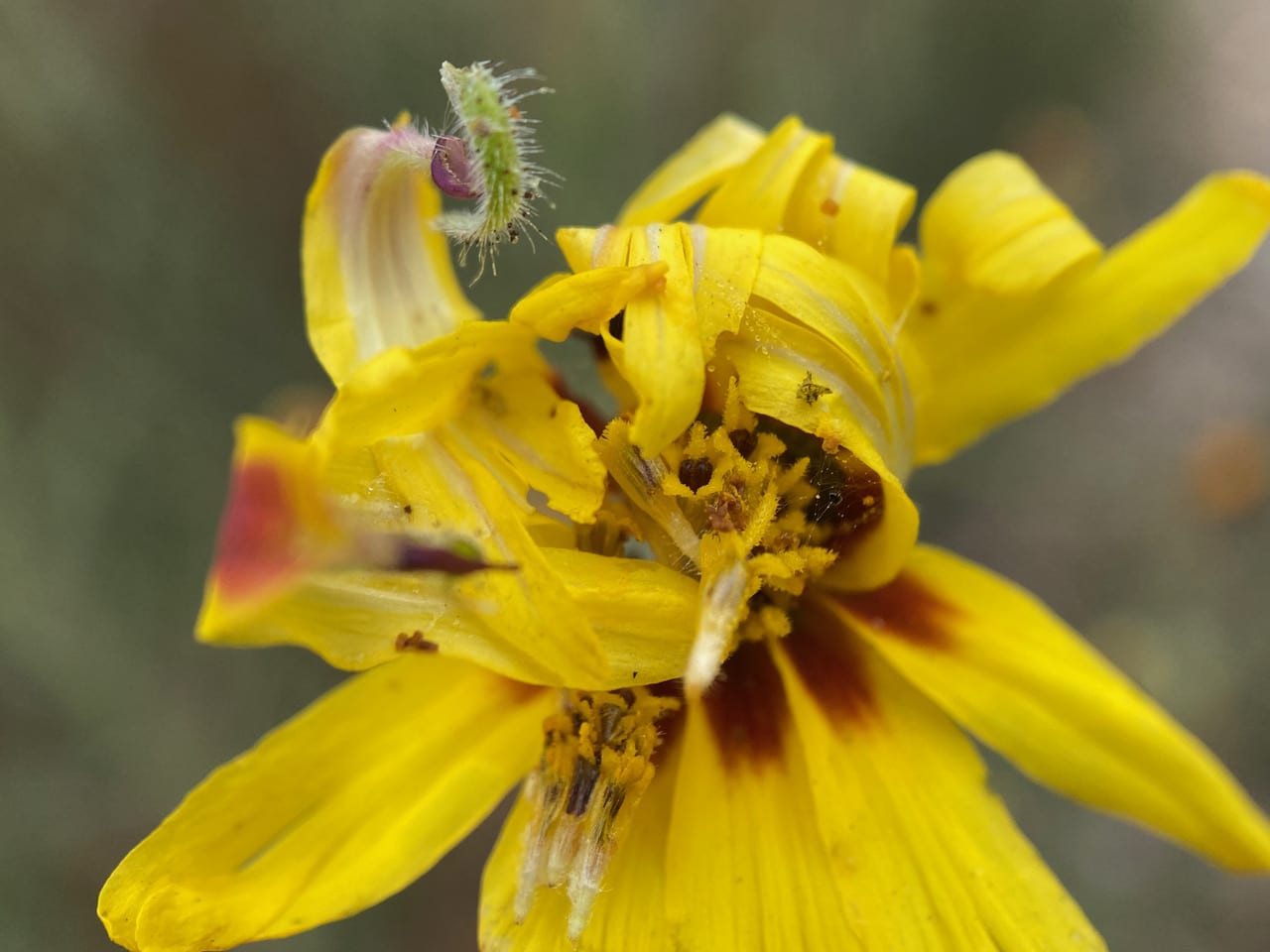
Here’s another shelter under construction. I don’t see a caterpillar inside. Perhaps it is already taken by a predator? There are clear signs of a struggle – torn ligules and detached florets. Several Yellowjacket wasps are out hunting in the patch. A caterpillar’s life is rife with danger.

This fortress seems to be holding well.

Insulated with ample hairs and scales, a Small Owlet Moth, Heliothodes diminutiva (family Noctuidae) is hunkered down on a flowerhead to shelter from the cold winds.
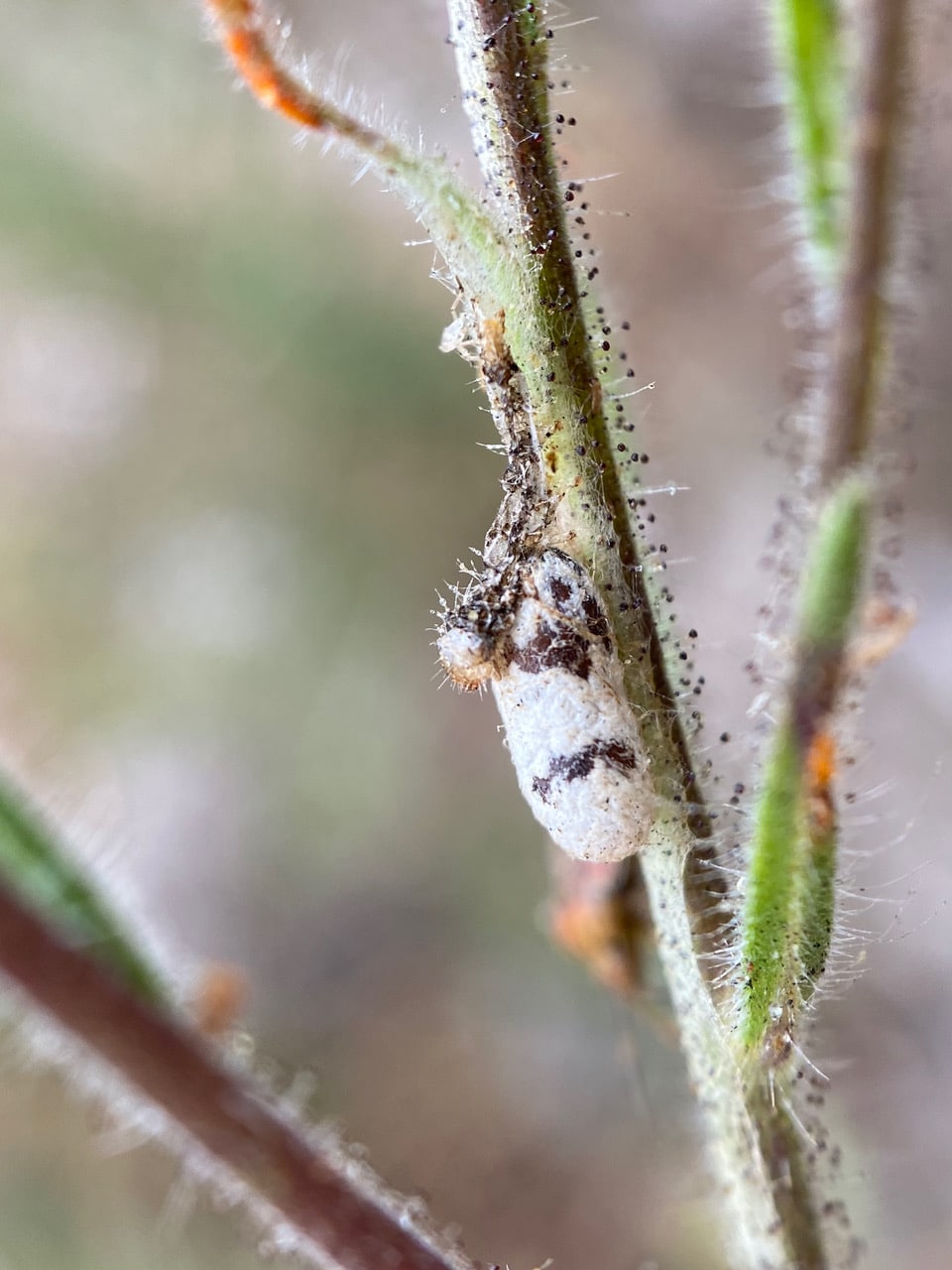
A withered caterpillar is draped over a Hyposoter wasp pupa that is attached to the stem of Elegant Tarweed. It’s a horrible way to die.
Hyposoter is a large cosmopolitan genus of parasitoid wasps belonging to the family Ichneumonidae. Obvious evidence that Hyposoter is present is its black-and-white pupal cocoon. These commonly occur on foliage attached to the shriveled skin of the caterpillar in which the parasitoid fed during its larval stage.
Hyposoter undergoes complete metamorphosis. The adult wasp lays its egg in the caterpillar. After hatching, the larva feeds inside on the caterpillar’s hemolymph (blood) while developing through three, increasingly larger instars. The wasp larva then feeds on the caterpillar’s tissues consuming the entire body except for the skin and head capsule. The host caterpillar shrinks and becomes a hard and brittle, shriveled skin. The parasitoid emerges from the host skin as a mature third instar (prepupa). The wasp then spins a silken cocoon commonly attached to the dead caterpillar’s skin. The cocoon is about 1/4 in. long, oblong with dense white silk and blackish patches. Parasite development time from oviposition until adult emergence is about one month. There may be several generations per year. Hyposoter is used in the biological control of caterpillars in many crops.

Two caterpillars are feeding in the open, seemingly oblivious to danger.
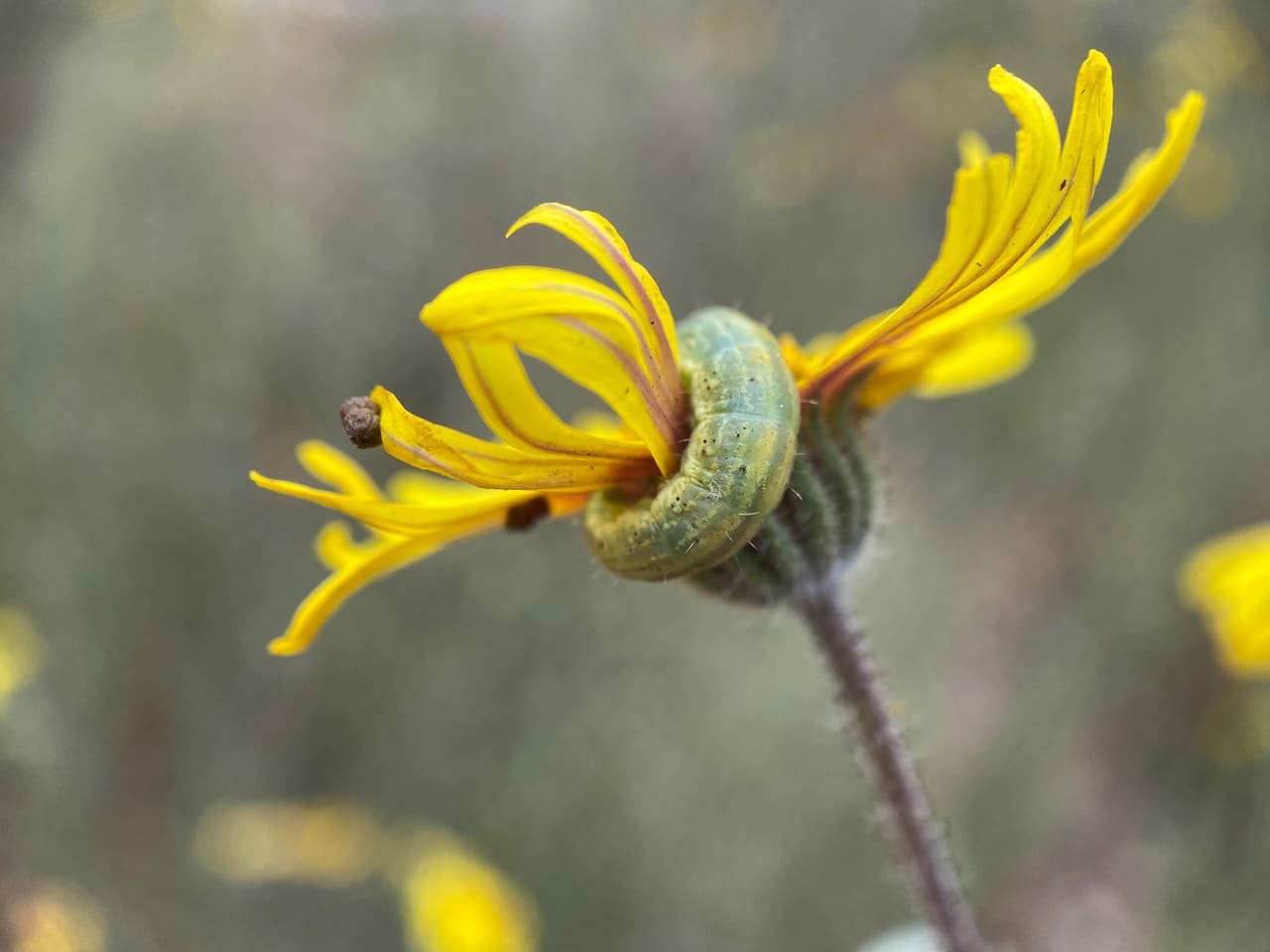
To the insatiable Heliothodes caterpillar, the focus is always flowers. They pretty much leave the leaves alone.
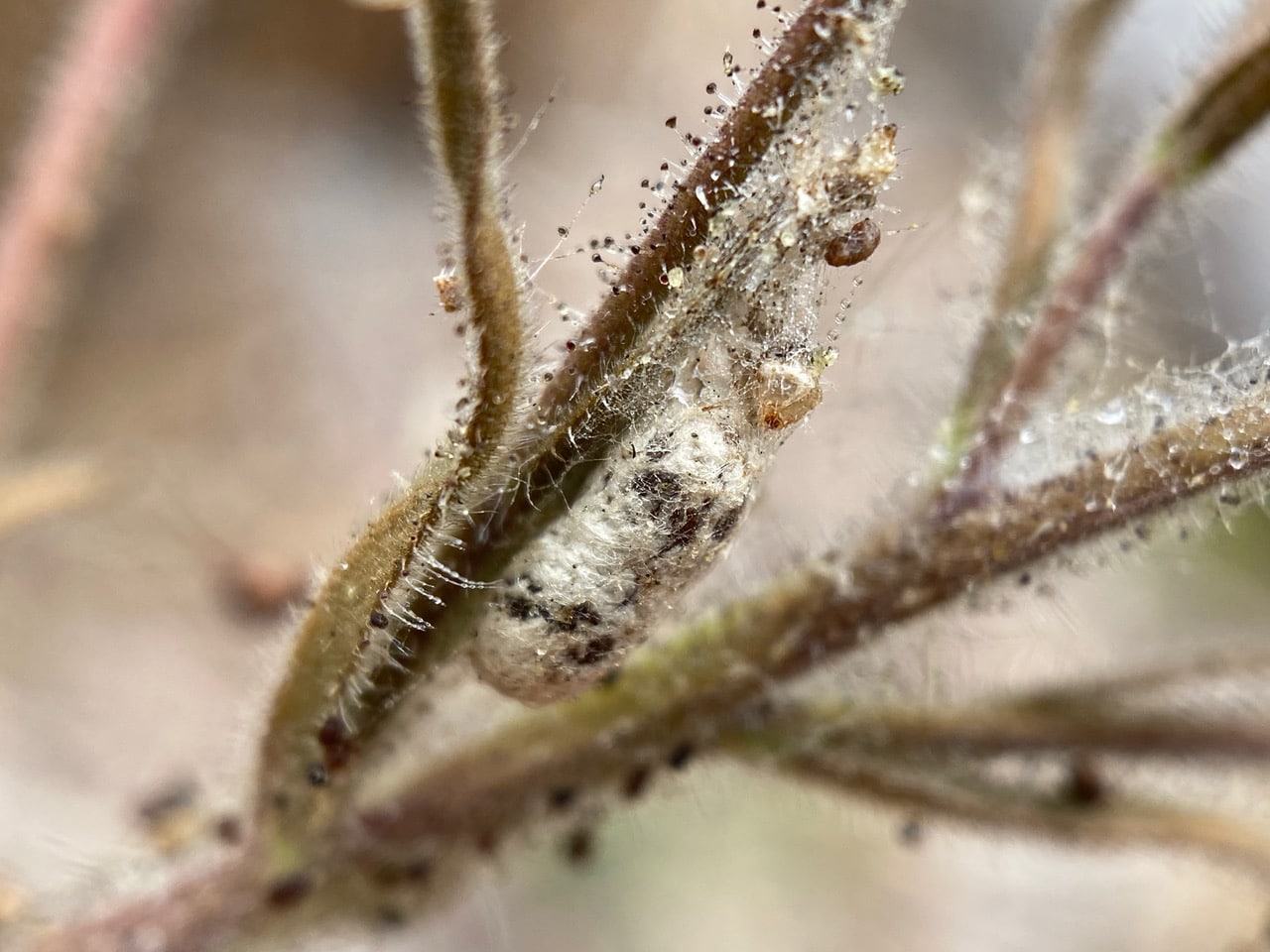
Somewhere in that tangled mess there is a parasitoid wasp pupa and a dead caterpillar. Can you see them?

Two Lygus Bug (family Miridae) nymphs are romping on the foliage of Elegant Tarweed. See the dark tipped rostrum that is folded under the body? Like the adults, the nymphs feed by piercing plant tissues with the rostrum to extract plant sap.

“True bugs” in the order Hemiptera undergo incomplete metamorphosis without a pupal stage. The nymphs, which look like adults, develop through a series of molts, each time getting bigger after shedding their old exoskeleton. At the last molt, they transform into adults with functional wings and reproductive parts.
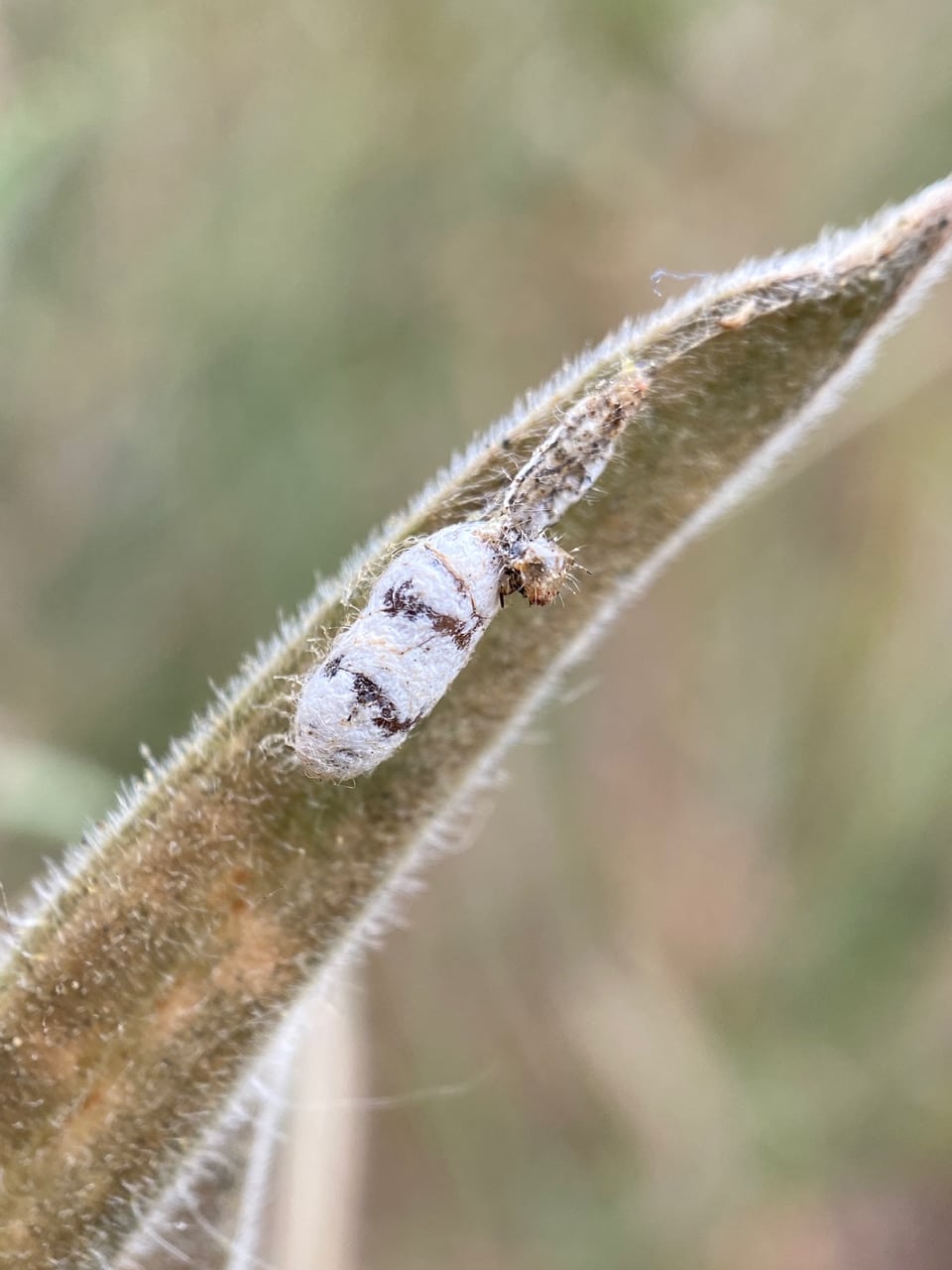
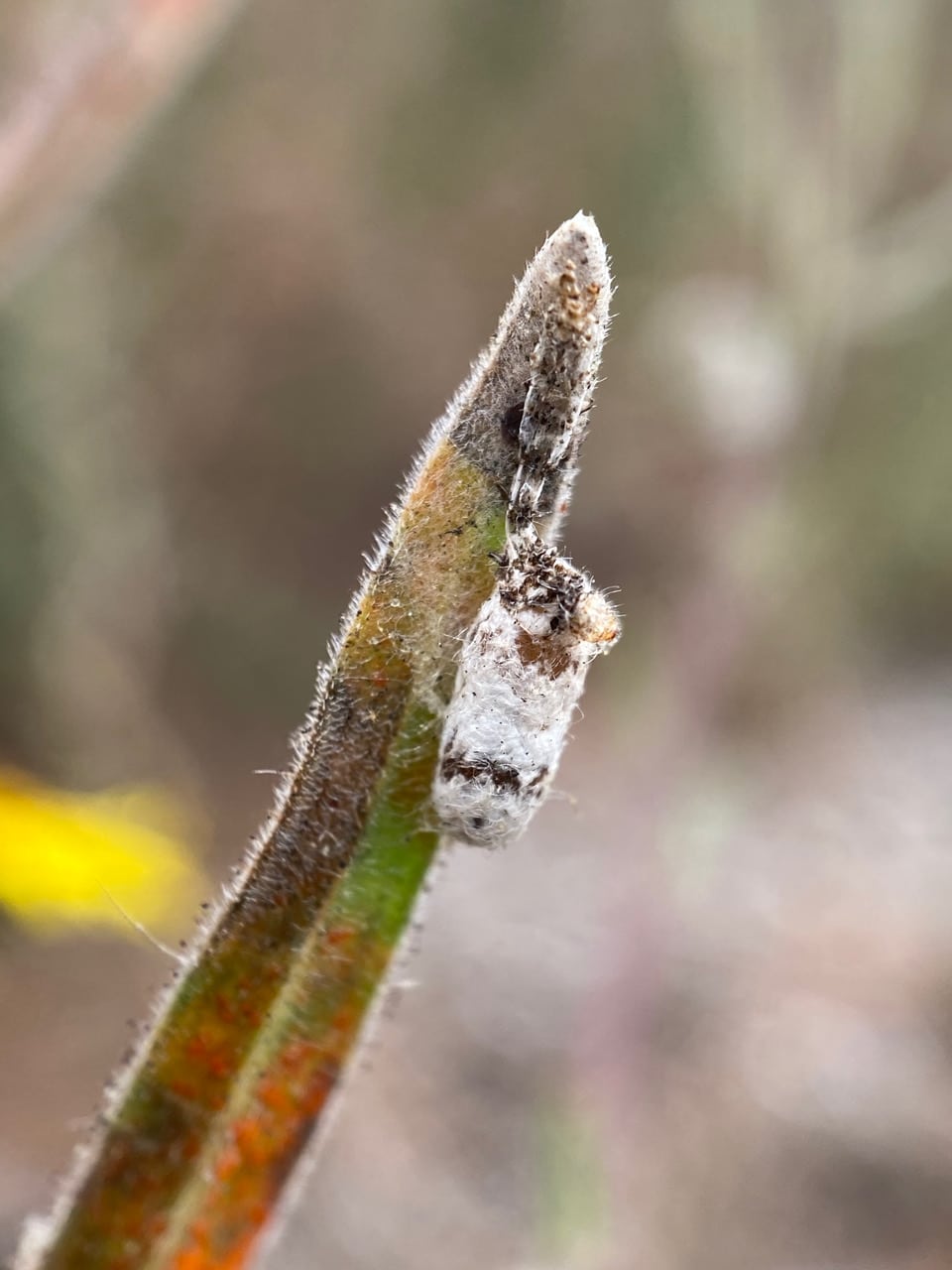
Another gruesome dead caterpillar-parasitoid pupa pair on the back of a rust-infected leaf of Elegant Madia.
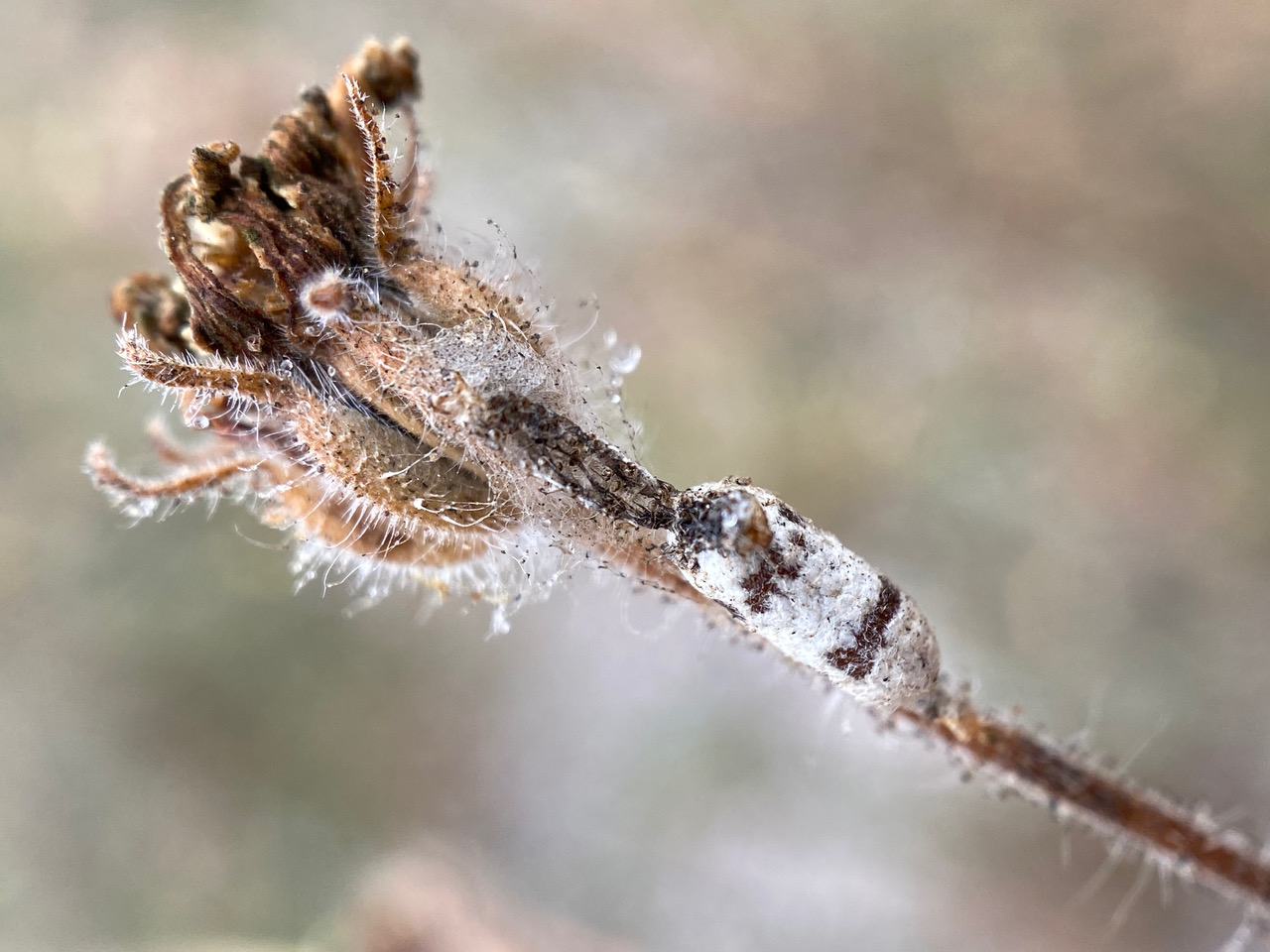
Yet another gruesome pair under a withered flowerhead. None of the wasp pupae seem to have an exit hole on the end. I wonder when the Hyposoter wasps will emerge? There is quite an impressive population of them here providing natural caterpillar control for the tarweeds.

A fresh, vividly colored Heliothodes caterpillar has just stepped out of its old skin in the process of molting! This is the normal developmental process if caterpillars have not been parasitized.
The larval stage of a butterfly or moth is spent doing little but eating. Only as a caterpillar do these insects have chewing mouthparts, and they waste no time using them. As they eat, caterpillars increases in size and their skin (exoskeleton) becomes tighter and tighter, as it doesn’t grow larger. The caterpillar grows a new, larger exoskeleton underneath the outer skin and then sheds, or molts, the old one. Most caterpillars molt five times. At first, the new exoskeleton is very soft, but it soon hardens. The shed exoskeleton is often eaten before the caterpillar ingests more plant food.
The caterpillar’s stage of development in between each molt a called an “instar”. When the caterpillar hatches from its egg, it is referred to as a “first instar” caterpillar. After its first molt, the caterpillar is referred to as a “secondary instar” and so on up until the exoskeleton is shed for the final time, revealing the chrysalis.

From one flowerhead to the next, the caterpillar never stops feeding.
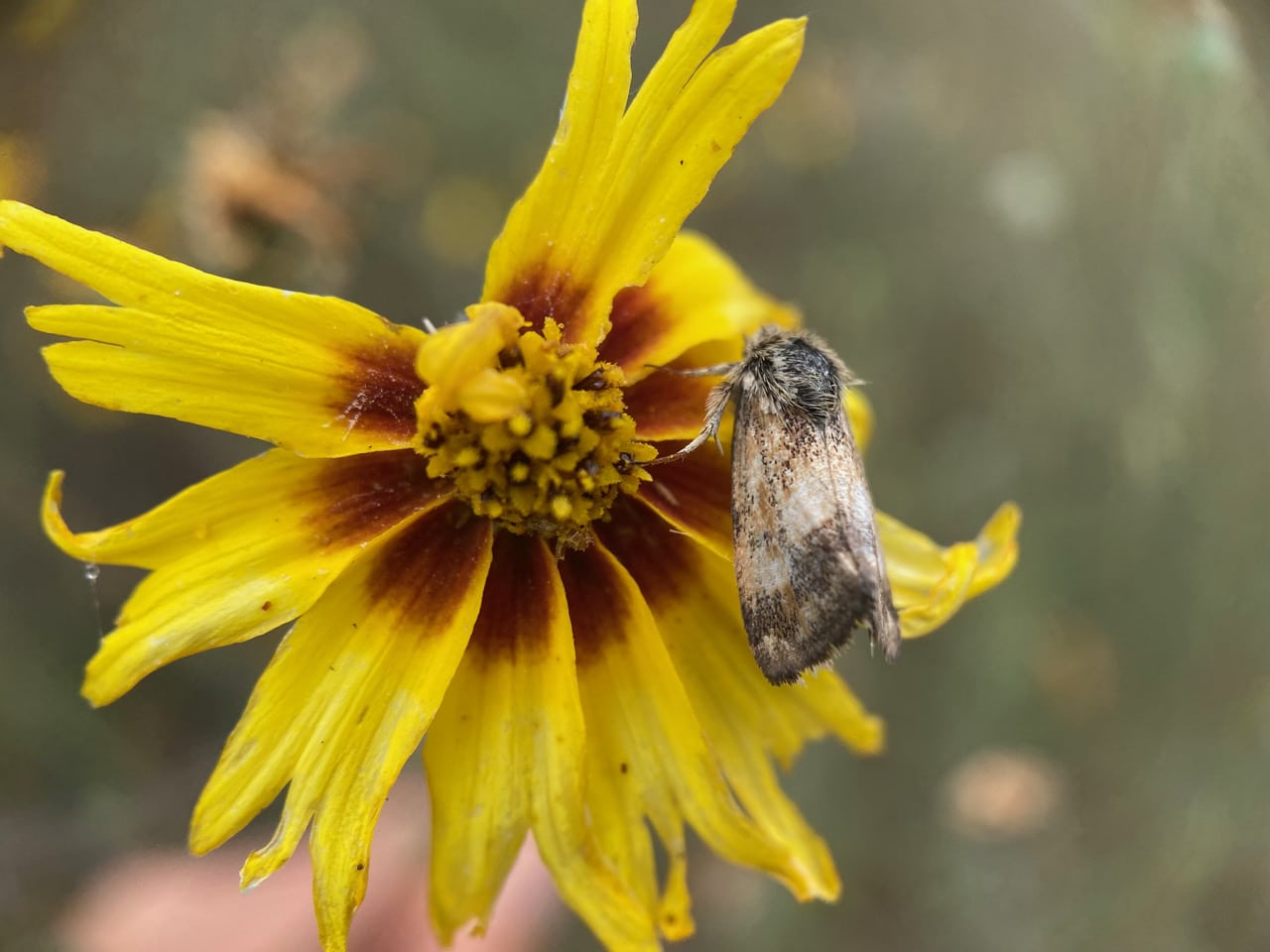
An older Small Owlet Moth, Heliothodes diminutiva (family Noctuidae) is resting on an Elegant Tarweed flowerhead. It has lost a lot of scales on its wings and thorax, and is no longer colorful.
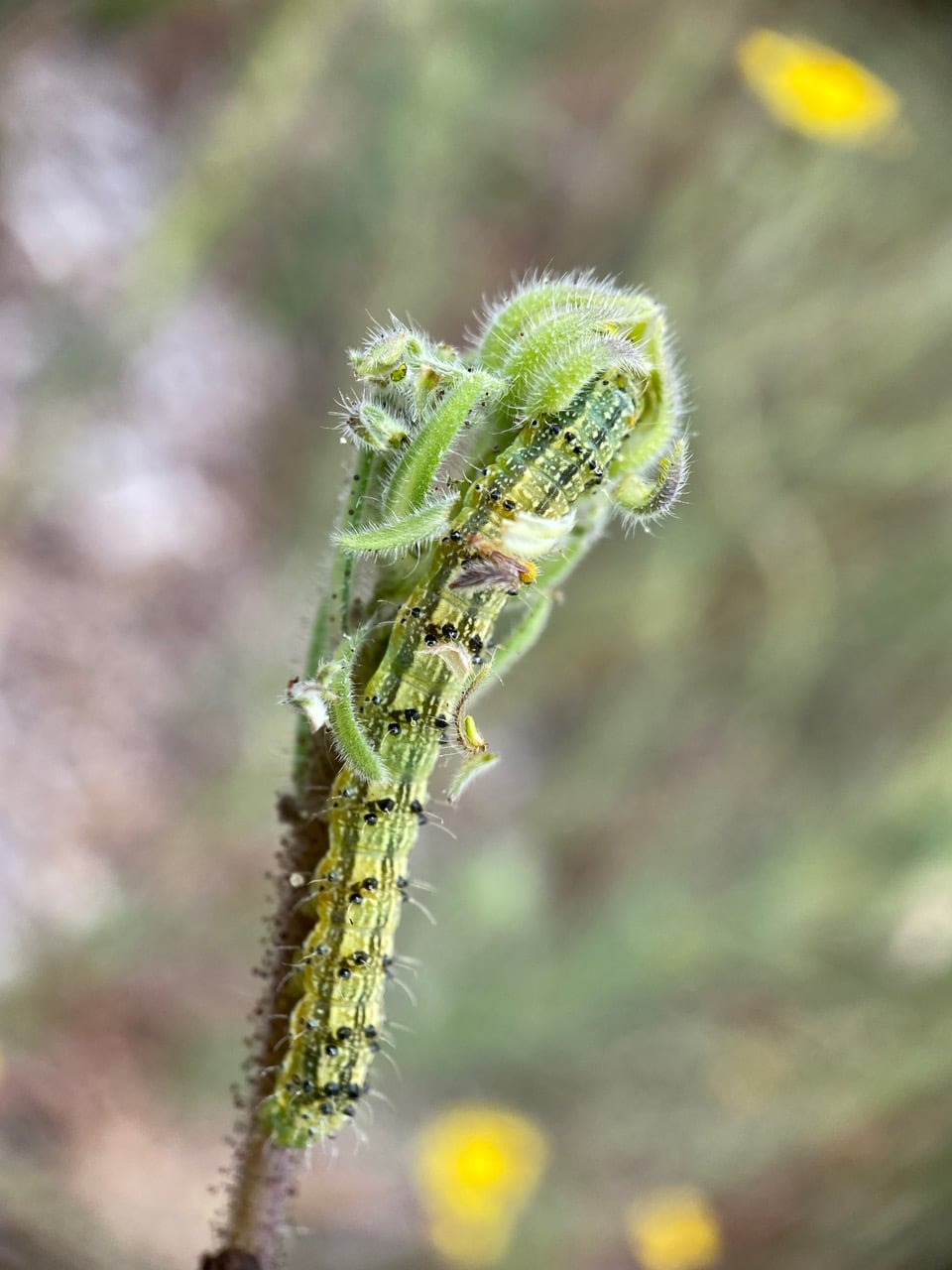
Going from one flowerhead to the next.

Gruesome demise of the Heliothodes caterpillar.

A nymph of Lygus Bug (family Miridae) is foraging in a Farewell-to-spring flower, Clarkia rubicunda. Note the short wing pad.
“True bugs” in the order Hemiptera undergo incomplete metamorphosis without a pupal stage. The nymphs, which look like adults, develop through a series of molts, each time getting bigger after shedding their old exoskeleton. At the last molt, they transform into adults with functional wings and reproductive parts.
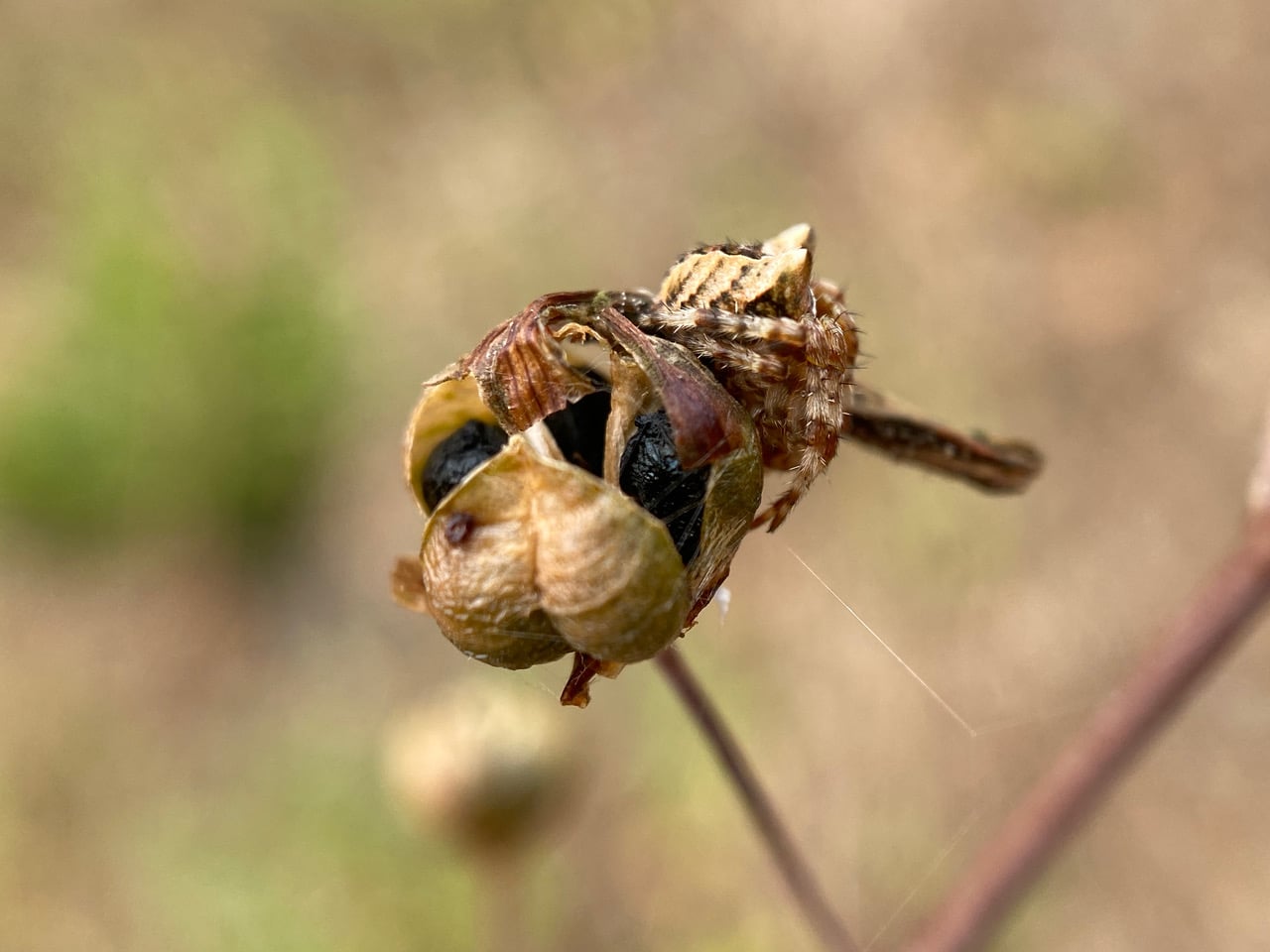
The seed capsule has ripened and split open on the Soap Plant, but the Two-tubercled Orb-weaver Spider is still clinging to it. It is even more difficult to see the spider now that the fruit has turned brown.
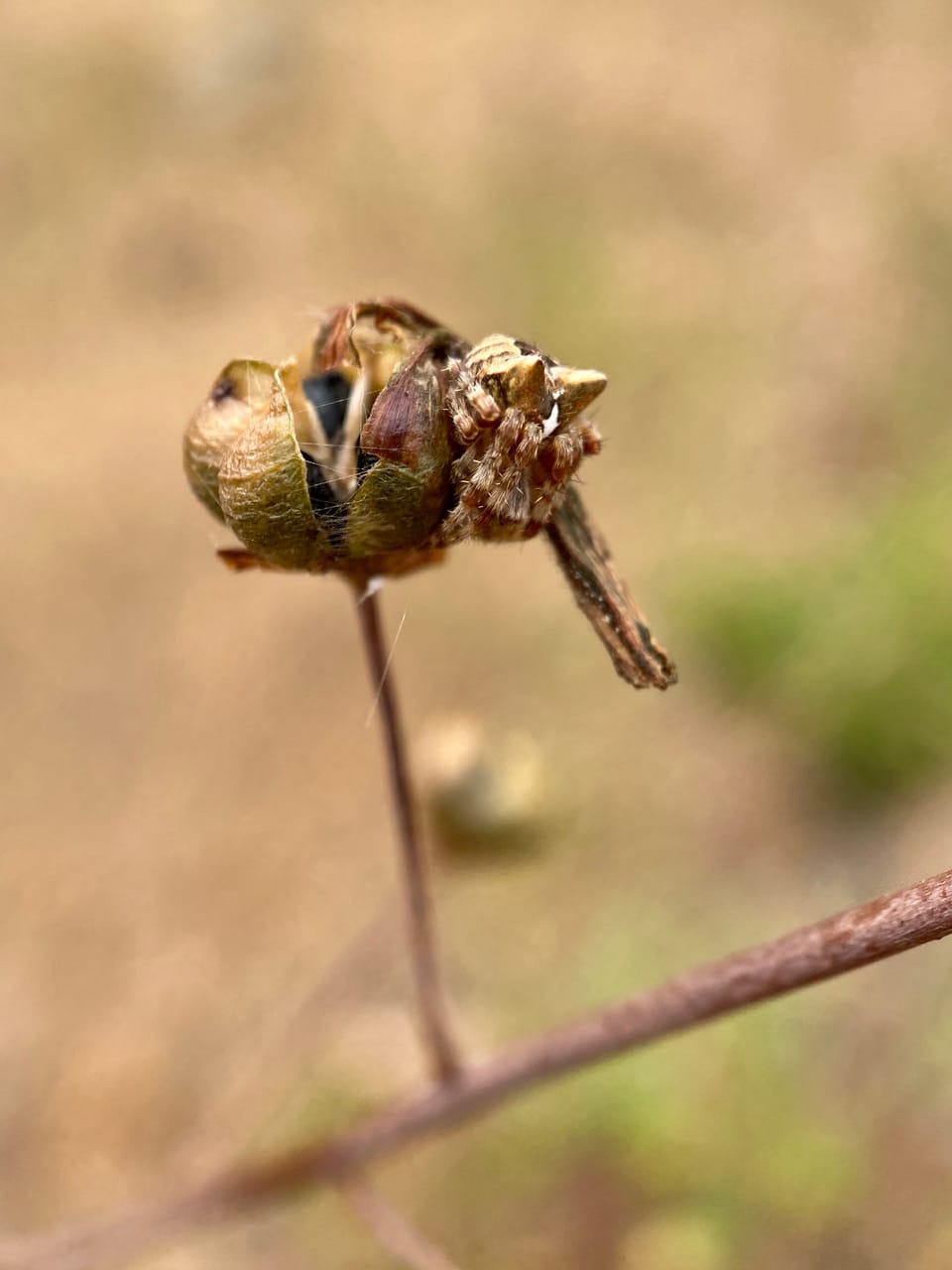
The spider viewed from a different angle. The white marking runs between the twin tubercles toward the spider’s head.
Gibbaranea bituberculata is a species of ‘orbweavers’ belonging to the family Araneidae. They are found in sunny habitats on shrubs, edges and low plants, where they can make their webs near the ground. Their basic color is very variable, but usually it is brownish, with whitish shades. The cephalothorax is covered with lying down hairs.
Orb-weaver spiders are members of the spider family Araneidae. They are the most common group of builders of spiral wheel-shaped webs often found in gardens, fields, and forests. Generally, orb-weavers are three-clawed builders of flat webs with sticky spiral capture silk. The third claw is used to walk on the non-sticky part of the web. Typically, the prey insect that blunders into the sticky lines is stunned by a quick bite, and then wrapped in silk.

Who has folded the top Bay leaf up so artfully?
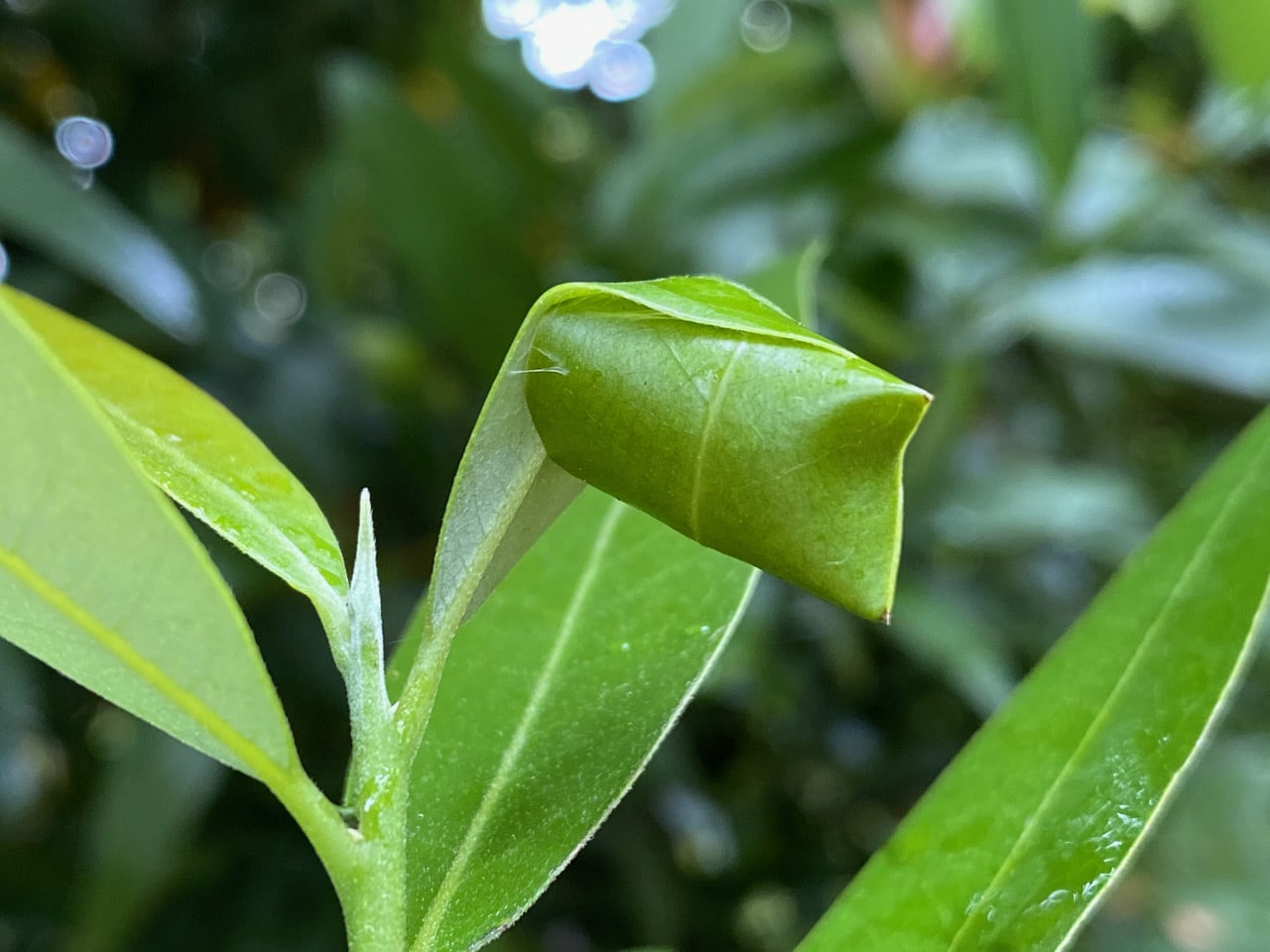
I lift the branch up for a better look. The leaf shelter has been folded into a boxy space and seamlessly sealed with silk. Wow, spider or caterpillar? I don’t have the heart to pull it apart to find out.
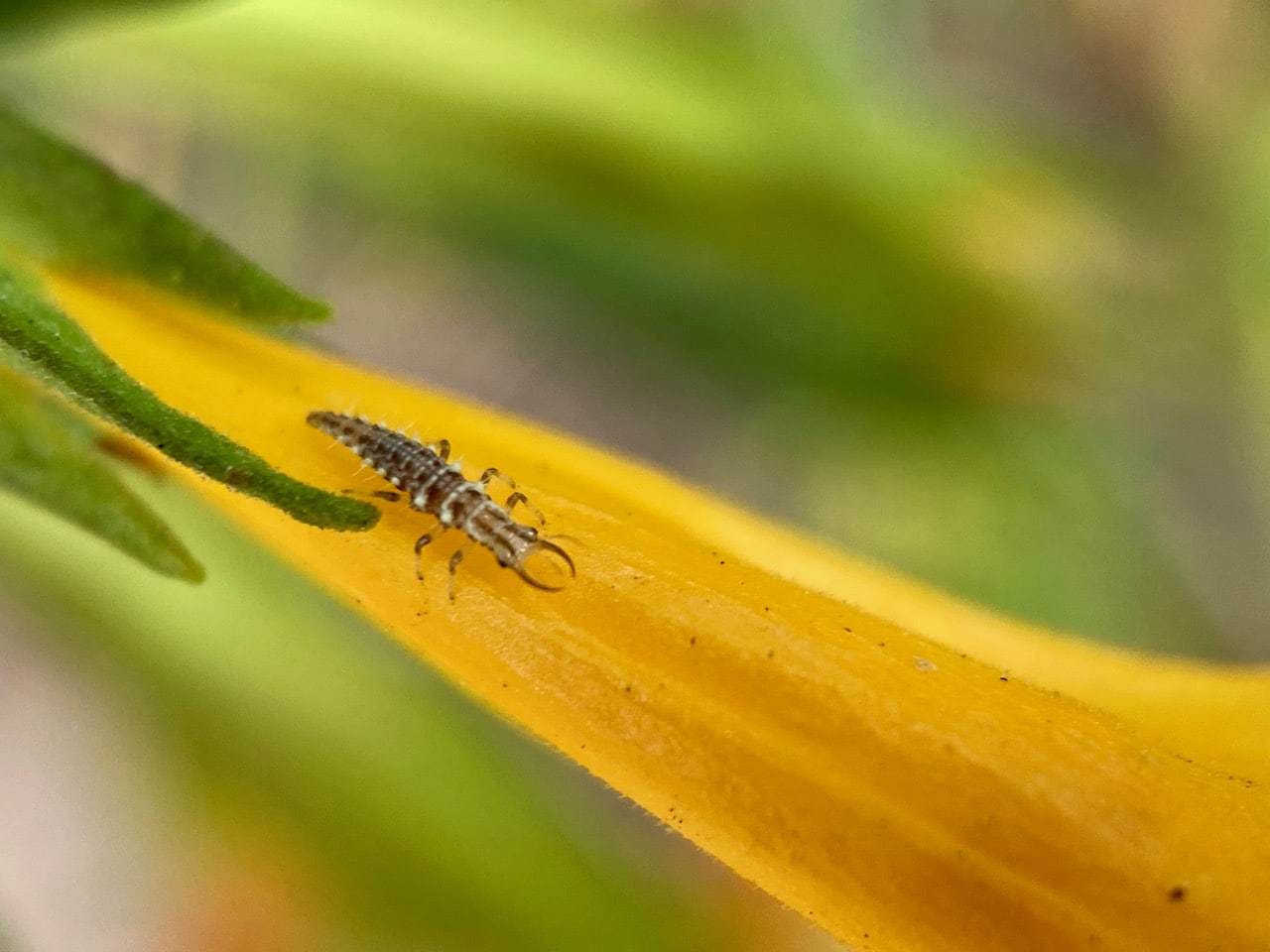
A Lacewing larva is hunting on the outside of a Sticky Monkeyflower.
Lacewings are insects in the large family Chrysopidae of the order Neuroptera. Adults are crepuscular or nocturnal. They feed on pollen, nectar and honeydew supplemented with mites, aphids and other small arthropods. Eggs are deposited at night, hung on a slender stalk of silk usually on the underside of a leaf. Immediately after hatching, the larvae molt, then descend the egg stalk to feed. They are voracious predators, attacking most insects of suitable size, especially soft-bodied ones (aphids, caterpillars and other insect larvae, insect eggs). Their maxillae are hollow, allowing a digestive secretion to be injected in the prey. Lacewing larvae are commonly known as “aphid lions” or “aphid wolves”. In some countries, Lacewings are reared for sale as biological control agents of insect and mite pests in agriculture and gardens.
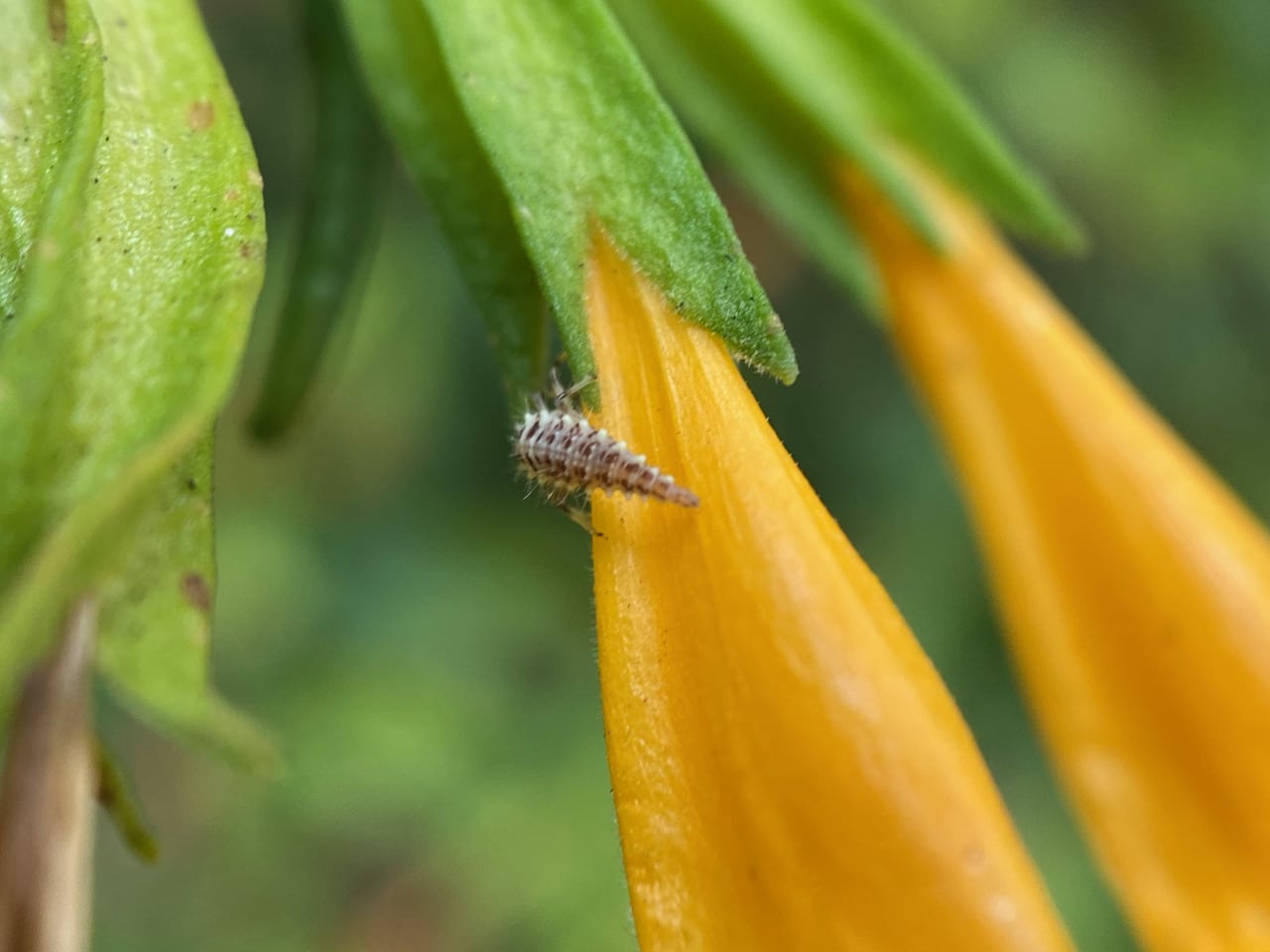
The agile Lacewing larva eventually slips under the calyx of the Sticky Monkeyflower. Happy hunting, little predator!