

Pollinator Post 8/19/25 (2)
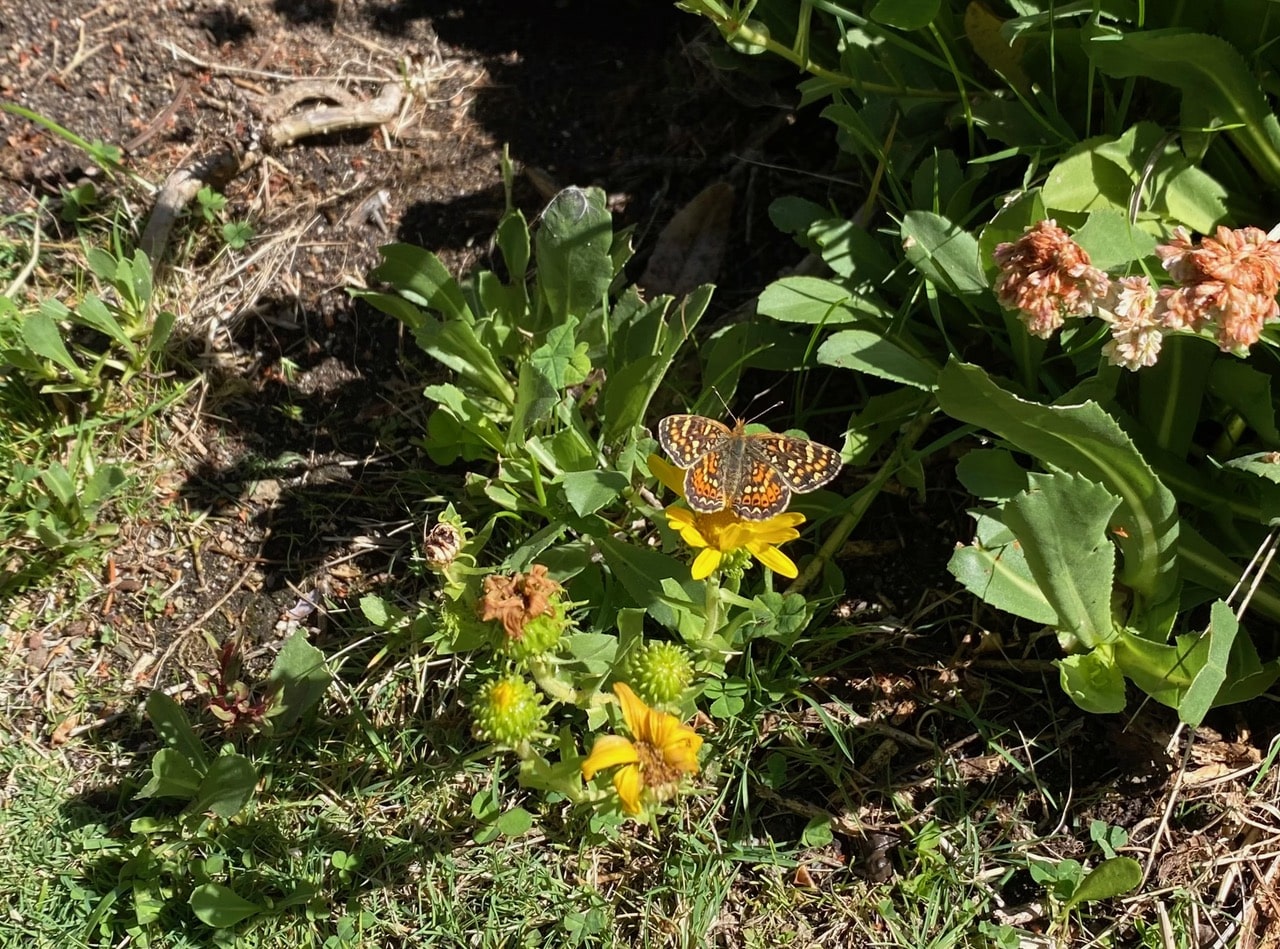
A small butterfly lands on a Grindelia flowerhead, and obligingly opens its wings. It’s a very fresh Field Crescent!
The Field Crescent, Phyciodes pulcella (family Nymphalidae) is found in western North America. It is a small butterfly, with wingspan of 1-1.75 in. There are 3-4 flights from April-October in lowland California. Host plants are various Asters. Females lay eggs in large batches on underside of host plant leaves. Caterpillars feed on leaves; young ones sometimes live in a loose web. Partially-grown caterpillars hibernate.
Field Crescent (Phyciodes pulchella) · iNaturalist








A bright blue Damselfly lands on a lichen-covered rock. It is a male Vivid Dancer, Argia vivida (order Odonata, suborder Zygoptera). The garden’s various water features (creeks and ponds) have given rise to a delightful diversity of Dragonflies and Damselflies.
The Vivid Dancer, Argia vivida is a species of narrow-winged damselfly in the family Coenagrionidae. The species is commonly found in springs and forests of Central America and North America. Males are a rich blue color with transparent wings, while the adult females are tan and gray. Males tend to perch on rocks or vegetation in shoreline areas awaiting females. Copulation is lengthy with extended flying in tandem afterward. Tandem pairs oviposit usually below the waterline in the stems of aquatic plants. Because the larvae are aquatic, they typically feed on small invertebrates found in the water, such as larvae from mosquitoes and mayflies. The adult Argia vivida typically feed on a variety of soft-bodied, small flying insects including mosquitoes, flies, mayflies and even small moths.
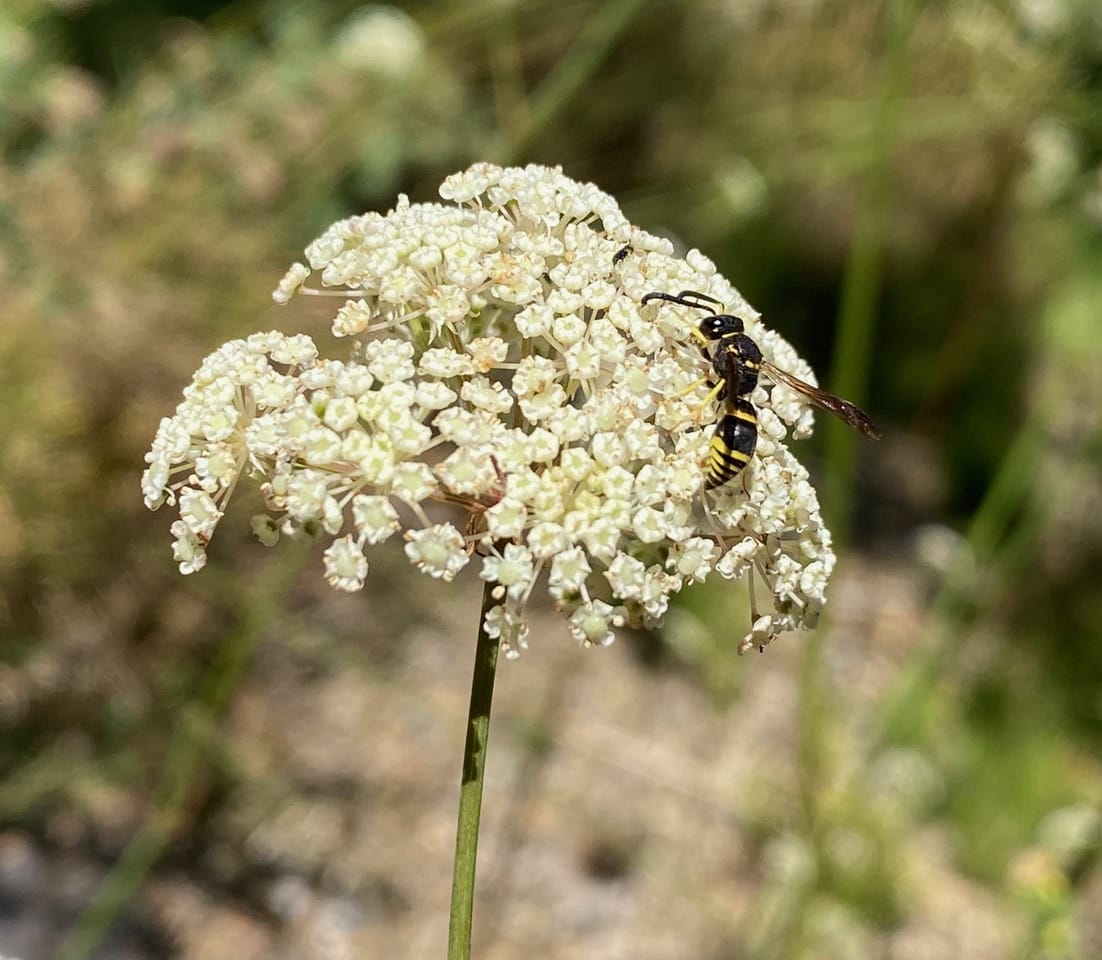
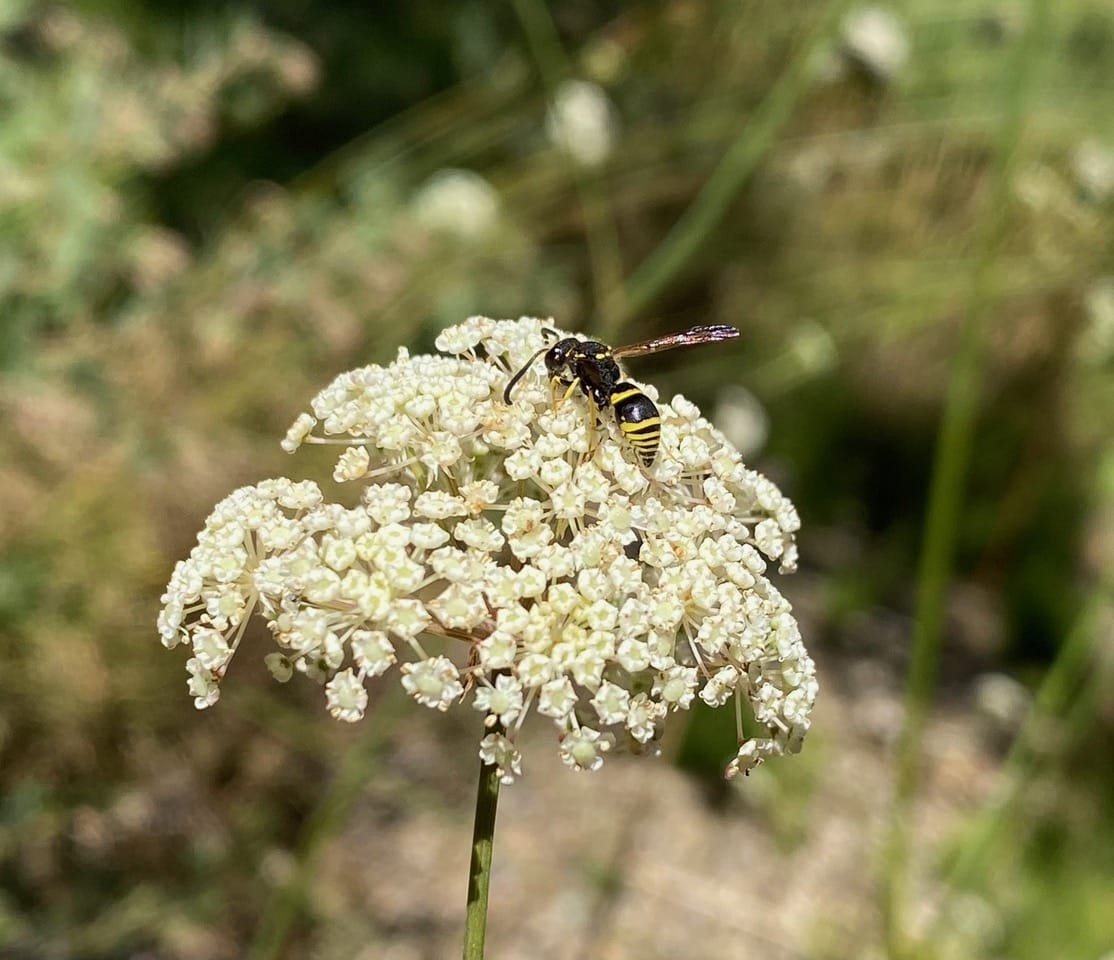
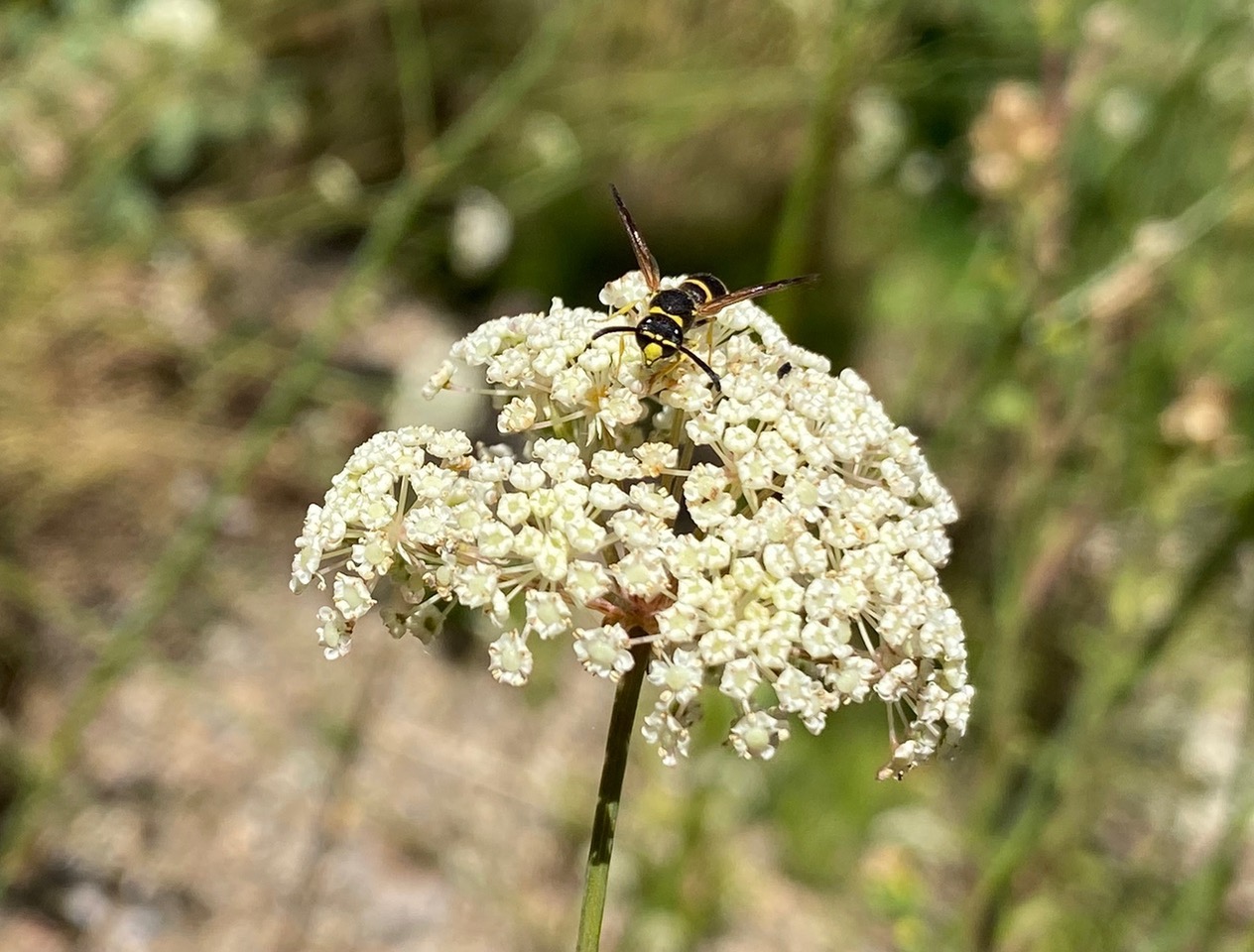
The Yampah, Perideridia californica is still blooming nicely in the garden, gathering many insect visitors when most other floral resources have dwindled. A Yellowjacket wasp and an Eurasian Drone Fly are feeding peaceably on the same Yampah inflorescence.
Yellowjacket is the common name for predatory social wasps of the genera Vespula and Dolicovespula (family Vespidae). Yellowjackets are social hunters living in colonies containing workers, queens, and males (drones). Colonies are annual with only inseminated queens overwintering. Queens emerge during the warm days of late spring or early summer, select a nest site, and build a small paper nest in which they lay eggs. They raise the first brood of workers single-handedly. Henceforth the workers take over caring for the larvae and queen, nest expansion, foraging for food, and colony defense. The queen remains in the nest, laying eggs. Later in the summer, males and queens are produced. They leave the parent colony to mate, after which the males quickly die, while fertilized queens seek protected places to overwinter. Parent colony workers dwindle, usually leaving the nest to die, as does the founding queen. In the spring, the cycle is repeated.
Yellowjackets have lance-like stingers with small barbs, and typically sting repeatedly. Their mouthparts are well-developed with strong mandibles for capturing and chewing insects, with probosces for sucking nectar, fruit, and other juices. Yellowjacket adults feed on foods rich in sugars and carbohydrates such as plant nectar and fruit. They also search for foods high in protein such as insects and fish. These are chewed and conditioned in preparation for larval consumption. The larvae secrete a sugary substance that is eaten by the adults.
The Western Yellowjackets typically build nests underground, often using abandoned rodent burrows. The nests are made from wood fiber that the wasps chew into a paper-like pulp. The nests are completely enclosed except for a small entrance at the bottom. The nests contain multiple, horizontal tiers of combs within. Larvae hang within the combs.
The Eurasian Drone Fly, Eristalis arbustorum is an abundant species of hover fly that occurs throughout the northern hemisphere, including Europe, North Africa and North India. It was introduced to North America in the mid 1800’s and is now ubiquitous throughout much of the United States and Canada. The common name “drone fly” refers to its resemblance to the drone of the honeybee. Hoverflies get their names from the ability to remain nearly motionless while in flight. The adults are also known as flower flies as they are commonly found on and around flowers feeding on nectar and pollen. The Eurasian Drone Fly is found in a diversity of habitats, including wetland, forests, montane tundra, as well as farmland, urban parks and gardens. It visits the flowers of a wide range of low-growing plants and shrubs. The larvae are aquatic, occurring in shallow, nutrient rich standing water and in cow manure and compost heaps. Also known as “rat-tailed maggots”, the larvae have a siphon on their rear end that acts like a snorkel, helping them breathe under water. The siphon can be several times the length of the larva’s body. The larvae are saprophagous, feeding on bacteria in stagnant water rich in decomposing organic matter.
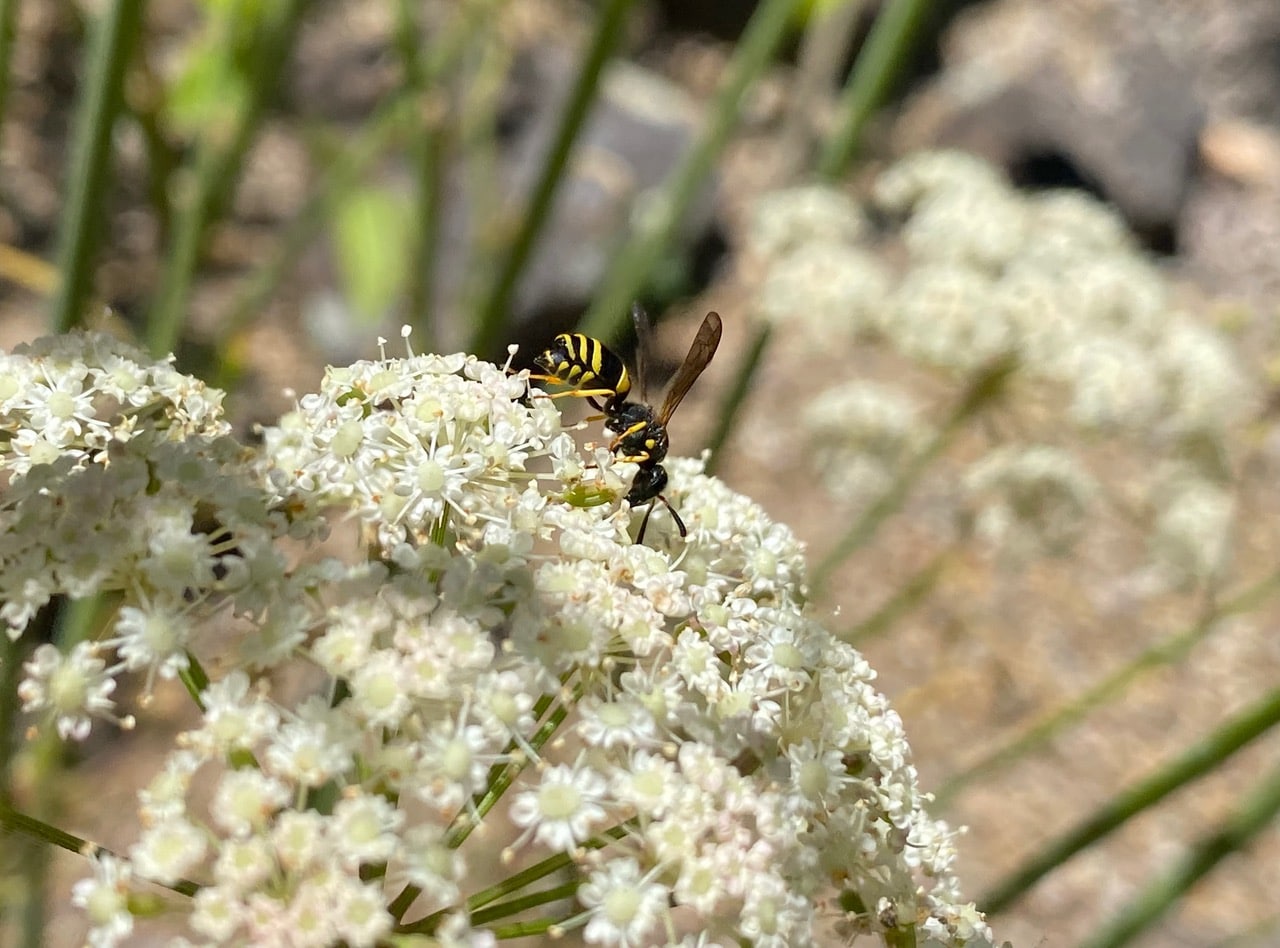
Ooh, I think that is a Mason Wasp, Ancistrocerus bustamente (family Vespidae, subfamily Eumeninae).
Potter wasps (or mason wasps), the Eumeninae, are a cosmopolitan wasp group presently treated as a subfamily of Vespidae. Most eumenine species are black or brown, and commonly marked with strikingly contrasting patterns of yellow, white, orange, or red. Their wings are folded longitudinally at rest. Eumenine wasps are diverse in nest building. The Mason Wasps are species that generally nest in pre-existing cavities in wood, rock, or other substrate. Potter Wasps are the species that build free-standing nests out of mud, often with a spherical mud envelope. The most widely used building material is mud made of a mixture of soil and regurgitated water.
All known Eumenine species are predators, most of them solitary mass provisioners. When a cell is completed, the adult wasp typically collects beetle larvae, spiders, or caterpillars and, paralyzing them, places them in the cell to serve as food for a single wasp larva. As a normal rule, the adult wasp lays a single egg in the empty cell before provisioning it. The complete life cycle may last from a few weeks to more than a year from the egg until the adult emerges. Adult mason wasps feed on floral nectar.
The Mason Wasp, Ancistrocerus bustamente (family Vespidae, subfamily Eumeninae) is found in western North America and Mexico. The species frequents arid areas, and nests in pre-existing cavities (e.g. old borings in wood, hollow stems, rock crevices) and use mud for partitions between brood cells. The wasps have been known to nest in Sambucus (Elderberry) stems. The name of the genus means “hooked horn” for the back-curved last segments of the antennae characteristic of the males.
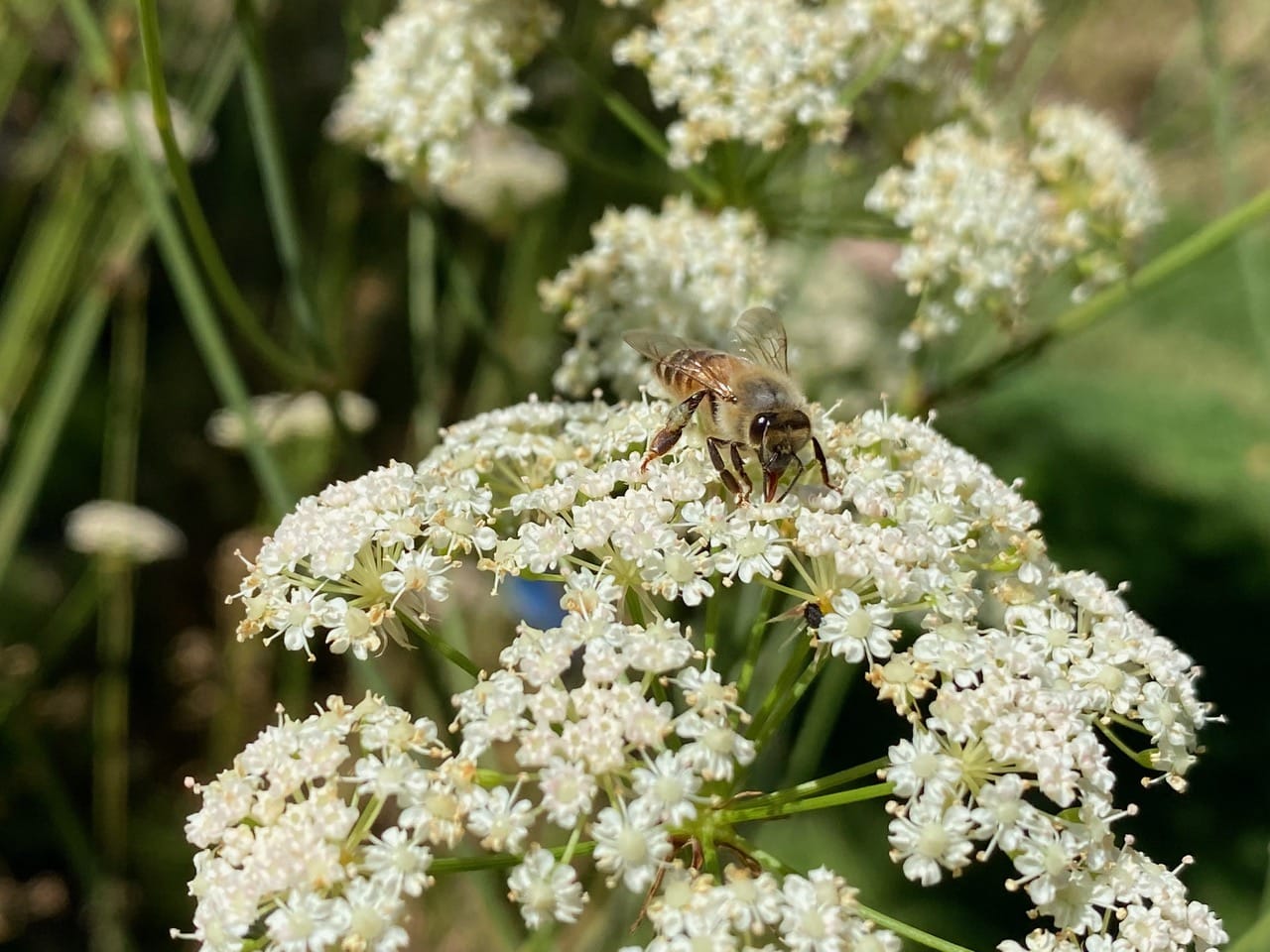
The Honey Bees, Apis mellifera (family Apidae) are the most common insects visiting the Yampah flowers.
A small black beetle with a long, pointed tail is feeding on pollen of a Yampah flower. It is easily recognizable as the Tumbling Flower Beetle (family Mordellidae).
The Tumbling Flower Beetles (family Mordellidae) are named for the characteristic irregular movements they make when escaping predators. They are also sometimes called Pintail Beetles for their abdominal tip which aids them in performing these tumbling movements. Mordellids are small, wedge-shaped, hump-backed beetles with head bent downward. The body is densely covered with fine silky hairs, usually black, but often very prettily spotted or banded with silvery hues. The adults feed on pollen, occurring on flowers or on dead trees, flying or running with rapidity. The larvae live in old wood or in the pith of plants, and those of some species are said to be carnivorous, feeding on the young of Lepidopterans and Diptera which they find in the plant stems.
A tiny bee, about the size of a grain of rice, is foraging on Yampah flowers. By the yellow markings on her body, I gather that it is a Masked Bee, Hylaeus sp. (family Colletidae). Note the absence of scopae on her legs.
Hylaeus (family Colletidae) are shiny, slender, hairless, and superficially wasp-like bees. They are small, 5 to 7 mm long, usually black with bright yellow or white markings on their face and legs. These markings are more pronounced on the males. Hylaeus do not carry pollen and nectar externally, they instead store their food in the crop and regurgitate it upon returning to their nests. They are primarily generalist foragers. Hylaeus are short-tongued, but their small body size enables them to access deep flowers. Hylaeus nest in stems and twigs, lining their brood cells with self-secreted cellophane-like material. They lack strong mandibles and other adaptations for digging, using instead pre-existing cavities made by other insects.
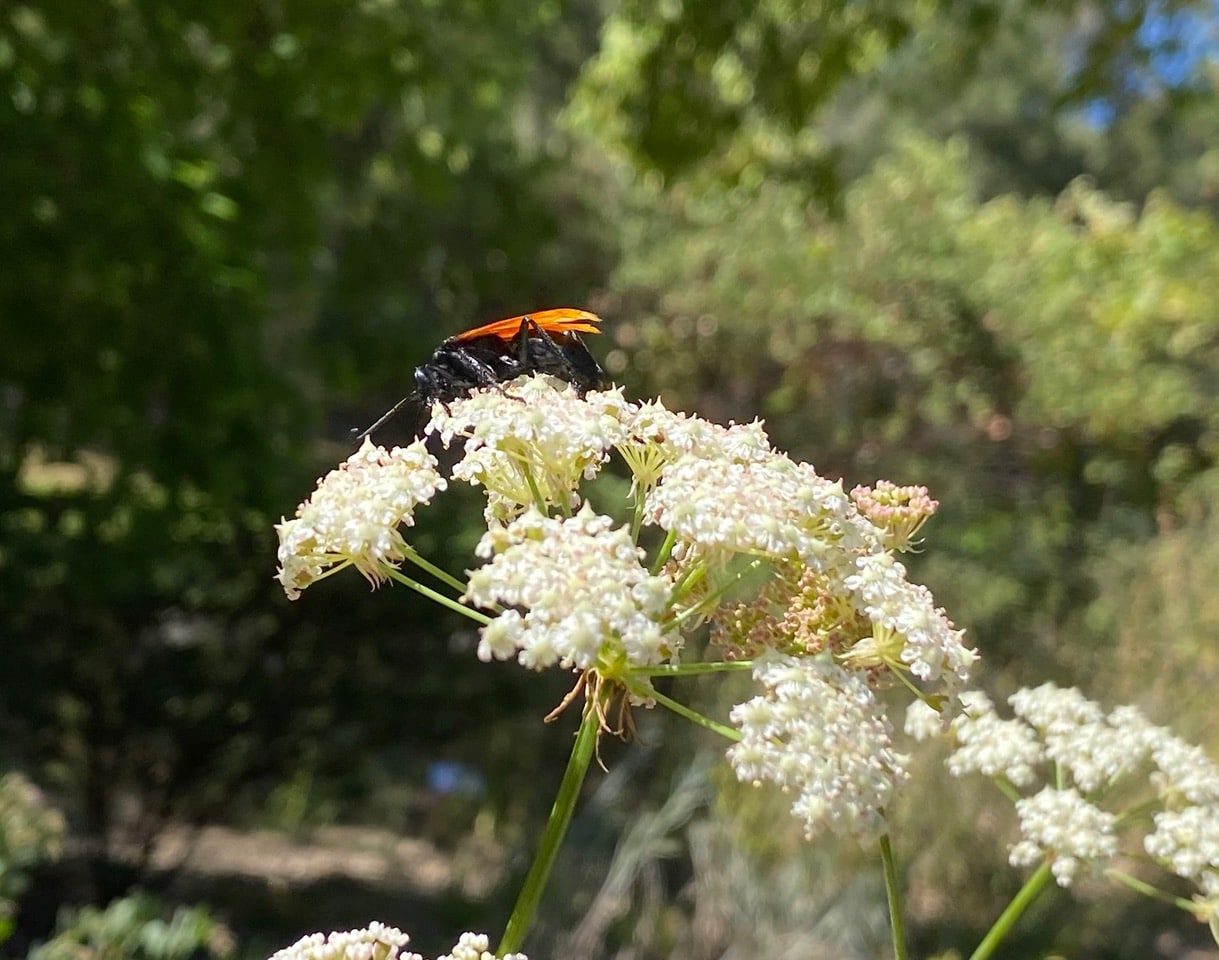
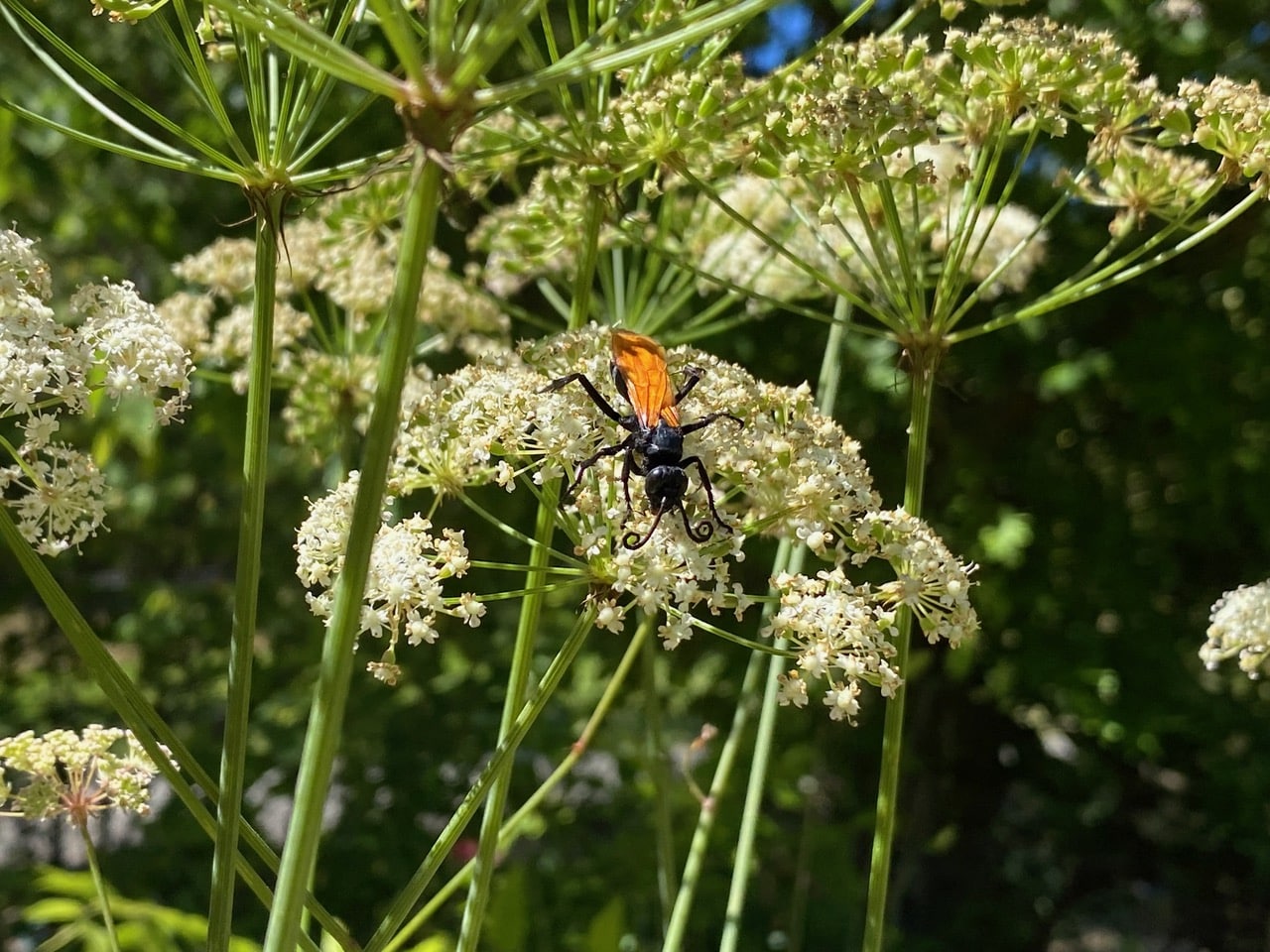
Whoa, that’s a huge wasp on the Yampah flowers! It’s a Thisbe’s Tarantula-hawk Wasp, Pepsis thisbe (family Pompilidae).
A Tarantula Hawk is a spider wasp (family Pompilidae) that preys on tarantulas. They comprise several species in the genera Pepsis and Hemipepsis. Common species are up to 2 in. long, making them among the largest of wasps, and have blue-black bodies and bright, orange colored wings (Some species have black wings.) The bright colors advertise to potential predators the wasps’ ability to deliver a powerful sting, considered one of the most painful insect stings in the world.
The female tarantula hawk stings a tarantula between the legs, paralyzing it, then drags the prey to a specially prepared burrow, where a single egg is laid on the spider’s abdomen, and the burrow entrance is covered. When the wasp larva hatches, it penetrates the spider’s abdomen, and feeds on it from the inside, avoiding vital organs for as long as possible to keep the spider alive. The wasp larva pupates within the spider and eventually emerges as an adult to continue the life cycle.
The venom from the sting of a Tarantula Hawk can paralyze prey for several months; this paralysis is not directly fatal, but prey is likely to starve to death before the paralysis wears off. The sting of tarantula hawks has been described as “blinding, fierce, shockingly electric”. Mess with these wasps at your own peril!
While more common in desert regions, several species of tarantula hawks, including Pepsis thisbe, can be found in the Bay Area. Adults are nectarivores, often seen around blossoms during the summer months.
Check out those curly antennae! The Tarantula Hawk is a female!
In female Pepsis the terminal sections of the antennae is usually curled by 3/4 of a turn (or more) into a relatively tight circular-spiral. The females are capable of straightening their antennae; males can “arch” their straight antennae, but not as tightly. The antennal differences offer an easy way to distinguish the genders in these Tarantula Hawks.
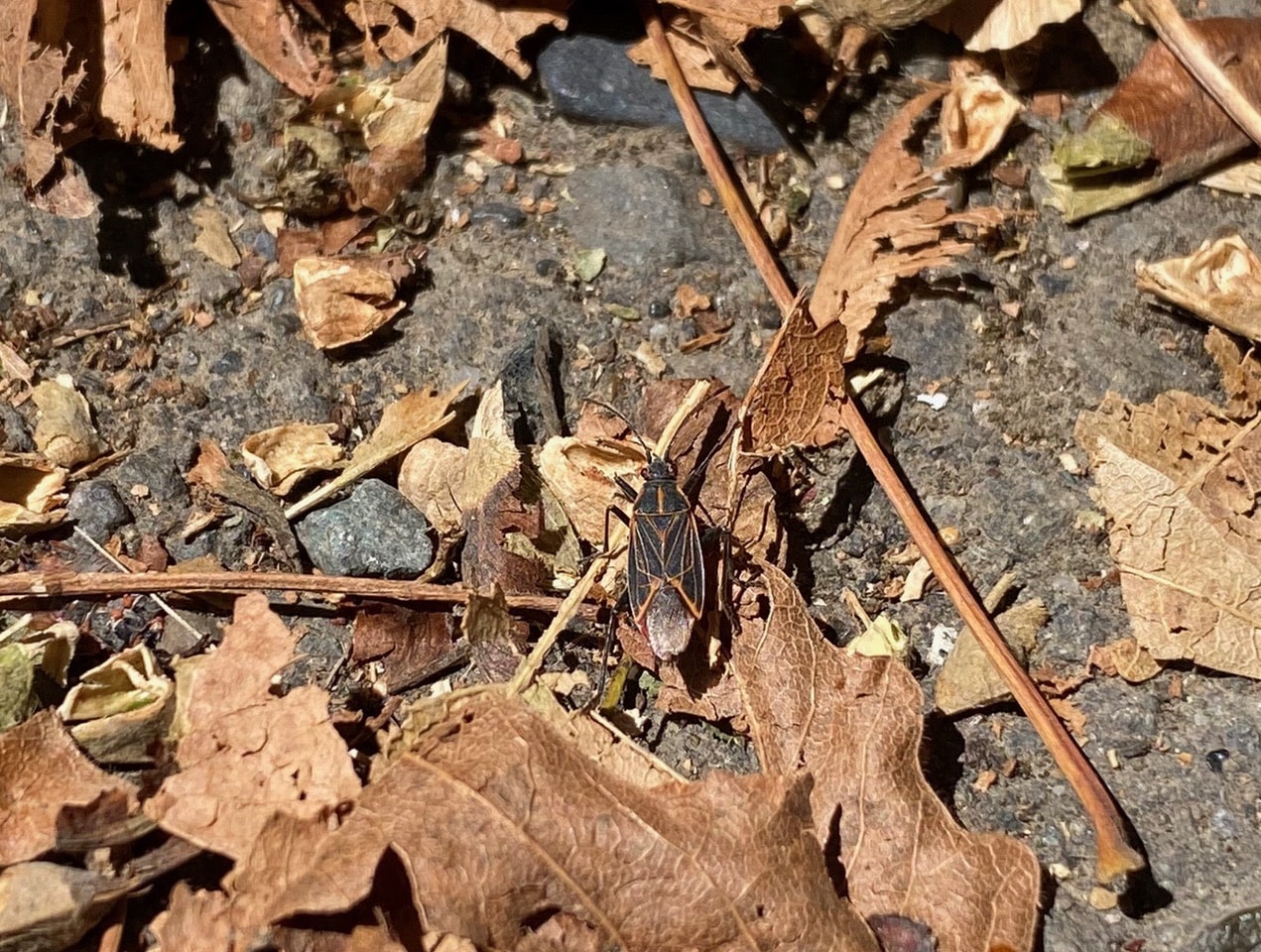
Crossing the foot bridge to the parking lot, I am on the lookout for Boxelder Bugs under the large Bigleaf Maple trees. The last time I was here on 7/29, I have encountered some nymphs. Hey, sure enough, here’s an adult running around in the leaf litter!
The Western Boxelder Bug, Boisea rubrolineata (family Rhopalidae) is found in western North America. Adults are 9-13 mm in length. The thorax and wings are black with red lines, and the abdomen is red. Nymphs are bright red and gray. The bugs prefer to live in areas where there are trees and other vegetation as food sources. This includes natural areas, but also urban, suburban, and agricultural areas. Western Boxelder Bugs are primarily frugivores and granivores. They eat fruits and seeds from trees like boxelder (Acer negundo), ash (Fraxinus), big leaf maple (Acer grandifolium), as well as orchard fruits like pear, plum, cherry, and grape.
A mating pair of Boxelder Bugs is making their way through the leaf litter. The larger female is leading the way, while the male hangs on passively.
It’s not easy to spot the adult Boxelder Bugs unless they move. They blend seamlessly into their surroundings.
There are still a few Boxelder Bug nymphs running around. This cutie looks just like the one I photographed last time.
Western Boxelder Bugs develop from eggs, laying dormant through the winter after they are laid, emerging in the spring as first instar nymphs. The nymphs go through incomplete metamorphosis consisting of five instars before becoming adults. Nymphs slowly increase in size and physiological development as they progress through each instar stage, until they reach maturity. Functional wings and reproductive parts are acquired at the last molt.