

Pollinator Post 8/18/25
I take a walk at Crab Cove this sunny morning.

I make a quick stop at the butterfly garden at the end of McKay Ave. A small dark Sweat Bee is foraging on the small flower of Perez’s Sea Lavender, Limonium perezii. I think it is a Kincaid’s Sweat Bee, Lasioglossum kincaidii (family Halictidae).
Lasioglossum species are found worldwide, and they constitute the largest bee genus. The majority of Lasioglossum are generalists. Because they are so abundant throughout the flowering season, the bees are often important pollinators. Their sheer numbers are enough to achieve excellent pollination of many wild flowers, especially of plants in the Asteraceae, which have shallow floral tubes that are easily accessed by these minute bees.
Lasioglossum are closely related to the genera Halictus and Agapostemon. These genera are commonly called “sweat bees” because of their attraction to human sweat, which they drink for its salt content. Lasioglossum are dusky black to brown slender bees with bands of hair on their abdomen. Female Sweat Bees (family Halictidae) carry pollen in the scopae on their entire hind legs and underside of their abdomen.
Lasioglossum exhibit a range of social behaviors; the genus includes solitary, communal, semi social, primitively eusocial, and even parasitic species. Almost all Lasioglossum in the U.S. nest in the ground. Generally these nests are built in the spring by fertilized females (called foundresses) that spent the winter in hibernation. In social species, the foundresses behave much like the queen bumble bees – they lay the first batch of eggs that develop into the first generation of female workers. The nest grows with each additional generation of bees. Later broods may consist of both males and females. They mate, and at the end of the season the fertilized females hibernate til the following spring, repeating the life cycle of the colony.
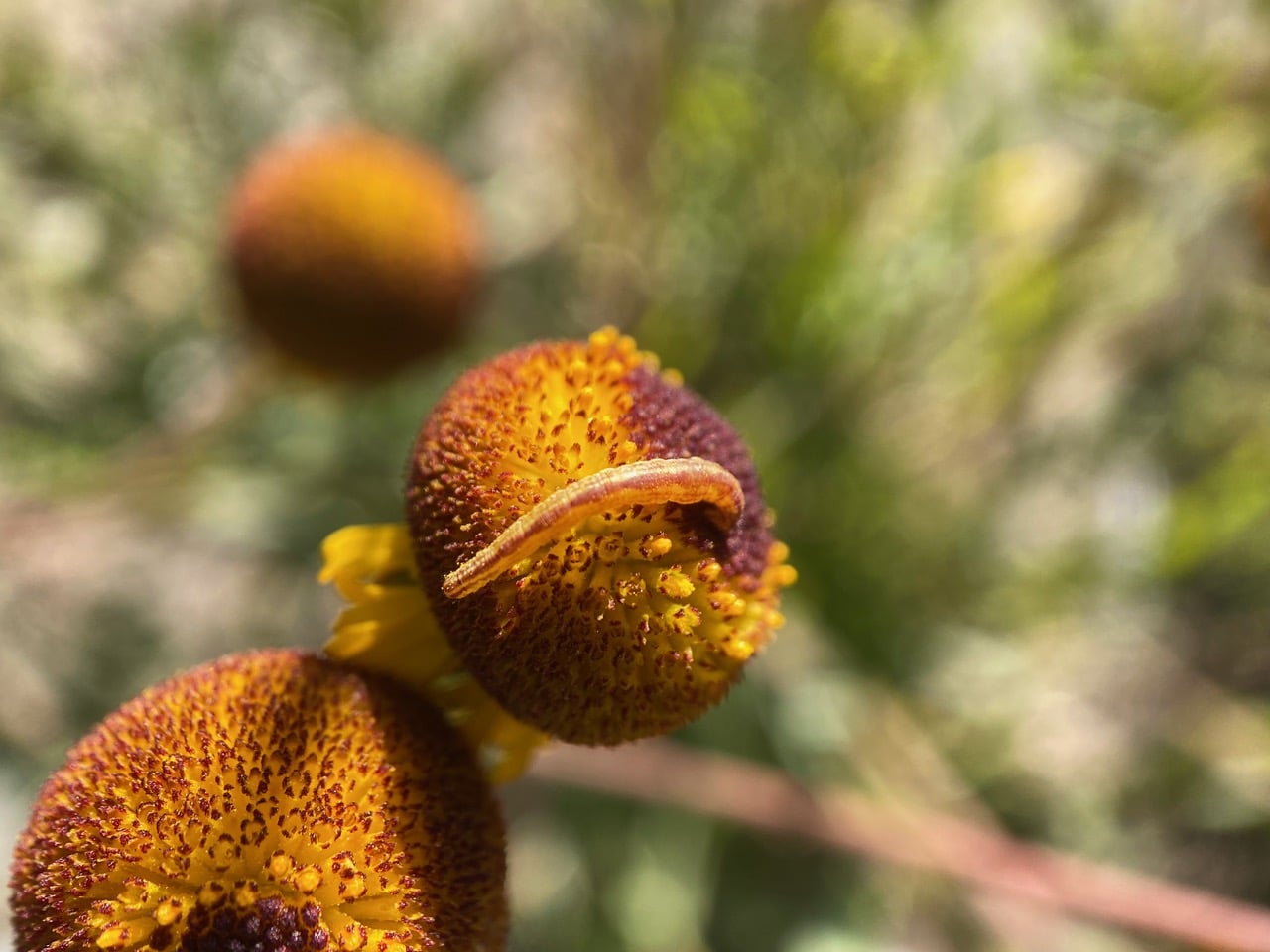
An Inchworm caterpillar of the Common Eupithecia Moth, Eupithecia miserulata (family Geometridae) is feeding on a globular flowerhead of Sneezeweed, Helenium puberulum.
Inchworms are also called loopers and measuring worms. They majority of the inchworms are the larvae of moths in the family Geometridae. The name comes from the Greek “geo” for earth and “metro” from measure, because the caterpillars seem to be measuring the surface on which they are walking. Most caterpillars have five sets of prolegs, four in the middle of the body and one pair at the hind end. Inchworms have the normal six true legs but only two or three pairs of prolegs, all located at the tail end of the body, with none in the middle. When an inchworm walks, it moves its tail-end prolegs up behind its true legs, causing the center of its body to loop upward. Then it stretches its front end forward to take another step.
Eupithelia is the largest genus of moths of the family Geometridae. Occurring worldwide except for Australasia, species in the genus are commonly known as pugs. Adults are typically small, 12 – 35 mm, with muted colors. Most species rest with forewings held flat at right angles to the body, while the hindwing are largely covered by the forewings. They are generally nocturnal. Larvae mostly feed from the flowers and seeds of their food plants rather than the foliage. Many species have a very specific food plant.
Eupithecia miserulata, the Common Eupithecia Moth is found in North America. The adult wingspan is 12-20 mm. The larvae feed on a wide range of plants, including coneflower, asters, willow, cherry, juniper and clover.

Ooh, that looks like a spent cocoon of a parasitic wasp (family Braconidae) that parasitizes caterpillars. The female wasp lays an egg in a caterpillar. The larva that hatches feeds on the caterpillar from the inside, then makes its way out of the caterpillar to spin a cocoon in which it pupates. The blunt end of the cocoon here is the hole cut by the adult wasp as it emerged. These cocoons are often found next to dead caterpillars.

That looks like a pile of floral debris lying on a Sneezewood flowerhead. What is going on?
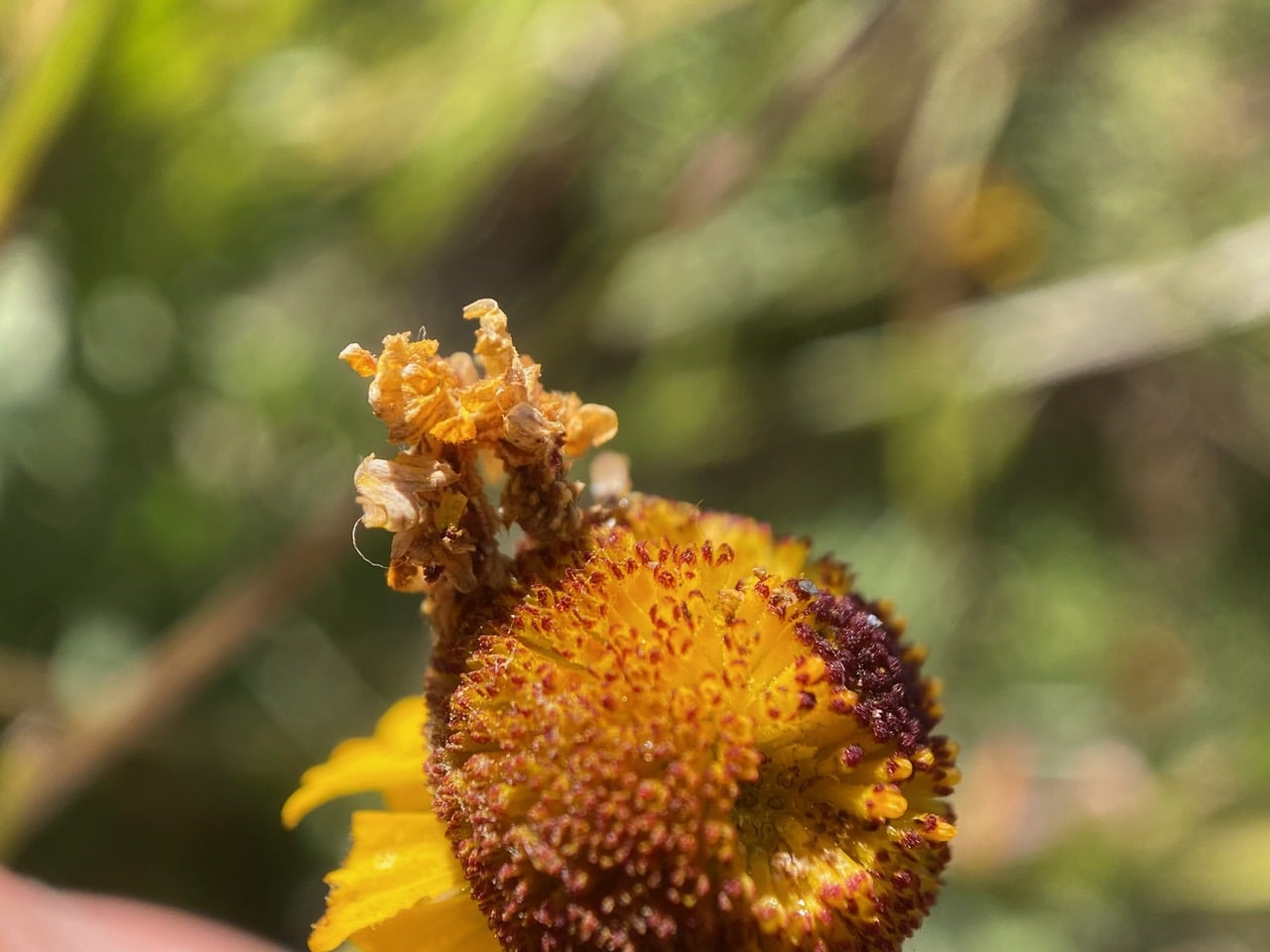
As I tilt the flowerhead into the sun and puzzle over the loose flower parts, the pile suddenly rise up and starts to move! Ah, a Camouflage Looper – what joy! Note the hole in the flowerhead where the caterpillar has been feeding and where the caterpillar’s costume came from.
While most inchworms are well camouflaged, the Camouflage Looper, also known as the Wavy-lined Emerald Moth caterpillar, Synchlora aerata (family Geometridae) has taken the charade to a different level. It is able to disguise itself by attaching pieces of plant to its back. The inchworm bites off pieces of the particular flower it is feeding on and uses gelatinous “spit” or liquid silk from its mouth to glue the flower pieces to the spines on its back. The “spit” also helps stiffen the flower parts and keep them looking fresh. When parts fall off or start to dry out, they are replaced. When the caterpillar begins feeding on a different kind of flower, it discards the previous disguise and replaces it with the new flower.
The disguise worn by the Camouflage Looper is an adaptation probably most useful for hiding from hungry birds. Most caterpillars have some level of camouflage; some look like bark, twigs, thorns, and even bird droppings, but very few can alter their appearance over time. Scientists figure the Camouflage Looper’s ability to change disguises allows it to have a much more varied diet than other caterpillars because it isn’t restricted to eating only those flowers or plant parts that it resembles in appearance. The Camouflage Looper feeds on a wide variety of plants, but composite flowers (Asteraceae) are its favorites. The caterpillars also feed on a variety of shrubs and trees.
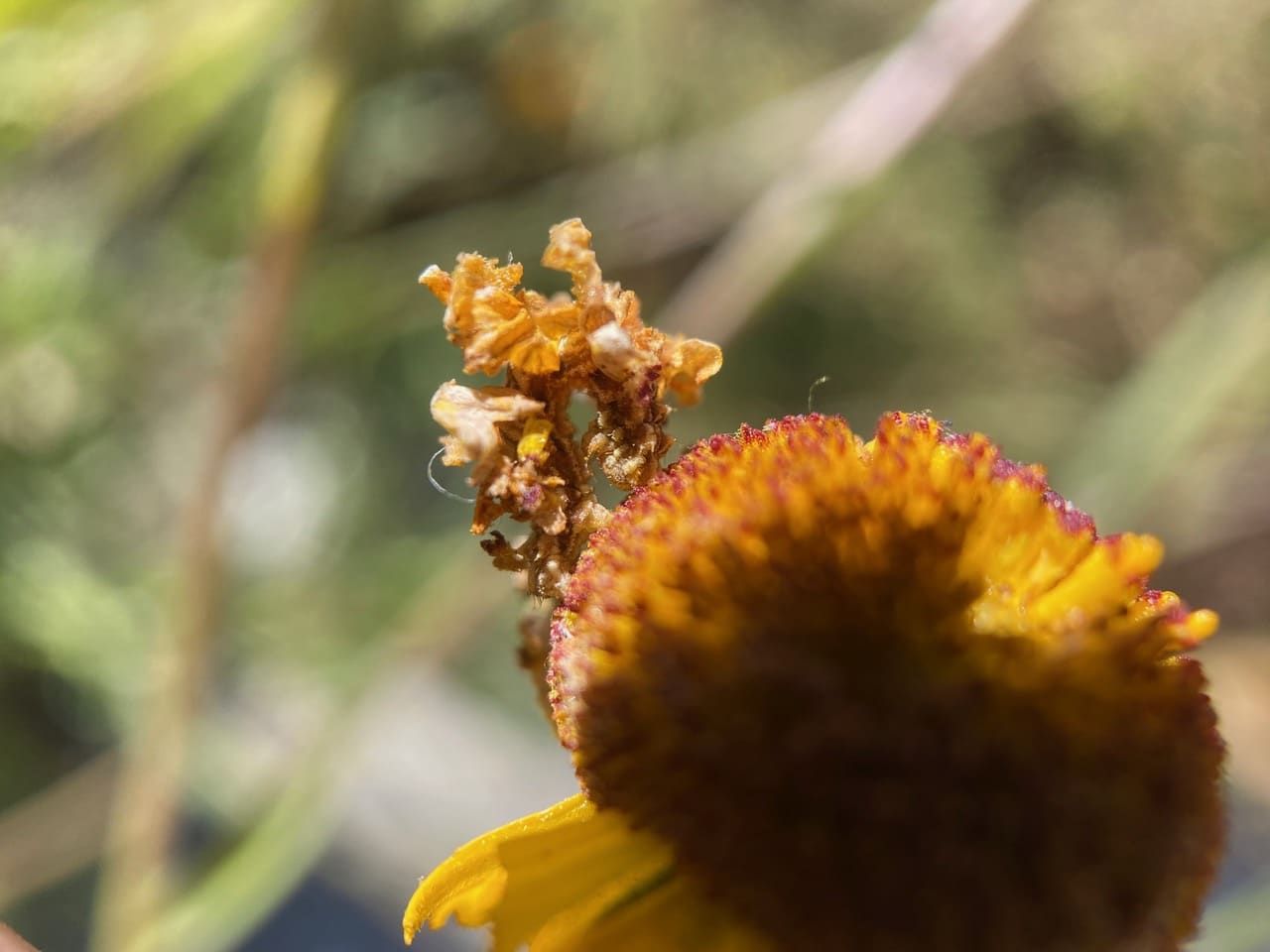
I tilt the flowerhead a little more to get light on the caterpillar. You can sort of see the caterpillar now, its head hanging just above the flowerhead. Amazing critter!
I have only seen the Camouflage Looper a few times before – all on California Goldenrod. Their camouflage was so incredible against the dense flowers of goldenrod I was only able to spot the caterpillars because they moved, or because they didn’t freshen up their costume enough to perfectly match the flowers they were on.

I continue on to the narrow spit that partially encloses Ballena Bay to check on the Oregon Gumweed, Grindelia stricta blooming along the edges.
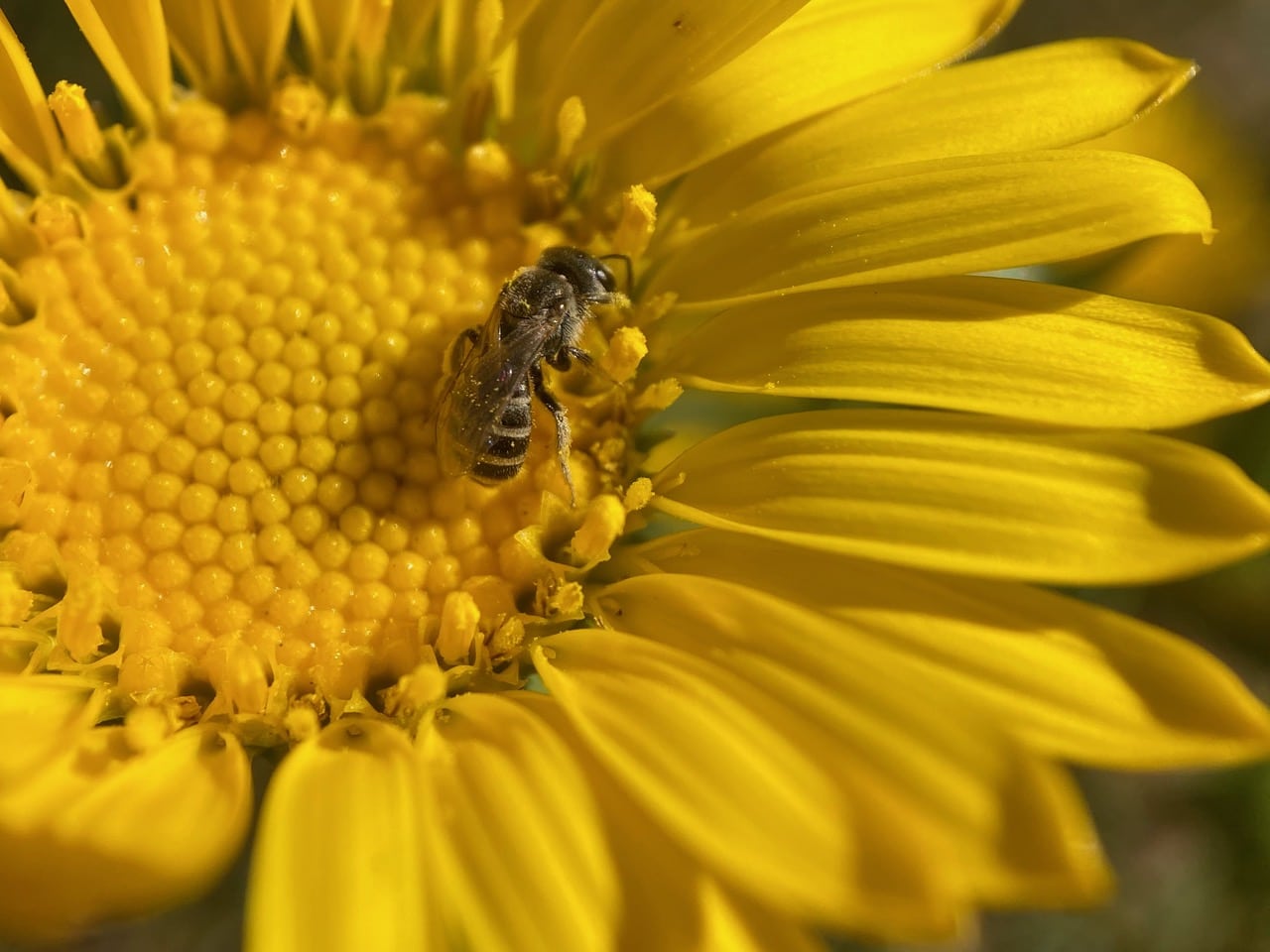
The Tripartite Sweat Bee, Halictus tripartitus (family Halictidae) is out in force today. The little bees are everywhere!
Halictus is found worldwide; they are most common in the Northern Hemisphere. All are generalists, foraging from a wide variety of flowering plants. Many species are social and produce several generations per year. This is not surprising as most blooming plants are season-specific; a bee that requires pollen and nectar across multiple seasons would not thrive as a specialist. All Halictus in North America nest in the ground, often in aggregations; and they may nest in the same area for decades.
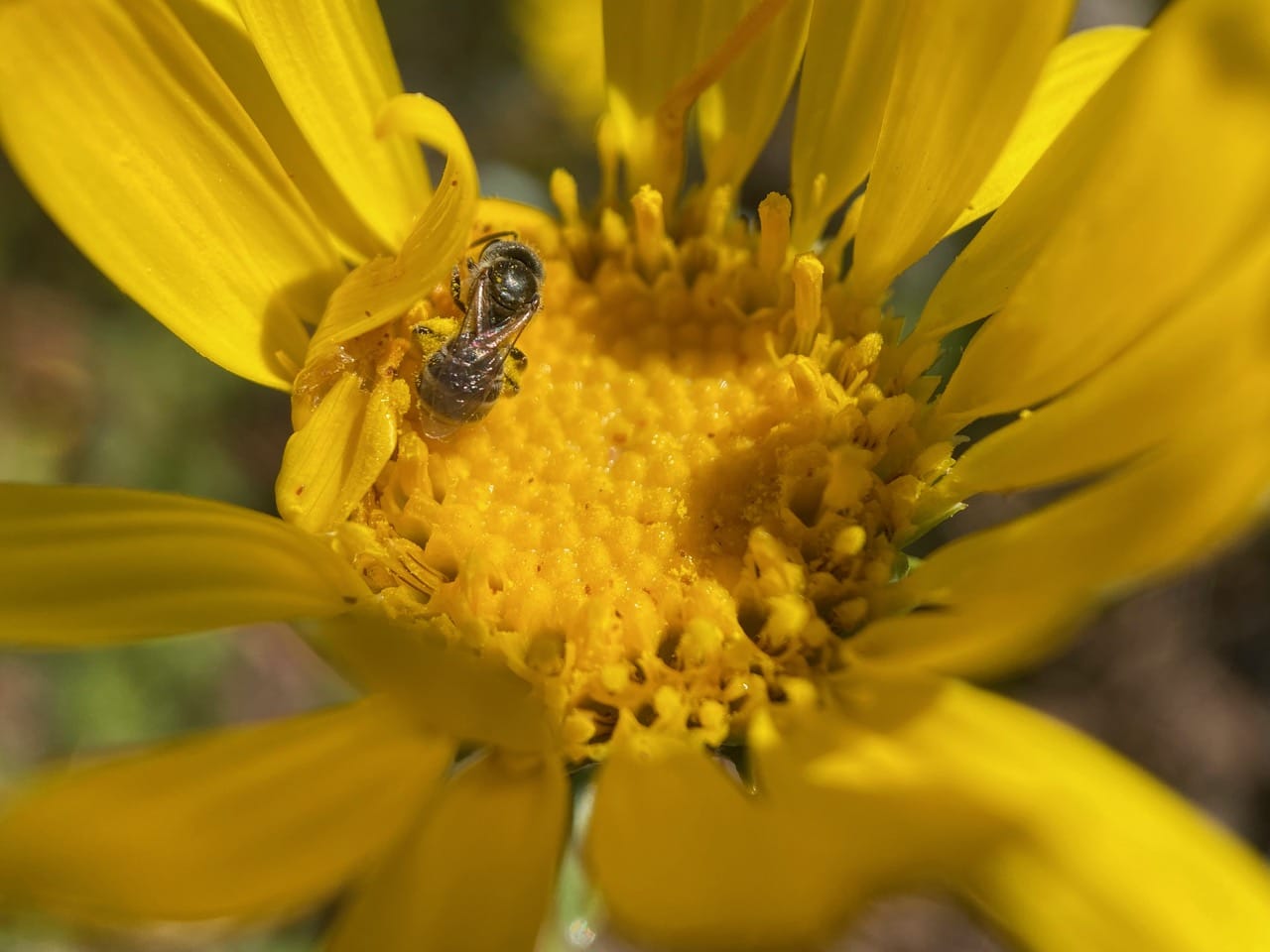
The species Halictus tripartitus is primitively eusocial, meaning it has a social structure that is less complex than highly social insects like honey bees, but more advanced than solitary bees. The bees form annual colonies in the soil, where some workers are capable of reproducing. Only potential queens overwinter, then provision a worker brood in the spring, with at least one worker brood produced before males and new queens emerge. These bees are known to nest in aggregations, often in flat, bare ground. They visit and pollinate a wide variety of flowers.

Her scopae packed with pollen, the bee is ready to take off.

Numerous male Long-horned Bees are flying around the Grindelia, occasionally landing on the same flowerheads and having a scuffle. The bees seem rather small and pale in color. iNaturalist has suggested a Small Long-horned Bee, Melissodes microstictus (family Apidae).
The Longhorn Bees, Melissodes sp. (family Apidae) are medium to large bees, stout-bodied, usually with gray hair on the thorax and pale hair bands on the abdomen. Males usually have yellow markings on their faces and have very long antennae from which their common name is derived. They are active May to September, with peak flight in late June to early August. The females prefer flat, bare ground for digging their solitary nests, though they sometimes nest in aggregations. Pollen is transported in scopae on the hind legs. Pollen loads are often copious and brightly colored and thus very distinguishable. Melissodes are specialists on Asteraceae – females gather pollen from flowers of Aster, Bidens, Coreopsis, Cosmos, Encelia, Gaillardia, Helianthus, and Rudbeckia ssp.

The characteristic silk webs of Funnel Weaver Spiders (family Agelenidae) decorate a big Ceanothus shrub in the native plants demonstration garden.

A Funnel-weaver Spider suddenly darts out from its hiding place to catch a prey, then disappears down its funnel in a split second. This is a rare sight, as these fast and elusive spiders are hardly ever seen.
A funnel-weaver (family Agelenidae) is most easily identified by its web, which is constructed of a flat sheet of webbing that narrows into a funnel or tube shape in the back. The funnel often bottlenecks into a shrub, hollow crevice, or into the corners of a structure. Agelenids are not active predators, preferring to “sit-and-wait” in their funnel for unsuspecting prey to be intercepted by the web. Their webbing is not sticky. Rather, the spider relies on lightning fast speed to quickly dart from its hiding place to capture its prey. The spiders bite and paralyze their prey and often drag it back into the safety of the funnel to consume it.

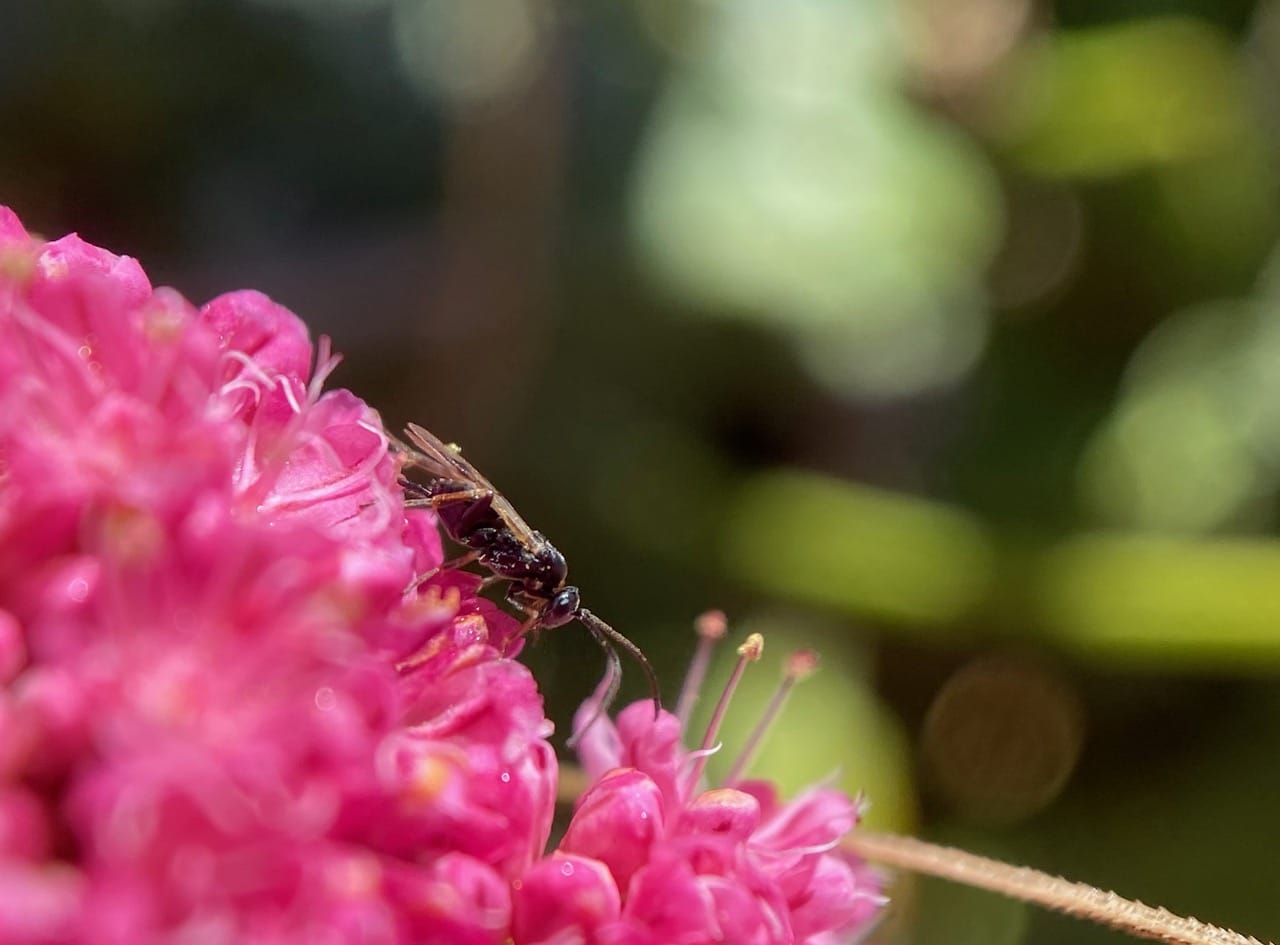
A tiny black wasp with long antennae is exploring an inflorescence of Red-flowered Buckwheat, Eriogonum grande ssp. rubescens. iNaturalist has helped identify it as a Braconid Wasp, Chelonus sp. (family Braconidae).
The Braconidae are a family of parasitoid wasps. After the closely related Ichneumonidae, braconids make up the second-largest family in the order Hymenoptera, with about 17,000 recognized species. Females often have long ovipositors to lay eggs on or in their hosts. The larvae of most braconids are internal primary parasitoids of other insects, especially the larval stages of Coleoptera, Diptera, and Lepidoptera. Generally, the braconid life cycle begins when the female wasp deposits her eggs in the host insect, and the braconid larvae develop in the host body, eating it from the inside out. When the wasp larvae are ready to pupate, they may do so in or on the host insect. The new generation of adult braconid wasps emerges from their cocoons and begins the life cycle again.
Braconid wasps use a remarkable weapon to disable the defenses of their host insects – a virus. These parasitic wasps coevolved with polydnaviruses (read poly-DNA-virus), which they carry and inject into the host insects along with their eggs. The virus attacks the host’s immune system and renders it unable to encapsulate the wasp egg; it also halts the host’s development, so it can’t pupate and transform into an adult. Amazingly, the “bracovirus” also changes the host’s metabolism so that it can survive longer without food or water – thus ensuring a nurturing environment for all the young wasps to come.

The wasp probes every nook and cranny of the inflorescence meticulously with its long antennae. She is not here to take nectar, but is in search of potential host on which to lay her eggs.
Chelonus is a wasp genus in the family Braconidae. Their larvae feed chiefly on larvae of moths in superfamilies Tortricoidea and Pyraloidea.

The female has a short, stout ovipositor.

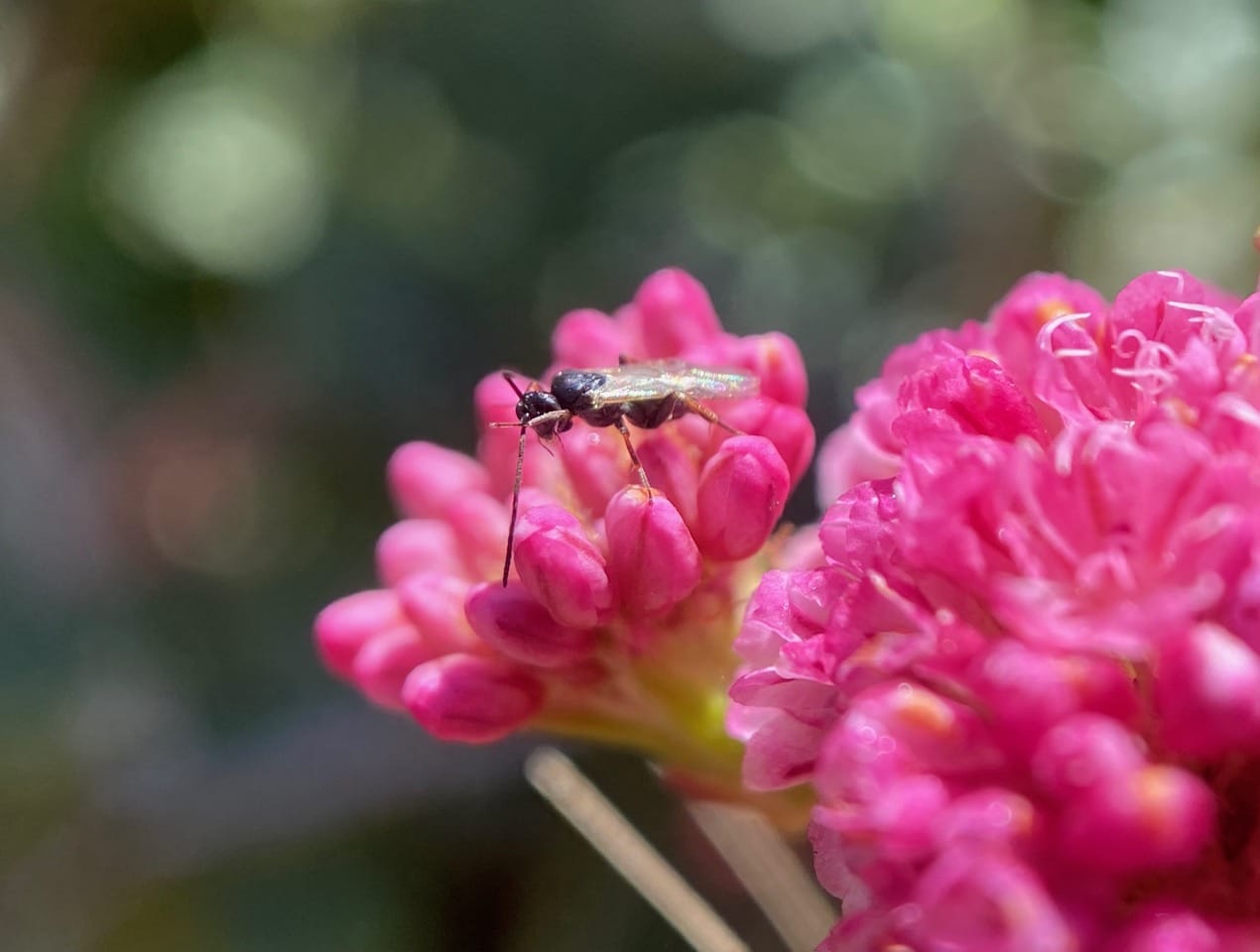
The wasp stops for an instant to clean her antennae. It is quite a chore pulling her long antenna through her antenna cleaner of her foreleg.
Like bees, wasps possess specialized structures on their forelegs that function as antenna cleaners. These antenna cleaners or strigils, help wasps keep their antennae clean and functional by removing debris nd contaminants. The antenna cleaner typically consists of a notch in the basitarsus (the first segment of the foot) and a corresponding spur on the tibia (the segment above the foot). The wasp flexes its legs, slipping the antenna into the groove of the strigil. The spur on the tibia then acts like a scraper, removing debris as the antenna is pulled through. Keeping antennae clean is crucial for wasps to maintain optimal sensory function. Dirt and debris can interfere with the detection of scents and other environmental cues, and navigation.
While most hymenopterans (ants, bees, and wasps) have these antenna cleaners, the specific morphology and features can vary between different groups. Some may have multiple rows of projections on the spur, while others might have a single row.
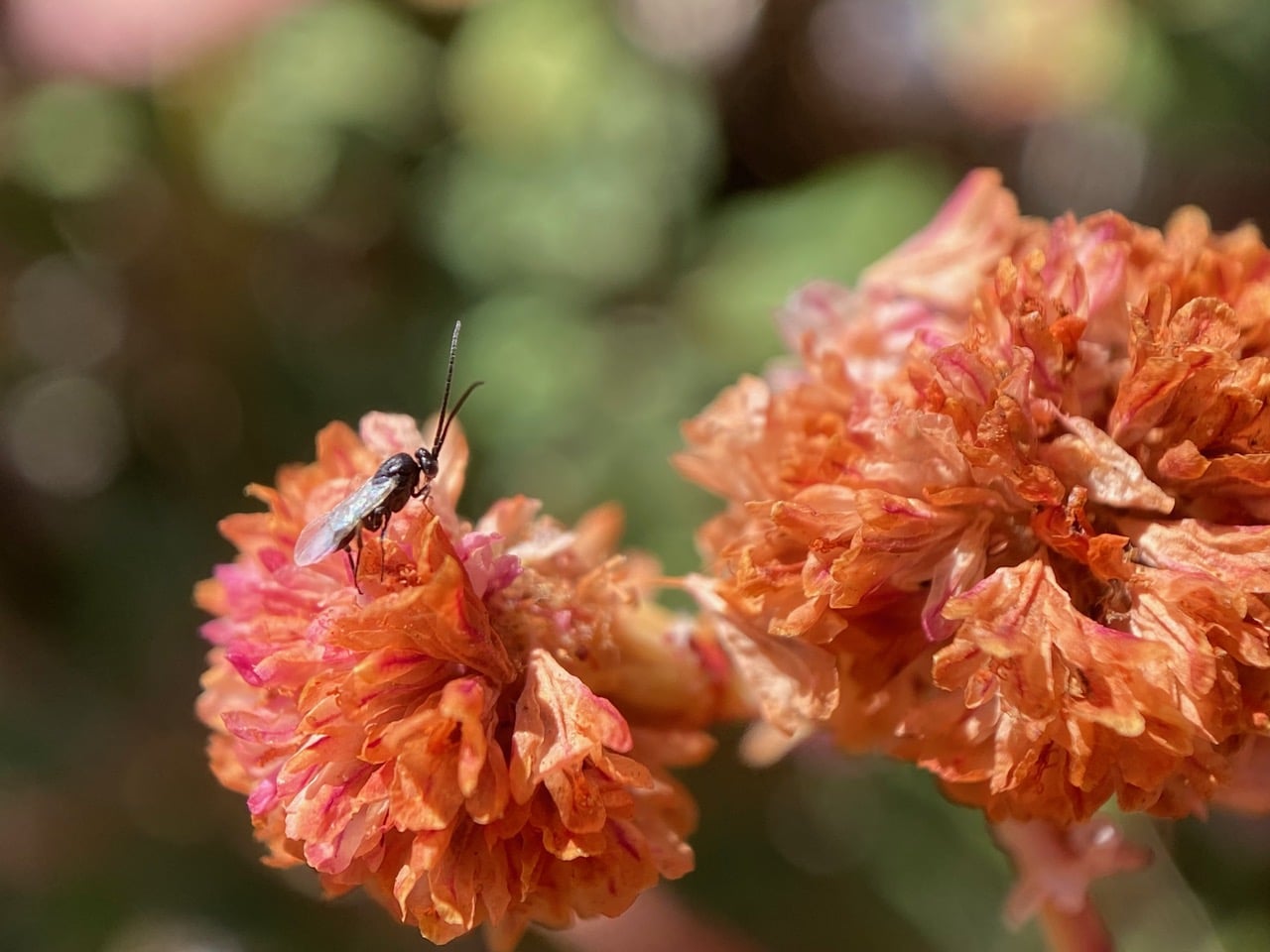
A similar wasp is searching on a spent Red-flowered Buckwheat inflorescence.
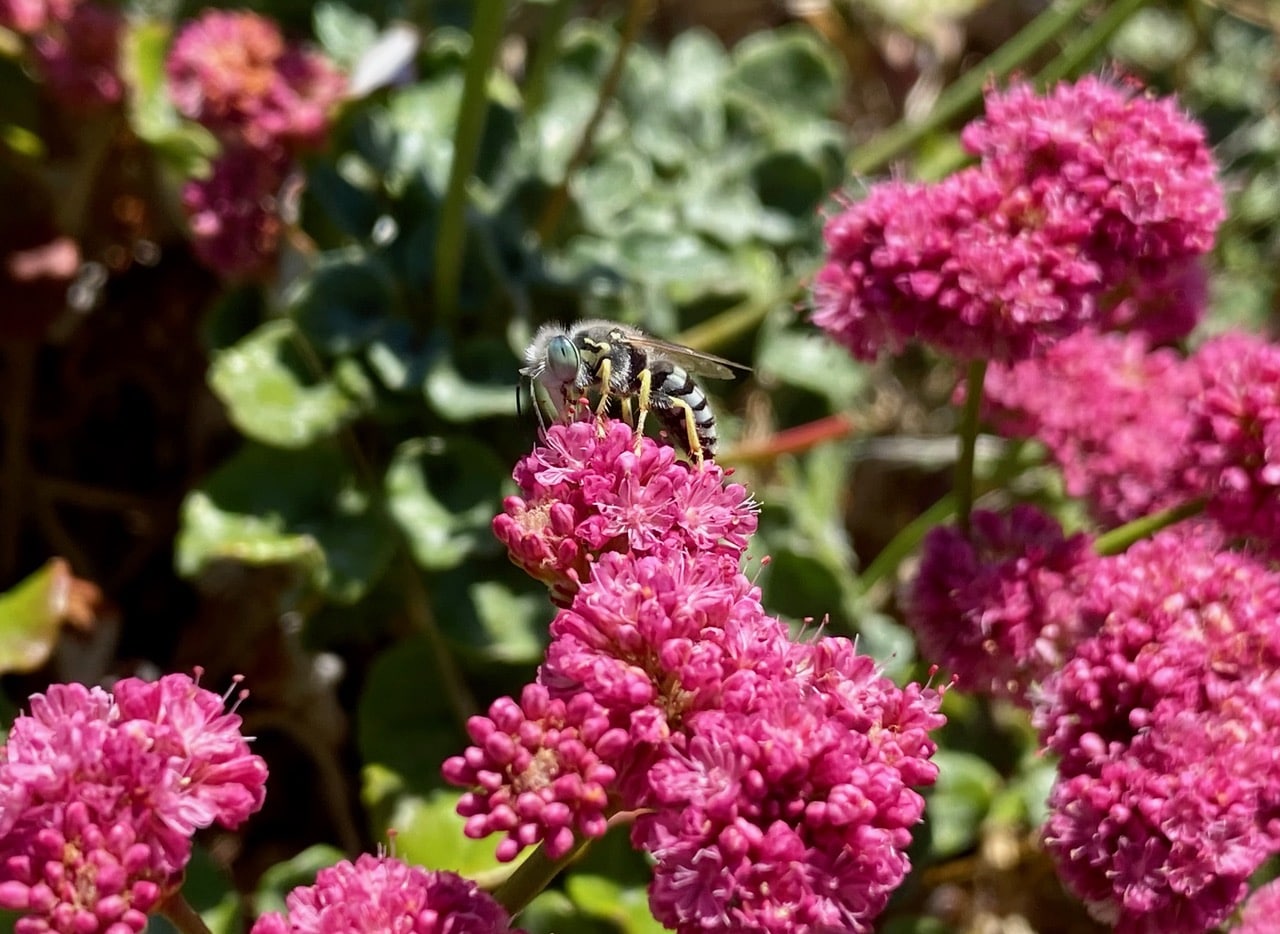
The American Sand Wasps, Bembix americana (family Crabronidae) rule the patch of Red-flowered Buckwheat here. They are some of the largest insects visiting the flowers, able to muscle others out of the way.
Sand wasps in the genus Bembix are familiar and common throughout North America, digging their burrows in dunes, on beaches, and other habitats with loose, deep sand. The female rapidly kicks out large quantities of sand using a “tarsal rake” of spines on each front leg. The burrow is excavated before the wasp goes hunting. Bembix are generalist, opportunistic hunters. True flies in the order Diptera are the usual prey. A victim is paralyzed or killed by the wasp’s sting, and is then flown back to the nest. Most species will lay an egg on the first victim, while some species lay an egg in the empty cell before starting to hunt. Once the egg hatches, mama wasp brings flies to her larva as needed. This “progressive provisioning” is rare in the insect world. When the larva reaches maturity, mama wasp closes the cell. Inside, the larva spins an oblong cocoon, weaving sand grains into the structure and resulting in a hardened capsule. Overwintering takes place as a prepupa inside this cocoon, but there are usually two generations a year.
Male sand wasps often engage in an elaborate flight ritual called “sun dances”. Males emerge before females, and fly erratically at dizzying speed one or two inches above the ground attempting to detect virgin females about to emerge from their underground nests. Both sexes are often seen taking nectar at flowers, especially from Asteraceae family. Bembix wasps are often victims of other insects such as cuckoo wasps (Chrysididae), velvet ants (Mutillidae), satellite flies (Sarcophagidae), bee flies (Bombyliidae), and thick-headed flies (Conopidae).

A Thick-legged Hover Fly, Syritta pipiens (family Syrphidae) lands on a cluster of buckwheat flowers.
Syritta pipiens originates from Europe and is currently distributed across Eurasia and North America. They are fast and nimble fliers. The fly is about 6.5 – 9 mm long. The species flies at a very low height, rarely more than 1 m above the ground. Adults visit flowers – males primarily to feed on nectar, and females to feed on protein-rich pollen to produce eggs. The species is found wherever there are flowers. It is also anthropophilic, occurring in farmland, suburban gardens, and urban parks. Larvae are found in wetlands that are close to bodies of freshwater such as lakes, ponds, rivers, ditches. Larvae feed on decaying organic matter such as garden compost and manure. Males often track females in flight, ending with a sharp dart towards them after they have settled, aiming to attempt forced copulation.

A bubblegum-pink Inchworm rears up and reaches over to another cluster of buckwheat flowers. What amazing camouflage!
Inchworms are also called loopers and measuring worms. The majority of the inchworms are the larvae of moths in the family Geometridae. The name comes from the Greek “geo” for earth and “metro” from measure, because the caterpillars seem to be measuring the surface on which they are walking.
Most caterpillars have five sets of prolegs, four in the middle of the body and one pair at the hind end. Inchworms have the normal six true legs but only two or three pairs of prolegs, all located at the tail end of the body, with none in the middle. When an inchworm walks, it moves its tail-end prolegs up behind its true legs, causing the center of its body to loop upward. Then it stretches its front end forward to take another step.
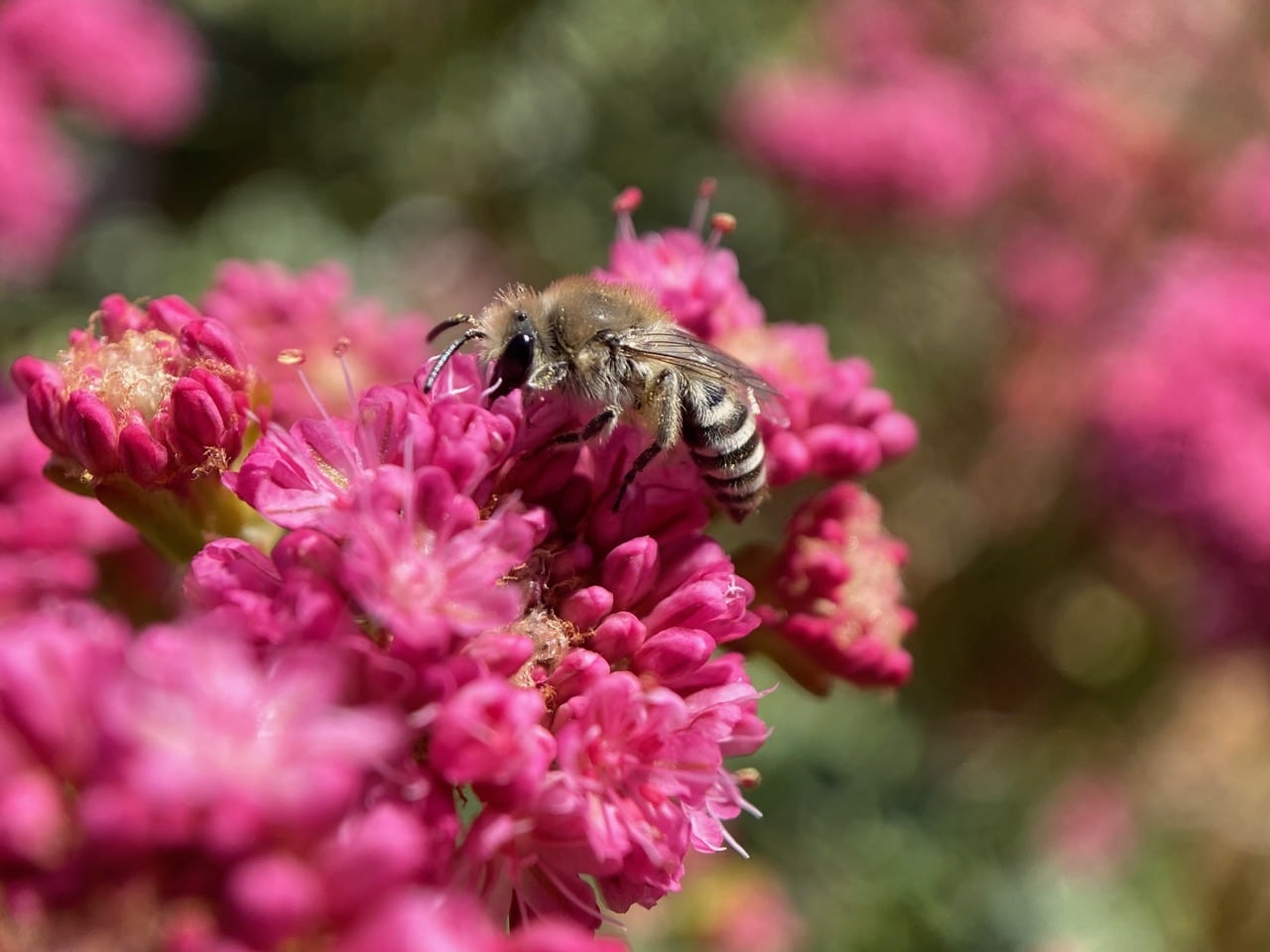
A Cellophane Bee, Colletes sp. (family Colletidae) is foraging on the flowers of Red-flowered Buckwheat.
The bee family Colletidae includes generalists and specialists, and they are likely important pollinators of many wildflowers. All Colletidae in North America are solitary ground nesters, but some species nest in large aggregations. There are two major genera of Colletidae in North America: the Masked Bees (genus Hylaeus) and Cellophane Bees (genus Colletes). The most obvious shared characteristics of Colletidae is also the hardest to see: their short tongue. Colletes are moderately hairy, slender bees, ranging in size from 7 to 16 mm. Distinct features include a hairy head and thorax, pale bands of hair on the abdomen, and a heart-shaped head. The eyes of Colletes are angled (rather than being parallel), making the face slightly heart-shaped.
The genus name Colletes means “one who glues”, referring to their habit of applying a glue- or cellophane-like lining to the walls of nest cells, using their specialized tongues. This lining gives rise to their common names: cellophane bees, polyester bees, and plasterer bees. Colletes tongue is unique: short, flat, and forked at the tip. Colletes line their nests with a distinctive cellophane-like substance made from saliva and secretions from the Dufour’s gland on the abdomen. Using their specialized tongue, they paint the walls with saliva, then with secretions from the Dufour’s gland, they add a coat of varnish. This creates a clear covering that is strong, durable, and resistant to mold and water.

Small brownish Bee Flies hover around the edges of the large patches of Red-flowered Buckwheat, sometimes taking nectar. They invariably land on the short dried grasses on the periphery of the patches, probably scouting for potential host nests. I am impressed by the variation in size of these bee flies – some are literally 2-3 times larger than others. iNaturalist has helped identify the fly as a member of the genus Lepidanthrax (family Bombyliidae, tribe Villini).
The Bee Flies belong to the family Bombyliidae. Adults generally visit flowers for nectar and pollen, some being important pollinators. Larvae generally are parasitoids of other insects. When at rest, many species of bee flies hold their wings at a characteristic “swept back” angle. The adult females usually deposit eggs in the vicinity of possible hosts, quite often in the burrows of beetles or ground-nesting bees/wasps. Bombyliidae parasitism is not host-specific, but rather opportunistic, using a variety of hosts.
Lepidanthrax is a genus of Bee Flies consisting of at least 50 described species, primarily found in the New World. In the continental U.S. they are found mainly in the southwestern region. Most are small, ranging from 5-9 mm, with one species reaching 11 mm. Lepidanthrax is distinguished by characteristic covering of broad scales and the shape of the third antennal segment.
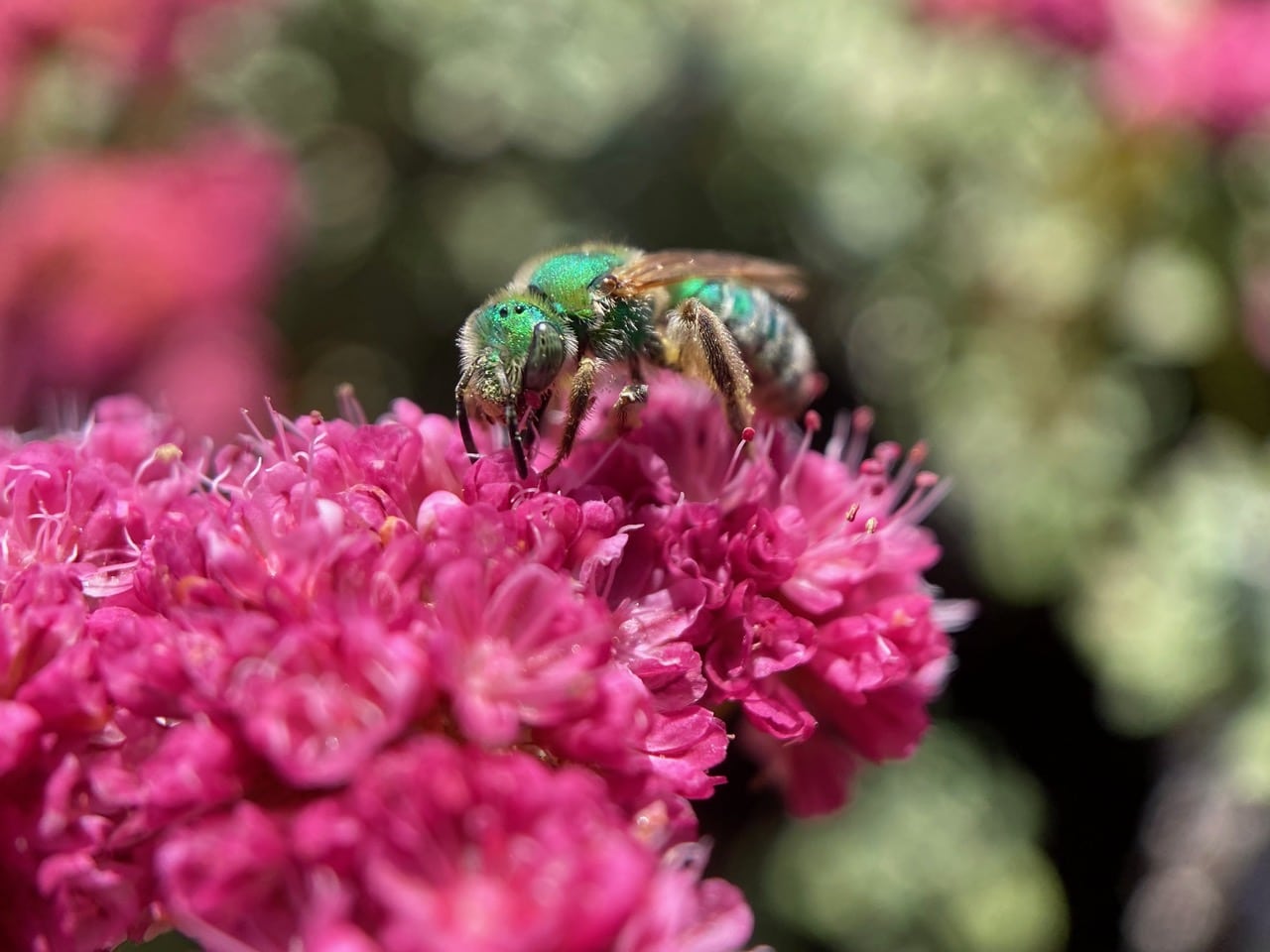
A female Fine Striped Sweat Bee, Agapostemon subtilior (family Halictidae) is foraging on the flowers of Red-flowered Buckwheat.
Agapostemon are brightly colored metallic green or blue bees measuring 7 to 14.5 mm long. Most species have a metallic green head and thorax, and black-and-yellow striped abdomen; some females are entirely bright green or blue. Females carry pollen on scopal hairs located on their hind legs. Agapostemon are generalists. Like other members of the family Halictidae, they are short-tongued and thus have difficulty extracting nectar from deep flowers. Males are often seen flying slowly around flowers looking for females. The bees favor flowers with high densities. Females excavate nests in the ground. These bees are active summer to fall.
Fine striped sweat bee (Agapostemon subtilior) · iNaturalist
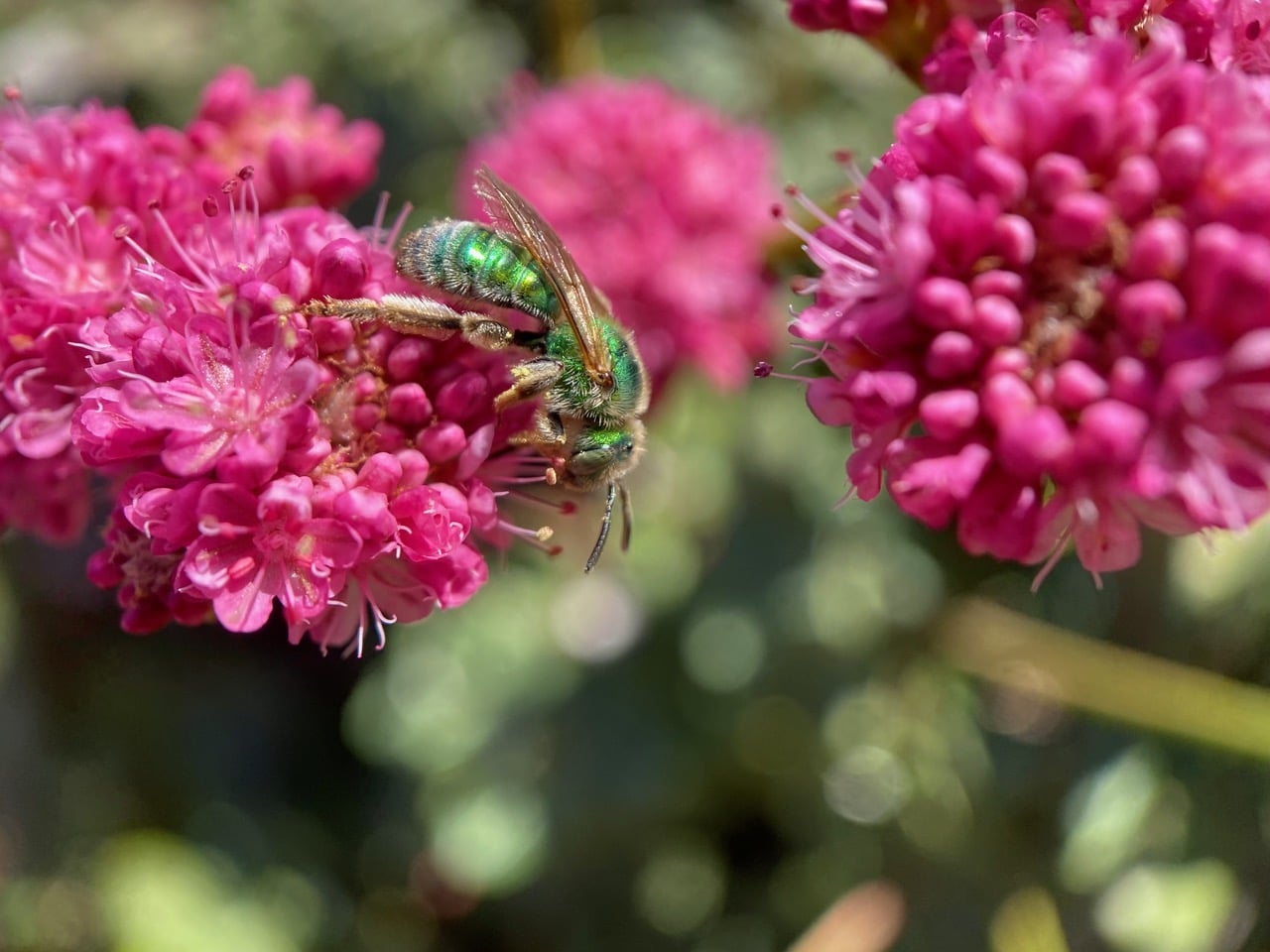
The female appears to be only taking nectar, not collecting pollen. Her scopae (pollen collecting hairs) are empty.
Agapostemon females dig deep vertical burrows in flat or sloping soil, or sometimes in banks. Most species are solitary, but some species nest communally. Up to two dozen females may share a single nest entrance, but each individual builds and provisions its own cluster of brood cells. Where a communal nest gallery shares a single entrance, one bee usually guards the hole, with only her head visible from above ground. Unlike other social bees, in communal bees there is no reproductive division of labor. In cool temperate regions, there is one generation per year, with females active in the early summer and males and pre-diapausing females active in the late summer. Only mated females survive the winter. This is probably because unmated females cannot enter diapause (insect version of hibernation).