

Pollinator Post 8/16/26 (2)
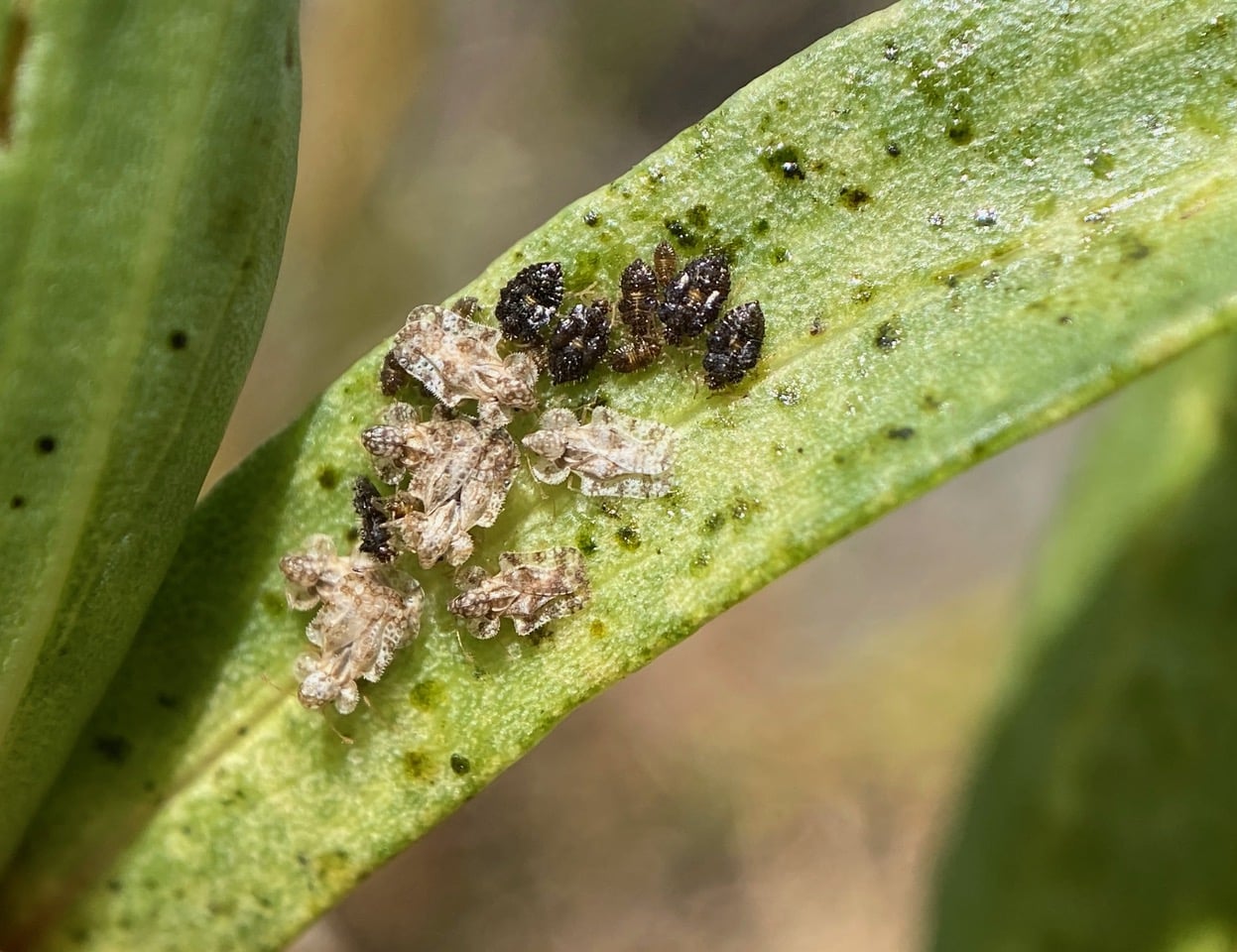
I revisit the patch of sick Oregon Gumweed, Grindelia stricta and find more of their torturers, the Lace Bugs, Corythuca sp. (family Tingidae). The bristly, black creatures are the wingless nymphs. Underneath the fancy, lacy wings and hoods, the adults pretty much look like that.
The Tingidae are a family of very small (2-10 mm) insects in the order Hemiptera that are commonly referred to as lace bugs. They are called lace bugs because the pronotum and fore wings of the adult have a delicate and intricate network of divided areas that resemble lace. Their body is flattened dorsoventrally, and the head is often concealed under the hood-like pronotum. Lace Bugs feed by sucking sap from plants, extracting the protein they need and excreting liquid waste as honeydew. The most common symptom of feeding is the stippled and mottled yellowish foliage. In heavy infestations, black sooty mold may develop on the honeydew, impairing photosynthesis by the plant. This may result in some dieback of twigs and branches and a reduction in flowering the following year. Tingids are usually host-specific and can be very destructive to plants. Each individual usually completes its entire lifecycle on the same plant, if not the same part of the plant.
Lace Bugs have many general insect predators and a few specialized enemies, such as green lacewing larvae, minute pirate bugs, assassin bugs, lady beetles, jumping spiders, predaceous mites, and tiny parasitic wasps.
The genus Corythucha is primarily distributed in the northern hemisphere, including Europe, North America and eastern Asia.
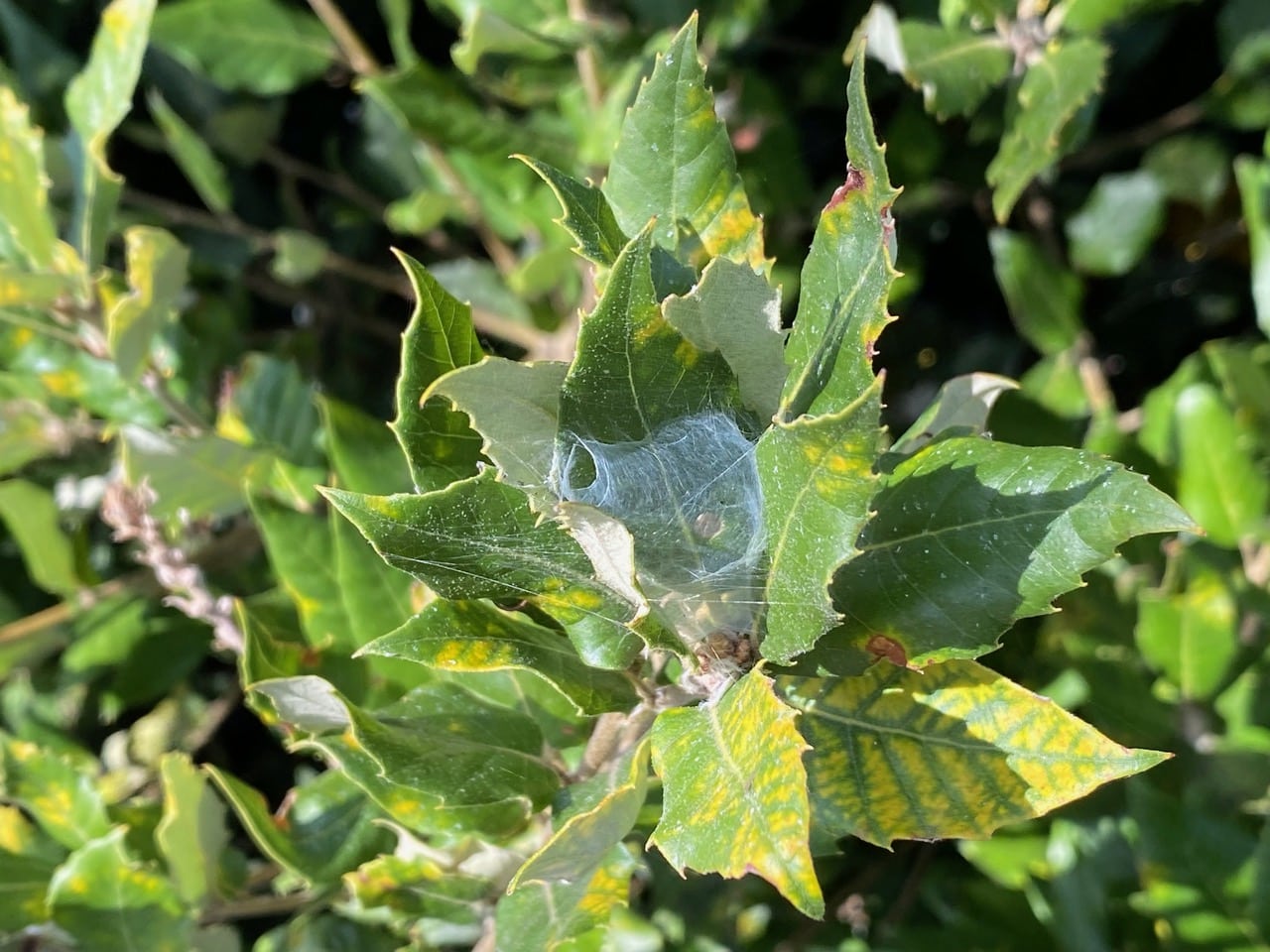
Passing the Holm Oak, Quercus ilex, I notice the various spider webbings on the terminal shoots of the plant. This wispy one is roomy and has an opening. I don’t see any occupants. It is likely the abandoned retreat of a Yellow Sac Spider.

Here’s another retreat built between the terminal leaves of the Holm Oak, with an opening on either end.
Cheiracanthium spiders, commonly known as Yellow Sac Spiders, are wandering nighttime hunters that do not build traditional prey-catching webs. Instead, they construct distinct, silk “sac” retreats during the day to rest, molt, mate, and guard their eggs. In gardens and on foliage, these spiders frequently draw terminal leaves together, silking the edges to form a protective tube, “tent”, or folded retreat. These retreats are built almost daily, often completed in a single night. The silken sacs provide camouflage and protection from predators, and they also serve as a crucial, protected nursery where the female will lay and guard her eggs.

More of the same kind of spider retreats. There seems to be some exuvia (shed exoskeleton) in the bottom of the large tube – the spider might have molted in there.

Ooh, that’s a different spider – an Orbweaver (family Araneidae). It is hiding in a little retreat in the branch tip away from its orb web to the right.
Orbweaver spiders are members of the spider family Araneidae. They are the most common group of builders of spiral wheel-shaped webs found in gardens, fields, and forests. The webs serve as traps for aerial insects. Many orb-weavers build a new web each day. Most tend to be active during the evening hours; they hide for most of the day. Generally towards evening, the spider consumes the old web to recycle the proteins, rests a while, then spins a new web in the same general location. Thus, the webs of orb-weavers are generally free of the accumulation of detritus common to other species. Not all orb-weavers sit in the middle of their web. Many hide in a retreat they build in the vegetation nearby, holding onto a contact line to the web to be alerted when any prey is struggling in the trap.
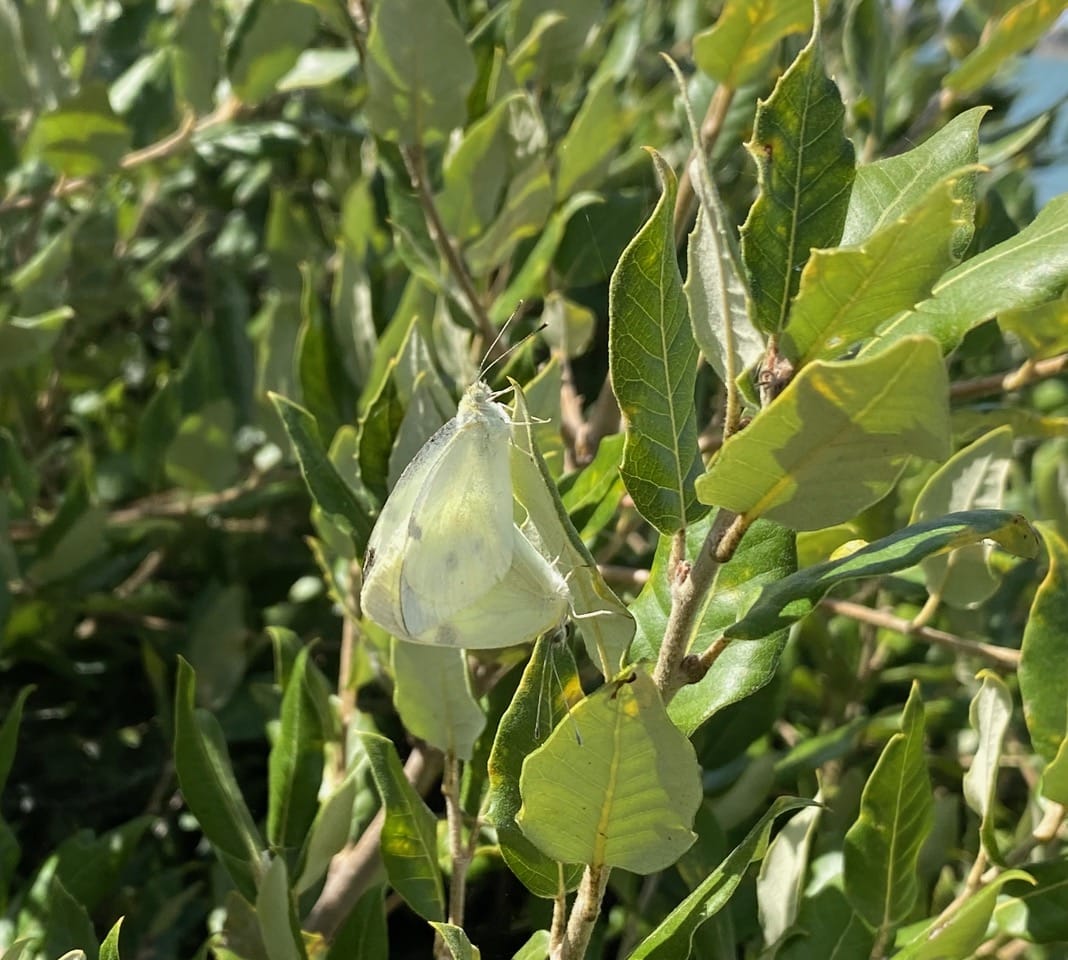
I am startled to find this pair of Cabbage White butterflies mating on the Holm Oak. Backlit by the sun, their wings are translucent, rendering them almost invisible among the foliage.
The Cabbage White, Pieris rapae (family Pieridae) was introduced to the US along with European cabbage imports in the 1860’5. The caterpillars feed on plants in the mustard or Brassicaceae family, and occasionally some in the caper family. The butterflies have a darkened, yellowish underside of the hind wings, which enables them to heat up quickly in the sun. The butterfly’s white wings reflect ultraviolet light, which we can’t see but the butterflies can. To our eyes the butterflies seem plain and drab, but to each other, females are a gentle lavender and males shine with a deep royal purple. Brighter males are more attractive to females as the color’s strength reflects the amount of protein the males consumed as caterpillars.
To tell a male and female Cabbage White butterfly apart, look at the black spots on their upper forewings. Males have one single spot, while females have two.
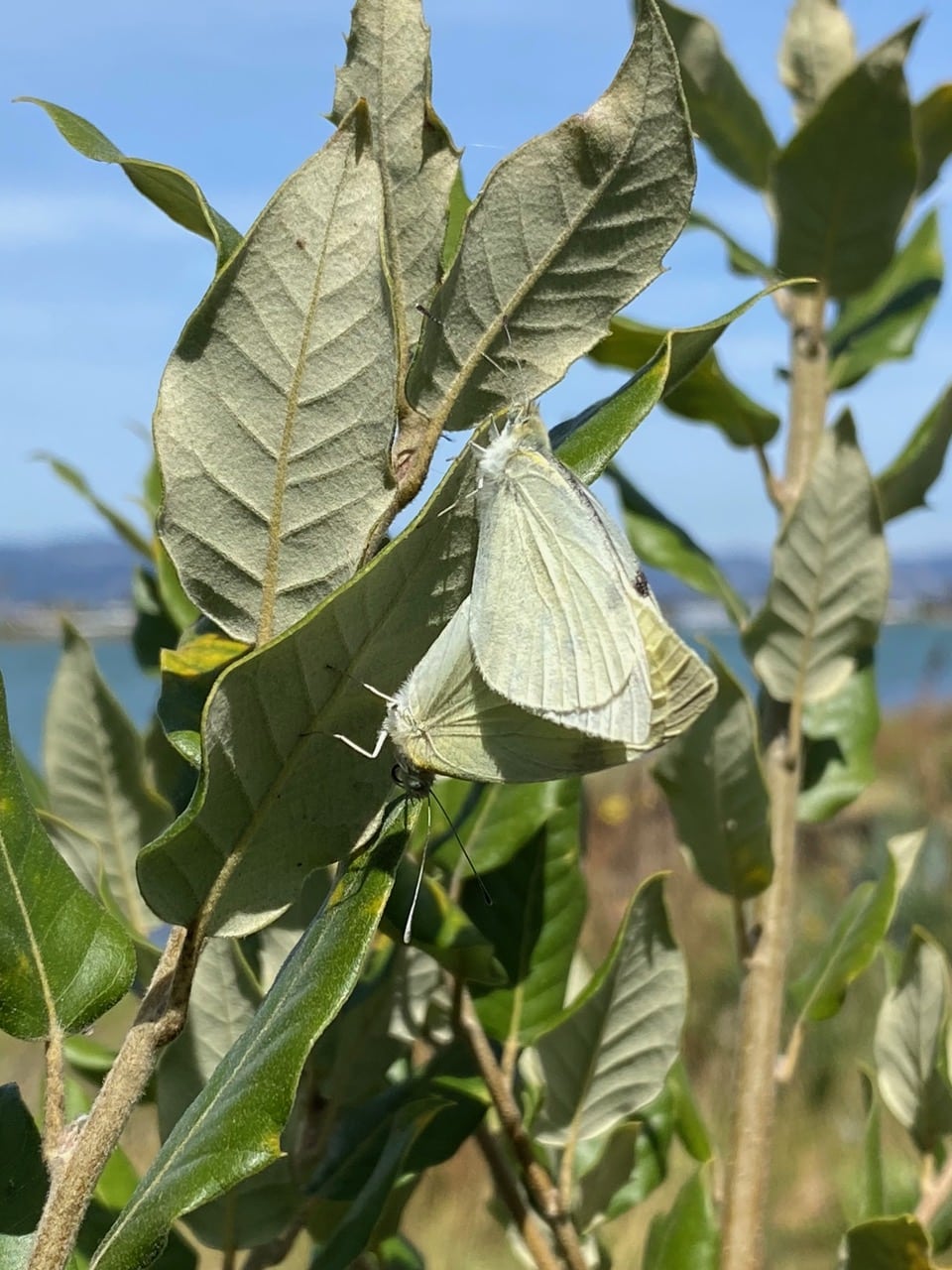
Here’s what they look like on the other (sun-facing) side – still remarkably camouflaged!
Cabbage White butterflies mate by coupling tail-to-tail resting on vegetation. The male transfers a massive sperm package – weighing up to 13% of his body weight – into the female’s reproductive pouch. The female uses specialized internal jaw-like structures to slowly chew open this package over 36 hours to extract vital nutrients for egg production. Sperm then migrates to a separate storage organ inside the female for future egg fertilization.
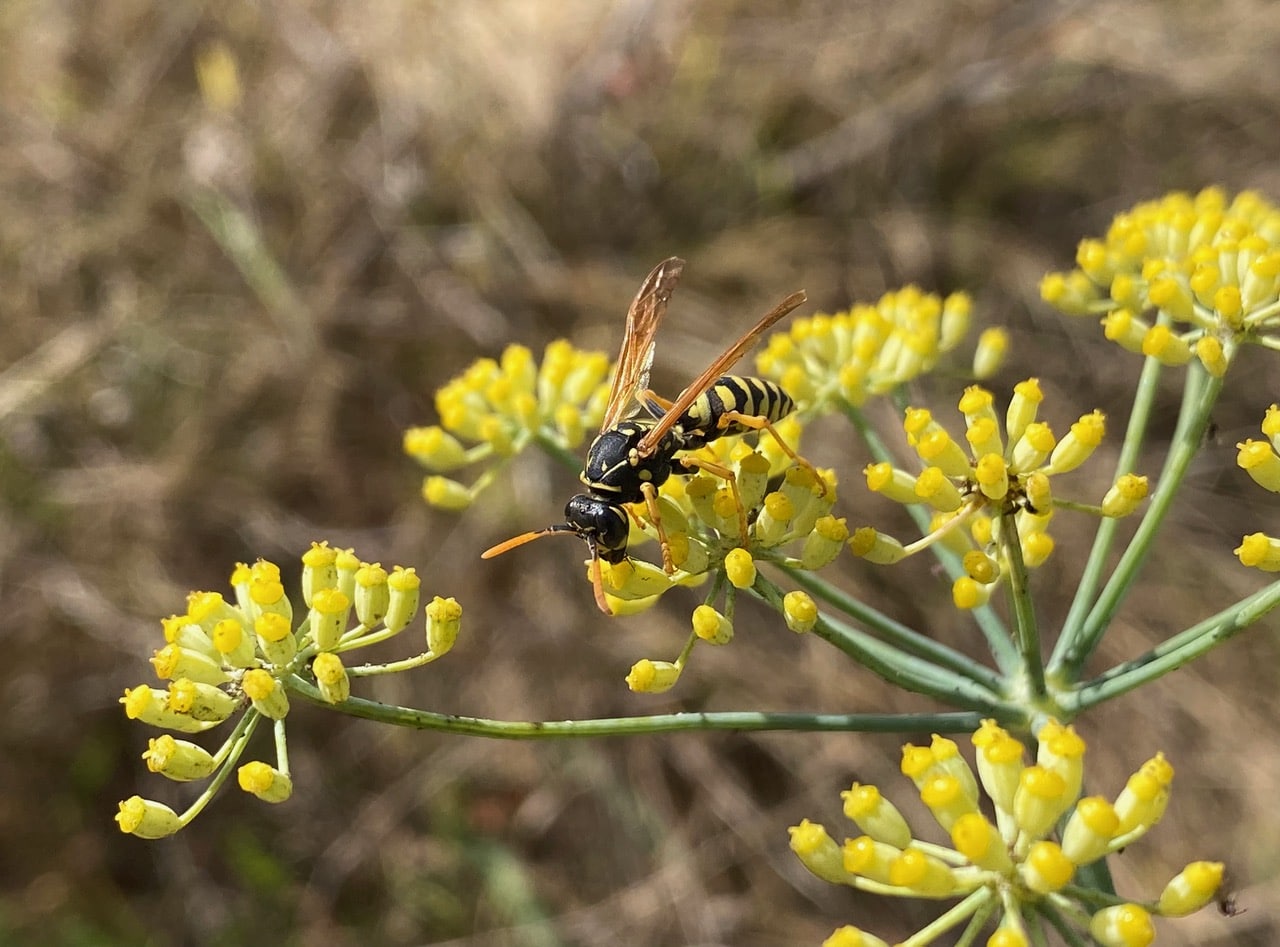
A European Paper Wasp is taking nectar from the flowers of Fennel, Foeniculum vulgare.
Native to Europe, the European Paper Wasp, Polistes dominula (family Vespidae), is a social insect that produces an annual colony in a paper nest. Individual colonies are established anew each spring. The overwintering stage are mated females (queens). The overwintered queens emerge from sheltered spots in spring and search out sites to establish a new colony. Nests are constructed of paper, produced from chewed wood fibers of weathered fences, porch decks and other similar sources. Larvae are fed crushed insects, usually caterpillars. As the population increases, the original queen increasingly remains in the nest as new workers take over colony activities. A few of the wasps produced later in summer are males and increasing numbers of the females become sexually mature. Mating occurs and the mated females are the surviving overwintering stage. Males and non-reproductive females do not survive winter and the nest is abandoned by late fall. European Paper Wasps will sometimes feed on sweet materials, including honeydew produced by aphids. They may also feed on damaged ripe fruits. Because of their habit of hunting caterpillars, the wasps have become one of the most important natural controls of garden pests.
Often mistaken for Yellowjacket Wasps, the European Paper Wasps can be distinguished by their slender body, and their orange-tipped antennae. Yellowjackets have shorter, thicker bodies, and they have black antennae. Paper wasps dangle their long legs when they fly, while the yellowjackets tuck their legs under their bodies when they fly. Paper wasp nests resemble an open honeycomb or upside-down umbrella. They often build their nests on man-made structures such as eaves or lawn furniture. Yellowjacket nests are covered with a surrounding envelope of paper; the nests have a single opening that is often hard to see because the nest is underground.
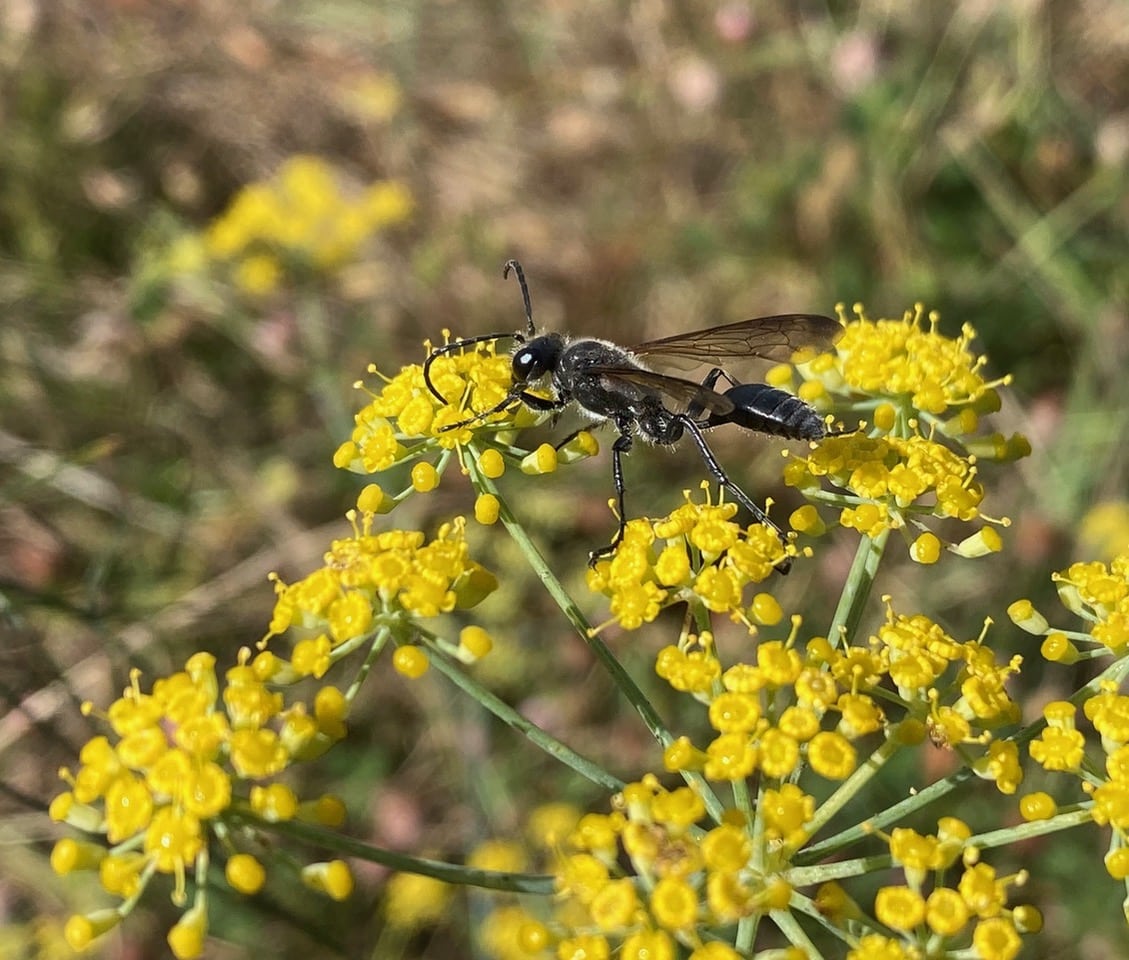
Ooh, here’s a larger, all-black wasp foraging on the Fennel flowers. It is a Mexican Grass-carrying Wasp, Isodontia mexicana (family Sphecidae).
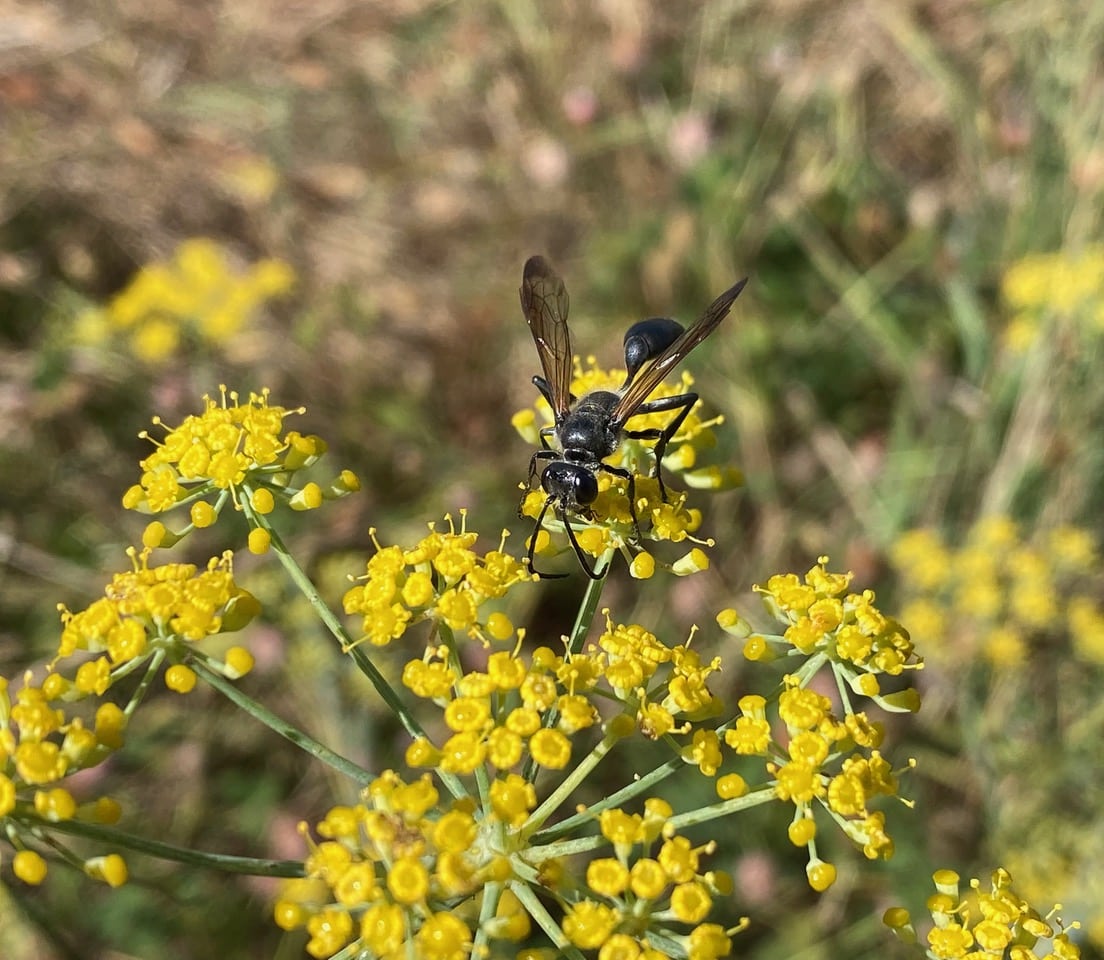
The Mexican Grass-carrying Wasp, Isodontia mexicana is a species of wasps belonging to the family Sphecidae. It is mainly found throughout North America, but has become established in Europe. Like others in the Sphecidae family, Grass-carrying Wasps have a very narrow section (thread waist) connecting their abdomen to their thorax. The adults grow up to 18-20 mm long, the body is completely black, thorax is quite hairy and the wings have a smoky-brown color. They are often seen from early summer through September. Females are larger and emerge as adults later in the season than males. The wasps frequent woodland edges, gardens, meadows, old fields and farms.
After emerging from their natal nest, females mate with males and begin nest construction. These wasps build their nests in preexisting cavities such as hollow stems or in other natural cavities, often reusing the nests of other species. Females typically use pieces of grass to line their nests and make divisions inside the cavity for the developing larvae. Using her mandibles, the female wasp cuts a grass blade, then flies back to her nest carrying it in her mandibles. She coils the blades to form partitions between the brood cells or to plug the end of the nest cavity.
Isodontia mexicana mainly preys on grasshoppers (usually katydids, Tettigoniidae species) or tree crickets (Gryllidae species) to feed their young. The female stings the victim, then clutching the paralyzed prey underneath her, she carries it back to the nest. Once a brood cell is provisioned with enough prey, she lays an egg. When the food provisions are entirely consumed, each larva spins a cocoon in which it overwinters in prepupal or pupal state. Development continues the following spring with the adults emerging in July.
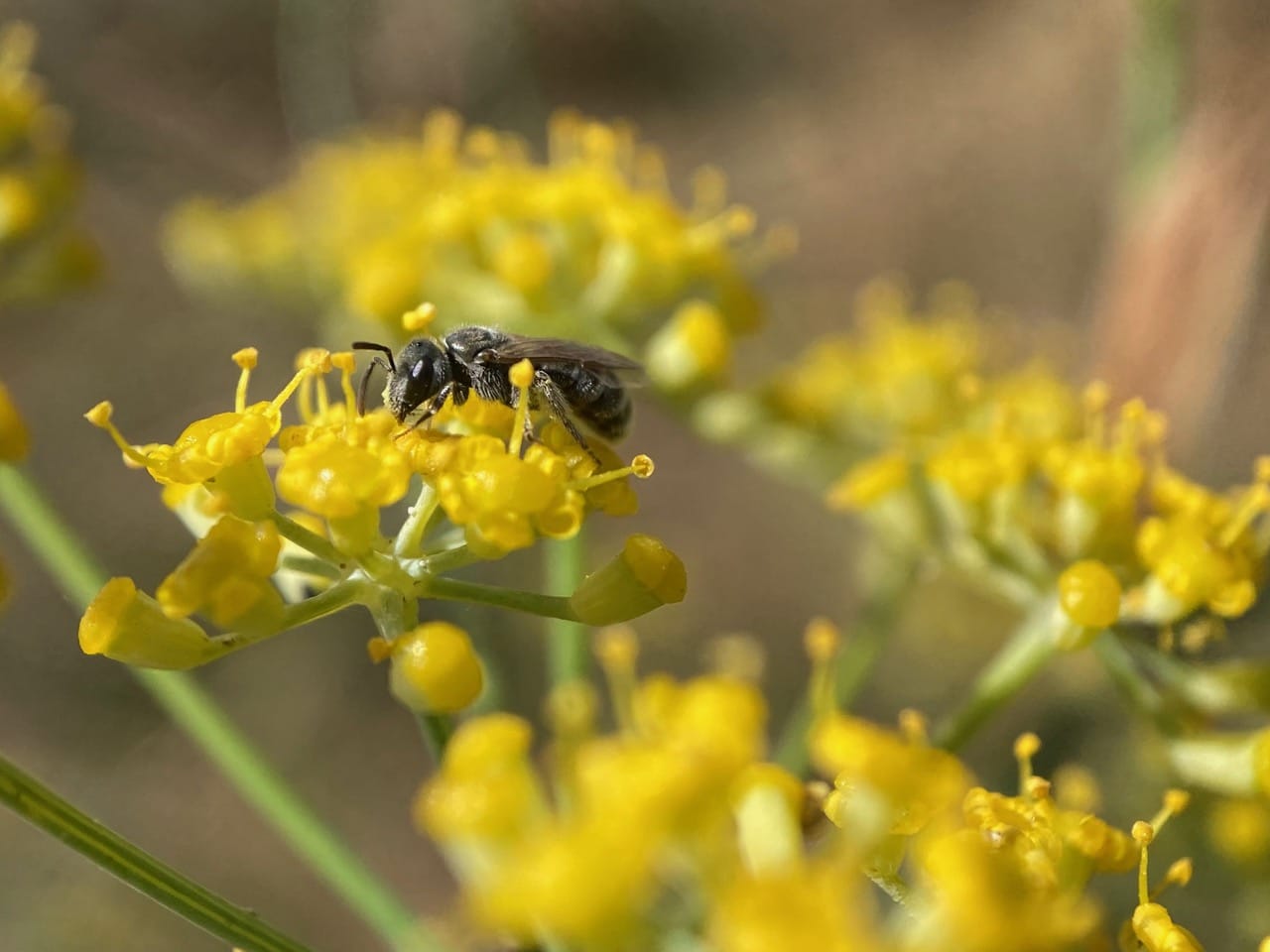
A tiny bee is foraging on an umbel of Fennel flowers. From its size and black-and-white bands on its abdomen, I gather that it is a Tripartite Sweat Bee, Halictus tripartitus (family Halictidae).
Halictus is found worldwide; they are most common in the Northern Hemisphere. All are generalists, foraging from a wide variety of flowering plants. Many species are social and produce several generations per year. This is not surprising as most blooming plants are season-specific; a bee that requires pollen and nectar across multiple seasons would not thrive as a specialist. All Halictus in North America nest in the ground, often in aggregations; and they may nest in the same area for decades.
Tripartite Sweat Bees, Halictus tripartitus are social, forming annual colonies in the soil where a queen lays eggs and daughter bees act as workers. They are considered a “primitively social” species, meaning they have a social organization with a queen and workers, but with simpler colonies compared to more complex eusocial insects such as honey bees.

Sweat Bees (family Halictidae) generally have flat, relatively bald faces.
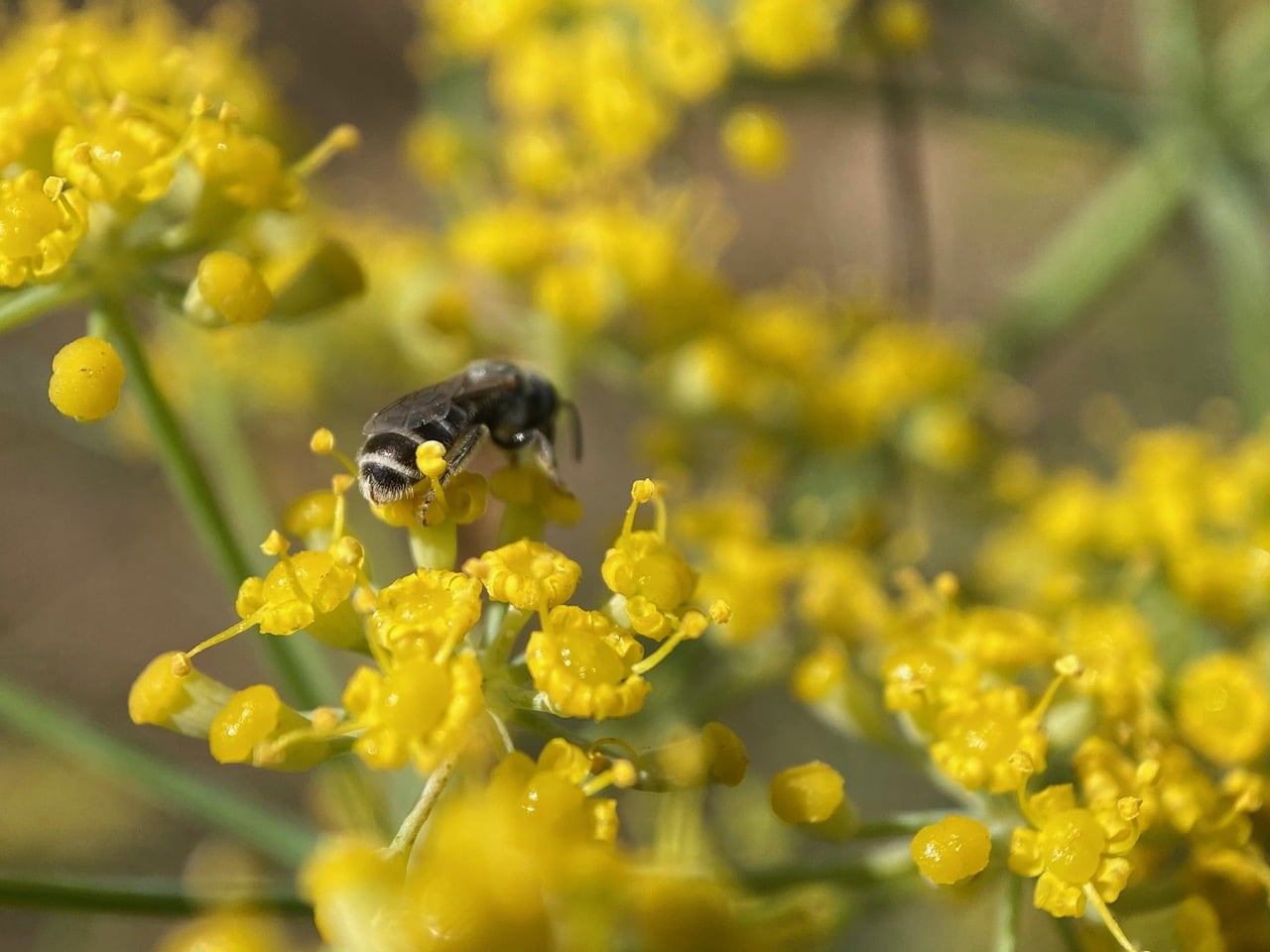
See the “furrow” at the tip of the bee’s abdomen? It clinches the case for the Tripartite Sweat Bee. The bee is one of a few sweat bee species whose females have this anatomical feature, giving them the common name of “Furrow Bees”.
Furrow Bees are a group of ground-nesting, solitary, or primitively social bees. They get their name from a distinct longitudinal groove or “furrow” found on the abdomen of the females. They are also commonly known as Sweat Bees (family Halictidae) due to their habit of landing on humans to drink sweat for moisture and salts. These bees are generally small to medium (6 -14 mm long). They often have dark, metallic, or matte bodies with thin white or pale hair bands across the abdomen. The “furrow” on the female’s final abdominal segment is used for digging and nesting. While most furrow bees are solitary, each female digging her own tunnel in soil to lay her eggs, some species, such as the Tripartite Sweat Bee exhibit primitively social behavior. They form small colonies with a single queen and a few non-reproductive workers who forage for pollen. Their life cycle is akin to that of the bumble bees. Mated females spend the winter hibernating deep in the soil. In the spring they emerge, construct nests, and lay eggs in small chambers stocked with pollen. By the fall, the next generation of mated queens (gynes) prepare to overwinter, completing the annual cycle. These bees are crucial generalist pollinators that visit a wide variety of flowering plants and crops. Because they are short-tongued, they heavily favor easily accessible, open blooms like daisies, asters, and goldenrods.
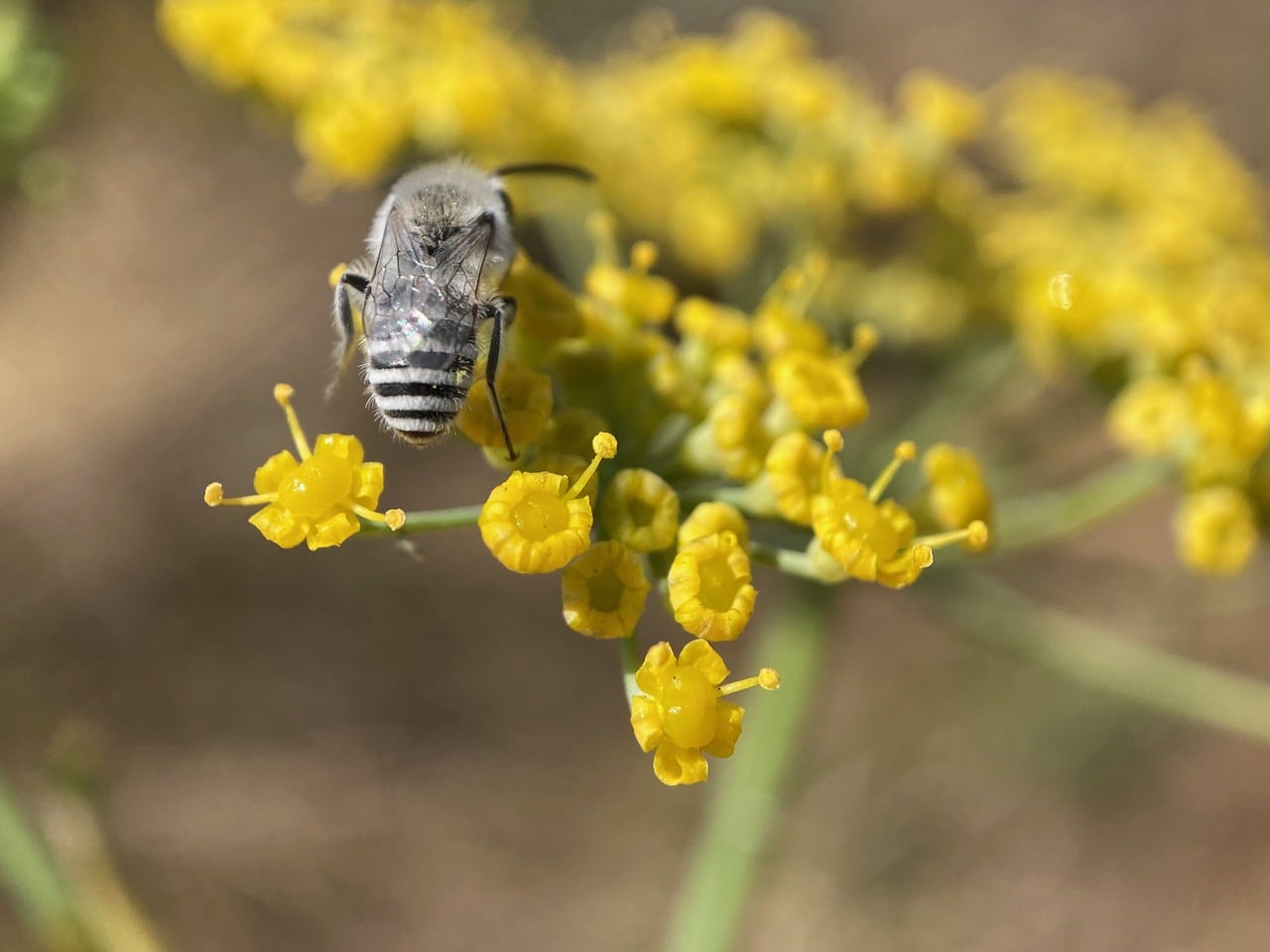
Here’s another bee with a black-and-white banded abdomen, but it is fuzzy all over.

The heart-shaped face is very hairy on this male Cellophane Bee, Colletes sp. (family Colletidae).
The bee family Colletidae includes generalists and specialists, and they are likely important pollinators of many wildflowers. All Colletidae in North America are solitary ground nesters, but some species nest in large aggregations. There are two major genera of Colletidae in North America: the Masked Bees (genus Hylaeus) and Cellophane Bees (genus Colletes). The most obvious shared characteristics of Colletidae is also the hardest to see: their short tongue. Colletes are moderately hairy, slender bees, ranging in size from 7 to 16 mm. Distinct features include a hairy head and thorax, pale bands of hair on the abdomen, and a heart-shaped head. The eyes of Colletes are angled (rather than being parallel), making the face slightly heart-shaped. The eyes of Colletes are angled (rather than being parallel), making the face slightly heart-shaped.
The genus name Colletes means “one who glues”, referring to their habit of applying a glue- or cellophane-like lining to the walls of nest cells, using their specialized tongues. This lining gives rise to their common names: cellophane bees, polyester bees, and plasterer bees. Colletes tongue is unique: short, flat, and forked at the tip. Colletes line their nests with a distinctive cellophane-like substance made from saliva and secretions from the Dufour’s gland on the abdomen. Using their specialized tongue, they paint the walls with saliva, then with secretions from the Dufour’s gland, they add a coat of varnish. This creates a clear covering that is strong, durable, and resistant to mold and water.
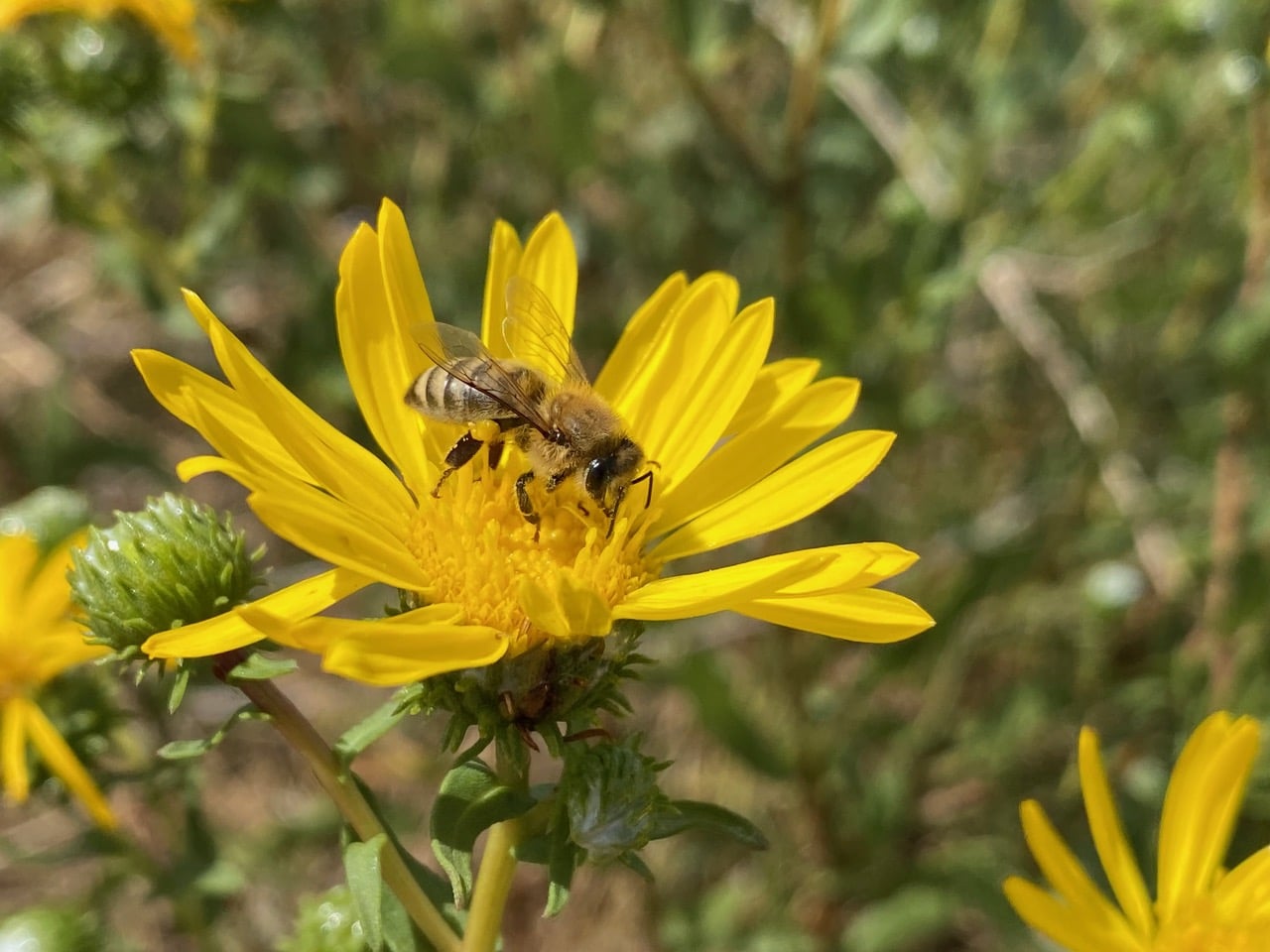
A robust, dark Honey Bee, Apis mellifera (family Apidae) is foraging on a Grindelia flowerhead. I have been seeing increasing numbers of these over the years during the hottest times in the summer. In fact, I often receive inquiries in the summer from gardeners who send me photos of them, wondering what kind of bees they are. I might have the right answer this year.
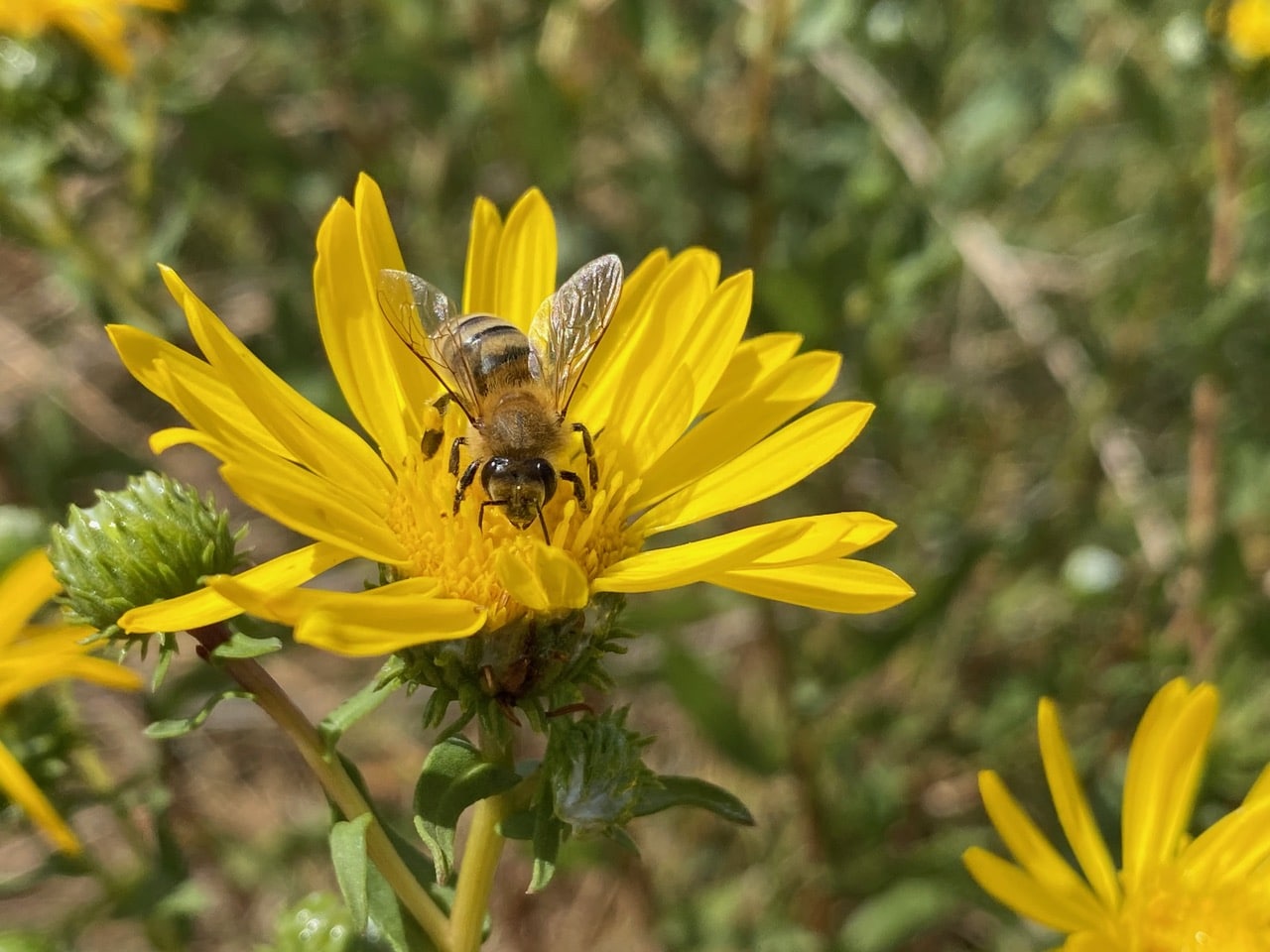
The European Dark Bee, or Apis mellifera mellifera, is a subspecies of the European Honey Bee, Apis mellifera (family Apidae). They have been present from the Pyrenees to Scandinavia for about a million years. They were domesticated in Europe and hives were brought to North America in the colonial era in 1622. Black-brown in color, they are bigger and darker than other European subspecies, with a particularly large and voluminous abdomen. Their trunk is relatively short and their furry thorax makes them excellent collectors and spreaders of pollen, thus ensuring the survival of many wild plants in their native habitats, and contributing to the yields in agricultural production. However, being nervous and aggressive, these dark bees are not very popular with beekeepers.
The dark bees are well adapted to the European climate; they are more resistant to disease and its workers are known for their longevity. They are able to cope with extreme winter conditions by reducing the size of their colony and consuming their honey reserves sparingly, a regulatory process that increases their chances of survival. During summer, the European Dark Honey Bees focus on foraging, expanding their brood, and storing nectar. They handle cooler, unpredictable northern summer better than other bees, but can slow down honey production if forage dries up during late summer dry spell. Queen egg-laying peaks in early-to-mid summer, then tapers off as day length shortens. I wonder if the dark bees aren’t also able to better cope the with extreme heat of summer in California, hence being seen more commonly in summer than their lighter-colored cousins.

The rising tide has flooded the Pickleweed, Salicornia pacifica on the lower marsh. Bright orange clumps of Dodder on the Pickleweed are barely above water now.
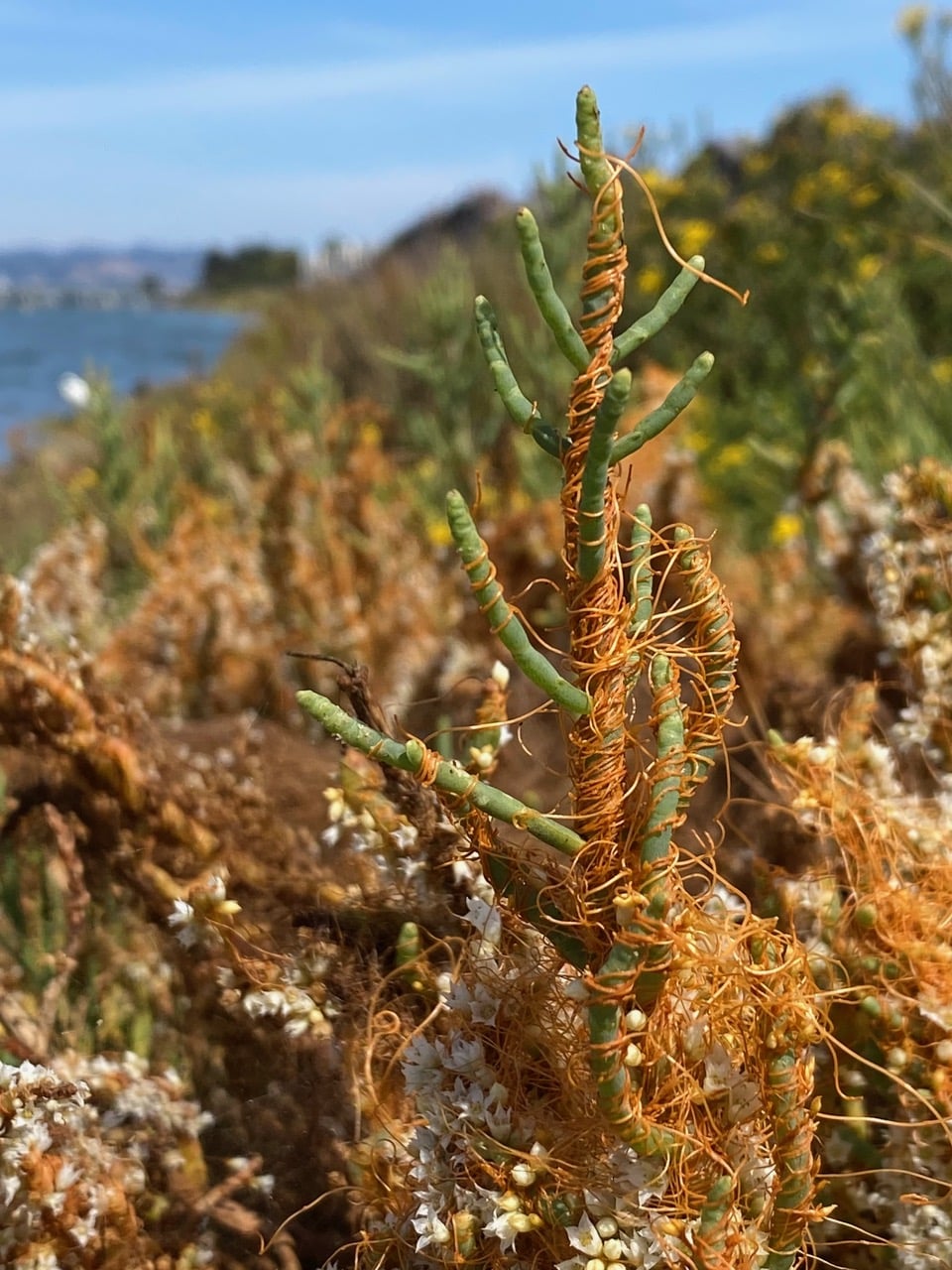
I tread carefully on soggy ground to reach the Pacific Dodder, Cuscuta pacifica that is blooming profusely.
Dodder is an annual parasitic vine in a single genus, Cuscuta in the family Cuscutaceae. Dodders are obligate parasites, meaning they can’t make a living without their plant hosts. The thin, thread-like, yellow or orange stems grow rapidly entwining and covering their host plants.
Dodder seeds germinate in the soil and can live on their own for 5-10 days. Dodder seedlings are capable of detecting plant volatiles released by prospective host plants. If they have not found a suitable host in time the seedlings will die. Seedlings that find a suitable host twine around the plant and insert haustoria (modified adventitious roots) into the tender stem. The haustoria penetrate and tap the host plant’s vascular system for water, minerals and nutrients. Dodder is weakly photosynthetic, but most produce very little food on their own. As the vine successfully taps the host plant, its connection to the soil is severed. Small, white, bell-shaped flowers form in late summer and early fall and can produce copious amounts of seeds.
Cuscuta pacifica, or Goldenthread is native to the coast of western North America from British Columbia to Baja California.

Close-up of the flowers of Pacific Dodder or Goldenthread, Cuscuta pacifica.
The salt marsh dodder produces flowers with bell-shaped, white glandular corollas with five pointed triangular lobes. It tends to parasitize Salicornia, but also may be found on other species such as Jaumea carnosa and Grindelia stricta. The small inconspicuous Dodder flowers are primarily pollinated by wasps, particularly small, native wasp species that are attracted to the host plant’s flowers. Dodder uses its host plant’s flowering signals to synchronize its own flowering. The host plant’s leaves sense environmental cues and produce a flowering signal that travels through the plant’s vascular system. Dodder “eavesdrops” on it to produce its own flowers. Dodder flowers generally don’t produce much nectar, and lack their own strong floral scent. It relies on the proximity to its host plant’s flowers to attract pollinators.

A male Western Leafcutter Bee, Megachile perihirta (family Megachilidae) has landed on a Grindelia flowerhead.
Leaf-cutter Bees, Megachile sp. (family Megachilidae) are stout-bodied, usually with pale hair on the thorax and stripes of white hairs on the abdomen. Females usually have a triangular abdomen with a pointed tip, and males’ faces are covered with dense, pale hair. Flight season is from May into September, with peak activity from June to August. Solitary females construct nests in tubular cavities, including hollow stems, tree holes, and abandoned beetle burrows in wood. Many use holes drilled into wood, straws, or other manufactured tunnels. Females cut pieces from leaves or flower petals for use in the construction of brood cells. Most Megachile females are generalist foragers, but prefer flowers in the family Asteraceae.
North America is home to many leafcutter bees, but the Western Leafcutter, Megachile perihirta is one of the largest. The species ranges on the west coast from British Columbia south to northern Mexico. From a distance, the female can be mistaken for a honey bee. She is about the same size as a worker honey bee and enjoys many of the same flowers, but her head is disproportionately large because it houses the bulky muscles that operate her large mandibles. While most leafcutter bees nest above ground in tubes and tunnels, the Western Leafcutter nests underground. Often a small group of females live in a community and burrow into soil, gravel, or sand.
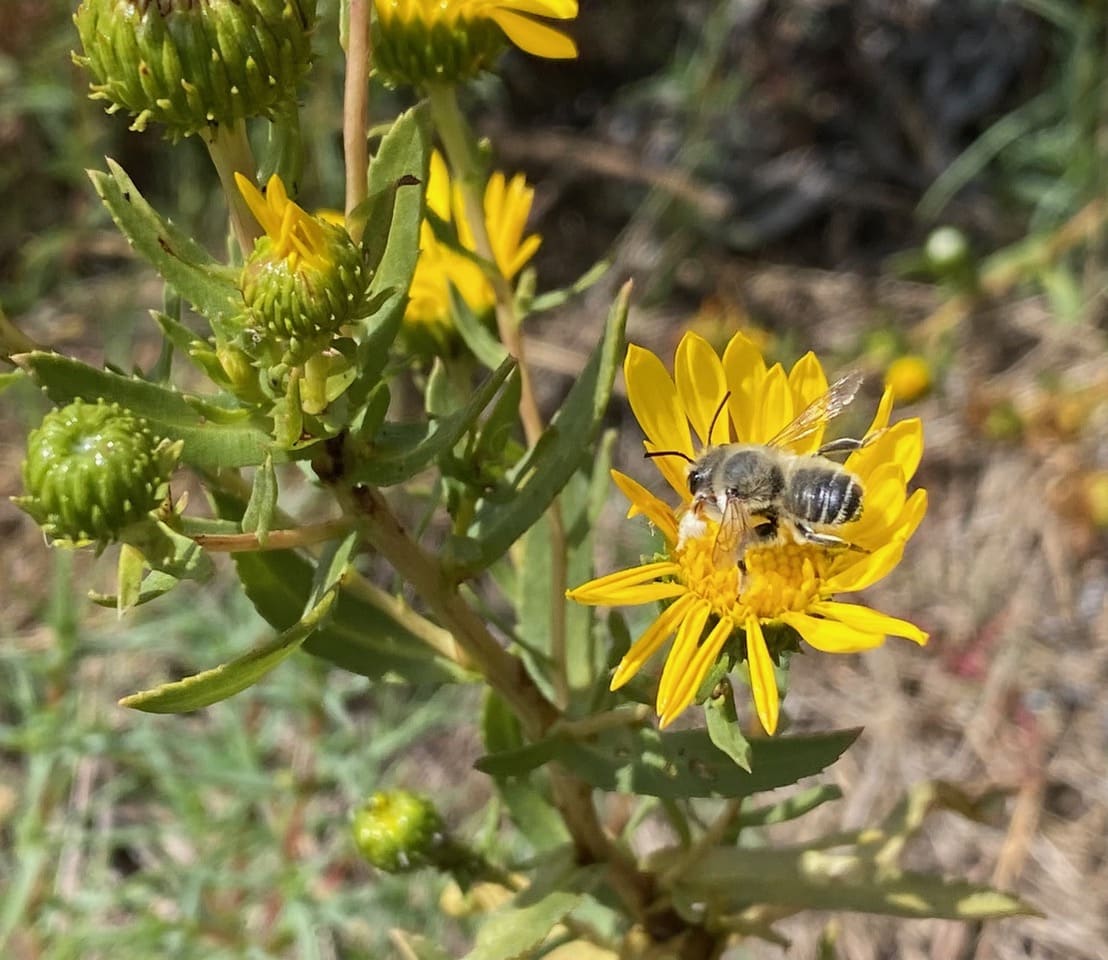
Note that the male’s orange front leg is covered with fringes of long white hairs.
Male Western Leafcutter Bees, Megachile perihirta (family Megachilidae) feature enlarged, modified front legs lined with a dense fringe of long, feathery hairs. They use these hair-lined forelegs during courtship to partially cover the female’s eyes, while using hidden odor glands near their front legs to emit pheromones close to her antennae, purportedly to pacify the female and to render her more receptive.
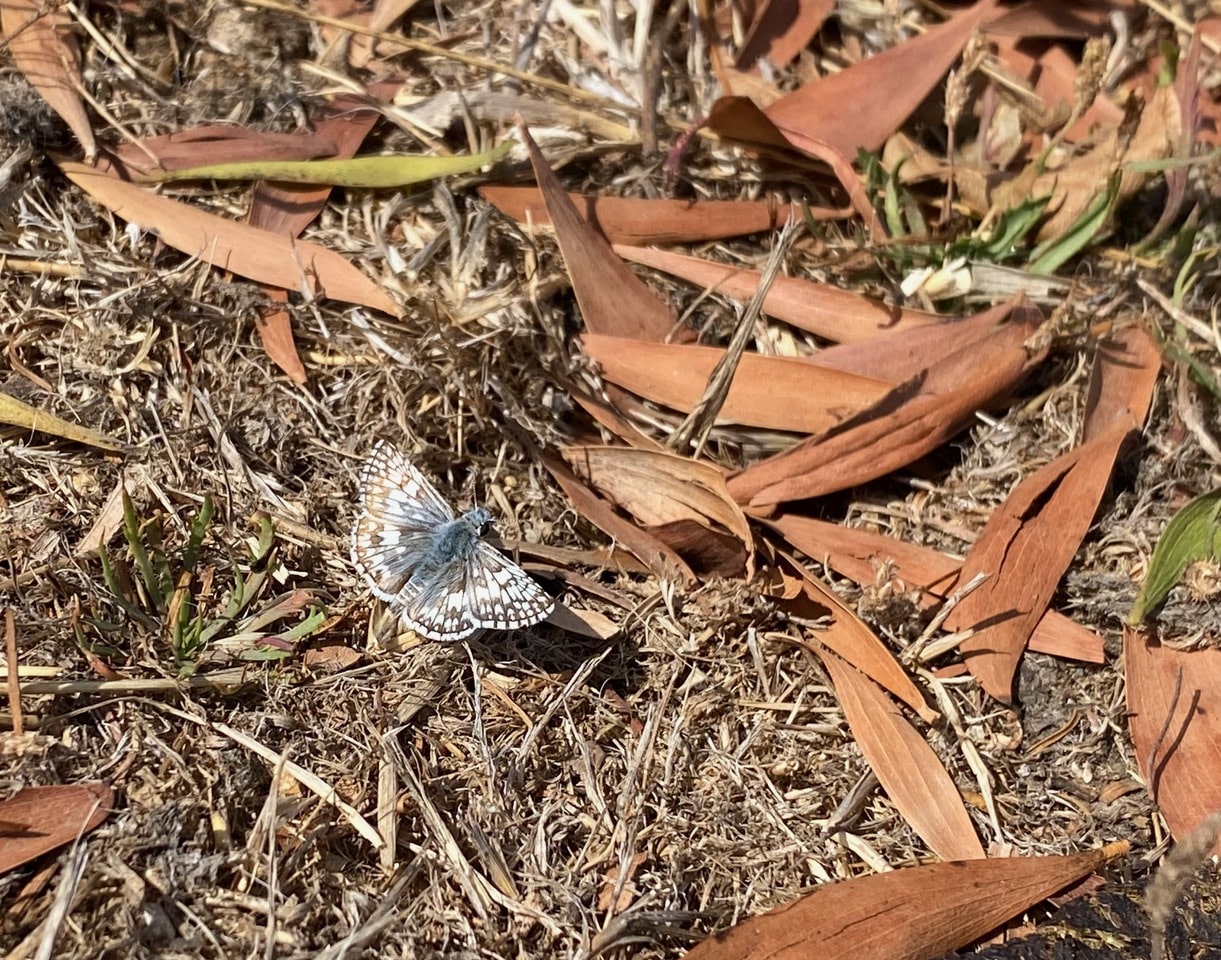
A Common Checkered-Skipper, Burnsius communis (family Hesperiidae) flies low ahead of me and finally lands on the leaf-littered ground. It shifts its position to place its spread wings in direct sunlight.
Because of its small size, bluish color, and spread-wing posture, the butterfly is often mistaken for one of the “Blues” in the family Lycaenidae. Skippers have the antennae clubs hooked backward like a crochet hook, while the typical butterflies have club-like tips to their antennae. Skippers also have generally stockier bodies and larger compound eyes.
Checkered Skippers belong to the subfamily Pyrginae, commonly known as spread-wing skippers, in the family Hesperiidae. Spread-wing skippers bask with their wings held wide open. The wings are held closed when they are at rest. Caterpillars make folded-leaf nests in which they live and feed on several plants in the mallow family, Malvaceae.