

Pollinator Post 8/16/25

The sun hasn’t come out all day. I decide to take an afternoon walk anyway – even if the insects are not out, the wide skies and open waters of Bay Farm Island will do me good.
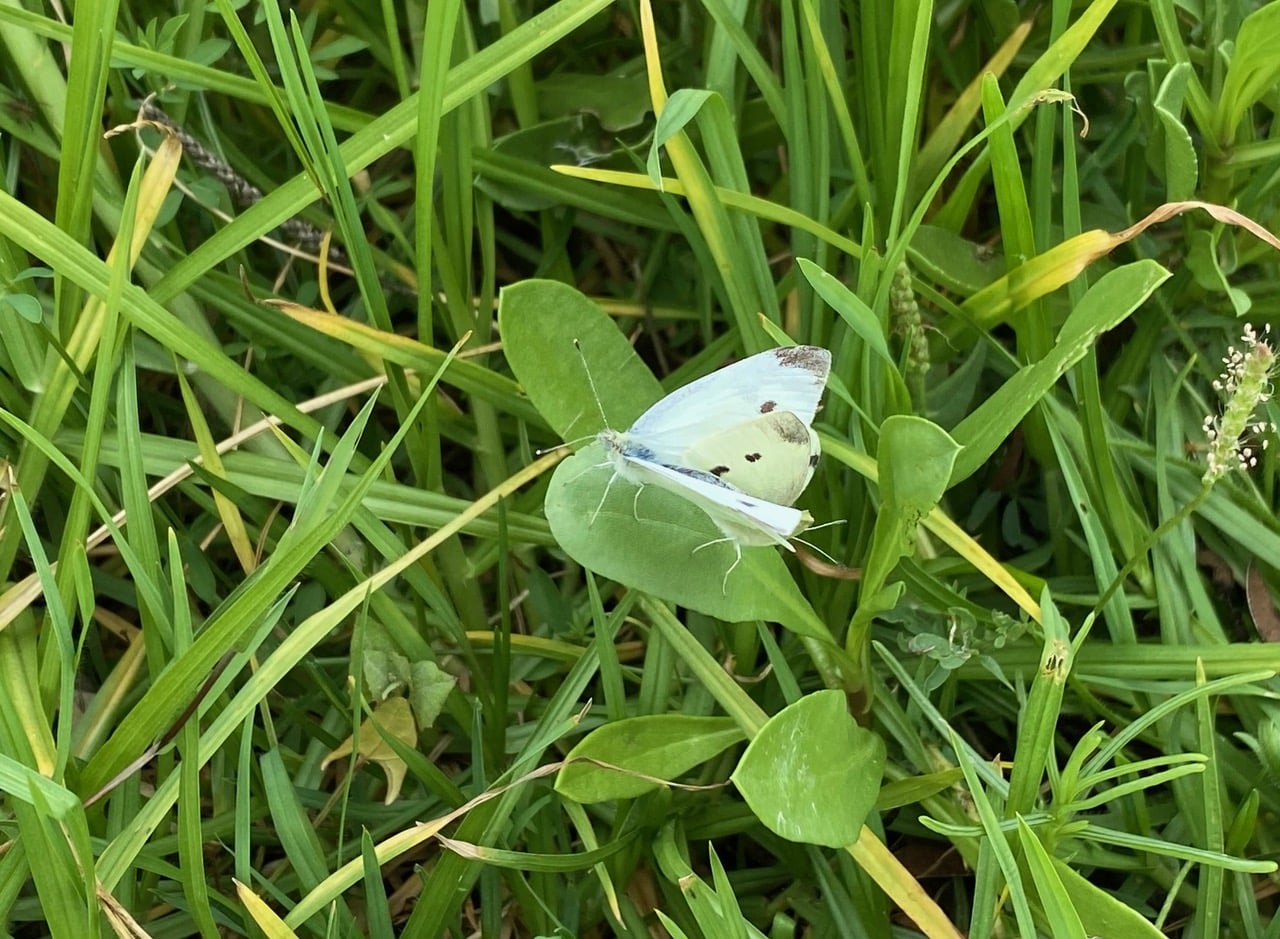
Hey, that looks like a large Cabbage White butterfly perched quietly on the undergrowth by the shore. For a moment I am very confused – there seems to be too many wings and too many spots on the butterfly. Then I realize it is actually a pair of mating Cabbage White. The one facing the left with a single black spot on its forewing is the male. And the one enclosed by his wings is the female; she has two black spots on her forewings. The pair lifts off into the air, and flitted over the lawn area, with the male at the helm. Her wings folded, the female hangs on while the male does all the flying. According to Sarab, my butterfly guru, when they fly as a mating pair, one butterfly always does all the work while the other clings on with folded wings. But the pilot can be either the male or the female. It will be the one whose wings enfold the other one’s.
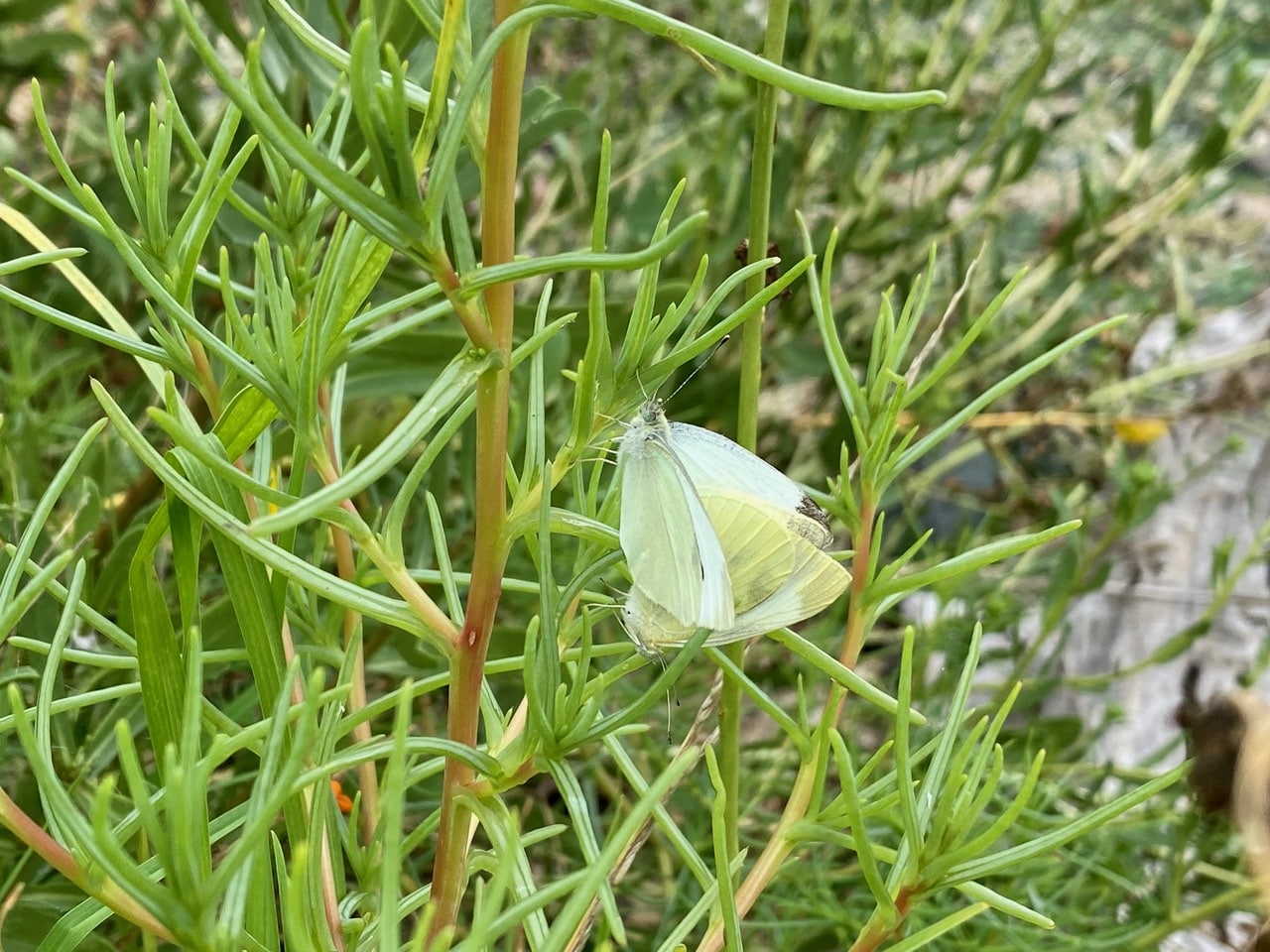
The pair finally lands on a small thicket of Fleshy Russian Thistle, Salsola soda by the water. Note that the underside of the butterflies’ wings are yellowish. The undulating flight starts all over again, but slow enough for me to follow the pair until they make landfall. This goes on for several times.

Alighting on the foliage of Creeping Saltbush, Atriplex prostrata, the male Cabbage White looks directly at me, his sweetheart safely enfolded between his wings.
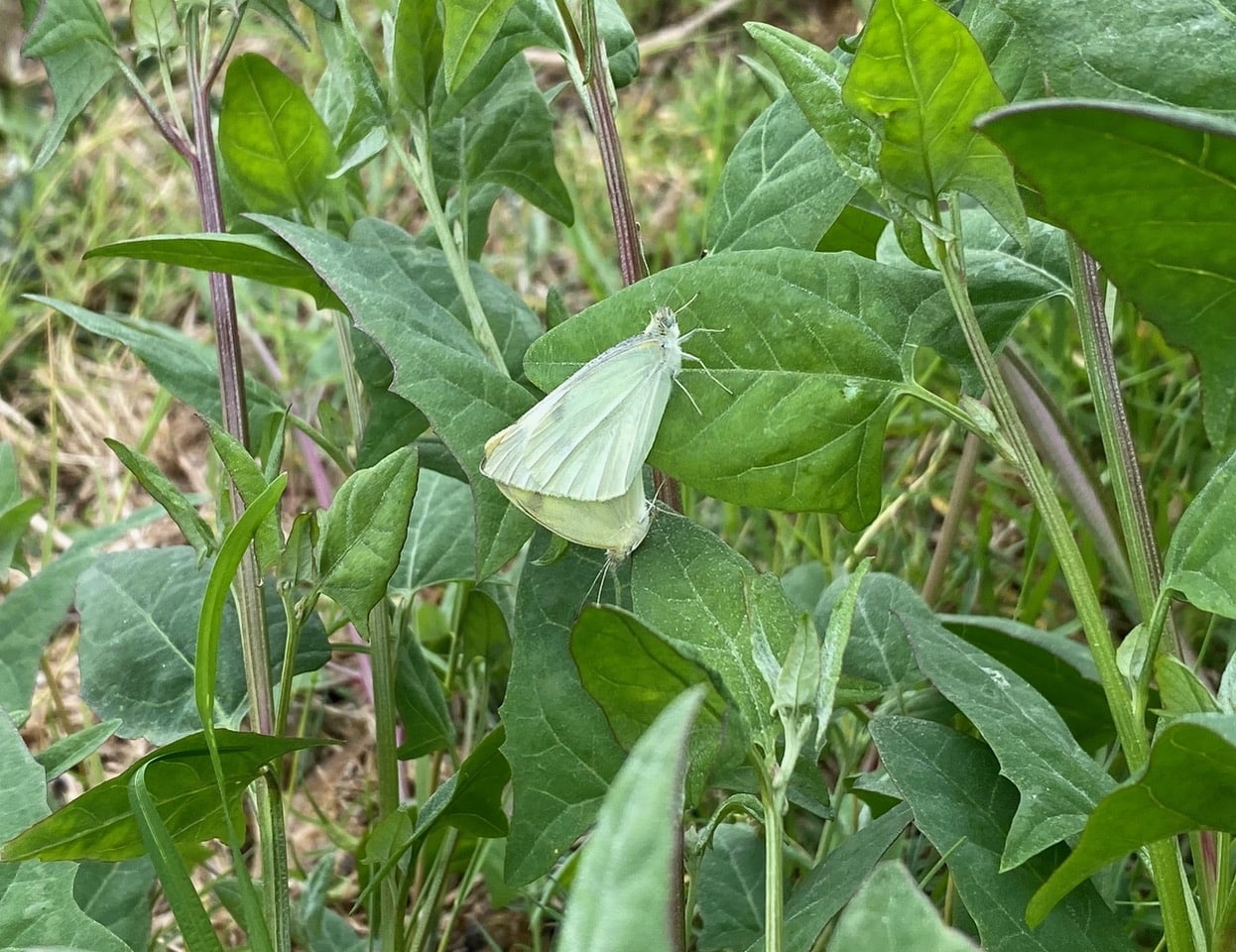
The Cabbage White, Pieris rapae (family Pieridae) was introduced to the US along with European cabbage imports in the 1860’5. The caterpillars feed on plants in the mustard or Brassicaceae family, and occasionally some in the caper family. The butterflies have a darkened, yellowish underside of the hind wings, which enables them to heat up quickly in the sun. The butterfly’s white wings reflect ultraviolet light, which we can’t see but the butterflies can. To our eyes the butterflies seem plain and drab, but to each other, females are a gentle lavender and males shine with a deep royal purple. Brighter males are more attractive to females as the color’s strength reflects the amount of protein the males consumed as caterpillars.

The sex life of the Cabbage White butterfly has been studied in great detail. During mating, the male butterfly ejaculates a solid package of sperm called a spermatophore, which is often 13% of its body weight. The spermatophore is composed of a tough outer envelope, an inner matrix of fluids and a bolus of sperm. The package is left in a pouch in the female’s reproductive tract where the sperm moves on to a second pouch where it will later fertilize eggs. The rest of the protein-packed spermatophore is broken down for the female’s nourishment to enhance her egg development. The female has specialized jaw-like structures in her reproductive tract that help her break down the outer layer of the spermatophore to access the nutrients. Because the spermatophore occupies much of the female reproductive tract, she cannot mate again until it is gone. This delay benefits the male by assuring more of his sperm fertilize her eggs.

A female Western Leafcutter Bee, Megachile perihirta (family Megachilidae) has landed on a Grindelia flowerhead.
Leaf-cutter Bees, Megachile sp. (family Megachilidae) are stout-bodied, usually with pale hair on the thorax and stripes of white hairs on the abdomen. Females usually have a triangular abdomen with a pointed tip, and males’ faces are covered with dense, pale hair. Flight season is from May into September, with peak activity from June to August.
Solitary females construct nests in tubular cavities, including hollow stems, tree holes, and abandoned beetle burrows in wood. Many use holes drilled into wood, straws, or other manufactured tunnels. Females cut pieces from leaves or flower petals for use in the construction of brood cells. Most Megachile females are generalists when foraging for pollen. Pollen is transported in dense scopae on the underside of the abdomen.
Photos of Western Leafcutter Bee (Megachile perihirta) · iNaturalist

Note the dense brush of orange hairs that make up the scopa on the underside of the female leaf cutter’s abdomen. When she fills the scopa up with pollen, it will appear yellow.
North America is home to many leafcutter bees, but the Western Leafcutter, Megachile perihirta is one of the largest. The species ranges on the west coast from British Columbia south to northern Mexico. From a distance, the female can be mistaken for a honey bee. She is about the same size as a worker honey bee and enjoys many of the same flowers, but her head is disproportionately large because it houses the bulky muscles that operate her large mandibles. While most leafcutter bees nest above ground in tubes and tunnels, the Western Leafcutter nests underground. Often a small group of females live in a community and burrow into soil, gravel, or sand.

An American Sand Wasp, Bembix americana (family Crabronidae) is foraging on the dense inflorescence of Algerian Sea Lavender, Limonium ramosissimum.
Sand wasps in the genus Bembix are familiar and common throughout North America, digging their burrows in dunes, on beaches, and other habitats with loose, deep sand. The female rapidly kicks out large quantities of sand using a “tarsal rake” of spines on each front leg. The burrow is excavated before the wasp goes hunting. Bembix are generalist, opportunistic hunters. True flies in the order Diptera are the usual prey. A victim is paralyzed or killed by the wasp’s sting, and is then flown back to the nest. Most species will lay an egg on the first victim, while some species lay an egg in the empty cell before starting to hunt. Once the egg hatches, mama wasp brings flies to her larva as needed. This “progressive provisioning” is rare in the insect world. When the larva reaches maturity, mama wasp closes the cell. Inside, the larva spins an oblong cocoon, weaving sand grains into the structure and resulting in a hardened capsule. Overwintering takes place as a prepupa inside this cocoon, but there are usually two generations a year.
Male sand wasps often engage in an elaborate flight ritual called “sun dances”. Males emerge before females, and fly erratically at dizzying speed one or two inches above the ground attempting to detect virgin females about to emerge from their underground nests. Both sexes are often seen taking nectar at flowers, especially from Asteraceae family. Bembix wasps are often victims of other insects such as cuckoo wasps (Chrysididae), velvet ants (Mutillidae), satellite flies (Sarcophagidae), bee flies (Bombyliidae), and thick-headed flies (Conopidae).
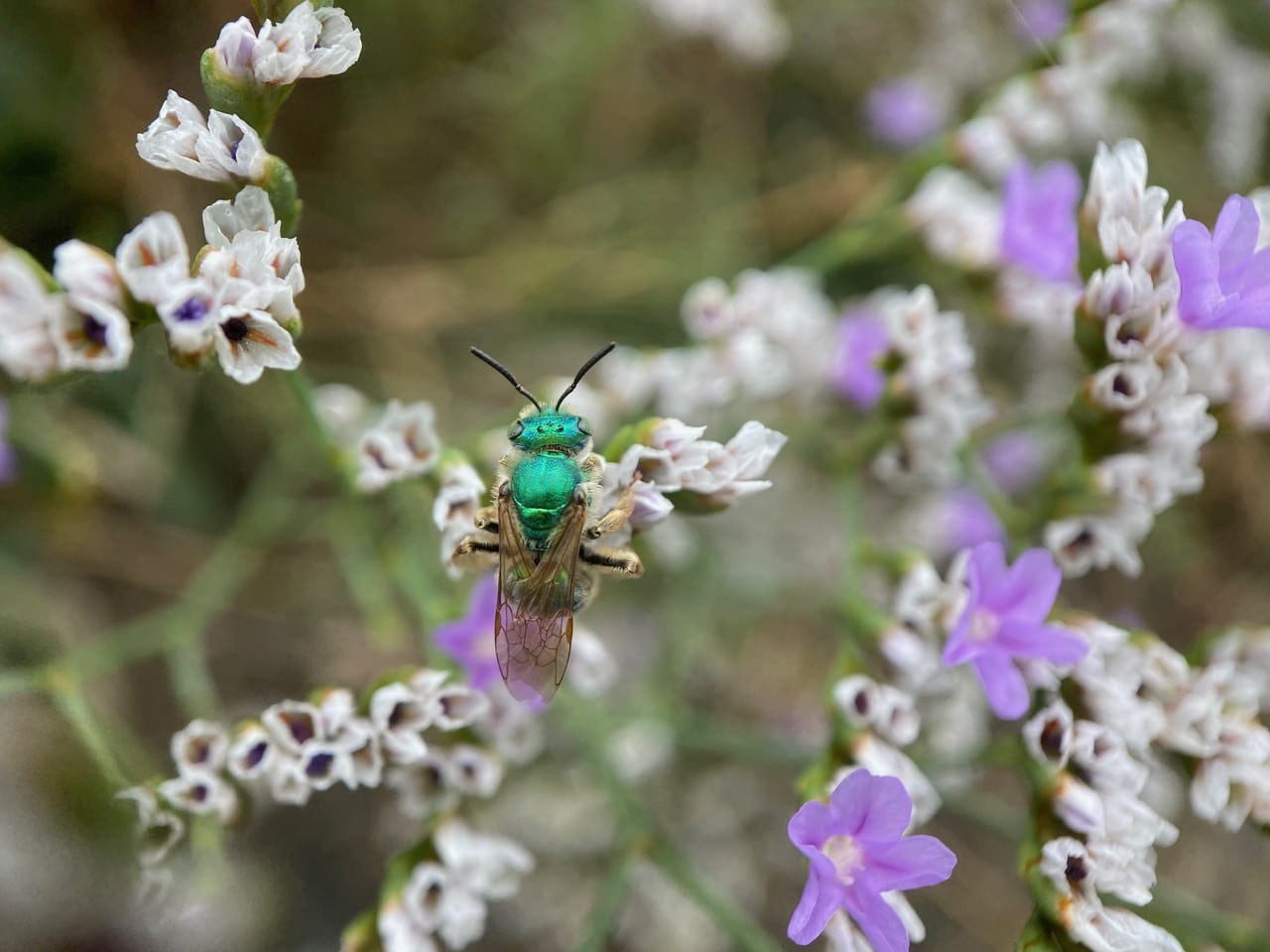
The iridescent green body of the female Fine Striped Sweat Bee, Agapostemon subtilior (family Halictidae) does not shine as brightly today under the overcast sky.
The genus Agapostemon is widespread and abundant throughout North America. They are most diverse and abundant in temperate regions and southwestern U.S. deserts. Agapostemon are commonly called “sweat bees” because they are closely related to, and resemble bees in the Halictus and Lasioglossum genera. Unlike those bees however, Agapostemon are not attracted to human sweat.
Agapostemon are brightly colored metallic green or blue bees measuring 7 to 14.5 mm long. Most species have a metallic green head and thorax, and black-and-yellow striped abdomen; some females are entirely bright green or blue. Females carry pollen on scopal hairs located on their hind legs. Agapostemon are ground-nesters and generalist foragers. Like other members of the family Halictidae, they are short-tongued and thus have difficulty extracting nectar from deep flowers. Males are often seen flying slowly around flowers looking for females. The bees favor flowers with high densities. They are active summer through fall.
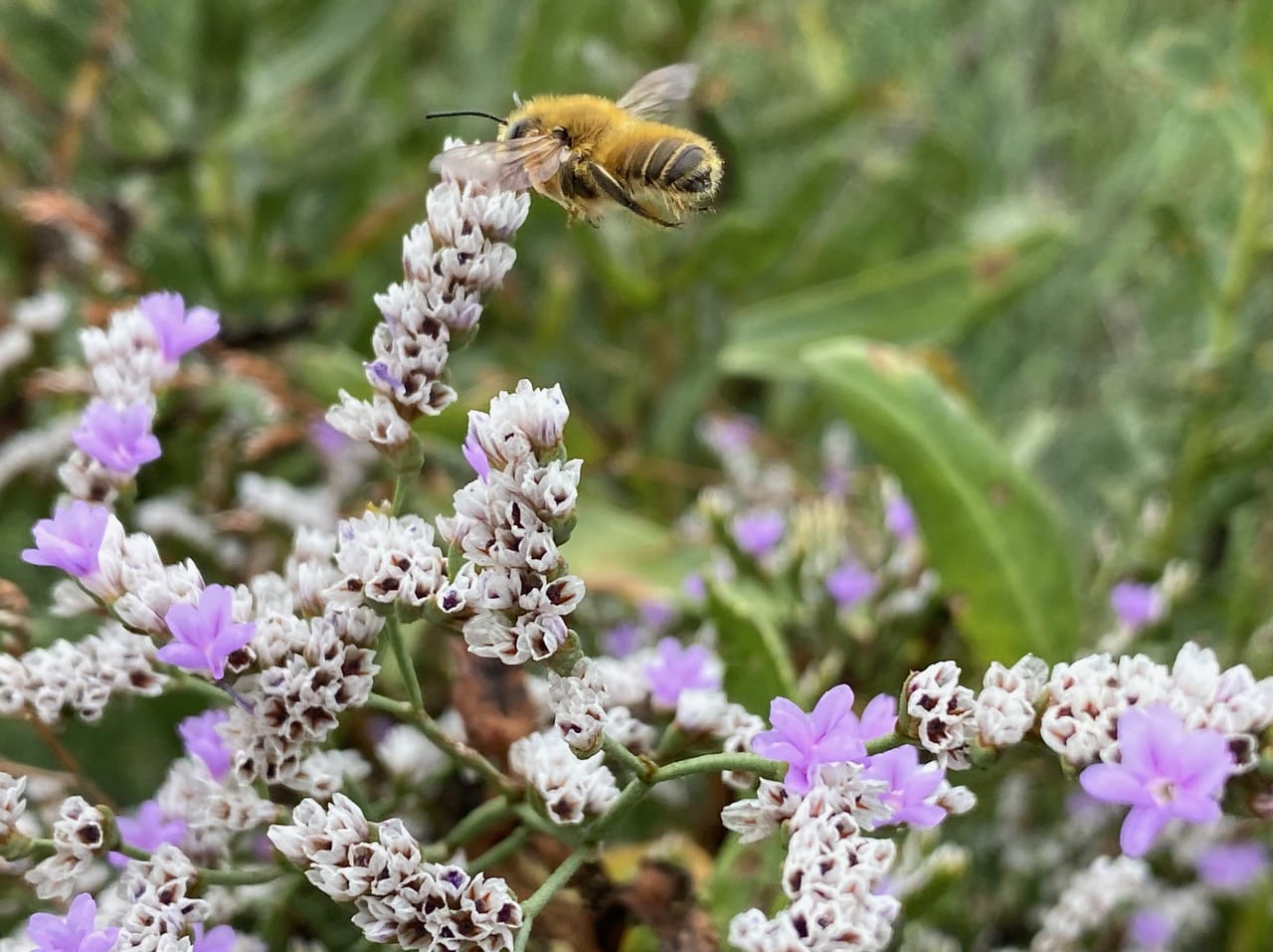
A male Western Leafcutter Bee, Megachile perihirta (family Megachilidae) is buzzing over the small flowers of Algerian Sea Lavender. Unlike the females, his abdomen ends in a rounded tip. He appears to have shaggy hairs under his abdomen, but he does not collect pollen.
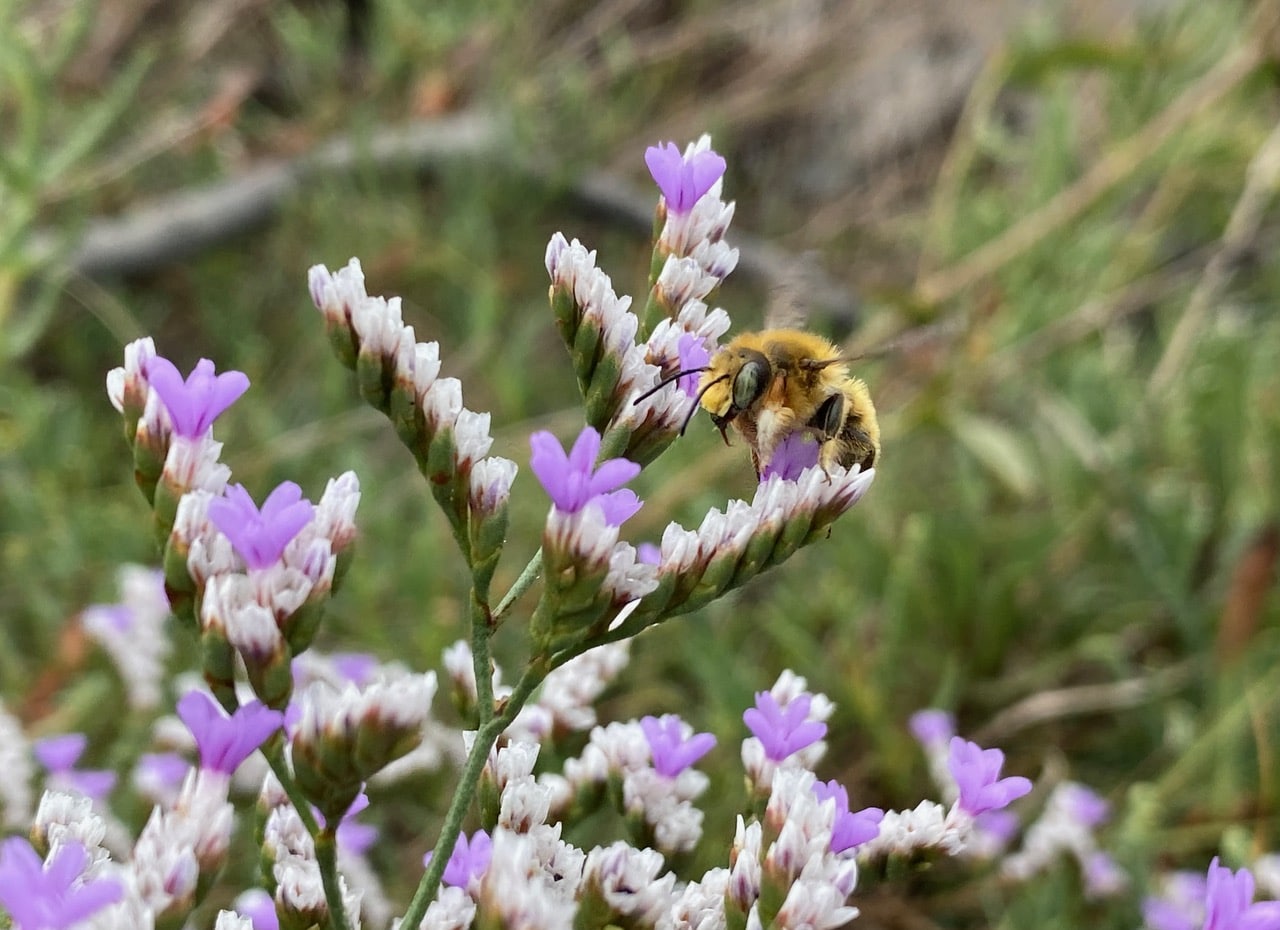
The male Western Leafcutter Bee lands to groom himself. Note his front leg that is of a different, reddish color; it has long fringes of pale hairs along the edges.
The male Western Leafcutter Bee is covered with a dense fur coat, and there are long fringes hanging from his extra-wide forelegs. These fringe-lined legs are crucial during the mating processs. The male uses his hairy legs – the portion known as the tarsus – to cover the eyes of the female during copulation, probably to keep her calm and receptive. The fringes are also associated with odor glands on the male’s legs, allowing them to release pheromones close to the female’s antennae. The fringes are part of the modified front legs that help the male grasp the female’s wings and abdomen to hold her in place during mating.


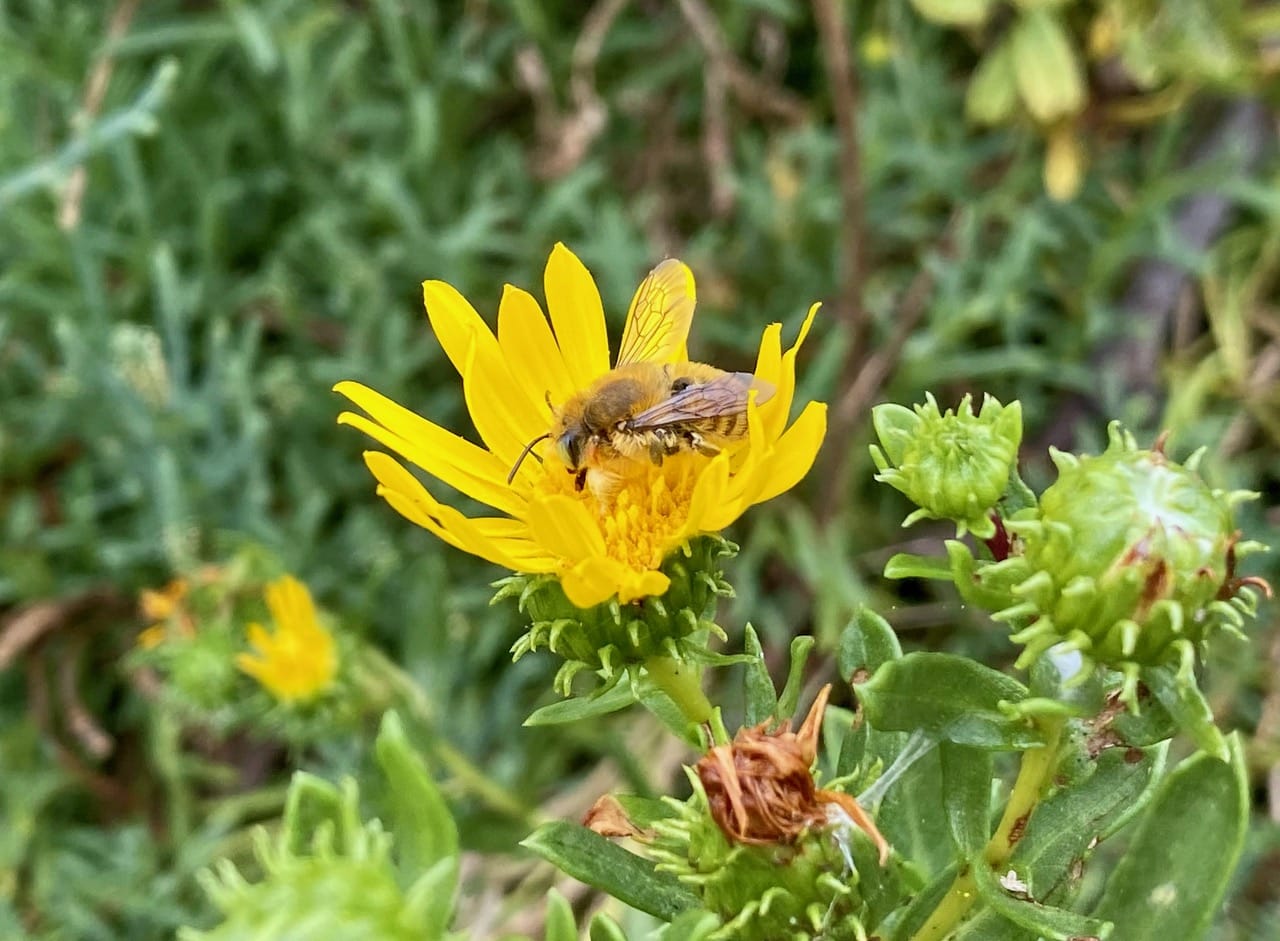
You can see the modified front legs of this male Western Leafcutter Bee foraging on a Grindelia flowerhead.
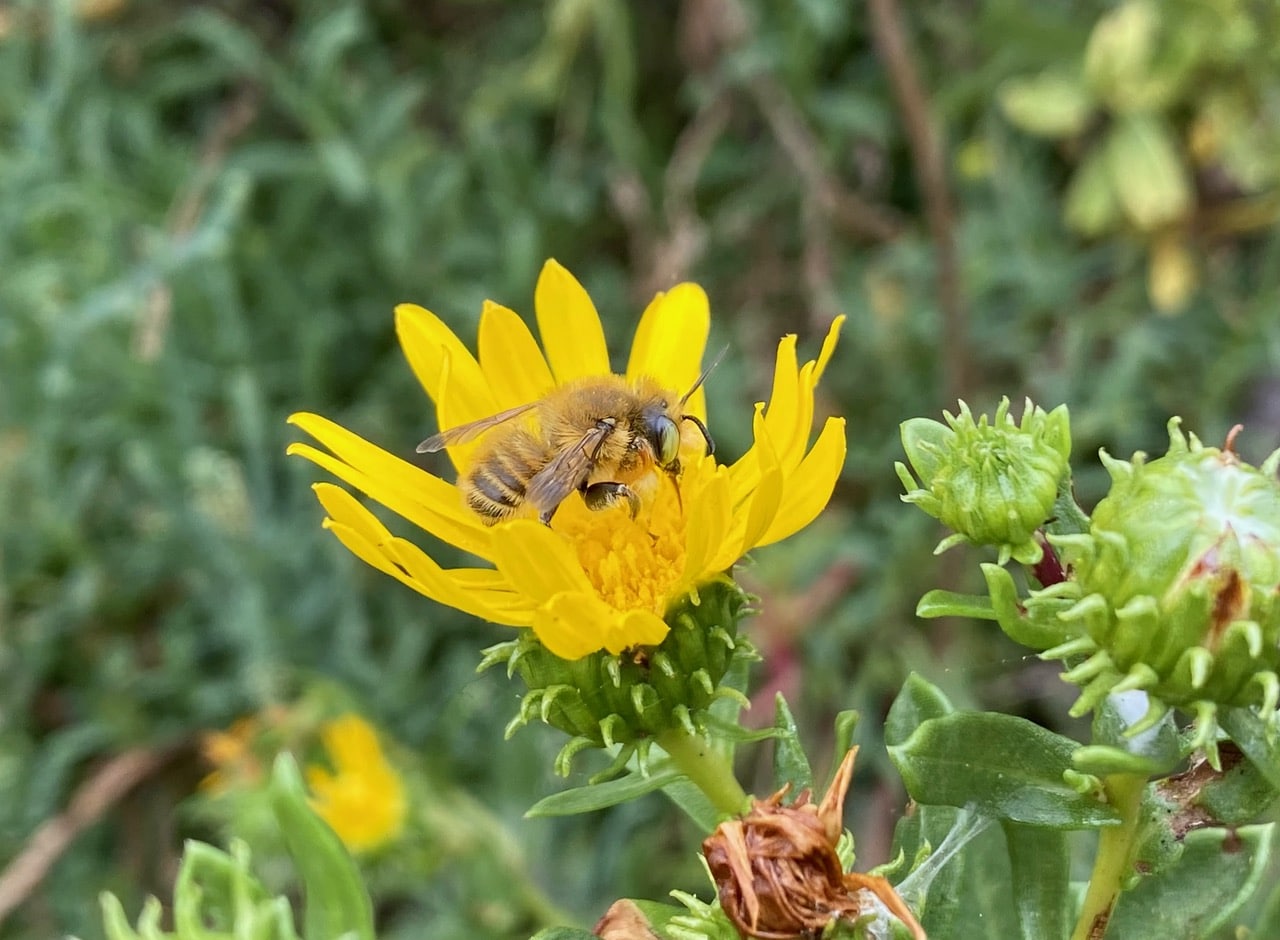
Like other male bees, the male Leafcutter Bee does not collect pollen. However, he does visit flowers for nectar. His dense fur coat helps attract pollen, and often contributes to pollination.
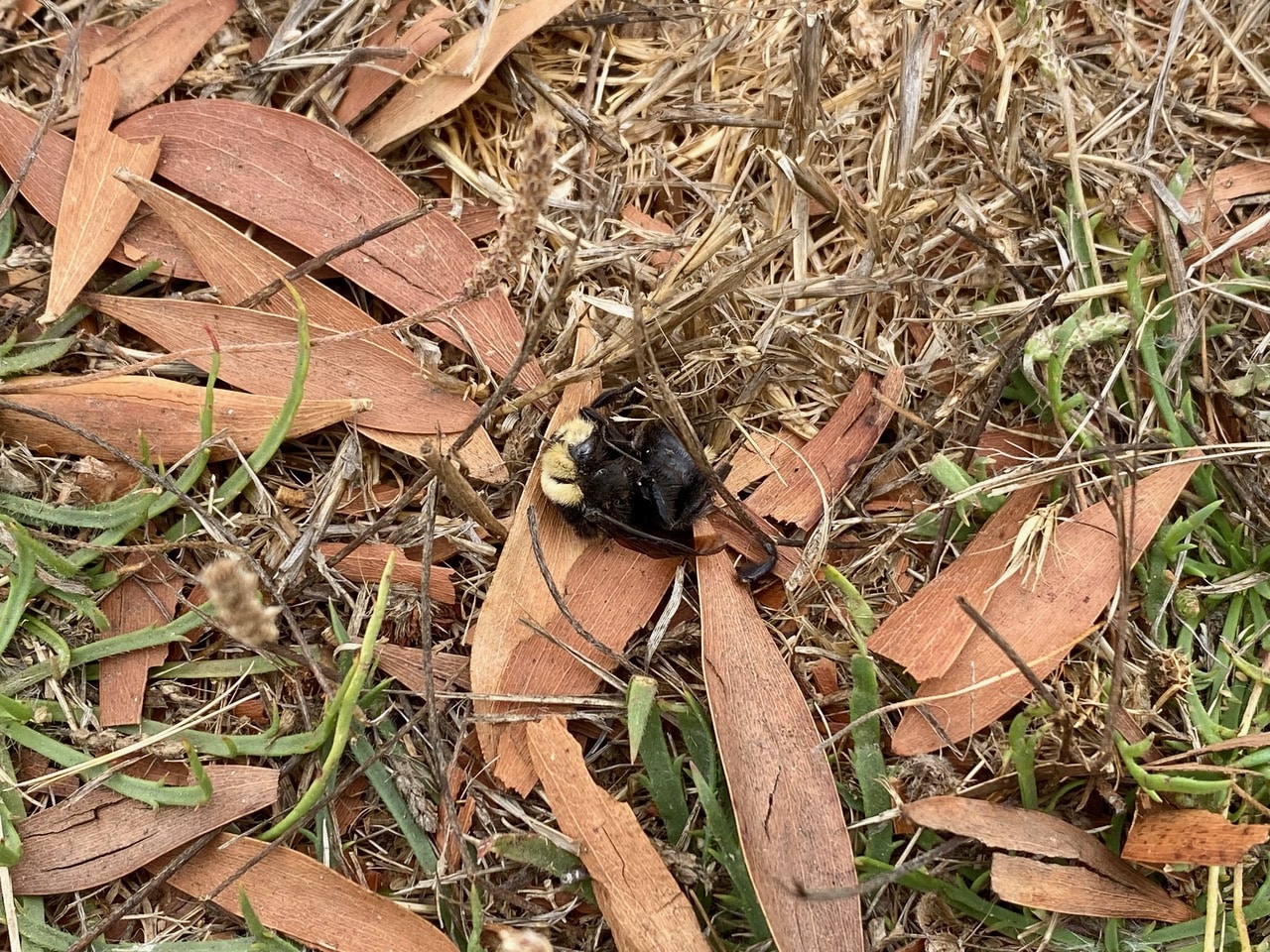
Uh-oh, there’s a dead bumble bee in the leaf litter at the edge of the lawn! By its large size, it appears to be a fresh queen produced this year. Seeing dead queen bumble bees always saddens me, as each represents the potential of a colony.
Queens are noticeably larger than worker bees, which is one of the easiest ways to distinguish them. Queen bees are fed a more substantial diet during their larval development, contributing to their larger size. The queen’s large size is crucial for her to store enough nutrients to lay a large number of eggs throughout the colony’s lifespan.
Bumble bees are social and live in colonial hives. Many of the large individuals seen early in the season are queens. They are the only members of their colony to survive the winter, hibernating until the days begin to warm and their host plants are in bloom. These queens have mated before they went into hibernation. Now their first order of business is to each find a nesting site (usually an abandoned rodent burrow), lay eggs, brood and nurture the first batch of workers. Henceforth, the queens stay behind in the hive to concentrate on laying eggs while the workers take on hive duties and foraging. At the end of the season, usually in late summer, the colony produces gynes (new queens) and drones (males). These mate with others from neighboring colonies. The mated queens go off to find a safe place to hibernate through the winter, while the rest of the colony, including the old queen dies. And so the cycle is repeated.
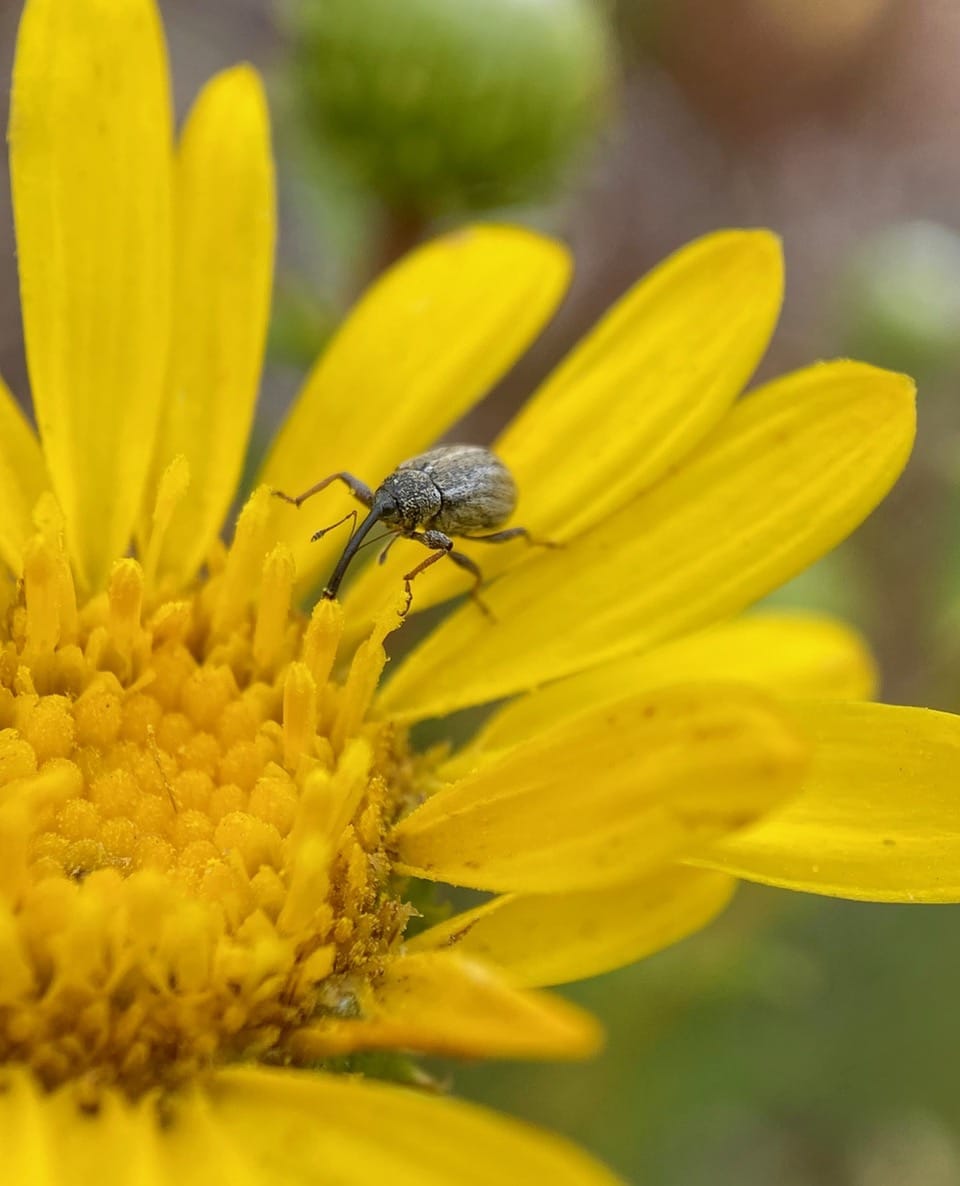
A Weevil (family Curculionidae) is exploring a flowerhead of Grindelia flowerhead. Note its long snout and the attached, elbowed antennae.
Weevils, family Curculionidae, are also called snout beetles. Curculionidae is one of the largest beetle families (about 40,000 species). Most weevils have long, distinctly elbowed antennae that may fold into special grooves on the snout. The snout is used not only for penetration and feeding but also for boring holes in which to lay eggs. The mouthparts are quite small and located at the end of the rostrum (snout), designed for chewing. Many weevils have no wings, while others are excellent fliers. Most are less than 6 mm in length. The majority of weevils feed exclusively on plants. The fleshy, legless larvae of most species feed only on a certain part of a plant – i.e., the flower head, seeds, fleshy fruits, stems, or roots. Many larvae feed either on a single plant species or on closely related ones. Adult weevils tend to be less specialized in their feeding habits. The family includes some very destructive agricultural pests.
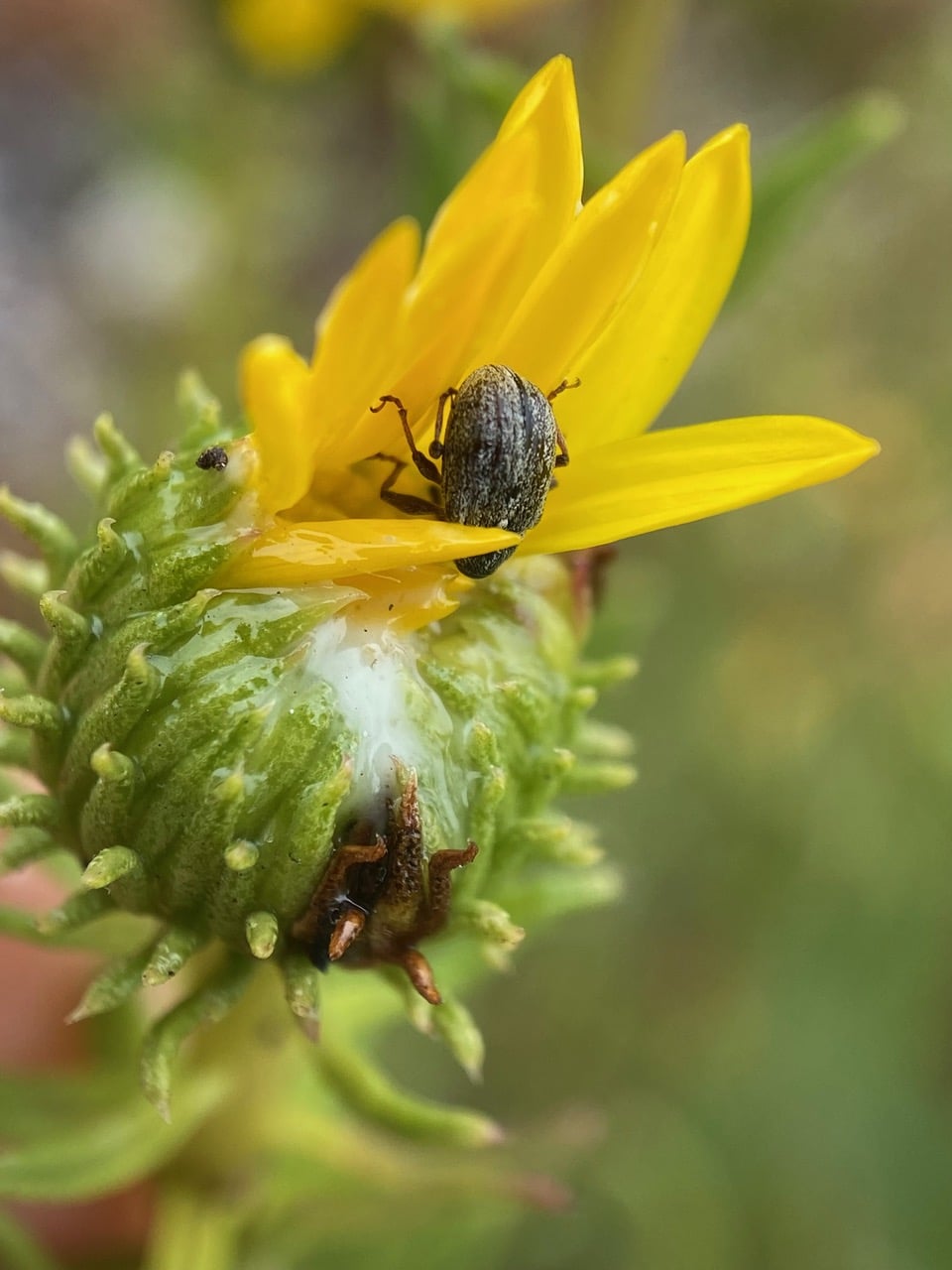
Here’s a similar Weevil feeding on a newly opened Grindelia flowerhead on the same plant.
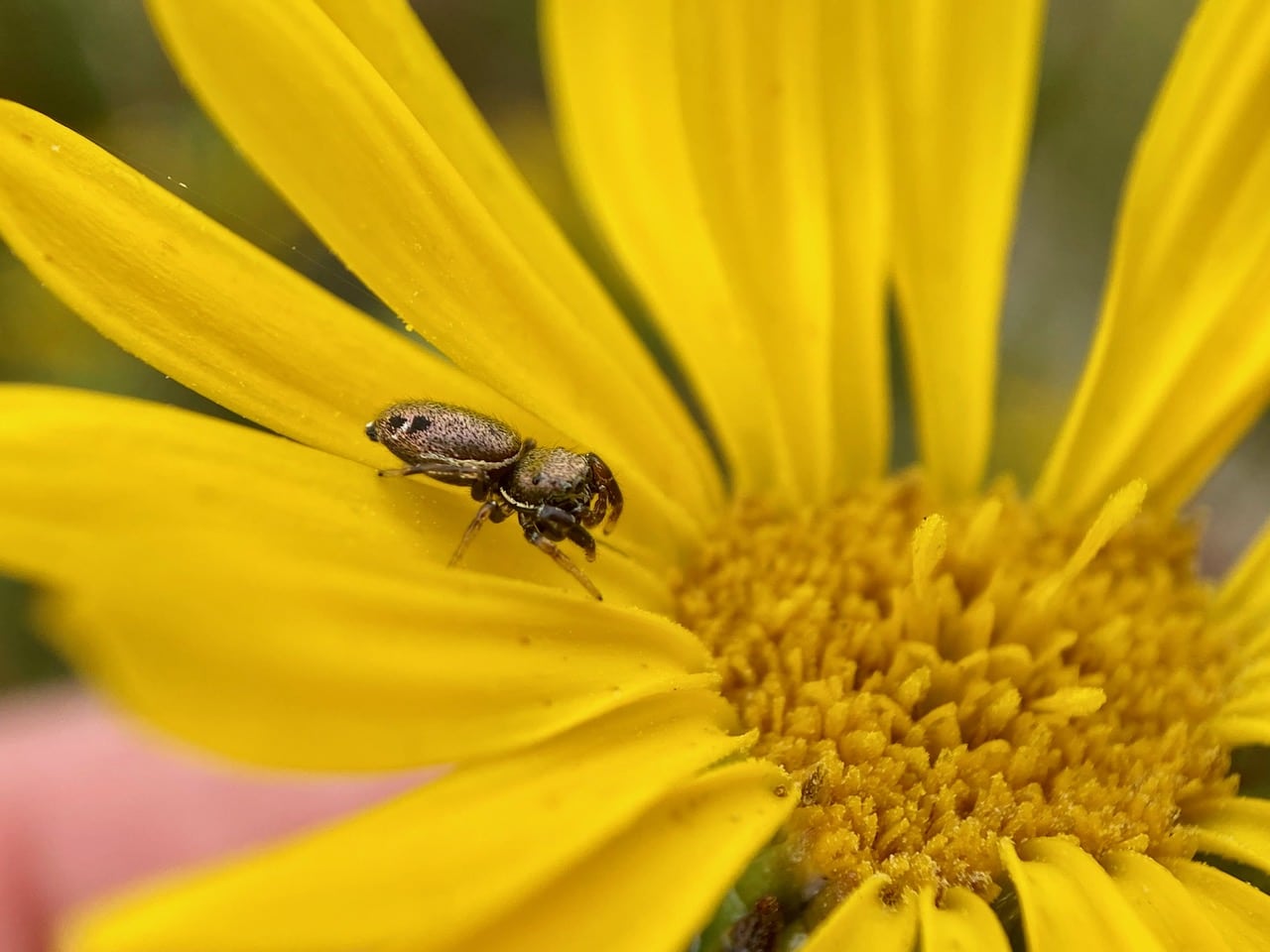
Usually a brilliant glint of gold, this little Jumping spider is a lackluster on this cloudy day. It is a Buttonhook Leafbeetle Jumping Spider, Sassacus vitis (family Salticidae).
Jumping spiders (family Salticidae) are free-roaming hunting spiders. They do not weave a web to catch prey. They stalk, then pounce on their prey. Just before jumping, the spider fastens a safety line to the substrate. It can leap 10-20 times their body length to capture prey. Their movement is achieved by rapid changes in hydraulic pressure of the blood. Muscular contractions force fluids into the hind legs, which cause them to extend extremely quickly. Jumping spiders are visual hunters. Their excellent vision has among the highest acuities in invertebrates. Since all their 8 eyes are fixed in place and cannot pivot independently from the body like human eyes can, jumping spiders must turn to face whatever they want to see well. This includes moving their cephalothorax up and down, an endearing behavior.
It is often difficult to tell whether a particular spider is an adult or an immature, judging by size alone. In the jumping spiders in the genus Sassacus, the adults are only about 3-5 mm. The genus name Sassacus was the last chief of the Pequot Indians, a Native American tribe of the Connecticut Valley that was vanquished in a war with English settlers in 1637. The iridescent color and very compact appearance of these spiders leads scientists to suspect that they are mimics of certain leaf beetles in the family Chrysomelidae. Many Chrysomelids don’t taste good, as they feed on poisonous plants and sequester those plant toxins for their own defense. They advertise their distastefulness to predators with bold black and white, yellow, orange, or red color patterns, or with brilliant metallic colors. One of the defining characteristics of the genus is the very short legs. The fourth pair of legs is still the thickest, with one or two pairs of spines, used in tackling prey. Like most jumping spiders, Sassacus engages in visual courtship displays. The twitching abdomen also produces an auditory stimulus as the male waves his front legs to garner the female’s attention.
Sassacus vitis is native to North America, with a range spanning from Canada to Panama. It is a small jumping spider with iridescent gold abdomen and white ring around the anterior surface of abdomen. Body is covered with golden scales. Males are 3.5 mm long, females 4.5 mm. The name vitis is Latin for “grapevine”. The spider is commonly found on shrubs and vines and in fields. Best known as a common resident of vineyards.

A small stout bee with pale milky blue eyes and black-and-white banded abdomen is foraging on a Grindelia flowerhead. It is a Short Sun-digger Bee, Anthophora curta (subgenus Micranthophora, family Apidae).
The species is native to North America, and is known to prefer dry, desert-like habitats. Ironically, Grindelia stricta grows in moist habitats at water’s edge.
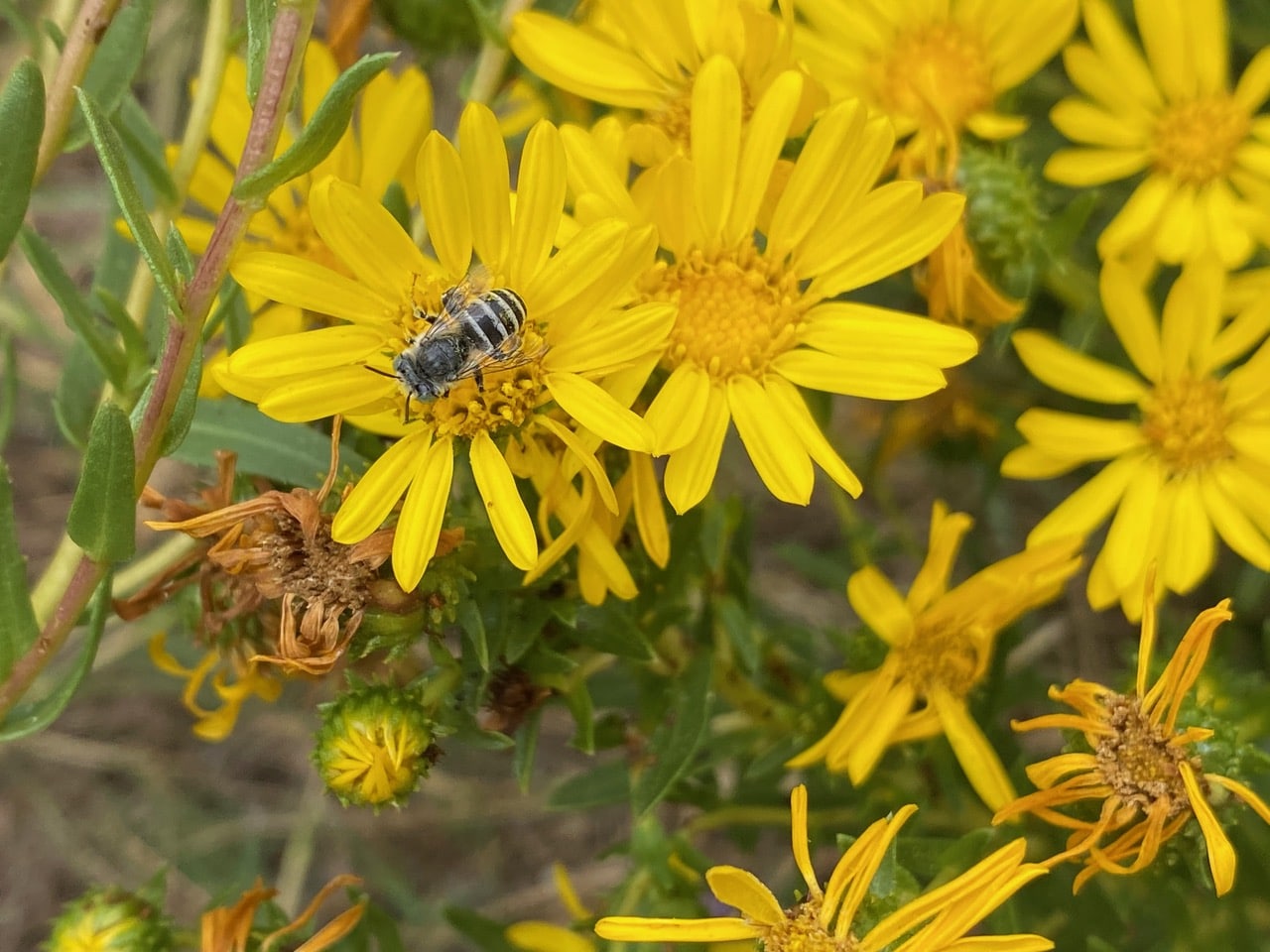
Members of the subgenus Micranthophora are smaller than other New World Anthophora. Females have yellow markings on the face.

The bee genus Anthophora, commonly known as Digger Bees, is one of the largest in the family Apidae. All species are solitary, though many nest in large aggregations. Nearly all species construct nests in the soil, either in banks or in flat ground; the larvae develop in cells with waterproof linings and do not spin cocoons. Males commonly have pale white or yellow facial markings, and/or peculiarly modified leg armature and hairs. Members of the subgenus Micranthophora are much smaller in size than the common Anthophora species. A. Curta is only about a third the size of the A. pacifica I am used to seeing in early spring. The general appearance and behavior (frenetic) are, however, similar.
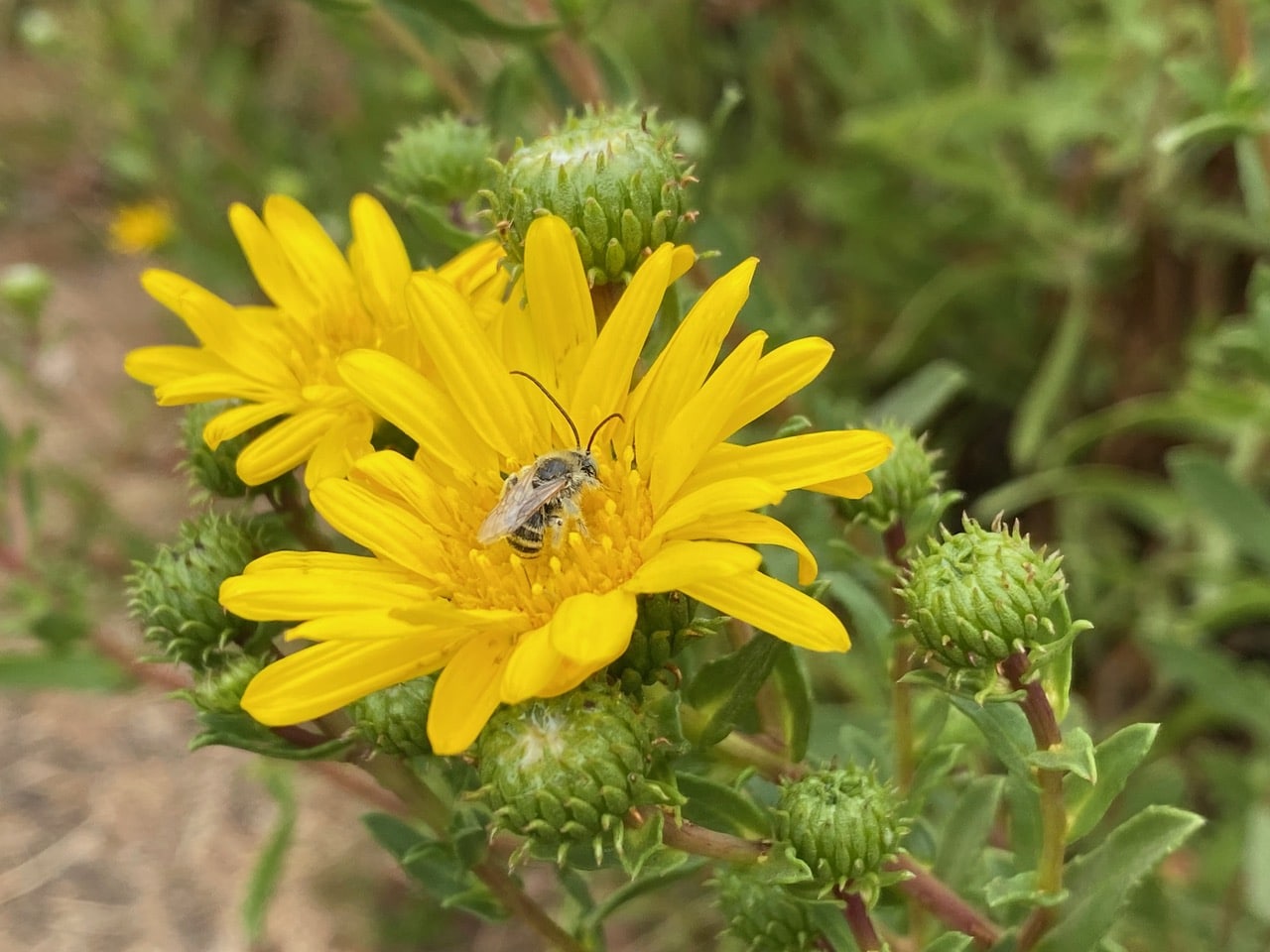
The Summer Longhorn Bees, Melissodes sp. (family Apidae) are the predominant bees around here right now, but they are difficult to photograph, being rather active and wary. I am glad I finally get a picture of this male. I have yet to see a female out foraging.
The Summer Longhorn Bees, Melissodes sp. (family Apidae) are medium to large bees, stout-bodied, usually with gray hair on the thorax and pale hair bands on the abdomen. Males usually have yellow markings on their faces and have very long antennae from which their common name is derived. They are active May to September, with peak flight in late June to early August. The females prefer flat, bare ground for digging their solitary nests, though they sometimes nest in aggregations. Pollen is transported in scopae on the hind legs. Pollen loads are often copious and brightly colored and thus very distinguishable. Melissodes are specialists on Asteraceae – females gather pollen from flowers of Aster, Bidens, Coreopsis, Cosmos, Encelia, Gaillardia, Helianthus, and Rudbeckia ssp.

A female Fine Striped Sweat Bee, Agapostemon subtilior (family Halictidae) is foraging on a Grindelia flowerhead.
Agapostemon females dig deep vertical burrows in flat or sloping soil, or sometimes in banks. Most species are solitary, but some species nest communally. Up to two dozen females may share a single nest entrance, but each individual builds and provisions its own cluster of brood cells. Where a communal nest gallery shares a single entrance, one bee usually guards the hole, with only her head visible from above ground. Unlike other social bees, in communal bees there is no reproductive division of labor. In cool temperate regions, there is one generation per year, with females active in the early summer and males and pre-diapausing females active in the late summer. Only mated females survive the winter. This is probably because unmated females cannot enter diapause (insect version of hibernation).