

Pollinator Post 8/15/23
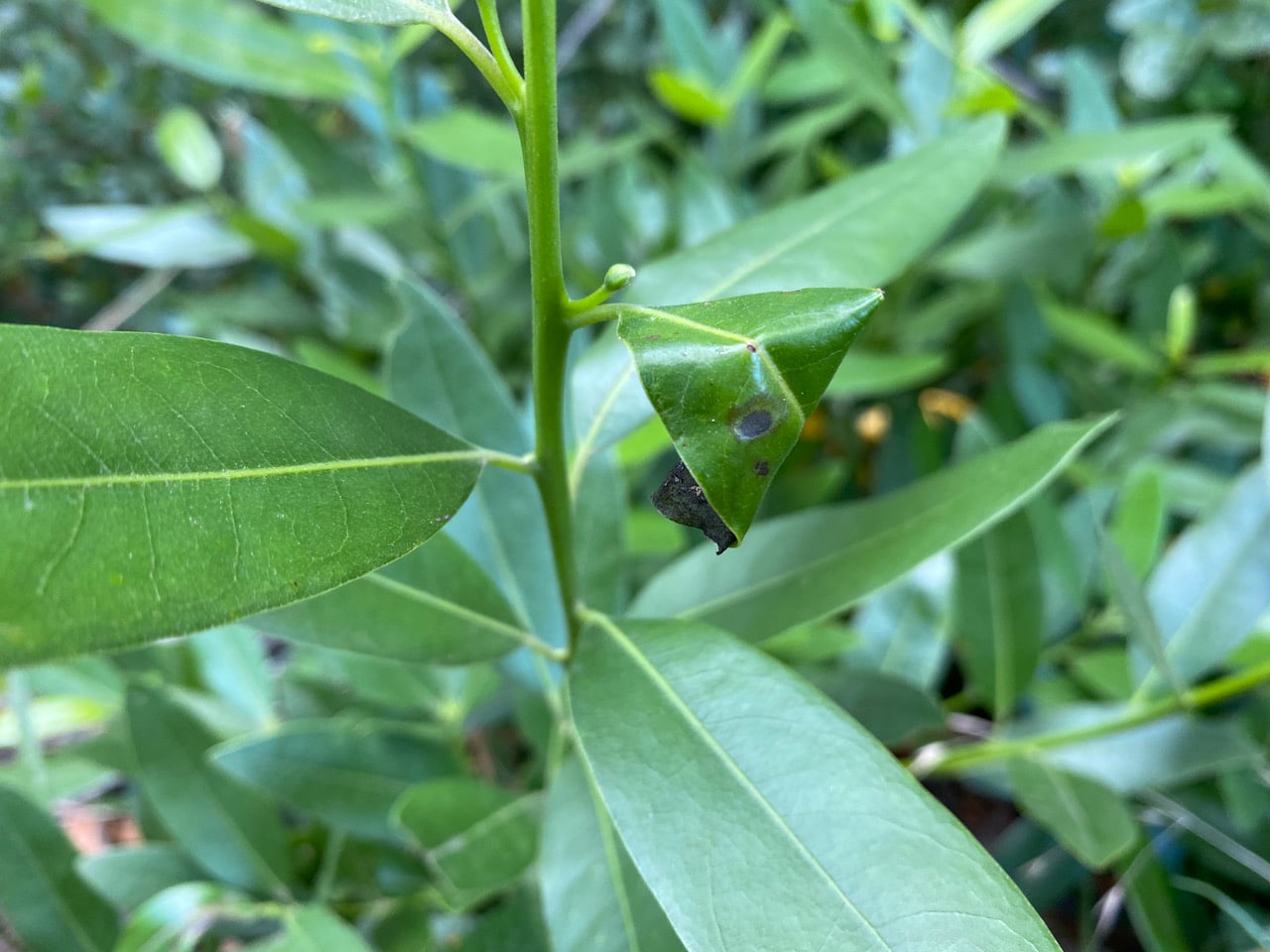
I scan the Bay Trees, Umbellularia californica along Skyline Trail for the 3-sided folded leaves. Here’s an older one, part of it already turning black. I wonder if the caterpillar is still in there? Carefully unwrapping the mystery box, I find only traces of silk and frass (insect poop) inside.
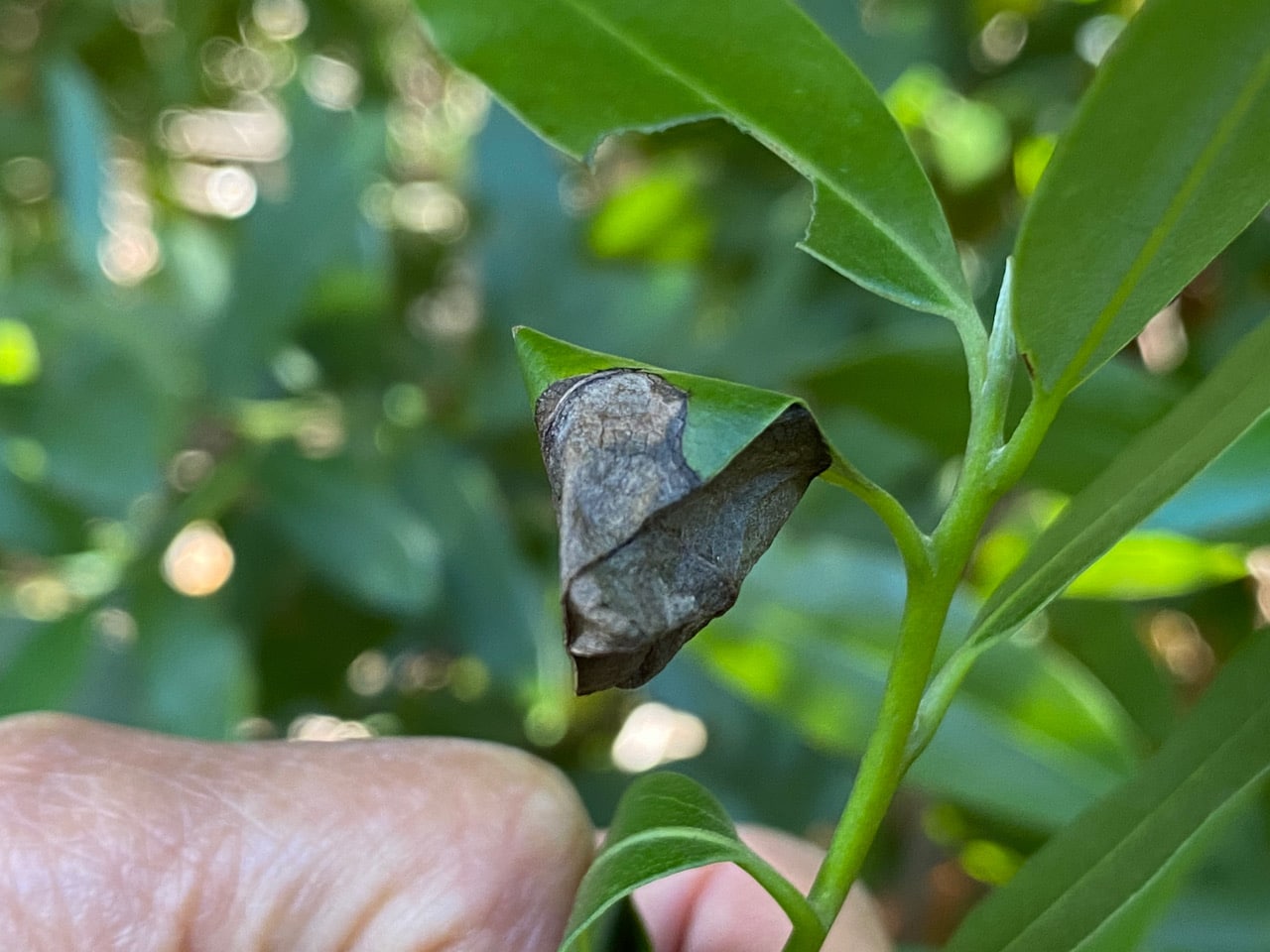
Here’s an even older one. As I have now come to expect, there is no caterpillar inside, just silk and frass. Is the leaf turning black due to caterpillar feeding? Has the caterpillar left to pupate elsewhere?

Ooh, there are two fresh folded leaves, side by side on this branch!
 A tiny Soft-winged Flower Beetle (family Melyridae) is foraging among the flowers of Naked Buckwheat.






Yet another one close by on the same tree. I don’t have the heart to tear these open in case the caterpillar is still inside. But I marked them with pieces of red yarn so I can check on them occasionally.
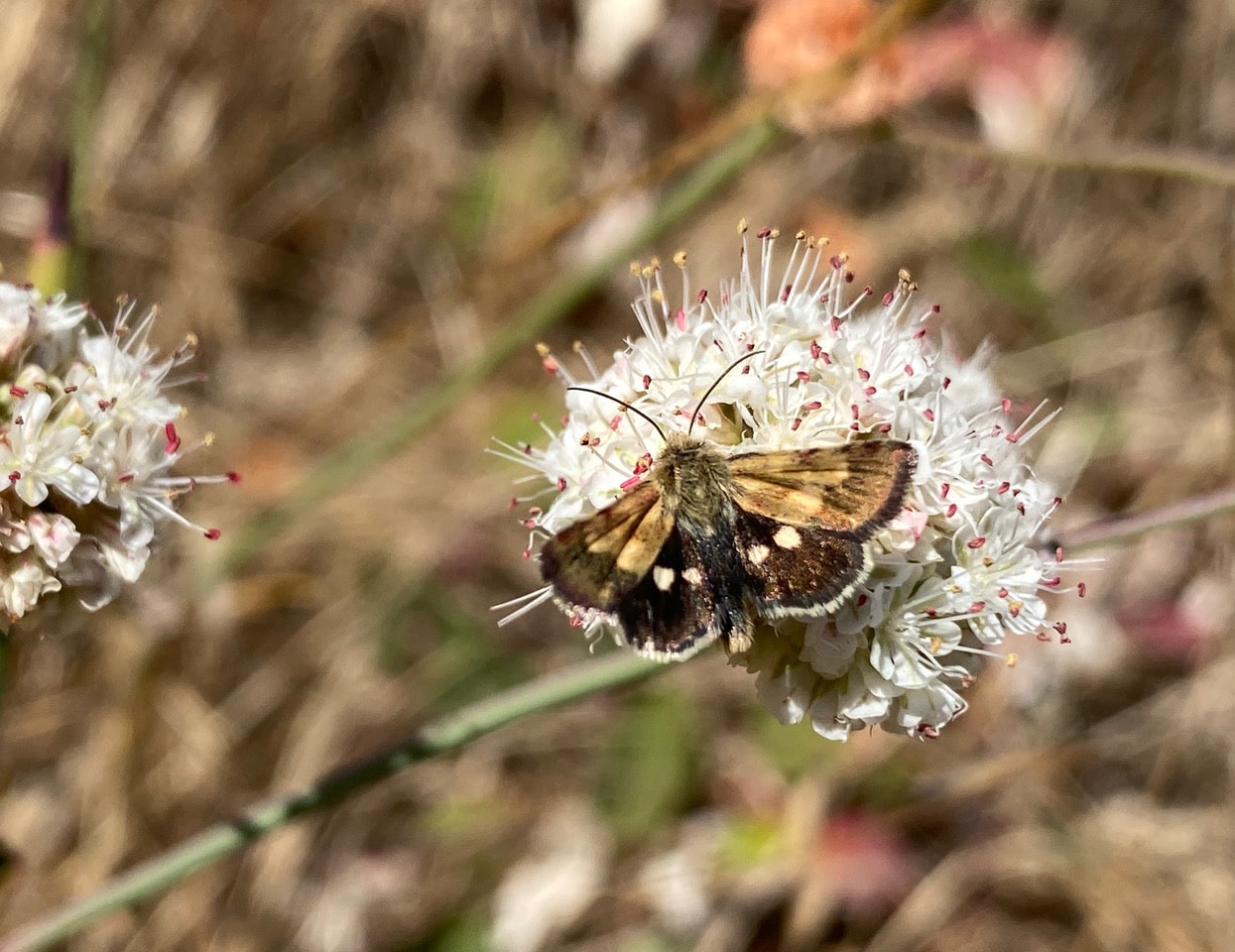
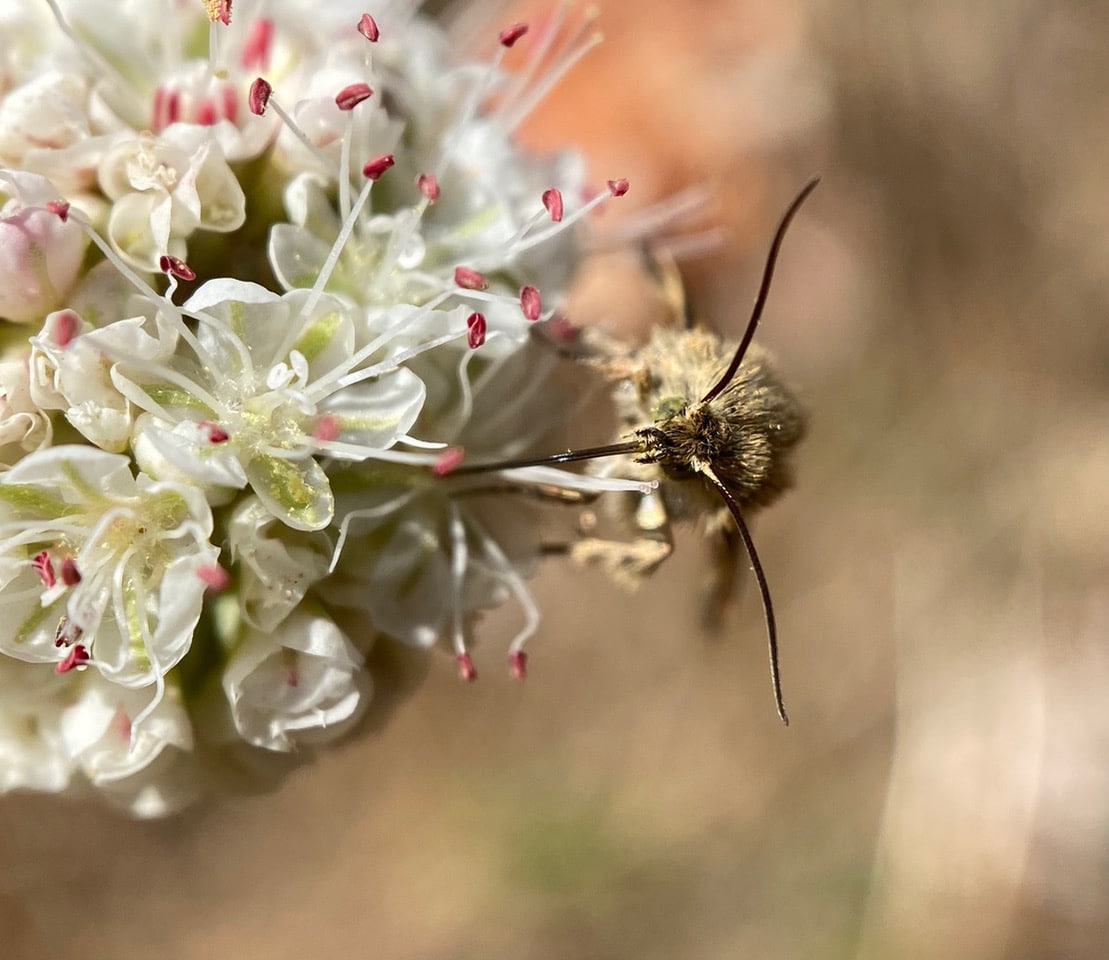
I am rather surprised to find this moth on the flowers of Naked Buckwheat, Eriogonum nudum. The larvae of the Small Owlet Moth, Heliothodes diminutiva (family Noctuidae) are specialists on Asteraceae flowers, most commonly seen on tarweeds at Skyline Gardens. The adults are diurnal and tend to hang around the larval host plants, taking nectar and laying eggs. The species is found in western US from California, through Oregon to Washington.
View of the Owlet Moth head-on, showing its extended proboscis. Note that the proboscis, as in all Lepidoptera, is a double tube. Two separate tubes are “zipped” together at eclosure to form a single tube for feeding.
A tubular sucking organ, the proboscis enables a butterfly/moth to extract sweet nectar from flowers, regardless of the shape of the blossom. When not in use, the proboscis is rolled up out of the way. Unlike caterpillars, adult butterflies/moths do not have any chewing mouthparts, and therefore must obtain their nutrition from sipping liquids. Hydrostatic pressure extends the curled proboscis which is inserted deep into the tubes of flowers. At emergence from the chrysalis, the proboscis initially consists of two parts that appear like a forked tongue. Almost immediately the two tubes are “zipped” together to form the single tube.
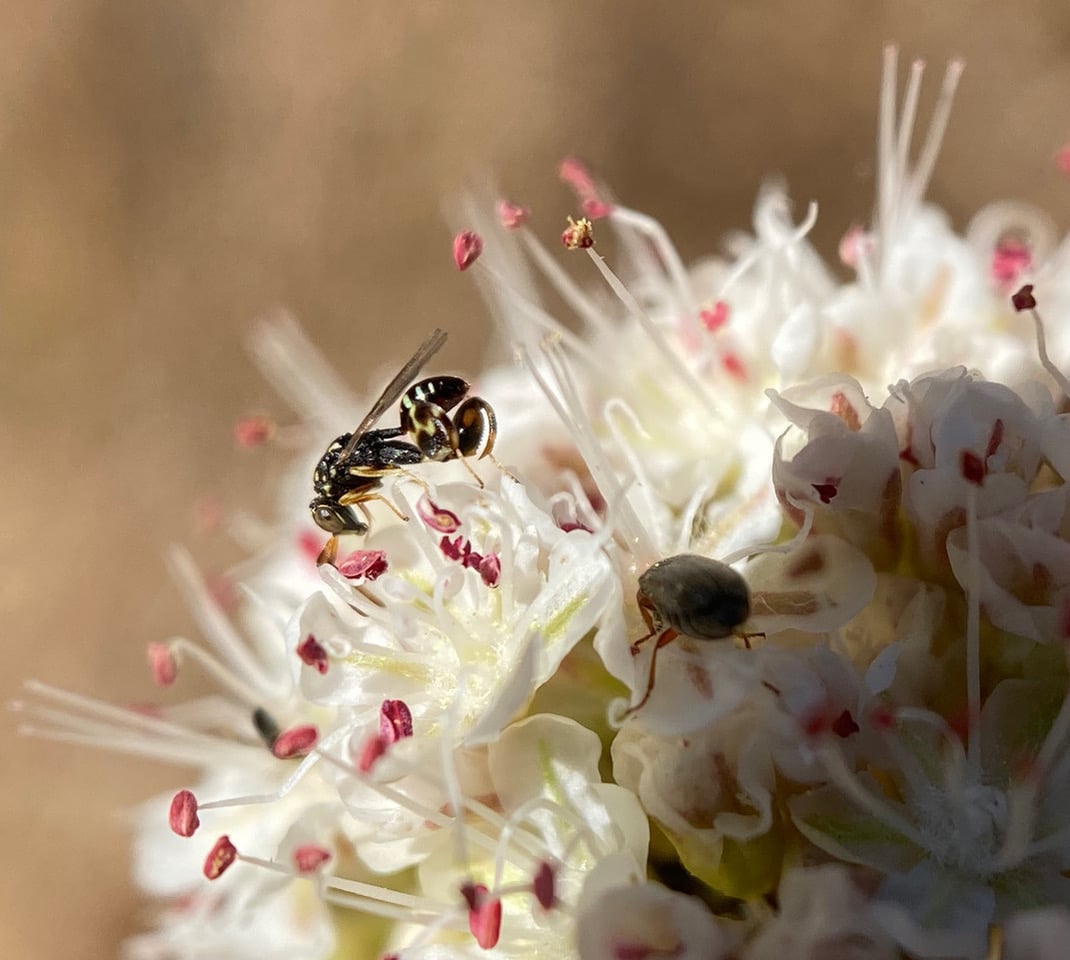
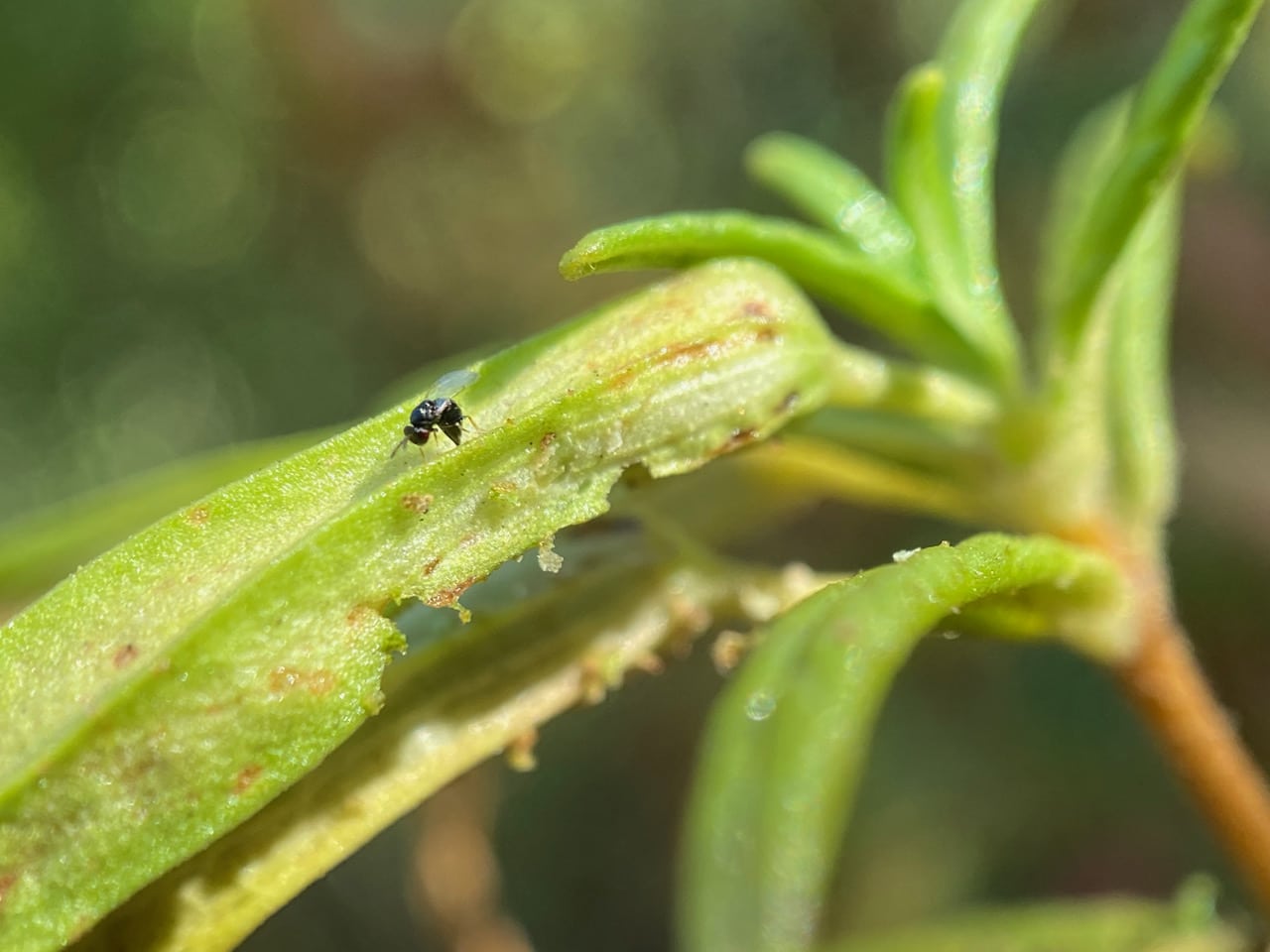
Whoa, who is this bizarre looking wasp, barely 2 mm long, with greatly enlarged, spotted hind femora? It is a Chalcidid Wasp, Conura sp. (family Chalcididae).
The Chalcididae are a moderate-sized family within the superfamily Chalcidoidea, composed mostly of parasitoids and a few hyperparasitoids. They are often black with yellow, red, or white markings, with a robust mesosoma and strong sculpturing. The hind femora are often greatly enlarged, with a row of teeth or serrations along the lower margin. The Chalcidids are parasitoids of Lepidoptera (butterflies and moths), Diptera (flies), and Coleoptera (beetles), and some are hyperparasitoids that attack Tachinids or Ichneumonids.
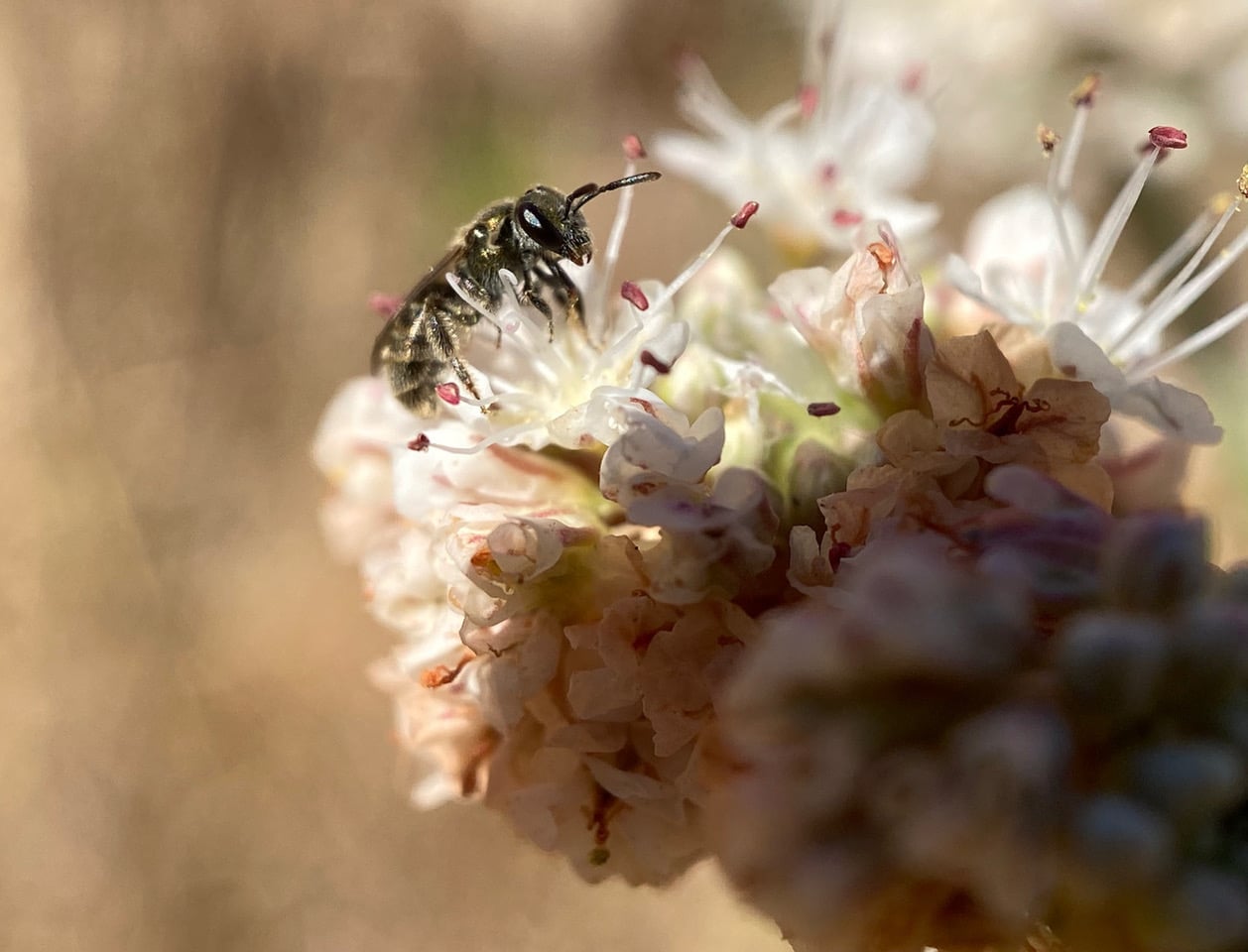
A metallic Sweat Bee, Lasioglossum (Dialictus) sp. (family Halictidae) is foraging on the flowers of Naked Buckwheat.
Lasioglossum species are found worldwide, and they constitute the largest bee genus. The subgenus Dialictus are the most likely to be seen in the U.S., with over 300 species of these tiny metallic bees. The majority of Lasioglossum are generalists. Because they are so abundant throughout the flowering season, the bees are often important pollinators. Their sheer numbers are enough to achieve excellent pollination of many wild flowers, especially those with shallow floral tubes that are easily accessed by these minute bees.
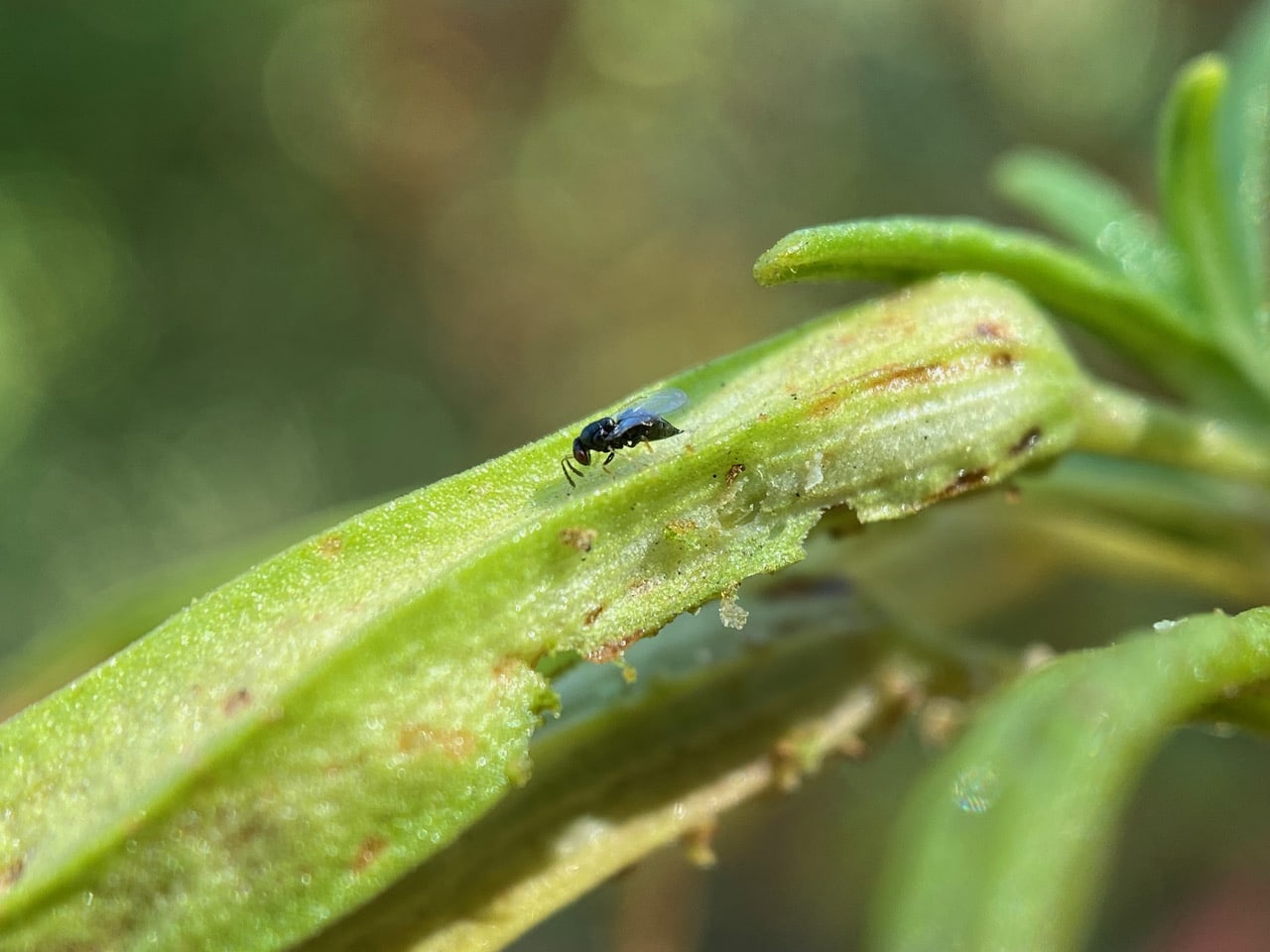
A tiny Soft-winged Flower Beetle (family Melyridae) is foraging among the flowers of Naked Buckwheat. Most species of Melyridae are various shades of brown or black and just 2 to 4 mm in length. Omnivorous adult Melyrids are often found on flowers out in the open, where they eat pollen, insect eggs, and flower-loving insects that land within their grasp. The larvae generally stay concealed under tree bark or leaf litter or soil, where they prey on other invertebrates.
Her antennae lowered to tap on the calyx of a Sticky Monkeyflower, a tiny wasp is totally focused on her pursuit. Is she seeking a good spot to lay her eggs? She is a parasitoid wasp in the superfamily Chalcidoidea, probably family Pteromalidae.
Most Chalcidoid species are parasitoids of other insects, attacking the eggs or larval stage of their host, though many other life cycles are known. These hosts are to be found in at least 12 different insect orders including Lepidoptera (butterflies and moths), Diptera (true flies), Coleoptera (beetles), Hemiptera (true bugs), and other Hymenoptera, as well as two orders of Arachnida. When the host is itself a parasitoid, the wasps are referred to as hyperparasitoids. Generally beneficial to humans as a group, chalcidoids help keep various crop pests under control, and many species have been used as biocontrol agents.
As I have expected, the wasp lowers her abdomen to lay eggs in the calyx. The calyces of Sticky Monkeyflowers are often home to a slew of various insects – gall makers, inquilines, parasitoids and hyperparasitoids. The larvae of this little wasp are components of this invisible ecosystem.
A Black-backed Grass Skimmer, Paragus haemorrhous (family Syrphidae) lands on a piece of dried vegetation. It is probably the smallest hover fly we have a Skyline Gardens, measuring only about 4 mm in length. The species has a world-wide distribution, found in unimproved grassland, dune grass, open areas and pathsides in forest, and meadows. Adults visit flowers for nectar and pollen. Larvae feed on aphids on low herbaceous plants.
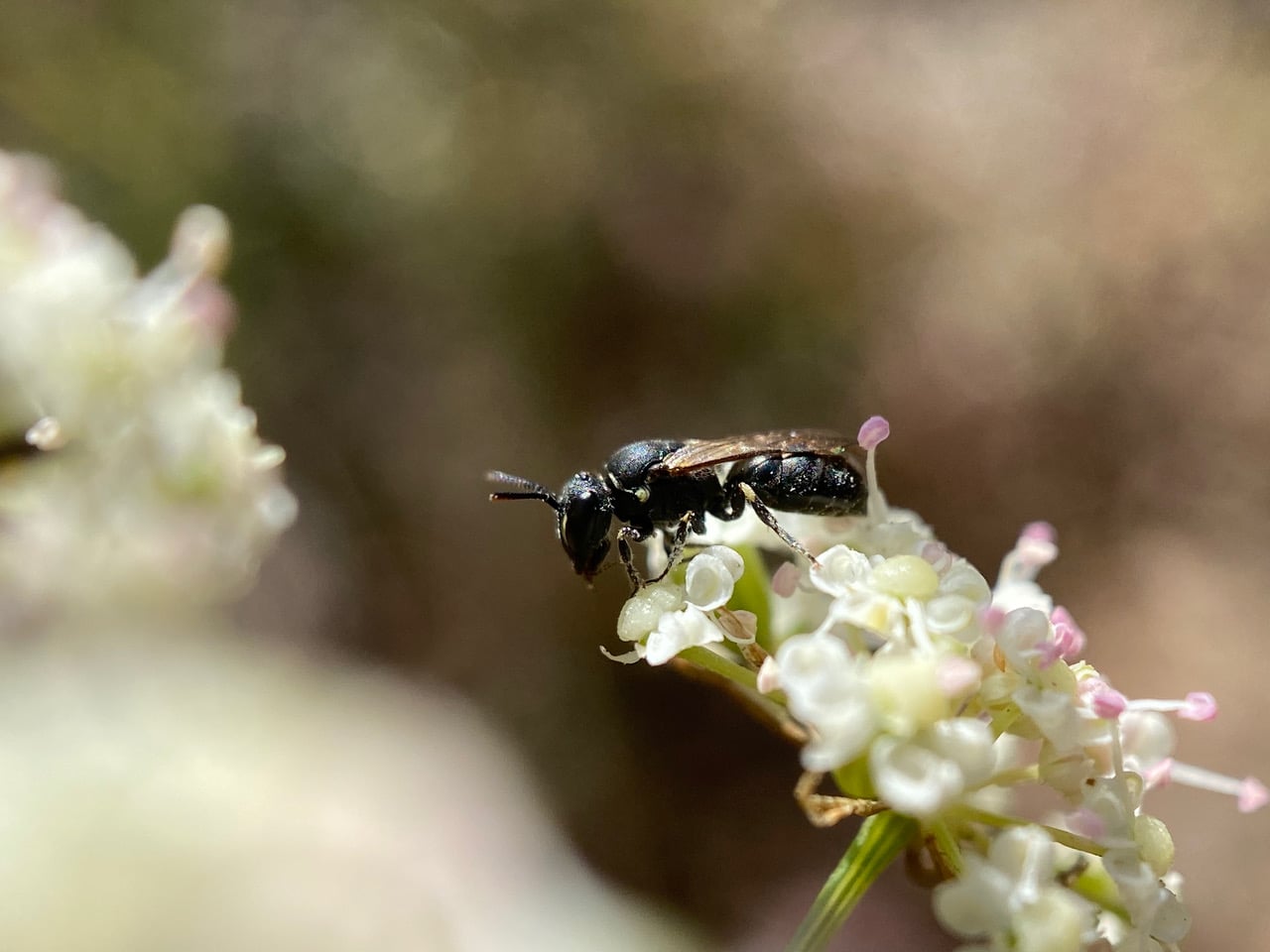
A Masked Bee, Hylaeus sp. (family Colletidae) forages on a floral umbel of Kellogg’s Yampah, Perideridia kelloggii. Without a front view of its face, it’s difficult to tell its gender, as neither the males nor females of this genus possess scopae on the hind legs. Instead of the external scopae, the females transport the pollen and nectar they have collected in a crop (part of the gut).
Hylaeus (family Colletidae) are shiny, slender, hairless, and superficially wasp-like bees. They are small, 5 to 7 mm long, usually black with bright yellow or white markings on their face and legs. These markings are more pronounced on the males. Hylaeus do not carry pollen and nectar externally, they instead store their food in the crop and regurgitate it upon returning to their nests. They are primarily generalist foragers. Hylaeus are short-tongued, but their small body size enables them to access deep flowers. Hylaeus nest in stems and twigs, lining their brood cells with self-secreted cellophane-like material. They lack strong mandibles and other adaptations for digging, using instead pre-existing cavities made by other insects.
The tiny flowers of Kellogg’s Yampah are well-suited for the Black-backed Grass Skimmer, Paragus haemorrhous (family Syrphidae).
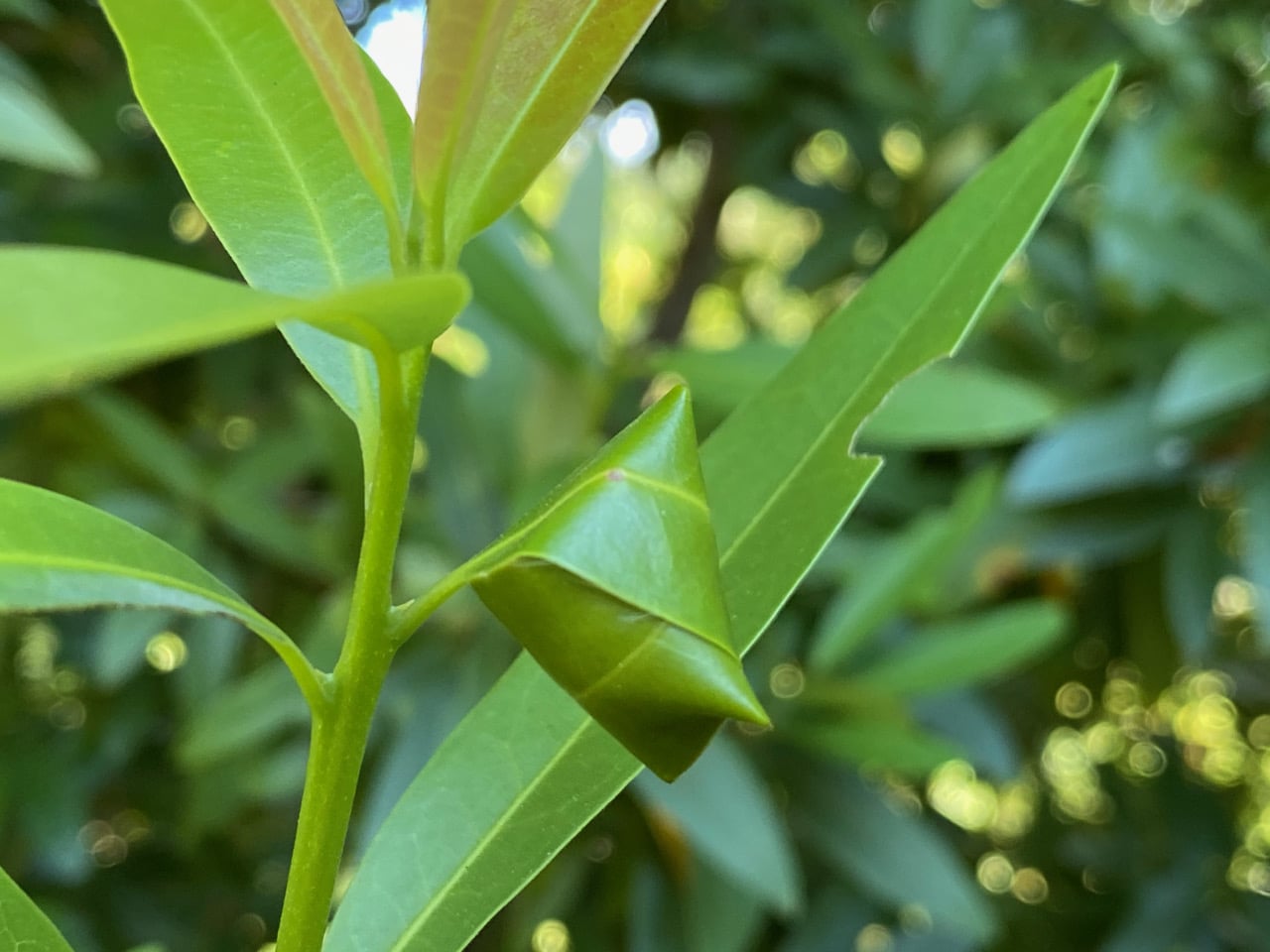
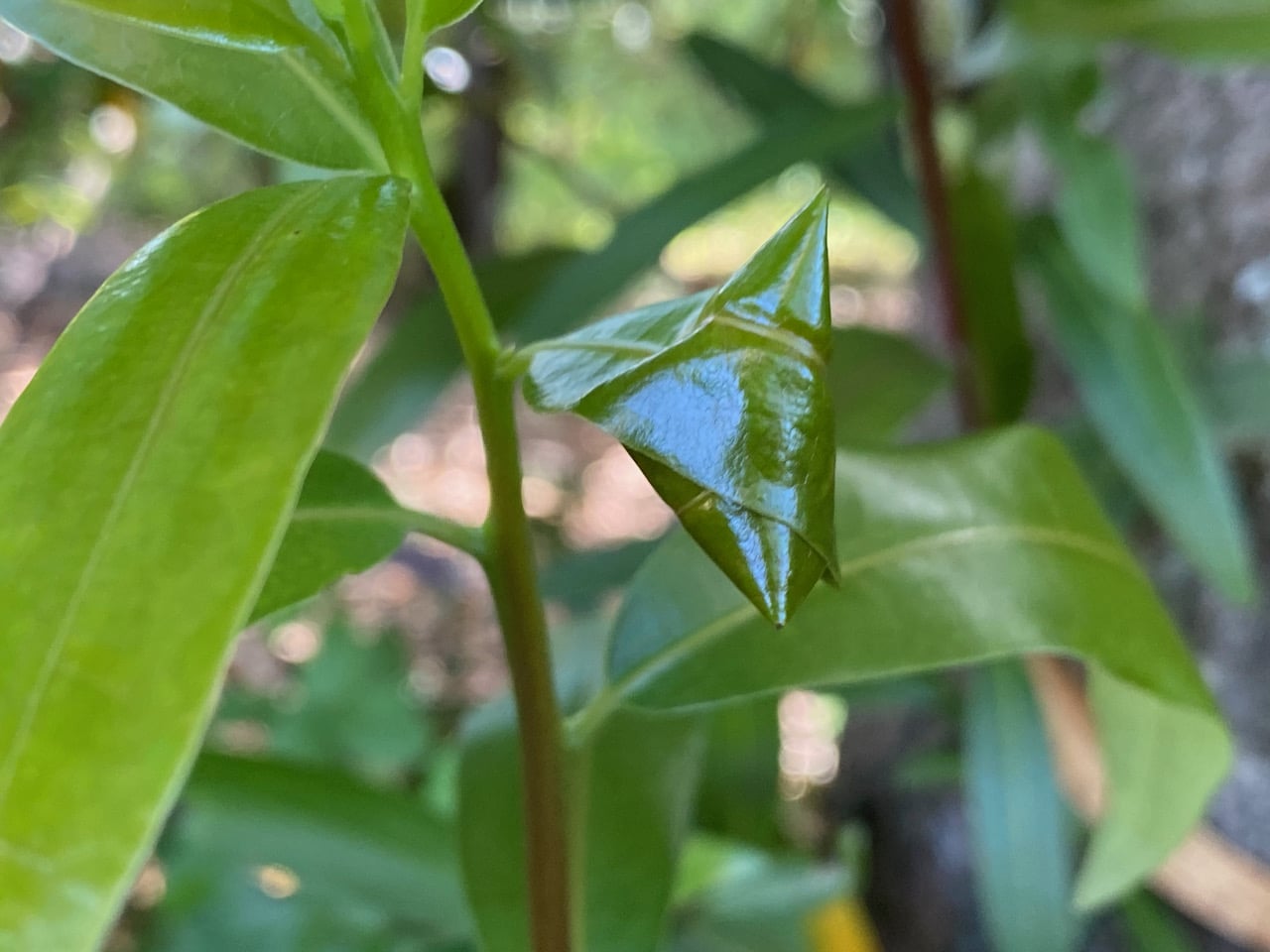
A shiny, young leaf of California Bay Tree, Umbellularia californica has been skillfully wrapped by a leafroller caterpillar, probably in the family Tortricidae, commonly known as tortrix moths or leafroller moths.
Many species of Tortricidae are economically important pests. The typical resting posture is with the wings folded back, producing a rather rounded profile. Tortricid moths are generally small, with a wingspan of 3 cm or less. Many species are drab and have mottled and marbled brown colors. Larvae of some species feed by boring into stems, roots, buds or seeds. Others feed externally and construct leaf rolls.
Leaf shelter-builders, either leaf-tiers or leaf-rollers, do not manipulate leaves directly but use their silk to draw plant surfaces together. The caterpillars impart potential energy to their silk strands by stretching them beyond their equilibrium length as they are spun out. Axial retraction of the stretched strands then draws the bound plant surfaces together. Although a single stretched strand exerts only a minuscule force, the combined force generated by many such strands attached to the same opposable plant surfaces is substantial and allows the caterpillars to manipulate leaves many times their size and mass.
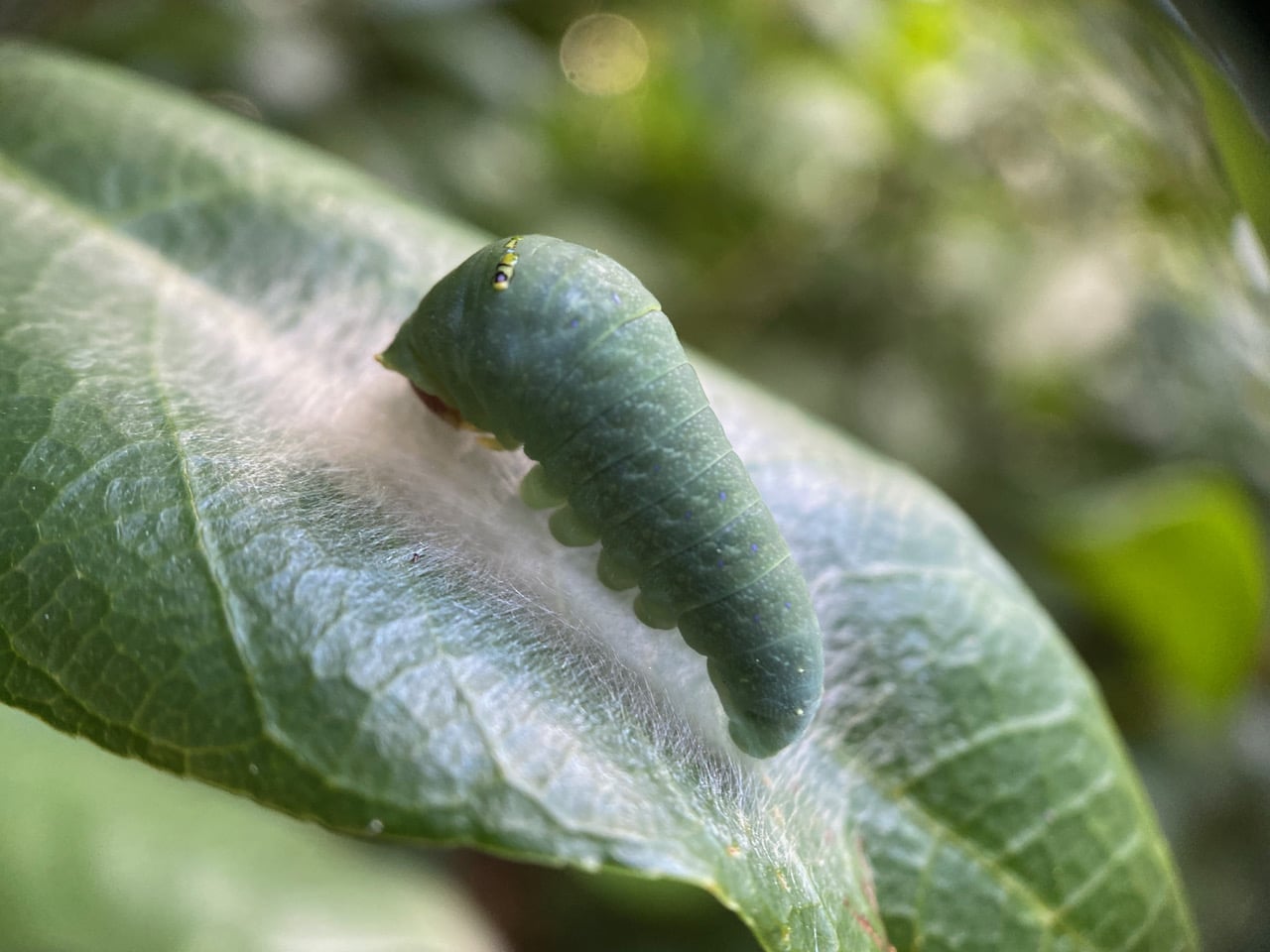
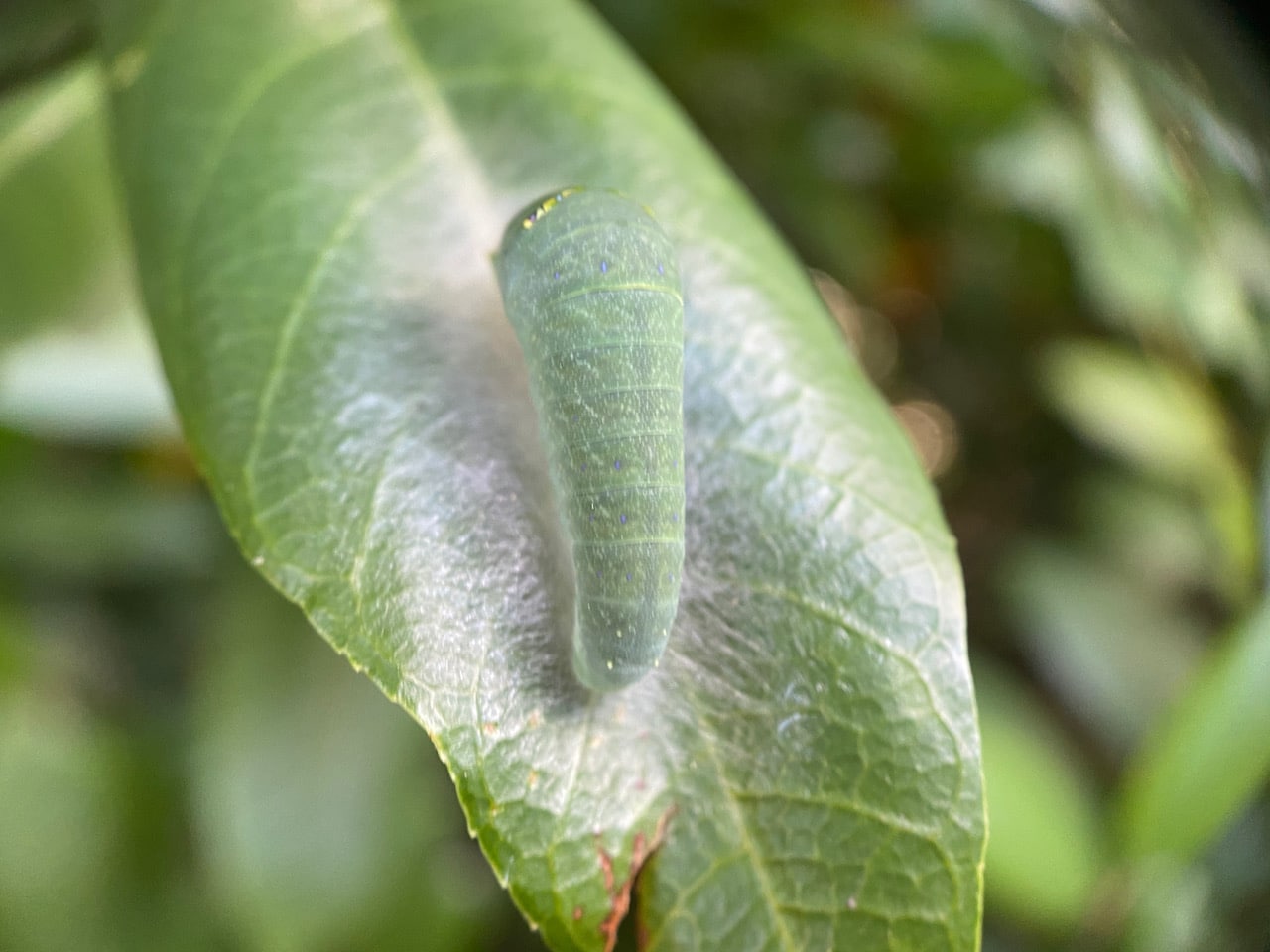
In its stillness, Blue, the Pale Swallowtail caterpillar resembles a Zen master in deep meditation. I have never seen a caterpillar that is so sedentary and calm. Surely Blue must have been feeding from time to time away from its Coffeeberry home leaf, since it seems to be growing bigger.
Hey, the white dot has disappeared from its back! Blue is changing slowly but surely. And it keeps its home leaf spotlessly clean!
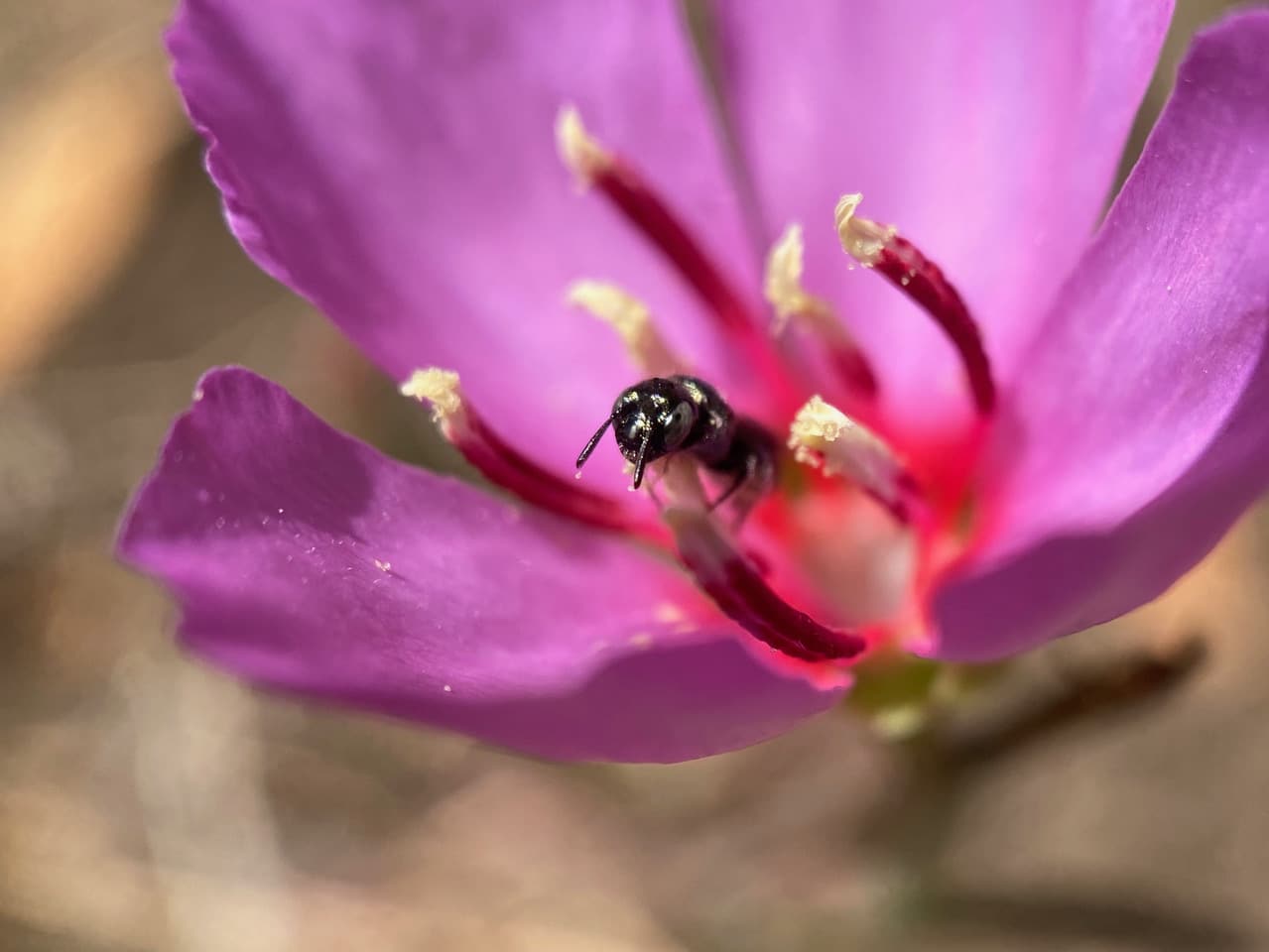
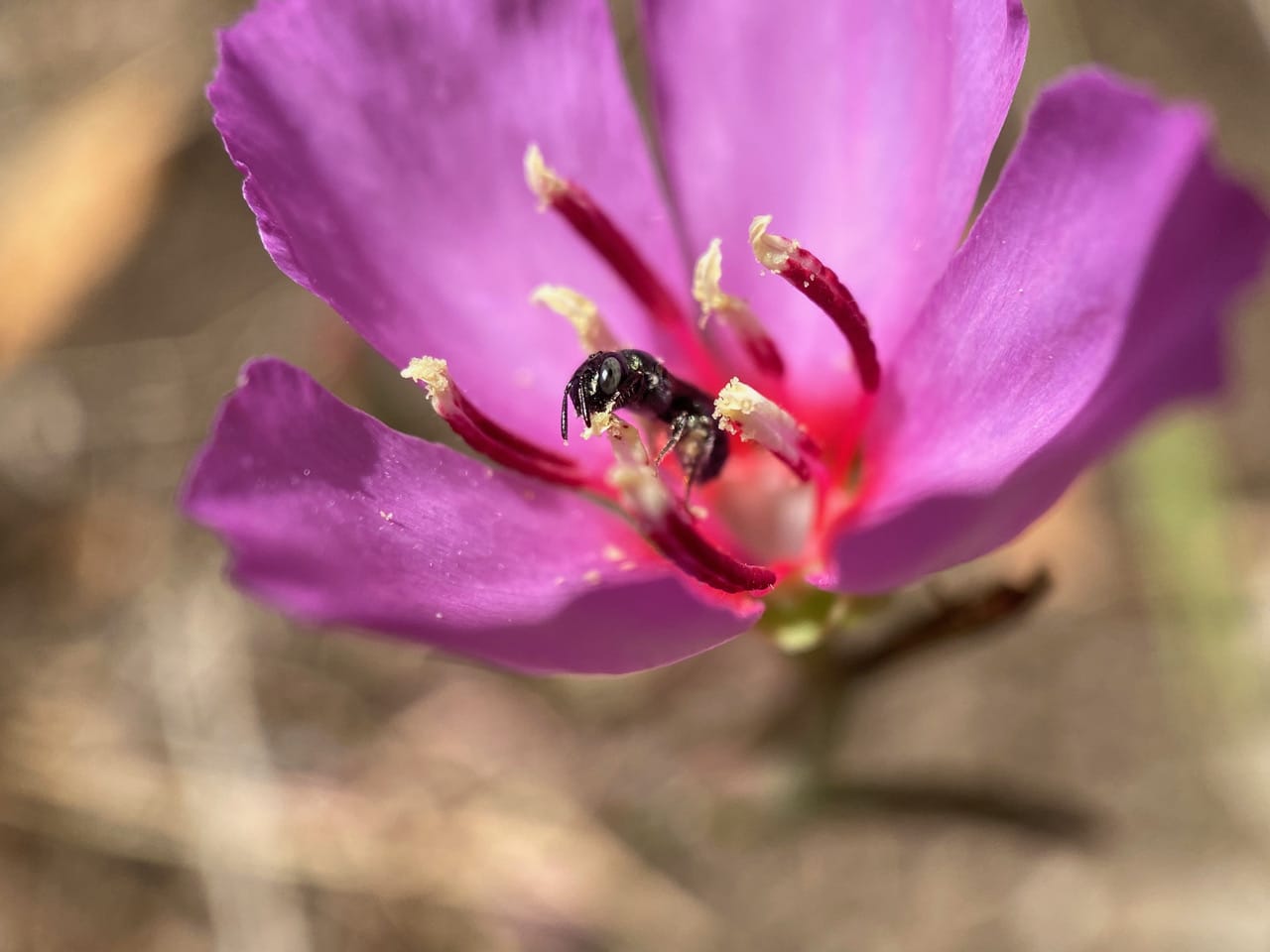
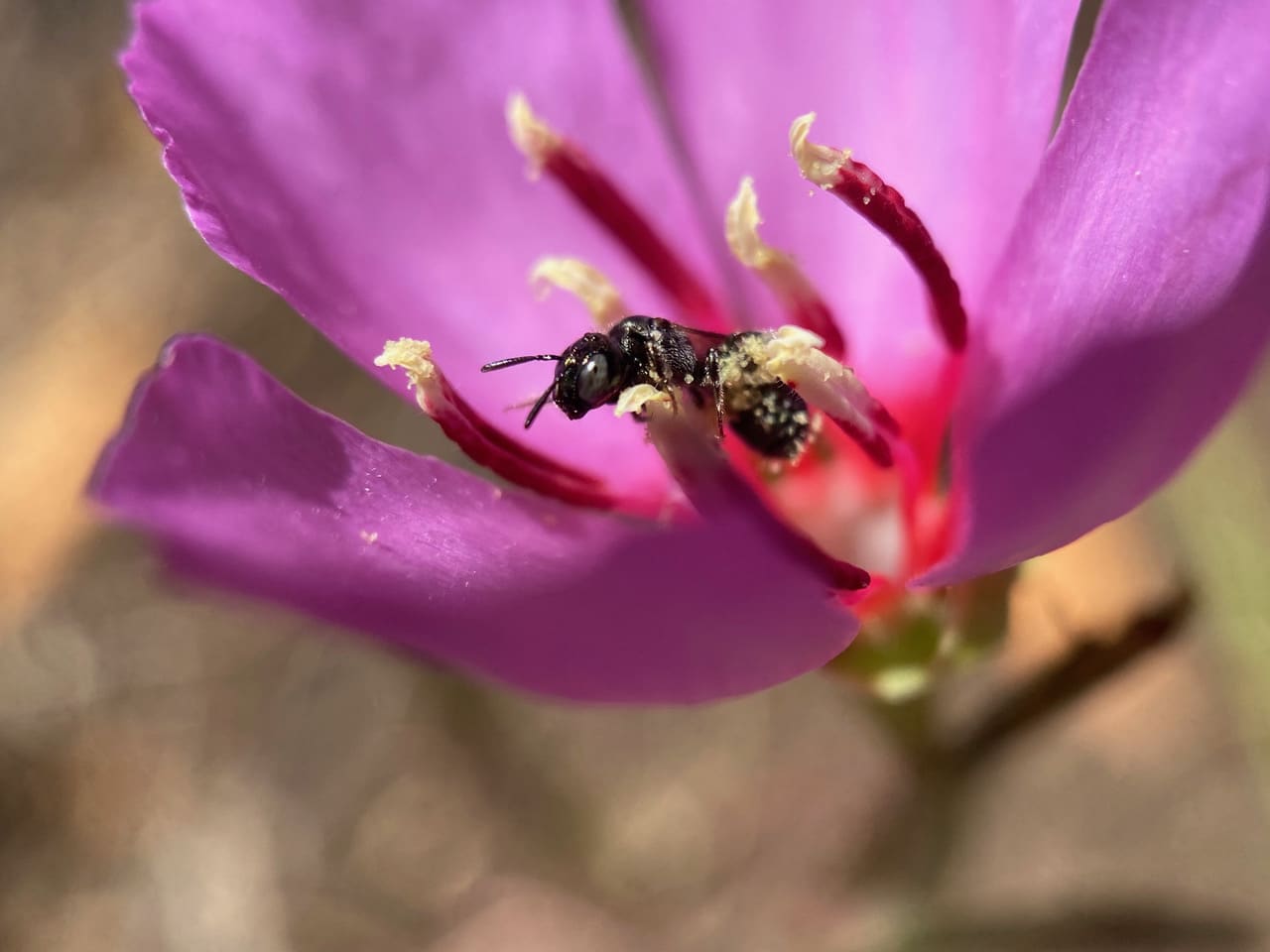
A shiny black bee is foraging on a flower of Farewell-to-spring, Clarkia rubicunda by Skyline Trail. The bee appears to be a Small Carpenter Bee, Ceratina sp. (family Apidae).
The Small Carpenter Bee genus Ceratina is closely related to the more familiar, and much larger Carpenter Bees (genus Xylocopa). Ceratina are typically dark, shiny, even metallic bees, with fairly sparse body hairs and a weak scopa on the hind leg. The shield-shaped abdomen comes to a point at the tip. Some species have yellow markings, often on the face.
Females excavate nests with their mandibles in the pith of broken or burned plant twigs and stems. While many species are solitary, a number are subsocial. Both male and female carpenter bees overwinter as adults within their old nest tunnels, emerging in the spring to mate. In the spring, this resting place (hibernaculum) is modified into a brood nest by further excavation. The female collects pollen and nectar, places this mixture (called bee bread) inside the cavity, lays an egg on the provision, and then caps off the cell with chewed plant material. Several cells are constructed end to end in each plant stem.

When I review these pictures at home, I notice the unusual eye – mottled and milky gray, unlike the eyes of any Ceratina familiar to me.
The bee is efficiently collecting pollen from the anthers of the Clarkia flower, turning from one to the next. Note the scopae on her hind leg.
After posting the pictures on iNaturalist requesting identification, I hear from our premier bee expert, John Ascher within hours. He identifies the bee as Ceratina sequoiae, one of the “Clarkia bees” that depend exclusively on the pollen of Clarkia to feed their young. The nests are commonly found in the stems of Blue Elderberry, Sambucus caerulea.
Most bees can be categorized by their pollen preferences: either generalists or specialists. Generalist bees are by far the most abundant. They are not too picky about the flowers they visit, and often visit a wide range of flower species for pollen.
On the other side of the spectrum, specialist bees have evolved a specific relationship with a few or even just one plant species. Some specialist bees forage for pollen that can only be found on one plant species. The specialist bees emerge from their nests at the same time their host plant begins to bloom. Some plants are dependent on their specialist bees for pollination.
A small Bee Fly, Geron sp. (family Bombyliidae) is cleaning its long proboscis after feeding on nectar from the flowers of California Goldenrod, Solidago velutina ssp. californica.
“Geron” is Greek for “old man” (imagine a humpbacked man carrying a cane). The fly is easily recognizable from its humpbacked appearance, conical abdomen and shiny, golden pubescence. Like many bee flies, it flies around with a long proboscis that cannot be folded up. Larvae are parasitoids of the immature stages (caterpillars) of various moths in concealed situations. Some are also hyperparasitoids. Adults take nectar at flowers, preferring members of the sunflower family, Asteraceae. Unusual for bee flies, Geron often bobs up and down above an inflorescence before landing to nectar. Males often form loose swarms.
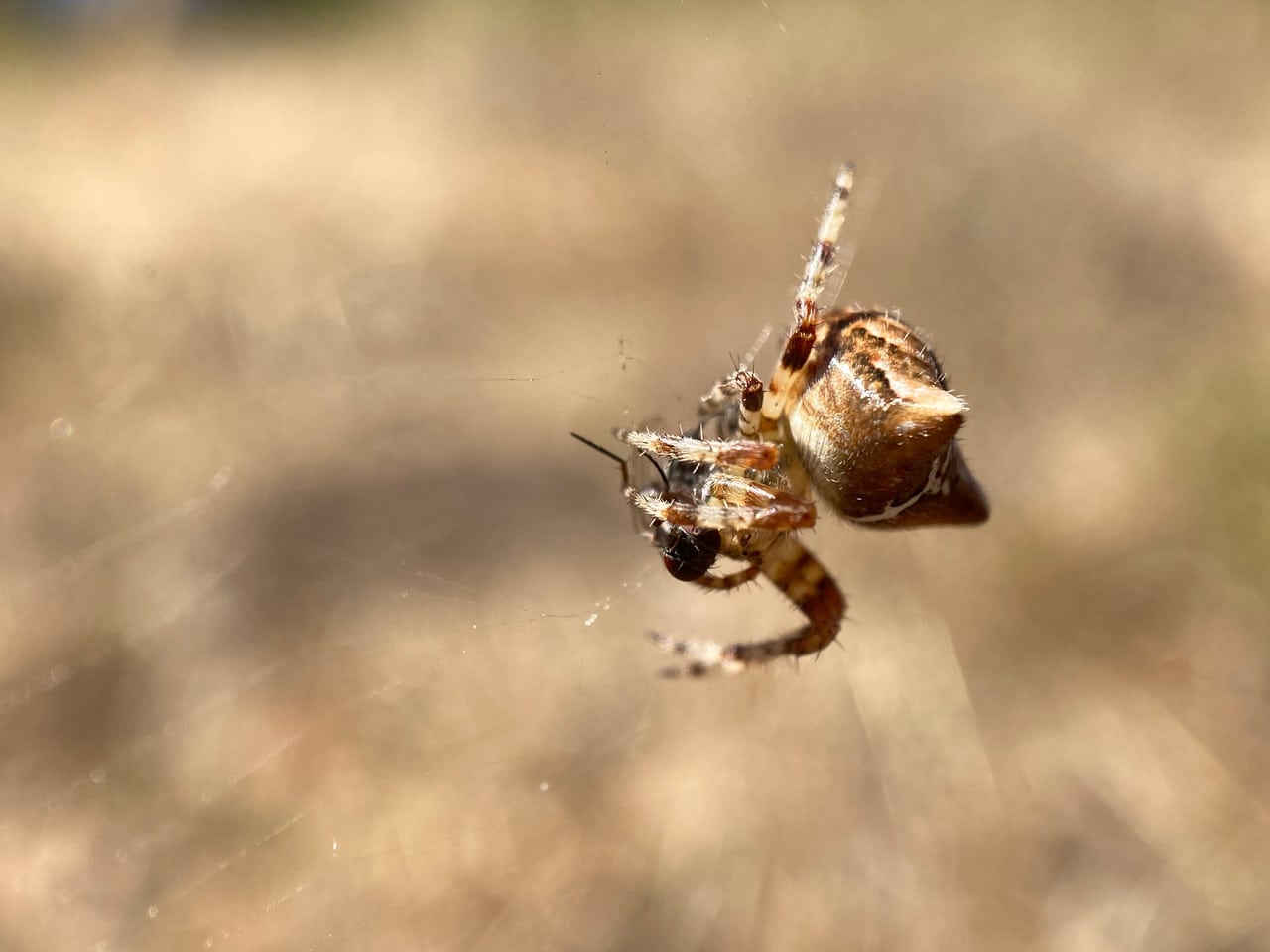
Passing the Soap Plant I have marked, I check for the Two-tubercled Orb-weaver Spider on her previous perch, a seed capsule. She’s not there. With some searching, I find her on a silk web that has been strung over 21/2 feet between her seed capsule and an adjacent Soap Plant. The spider herself is only about 1/4 in. long. I have not expected her trap to be so extensive. And she has caught something!
Closing in, I see that her catch is a fly. Bon appetite, Spider !