

Pollinator Post 8/14/25
My friend and fellow bee enthusiast, Emil submitted some pictures of a female Red-footed Cuckoo Leafcutter to iNaturalist yesterday. The bee was foraging on the flowers of Topped Lavender in a garden in Alameda. I wonder if I’d be able to find the bee, guided by the GPS information that accompanies Emil’s photos on iNaturalist. On a cloudy morning like this, I might even find her still sleeping? I won’t know unless I try!


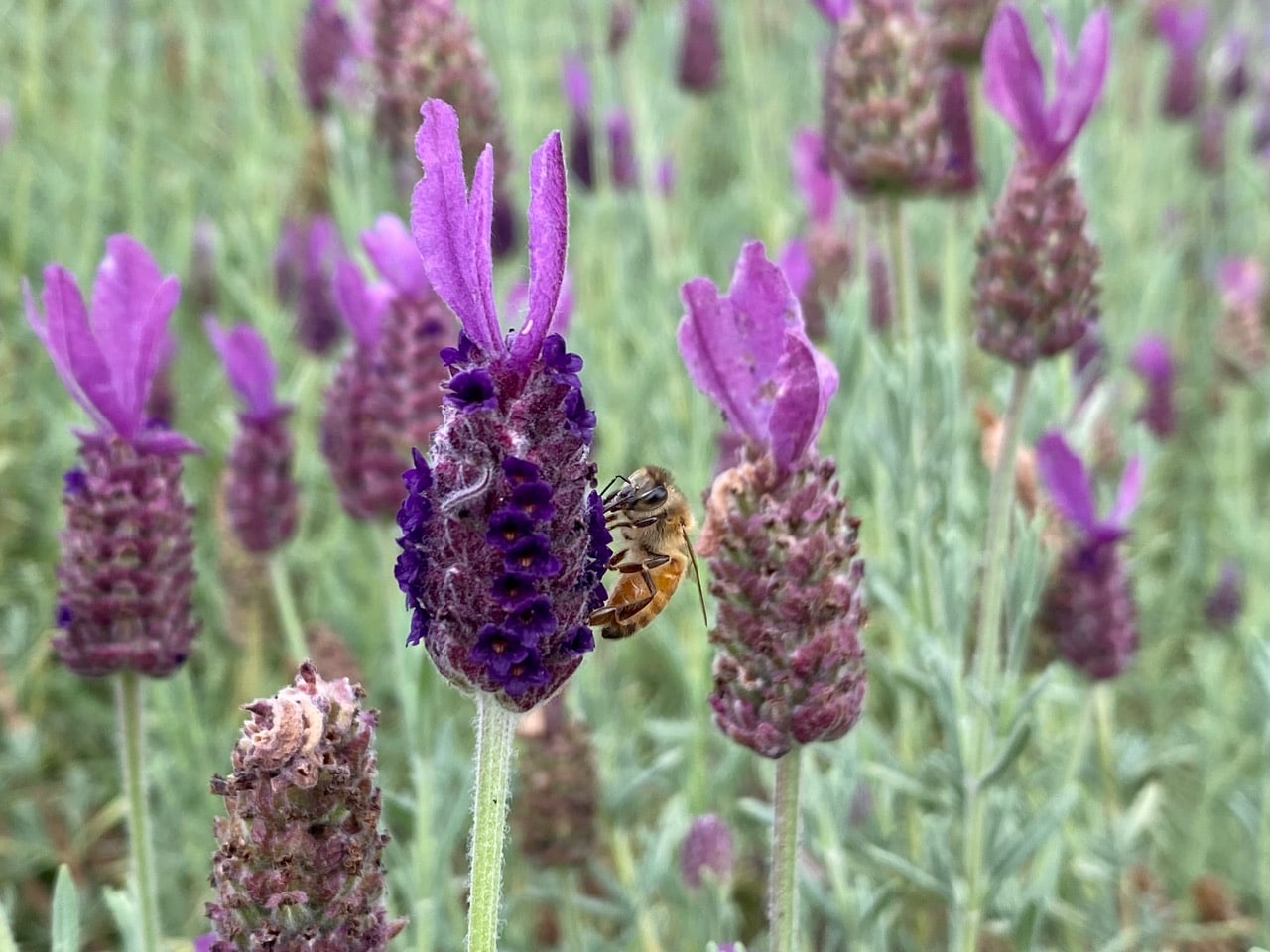
I arrive at my destination on Thompson Ave. at 9:45 am staring at a large shrub of Topped Lavender, Lavandula stoechas in a front yard. The sun is not out yet, and things are quiet, except for an occasional Honey Bee, Apis mellifera (family Apidae) already out foraging.
Wait, there are other bees here! Three male Summer Longhorn Bees, Melissodes sp. (family Apidae) are sleeping, clustered around a seed head of a weedy Asteraceae in front of the Topped Lavender shrub. How sweet!
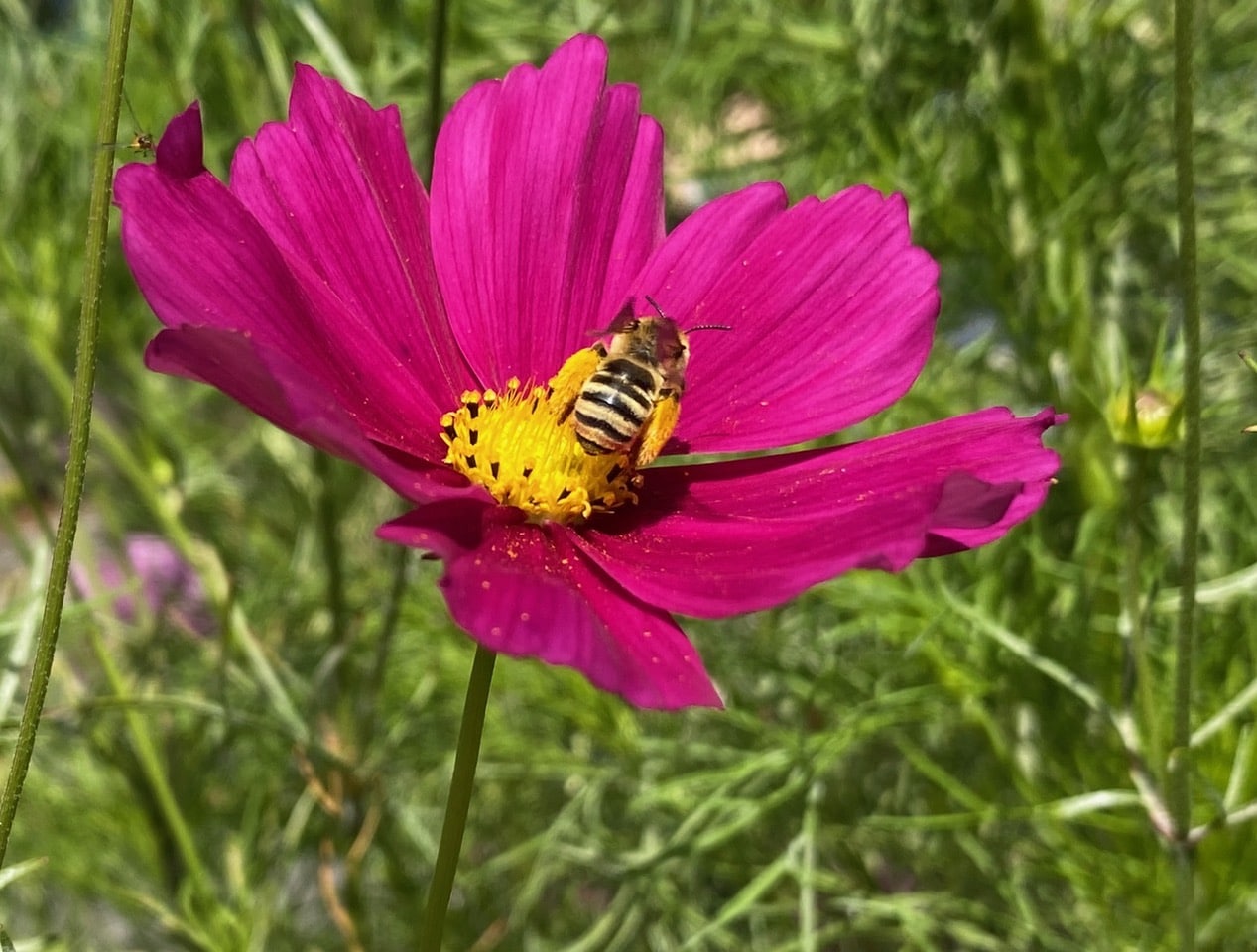
The Summer Longhorn Bees, Melissodes sp. (family Apidae) are medium to large bees, stout-bodied, usually with gray hair on the thorax and pale hair bands on the abdomen. Males usually have yellow markings on their faces and have very long antennae from which their common name is derived. They are active May to September, with peak flight in late June to early August. The females prefer flat, bare ground for digging their solitary nests, though they sometimes nest in aggregations. Pollen is transported in scopae on the hind legs. Pollen loads are often copious and brightly colored and thus very distinguishable. Melissodes are specialists on Asteraceae – females gather pollen from flowers of Aster, Bidens, Coreopsis, Cosmos, Encelia, Gaillardia, Helianthus, and Rudbeckia ssp. Male Melissodes have the endearing habit of sleeping in aggregation on flowers and vegetation, often seen in early morning or late afternoon.
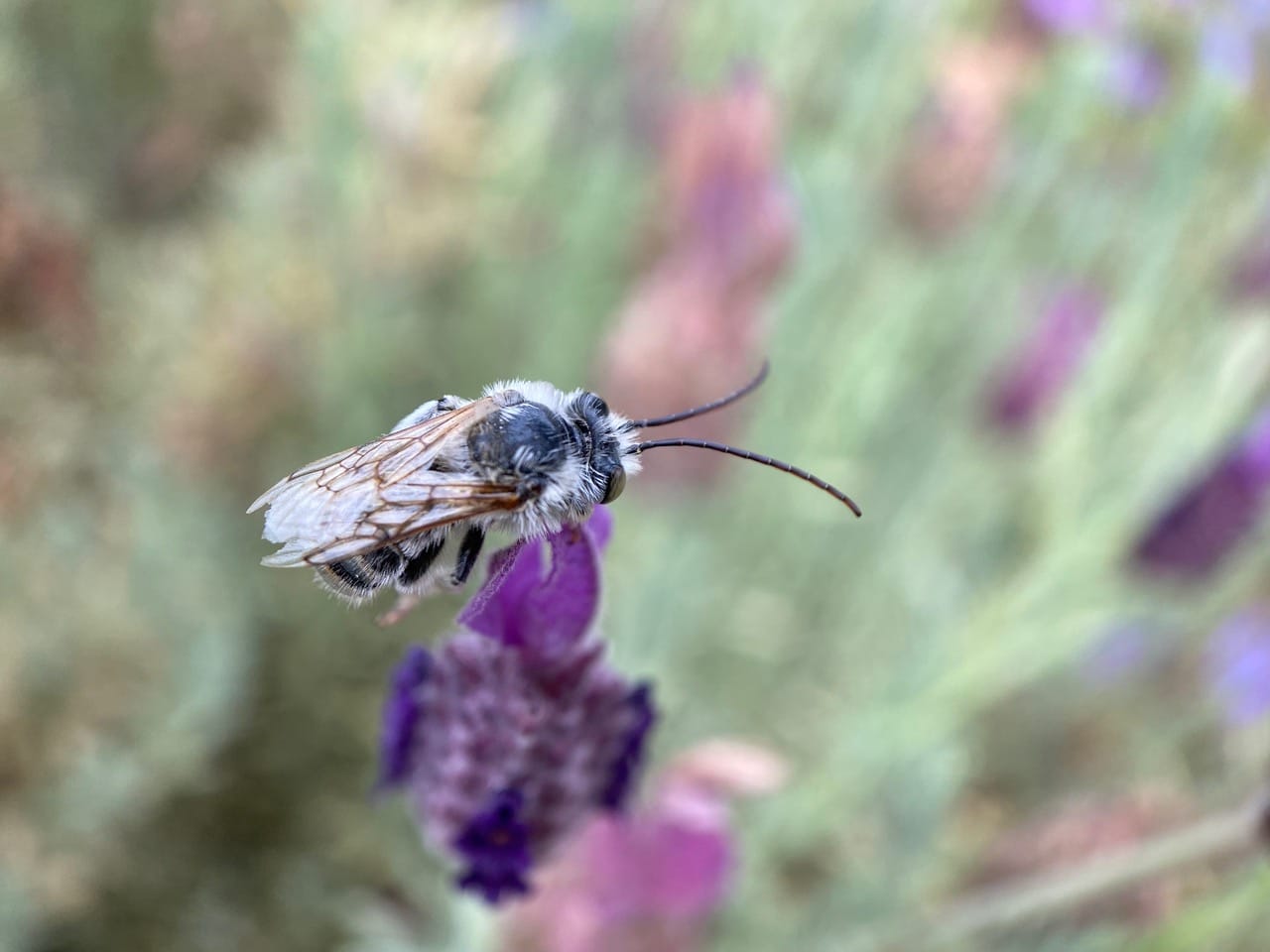
A lone Melissodes male has woken up atop a spike of lavender flowers, and is slowly grooming himself. He appears to be an old bee, missing a lot of hairs on his body, and his wings are worn and frayed at the edges. I often find old Longhorn males sleeping by themselves, not in aggregations. I wonder why? Are they excluded from the slumber party by the younger males?
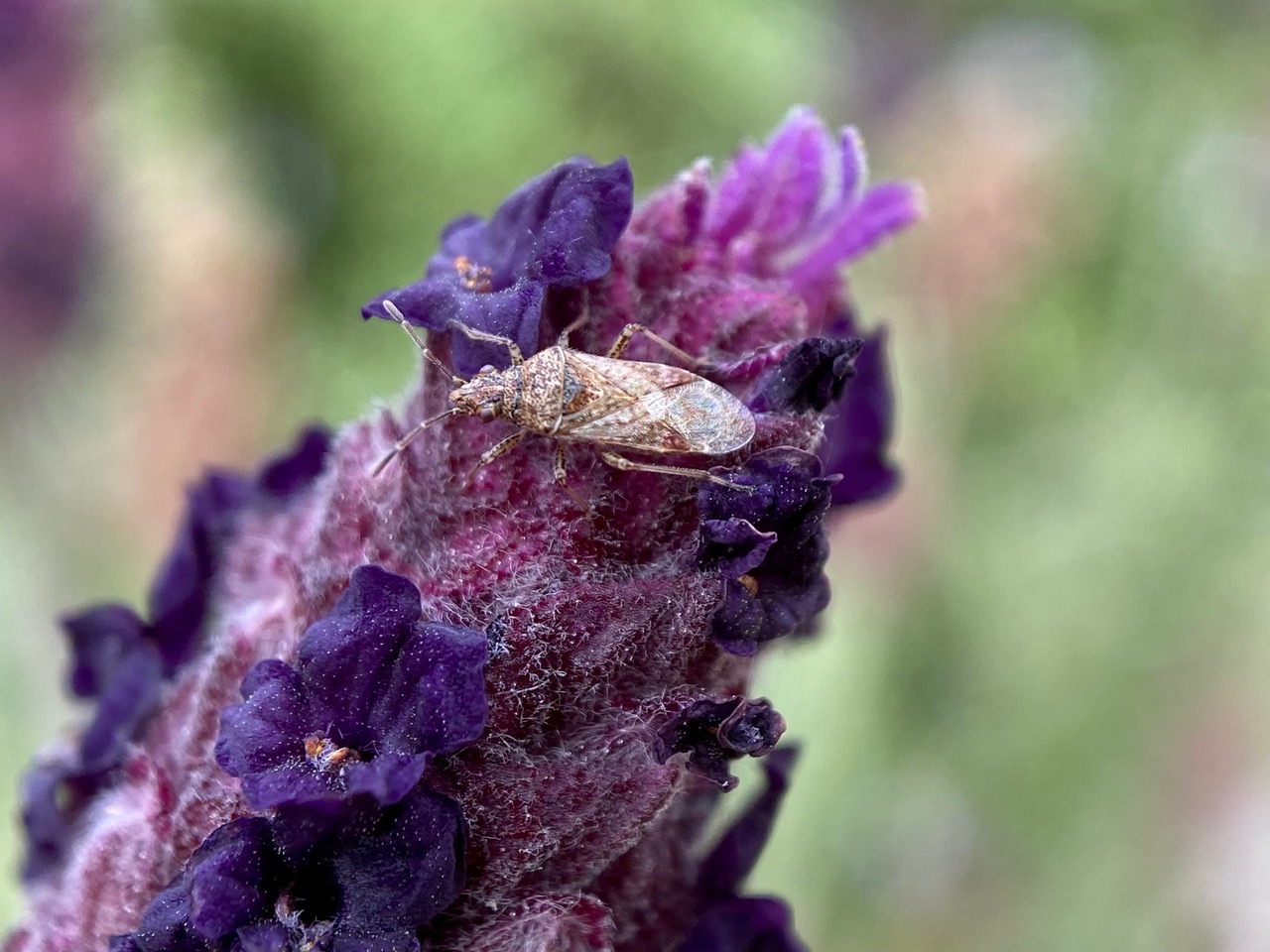
A Scentless Plant Bug, Arhyssus sp. (family Rhopalidae) is lurking among the small dark flowers of Topped Lavender.
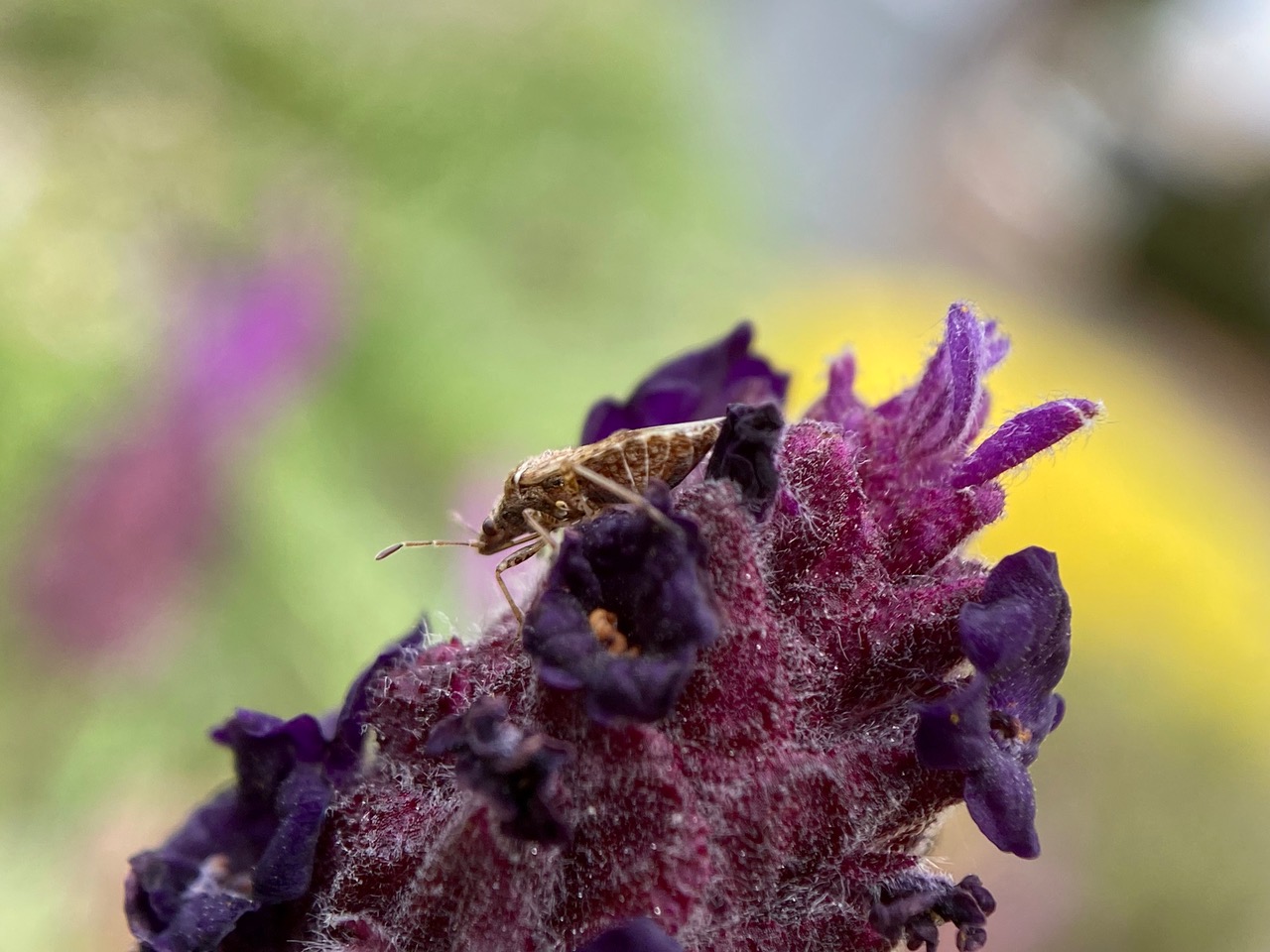
Most species of Arhyssus are found in the western states, often in fields, weedy areas and savanna. The Rhopalidae are distinguished by many veins on the membranous portion of the forewings. They differ from coreids and other hemipterans in lacking functional scent glands. All are plant-feeders, usually on ripe seeds. Like other “true bugs” in the order Hemiptera, Rhopalids have piercing-sucking mouthparts that they use to extract plant tissues. They are able to feed on seeds by injecting digestive juices into the seeds and sucking up the digested contents as a liquid. The mouthparts, collectively called a rostrum, is folded under the body when not in use.
Side view of the same Scentless Plant Bug showing its rostrum that is folded under the body.
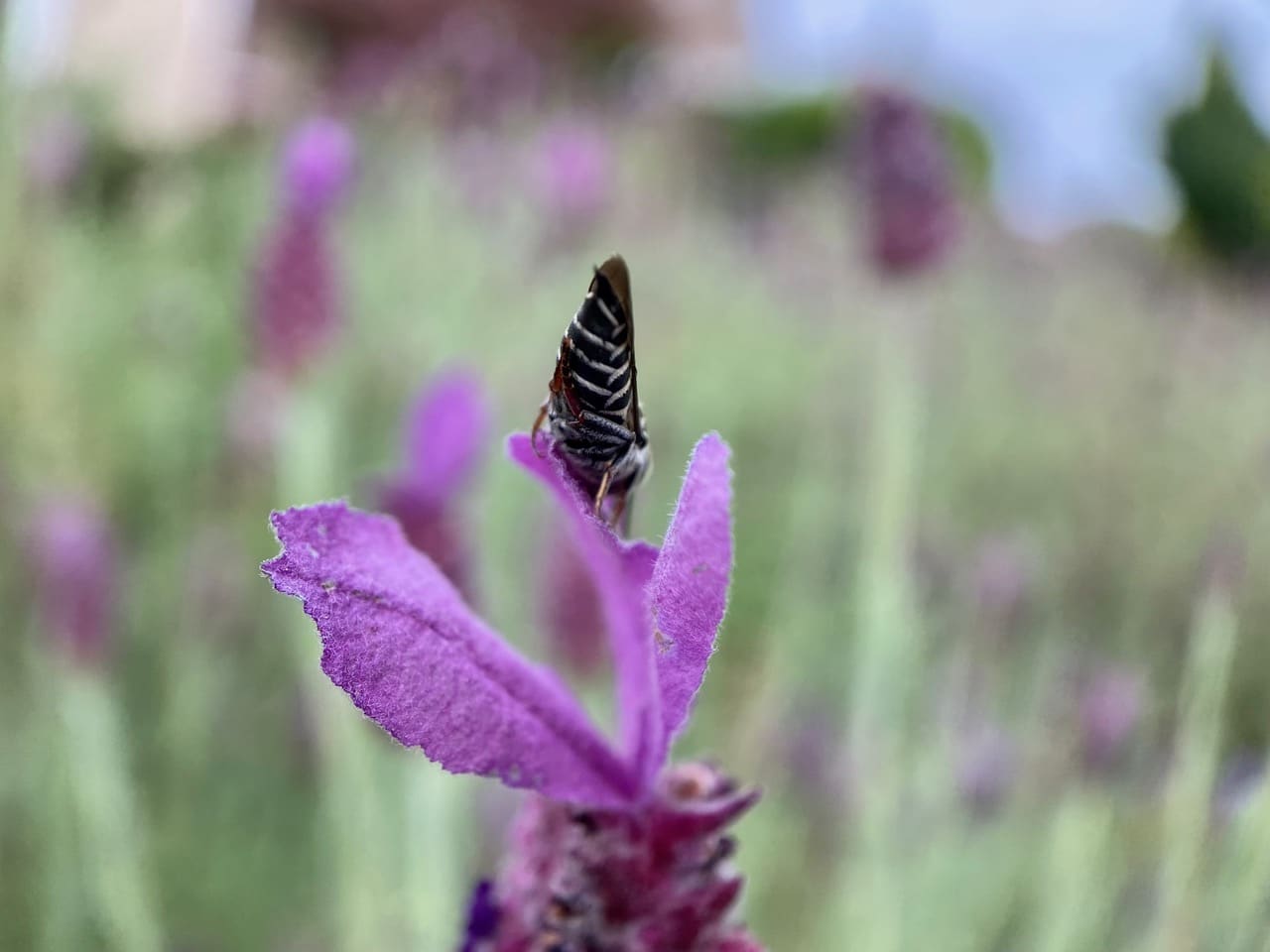
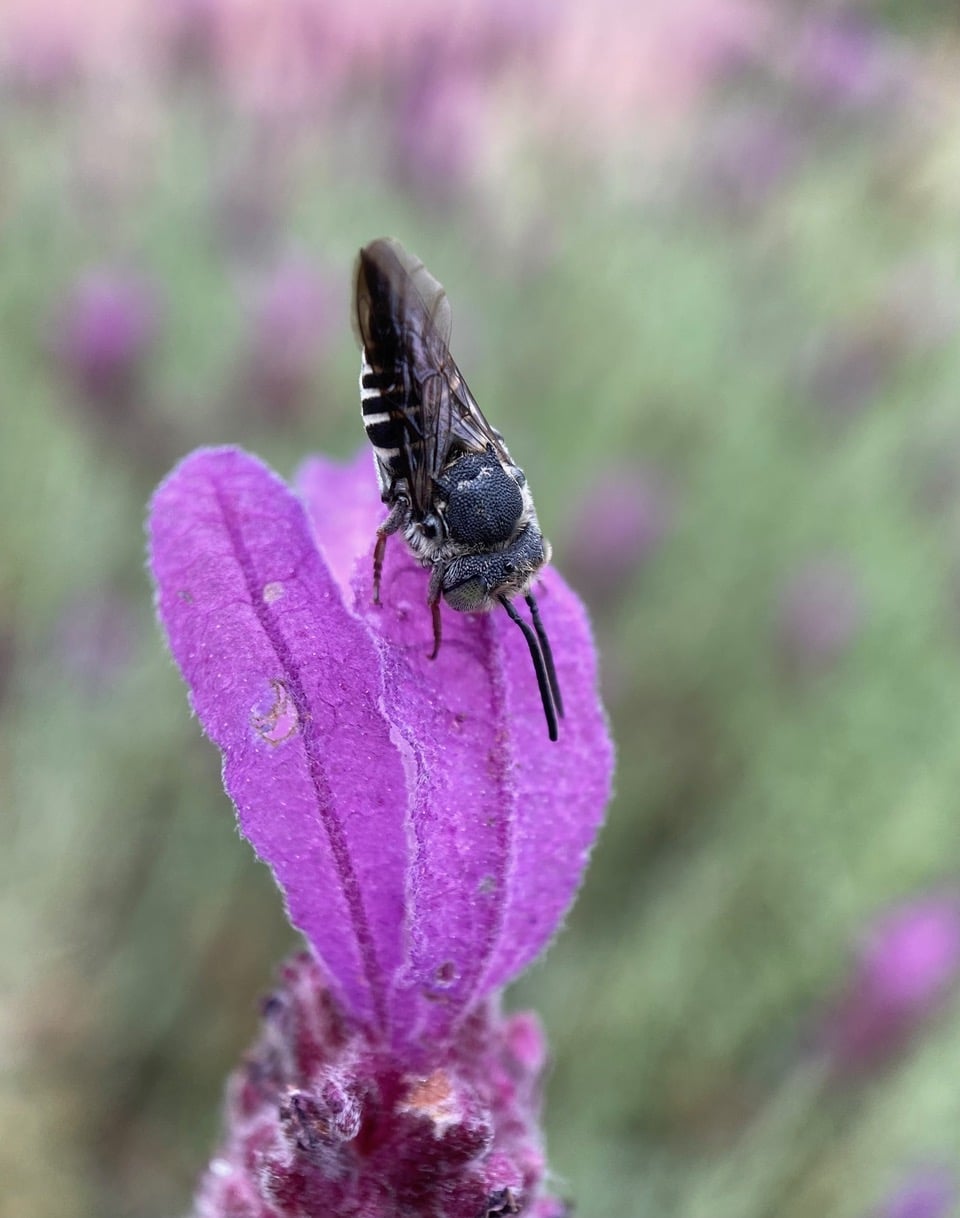
My eyes finally make out a dark form atop a purple bract of the Topped Lavender flower spike. Yay, that’s what I am looking for! The female Cuckoo Bee is sleeping with her rear pointing skyward on a tall stalk in the middle of the large lavender bush.
The term cuckoo bee refers to a variety of different bee lineages which have evolved the kleptoparasitic behavior of laying their eggs in the nests of other bees, similar to the behavior of cuckoo birds. Female cuckoo bees lack pollen-collecting structures and do not construct their own nests. Cuckoo bees typically enter the nests of pollen-collecting species, and lay their eggs in cells provisioned by the host bee. When the cuckoo bee larva hatches, it consumes the provision in the nest, and kills the host larva. Many cuckoo bees are closely related to their hosts, and may bear similarities in appearance reflecting this relationship. Others parasitize bees in families different from their own.
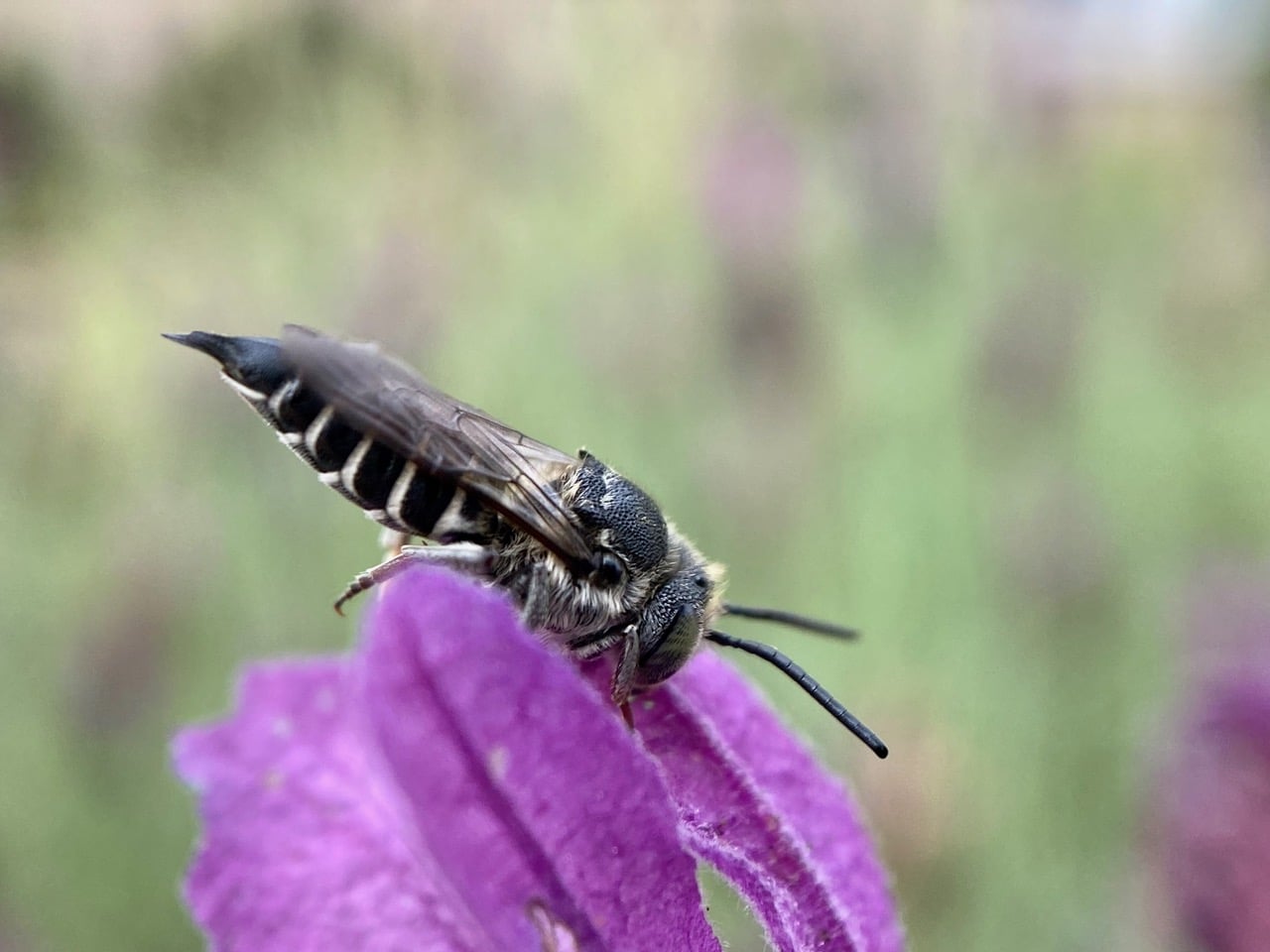
The Cuckoo Leafcutter Bees, also known as Sharp-tailed Bees, belong to the genus Coelioxys, in the same family as their hosts, Megachilidae. Members of the genus Coelioxys share the distinctive trait of having hairs on their eyes. In addition, the back rim of the bee’s scutellum (the second segment of the thorax) has prominent toothlike protrusions called axillae. In Greek, Coelioxys means “sharp belly”, referring to the tapered, pointed abdomens of cuckoo leaf cutters. The bees have dark abdomens banded by short pale hairs; thorax with prominent axillae; red, black or red-and-black legs; and green eyes. Female Coelioxys have pointed, conical abdomens with spearlike tips. The spade-shaped abdominal tips allow the female cuckoos to break through the brood-cell walls that leafcullters construct with leaves, petals and other materials. Males have abdomens armed with multiple pronged tips.
These bees are known to sometimes sleep upside down on vegetation, holding on with their mandibles.
Note the prominent axillae (tooth-like protrusions) on the hind end of the bee’s thorax.
The Red-footed Cuckoo Leafcutter Bee, Coelioxys rufitarsis (family Megachilidae) is native to North America. The species is one of the most common cuckoo bees, found frequenting gardens where members of its host species, Megachile are present. As a cuckoo bee, it invades the nests of leafcutter bees and deposits its eggs inside. When the cuckoo larvae hatch, they eat the host’s eggs and devour the stores of nectar and pollen left by the mother leafcutter for her offspring. Cuckoo Leafcutters lack pollen-collecting scopal hairs, because they do not collect pollen. They do however drink nectar from flowers.
A close-up shows her conical abdomen with spear-like tip. She has perforated the bract with her mandibles to anchor herself while she sleeps with her hind legs retracted. Often the cuckoo bees don’t even use their legs, holding on with only their mandibles while they sleep.
Unlike social bees like honey bees, cuckoo bees are solitary and neither sexes construct nests. They do not have a hive or nest to return to for warmth and shelter at night. Bees are cold-blooded, meaning their body temperature fluctuates with the surrounding environment. By gripping a plant with their mandibles, they anchor themselves securely and can completely relax their bodies, including their legs and antennae, until they drift off to sleep. This reduces the energy expenditure that would be required to maintain an upright position while resting.
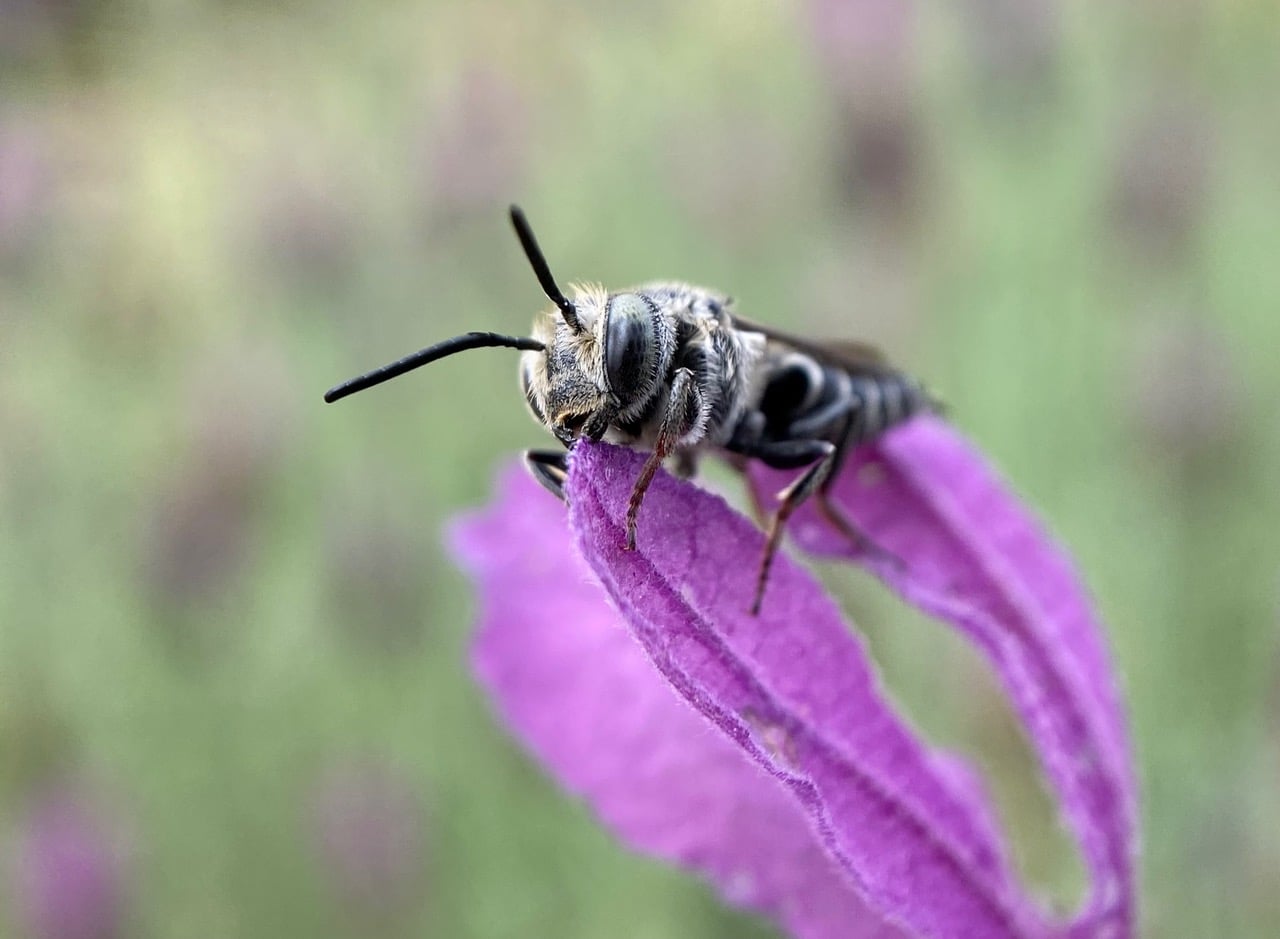
The bee is waking up, lowering her abdomen and hind legs. Note that her head and thorax are heavily sclerotized and pitted. Like most cuckoo bees, she is well armored in case she has to defend herself when discovered by an angry host bee.
A close-up of the bee’s face shows her hairy eyes. Coelioxys bees are one of the few types of bees that have hairy eyes, similar to honey bees. These hairs are located on the compound eyes and are believed to play a role in wind sensing for navigation.
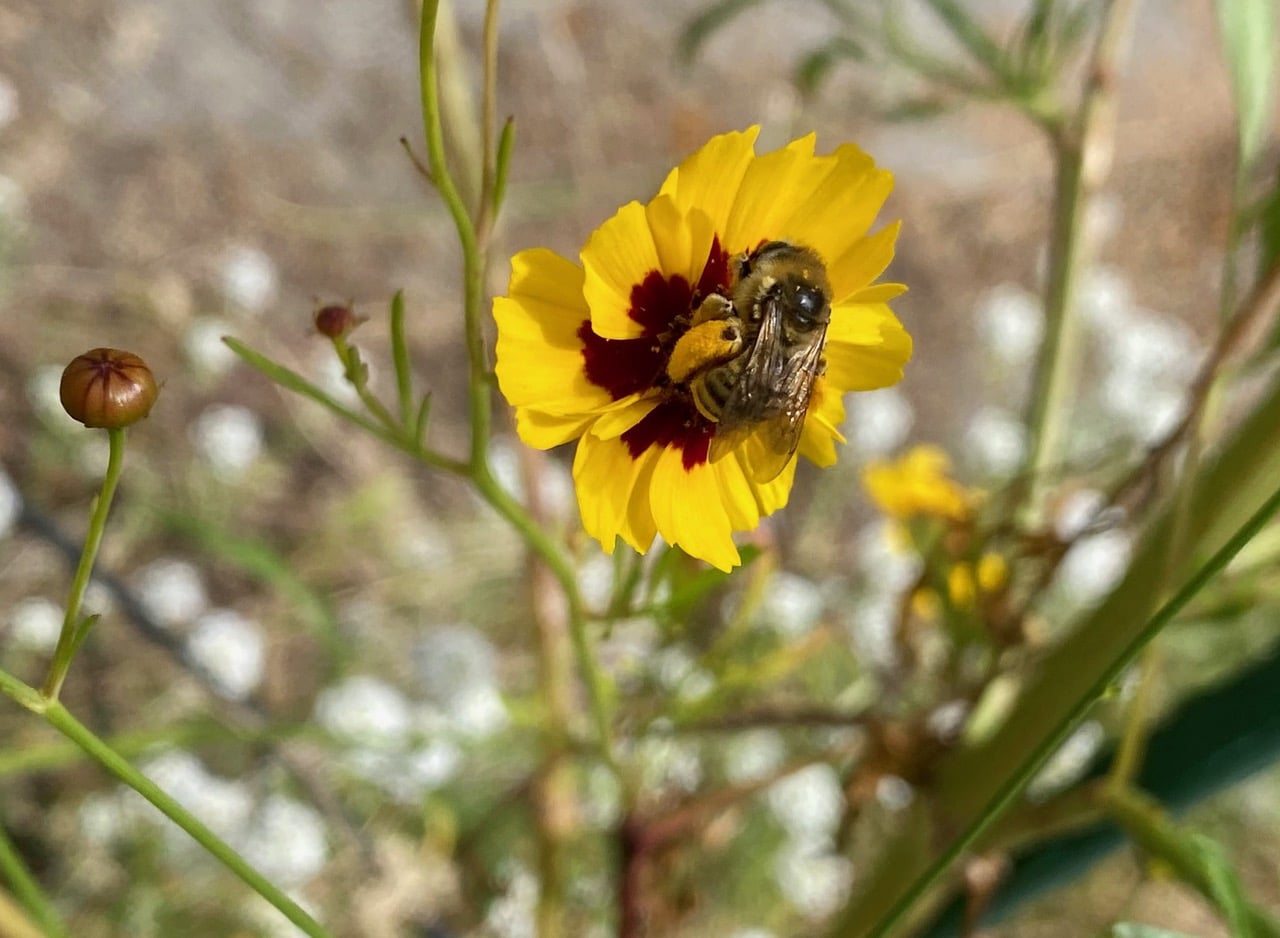
I walk a couple of blocks onto High Street and stop to admire the colorful plantings in a sidewalk strip. All the plants are non-native ornamentals, but they appear to attract a diversity of enthusiastic pollinators. A female Summer Longhorn Bee, Melissodes sp. (family Apidae) is foraging on a Plains Coreopsis, Coreopsis tinctoria. She is fast filling up the prodigious scopae on her hind legs.
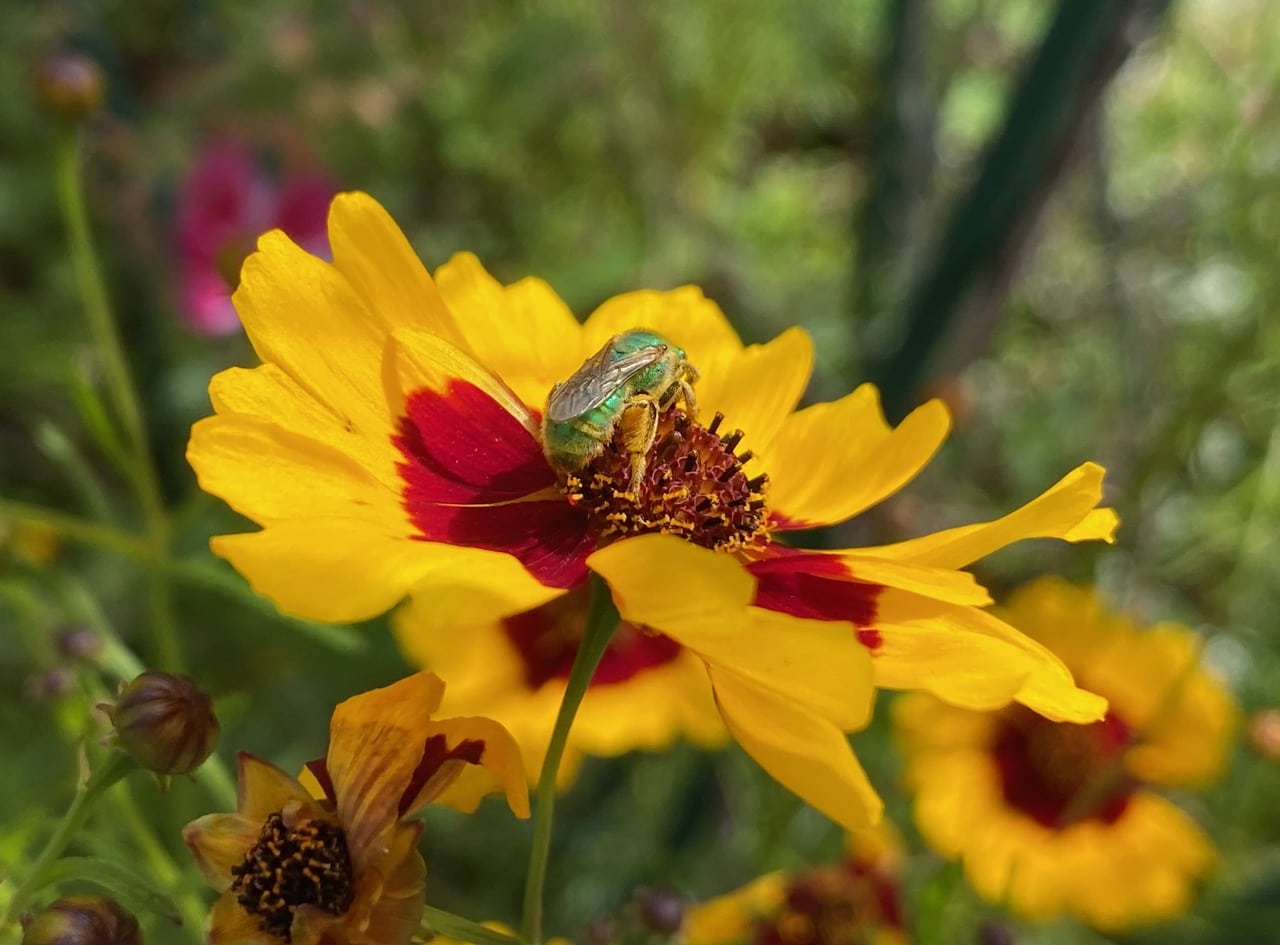
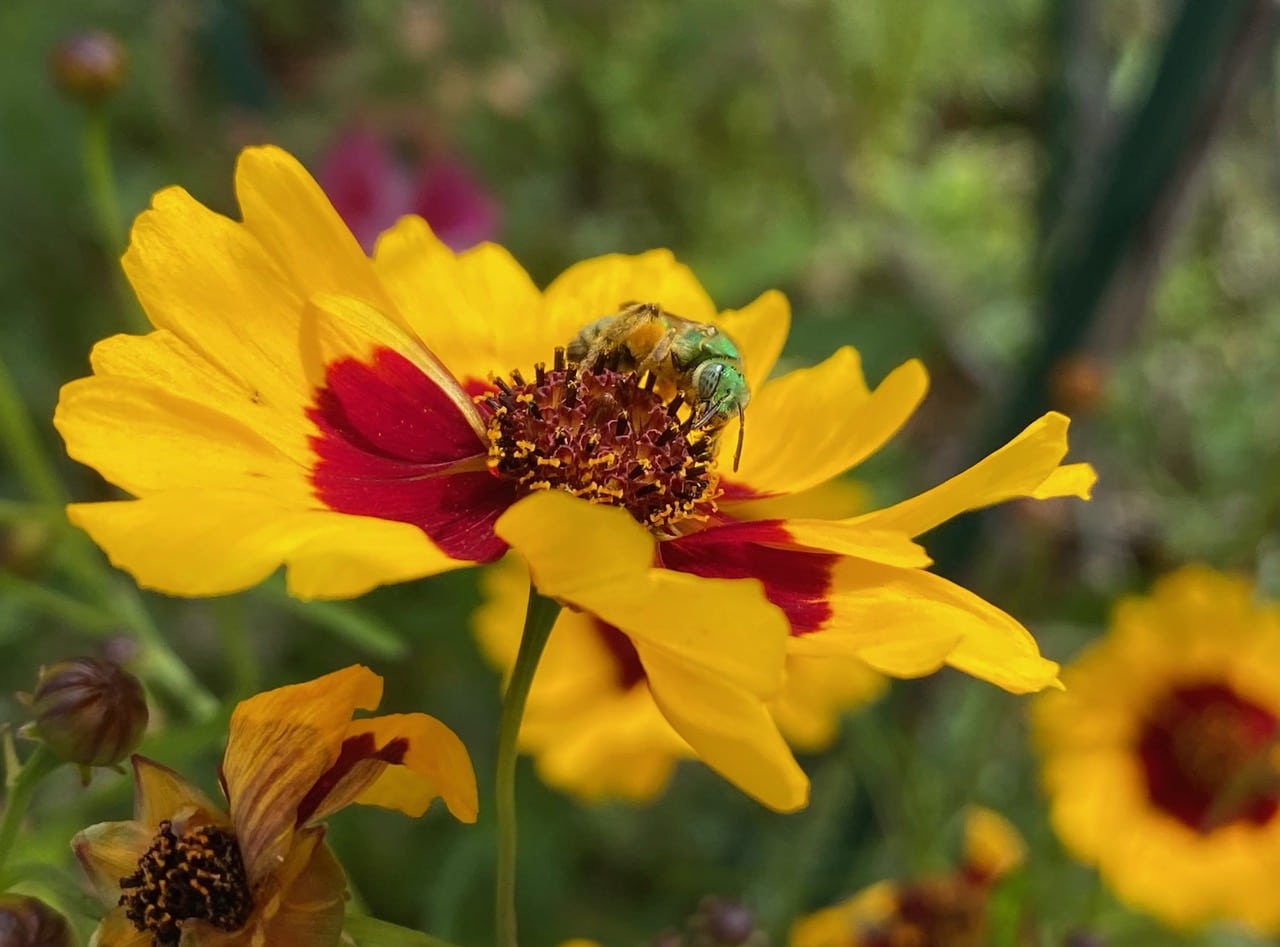
A female Fine Striped Sweat Bee, Agapostemon subtilior (family Halictidae) has landed on a flowerhead of Plains Coreopsis.
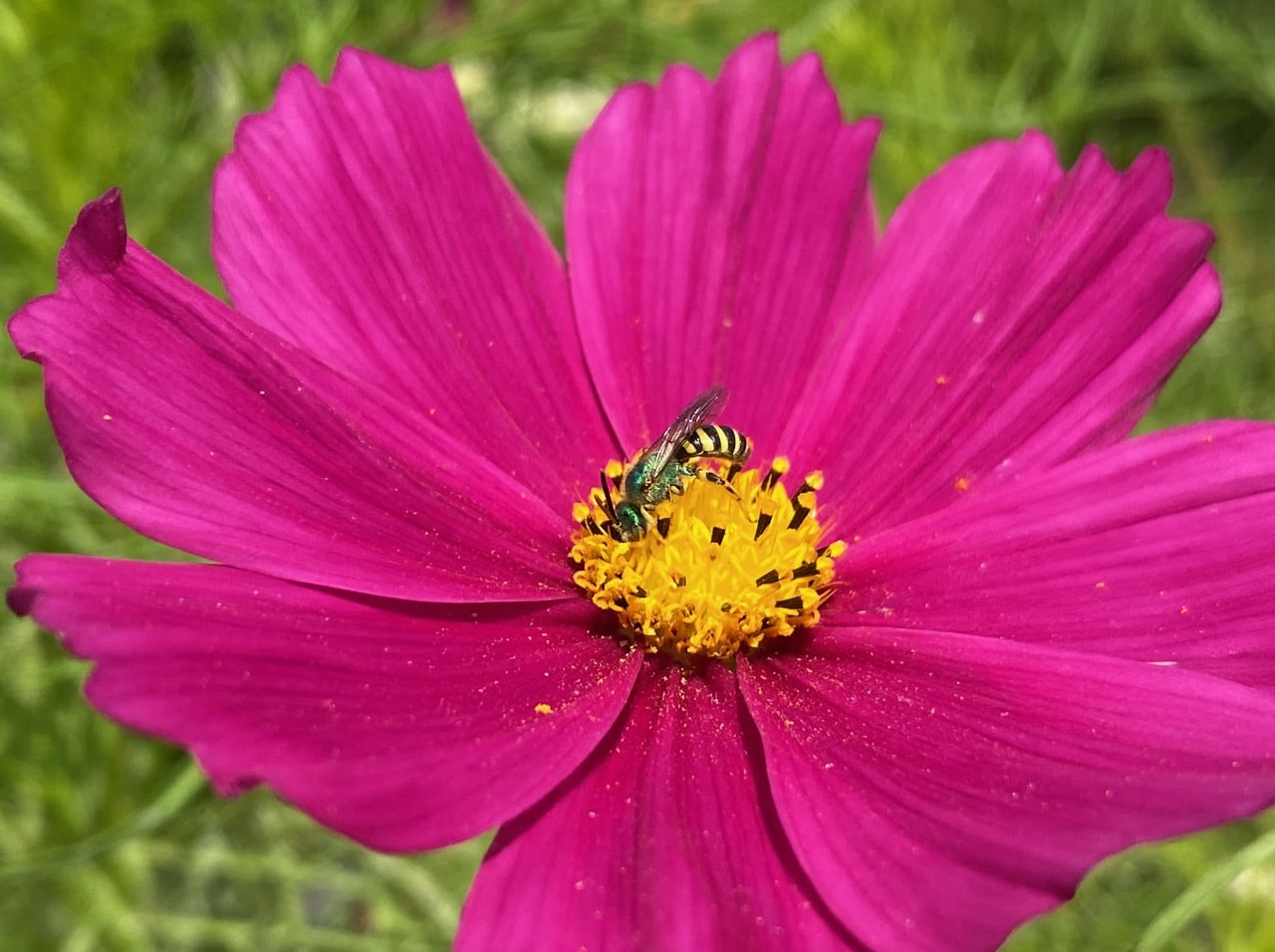
Agapostemon are brightly colored metallic green or blue bees measuring 7 to 14.5 mm long. Most species have a metallic green head and thorax, and black-and-yellow striped abdomen; some females are entirely bright green or blue. Females carry pollen on scopal hairs located on their hind legs. Agapostemon are generalists. Like other members of the family Halictidae, they are short-tongued and thus have difficulty extracting nectar from deep flowers. Males are often seen flying slowly around flowers looking for females. The bees favor flowers with high densities. Females excavate nests in the ground. These bees are active summer through fall.
Fine striped sweat bee (Agapostemon subtilior) · iNaturalist
A male Fine Striped Sweat Bee, Agapostemon subtilior (family Halictidae) is taking nectar from a flowerhead of Cosmos, Cosmos sp.
Cosmos is a genus, with the same common name of Cosmos, consisting of flowering plants in the sunflower family, Asteraceae. Cosmos species are native to scrub and meadowland in the Americas, from Colorado and Missouri in the United States, extending south through Mexico (where the highest species diversity occurs), and Central America to South America.
Cosmos are herbaceous perennial or annual plants growing 1-6 ft. tall. The flowers are produced in a capitulum with a ring of broad ray florets and a center of disc florets. Flower color varies significantly between the different species. The genus includes several ornamental plants popular in gardens, and is a good source of nectar and pollen for pollinators through the summer.
An Asteraceae specialist, the female Melissodes is an avid visitor to the Cosmos and Coreopsis flowers.
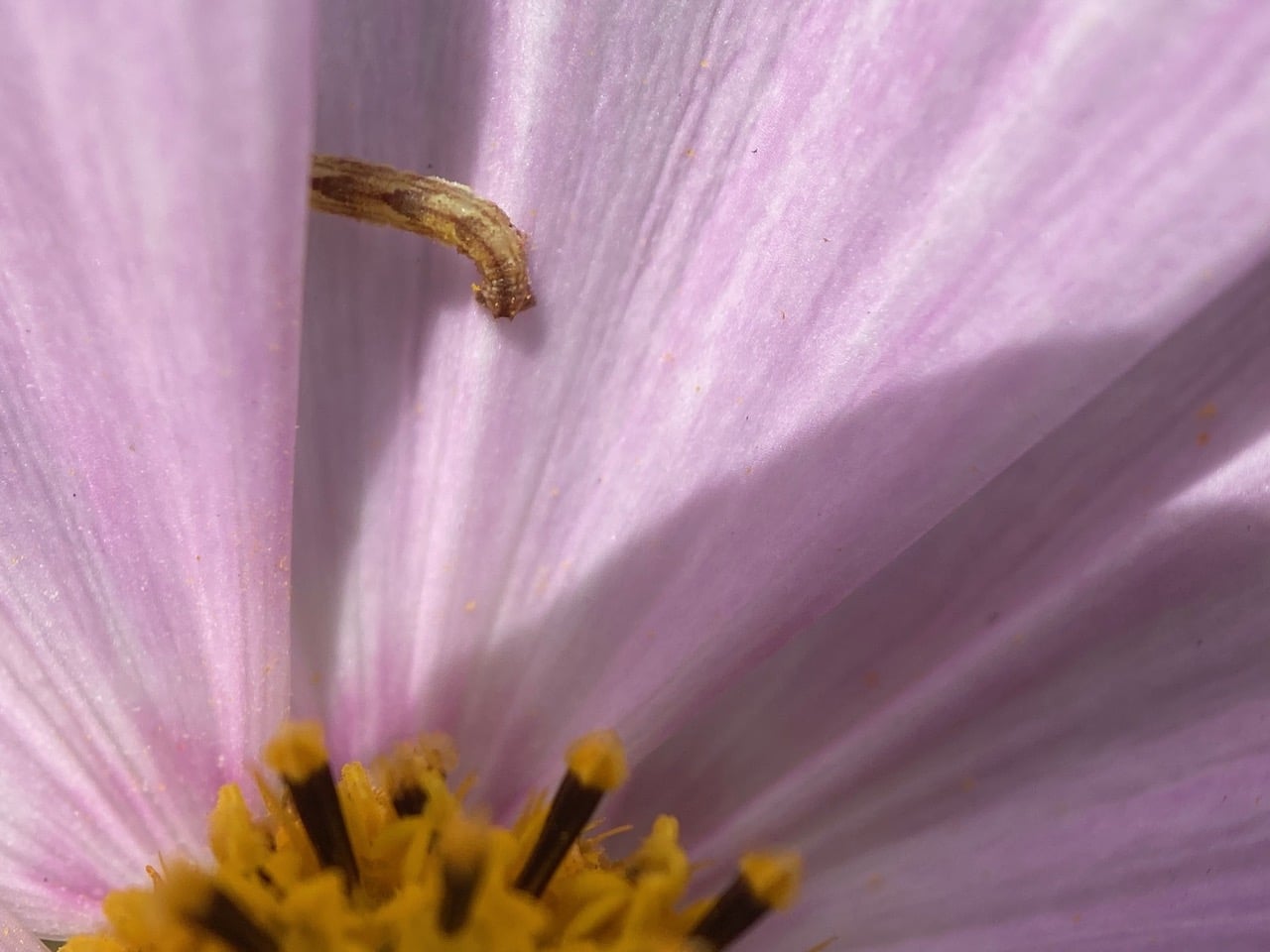
I catch sight of the hind end of an inchworm as it disappears behind a petal of Cosmos. It is the caterpillar of the Common Eupithecia moth, Eupithecia miserulata (family Geometridae).
Inchworms are also called loopers and measuring worms. They majority of the inchworms are the larvae of moths in the family Geometridae. The name comes from the Greek “geo” for earth and “metro” from measure, because the caterpillars seem to be measuring the surface on which they are walking. Most caterpillars have five sets of prolegs, four in the middle of the body and one pair at the hind end. Inchworms have the normal six true legs but only two or three pairs of prolegs, all located at the tail end of the body, with none in the middle. When an inchworm walks, it moves its tail-end prolegs up behind its true legs, causing the center of its body to loop upward. Then it stretches its front end forward to take another step.
Eupithelia is the largest genus of moths of the family Geometridae. Occurring worldwide except for Australasia, species in the genus are commonly known as pugs. Adults are typically small, 12 – 35 mm, with muted colors. Most species rest with forewings held flat at right angles to the body, while the hindwing are largely covered by the forewings. They are generally nocturnal. Larvae mostly feed from the flowers and seeds of their food plants rather than the foliage. Many species have a very specific food plant.
Eupithecia miserulata, the Common Eupithecia Moth is found in North America. The adult wingspan is 12-20 mm. The larvae feed on a wide range of plants, including coneflower, asters, willow, cherry, juniper and clover.
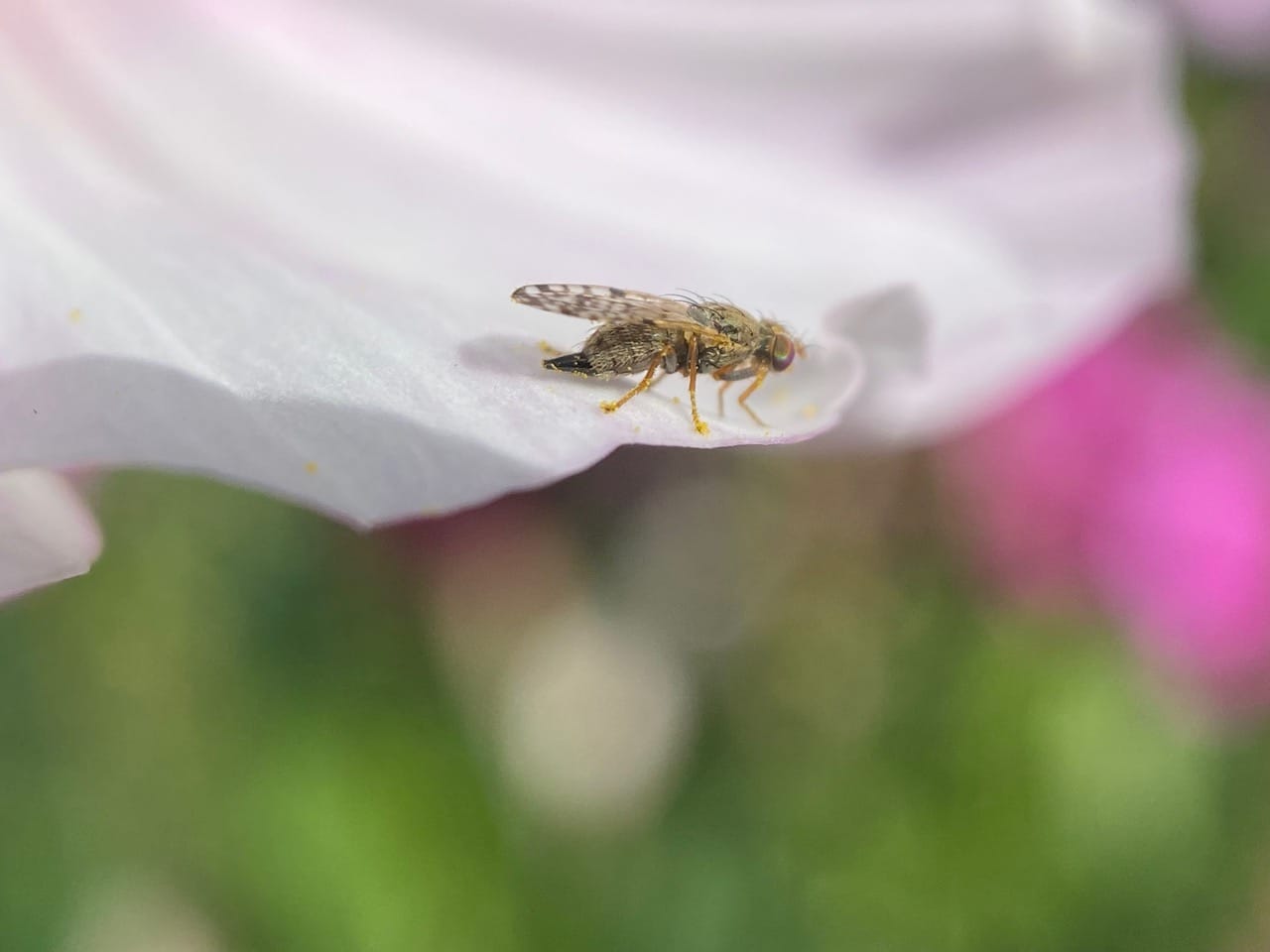
A female Fruit Fly, Campiglossa sp. (family Tephritidae) is perched on a white Cosmos ray petal. The conical black structure, the oviscape at the tip of the Fruit Fly’s abdomen distinguishes it as a female. It is the non-retractile sheath that houses the telescopic ovipositor; it remains exposed when the ovipositor is withdrawn.
Tephritids are small to medium-sized flies that are often colorful, and usually with picture wings. The larvae of almost all Tephritidae are phytophagous. Females deposit eggs in living, healthy plant tissues using their telescopic ovipositors. Here the larvae find their food upon emerging. The larvae develop in leaves, stems, flowers, seeds, fruits, and roots of the host plant, depending on the species. Adults are often found on the host plant and feeding on pollen, nectar, rotting plant debris, or honeydew. Tephritid flies are of major economic importance as they can cause damage to fruit and other plant crops. On the other hand, some Tephritids are used as agents of biological control of noxious weeds.
The genus Campiglossa has a worldwide distribution. Adult females oviposit in flowerheads of Asteraceae. The short, stout larvae live in the ovaries, feeding on the developing seeds. Many species are reported to be monophagous, some oligophagous. In entomology, a monophagous insect is one that feeds on only a single species of plant; oligophagous insects feed on a few closely related species.
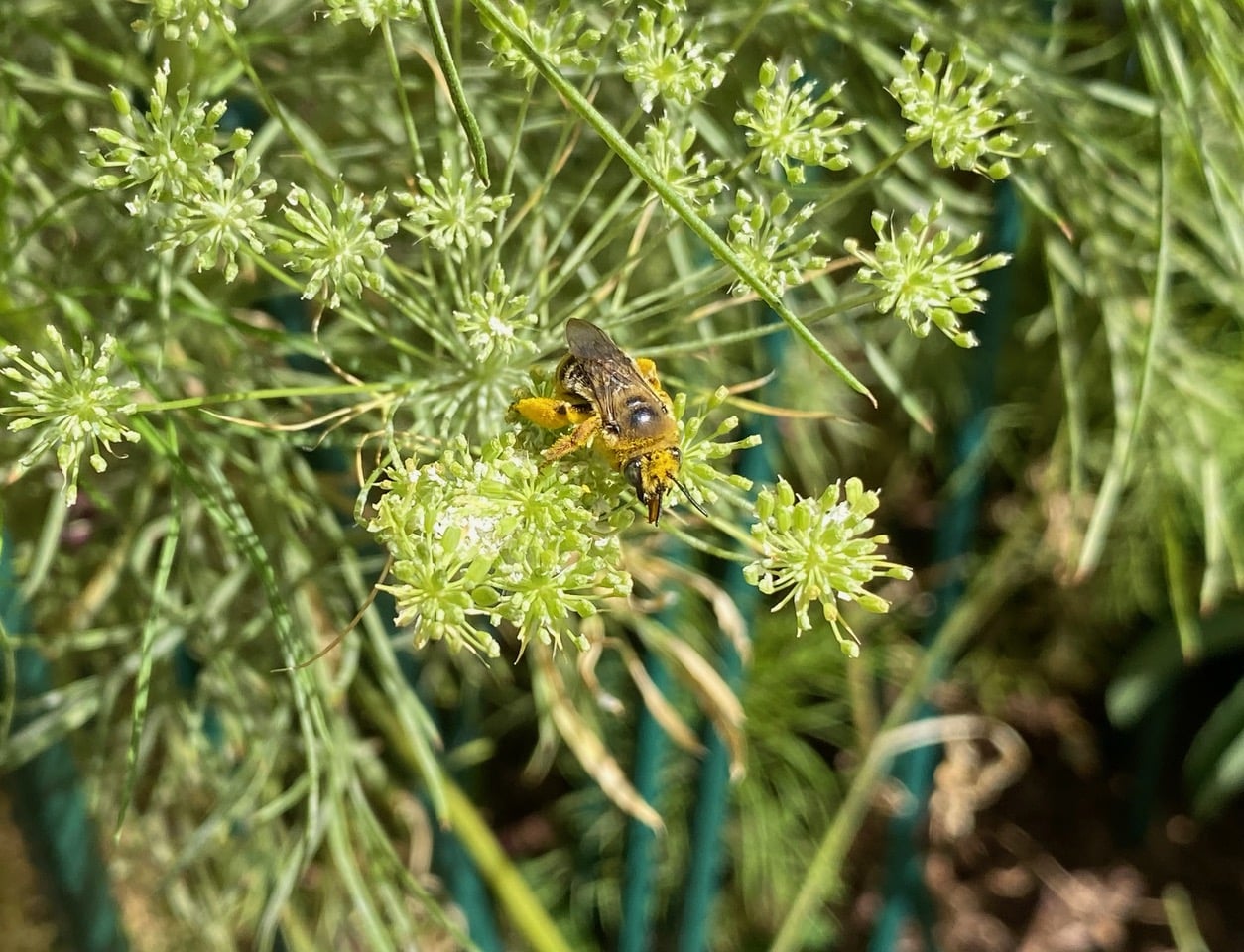
After foraging on Cosmos flowers, a pollen-covered female Longhorn Bee, Melissodes sp. lands on a flower umbel of an unidentified plant to clean her tongue.