

Pollinator Post 8/13/26

It’s a cool morning at Bay Farm Island. A female Fine Striped Sweat Bee, Agapostemon subtilior (family Halictidae) is forcing her way into a half-opened flowerhead of Bristly Oxtongue, Helminthotheca echioides. She is already carrying a pair of huge saddlebags of candy corn-colored pollen on her hind legs. A pollen generalist, she has apparently been collecting pollen from different flowers on this foraging trip. I wonder where the orange-colored pollen came from? Calandrinia flowers in the neighbors’ gardens?
The Fine Striped Sweat Bee, Agapostemon subtilior is a small, widespread species found across North America. They are active from late spring to fall, with all-green females measuring roughly 11 mm, and males (slightly smaller) displaying a black-and-yellow striped abdomen. Like other Agapostemon bees, they are solitary ground-nesters, and are polylectic, foraging from a wide variety of flowers.

Rows of purplish-brown aphids line several stems of this Bristly Oxtongue.
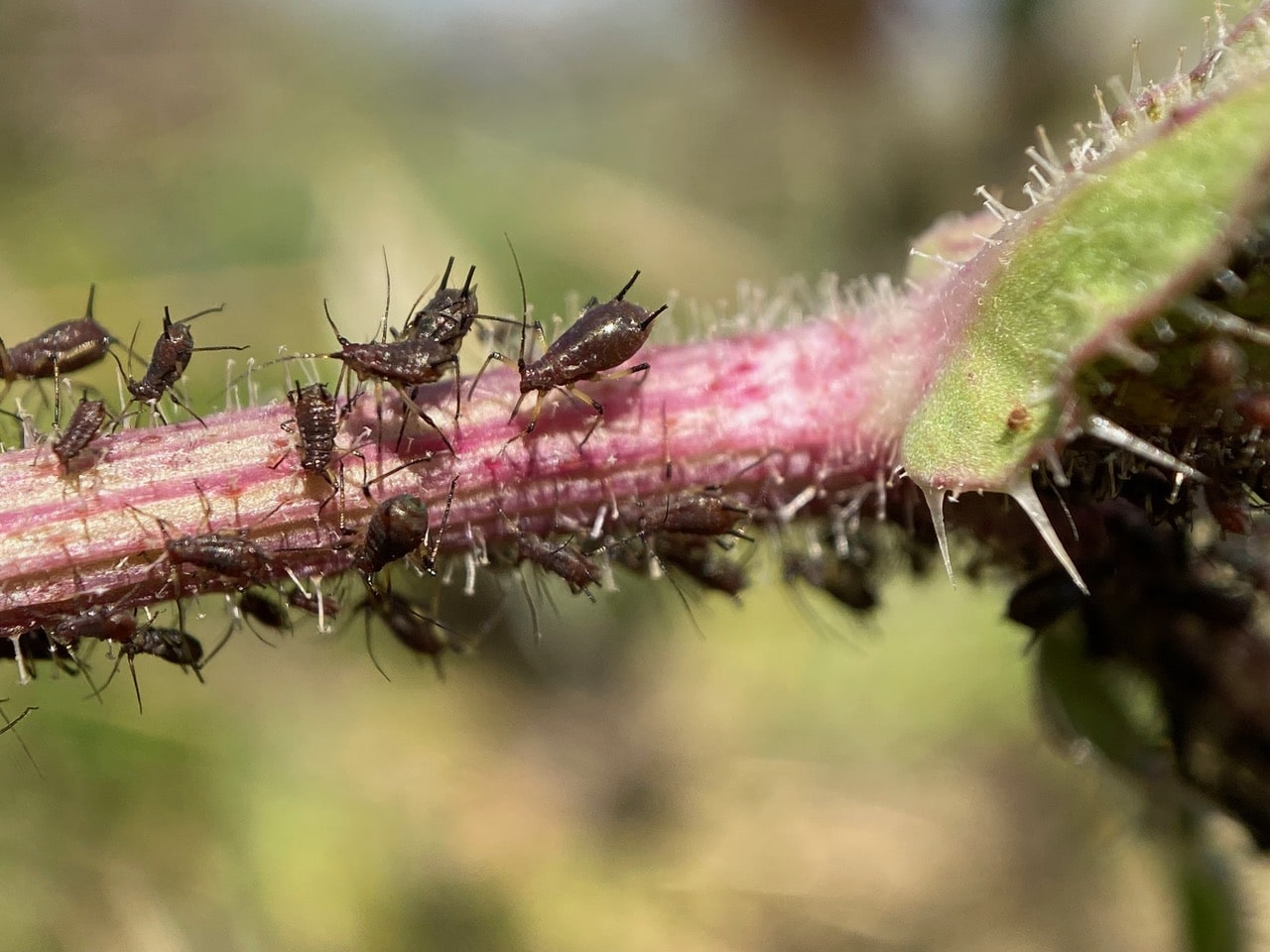
iNaturalist has helped identify the long-legged aphids with long cornicles (“tail pipes”) as the Sow-thistle Aphids, Uroleucon sonchi (family Aphididae).
Cornicles (also called siphunculi) are unique to aphids and are found on no other insects. These tiny, pipe-like structures project from the rear dorsal side of an aphid’s abdomen and serve as a key feature for identifying them. People often think cornicles produce the sticky honeydew, but honeydew actually comes from the aphid’s anus. Cornicles release a waxy fluid containing an alarm pheromone when a predator is near. Nearby aphids smell this chemical and drop off the plant or run away to safety. Some aphid species can use their long cornicles to smear sticky fluid directly onto an attacker’s face.
The Sow-thistle Aphid, Uroleucon sonchi (family Aphididae) is native to Europe, and has been introduced to several other countries. It primarily feeds on the sow thistle (genus Sonchus), but also on many plants in the Asteraceae family, including cultivated lettuce.
Aphids (family Aphididae) are small sap-sucking insects in the order Hemiptera. Aphids usually feed passively on phloem of plants. Once the phloem vessel is punctured, the sap, which is under pressure, is forced into the aphid’s food canal. Aphids produce large amounts of a sugary liquid waste called “honeydew”. A fungus called sooty mold can grow on honeydew deposits that accumulate on leaves and branches, turning them black.

A Spotless Lady Beetle is crawling around the flowerhead bracts of the Bristly Oxtongue, apparently hunting for aphids. Both adult and larval lady beetles are voracious predators of aphids and other soft-bodied insects.
The Spotless Lady Beetle, Cycloneda sanguinea (family Coccinellidae) is a widespread species of lady beetle in the Americas. It is is a large lady beetle with red, unspotted elytra (wing covers) ranging from 4-6.5 mm long. The black and white marks on the head and pronotum are very distinctive, and they are also gender-specific. Both adult and larvae of Spotless Lady Beetles are voracious predators of aphids. They are very often found feeding on aphids on milkweeds, but also occur on a number of other plants.

Ooh, that’s a Lady Beetle pupa attached to a dried Bristly Oxtongue flowerhead.
Lady Beetle pupae are not helpless creatures. The clefts between the sclerotized dorsal abdominal segments of the pupa act like gin traps that can snap shut like clamping jaws. The segments remain open at rest and snap shut via a reflex arc when touched by small predators such as ants. The sudden snapping motion pinches the attacker or startles it, often causing the entire pupa to jerk or flip into an upright stance to fend off threats.

Here’s an older, darker lady beetle pupa.

This fresh Lady Beetle pupa is lodged beautifully in a spent seed head of the Bristly Oxtongue. At this stage the pupa is still soft and able to move a little when disturbed, flexing its body to startle potential predators.

While photographing the aphids, I notice an orange creature in the background to the right.

Here’s another slug-like orange creature underneath a dead aphid.

Two more here. I recognize them as the larvae of the Aphid Midge, Aphidoletes aphidimyza (family Cecidomyiidae).

I find more of them under an immature flowerhead. Note the aphid carcasses around them. Are these midge larvae responsible for all this mayhem?
The orange creatures are the larvae of the Aphid Midge, Aphidoletes aphidimyza (family Cecidomyiidae). Cecidomyiidae are usually known as gall midges, with larvae that live and feed within plant galls. The Aphid Midge is sort of an oddball within the family. Instead of growing up in a gall, it is a free-roaming aphid hunter.
The Aphid Midge, Aphidoletes aphidimyza is a midge whose larvae feed on over 80 aphid species. The adults are small, less than 3.2 mm long, black, delicate, short-lived flies that feed on aphid honeydew. They hide beneath the leaves during the day, and are active at night. Females deposit 100-250 tiny shiny orange eggs among aphid colonies that hatch in 2-3 days. After 3-7 days the larvae drop to the ground to pupate in the soil. The small, bright orange, slug-like larvae inject a toxin into aphids’ leg joints to paralyze them and then suck out the aphid body contents through a hole bitten in the thorax. Larvae can consume aphids much larger than themselves and may kill more aphids than they eat when aphid populations are high. A single larva grows up to 3.2 mm long and kills 4-65 aphids a day. The life cycle from egg to adult can be completed in about 3 weeks, with multiple generations per year. The Aphid Midge is commercially available, widely used in biological control programs for greenhouse crops and orchards.
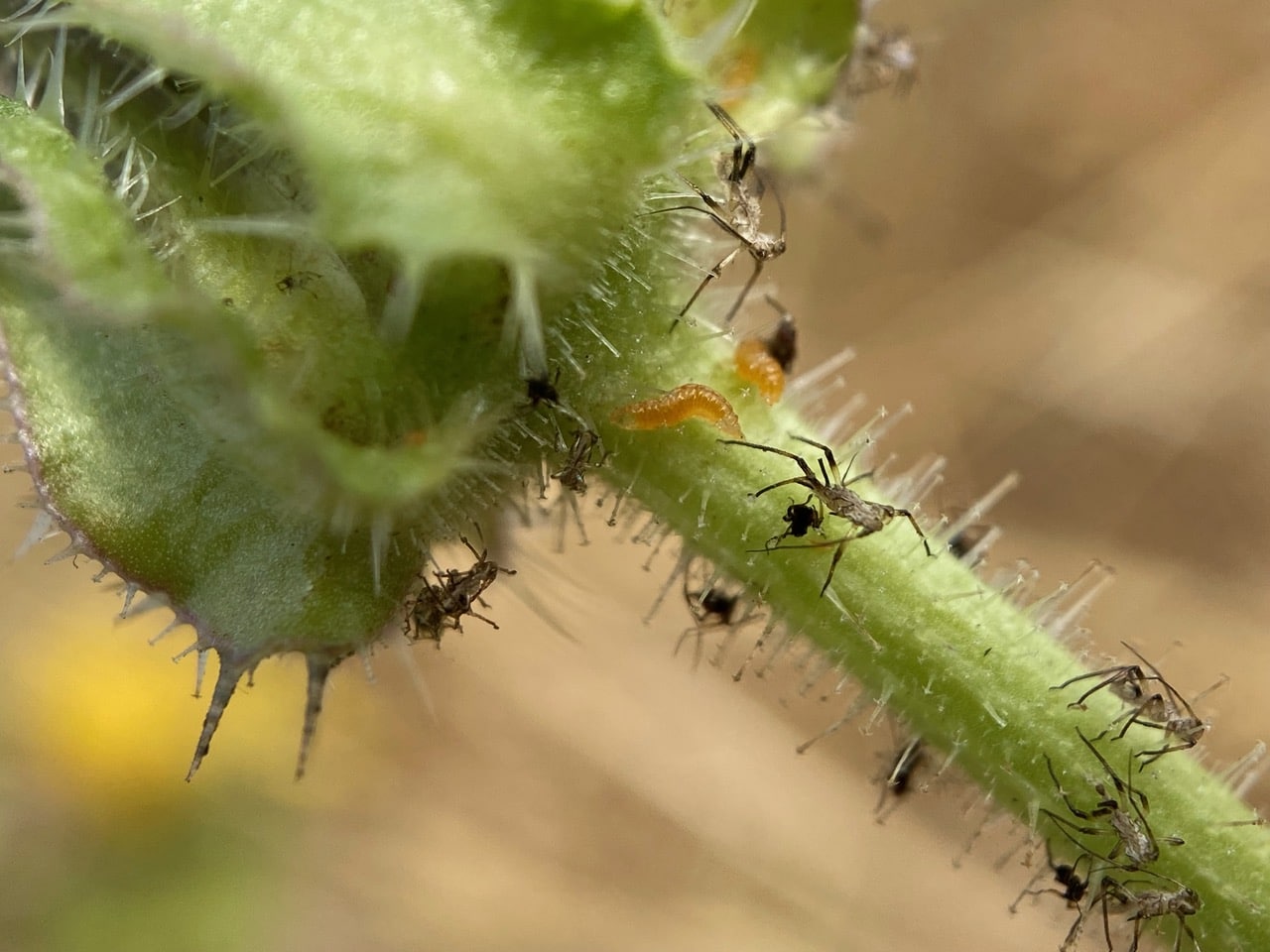
I watch as an Aphid Midge larva thrashes around and finally latches on to a leg of a dead aphid.
Aphid midge larvae lack functional eyes and are effectively blind. They sweep and tap their headless-looking front segments back and forth along the plant surface. They detect the close proximity of aphids by sensing chemicals and movement in the colony. Once they bump into an aphid, they quickly bite a leg joint and inject a paralyzing venom.
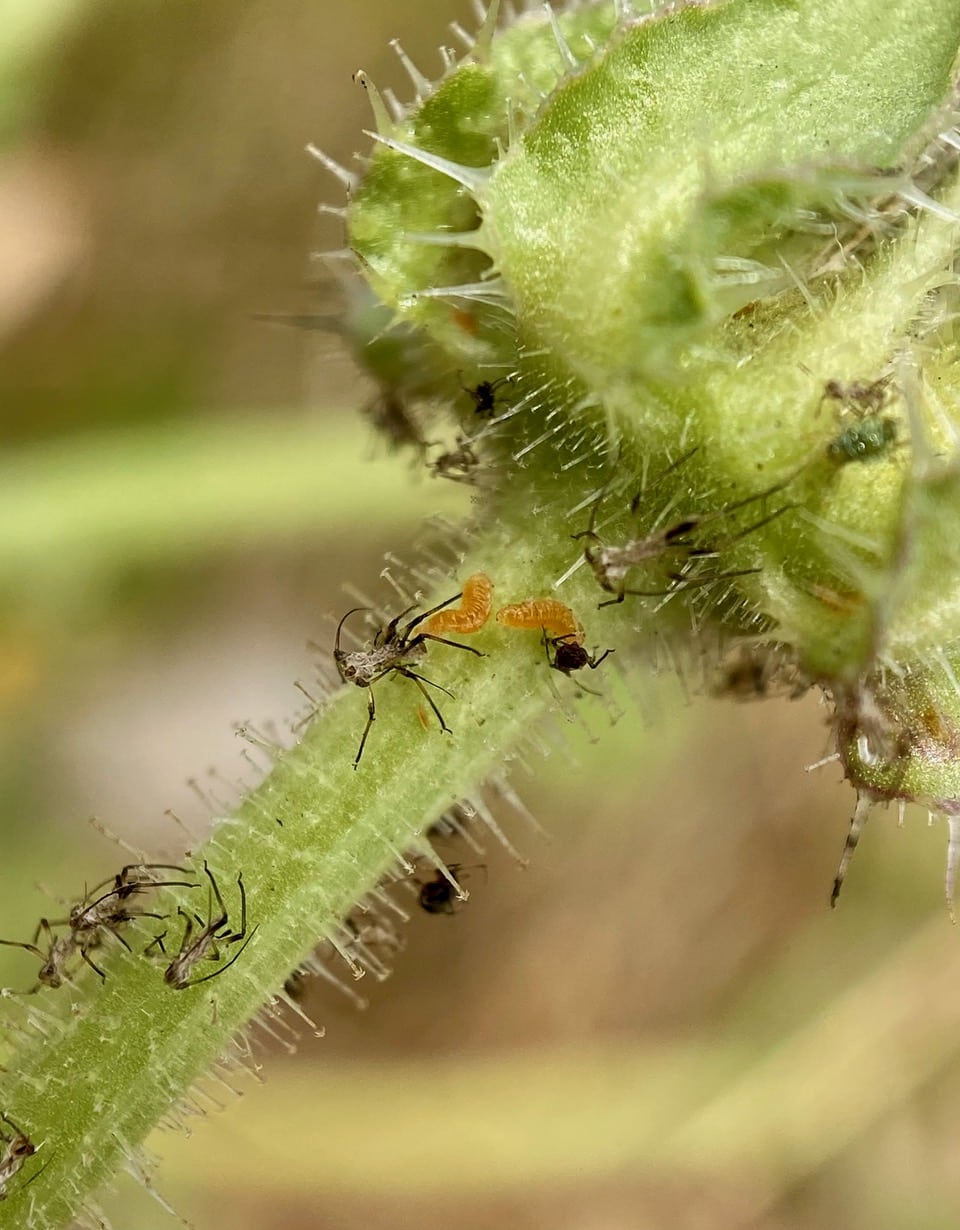
The same midge larva proceeds to attack the body of the aphid. It must be disappointing for it to find that the aphid is a mere husk, having already been drained of its body contents. Is the midge larva exhibiting a fixed action pattern (FAP) – a fixed sequence of behavior driven by instinct? Wow, these are compulsive, tenacious aphid predators!

Look, a mama aphid is giving birth!
A typical life cycle involves flightless females giving live birth to female nymphs, – who may also be already pregnant, an adaptation called telescoping generations – without the involvement of males. Maturing rapidly, females breed profusely so that the population multiplies quickly. Winged females may develop later in the season, allowing the insects to colonize new plants. In temperate regions, a phase of sexual reproduction occurs in the autumn, with the insects often overwintering as eggs. The life cycle of some species involves an alternation between two species of host plants. Some species feed on only one type of plant, while others are generalists, colonizing many plant groups. Some ants have a mutualistic relationship with aphids, tending them for their honeydew and protecting them from predators.
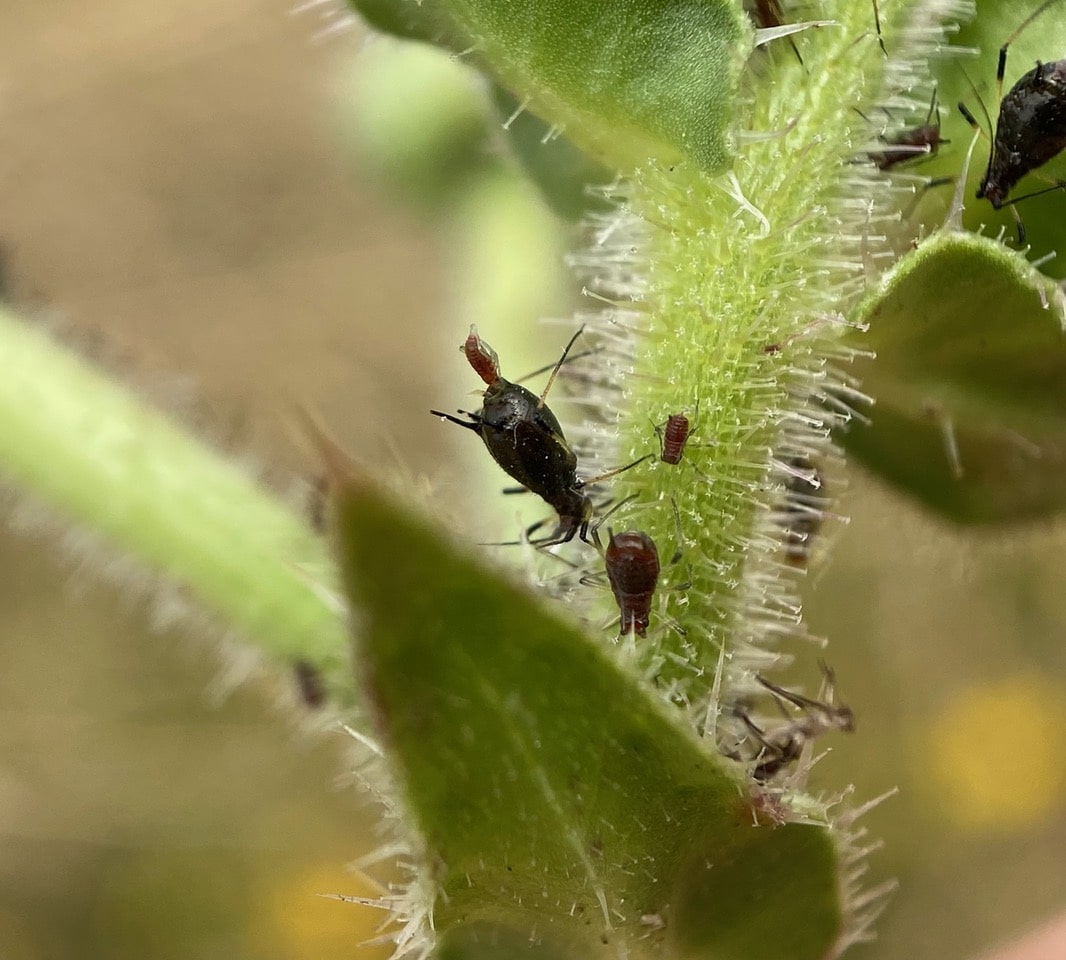
Ooh, here’s another birthing event! Aphid babies are born breech, meaning they come out rear-end first. This newborn is beginning to extend its legs, ready for the landing. Soon the baby will be gently lowered onto the substrate, not casually dropped.
Aphids reproduce with extreme speed via a process where females give birth to live, clonal, already-pregnant daughters without mating (parthenogenesis). This “telescoping of generations” allow nymphs to mature in roughly 10 days, with a single female producing up to 12 offspring daily. Under ideal conditions, a single aphid can theoretically produce hundreds of billions of descendants in a season. The aphid’s fecundity is their major contribution to the ecosystem, feeding a large number of organisms (mainly other insects) further up the food chain.

Do you see the small, white, rice-grain-shaped object on the leafy bract close to the aphids? I occasionally find these when I am looking closely at aphids under high magnification. They are the eggs laid by female Hover Flies (family Syrphidae).
Female hover flies of many species like to lay their eggs near aphid colonies to ensure an abundance of food for their aphidophagous offspring when they hatch. White, and shaped like miniature rice grains, Syrphid eggs are usually laid singly, scattered so that the larvae that hatch out wouldn’t have to compete with each other for food. Each larva can eat about 100 to 400 aphids before it pupates, depending on the species and size of the Syrphid relative to the aphids.

Clouds are rapidly gathering overhead, and the winds have picked up. Alas, it’s time to head home!