

Pollinator Post 8/13/23 (2)

It’s a hot day. By the time I reach the tarweed patch below the Water Tank at 10:30 am, most of the Elegant Tarweed, Madia elegans already look wilted and tired. There are some of the usual visitors to the flowers, but I decide to focus on the Coast Tarweed, Madia sativa today.

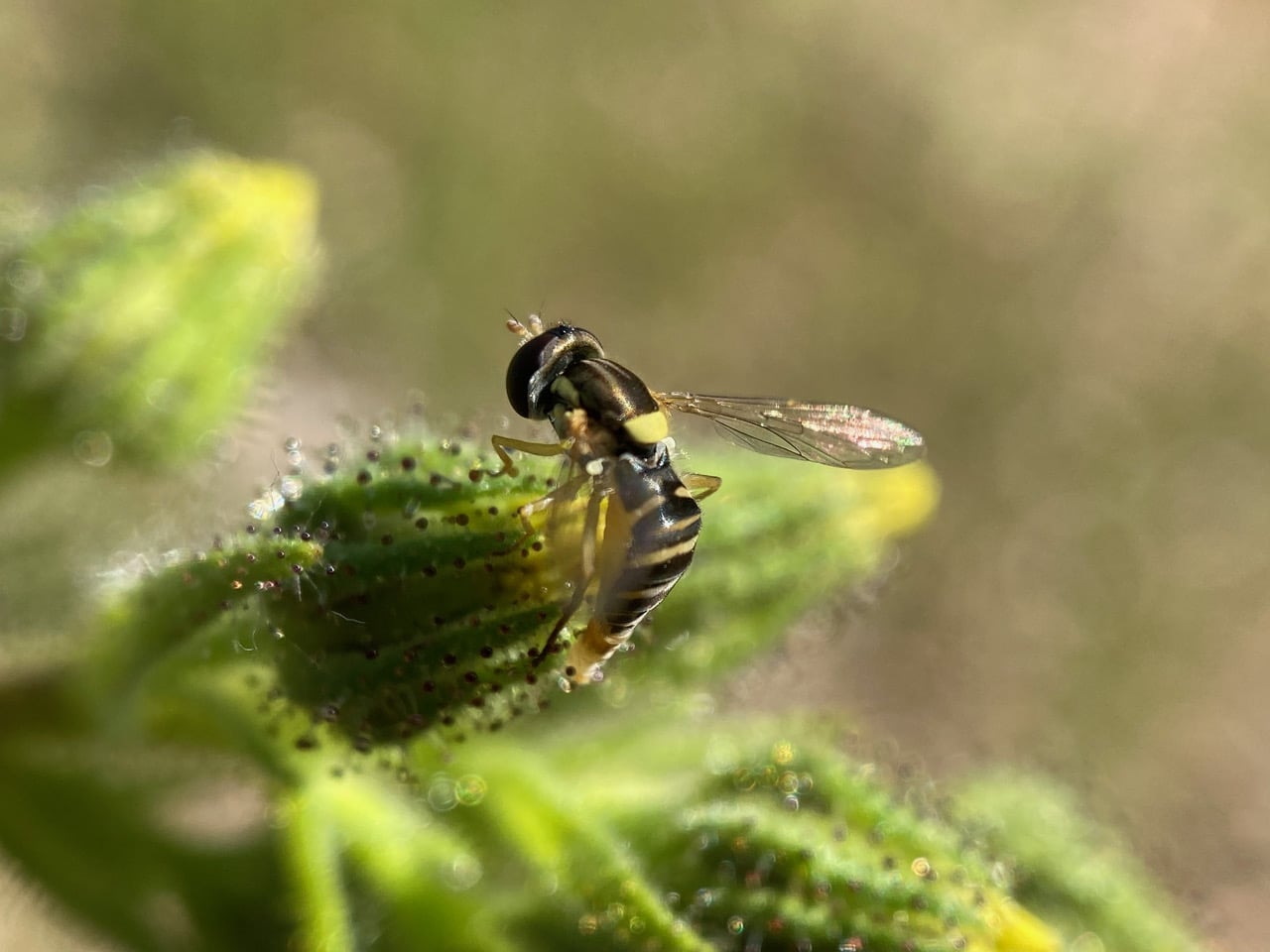 A female Forked Globetail, Sphaerophoria sulphuripes (family Syrphidae) hovers slowly around, scanning the plant. She eventually lands on an immature flowerhead and angles her abdomen forward to lay an egg. The larvae of Globetail Hover Flies are voracious predators of aphids. Females seek out plants with aphid infestation and lay their eggs among or near the aphid colony. Syrphid eggs are usually laid singly, so that the larvae won’t have to compete with each other for prey.
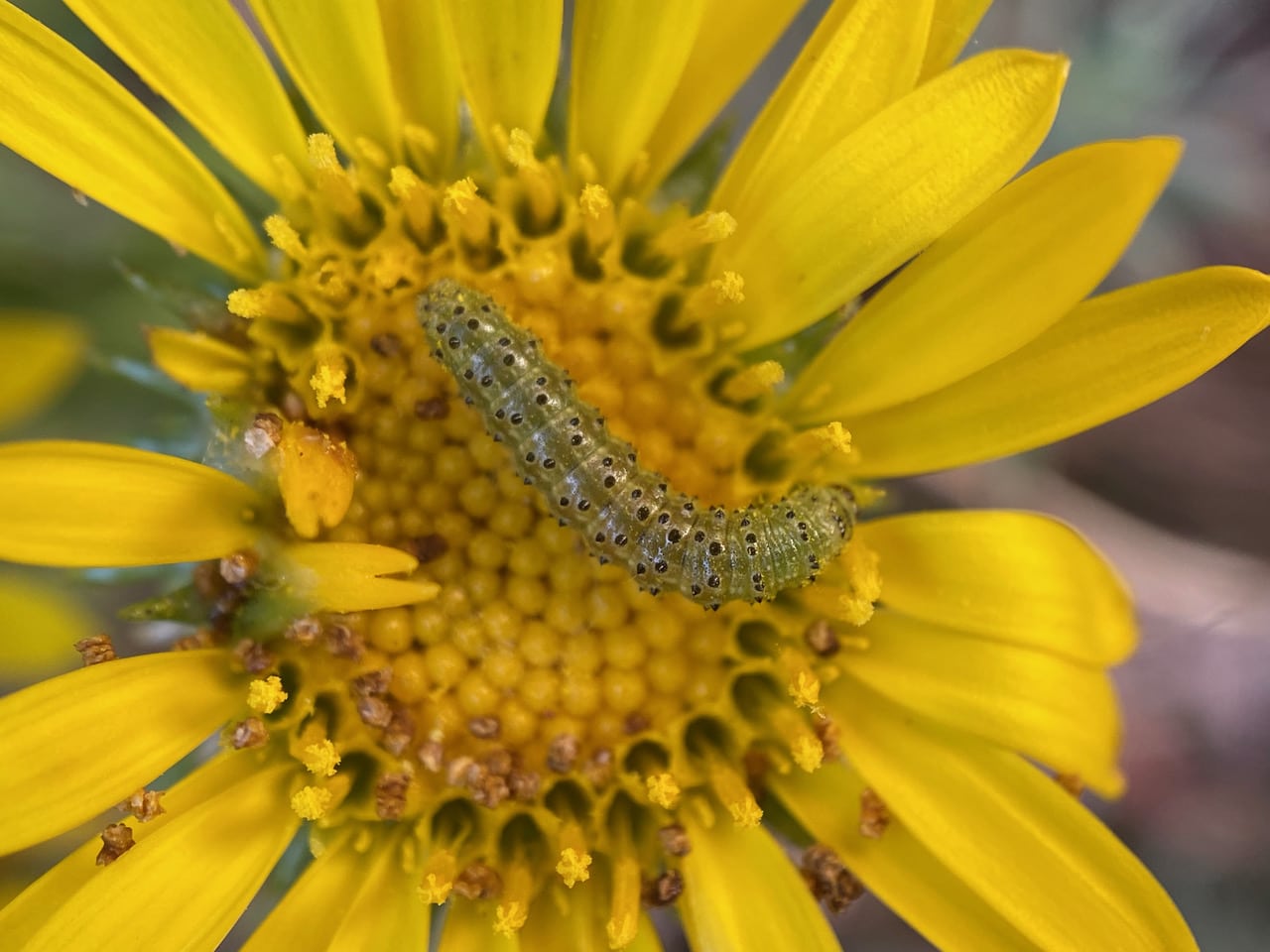 Back at my own home garden, the Gum Plant, Grindelia sp. is blooming gloriously, attracting a slew of insects. A Small Owlet Moth caterpillar, Heliothodes diminutiva (family Noctuidae) is feeding on one of the flowerheads.




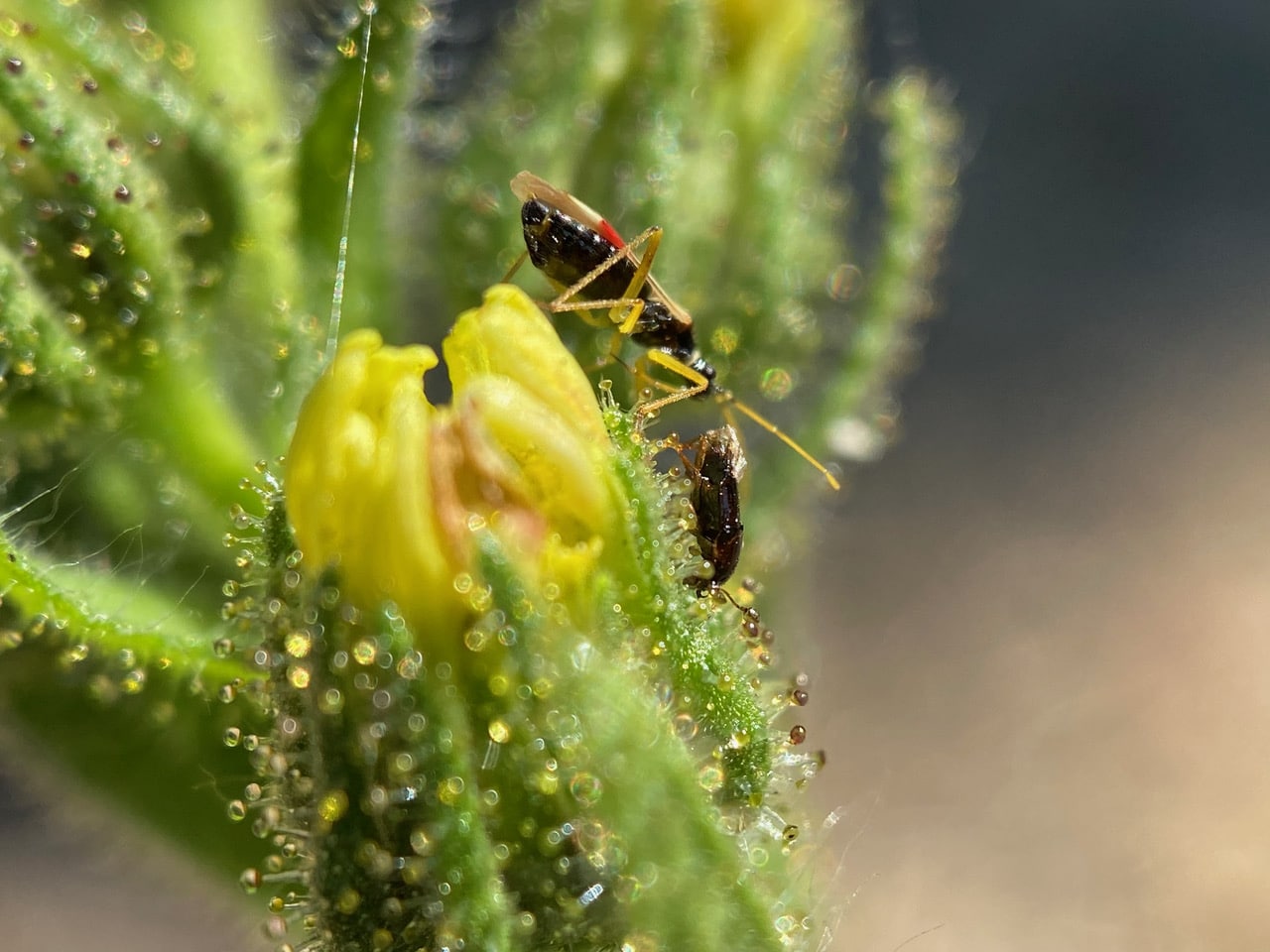
A Phacelia Plant Bug, Tupiocoris californicus (family Miridae) is checking out what looks like a dead insect on a flowerhead of Coast Tarweed. I think the Plant Bug might not be strictly herbivorous, but a part-time scavenger.
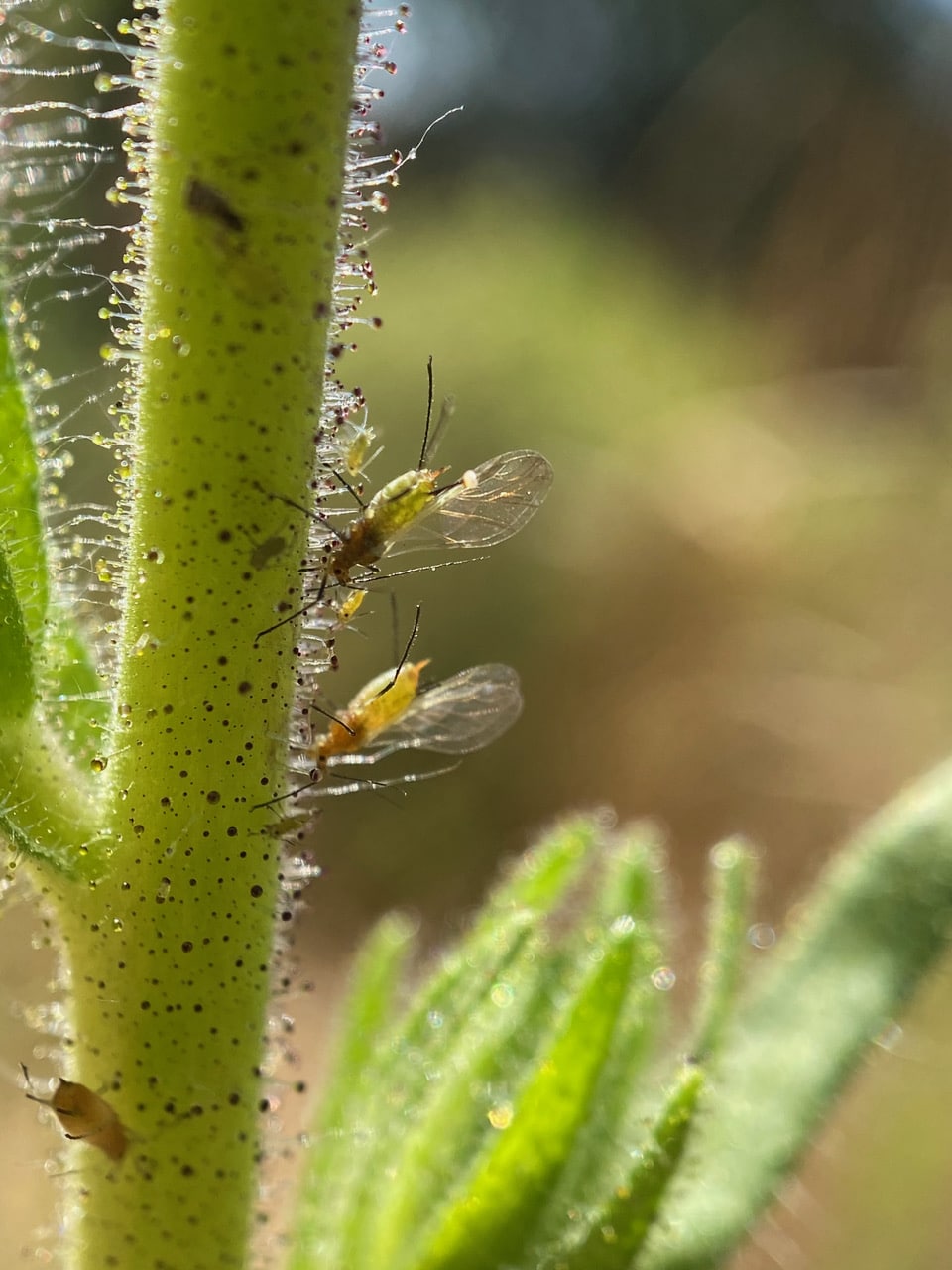
Ooh, winged aphids on the stem of Coast Tarweed! New arrivals? These look like the ones I found on the plants at Siesta Gate last year. Probably Macrosiphum sp. (family Aphididae). They seem to be immune to the sticky exudates of the plant.
Reproduction is already taking place. There’s nothing like aphids to jump start the food web of an ecosystem!
Aphids have many generations a year. Most aphids in California’s mild climate reproduce asexually throughout most or all of the year with adult females giving birth to live offspring – often as many as 12 per day – all clones of the mother. The young aphids or nymphs molt, shedding their skin about four times before becoming adults. When the weather is warm, many species can develop from newborn to reproductive adult in 7-8 days. Because each adult aphid can produce up to 80 offspring in a matter of a week, aphid populations can increase in staggering speed.
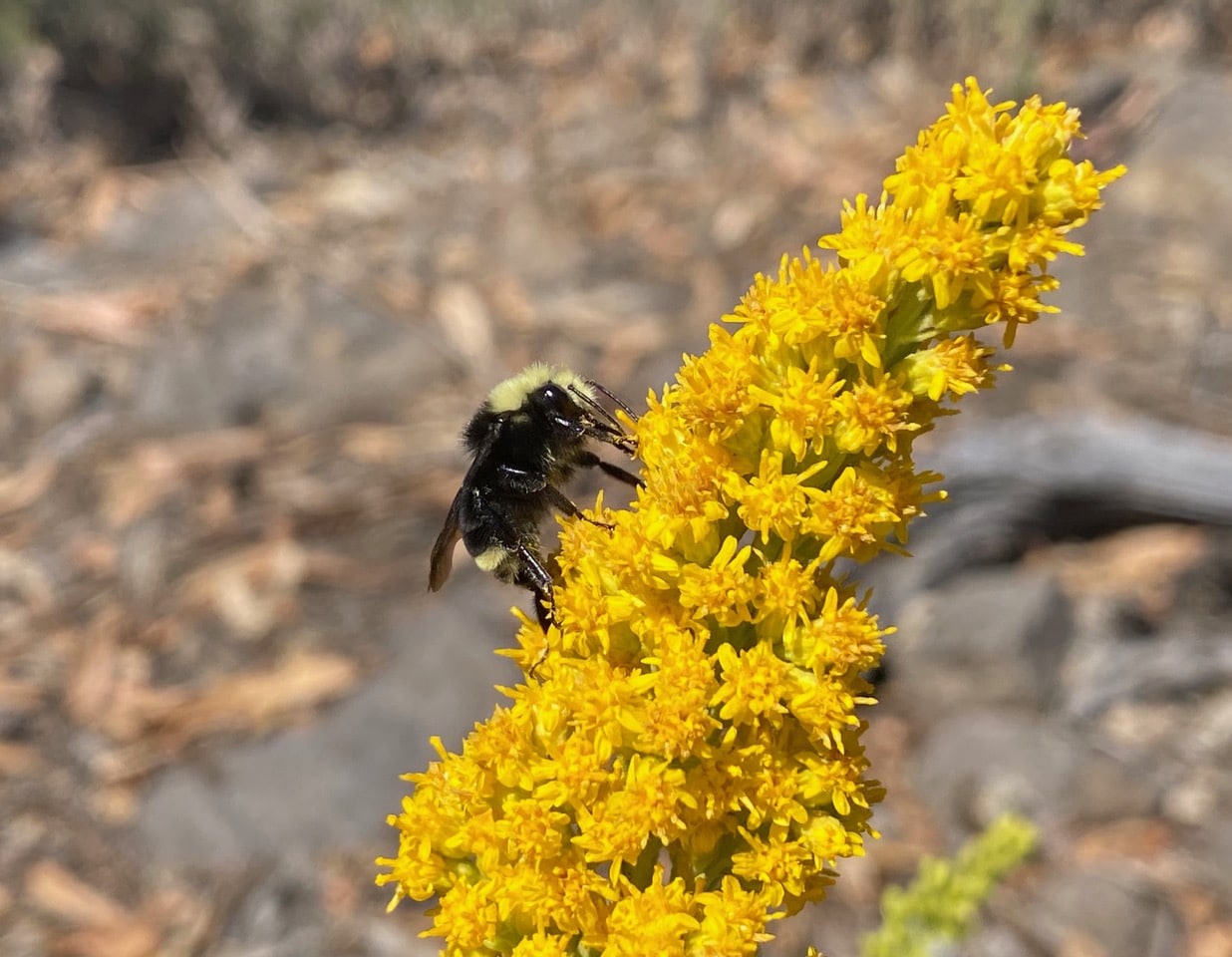
A female Forked Globetail, Sphaerophoria sulphuripes (family Syrphidae) hovers slowly around, scanning the plant. She eventually lands on an immature flowerhead and angles her abdomen forward to lay an egg. The larvae of Globetail Hover Flies are voracious predators of aphids. Females seek out plants with aphid infestation and lay their eggs among or near the aphid colony. Syrphid eggs are usually laid singly, so that the larvae won’t have to compete with each other for prey.Along the paved road from Water Tank, many of the California Goldenrod, Solidago velutina ssp. californica are already blooming. A Yellow-faced Bumble Bee, Bombus vosnesenskii is taking nectar from an inflorescence.
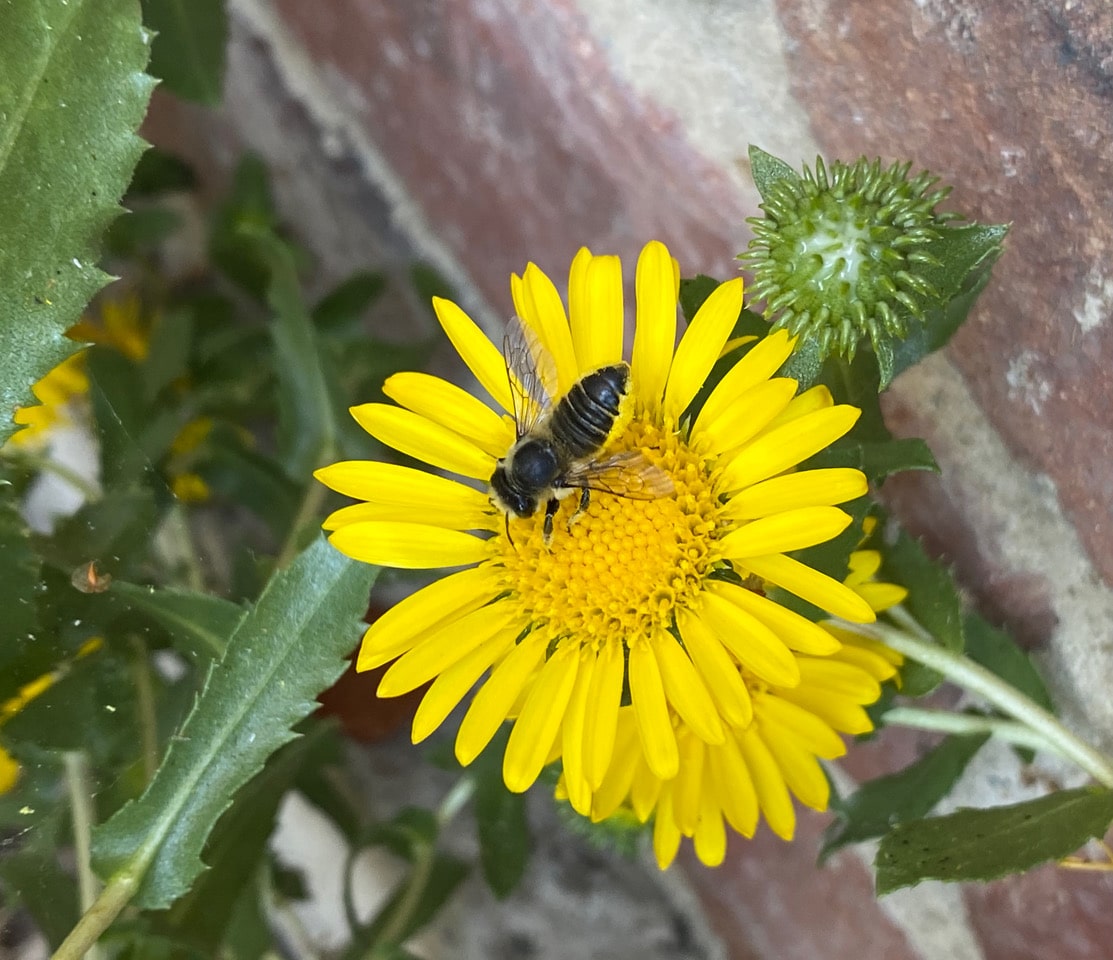
Back at my own home garden, the Gum Plant, Grindelia sp. is blooming gloriously, attracting a slew of insects. A Small Owlet Moth caterpillar, Heliothodes diminutiva (family Noctuidae) is feeding on one of the flowerheads. Wings spread apart and abdomen held high, a female Western Leafcutting Bee, Megachile perihirta (family Megachilidae) is foraging on a Gum Plant flowerhead. Note the yellow pollen coating the underside of her abdomen.
Members of the family Megachilidae (which includes Mason Bees as well as Leafcutter Bees) are unique among bees in having their scopae (special pollen-collecting hairs) on the underside of their abdomen, instead of on their hind legs like most other bees.
It is fairly easy to tell the sexes of the Leafcutter Bees, even though neither male nor female have scopae on their legs. Males do not collect pollen, so will not show pollen on their belly. The females are larger than the males and have a triangular shaped abdomen that ends in a point. The males can be identified by their smaller, blunt-tipped abdomen and longer antennae.
The Leaf-cutter Bee has a larger head than most bees due to extra muscles they have developed to help them cut through leaves. This is not as evident in the males as they do not construct nests and thus do not cut leaves.
Leafcutting Bees love flowers in the sunflower family, Asteraceae because the small flowers are densely packed together in a flowerhead. All the female has to do is to walk over these flowers and tap her abdomen rapidly and lightly on the anthers to gather pollen on her belly.
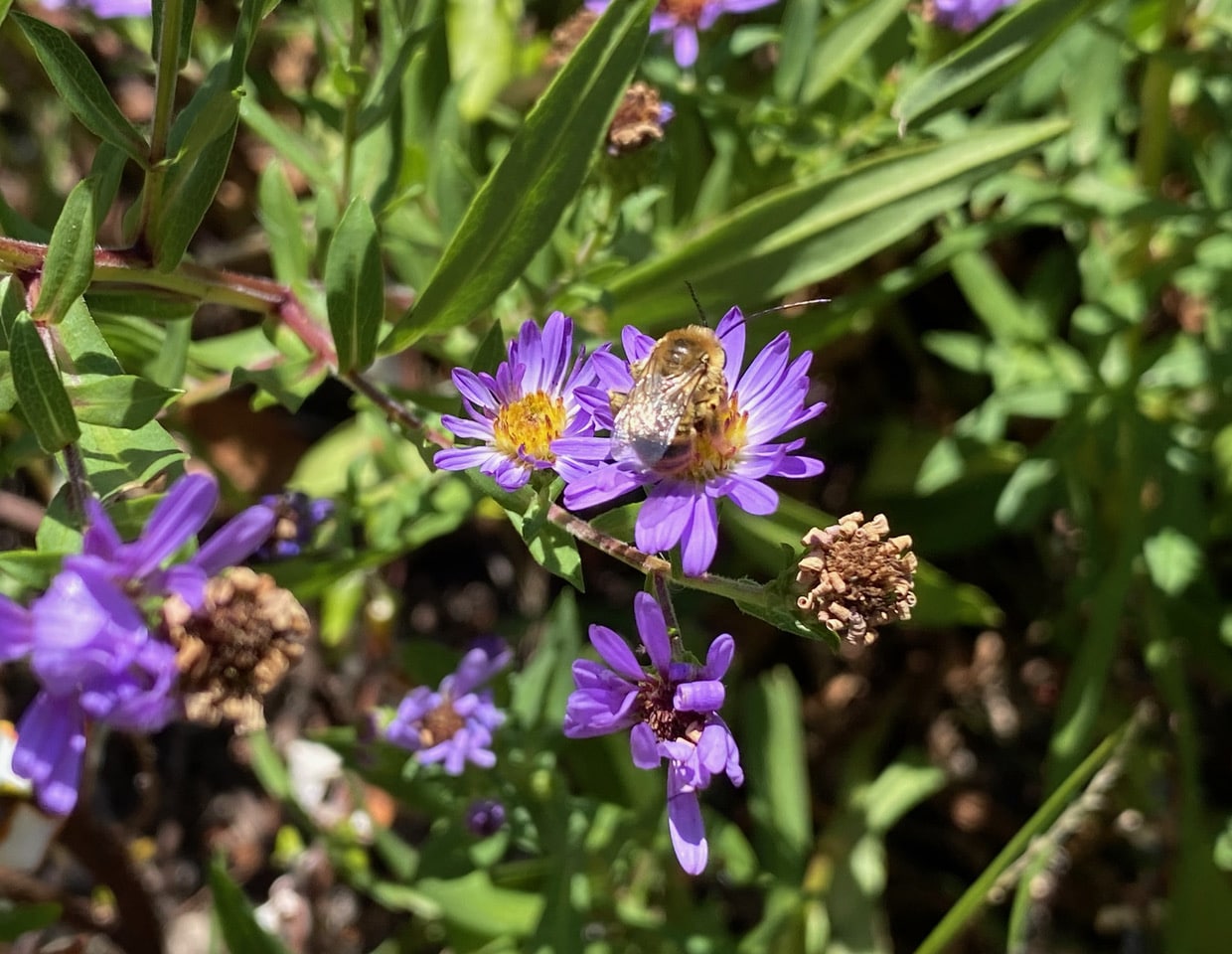
A male Summer Longhorned Bee, Melissodes sp. (family Apidae) is feeding on an Aster flowerhead. Note the long antennae that give rise to their common name. The antennae of the females are not particularly long. This individual is mostly brown.
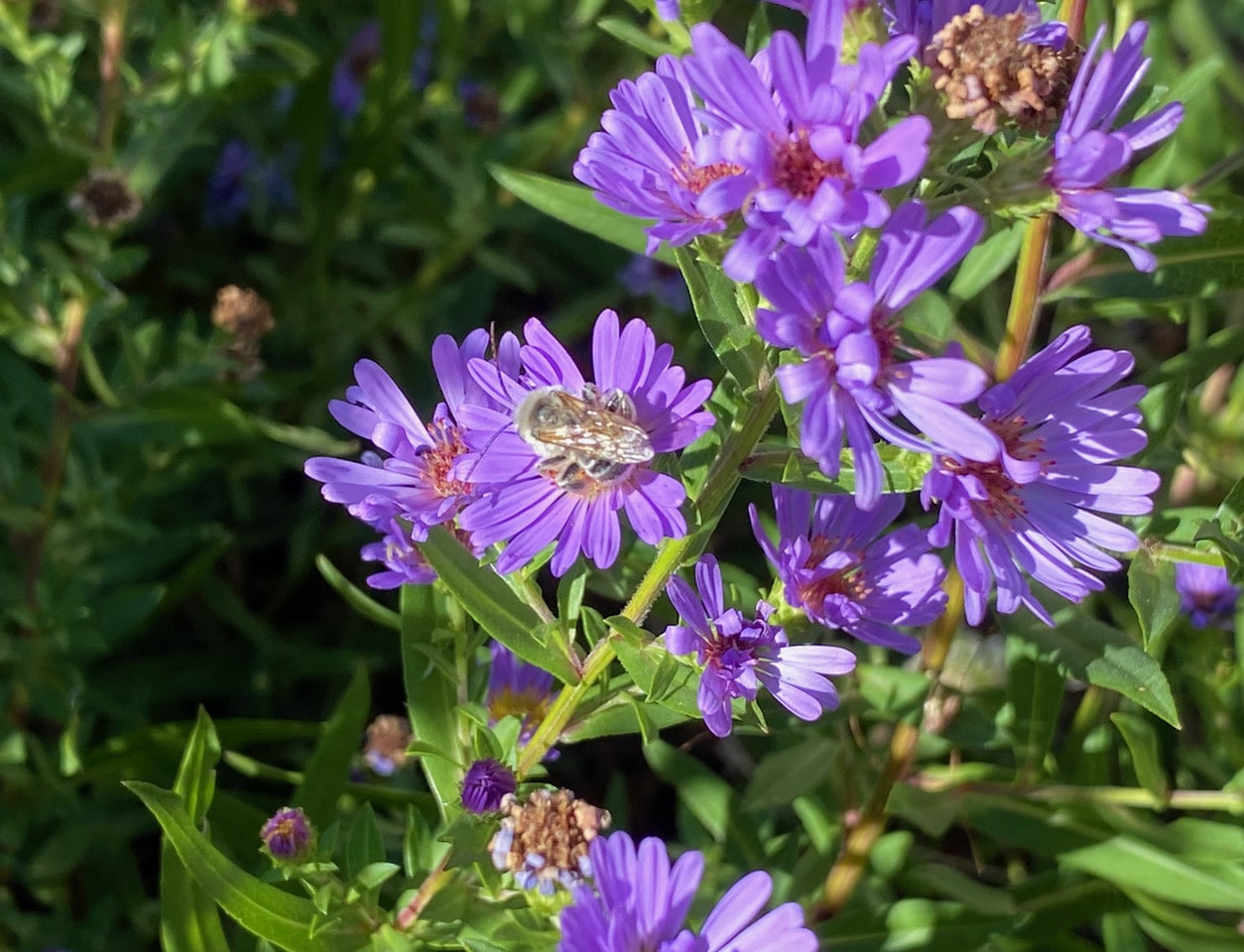
Another male Longhorned Bee is visiting an Aster flowerhead. Note that his coloring is more silvery gray. There’s a wide variation in the hair color of these bees, ranging from brown to gray. The male Longhorned Bees have the endearing habit of sleeping together in aggregation, clinging to a flower or vegetation through the night. Early in the morning, it is not unusual to find an aggregation of a dozen males still sleeping soundly on a flowerhead.
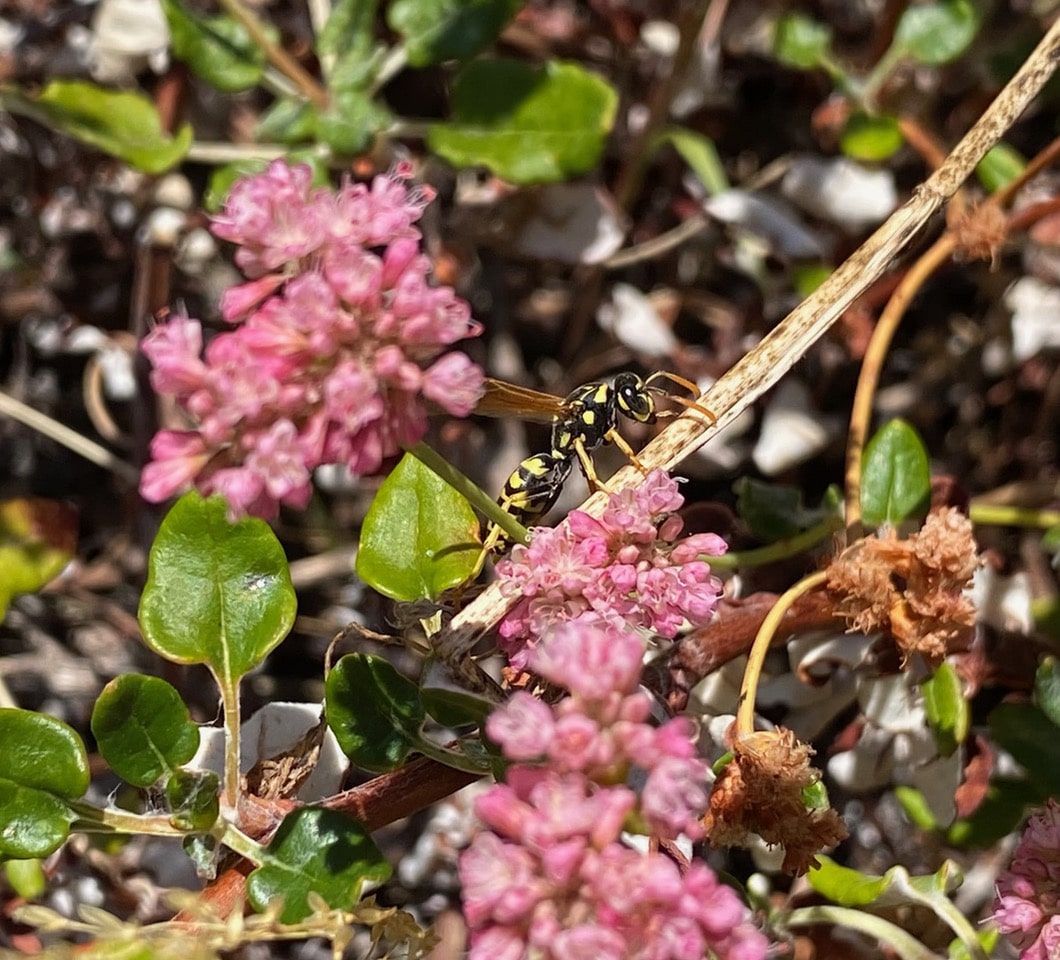
The Red-flowering Buckwheat, Eriogonum grande var. rubescens in my garden is blooming and attracting many insects including several species of wasps. See the black-and-yellow wasp on the dried flower stalk? That’s not a Yellowjacket, but a European Paper Wasp, Polistes dominula.
European Paper Wasps are yellow and black, and they sting, so they are frequently mistaken for yellowjackets (Vespula spp.). Paper wasps have slender bodies with a thin waist, and they have orange-tipped antennae. Yellowjackets have shorter, thicker bodies, and they have black antennae. Paper wasps dangle their long legs when they fly, while the yellowjackets tuck their legs under their bodies when they fly. Paper wasp nests resemble an open honeycomb or upside-down umbrella. They often build their nests on man-made structures such as eaves or lawn furniture. Yellowjacket nests are covered with a surrounding envelope of paper; the nests have a single opening that is often hard to see because the nest in underground.
Native to Europe, the European Paper Wasp, Polistes dominula, is a social insect that produces an annual colony in a paper nest. Individual colonies are established anew each spring. The overwintering stage are mated females (queens). The overwintered queens emerge from sheltered spots in spring and search out sites to establish a new colony. Nests are constructed of paper, produced from chewed wood fibers of weathered fences, porch decks and other similar sources. Larvae are fed crushed insects, usually caterpillars. As the population increases, the original queen increasingly remains in the nest as new workers take over colony activities. A few of the wasps produced later in summer are males and increasing numbers of the females become sexually mature. Mating occurs and the mated females are the surviving overwintering stage. Males and non-reproductive females do not survive winter and the nest is abandoned by late fall. European Paper Wasps will sometimes feed on sweet materials, including honeydew produced by aphids. They may also feed on damaged ripe fruits. Because of their habit of hunting caterpillars, the wasps have become one of the most important natural controls of garden pests.
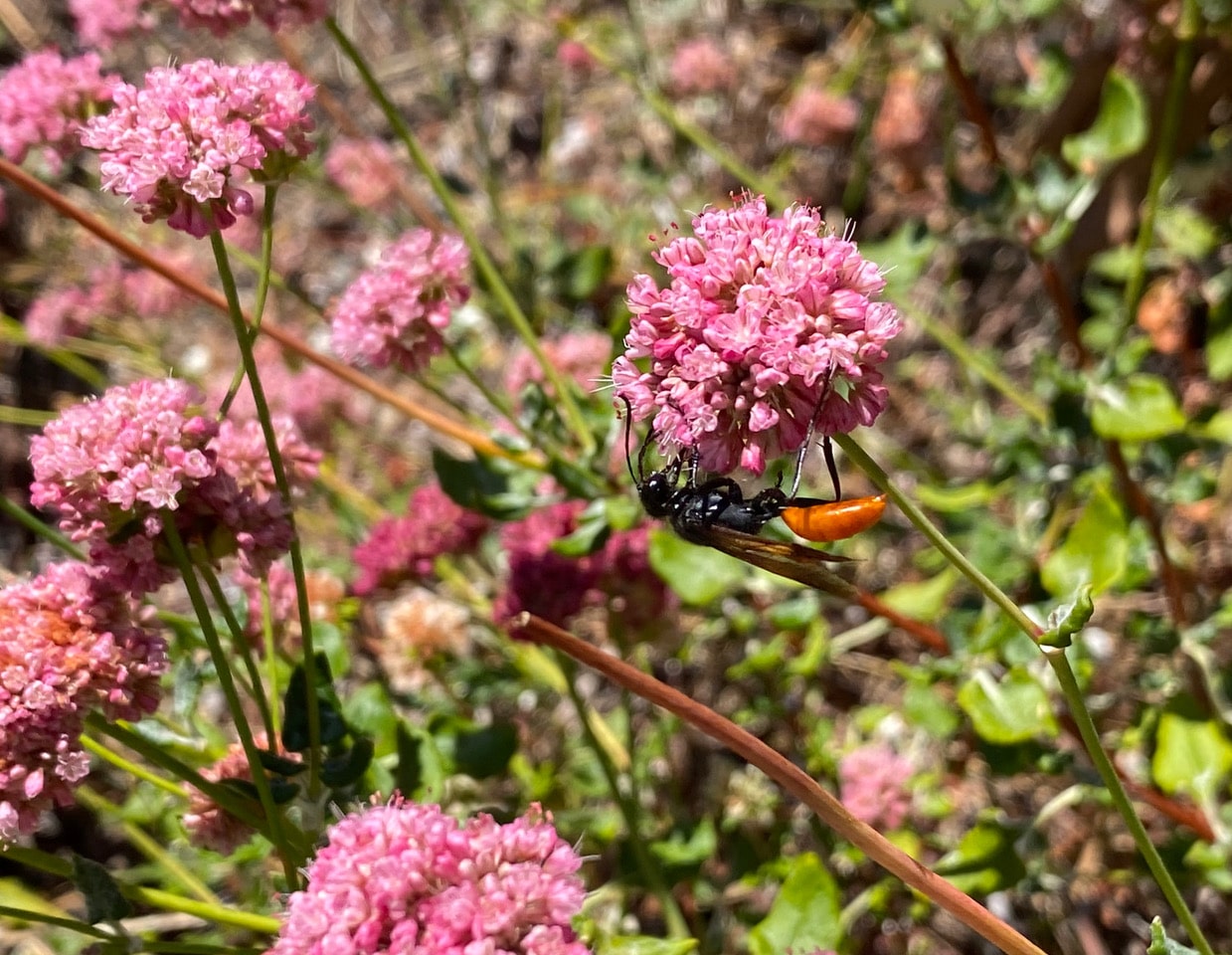
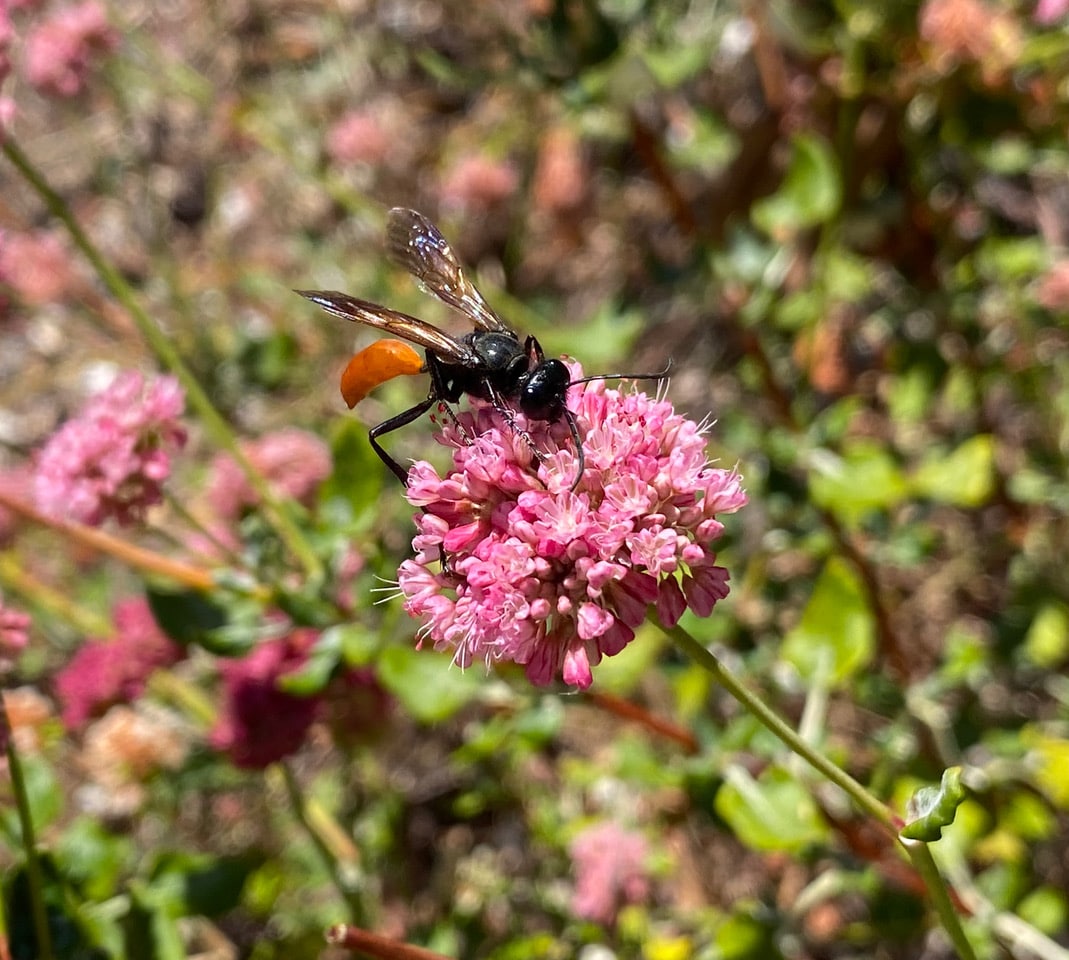
A female Burrowing Wasp, Sphex lucae (family Sphecidae) is taking nectar from the buckwheat flowers.
The Sphecidae are solitary wasps with elongated and narrow first abdominal segment, giving rise to the common name Thread-waisted Wasps. Sphex lucae is a widespread western species, ranging from WA in the north, south to CA, and east to TX. The species exhibits sexual dimorphism – females are black with a red abdomen, while the males are all black. Adults visit many types of flowers for nectar. Females hunt katydids as food for their young. The wasp excavates a single-celled burrow in the soil in advance of hunting activities. She drags her paralyzed prey back to the burrow, laying a single egg on the victim. The nest entrance is then sealed and the process is repeated. Males of this species spend nights in sleeping aggregations in sheltered places such as beneath a rock overhang.