

Pollinator Post 8/13/23 (1)
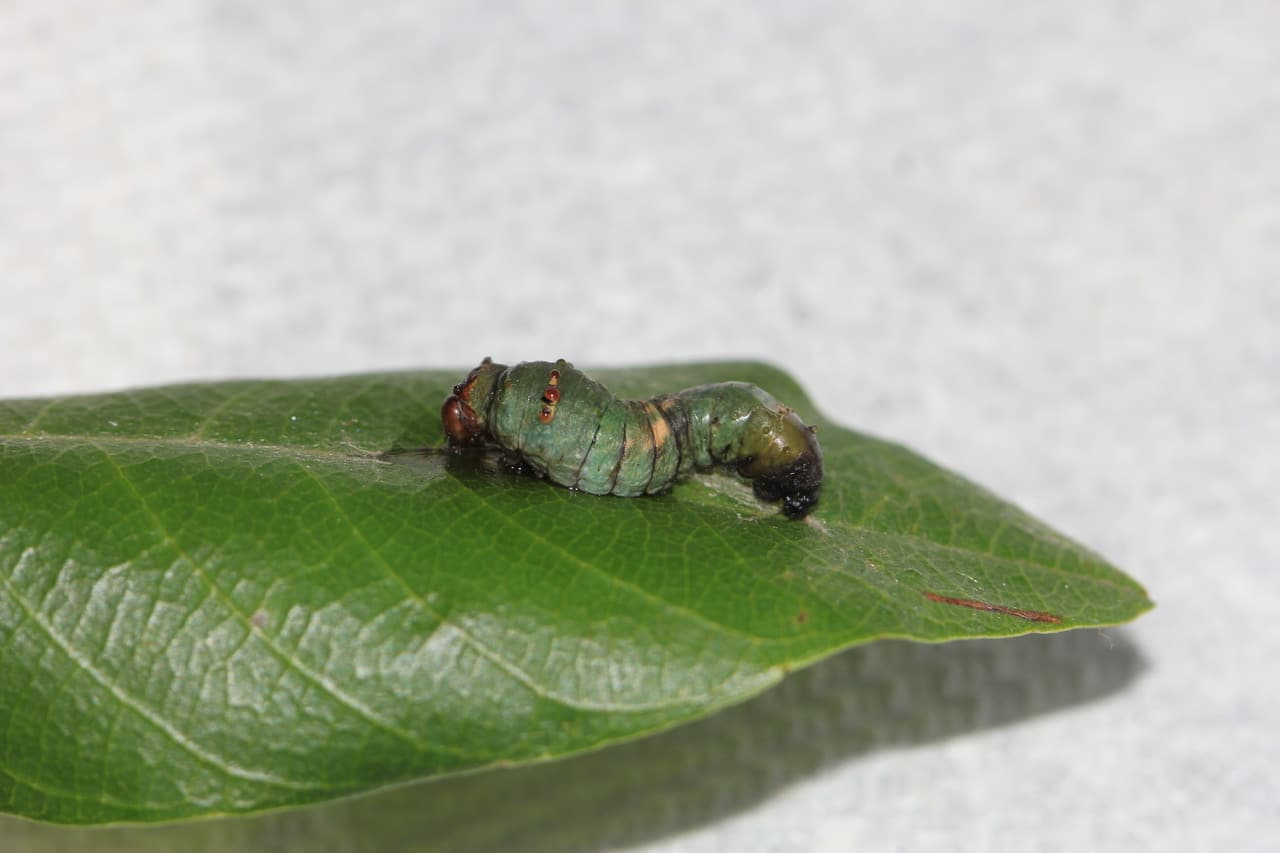
I have sad news. Alan reported that Cinch, the Pale Swallowtail caterpillar did not make it past its next molt, despite our best efforts to save its life. I am heart broken. I feel an urge to visit Blue, Cinch’s sibling who shares the same Coffeeberry, to make sure that it is alright.
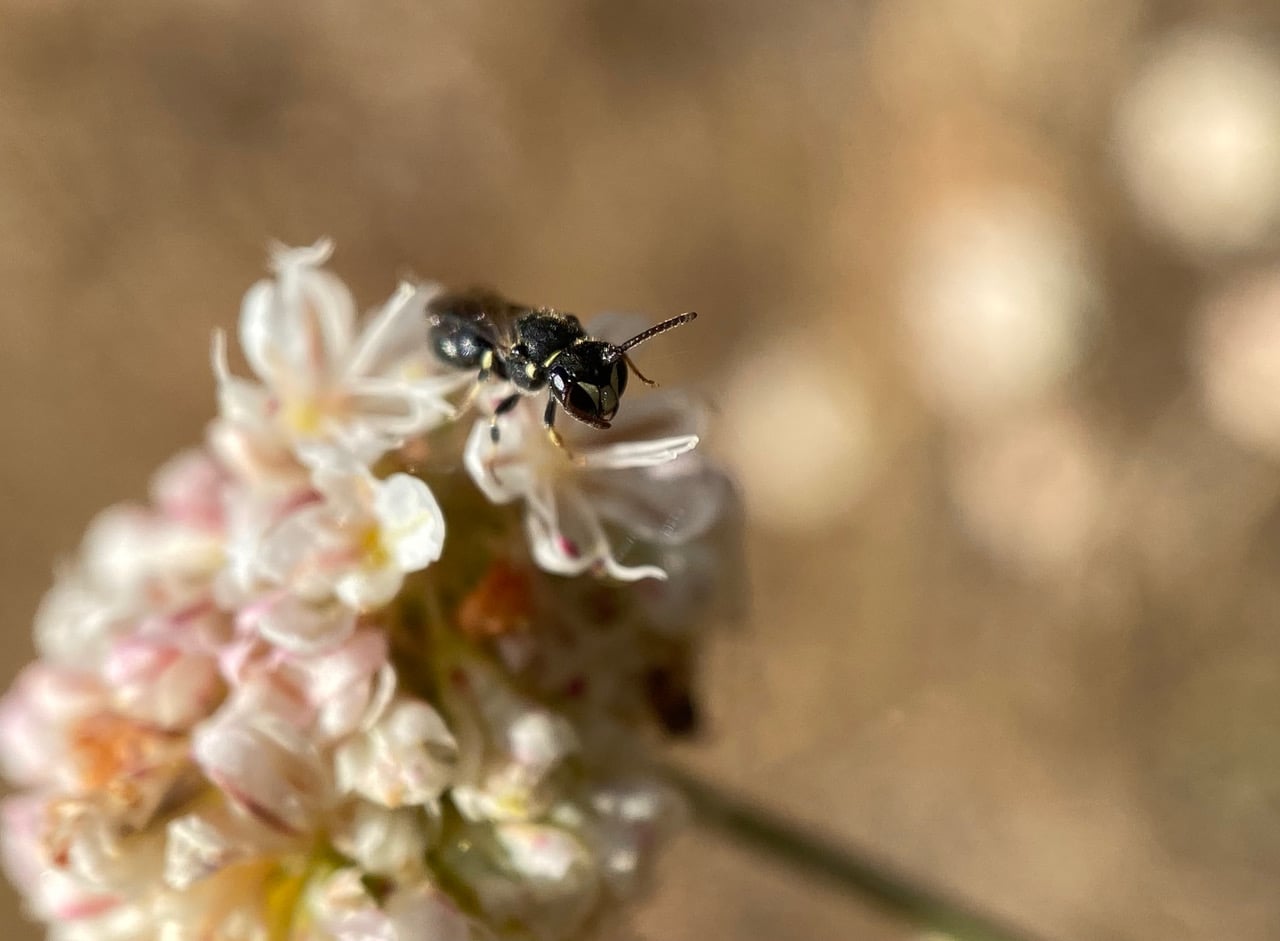
A male Masked Bee, Hylaeus sp. (family Colletidae) lands on an inflorescence of Naked Buckwheat, Eriogonum nudum. A front view of its face is all it takes to identify its sex – males have more prominent yellow markings on their faces than their female counterparts.
Hylaeus (family Colletidae) are shiny, slender, hairless, and superficially wasp-like bees. They are small, 5 to 7 mm long, usually black with bright yellow or white markings on their face and legs. These markings are more pronounced on the males. Hylaeus do not carry pollen and nectar externally, they instead store their food in the crop and regurgitate it upon returning to their nests. They are primarily generalist foragers. Hylaeus are short-tongued, but their small body size enables them to access deep flowers. Hylaeus nest in stems and twigs, lining their brood cells with self-secreted cellophane-like material. They lack strong mandibles and other adaptations for digging, using instead pre-existing cavities made by other insects.
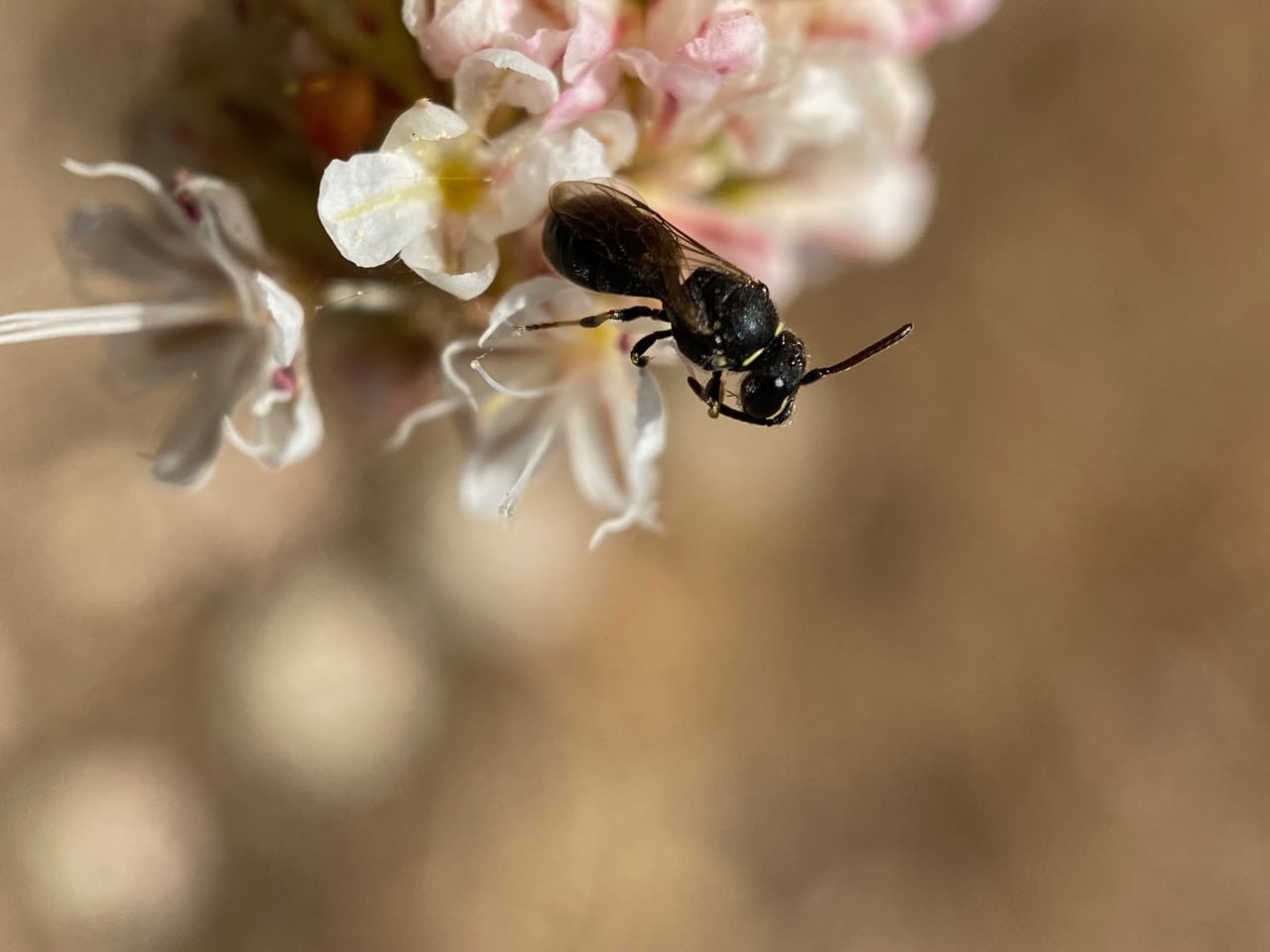
After feeding on nectar, the Masked Bee proceeds to clean his antennae.
The antennae of male bees are often much longer than their female counterparts. Male antennae have an extra segment and the segments themselves are longer. This is because male antennae are specialized to pick up the subtle scent of female pheromones.
All bees have an antenna cleaner on each of their two forelegs. The antenna cleaners consists of two parts: a notch in the basitarsus, which is fitted with stiff hairs, and a corresponding spur on the tibia. To clean its antenna, the bee raises its foreleg over its antenna and then flexes it tarsus. The action allows the spur to close the notch, forming a ring around the antenna. The bee pulls each antenna through the bristles to clean it of debris such as pollen or dust which might interfere with the many sensory organs within the antenna. A bee’s antennae serve numerous functions: smell, taste, perceive humidity and temperature, feel, monitor gravity and flight speed and even detect sound waves to help guide the bee in its daily activities.
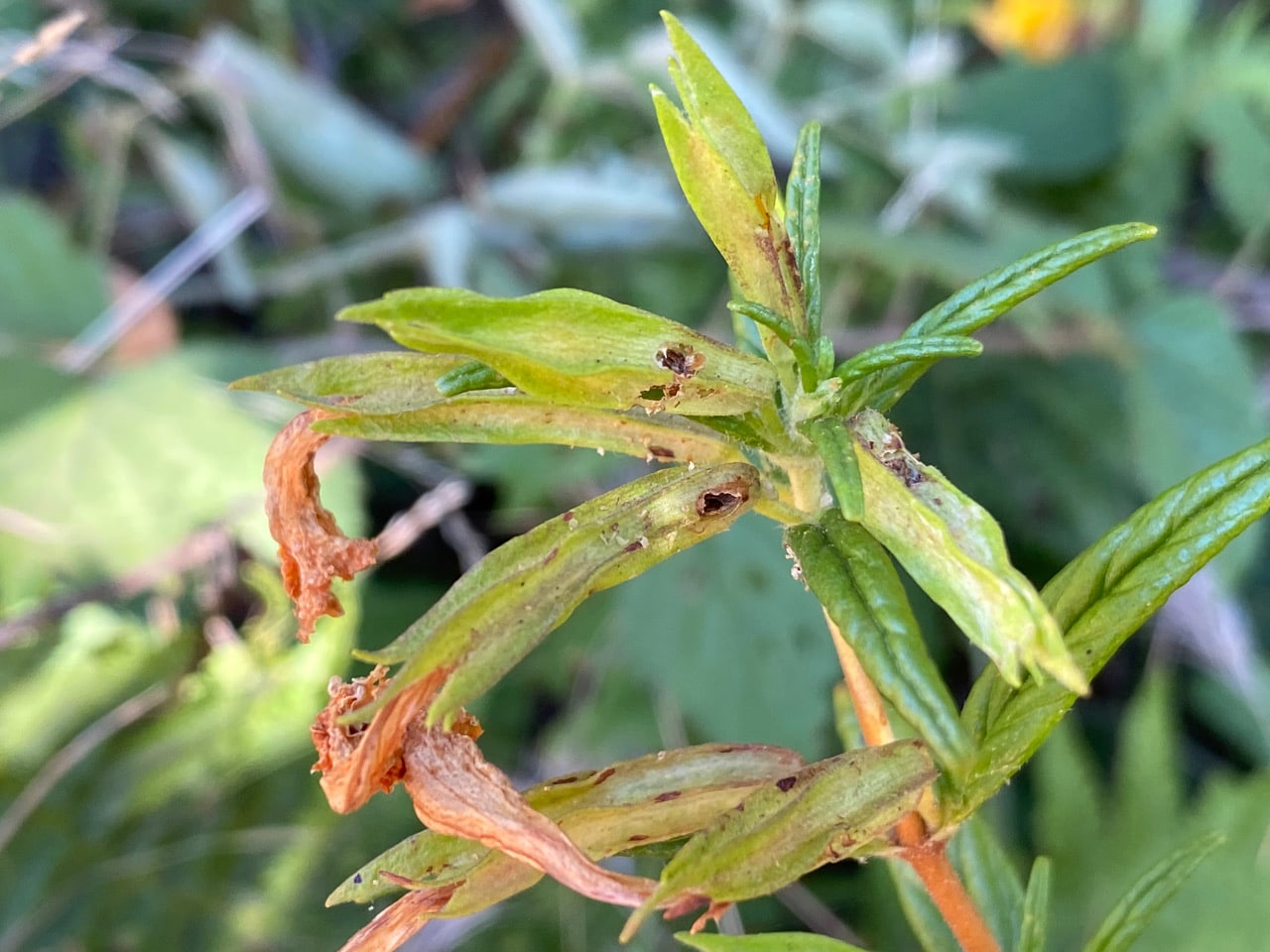
Someone has bitten through the calyces of this Sticky Monkeyflower, Diplacus aurantiacus, probably to get to the developing seeds, or the various insects that might be living there. Diplacus calyces are home to a slew of small insects – gall makers, inquilines, parasitoids and hyperparasitoids.
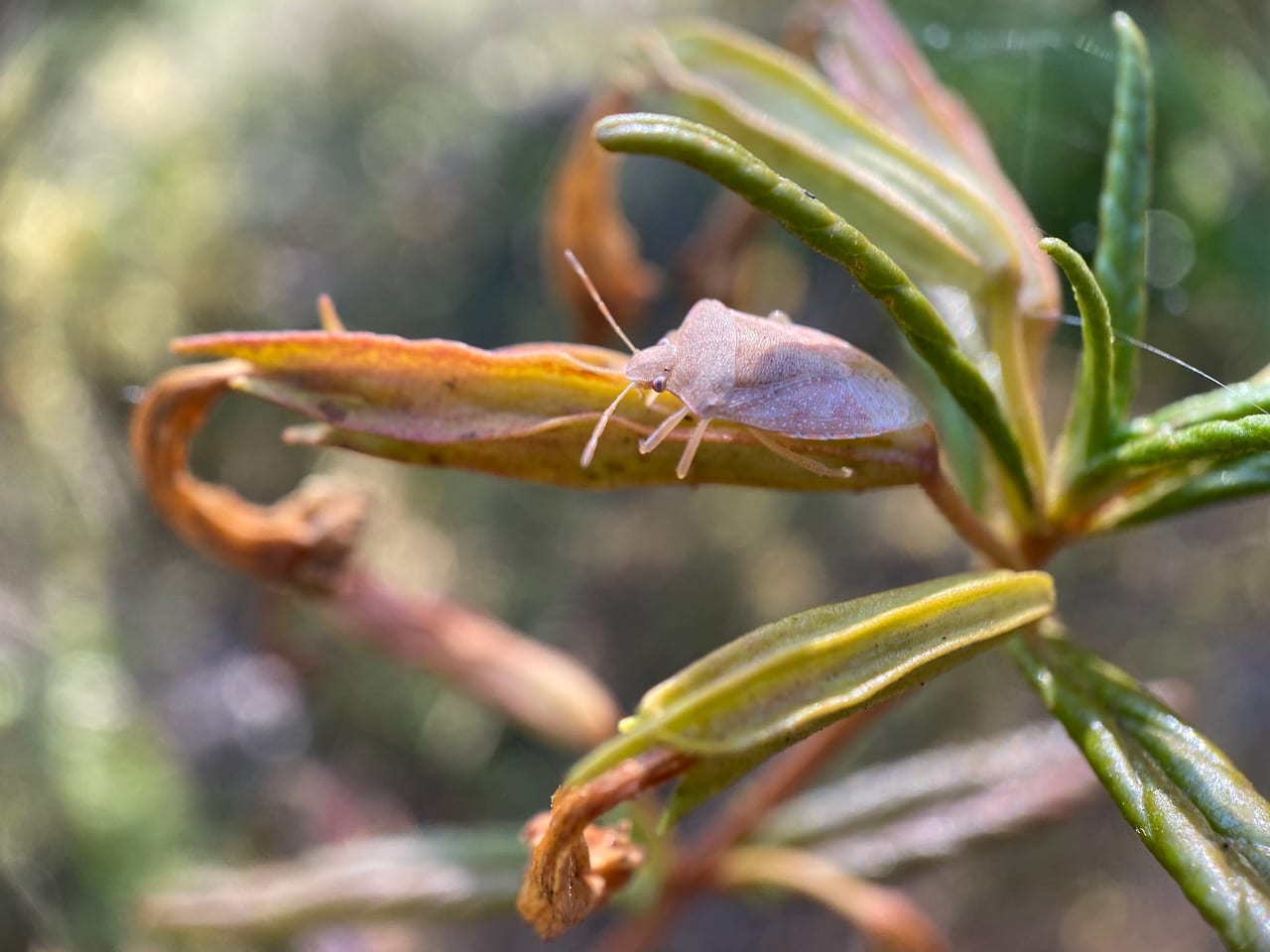
A pale insect is sitting very still on a spent calyx of Sticky Monkeyflower. It is a teneral Stink Bug (family Pentatomidae) that has just completed its final molt into an adult.
“True bugs” in the order Hemiptera undergo incomplete metamorphosis without a pupal stage. The nymphs, which look like adults, develop through a series of molts, each time getting bigger after shedding their old exoskeleton. At the last molt, they transform into adults with functional wings and reproductive parts.
A teneral insect is one that has recently molted and its exoskeleton is yet to harden and get its final coloration. In this state the insect is very vulnerable and the teneral state can last for some time. Teneral insects may be mobile and may even fly during this time but can often be identified due to their pale coloration.

I can tell that this is an adult Stink Bug – it already has functional wings.
All Pentatomids have 5-segmented antennae (hence their family name, Penta – five and tomos – section.) They generally have a large triangular scutellum in the center of the back. The adult is generally shield-shaped when viewed from above. The common name of Stink Bug refers to their ability to release a pungent defensive spray when threatened, disturbed, or crushed.
#/media/File:Heteroptera_morphology-d.svg)

A Tarantula Hawk, Pepsis sp. (family Pompilidae) lands on the dried vegetation along the trail, and explores the ground thoroughly, probably looking for tarantula burrows. Sensing my approach, it scrambles out and takes flight.
A Tarantula Hawk is a spider wasp (family Pompilidae) that preys on tarantulas. They comprise several species in the genera Pepsis and Hemipepsis. Common species are up to 2 in. long, making them among the largest of wasps, and have blue-black bodies and bright, orange colored wings (Some species have black wings.) The bright colors advertise to potential predators the wasps’ ability to deliver a powerful sting, considered one of the most painful insect stings in the world.
The female tarantula hawk stings a tarantula between the legs, paralyzing it, then drags the prey to a specially prepared burrow, where a single egg is laid on the spider’s abdomen, and the burrow entrance is covered. When the wasp larva hatches, it penetrates the spider’s abdomen, and feeds on it from the inside, avoiding vital organs for as long as possible to keep the spider alive. The wasp larva pupates within the spider and eventually emerges as an adult to continue the life cycle.
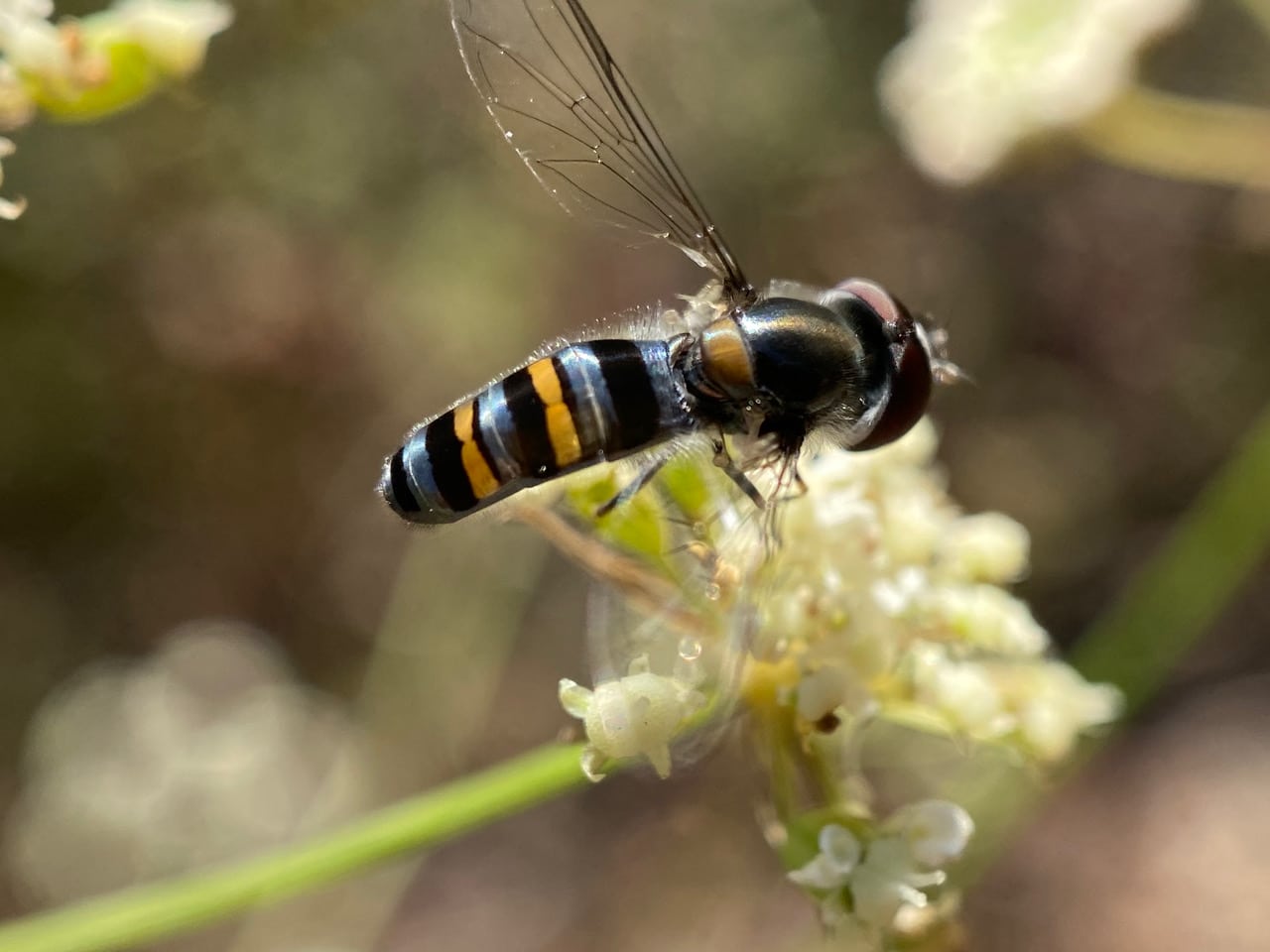
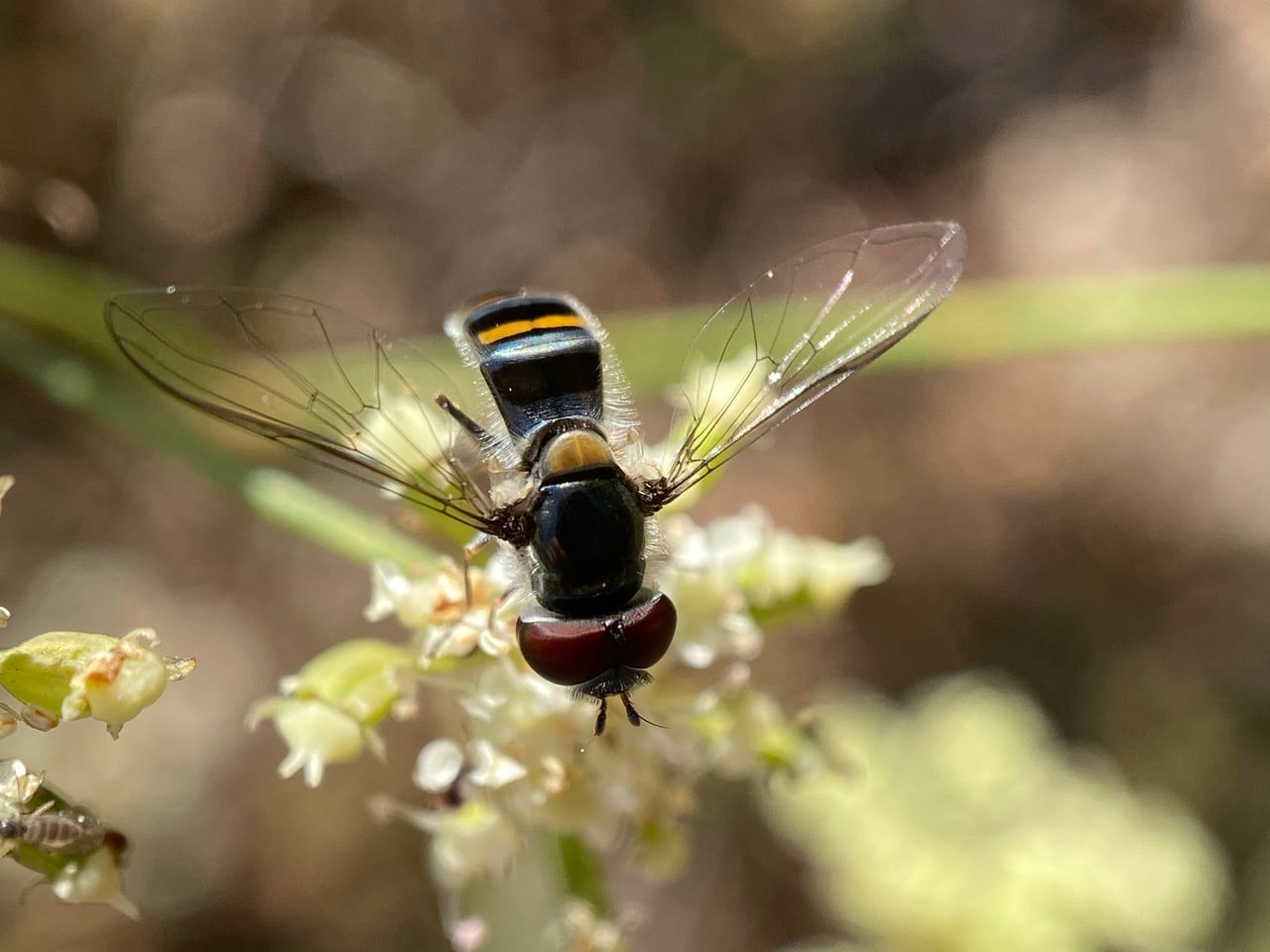
A Silver-banded Hover Fly, Pseudoscaeva diversifasciata (family Syrphidae) visits the flowers of Kellogg’s Yampah, Perideridia kelloggii.
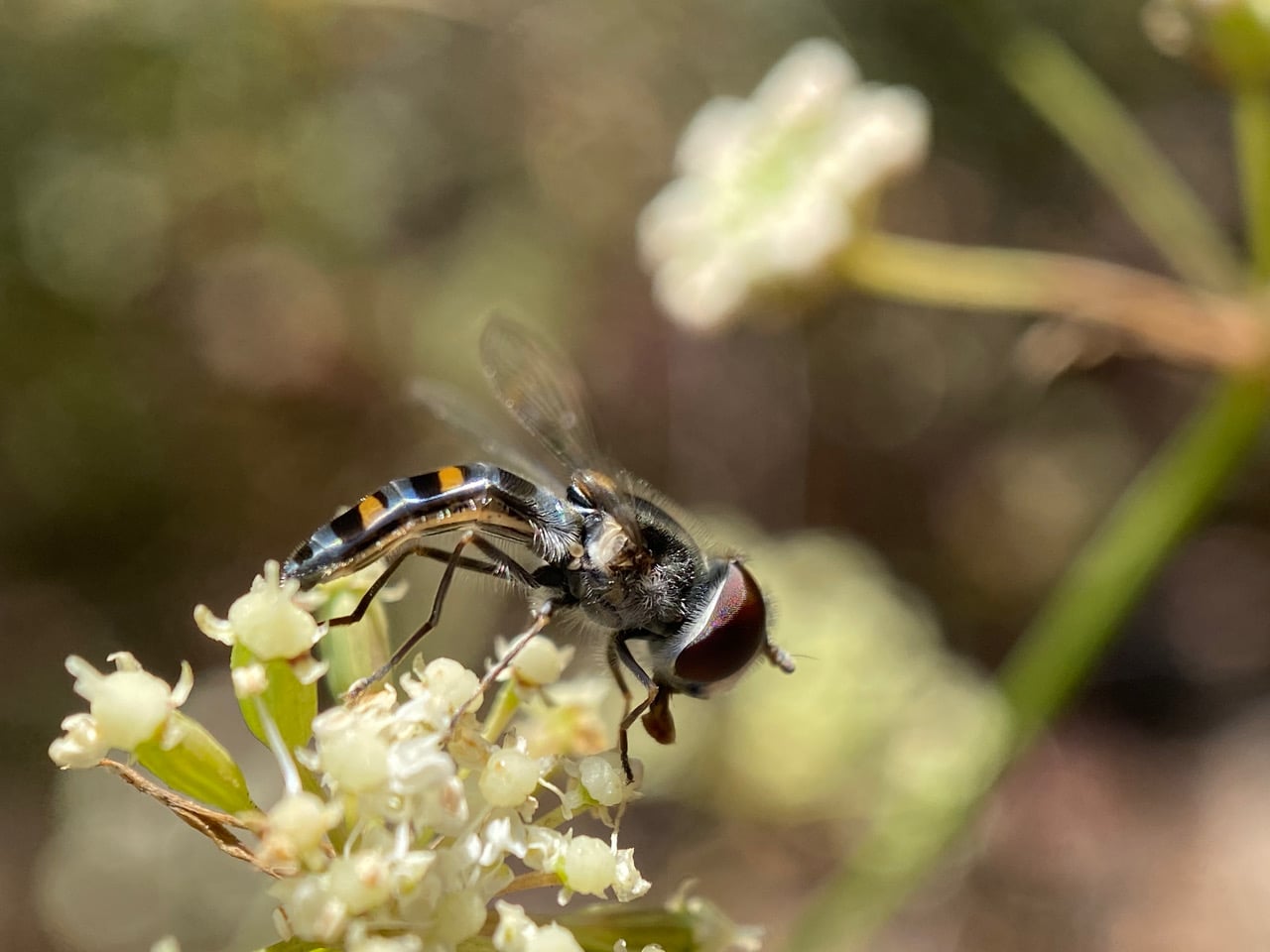
There’s hardly any information out there on the natural history of the species. Since it is in the subfamily Syrphinae, I would assume that the larvae are aphidophagous (feeding on aphids)?
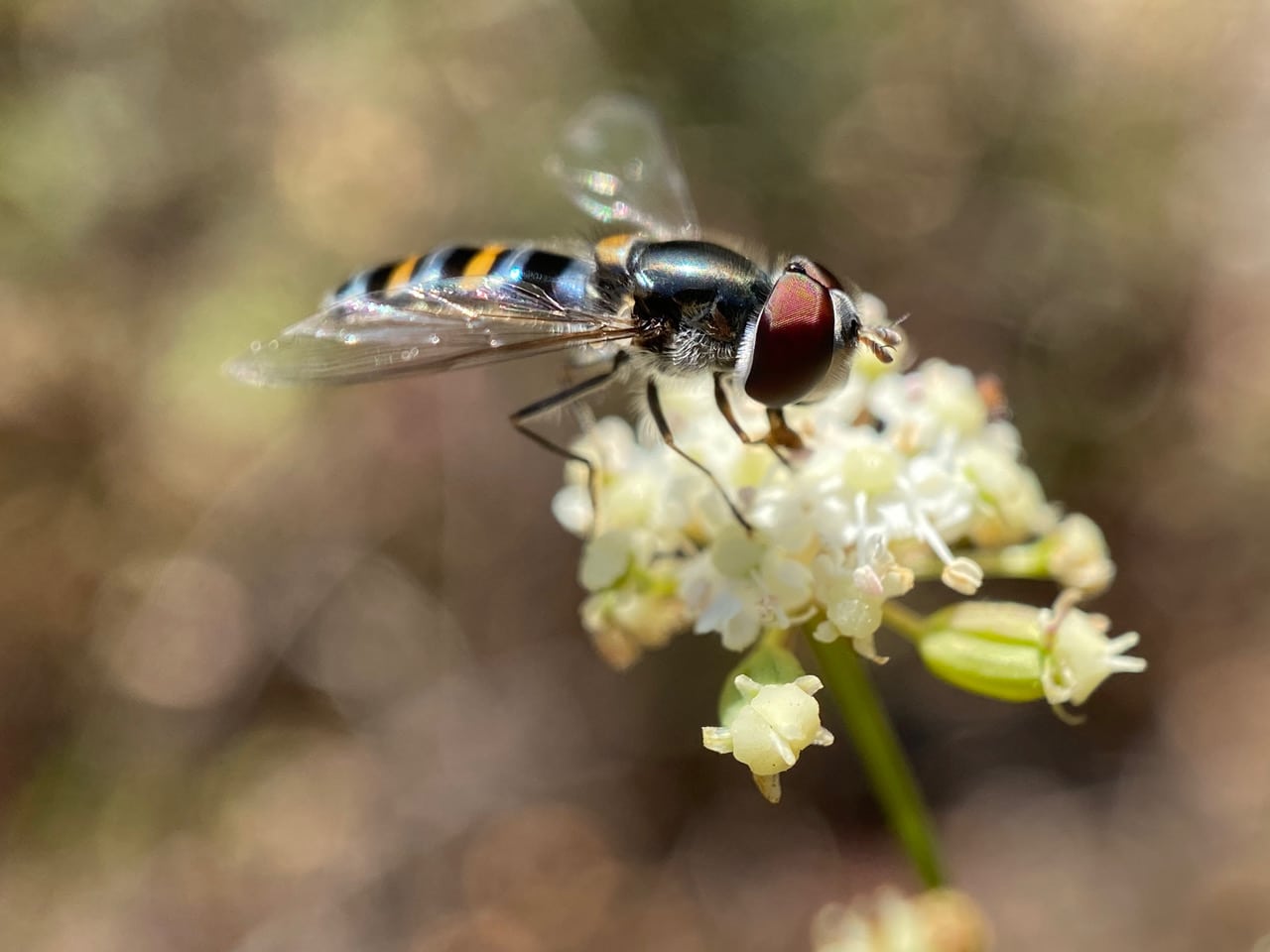
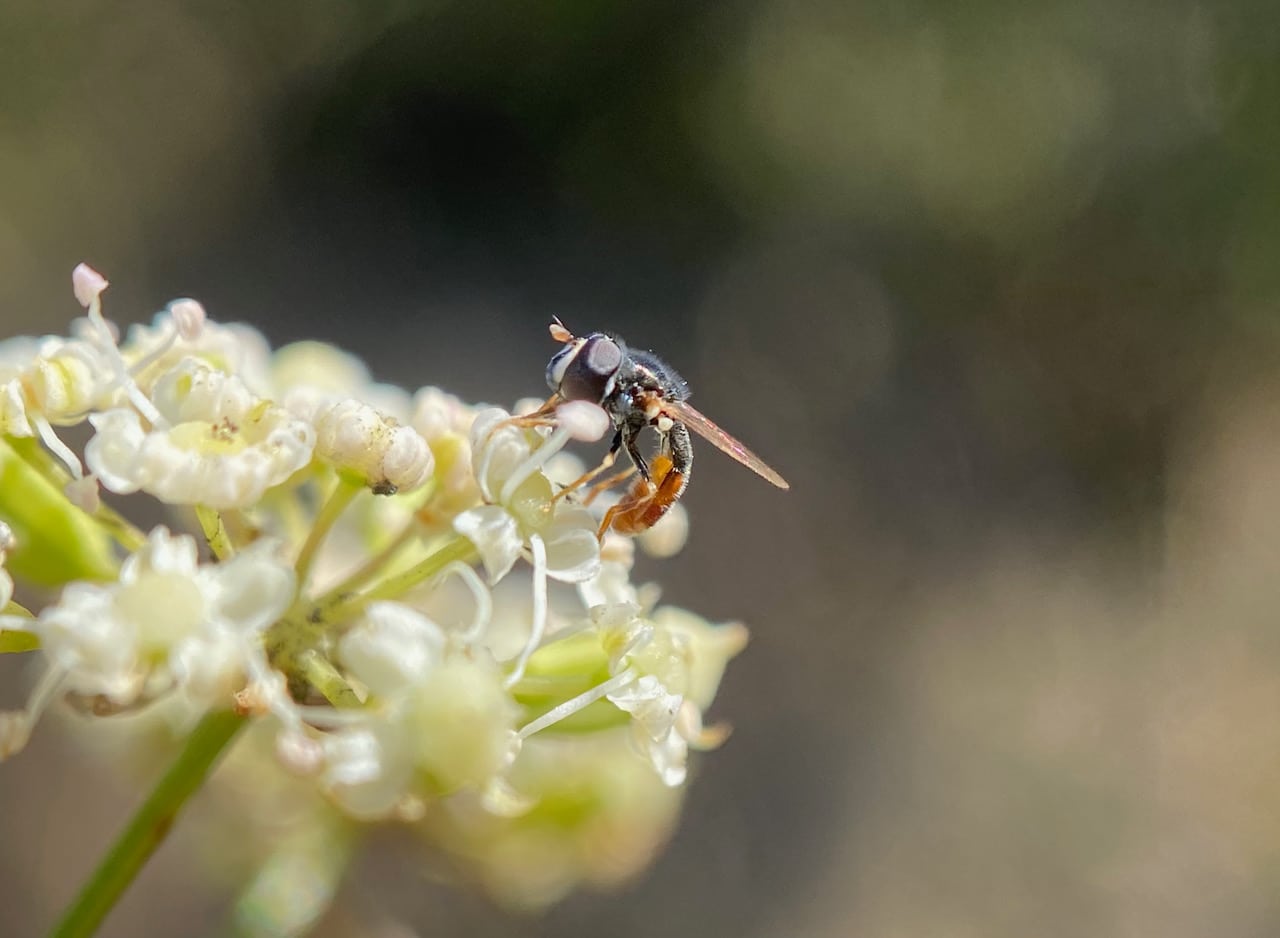
A Black-backed Grass Skimmer, Paragus haemorrhous (family Syrphidae) lands on an umbel of Yampah flowers. It is probably the smallest hover fly we have a Skyline Gardens, measuring only about 4 mm in length. The species has a world-wide distribution, found in unimproved grassland, dune grass, open areas and pathsides in forest, and meadows. Adults visit flowers for nectar and pollen. Larvae feed on aphids on low herbaceous plants.
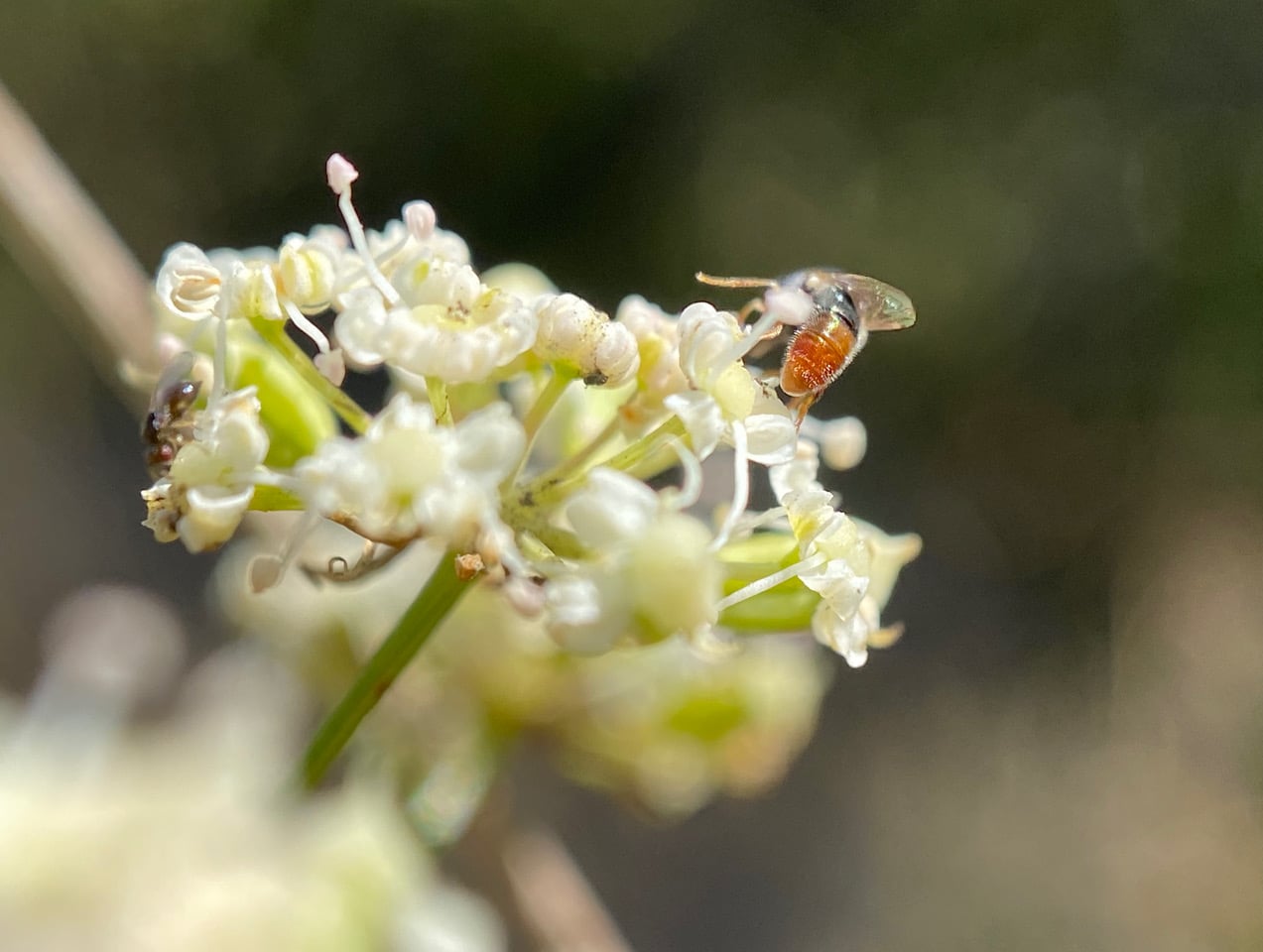
Rear view of the Black-backed Grass Skimmer, showing its red abdomen.
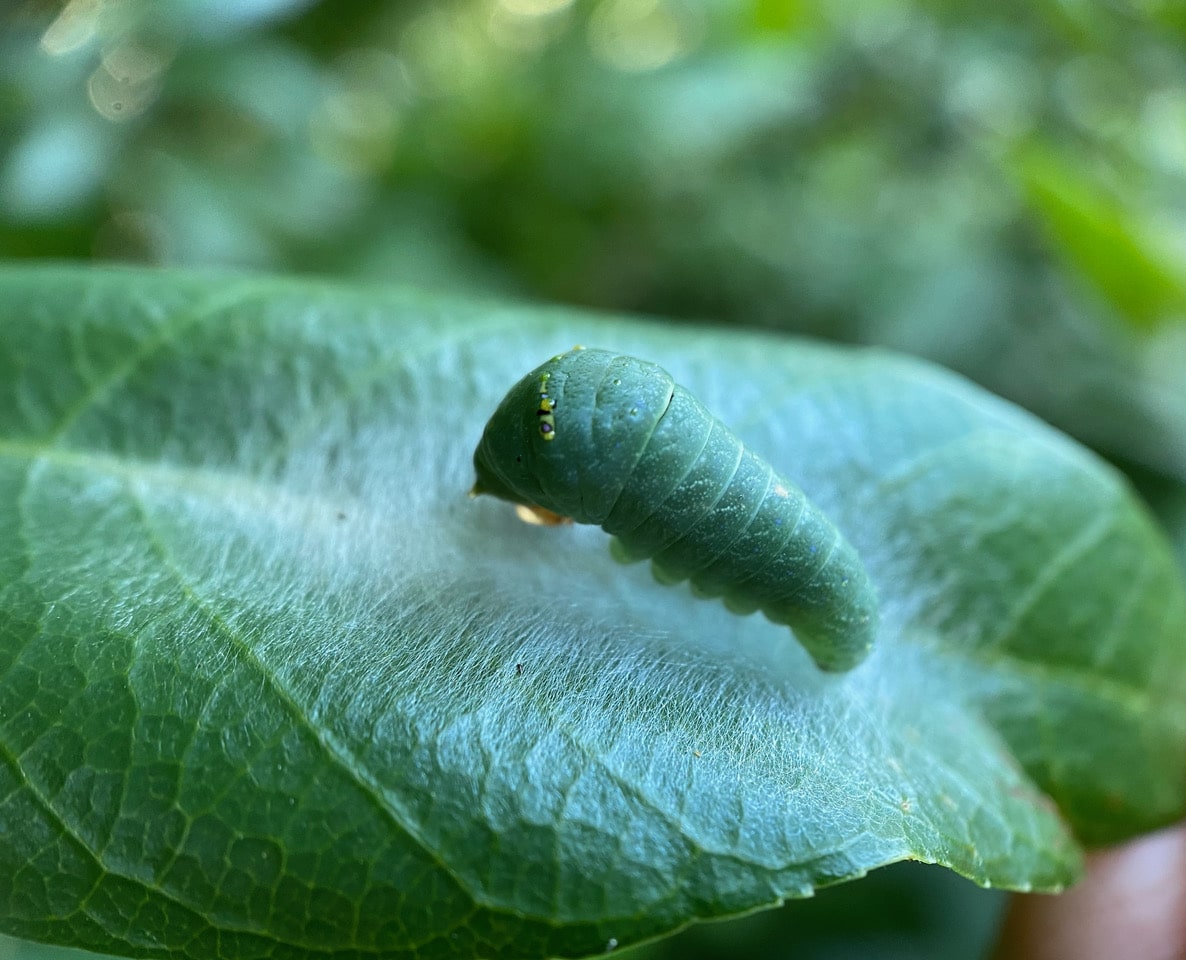
I finally reach the Coffeeberry bush that is Blue’s home. The Pale Swallowtail caterpillar is resting on its silk pad, perfectly matching the color of its home leaf.
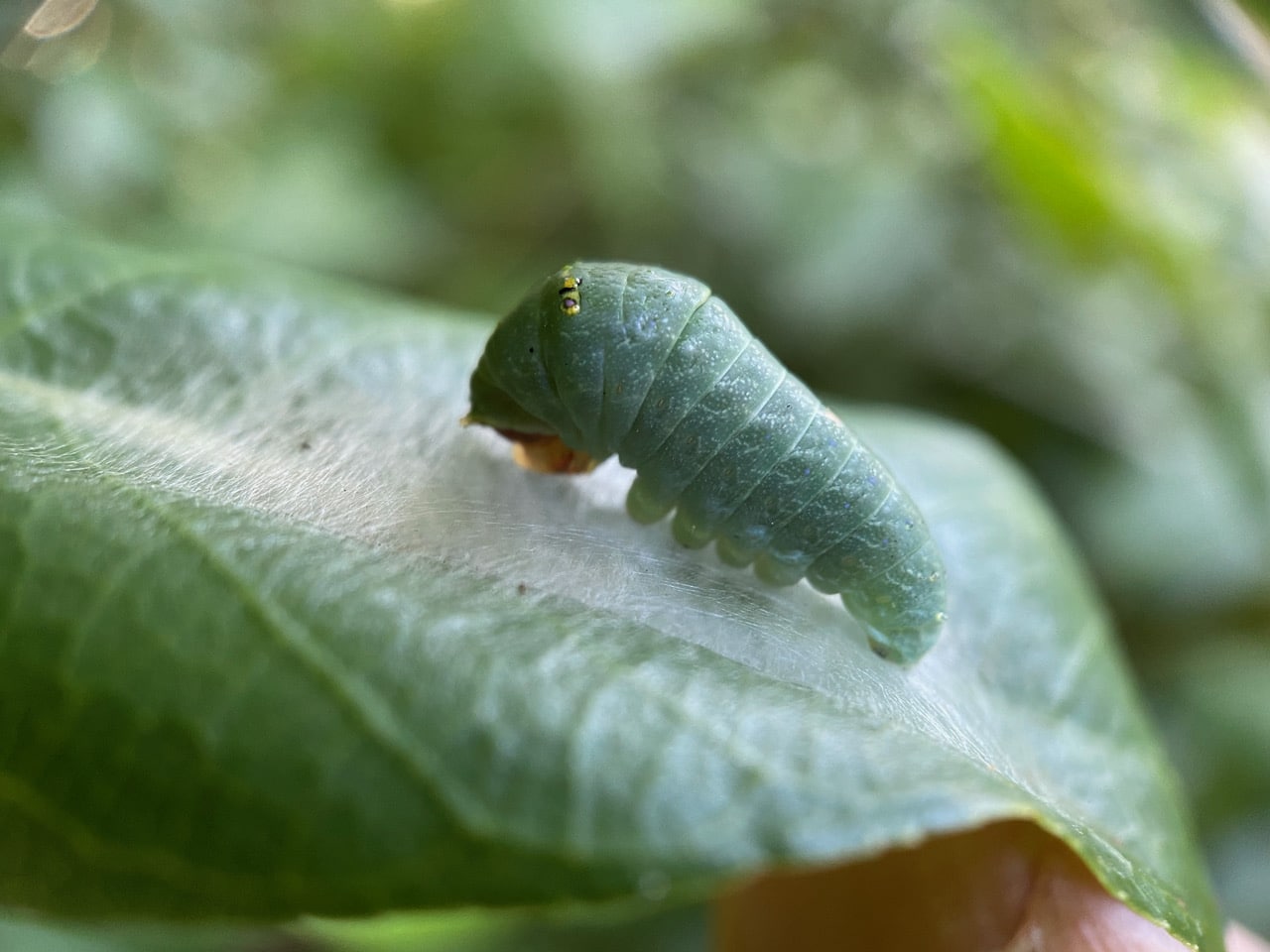
The light here in the shade of a Bay Tree changes every time the wind blows. Blue and its home leaf shift colors simultaneously, varying between green and powder blue.
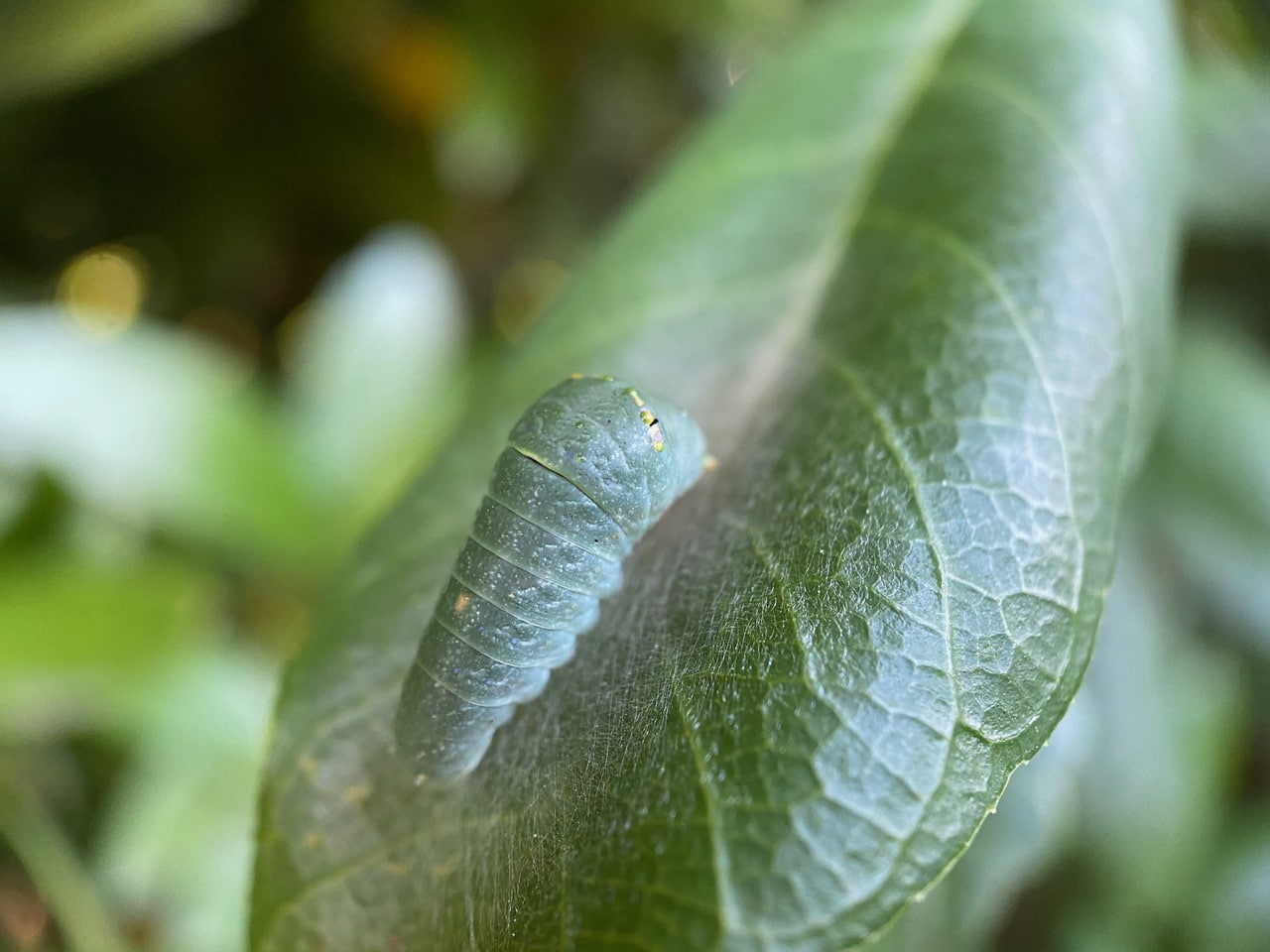
The previously extensive white marking on its back has faded to a simple dot. Has Blue molted since the last time I saw it?

I find the same folded leaves on the Bay Tree.
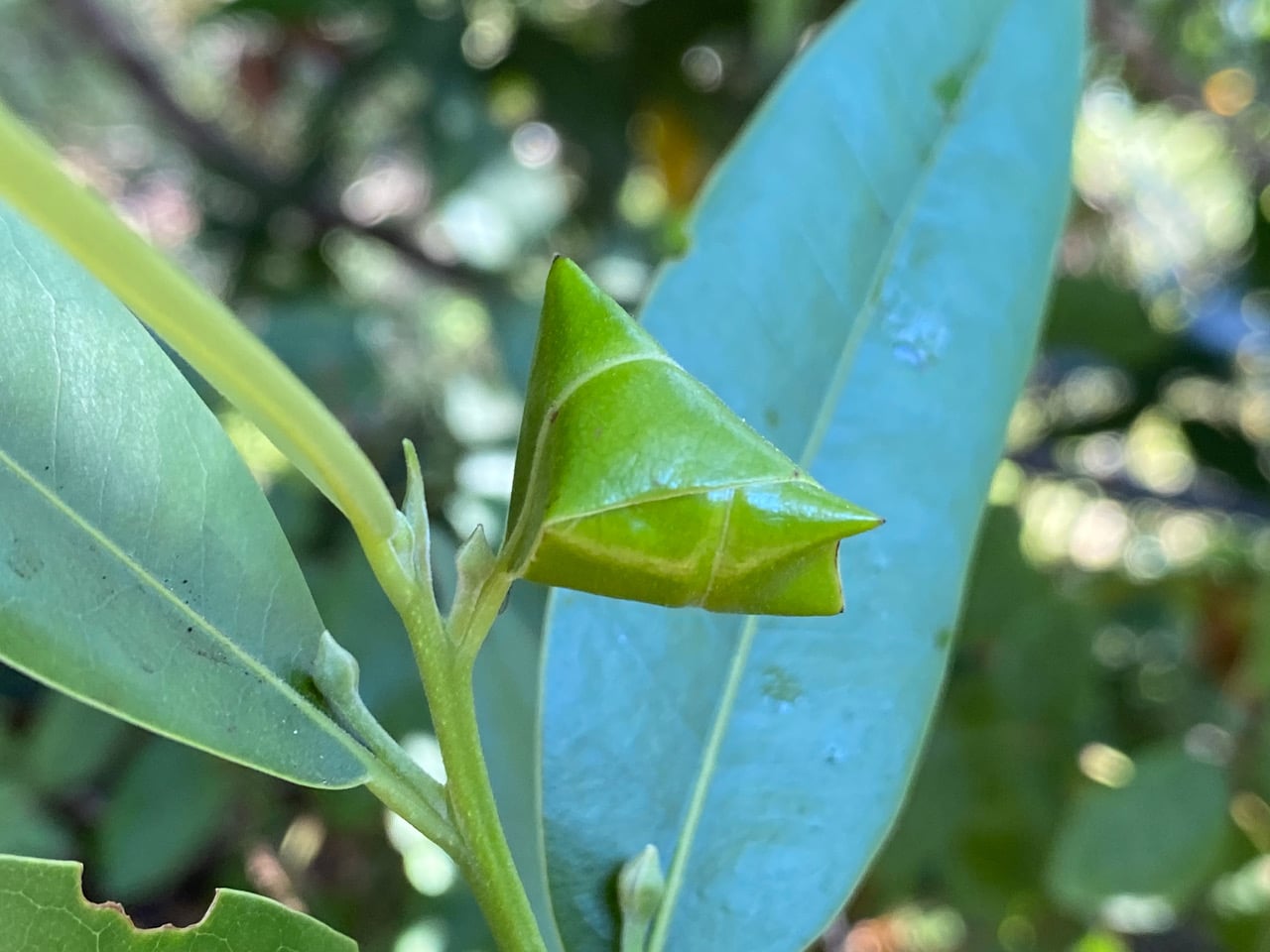
I look for the leaf that was rolled by a tiny caterpillar while I watched yesterday, but can’t find it. In its place is this triangular folded leaf! Wow, I think the rolling of the leaf tip was the start of the process of constructing this boxy three-sided structure! Fascinating! I can’t believe that tiny caterpillar can accomplish this feat with the silk from its mouth, and within 24 hours!