

Pollinator Post 8/12/25
A windy afternoon at Bay Farm Island. I walk the stretch of the trail along the shore that does not have any Grindelia, not expectIng to see any insects out in these conditions.
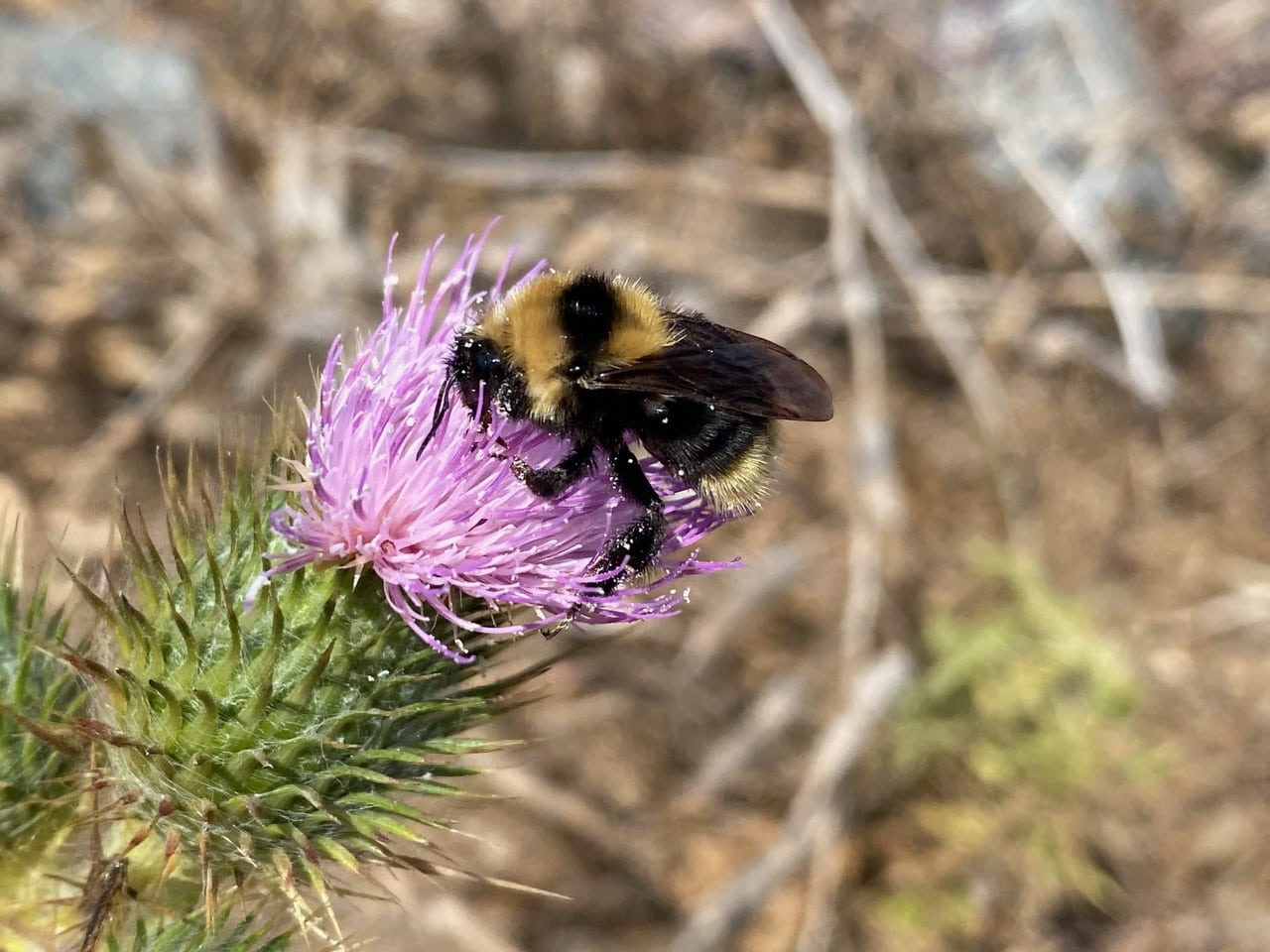

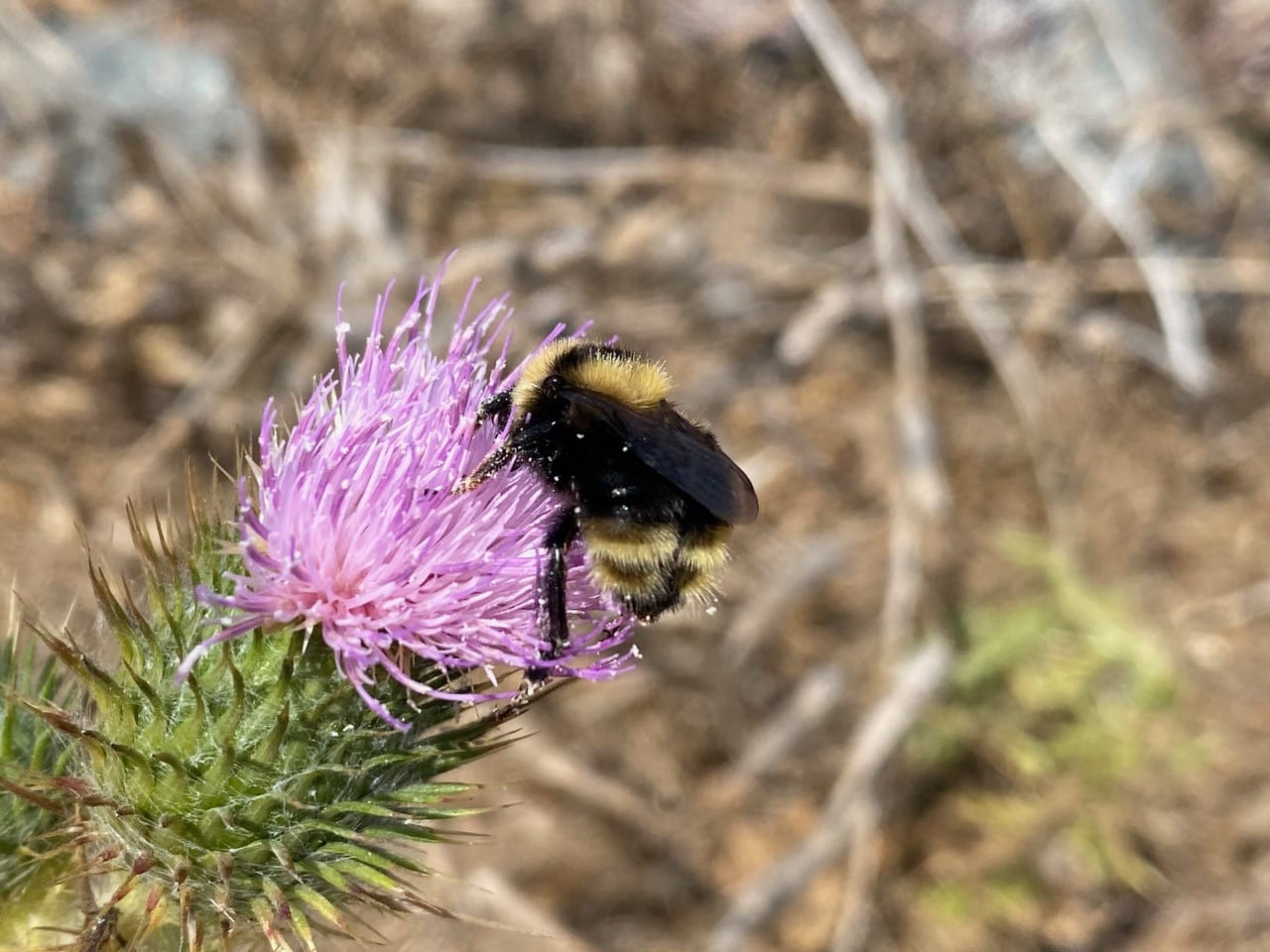
Surprise – a large bumble bee is out foraging on a flowerhead of Bull Thistle, Cirsium vulgare. It has more than one yellow band on its abdomen. A male Yellow-faced Bumble Bee?
No, the bee has a black head! A California Bumble Bee, Bombus californicus ? No, apparently not. I was surprised when my bee guru Emil identified it as a Red-belted Bumble Bee, Bombus rufocinctus. This ID has since been confirmed by the premier bee expert on iNaturalist, John Ascher. The bee has no visible band of red on its abdomen! It makes me wonder if all the black-headed bumble bees I have identified as California Bumble Bees in the past weren’t Red-belted Bumble Bees instead! There’s so much I need to learn about our bumble bees!
The Red-belted Bumble Bee, Bombus ruficinctus (family Apidae) is native to North America, where it is widely distributed across Canada and the western, midwestern, and northeastern United States. The species is extremely variable in color patterns. Over 30 different color morphs make this species difficult to identify readily. There seems to be no geographic pattern associated with the various color morphs, and an individual colony may produce workers with many different color patterns. Hair length is relatively short and even. Characters used for identification include a distinctly shorter-than-wide cheek and black hair on the face. The thorax is generally yellow, with usually a distinct band of black hairs between the wings. All females have relatively short hair and very short faces, which give them a cute, soft gestalt. Males have large eyes and often perch high on vegetation near flowers and aggressively pursue potential mates. Queens are 17-18 mm in length, workers 9-13 mm.
This small, short-tongued bee lives in and around wooded areas and it can be found in urban parks and gardens. It feeds on several kinds of plants, including, chicories, snakeroots, strawberries, gum weeds, sunflowers, goldenrods, clovers, vetches, and goldeneyes. It usually nests on or above ground level.
Like other bumble bees, the Red-belted Bumble Bee lives in colonies composed of a single queen and female workers. Colonies start to produce new queens and males in the mid- to late summer. Only new, mated queen overwinter, emerging from diapause (a form of hibernation) in the spring. New queens are responsible for fining a new nest site, laying eggs, and for all of the foraging and care of the colony until the first workers emerge. Once the first workers emerge, the queen remains in the colony laying eggs.
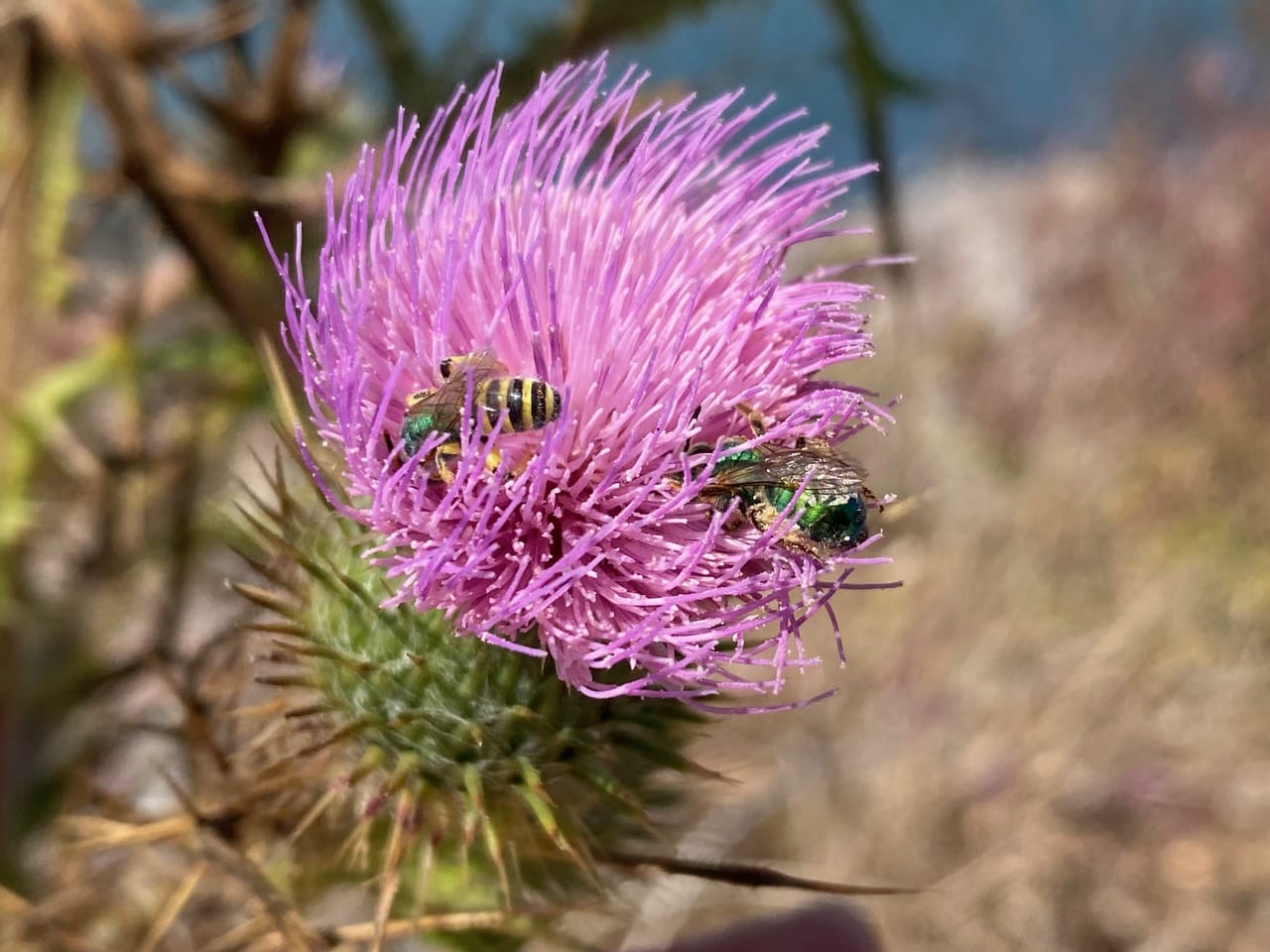
Even more surprising is the sight of these small bees out foraging in this gusty wind. A male (left) and a female (right) Fine Striped Sweat Bee, Agapostemon subtilior (family Halictidae) are diving deep through the florets of a Bull Thistle flowerhead, apparently seeking nectar.
The genus Agapostemon is widespread and abundant throughout North America. They are most diverse and abundant in temperate regions and southwestern U.S. deserts. Agapostemon are commonly called “sweat bees” because they are closely related to, and resemble bees in the Halictus and Lasioglossum genera. Unlike those bees however, Agapostemon are not attracted to human sweat.
Agapostemon are brightly colored metallic green or blue bees measuring 7 to 14.5 mm long. Most species have a metallic green head and thorax, and black-and-yellow striped abdomen; some females are entirely bright green or blue. Females carry pollen on scopal hairs located on their hind legs. Agapostemon are ground-nesters and generalist foragers. Like other members of the family Halictidae, they are short-tongued and thus have difficulty extracting nectar from deep flowers. Males are often seen flying slowly around flowers looking for females. The bees favor flowers with high densities.
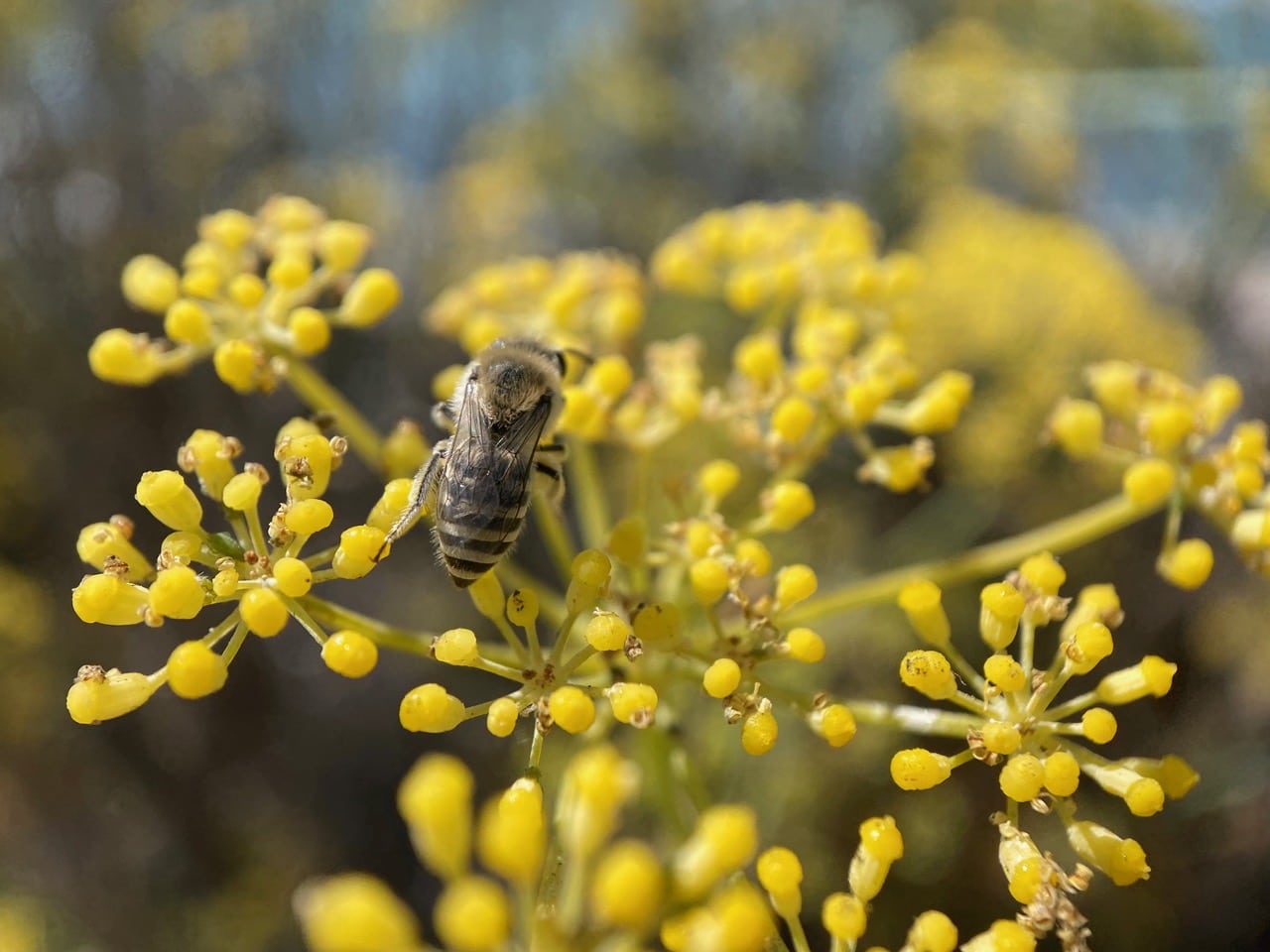
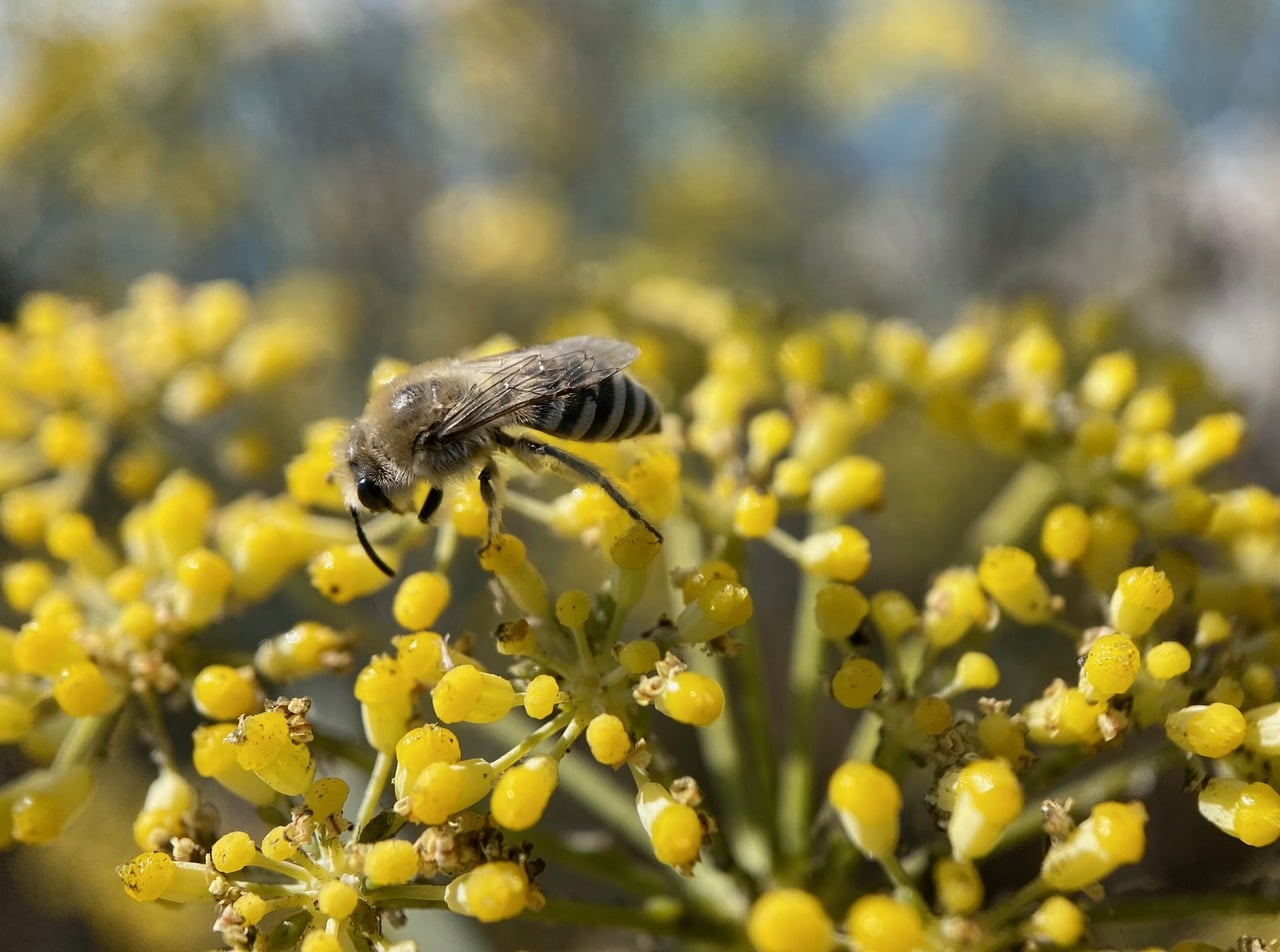
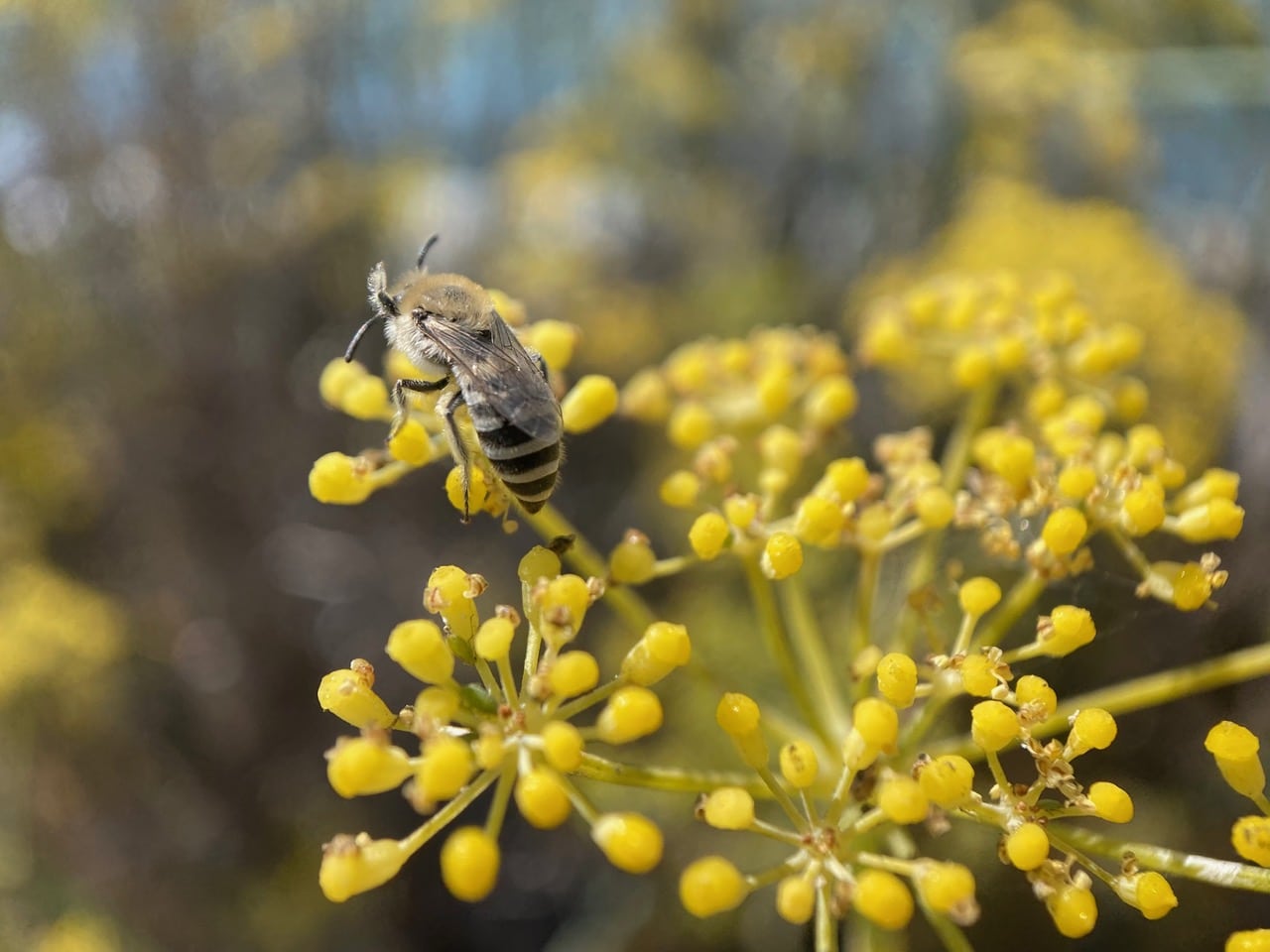
A female Cellophane Bee, Colletes sp. (family Colletidae) is foraging on a flower umbel of Fennel, Foeniculum vulgare.
The bee family Colletidae includes generalists and specialists, and they are likely important pollinators of many wildflowers. All Colletidae in North America are solitary ground nesters, but some species nest in large aggregations. There are two major genera of Colletidae in North America: the Masked Bees (genus Hylaeus) and Cellophane Bees (genus Colletes). The most obvious shared characteristics of Colletidae is also the hardest to see: their short tongue. Colletes are moderately hairy, slender bees, ranging in size from 7 to 16 mm. Distinct features include a hairy head and thorax, pale bands of hair on the abdomen, and a heart-shaped head. The eyes of Colletes are angled (rather than being parallel), making the face slightly heart-shaped.
The genus name Colletes means “one who glues”, referring to their habit of applying a glue- or cellophane-like lining to the walls of nest cells, using their specialized tongues. This lining gives rise to their common names: cellophane bees, polyester bees, and plasterer bees. Colletes tongue is unique: short, flat, and forked at the tip. Colletes line their nests with a distinctive cellophane-like substance made from saliva and secretions from the Dufour’s gland on the abdomen. Using their specialized tongue, they paint the walls with saliva, then with secretions from the Dufour’s gland, they add a coat of varnish. This creates a clear covering that is strong, durable, and resistant to mold and water.
The Cellophane Bee stops momentarily to clean her antennae.
All bees have an antenna cleaner on each of their two forelegs. The antenna cleaners consists of two parts: a notch in the basitarsus, which is fitted with stiff hairs, and a corresponding spur on the tibia. To clean its antenna, the bee raises its foreleg over its antenna and then flexes it tarsus. The action allows the spur to close the notch, forming a ring around the antenna. The bee pulls each antenna through the bristles to clean it of debris such as pollen or dust which might interfere with the many sensory organs within the antenna. A bee’s antennae serve numerous functions: smell, taste, perceive humidity and temperature, feel, monitor gravity and flight speed and even detect sound waves to help guide the bee in its daily activities.
So well matched in color to the Fennel flowers, the Yellowjacket wasp in front of me is almost invisible while I have no problem seeing the smaller Cellophane Bee.
Yellowjacket is the common name for predatory social wasps of the genera Vespula and Dolicovespula (family Vespidae). Yellowjackets are social hunters living in colonies containing workers, queens, and males (drones). Colonies are annual with only inseminated queens overwintering. Queens emerge during the warm days of late spring or early summer, select a nest site, and build a small paper nest in which they lay eggs. They raise the first brood of workers single-handedly. Henceforth the workers take over caring for the larvae and queen, nest expansion, foraging for food, and colony defense. The queen remains in the nest, laying eggs. Later in the summer, males and queens are produced. They leave the parent colony to mate, after which the males quickly die, while fertilized queens seek protected places to overwinter. Parent colony workers dwindle, usually leaving the nest to die, as does the founding queen. In the spring, the cycle is repeated.
Yellowjackets have lance-like stingers with small barbs, and typically sting repeatedly. Their mouthparts are well-developed with strong mandibles for capturing and chewing insects, with probosces for sucking nectar, fruit, and other juices. Yellowjacket adults feed on foods rich in sugars and carbohydrates such as plant nectar and fruit. They also search for foods high in protein such as insects and fish. These are chewed and conditioned in preparation for larval consumption. The larvae secrete a sugary substance that is eaten by the adults.
The Western Yellowjackets typically build nests underground, often using abandoned rodent burrows. The nests are made from wood fiber that the wasps chew into a paper-like pulp. The nests are completely enclosed except for a small entrance at the bottom. The nests contain multiple, horizontal tiers of combs within. Larvae hang within the combs.
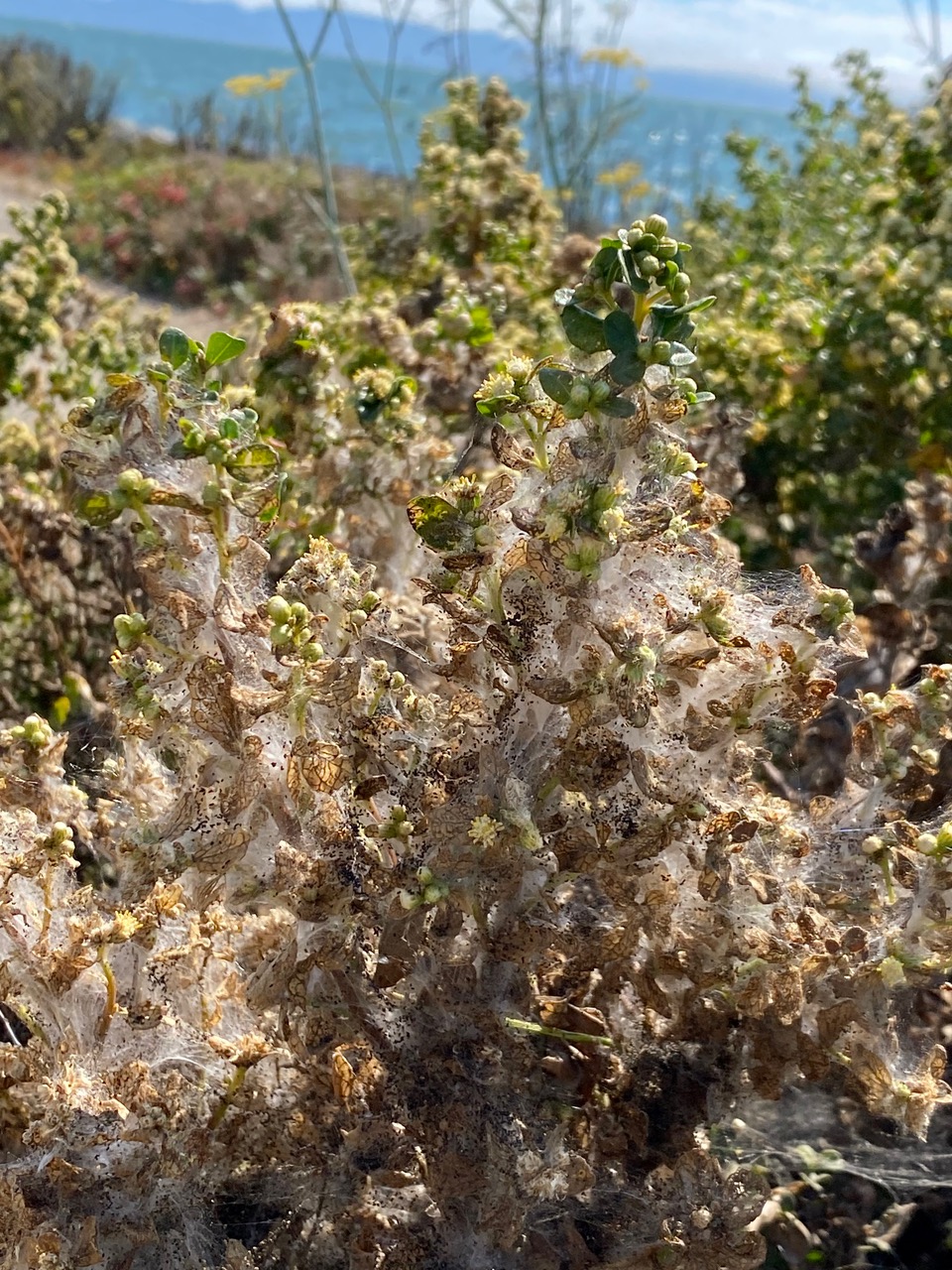
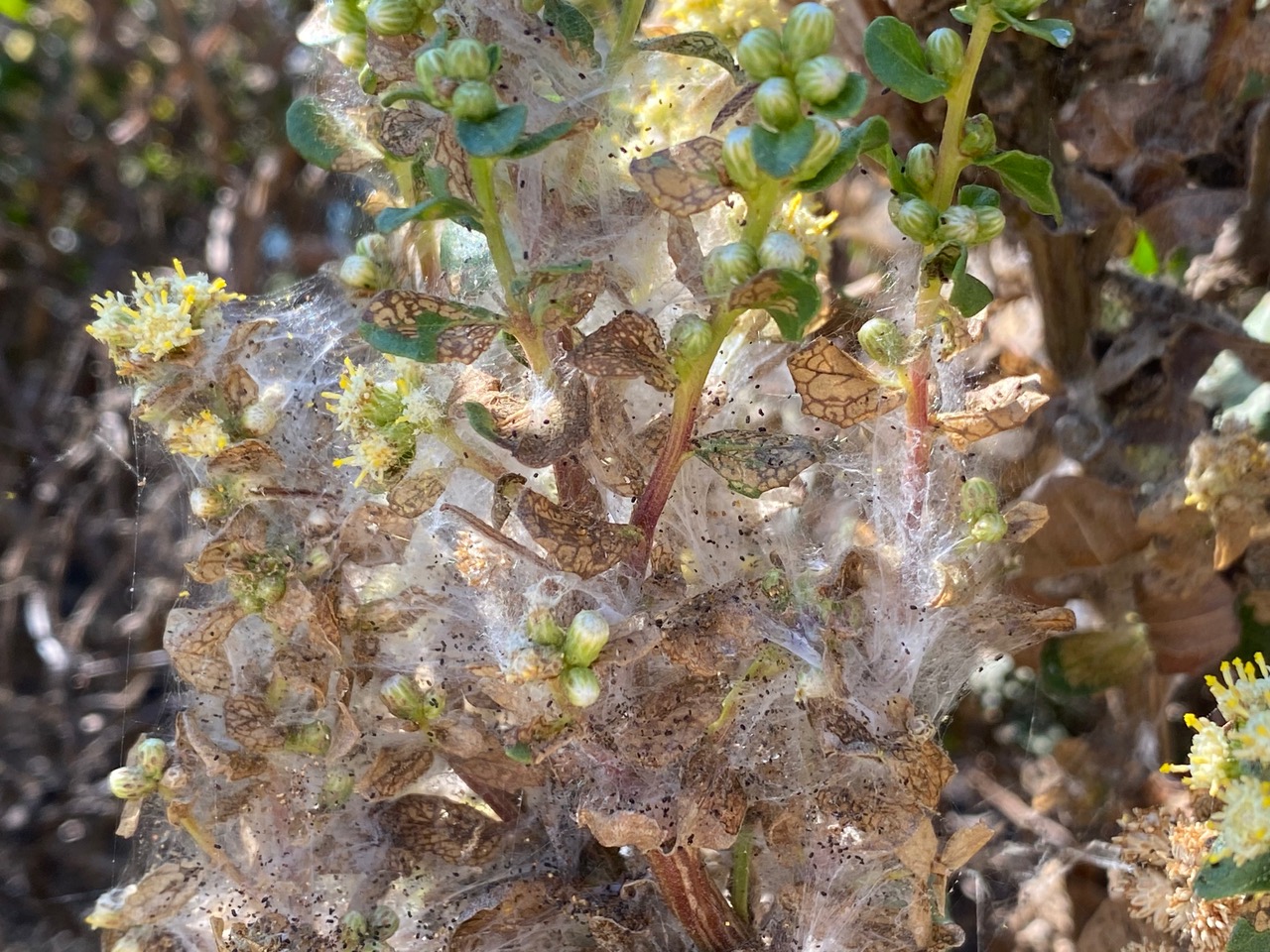
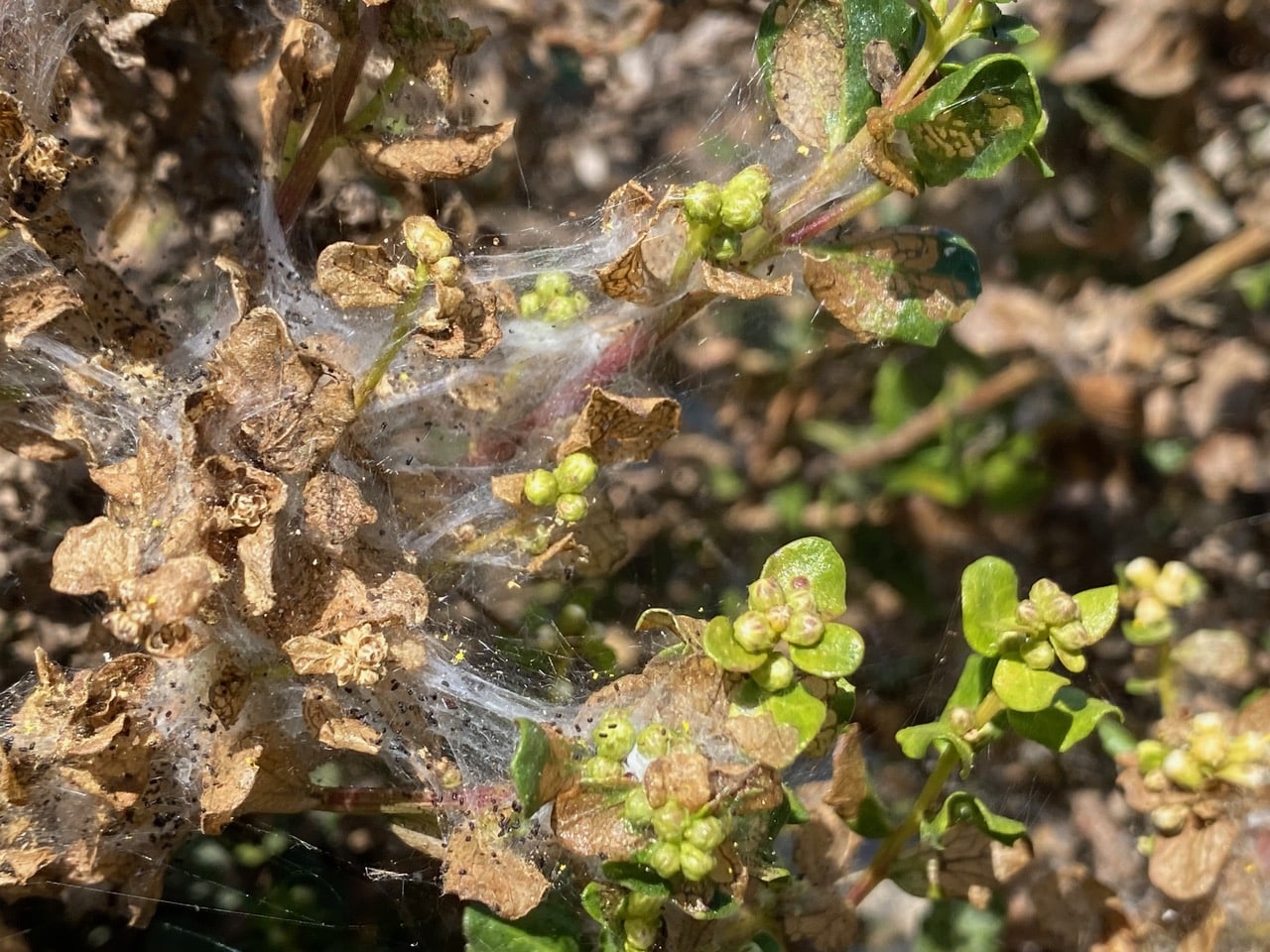
Wow, a good portion of this large male Coyote Brush, Baccharis pilularis is shrouded in a silk mesh peppered with tiny frass (insect poop). The enclosed leaves have been skeletonized and have turned brown. Half of the shrub is dead. A severe infestation of some kind of caterpillars that feed in aggregation?
I examine the affected parts closely to look for the culprit, but fail to see any caterpillars within the tangle of silk.
New green foliage is still being attacked, but there is no sign of any caterpillars. How mysterious!
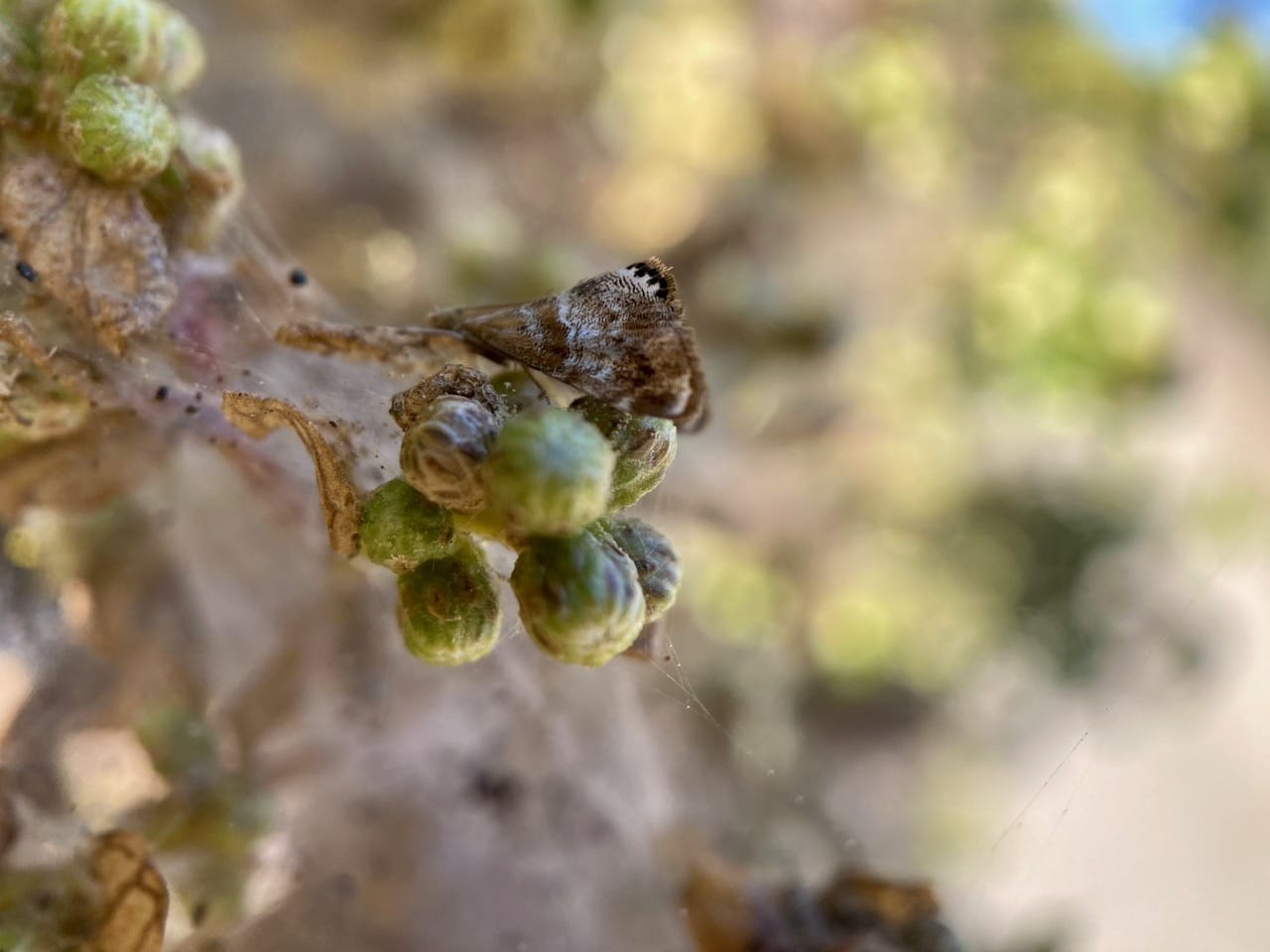
A few small moths are flying erratically around the Coyote Brush, but quickly disappear as they land. I happen to catch a glimpse of this one as it lands on a cluster of immature flowerheads in the shadows. From the black-and-white markings on its raised hind wings, I recognize it as the moth Dicymolomia metalliferalis (family Crambidae). Are the caterpillars of this moth responsible for the damage on the plant?
The moth Dicymolomia metalliferalis (family Crambidae) is found in western North America, from southern Vancouver Island to San Diego. The caterpillar is a case-bearing larva, meaning it lives within a protective case constructed from plant material. They have been observed feeding in aggregation. The larvae are known to feed on decaying seed pods of Lupinus species. They have been recorded as an internal feeder in cattails and cactus stem. They are known to consume leaves and stems of host plants, potentially impacting photosynthesis and vitality.