

Pollinator Post 8/11/26 (1)
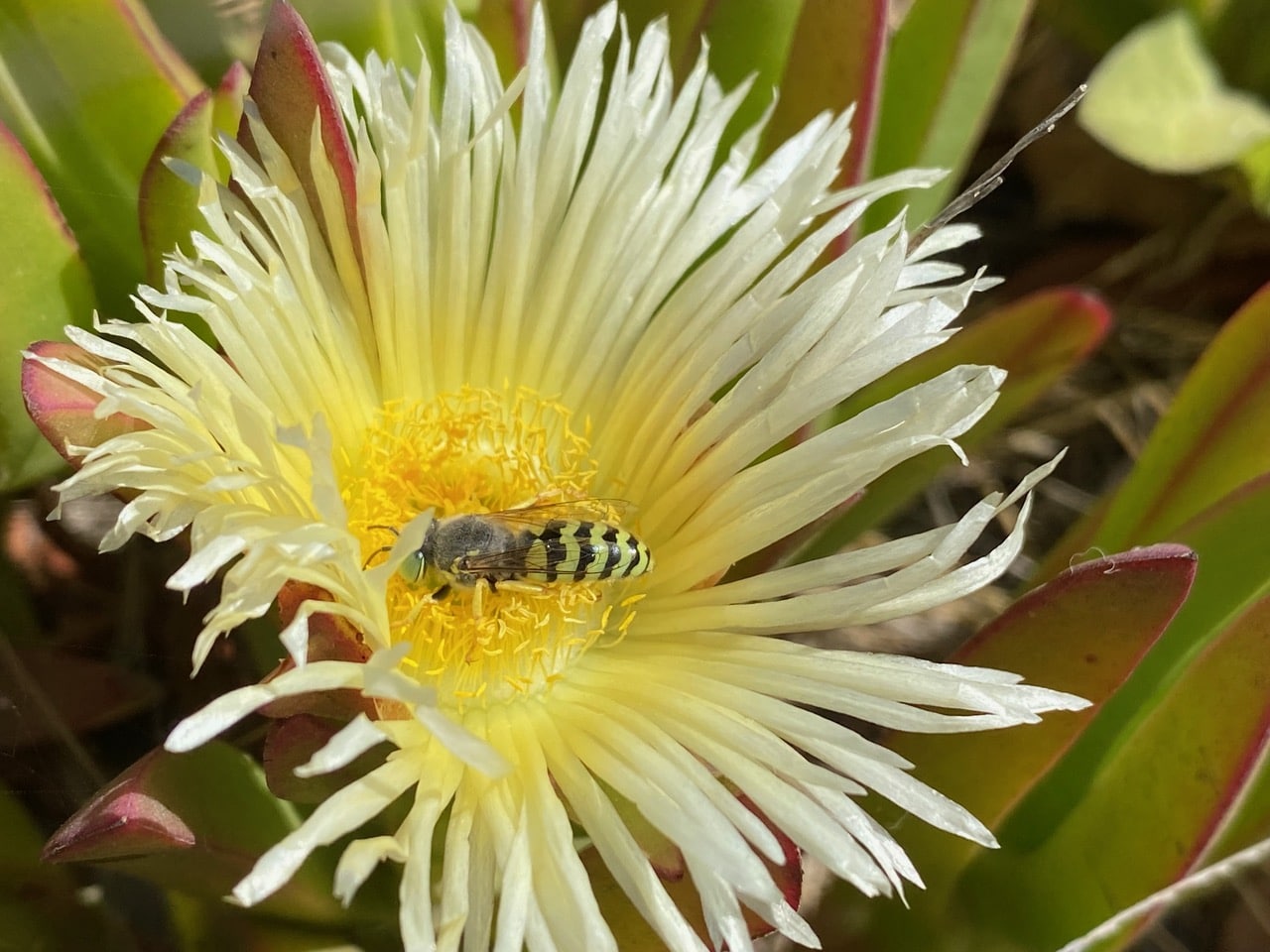
I venture out to Bay Farm this morning at the first sign that our smoke-tainted air has cleared somewhat. An American Sand Wasp, Bembix americana (family Crabronidae) is foraging on one of the last flowers of Ice Plant, Carpobrotus edulis.
Sand wasps in the genus Bembix are familiar and common throughout North America, digging their burrows in dunes, on beaches, and other habitats with loose, deep sand. The female rapidly kicks out large quantities of sand using a “tarsal rake” of spines on each front leg. The burrow is excavated before the wasp goes hunting. Bembix are generalist, opportunistic hunters. True flies in the order Diptera are the usual prey. A victim is paralyzed or killed by the wasp’s sting, and is then flown back to the nest. Most species will lay an egg on the first victim, while some species lay an egg in the empty cell before starting to hunt. Once the egg hatches, mama wasp brings flies to her larva as needed. This “progressive provisioning” is rare in the insect world. When the larva reaches maturity, mama wasp closes the cell. Inside, the larva spins an oblong cocoon, weaving sand grains into the structure and resulting in a hardened capsule. Overwintering takes place as a prepupa inside this cocoon, but there are usually two generations a year.
Male sand wasps often engage in an elaborate flight ritual called “sun dances”. Males emerge before females, and fly erratically at dizzying speed one or two inches above the ground attempting to detect virgin females about to emerge from their underground nests. Both sexes are often seen taking nectar at flowers, especially from Asteraceae family. Bembix wasps are often victims of other insects such as cuckoo wasps (Chrysididae), velvet ants (Mutillidae), satellite flies (Sarcophagidae), bee flies (Bombyliidae), and thick-headed flies (Conopidae).
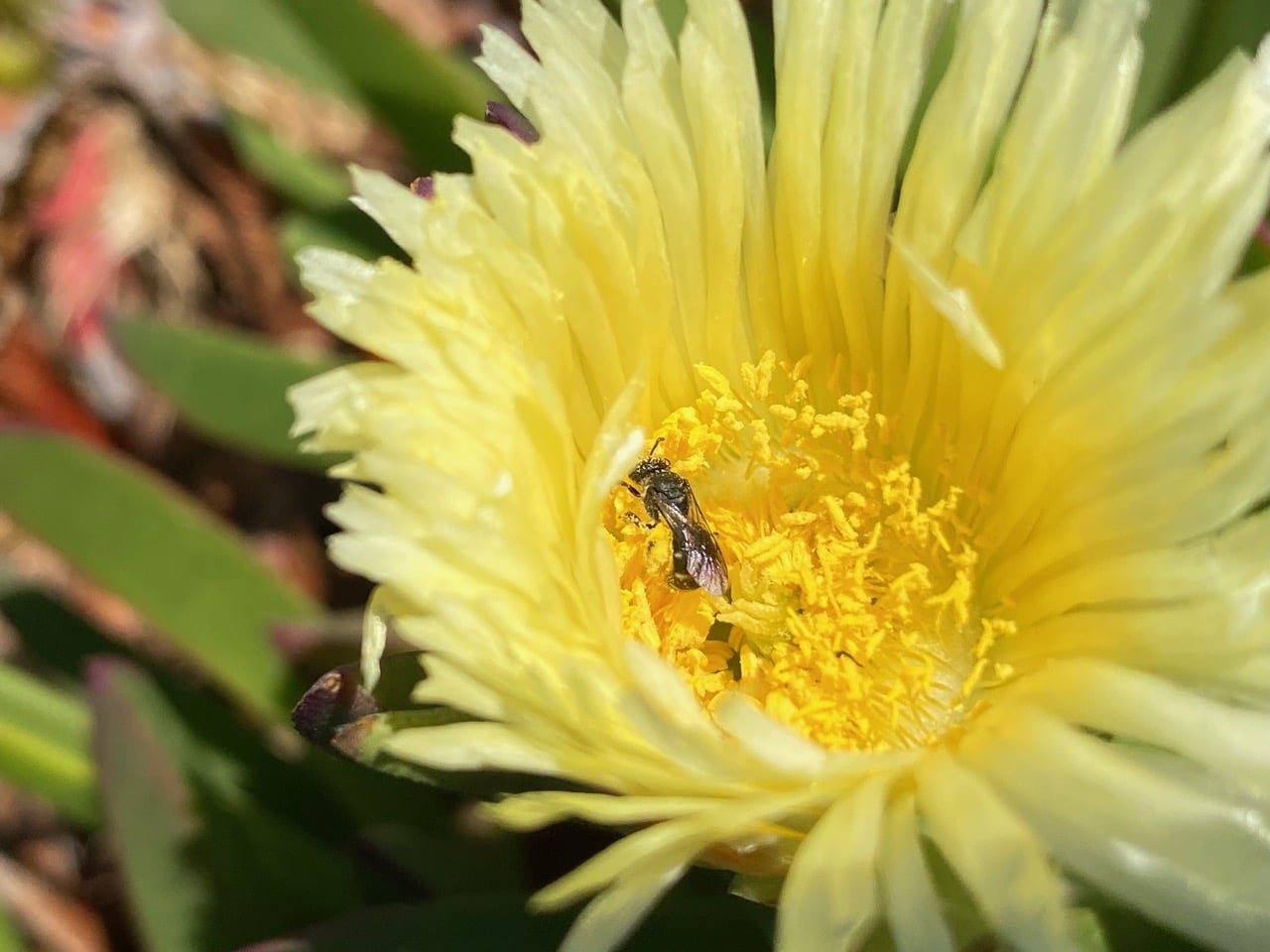
Nearby, a Kincaid’s Sweat Bee, Lasioglossum kincaidii (family Halictidae) is foraging in another Ice Plant flower.
Kincaid’s Sweat Bee, Lasioglossum kincaidii is a small, jet-black solitary bee with black smoky wings and faint white bands on the abdomen. Widely found in urban/suburban gardens and natural habitats in California, they are highly active foragers that emerge as early as spring to pollinate smaller flowers. The bees are polylectic generalists, meaning they will visit a wide variety of flora, and are especially fond of smaller flowers. Like most sweat bees, they are ground-nesting.
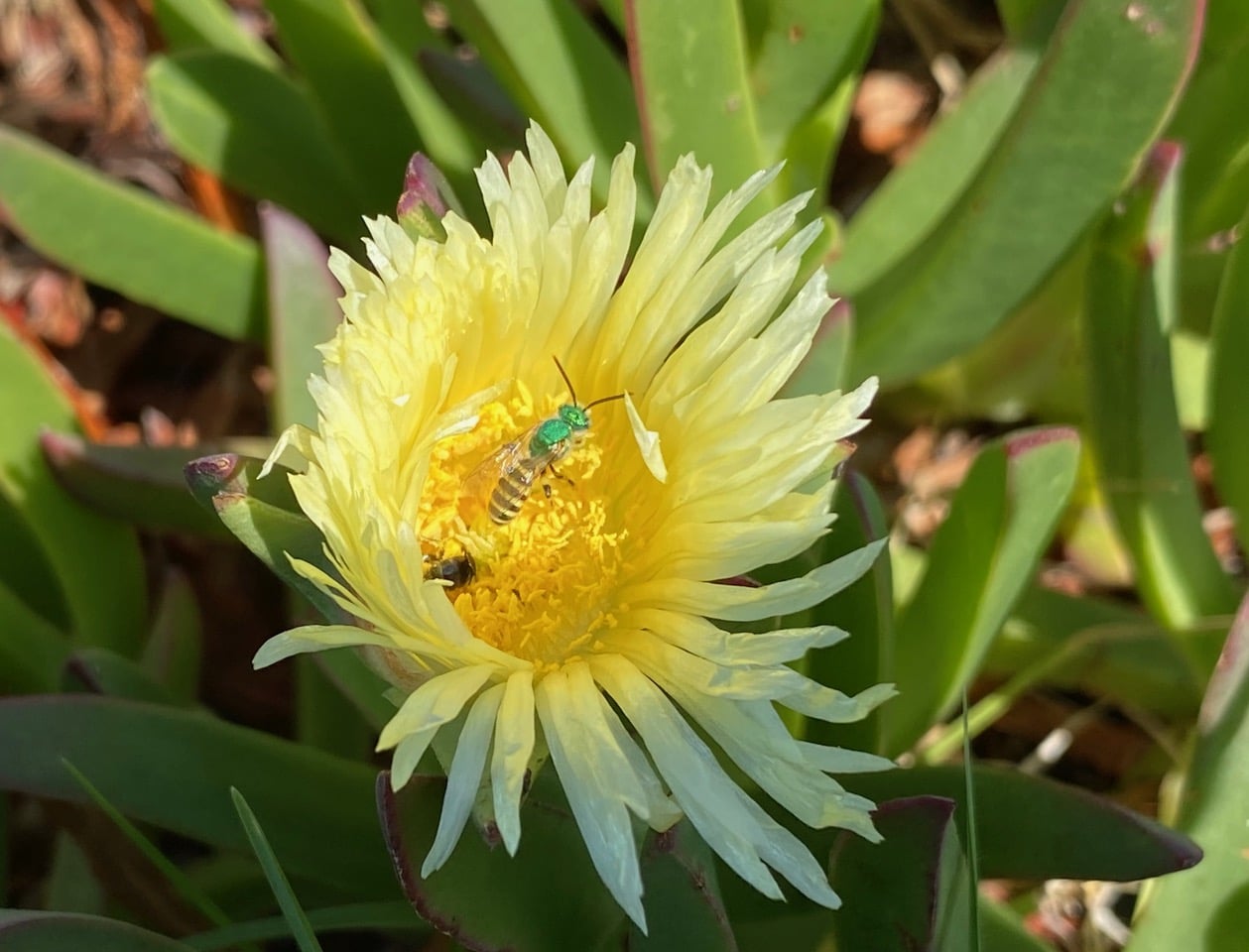
The little Sweat Bee is momentarily joined by a cousin, a male Fine Striped Sweat Bee, Agapostemon subtilior (family Halictidae). The latter does not seem to enjoy the company of another bee, and promptly flies off.
Agapostemon are brightly colored metallic green or blue bees measuring 7 to 14.5 mm long. Most species have a metallic green head and thorax, and black-and-yellow striped abdomen; some females are entirely bright green or blue. Females carry pollen on scopal hairs located on their hind legs. Agapostemon are ground-nesters and generalist foragers. Like other members of the family Halictidae, they are short-tongued and thus have difficulty extracting nectar from deep flowers. Males are often seen flying slowly around flowers looking for females. The bees favor flowers with high densities.
The Fine Striped Sweat Bee, Agapostemon subtilior is a small, widespread species found across North America. They are active from late spring to fall, with all-green females measuring roughly 11 mm, and males (slightly smaller) displaying a black-and-yellow striped abdomen. Like other Agapostemon bees, they are solitary ground-nesters, and are polylectic, foraging from a wide variety of flowers.
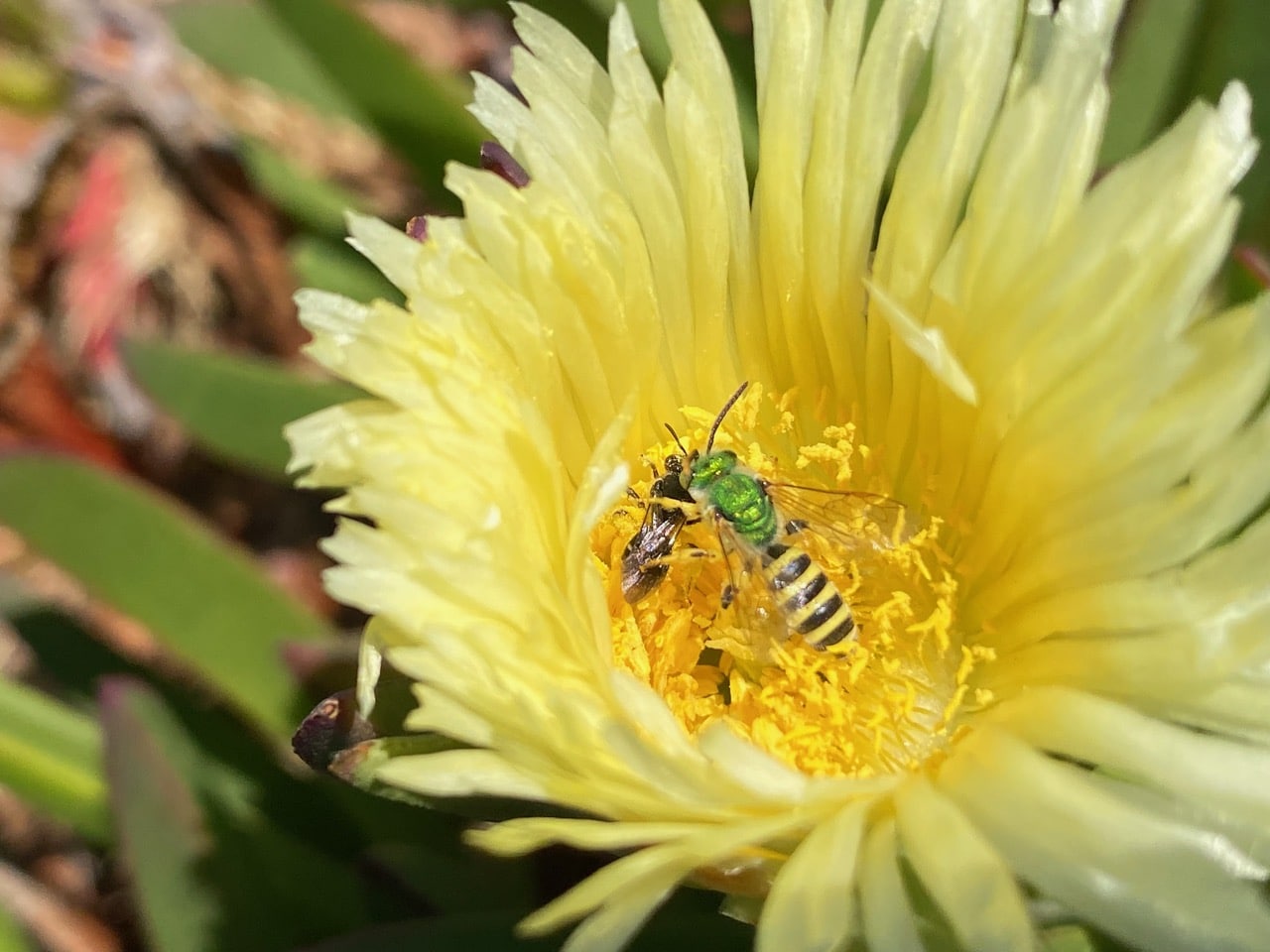
In a minute, the male Striped Sweat Bee returns with a vengeance, heading straight for the smaller bee. It is an intentional attack.

A brief scuffle ensues, then both bees buzz off. This stretch of the Shoreline Trail is quite barren – it’s no wonder that competition for floral resources is so fierce among the insects.

The only native plant still in bloom along this dry, barren stretch is the hardy Telegraph Weed, Heterotheca grandiflora. Its face and legs covered with the sticky pollen, a Common Grass Skimmer, Paragus haemorrhous (family Syrphidae) is foraging on a flowerhead of Telegraph Weed.

The Common Grass Skimmer, Paragus haemorrhous (family Syrphidae) is the smallest hover fly I know, measuring only about 4 mm in length. The species has a world-wide distribution, found in unimproved grasslands, dune grass, open areas and pathsides in forest, and meadows. Adults visit flowers for nectar and pollen. Larvae feed on aphids on low herbaceous plants.
Photos of Common Grass Skimmer (Paragus haemorrhous) · iNaturalist
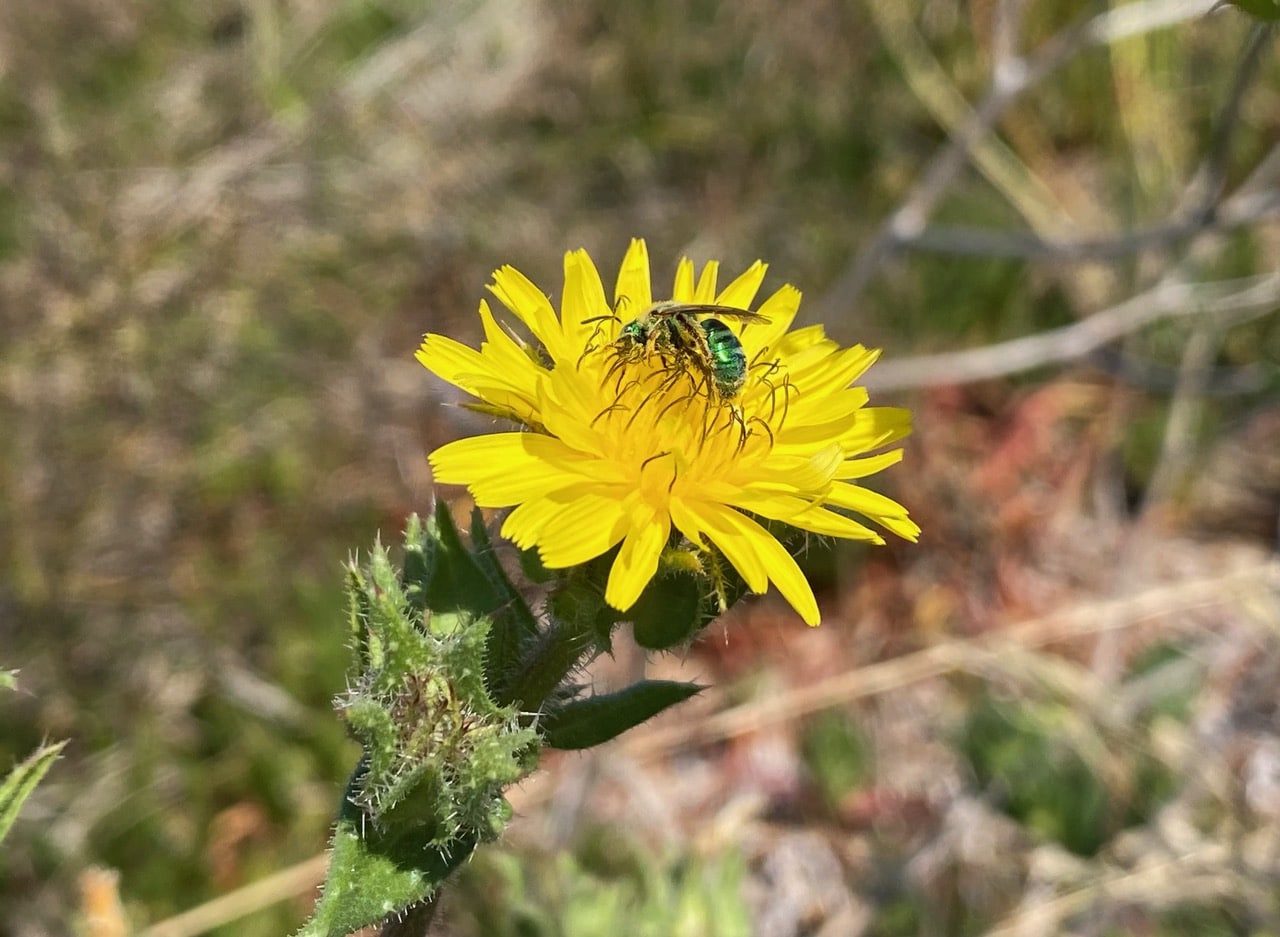
Her head buried among the stamens, a female Fine Striped Sweat Bee, Agapostemon subtilior (family Halictidae) is foraging on a flowerhead of Bristly Oxtongue, Helminthotheca echioides.
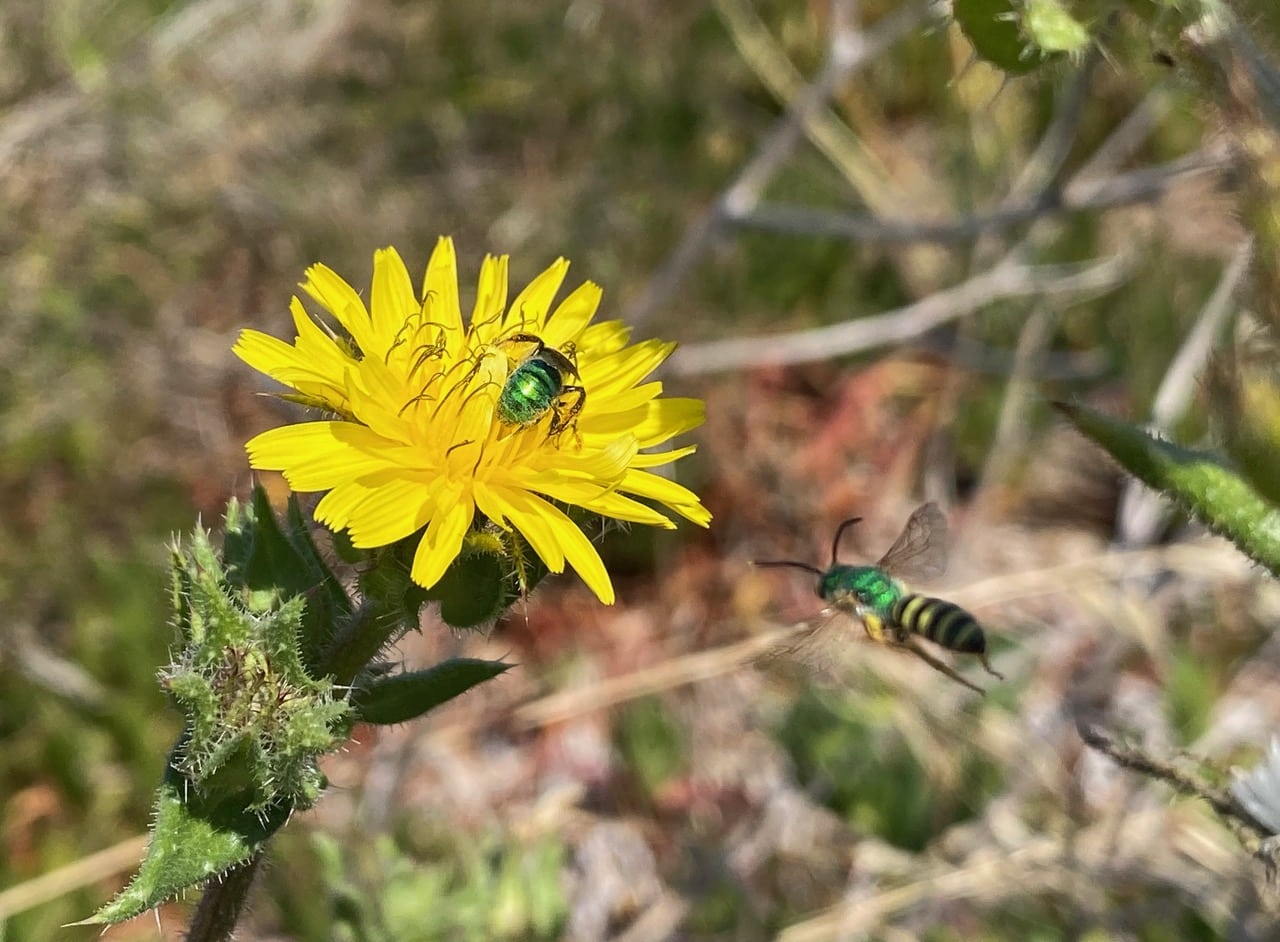
While I am photographing the female, a male Fine Striped Sweat Bee zips in for a chance to mate with her. She promptly flies away. Alas, generally the males’ amorous attempts are not welcome by the females. For him, mating is his sole mission in life.
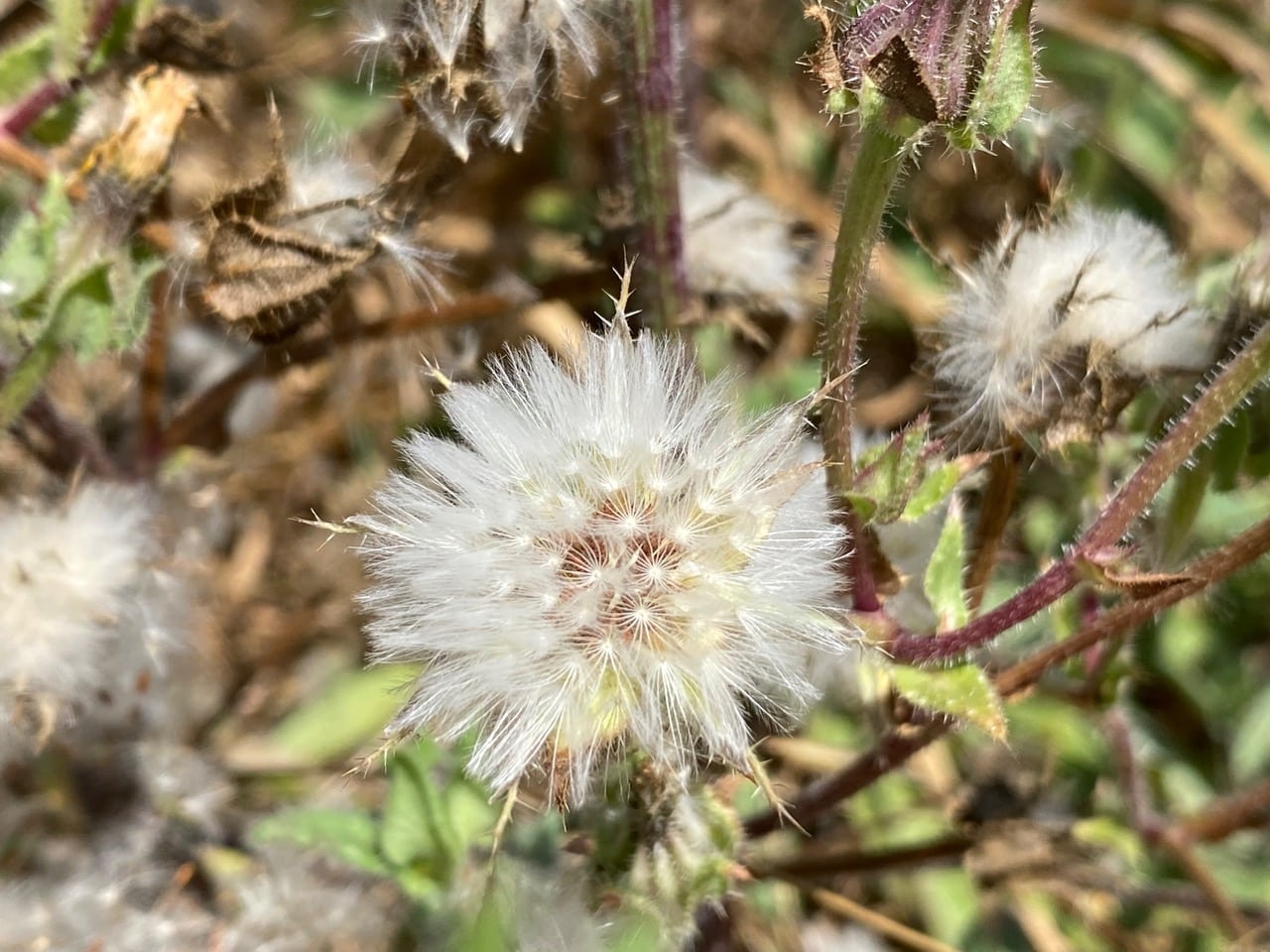
Most of the flowers of the Bristly Oxtongue have gone to seed. Small dandelion-like puffballs have replaced the flowerheads.
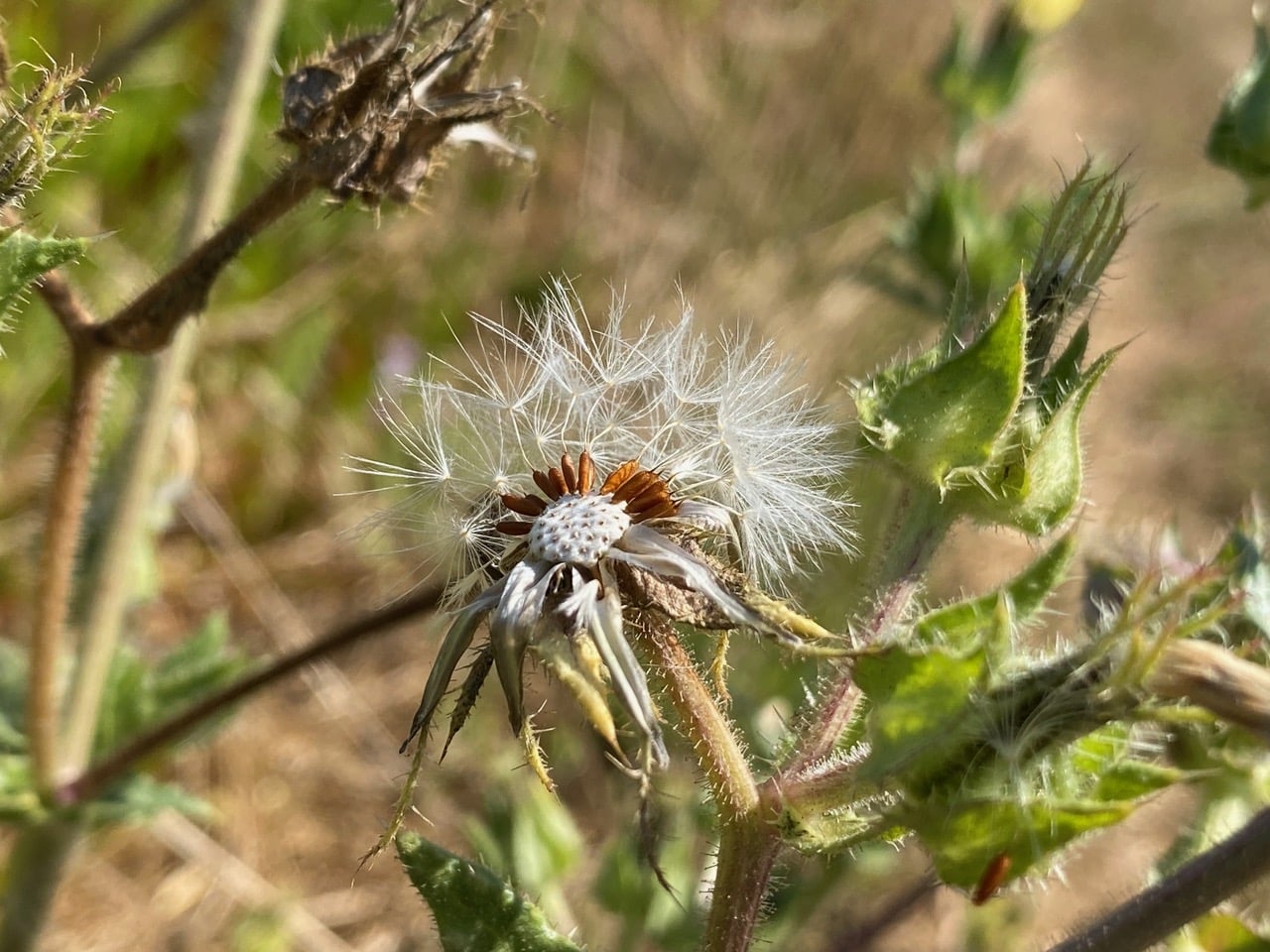
As the wind blows, the elongated brown seeds with feathery plumes detach from the seed head to be carried further afield.

Oregon Gumweed, Grindelia stricta grows well along the wetter sections of the trail. And this is where I can look forward to seeing more insect activity.
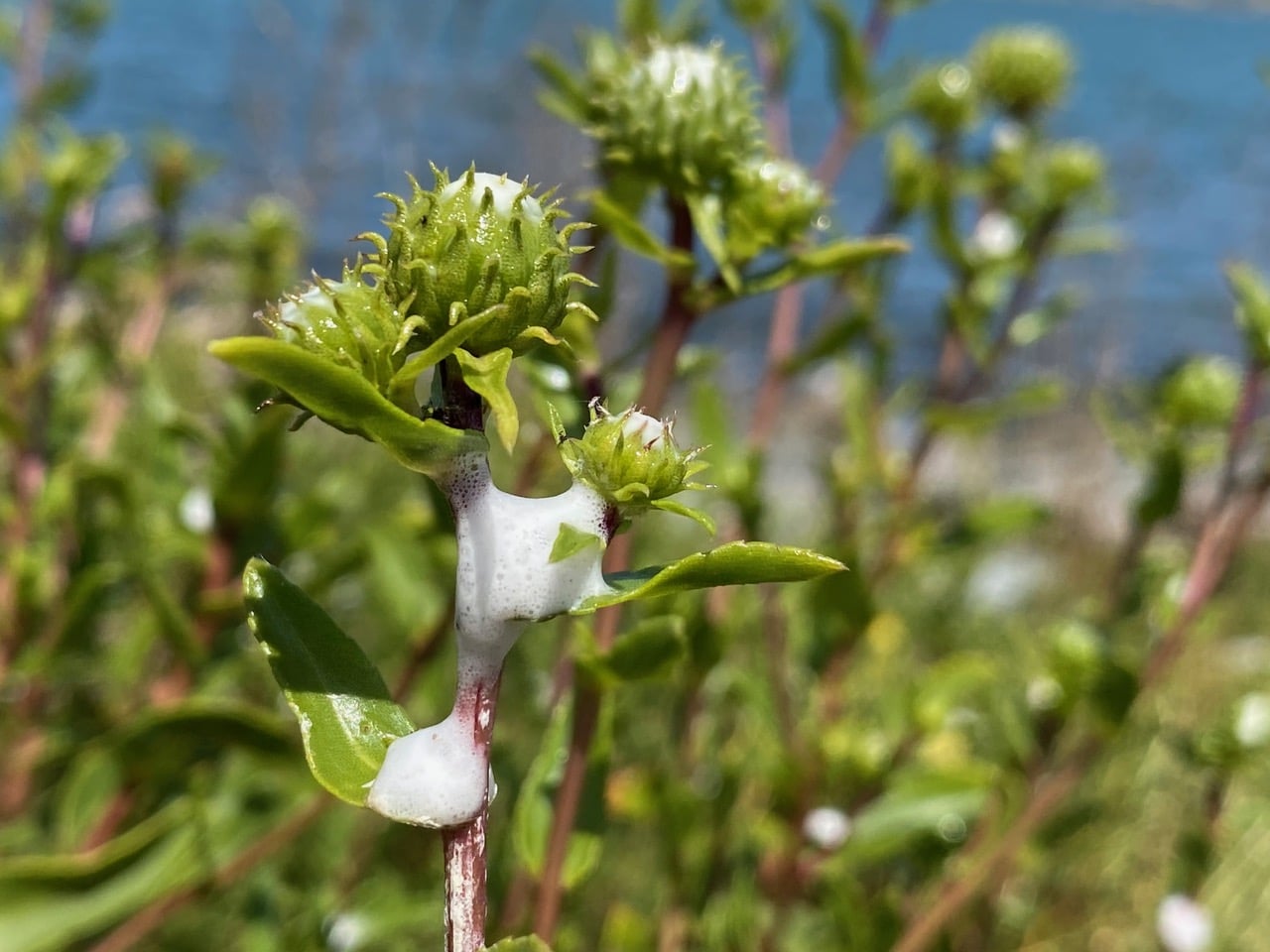
Many of the Grindelia plants are bearing white foamy masses at the leaf axils created by Spittlebugs. I check on the larger masses for adult bugs emerging. So far all is quiet.

A male Summer Longhorn Bee, Melissodes sp. (family Apidae) has landed to take nectar on a Grindelia flowerhead.
The Summer Longhorn Bees, Melissodes sp. (family Apidae) are medium to large bees, stout-bodied, usually with gray hair on the thorax and pale hair bands on the abdomen. Males usually have yellow markings on their faces and have very long antennae from which their common name is derived. They are active May to September, with peak flight in late June to early August. The females prefer flat, bare ground for digging their solitary nests, though they sometimes nest in aggregations. Pollen is transported in scopae on the hind legs. Pollen loads are often copious and brightly colored and thus very distinguishable. Melissodes are specialists on Asteraceae – females gather pollen from flowers of Aster, Bidens, Coreopsis, Cosmos, Encelia, Gaillardia, Helianthus, and Rudbeckia ssp.
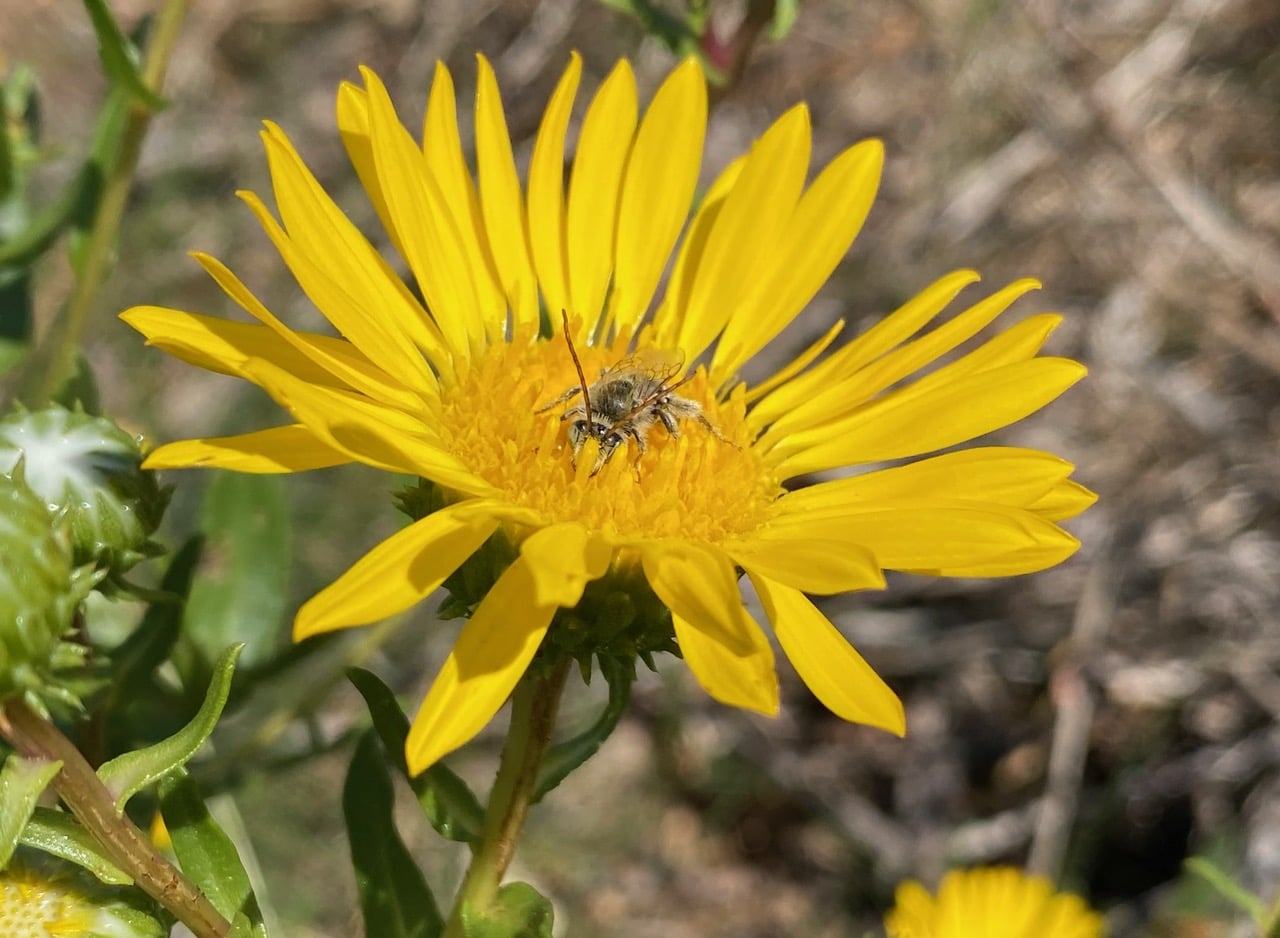
Just like I had noticed the last time I came here, these males have rust-colored antennae.
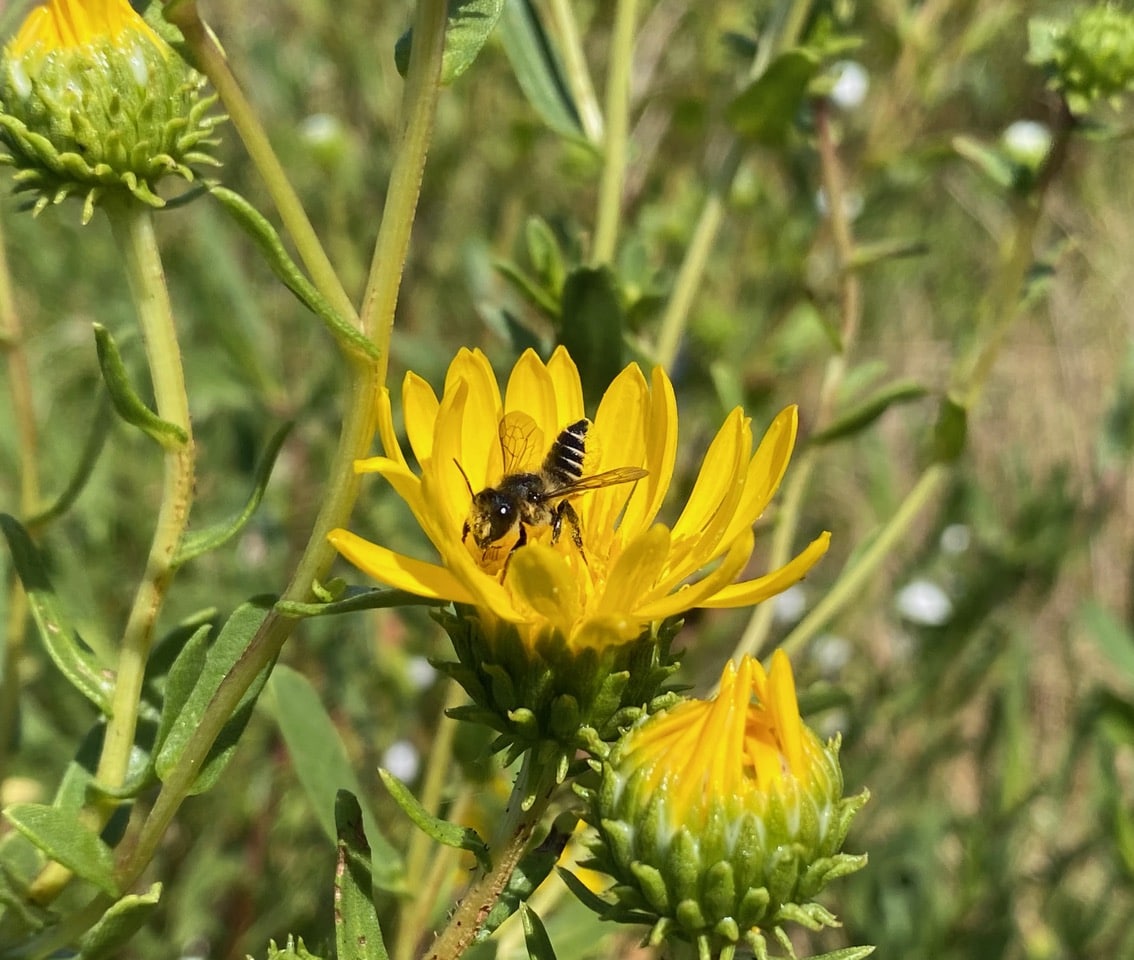
Her abdomen held high, a female Western Leafcutter Bee, Megachile perihirta (family Megachilidae) is collecting pollen on a Grindelia flowerhead.
Leaf-cutter Bees, Megachile sp. (family Megachilidae) are stout-bodied, usually with pale hair on the thorax and stripes of white hairs on the abdomen. Females usually have a triangular abdomen with a pointed tip, and males’ faces are covered with dense, pale hair. Flight season is from May into September, with peak activity from June to August. Solitary females construct nests in tubular cavities, including hollow stems, tree holes, and abandoned beetle burrows in wood. Many use holes drilled into wood, straws, or other manufactured tunnels. Females cut pieces from leaves or flower petals for use in the construction of brood cells. Most Megachile females are generalist foragers, but prefer flowers in the family Asteraceae.
Female Leafcutter Bees carry pollen on a dense brush of stiff hairs on the underside of their abdomen, known as a scopa. As the bee flies, her fuzzy body builds up a positive static charge. When she lands on a flower, this static electricity pulls pollen grains from the anthers, causing them to cling all over her body. Rather than landing and simply walking around, leafcutter bees often dive directly onto the flower and raise their abdomen, rubbing their hairy underside aggressively against the flower’s reproductive parts. She uses a coordinated grooming motion to brush pollen off her body with her forelegs, passing it to her middle legs, and then uses her hind legs to rake and pack the pollen grains securely into the scopa on her belly. When she returns to her nesting cavity, she scrapes the pollen off her abdomen using her hind legs and mixes it with regurgitated nectar to form a nutrient-rich “bee bread” on which she lays an egg.
North America is home to many leafcutter bees, but the Western Leafcutter, Megachile perihirta is one of the largest. The species ranges on the west coast from British Columbia south to northern Mexico. From a distance, the female can be mistaken for a honey bee. She is about the same size as a worker honey bee and enjoys many of the same flowers, but her head is disproportionately large because it houses the bulky muscles that operate her large mandibles. While most leafcutter bees nest above ground in tubes and tunnels, the Western Leafcutter nests underground. Often a small group of females live in a community and burrow into soil, gravel, or sand.
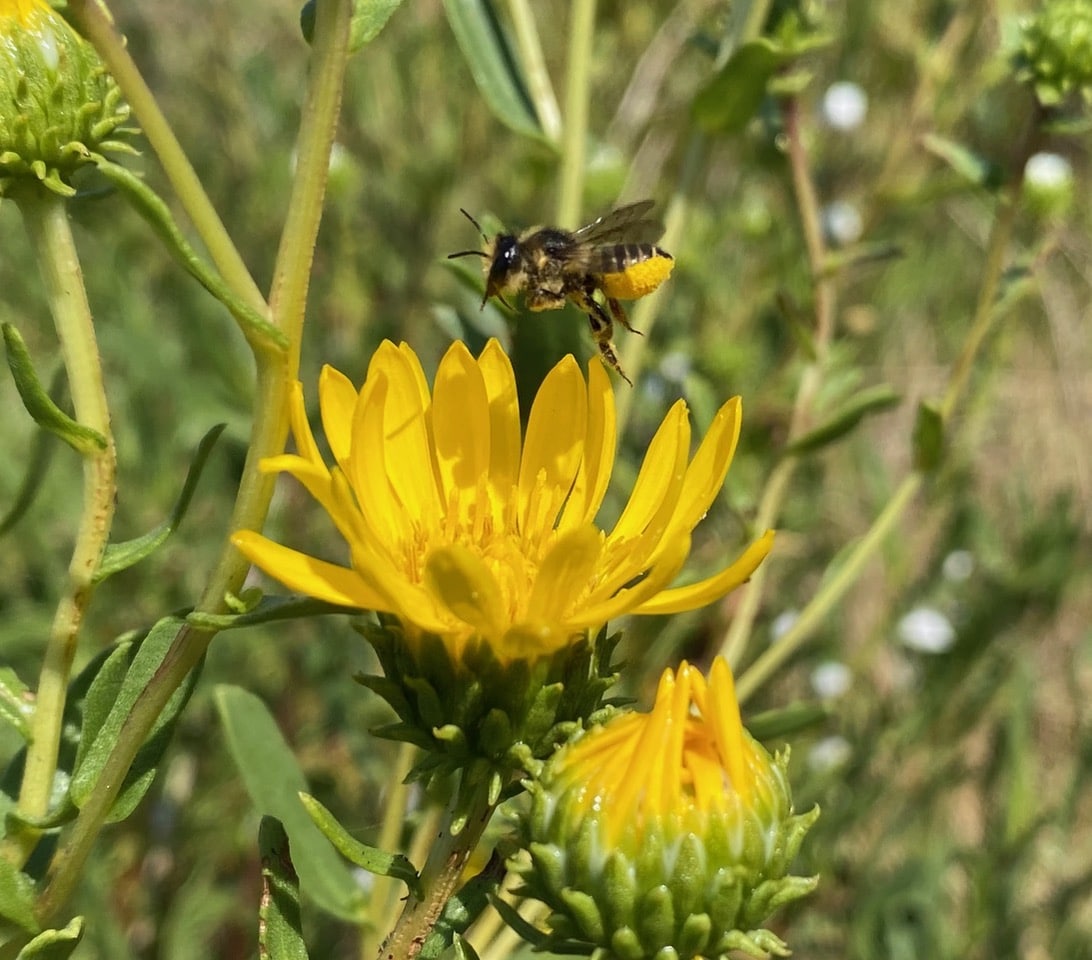
As the female lifts off, you can see the yellow pollen covering the underside of her abdomen (which was previously difficult to see as it blended in with the flower).
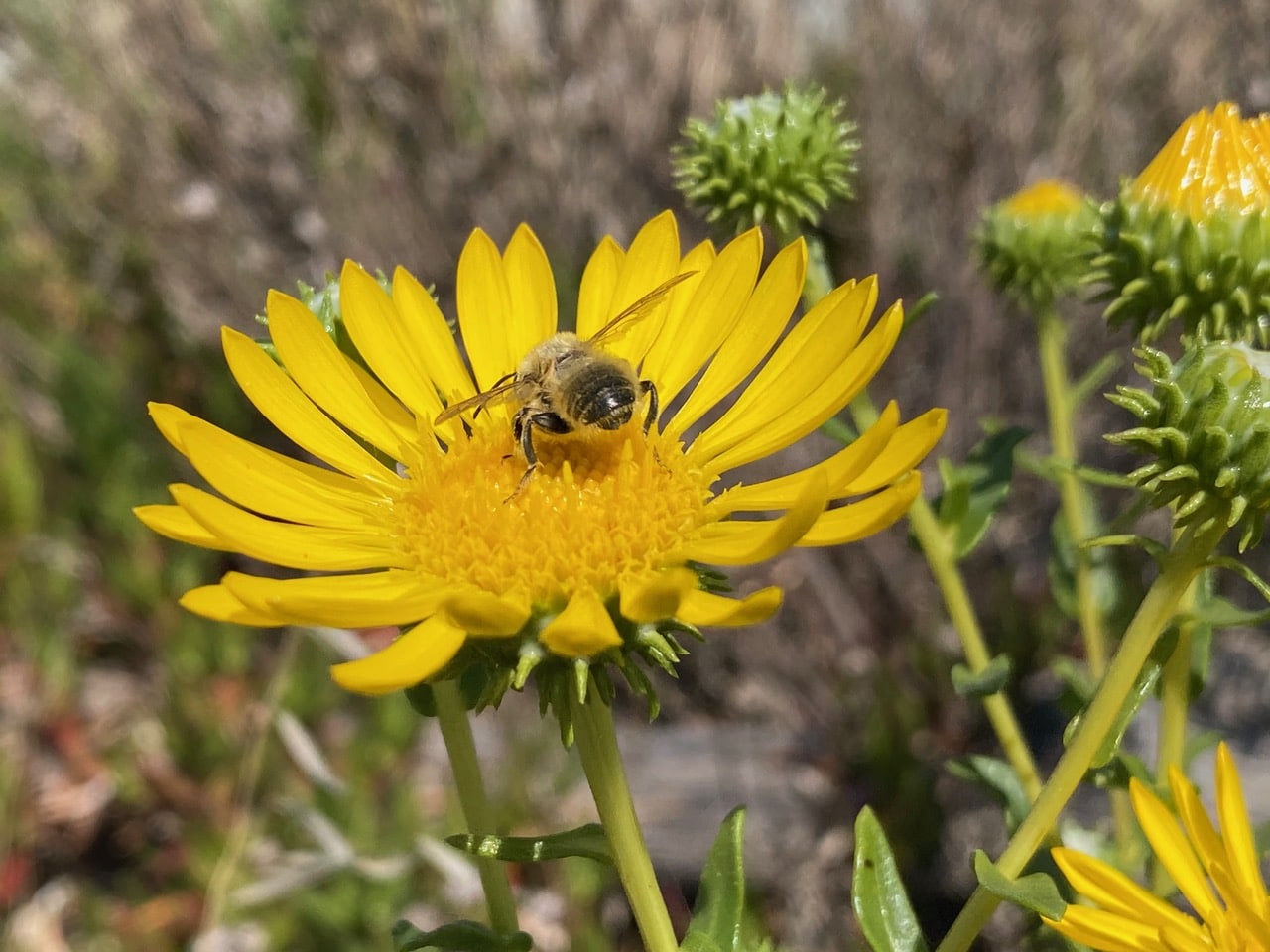
Hey, a male Western Leafcutter Bee, Megachile perihirta (family Megachilidae) has landed on a Grindelia flowerhead. Note that the tip of his abdomen is rounded, in contrast to that of the females.

It’s a scruffy male, the hairs on his thorax rather matted.
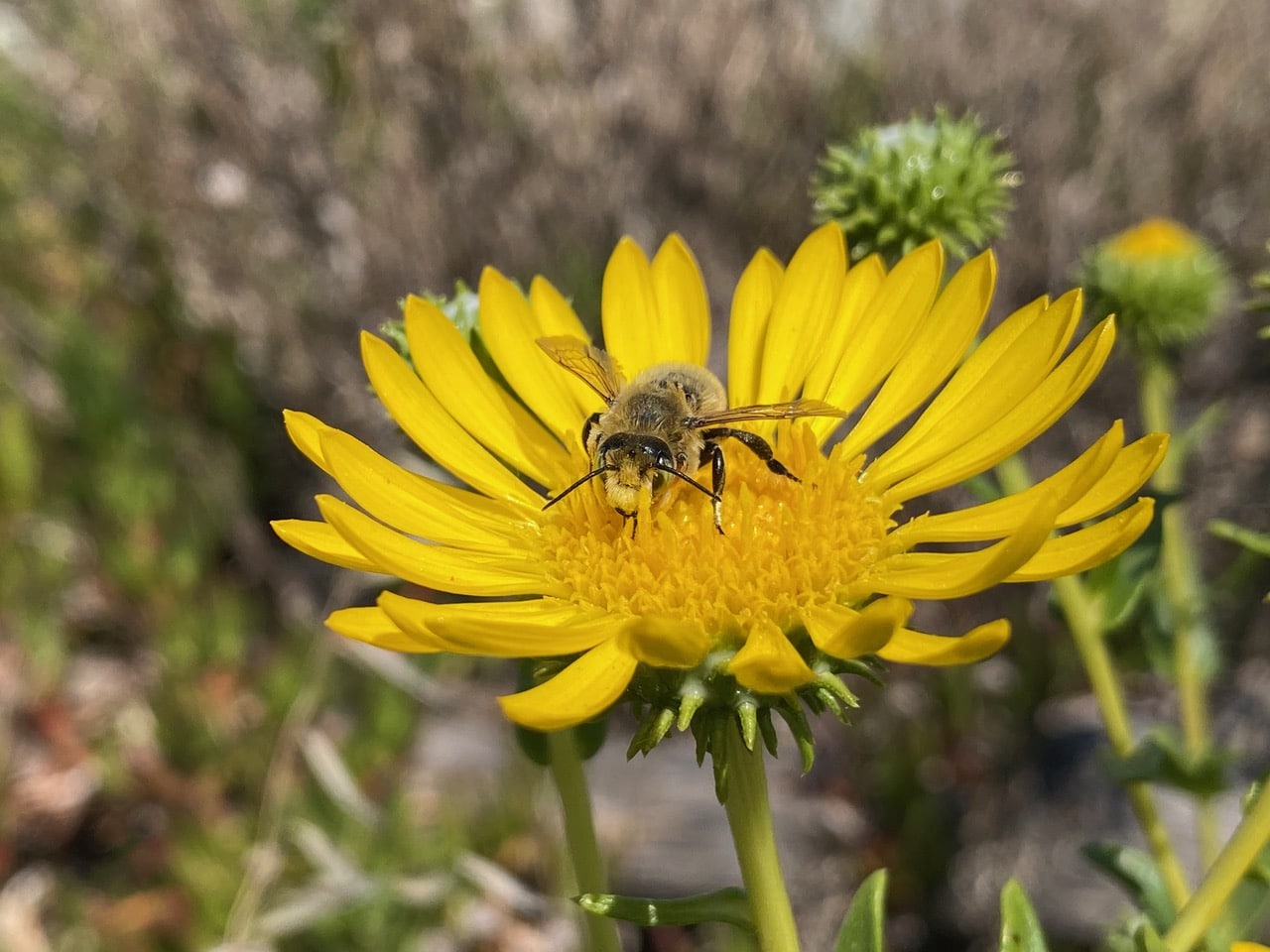
Check out his hairy face and the prolific mustache.
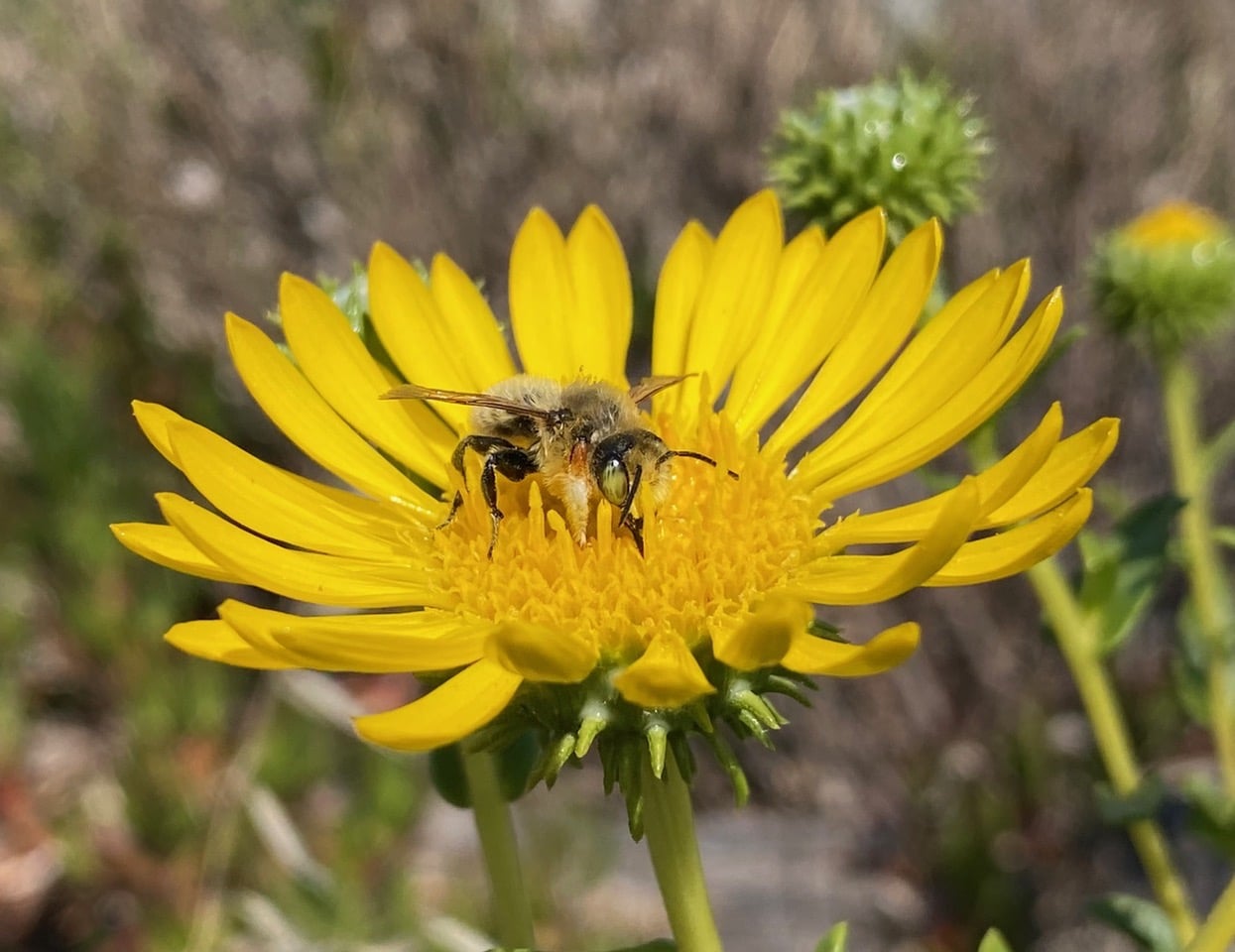
Note that the front leg of the male Western Leafcutter Bee is an orange color and it bears a fringe of long white hairs.
Male Western Leafcutter Bees, Megachile perihirta (family Megachilidae) feature enlarged, modified front legs lined with a dense fringe of long, feathery hairs. They use these hair-lined forelegs during courtship to partially cover the female’s eyes, while using hidden odor glands near their front legs to emit pheromones close to her antennae, purportedly to pacify the female and to render her more receptive.
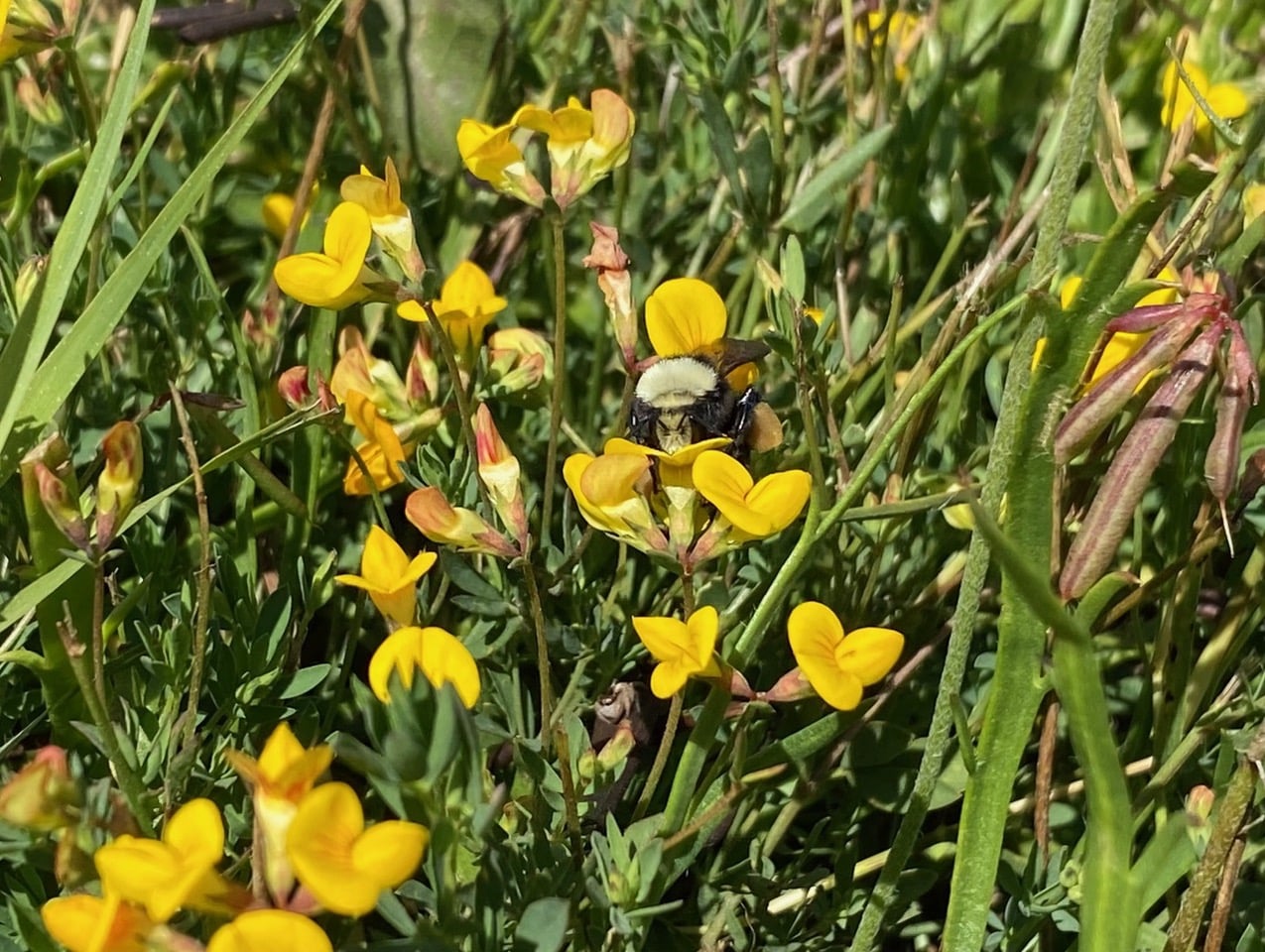
Going from flower to flower, a Yellow-faced Bumble Bee, subgenus Pyrobombus (genus Bombus, family Apidae) is taking nectar from the low-growing Birdsfoot Trefoil, Lotus corniculatus. It’s not an easy task, as the small flowers invariably droop under the bee’s weight.

My heart misses a beat as I spot a bee with an elongated, sharp-tipped, black-and-white banded abdomen land on a Birdsfoot Trefoil flower to take nectar. It’s a Sharptail Bee, Coelioxys sp. (family Megachilidae), a cuckoo bee that targets the Leafcutter Bees as hosts.
The term cuckoo bee refers to a variety of different bee lineages which have evolved the kleptoparasitic behavior of laying their eggs in the nests of other bees, similar to the behavior of cuckoo birds. Female cuckoo bees lack pollen-collecting structures and do not construct their own nests. Cuckoo bees typically enter the nests of pollen-collecting species, and lay their eggs in cells provisioned by the host bee. When the cuckoo bee larva hatches, it consumes the provision in the nest, and kills the host larva. Many cuckoo bees are closely related to their hosts, and may bear similarities in appearance reflecting this relationship. Others parasitize bees in families different from their own.
The Cuckoo Leafcutter Bees, also known as Sharptail Bees, belong to the genus Coelioxys, in the same family as their hosts, Megachilidae. Members of the genus Coelioxys share the distinctive trait of having hairs on their eyes. In addition, the back rim of the bee’s scutellum (the second segment of the thorax) has prominent toothlike protrusions called axillae. In Greek, Coelioxys means “sharp belly”, referring to the tapered, pointed abdomens of cuckoo leaf cutters. The bees have dark abdomens banded by short pale hairs; thorax with prominent axillae; red, black or red-and-black legs; and green eyes. Female Coelioxys have pointed, conical abdomens with spearlike tips. The spade-shaped abdominal tips allow the female cuckoos to break through the brood-cell walls that leafcullters construct with leaves, petals and other materials. Males have abdomens armed with multiple pronged tips. These bees are known to sometimes sleep upside down on vegetation, holding on with their mandibles.
While we might take offense at the cuckoo bees’ unsavory behavior, we really have nothing to worry about. The presence of cuckoo bees is a clear indication of a thriving population of their host bees. By parasitizing specific species, cuckoo bees prevent dominant host bees from pushing out less competitive, rarer bee species, allowing for greater biodiversity. The arms race between cuckoo bees and their hosts drives genetic diversity and adaptation. Hosts evolve defenses against parasites, which naturally strengthens the resilience of the bee community. What’s more, although they do not intentionally collect pollen, cuckoo bees must visit flowers to forage for nectar, which sometimes leads to incidental pollen transfer.