

Pollinator Post 8/10/23 (1)

I arrive at Siesta Gate at 9 am when it is still shrouded in fog. Another blessedly cool morning in the Berkeley hills while the rest of the world sizzles in heat!

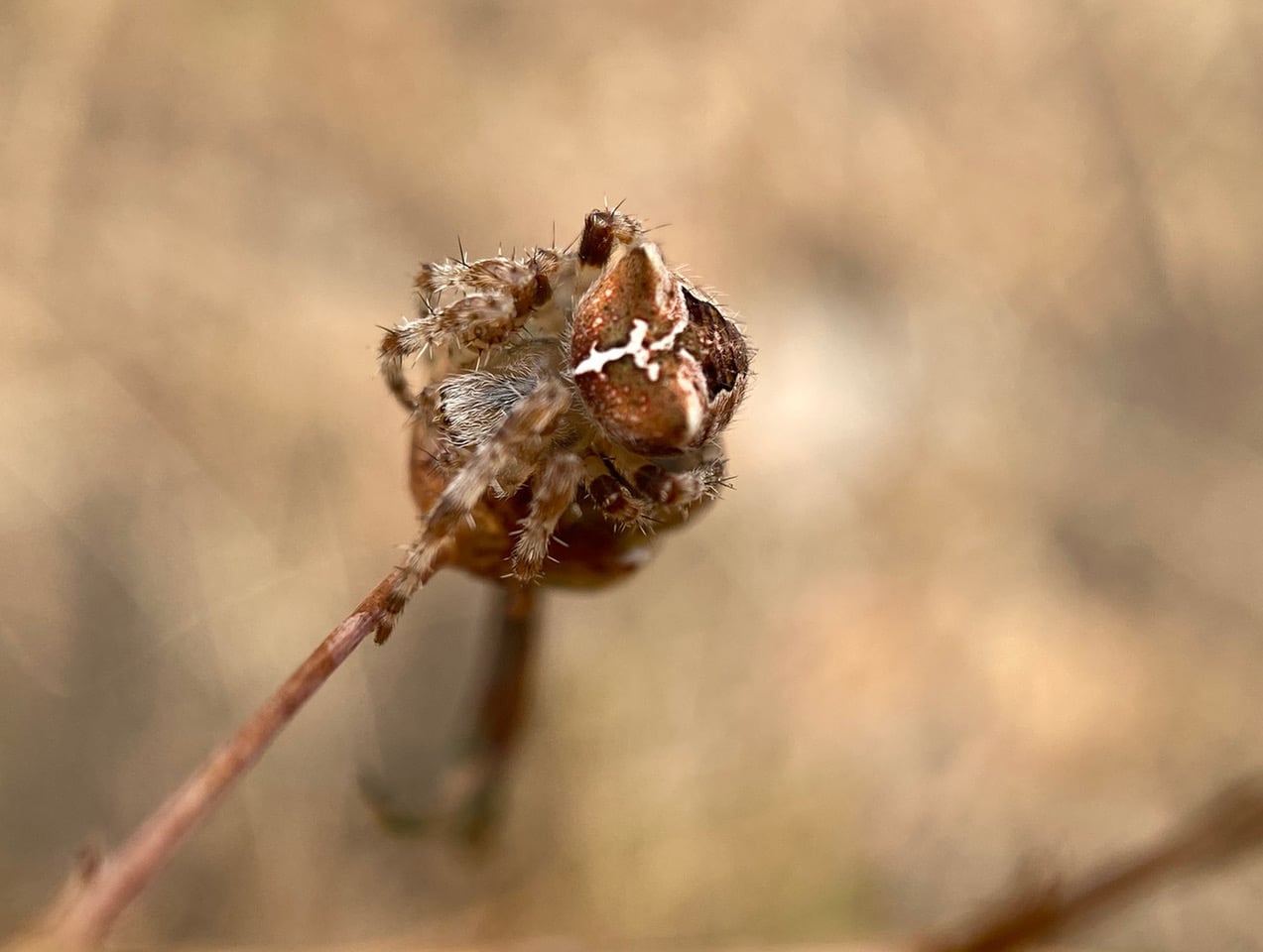

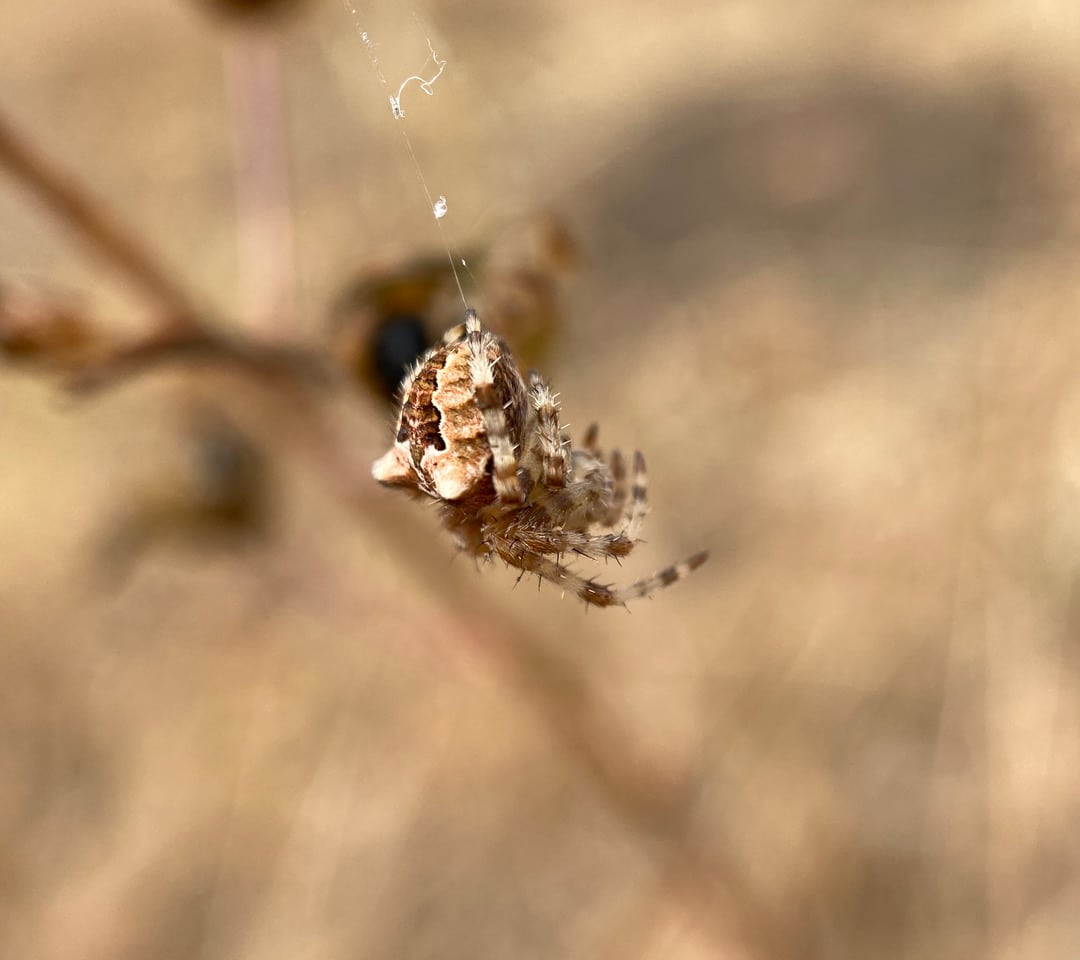
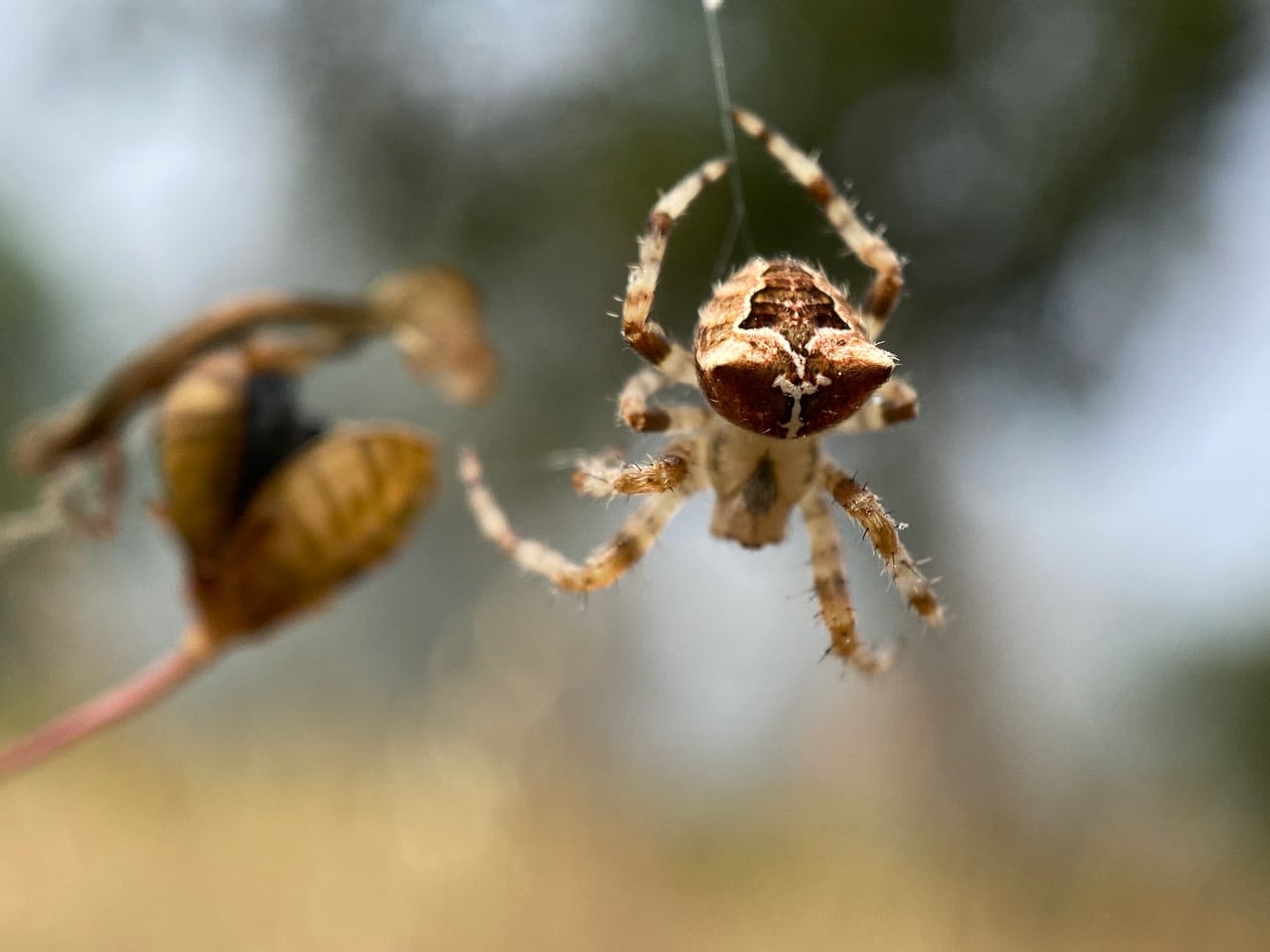
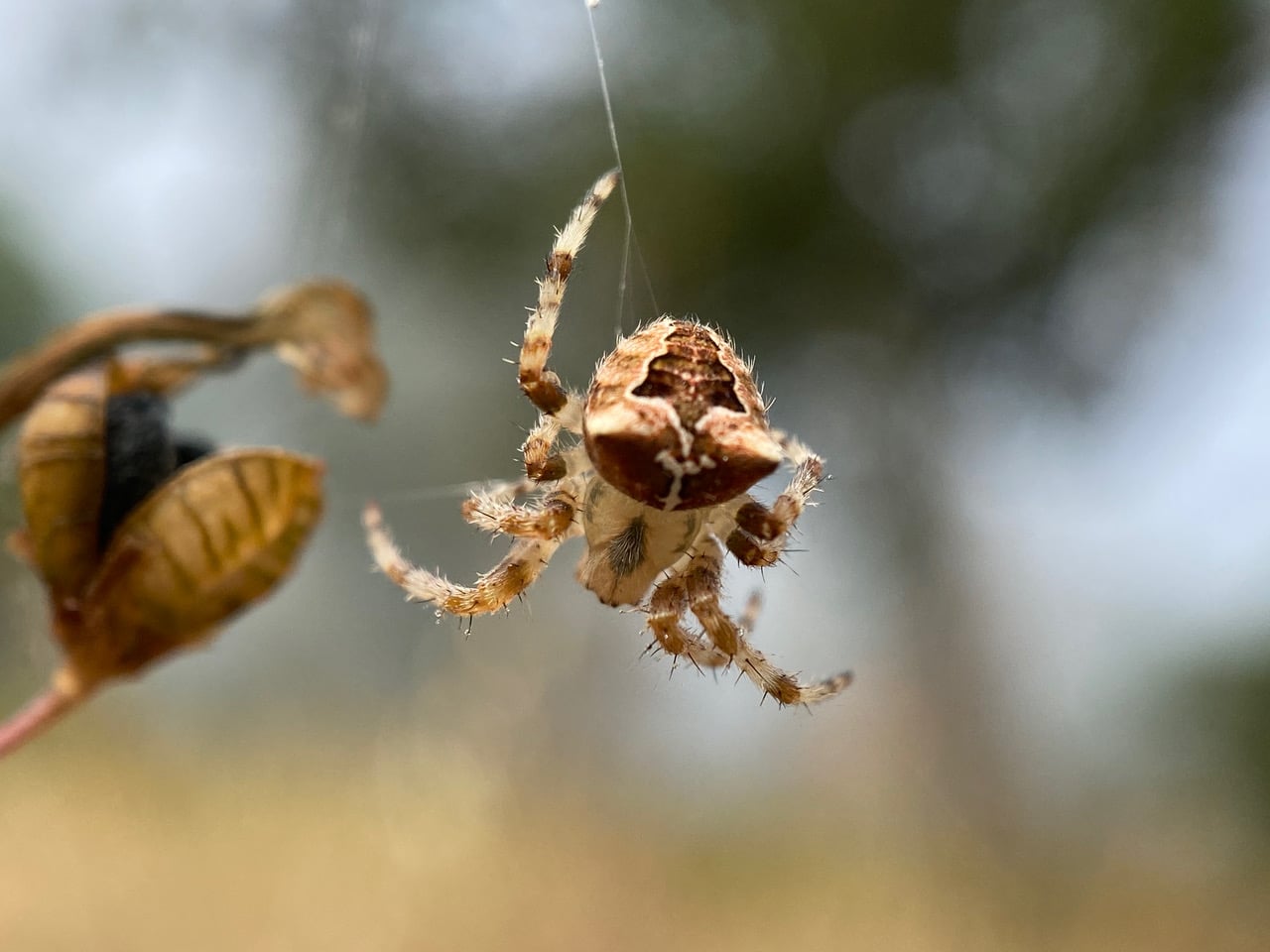 As the spider is suspended and moving around in mid-air, I take a series of pictures in rapid fire….


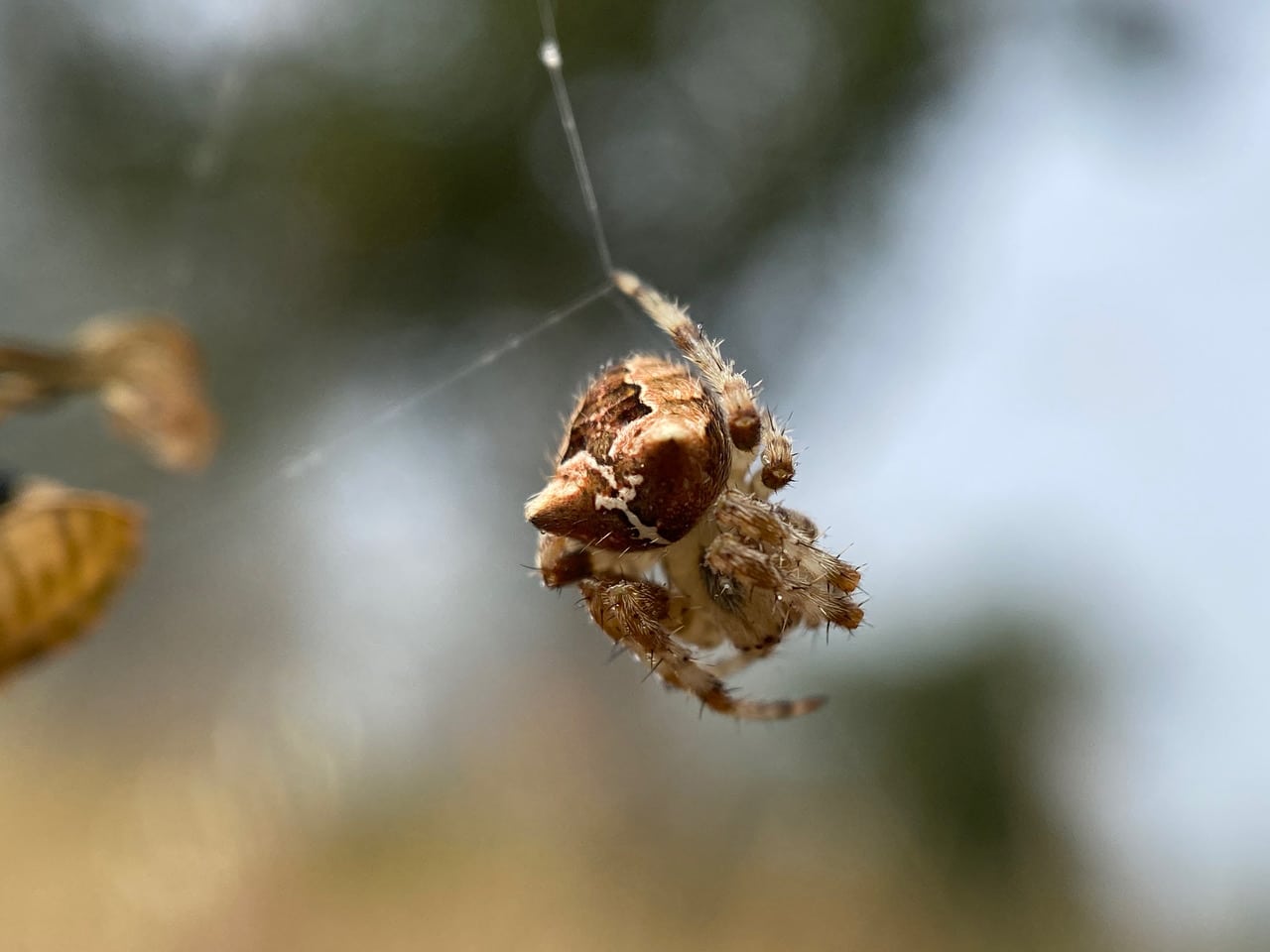 Thank you, Spider! What a thrill to be able to see your whole magnificent body and your rappelling skill!



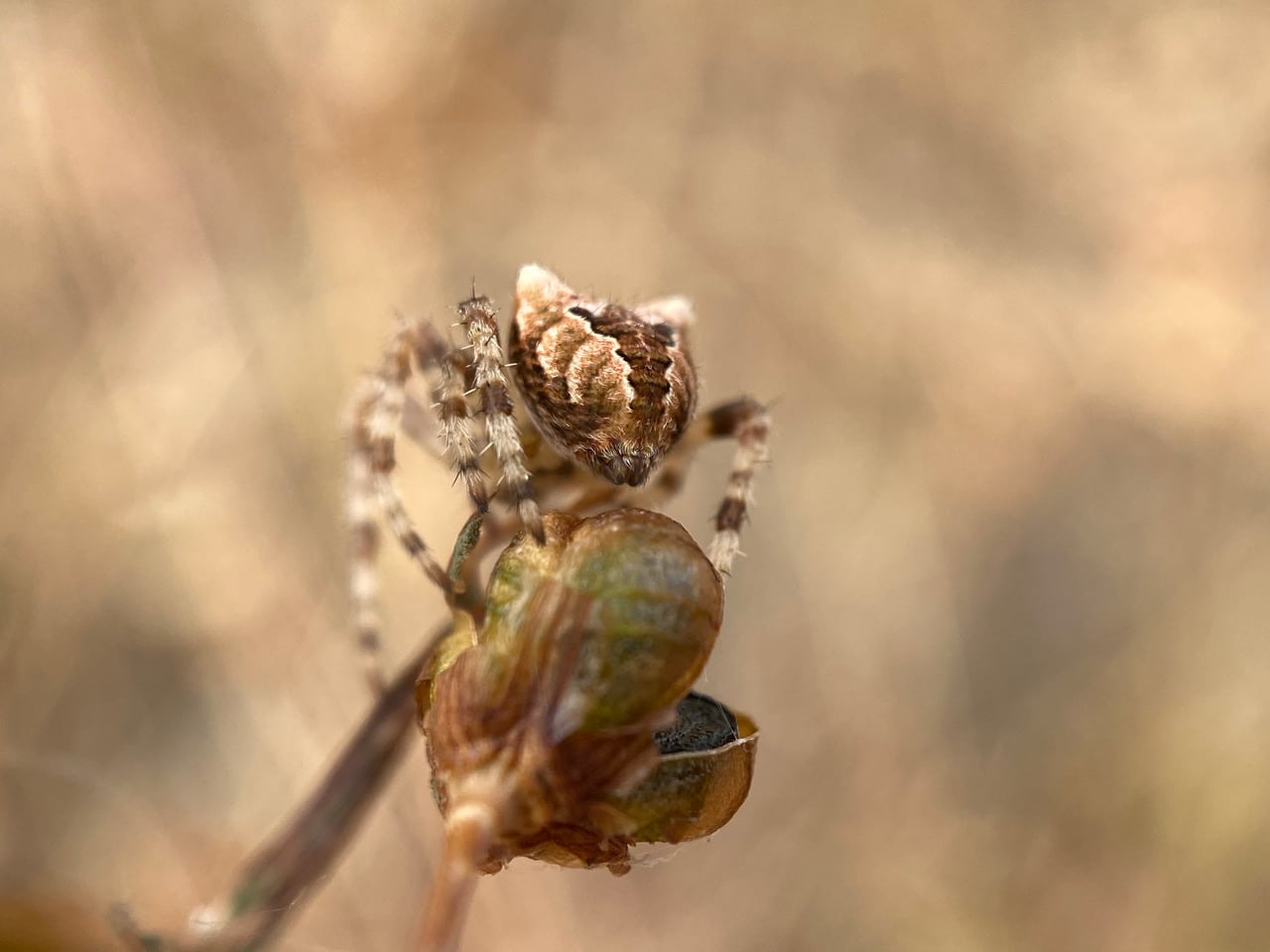
About 12 feet further along Skyline Trail from a tall Soap Plant where I have been observing a Two-tubercled Orb-weaver Spider for more than 2 weeks, I find another of the same spider. I can’t be sure if it is the same individual that has moved over to this smaller Soap Plant. The spider is resting on the side of an opened seed capsule.
I tilt the branch to get some light on the spider. This is a view of her from the top.
Sensing my intrusion, the spider stands up. I can now see her spinnerets at the tip of her beautifully patterned abdomen.
A spinneret is a silk-spinning organ of a spider. Spiders have special glands that secrete silk proteins (made up of chains of amino acids). The spider pushes the liquid solution through long ducts, leading to microscopic spigots on the spider’s spinnerets. Spiders typically have two or three spinneret pairs, located at the rear of the abdomen. Most spinnerets are not simple structures with a single orifice producing a single thread, but complex structures of many microscopic spigots, each producing one filament. The spigots allow the spider to combine multiple filaments in different ways to produce many kinds of silk for various purposes.
Various species of spiders use silk extruded from spinnerets to build webs, to transfer sperm, to entrap insects, to make egg-cases, to manipulate static electricity in the air, and to fly (ballooning), etc.

Then the spider drops from the seed capsule. She is in full control, holding onto silk threads that she has woven around her perch. While she is a Orb-weaver, I don’t see an orb, but there’s a whole matrix of spider silk below the seed capsule that probably serves to trap prey. The 3- dimensional branchings of the stalked seed capsules provide convenient scaffolding for the little spider to set up her invisible trap.
There are knots and kinks along the silk threads where the spider has adjusted their tension as she moves along.
The Two-tubercled Orbweaver, Gibbaranea bituberculata is a species of ‘orbweavers’ belonging to the family Araneidae. They are found in sunny habitats on shrubs, edges and low plants, where they can make their webs near the ground. Their basic color is very variable, but usually it is brownish, with whitish shades. The cephalothorax is covered with adpressed hairs.
Orb-weaver spiders are members of the spider family Araneidae. They are the most common group of builders of spiral wheel-shaped webs often found in gardens, fields, and forests. Generally, orb-weavers are three-clawed builders of flat webs with sticky spiral capture silk. The third claw is used to walk on the non-sticky part of the web. Typically, the prey insect that blunders into the sticky lines is stunned by a quick bite, and then wrapped in silk.
As the spider is suspended and moving around in mid-air, I take a series of pictures in rapid fire…. What spectacular designs on her abdomen!
Here’s a good look at her cephalothorax, normally hidden under her folded legs. It is wider than I had envisioned and has some greenish markings and covered with short adpressed hairs.
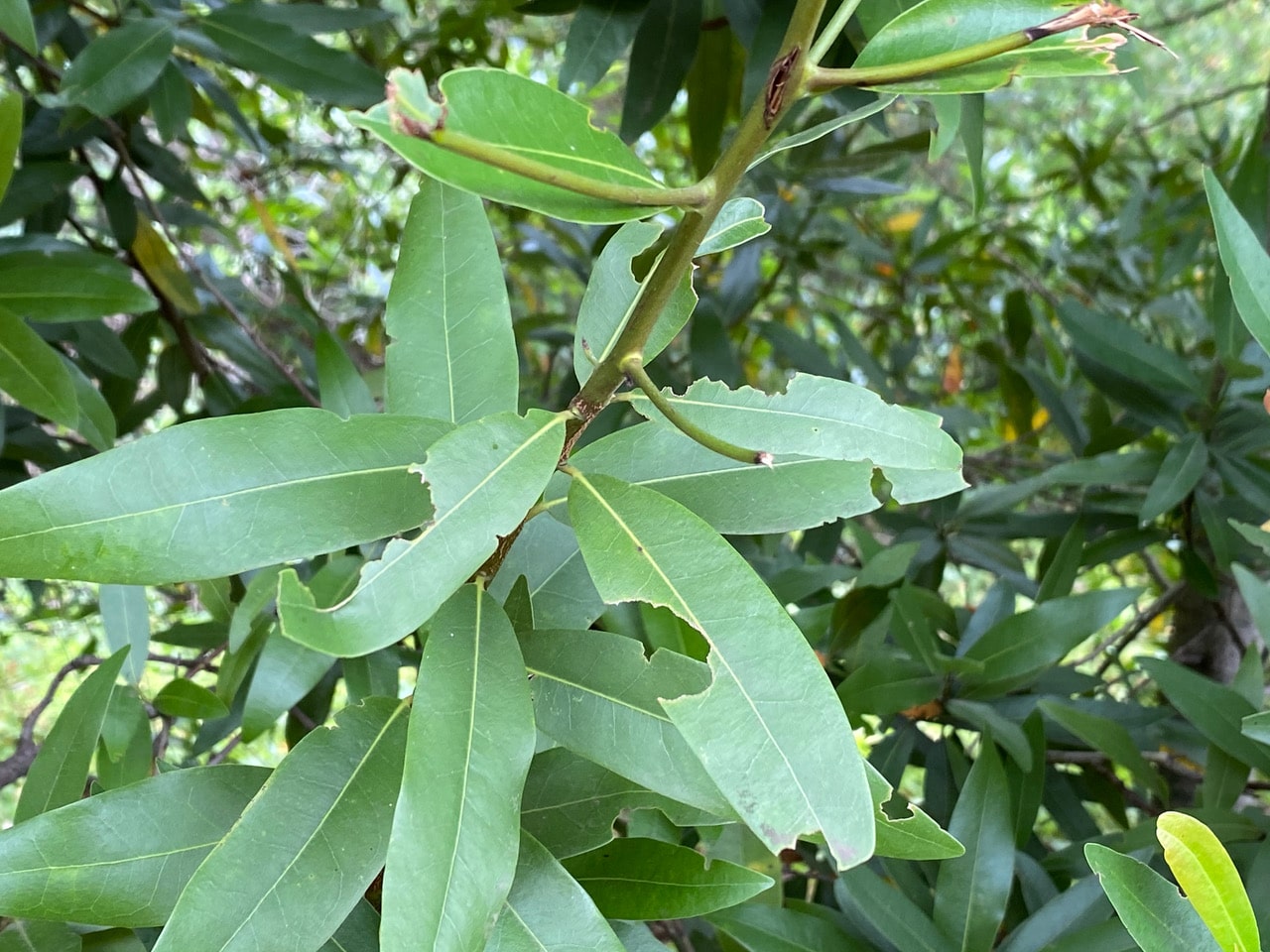
Thank you, Spider! What a thrill to be able to see your whole magnificent body and your rappelling skill!Someone has been chewing on the edges of the leaves of Bay Trees, Umbellularia californica along Skyline Trail. Who? Who can tolerate the spicy, pungent chemicals of the Bay leaves?
I never see any insects on the Bay Trees large enough to incur this kind of feeding damage. I suspect some nocturnal insects. Katydids? The Bush Katydid nymphs we have been seeing on the flowers have all but disappeared. Perhaps they have transformed into adults that live and feed on trees?
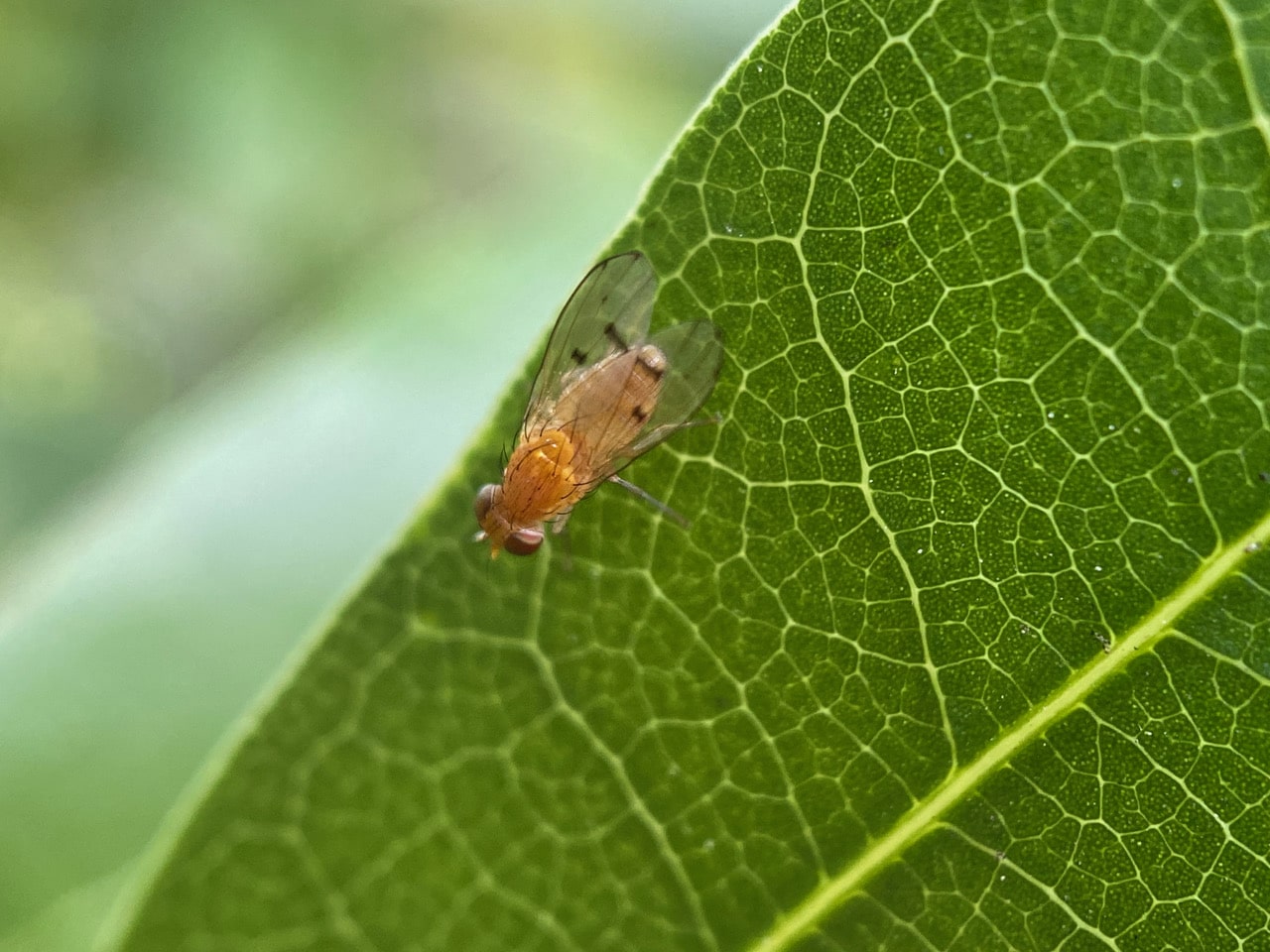
A small fly, Homoneura sp. (family Lauxaniidae) is walking on a Bay leaf.
Lauxaniidae are small flies (2-7 mm in length). They are often rather plump and dull, the body color varying from yellow-brown to black, or with a combination of these colors. They are characterized by strong, backward pointing bristles on the front (top of the head right above the eyes). The larvae are mostly saprophages, feeding in leaf litter, soil, bird nests, etc. Larvae of some mine fallen leaves, others live in rotten wood.
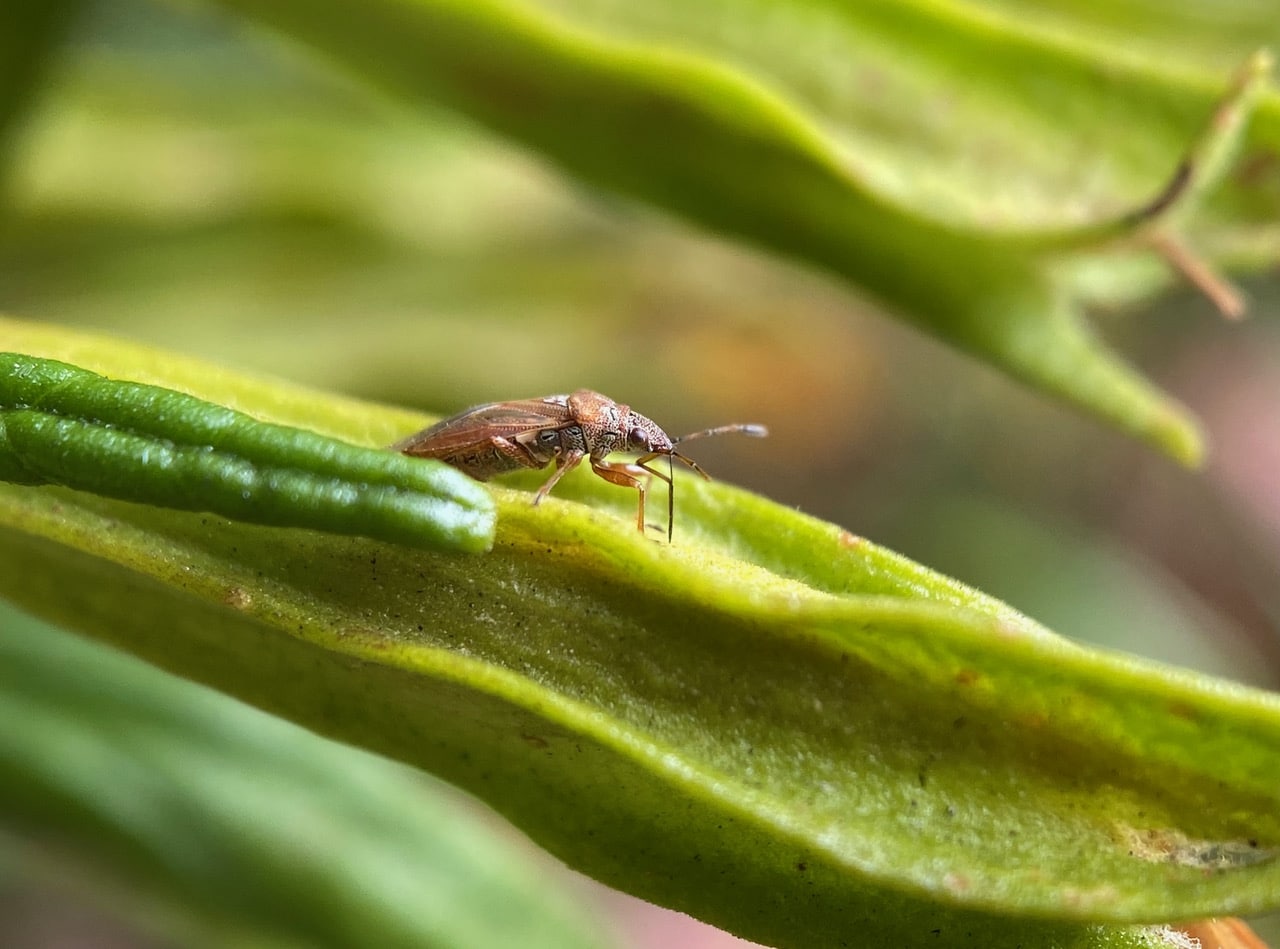
A Seed Bug, Kleidocerys franciscanus (family Lygaeidae) is using its rostrum to feed on the developing seeds inside the calyx of a withered Sticky Monkeyflower, Diplacus aurantiacus.
The defining feature of Hemipterans or “true bugs” is their “beak” or rostrum in which the modified mandibles and maxillae form a “stylet” which is sheathed within a modified labium. The stylet is capable of piercing tissues and sucking liquids, while the labium supports it. The stylet contains a channel for outward movement of saliva and digestive enzymes, and another channel for the inward movement of pre-digested liquid food. The rostrum is usually folded under the body when not in use. Seed bugs are able to feed on seeds by injecting digestive juices into the seeds and sucking up the digested contents as a liquid.

Most of the Metallic Flea Beetles, Altica sp. (family Chrysomelidae) on the Naked Buckwheat, Eriogonum nudum have a shiny dark blue exoskeleton. Today I spot one that is more of a greenish-gold color. Here it is next to a blue one for comparison.
Flea Beetles are in the largest subfamily (Alticinae) of the family Chrysomelidae, or Leaf Beetles. The name Altica is derived from the Greek word haltikos, meaning good jumpers. The beetles have strong hind legs allowing them to jump long distances like true fleas. Altica flea beetles are 3-9 mm in length, and females are typically larger then males. Most Altica beetles have hard outer wings elytra that are metallic blue to green in color that protect similarly colored metallic bodies that reflect purple and bronze colors and are elongate oval in shape. Antennae have 11 segments and are filiform (threadlike).
The life history patterns of common flea beetles are very similar among Altica species with the major difference being host plant preference. Adults and larvae Altica flea beetles feed on all sorts of plant tissues, and all species are fully herbivorous. Many are serious pests of cultivated plants, including food crops. Others are beneficial due to their use in biocontrol of invasive weeds.
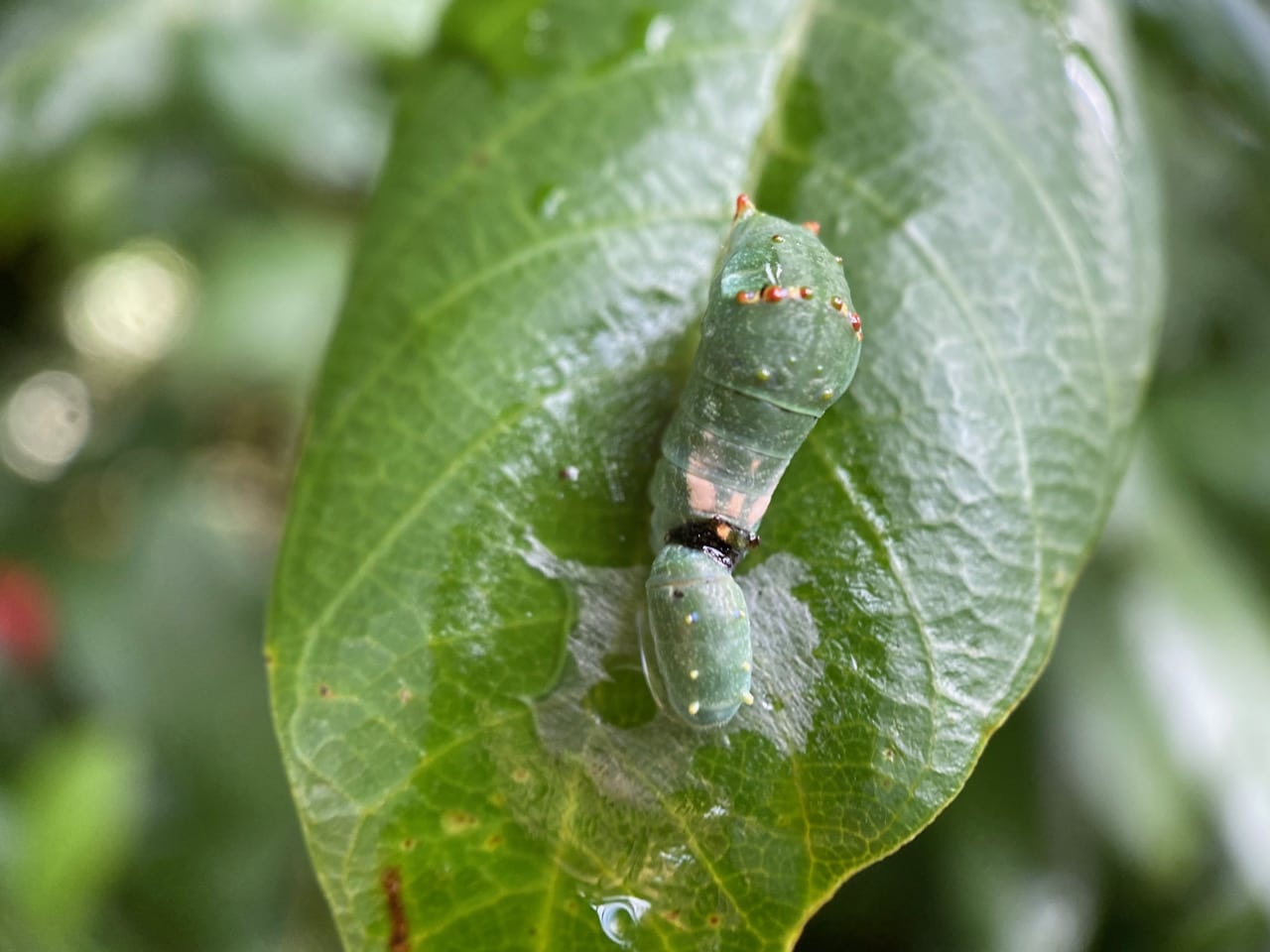
Ah, I am so glad to find Cinch, the Pale Swallowtail caterpillar resting on its silk pad on a Coffeeberry leaf. It may sound silly, but I am here on a rescue mission – to have the band of old skin around its body removed. I have consulted Alan, the entomologist on iNaturalist who helped identify the caterpillar. Alan has advised that unless the old skin is removed, Cinch does not have much of a chance of developing into a butterfly. Asked if he is able to perform the operation, Alan said that he would give it a try (He has done it several times before). With that, we have agreed that I would collect Cinch and deliver it to Alan (he lives in the Bay Area). I would only need to cut off the home leaf with Cinch on it. No need to collect any food plant for Cinch, as Alan has easy access to Coffeeberry near his home. If Cinch makes it to adulthood, it would be released back at Skyline Gardens, exactly where I have found it.
So, here’s little Cinch on its home leaf placed in a petri dish. I have also collected the leaf on which I have seen it feed, just in case Cinch gets hungry. I put the lid on, and the whole thing fits snuggly into my vest pocket.
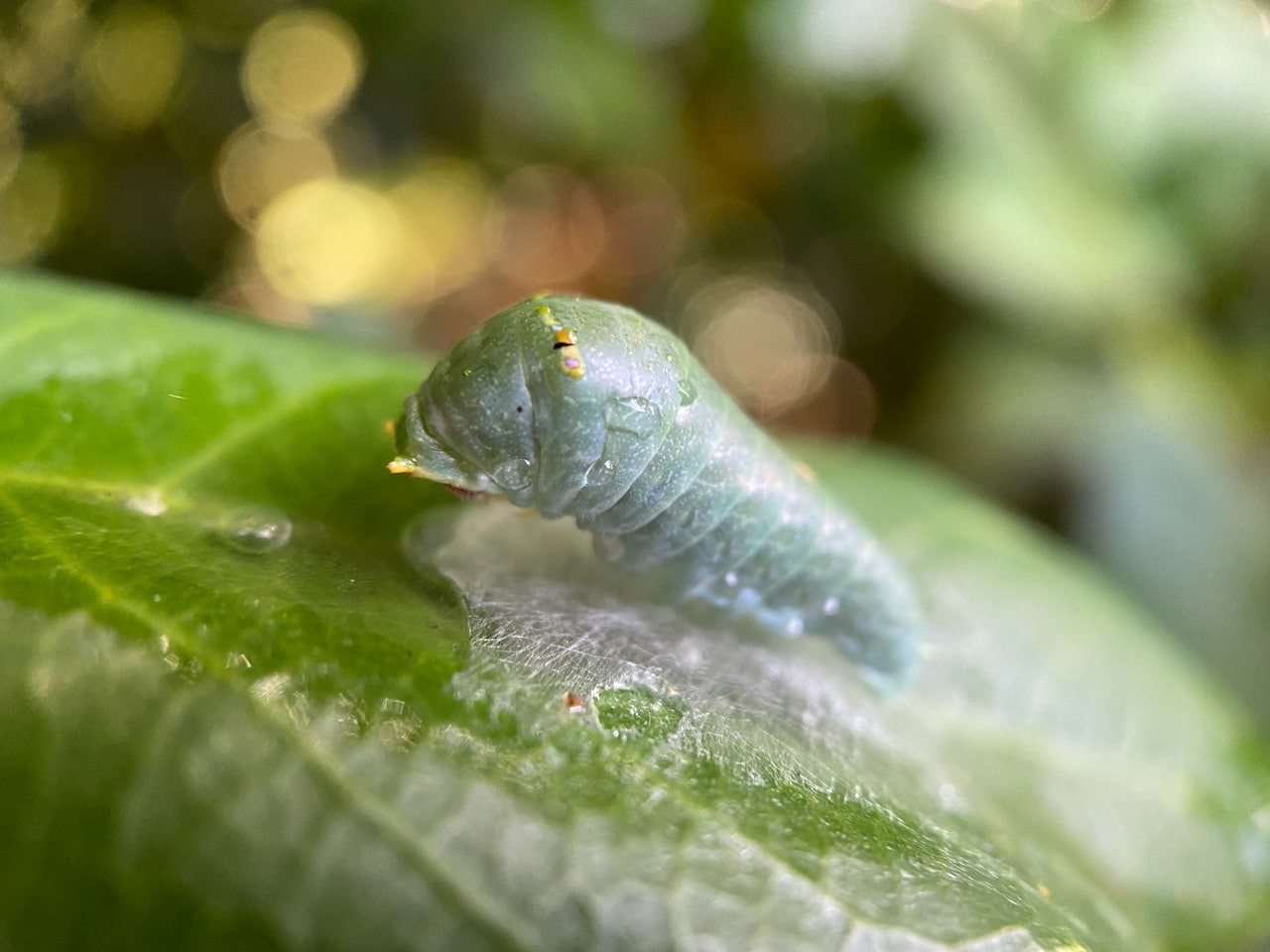
Cinch’s sibling, Blue has grown plump and round. It is resting well on its own Coffeeberry leaf.