

Pollinator Post 7/9/26 (2)
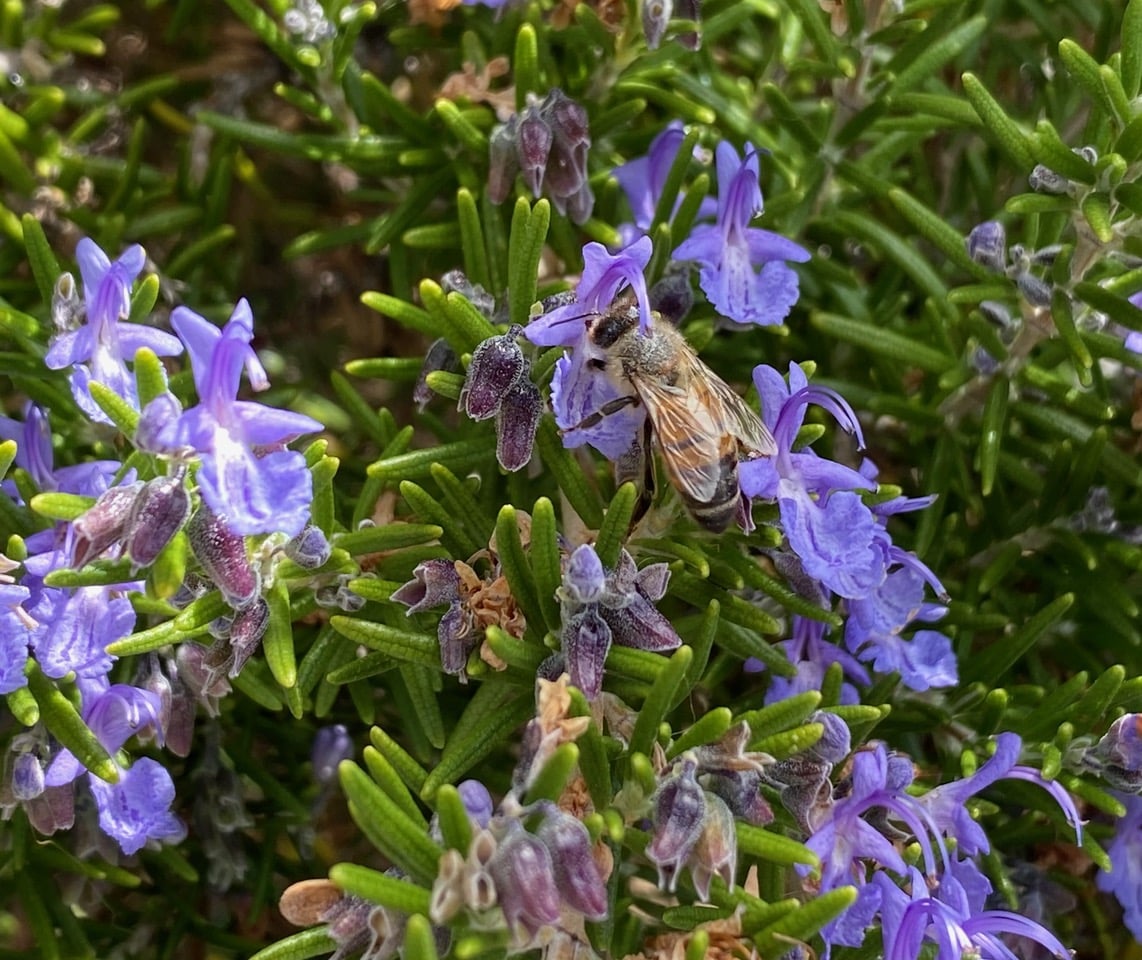
The morning is still young. I walk a couple of blocks to a tree-lined neighborhood on Thompson Ave. Although most of the neat, well-tended gardens here are planted with non-native ornamentals, I do often find interesting insects on them.
Numerous Honey Bees are buzzing around a Rosemary bush, Salvia rosmarinus blooming gloriously. When the bees land to take nectar, their thorax is invariably dabbed with the cream-colored pollen from the stamens arching overhead. It’s a show I simply can’t pass up.

Sage (genus Salvia) flowers are characterized by a bilateral two-lipped structure. The corolla has an upper, hood-like lip and a three-lobed lower lip. The lower lip serves as a landing platform for bees, while the upper lip protects the reproductive parts. Salvia has two fertile stamens that act as a lever. As a bee probes for nectar at the base of the flower with its tongue, the stamen lever pivots to deposit pollen on the insect’s back. This unique pollination mechanism in Salvia is termed a “staminal lever mechanism”.
The flower is bisexual and protandrous, i.e. the male parts mature earlier than the female parts. When a pollinator probes the back of a male-phase flower in search of nectar, a see-saw contraption tilts the pair of pollen-filled (male) anthers down to deposit their load on the back of the insect. When the insect next visits a female-phase flower, the protruding mature stigma will be the first part of the flower to touch the pollinator and will receive the pollen from the previous flower.
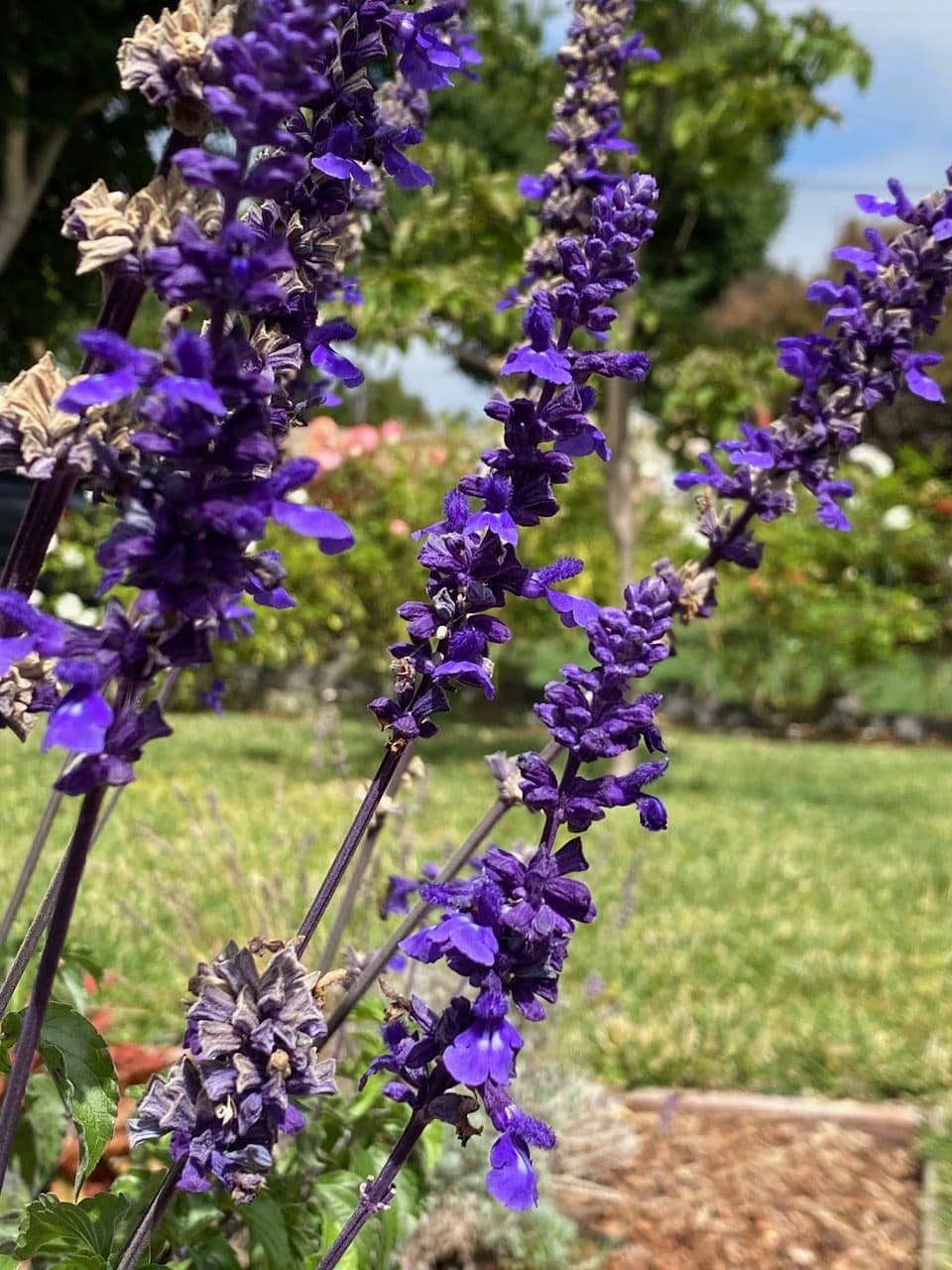
In another front yard, I stop to watch bee activities on this eye-catching Mealy Blue Sage, Salvia farinacea. The sage has tall spikes of deep blue flowers much loved by the Honey Bees, Apis mellifera (family Apidae).
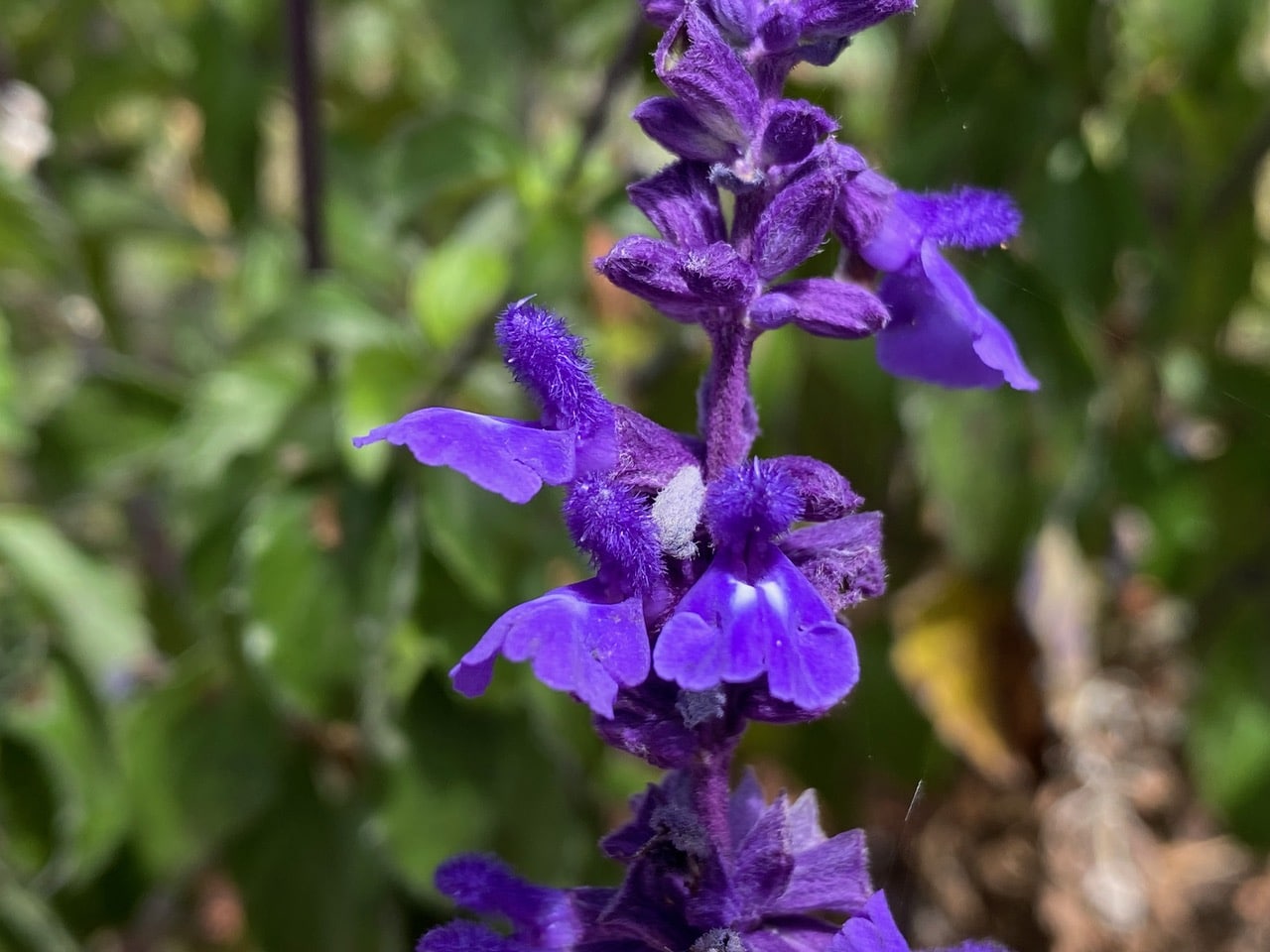
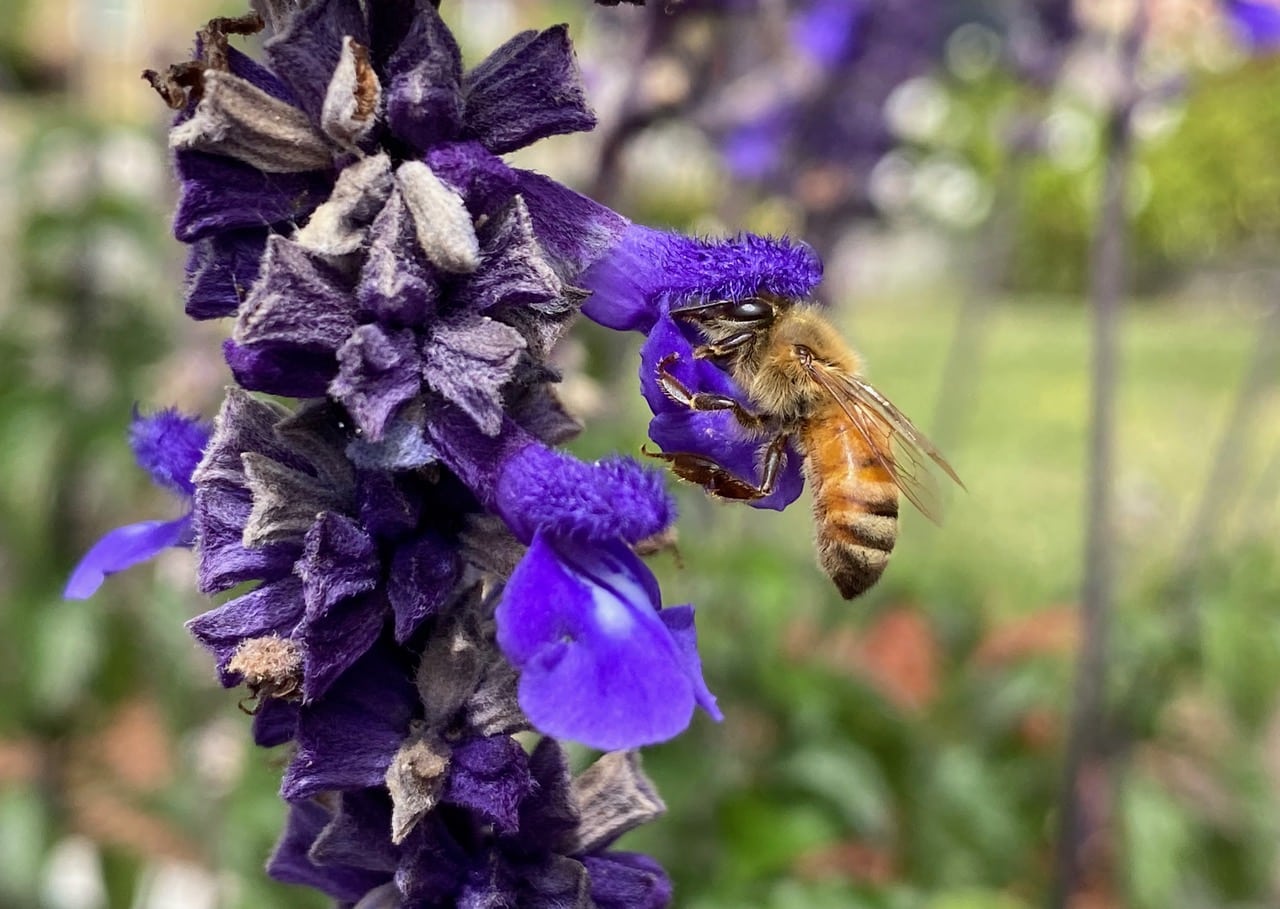







What bizarre flowers with furry upper lips! I can barely make out the slightly protruding pale stigma (?) under them.
Grasping the lower lip of a flower, a Honey Bee, Apis mellifera (family Apidae) is straining to reach the nectar at the base of the flower with her tongue. I don’t know for sure, but imagine that the bee is probably tripping the Sage flower’s staminal lever mechanism. The hidden stamens are probably being lowered to dab the bee on the head with pollen. I am tempted to take apart some flowers to examine their hidden anatomy, but the home owner might not appreciate that!
Over the years, I have examined many of our native Salvias (by simply probing the throat of the flowers with a thin stick, and looking for movements of the stamens or style), but I have been largely disappointed. I have since learned that unlike the non-native Salvias from Europe, most of our new world Salvias are adapted for bird-pollination. Apparently in New World Salvias (the Neotropical sage lineage), a massive evolutionary shift to hummingbird pollination drove flowers to abandon the classic bee-pollinated lever in favor of stiff, linear stamens that deposit pollen directly onto the bird’s head or chest. Most of the ornamental Salvias planted in suburban gardens in the Bay Area are non-native Old World species that exhibit the lever mechanism. Be sure to check them out and be entertained!
A pinkish moth lands on a spike of flowers of the Mealy Blue Sage. iNaturalist has helped identify it as a Mint Moth, Pyrausta sp. (family Crambidae).
Pyrausta is a diverse genus of colorful snout moths (family Crambidae) known as Mint Moths. Ranging from wingspan from 13-30 mm, these day-flying moths are easily spotted resting on the leaves of host plants in the mint family (Mentha species, monad, and sage). Caterpillars are typically creamy-colored and feed on the buds, leaves, and stems of mint-family plants. They generally produce two generations per year, actively flying in the sunshine from spring through early fall.
Wow, what intensely bright flowers!
A small, slender black bee with faint white bands on its abdomen is foraging on the flowers of Garden Cosmos, Cosmos bipinnatus. I recognize it as a Kincaid’s Sweat Bee, Lasioglossum kincaidii (family Halictidae).
Sweat Bees (family Halictidae) earn their nickname from their habit of landing on skin to sip salty minerals from human sweat. Lasioglossum species are found worldwide, and they constitute the largest bee genus. The majority of Lasioglossum are generalists. Because they are so abundant throughout the flowering season, the bees are often important pollinators. Their sheer numbers are enough to achieve excellent pollination of many wild flowers, especially of plants in the Asteraceae, which have shallow floral tubes that are easily accessed by these minute bees.
Lasioglossum exhibit a range of social behaviors; the genus includes solitary, communal, semi social, primitively eusocial, and even parasitic species. Almost all Lasioglossum in the U.S. nest in the ground. Generally these nests are built in the spring by fertilized females (called foundresses) that spent the winter in hibernation. In social species, the foundresses behave much like the queen bumble bees – they lay the first batch of eggs that develop into the first generation of female workers. The nest grows with each additional generation of bees. Later broods may consist of both males and females. They mate, and at the end of the season the fertilized females hibernate till the following spring, repeating the life cycle of the colony.
Kincaid’s Sweat Bee, Lasioglossum kincaidii is a small, jet-black solitary bee with black smoky wings and faint white bands on the abdomen. Widely found in urban/suburban gardens and natural habitats in California, they are highly active foragers that emerge as early as spring to pollinate smaller flowers. The bees are polylectic generalists, meaning they will visit a wide variety of flora, and are especially fond of smaller flowers. Like most sweat bees, they are ground-nesting.
A tiny fly is grooming itself with its hind legs on the tip of a Cosmos ray petal. From its picture wings (distinct, complex black-and-brown patterns on the wings), I gather that it is a Fruit Fly (family Tephritidae). From the absence of a pointed oviscape on the abdomen, I gather that it is a male. Some pinkish fluff is stuck on the fly’s thorax.
iNaturalist has helped identify the Fruit Fly as a member of the genus Campiglossa (family Tephritidae).
Campiglossa is a large, diverse genus of picture-winged fruit flies in the family Tephritidae, containing nearly 200 species. Unlike household fruit flies (Drosophila), these are not attracted to rotting fruits. Instead, their larvae are specialized plant feeders that typically develop inside the ovaries and flower heads of the sunflower family Asteraceae. These flies are characterized by patterned wings, an elongated proboscis, and widely separated antennae. The adults generally feed on nectar, pollen, and honeydew. They are active during the warmer months, between June and early September.
I detected the strange pattern amidst the spent spike of Salvia flowers and didn’t know what it was until I looked through my macro lens. It’s the abdomen of a spider with its front legs folded up to conceal its cephalothorax. iNaturalist has helped identify it as a Noble False Widow, Steatoda nobilis (family Theridiidae). Now I recall seeing a much larger one on the wall of an outdoor public toilet last year.
The Noble False Widow, Steatoda nobilis superficially resembles the black widow spider (genus Latrodectus), hence the common name of ‘false widow’. The spider is native to Madeira and the Canary Islands from where it has spread to Europe and other parts of the world including the United States. It can be found all year round, both indoors and outdoors in a variety of habitats including cacti, roadside cuttings, and demolished buildings. In California they have been observed in urban habitats but have also spread to natural habitats. They are hefty spiders with females measuring 9.5 – 14 mm in size.
As with other members of the family Theridiidae, Steatoda nobilis constructs a cobweb which is an irregular 3-dimensional tangle of sticky silken fibers, with a tubular retreat hidden in a deep crack or hole. Steatoda nobilis uses an “attack wrap” strategy to immobilize prey. Captured prey is wrapped using the spider’s fourth legs, allowing the spider to bite the victim. The potent, fast-acting venom allows them to capture vertebrate as well as invertebrate prey much larger than themselves. To humans, the symptoms of a bite are typically similar to a bee or wasp sting.
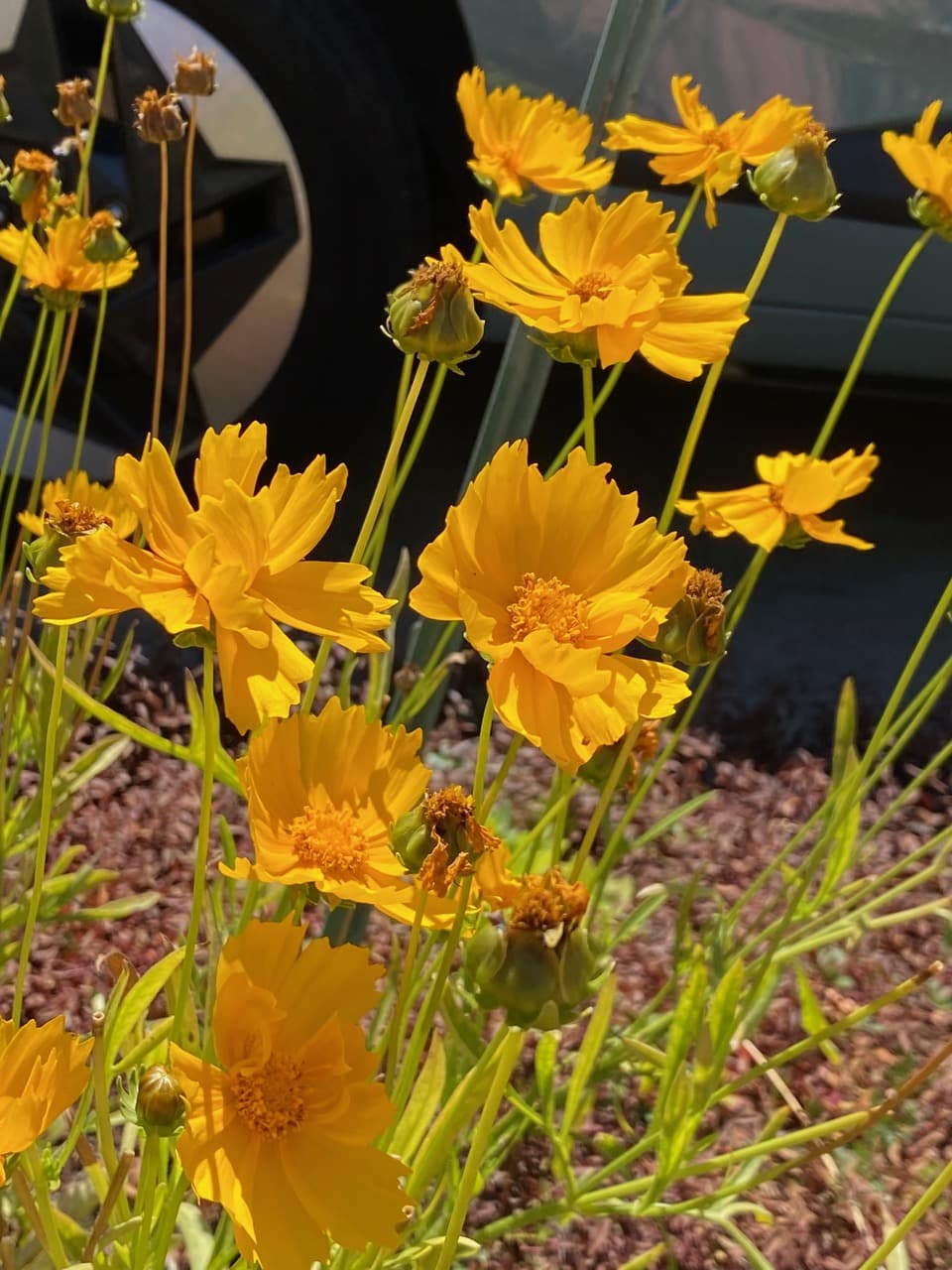
It is full sunshine by the time I reach this vibrant stand of Coreopsis on someone’s driveway. Bees, mostly male Summer Longhorn Bees, are swarming over the large flowerheads. If one dares to stop for refreshment, he is promptly dive-bombed and bumped off the perch. It’s bee pandemonium!
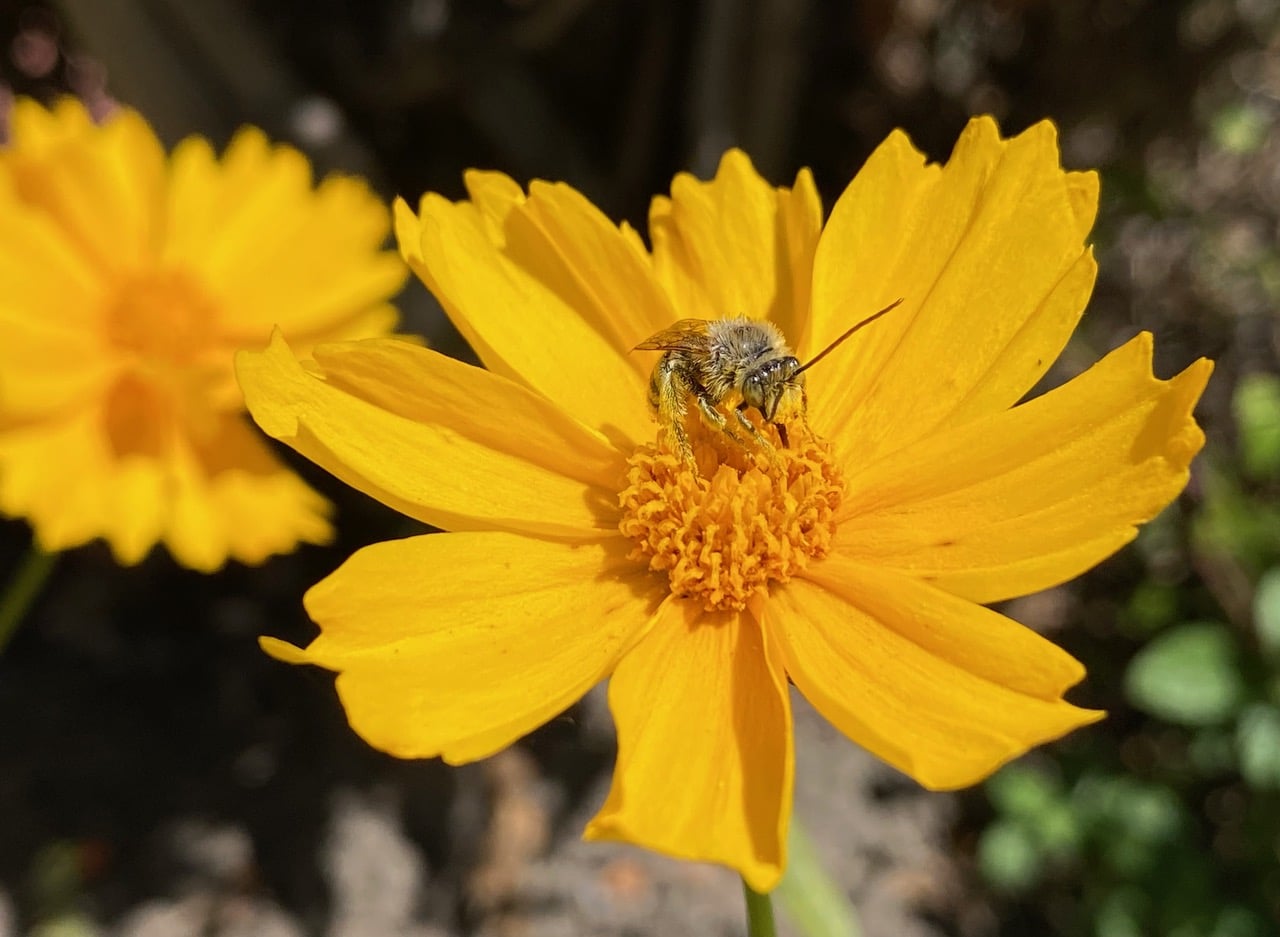
I finally get a chance to photograph a male as he lands to take nectar on a Coreopsis flowerhead.
The Summer Longhorn Bees, Melissodes sp. (family Apidae) are medium to large bees, stout-bodied, usually with gray hair on the thorax and pale hair bands on the abdomen. Males usually have yellow markings on their faces and have very long antennae from which their common name is derived. They are active May to September, with peak flight in late June to early August. The females prefer flat, bare ground for digging their solitary nests, though they sometimes nest in aggregations. Pollen is transported in scopae on the hind legs. Pollen loads are often copious and brightly colored and thus very distinguishable. Melissodes are specialists on Asteraceae – females gather pollen from flowers of Aster, Bidens, Coreopsis, Cosmos, Encelia, Gaillardia, Helianthus, and Rudbeckia ssp.
His mustache and legs are covered with sticky yellow pollen. Although male bees are often thought of as “lazy”, not helping to construct nests or provision for the young, they can, however, be very effective pollinators. While they don’t intentionally collect pollen, their hairy bodies naturally attract pollen as they seek nectar from flowers.
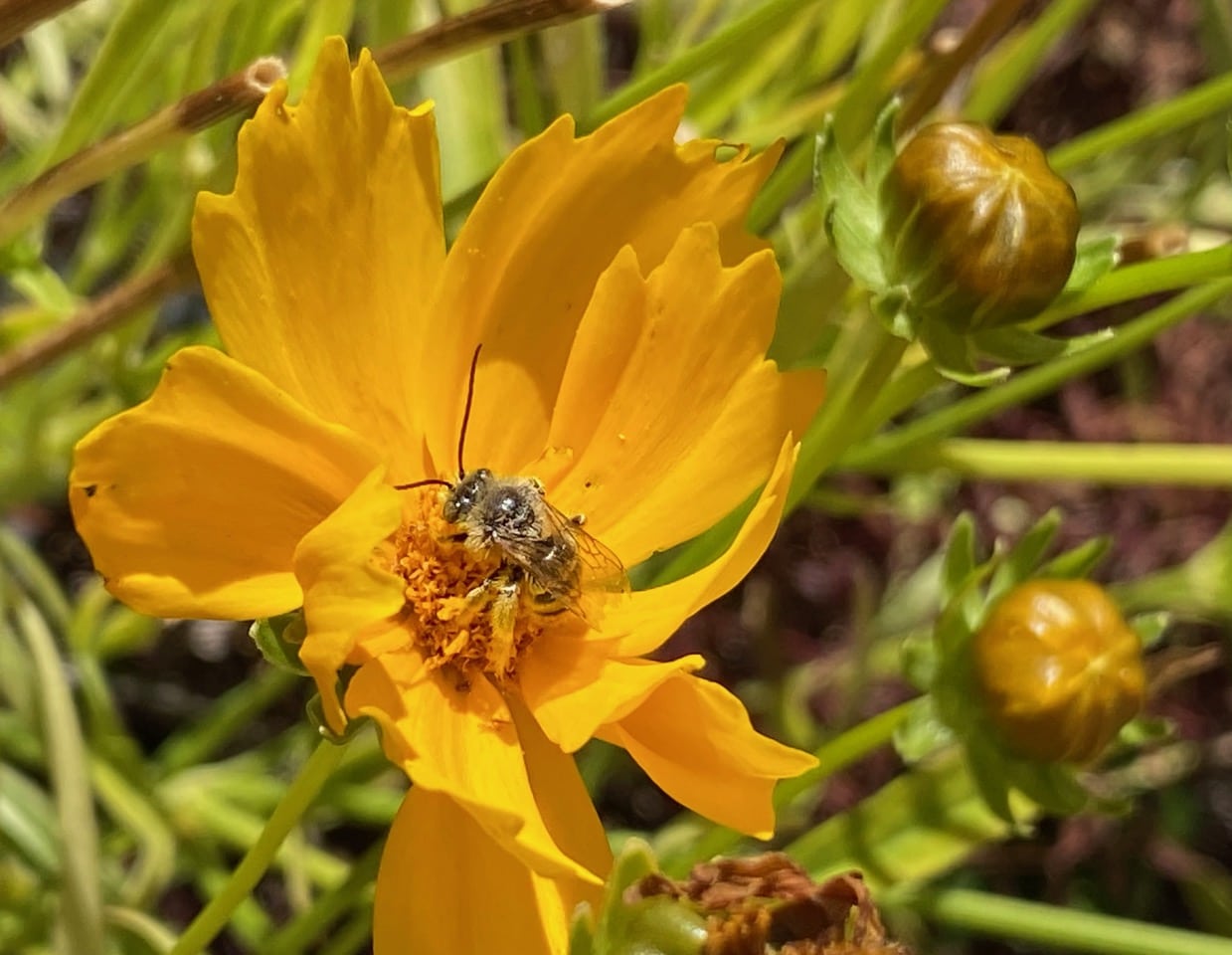
Here’s another scruffy male Longhorn bee landing for nectar.
He too is covered with pollen on his belly and legs. The pollen is transferred from flower to flower as he seeks nectar.
An adjacent patch of Max Chrysanthemum, Leucanthemum maximum appears to be equally popular with the Asteraceae specialist Melissodes bees.
A male Summer Longhorn Bee, Melissodes sp. (family Apidae) pauses for a second to clean his antennae. It’s a habit that the males take very seriously.
All bees have an antenna cleaner on each of their two forelegs. The antenna cleaners consists of two parts: a notch in the basitarsus, which is fitted with stiff hairs, and a corresponding spur on the tibia. To clean its antenna, the bee raises its foreleg over its antenna and then flexes it tarsus. The action allows the spur to close the notch, forming a ring around the antenna. The bee pulls each antenna through the bristles to clean it of debris such as pollen or dust which might interfere with the many sensory organs within the antenna. A bee’s antennae serve numerous functions: smell, taste, perceive humidity and temperature, feel, monitor gravity and flight speed and even detect sound waves to help guide the bee in its daily activities.
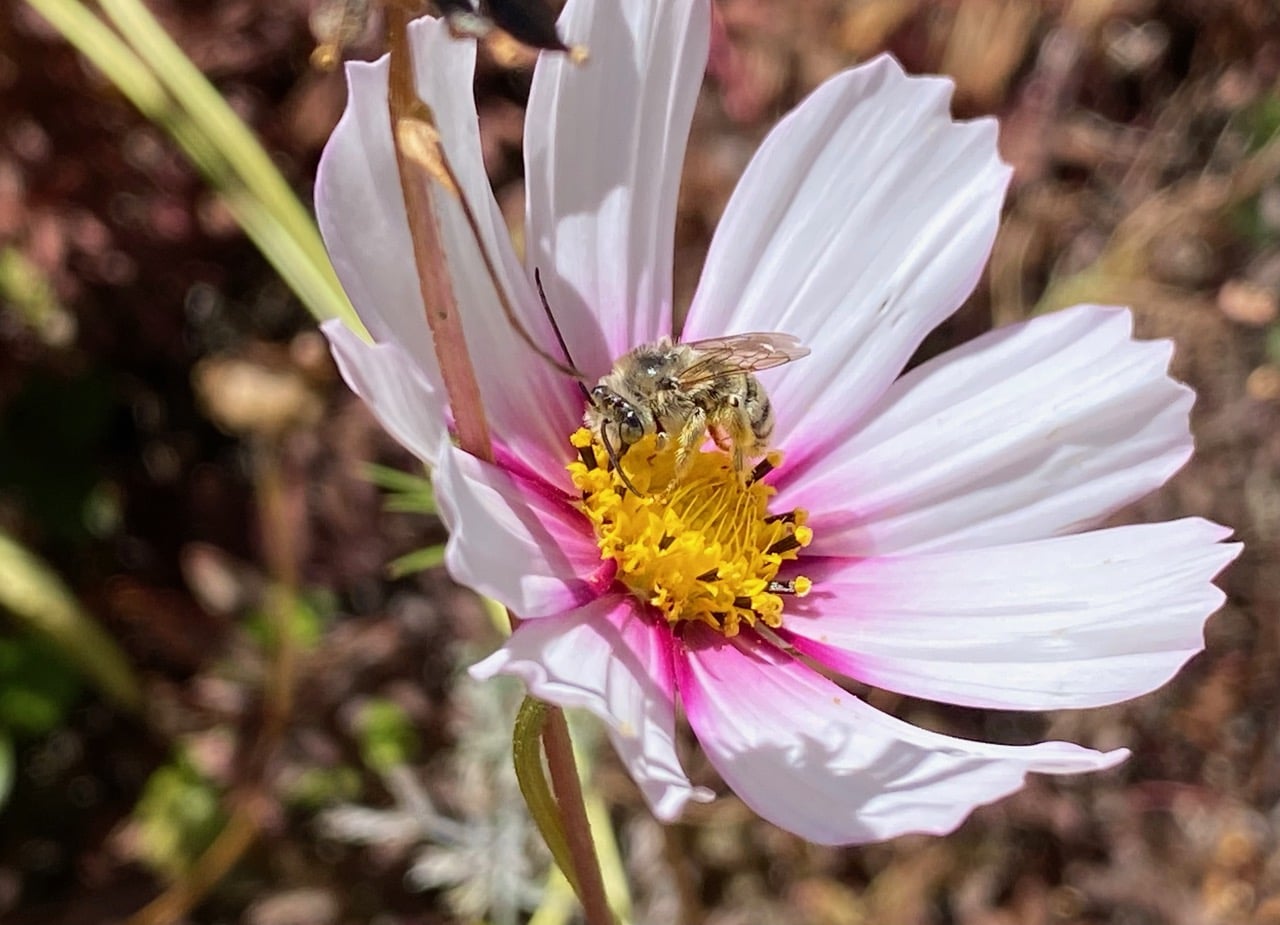
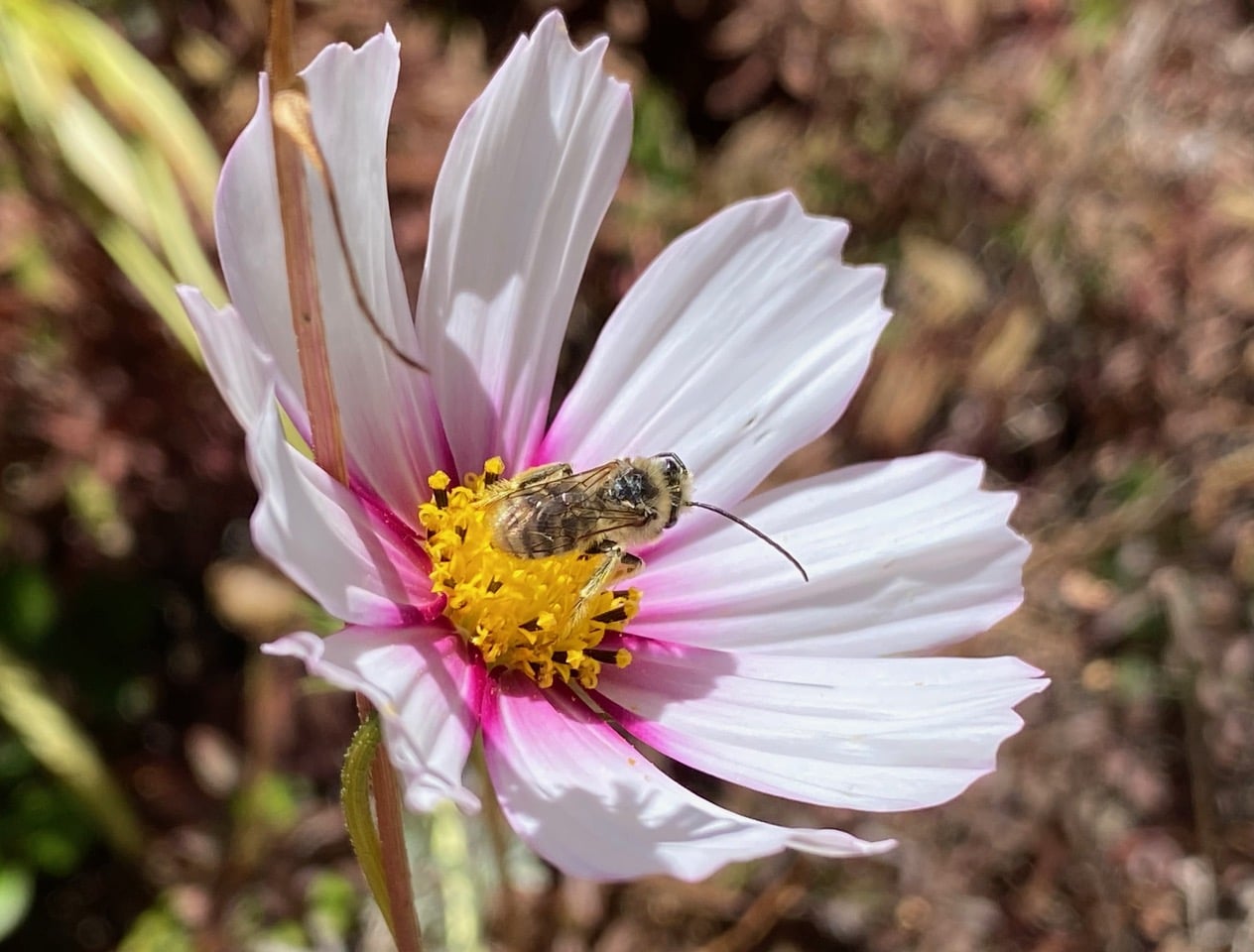
A male Summer Longhorn Bee, Melissodes sp. (family Apidae) is taking nectar from a pale pink Cosmos flowerhead. Although the males can conceivably take nectar from any flower, they tend to hang out on Asteraceae blooms, as this is where they are likely to meet the females out foraging. The females are pollen specialists, gathering pollen from only members of the sunflower family to provision their nests.
The bee is drawing his left antenna through the antenna cleaner on his left front leg. Got to look good for his date! What do the Longhorn males use their long antennae for? I’ll leave the answer to this video: