

Pollinator Post 7/9/26 (1)
 The morning is cool and heavily overcast. Perhaps a good time for seeing sleeping bees? I head for Jenny and Craig’s garden in Alameda at 9 am. With their abundant plantings of natives in the sunflower family Asteraceae, such as California Bush Sunflower, Encelia californica and Seaside Daisy, Erigeron glaucus, I am hopeful that some male Summer Longhorn Bees would still be sleeping on them. It turns out that I strike out on these bets, but actually spot the bees on the non-native Cosmos! Do you see them?
Two male Summer Longhorn Bees, Melissodes sp. (family Apidae) are fast asleep on a Cosmos flowerhead, clinging to the yellow florets in the center. They might have been fierce competitors during the day, but they are best buddies when they sleep.
The Summer Longhorn Bees, Melissodes sp. (family Apidae) are medium to large bees, stout-bodied, usually with gray hair on the thorax and pale hair bands on the abdomen. Males usually have yellow markings on their faces and have very long antennae from which their common name is derived. They are active May to September, with peak flight in late June to early August. The females prefer flat, bare ground for digging their solitary nests, though they sometimes nest in aggregations. Pollen is transported in scopae on the hind legs. Pollen loads are often copious and brightly colored and thus very distinguishable. Melissodes are specialists on Asteraceae – females gather pollen from flowers of Aster, Bidens, Coreopsis, Cosmos, Encelia, Gaillardia, Helianthus, and Rudbeckia ssp.
Male bees do not participate in nest construction, so at the end of the day they don’t have a home to return to. They usually sleep out in the open, mainly on vegetation. The male Longhorn Bees are well-known to gather and sleep in aggregations. Apparently there is safety in numbers – when one is attacked by a predator, the others are alerted right away and are able to escape.

I am surprised to find a female Melissodes on an adjacent Cosmos flowerhead under the males. Why isn’t she sleeping in her own nest? Note the brushes of long stiff hairs on her hind legs. These are the scopae that are used to carry pollen when she goes foraging.

The bee wouldn’t normally have let me take such a close-up picture of her if she were awake. She doesn’t budge – because she is asleep. Bee do not have eye lids!

Carefully scanning the Seaside Daisy, Erigeron glaucus, I spot a slender pale, colorless insect on a flowerhead. It’s a challenge to take pictures with so little sunlight. The insect looks like a bug (order Hemiptera).

The bug flees to the underside of the flowerhead. Tipping the flowerhead on its side, I catch a glimpse of the bug’s curved beak. Ah, it is a Damsel Bug (family Nabidae), a predatory bug.
The defining feature of Hemipterans or “true bugs” is their “beak” or rostrum in which the modified mandibles and maxillae form a “stylet” which is sheathed within a modified labium. The stylet is capable of piercing tissues and sucking liquids, while the labium supports it. The stylet contains a channel for outward movement of saliva and digestive enzymes, and another channel for the inward movement of pre-digested liquid food. The rostrum is usually folded under the body when not in use. In herbivorous bugs, the rostrum is used to extract plant sap, while in the predatory species, it is used to stab and suck out the contents of other insects.


A similar Damsel Bug, Nabis sp. (family Nabidae) is resting stock-still on a faded Seaside Daisy flowerhead. Note the predator’s enlarged, raptorial front legs.
Damsel Bugs are slender, tan-colored, soft-bodied, elongate, winged predators. They generally have large, round eyes and long legs. They are generalist predators, catching almost any insect smaller than themselves, and cannibalizing each other when no other food is available. They use their thickened raptorial front legs that are lined with spines to catch and hold prey, then suck out the body contents with their piercing mouthparts. Females deposit their tiny eggs in plant stems or other tissue, and immatures (nymphs) go through five instars before becoming adults.

A chonker of an Inchworm rears up menacingly from a flowerhead of Seaside Daisy. Note the damage it has done to the peripheral florets of the flowerhead, and the frass (insect poop) it has dropped. iNaturalist has helped identify it as a caterpillar of a Pug Moth, Eupithecia sp. (family Geometridae). This is the biggest of its kind I have ever seen.

Inchworms are also called loopers and measuring worms. The majority of the inchworms are the larvae of moths in the family Geometridae. The name comes from the Greek “geo” for earth and “metro” from measure, because the caterpillars seem to be measuring the surface on which they are walking. The “looping” locomotion is mandated by the absence of prolegs in the middle section of the caterpillar’s body.
Eupithecia is the largest genus of moths of the family Geometridae. Occurring worldwide except for Australasia, species in the genus are commonly known as pugs. The caterpillars move in a looping manner and are commonly called inchworms. Adults are typically small, 12 – 35 mm, with muted colors. Most species rest with forewings held flat at right angles to the body, while the hindwing are largely covered by the forewings. They are generally nocturnal. Larvae mostly feed from the flowers and seeds of their food plants rather than the foliage. Many species have a very specific food plant. Many are commonly found on Asteraceae flowers.

Two cocoons are attached to a spent Seaside Daisy flowerhead. Did Eupithecia caterpillars make these? Most Eupithecia caterpillars pupate in the soil or leaf litter, rather than forming a visible silk cocoon. Wow! I am willing to bet that some poor caterpillar has been parasitized by a Braconid wasp, and the wasp larvae have emerged from the host to pupate outside, creating these cocoons. I often see similar ones next to dead Anise Swallowtail caterpillars on Yampah, and have actually raised out the wasps.
Braconid Wasps (family Broconiade) are one of the greatest parasitoids, responsible for many moth and butterfly deaths. After the closely related Ichneumonidae, braconids make up the second-largest family in the order Hymenoptera, with about 17,000 recognized species. Females often have long ovipositors to lay eggs on or in their hosts. The larvae of most braconids are internal primary parasitoids of other insects, especially the larval stages of Coleoptera, Diptera, and Lepidoptera. Generally, the braconid life cycle begins when the female wasp deposits her eggs in the host insect, and the braconid larvae develop in the host body, eating it from the inside out. Before the caterpillar is ready to pupate, Braconid wasp larvae will exit the caterpillar, and immediately weave their cocoons, often on or next to the host. The adult braconid wasp emerges by cutting a hole on one side of the cocoon and begins the life cycle again.
Braconid wasps use a remarkable weapon to disable the defenses of their host insects – a virus. These parasitic wasps coevolved with polydnaviruses (read poly-DNA-virus), which they carry and inject into the host insects along with their eggs. The virus attacks the host’s immune system and renders it unable to encapsulate the wasp egg; it also halts the host’s development, so it can’t pupate and transform into an adult. Amazingly, the “bracovirus” also changes the host’s metabolism so that it can survive longer without food or water – thus ensuring a nurturing environment for all the young wasps to come.

Alarmed by my approach, a pair of Scentless Plant bugs, Arhyssus sp. (family Rhopalidae) mating on a Seaside Daisy flowerhead separate and scamper away.
Arhyssus is a genus of small, true bugs belonging to the family Rhopalidae. There are over a dozen species native to North America. They are small, typically measuring 5-12 mm in length. They possess distinct, raised simple eyes (ocelli) at the front of the head. Unlike other true bugs, they lack well-developed scent glands (hence the common name).
Arhyssus primarily feed on weeds, seeds, and xeric (dry-habitat) grass plants. Adults spend the spring and summer feeding outdoors. In early autumn, they migrate into wall crevices, woodpiles, or homes to hibernate.
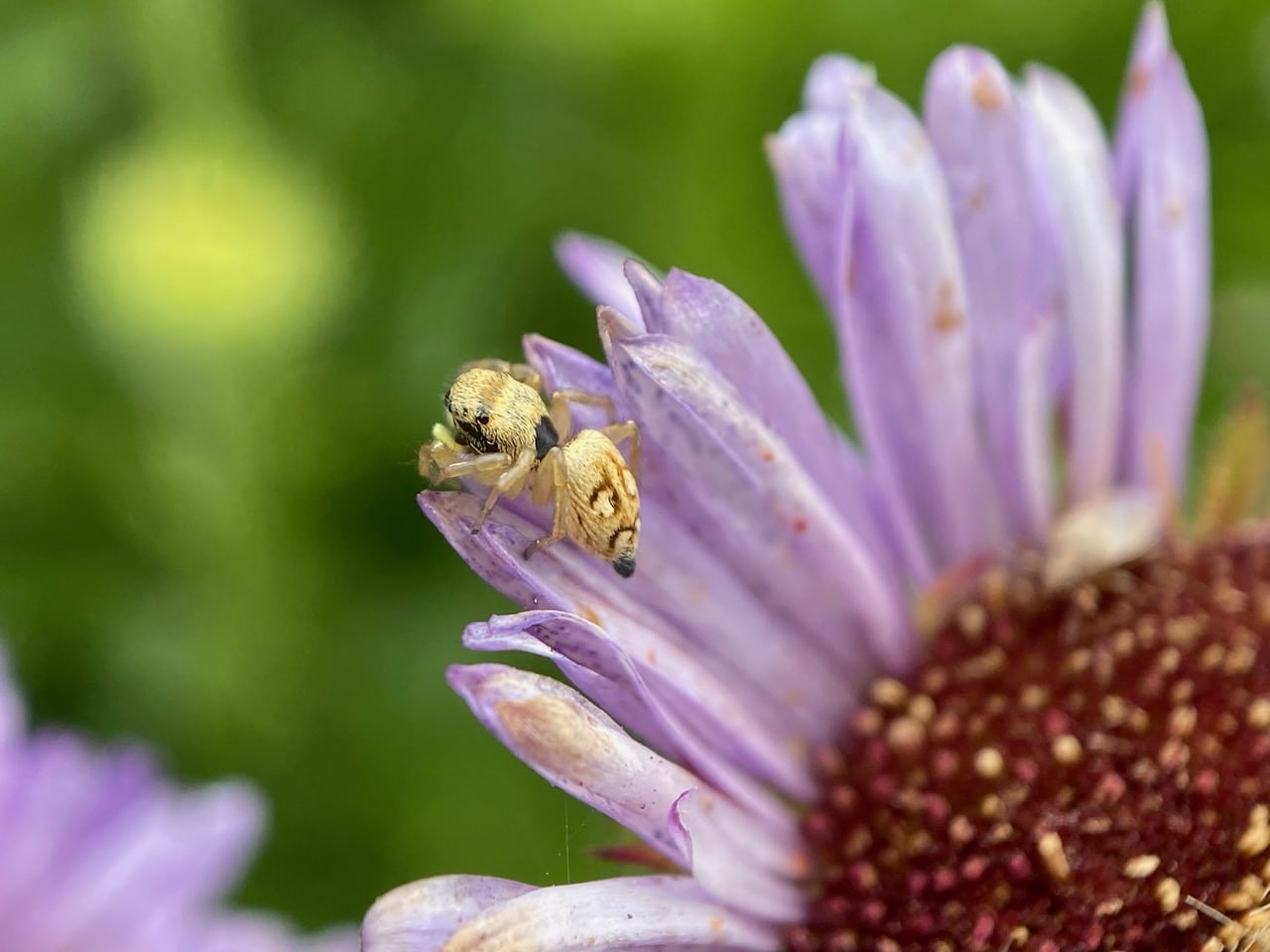
A little Jumping Spider is surveying its neighborhood from a ray petal of a fading Seaside Daisy flowerhead. I am not familiar with its color pattern.
Jumping spiders (family Salticidae) are free-roaming hunting spiders. They do not weave a web to catch prey. They stalk, then pounce on their prey. Just before jumping, the spider fastens a safety line to the substrate. It can leap 10-20 times their body length to capture prey. Their movement is achieved by rapid changes in hydraulic pressure of the blood. Muscular contractions force fluids into the hind legs, which cause them to extend extremely quickly. Jumping spiders are visual hunters. Their excellent vision has among the highest acuities in invertebrates. Since all their 8 eyes are fixed in place and cannot pivot independently from the body like human eyes can, jumping spiders must turn to face whatever they want to see well. This includes moving their cephalothorax up and down, an endearing behavior.

iNaturalist has helped identify the spider as a Sun Jumper, Heliophanus apiatus (family Salticidae).

The genus Heliophanus is one of the largest genera of jumping spiders with over 150 species, widespread in the Palearctic and Africa, with one center of diversity in the Mediterranean region. Heliophanus apiatus was first reported in the San Francisco Bay Area in 2015. H. apiatus is a small salticid, male measuring 3.5-4.0 mm, and females 4.0-4.5 mm in body length. Mature males and females are similar in appearance, but only the females have yellow pedipalps. These spiders are found on low vegetation and on hard structures on or near the ground. They are capable of taking prey their own size.

The spider’s greenish-yellow pedipalps tell me that it is a female Sun Jumper, Heliophanus apiatus (family Salticidae)
The pedipalps are jointed appendages, much like small legs. They are used by the spider to sense objects, shape their webs, and to aid in prey capture and feeding. In male spiders, the pedipalps are also used to deliver sperm during mating.

Jumping spiders have a unique eye arrangement consisting of eight eyes in four pairs. The most prominent pair are the two large, forward-facing anterior median eyes (AMEs), which provide sharp, detailed vision and depth perception. The other three pairs are smaller secondary eyes: two anterior lateral eyes (ALEs), two posterior median eyes (PMEs), and two posterior lateral eyes (PLEs). These secondary eyes offer a wider field of view and help with detecting movement.

As the spider lowers her pedipalps, I can see her black chelicerae.
Spider chelicerae are the pair of specialized mouthparts that serve as a spider’s jaws. Positioned at the front of the cephalothorax, they consist of a stout basal segment (the paturon) and a sharp, articulated fang. Their primary function is to bite prey, inject venom, and hold the meal while it is digested.

A Lygus Bug, Lygus sp. (family Miridae) is resting on a fading Seaside Daisy flowerhead.
Lygus Bugs are small (6-7 mm long), oval-shaped plant bugs (family Miridae), ranging in color from pale green to yellowish-brown or dark brown. They feature a prominent, triangular “V” shape in the center of their back and have long, spindly antennae. Nymphs are wingless, generally pale green, and resemble aphids but lack the backward-facing tubes (cornicles) on their abdomen. They are fast-moving and larger nymphs often have five black spots on their backs. Lygus Bugs are major agricultural pests. They have a massive host range, primarily feeding on flowering crops and common weeds, which act as reservoirs before the insects migrate to commercial fields. Both adults and nymphs use piercing-sucking mouthparts to feed on new growth, buds, and seeds. Their feeding causes severe plant damage, including flower drop, discolored leaves, and deformed fruits or seeds.

A late-instar nymph of Lygus Bug is posing for the camera. Note the five black spots on its back, and the short wing pads. At this stage, the bug is not capable of flying.

Insect larvae are called nymphs when they undergo incomplete metamorphosis (hemimetabolism), meaning they resemble smaller, wingless versions of the adult. Unlike larvae that pupate, nymphs gradually develop adult features through several stages (instars) and molt directly into adults, rather than transforming completely in a pupal stage.
Like the adults, Lygus Bug nymphs use their piercing-sucking mouthparts to feed on new growths, buds and seeds.

A female Forked Globetail, Sphaerophoria sulphuripes (family Syrphidae) is sampling pollen from the flowers of Seaside Woolly Sunflower, Eriophyllum staechadifolium.
The Forked Globetail, Sphaerophoria sulphuripes (family Syrphidae) is a hover fly native to western North America. Adults visit flowers for nectar and pollen. Larvae feed on aphids and other soft-bodied insects. There is marked sexual dimorphism in the species – the males have a slender abdomen with a reddish, swollen tip.


Look, a Crab Spider (family Thomisidae) on a Seaside Daisy flowerhead! I haven’t seen one in a long time. Somehow their numbers seem to have declined drastically over the past couple of years. I wonder why? Shortage of pollinators, their predominant food source?

I am pleasantly surprised that the spider allows me to get so close without flinching. It has its two pairs of extra long front legs outstretched, ready to grab passing prey. iNaturalist has helped identify it as a Flower Crab Spider, Misumena sp. (family Thomisidae).
Crab Spiders (family Thomisidae) do not spin webs for trapping prey. They are ambush predators that sit and wait on or by flowers to grab the insect that blunders into the reach of their extra long front legs. These spiders are usually yellow or white. This ultimately depends on the flower on which these ambush predators are hunting (active camouflage). They have the ability to change between these colors based on their surroundings, using visual cues. The color change is not immediate, but takes place over days or weeks.

Dialing up the magnification on the camera, I can see the eye arrangement of the Crab Spider (family Thomisidae).
Spiders are generally identified to families by the arrangements of their eyes. Crab Spiders (family Thomisidae) have eight eyes arranged in two distinct, curved, forward-facing rows. These eyes are usually unequal in size and are frequently positioned on prominent, raised white bumps called tubercles. This positioning gives the spider a wide, panoramic field of view to ambush prey, enabling the spider to spot moving insects from a distance and strike quickly.

Before I leave Jenny and Craig’s garden, I check on the two male Summer Longhorn Bees, Melissodes sp. (family Apidae) on the Cosmos. They have shifted positions, but are still in deep slumber. Ah, the easy life of male bees! The female on the other flowerhead is already zipping around foraging.

On another Cosmos flowerhead, two Common European Greenbottle Flies seem to be getting it on.
The Common European Greenbottle Fly, Lucilia sericata (family Calliphoridae) is a Blowfly found in most areas of the world and is the most well-known of the numerous green bottle fly species. The lifecycle of Lucilia sericata is typical of blowflies. Females lay masses of eggs in fresh carrion. The flies are extremely prolific – a single female may produce 2,000 to 3,000 eggs in her lifetime. The larvae feed on dead or necrotic tissue, passing through 3 larval instars. Third-instar larvae drop off the host to pupate in the soil. The adults feed opportunistically on nectar, pollen, feces, or carrion; they are important pollinators as well as important agents of decomposition. Pollen is used as an alternative protein source, especially for gravid females who need large amounts of protein and cannot reliably find carrion.
While we may find the blowflies disgusting for their association with filth and carrion, they are important decomposers/ recyclers in the ecosystem. What’s more, their larvae are used in maggot therapy to clean wounds by consuming only dead and infected tissue, helping to promote faster healing and prevent infection.