

Pollinator Post 7/9/24 (3)

A European Paper Wasp, Polistes dominula (family Vespidae) is hunting among the spent flowers of Autumn Sage “Lemon Light”, Salvia gregii.
Native to Europe, the European Paper Wasp, Polistes dominula, is a social insect that produces an annual colony in a paper nest. Individual colonies are established anew each spring. The overwintering stage are mated females (queens). The overwintered queens emerge from sheltered spots in spring and search out sites to establish a new colony. Nests are constructed of paper, produced from chewed wood fibers of weathered fences, porch decks and other similar sources. Larvae are fed crushed insects, usually caterpillars. As the population increases, the original queen increasingly remains in the nest as new workers take over colony activities. A few of the wasps produced later in summer are males and increasing numbers of the females become sexually mature. Mating occurs and the mated females are the surviving overwintering stage. Males and non-reproductive females do not survive winter and the nest is abandoned by late fall. European Paper Wasps will sometimes feed on sweet materials, including honeydew produced by aphids. They may also feed on damaged ripe fruits. Because of their habit of hunting caterpillars, the wasps have become one of the most important natural controls of garden pests.

Note that, unlike the Yellowjackets, the European Paper Wasp flies with its long legs dangling.
Often mistaken for Yellowjacket Wasps, the European Paper Wasps can be distinguished by their slender body, and their orange-tipped antennae. Yellowjackets have shorter, thicker bodies, and they have black antennae. Paper wasps dangle their long legs when they fly, while the yellowjackets tuck their legs under their bodies when they fly. Paper wasp nests resemble an open honeycomb or upside-down umbrella. They often build their nests on man-made structures such as eaves or lawn furniture. Yellowjacket nests are covered with a surrounding envelope of paper; the nests have a single opening that is often hard to see because the nest is underground.
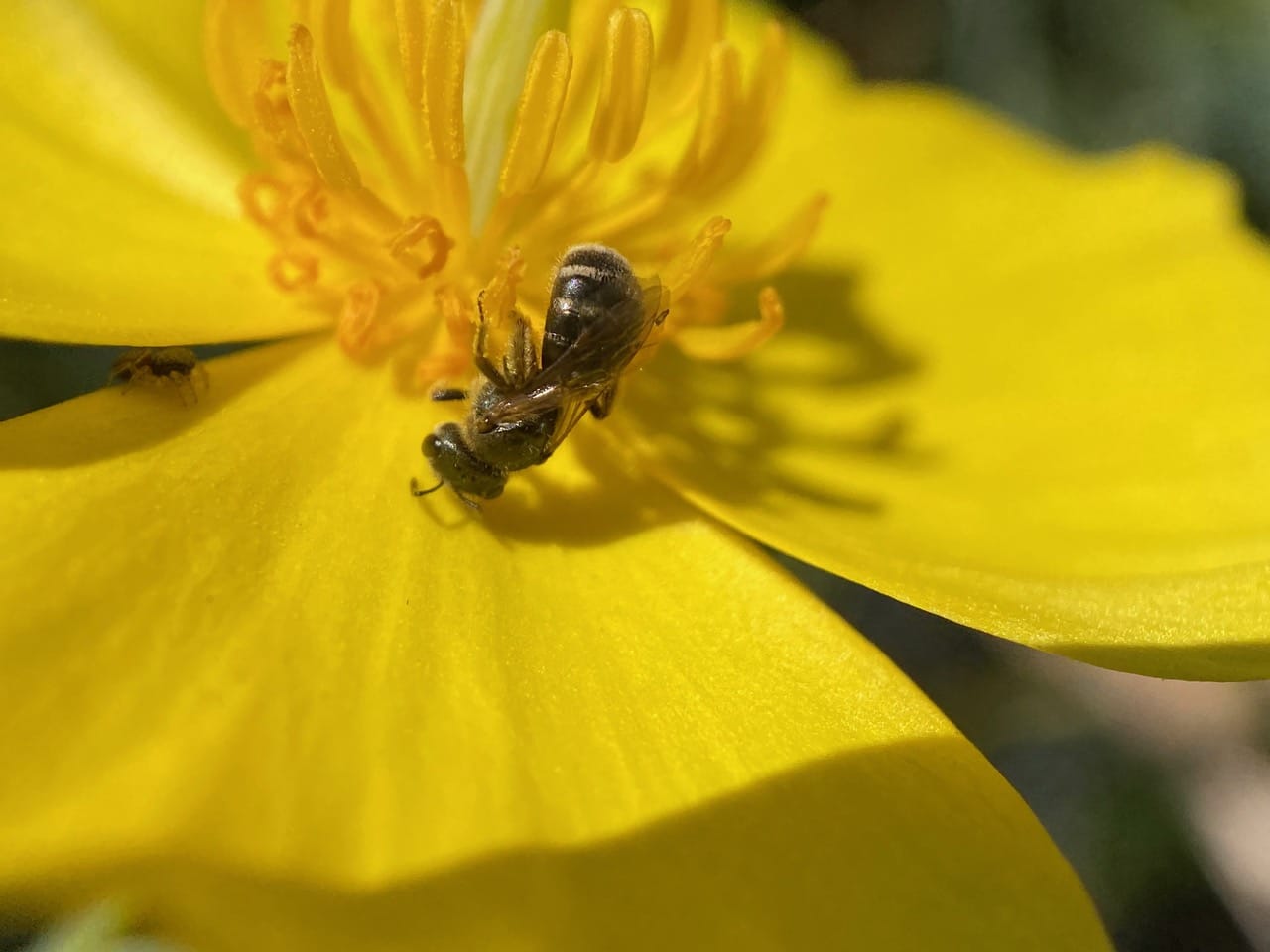
A Sweat Bee, Halictus sp. (family Halictidae) is foraging among the stamens of a Bush Poppy, Dendromecon rigida. The flowers of all species of poppy lack nectaries, thus there is no sugary nectar available to pollinators. Instead, the flowers are packed with pollen-bearing anthers
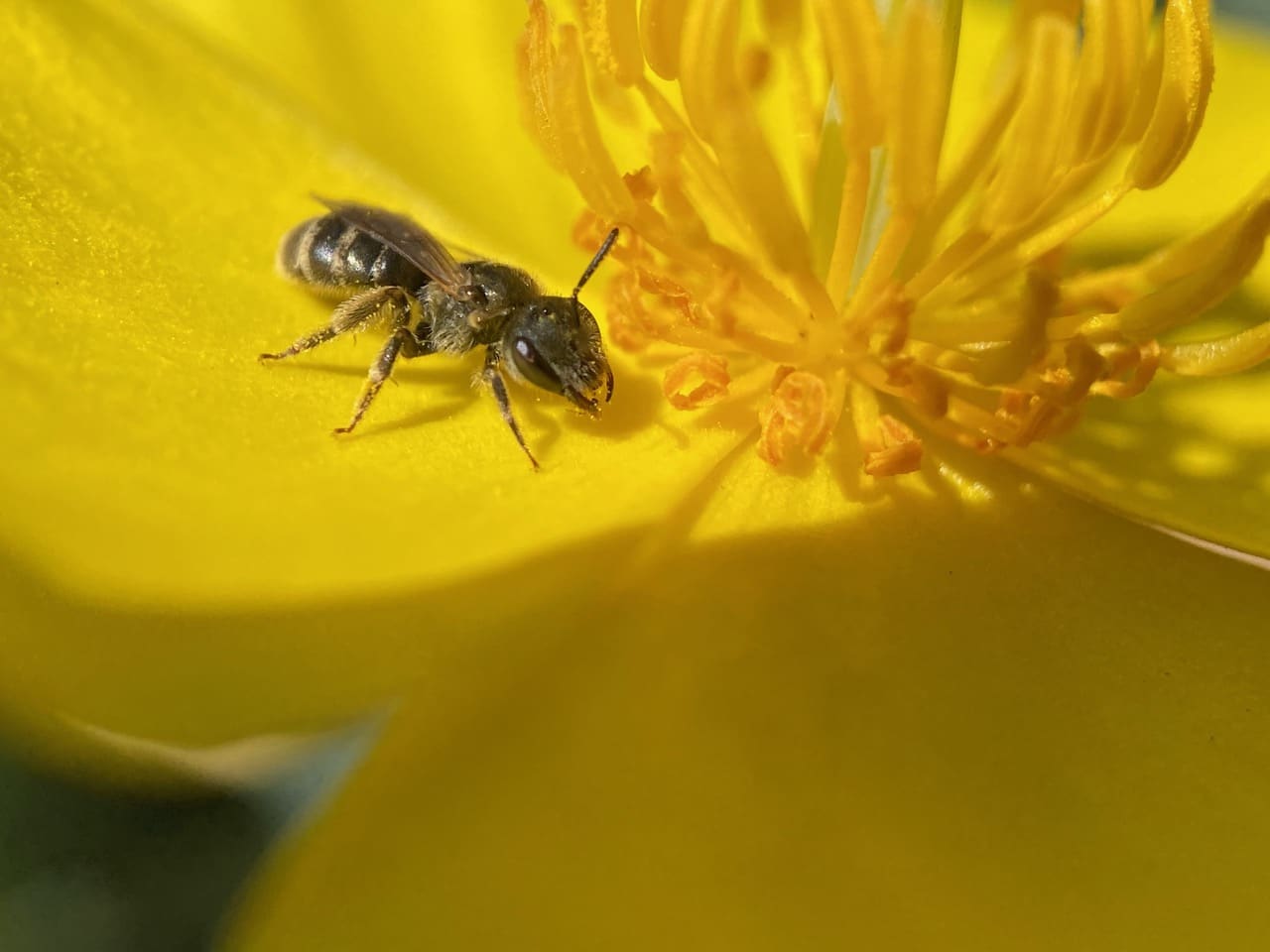
The bee has yet to fill the scopa (special pollen-collecting hairs) on her hind legs.
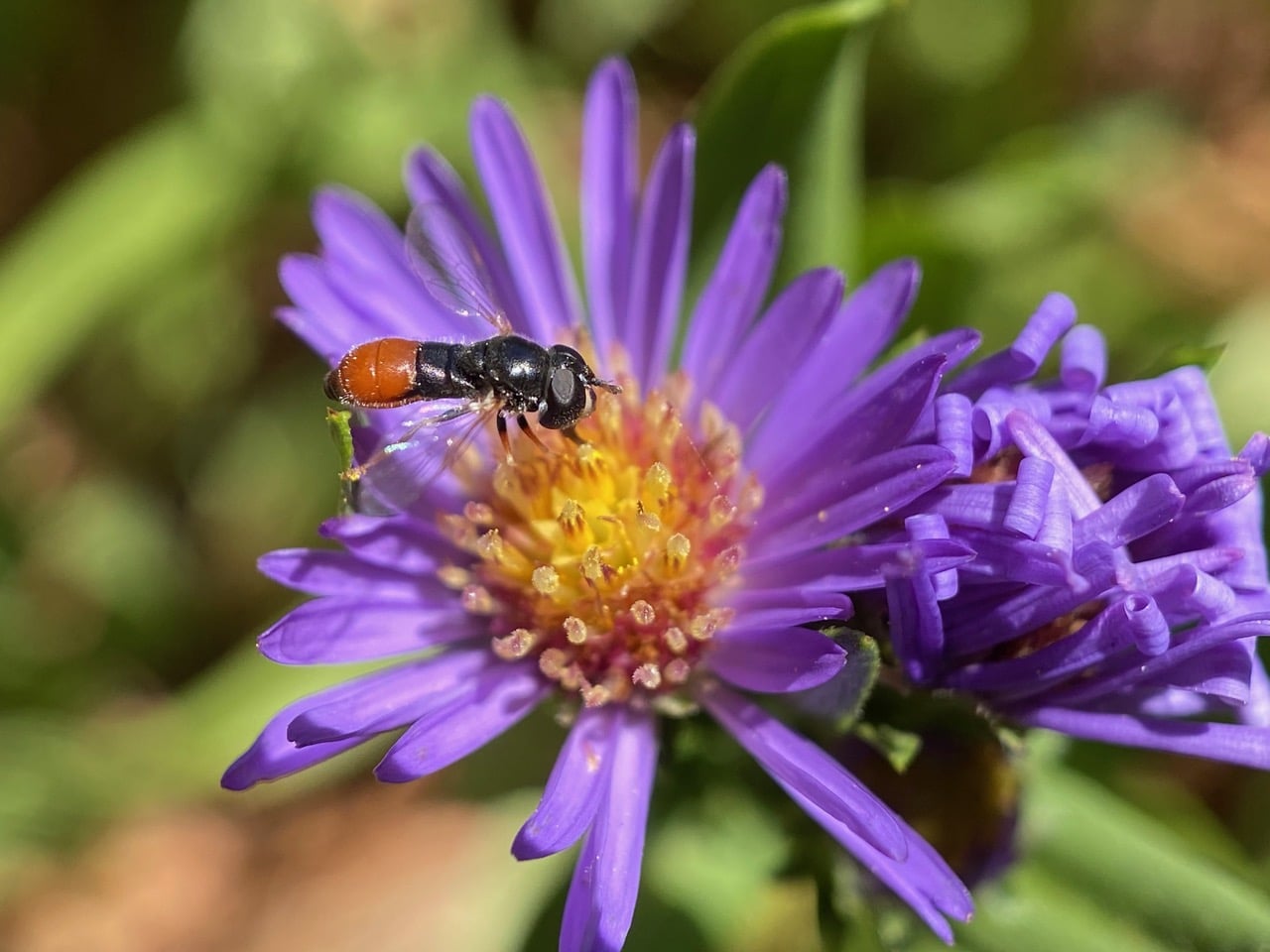
A tiny hoverfly, the Common Grass Skimmer, Paragus haemorrhous (family Syrphidae) has landed on a flowerhead of Plumas Purple Aster, Symphyotrichum x “Plumas Purple”.
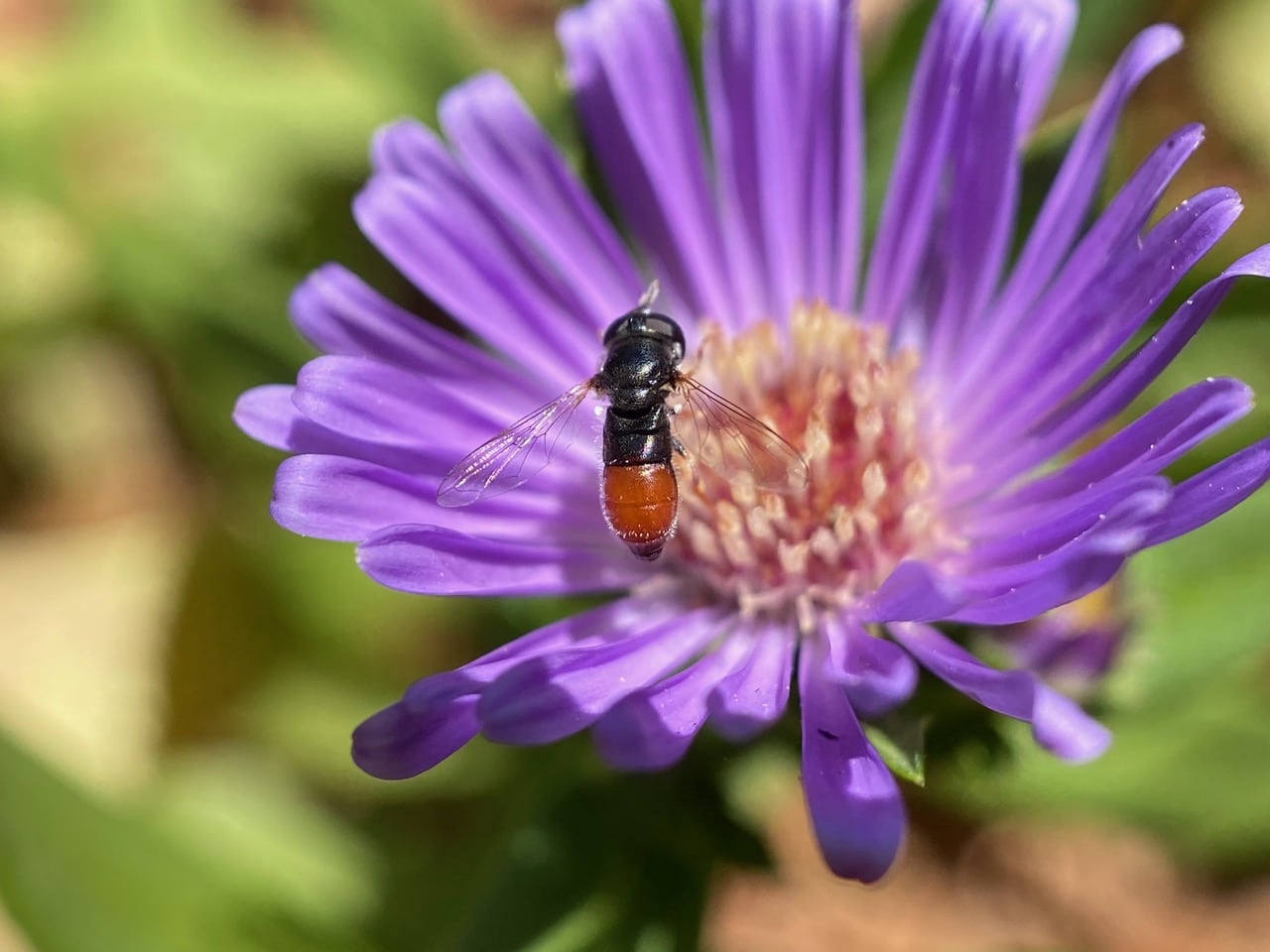
The Common Grass Skimmer, Paragus haemorrhous (family Syrphidae) is easily the smallest hover fly in our area, measuring only about 4 mm in length. The species has a world-wide distribution, found in unimproved grassland, dune grass, open areas and pathsides in forest, and meadows. Adults visit flowers for nectar and pollen. Larvae feed on aphids on low herbaceous plants.
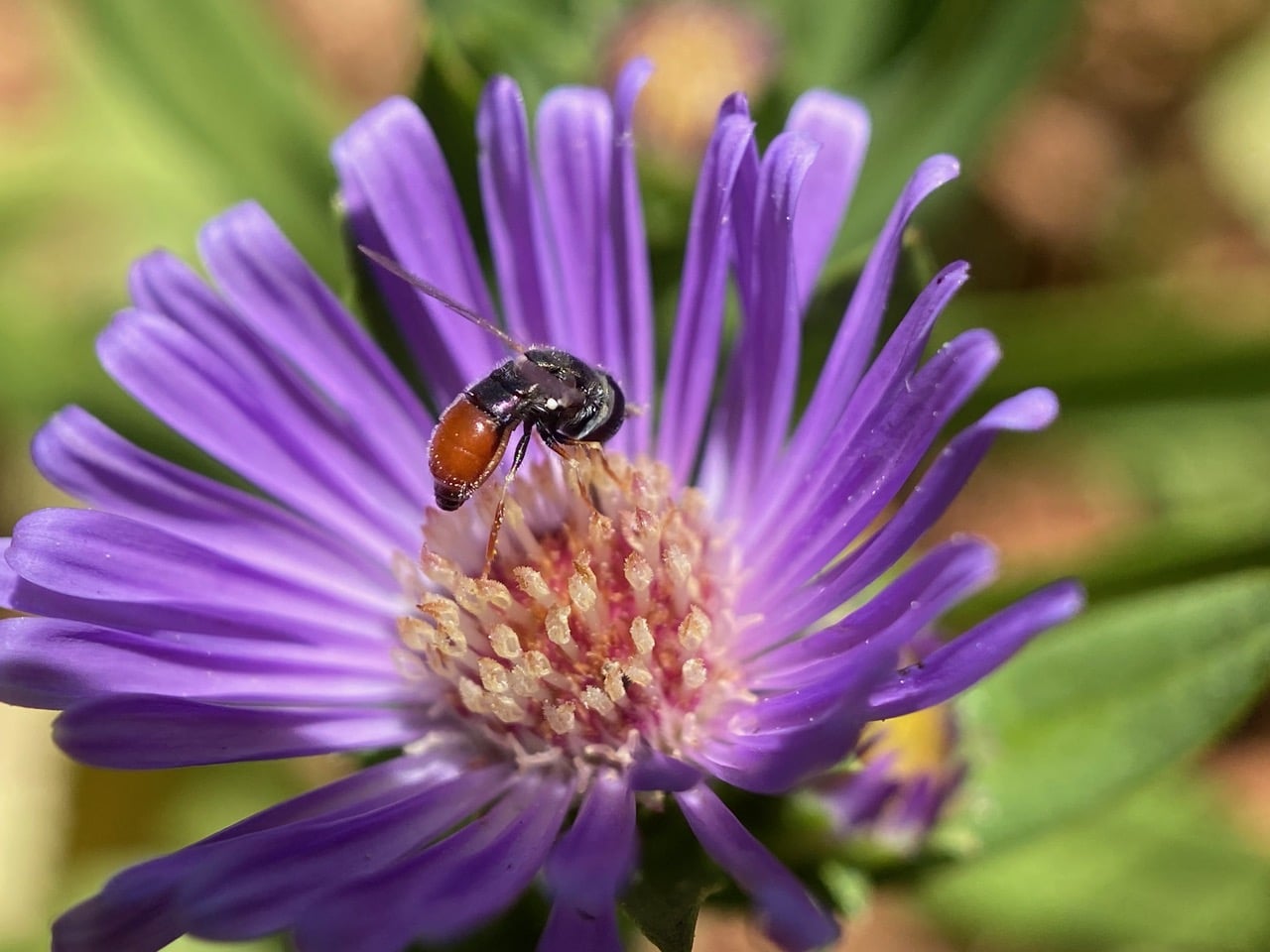
This is the typical, hunched posture of the Common Grass Skimmer.
 The California Brittlebush, Encelia californica in the garden is past its prime, but if you look carefully at the dark, central disc flowers, you are still likely to see some insect visitors.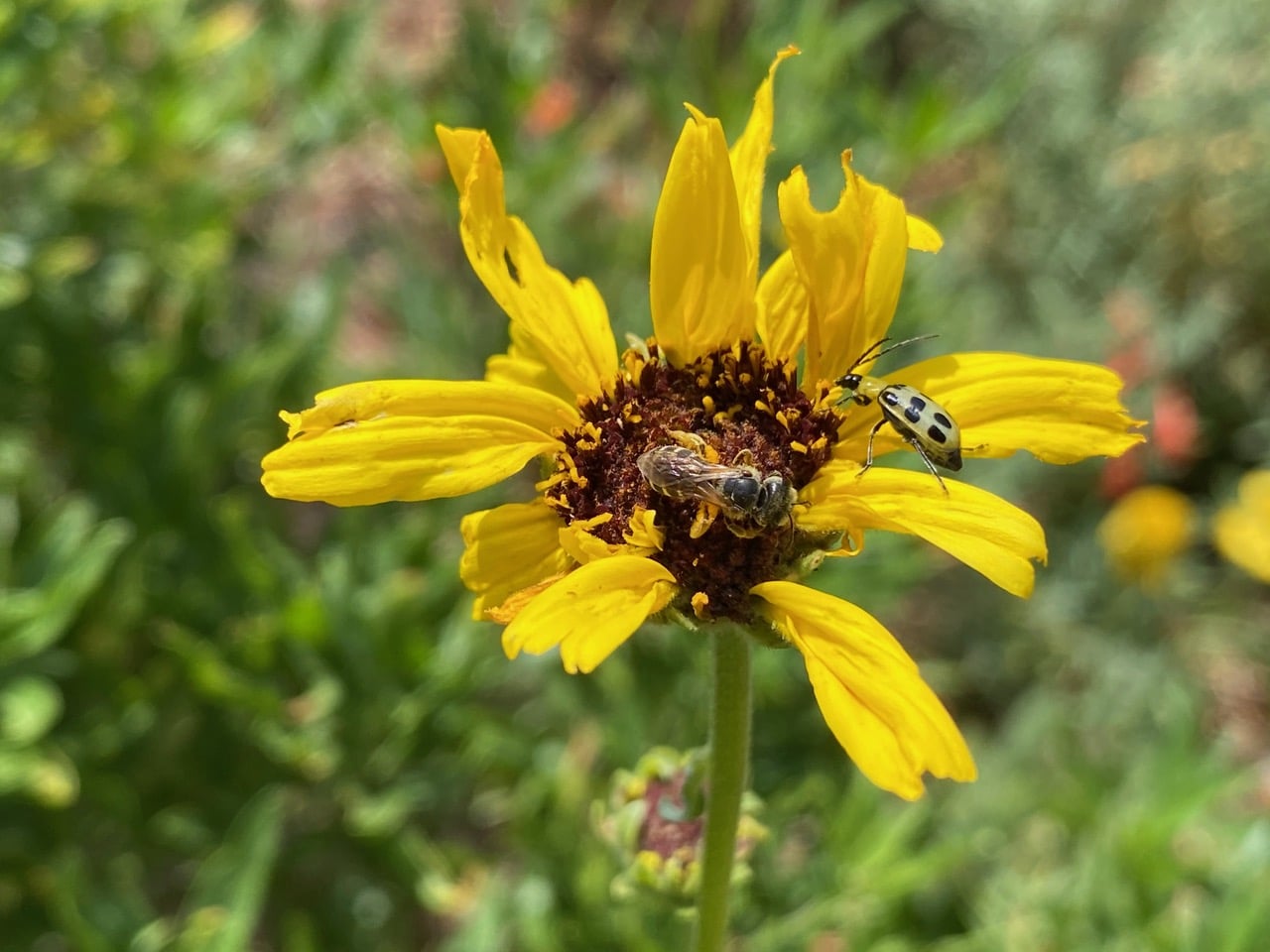
A Sweat Bee, Halictus sp. (family Halictidae) and a Spotted Cucumber Beetle, Diabrotica undecimpunctata (family Chrysomelidae) are sharing a flowerhead of California Brittlebush.
Members of the family Chrysomelidae are commonly known as Leaf Beetles. Adults and larvae feed on all sorts of plant tissues, and all species are fully herbivorous. Many are serious pests of cultivated plants, including food crops. Others are beneficial due to their use in biocontrol of invasive weeds. Chrysomelids are popular among insect collectors, as many are conspicuously colored, typically in glossy yellow to red or metallic blue-green hues, and some have spectacularly bizarre shapes. Photos of Leaf Beetles (Family Chrysomelidae) · iNaturalist
Native to North America, the Spotted Cucumber Beetle can be a major agricultural pest, causing damage to crops in the larval as well as adult stages of their life cycle. Larvae, sometimes known as rootworms feed on the roots of emerging plants. In the adult stage the beetles cause damage by eating the flowers, leaves, stems and fruits of the plant.
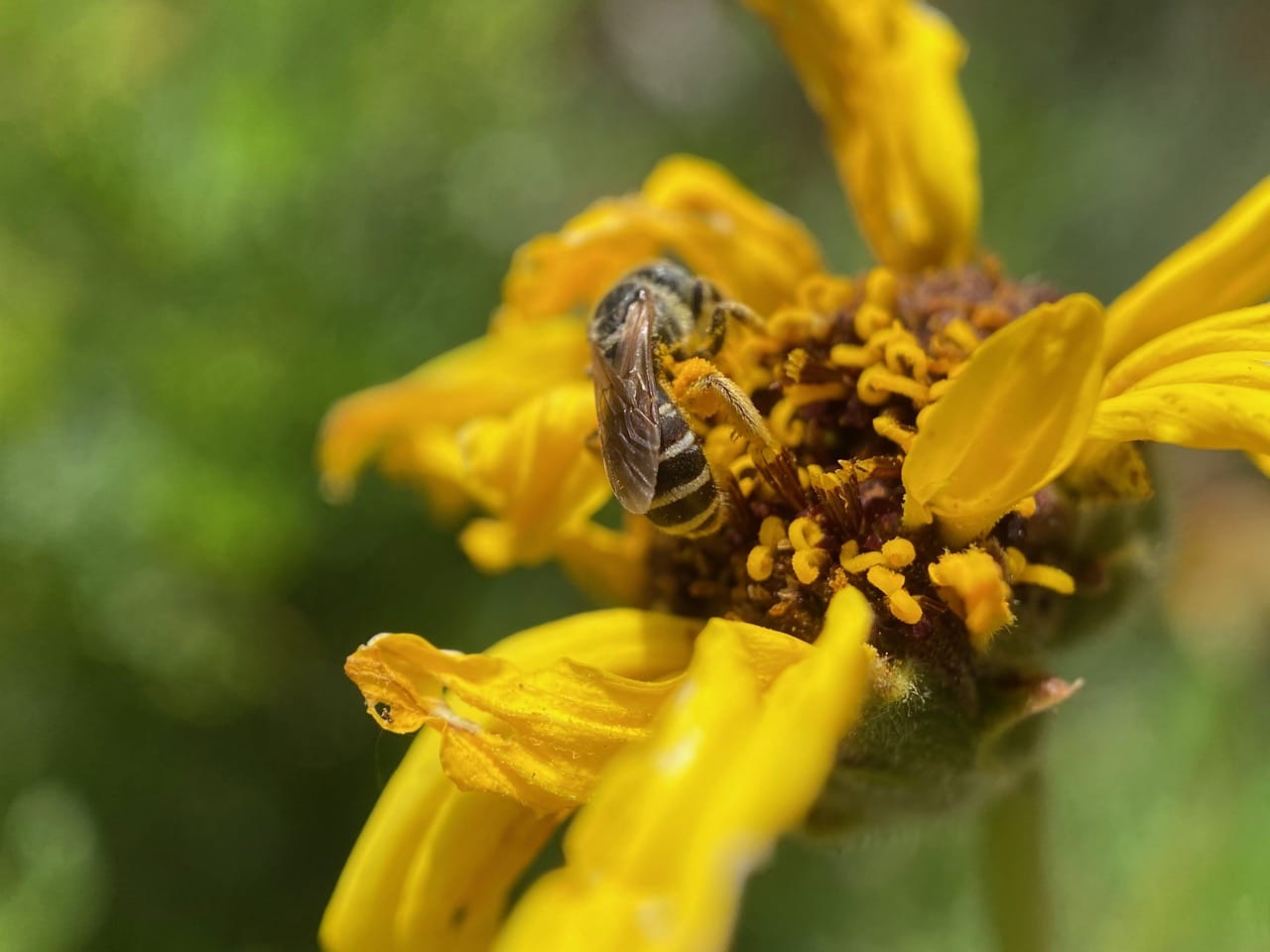
Judging by the curly-cue stigmas on the disc flowers, they are mostly in the female phase. Flowers of Asteraceae are protandrous, the male parts maturing before the female parts. Pollen is produced during the male phase.
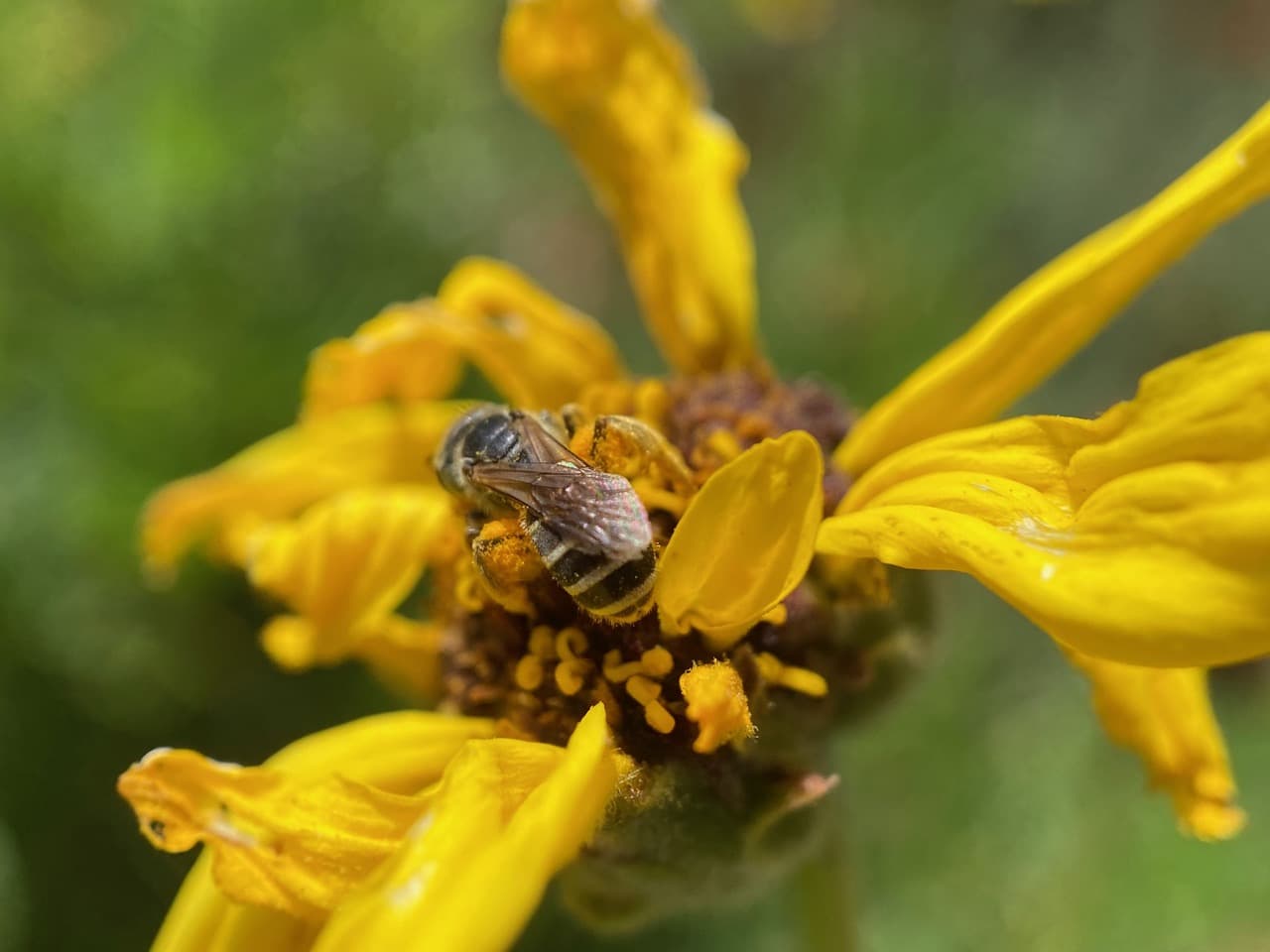
Nevertheless, the Sweat Bee is still able to gather prodigious amounts of pollen in her scopae.
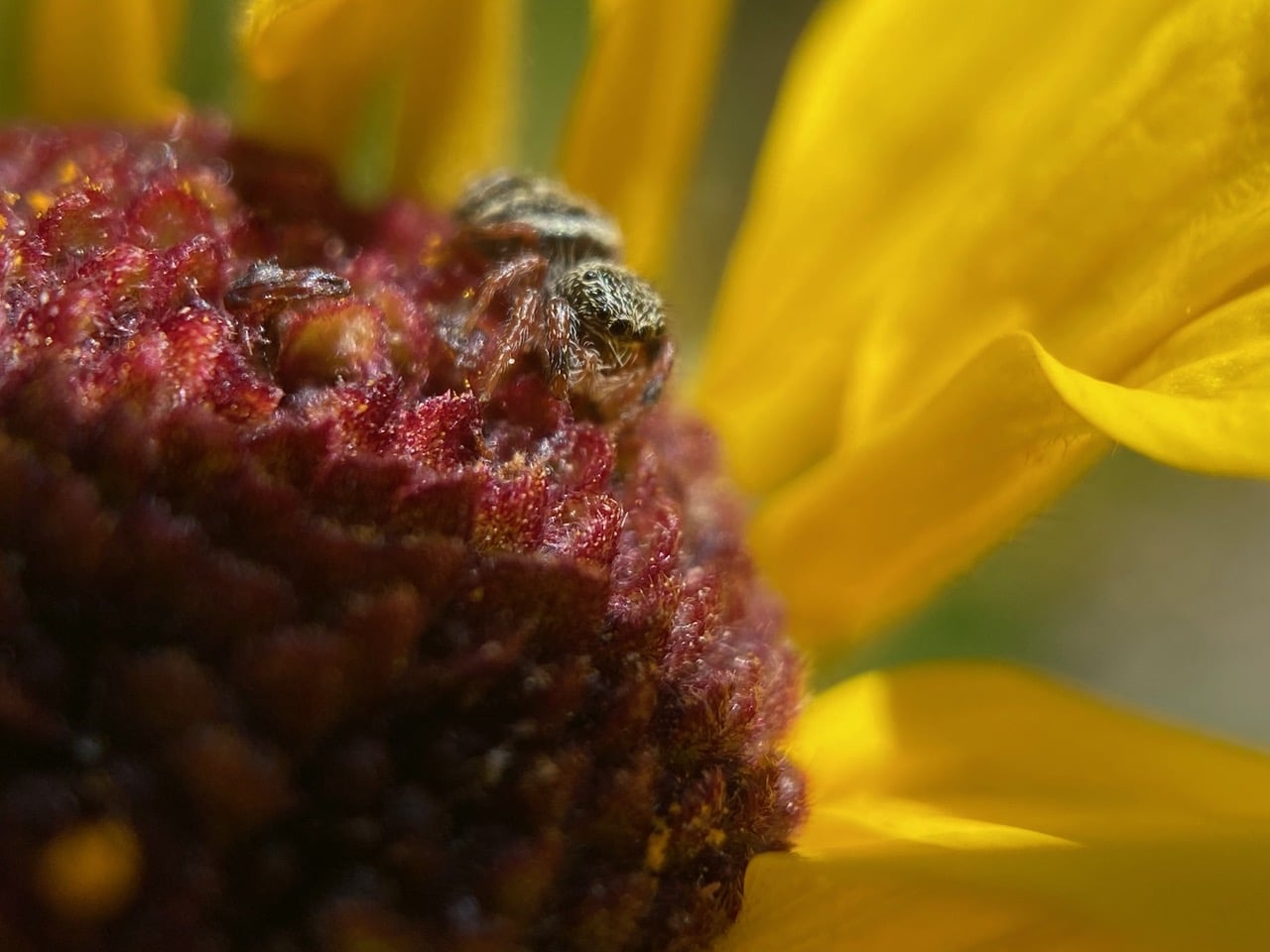
On a fresh flowerhead of California Brittlebush, a tiny Jumping Spider (family Salticidae) is hunting in a field of dark flower buds.
Salticids are free-roaming hunters. They do not weave a web to catch prey. They stalk, then pounce on their prey. Just before jumping, the spider fastens a safety line to the substrate. It can leap 10-20 times their body length to capture prey. Their movement is achieved by rapid changes in hydraulic pressure of the blood. Muscular contractions force fluids into the hind legs, which cause them to extend extremely quickly.
Jumping spiders have excellent vision, with among the highest acuities in invertebrates.
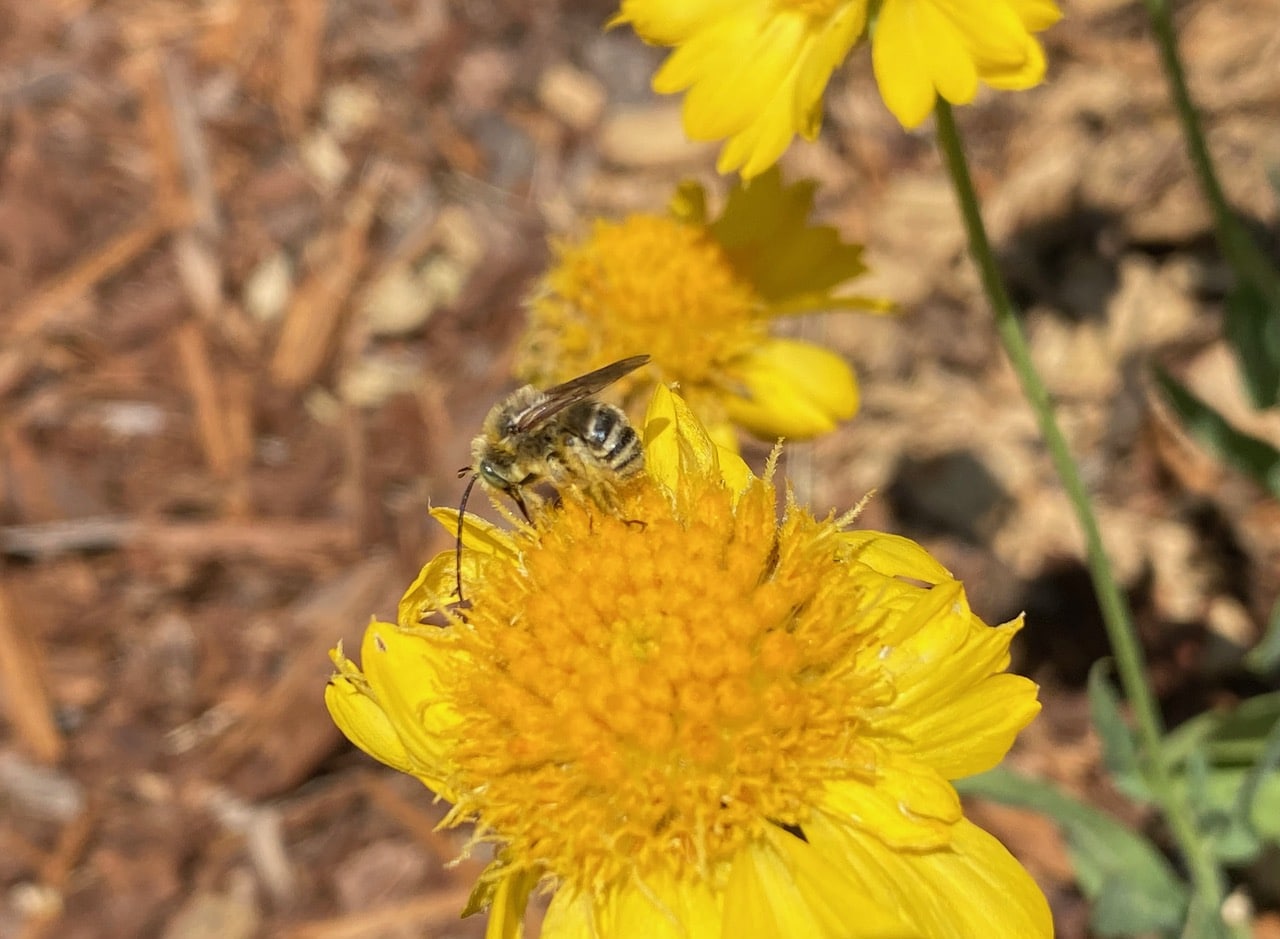 A male Summer Longhorn Bee, Melissodes sp. (family Apidae) is taking nectar from a flowerhead of Blanket Flower, Gaillardia sp.
The Summer Longhorn Bees, Melissodes sp. (family Apidae) are medium to large bees, stout-bodied, usually with gray hair on the thorax and pale hair bands on the abdomen. Males usually have yellow markings on their faces and have very long antennae from which their common name is derived. They are active May to September, with peak flight in late June to early August. The females prefer flat, bare ground for digging their solitary nests, though they sometimes nest in aggregations. Pollen is transported in scopae on the hind legs. Pollen loads are often copious and brightly colored and thus very distinguishable. Melissodes are specialists on Asteraceae – females gather pollen from flowers of Aster, Bidens, Coreopsis, Cosmos, Encelia, Gaillardia, Helianthus, and Rudbeckia ssp.
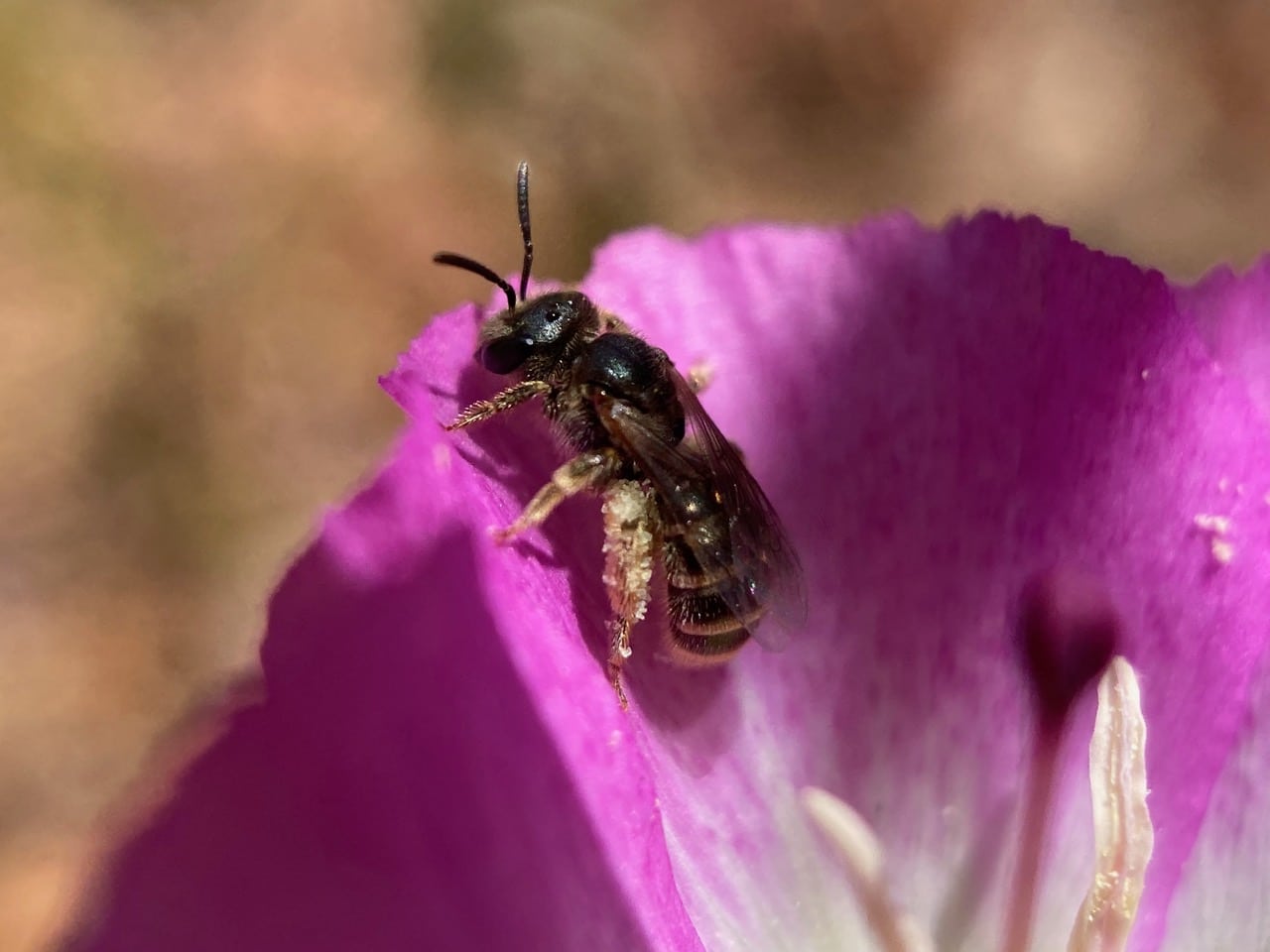
Her scopae studded with large triangular-shaped pollen grains, a female Sweat Bee, Halictus sp. (family Halictidae) crawls out from a flower of Pismo Clarkia, Clarkia speciosa ssp. immacolata (family Onagraceae).
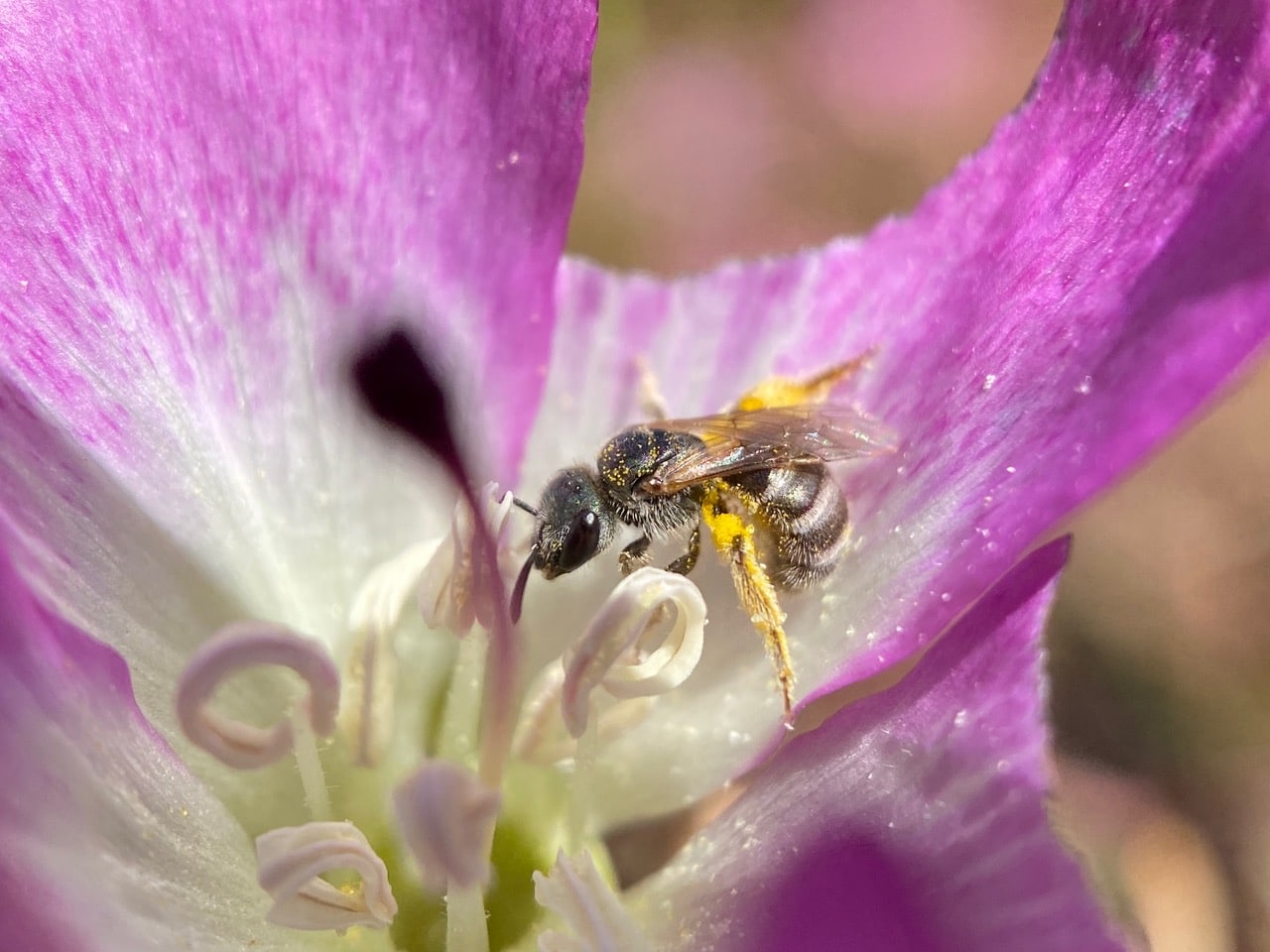
Another Sweat Bee, Halictus sp. (family Halictidae) lands on an adjacent flower of Pismo Clarkia. Note that two of the petals have had rounded pieces cut out of them – they are the handiwork of Leaf-cutter Bees, Megachile sp. (family Megachilidae). Female Leaf-cutter bees are equipped with large, powerful mandibles that enable them to cut pieces of leaves or petals with which they use to line their nest cells.
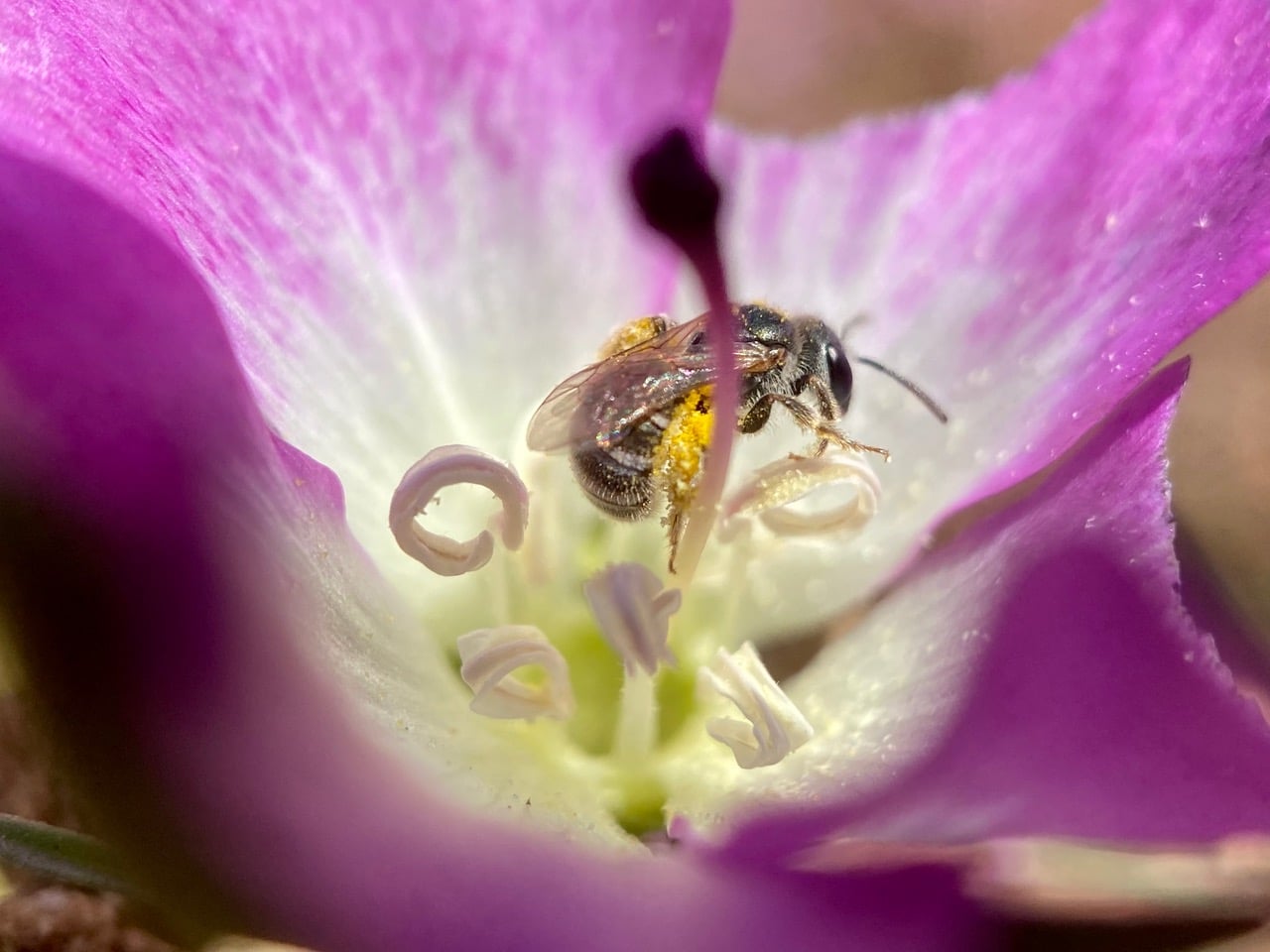
The yellow pollen on the Sweat Bee’s scopae are obviously not from the Clarkia (whose pollen grains are a translucent light pinkish-purple). Sweat Bees are generalist foragers that gather pollen from a wide variety of flowers, and they are liable to visit more than one type of flowers on a single foraging trip.
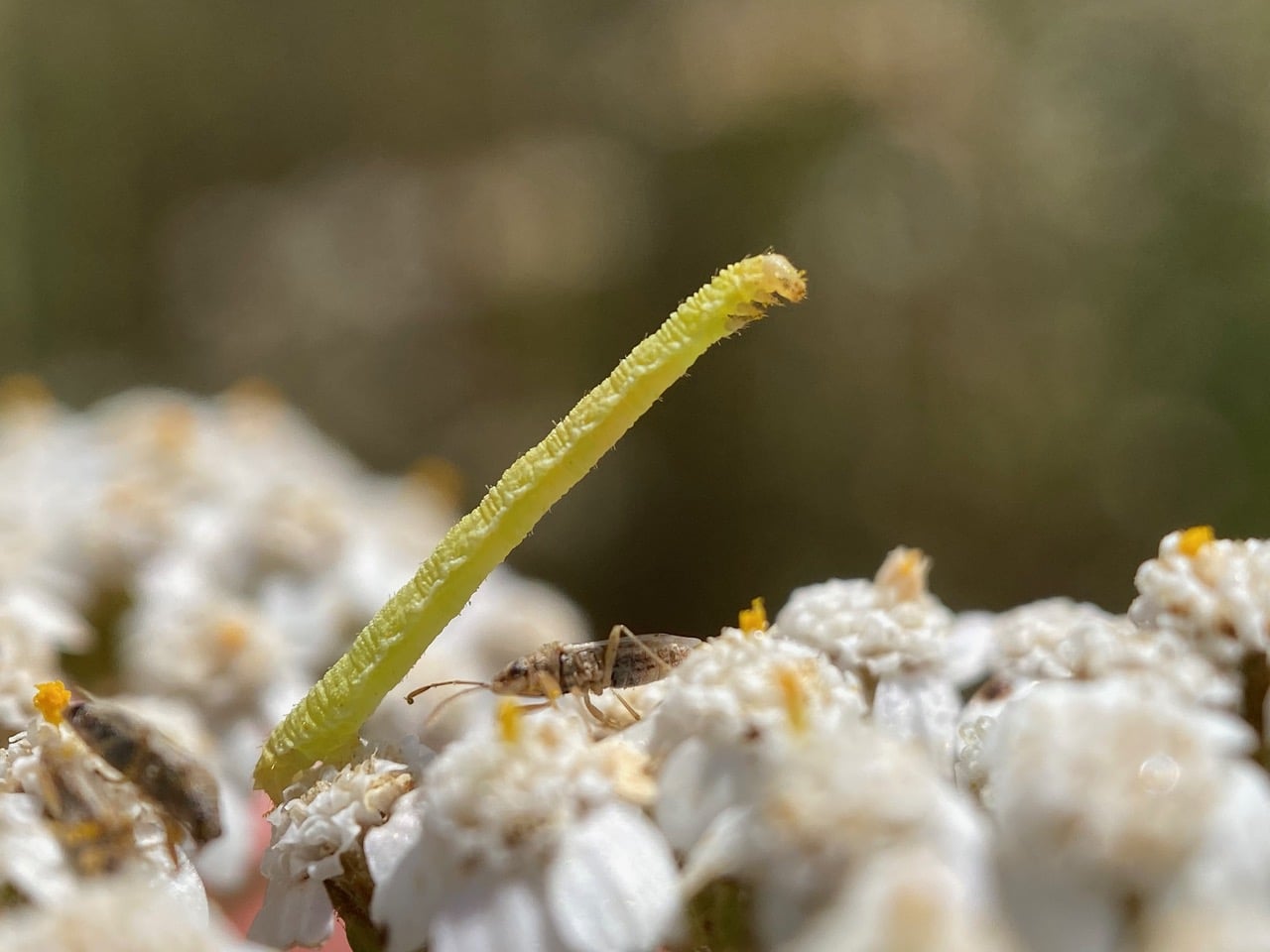
Just as Stefanie and I are sharing our observations that the flowers of Yarrow, Achillea millefolium seem to have few insect visitors this year, I spot a tiny Inch Worm that has reared up stiffly among a Yarrow inflorescence. Taking a closer look, I realize that the caterpillar has assumed this pose in response to the approach of some Seed Bugs, Nysius raphanus (family Lygaeidae).
Inchworms are also called loopers and measuring worms. The majority of the inchworms are the larvae of moths in the family Geometridae. The name comes from the Greek “geo” for earth and “metro” from measure, because the caterpillars seem to be measuring the surface on which they are walking.
All caterpillars have three pairs of jointed legs behind their heads. These legs are called true legs because they will become the six legs of the adult butterfly or moth. There are additional appendages, called prolegs, along their bodies. Prolegs are not true legs, they are just outgrowths of the body wall and will be lost at metamorphosis. They have little hooks on their soles to help the caterpillar walk and grip onto things.
Most caterpillars have five sets of prolegs, four in the middle of the body and one pair at the hind end. Inchworms have the normal six true legs but only two or three pairs of prolegs, all located at the tail end of the body, with none in the middle. When an inchworm walks, it moves its tail-end prolegs up behind its true legs, causing the center of its body to loop upward. Then it stretches its front end forward to take another step.