

Pollinator Post 7/9/24 (2)
Susan and I are excited to visit Stefanie’s lovely garden in San Leandro this morning. The garden is still colorful with late-blooming plants, and abuzz with insects.
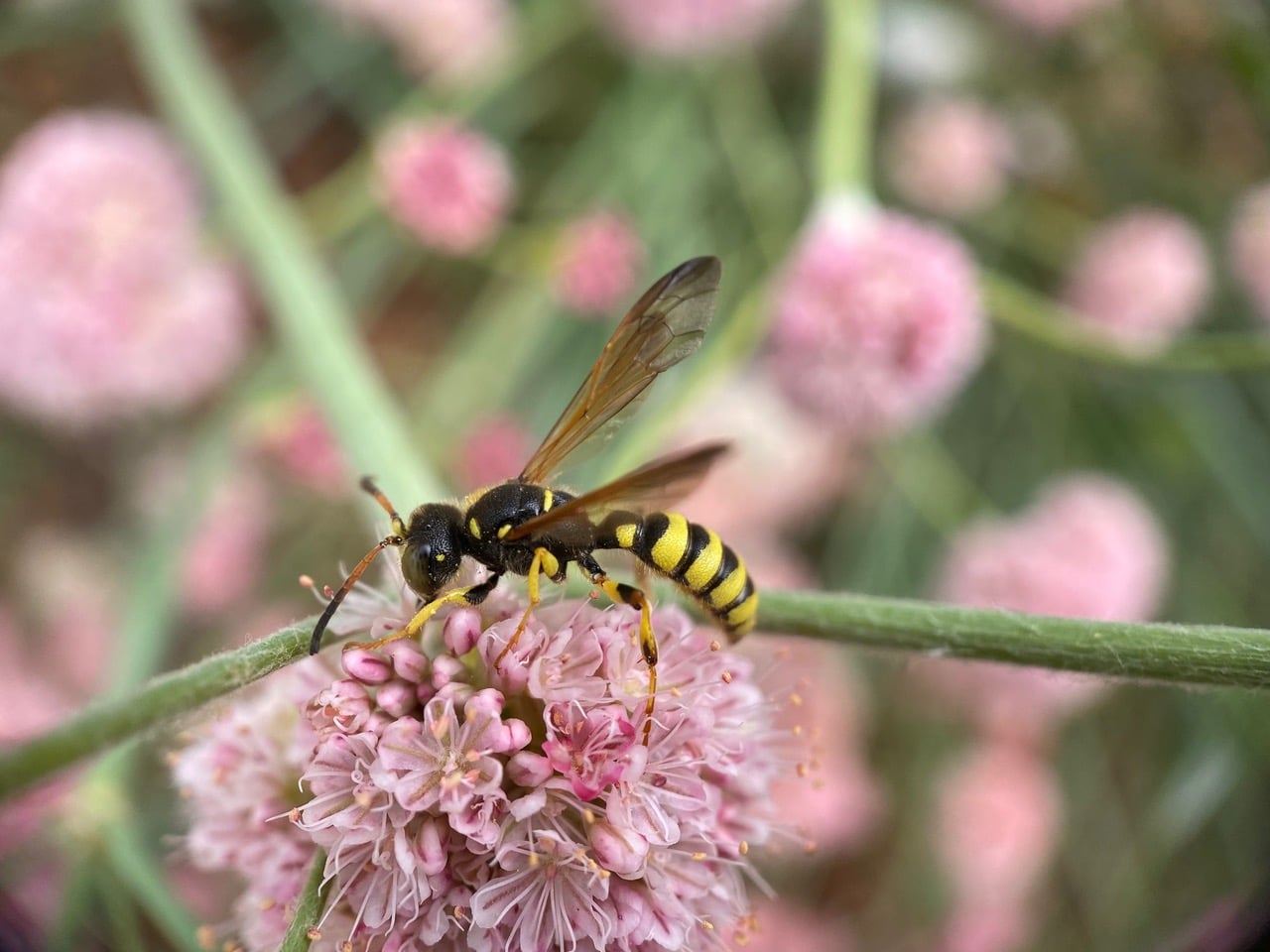
A small wasp is foraging on an inflorescence of the Red-flowered Buckwheat, Eriogonum grande var. rubescens. It is a Weevil Wasp, Cerceris sextoides (family Crabronidae, Tribe Cercerini). Cerceris is the largest genus of wasps in the family Crabronidae. C. sextoides is a common wasp in the Pacific coast states, active from May to October. The abdominal segments are constricted very strongly at the junctures, giving the abdomen a somewhat corrugated, accordion-like appearance. The female digs a nest in the soil and provisions it with living prey items she has paralyzed with venom. The prey are usually weevils, and other beetles, and sometimes bees.
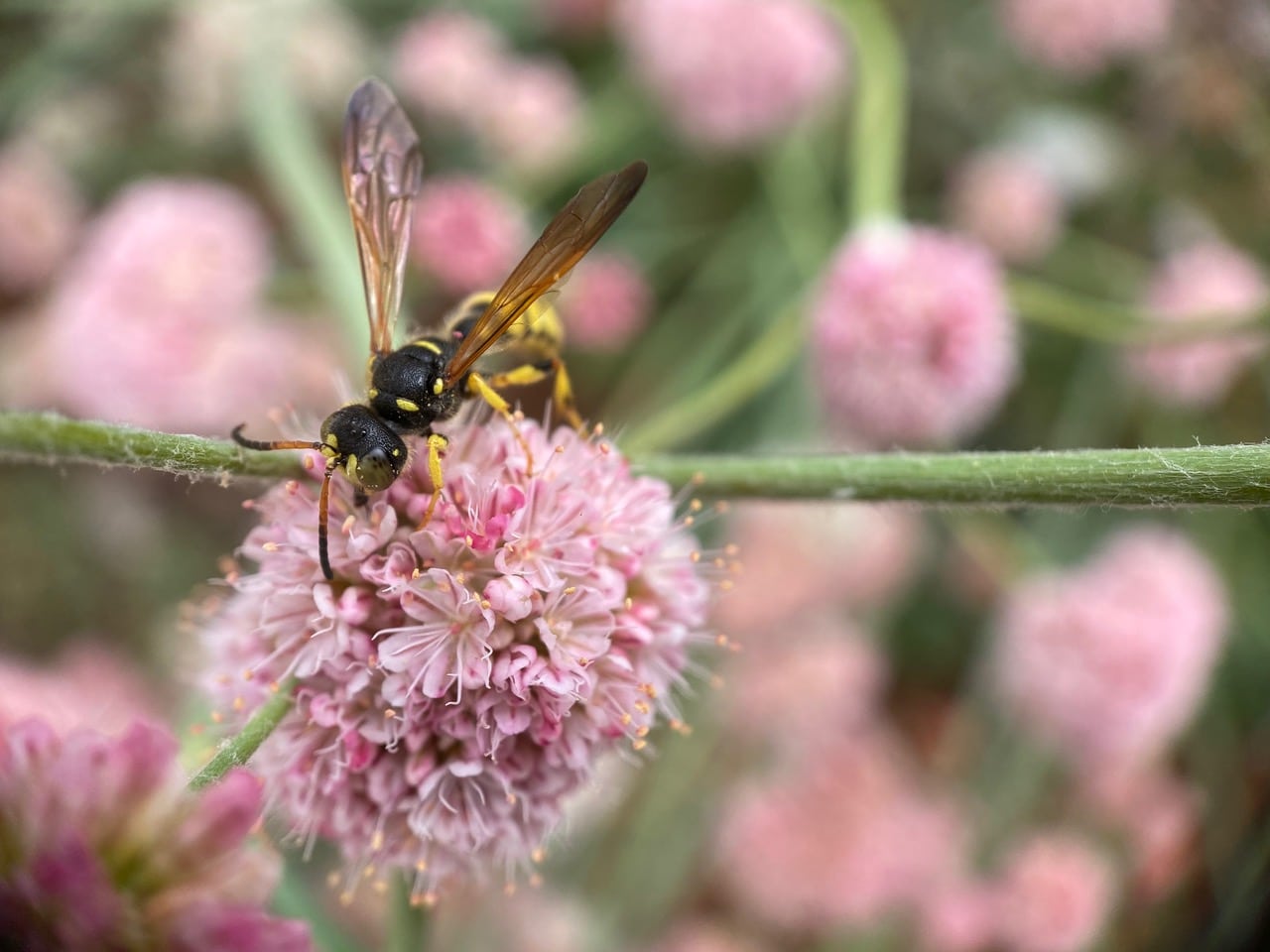





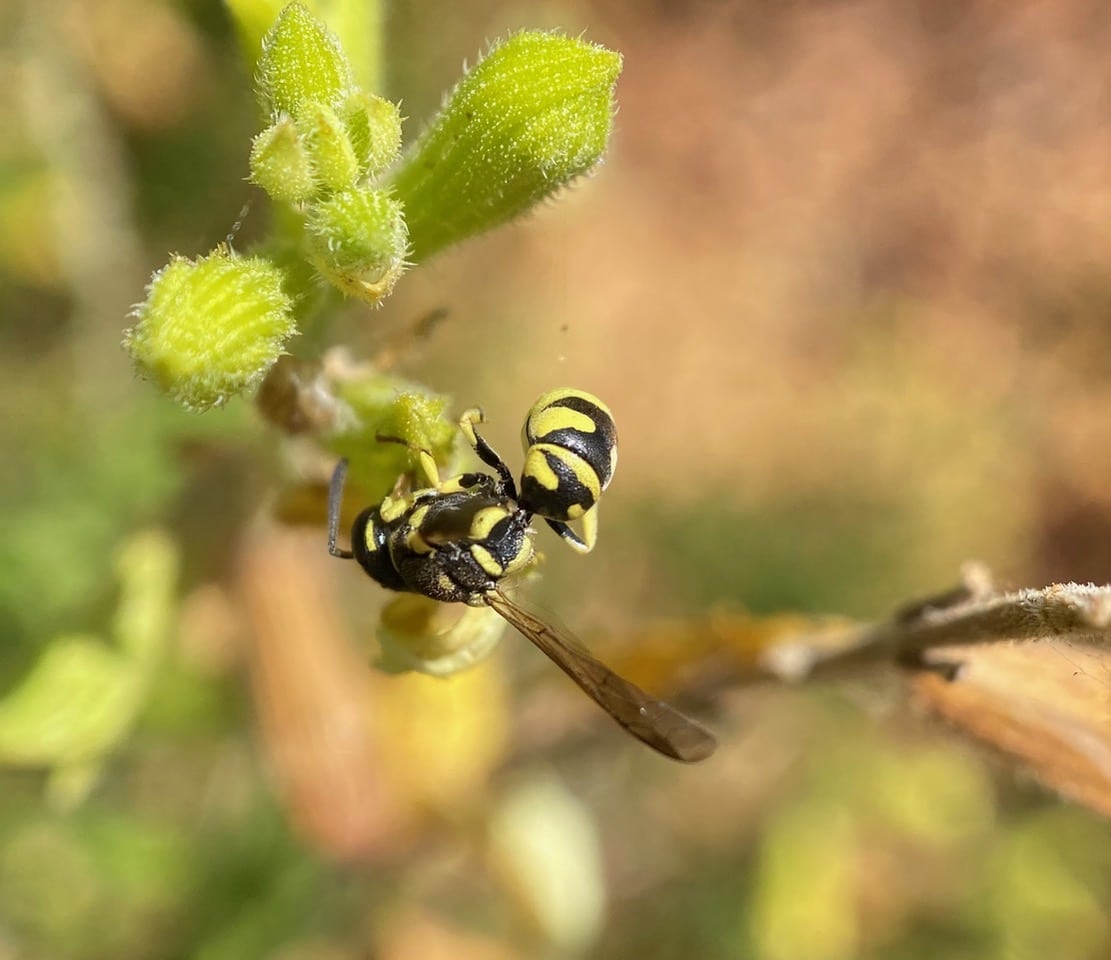
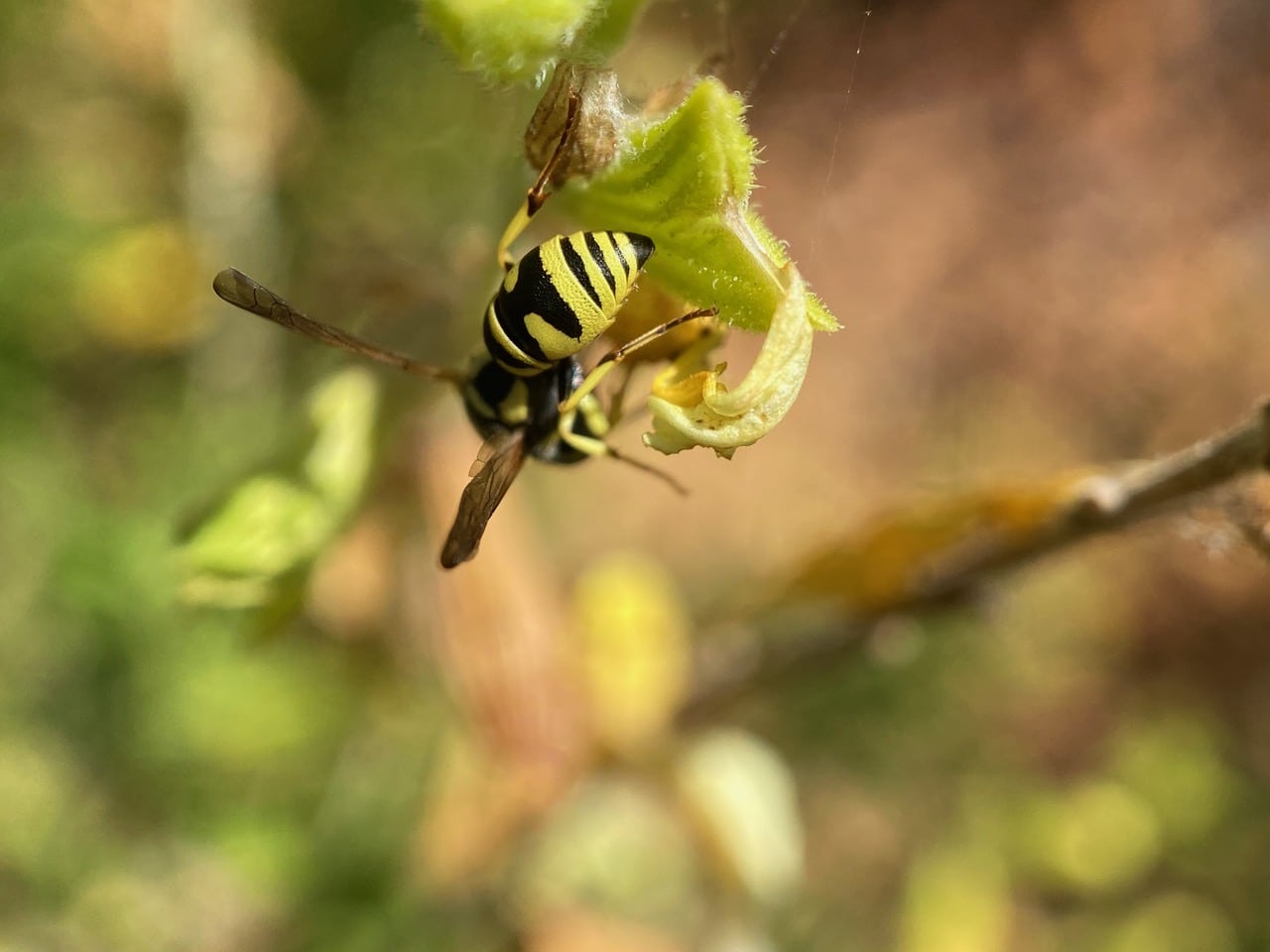
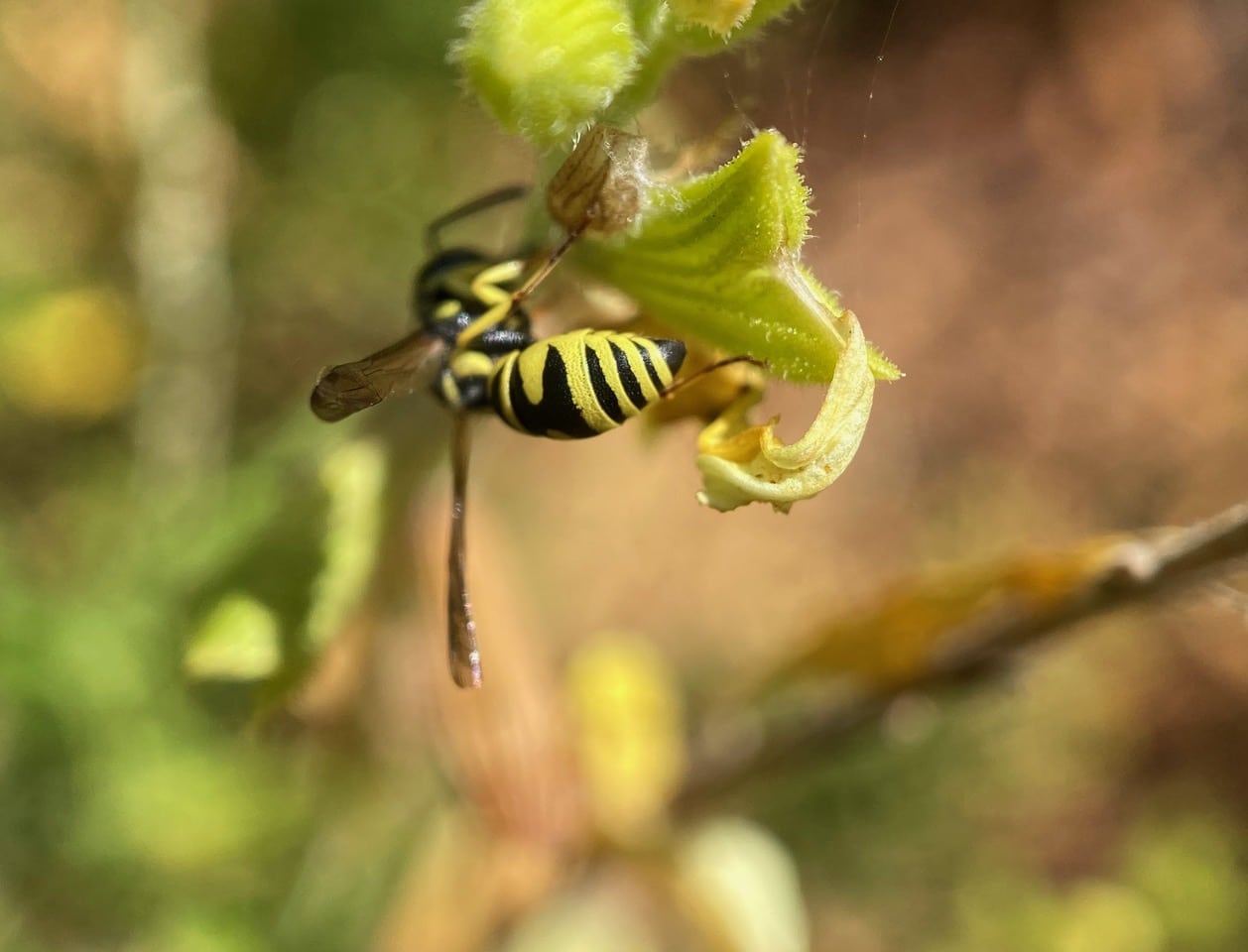
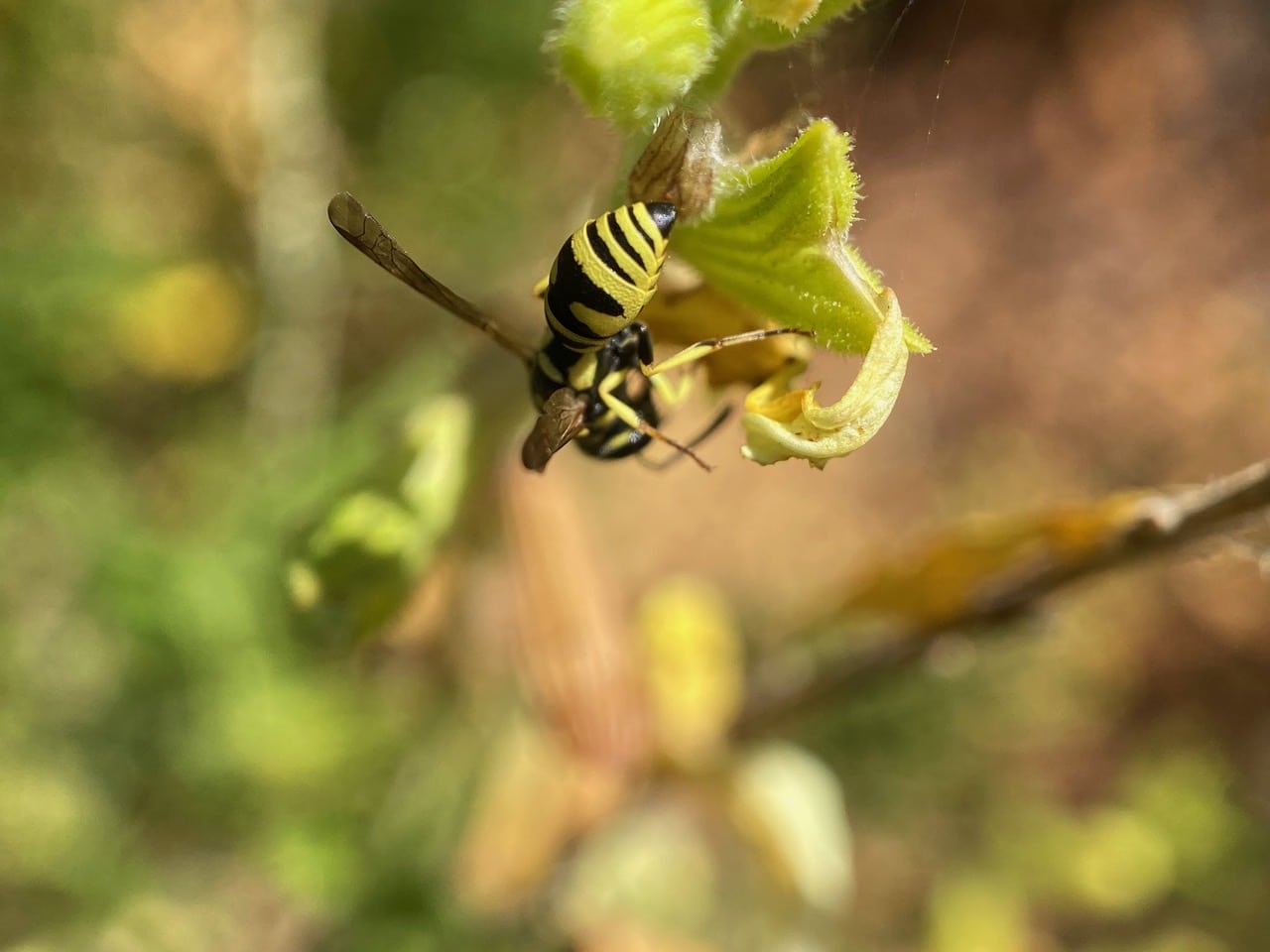
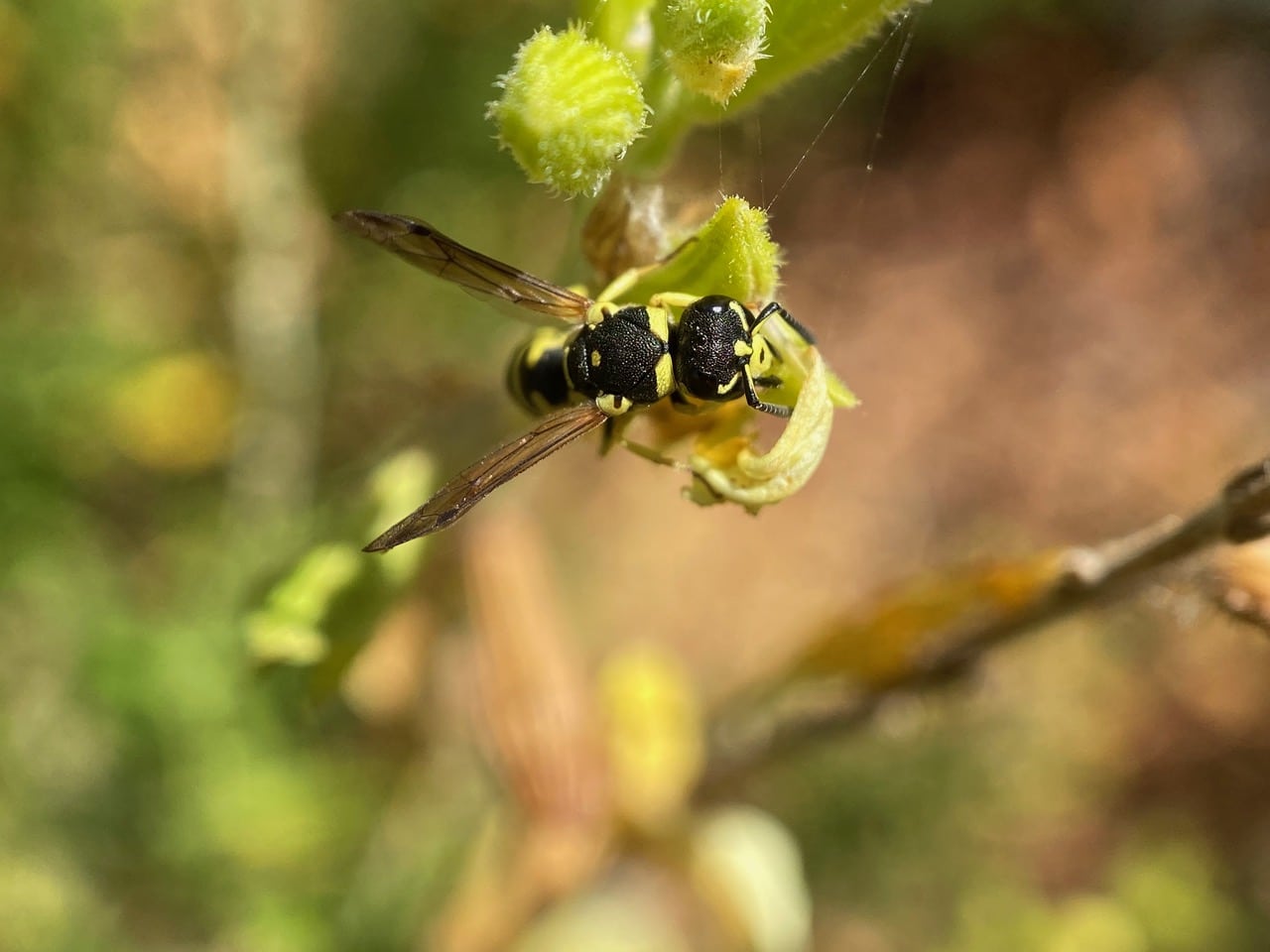

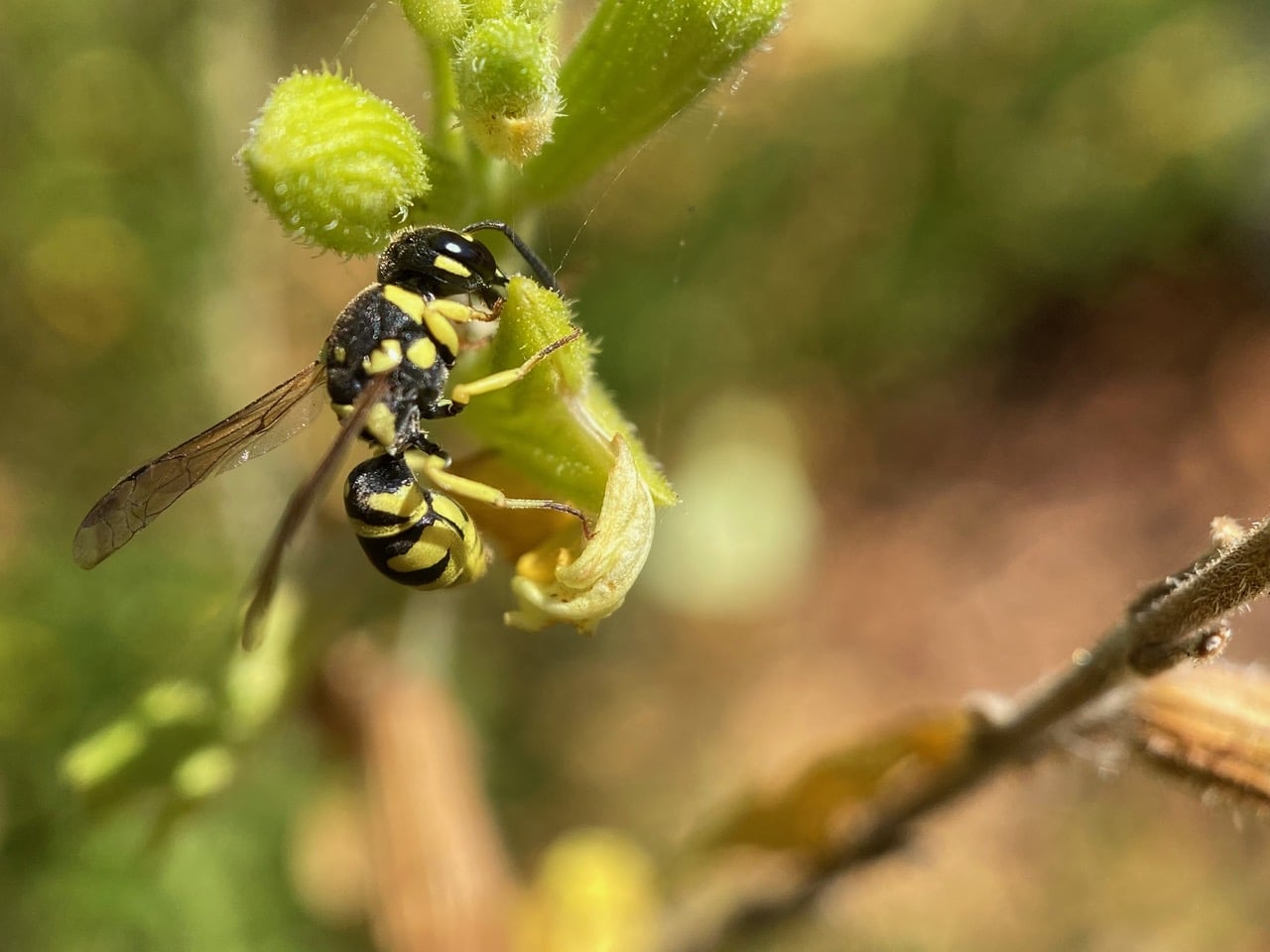
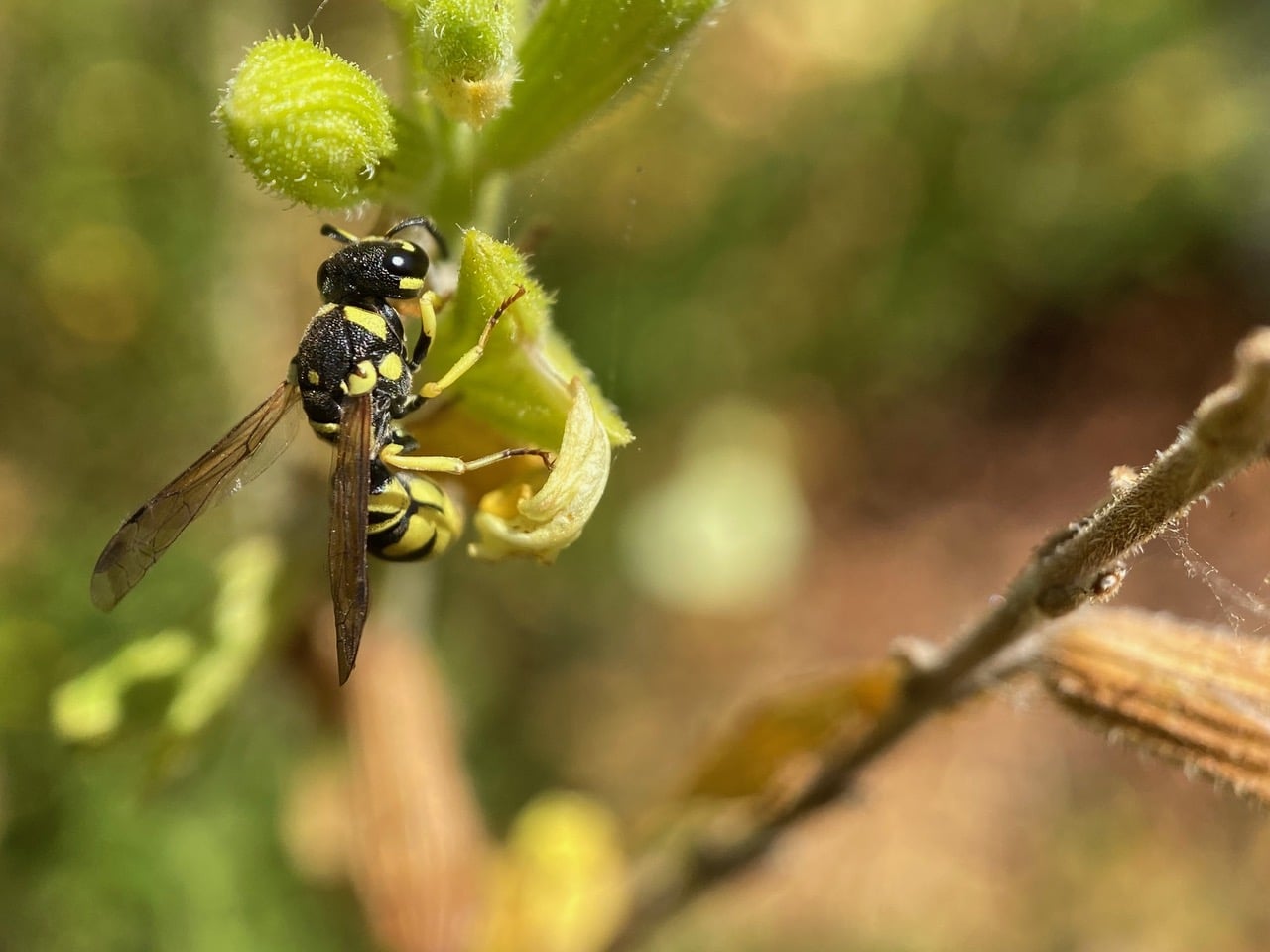
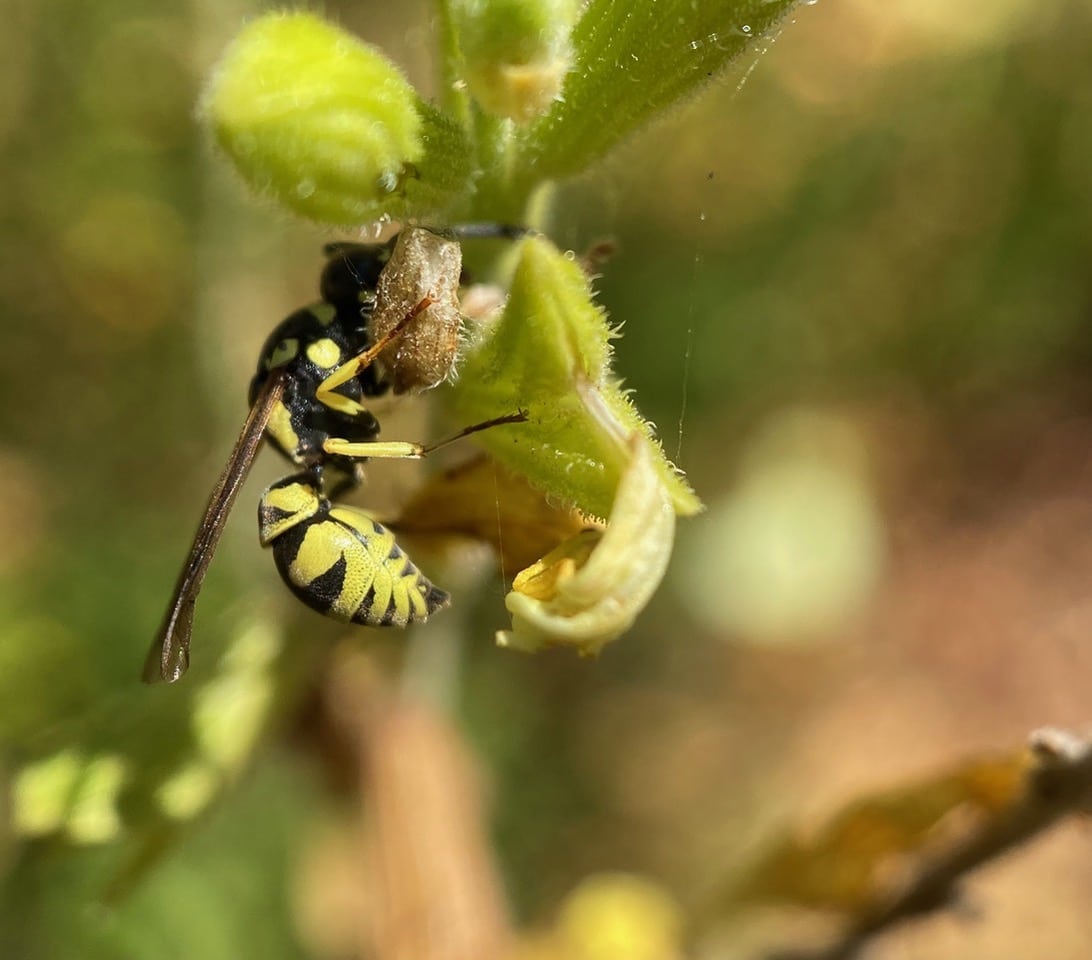

This wasp appears to be male. Female Cerceris sextoides has horn-like processes on the clypeus (“upper lip”) that is thought to assist her in digging.
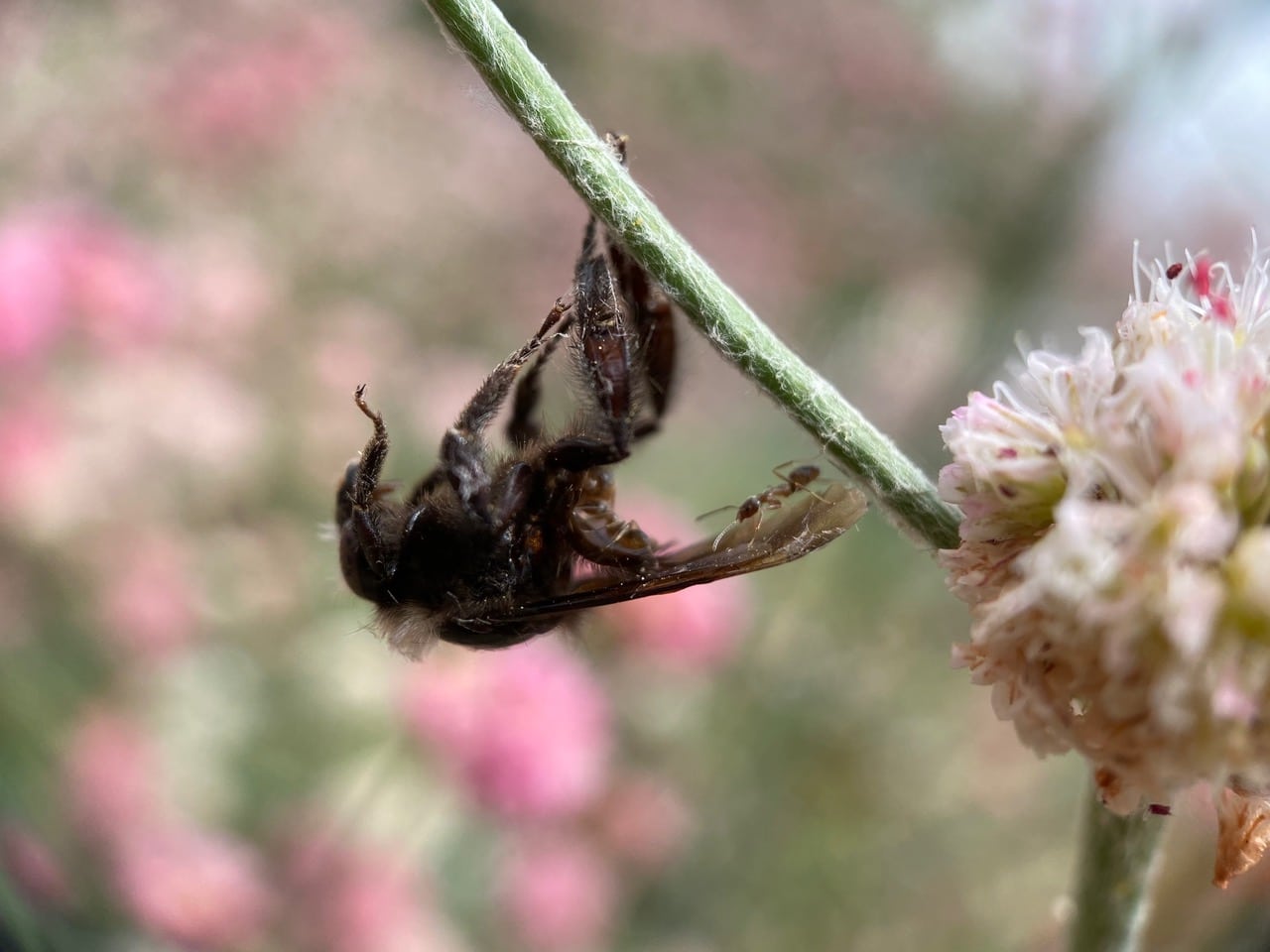
A dead bumble bee hangs lifelessly from a stem of Nude Buckwheat. Some Argentine ants are scavenging on its almost absent abdomen.
Many Sweat Bees, Halictus sp. (family Halictidae) are foraging on an inflorescence of Nude Buckwheat, Eriogonum nudum. This female has yet to fill the scopae on her hind legs.
This female is filling up her scopae nicely.
Halictus is found worldwide; they are most common in the Northern Hemisphere. All are generalists, foraging from a wide variety of flowering plants. Many species are social and produce several generations per year. This is not surprising as most blooming plants are season-specific; a bee that requires pollen and nectar across multiple seasons would not thrive as a specialist. All Halictus in North America nest in the ground, often in aggregations; and they may nest in the same area for decades.
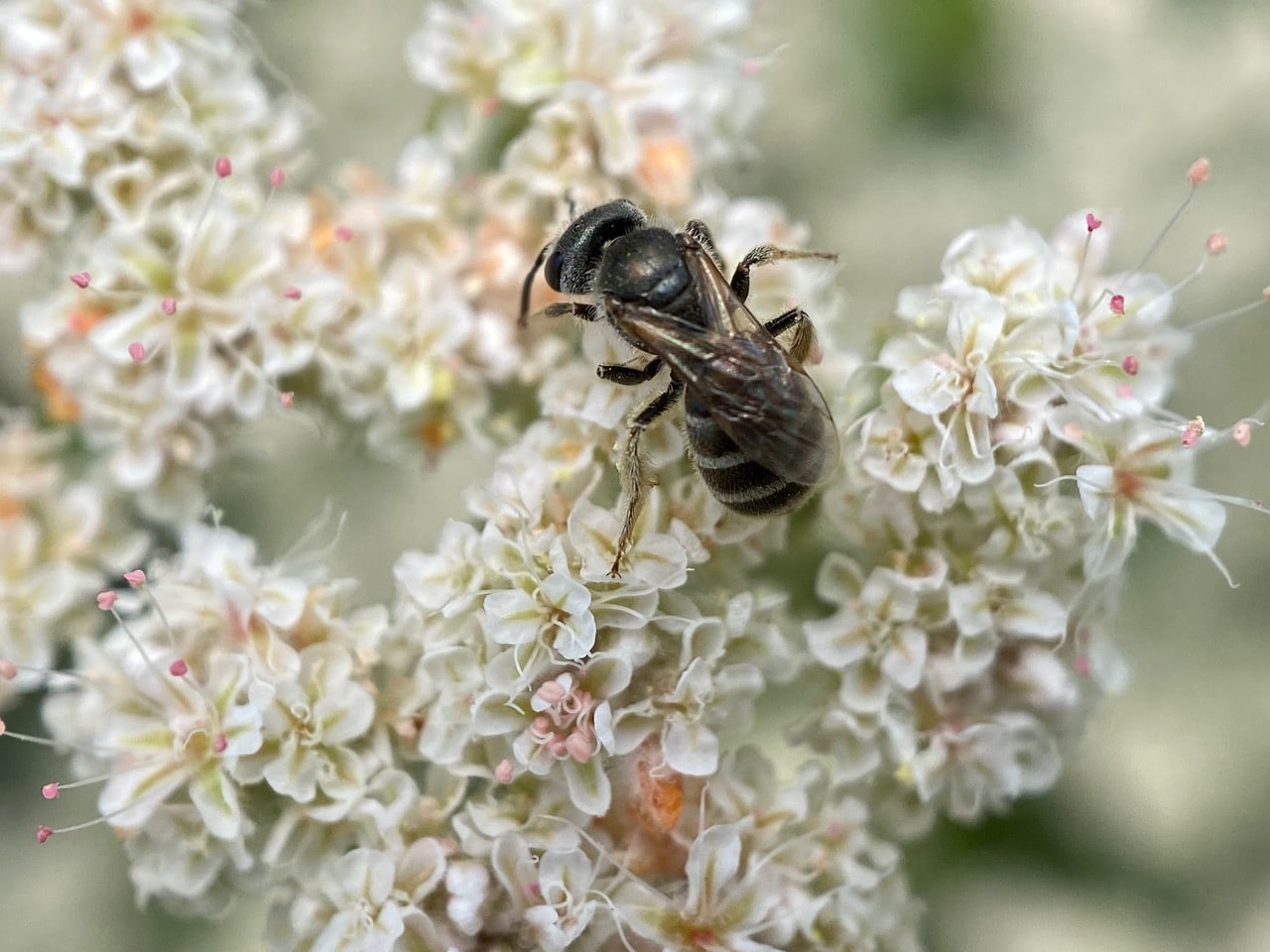
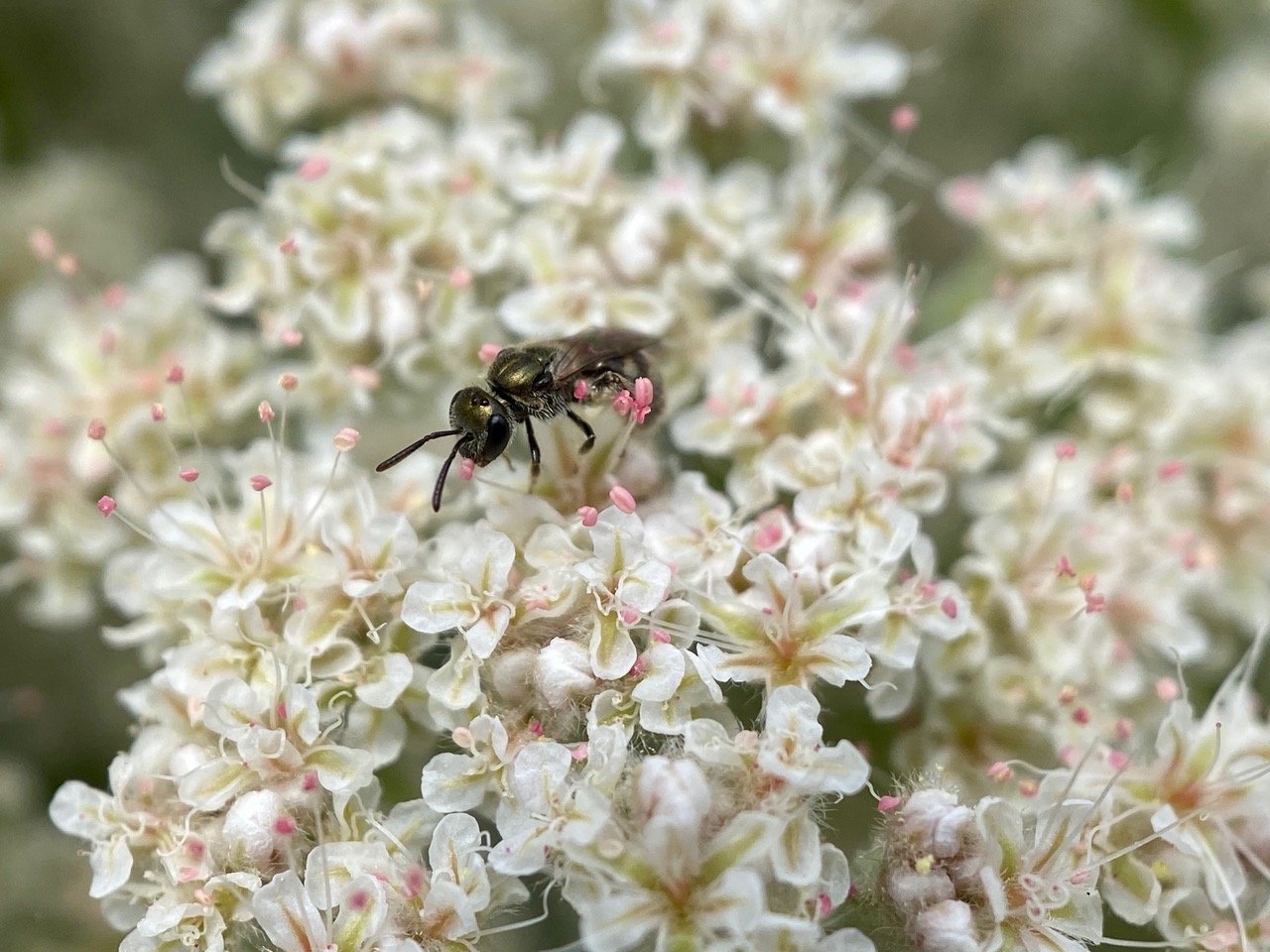
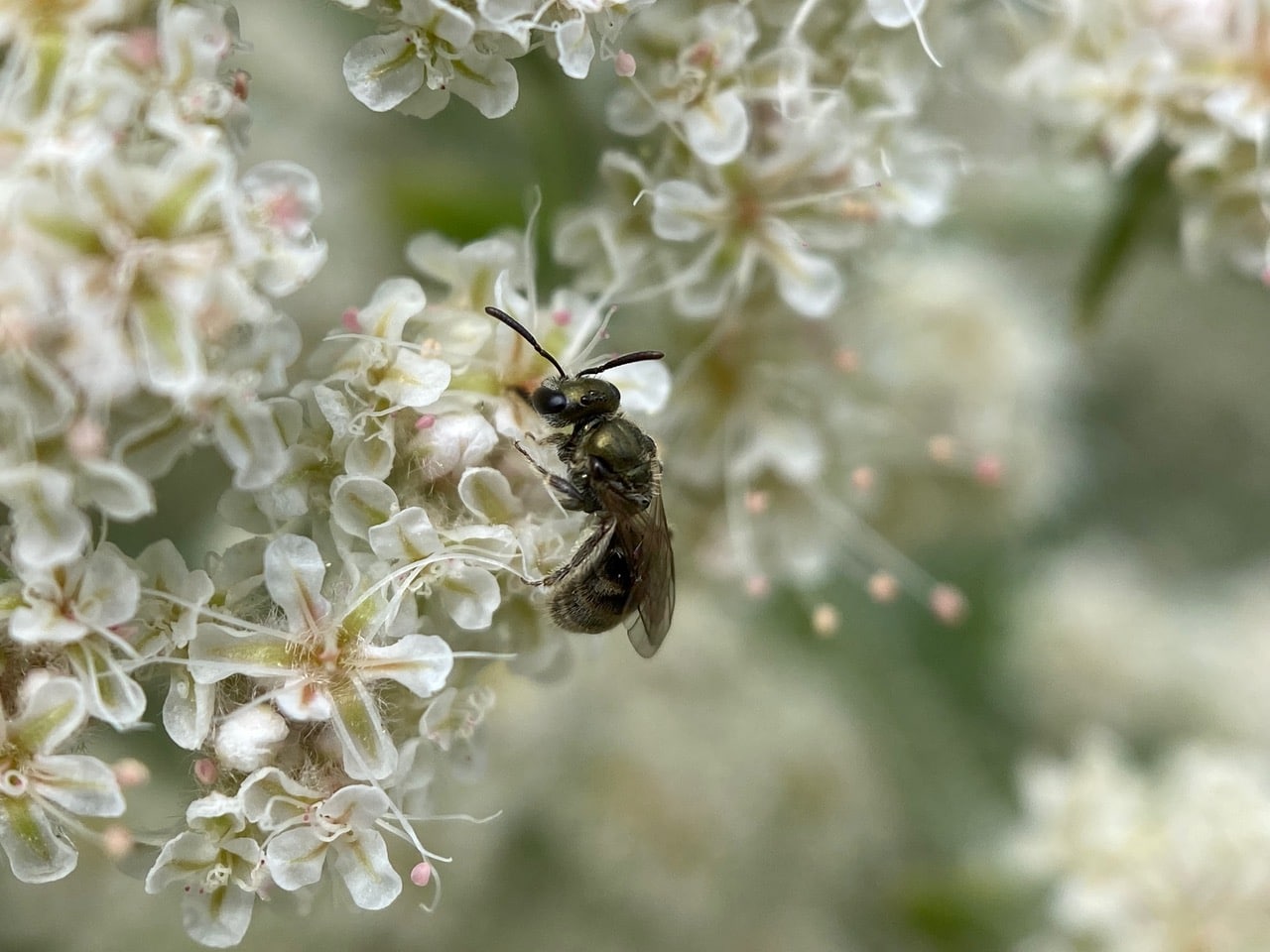
A Metallic Sweat Bee, Lasioglossum (Dialictus) sp. (family Halictidae) is foraging on a cluster of buckwheat flowers. The small, tightly clustered, shallow flowers with fully exserted stamens are perfect for the little bees.
Lasioglossum species are found worldwide, and they constitute the largest bee genus. The subgenus Dialictus are the most likely to be seen in the U.S., with over 300 species of these tiny metallic bees. The majority of Lasioglossum are generalists. Because they are so abundant throughout the flowering season, the bees are often important pollinators. Their sheer numbers are enough to achieve excellent pollination of many wild flowers, especially of plants in the Asteraceae, which have shallow floral tubes that are easily accessed by these minute bees.
Lasioglossum are closely related to the genera Halictus and Agapostemon. These genera are commonly called “sweat bees” because of their attraction to human sweat, which they drink for its salt content. Lasioglossum are dusky black to brown slender bees with bands of hair on their abdomen. Female Sweat Bees (family Halictidae) carry pollen in the scopae on their entire hind legs and underside of their abdomen.
Lasioglossum exhibit a range of social behaviors; the genus includes solitary, communal, semi social, primitively eusocial, and even parasitic species. Almost all Lasioglossum in the U.S. nest in the ground. Generally these nests are built in the spring by fertilized females (called foundresses) that spent the winter in hibernation. In social species, the foundresses behave much like the queen Bumble Bees – they lay the first batch of eggs that develop into the first generation of female workers. The nest grows with each additional generation of bees. Later broods may consist of both males and females. They mate, and at the end of the season the fertilized females hibernate til the following spring, repeating the life cycle of the colony.
The Metallic Sweat Bee has extended her tongue to take nectar from a buckwheat flower. Members of Halictidae have short tongues, compared to other types of bees.
Dialictus is a subgenus of sweat bees belonging to the genus Lasioglossum. Most of the members of this subgenus have a metallic appearance. They are commonly found in the Northern Hemisphere and are found in abundance in North America. Members of this subgenus also have very diverse forms of social structure making them model organisms for studying the social behavior of bees.
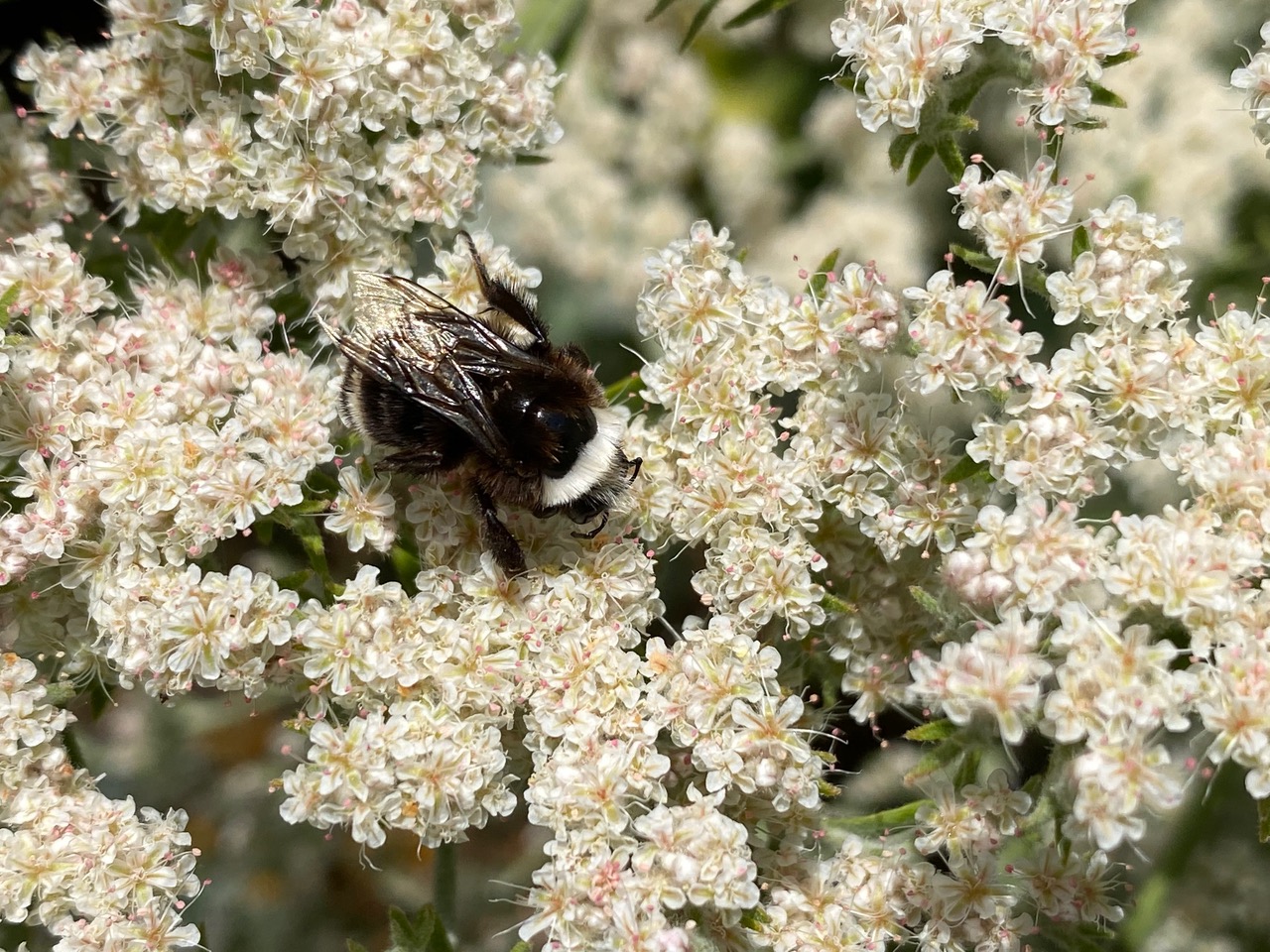
A Yellow-faced Bumble Bee, Bombus vosnesenskii (family Apidae) is resting motionless on the flowers of Nude Buckwheat. She appears to be old, with a balding thorax. Susan and I heave a sigh of relief as the bee stirs and flies away – she was just taking a break.
Holding still, a female Masked Bee, Hylaeus sp. (family Colletidae) is “blowing bubbles” on an inflorescence of Nude Buckwheat. “Bubble blowing” is a behavior often observed in Hylaeus. The bee repeatedly brings up a droplet of liquid in its jaws, and then slowly retrieves it into its body. It has been speculated that Masked Bees do this to facilitate the evaporation of the nectar they have collected, to reduce the load they have to fly home with.
It was recently discovered that the semi-liquid provisions that females of a species of Colletidae prepare for the young is a fermented brew rich in lactic acid bacteria. Is bubble-blowing a procedure to mix the gathered nectar and pollen with the bacteria, I wonder? Many insects have compartments in their gut that harbor symbiotic microbiota that aid in their nutrition. Maybe the Hylaeus moms are starting the brewing process even before they head home with the day’s harvest?
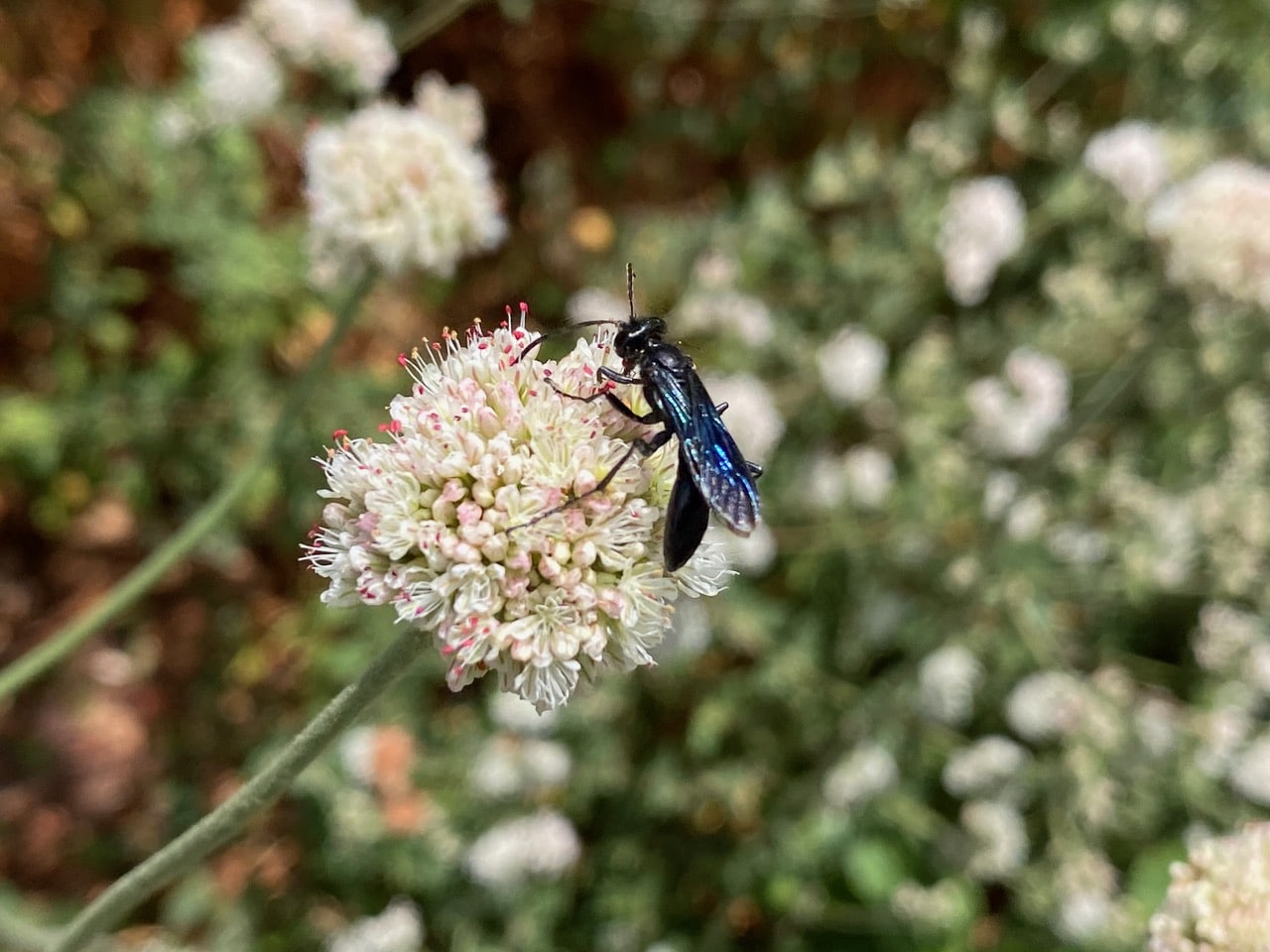
Smokey wings flashing iridescent blue, a male Thread-waisted Burrowing Wasp, Sphex lucae (family Sphecidae) is taking nectar on an inflorescence of Nude Buckwheat.
The Sphecidae are solitary wasps with elongated and narrow first abdominal segment, giving rise to the common name Thread-waisted Wasps. Sphex lucae is a widespread western species, ranging from WA in the north, south to CA, and east to TX. The species exhibits sexual dimorphism – females are black with a red abdomen, while the males are all black. Adults visit many types of flowers for nectar. Females hunt katydids and grasshoppers as food for their young. The wasp excavates a single-celled burrow in the soil in advance of hunting activities. She drags her paralyzed prey back to the burrow, laying a single egg on the victim. The nest entrance is then sealed and the process is repeated. Males of this species spend nights in sleeping aggregations in sheltered places such as beneath a rock overhang.
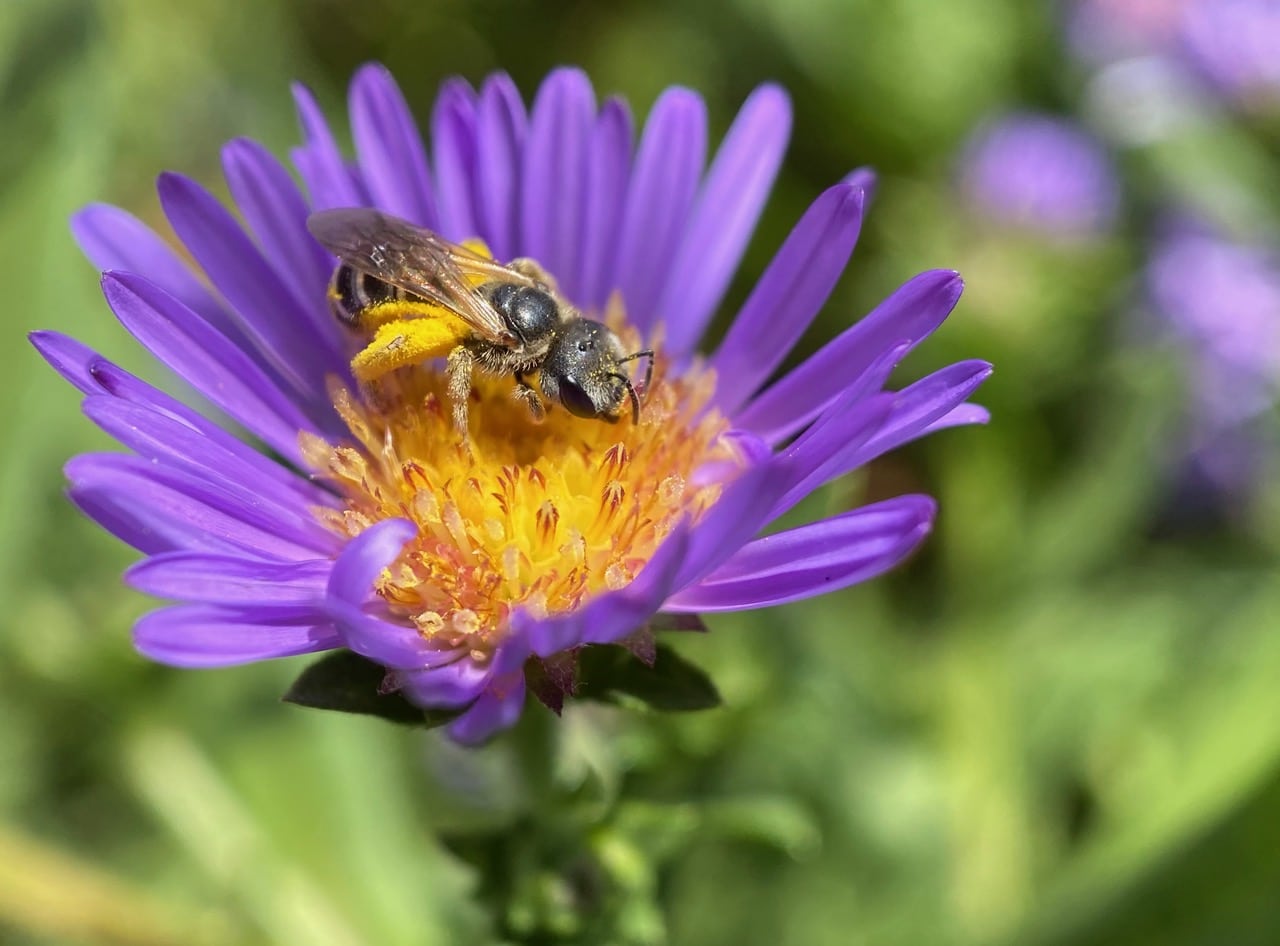
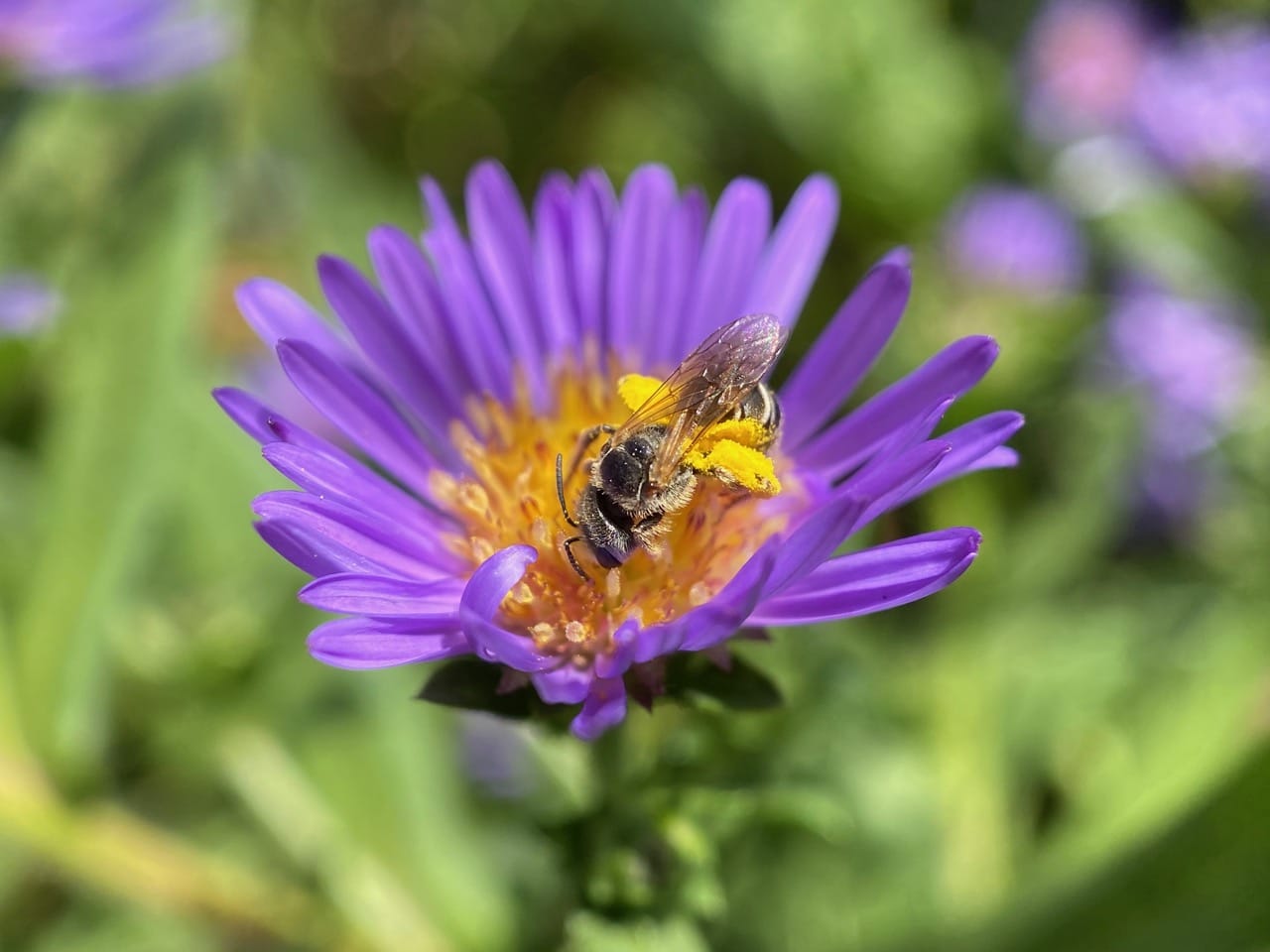
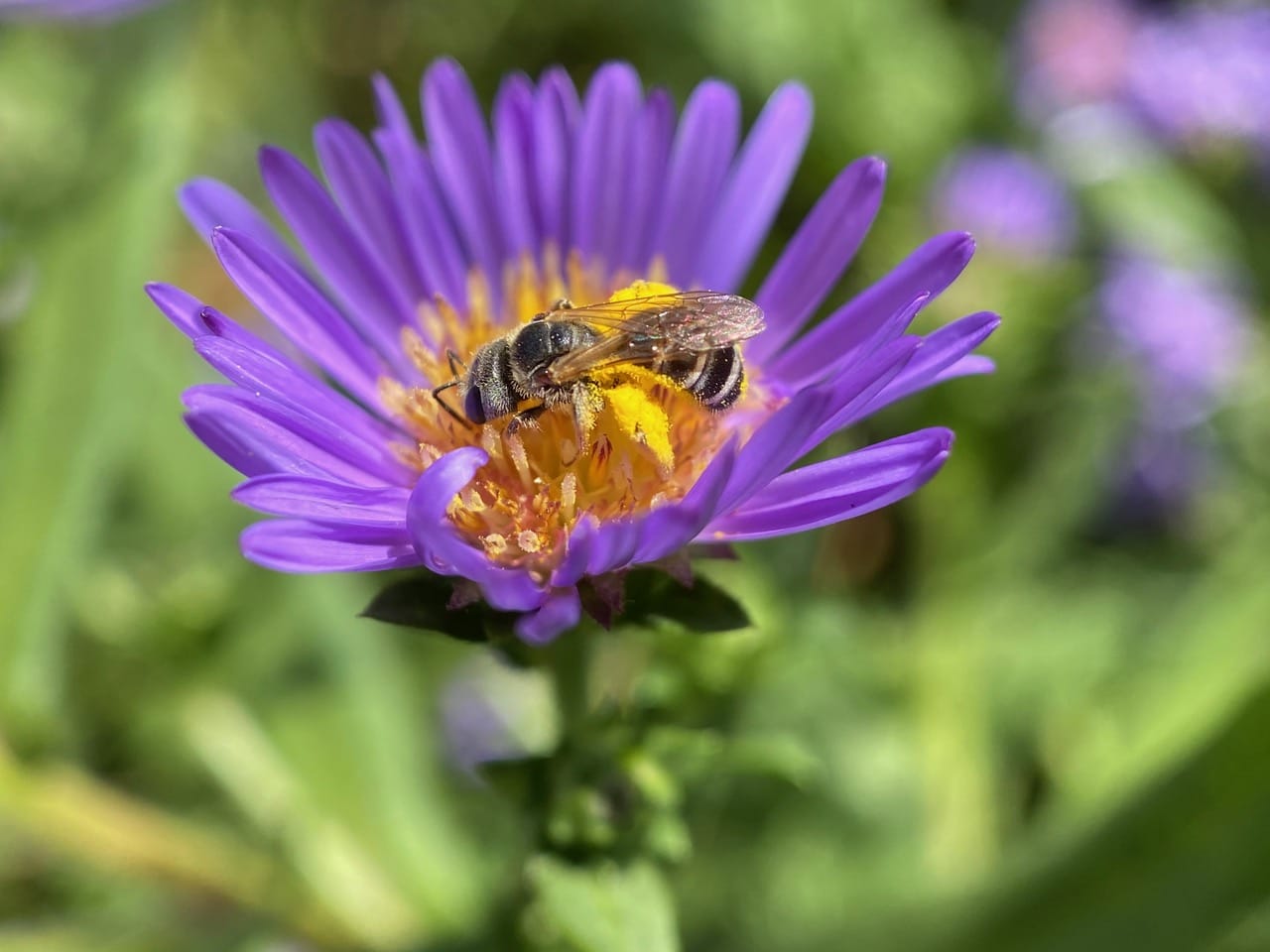
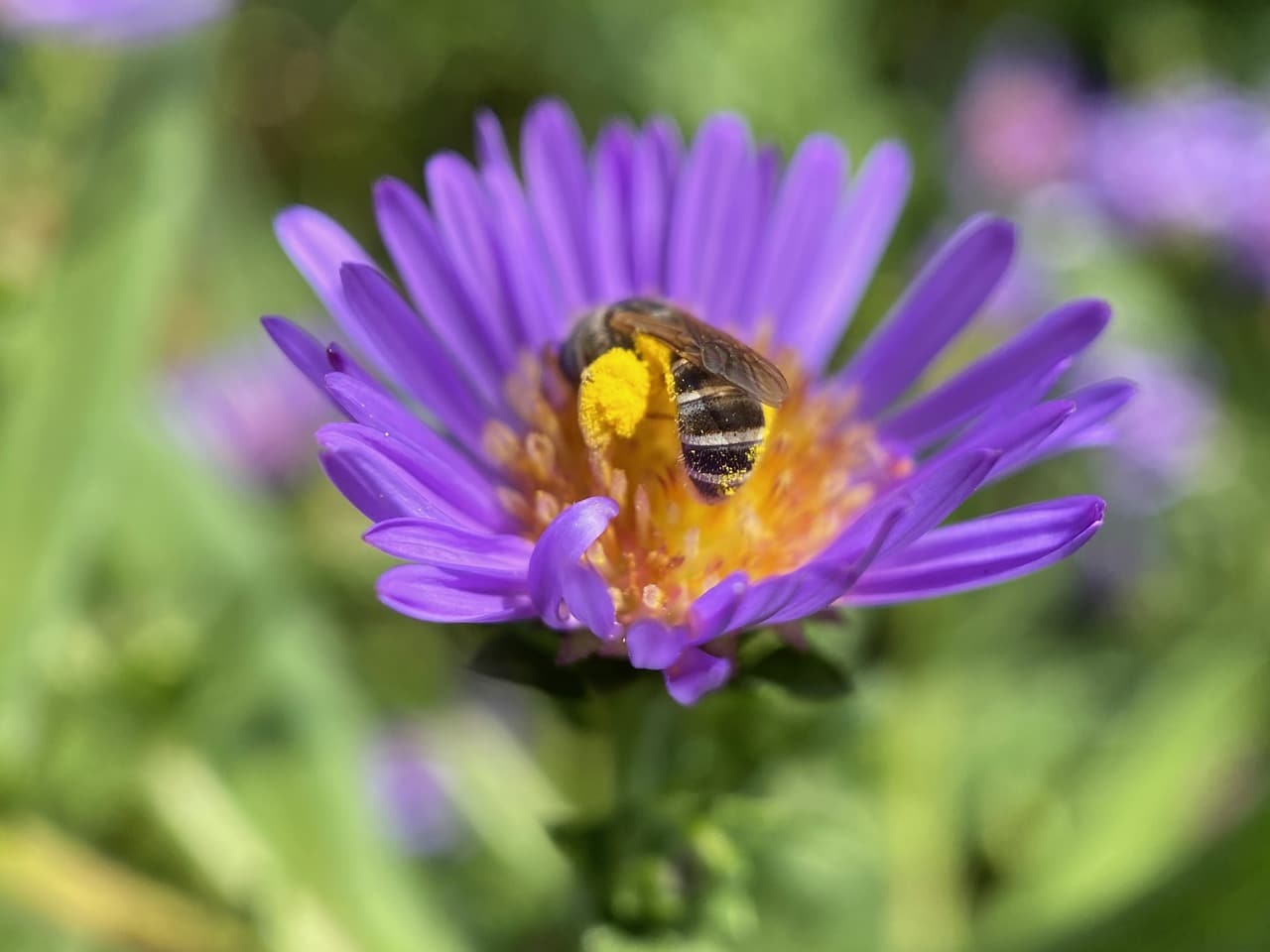
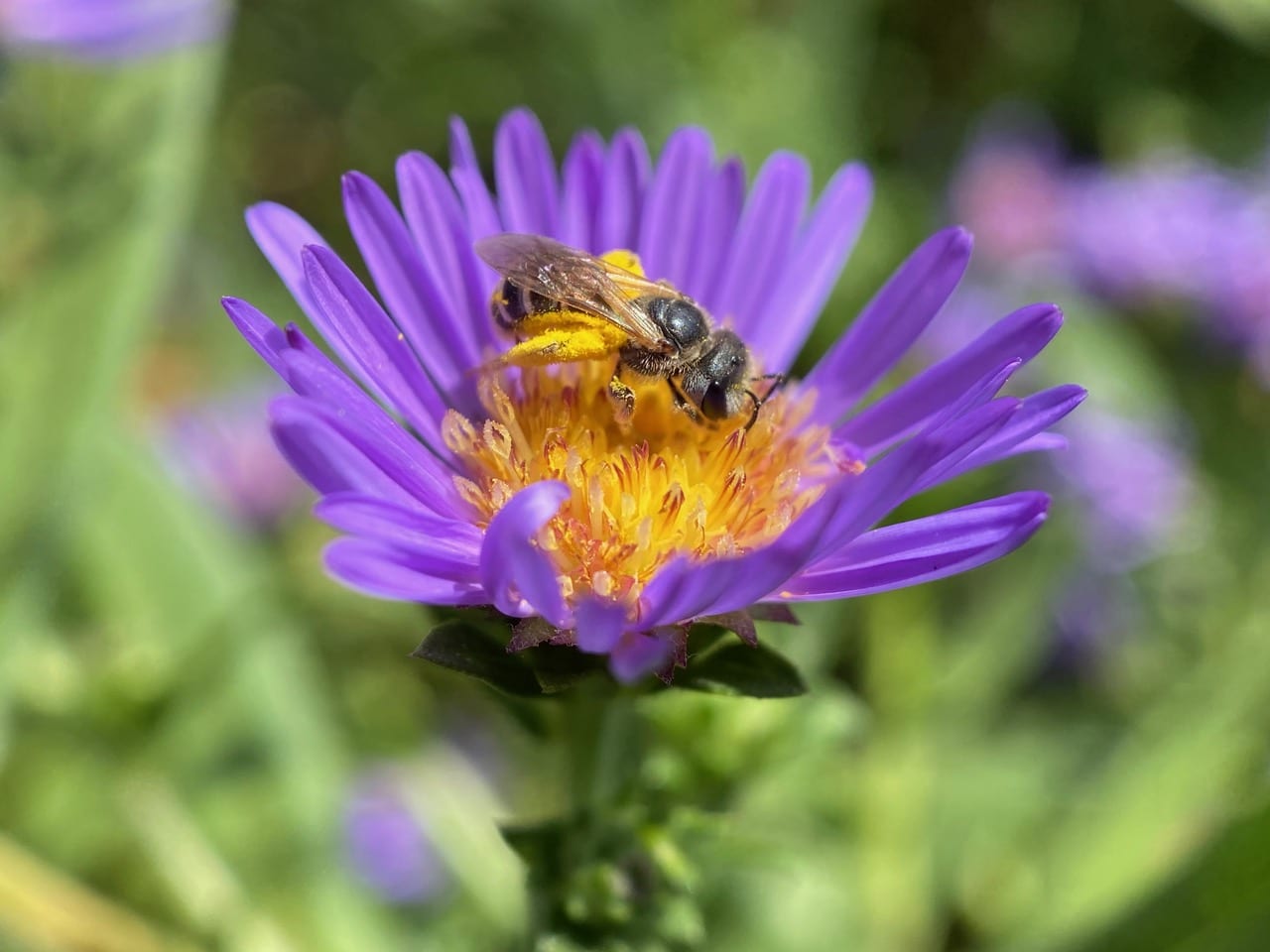
The Plumas Purple Aster, Symphyotrichum x ‘Plumas Purple’, a compact form of the Pacific Aster is still in bloom, attracting many insects.
Many members of the sunflower family Asteraceae have a special pollination mechanism. Generally, the flowerhead is composed of disk flowers in the center, surrounded by ray flowers on the rim. Like other Asteraceae, Aster flowers are protandrous, the male parts maturing before the female parts. When visited by an insect the flowers react to the insect’s touch and the stamen filaments contract over a few seconds, pulling the anther tube down and forcing the style to extrude, pushing out pollen like a piston. Once the pollen is shed, the styles grow out of the anther tube and the pair of stigmas open out and become receptive. It has been observed that electrical stimulation can induce the movement, suggesting that it is an electrochemical phenomenon. Similar movements are observed in many other Asteraceae. With or without excitability, the pollen is generally presented when the style extends from the anther tube, by growth if not by a touch-elicited movement.
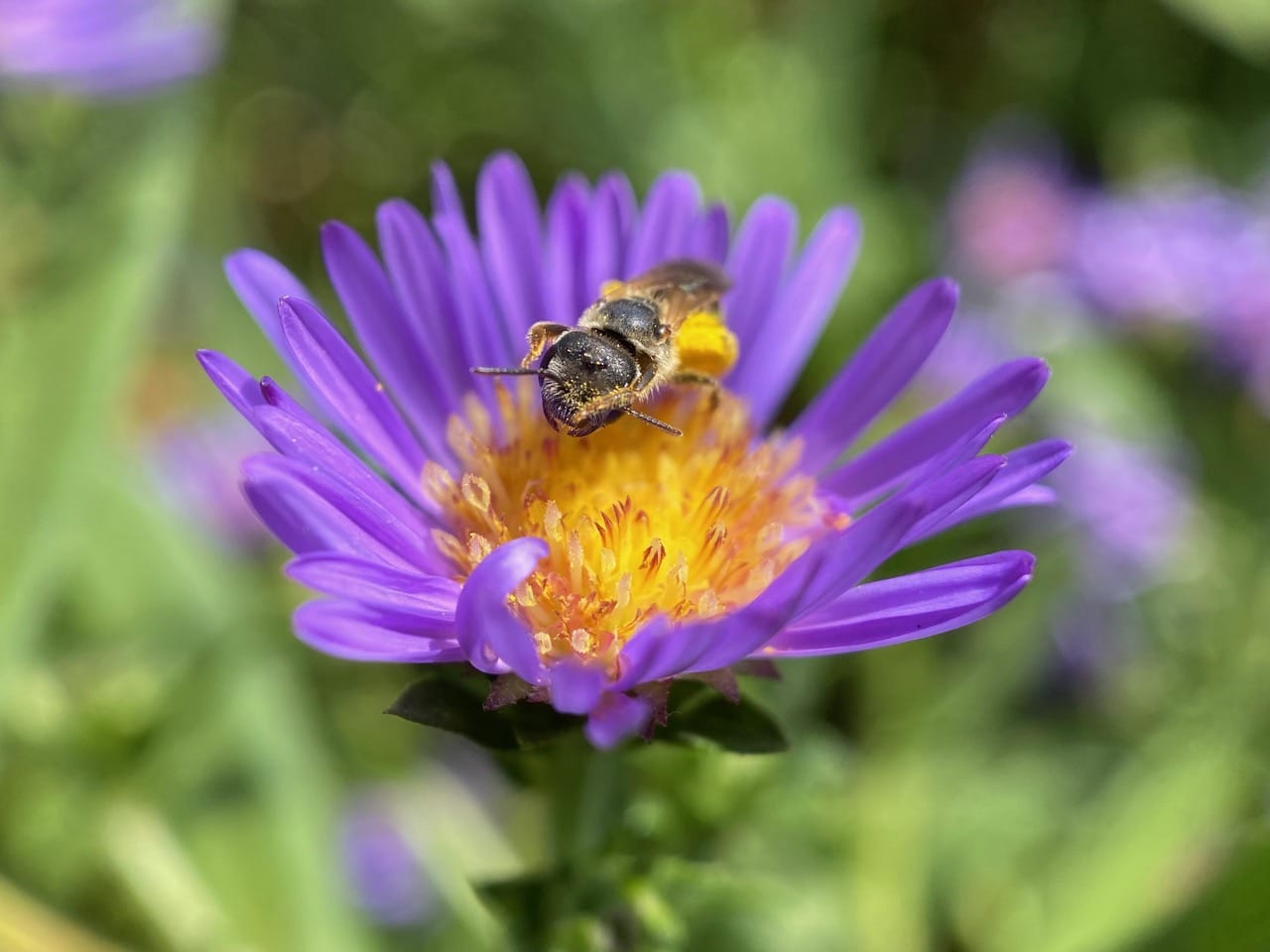
A Sweat Bee, Halictus sp. (family Halictidae) is collecting prodigious amounts of pollen into her scopae
The Sweat Bee pauses for a moment to clean her antennae before flying off.
All bees have an antenna cleaner on each of their two forelegs. The antenna cleaners consists of two parts: a notch in the basitarsus, which is fitted with stiff hairs, and a corresponding spur on the tibia. To clean its antenna, the bee raises its foreleg over its antenna and then flexes it tarsus. The action allows the spur to close the notch, forming a ring around the antenna. The bee pulls each antenna through the bristles to clean it of debris such as pollen or dust which might interfere with the many sensory organs within the antenna. A bee’s antennae serve numerous functions: smell, taste, perceive humidity and temperature, feel, monitor gravity and flight speed and even detect sound waves to help guide the bee in its daily activities.
The Lacy Phacelia, Phacelia tanacetifolia is coming to an end of its bloom, with only the fresh flowers on the tips the coiled inflorescences. A Sweat Bee, Halictus sp. (family Halictidae) is collecting pollen from one of the long, extruded stamens of a flower. For these small bees, it is slow, meticulous work, one anther at a time.
Halictus is found worldwide; they are most common in the Northern Hemisphere. All are generalists, foraging from a wide variety of flowering plants. Many species are social and produce several generations per year. This is not surprising as most blooming plants are season-specific; a bee that requires pollen and nectar across multiple seasons would not thrive as a specialist. All Halictus in North America nest in the ground, often in aggregations; and they may nest in the same area for decades.
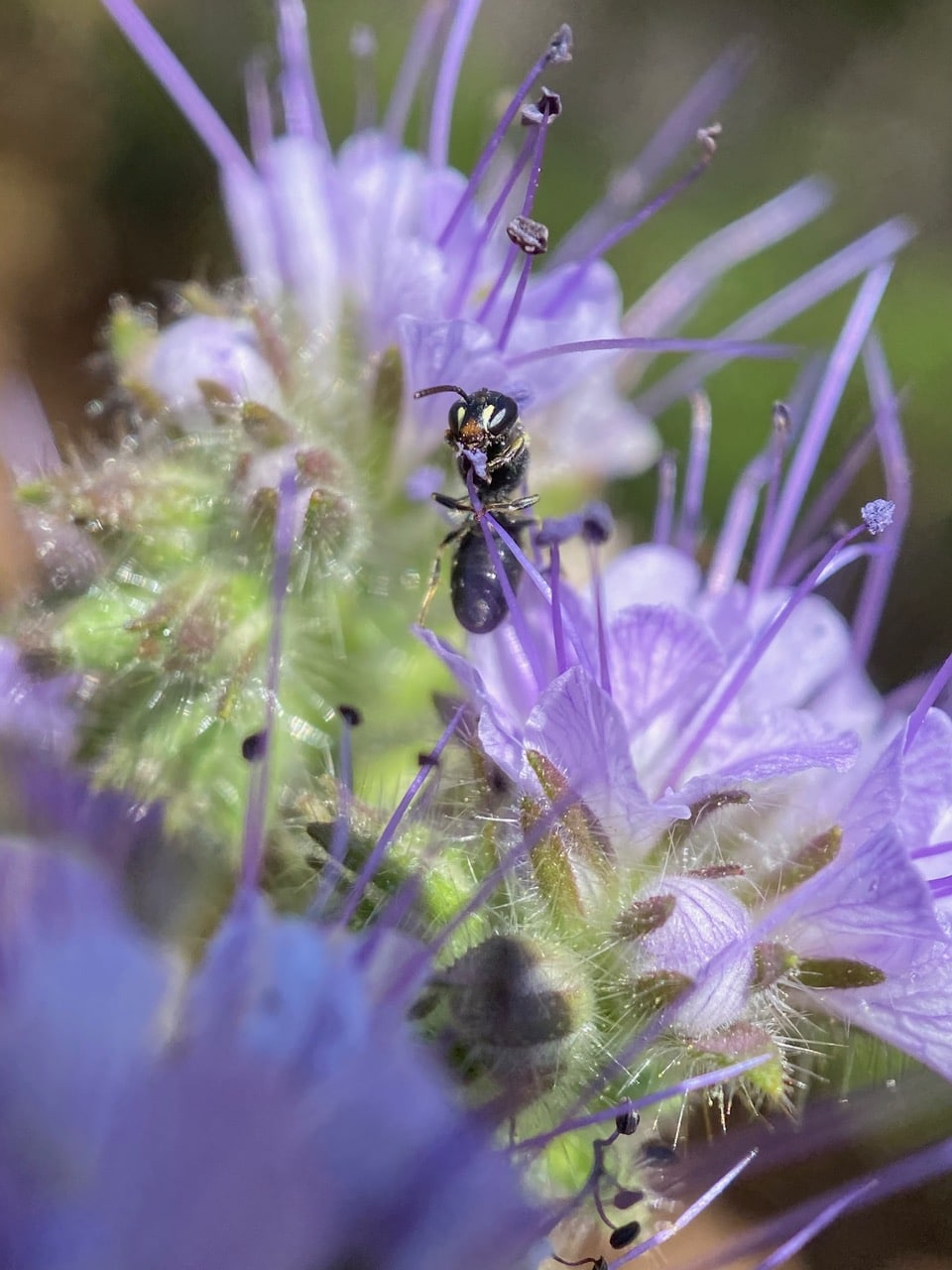
On an adjacent phacelia flower, an even smaller bee, the Masked Bee, Hylaeus sp. (family Colletidae) is doing the same thing. Holding on to the filament, she is using her mandible and front legs to extract pollen from the anther. Note that she has no scopa on her hind legs.
Front view of the female Masked Bee showing the yellow facial markings along the inner margins of her compound eyes.
Hylaeus (family Colletidae) are shiny, slender, hairless, and superficially wasp-like bees. They are small, 5 to 7 mm long, usually black with bright yellow or white markings on their face and legs. These markings are more pronounced on the males. Hylaeus do not carry pollen and nectar externally, they instead store their food in the crop and regurgitate it upon returning to their nests. They are primarily generalist foragers. Hylaeus are short-tongued, but their small body size enables them to access deep flowers. Hylaeus nest in stems and twigs, lining their brood cells with self-secreted cellophane-like material. They lack strong mandibles and other adaptations for digging, using instead pre-existing cavities made by other insects.
A little wasp is investigating a spent flower of Autumn Sage “Lemon Light”, Salvia gregii (not CA native). Is the flower still producing nectar, or is the wasp hunting for caterpillars?
The wasp appears to be a Potter Wasp, Ancistrocerus sp. (subfamily Eumeninae, family Vespidae).
Female Potter Wasps build earthenware nests attached to twigs, leaves and walls. The wasps get their common name from the brood chamber or “pot” they build. Adults visit flowers for nectar. Mature females construct earthen homes for their young and provision them with food. The female potter wasp gathers clay and soil particles in moist areas and transports them back to the construction site. Layer by layer she carefully molds the mud into a tiny hollow vessel. This requires many trips to the mud puddle. When the pot is nearly finished, she provisions the pot with enough food to support the growth and development of her young that will grow inside the pot. Most hunt for small caterpillars, other species fill their pots with beetles or spiders. Upon finding a caterpillar the potter wasp delivers a paralyzing but non-lethal sting, and then carries the victim back to be placed in the pot. When the pot is fully stocked with fresh meat, the potter lays an egg on the victims. Then she gathers more mud and seals the chamber completely. After a few days the egg hatches into a small legless larva which feeds on the caterpillars. When it is fully developed, the larva molts into a pupa, and eventually transforms into a wasp. With powerful jaws the wasp breaks open its earthen nursery, frees itself and emerges to find a mate.
The wasp is very thorough in her search, definitely not for nectar. She’s probably hunting for caterpillars to provision her earthen nest.
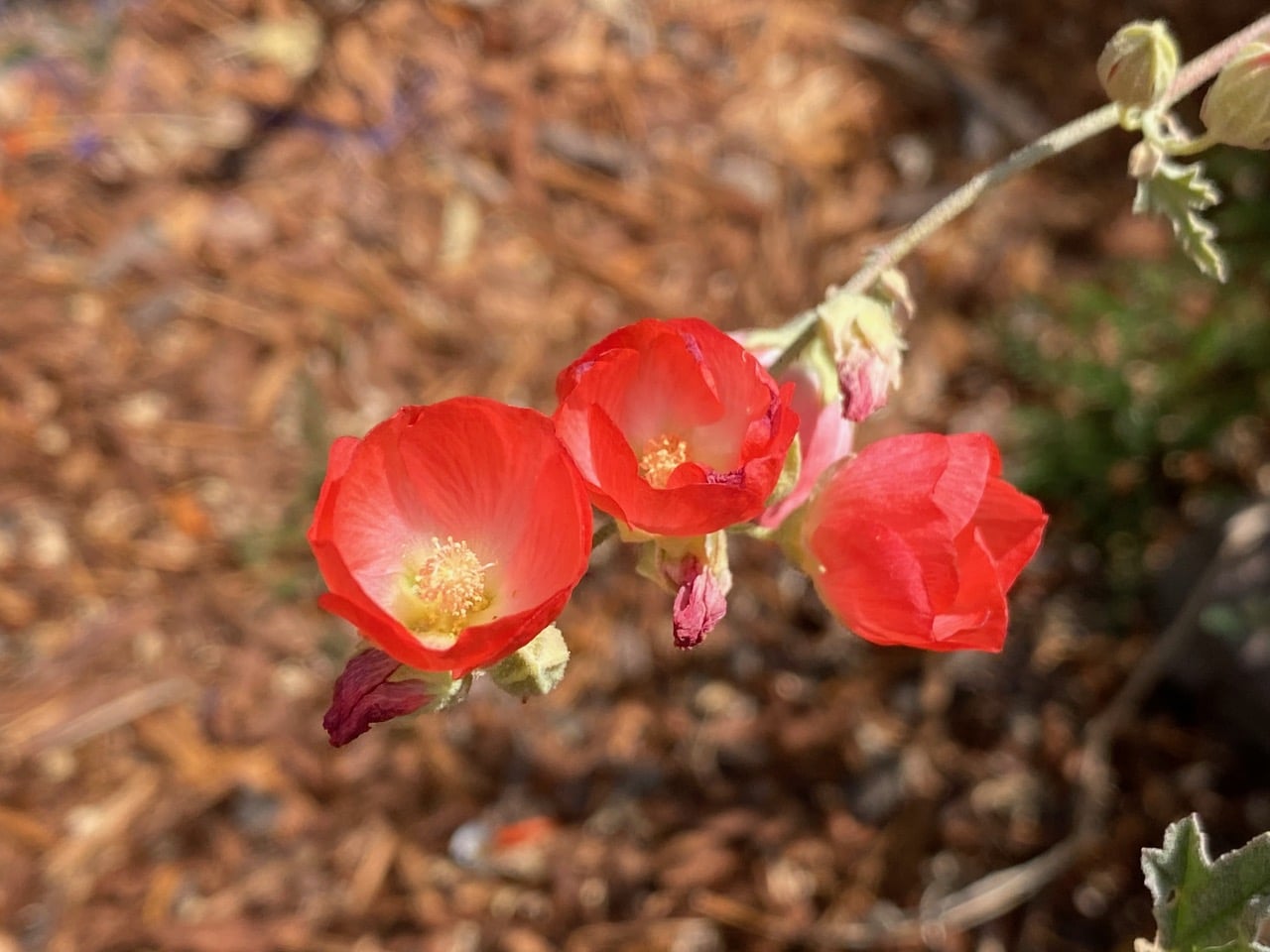
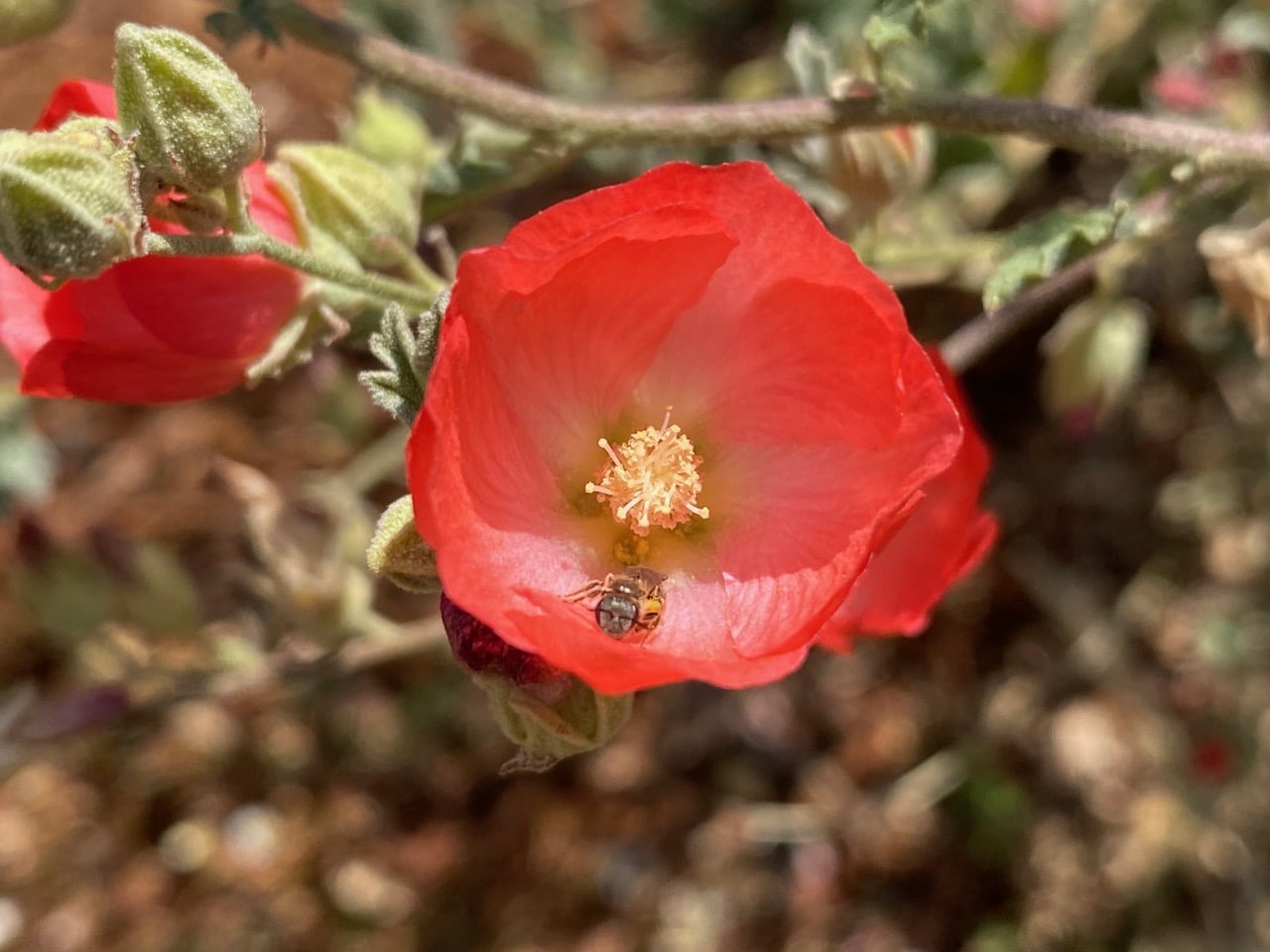
A little bee is foraging in a flower of the Desert Globemallow, Sphaeralcea “Newleaze”.
Next to the plant is another cultivar of the Desert Globemallow, Sphaeralcea “Louis Hamilton”. This plant has larger, globe-shaped flowers, with white base to the petals. Both are cultivars of the Desert Globemallow, Sphaeralcea ambigua (family Malvaceae).
A Sweat Bee (family Halictidae) is crawling out of a flower of Sphaeralcea “Louis Hamilton”. Stafanie tells us she has yet to decide which cultivar is more popular with the pollinators.