

Pollinator Post 7/8/25 (2)
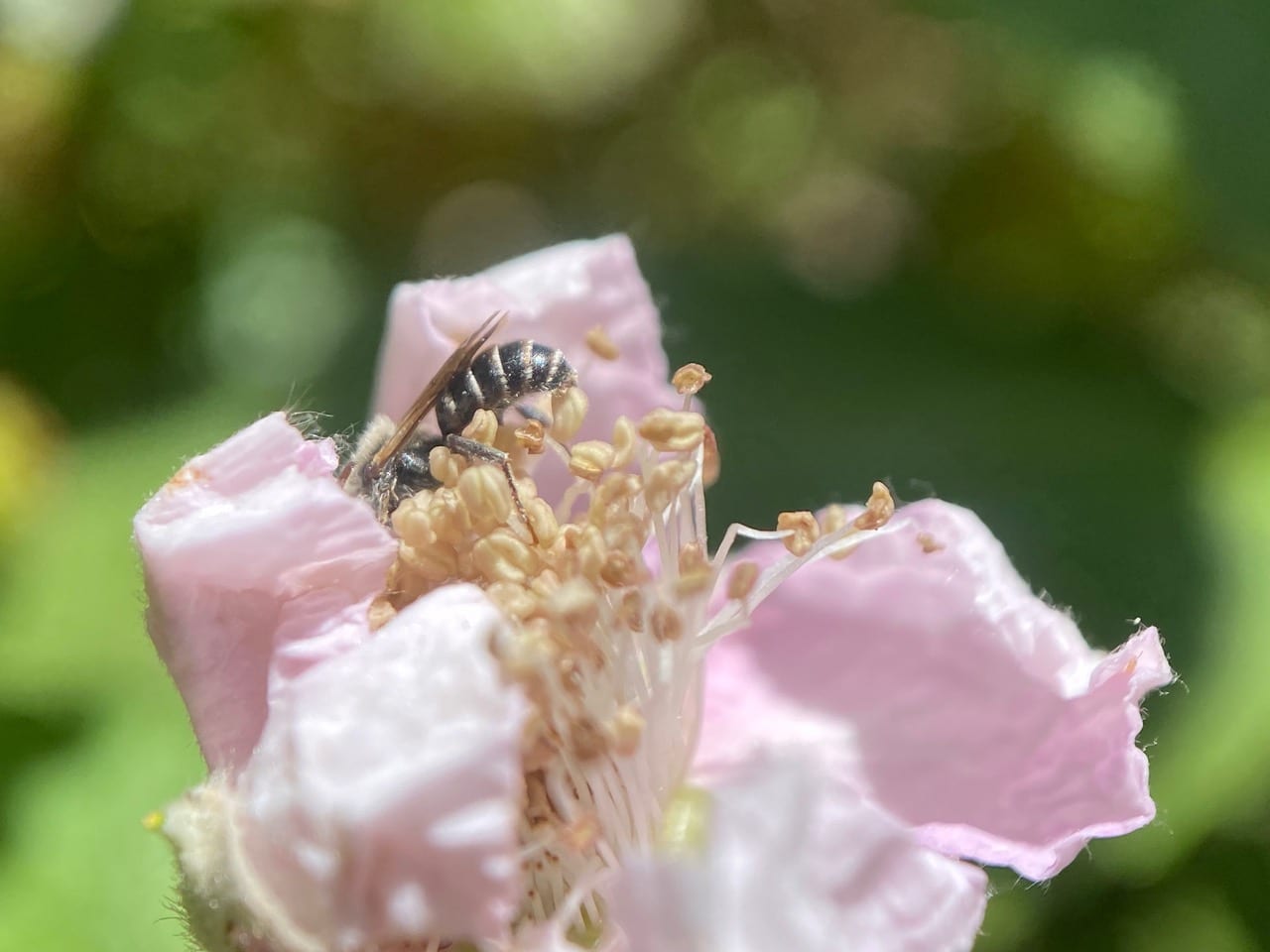
That appears to be a Tripartite Sweat Bee on the Armenian Blackberry flower, Rubus armeniacus….
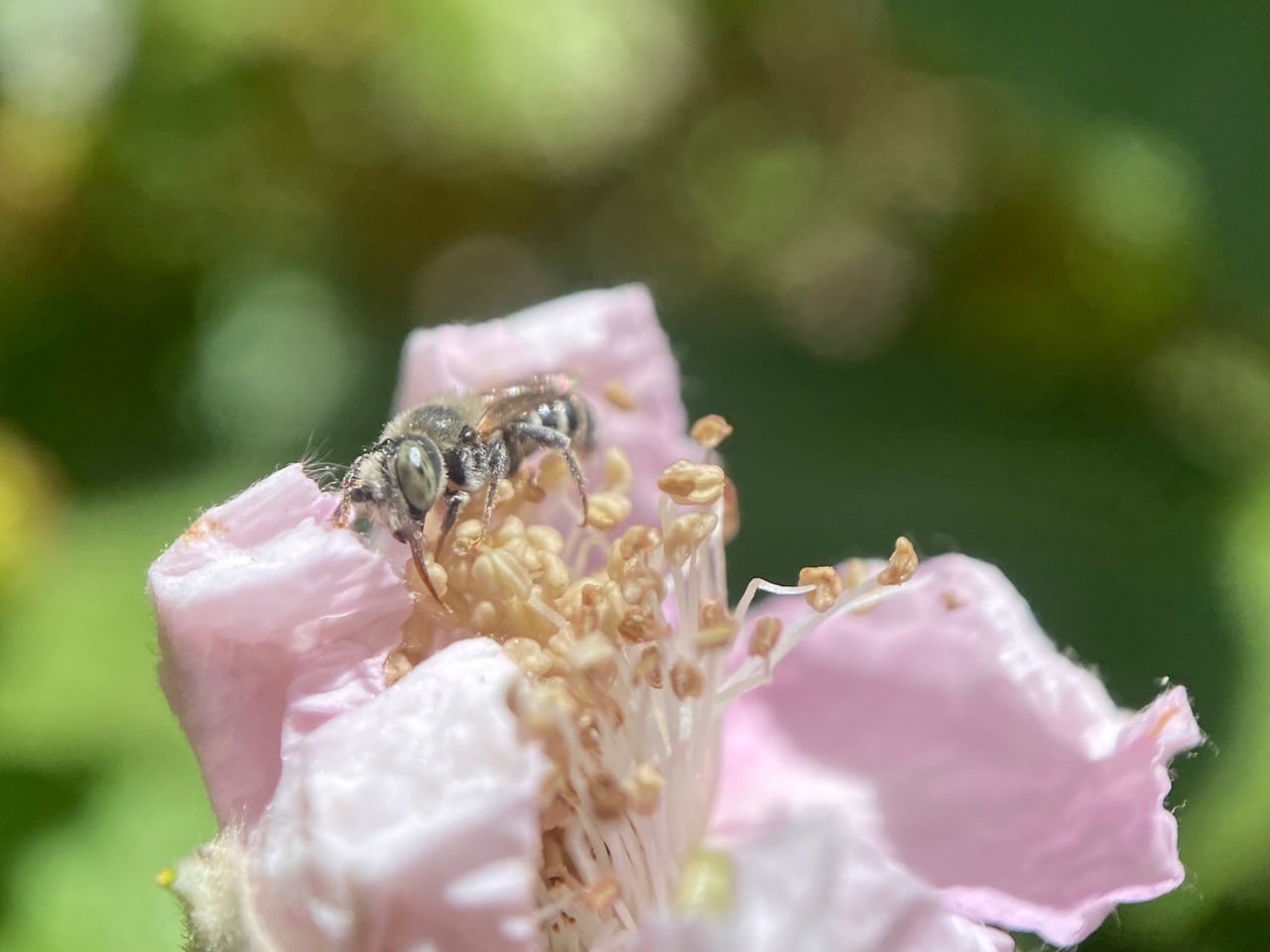
… until it turns around and I see its eyes. They are a mottled gray color!
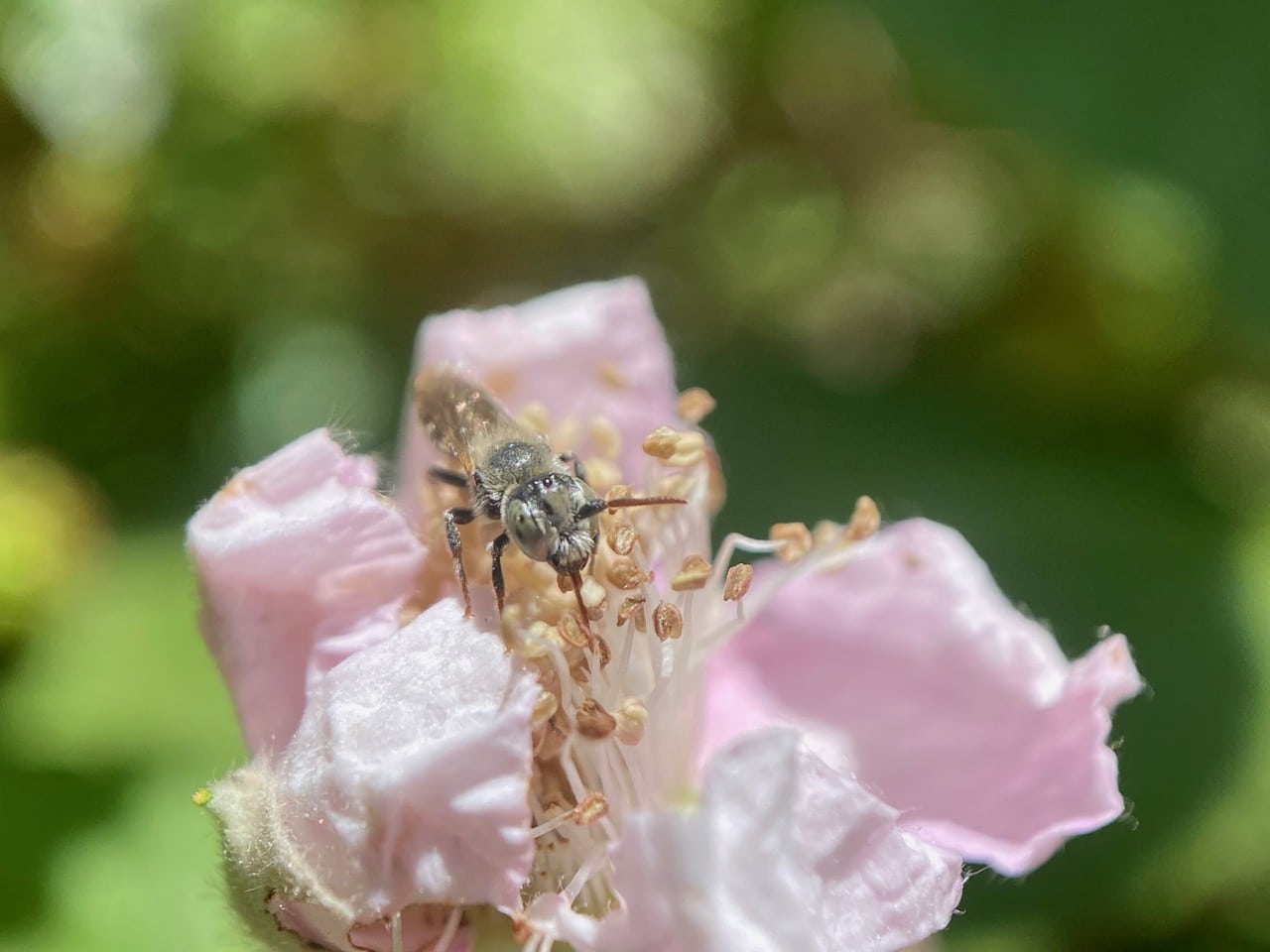
This is not the familiar face of a sweat bee.
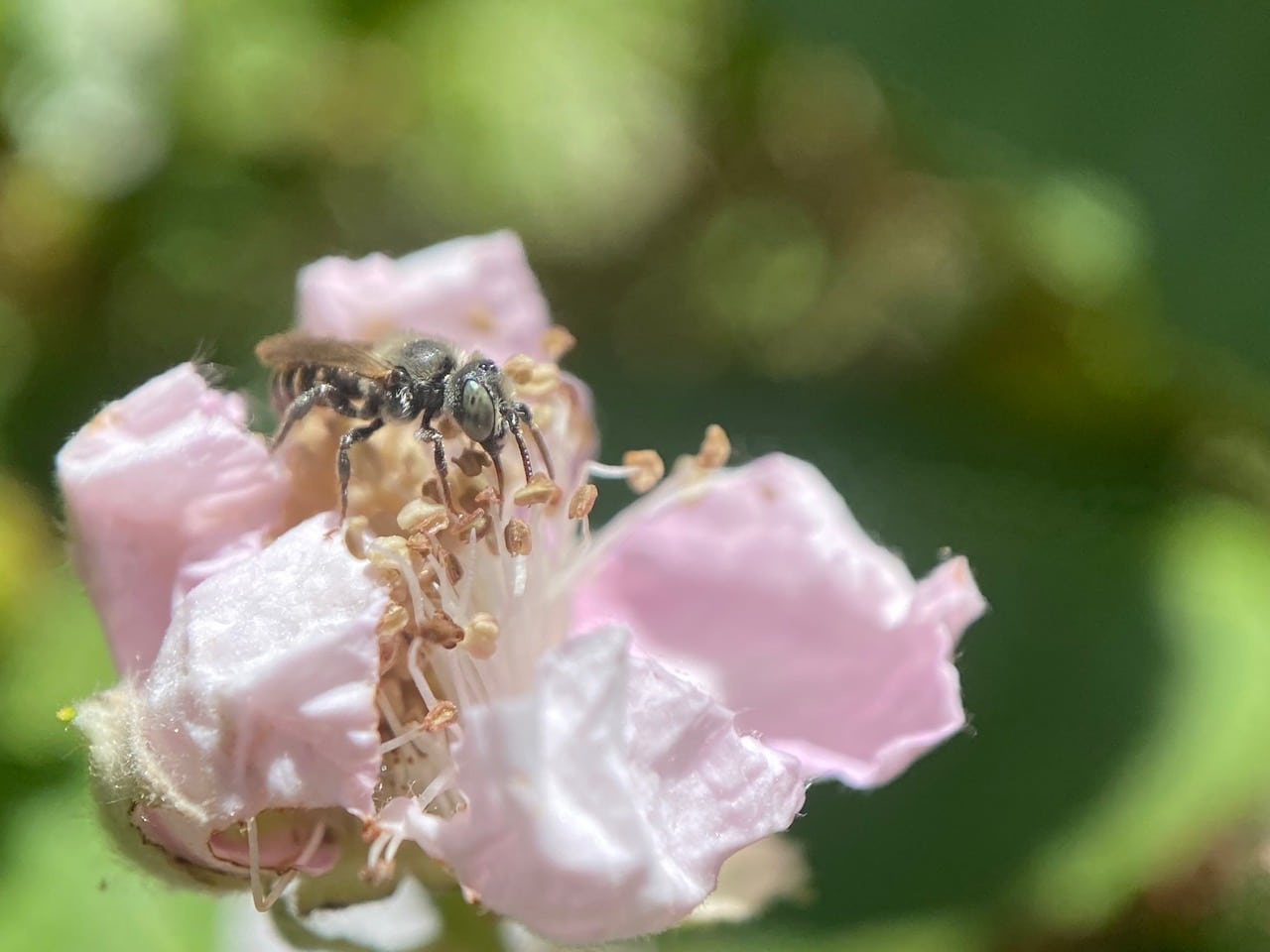
I take as many pictures of the bee before it flies away, hoping iNaturalist could help with the identification.
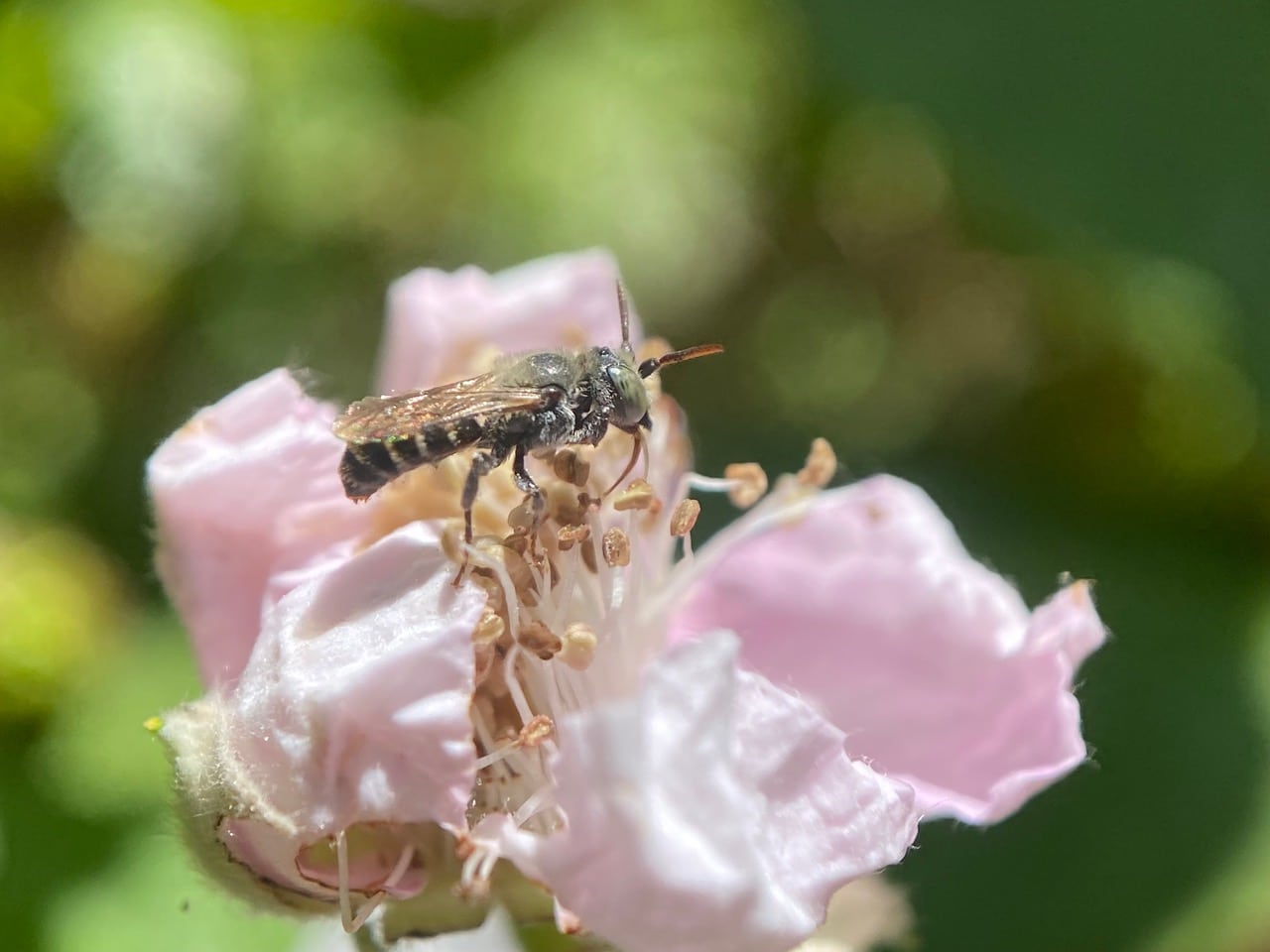
A bee expert on iNaturalist has helped identify the bee as a Small Mason Bee, subgenus Alcidamea (genus Hoplitis, family Megachilidae).
Hoplitis is wide-ranging, found on every continent except Australia, South America, and Antarctica. Within the U.S., Hoplitis are more diverse along the west coast. The bees are more diverse in boreal and cool mountain habitats. Members of the genus Hoplitis are generally nonmetallic. There is a wide range of sizes and colors. Many have pale hairs on the thorax and hair bands on the abdomen. A few species are found in urban gardens, but none are widespread or common. Flight season is from May to September, with peak season in June and July. Most are cavity nesters – excavated burrow in soil, cracks in rocks, or pithy stems to pre-existing abandoned beetle or bee burrows, empty galls, and empty snail shells. Hoplitis use specific materials such as chewed-up leaf pulp, pebbles, bits of wood, resin, clay, sand, and petals to create partitions between cells and nest plugs. Females transport pollen in the scopae on the underside of the abdomen. Most encountered species in urban gardens are generalists, visiting a wide range of flowers.
Species within the subgenus Alcidamea build nests in pithy stems, and use leaf pulp, pith particles, and/or pebbles to create the walls between cells.

A skinny, strangely shaped wasp has landed on a blackberry leaf. It is a male Carrot Wasp, Gasteruption sp. (family Gasteruptiidae).
Gasteruption are wasps in the family Gasteruptiidae, a family of parasitoid wasps with a worldwide distribution. They are small wasps, from 13-40 mm depending on the species, and much of that length owing to the long ovipositor in females of some species. The wasps are so skinny they have been called “flying needles”. The wasp has a pronounced “neck” between head and thorax. The abdomen is attached high up on the thorax, not between hind legs. Hind tibia are swollen.
Adult wasps are most often found at flowers, especially those in the carrot family, Apiaceae, hence their common name of “carrot wasps”. Flight activity peaks in late spring and/or mid-summer. Carrot Wasps are parasitoids of solitary bees and wasps that nest in twigs or borings in wood. The female searches for nests of various solitary bees or wasps, assessing each hole by feeling for vibrations from the larvae moving around inside, as the nest burrow will have been blocked up to protect the larvae. The female wasp needs her long ovipositor to reach the depths of a host’s tunnel and deposit an egg. She pushes her long ovipositor through the blocked-up entrance into the nest cell, depositing her own eggs next to the host larvae. The larva that hatches out prey upon the host eggs, larvae and provisions. Gasteruption wasps have been recorded in the nests of digger bees, plasterer bees, leaf-cutter bees, mud daubers, and pollen wasps.

A tiny iridescent insect is running around on the terminal leaves and stem of an Armenian Blackberry. It’s a Cuckoo Wasp, Omalus sp. (family Chrysididae, subfamily Chrysidinae).
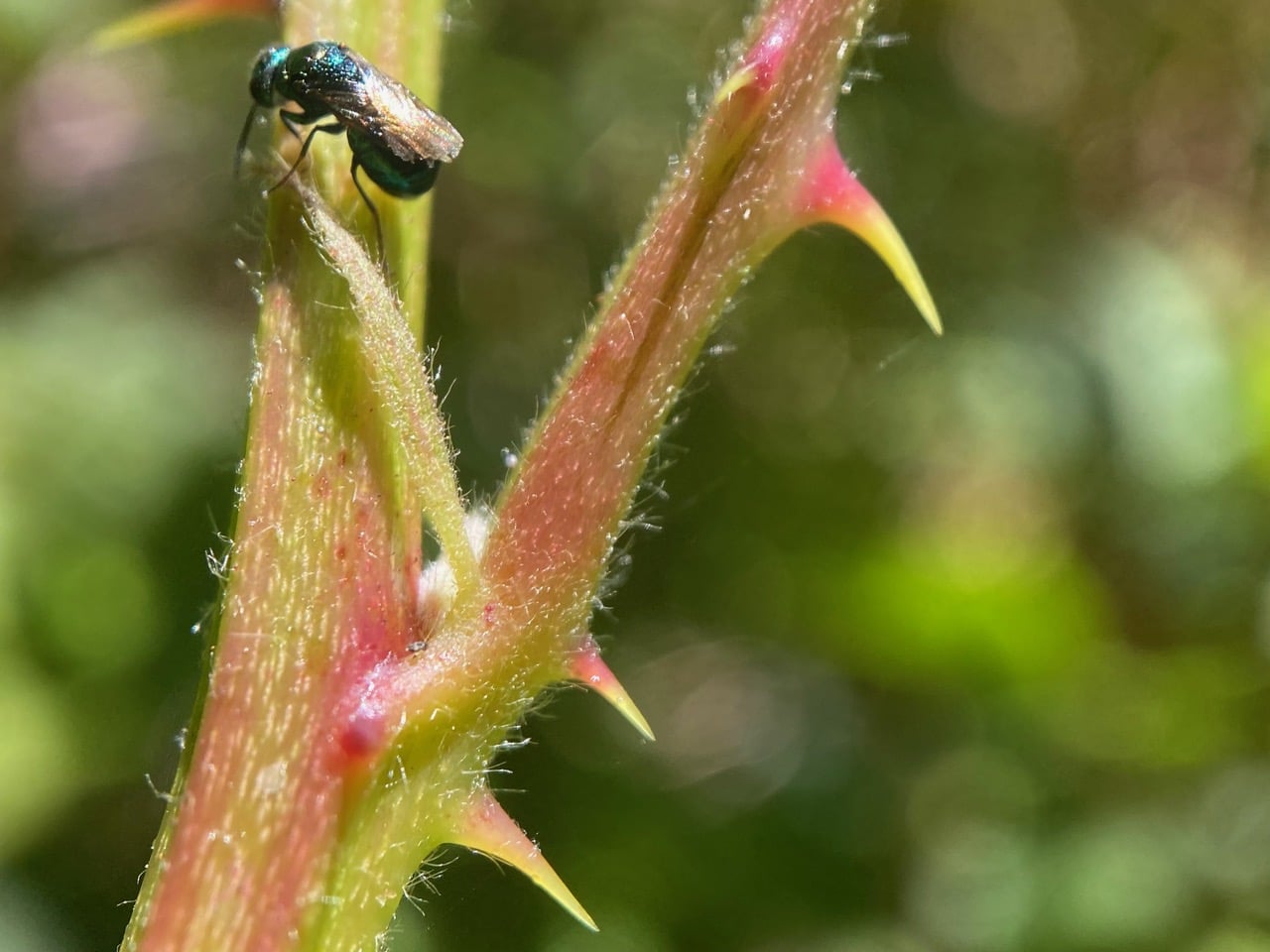
Commonly known as Cuckoo Wasps or Emerald Wasps, the wasp family Chrysididae is a very large cosmopolitan group of parasitoid or kleptoparasitic wasps. They are often highly sculptured (“pitted), with brilliant metallic colors created by structural coloration. They are most diverse in desert regions of the world, as they are typically associated with solitary bee and wasp species, which are also most diverse in such areas. The term “cuckoo wasp” refers to the cuckoo-like way in which these wasps lay eggs in the nest of unrelated host species. Chrysidids are always solitary, and are active mainly in the hottest and driest months of summer in Mediterranean climates. They are found in habitats where the adults can find hosts to parasitize. Some species visit flowers such as the Apiaceae, Asteraceae and Euphorbiaceae.
Members of the largest subfamily, Chrysidinae, are generally kleptoparasites, laying their eggs in host nests, where their larvae consume the host egg or larva, then the food provided by the host for its own young.

Like most Cuckoo Wasps in the subfamily Chrysidinae, Omalus has flattened or concave lower abdomens and can curl into a defensive ball (“volvation”) when attacked by a potential host, in the manner of a pill bug. The hosts for Omalus are Aphid Wasps (family Crabronidae, subfamily Pemphredoninae) which hunt for aphids to provision for their young. Omalus lays eggs on aphids so they get carried to the nest by the wasp’s host. This “Trojan Horse” strategy is a remarkable adaptation that allows Omalus wasps to successfully parasitize their hosts while minimizing the risks of being attacked or injured by the host wasp.
Aphid Wasps (Subfamily Pemphredoninae) · iNaturalist

Under high magnification of my macro lens, this tiny creature reveals itself to be a nymph of a Typical Leafhopper (family Cicadellidae). It has a row of comb-like spines along the hind legs, just like the adult leafhoppers.
Leafhopper is the common name given to true bugs in the family Cicadellidae. The bugs are plant feeders that suck plant sap from grass, shrubs, or trees. Their hind legs are modified for jumping, and are covered with hairs that facilitate the spreading of a secretion over their bodies that act as a water repellent and carrier of pheromones. They undergo partial metamorphosis, and have various host associations, varying from very generalized to very specific.
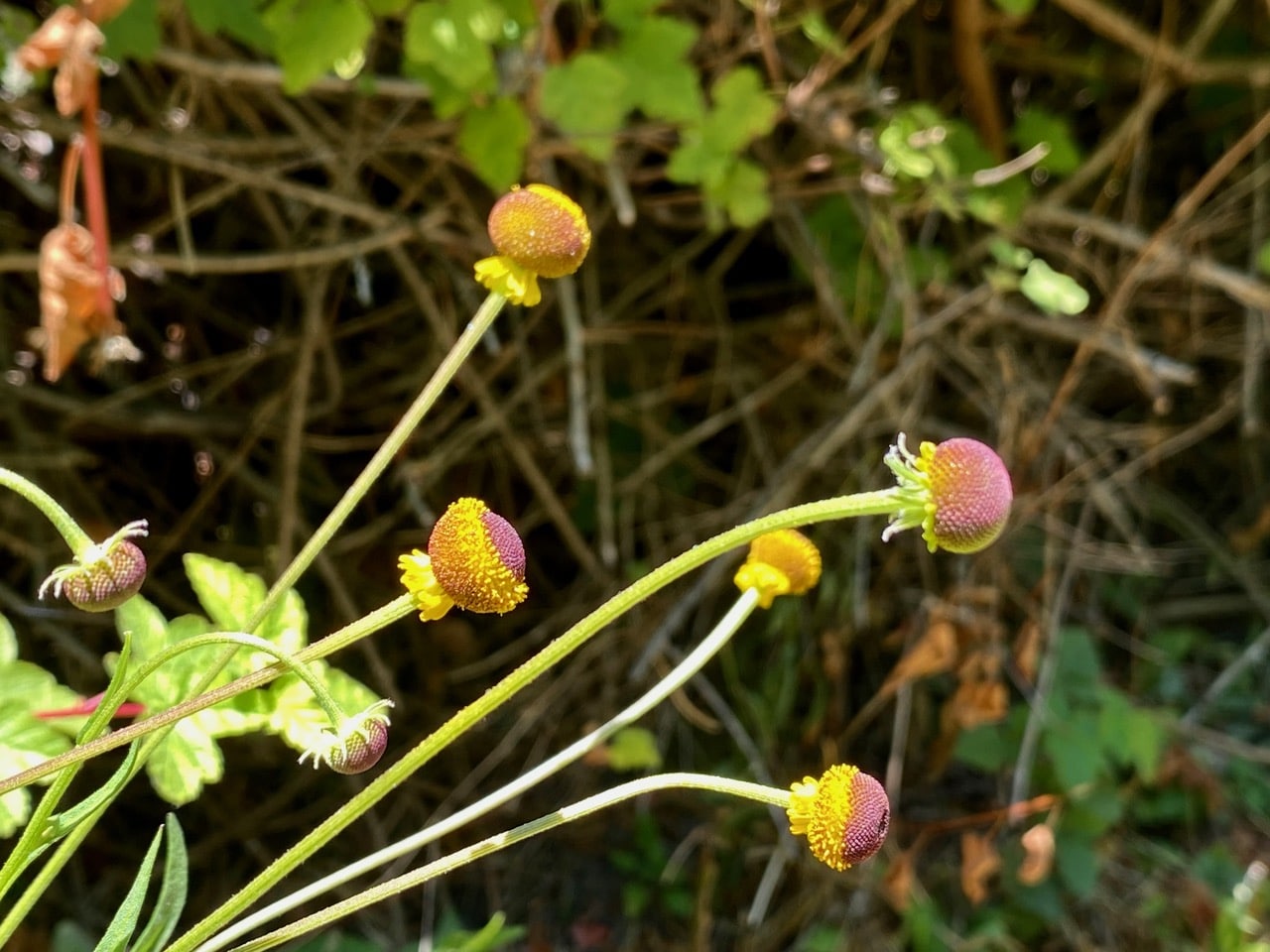
Along the sunny section of the trail, a few robust Sneezeweed, Helenium puberulum are blooming nicely. Andy and I are particularly fond of this humble plant; we recall how the male Longhorn Bees, Melissodes used to sleep in aggregations on their globular seedbeds at the BridgeView Pollinator Garden where we volunteered.
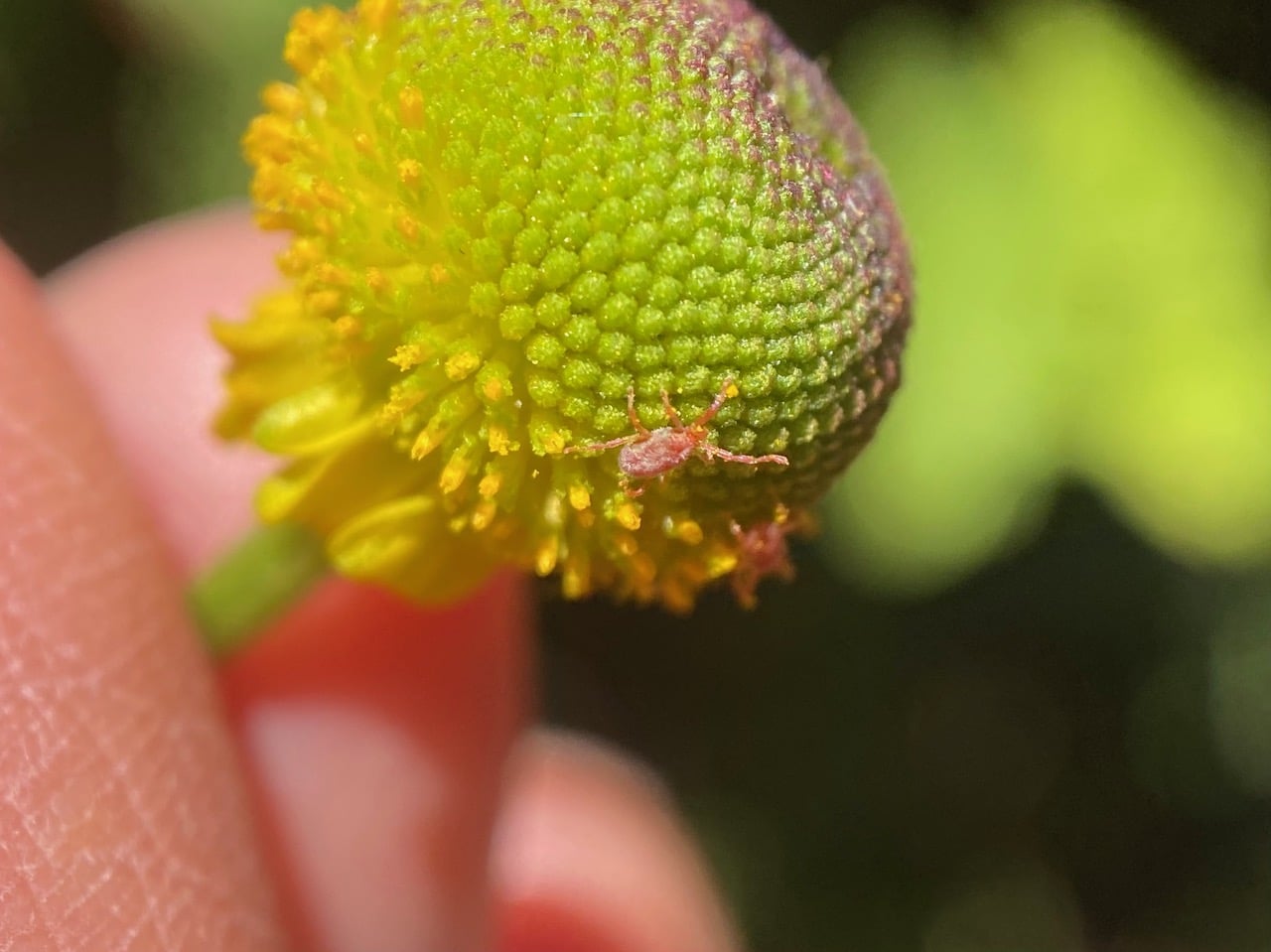
Covered with pollen, a couple of red mites are racing around on the globular flower head of Sneezeweed. The tiny florets have started to bloom from the bottom up. I wonder what these mites are doing here. Are they flower mites? Flower mites are tiny arachnids that can be found on various plants, including flowers, where they feed on pollen, nectar, or plant tissue.
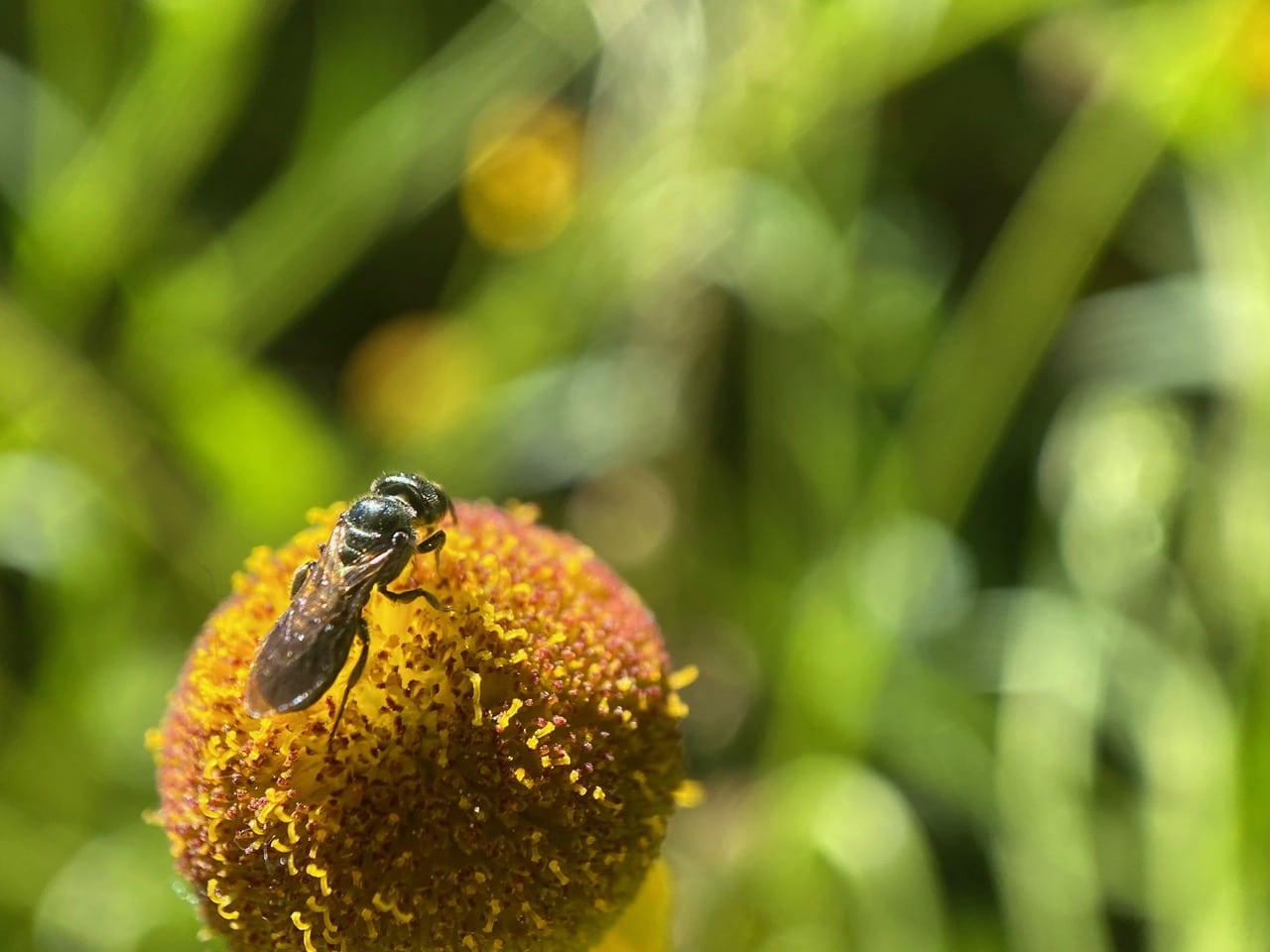
A Small Carpenter Bee, Ceratina sp. (family Apidae) is foraging on a flowerhead of Sneezeweed.
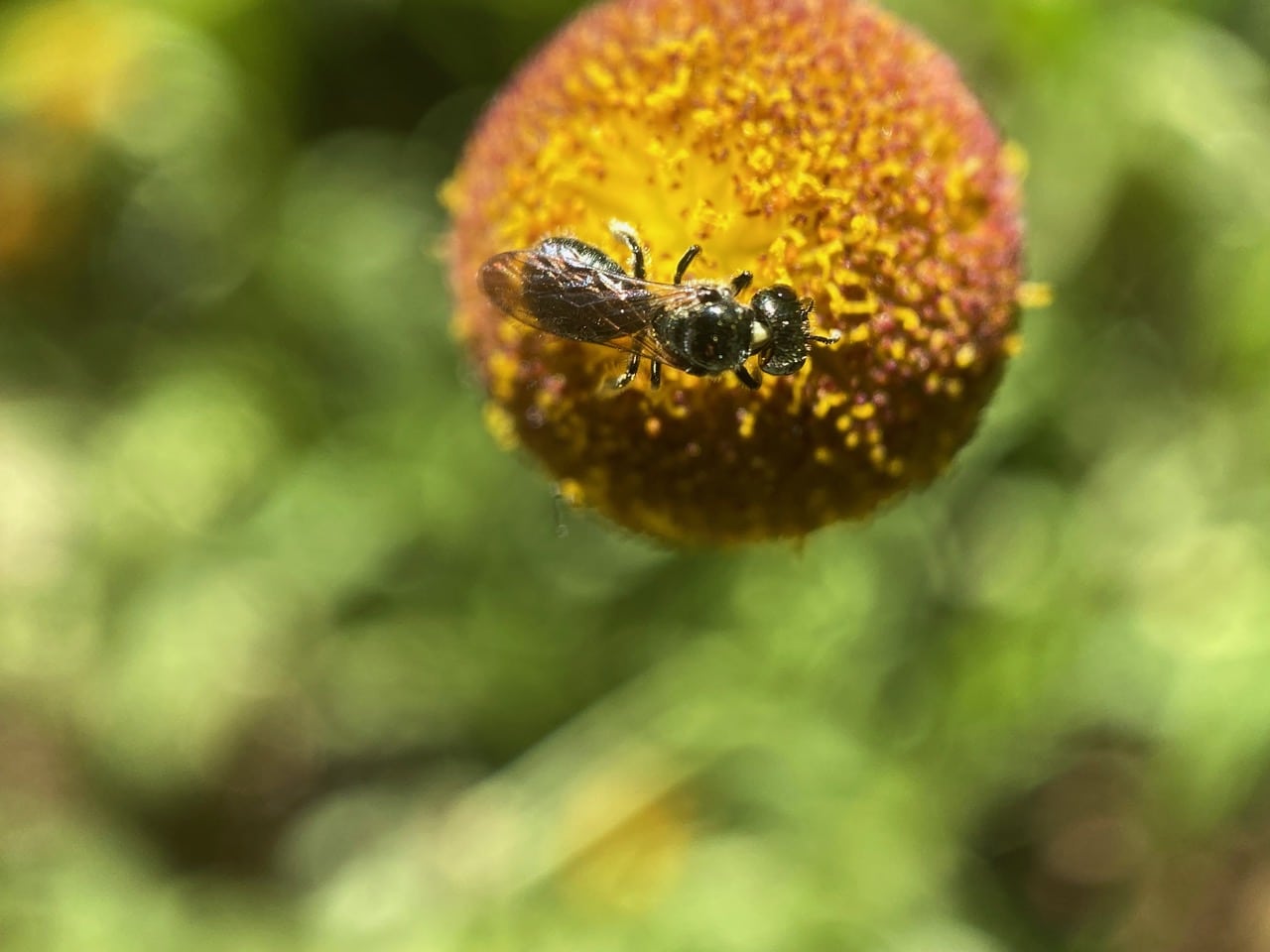
The Small Carpenter Bee genus Ceratina is closely related to the more familiar, and much larger Carpenter Bees (genus Xylocopa). Ceratina are typically dark, shiny, even metallic bees, with fairly sparse body hairs and a weak scopa on the hind leg. The shield-shaped abdomen comes to a point at the tip. Some species have yellow markings, often on the face.
Females excavate nests with their mandibles in the pith of broken or burned plant twigs and stems. While many species are solitary, a number are subsocial. Both male and female carpenter bees overwinter as adults within their old nest tunnels, emerging in the spring to mate. In the spring, this resting place (hibernaculum) is modified into a brood nest by further excavation. The female collects pollen and nectar, places this mixture (called bee bread) inside the cavity, lays an egg on the provision, and then caps off the cell with chewed plant material. Several cells are constructed end to end in each plant stem.


Here’s another Small Carpenter Bee, Ceratina sp. (family Apidae) foraging on a Sneezeweed flowerhead. Note that she already has some pollen in the modest scopa of her hind leg.
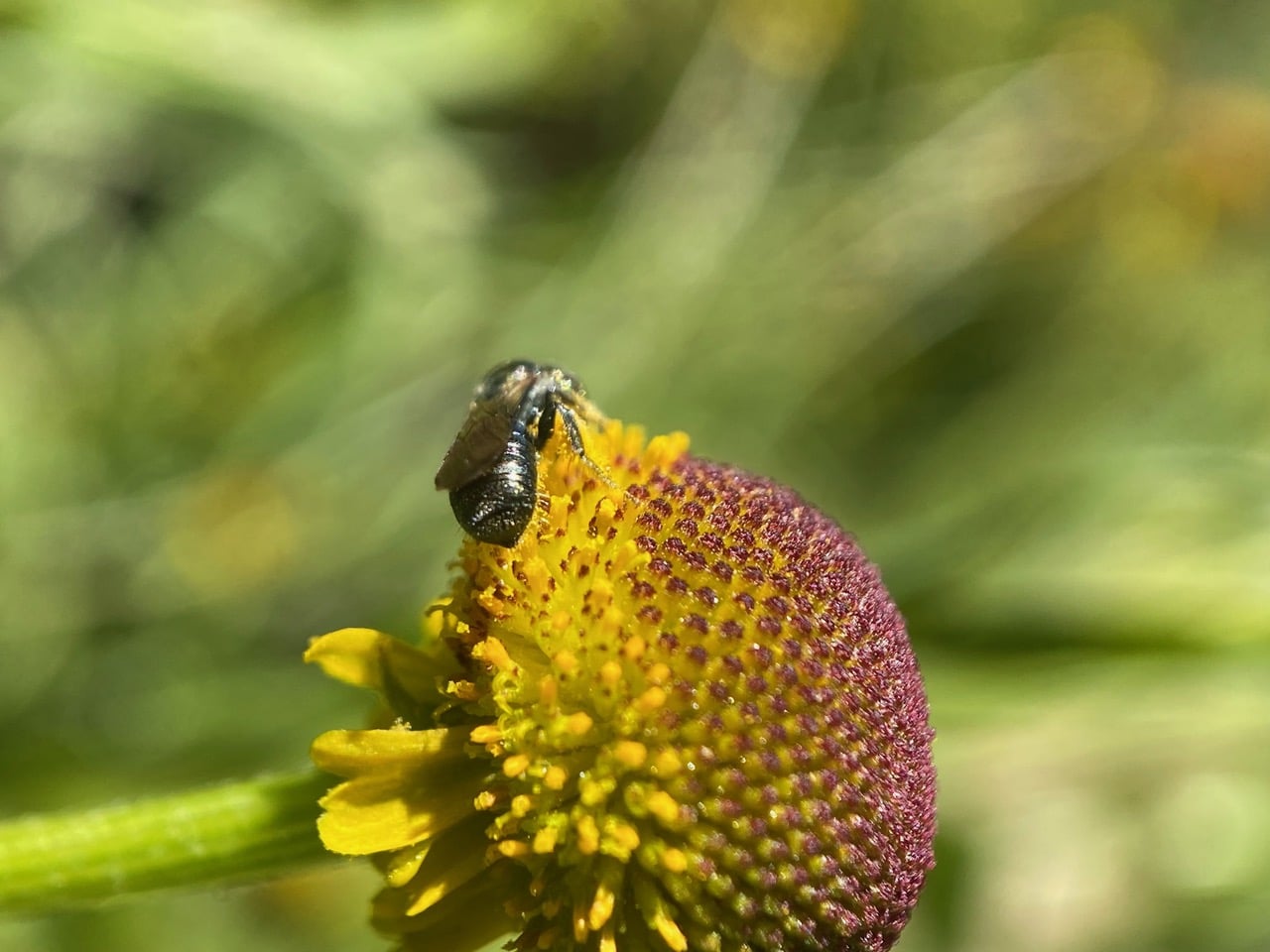
Note that the tip of Ceratina’s abdomen comes to a point.
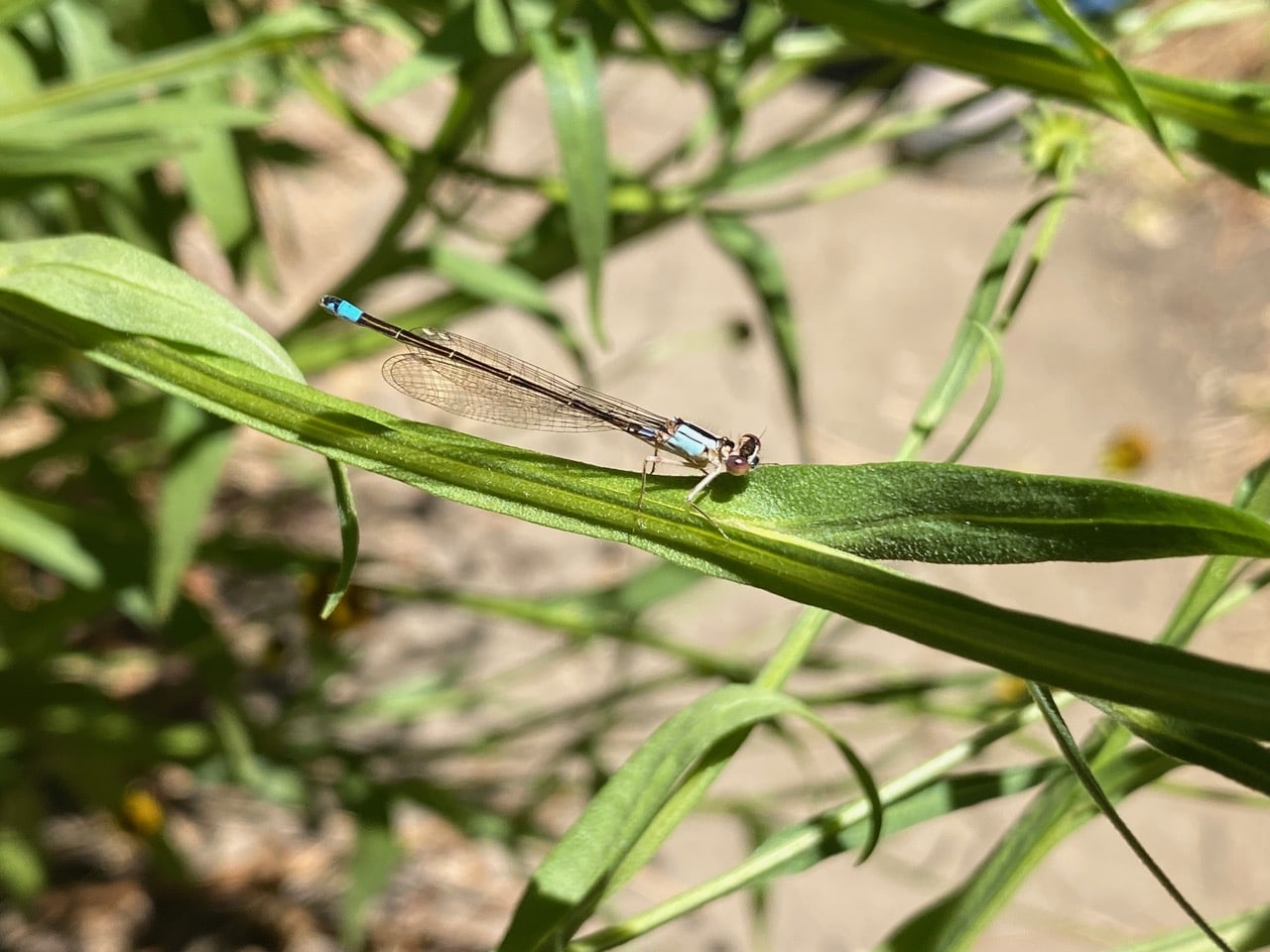
A Pacific Forktail, Ischnura cervula (family Coenagrionidae) settles on a Sneezeweed leaf.
Damselflies are flying insects of the suborder Zygoptera in the order Odonata. They are similar to dragonflies but are usually smaller and have slimmer bodies. Most species fold the wings along the body when at rest, unlike dragonflies which hold the wings flat and away from the body. All damselflies are predatory; both nymphs and adults actively hunt and eat other insects. Adults catch and eat flies, mosquitoes, and other small insects. Often they hover among grasses and low vegetation, picking prey off stems and leaves with their spiny legs. The nymphs are aquatic, living in a variety of freshwater habitats, such as ponds, lakes and streams. They mostly feed on crustaceans such as water fleas. The nymphs molt repeatedly, at the last molt climbing out of the water to undergo metamorphosis. The skin splits down the back, they emerge and inflate their wings and abdomen to gain their adult form. Most damselflies live out their lives within a short distance of where they were hatched.
Some species of damselflies have elaborate courtship behaviors. Many species are sexually dimorphic, the males often being more brightly colored than the females. They reproduce using indirect insemination and delayed fertilization. A mating pair form a configuration known as a “heart” or “wheel”, the male clasping the female at the back of the head, the female curling her abdomen down to pick up sperm from secondary genitalia at the base of the male’s abdomen. The pair often remains together with the male still clasping the female while she lays eggs within the tissue of plants in or near water. The presence of damselflies and dragonflies indicates an ecosystem of good quality. The most species-rich environments have a range of suitable microhabitats, providing suitable water bodies for breeding.
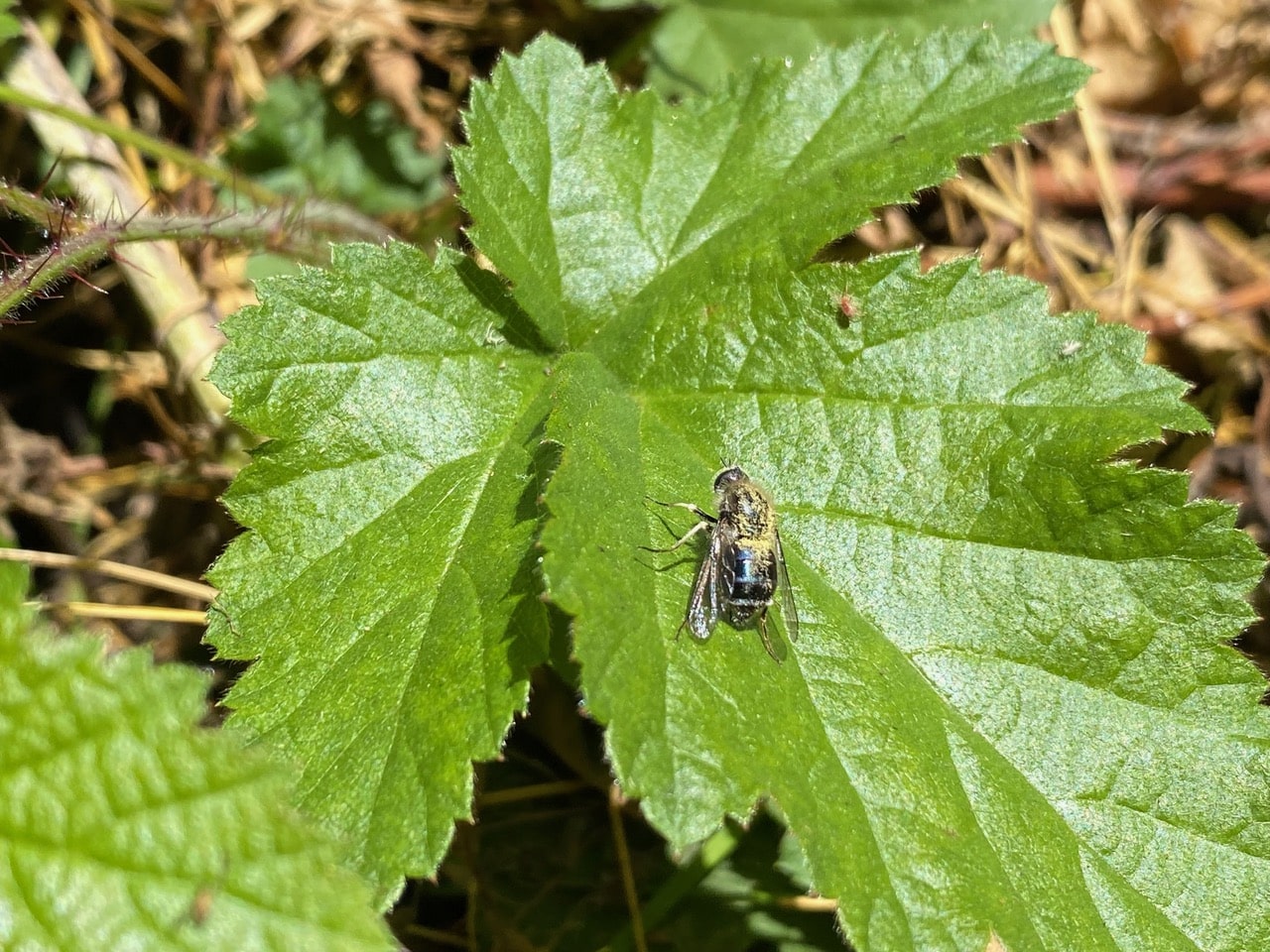
A large fly is resting on a leaf of California Blackberry. It’s not so much the insect itself that is so familiar, but the dense dusting of yellow pollen on its back! I recognize it instantly as the Small-headed Fly, or North American Jeweled Spider Fly, Eulonchus sp. (family Acroceridae). Both common names are appropriate, as the fly indeed has an undersized head, and its abdomen is a gleaming blue iridescence in the sun. I’m willing to bet that the pollen came from a Sticky Monkeyflower.
My acquaintance with this fly goes back a few years when I was a volunteer at the Bridgeview Pollinator Garden in Oakland. Each year I would watch the flies appear on the Sticky Monkeyflower, Diplacus aurantiacus just as the plant begins to bloom in May. In the early morning, the flies would be safely tucked within the floral tubes, with only their shiny butts visible. As the sun begins to warm up the air, the flies would wake up, move outside the flowers to bask and groom themselves. Often their backs are covered with pollen if the stamens on the roof of their chosen overnight shelter were dispensing a golden shower while they snoozed.
From my own observations over the years, this Eulonchus species has a close relationship with the Sticky Monkeyflower. The fly’s whole life revolves around the flowers. They sleep, feed, court and mate around the plant and its flowers. And since they are often covered with pollen, it’s hard not to believe that they are significant pollinators for Diplacus aurantiacus.
As far as is known, all Acroceridae are parasitoids of spiders. Not just any spiders, but the Mygalomorphs of a more ancient lineage. This Acrocerid species, most likely Eulonchus tristis is known to parasitize the California Turret Spiders. Females lay large numbers of eggs near their host nests. After hatching the young larvae, called planidia seek out the spiders. The planidia can move in a looping movement like an inchworm and can leap several millimeters into the air. When a spider contacts an Acrocerid planidium, the planidium grabs hold, crawls up the spider’s legs to its body, and forces its way through the body wall. Often, it lodges near the spider’s book lung, where it may remain for years before completing its development. Mature larvae pupate outside the host. The Acrocerid adults are nectar feeders with exceptionally long probosces which are folded on the underside of the body when not in use. Acrocerids are rare but can be locally abundant. They are believed to be efficient pollinators for some native plants, including the Sticky Monkeyflowers.
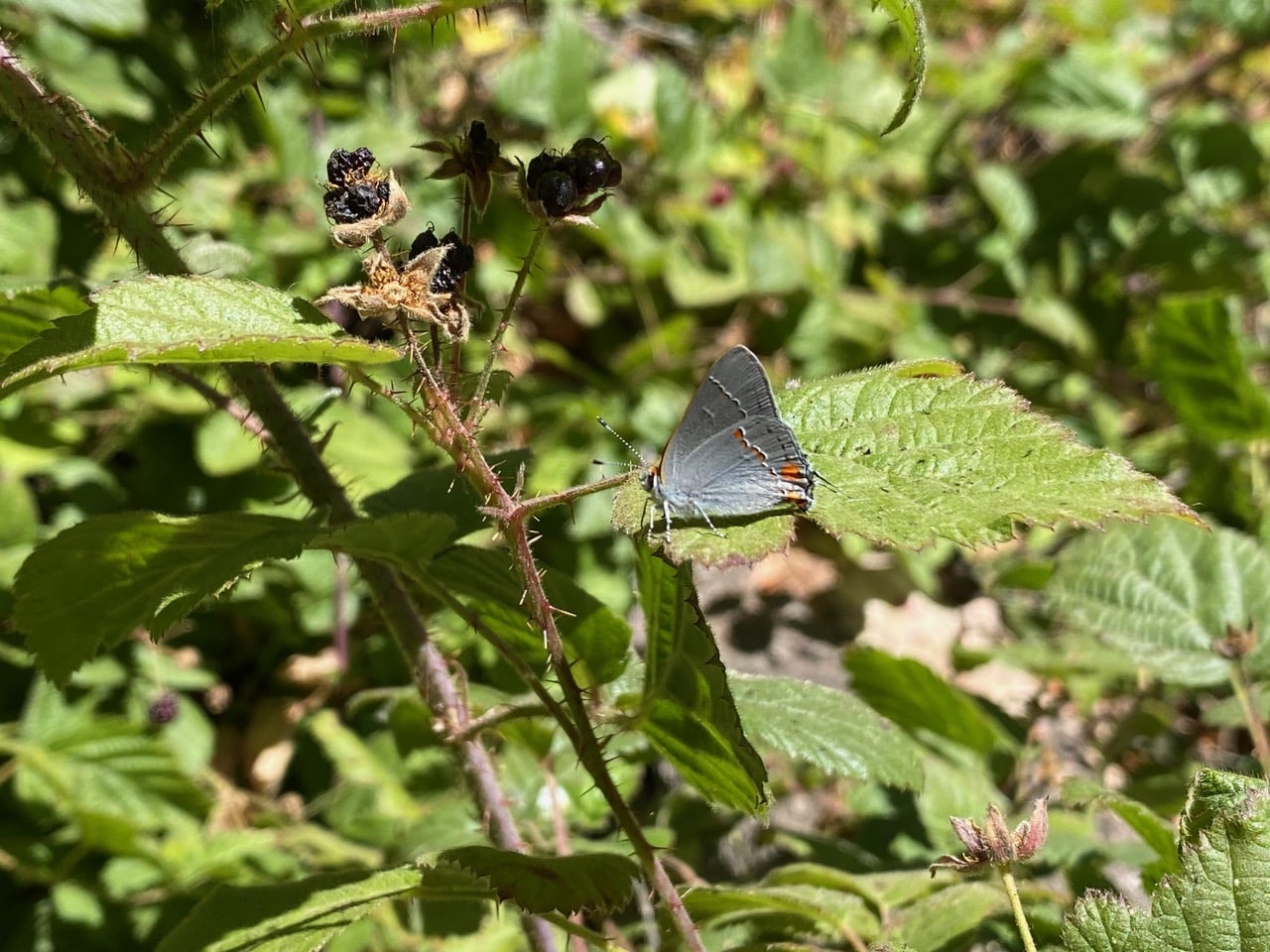
A Gray Hairstreak, Strymon melinus (family Lycaenidae) is perched on a leaf of California Blackberry, Rubus ursinus.
Why the name “hairstreak”? These small butterflies have a slim, hair-like tail on the lower corner of each hindwing. Gray Hairstreak also has colorful false eyespots near the base of each tail. The eyespots and antenna-like tails are believed to fool predators into mistaking its tail for its head. Hairstreaks even add a behavioral component – a nectaring hairstreak often rubs its wings up and down, simulating the movement of twitchy antennae. This may fool birds, lizards, and spiders into attacking the wrong end, sparing the life of the butterfly.
Female Gray Hairstreaks lay eggs singly on the flowers, flower buds, young fruits and nearby leaves of a host plant. Host plants include a wide variety of plants, notably from the pea (Fabaceae) and mallow (Malvaceae) families. The caterpillars are greenish at the start, but older individuals range in color from gray to pink. As in many species of Lycaenidae, Gray Hairstreak larvae are myrmecophiles (ant-lovers) – often tended by ants. Ants harvest a sweet liquid from the caterpillar’s dorsal nectary organ (“honey gland”) and in exchange may protect them from predators. Larvae of many Lycaenidae species also communicate with ants via ant-like sounds (clicks and hums) or by sending vibrations through the substrate.
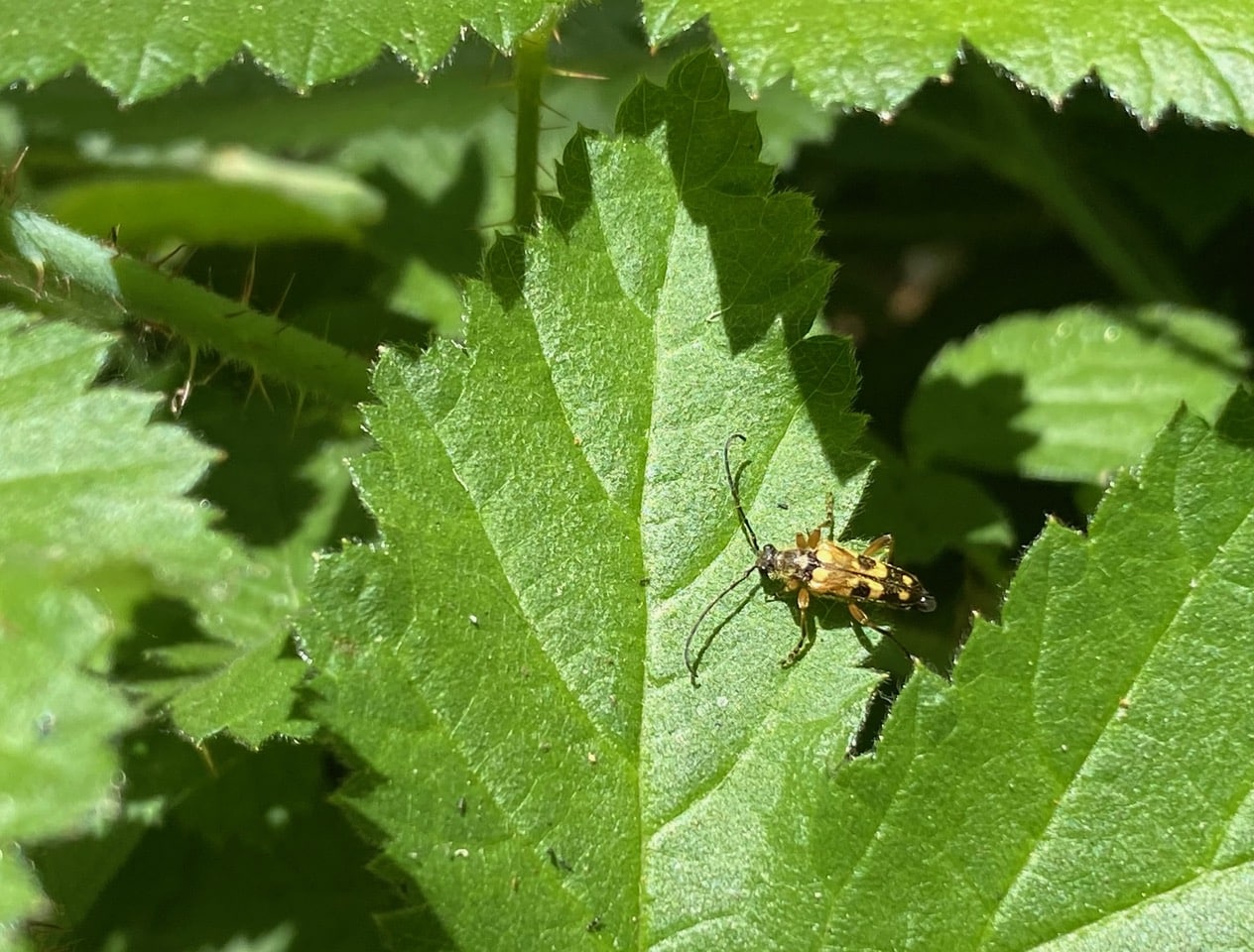 A
AA Flower Longhorn Beetle, Xestoleptura crassipes (family Cerambycidae, subfamily Lepturinae) is resting on a blackberry leaf.
Flower Longhorn Beetles (family Cerambycidae, subfamily Lepturinae) are usually among the smaller members of their family. These beetles have a narrow body and very long legs. The thorax is markedly less wide than the wings, while the elytra tips are often pointed. They also share the family trait with other Cerambycids of having very long antennae. Sexual dimorphism is found in some species. The beetles are found on flowers where they feed on pollen and nectar, and are considered pollinators. They have a particular affinity for the umbel flowers of the carrot family, Apiaceae. The beetles spend their larval days as borers, just like other Cerambycids. However they are not considered pests, as they select trees that are stressed, dying, or dead.
Xestoleptura crassipes is aproximately 10-17mm long. The species name crassipes means “thick-legged”. Adults are attracted to flowers (June-September) and larvae are wood-borers, found in forested areas and associated with conifers and oaks.

At the edge of Jewel Lake, a male Arroyo Bluet, Enallagma praevarum (family Coenagrionidae) is perched on a broken leaf of Scirpus Bulrush.
The Arroyo Bluet, Enallagma praevarum (family Coenagrionidae) is native to the western United States, south to southern Mexico. It is associated with slow-flowing streams or lake margins with emergent vegetation. The flight season spans the month of March to October. Males are often found near water where vegetation is abundant. The less brightly colored females are often found in mating pairs. The females ovipositor within floating vegetation, submerging themselves underwater to lay eggs while males guard above water.
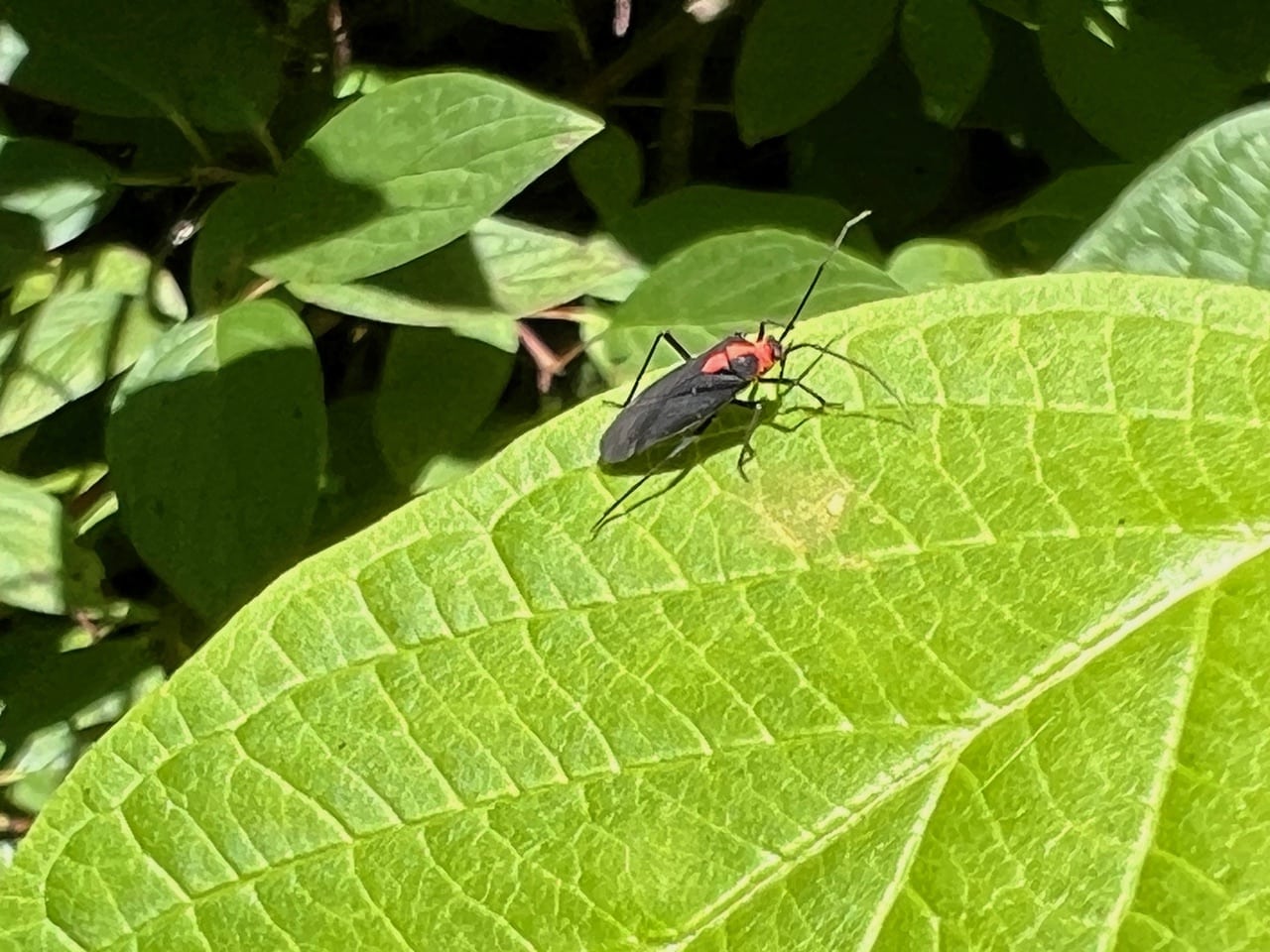
A Red-striped Mirid, Prepops rubrovittatus (family Miridae) is moving around on a leaf of Creek Dogwood, Cornus sericea.
Mirid bugs are also referred to as plant bugs or leaf bugs. Miridae is one of the largest family of true bugs in the order Hemiptera. Like other Hemipterans, Mirids have piercing-sucking mouthparts to extract plant sap. Some species are predatory. One useful feature in identifying members of the family is the presence of a cuneus; it is the triangular tip of the corium, the firm, horny part of the forewing, the hemielytron. The cuneus is visible in nearly all Miridae.
Not much is known about the biology of the Red-striped Mirid. The species is found in Central America and North America. The bug measure 5 – 5.3 mm in length. Host plant is believed to be willow (Salix). The insect hibernates beneath decaying vegetation and other cover. Adults are found in tall grass and herbage along the margins of ponds.

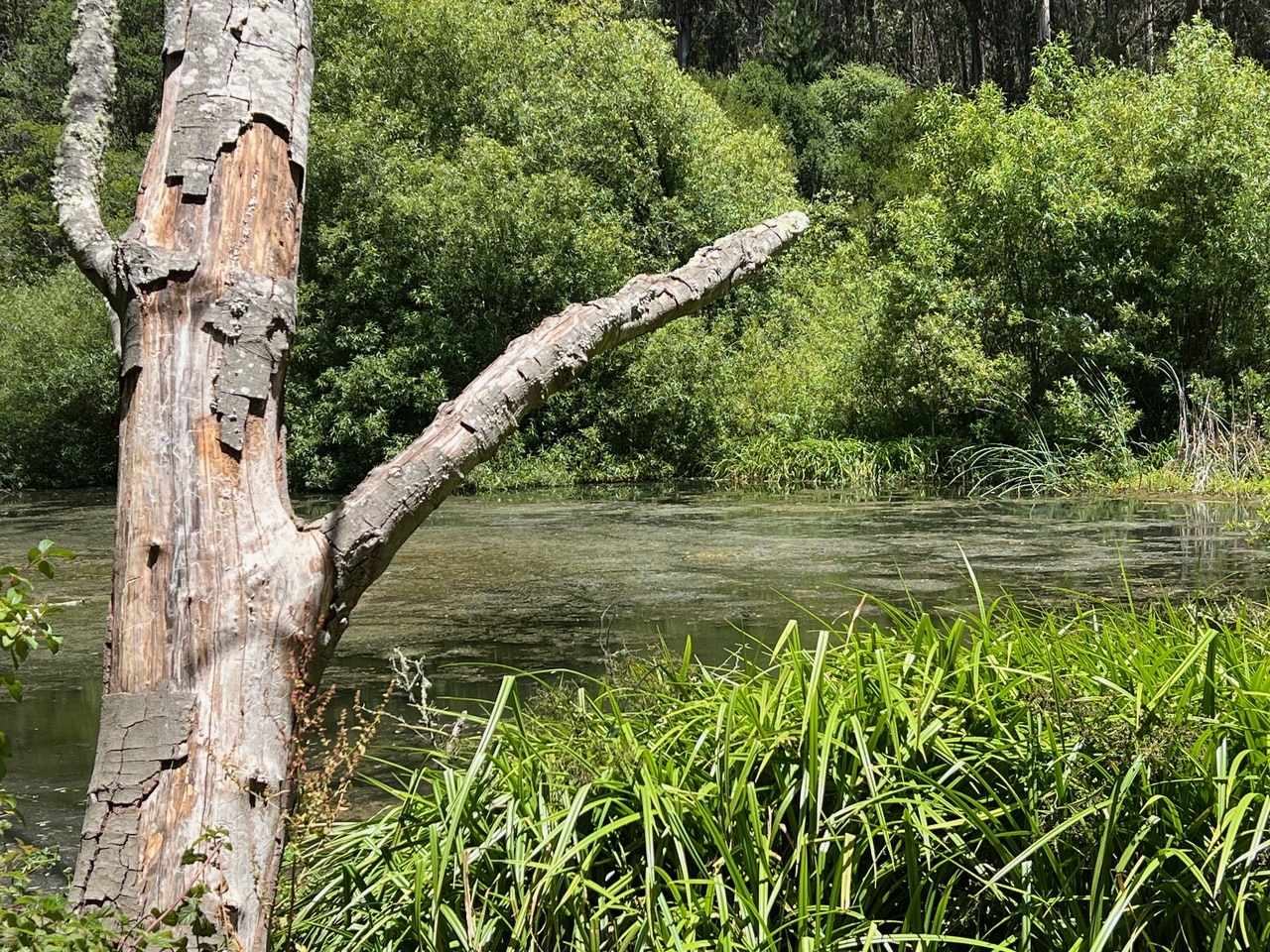
Andy, Ron and I sit on a bench to enjoy this view of Jewel Lake, watching dragonflies and damselflies flit by. A Phoebe hawks insects from a branch overhanging the water, while a Kingfisher occasionally dives for fish. A Brown Creeper has made a nest under the peeling bark of this dead tree, about half way up the trunk. We watch as a parent, insect in beak, disappear under the bark to feed its young.
Ah, life is good!!