

Pollinator Post 7/6-7/25 (3)
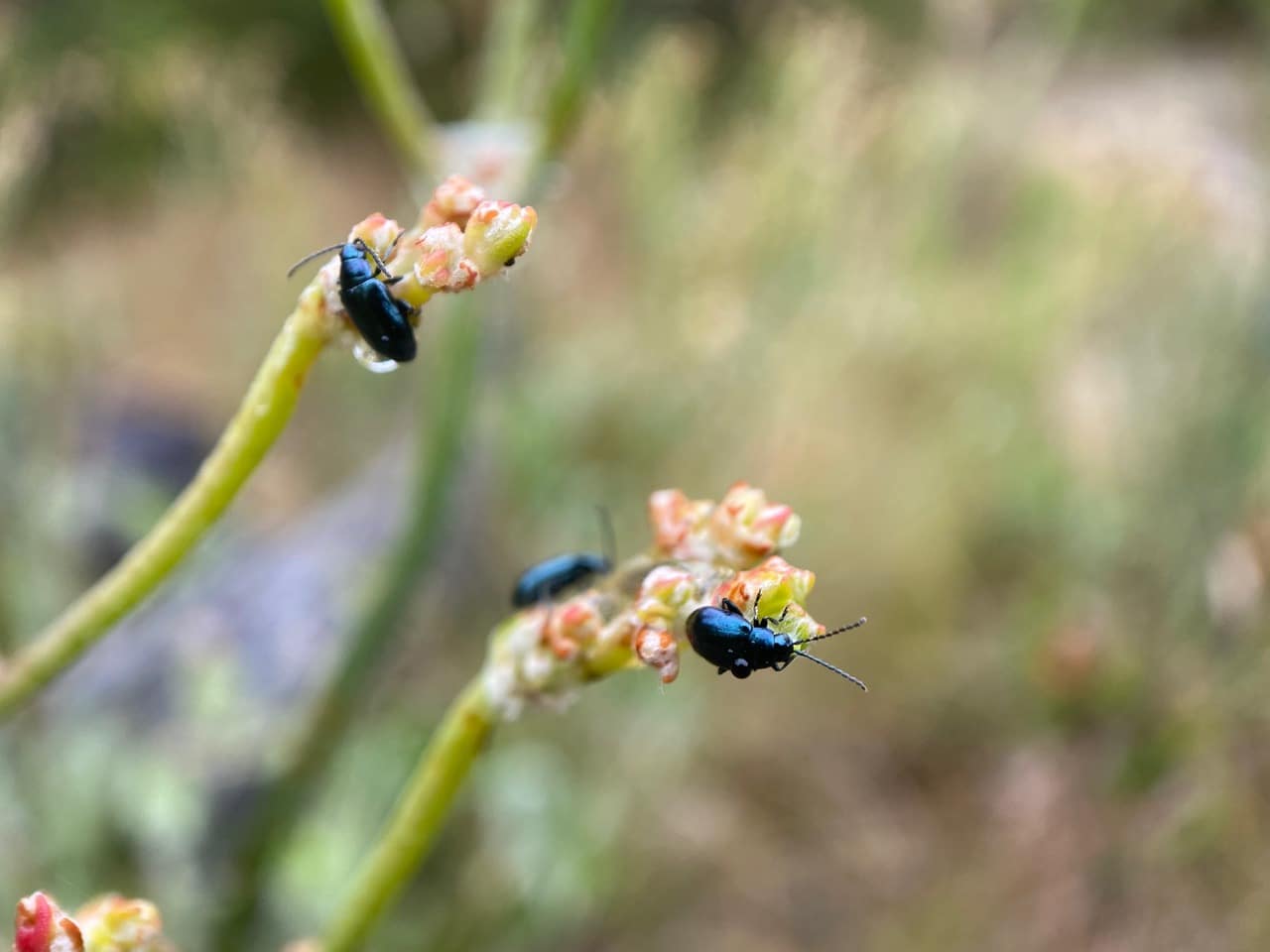
Small iridescent blue beetles are feeding on the flower buds of Antioch Dunes Buckwheat, Eriogonum nudum var. psychicola. These are Metallic Flea Beetles, Altica sp.(family Chrysomelidae).
Members of the family Chrysomelidae are commonly known as Leaf Beetles. Adults and larvae feed on all sorts of plant tissues, and all species are fully herbivorous. Many are serious pests of cultivated plants, including food crops. Others are beneficial due to their use in biocontrol of invasive weeds. Chrysomelids are popular among insect collectors, as many are conspicuously colored, typically in glossy yellow to red or metallic blue-green hues, and some have spectacularly bizarre shapes.
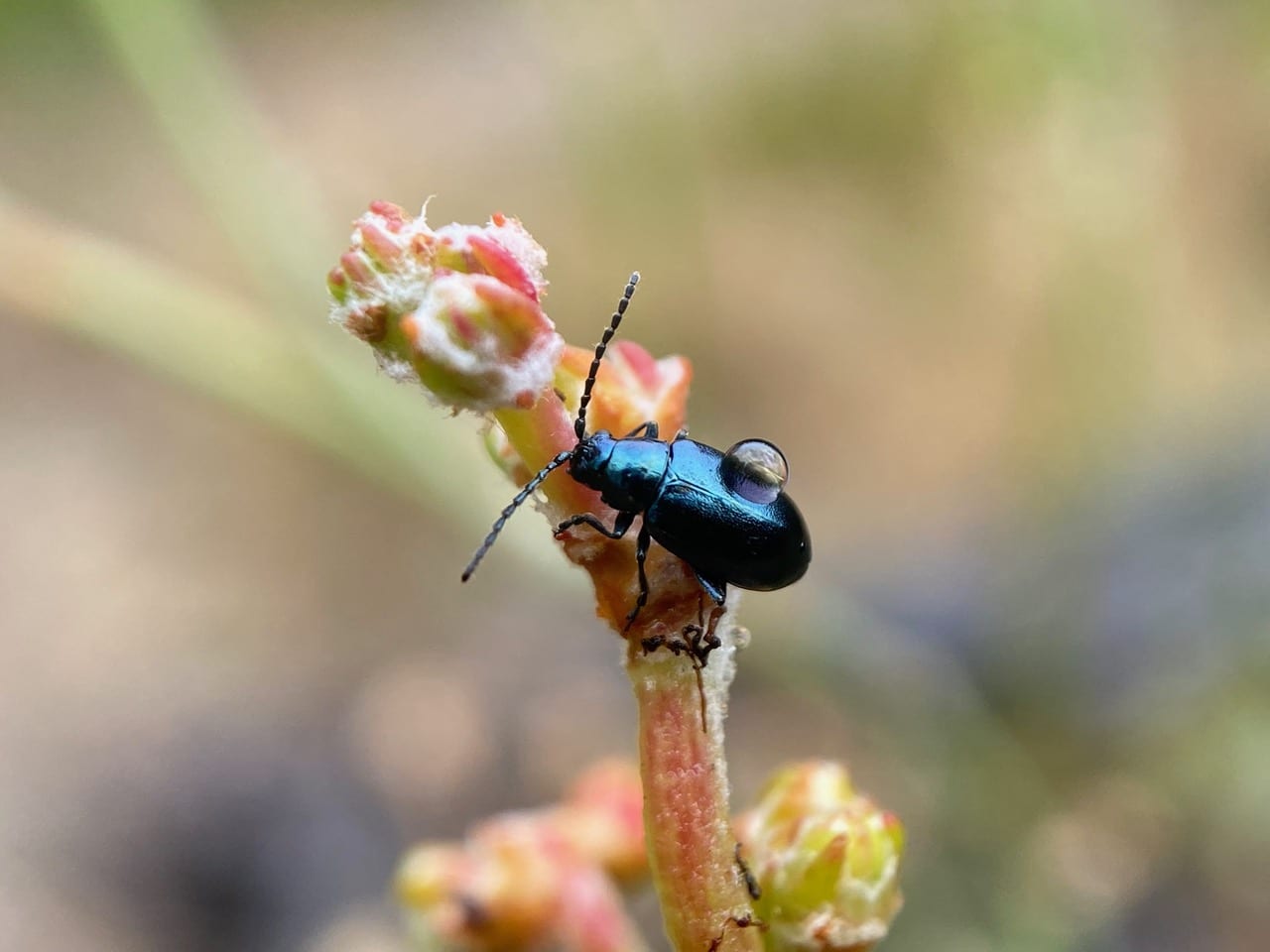
This section of the garden has just been irrigated, water droplets still clinging to the beetles’ elytra.
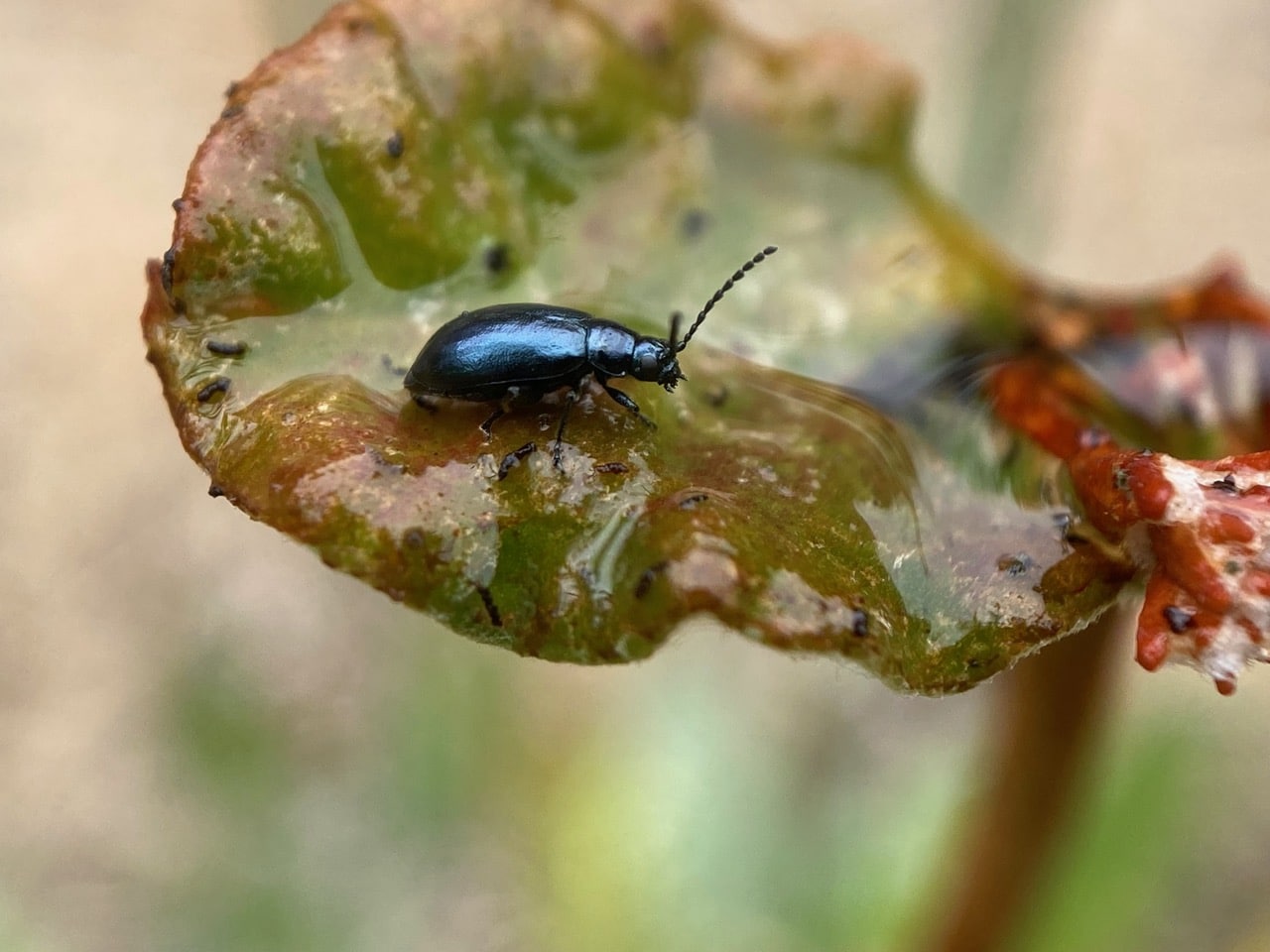
Flea Beetles are in the largest subfamily (Alticinae) of the family Chrysomelidae, or Leaf Beetles. The name Altica is derived from the Greek word haltikos, meaning good jumpers. The beetles have strong hind legs allowing them to jump long distances like true fleas. Altica flea beetles are 3-9 mm in length, and females are typically larger than males. Most Altica beetles have hard outer wings elytra that are metallic blue to green in color that protect similarly colored metallic bodies that reflect purple and bronze colors and are elongate oval in shape. Antennae have 11 segments and are filiform (threadlike).
The species are similar to each other, small metallic blue-green-bronze beetles, often distinguished from each other only by the aedeagus (male genitals). The species of Altica, both as larvae and as adults, are phytophagous, feeding on plant foliage of various food plant taxa, specific for each Altica species.
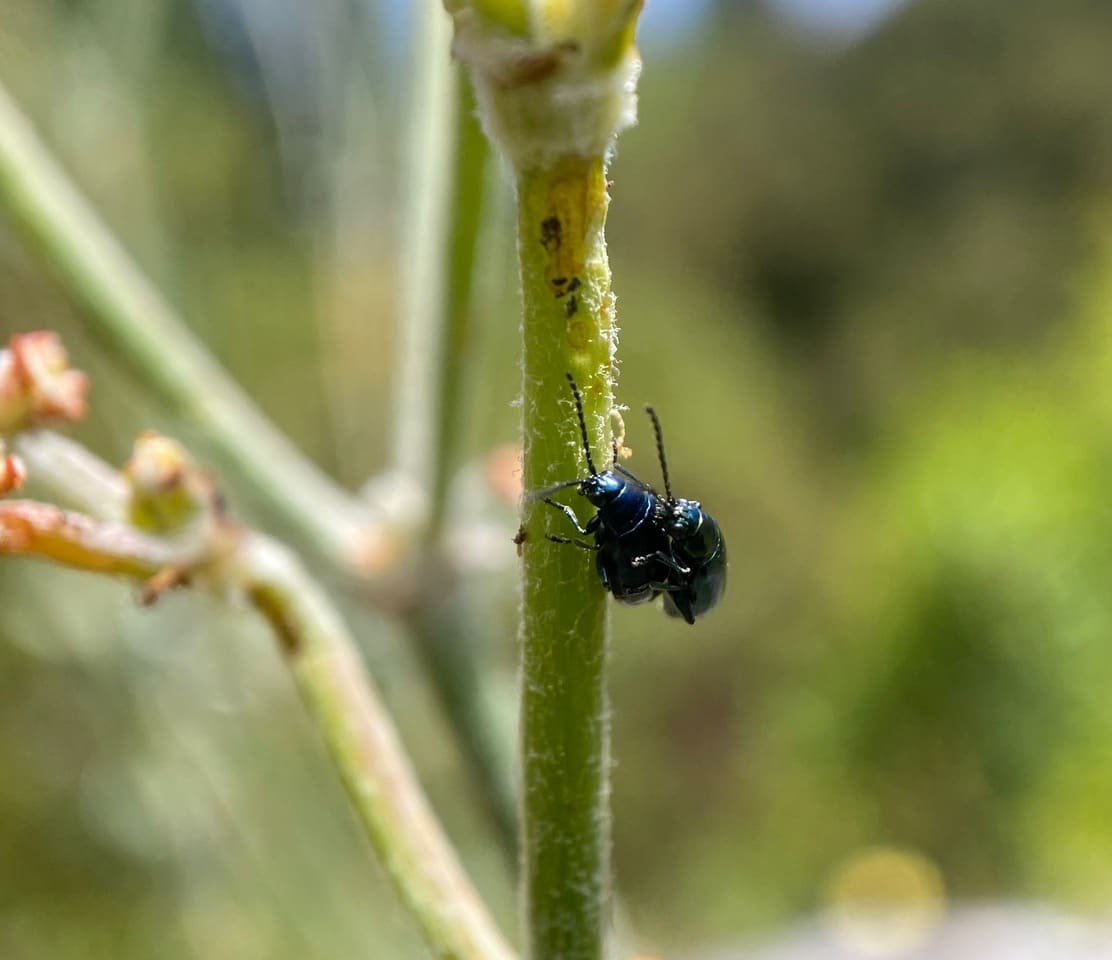
A pair of Metallic Flea Beetles, Altica sp. is mating on the stem of Antioch Dunes Buckwheat.
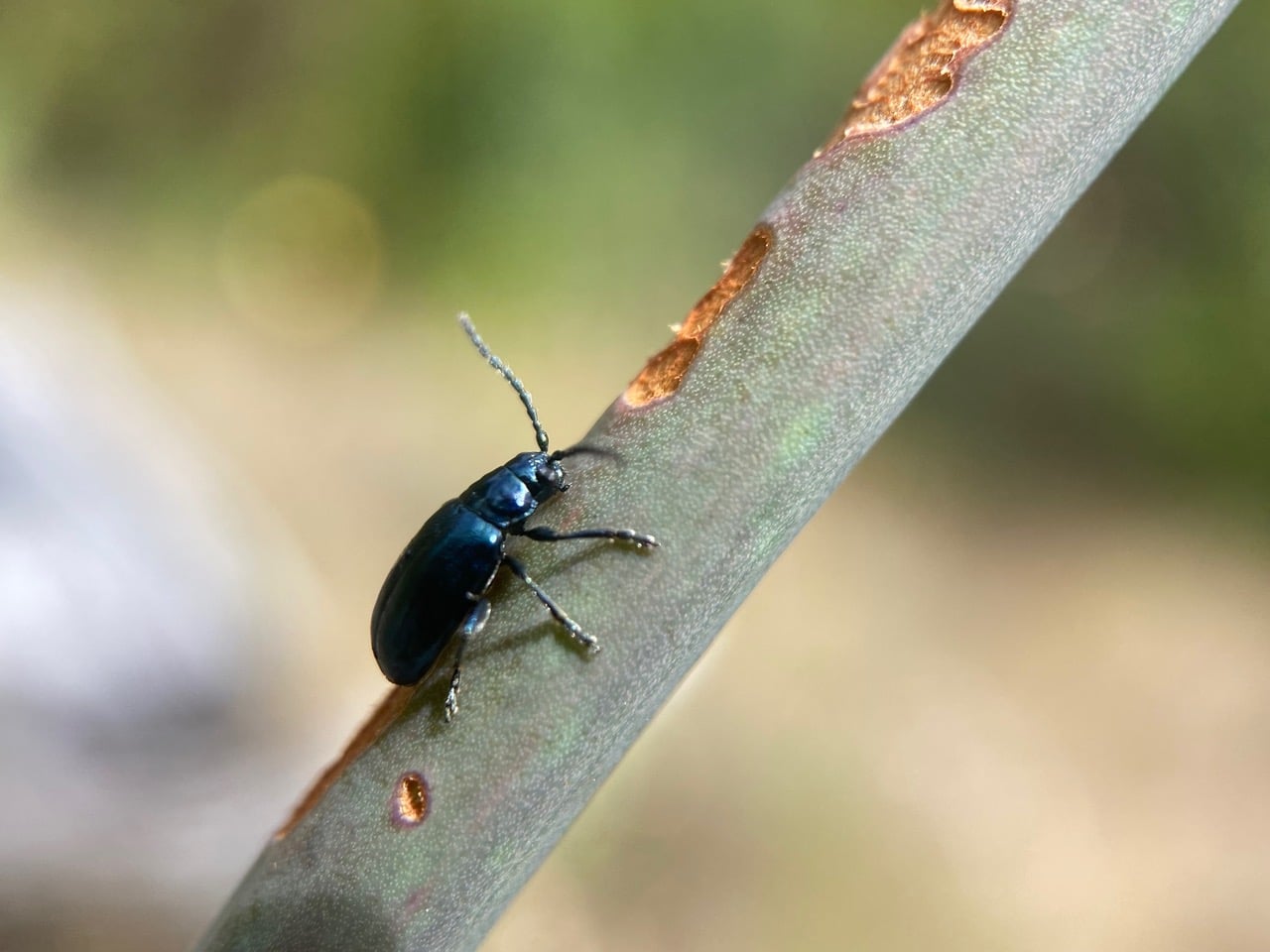
An Altica beetle is making its way up a buckwheat stem.
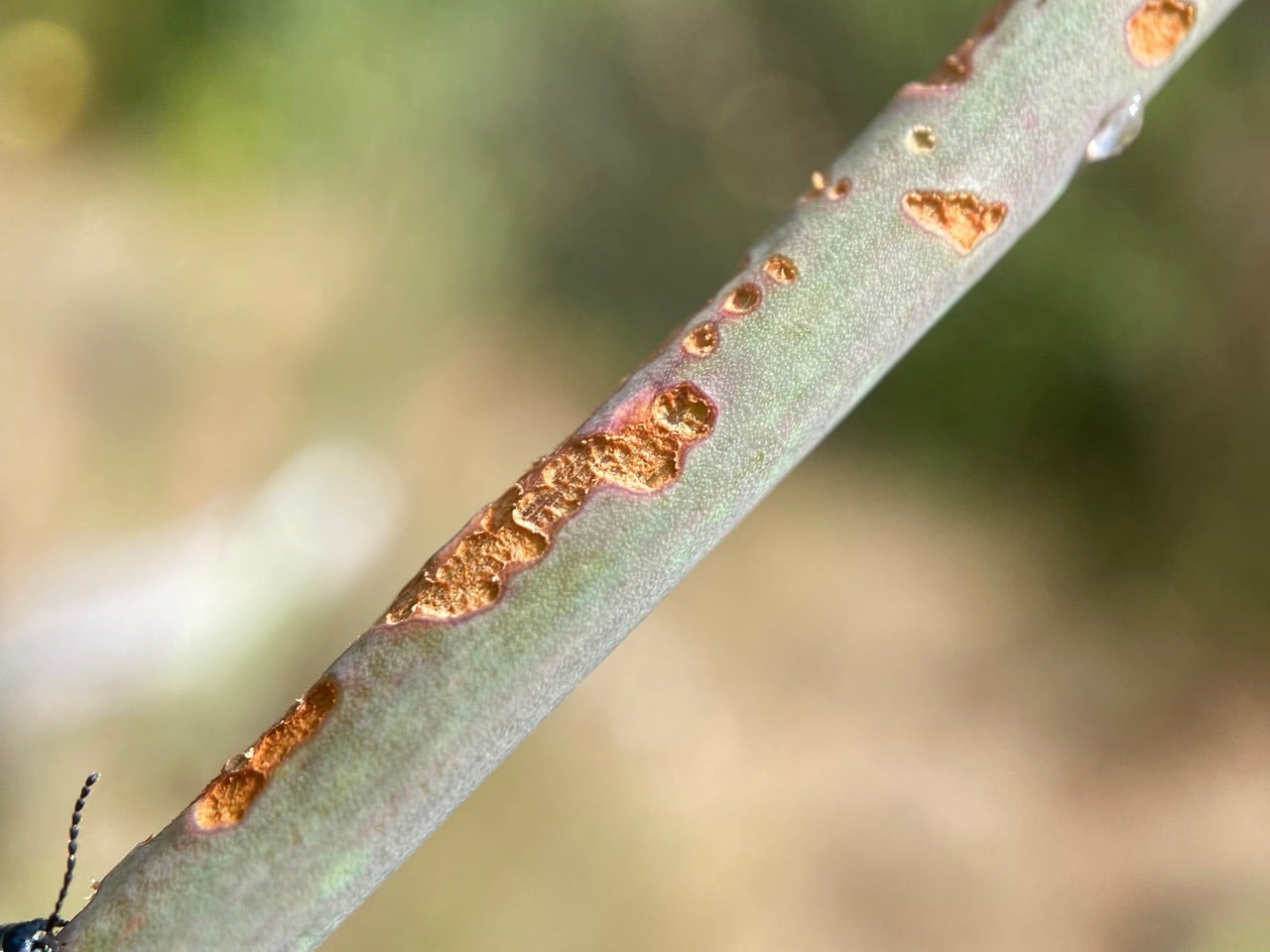
Look at all the feeding scars left by the Metallic Flea Beetles!
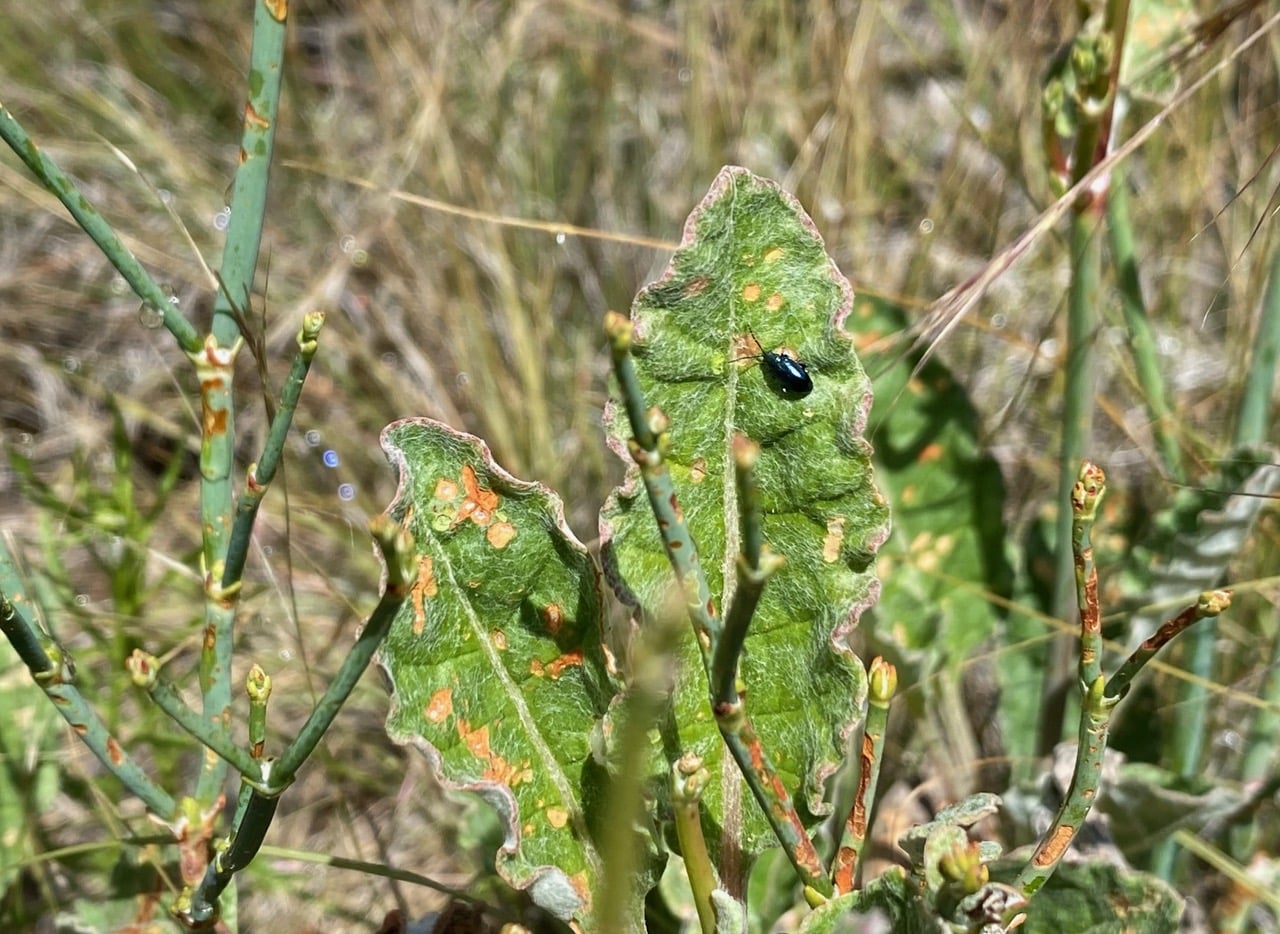
The Altica beetles seem to have done extensive damage to the Antioch Dunes Buckwheat, feeding on the flower buds, the stems and leaves of the plant.
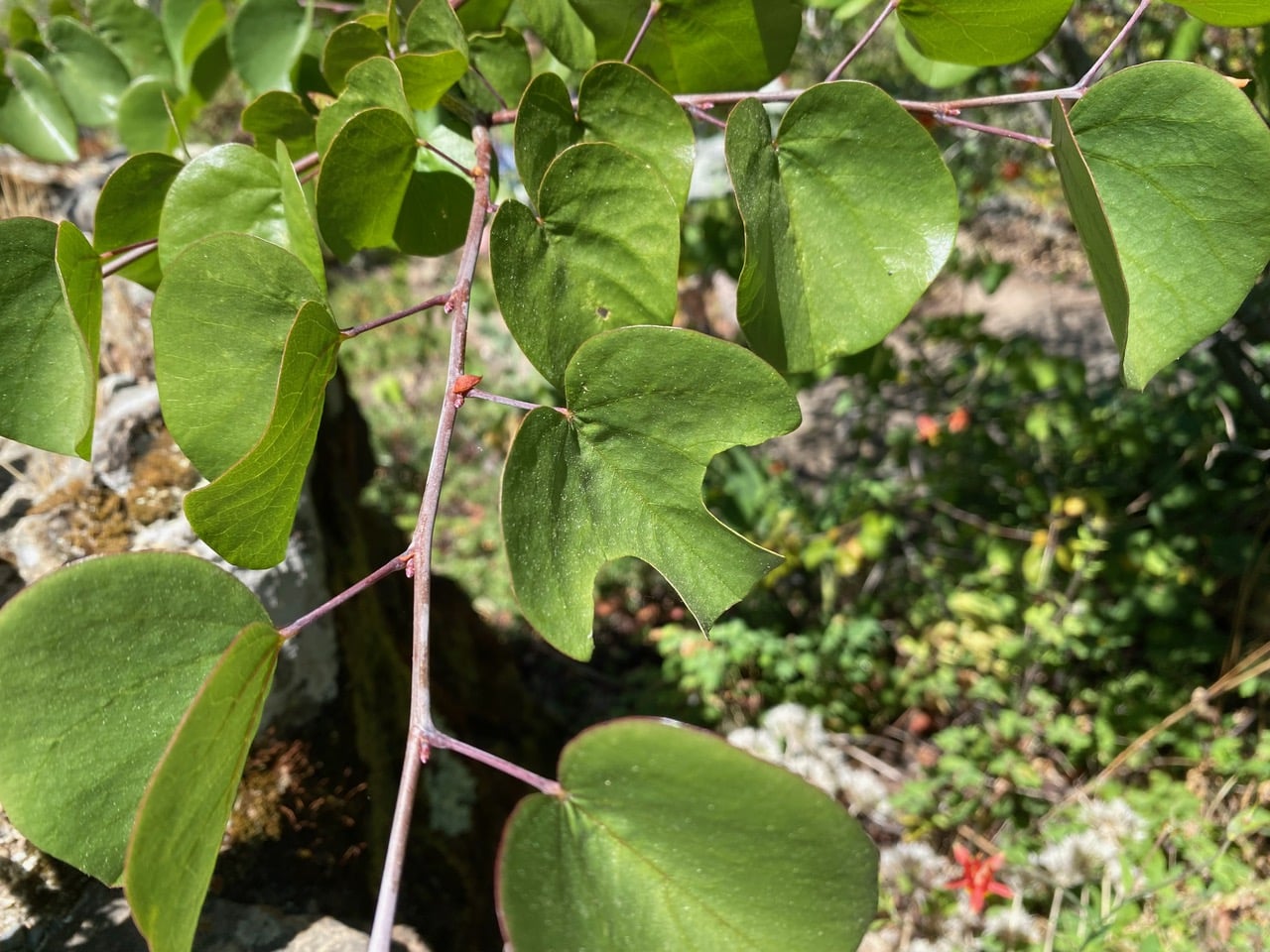
Ooh, look at that leaf of Western Redbud leaf, Cercis occidentalis that has two round pieces neatly cut out of it! The Leafcutter Bees, Megachile sp. (family Megachilidae) have been busy here.
Leaf-cutter Bees, Megachile sp. (family Megachilidae) are stout-bodied, usually with pale hair on the thorax and stripes of white hairs on the abdomen. Females usually have a triangular abdomen with a pointed tip, and males’ faces are covered with dense, pale hair. Flight season is from May into September, with peak activity from June to August.
Solitary females construct nests in tubular cavities, including hollow stems, tree holes, and abandoned beetle burrows in wood. Many use holes drilled into wood, straws, or other manufactured tunnels. Females cut pieces from leaves or flower petals for use in the construction of brood cells. Most Megachile females are generalists when foraging for pollen. Pollen is transported in dense scopae on the underside of the abdomen.
Photos of Western Leafcutter Bee (Megachile perihirta) · iNaturalist
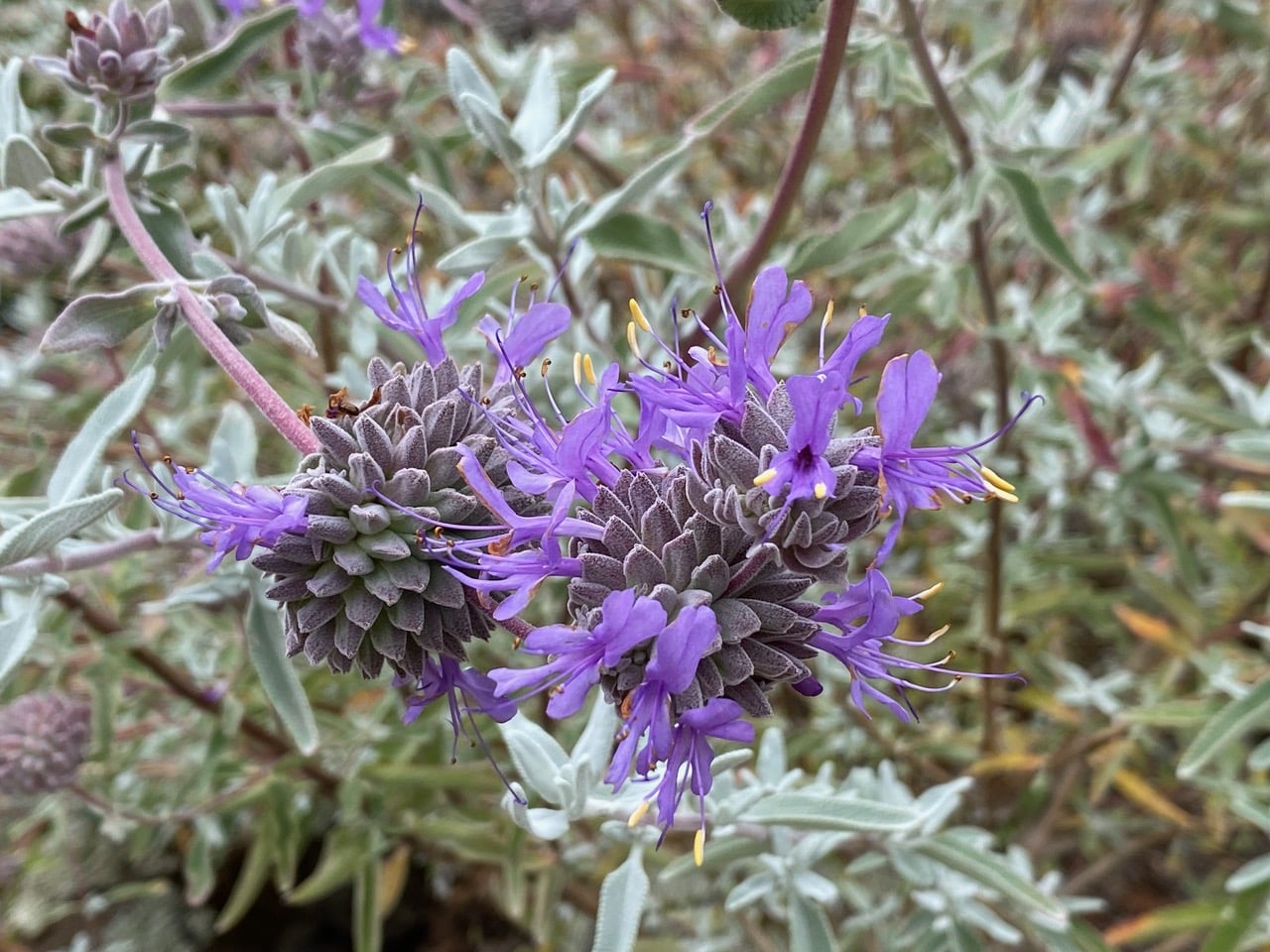
The Purple Sage, Salvia leucophylla near the front gate is in peak bloom.
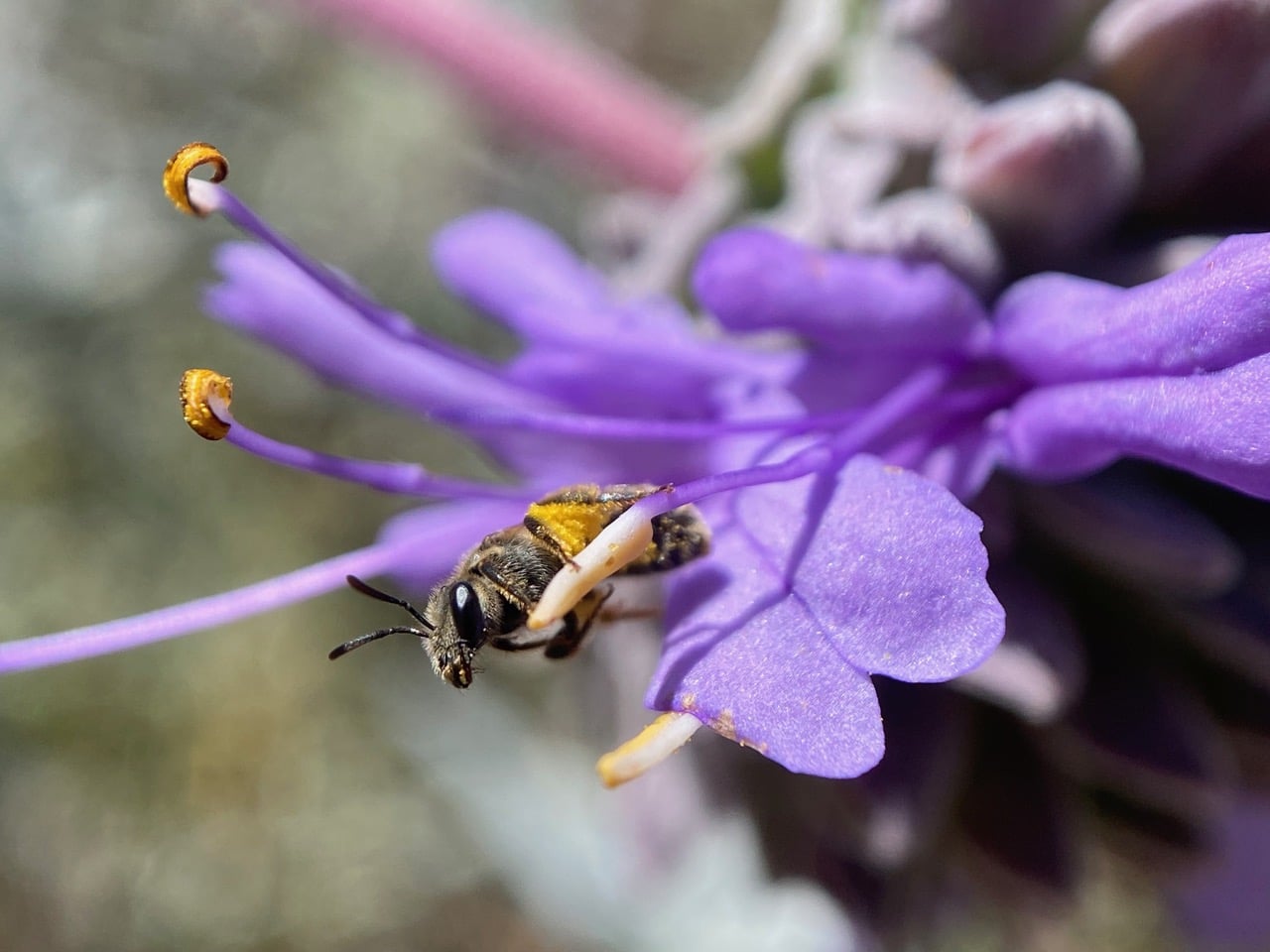
Using her mandibles, a Tripartite Sweat Bee, Halictus tripartitus (family Halictidae) is extracting pollen from an anther of a Purple Sage flower.

Halictus is found worldwide; they are most common in the Northern Hemisphere. All are generalists, foraging from a wide variety of flowering plants. Many species are social and produce several generations per year. This is not surprising as most blooming plants are season-specific; a bee that requires pollen and nectar across multiple seasons would not thrive as a specialist. All Halictus in North America nest in the ground, often in aggregations; and they may nest in the same area for decades.
The species Halictus tripartitus (family Halictidae) is partially eusocial, with nests connected underground and some workers capable of reproducing. It is a very successful species in our area, making up the majority of bees in many gardens right now, collecting floral resources from a large variety of plants.
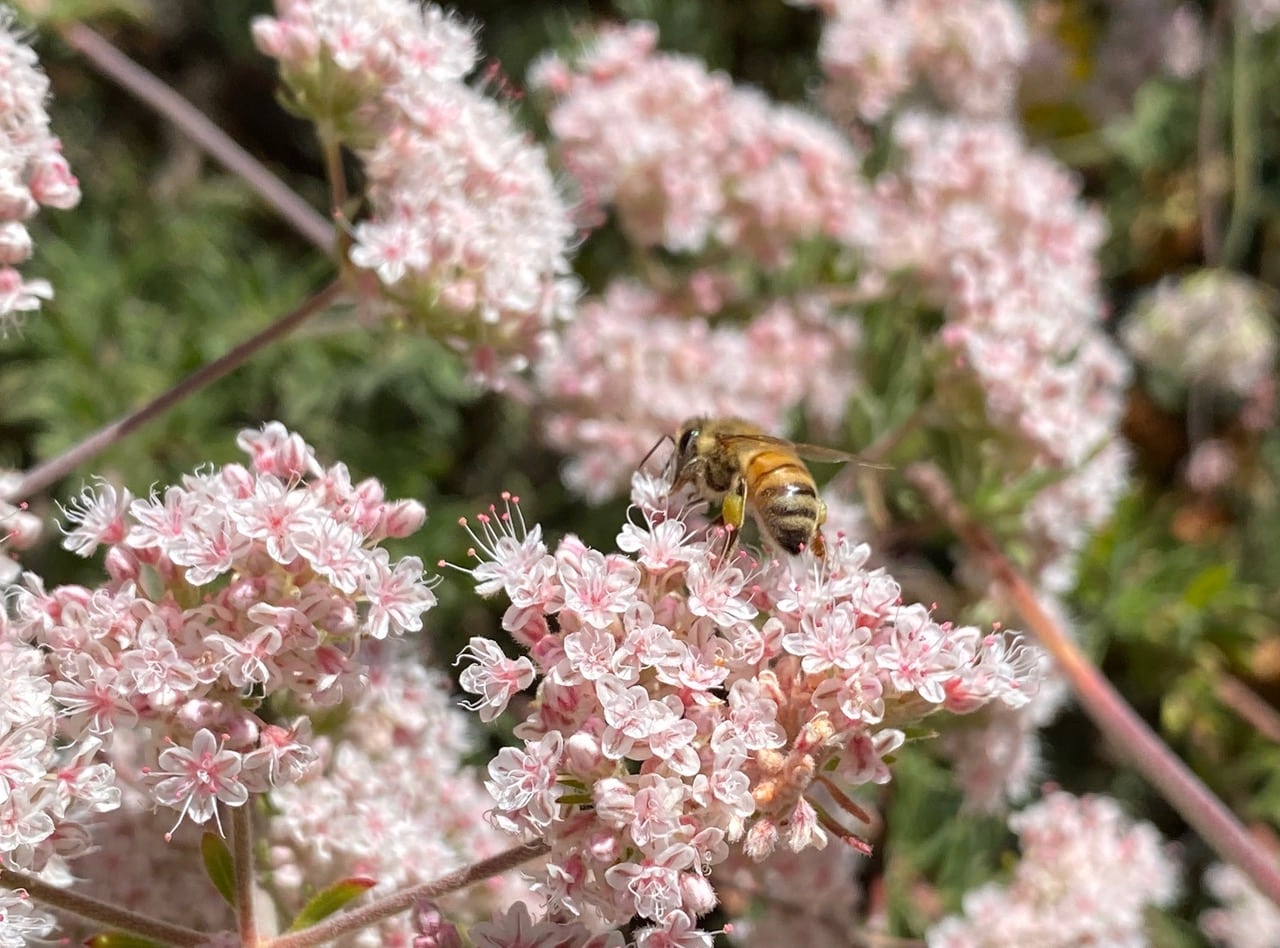
A Honey Bee, Apis mellifera (family Apidae) is foraging on an inflorescence of California Buckwheat, Eriogonum fasciculatum.
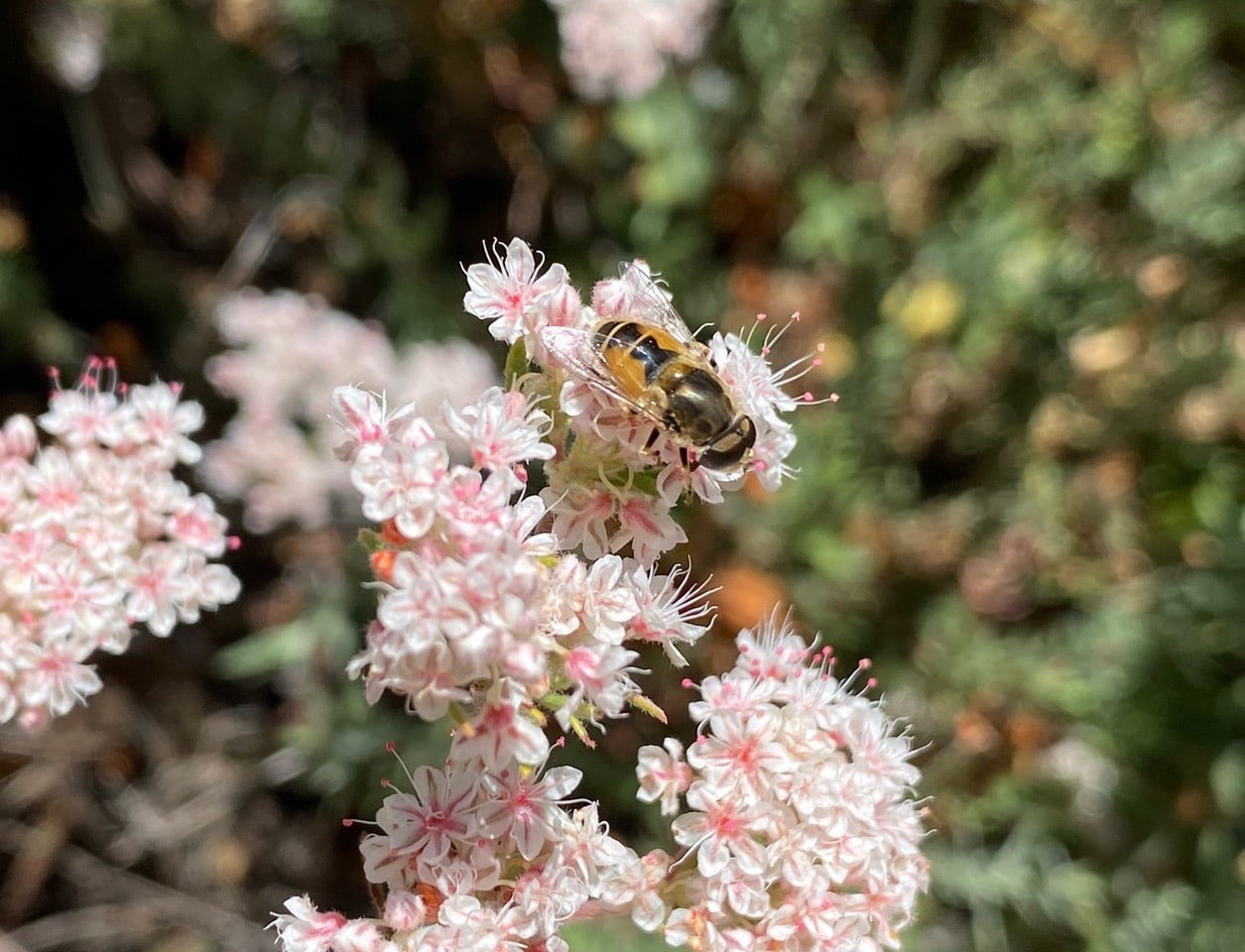
A male Eurasian Drone Fly, Eristalis arbustorum (family Syrphidae) has landed on the flowers of California Buckwheat.
The Eurasian Drone Fly, Eristalis arbustorum is an abundant species of hover fly that occurs throughout the northern hemisphere, including Europe, North Africa and North India. It was introduced to North America in the mid 1800’s and is now ubiquitous throughout much of the United States and Canada. The common name “drone fly” refers to its resemblance to the drone of the honeybee. Hoverflies get their names from the ability to remain nearly motionless while in flight. The adults are also known as flower flies as they are commonly found on and around flowers feeding on nectar and pollen. The Eurasian Drone Fly is found in a diversity of habitats, including wetland, forests, montane tundra, as well as farmland, urban parks and gardens. It visits the flowers of a wide range of low-growing plants and shrubs. The larvae are aquatic, occurring in shallow, nutrient rich standing water and in cow manure and compost heaps. Also known as “rat-tailed maggots”, the larvae have a siphon on their rear end that acts like a snorkel, helping them breathe under water. The siphon can be several times the length of the larva’s body. The larvae are saprophagous, feeding on bacteria in stagnant water rich in decomposing organic matter.
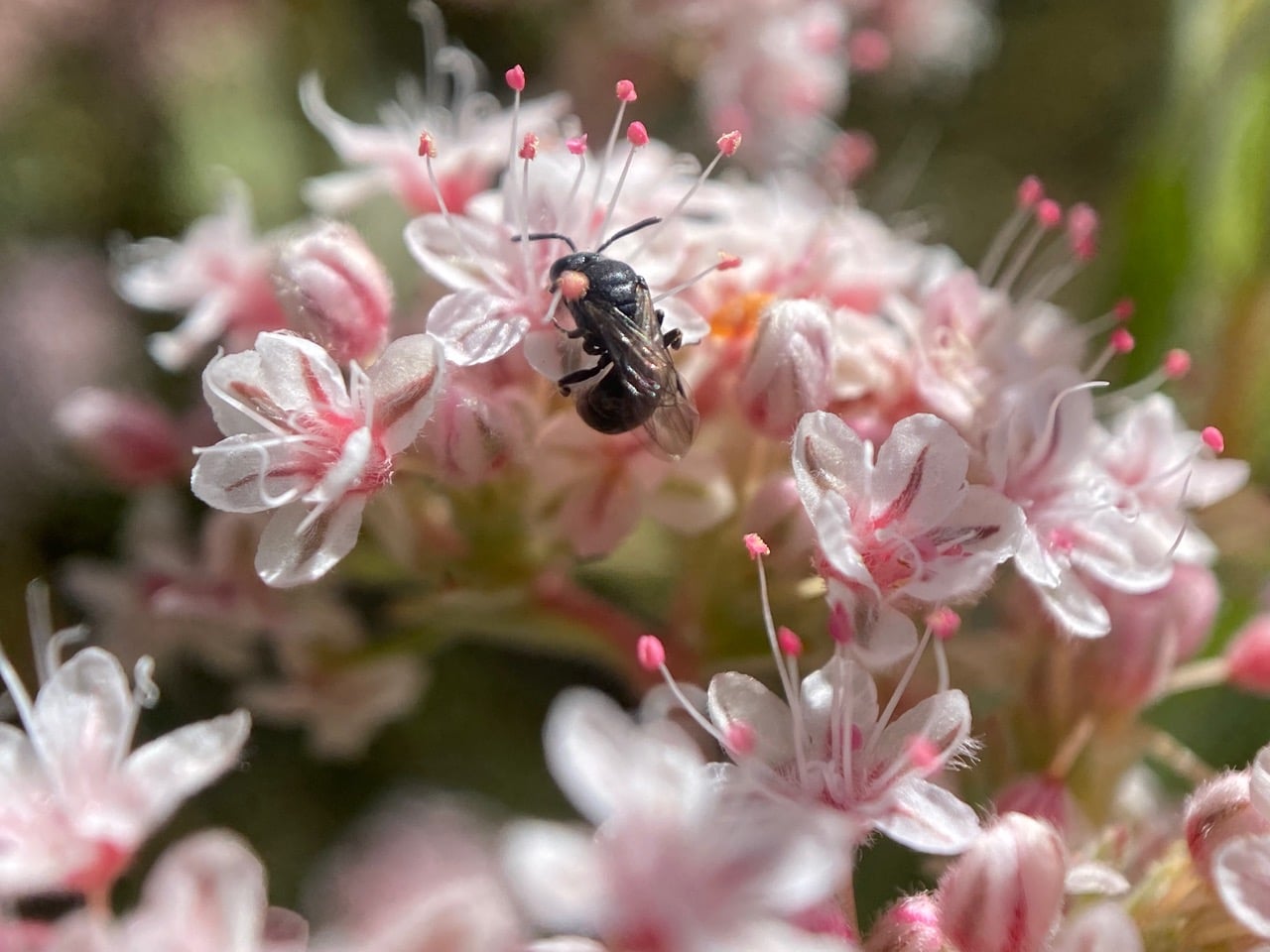
A tiny black bee is taking nectar from a buckwheat flower.
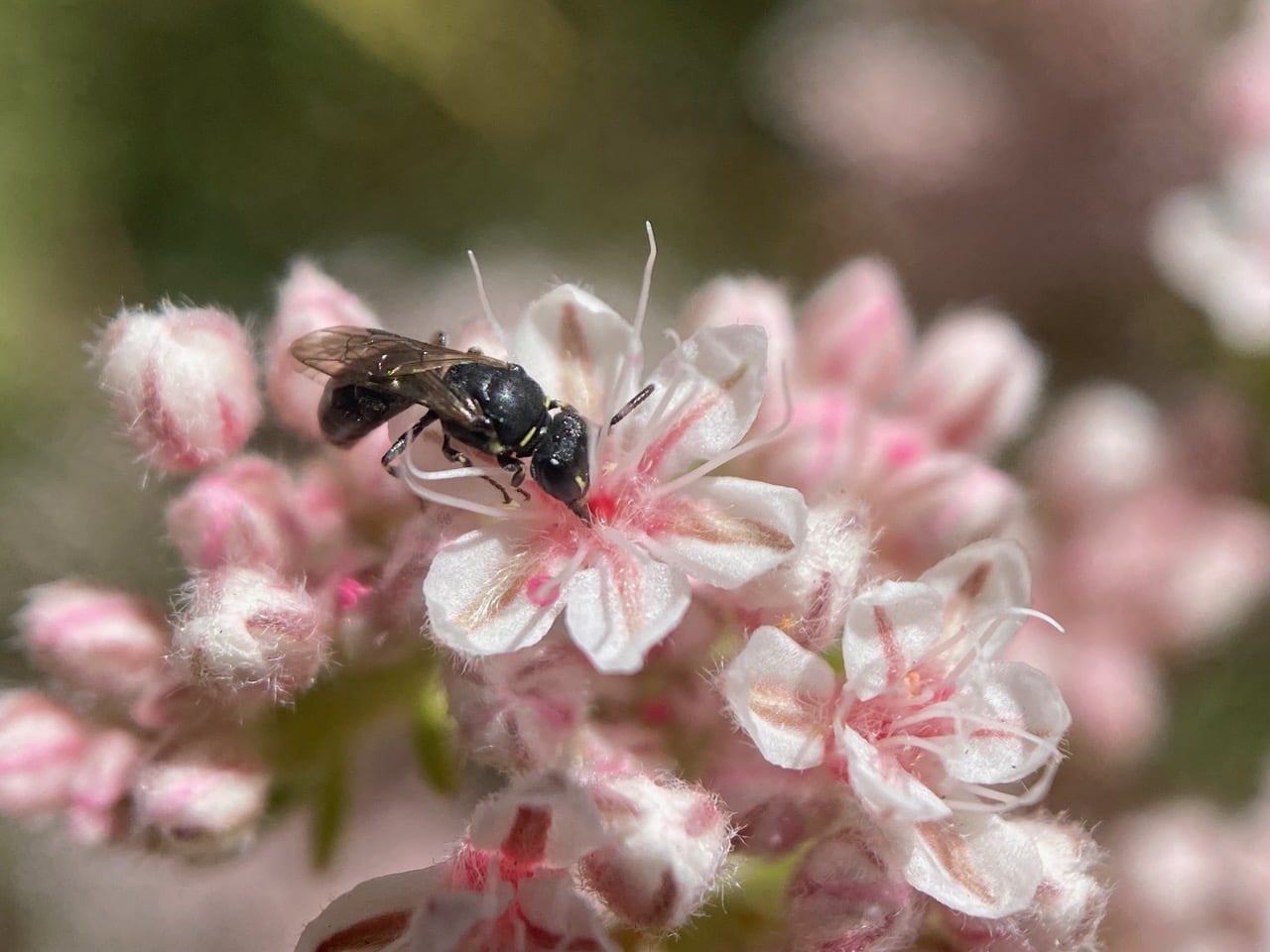
Note the yellow markings on its face and body, and absence of scopae on its hind legs. It is a female Masked Bee, Hylaeus sp. (family Colletidae).
Hylaeus (family Colletidae) are shiny, slender, hairless, and superficially wasp-like bees. They are small, 5 to 7 mm long, usually black with bright yellow or white markings on their face and legs. These markings are more pronounced on the males. Hylaeus do not carry pollen and nectar externally, they instead store their food in the crop and regurgitate it upon returning to their nests. They are primarily generalist foragers. Hylaeus are short-tongued, but their small body size enables them to access deep flowers. Hylaeus nest in stems and twigs, lining their brood cells with self-secreted cellophane-like material. They lack strong mandibles and other adaptations for digging, using instead pre-existing cavities made by other insects.
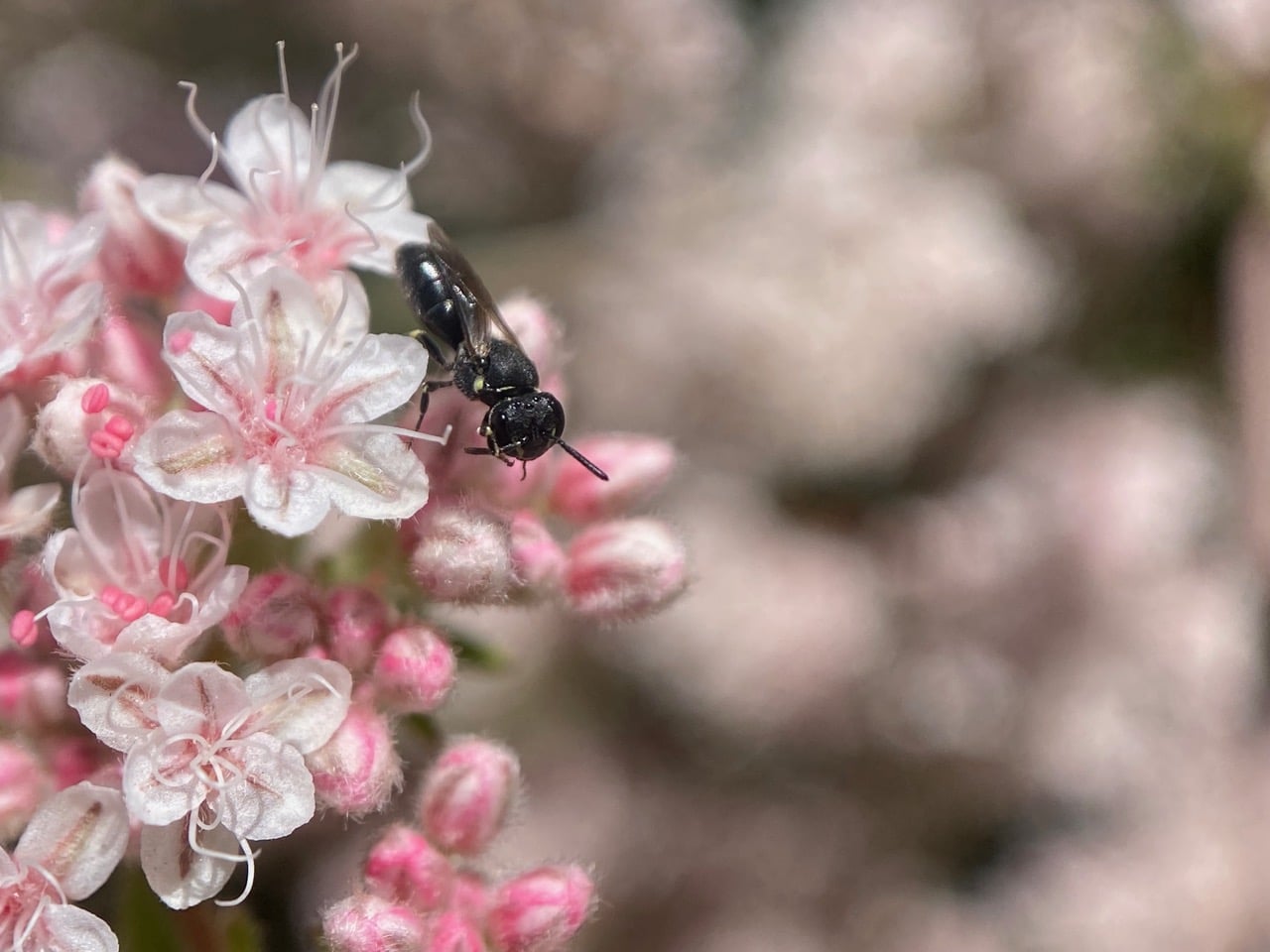
The bee cleans her antenna as she leaves.
All bees have an antenna cleaner on each of their two forelegs. The antenna cleaners consists of two parts: a notch in the basitarsus, which is fitted with stiff hairs, and a corresponding spur on the tibia. To clean its antenna, the bee raises its foreleg over its antenna and then flexes it tarsus. The action allows the spur to close the notch, forming a ring around the antenna. The bee pulls each antenna through the bristles to clean it of debris such as pollen or dust which might interfere with the many sensory organs within the antenna. A bee’s antennae serve numerous functions: smell, taste, perceive humidity and temperature, feel, monitor gravity and flight speed and even detect sound waves to help guide the bee in its daily activities.
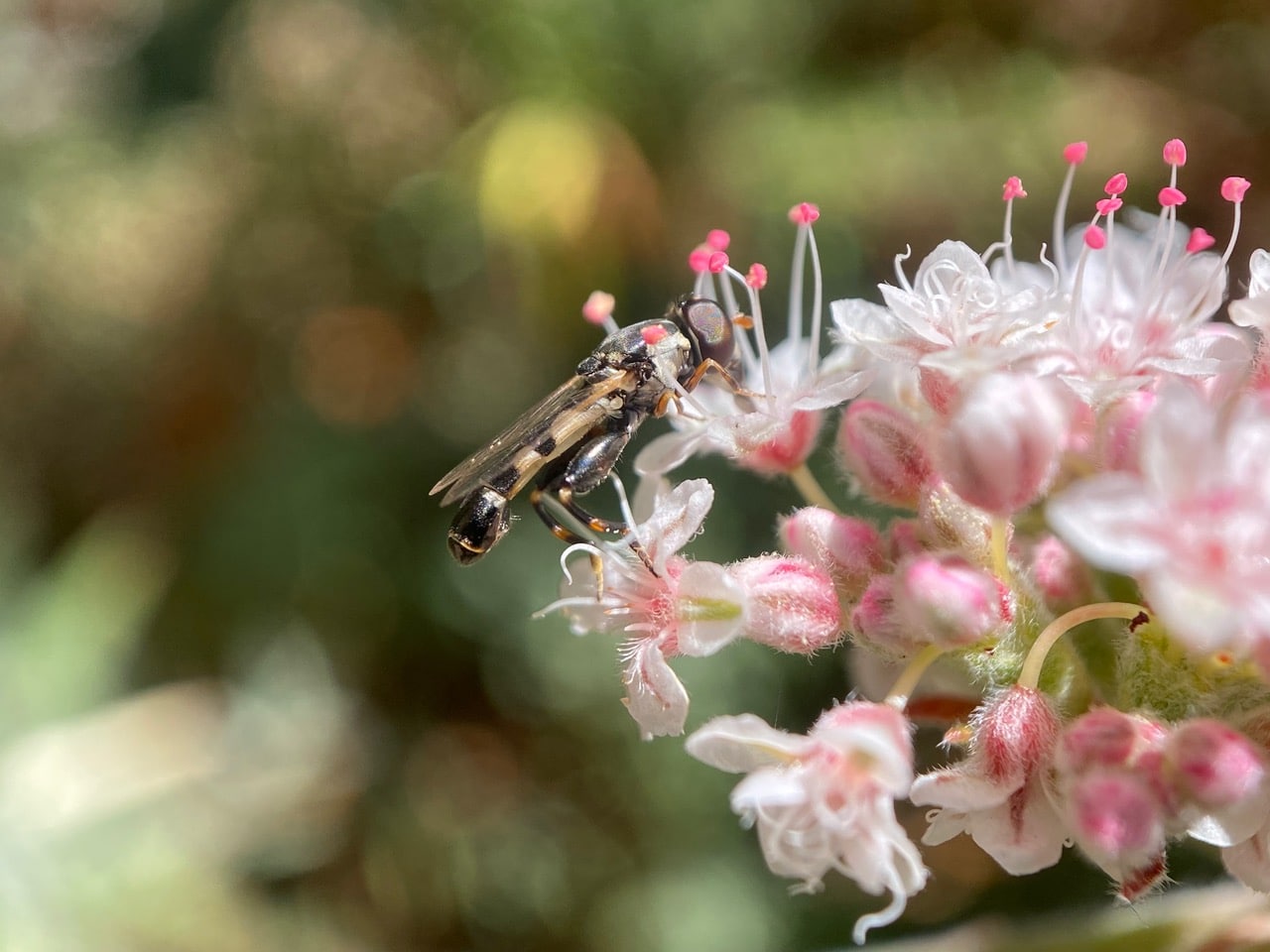
A Thick-legged Hover Fly, Syritta pipiens (family Syrphidae) is taking nectar from a buckwheat flower.

Syritta pipiens originates from Europe and is currently distributed across Eurasia and North America. They are fast and nimble flyers, and their larvae are found in wet, rotting organic matter such as garden compost, manure, and silage. The flies are important pollinators for a variety of flowering plants.
The Thick-legged Hover Flies are often found on flowers, where the adult males primarily feed on nectar and adult females eat protein-rich pollen to produce eggs. The common name comes from the fly’s distinctively broad femora. The fly is about 6.5 -9 mm long. The species flies at a very low height, rarely more than 1 m above the ground. Males accurately track females, aiming to attempt forced copulation.
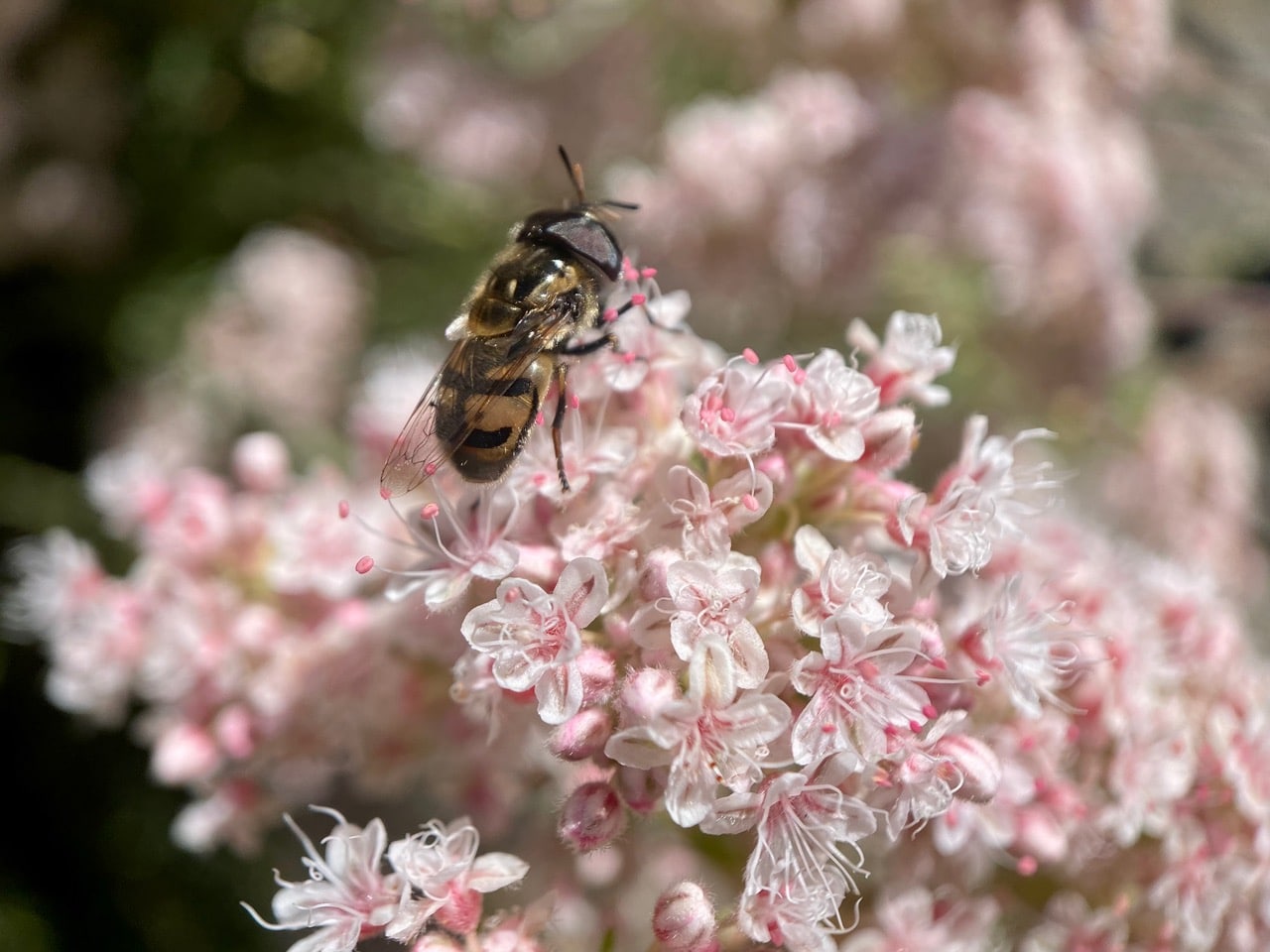
Ooh, that’s a much bigger and chunkier hover fly on the buckwheat flowers. It is a Bromeliad Hover Fly, Copestylum marginatum (family Syrphidae).
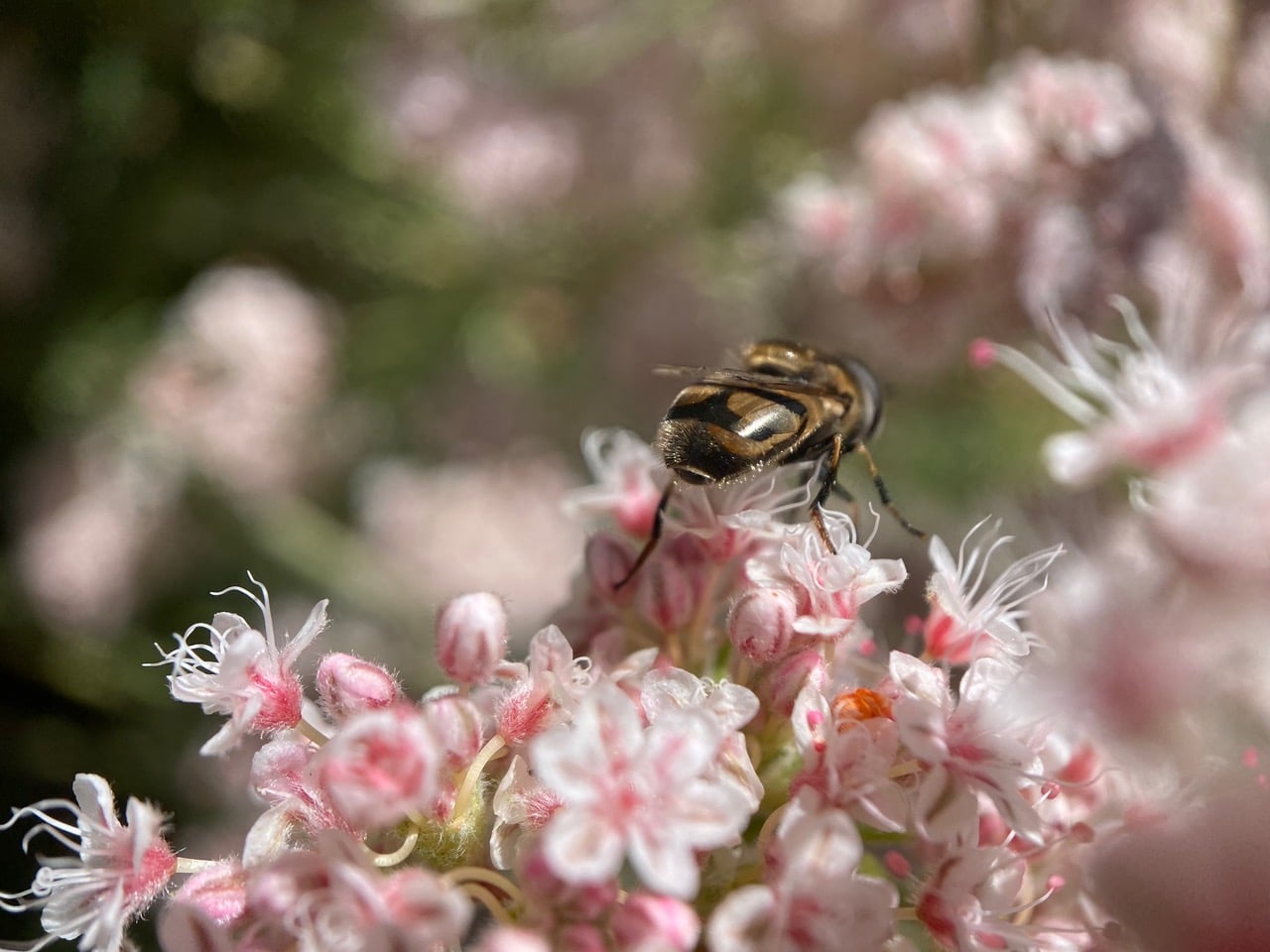
The abdomen of Copestylum marginatum is see-through translucent, almost jelly-like, with bold, black markings.
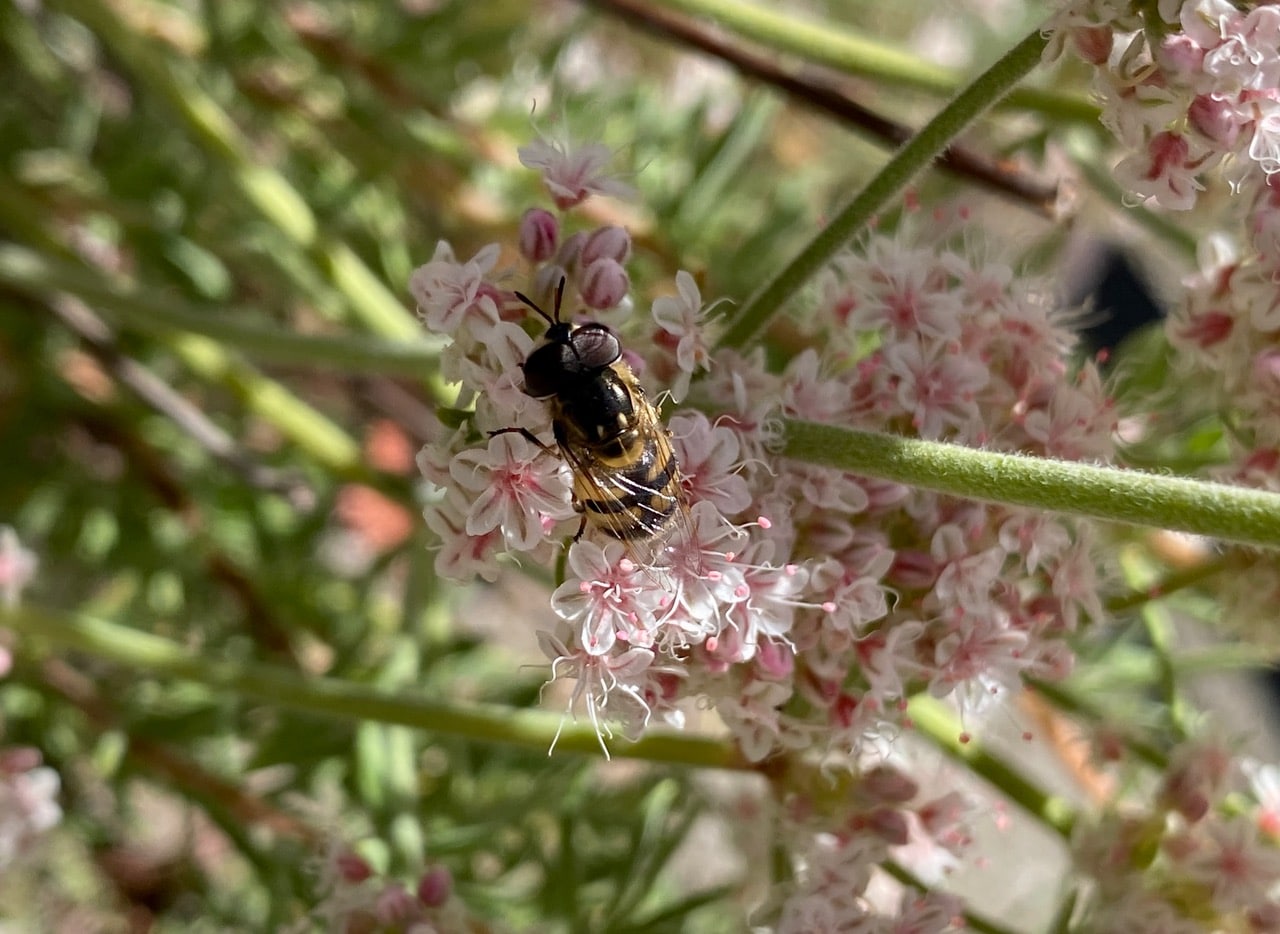
Bromeliad Hover Flies, belonging to the genus Copestylum, are a group of Syrphidae flies that have a unique life cycle, developing as larvae in the water-filled leaf axils of bromeliad plants, Heliconia spp., and decaying organic matter such as saguaro, rotting banana stumps, paw-paw, etc. The larvae are known to be predators of aphids and other small insects, helping to control pest populations. Adults visit flowers for nectar and pollen. Copestylum is a New World genus, mostly tropical. It is found across the United States and southwestern Canada.

The snout of a Copestylum hover fly is a distinctive feature of this genus. Copestylum marginatum has a prominent white “snout-like oral margin”. The snout is part of the proboscis of the adult fly; it encloses the proboscis. The structure allows the fly to reach nectar and pollen in deep, tube-shaped flowers inaccessible by other hover flies.