

Pollinator Post 7/6-7/25 (2)
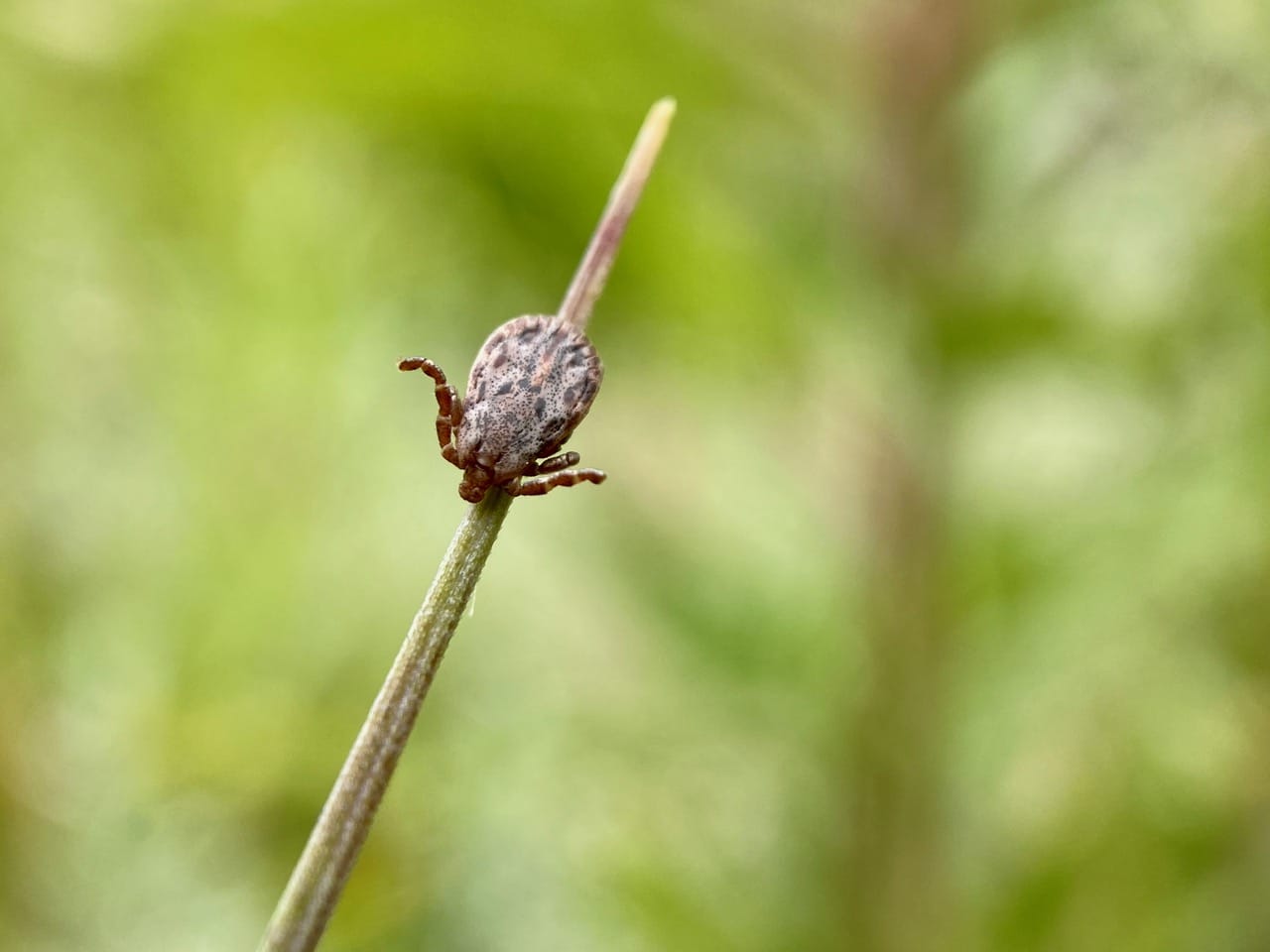
Yike, there’s a male Pacific Coast Tick, Dermacentor occidentalis (family Ixodidae) questing on the tip of a grass blade. And I thought I am safe from ticks in a botanic garden!
Ticks pick a place to wait by identifying well-used paths, resting on the tips of grasses and shrubs. They find their hosts by detecting animals’ breath and body odors, or by sensing body heat, moisture, and vibrations. Some species can even recognize a shadow. Ticks can’t fly or jump, but many species wait in a search position known as “questing”. Holding onto leaves or grass by their third and fourth pair of legs, they hold the first pair of legs outstretched, waiting to climb on to a passing host. When a host brushes the spot where the tick is waiting, it quickly climbs aboard. Recent research has shown that ticks are significantly aided by electrostatic forces (static electricity) when attaching to their hosts, allowing them to be passively attracted across air gaps to land on potential hosts due to the natural electrical charges animals accumulate on their bodies.
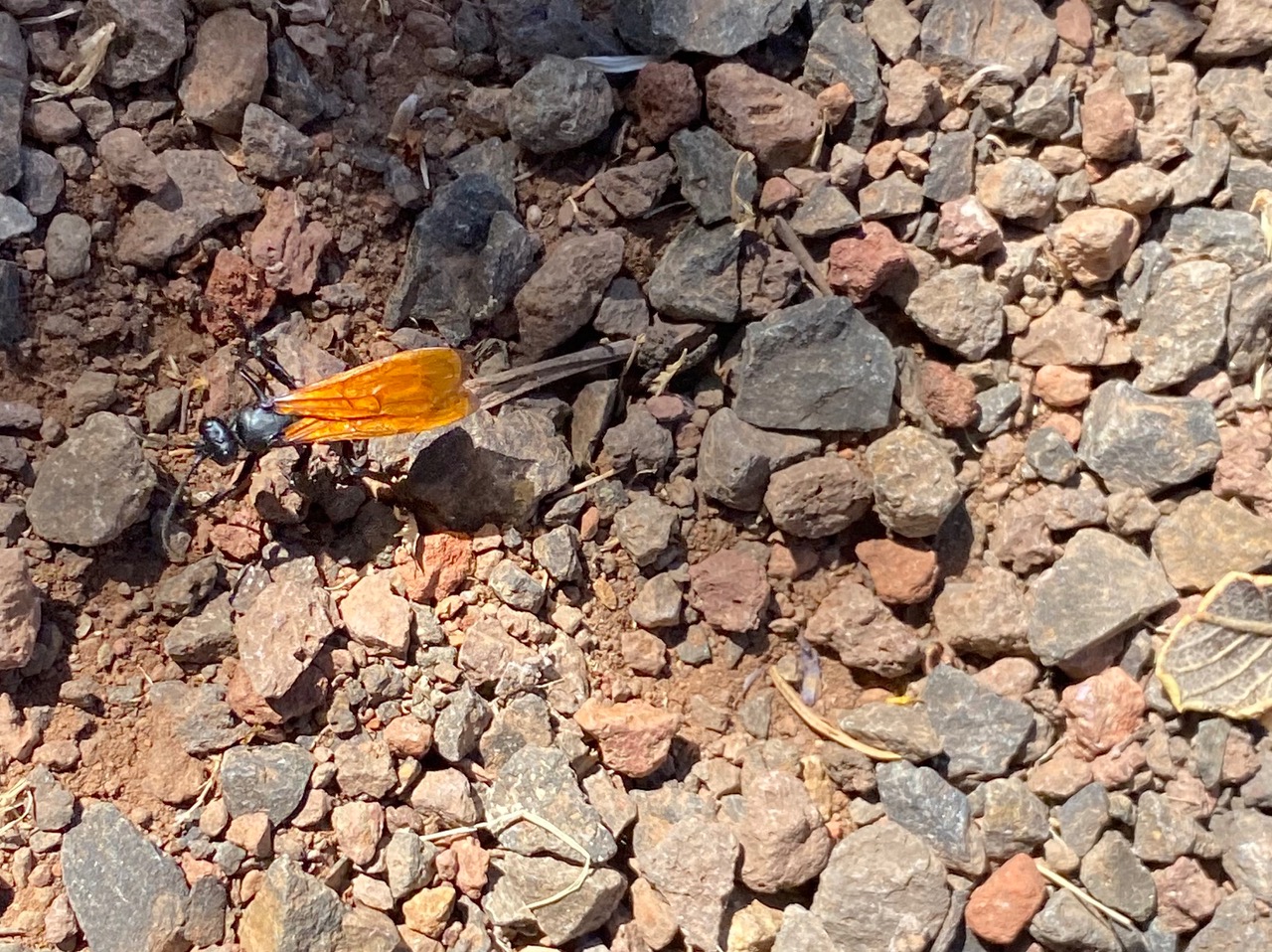
A large wasp with bright orange-red wings is running on the gravel mulch of a flower bed, peeking into every nook and cranny, seemingly looking for something. It is a Flamed Tarantula-hawk Wasp, Hemipepsis ustulata (family Pompilidae). Is it on the hunt for tarantulas?
A Tarantula Hawk is a spider wasp (family Pompilidae) that preys on tarantulas. They comprise several species in the genera Pepsis and Hemipepsis. Common species are up to 2 in. long, making them among the largest of wasps, and have blue-black bodies and bright, orange colored wings (Some species have black wings.) The bright colors advertise to potential predators the wasps’ ability to deliver a powerful sting, considered one of the most painful insect stings in the world.
The female tarantula hawk stings a tarantula between the legs, paralyzing it, then drags the prey to a specially prepared burrow, where a single egg is laid on the spider’s abdomen, and the burrow entrance is covered. When the wasp larva hatches, it penetrates the spider’s abdomen, and feeds on it from the inside, avoiding vital organs for as long as possible to keep the spider alive. The wasp larva pupates within the spider and eventually emerges as an adult to continue the life cycle.
The venom from the sting of a Tarantula Hawk can paralyze prey for several months; this paralysis is not directly fatal, but prey is likely to starve to death before the paralysis wears off. The sting of tarantula hawks has been described as “blinding, fierce, shockingly electric”. Mess with these wasps at your own peril!
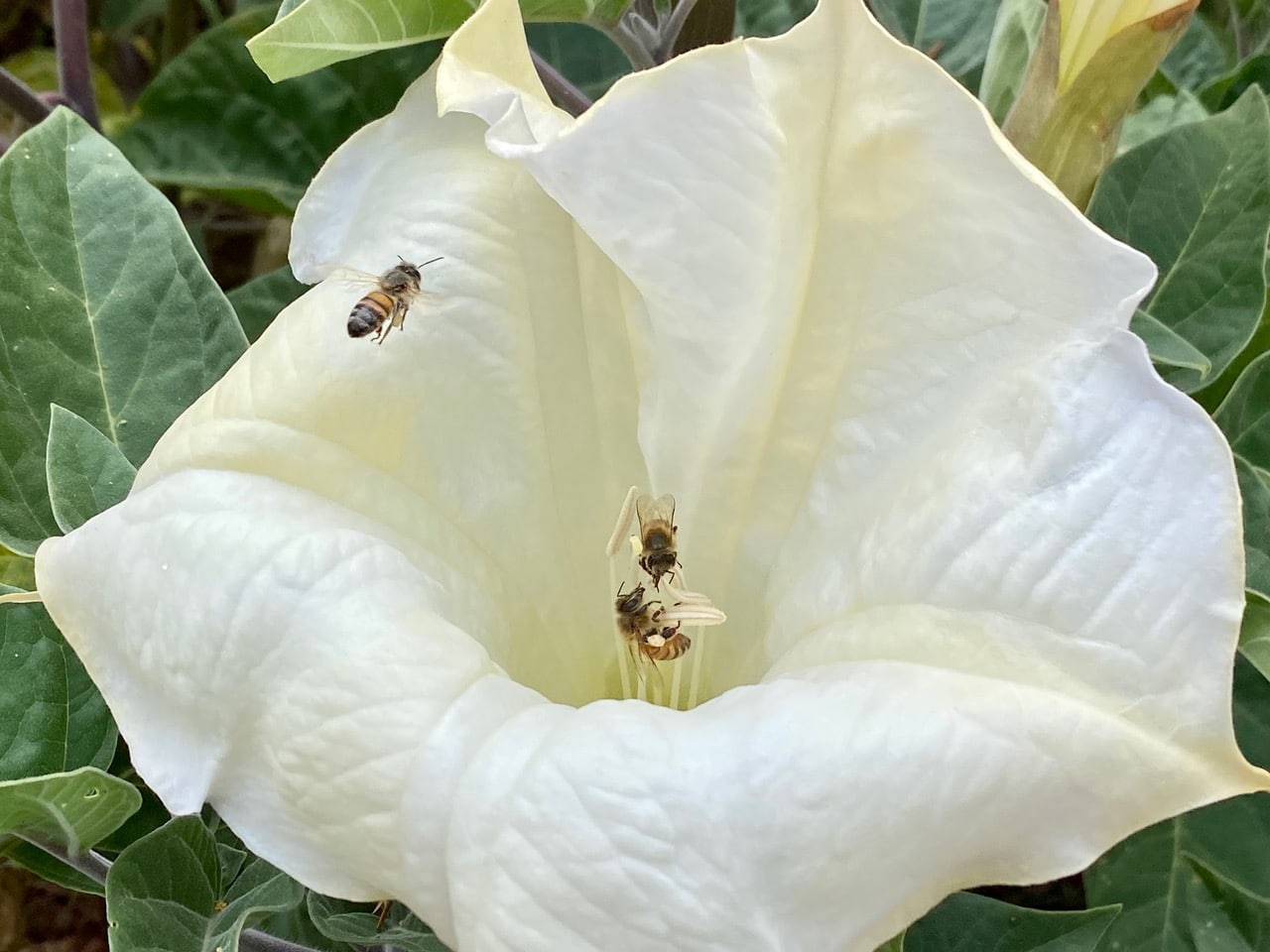
The Datura, in the garden is in full bloom. Still open in early morning, the large white fragrant flowers are eagerly visited by Honey Bees.
Datura is a genus of nine species of highly poisonous plants belonging to the nightshade family (Solanaceae). All species of Datura are extremely poisonous and psychoactive, especially their seeds and flowers. Datura flowers are typically large, trumpet-shaped, and fragrant, with a five-pointed rim. They are white or creamy, and open at night. Datura species, like Datura wrightii, have evolved to be primarily pollinated by hawk moths (family Sphingidae) which are nocturnal pollinators with long tongues that can reach the nectar deep within the trumpet-shaped flowers. These moths are attracted to the flowers’ strong, sweet fragrance and the nectar they offer. While probing for nectar with their long tongues, the moth’s wings and body may pick up pollen from the stamens located near the opening of the corolla. This can be transferred to the next flower’s stigma which protrudes beyond the stamens in most species.
Honey Bees, Apis mellifera (family Apidae) are also frequent visitors to Datura flowers, especially at the beginning and end of the day when hawk moths may be less active. Honey Bees forage on the anthers of Datura flowers, collecting pollen, and may transfer this pollen to other flowers, potentially leading to pollination.
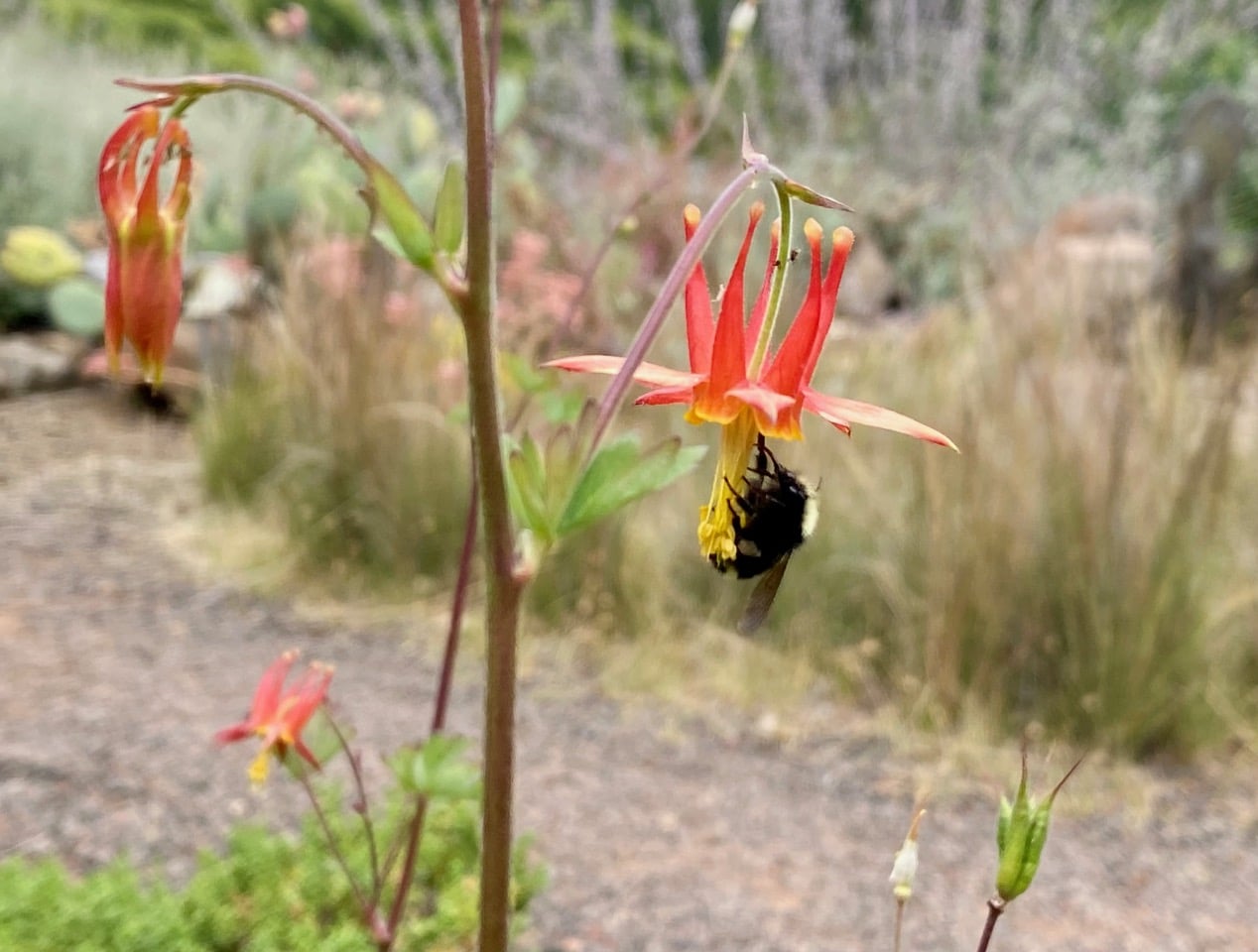
A Yellow-faced Bumble Bee, subgenus Pyrobombus (genus Bombus, family Apidae) has landed on the stamens of a Western Columbia Flower, Aquilegia formosa.
At first glance, a columbine flower looks like a Dr. Seuss creation. Closer inspection reveals it to possess the basic parts of a ‘standard flower’. Like all columbines, this species has a five-petalled flower with unusual “spurs” on the top. Each spur is formed by one of the five petals, curling into a cylinder as it rises. The lower ends of the petals join into a circle, within which are the yellow pollen-bearing stamens protruding beyond the corolla. Instead of being green as in most flowers, the sepals are red, and extend out at right angles when the flower opens. The filaments flex backwards as the anthers ripen to release pollen. The pistils (female parts) protrude beyond the anthers in older flowers to receive incoming pollen. Pollination of the flower requires long-tongued insects, such as a bumble bee. To access the nectar, the insect invariable makes contact with the stamens and pick up pollen on its body. Columbine flowers are also a popular source of nectar for the hummingbirds that can hover under the hanging flower without perching while nectaring. The birds can pollinate the flowers as pollen is often transferred from one flower to the next on their head and thorax.
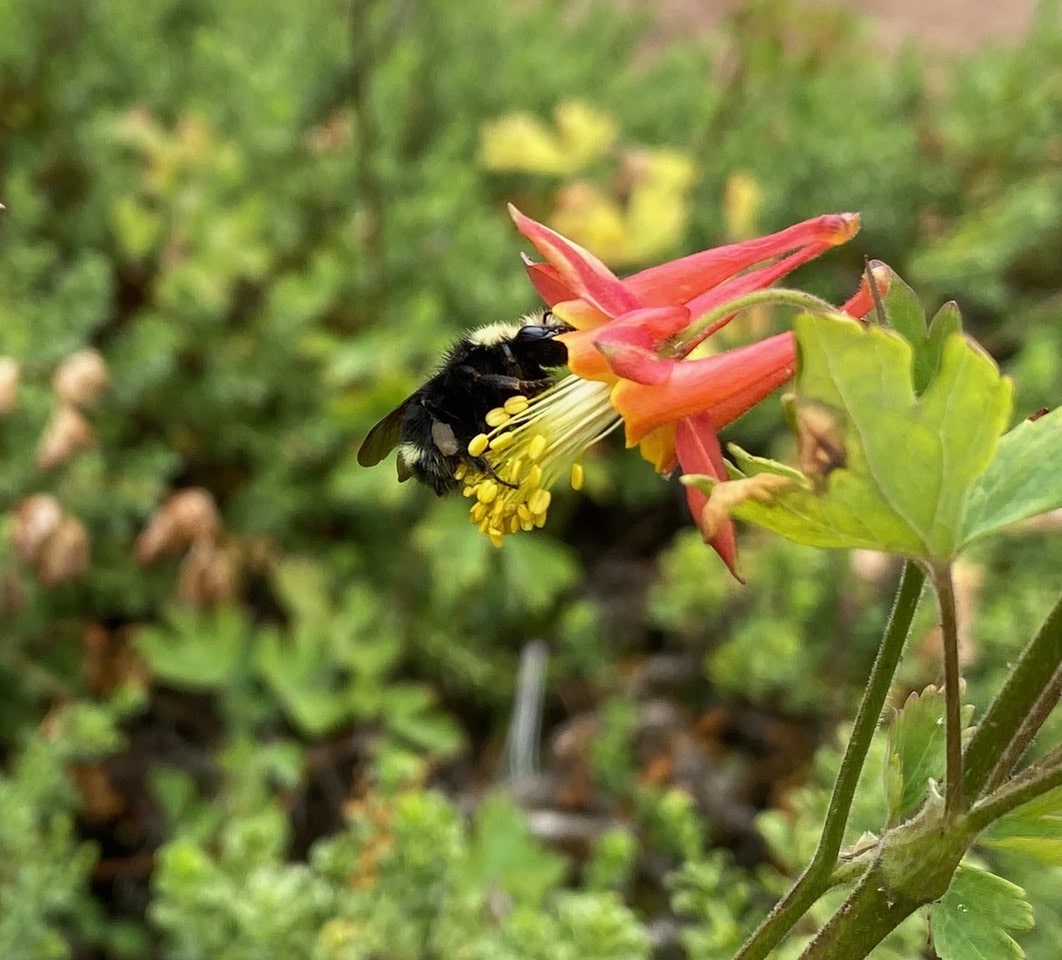
Her body wrapped around the protruding reproductive parts of the Columbine flower, a Yellow-faced Bumble Bee is sticking its long tongue into the corolla to access the nectar in one of the flower’s spurs.
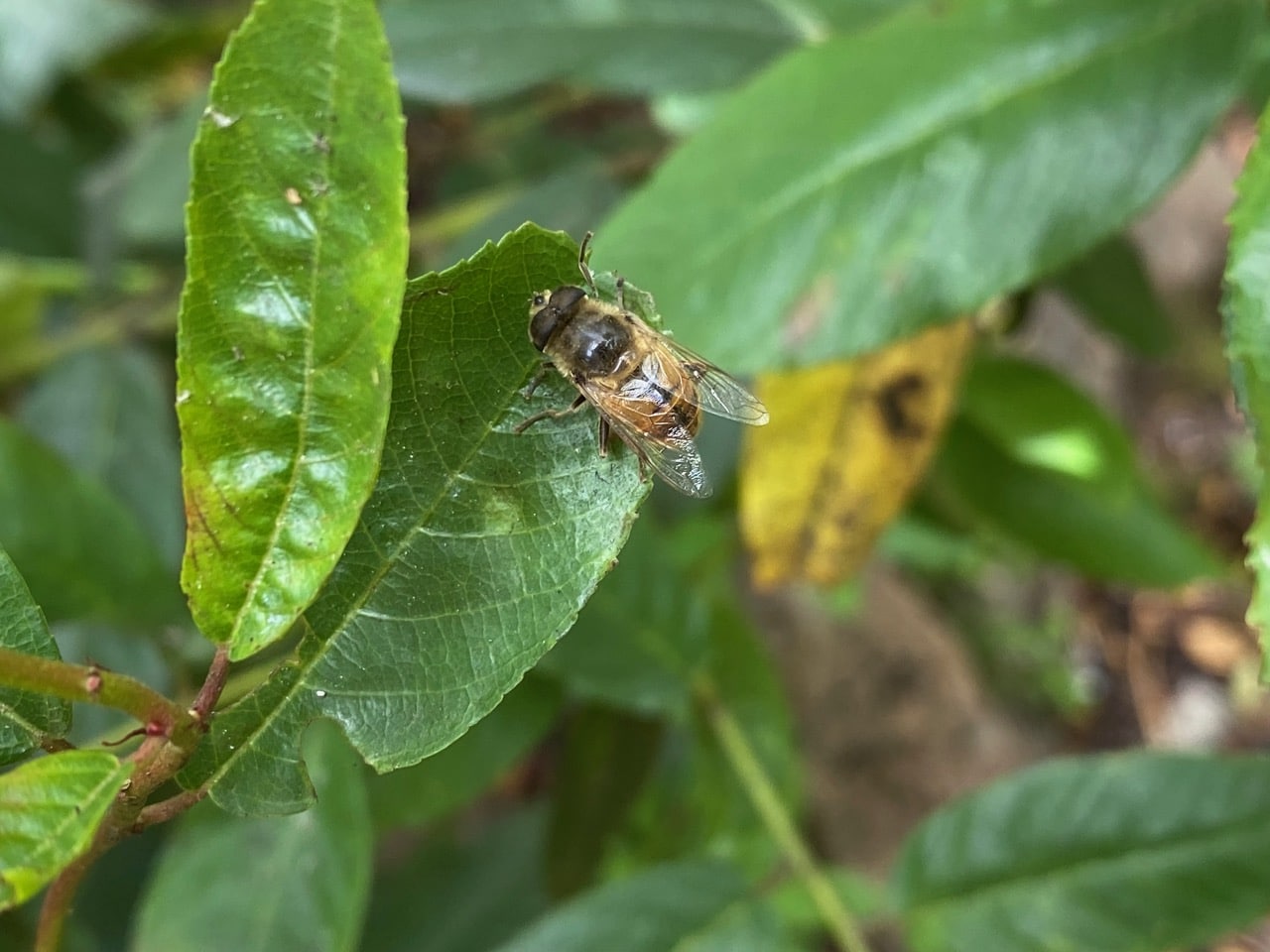
A Common Drone Fly, Eristalis tenax (family Syrphidae) is perched on a leaf of Coffeeberry in the shade, seemingly asleep.
Of all the hover flies, this species best mimics the Honey Bee. Why would a fly evolve to look like a bee? Any animal will think twice before attacking a bee because the bee can sting, and it can bring the wrath of the whole colony upon a predator. The fly is stingless and otherwise defenseless. This kind of mimicry is called Batesian Mimicry, after the English naturalist, Henry Walter Bates. Both the Honey Bee and the Drone Fly are originally from Europe. It makes sense that both insects evolved in the same place.
The Common Drone Fly, Eristalis tenax (family Syrphidae) is the most widely distributed Syrphid species in the world, occurring in all regions except the Antarctic. It was introduced into North America from Europe and is widely established. Adults visit flowers for nectar and pollen, and are significant pollinators. They are called drone flies because of their resemblance to a drone Honey Bee. The larva is aquatic. It has a siphon on its rear end that acts like a snorkel, helping it breathe under water. The siphon can be several times the length of the larva’s body, hence the common name, rat-tailed maggot. The larvae are saprophagous, feeding on bacteria in stagnant water rich in decomposing organic matter.
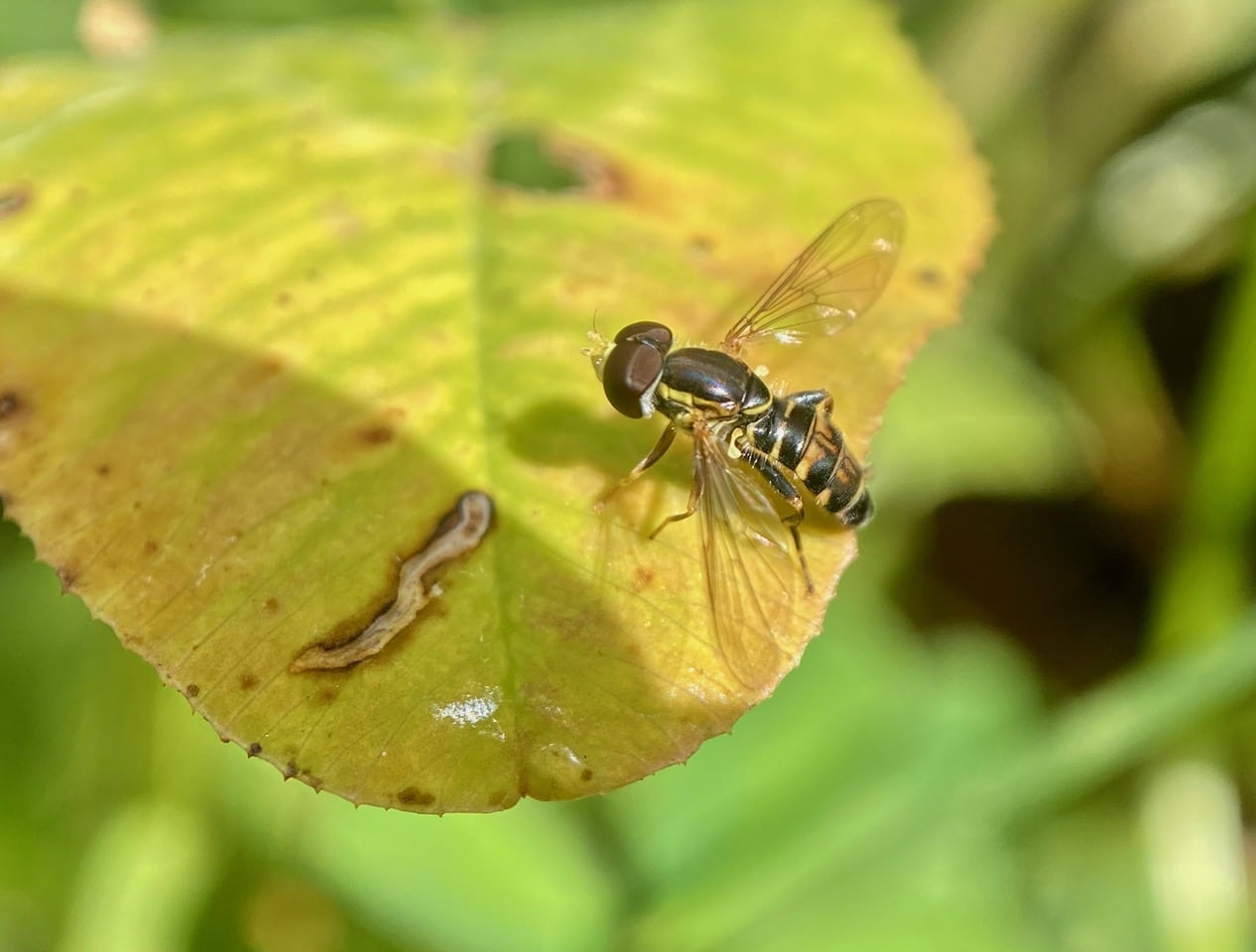
A male Western Calligrapher, Toxomerus occidentalis (family Syrphidae) has landed on a leaf of Coffeeberry.
Toxomerus is a very large genus of Hover Flies. They are found in North and South America. The majority of species are only 6-9 mm in length. They are notable for their mimicry of stinging Hymenoptera to avoid predators. Their unique abdominal patterns are diagnostic at the species level within the genus. There is marked sexual dimorphism – the females have a broader abdomen with lighter coloration and pattern. Most larvae feed on soft bodied insects, such as aphids; a few feed on pollen. Adults feed on the pollen of a wide range of flowers. A female can lay up to hundreds of eggs at a time and will place them where prey or pollen food sources are readily available. They can be found in a wide variety of habitats, often in dense ground cover.
The genus name Toxomerus comes from Greek toxon for ‘bow’ and meron for ’thigh’, referring to the bow-shaped hind femur. Colors vary with overall temperature during pupation: higher temperatures produce more yellow, while lower temperatures produce adults with darker markings.
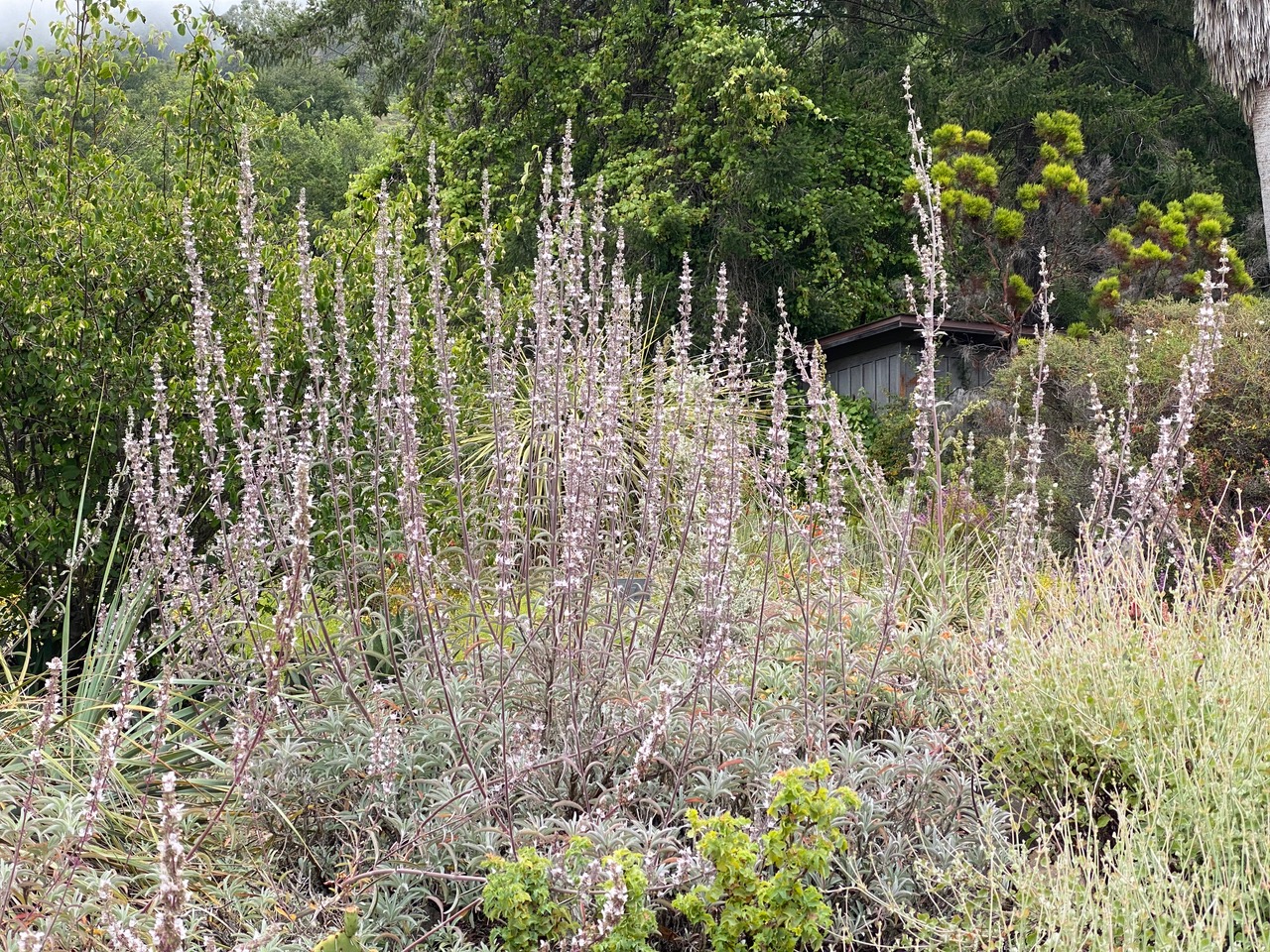
The White Sage, Salvia apiana is in glorious bloom, its tall flower spikes reaching for the sky.

Its tongue extended, a Yellow-faced Bumble Bee, subgenus Pyrobombus (genus Bombus, family Apidae) is taking nectar from a flower of White Sage, Salvia apiana.
The White Sage, Salvia apiana has an unusual flower structure, and undergoes protandrous development (with the male parts maturing before the female parts). In the male phase, the enlarged and frilled lower lip folds back and up, completely obscuring the small upper lip, and blocking the throat of the flower and the nectar source. Only a large insect, such as a Carpenter Bee or a Bumble Bee, is heavy enough to depress the lower lip of the corolla and open the path to the nectar. As the lip is depressed and the bee collects the nectar, the long stamens pivot inward to deposit pollen on the back or side of the insect. Since the stamens mature before the pistil, a pollen-dusted bee must approach another, more mature flower, before encountering a fertile pistil. Smaller pollinators may visit white sage but rarely do they obtain nectar or contact pollen on the young flowers. Thus, Salvia apiana limits its pollination to an exclusive set of pollinators – the heavy-bodied bees. Eventually as the flower matures into the female phase, the lower lip is lowered to offer free access to the nectar at the base of the flower; the long, forked style extends forward to receive incoming pollen on its stigmatic surface.

By its sheer weight, the bumble bee has lowered the lower lip of the White Sage flower when it lands, opening up access to the nectary.
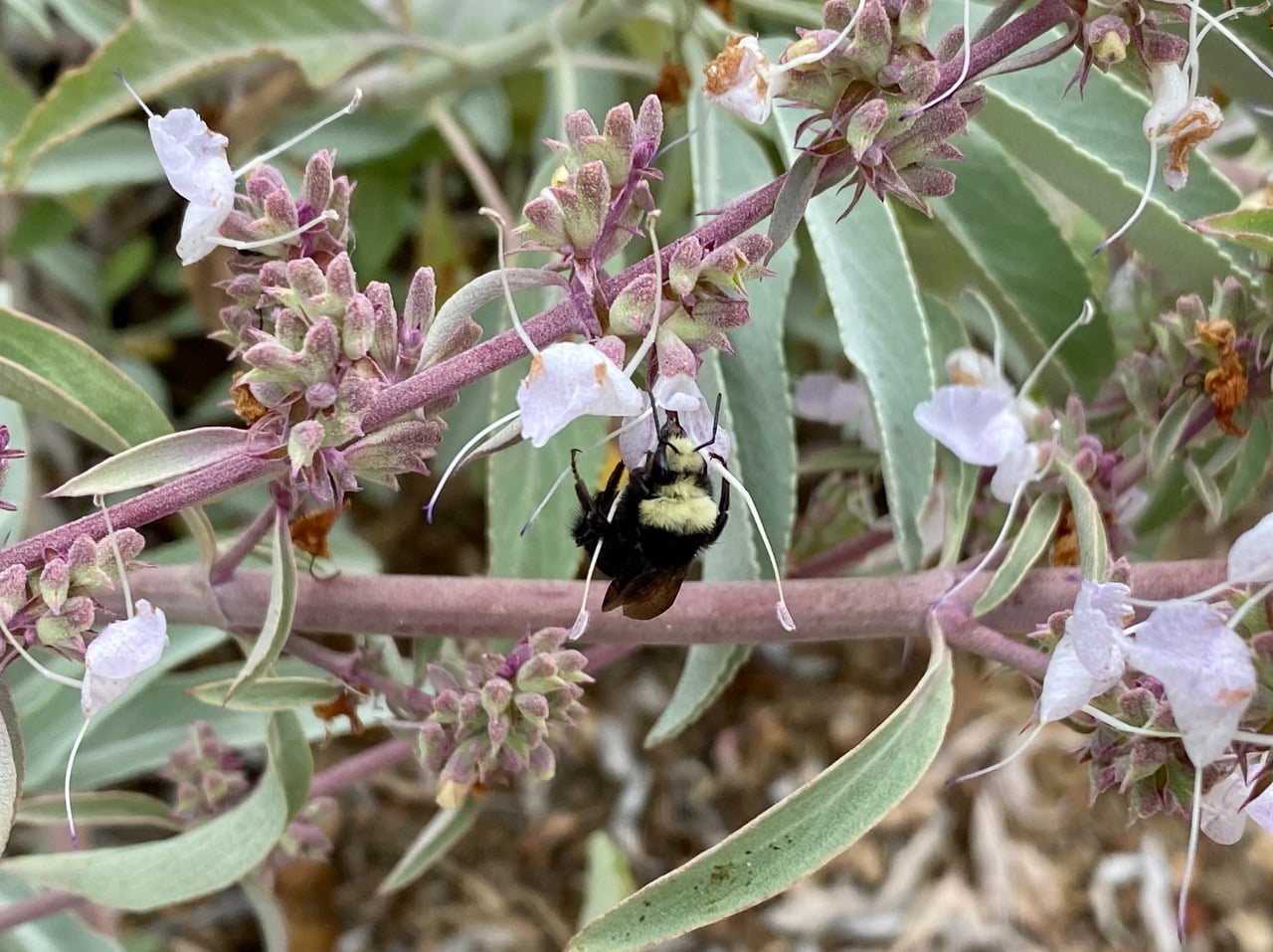
A Yellow-faced Bumble Bee is taking nectar from a White Sage flower. The tiny upper lip of the flower is visible in this view.
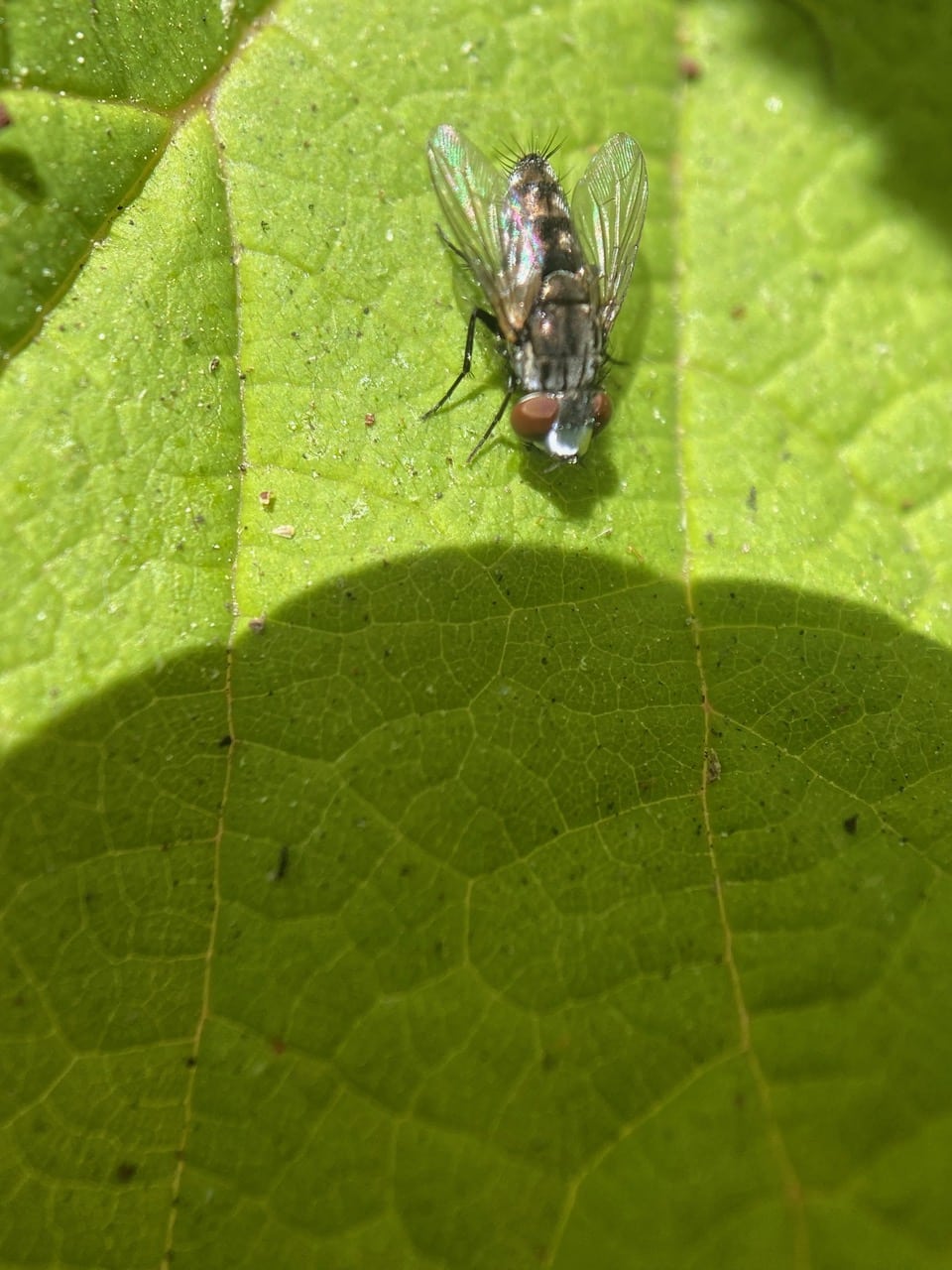
A small fly with a white snout caught my attention. iNaturalist has helped identify it as a Satellite Fly, Metopia sp. (family Sarcophagidae)
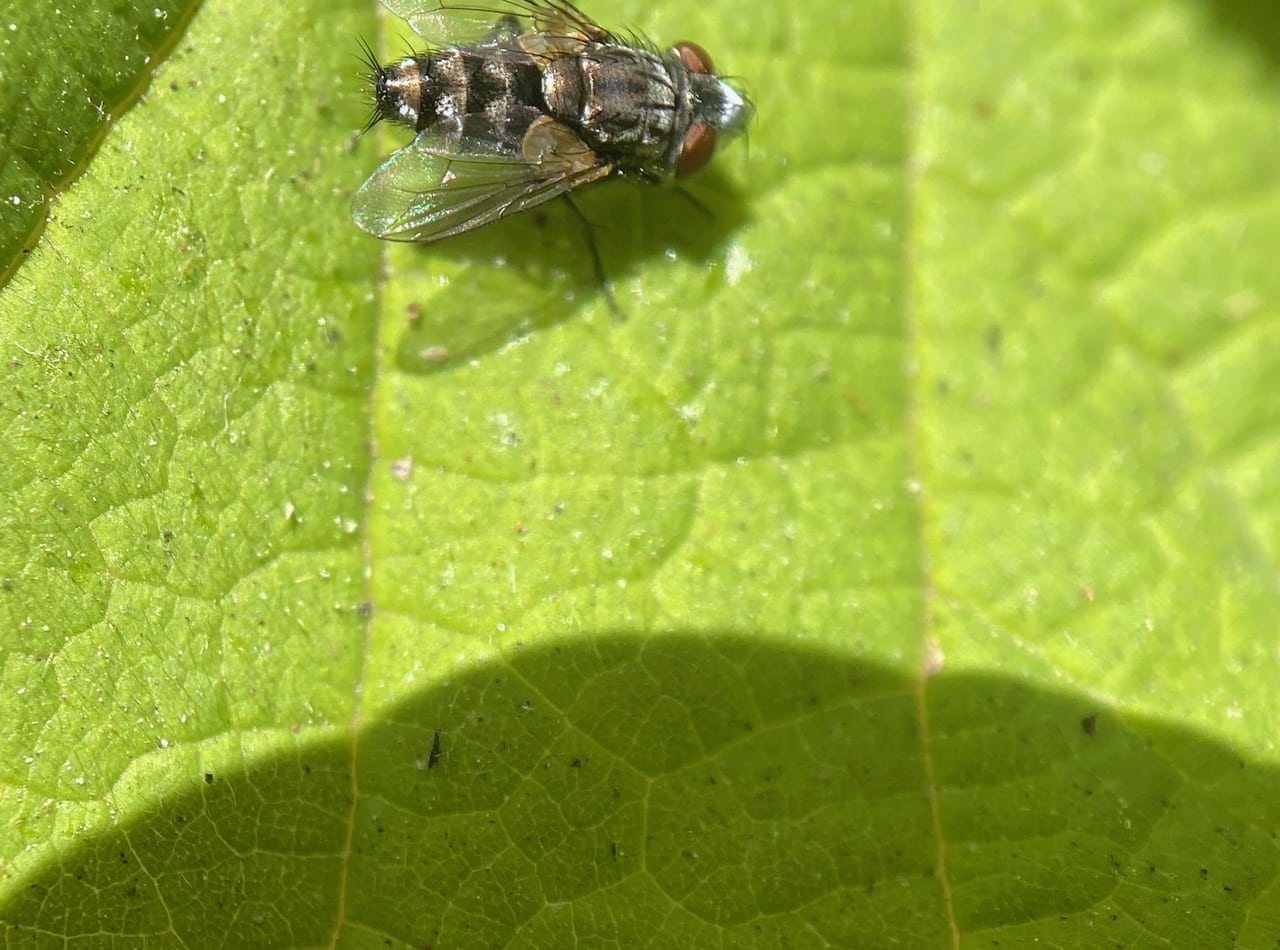
Members of the family Sarcophagidae are commonly called Flesh Flies. Many have black and gray longitudinal stripes on the thorax and checkering on the abdomen, red eyes, and a bristled abdomen sometimes with a red tip. They differ from most flies in that they are ovoviviparous, opportunistically depositing hatched or hatching maggots instead of eggs on carrion, dung, decaying material, open wounds of mammals, hence their common name. The adults mostly feed on fluids from animal bodies, nectar, sweet foods, fluids from animal waste and other organic substances. While we may find their habits revolting, Flesh Flies perform important roles in the ecosystem – the larvae as decomposers/recyclers, and the adults as pollinators.
Metopia is not your ordinary Flesh Flies (family Sarcophagidae). Its larvae occupy a special niche. As kleptoparasites, they develop in the nests of bees and wasps, feeding on the provisions that the females have prepared for their own young. The female Metopia enters the nest of its host to deposit its larvae. Females of some Metopia species have a prominent silvery snout.
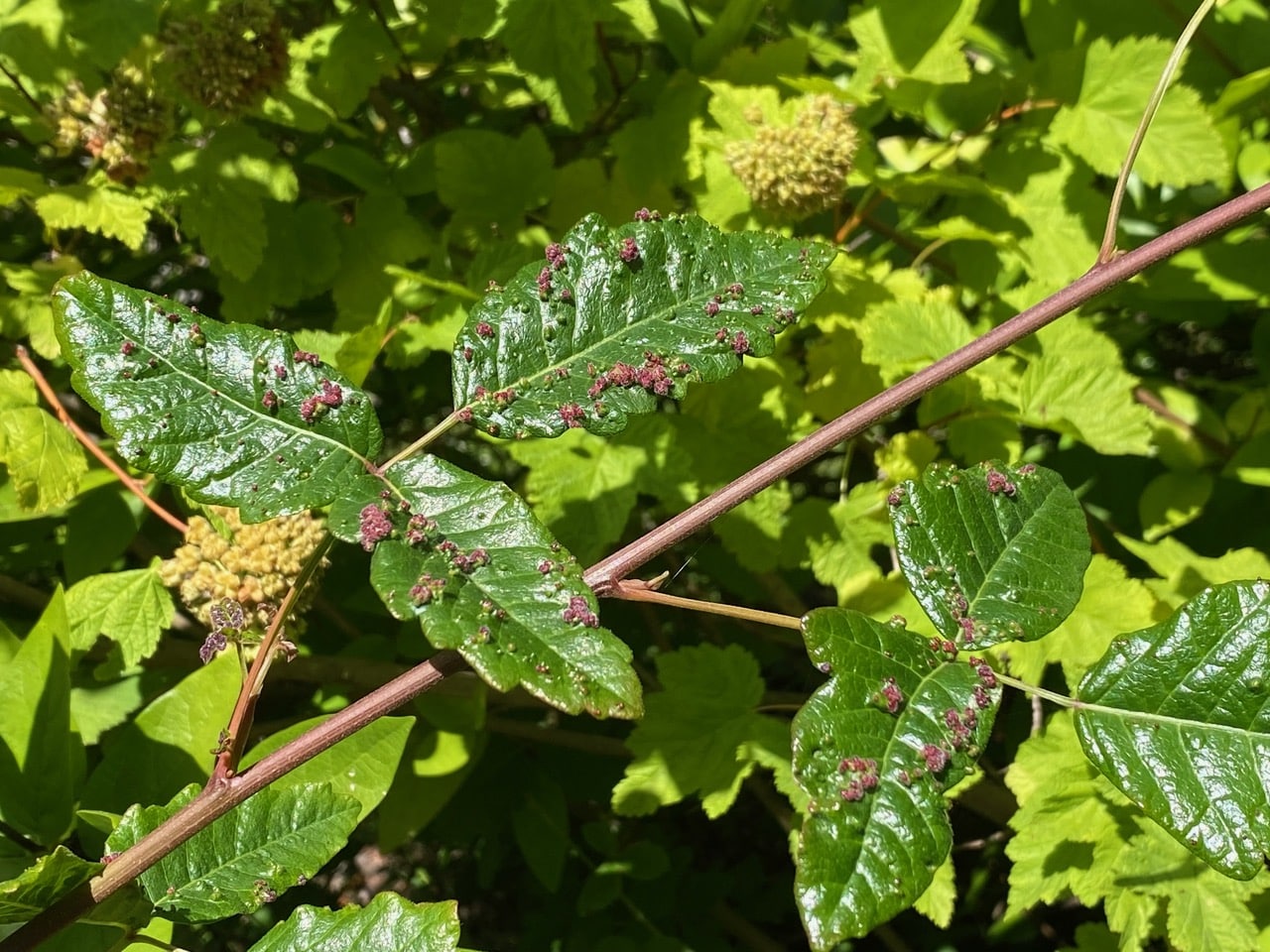
The leaves of that Poison Oak are covered with irregular red bumps. Poison Oak with a rash? One has to chuckle at the poetic justice.
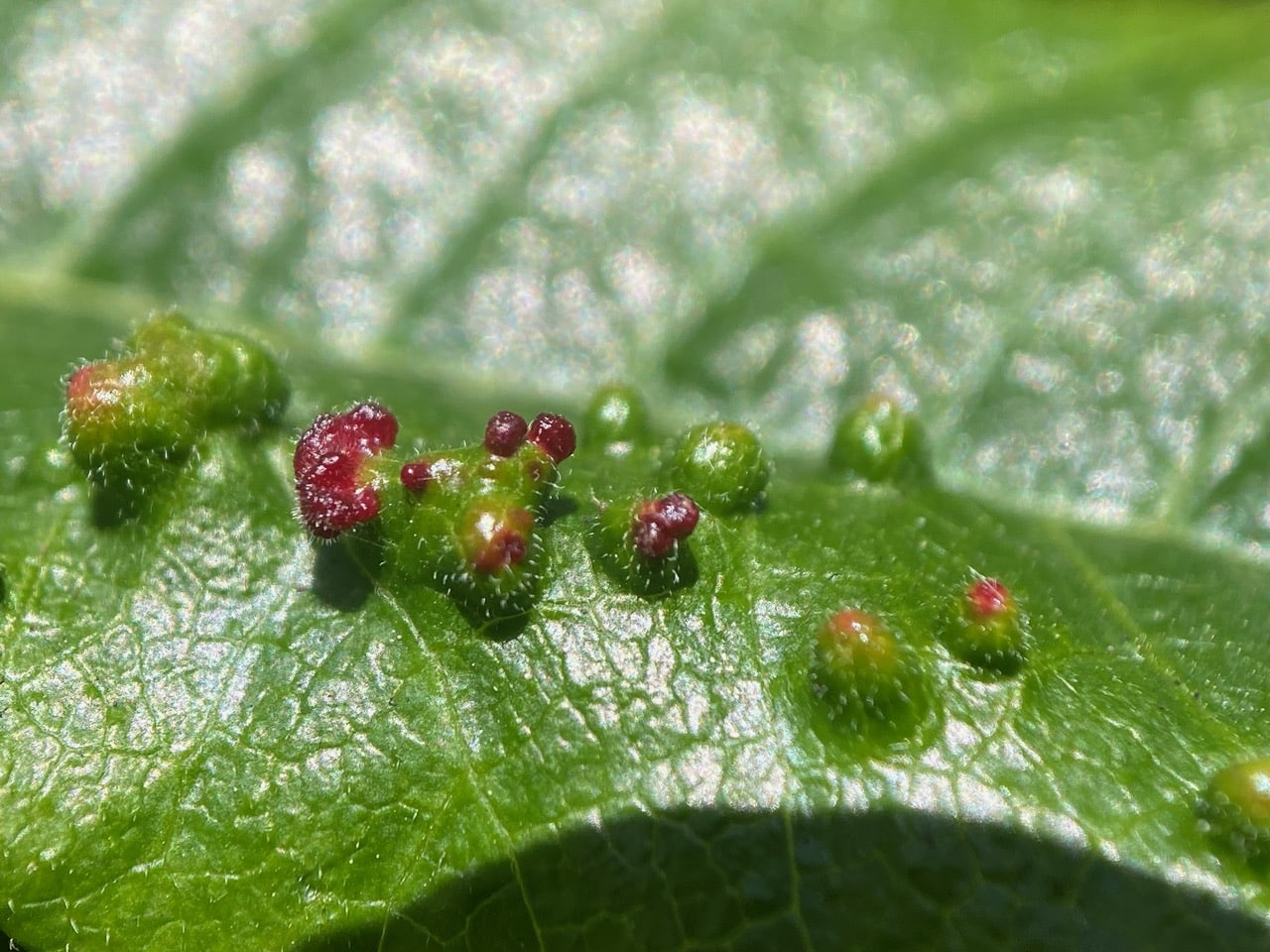
Close-up of the unsightly growths on the Poison Oak leaf shows that they first erupt as tiny green bumps on the upper surface of the leaf.
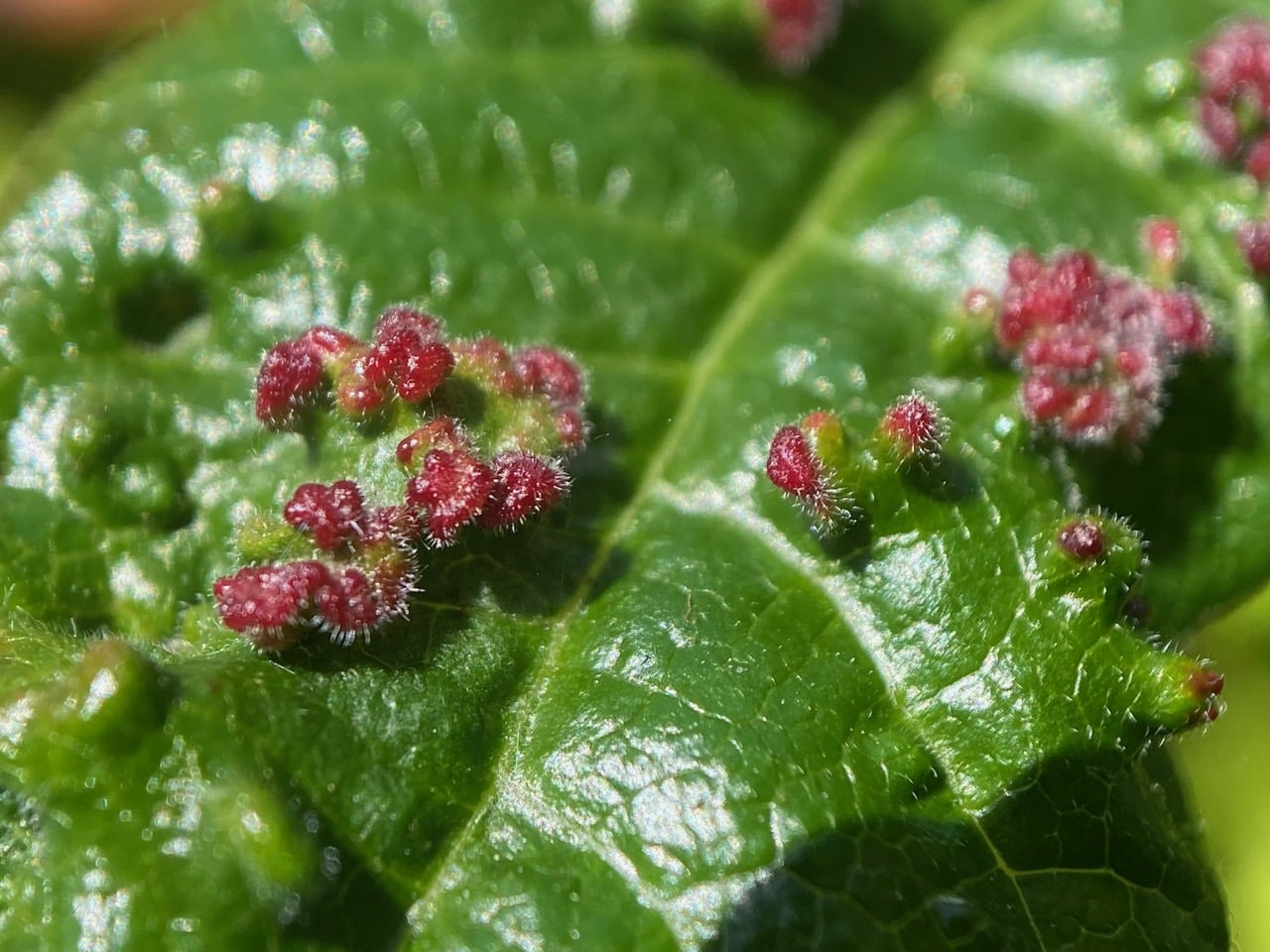
The wrinkled red growths are covered with short white hairs. These growths are leaf galls induced by Gall Mites in the family Eriophyidae.
Eriophyid Mites are microscopic mites that often go undetected. Unlike most adult mites that have four pairs of legs, eriophyid mites have only two pairs. They are slow-moving, usually white or yellow in color, and have a distinctive “carrot” shape. They are very host-specific. Most eriophyid mites make their home on the surface of leaves where their feeding can cause bronzing or reddening but some are also responsible for creating galls on leaves or witches’-broom on stems and flower buds. Adult females overwinter in cracks and crevices of twigs and bud scales. Females lay eggs in the spring. The young mites that hatch out resemble the adults. Numerous generations are produced each year. They are primarily spread by wind.
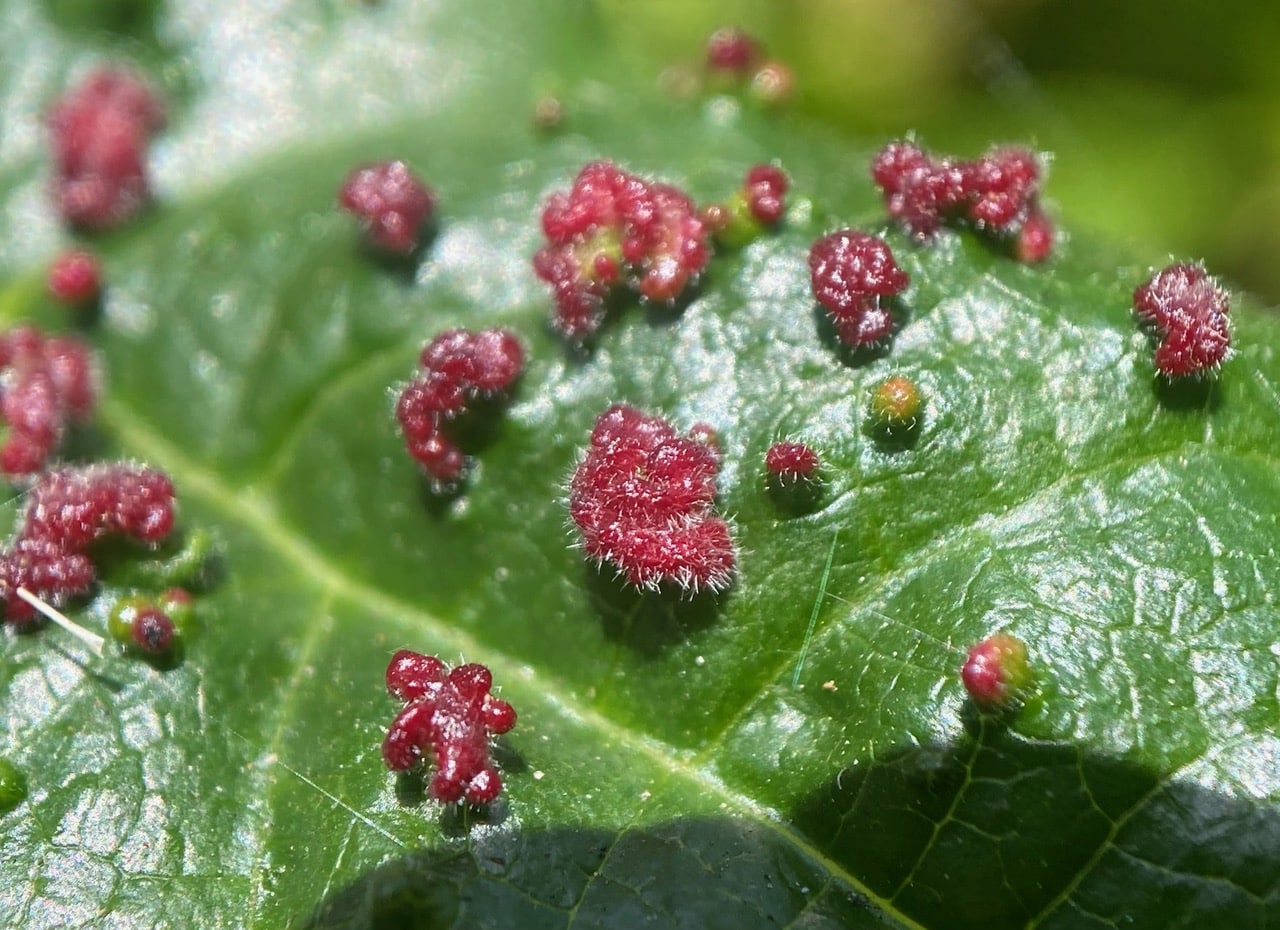
Just the sight of these galls is itch-inducing!