

Pollinator Post 7/6-7/25 (1)
It’s time to visit the Regional Parks Botanic Garden again.
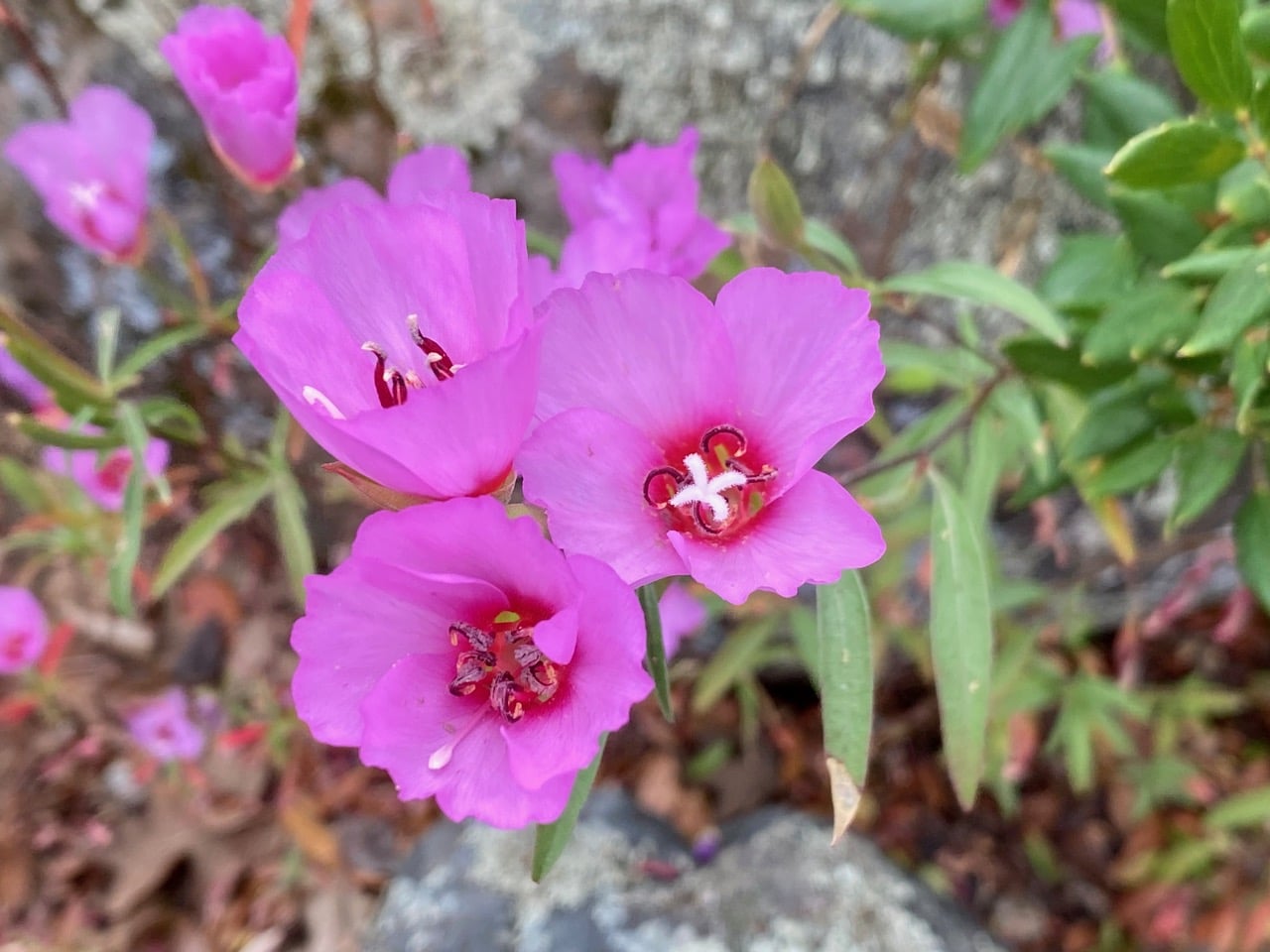
The large stand of Ruby Chalice Clarkia, Clarkia rubicunda is in peak bloom. Why do these three flowers from the same plant look so different? That’s because the reproductive parts of the Clarkia flower undergo visible changes, progressing from a male to a female phase. The flower on the upper left is the youngest, with immature anthers. Next in maturity is the flower on the lower left. The eight anthers have dehisced, curling back to release purplish pollen. This is the male phase. The immature stigma and style (female parts) appear as a Q-tip-shaped structure. The flower on the right with the prominent white, 4-lobed stigma is in its final, female phase, ready to receive incoming pollen. By this time, the stamens are spent, with little pollen left. The temporal separation of the male and female parts is a plant’s way of avoiding self-pollination. This is called dichogamy. When the male phase precedes the female phase, the condition is called protandry. When the female phase comes first, the phenomenon is called protogyny (“female first”). Clarkia is a classic protandrous flower.
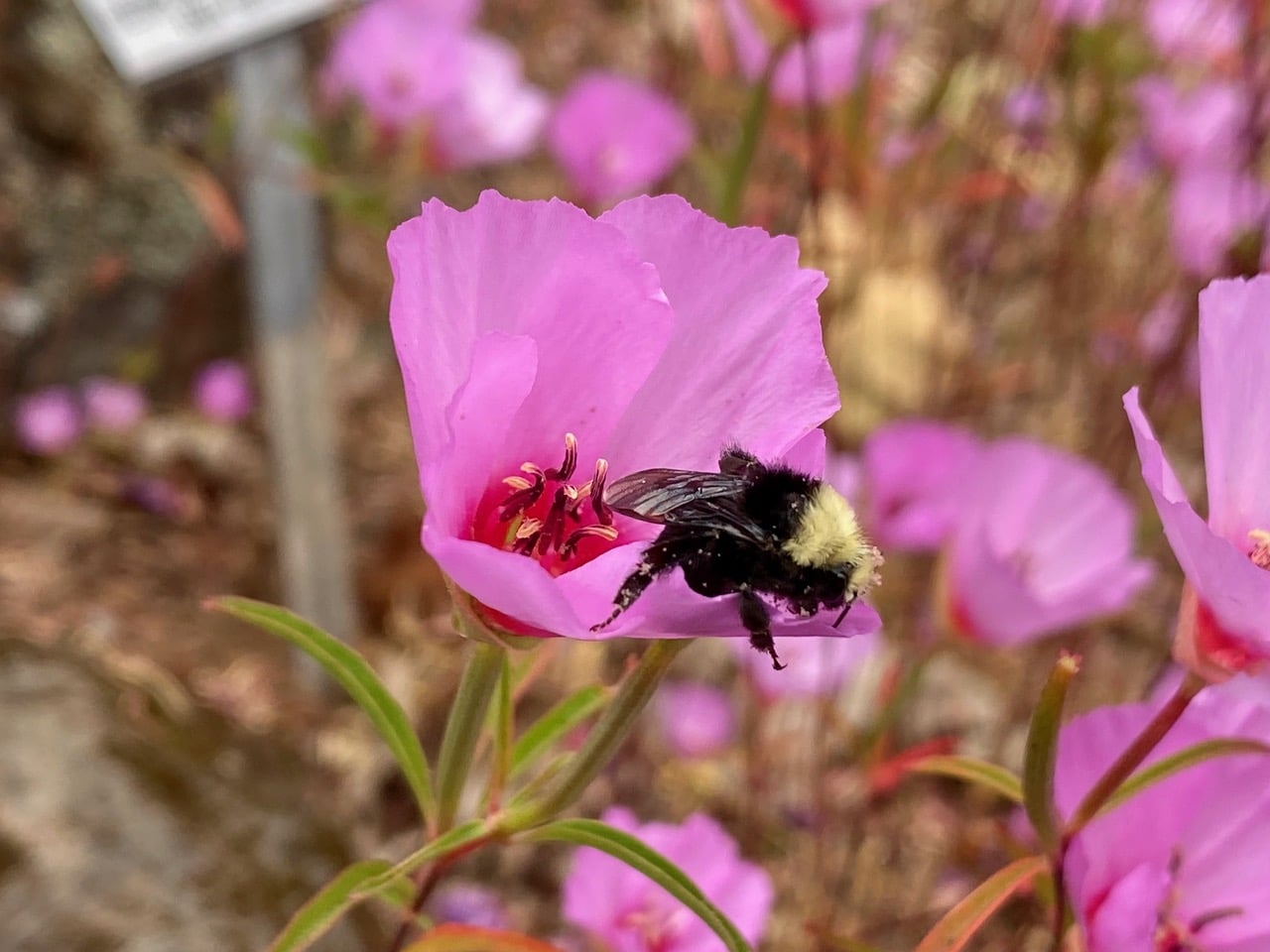
Its furry body speckled with pollen, a Yellow-faced Bumble Bee, subgenus Pyrobombus (genus Bombus, family Apidae) is hanging out on a Clarkia petal, still asleep. Has it been spending the night in the flower, safe from the elements, only to be exposed when Clarkia opens again. Why hasn’t this bee returned to its hive last night? In early mornings, when Clarkia flowers are just beginning to reopen for the day, it is not uncommon to find bees still sleeping in the partially closed flowers.

The Tall Evening Primrose, Oenothera elata (family Onagraceae) is blooming in profusion.
The Tall Evening Primrose, Oenothera elata is usually biennial, completing its life cycle in two growing seasons. It can reach 6 feet in height. Native to California, it is found along roadsides, in moist meadows, or in woodland. At the top of reddish stems are open clusters of 2-4 inch wide yellow flowers with 4 large petals and protruding yellow stamens and 4-branched pistil. The fragrant flowers open at dusk and close up during mid-morning the next day, turning orange with age.
The flowers of Evening Primrose open at night and have most of the characteristics associated with night-pollination by moths: they are large with nectar glands at the bottom of a deep flower cup, and their reproductive parts extend beyond the petals. The pale flowers are visible to night-pollinators; they are also sweetly scented as an additional guide at night. Pollinators brush against the reproductive structures when they go into the base of the flower after nectar. Sphinx moths are the most significant pollinators for the evening primrose that bloom at night. Their long tongues enable them to reach the nectar deep within the flower. As they feed, pollen is transferred from one flower to another. Oenothera elata is also pollinated by specialist bees active at dawn and dusk such as the twilight-foraging Evening Primrose Sweat Bees. These bees have evolved specialized hairs on their legs to collect the distinctive stringy pollen.

Note the stringy pollen hanging from the large anthers. The pollen grains are strung together with viscin threads.
Viscin threads are thread-like structures composed of sporopollenin, a tough, resilient material also found in the outer layer of pollen grains (exile). These threads are produced by some plants, notably within the Onagraceae and Ericaceae families, and they bind individual pollen grains together and also help them adhere to pollinators. The threads are not just sticky, but also exhibit a cobweb-like quality, making them difficult to handle.
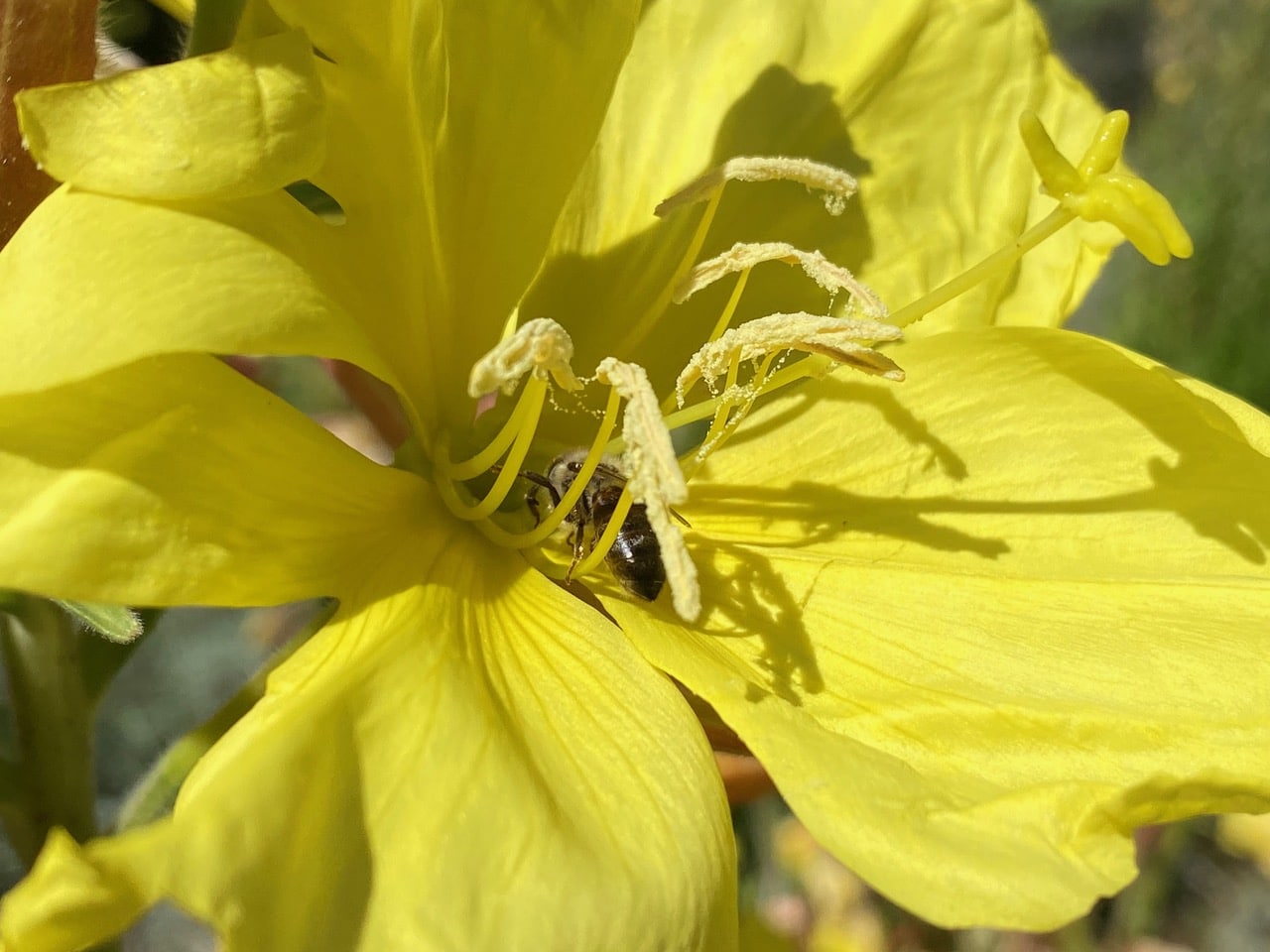
A dark Honey Bee, Apis mellifera (family Apidae) is seeking nectar at the base of the Tall Evening Primrose flower.
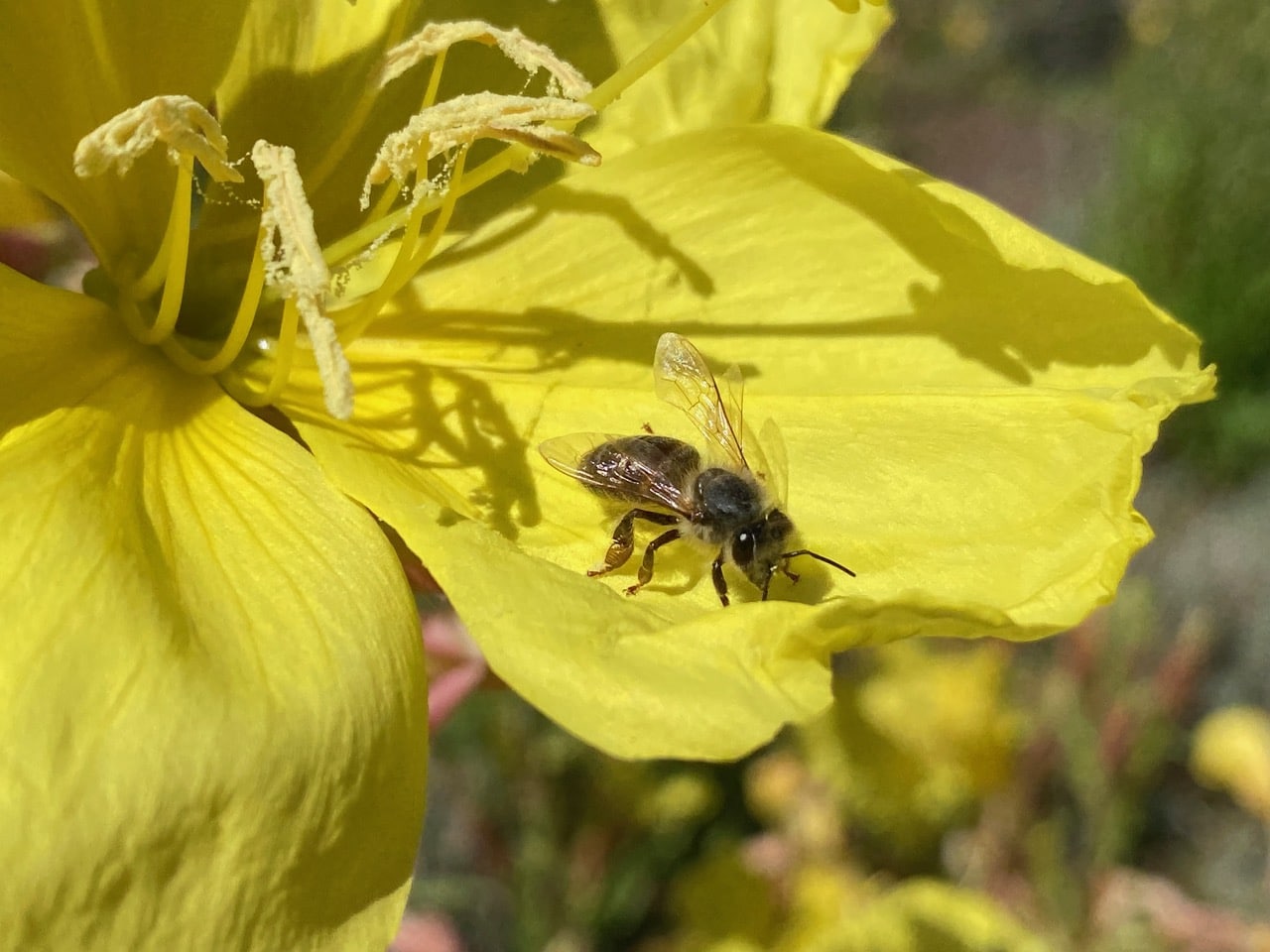
The bee exits the flower carefully, lucky not to have touched the sticky, cob-webby pollen.
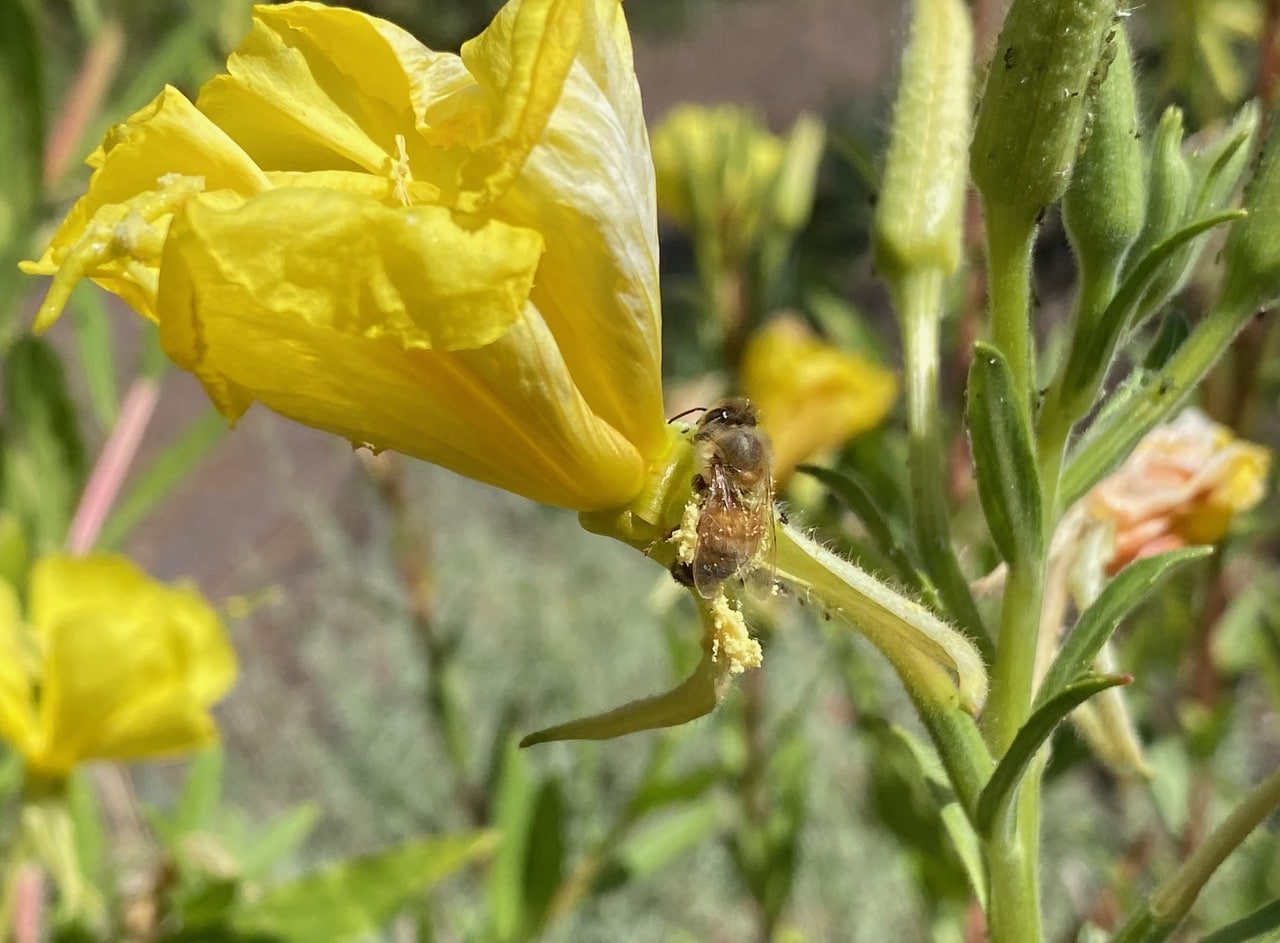
Other Honey Bees are not so lucky. Many come away mired with the sticky pollen, hardly able to fly.
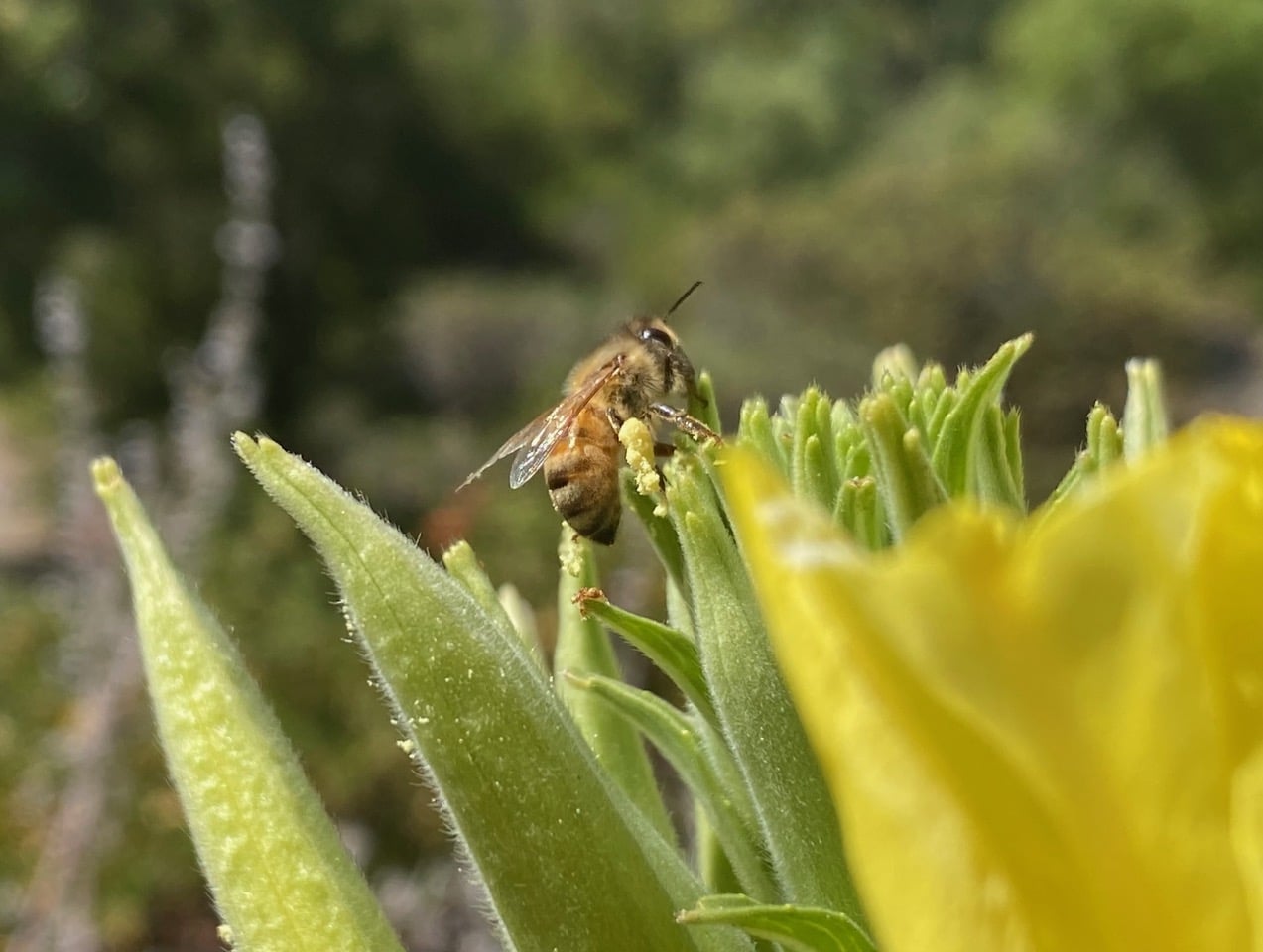
This Honey Bee is trying to groom itself of the sticky, stringy pollen after visiting an Evening Primrose flower. Nectar comes at a high price for these bees, who are essentially nectar thieves. Since the reproductive parts of the large flower are set far apart, it is unlikely that small insects can transfer the pollen from the anthers to the stigma of another flower for effective pollination.

Ooh, the spaces between the flower buds of this Tall Evening Primrose is densely populated with green aphids of different sizes and ages.
Aphids (family Aphididae) are small sap-sucking insects in the order Hemiptera. Aphids usually feed passively on phloem of plants. Once the phloem vessel is punctured, the sap, which is under pressure, is forced into the aphid’s food canal. Aphids produce large amounts of a sugary liquid waste called “honeydew”. A fungus called sooty mold can grow on honeydew deposits that accumulate on leaves and branches, turning them black.
A typical life cycle involves flightless females giving live birth to female nymphs, – who may also be already pregnant, an adaptation called telescoping generations – without the involvement of males. Maturing rapidly, females breed profusely so that the population multiplies quickly. Winged females may develop later in the season, allowing the insects to colonize new plants. In temperate regions, a phase of sexual reproduction occurs in the autumn, with the insects often overwintering as eggs. The life cycle of some species involves an alternation between two species of host plants. Some species feed on only one type of plant, while others are generalists, colonizing many plant groups. Some ants have a mutualistic relationship with aphids, tending them for their honeydew and protecting them from predators.
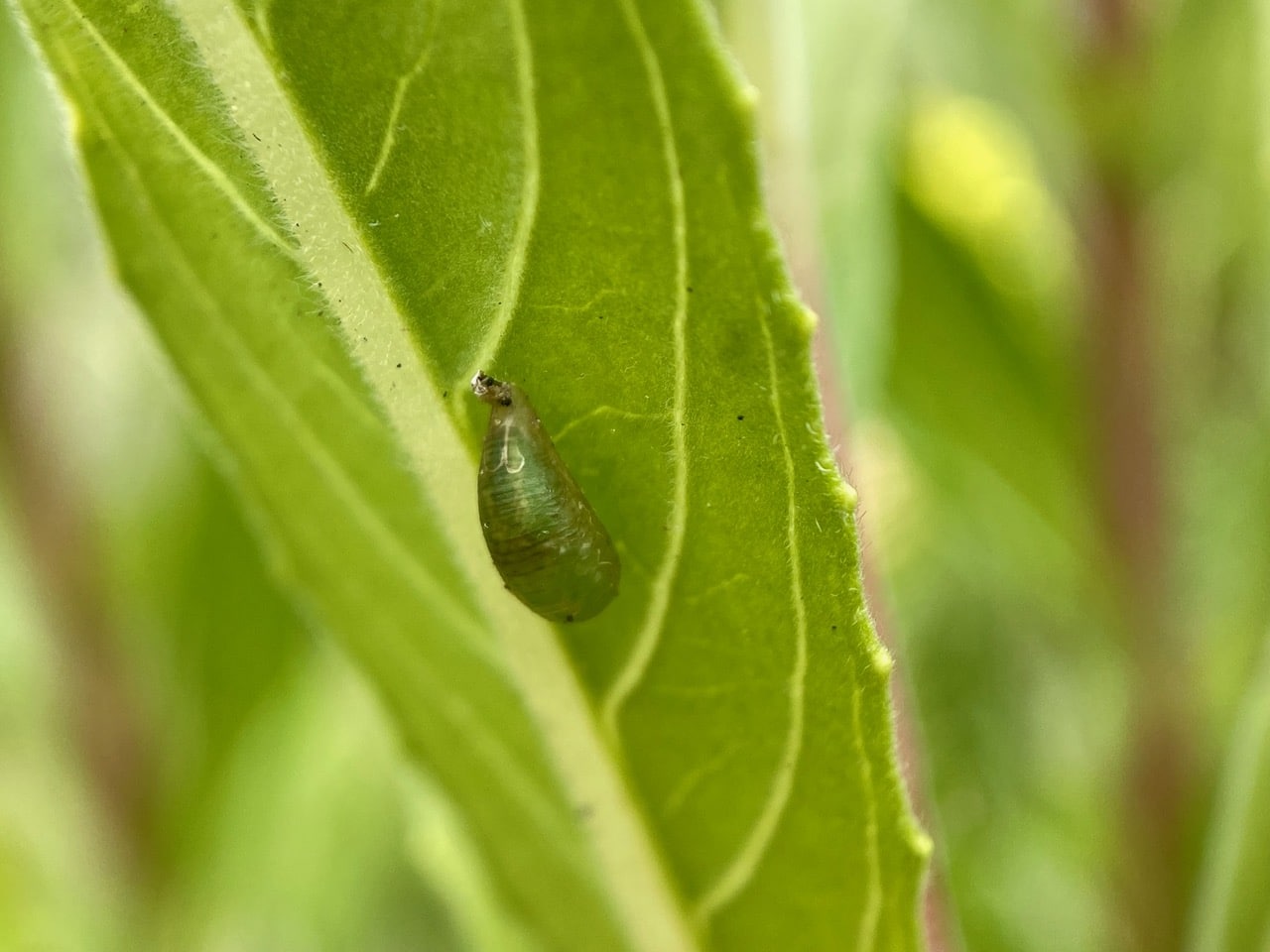
There is a green, teardrop-shaped structure attached to the underside of a leaf of the same plant. And no wonder – it’s a hover fly pupa! Many specie of hover flies (family Syrphidae) have aphidophagous larvae (that eat aphids). The females seek out aphid colonies on plants to lay their eggs, to ensure that the young will have plenty to eat. The larvae eventually transform into immobile pupae attached to plant parts. Eventually the pupa will turn brown, and the adult will emerge from the broad end of the pupa case, head-first.

Ooh, I wonder what species this Barberry is – I have never seen fruits this color!
Barberry fruits are small, oblong berries, typically bright red, although some varieties may be dark blue or purple. Some species may have a pink or violet waxy surface bloom. The fruit contains 1-3 small, black seeds. The fruits are known for their tart, acidic flavor and are often used in culinary applications like jams, jellies, and sauces. Barberry fruits, as well as the bark, roots, and stems, have a long history of use in Traditional Chinese Medicine and Ayurvedic medicine. They are known for their active ingredient, berberine, which has potential benefits for blood sugar, blood pressure, and other health concerns.
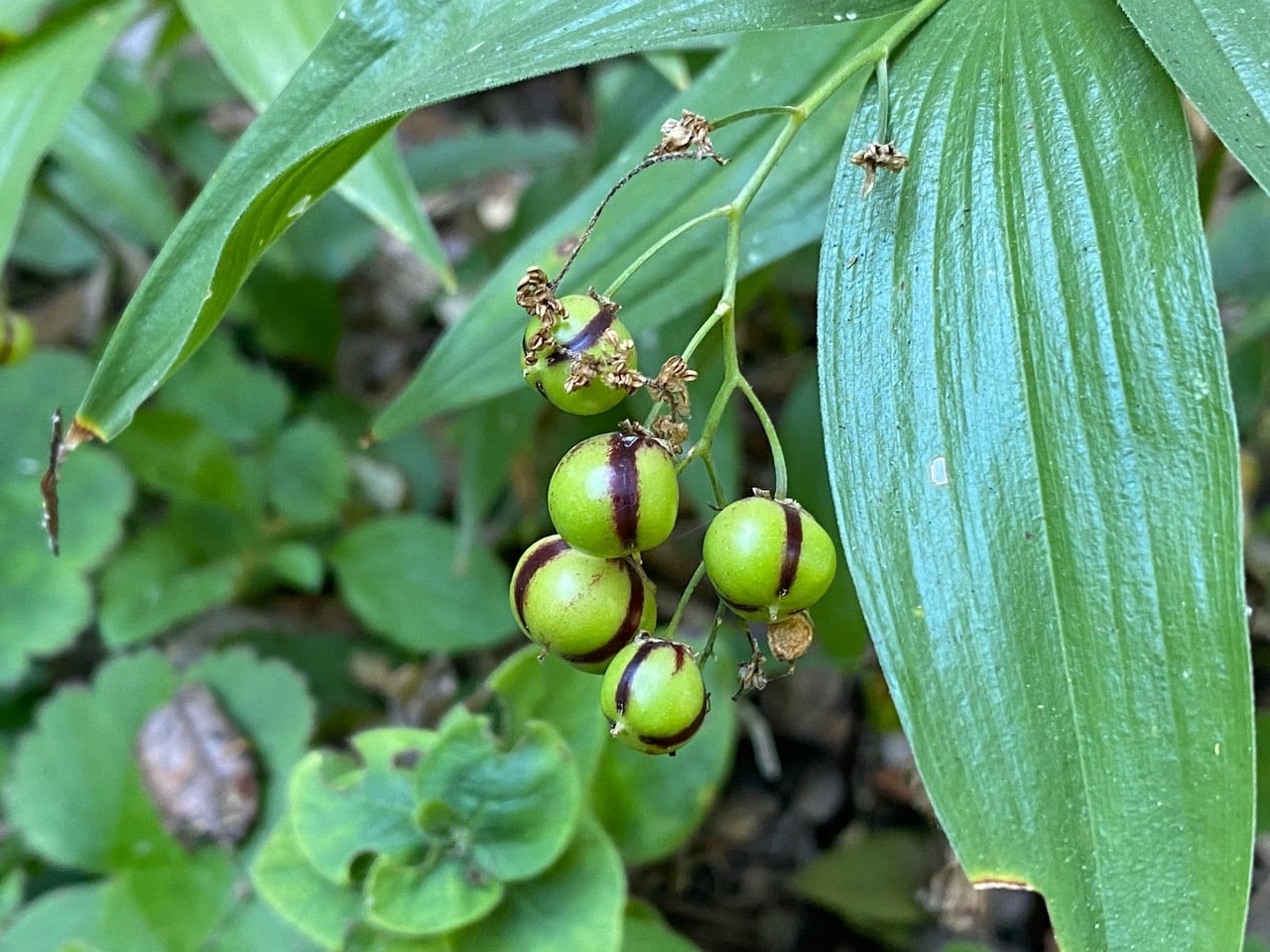
Close by in the shade, the Star-flowered Lily-of-the-Valley (formerly False Solomon Seal), Maianthemum stellatum has gone to fruit. I love these whimsical green berries with vertical maroon stripes. Eventually they turn red-purple to black at maturity. The fruits are eaten by numerous bird species, as well as small rodents.
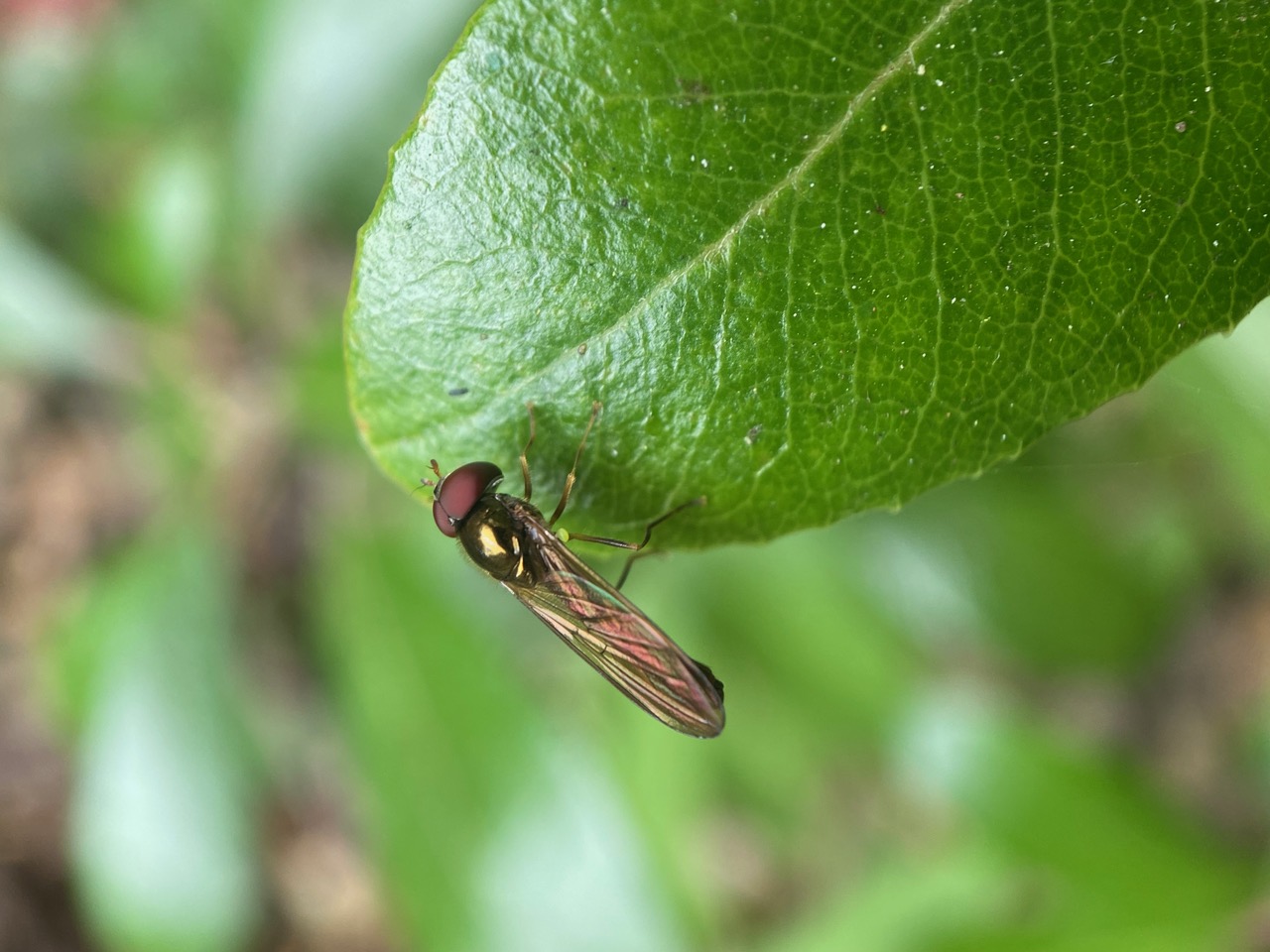
A dusky hover fly with polished bronze thorax is perched motionless on a Coffeeberry leaf. It resembles the Sedgesitter, genus Platycheirus, but I know it’s not that. The body seems more elongated than a Sedgesitter.
Hoverflies or syrphids, make up the insect family Syrphidae. As their common name suggests, they are often seen hovering or nectaring at flowers. The adults of many species feed mainly on nectar and pollen, while the larvae eat a wide range of foods. In some species, the larvae are saprotrophs, eating decaying plant and animal matter in the soil or in ponds and streams. In other species, the larvae are insectivores, preying on aphids, thrips, and other plant-sucking insects. Many species of hoverflies are mimics of stinging wasps and bees, a mimicry which may serve to ward off predators.
Hoverflies are important pollinators of flowering plants in many ecosystems worldwide, and are often considered second-most important group of pollinators after wild bees. Although hoverflies are often considered generalist pollinators visiting a wide range of flowers, some species are highly selective. In general, hoverflies have been shown to prefer white and yellow flowers. Many hoverflies have short, unspecialized mouthparts and tend to feed on flowers that are more open as the nectar and pollen can be easily accessed.
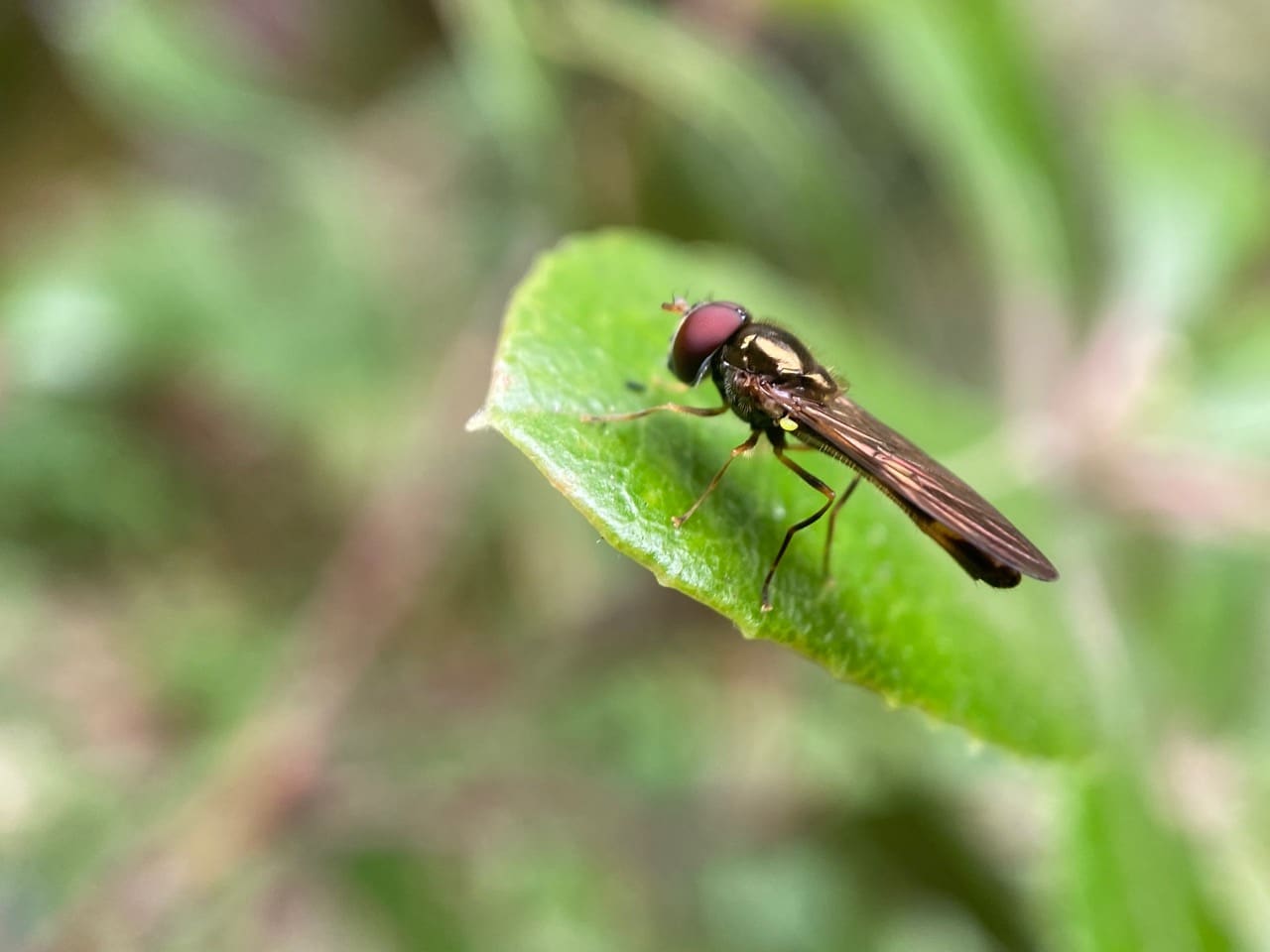
iNaturalist has helped identify it as the Variable Duskyface Fly, Melanostoma mellinum (family Syrphidae).
Melanostoma mellinum is a very common species of hover fly found in many parts of Britain, Europe, North Africa, East Palearctic, and North America. Very similar to Platycheirus, it is a small species, with wingspan of 4.7-7.0 mm. They are found in grasslands and moorlands, including those in high elevations. Adults feed on pollen of grasses (Poaceae) and other wind-pollinated plants. Little is known of their biology, but the larvae are thought to be a general predator of small insects in leaf litter.

A Limoniid Crane Fly (family Limoniidae) is resting on a Coffeeberry leaf.
Related to the Large Crane Flies (family Tipulidae), the Limoniids are medium or small-sized, rarely large. They can usually be distinguished by the way the wings are held at rest. Limoniids usually fold the wings over the back of the body, whereas other crane flies usually hold them out at right angles. Limoniid larvae are mostly aquatic or semi-aquatic. The various species have evolved to feed on different food sources, such as decaying plant matter and fungi. Some are predatory. Limoniids occupy a wide range of habitats: in soil rich in humus, in swamps and marshes, in leaf litter, and in wet spots in woods.
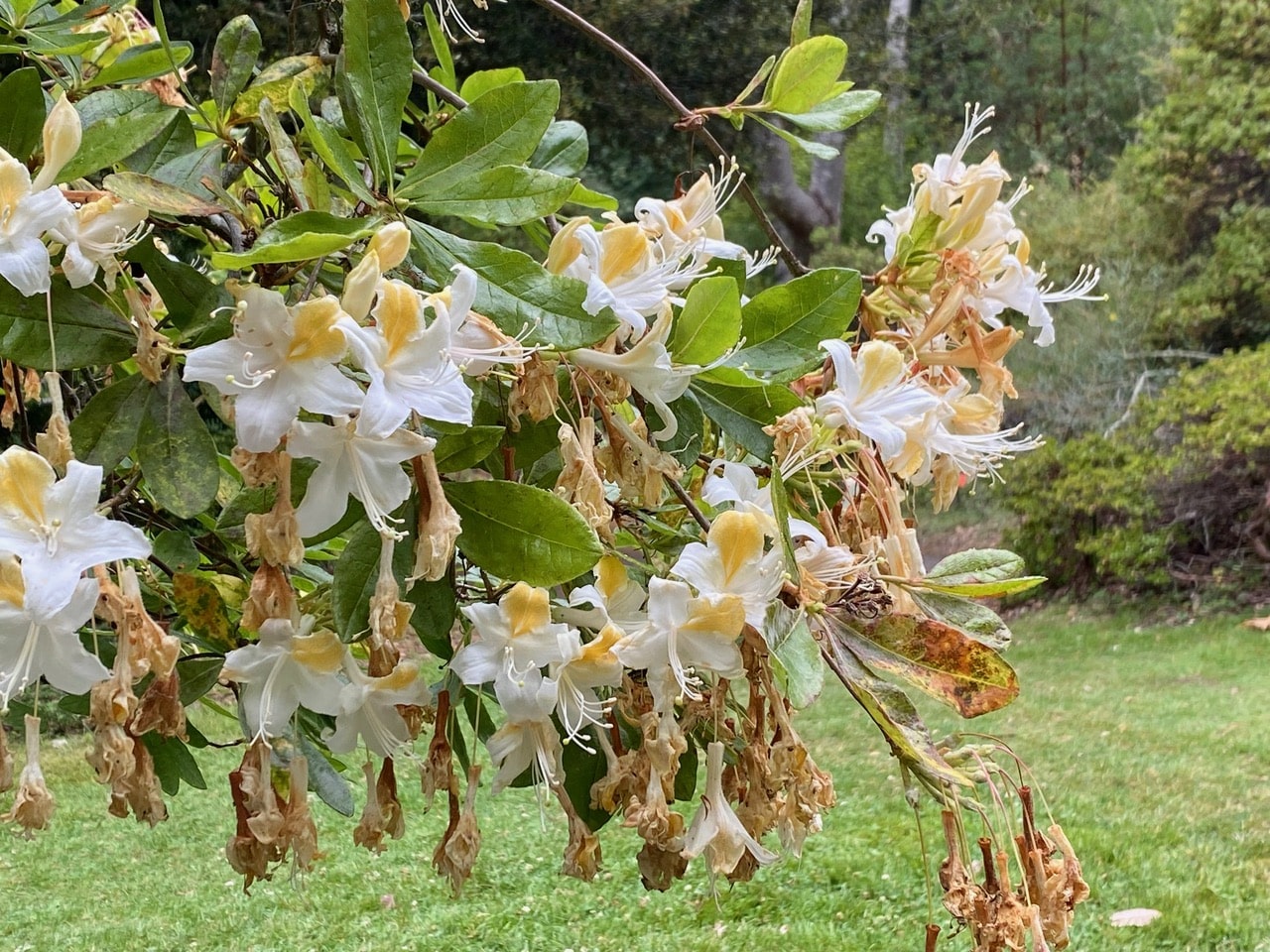
Although past its prime, the Western Azalea, Rhododendron occidentalis (family Ericaceae) is still in bloom, infusing the air with an intoxicating sweet scent.
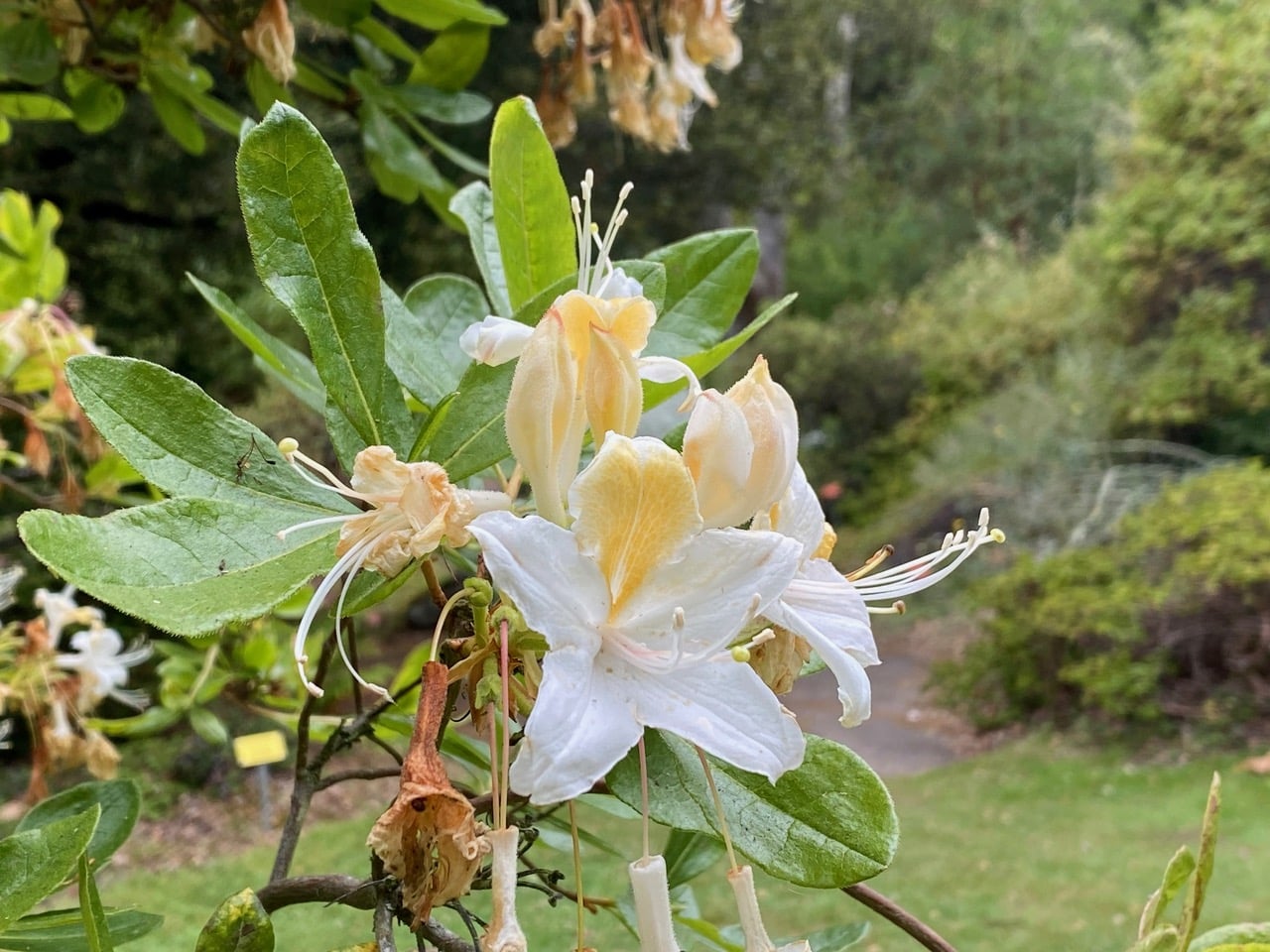
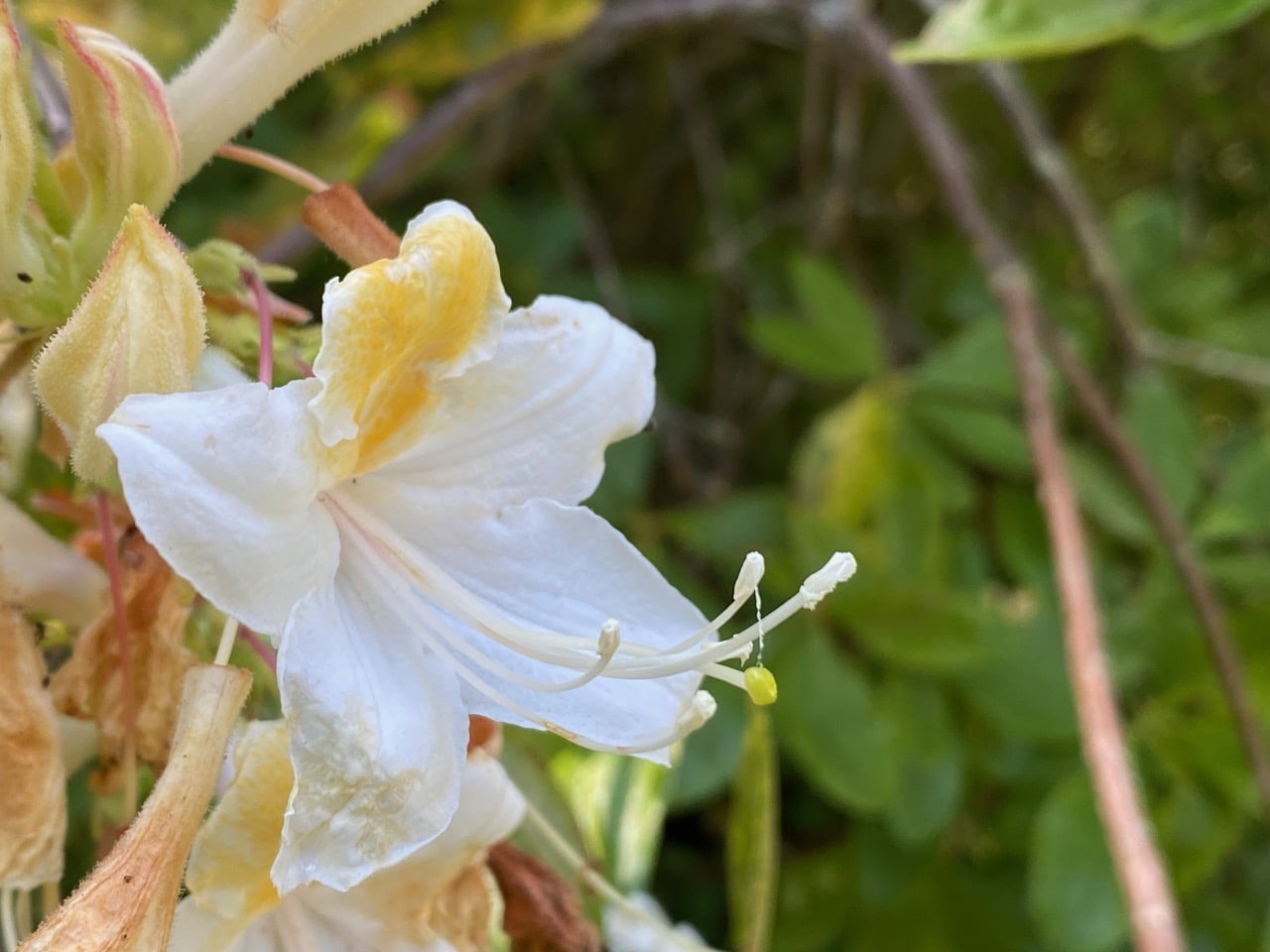
Like the Evening Primrose flowers we saw earlier, the Azalea flower is large, and has both the male (stamens) and female parts (style) very elongated and separated from one another. Note also the stringy pollen coming off the anthers – azalea pollen also comes with sticky viscin threads!
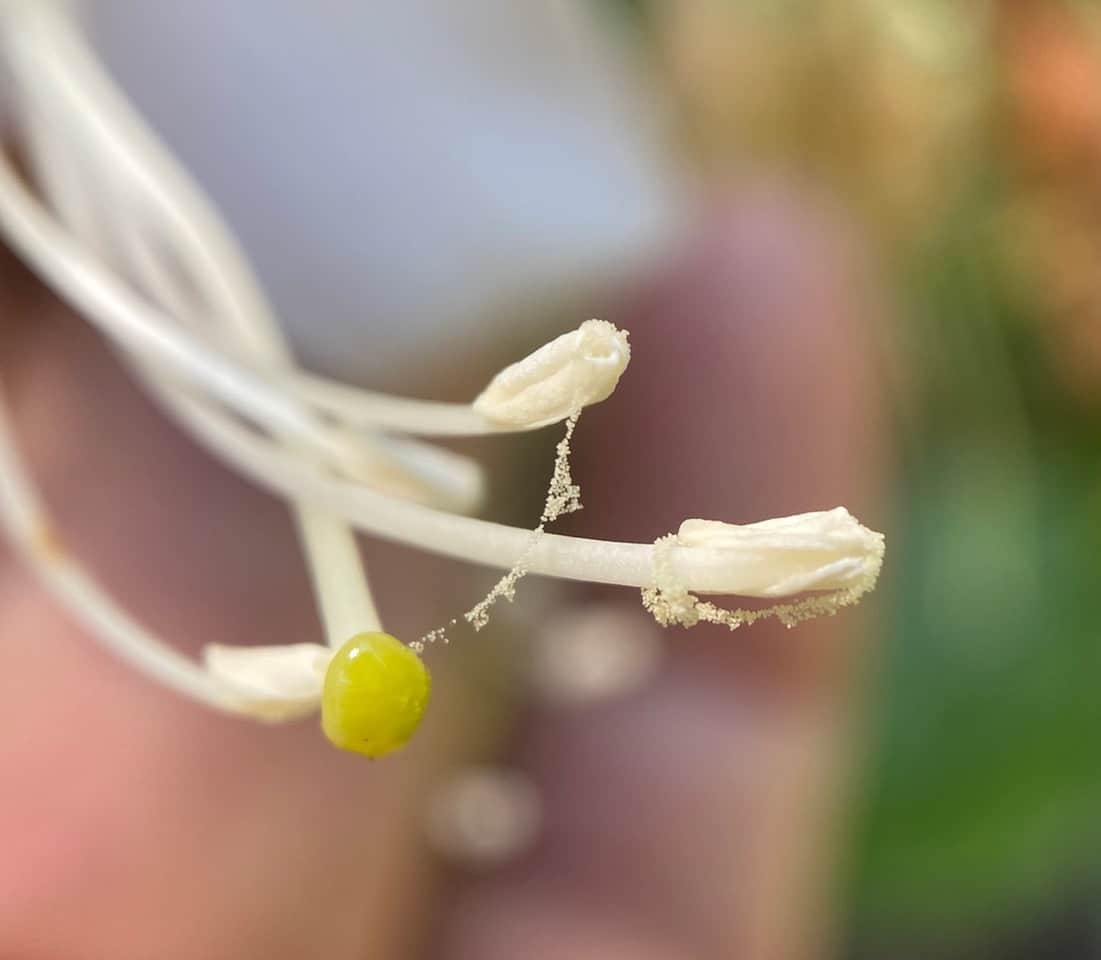
Here’s a close-up of the Western Azalea anthers, showing the large pollen grains strung together on viscin threads. At the appropriate stage of maturity, these threads can be readily drawn out of the terminal pore of the anther by a gentle touch of the finger, or by the flapping wing of a butterfly.
A limited number of flowering plant families use viscin to link their pollen grains together. Viscin functions, much like pollenkitt, by aiding in the attachment of pollen to visiting insects. Viscin threads are made up of sporopollenin, the same biopolymer that the exine (the outer wall of a pollen grain) is composed of. Viscin threads evolved independently in three plant families – Onagraceae (the evening primrose family), Ericaceae (the heath family) and a subfamily in the pea family known as Caesalpinioideae. It is not surprising that we find viscin threads in the Azalea flower, as the plant belongs to Ericaceae family.
The reproductive structures (both the stamens and pistil) of the large azalea flower are very elongated, protruding a distance from the corolla. The juxtaposition of the parts makes it unlikely for the flower to be pollinated by small insects such as bees. A small insect seeking nectar at the base of the petals is not likely to make contact with the reproductive parts. And a bee collecting pollen on the anthers are not very likely to make contact with the stigma some distance away.
A few years ago, the pollination of the Flame Azalea by the Eastern Swallowtail butterflies was discovered by an astute biologist from North Carolina State University. These large butterflies move their wings continuously as they feed on nectar, and the fanning motion enables the transfer of the stringy pollen from the anthers onto the butterfly’s wing, and eventually to the stigma of another flower. The story of the discovery is covered beautifully in the Nature program “Sex, Lies and Butterflies”.
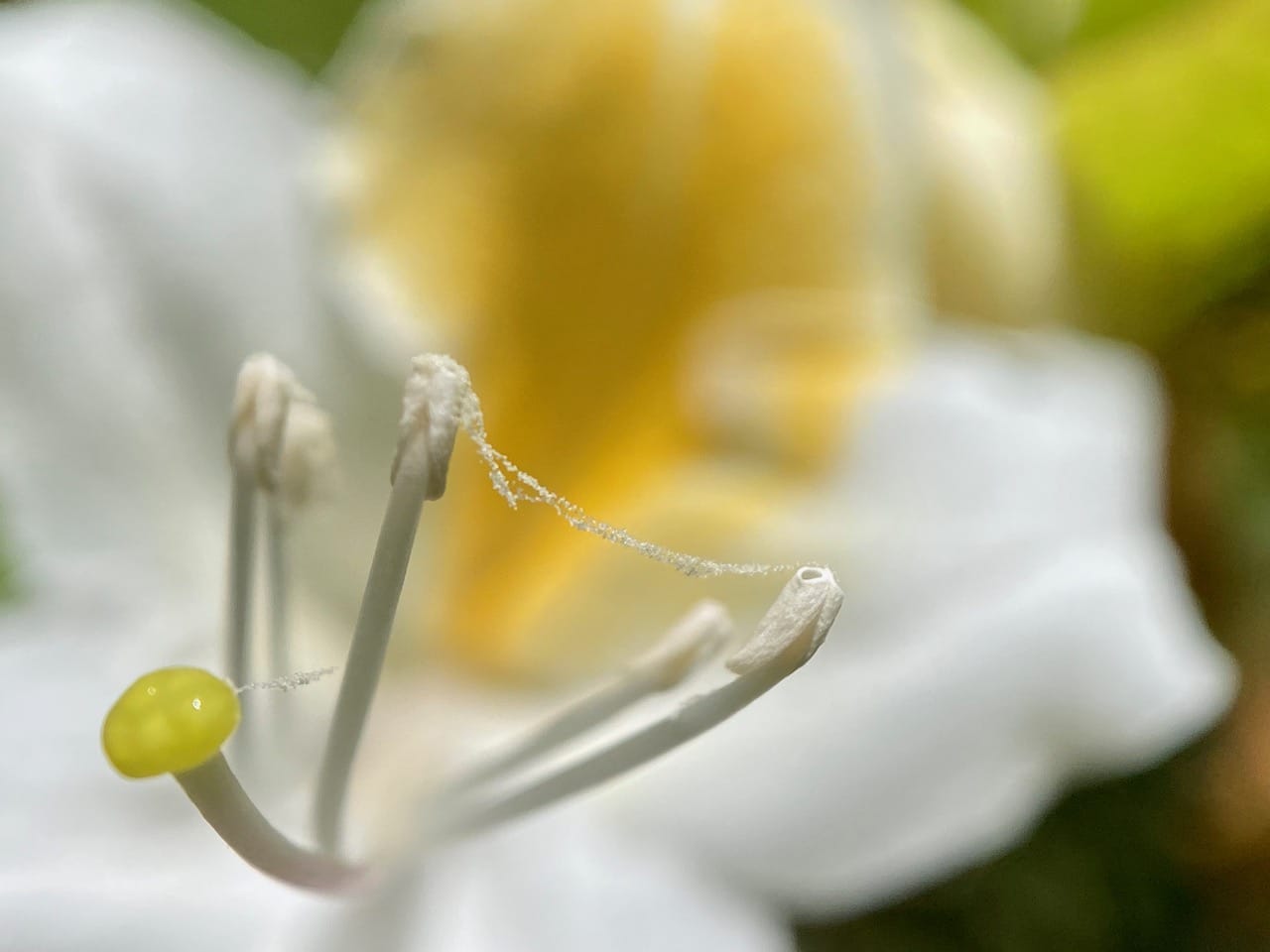
Given the pale color of the Western Azalea flowers and their strong fragrance, I wonder if they were not also pollinated by long-tongued Hawk Moths (family Sphingidae) at night. Their wings can conceivably draw out the stringy pollen from the anthers of Western Azalea and transfer it to the next flower the moths visit. Pollination of Evening Primrose, Oenothera sp. (family Onagraceae) by hawk moths is well documented.
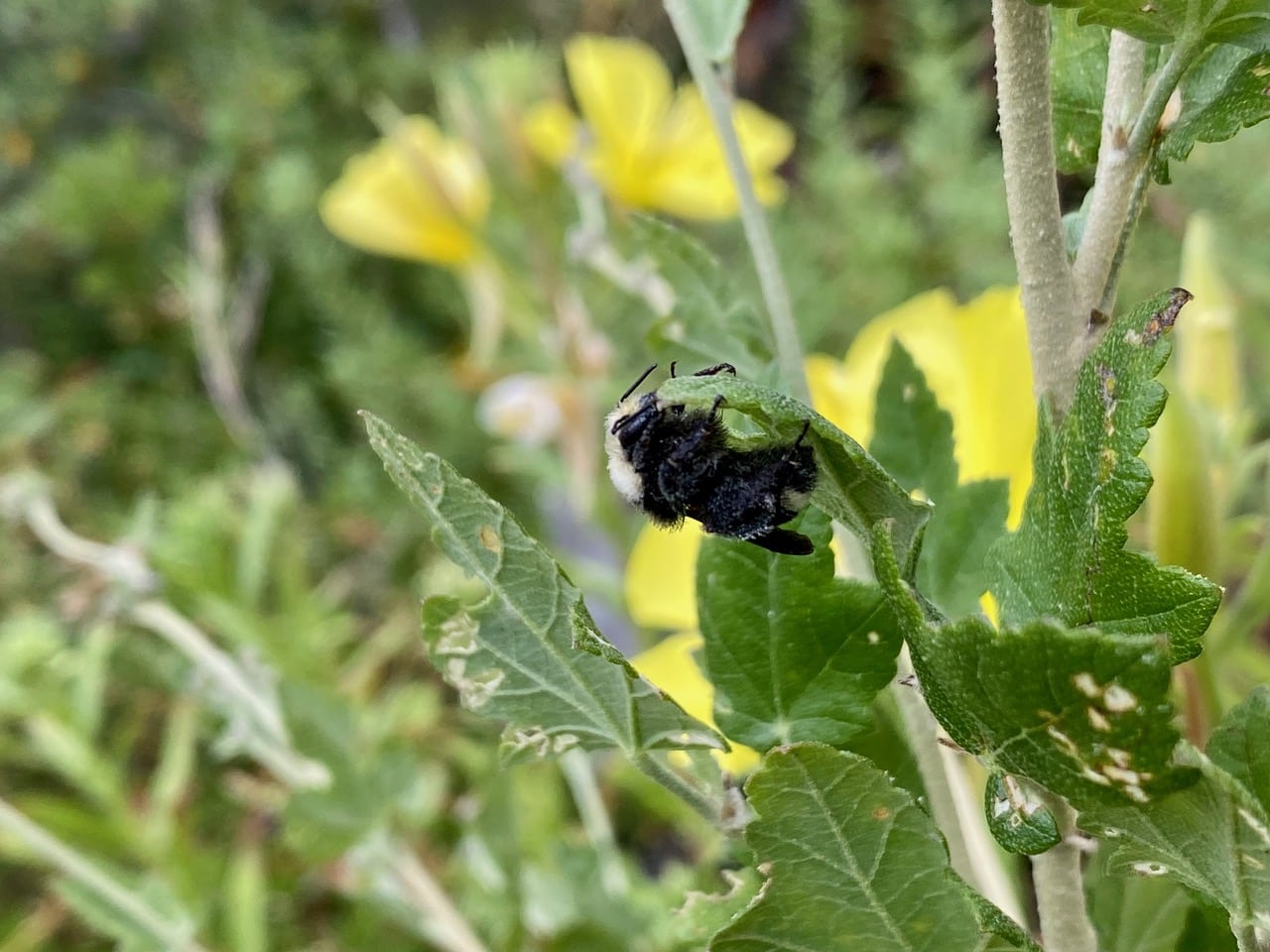
A Yellow-faced Bumble Bee, subgenus Pyrobombus (genus Bombus, family Apidae) is asleep while clinging to a Mallow leaf. Did the bee spend the night like this? It looks like it is wearing a fuzzy coat of fur; even the legs appear covered with hair. I have never seen bumble bees with such furry legs!
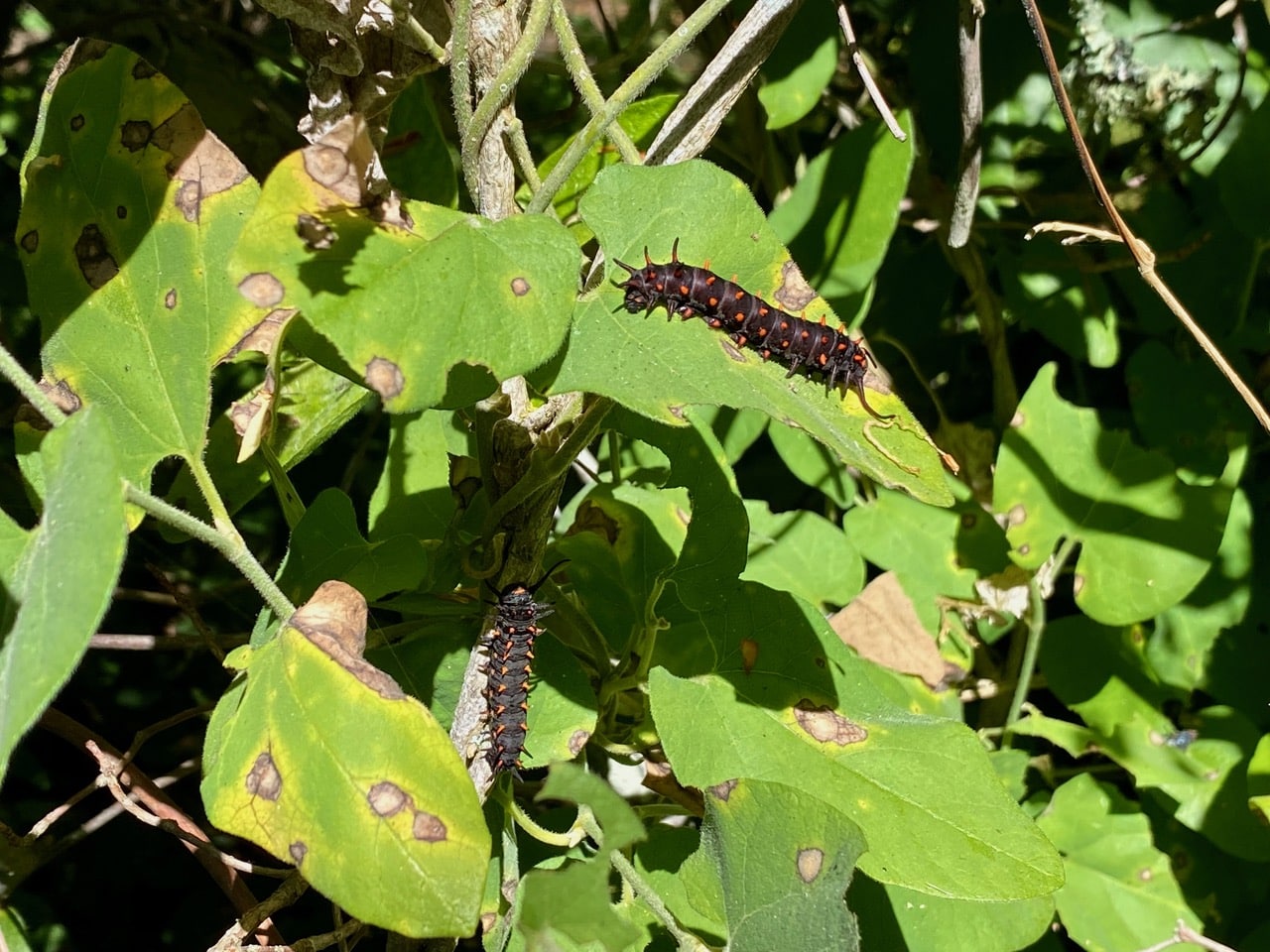
While a few Pipevine Swallowtail butterflies, Battus philenor (family Papilionidae) can be seen flying around the garden, numerous caterpillars are still feeding on their host plant, the California Pipevine, Aristolochia californica. Most of them are very large, close to pupation. It behooves garden visitors to tread with caution around the area, as these caterpillars will soon be wandering all over the place, including the paths, looking for a safe site to pupate.

A single California Pipevine fruit hangs from a vine, broken. It appears that someone has chewed out the bottom of the fruit to access the seeds inside even before the fruit is ripe.
The fruits of California Pipevine develop from the six-chambered ovary of the flower. They are green capsules, typically around 1.5 – 2.75 inches long. They are star-shape in cross-section, like a starfruit. At maturity, the fruits split open (dehisce) to release their seeds. The seeds are eagerly sought by Vespid wasps such as Yellowjackets. Each seed has an attached elaiosome, which is rich in proteins and lipids. The wasps take the seeds away to feed on the elaiosomes, and discard the seeds in their trash piles which often turn out to provide ideal conditions for seed germination. There you have it – seed dispersal by Yellowjackets!
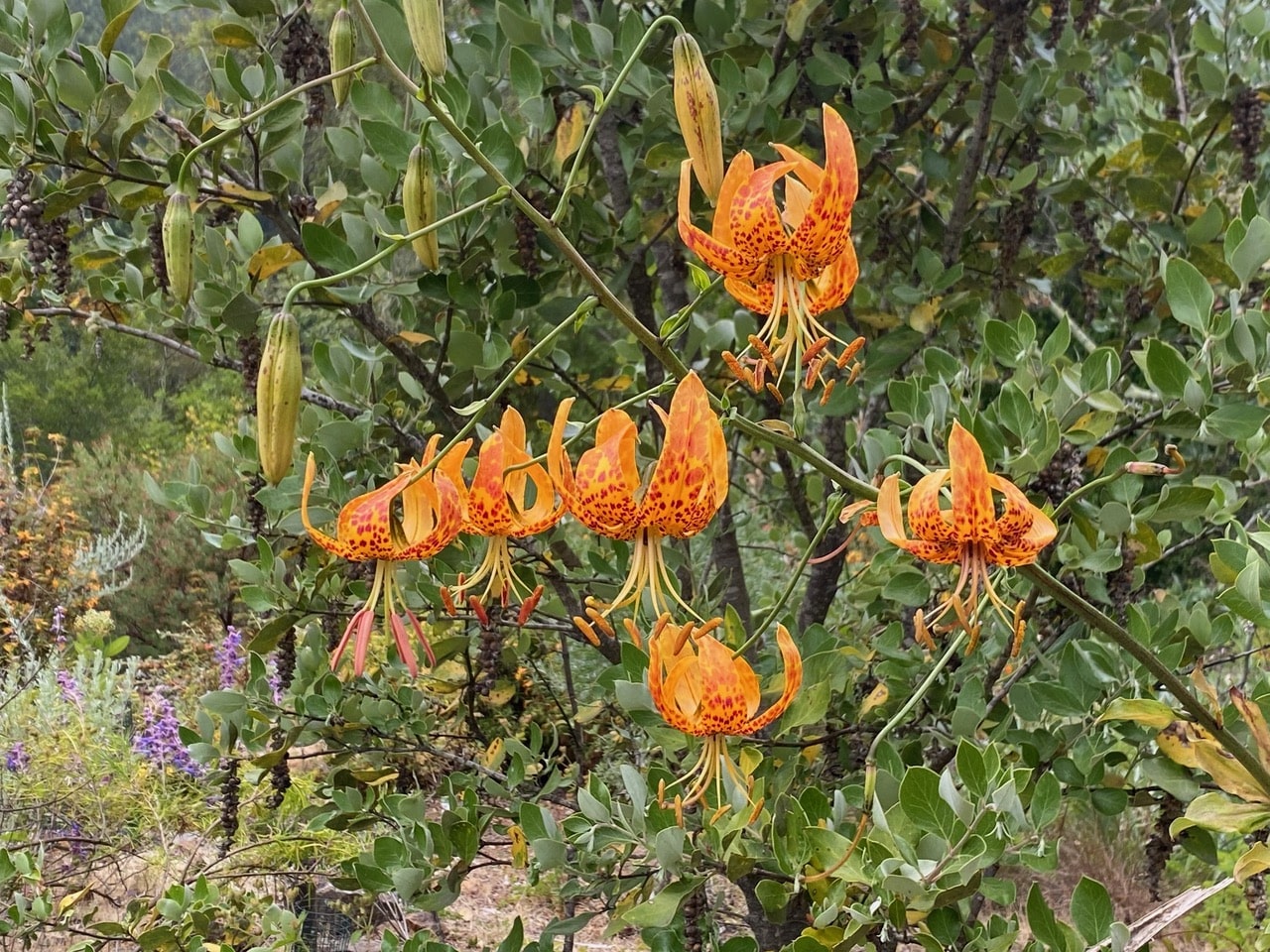
The Humboldt Lily, Lilium humboldtii is in glorious bloom, and its large, brightly colored pendant flowers can be seen from a distance.
The lily is native to the US state of California and the Mexican state of Baja California. The stunning, deciduous species can grow up to 8 feet tall. It produces large, pendant, golden-orange flowers marked with maroon splotches, blooming in May through July in a pyramidal cluster.
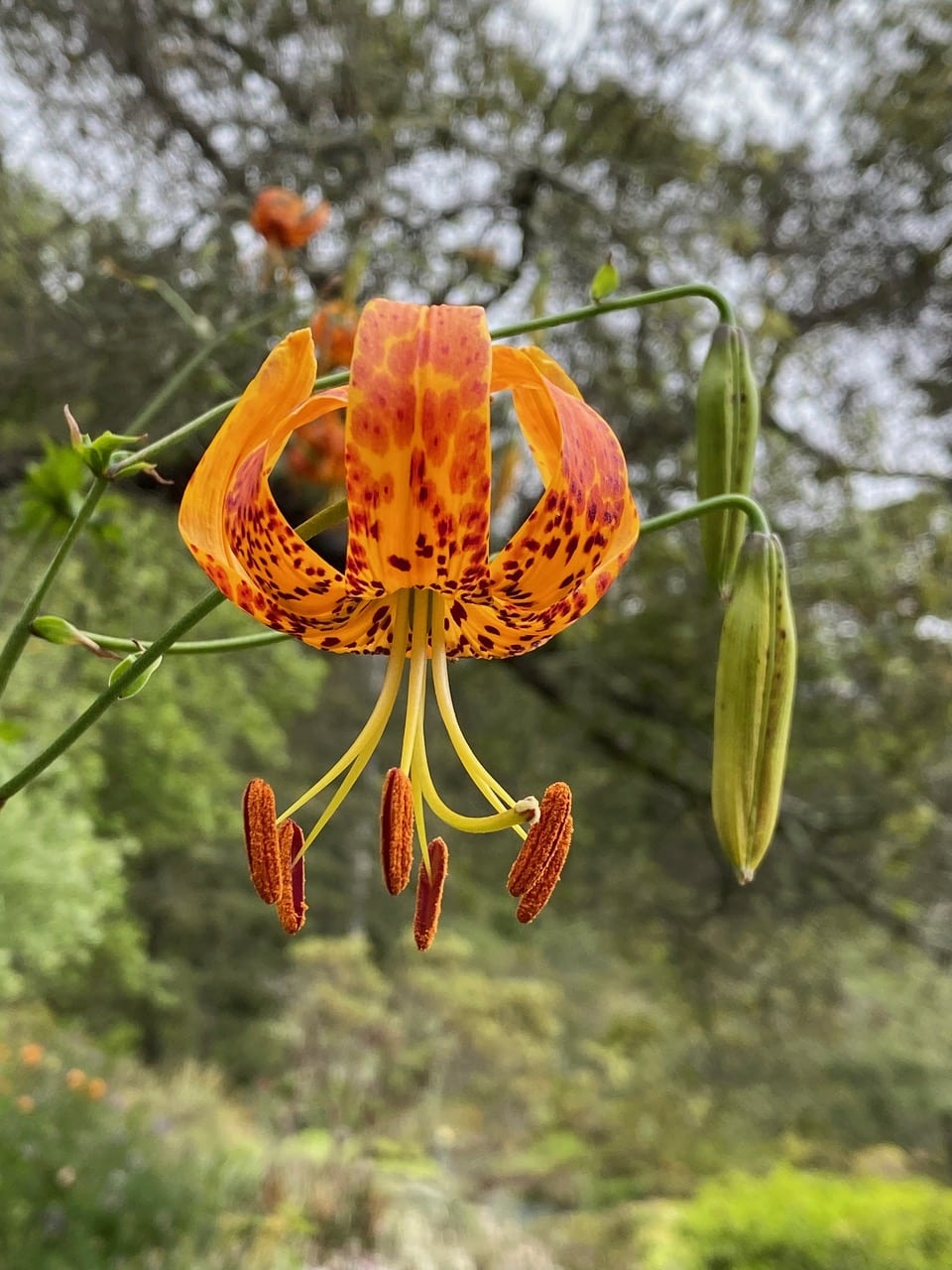
The Humboldt Lily’s flower is a large, pendant, showy funnel-shaped structure characterized by six reflexed tepals. The tepals are orange or yellow with maroon spots. There are six long, stamens that dispense orange pollen from purple anthers, and a single pistil with a three-lobed stigma.
As the flowers are large, and the reproductive structures hang quite a distance from the corolla, it is highly unlikely that small insects seeking nectar at the base of the flower can serve as effective pollinators. Small insects that collect pollen from the anthers directly can conceivably transfer pollen to the stigma of another flower it subsequently visits, as the male and female structures are located close to each other. However, the pollination of large lily flowers are usually attributed to butterflies, especially the large butterflies such as Swallowtails (family Papilionidae). As the butterfly feeds on the nectar, its wings come into contact with the anthers, picking up pollen that can subsequently be transferred to the next flower it visits.