

Pollinator Post 7/6/24 (2)
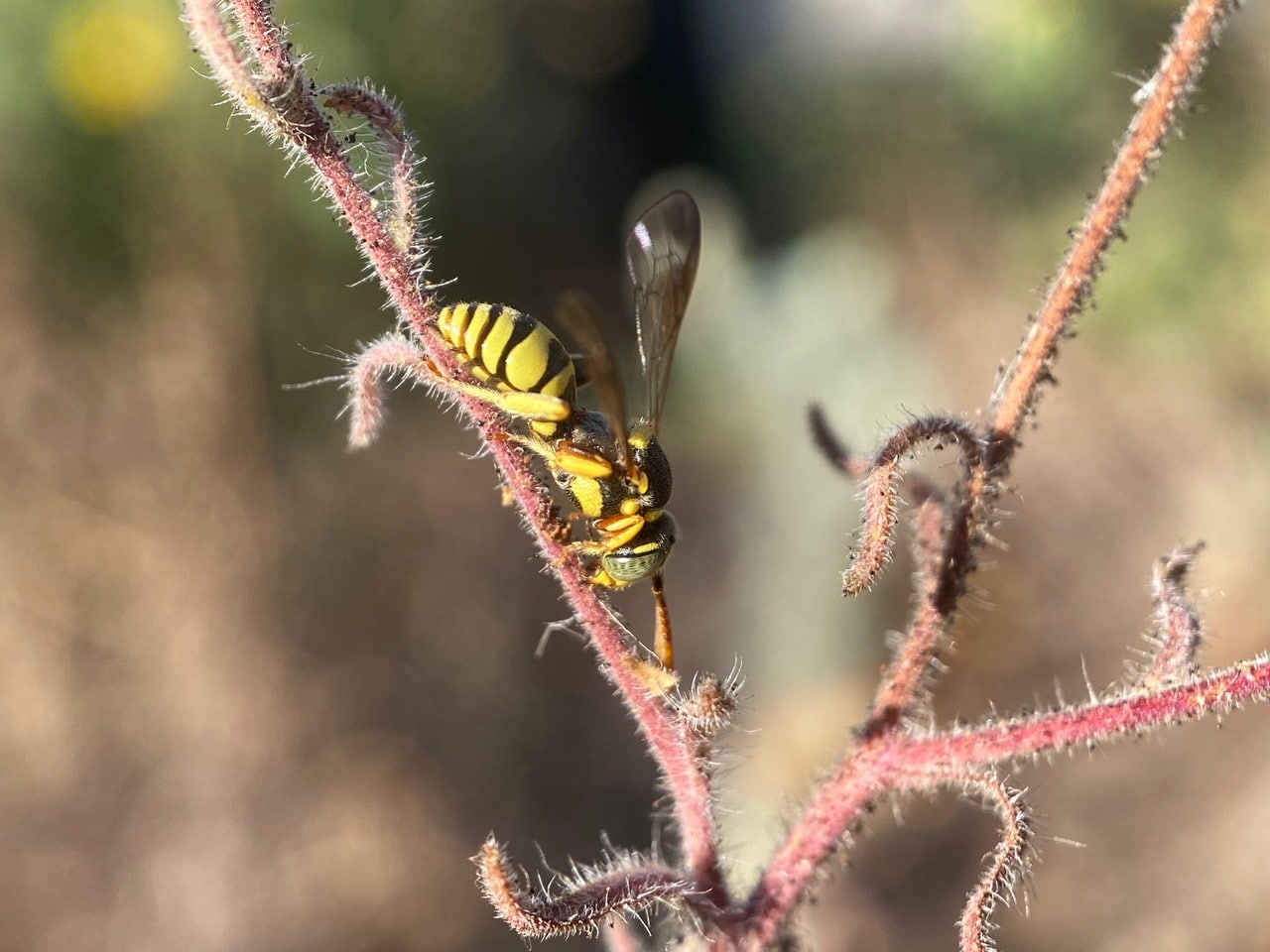 When Naomi joins me on the parking strip, she points out two small black-and-yellow, wasp-like insects clinging to a stem of a withered Elegant Tarweed, just inches off the ground. She has discovered them while looking for the sleeping Longhorn males on the Elegant Tarweed one evening. I am amazed that she found them, in the evening no less – these insects are only about 10 mm (0.4 in.) long!

Look Ma, no hands! I accidentally touch the plant, shaking the branches slightly. The bee responds with this startle reflex but makes no attempt to fly. Note that it is anchored to the tarweed stem by its mandibles. The bee is still fast asleep! I am almost sure that these two are Cuckoo Bees in the genus Nomada or Nomad Bees.

The bee under the seed head settles back down to sleep. Note that it is not holding on with its legs at all. I can’t believe I get such perfect light for these shots.

Close up of the other Cuckoo Bee lower down on the stem.

Conveniently, the bees eventually wake up and turn around, showing me their backs! Their resemblance to wasps are remarkable – the colors, the slender body, the lack of hairs, the absence of scopa.

The bees proceed to groom themselves. I try to take pictures of them from every possible angle, hoping to get them identified.

Nomad Bees in the genus Nomada is one of the largest genera in the family Apidae, and the largest genus of Cuckoo Bees. Nomada are kleptoparasites of many different types of ground-nesting bees as hosts, primarily the genus Andrena. They lack a pollen-carrying scopa, and are mostly hairless, as they do not collect pollen to feed their offspring. Adults visit flowers for nectar. The bees are extraordinarily wasp-like in appearance, often with yellow or white integumental markings on their abdomen.
Nomad Bees occur worldwide. All known species parasitize ground-nesting bees, and their habitats and seasonality correlate closely with their hosts. In early spring, females scout out their hosts, searching for nests to parasitize. The female Nomada sneaks into the host’s nest while the resident female is out foraging, then lays eggs in the nest. The parasite larva that hatches out kills the host offspring and feeds on the host’s provisions. This type of parasitism is termed brood parasitism. The parasites pupate in the host cell and finally emerge as adults the following season along with the hosts.
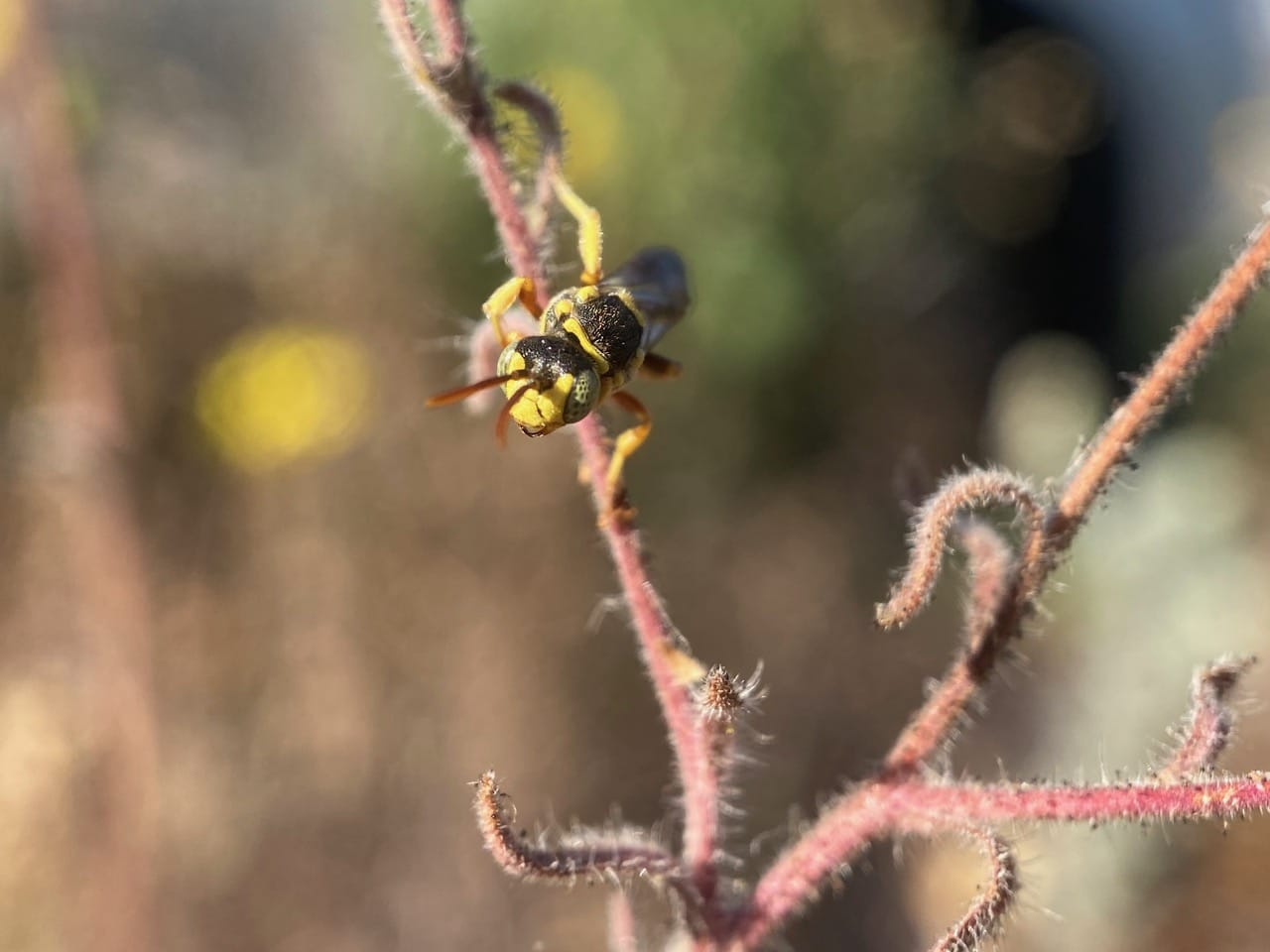


Note that the thorax is highly punctate (pitted) – a characteristic of many parasitic bees and wasps. The thick exoskeleton serves as defensive armor against angry host bees.
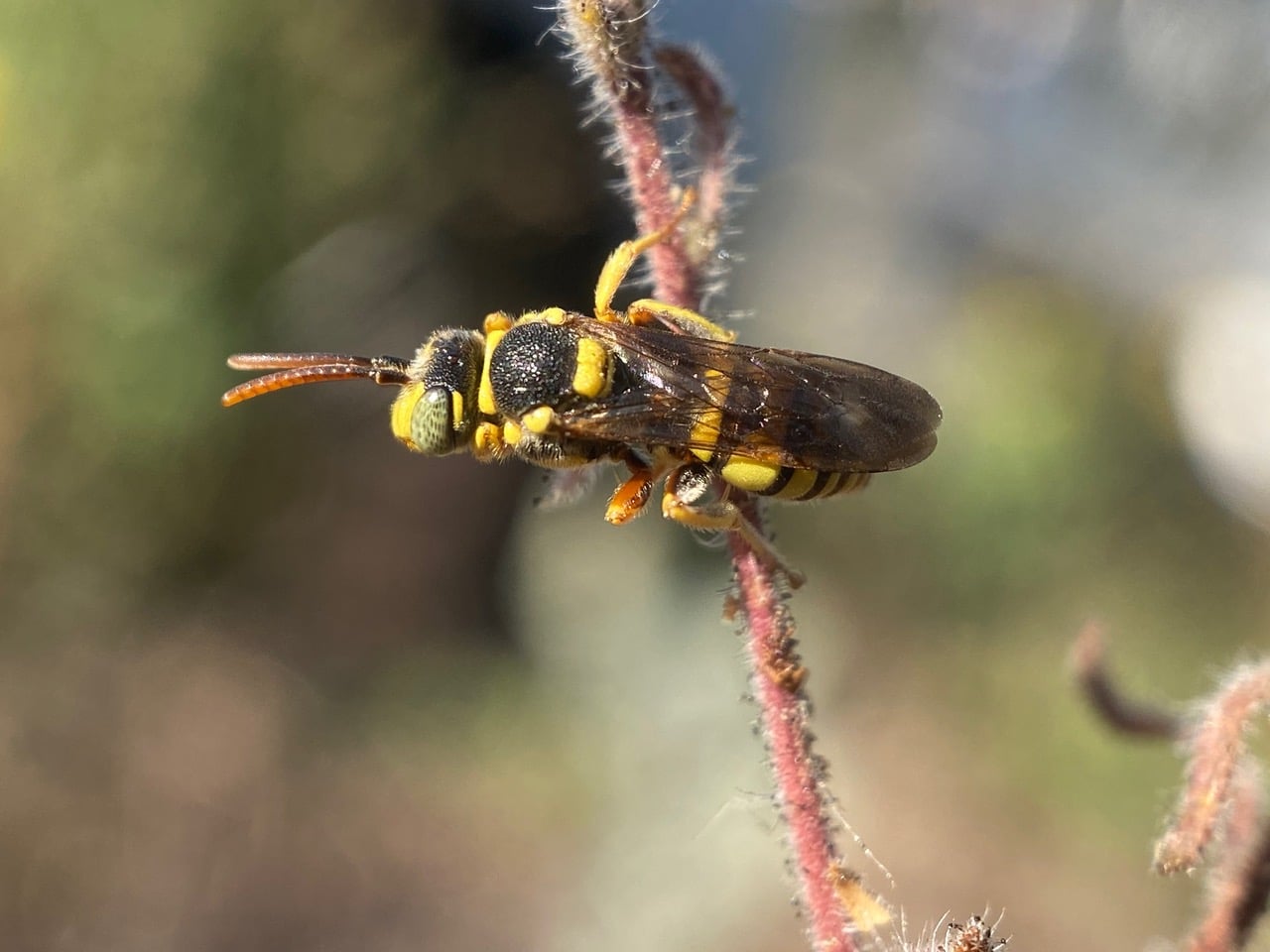
These are the calmest bees I know – imagine holding still and posing for these portraits! iNaturalist has identified the bees as the Suave Nomad Bees, Nomada suavis (family Apidae).
The species is found in the western Unite States. The name “Nomada” is derived from the Greek word nomas, meaning “roaming” or “wandering”. This genus are kleptoparasites in the nests of Andrena (Mining Bees), although some are parasites of Agapostemon, Halictus, Lasioglossum (family Halictidae, or Sweat Bees), and Eucera (Longhorn Bees in the family Apidae) – all of which are ground-nesting. As parasites, Nomada lack a pollen-carrying scopa, and are mostly hairless, as they do not collect pollen to feed their offspring. Adults are known to visit flowers and feed on nectar.

“Ooh, look, they’re mating!” exclaims Naomi pointing to a pair of small insects on a seed capsule of Blue-eyed Grass. Zooming in with my macro lens, I realize that they are actually not Cuckoo Bees, but hover flies, the Forked Globetail, Sphaerophoria sulphuripes (family Syrphidae).
There is marked sexual dimorphism in the Forked Globetail. The males of this species is easily recognizable for the slim, black/yellow abdomen and the bulbous reddish genitalia that is curled under the tip of the abdomen. Females have rounder abdomen and no red coloration. The larvae of Sphaerophoria feed on aphids and other soft-bodied insects.

The male on top has extended his bulbous genitalia from under his red-tipped abdomen and inserted it into the gravid female below him.

A male Striped Sweat Bee, Agapostemon sp. (family Halictidae) lands on a flowerhead of Elegant Tarweed.

As the male proceeds to groom himself, we get a clearer view of his black-and-yellow striped abdomen. This is why the genus Agapostemon has the common name of Striped Sweat Bees. The name is not at all descriptive of the females, who are completely green.

Angela, another friend who has joined us, spots this cluster of tiny eggs on an Elegant Tarweed leaf. I wonder what they will hatch into? Lygus Bugs? But I haven’t seen any adults today.

Naomi points out a green caterpillar among the terminal leaves of an Elegant Tarweed that I would not have otherwise noticed. This view shows the rear end of the caterpillar. iNaturalist has identified the caterpillar as a Tobacco Budworm Moth, Chloridea virescens (family Noctuidae).
The Tobacco Budworm, Chloridea virescens, formerly Heliolothis viresens (family Noctuidae) is a native species and is found throughout the eastern and southwestern United States, though it is also known from California. It is principally a pest of field crops, vegetable crops and horticultural plants. Eggs are deposited on flowers, fruit, and terminal growth. Larvae develop through 5-7 instars. Body color is variable. Pupation occurs in the soil. Adult moths are brownish in color, and lightly tinged with green. The front wings are crossed transversely by three dark bands, each of which is often accompanied by a whitish or cream-colored border.