

Pollinator Post 7/5/26 (1)

It looks like very low tide when I arrive at 9:20 am. A new sign has gone up at the trail head just south of Alameda Beach. I finally know whose ground I am treading on here, one of my favorite places to see insects.


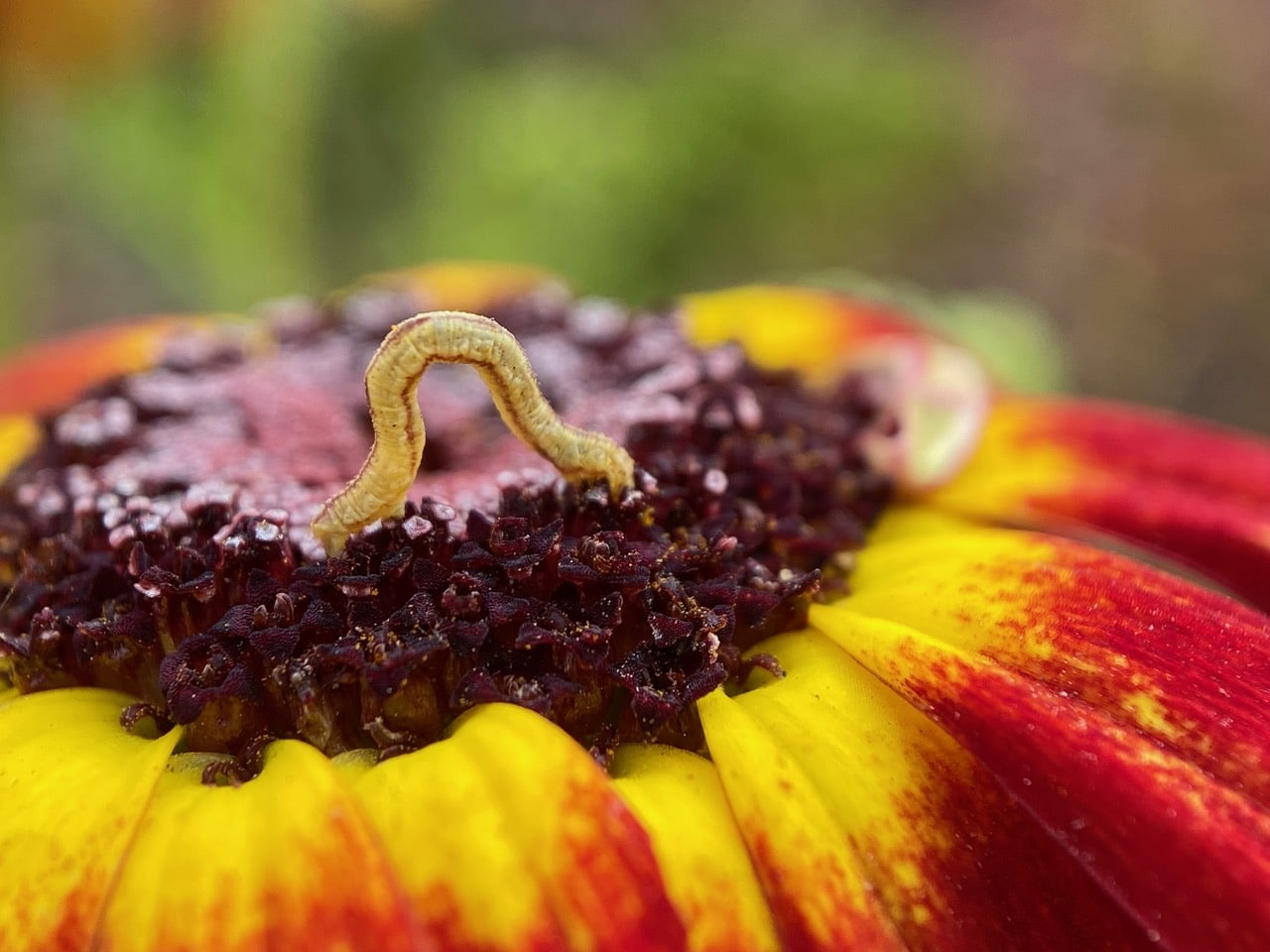 Residential homes line the narrow dirt path that winds along the upper marsh, and many home owners have voluntarily landscaped and planted gardens beyond their own properties. Only a few have planted California natives. I stop to check out an Inchworm on a flowerhead of Blanketflower, Gaillardia sp. in one of the gardens. It is a caterpillar of the Pug Moth, Eupithecia sp. (family Geometridae).
There’s on-going marsh restoration along this shoreline.
The tide is so low one can almost walk across the mud flat to Bay Farm Island.
Residential homes line the narrow dirt path that winds along the upper marsh, and many home owners have voluntarily landscaped and planted gardens beyond their own properties. Only a few have planted California natives. I stop to check out an Inchworm on a flowerhead of Blanketflower, Gaillardia sp. in one of the gardens. It is a caterpillar of the Pug Moth, Eupithecia sp. (family Geometridae).Inchworms are also called loopers and measuring worms. The majority of the inchworms are the larvae of moths in the family Geometridae. The name comes from the Greek “geo” for earth and “metro” from measure, because the caterpillars seem to be measuring the surface on which they are walking. The “looping” locomotion is mandated by the absence of prolegs in the middle section of the caterpillar’s body.
Eupithecia is the largest genus of moths of the family Geometridae. Occurring worldwide except for Australasia, species in the genus are commonly known as pugs. The caterpillars move in a looping manner and are commonly called inchworms. Adults are typically small, 12 – 35 mm, with muted colors. Most species rest with forewings held flat at right angles to the body, while the hindwing are largely covered by the forewings. They are generally nocturnal. Larvae mostly feed from the flowers and seeds of their food plants rather than the foliage. Many species have a very specific food plant. Many are commonly found on Asteraceae flowers.
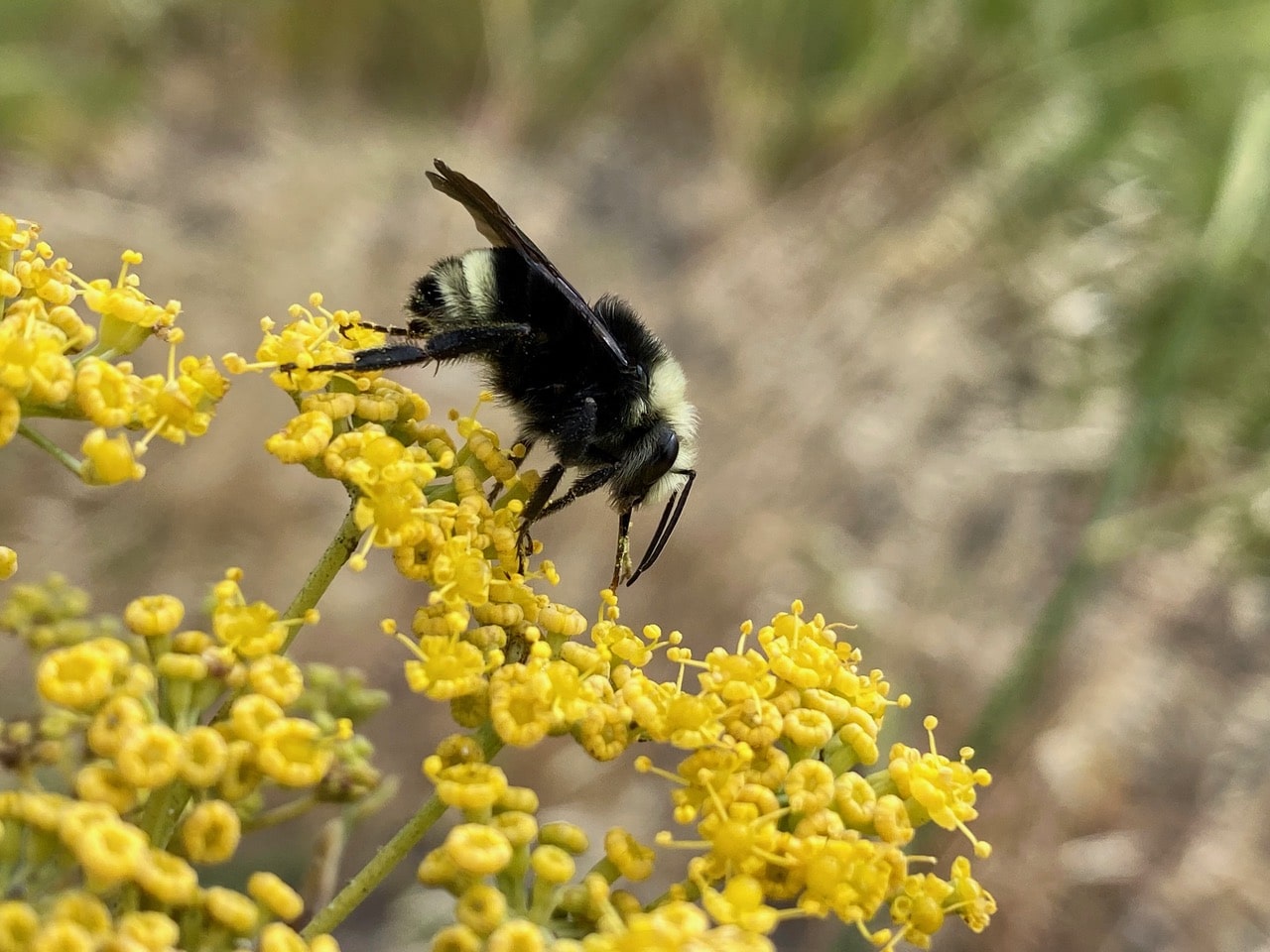
I think I might have come too early. The sun has yet to break through the clouds, and the only insects out foraging seem to be the cold-tolerant bumble bees. A Yellow-faced Bumble Bee, subgenus Pyrobombus (genus Bombus, family Apidae) is taking nectar on an umbel of Fennel flowers, Foeniculum vulgare. Note the extra band of yellow hairs on its abdomen, the long antennae and the absence of corbiculae (pollen baskets) on its hind legs. I think it is a male. Apparently male bumble bees are out in droves now. Bumble bee mating season is upon us. My friend Emil has just posted a picture of mating bumble bees on iNaturalist:
Late in the season (usually mid-to-late summer or fall), a bumble bee colony reaches its peak population and the queen switches from laying worker eggs to producing males (drones) and new queens (gynes). These newly produced males and queens leave the nest to mate. Shortly after, the original foundress queen, the workers, and the males all die naturally. Only the newly mated queens survive the winter by hibernating in the ground or in leaf litter, emerging the following spring to start entirely new colonies.

Here’s another male Yellow-faced Bumble Bee, sprawled on a flower of Rock Rose, apparently still sleeping. Note his skinny hind legs with no corbiculae.
Male bumble bees (drones) leave their colony permanently once they mature, so they do not return to the nest to sleep. Instead, they spend their nights sleeping outdoors, often hanging onto or curled up inside flowers, under petals, or on tall vegetation. This behavior is driven by the male bumble bee’s sole purpose in life: to find a queen to mate with. Because males do not help with colony duties like foraging, raising young, or maintaining the nest, they have no reason to return. Sleeping on or under plants allows them to stay close to food sources and potential mates while staying securely anchored out of the wind.
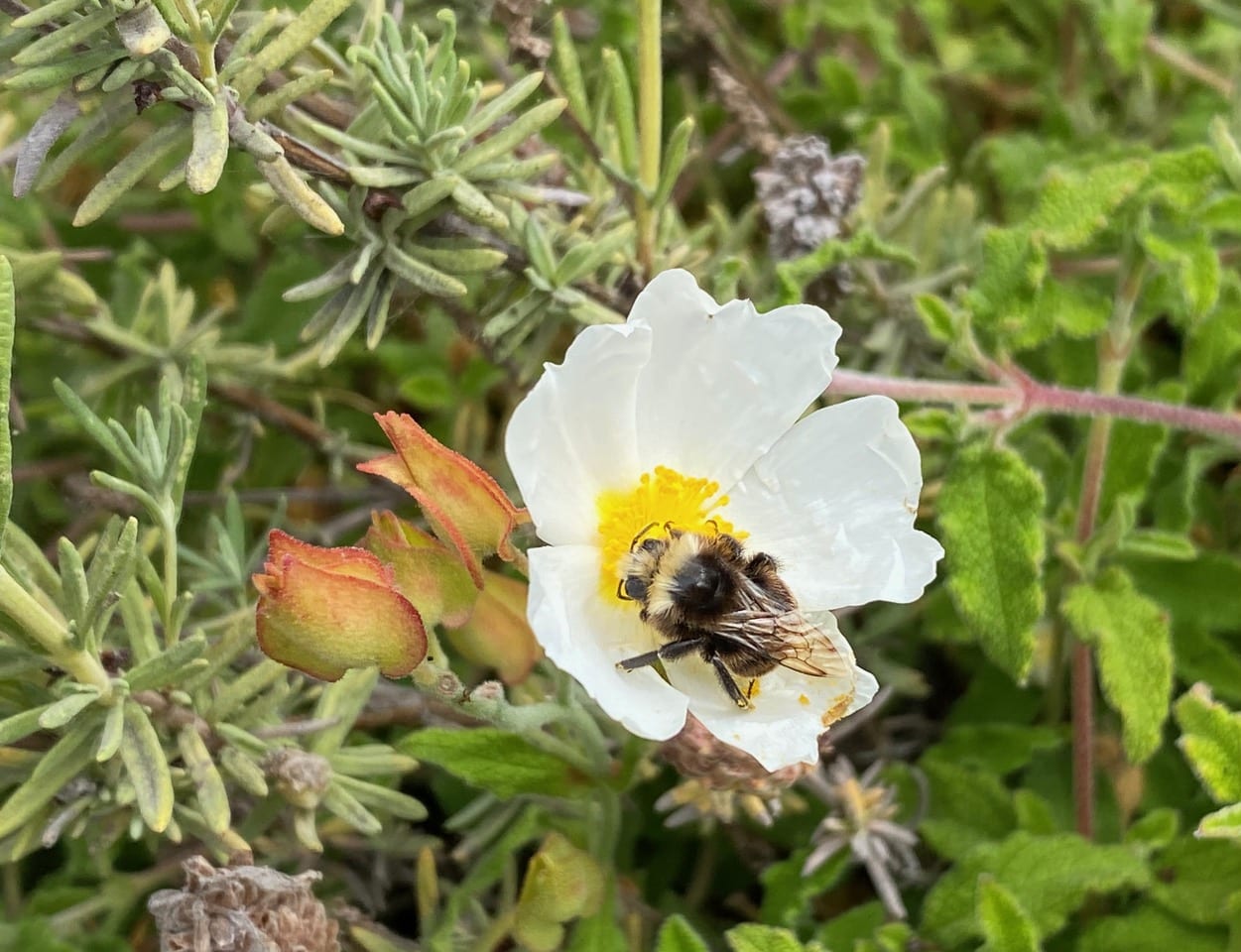
Another bumble bee is asleep on a Rock Rose flower. The profusion of yellow hairs among its black coat makes me think that it might be a different species. Fog-belt Bumble Bee, Bombus caliginosus (family Apidae)? Identifying bumble bee species is a life-long endeavor.
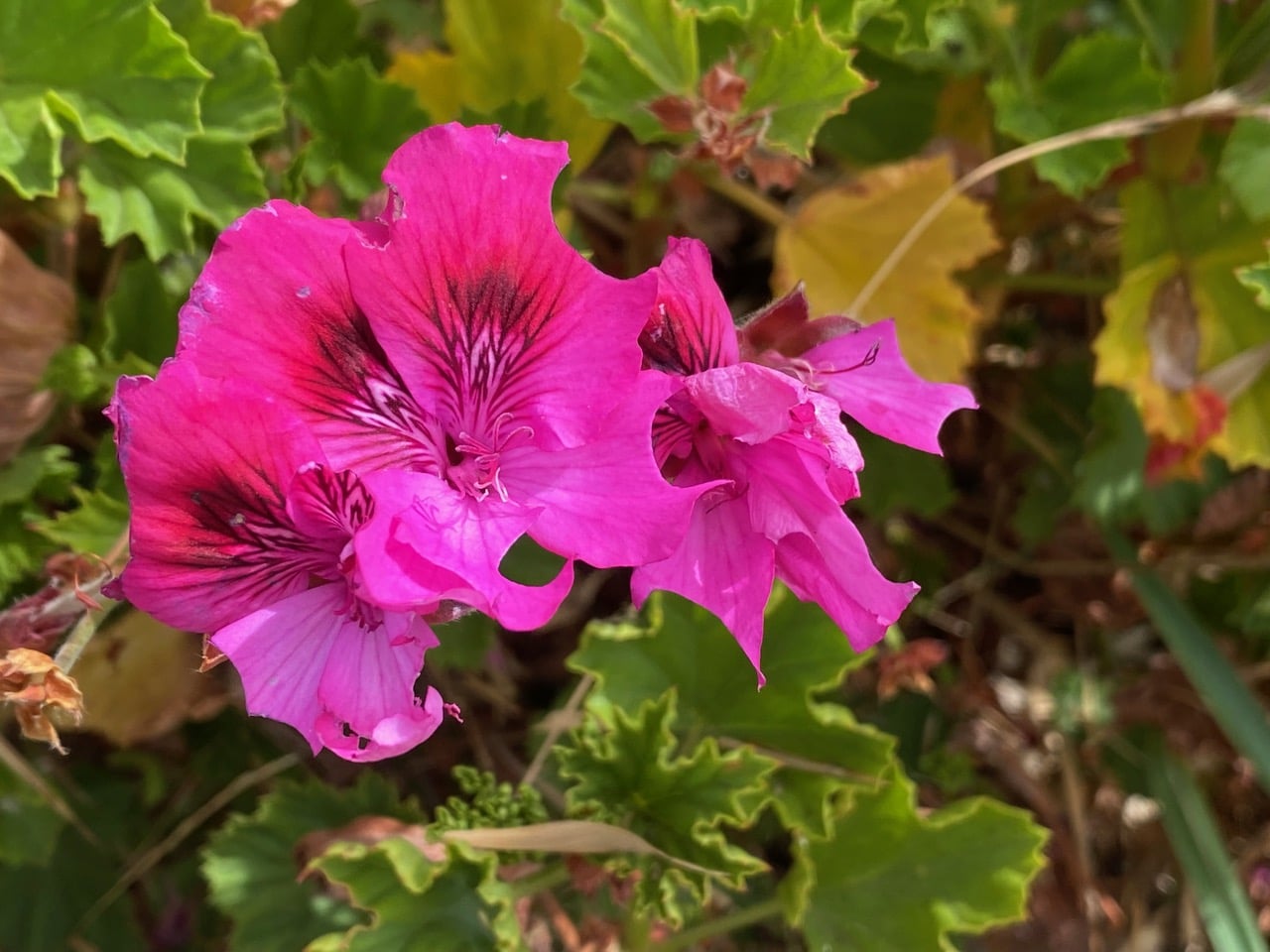
It makes me laugh to see these Rose Geranium flowers, Pelargonium sp. in one of the gardens. Note the round pieces that have been cut out of the petals. Apparently the Leafcutter bees have been busy here!
Leafcutter bees select petals and leaves for their nests based purely on texture, pliability, and thickness rather than by the type of plant. Female bees prefer thin, smooth, and flexible materials that they can easily cut, shape, and roll to build waterproof, breathable nursery chambers for their larvae.
In our area, the leafcutter females often cut leaves of roses and redbud, and petals of Clarkia, evening primrose, and cosmos.
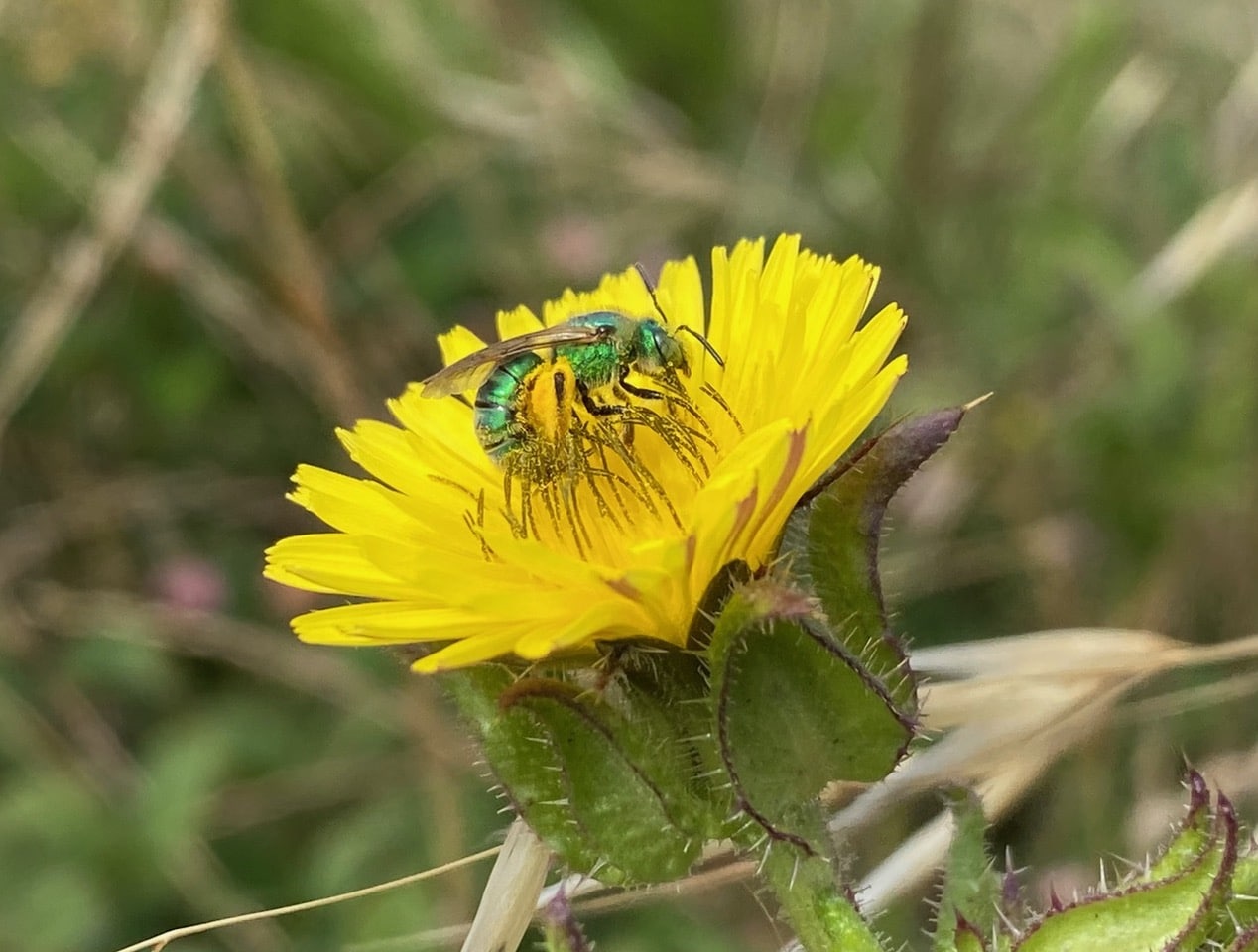
A female Fine Striped Sweat Bee, Agapostemon subtilior (family Halictidae) is foraging on a flowerhead of a Bristly Oxtongue, Helminthotheca echioides. She has gathered an impressive load of pollen on the scopae of her hind legs.
The Fine Striped Sweat Bee, Agapostemon subtilior is a North American species of sweat bees in the family Halictidae. Adult females are entirely iridescent green, about 11 mm in length, while males are slightly smaller at 9-10 mm and have black abdomens striped with yellow. The bees may change color based on atmospheric humidity, varying from bluish to pale green. The bees are generalist foragers, collecting pollen from a wide variety of plants. They nest in the ground in solitary burrows. Females carry pollen on the scopae on their hind legs.
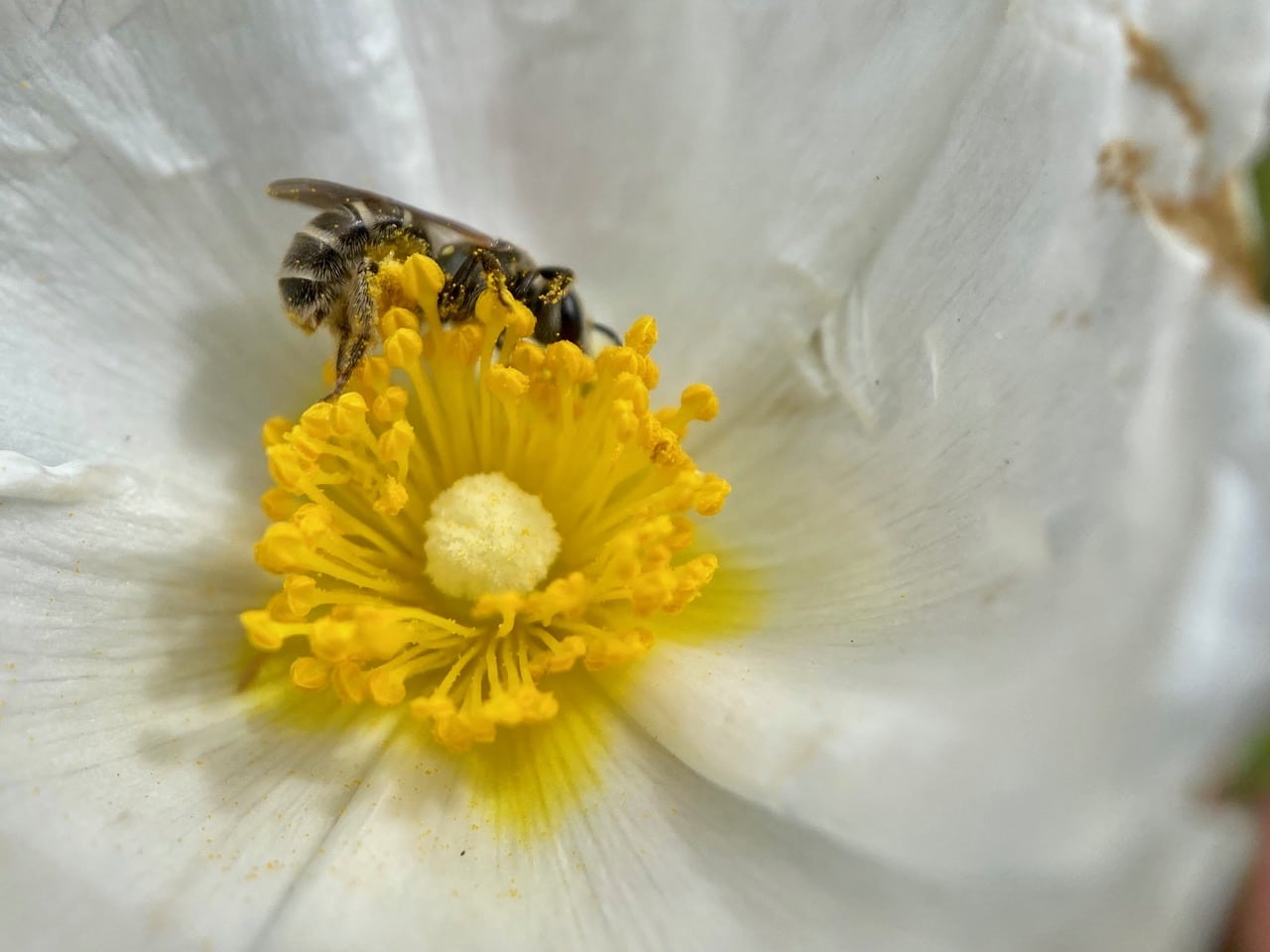
A Tripartite Sweat Bee, Halictus tripartitus (family Halictidae) is collecting pollen from a Rock Rose flower, Cistus sp.
Sweat Bees get their name because they are naturally drawn to human perspiration. They land on the skin to drink sweat, which provides them with essential moisture and salts. The bees belong to the family Halictidae. In our area, the family is primarily represented by three large genera – Halictus, Lasioglossum and Agapostemon.

The little sweat bee climbs up the petal to launch herself into the air.
Halictus is found worldwide; they are most common in the Northern Hemisphere. All are generalists, foraging from a wide variety of flowering plants. Many species are social and produce several generations per year. This is not surprising as most blooming plants are season-specific; a bee that requires pollen and nectar across multiple seasons would not thrive as a specialist. All Halictus in North America nest in the ground, often in aggregations; and they may nest in the same area for decades.

An American Sand Wasp, Bembix americana (family Crabronidae) is foraging on the clustered flowers of the Red-flowered Buckwheat, Eriogonum grande var. rubescens.
Sand wasps in the genus Bembix are familiar and common throughout North America, digging their burrows in dunes, on beaches, and other habitats with loose, deep sand. The female rapidly kicks out large quantities of sand using a “tarsal rake” of spines on each front leg. The burrow is excavated before the wasp goes hunting. Bembix are generalist, opportunistic hunters. True flies in the order Diptera are the usual prey. A victim is paralyzed or killed by the wasp’s sting, and is then flown back to the nest. Most species will lay an egg on the first victim, while some species lay an egg in the empty cell before starting to hunt. Once the egg hatches, mama wasp brings flies to her larva as needed. This “progressive provisioning” is rare in the insect world. When the larva reaches maturity, mama wasp closes the cell. Inside, the larva spins an oblong cocoon, weaving sand grains into the structure and resulting in a hardened capsule. Overwintering takes place as a prepupa inside this cocoon, but there are usually two generations a year.
Male sand wasps often engage in an elaborate flight ritual called “sun dances”. Males emerge before females, and fly erratically at dizzying speed one or two inches above the ground attempting to detect virgin females about to emerge from their underground nests. Both sexes are often seen taking nectar at flowers, especially from Asteraceae family. Bembix wasps are often victims of other insects such as cuckoo wasps (Chrysididae), velvet ants (Mutillidae), satellite flies (Sarcophagidae), bee flies (Bombyliidae), and thick-headed flies (Conopidae).
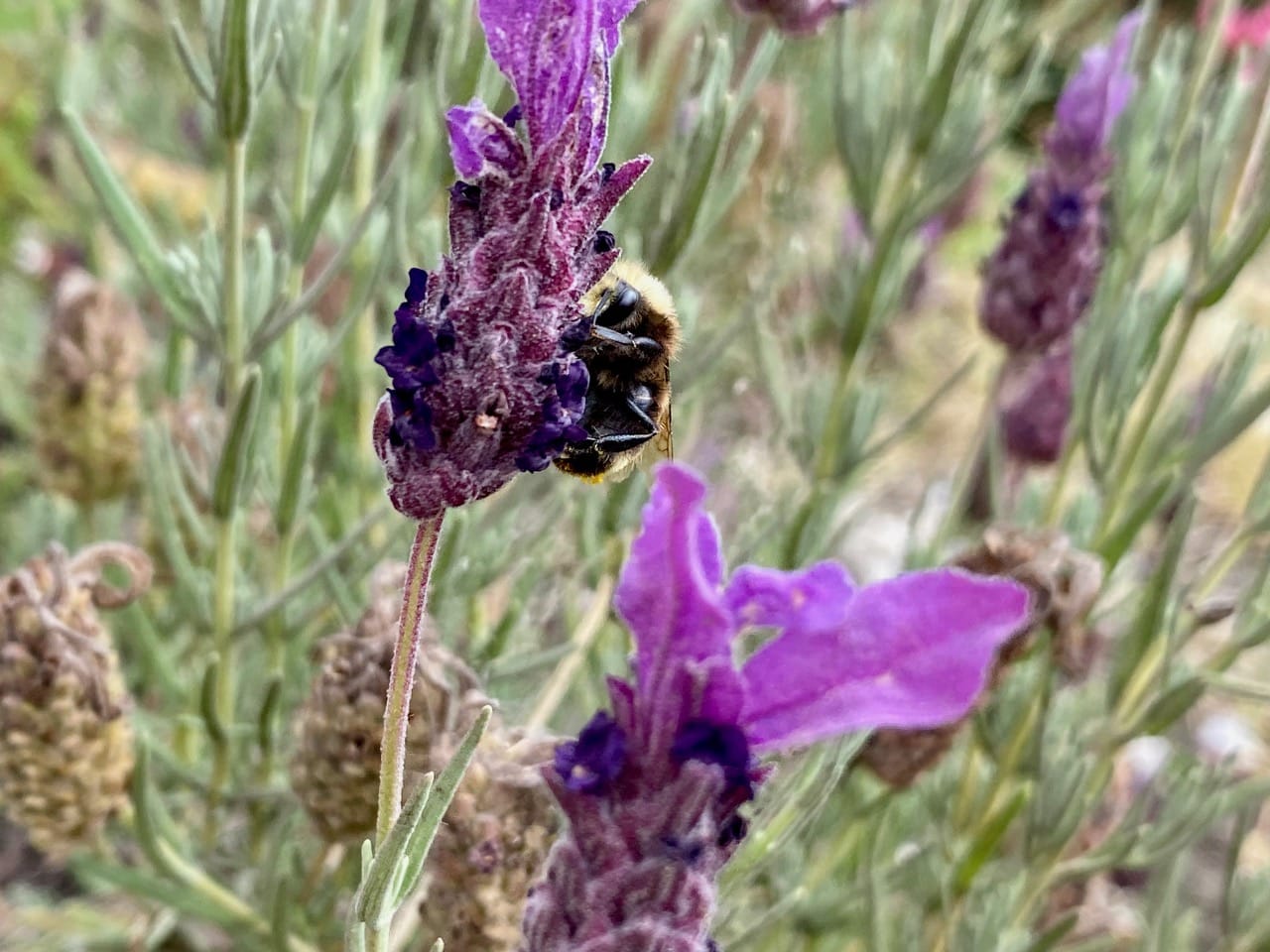
Clinging to a spike of flowers, a Yellow-faced Bumble Bee, subgenus Pyrobombus (genus Bombus, family Apidae) is taking nectar from the tiny flowers of Topped Lavender, Lavandula stoechas.
The inflorescence of the Topped Lavender is crowned by showy and bright lavender purple sterile bracts. Lower flowers form a tight rectangle in cross-section. Each tiny flower is subtended by a bract 4-8 mm long. It’s these inconspicuous flowers that bees seek nectar from. Native to Europe, Topped Lavender provides well for Honey Bees, as well as many of our native bees.
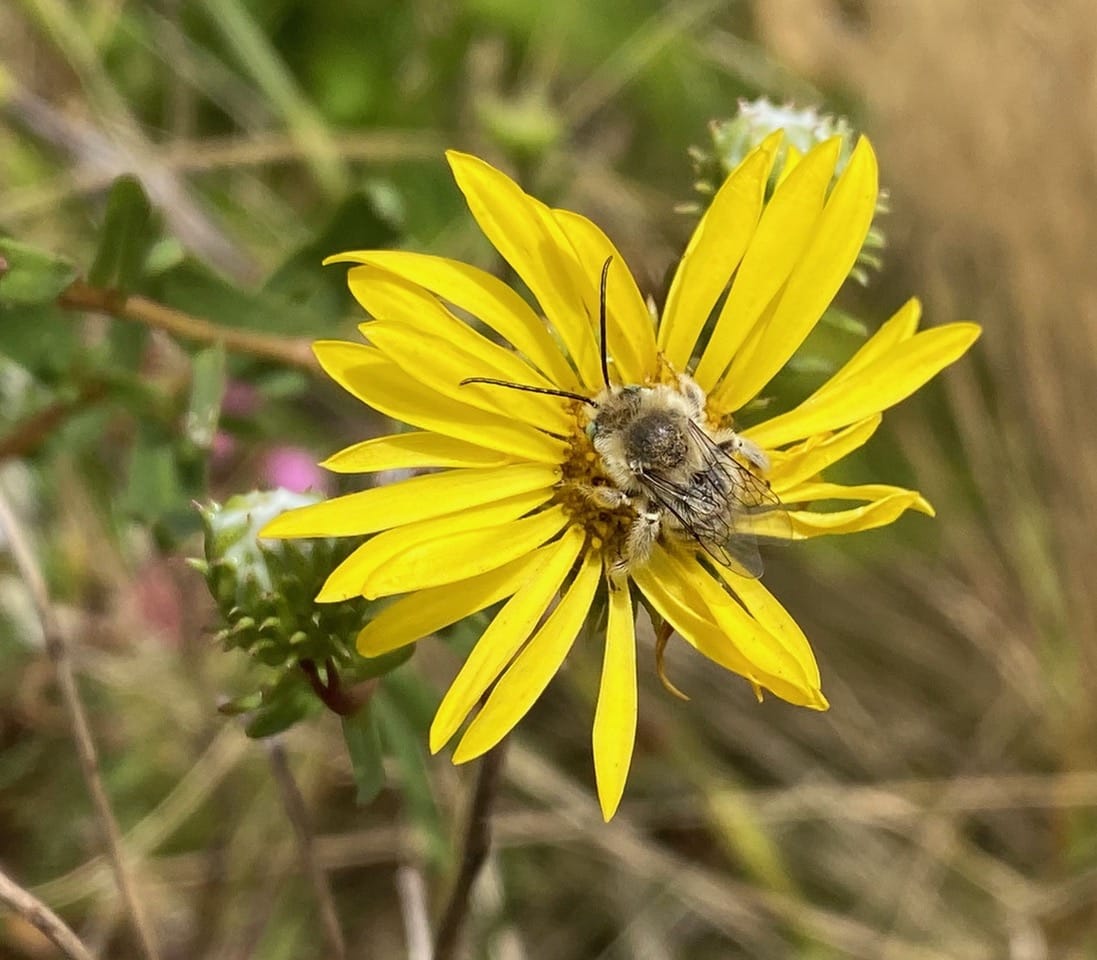
As the sun peeks through the clouds, I begin to see more bees. A male Summer Longhorn Bee, Melissodes sp. (family Apidae) has landed to take nectar from a flowerhead of Oregon Gumweed, Grindelia stricta.
The Summer Longhorn Bees, Melissodes sp. (family Apidae) are medium to large bees, stout-bodied, usually with gray hair on the thorax and pale hair bands on the abdomen. Males usually have yellow markings on their faces and have very long antennae from which their common name is derived. They are active May to September, with peak flight in late June to early August. The females prefer flat, bare ground for digging their solitary nests, though they sometimes nest in aggregations. Pollen is transported in scopae on the hind legs. Pollen loads are often copious and brightly colored and thus very distinguishable. Melissodes are specialists on Asteraceae – females gather pollen from flowers of Aster, Bidens, Coreopsis, Cosmos, Encelia, Gaillardia, Helianthus, and Rudbeckia ssp.
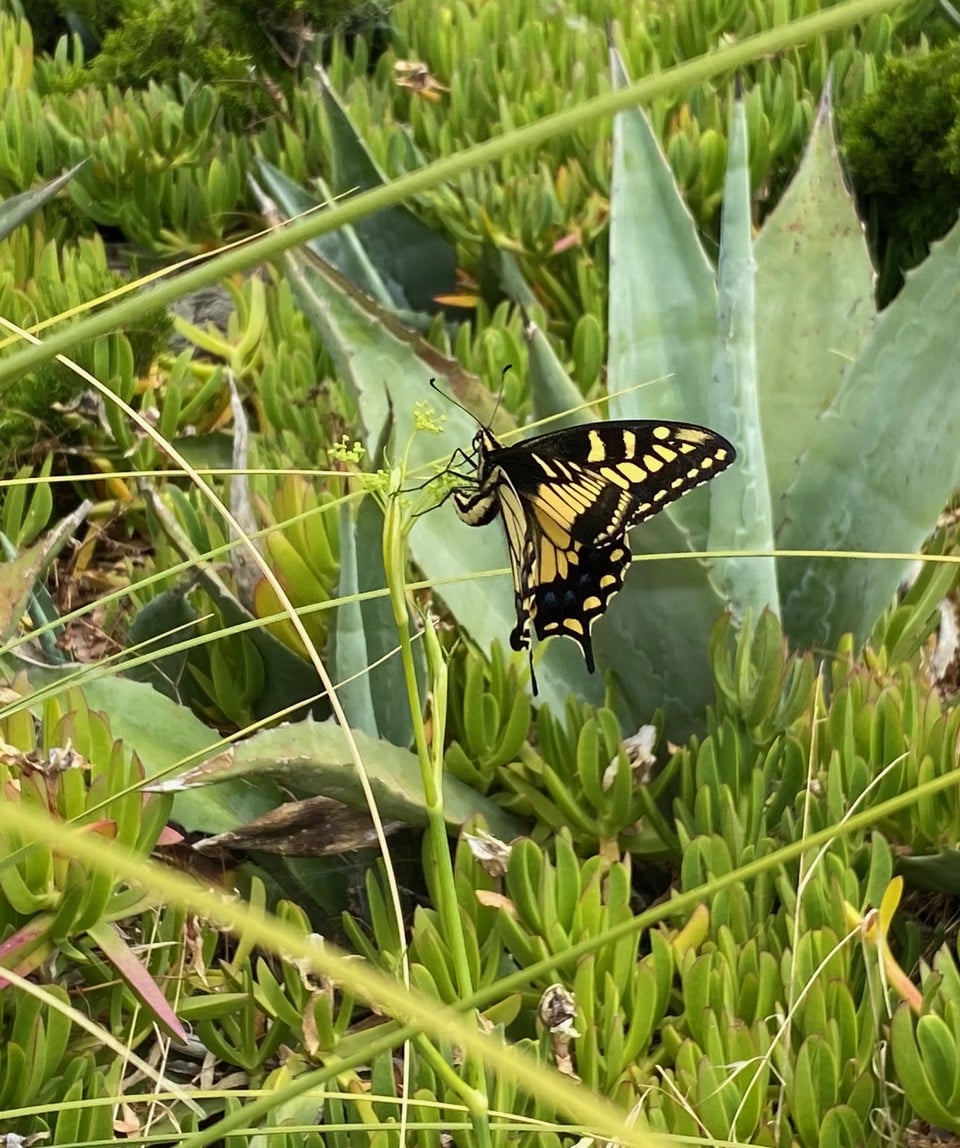
Her abdomen curled forward, an Anise Swallowtail butterfly is laying an egg on the immature flower umbel of a spindly Fennel, Foeniculum vulgare.
The Anise Swallowtail, Papilio zelicaon (family Papilionidae), is a common swallowtail butterfly of western North America. It is found in fairly open country, most likely seen on bare hills or mountains, in fields oar at the roadside. Adult females lay eggs singly on the underside of host plant leaves. In the first two instars, the caterpillar is a bird poop mimic – dark brown, almost black, with an irregular white band at its middle. After that it becomes more green at each successive molt until, in the fifth (last) instar, it is predominantly green, with markings in black, orange, and light blue. Its major food plants are members of the carrot family, Apiaceae (including Fennel), and also some members of the citrus family, Rutaceae.
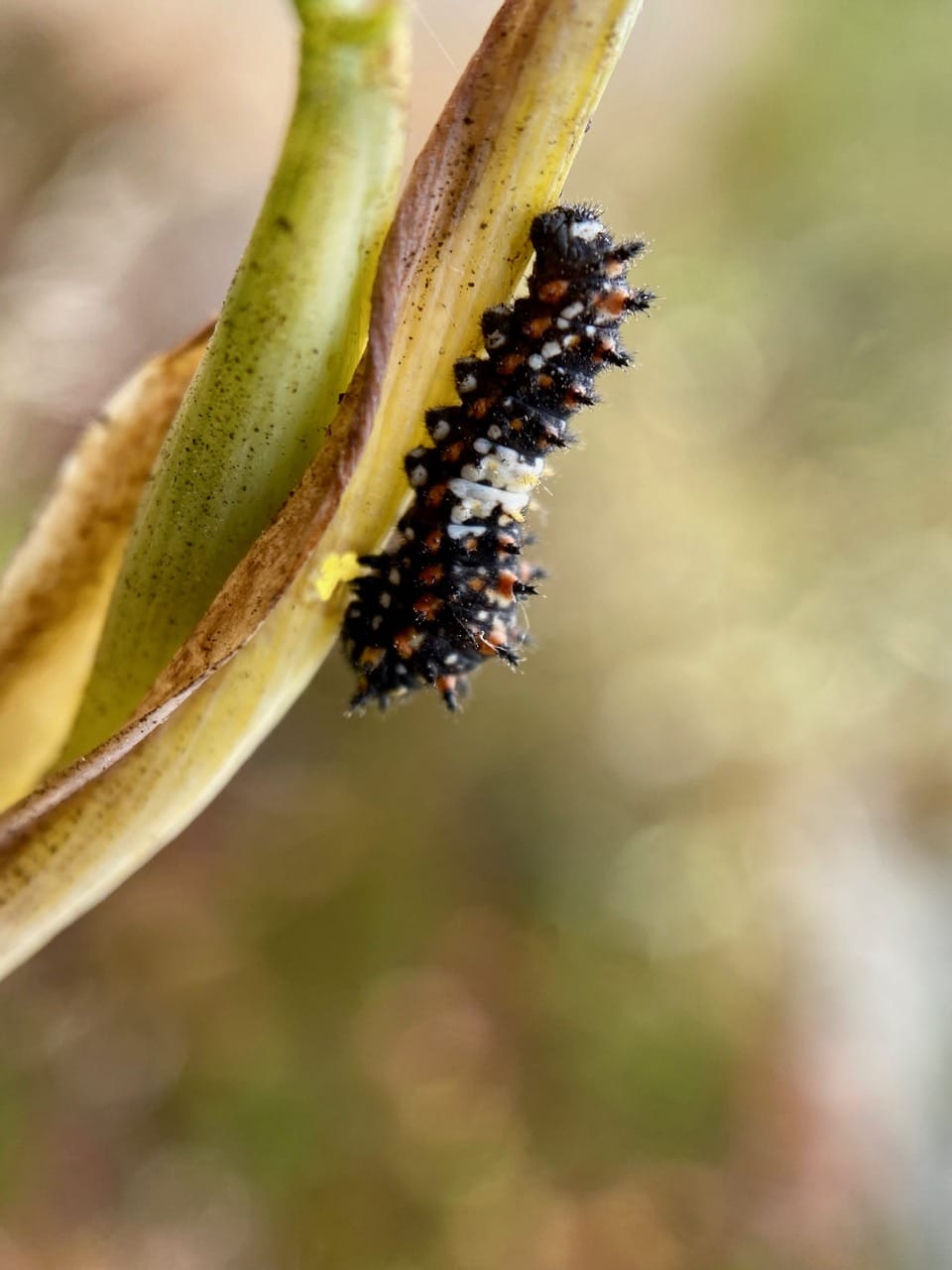
A early-instar Anise Swallowtail caterpillar is resting on a bract of Fennel. It is a bird-poop mimic, with an irregular patch of white across its middle to break up the outline of the larva and to mimic bird poop. The white paste in bird poop is actually bird pee. Birds convert bodily nitrogen waste into uric acid, which solidifies into this chalky, white substance. It is excreted alongside dark, solid feces through a single opening called the cloaca.

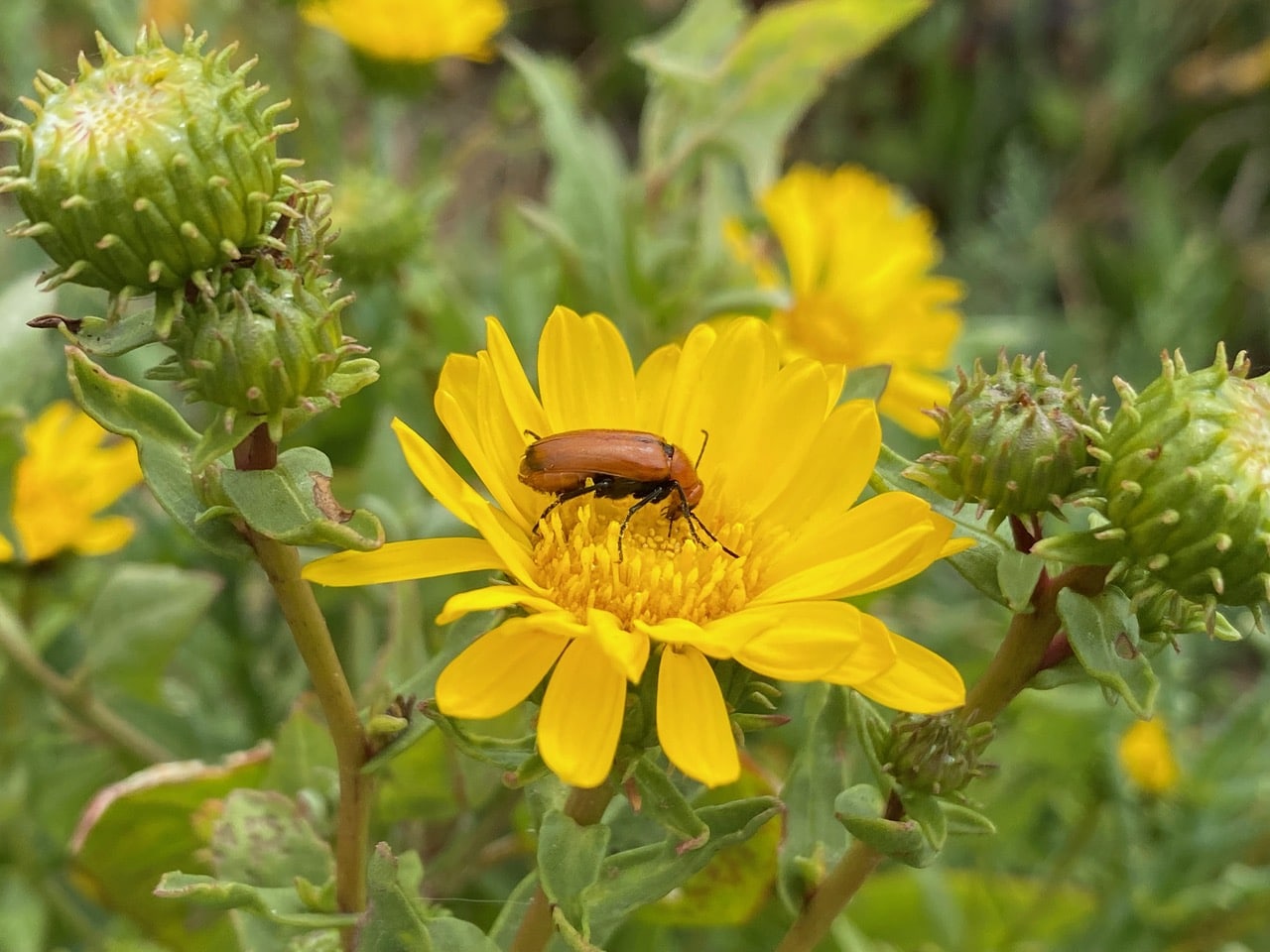
Whoa, my heart just missed a beat! A distinctive orange-colored Blister Beetle is taking nectar on a Grindelia flowerhead. I have only seen this beetle once before, and its kleptoparasitic life style and unique mouthparts blew me away.
Nemognatha scutellaris is a species of Blister Beetle (family Meloidae) native to North America. These beetles are characterized by their elongated, straw-like mouthparts used to extract nectar from flowers, and their long, sensory antennae.
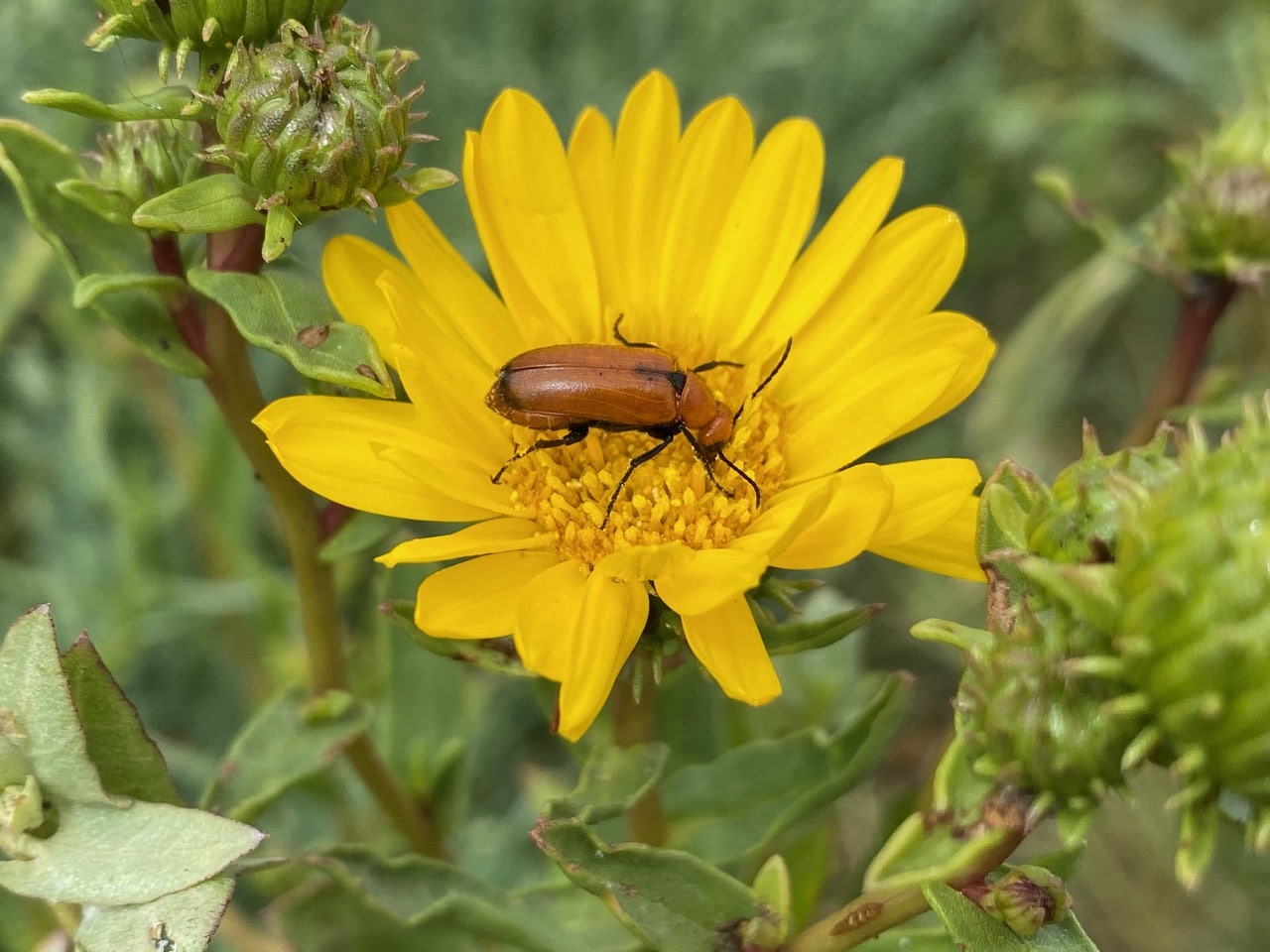
The Blister Beetle, Nemognatha scutellaris (family Meloidae) is a kleptoparasite of ground-nesting solitary bees. Instead of parasitizing adult bees, its hyper-mobile larvae (triungulins) attach themselves to foraging bees on flowers, hitching a ride into the bee’s underground nests to consume pollen reserves and bee larvae.
The beetle’s first-instar larvae hatch on flowerheads (often Asteraceae) and use claw-like legs to grasp adult bees as they visit for nectar/pollen. The bee unwittingly transports the hitchhiker to its underground nest. Once in the cell, the triungulin disembarks and attacks the bee’s developing egg or young larva. It then consumes the bee’s carefully provisioned pollen and nectar. Unlike typical insect larvae, these beetles go through distinct stages. After its first meal, it sheds its legs, transitioning into a grub-like stage to finish consuming the food, and overwinters inside the host’s nest before emerging as an adult in the spring. While they act as parasites by killing individual bee larvae and consuming their food reserves, they rarely decimate local solitary bee populations because of natural environmental checks and balances.
Like many blister beetles, N. scutellaris contains cantharidin. This toxic terpenoid is used as a chemical defense; if crushed against human skin, it can cause severe, painful blistering.

I am determined to take a good look at the beetle’s unique mouthparts, and fortunately the insect is very obliging. As the beetle lifts its head, I can see the tube-like mouthpart between its mandibles. It is plunging that repeatedly into the florets as it seeks nectar.
While many blister beetles eat plant foliage, Nemognatha are nectar-feeding blister beetles. The name Nemognatha translates to “thread-jaw” in Greek. It refers to the genus’s defining physical trait: the greatly elongated, thread-like outer mouthparts (the maxillary galeae). These extended galeae form a long, tube-like “proboscis” that functions like a butterfly’s straw, allowing the beetle to sip nectar from deep-throated flowers. Unlike true suction, the tube is densely bristled on the inside, which allows the beetle to draw up nectar via capillary action.
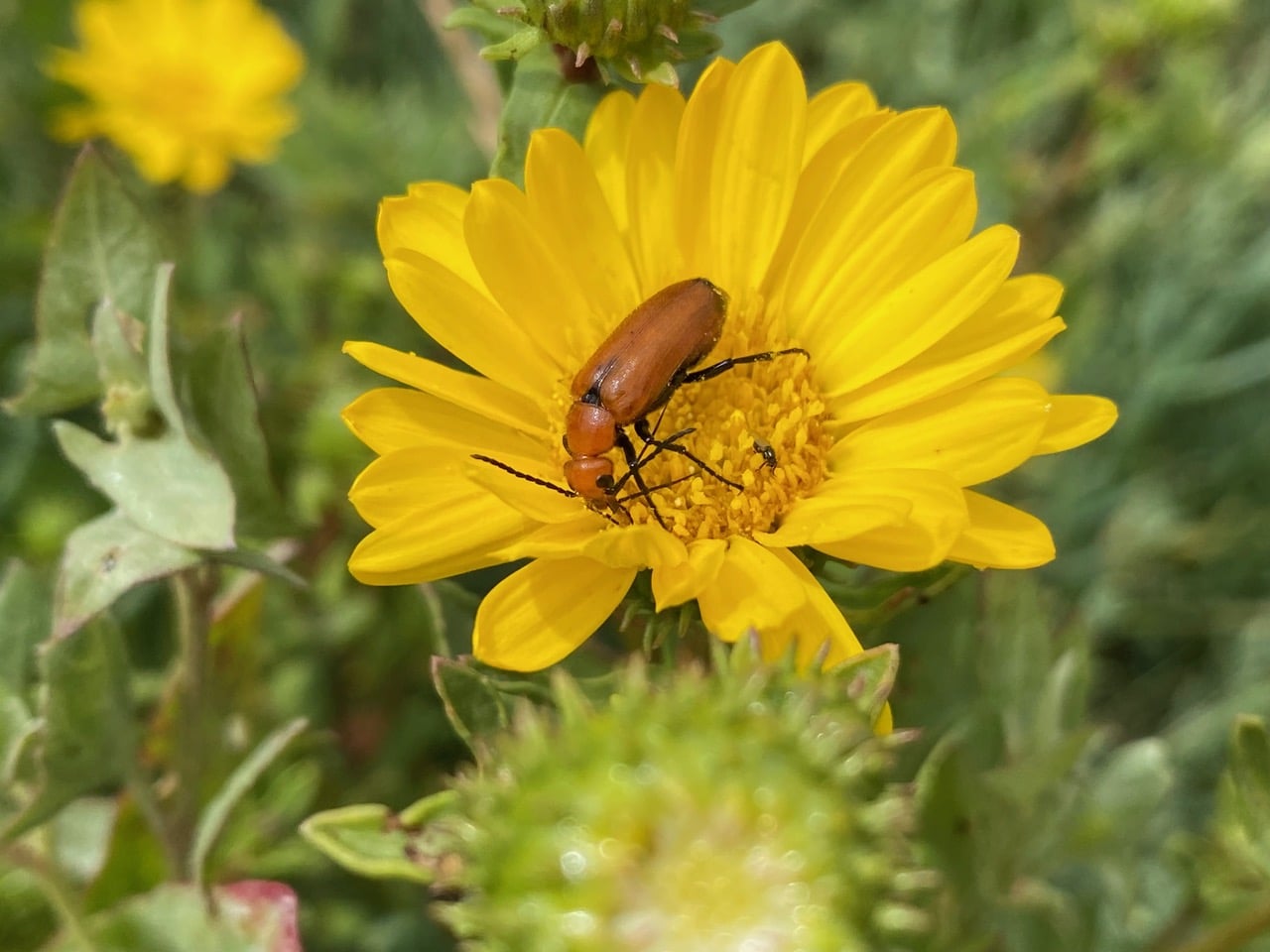
When the beetle finishes drinking nectar, the two maxillae are separated from the rolled tube. See the two thread-like structures?
These elongated maxillae are folded backward underneath the beetle’s body, safely out of the way when not in use. They are extended outward and rolled together to form a tube when the beetle is drinking nectar from flowers. The beetles retain typical chewing mandibles to feed on pollen when necessary.
What a remarkable beetle!
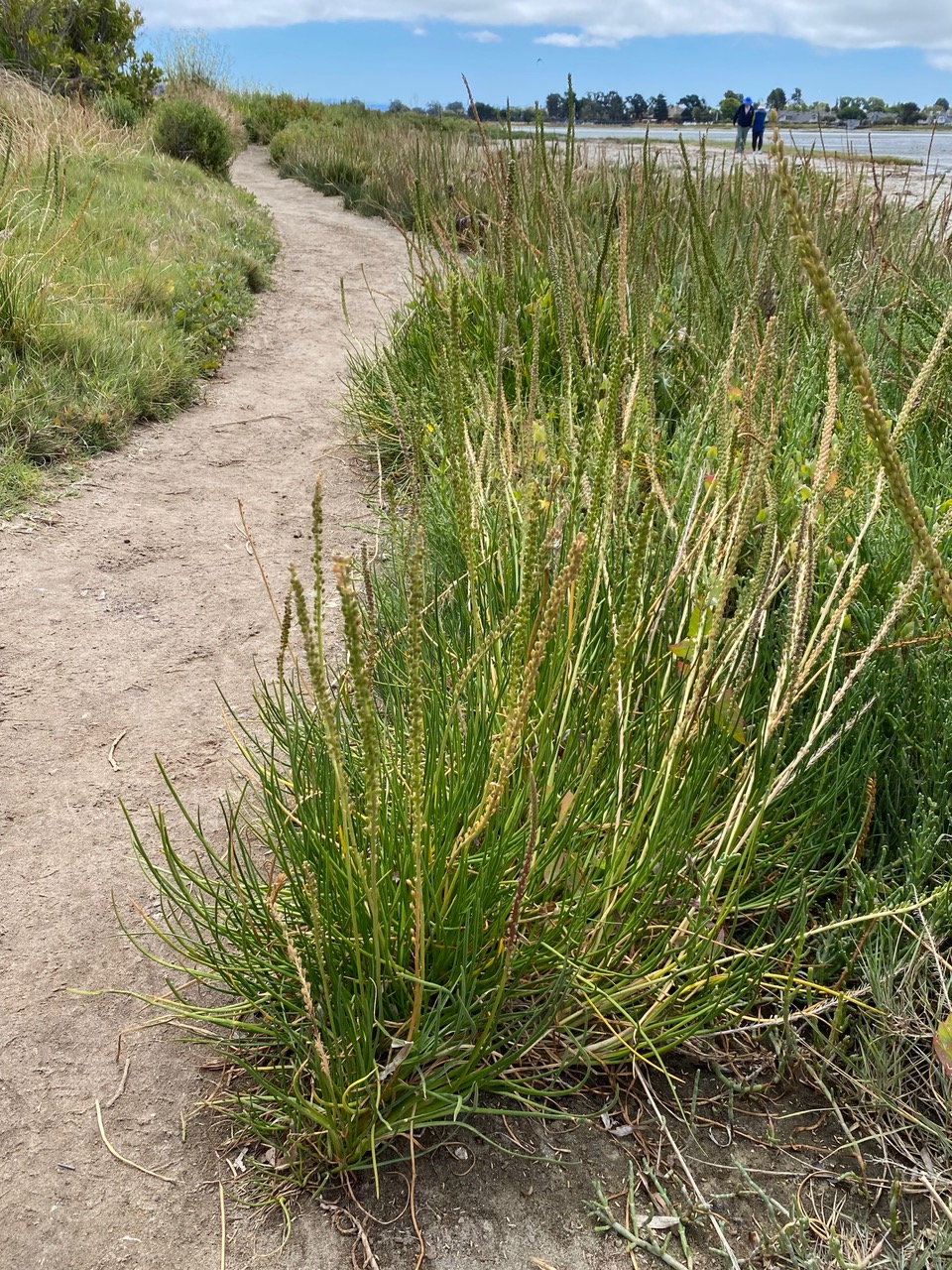
Tall flower spikes of Seaside Arrowgrass, Triglochin maritima line this section of the path winding through the marsh.
Seaside Arrowgrass, Triglochin maritima is a herbaceous perennial that naturally occurs throughout much of California in saline and brackish coastal marshes, wet sand beaches, and inland alkaline meadows. The plant produces small, inconspicuous green-to-brown flowers densely clustered along a stout, leafless spike. Though they lack showy petals, they feature unique reproductive structures, bloom progressively from the bottom up, and rely completely on the wind for pollination.
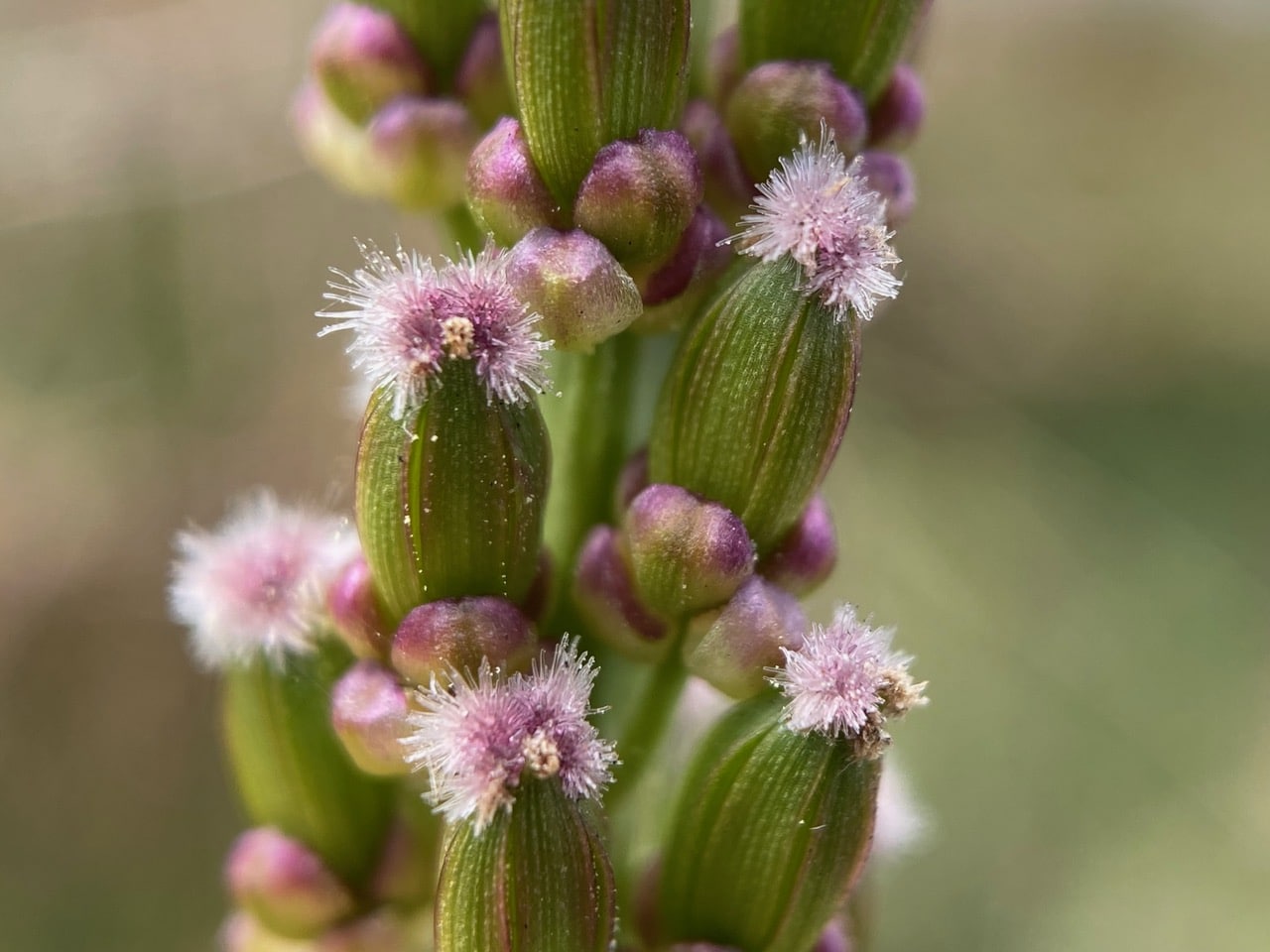
Close-up of the flowers of Seaside Arrowgrass, Triglochin maritima.
Individual flowers are very small, about 2-4 mm across, and sit closely against the stem. They have six fleshy, oval hairless segments (called tepals) that hide six stamens. At the top of the flower sits a distinctive, dense, feather-like cluster of white, yellow, or purple hair-like stigmas, which are designed to catch windborne pollen.
The flowers are hermaphroditic (containing both male and female parts), but they stagger their maturity to prevent self pollination. The female stigma matures and catches pollen first, and the stamens release their pollen only after the initial phase. This sequence called protogyny (“ladies first”). After pollination, the flowers develop into distinctive, oval-shaped seed pods (schizocarps) that eventually separate into six sections.