

Pollinator Post 7/5/24 (1)

I am back at the Reinhardt Redwood Regional Park in the Oakland hills for the third day in a row during this intense heat wave.

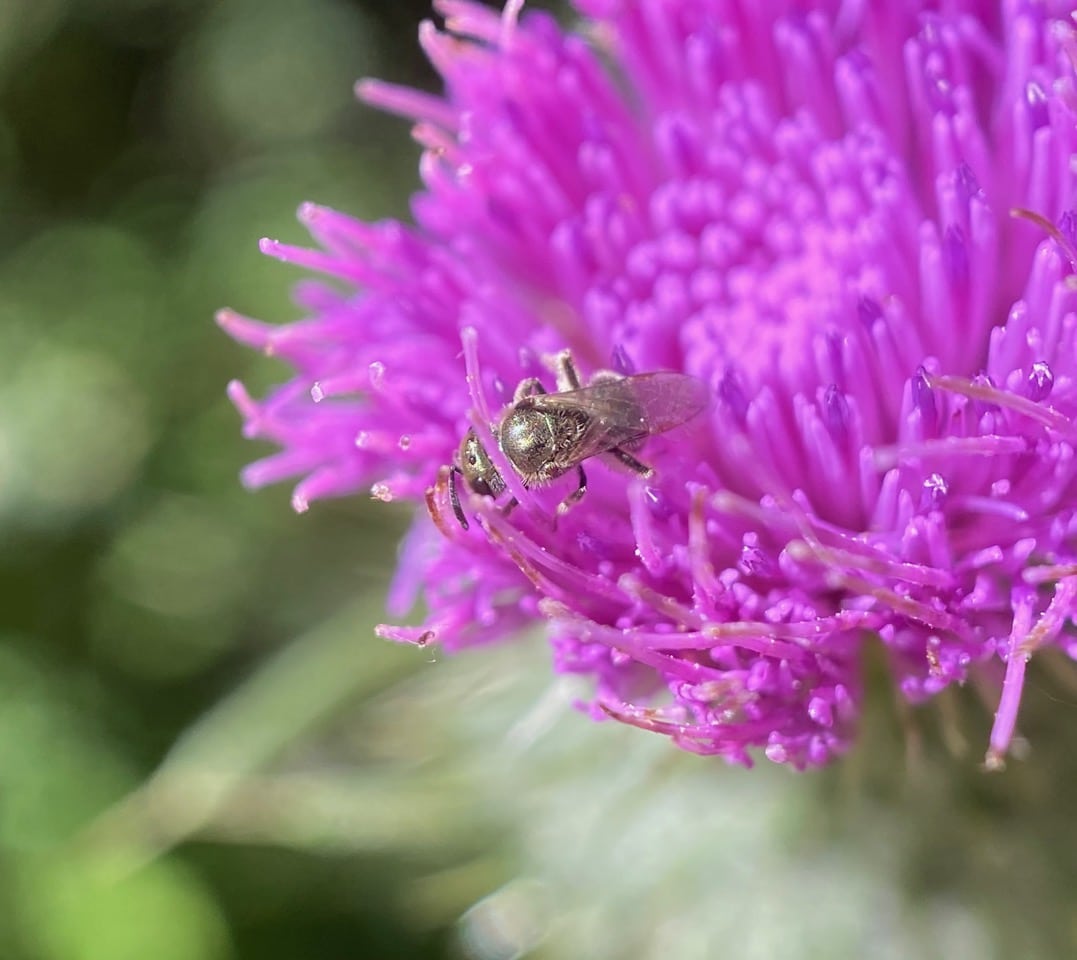







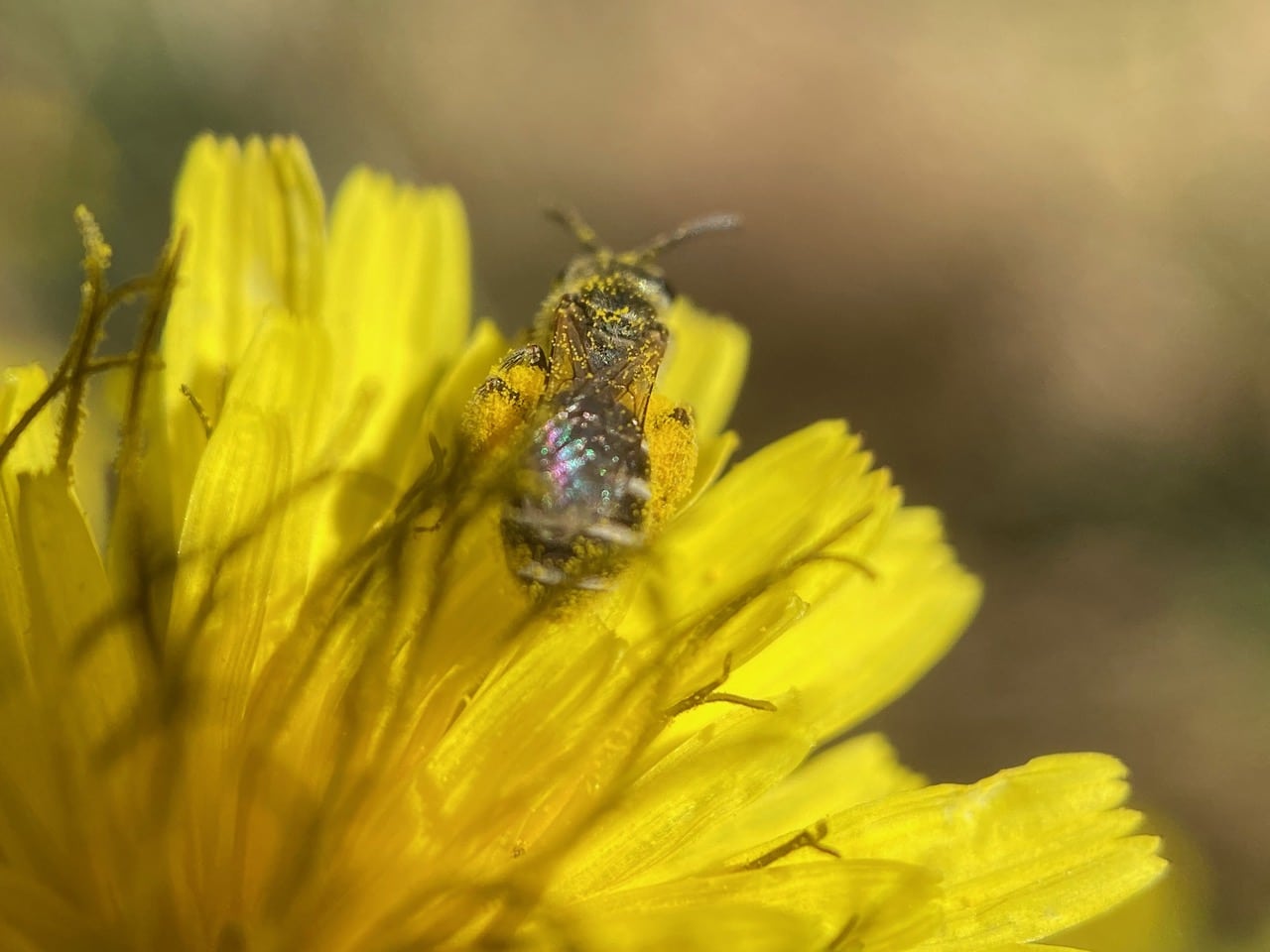




The body of a tiny Metallic Sweat Bee, Lasioglossum (Dialictus) sp., (family Halictidae) glows in the morning sun on a fresh flowerhead of Italian Thistle, Carduus pycnocephalus.
Straddling the tips of the Italian Thistle flowers, the bee is collecting pollen from the top of the anther tubes.
Lasioglossum are closely related to the genera Halictus and Agapostemon. These genera are commonly called “sweat bees” because of their attraction to human sweat, which they drink for its salt content. Lasioglossum are dusky black to brown slender bees with bands of hair on their abdomen. Lasioglossum species are found worldwide, and they constitute the largest bee genus. The subgenus Dialictus are the most likely to be seen in the U.S., with over 300 species of these tiny metallic bees. The majority of Lasioglossum are generalists. Because they are so abundant throughout the flowering season, the bees are often important pollinators. Their sheer numbers are enough to achieve excellent pollination of many wild flowers.
Lasioglossum exhibit a range of social behaviors; the genus includes solitary, communal, semi social, primitively eusocial, and even parasitic species. Almost all Lasioglossum in the U.S. nest in the ground. Generally these nests are built in the spring by fertilized females (called foundresses) that spent the winter in hibernation. In social species, the foundresses behave much like the queen Bumble Bees – they lay the first batch of eggs that develop into the first generation of female workers. The nest grows with each additional generation of bees. Later broods may consist of both males and females. They mate, and at the end of the season the fertilized females hibernate til the following spring, repeating the life cycle of the colony.
Dialictus is a subgenus of Sweat Bees belonging to the genus Lasioglossum. Most of the members of this subgenus have a subtly metallic appearance, and are small, about 3.4-8.1 mm in size. They are commonly found in Northern Hemisphere and are found in abundance in North America. As in the other members of the family Halictidae, the bees have very diverse forms of social structure, making them model organisms for studying the social behavior of bees.
The Metallic Sweat Bee is using her mandibles and front legs to delicately extract pollen from the tip of an anther tube.
Thistle flowers have a special pollination mechanism. The thistle flowerhead is composed of only disk flowers. Like other Asteraceae, thistle flowers are protandrous, the male parts maturing before the female parts. When visited by an insect the flowers react to the insect’s touch and the stamen filaments contract over a few seconds, pulling the anther tube down and forcing the style to extrude, pushing out pollen like a piston. Once the pollen is shed, the styles grow out of the anther tube and the pair of stigmas open out and become receptive. It has been observed that electrical stimulation can induce the movement, suggesting that it is an electrochemical phenomenon. Similar movements are observed in many other Asteraceae. With or without excitability, the pollen is generally presented when the style extends from the anther tube, by growth if not by a touch-elicited movement.
A Skipper butterfly (family Hesperiidae) is taking nectar from a flowerhead of a Bristly Oxtongue, Picris echioides. The dandelion-like flowerhead is composed of dozens of ray flowers. In a single stop, a butterfly can access nectar from numerous flowers with minimal expenditure of energy.
Skippers are a family, the Hesperiidae, of the order Lepidoptera (butterflies and moths). They are named for their quick, darting flight habits. Most have the antenna clubs hooked backwards like a crochet hook. They also have generally stockier bodies and larger compound eyes than the other butterflies. Their wings are usually small in proportion to their bodies. When at rest, skippers keep their wings usually angled upwards or spread out, and only rarely fold them up completely. Californian species are mostly brown or tan, with black, orange, or yellow markings.
Skipper caterpillars are usually green or brown, sometimes yellowish, never brightly colored. They have a distinctive “collar”, a narrow ring around the body right behind the head. Caterpillars are camouflaged and often hide during the day. Many species make nests of leaves and silk for additional protection. Most North American species feed on grasses, but some common species eat shrubs and trees, especially in the bean family. Most species are limited to a single group of food plants. Adult skippers are only active during the day, but Skipper caterpillars feed mainly when it is dark or partly light.
A small worker Yellow-faced Bumble Bee, Bombus vosnesenskii (family Apidae) is foraging on a flowerhead of Bristly Oxtongue. The weedy species has become a major source of sustenance for insects at a time when few native plants are in bloom.
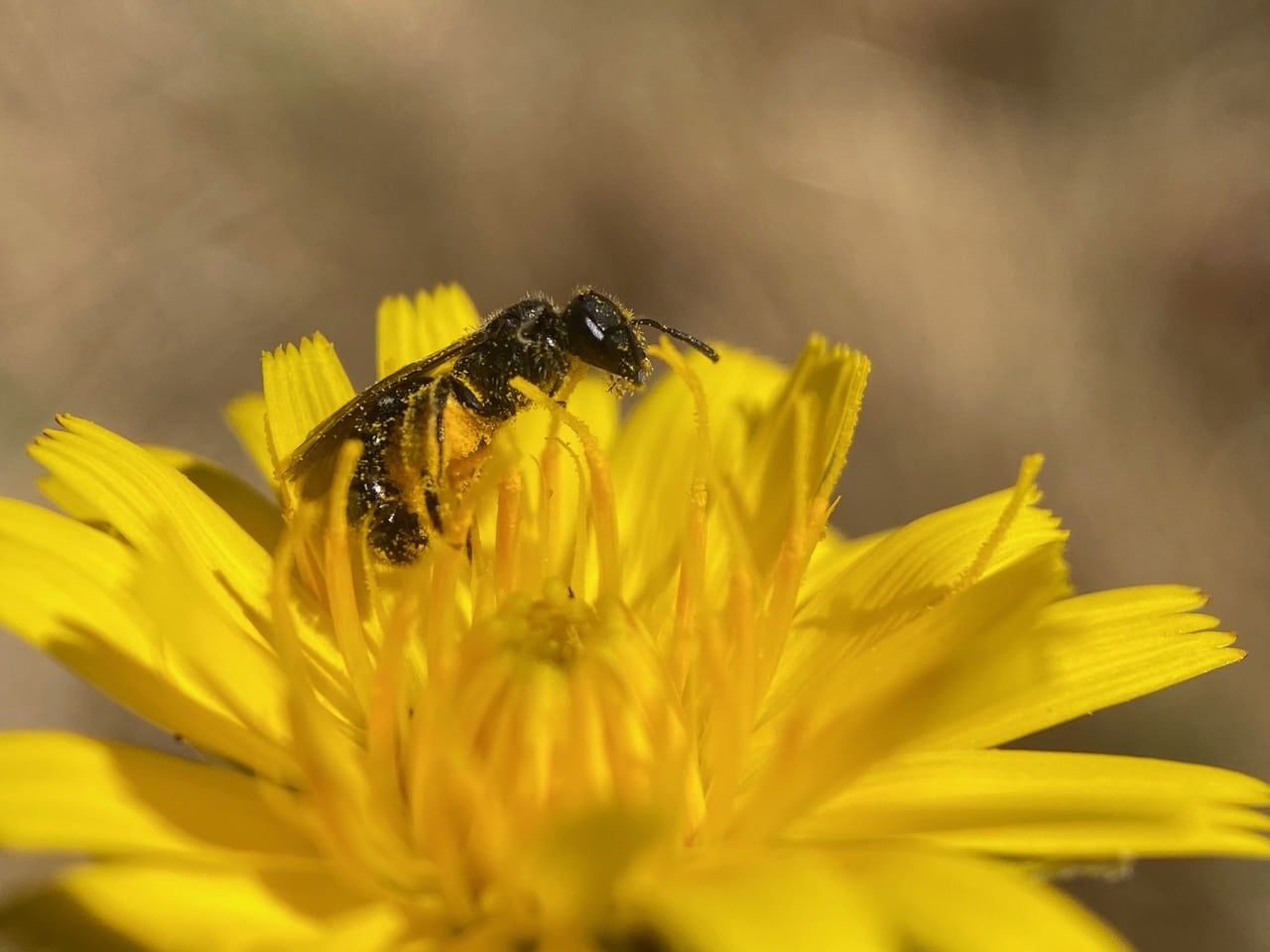
A female Sweat Bee (family Halictidae) is collecting pollen on a flowerhead of Bristly Oxtongue.
A very pale adult Lygus Bug, Lygus sp. (family Miridae) is resting motionless on a ray petal of a Bristly Oxtongue. It is a teneral freshly emerged from its final molt. A teneral insect is one that has recently molted and its exoskeleton has yet to harden and get its final coloration. In this state the insect is very vulnerable and the teneral state can last for some time. Teneral insects may be mobile and may even fly during this time but can often be identified due to their pale coloration.
Members of the family Miridae are also referred to as plant bugs or leaf bugs. Miridae is one of the largest family of true bugs in the order Hemiptera. Like other Hemipterans, Mirids have piercing, sucking mouthparts to extract plant sap. Some species are predatory. One useful feature in identifying members of the family is the presence of a cuneus; it is the triangular tip of the corium, the firm, horny part of the forewing, the hemielytron. The cuneus is visible in nearly all Miridae.

The term lygus bug is used for any member of the genus Lygus, in the family of plant bugs, Miridae. Adult lygus are approximately 3 mm wide and 6 mm long, colored from pale green to reddish brown or black. They have a distinctive triangle or V-shape on their backs. Lygus bugs are known for their destructive feeding habits – they puncture plant tissues with their piercing mouthparts, and feed by sucking sap. Both the physical injury and the plant’s own reaction to the bug’s saliva cause damage to the plant. Many lygus bugs are well-known agricultural pests.
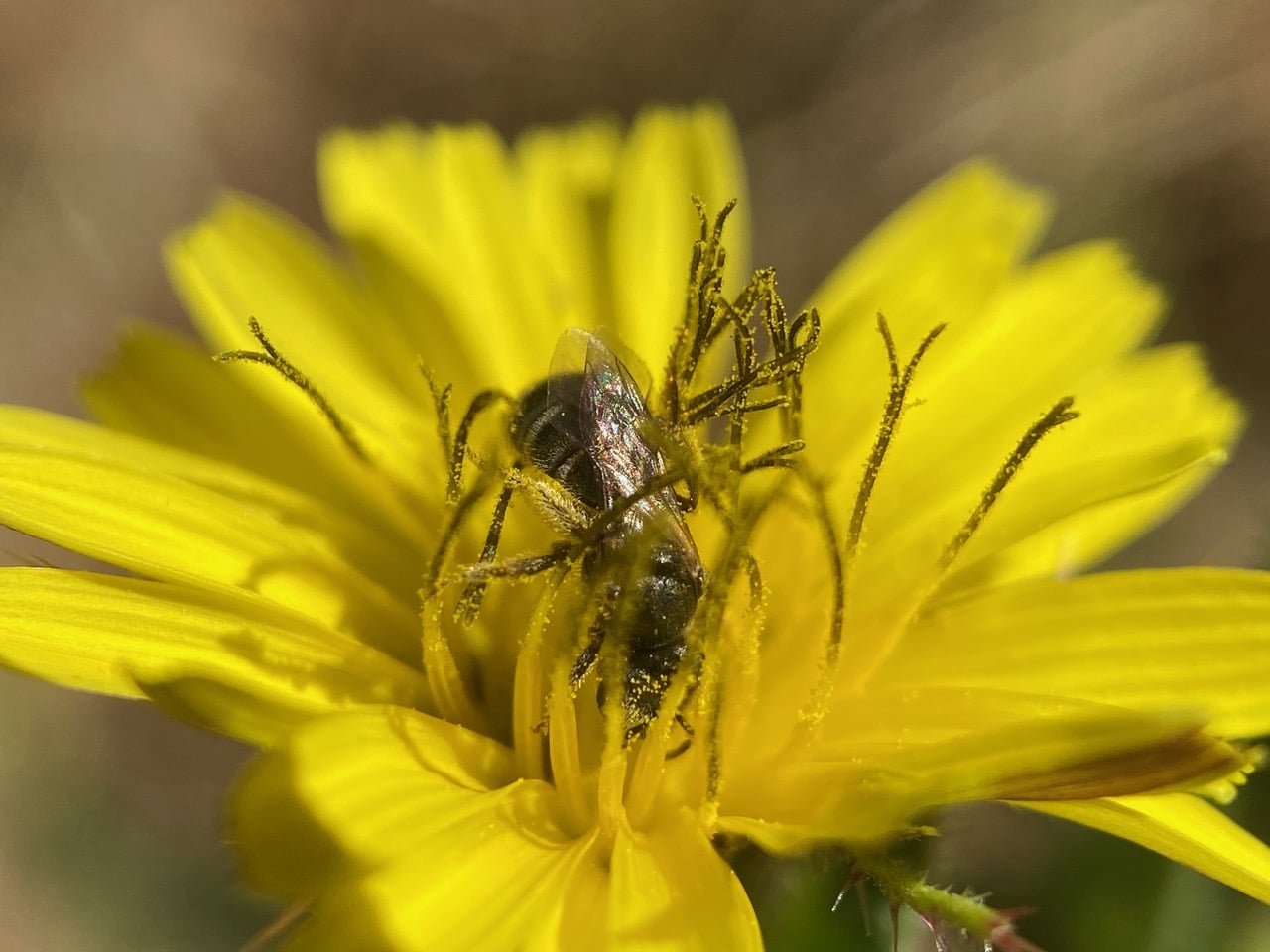
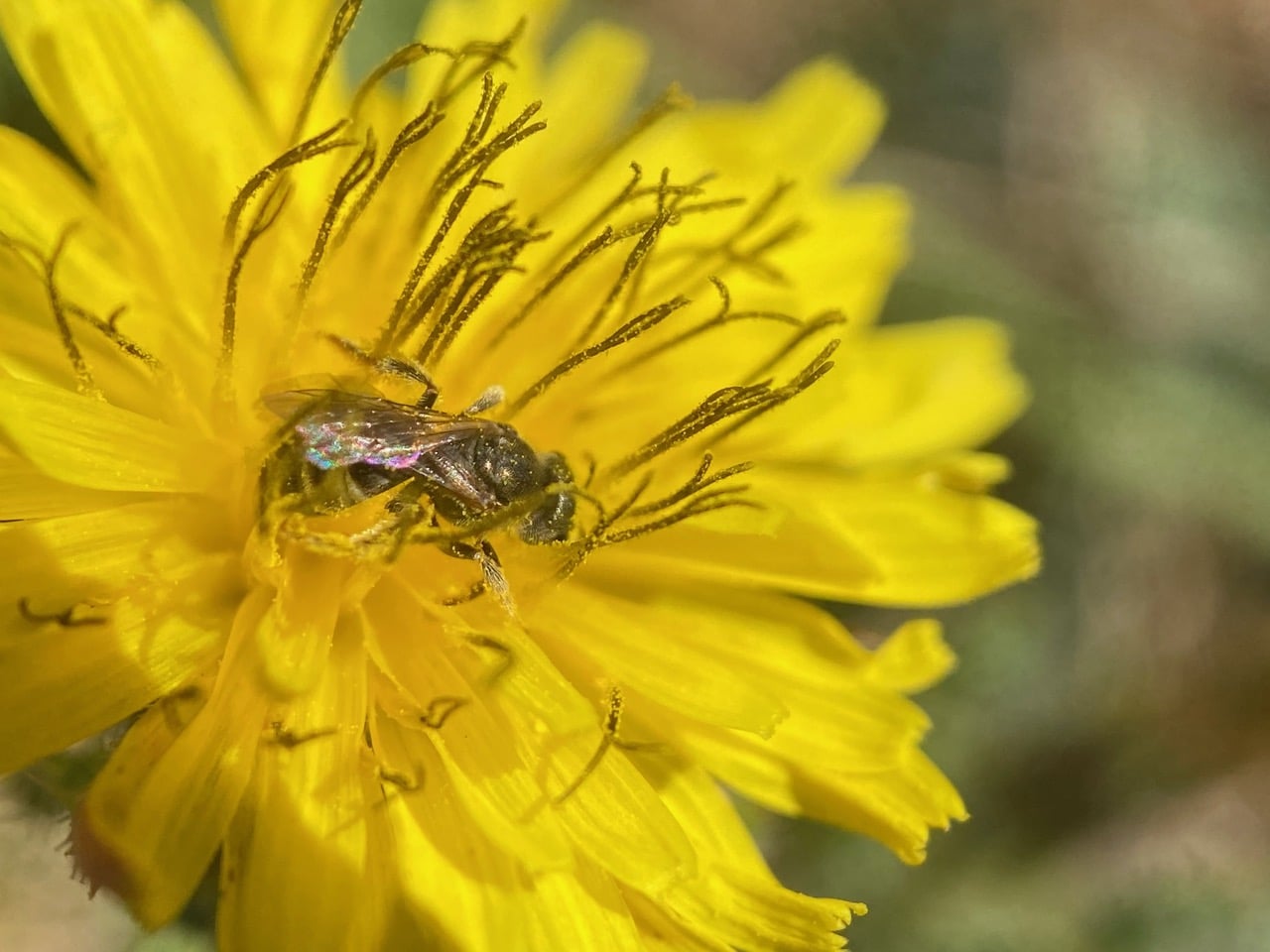
Many Sweat Bees, Halictus sp. (family Halictidae) are foraging on the flowerheads of Bristly Oxtongue.
That’s quite a harvest of pollen in her scopae as well as on the rest of her body.
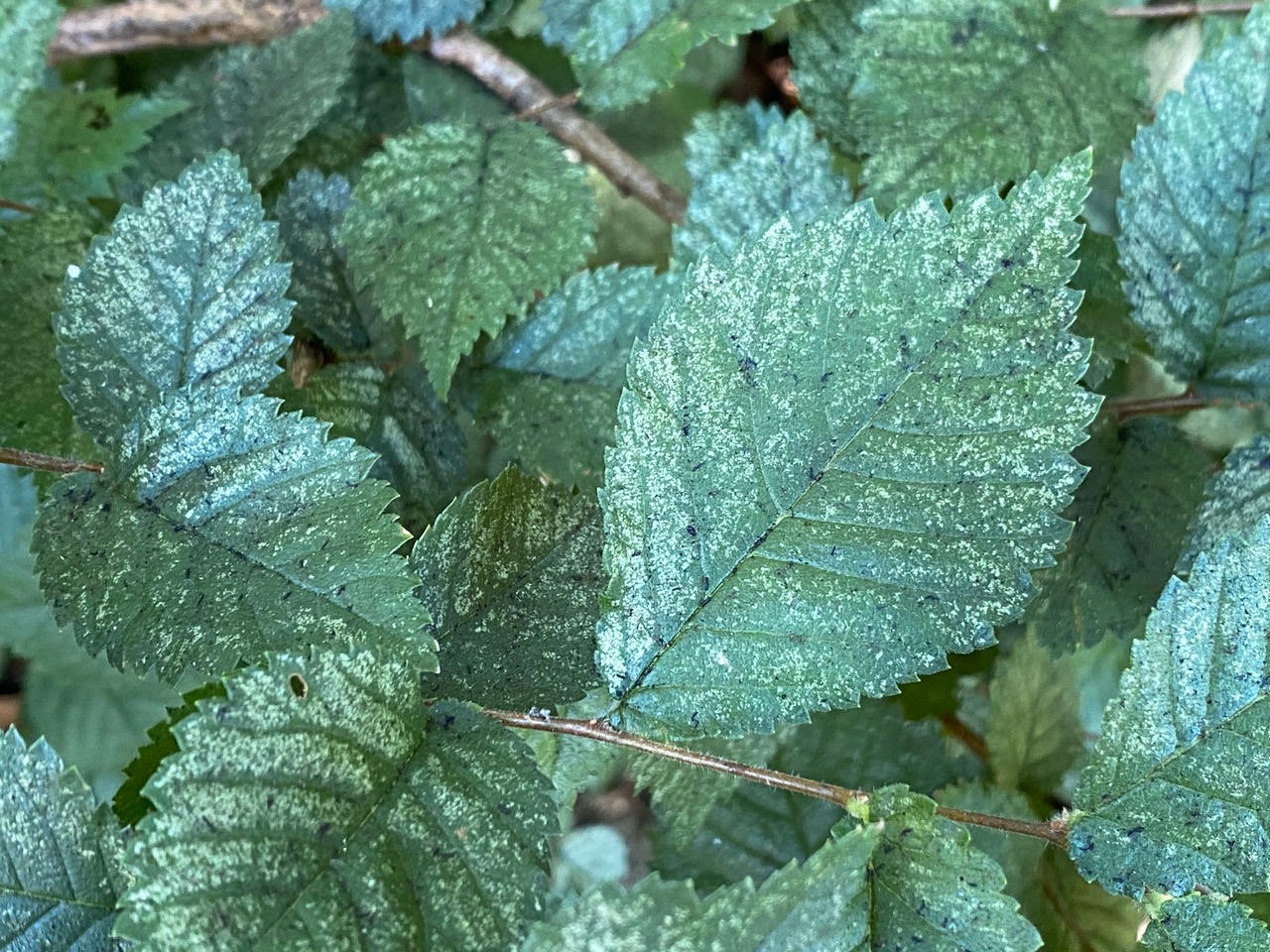
The young elms under the big trees look sickly. A close examination shows that the leaves are covered with punctate feeding scars. Infested with bugs (with piercing-sucking mouthparts)?
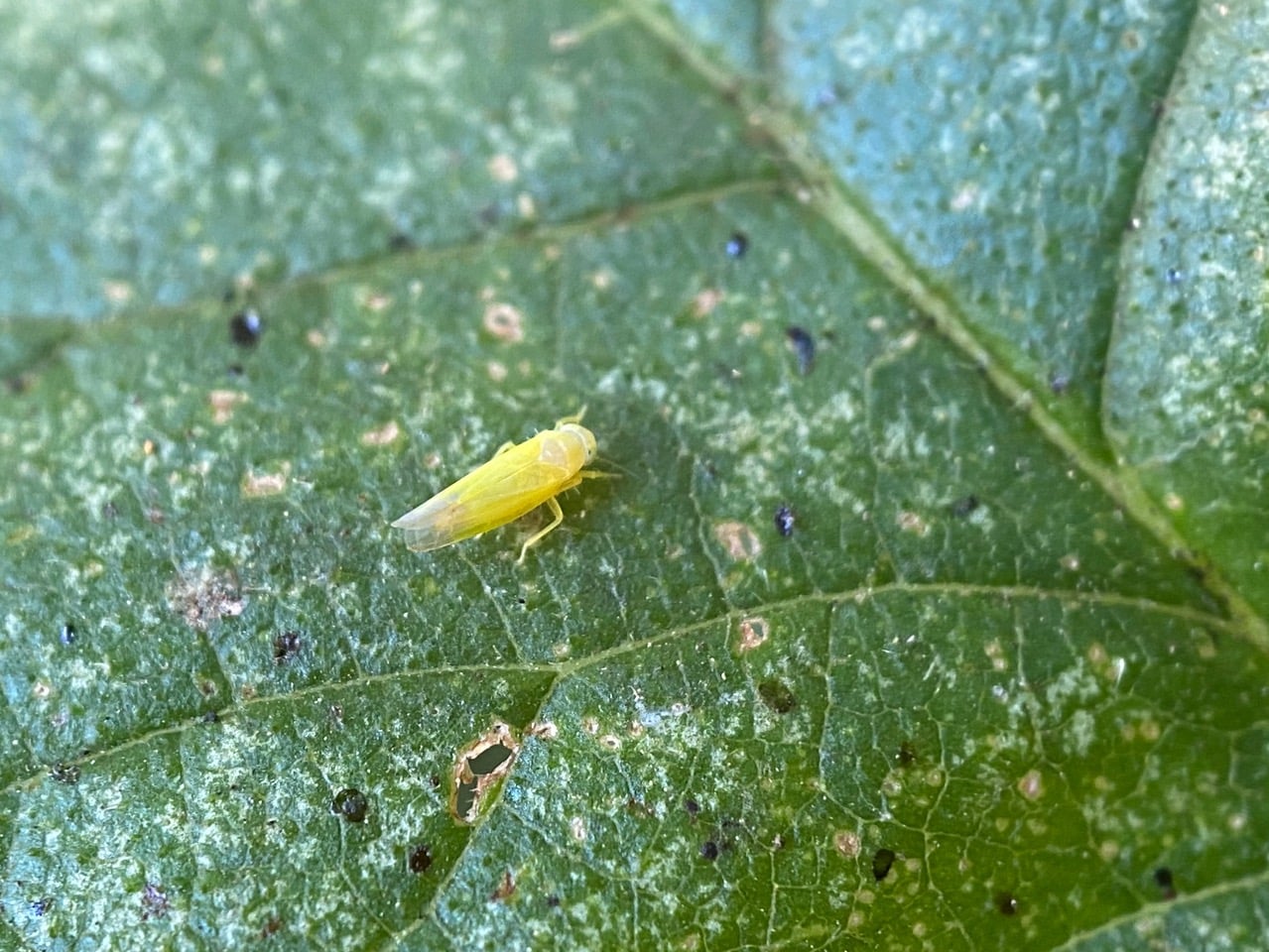
Are the Leafhoppers (family Cicadellidae) responsible for the leaf damage? There are many of them on the plant. The leafhopper looks translucent, yet it is an adult with functional wings.
Leafhopper is the common name given to true bugs in the family Cicadellidae. The bugs are plant feeders that suck plant sap from grass, shrubs, or trees. Their hind legs are modified for jumping, and are covered with hairs that facilitate the spreading of a secretion over their bodies that act as a water repellent and carrier of pheromones. They undergo partial metamorphosis, and have various host associations, varying from very generalized to very specific.
While sucking the sap of plants, these insects excrete any extra sugar as a sticky liquid commonly called honeydew. This is a serious hazard for small insects, possibly sticking the insect to a leaf, or gluing its body parts together. Some bugs deal with this problem by shooting the waste away from their bodies at high speed. Leafhoppers have a unique solution – they make brochosomes, a proteinaceous material within a special gland in their guts, and secrete them by the billions in a milky anal fluid, and spread them over their bodies using their legs. When the fluid dries, the brochosomes form a powdery coating, and the leafhoppers spread them even further using comb-like hairs on their legs. The brochosomal coat is superhydrophobic, and acts as a water-repellent, non-stick coating protecting the leafhoppers from their own sticky exudates.
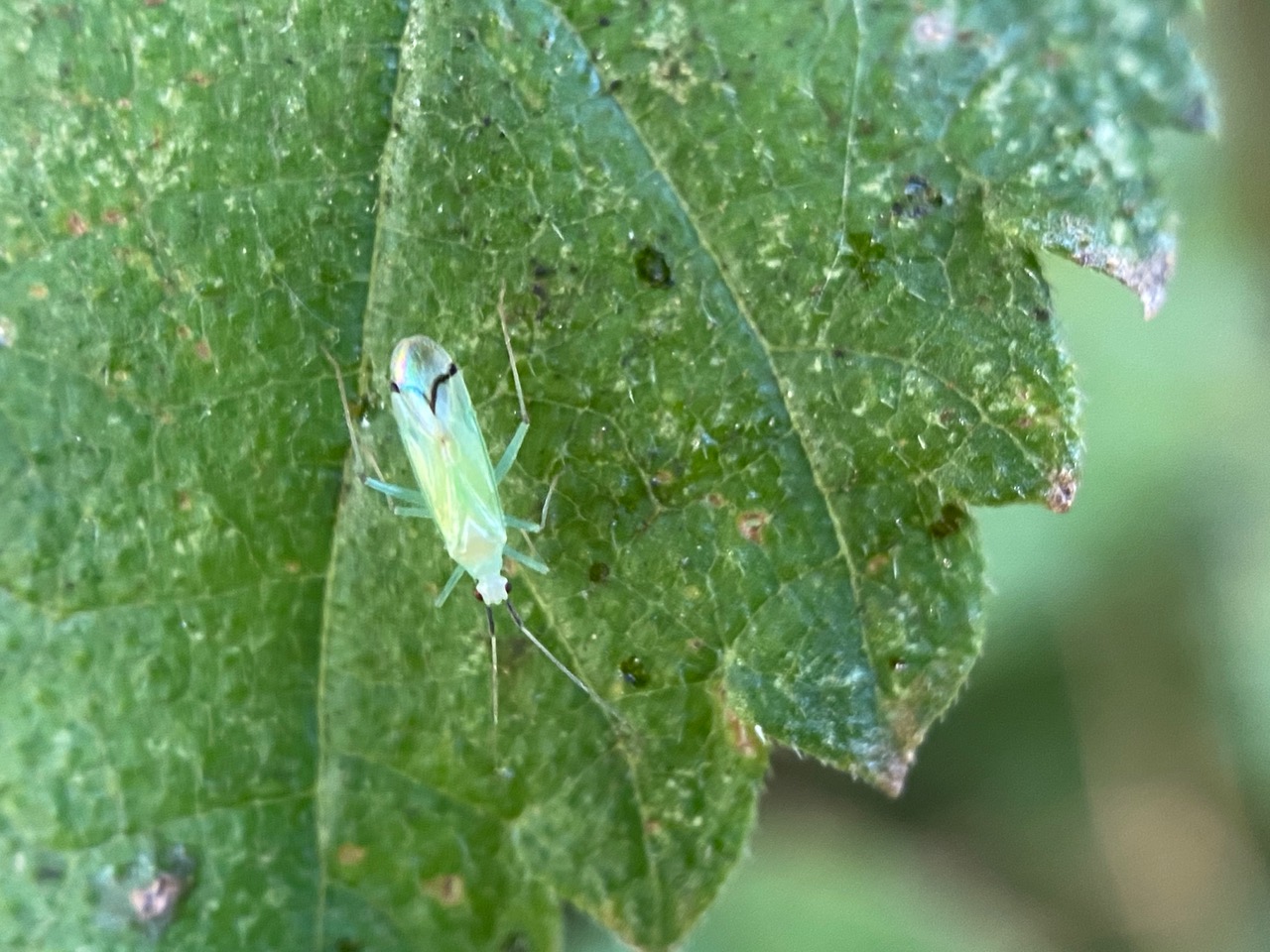
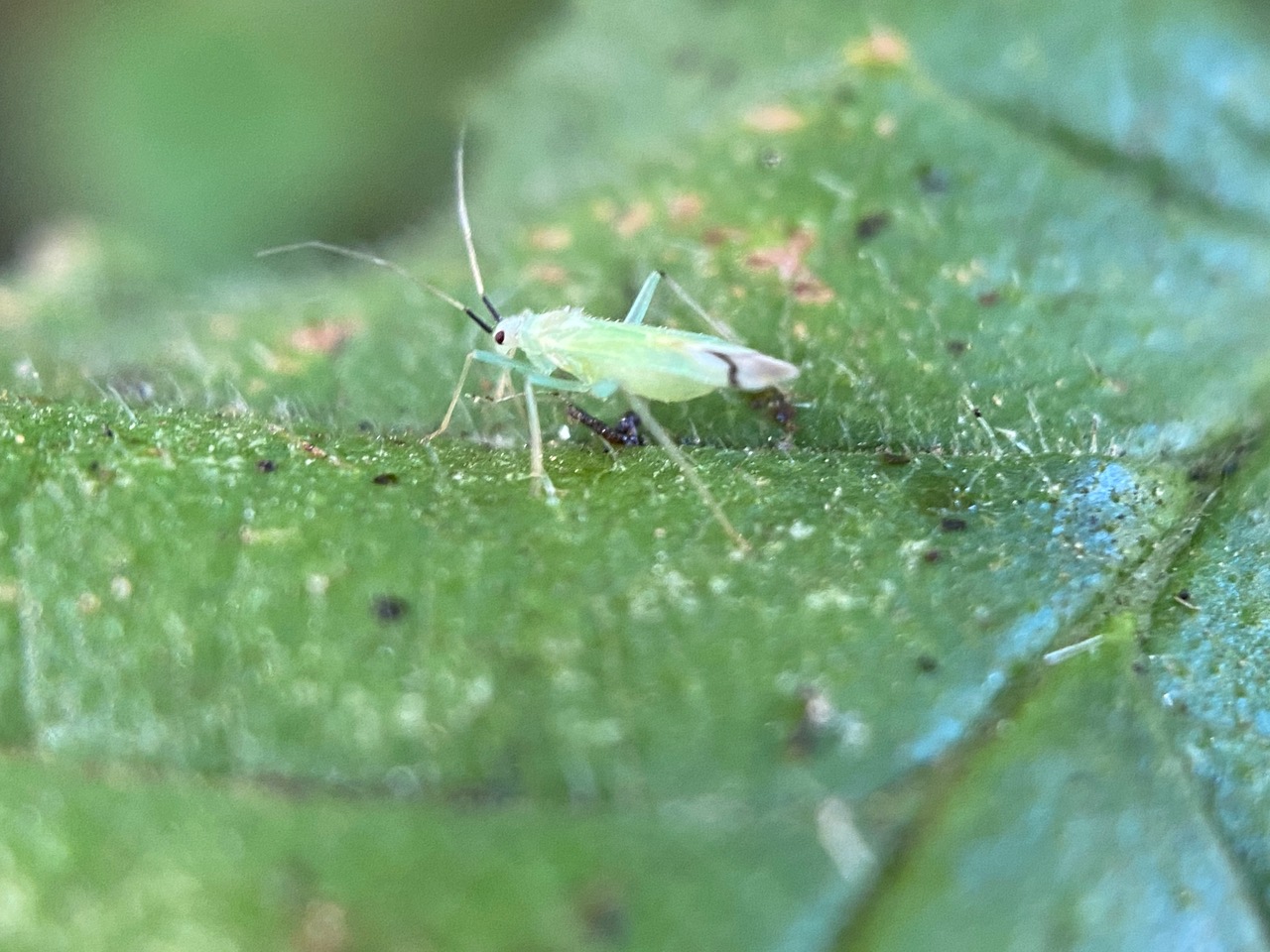
Running around on the Elm leaf is another translucent insect. It takes dozens of attempts to get the camera to focus on it. iNaturalist has identified it as Paraproba sp. (family Miridae).
Mirid bugs are also referred to as plant bugs or leaf bugs. Miridae is one of the largest family of true bugs in the order Hemiptera. Like other Hemipterans, Mirids have piercing, sucking mouthparts to extract plant sap. Some species are predatory. One useful feature in identifying members of the family is the presence of a cuneus; it is the triangular tip of the corium, the firm, horny part of the forewing, the hemielytron. The cuneus is visible in nearly all Miridae.
A fruit fly expert on iNaturalist has identified this Fruit Fly as a member of the subfamily Trypetinae (family Trephritidae).
Tephritids are small to medium-sized flies that are often colorful, and usually with picture wings. The larvae of almost all Tephritidae are phytophagous. Females deposit eggs in living, healthy plant tissues using their telescopic ovipositors. Here the larvae find their food upon emerging. The larvae develop in leaves, stems, flowers, seeds, fruits, and roots of the host plant, depending on the species. Adults are often found on the host plant and feeding on pollen, nectar, rotting plant debris, or honeydew. Tephritid flies are of major economic importance as they can cause damage to fruit and other plant crops. On the other hand, some Tephritids are used as agents of biological control of noxious weeds.
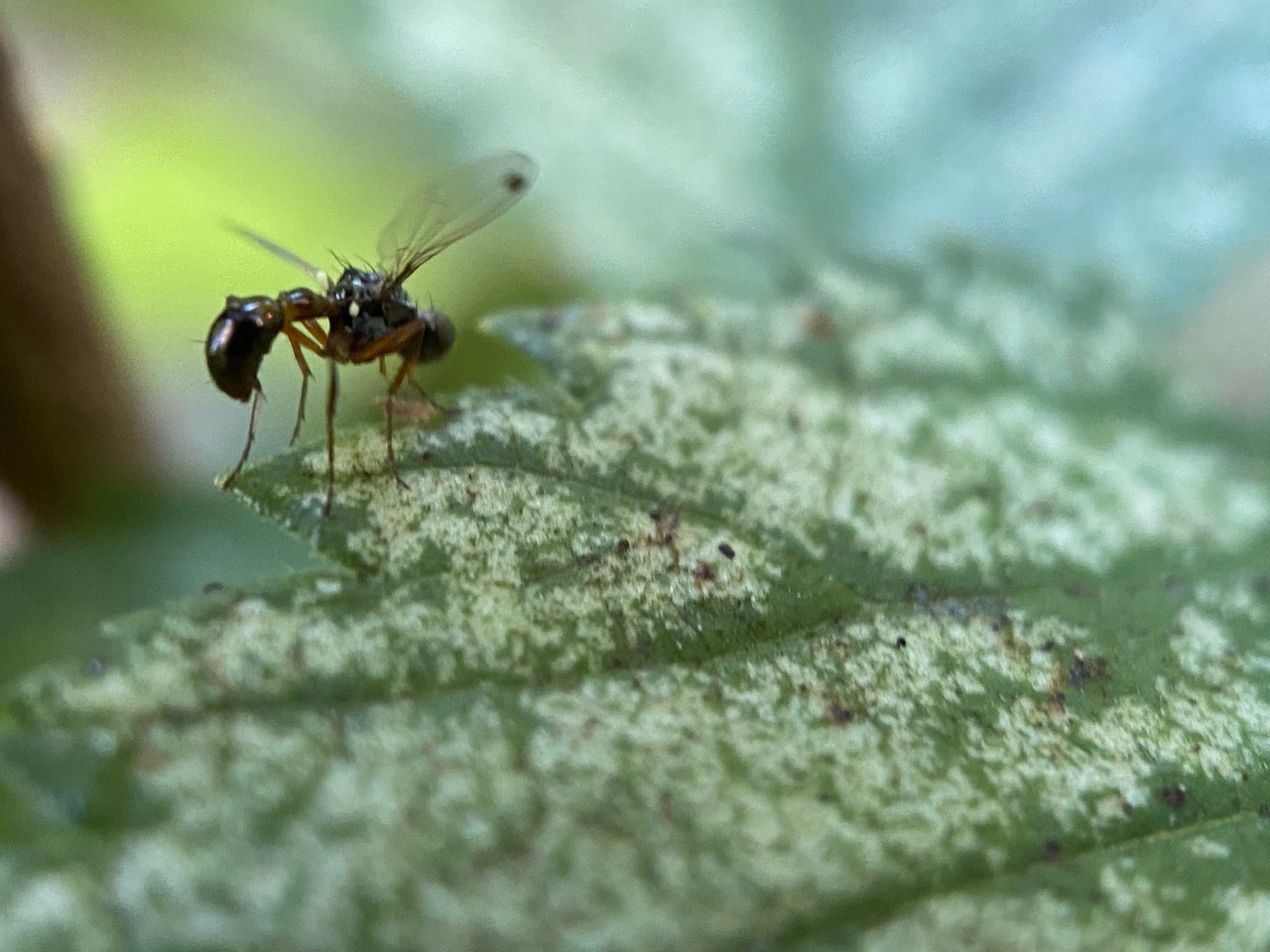
A tiny black insect is waving its raised wings as it races around on an Elm leaf. It looks like a winged ant, with a “waist”, but it is actually a fly, as evidenced by its halteres.
Halteres are the modified hind wings in Diptera (flies). They are shaped like ‘drum sticks’ or “lollipops” with a slender shaft connected to the thorax. Halteres are highly sophisticated balance organs, functioning as gyroscopes; they oscillate during flight. This is why the flies have only two wings (hence the name Diptera).
The feisty fly is a Black Scavenger Fly or Ensign Fly, in the family Sepsidae. Over 300 species are described worldwide. They are usually found around dung or decaying plant and animal material. Many species resemble winged ants, having a “waist” and glossy black body. The head is rounded. Many Sepsidae have a curious wing-waving habit made more apparent by dark patches at the wing tip. Adult flies are found mostly on mammal excrement, where eggs are laid and larvae develop, and on nearby vegetation, carrion, fermenting tree sap, and shrubs and herbs.
Revolting as their dietary habits might seem, these flies serve a vital function in the ecosystem as decomposers/recyclers of organic matter. Nature’s clean-up crew. Imagine a world without them!