

Pollinator Post 7/4/25 (4)
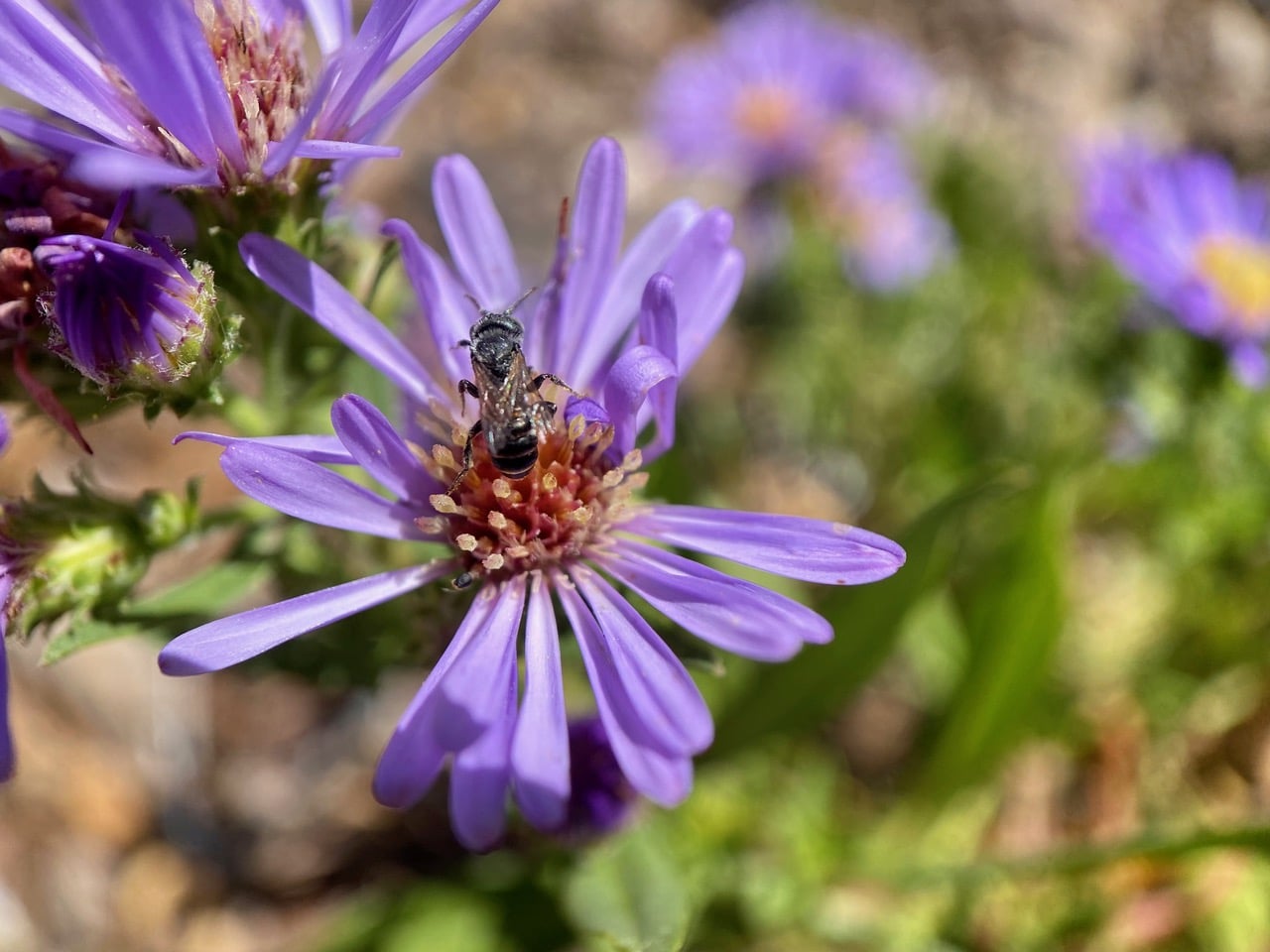
This scene puzzles me. First, although this flowerhead of Pacific Aster, Symphyotrichum chilense is relatively fresh, its florets are strangely devoid of pollen. Then the little bee – it superficially resembles a Tripartite Sweat Bee, but a few things don’t jive: the slim, elongate body, the slightly hairy thorax, and the absence of scopae on the hind legs of the female.
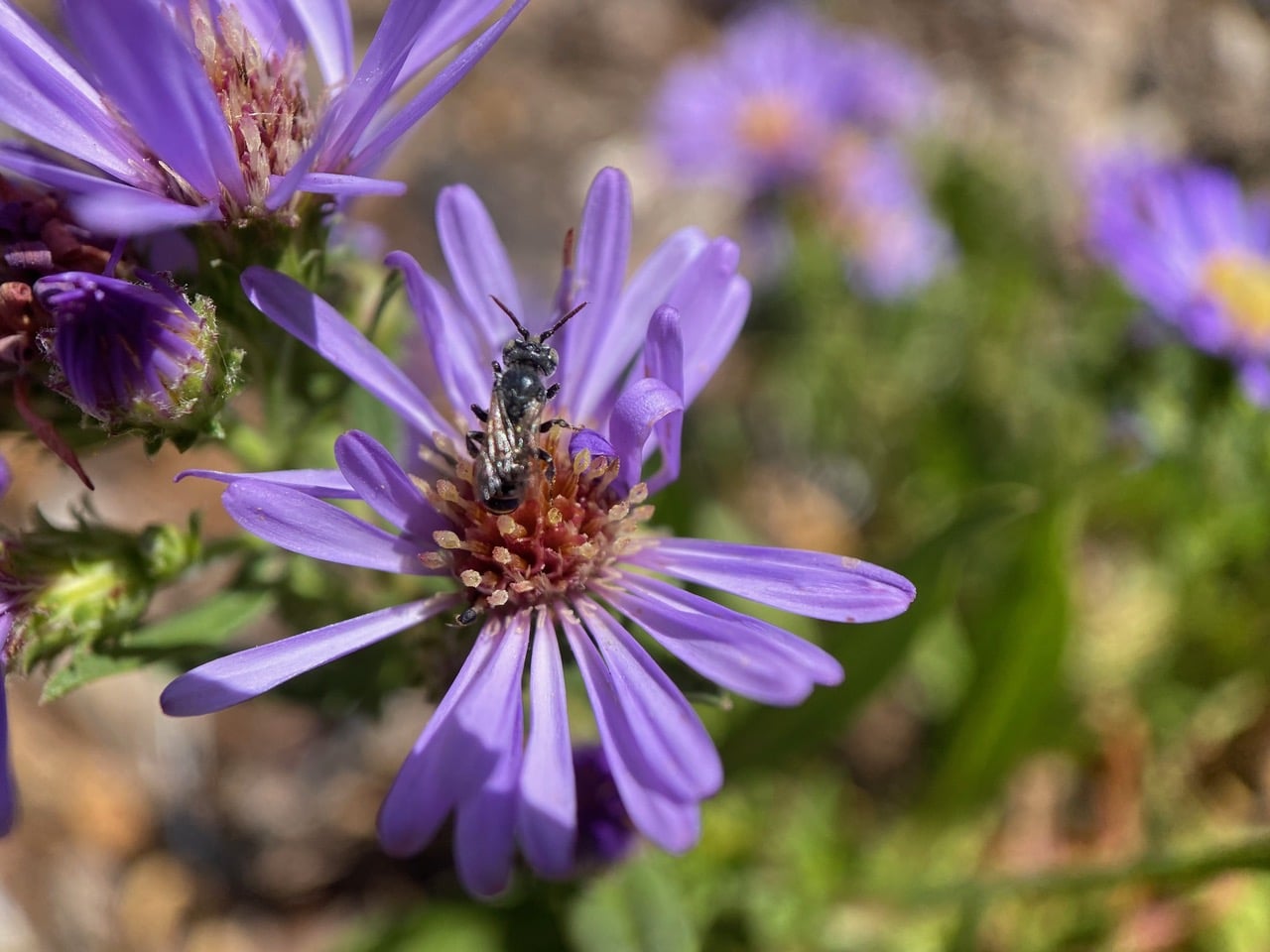
This closer view of the insect shows mottled eyes. I think the bee might be a Small Mason Bee in the genus Hoplitis (family Megachilidae). It makes sense that we don’t see scopa on the legs. Members of the Megachilidae family have scopa on the underside of their abdomen.
Hoplitis is wide-ranging, found on every continent except Australia, South America, and Antarctica. Within the U.S., Hoplitis are more diverse along the west coast. The bees are more diverse in boreal and cool mountain habitats. Members of the genus Hoplitis are generally nonmetallic. There is a wide range of sizes and colors. Many have pale hairs on the thorax and hair bands on the abdomen. A few species are found in urban gardens, but none are widespread or common. Flight season is from May to September, with peak season in June and July. Most are cavity nesters – excavated burrow in soil, cracks in rocks, or pithy stems to pre-existing abandoned beetle or bee burrows, empty galls, and empty snail shells. Hoplitis use specific materials such as chewed-up leaf pulp, pebbles, bits of wood, resin, clay, sand, and petals to create partitions between cells and nest plugs. Females transport pollen in the scopae on the underside of the abdomen. Most encountered species in urban gardens are generalists, visiting a wide range of flowers.

A female Acmon Blue butterfly has settled on a flowerhead of Pacific Aster to take nectar.
Acmon Blue, Icaricia acmon (family Lycaenidae) is a North American butterfly, found mostly in California. It is a small butterfly, with a wingspan of 0.75 to 1.125 in. It can be seen from March to October, with peak numbers in July. Adults feed on nectar while caterpillars feed on a variety of plant species, including buckwheats, deer weed, lupines, trefoils, and milkvetches. Like many Lycaenid butterflies, Acmon Blue shares a mutualistic relationship with ants. The ants protect the caterpillars from predators in exchange for the sweet “honeydew” the caterpillars secrete from a nectary gland. The larvae are often protected and kept in the ant nest when not feeding.
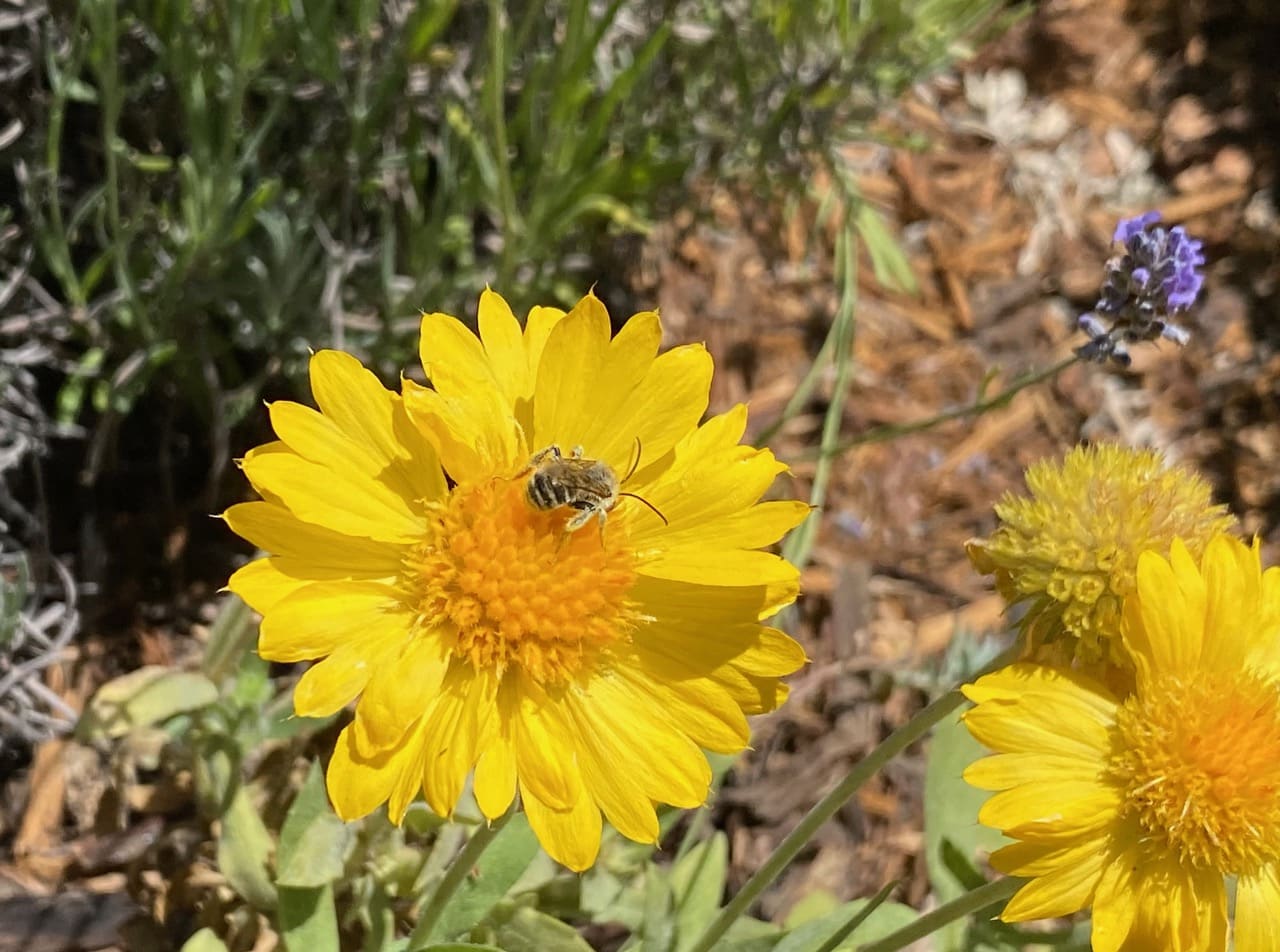
A male Summer Longhorn Bee, Melissodes sp. (family Apidae) is taking nectar from a flowerhead of Blanket Flower, Gailardia sp.
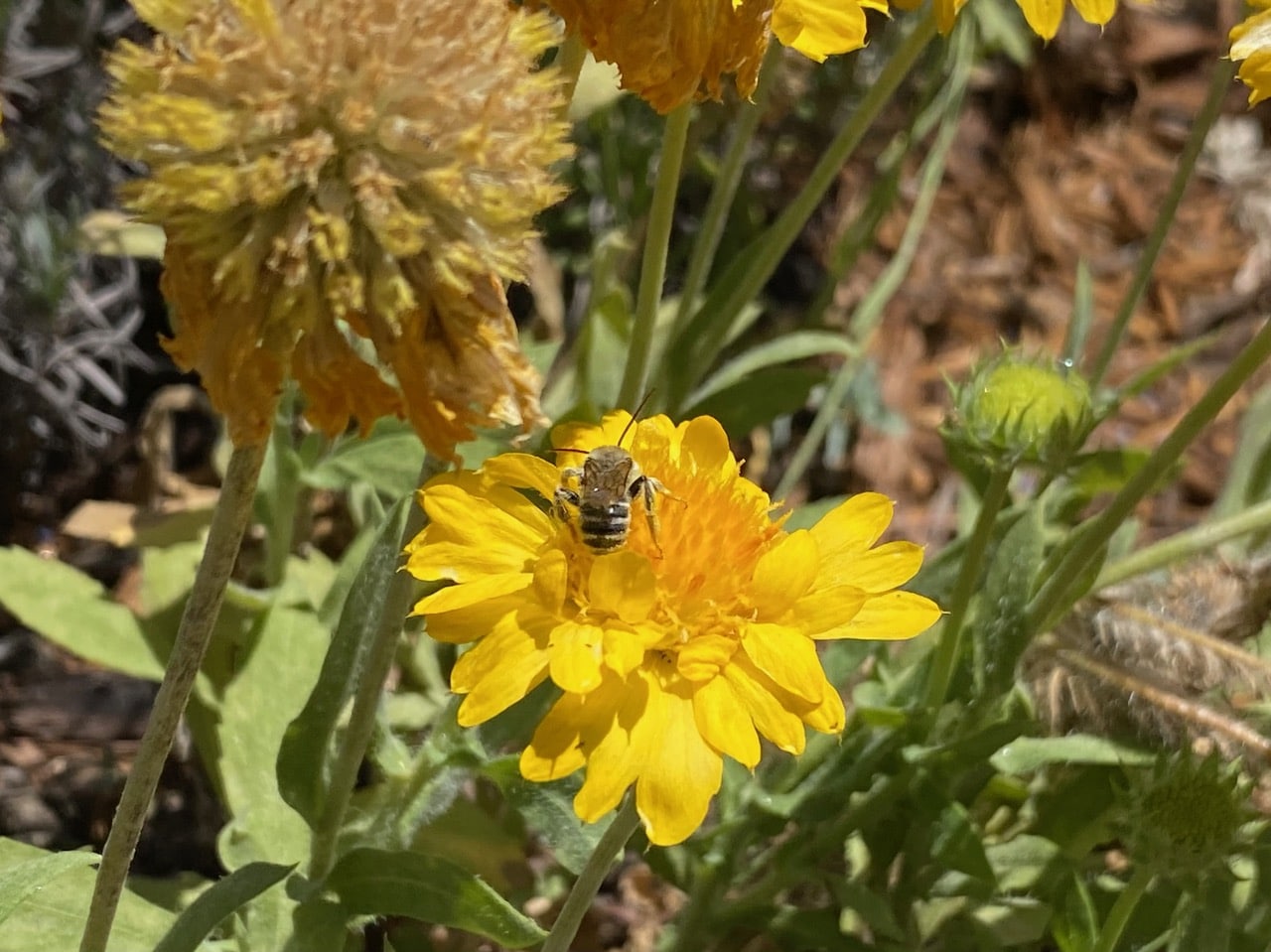
The Summer Longhorn Bees, Melissodes sp. (family Apidae) are medium to large bees, stout-bodied, usually with gray/brown hair on the thorax and pale hair bands on the abdomen. Males usually have yellow markings on their faces and have very long antennae from which their common name is derived. They are active May to September, with peak flight in late June to early August. The females prefer flat, bare ground for digging their solitary nests, though they sometimes nest in aggregations. Pollen is transported in scopae on the hind legs. Pollen loads are often copious and brightly colored and thus very distinguishable. Melissodes are specialists on Asteraceae – females gather pollen from flowers of Aster, Bidens, Coreopsis, Cosmos, Encelia, Gaillardia, Helianthus, and Rudbeckia ssp.
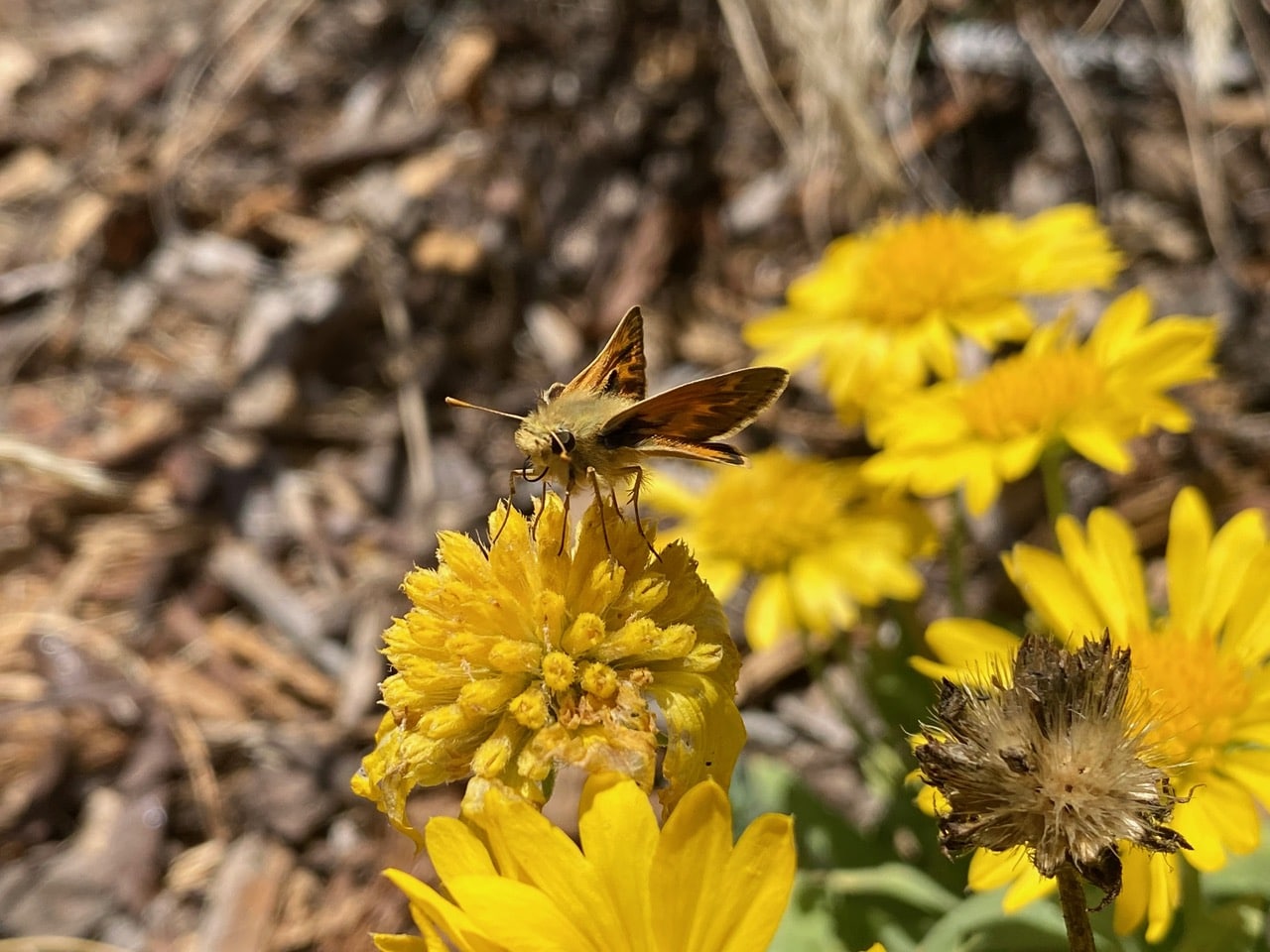
A Sandhill Skipper, Polites sabuleti (family Hesperiidae) has rolled up its proboscis after taking nectar from the Blanket Flowers.
Skippers are a family, the Hesperiidae, of the order Lepidoptera (butterflies and moths). They are named for their quick, darting flight habits. Most have the antenna clubs hooked backwards like a crochet hook. They also have generally stockier bodies and larger compound eyes than the other butterflies. Their wings are usually small in proportion to their bodies. When at rest, skippers keep their wings usually angled upwards or spread out, and only rarely fold them up completely. Californian species are mostly brown or tan, with black, orange, or yellow markings.
Skipper caterpillars are usually green or brown, sometimes yellowish, never brightly colored. They have a distinctive “collar”, a narrow ring around the body right behind the head. Caterpillars are camouflaged and often hide during the day. Many species make nests of leaves and silk for additional protection. Most North American species feed on grasses, but some common species eat shrubs and trees, especially in the bean family. Most species are limited to a single group of food plants. Adult skippers are only active during the day, but Skipper caterpillars feed mainly when it is dark or partly light.
A tubular sucking organ, the proboscis enables a butterfly to extract sweet nectar from flowers, regardless of the shape of the blossom. When not in use, the proboscis is rolled up out of the way. Unlike caterpillars, adult butterflies do not have any chewing mouthparts, and therefore must obtain their nutrition from sipping liquids. Hydrostatic pressure extends the curled proboscis which is inserted deep into the tubes of flowers. At emergence from the chrysalis, the proboscis initially consists of two parts that appear like a forked tongue. Almost immediately the two tubes are “zipped” together to form the single tube. In addition to flower nectar, butterflies also use the proboscis to suck up moisture from puddles, liquids from fermenting fruits, rotting animal flesh or animal excrements.
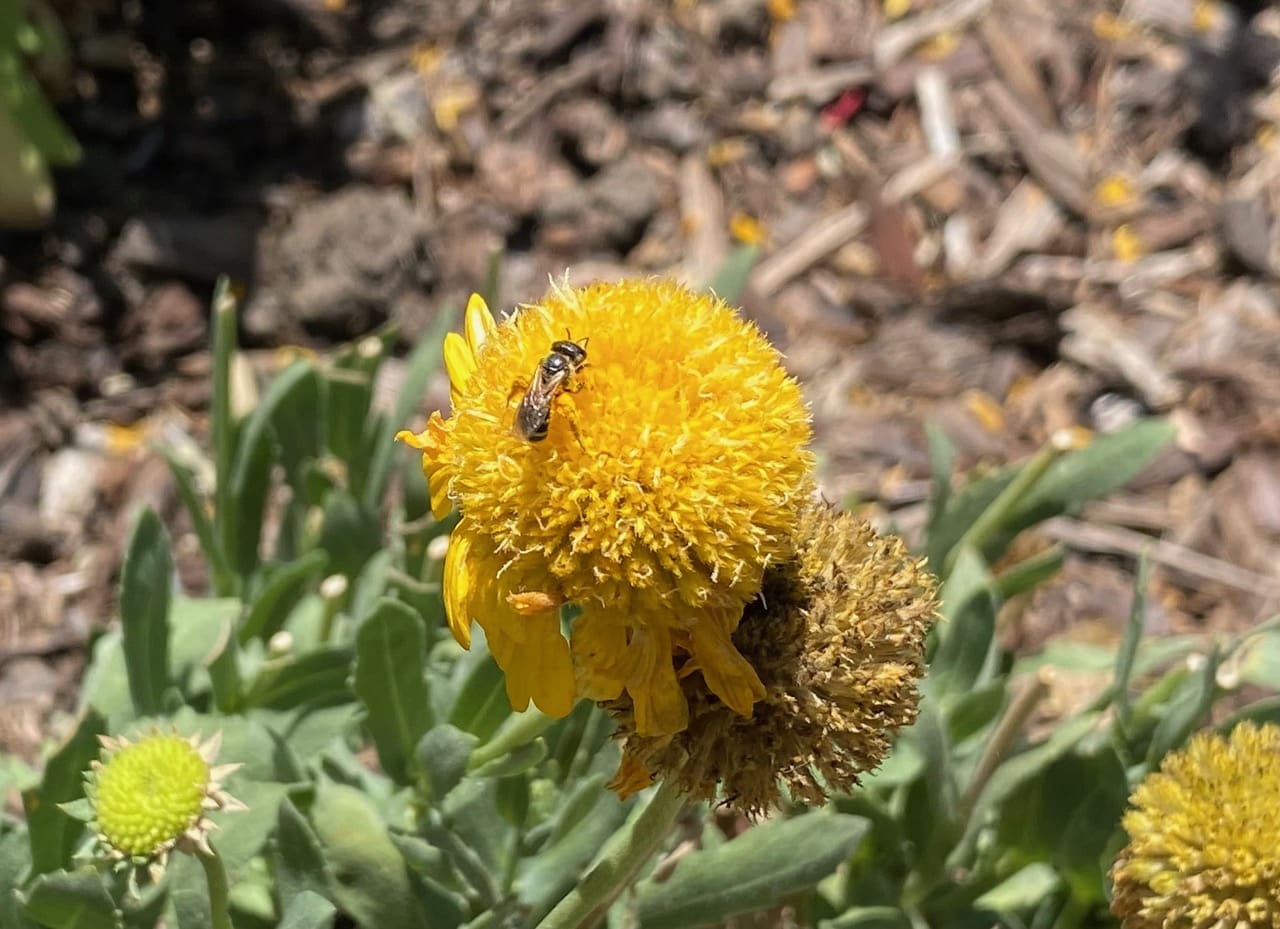
A Tripartite Sweat Bee, Halictus tripartitus (family Halictidae) is foraging on a fading flowerhead of Blanket Flower.
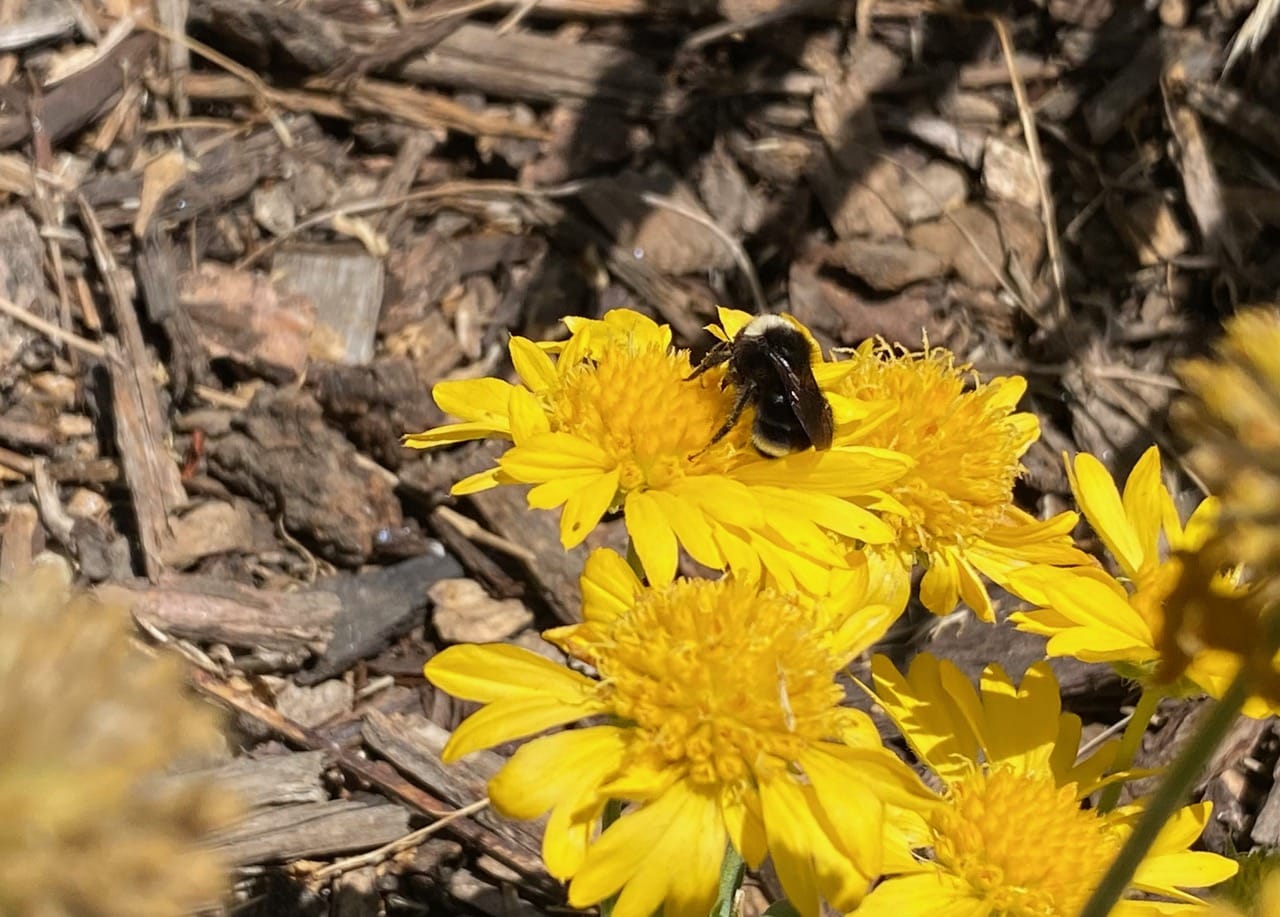
Although not a native species, the Blanket Flower, Gailardia sp. is a magnet for our local insects. Here, a Yellow-faced Bumble Bee, subgenus Pyrobombus (genus Bombus, family Apidae) is taking nectar from the flowers.

I am about to leave the garden when I notice some movements on a stalk of dried grass seed heads. Wow, what a bizarre sight – a male Acmon Blue butterfly, Icaricia acmon (family Lycaenidae) is frantically attempting to mate with a Gray Hairstreak, Strymon melinus (family Lycaenidae)! I quickly switch my camera to video mode to record this rare event.
Butterflies usually mate in a back-to-back position, joined together at the tip of the abdomen. As in most animals, only the same species, or closely related species, can mate successfully. For species that are very different, like these two butterflies, mating is physically impossible because the genitals need to join together through a precise lock-and-key system. That said, the two butterflies belong to the same family Lycaenidae. Perhaps there is sufficient overlap in their pheromonal signaling that is confusing the butterflies? Even if the copulation is successful, the offspring – a hybrid is not likely to be fertile.