

Pollinator Post 7/4/25 (3)
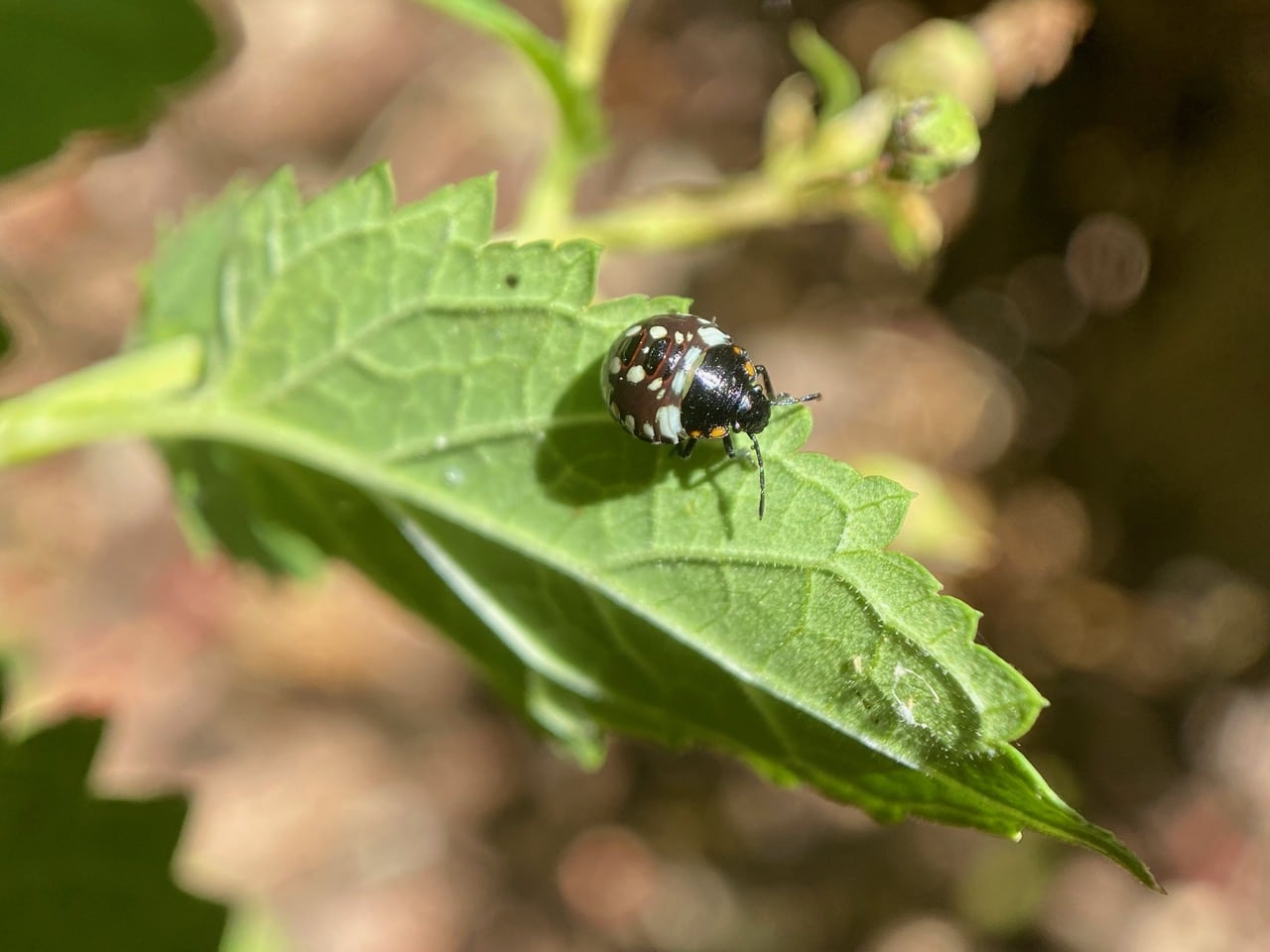
In the far corner of Stefanie’s backyard, a beetle-like insect is walking on a leaf of Bee Plant, Scrophularia californica. It is actually a Stink Bug nymph. The third instar nymph of the Southern Green Stink Bug, Nezara viridula (family Pentatomidae), to be exact.
Pentatomidae is a family of insects belonging to the order Hemiptera or “true bugs”. As hemipterans, the pentatomids have piercing-sucking mouthparts, and most are phytophagous, including several species that are severe pests on agricultural crops. Stink Bugs feed on plant fluids by inserting their needlelike mouthparts into stems, leaves or seed pods. While feeding, they inject materials into the plant to aid in digestion and sap removal. Penetration by the mouthparts can cause physical damage, much like stabbing the plant with a fine needle.
All Pentatomids have 5-segmented antennae (hence their family name, Penta – five and tomos – section.) They generally have a large triangular scutellum in the center of the back. The adult is generally shield-shaped when viewed from above. The common name of Stink Bug refers to their ability to release a pungent defensive spray when threatened, disturbed, or crushed.
The Southern Green Stink Bug, Nezara viridula (family Pentatomidae) is a plant-feeding stink bug. Believed to have originated in Ethiopia, it can now be found across the world. Because of its preference for certain species of legumes, such as beans and soybeans, it is an economically important pest on such crops.
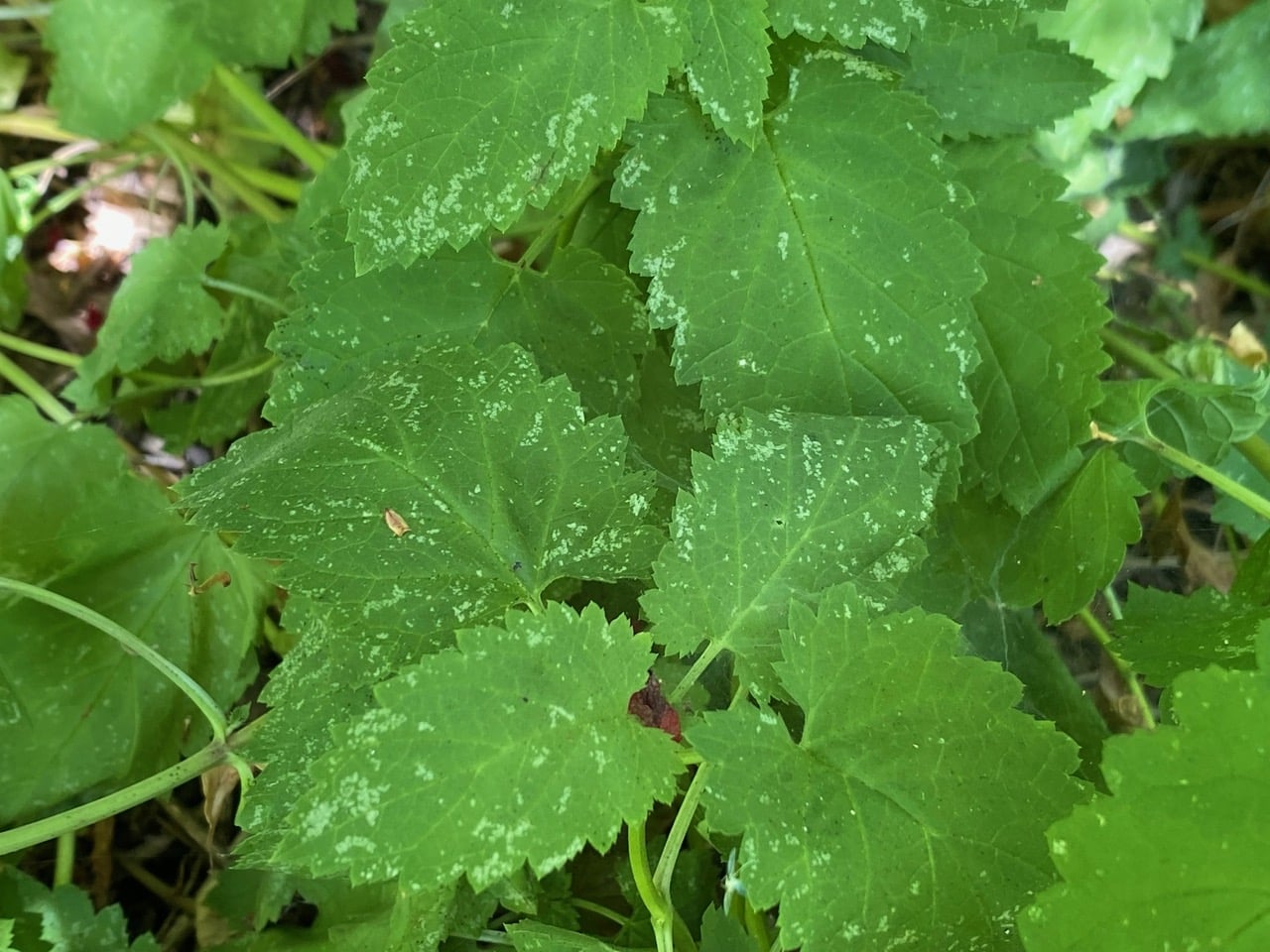
There are numerous stippled (punctate) feeding scars on the leaves of the Bee Plant in Stefanie’s backyard, indicative of damage from insects with piercing-sucking mouthparts. Stink Bugs? I only found one; where are they all hiding?
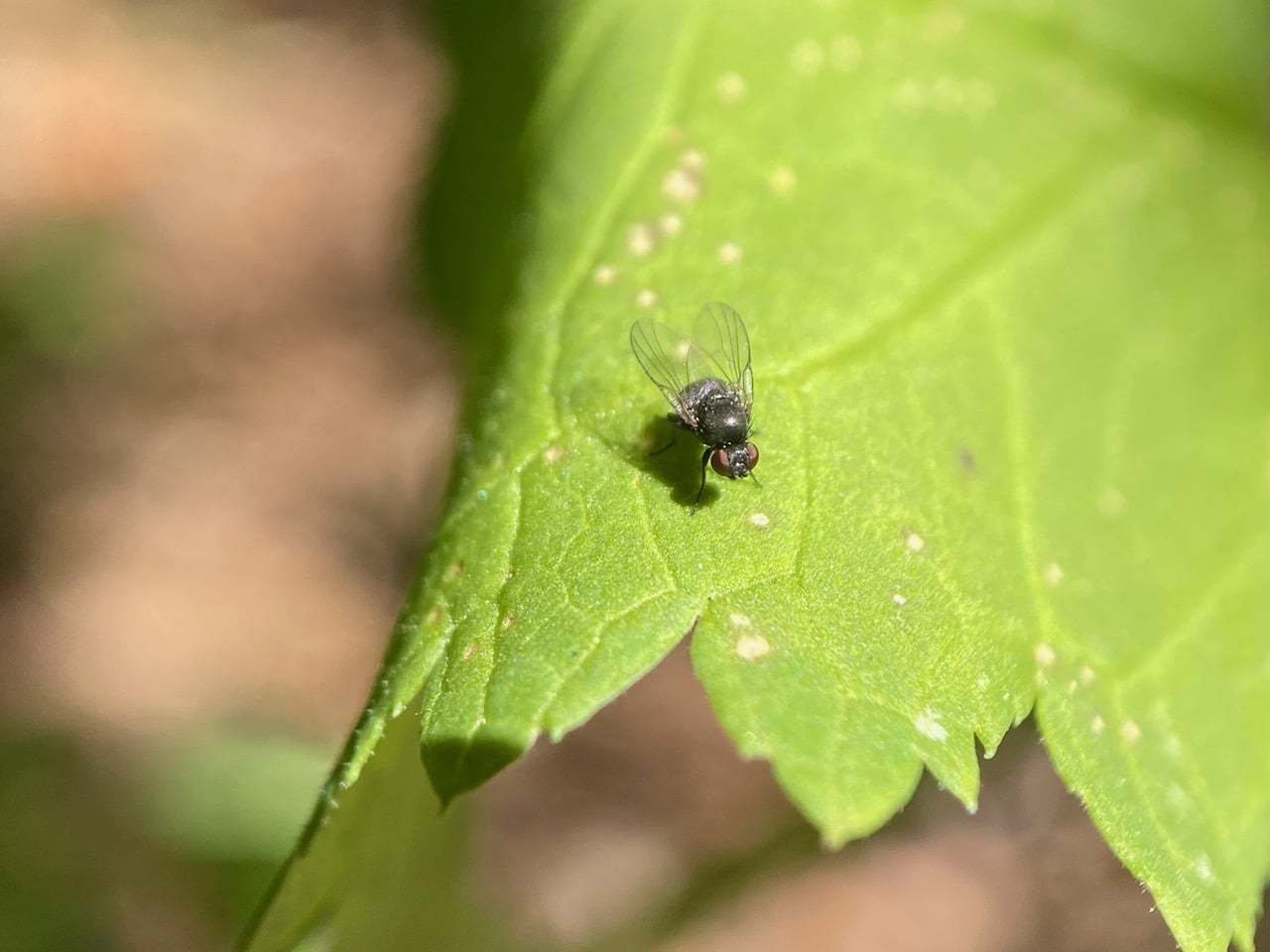
A tiny fly, barely 2 mm long is perched on a Bee Plant leaf. I immediately think of a Leaf-miner fly (family Agromyzidae).
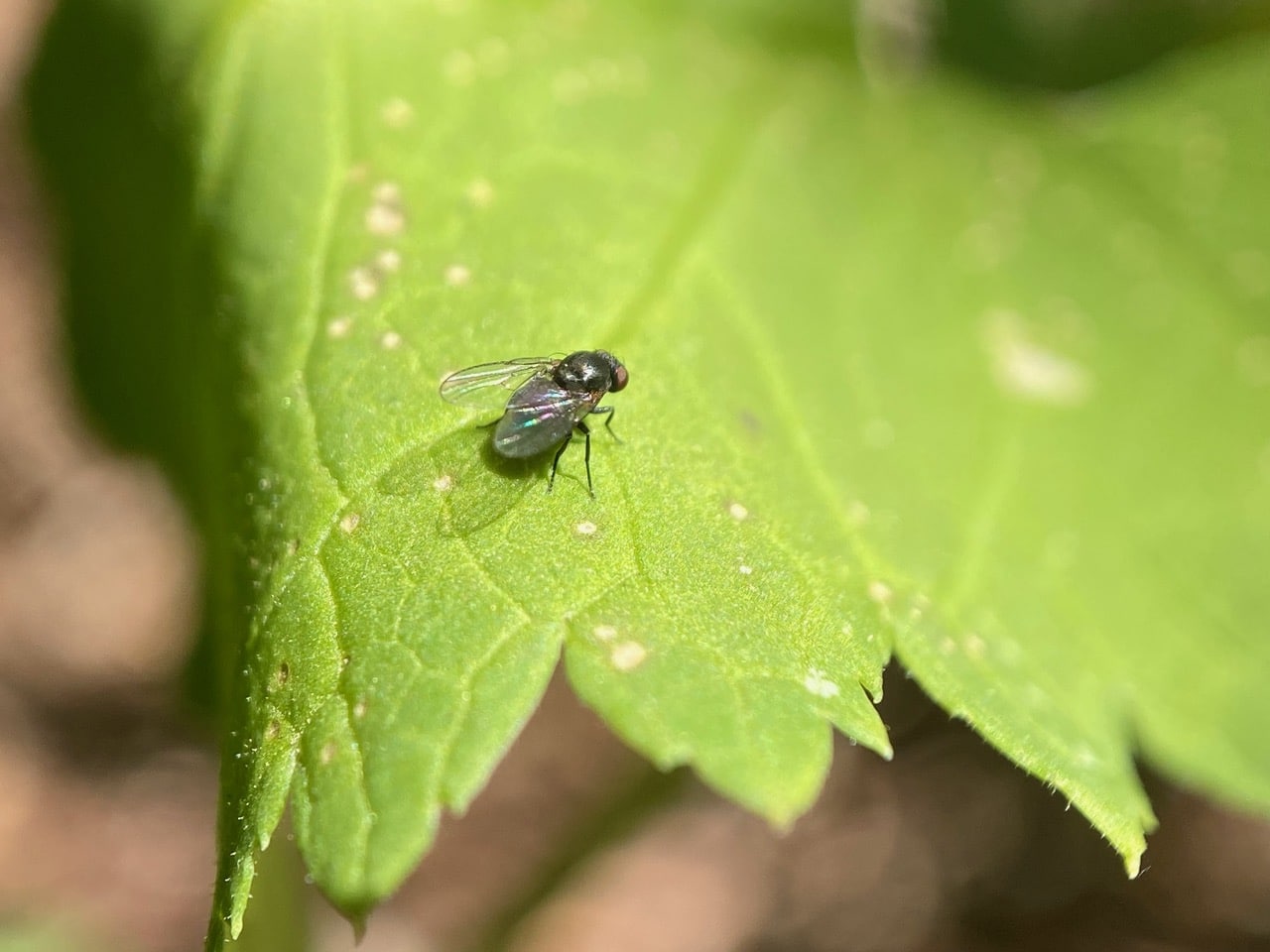
The Agromyzidae are a family commonly referred to as the Leaf-miner Flies, for the feeding habits of their larvae, most of which are leaf miners on various plants. They are small flies, most species in the range of 2-3 mm. Agromyzidae larvae are phytophagous, feeding as leaf miners, less frequently as stem miners or stem borers. A few live on developing seeds, or produce galls. There is a high degree of host specificity. A number of species attack plants of agricultural or ornamental value, so are considered pests. The shape of the mine is often characteristic of the species and therefore useful for identification. Adults occur in a variety of habitats, depending on the larval host plants.

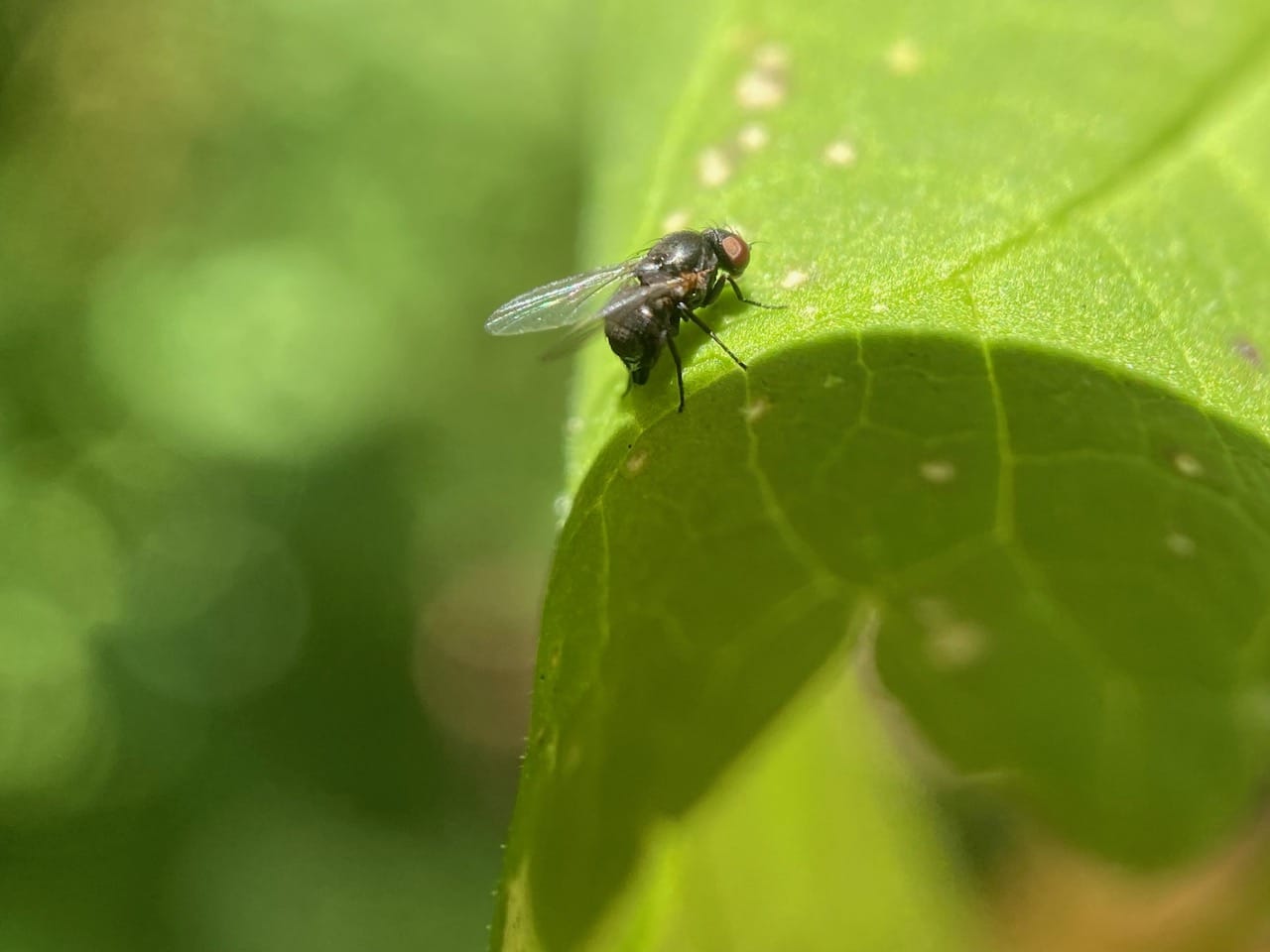
Ah, the rear view shows a prominent oviscape at the tip of the fly’s abdomen. It is a female Leaf-miner Fly.
An oviscape is the basal, often tubular or conical, part of an ovipositor of some species of insects. Specifically, it’s the non-retractile sheath that serves to protect the telescopic ovipositor. It remains visible at the tip of the female’s abdomen, even when not laying eggs. Leafminer (family Agromyzidae) females use their strongly sclerotized ovipositors to insert eggs into plant tissue, where the larvae will develop. The prominent, dark, and heavily sclerotized oviscape is a key diagnostic feature for identifying female Agromyzidae and a few other fly taxa.
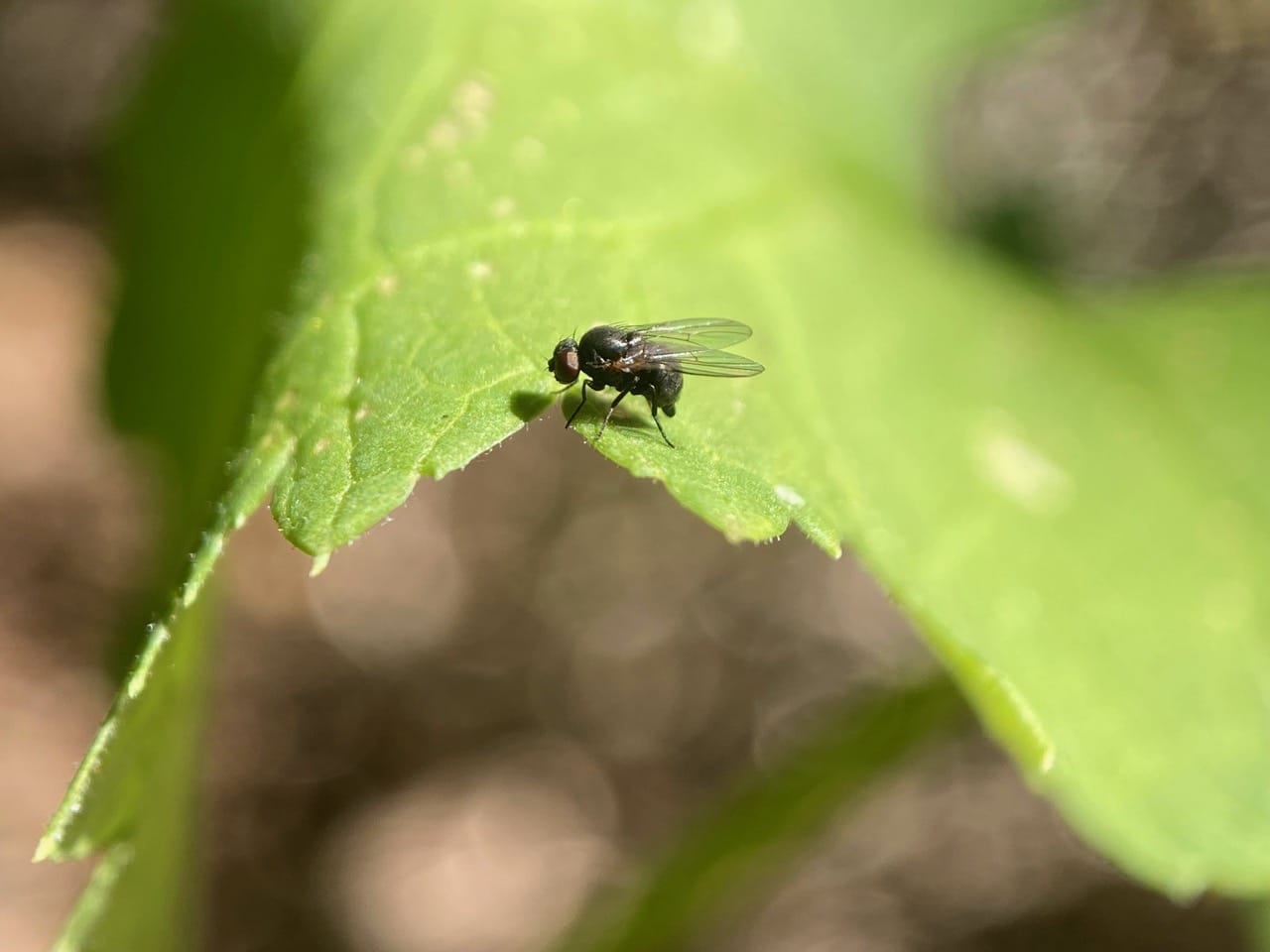
iNaturalist has helped identify the fly as a member of the genus Melanagromyza (family Agromyzidae).

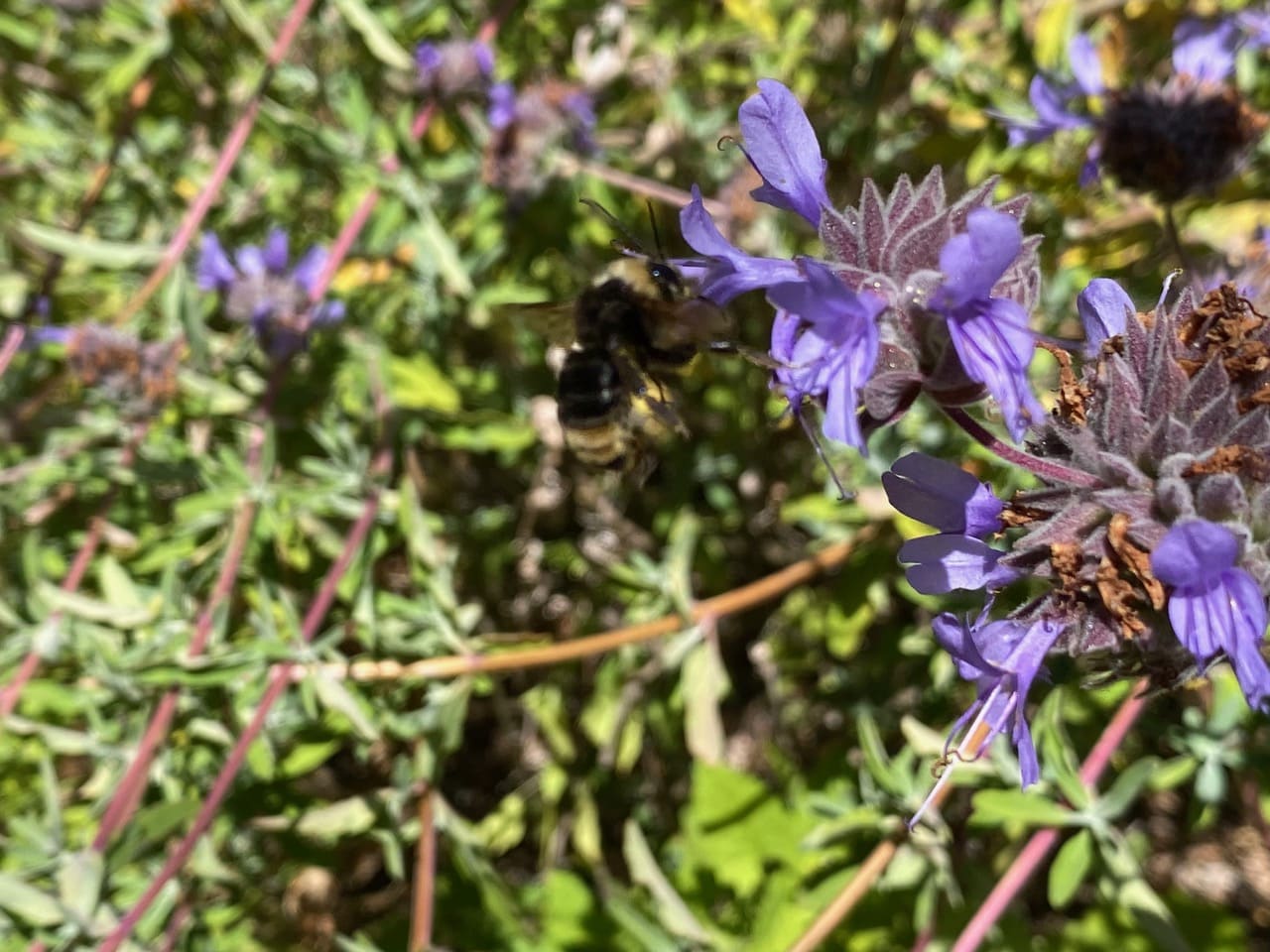
A Bumble Bee is taking nectar from a flower of Cleveland Sage, Salvia clevelandii X ‘Pozo Blue’. I am keeping my eyes on it as it appears to have a black, instead of a yellow head like that of the common Yellow-faced Bumble Bee.









As the bee backs off the flower, I can see that not only does it have a black head, it also has extra bands of yellow on its abdomen and long antennas. It is a male California Bumble Bee!
Bombus californicus, the California Bumble Bee, is found in Central and the western half of North America. The species is now classified as Vulnerable by the IUCN. It was the most common bumble bee in California until about the 1990s when its numbers and distribution began to decline. Many factors may have contributed to its decline, including invasive species, pesticide use, commercial bumble bee rearing, habitat destruction, and climate change.
Although morphologically the species is quite variable, the “typical” color pattern of female B. californicus is black with only a single strong yellow band anteriorly on the thorax, and another single yellow band near the apex of the abdomen. Males exhibit considerably more variation.
The California Bumble Bee is an important pollinator in alpine environments in its native range. They are social bees having a queen and workers. Their colonies last for one year. New queens overwinter, usually underground, and found new colonies from scratch the following year. Queens emerge from April through mid July. Workers are present from April to September. The species is known to pollinate sage, blueberry bushes, red clover, California poppies, and many other species of flowers.
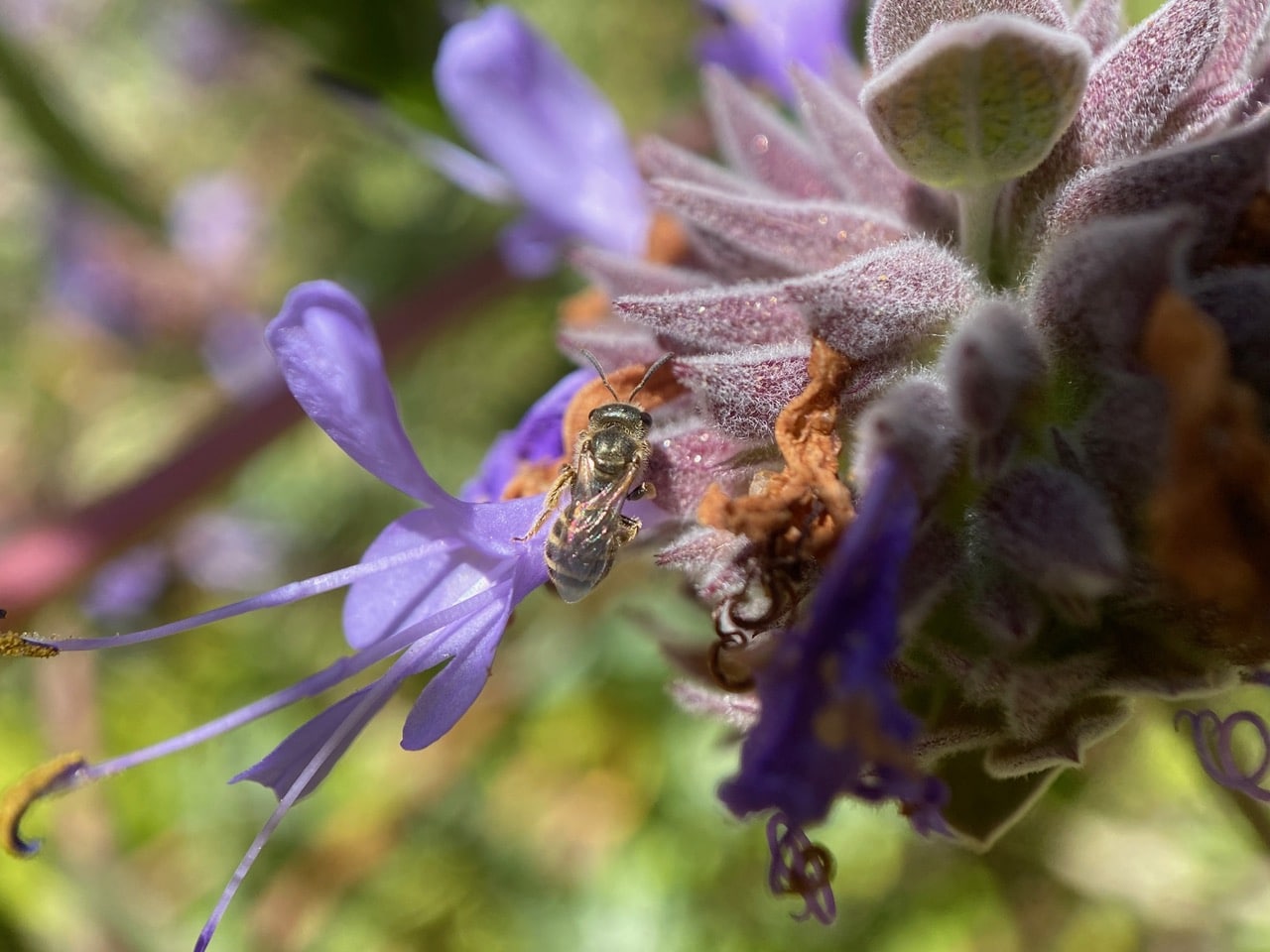
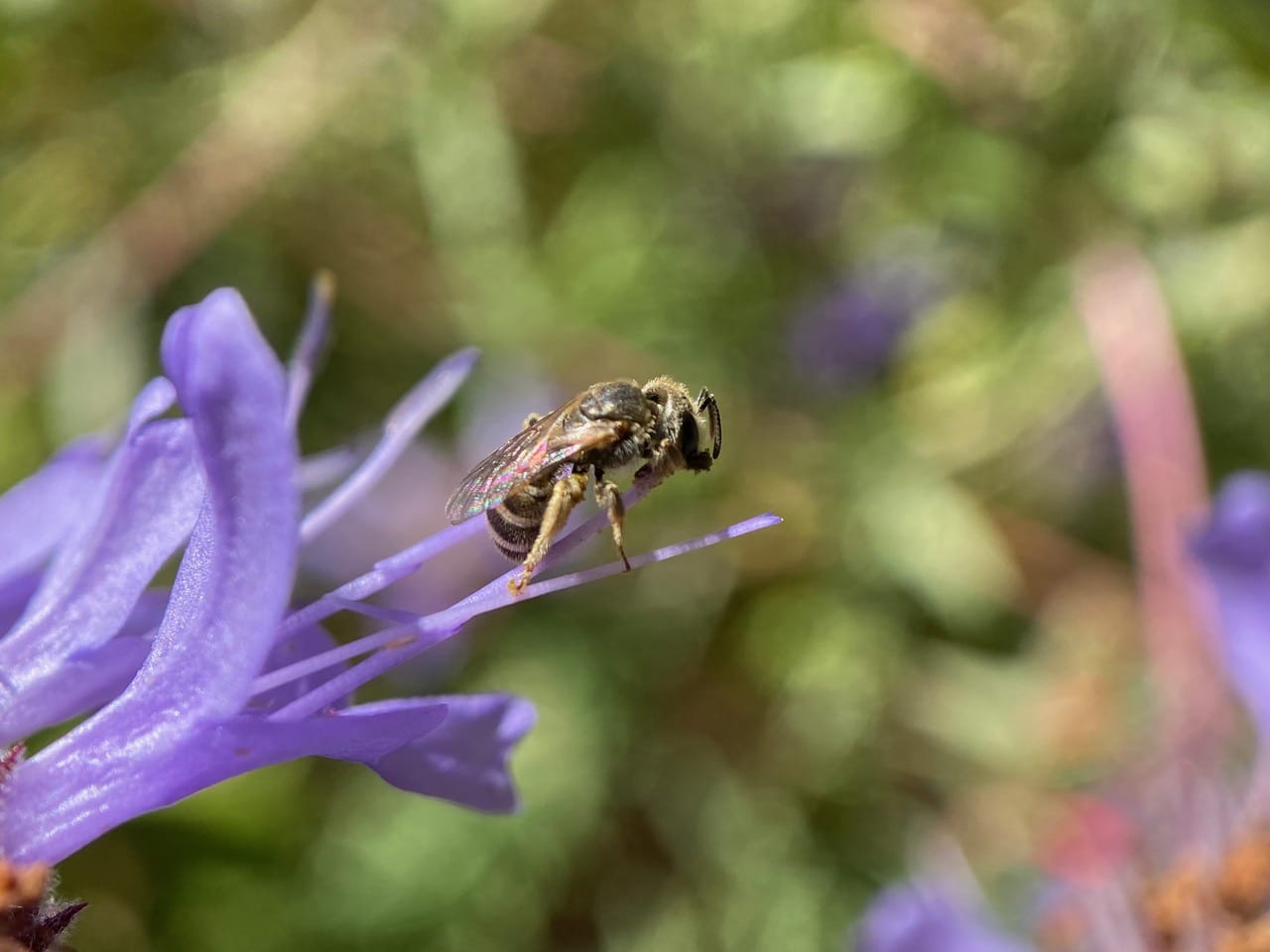
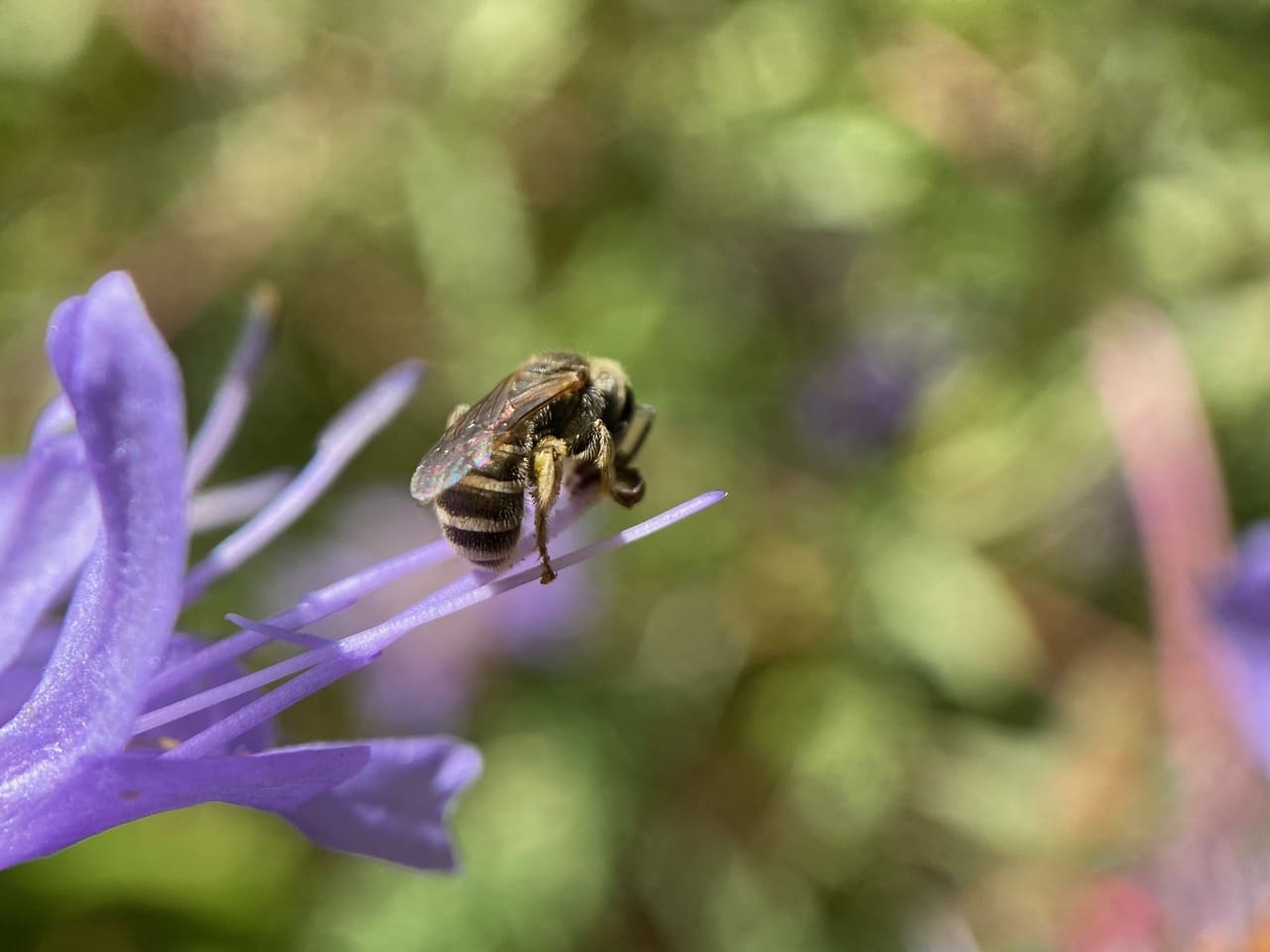
A Tripartite Sweat Bee, Halictus tripartitus (family Halictidae) is moving around on a flower of a Cleveland Sage, Salvia clevelandii x ‘Pozo Blue’.
Halictus is found worldwide; they are most common in the Northern Hemisphere. All are generalists, foraging from a wide variety of flowering plants. Many species are social and produce several generations per year. This is not surprising as most blooming plants are season-specific; a bee that requires pollen and nectar across multiple seasons would not thrive as a specialist. All Halictus in North America nest in the ground, often in aggregations; and they may nest in the same area for decades.
The species Halictus tripartitus (family Halictidae) is partially eusocial, with nests connected underground and some workers capable of reproducing. It is a very successful species in our area, making up the majority of bees in many gardens right now, collecting floral resources from a large variety of plants.
The little bee makes her way to a stamen and proceeds to collect pollen from the anther.
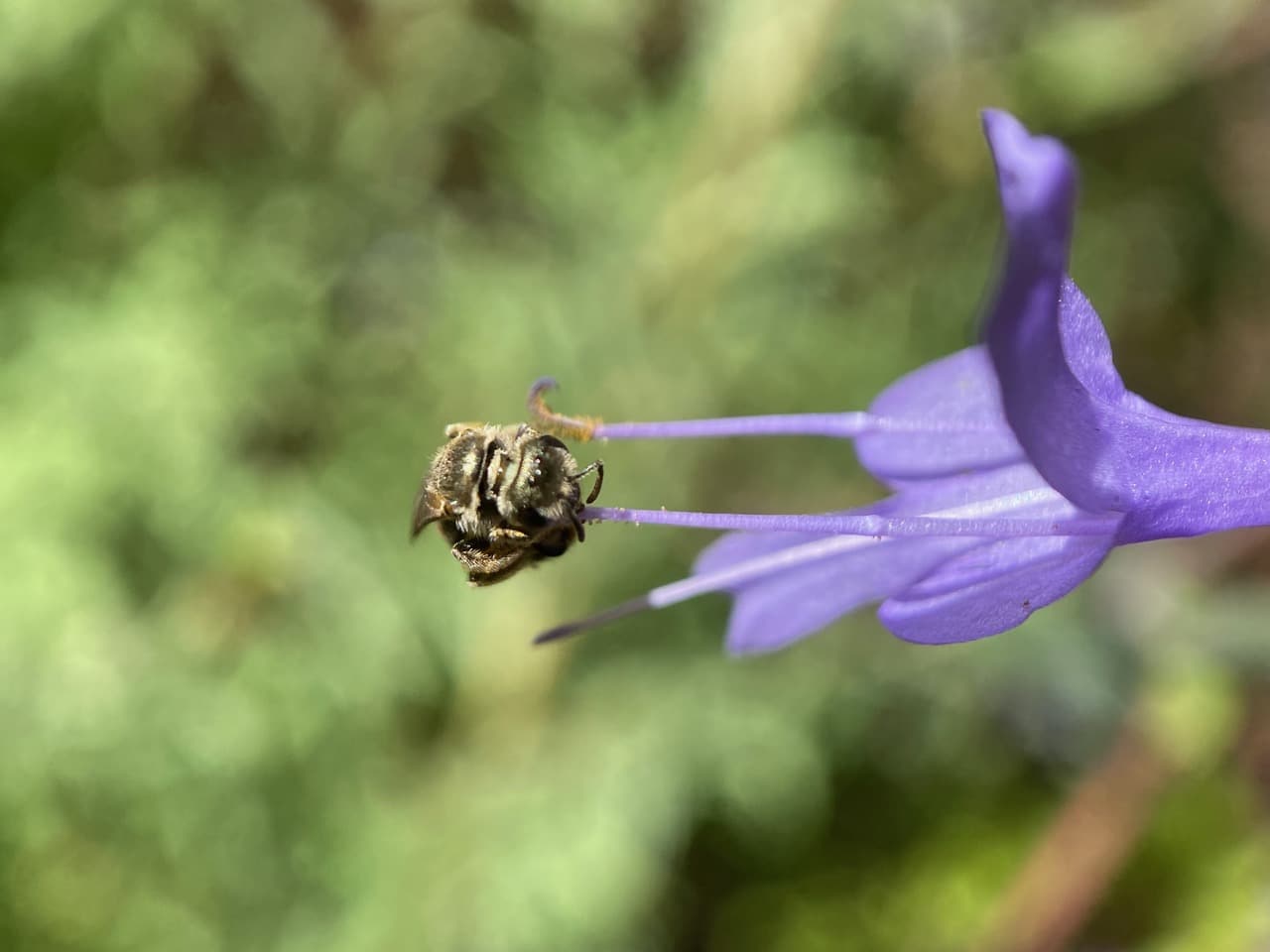
Here’s another Tripartite Sweat Bee hunched over to gather pollen from an anther of Cleveland Sage at the end of a stamen.
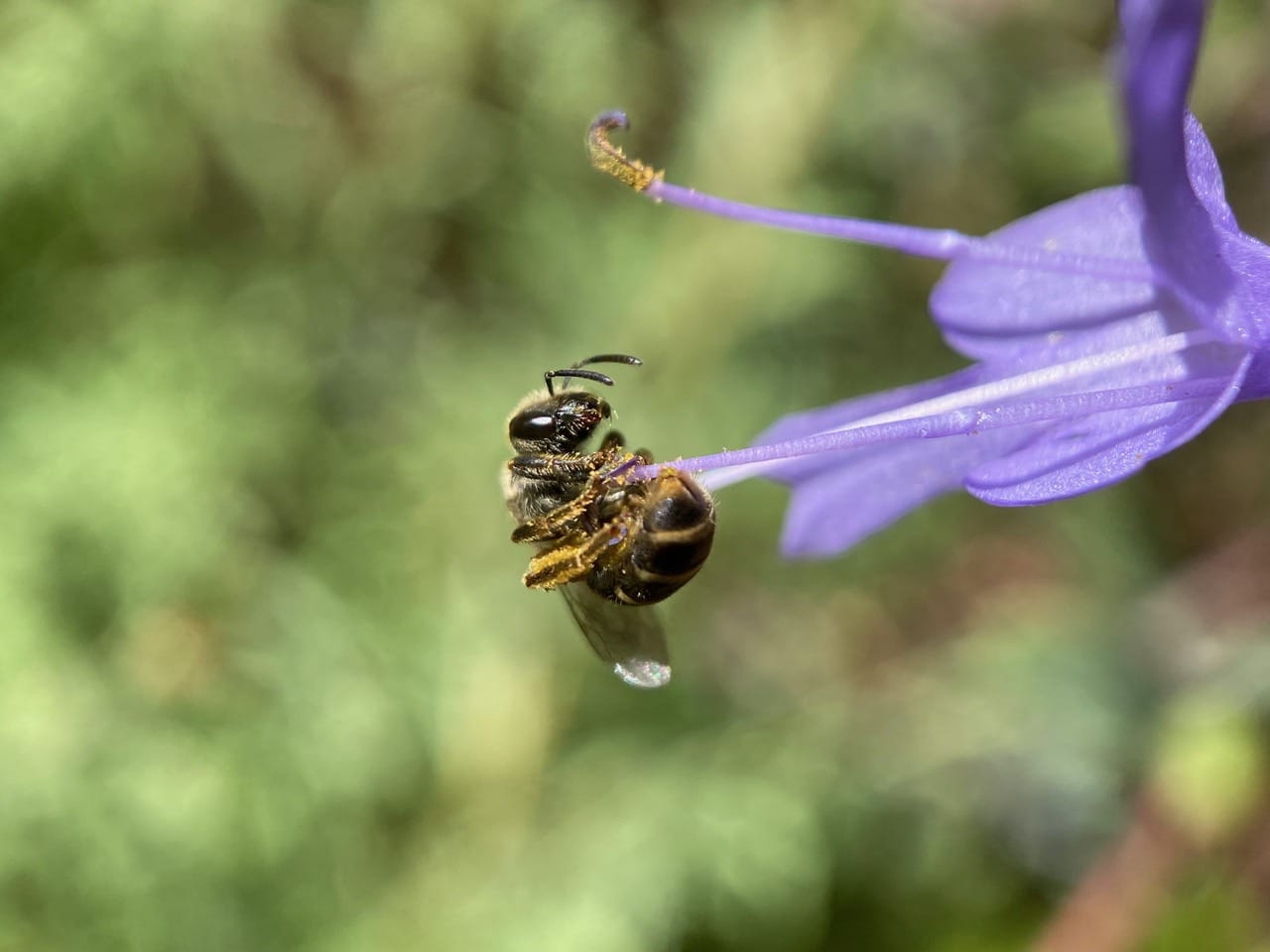
Often the bees actually break open the anthers with their mandibles instead to waiting for the anthers to dehisce naturally. This way they ensure that the pollen they gather for their offspring is fresh and clean, free from contaminants and pathogens.
Here’s another Tripartite Sweat Bee, Halictus tripartitus gathering pollen from a Sage anther.
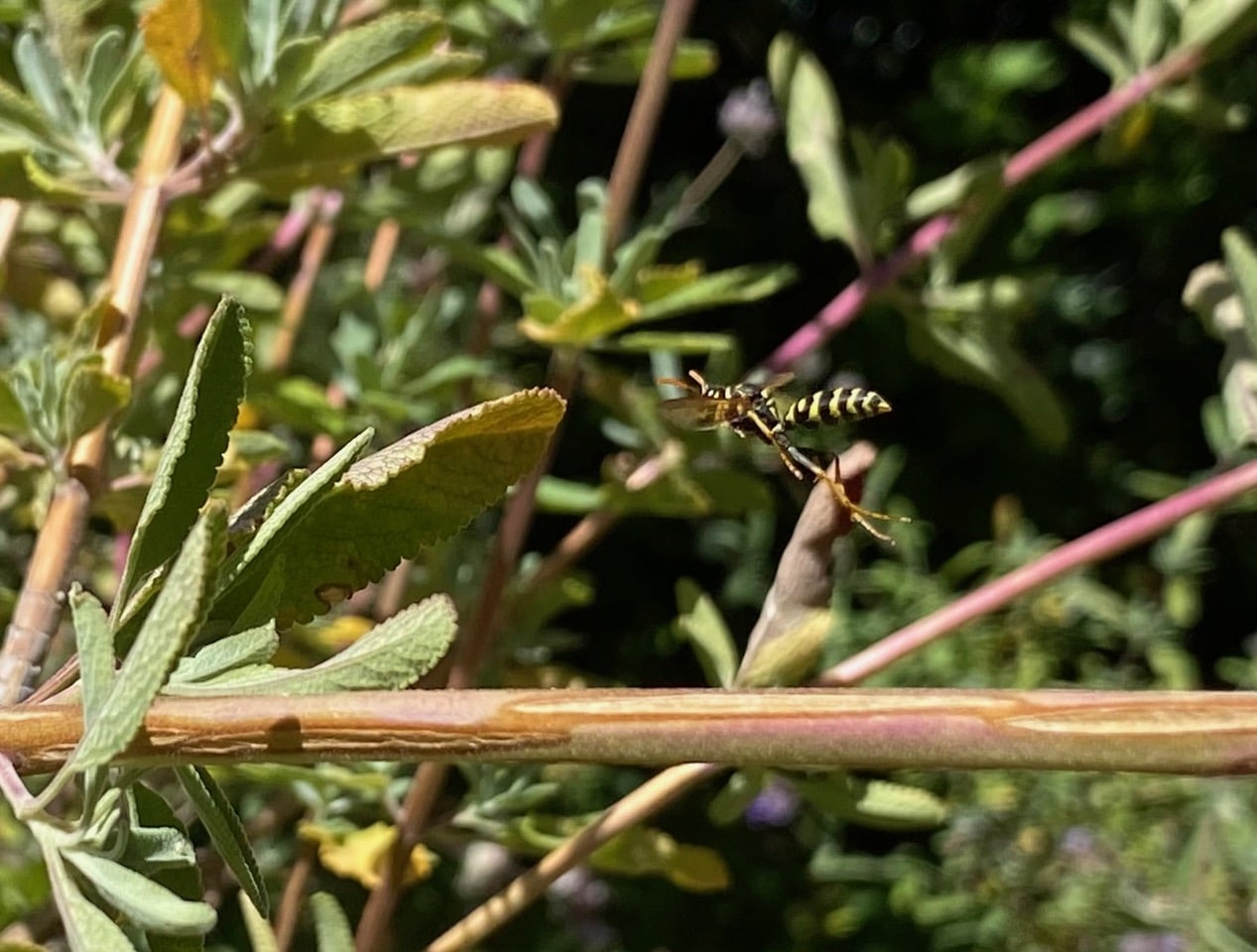
Her long legs dangling under her, a European Paper Wasp, Polistes dominula (family Vespidae) is flying around the foliage of the Cleveland Sage.
Native to Europe, the European Paper Wasp, Polistes dominula, is a social insect that produces an annual colony in a paper nest. Individual colonies are established anew each spring. The overwintering stage are mated females (queens). The overwintered queens emerge from sheltered spots in spring and search out sites to establish a new colony. Nests are constructed of paper, produced from chewed wood fibers of weathered fences, porch decks and other similar sources. Larvae are fed crushed insects, usually caterpillars. As the population increases, the original queen increasingly remains in the nest as new workers take over colony activities. A few of the wasps produced later in summer are males and increasing numbers of the females become sexually mature. Mating occurs and the mated females are the surviving overwintering stage. Males and non-reproductive females do not survive winter and the nest is abandoned by late fall. European Paper Wasps will sometimes feed on sweet materials, including honeydew produced by aphids. They may also feed on damaged ripe fruits. Because of their habit of hunting caterpillars, the wasps have become one of the most important natural controls of garden pests.
Often mistaken for Yellowjacket Wasps, the European Paper Wasps can be distinguished by their slender body, and their orange-tipped antennae. Yellowjackets have shorter, thicker bodies, and they have black antennae. Paper wasps dangle their long legs when they fly, while the yellowjackets tuck their legs under their bodies when they fly. Paper wasp nests resemble an open honeycomb or upside-down umbrella. They often build their nests on man-made structures such as eaves or lawn furniture. Yellowjacket nests are covered with a surrounding envelope of paper; the nests have a single opening that is often hard to see because the nest is underground.
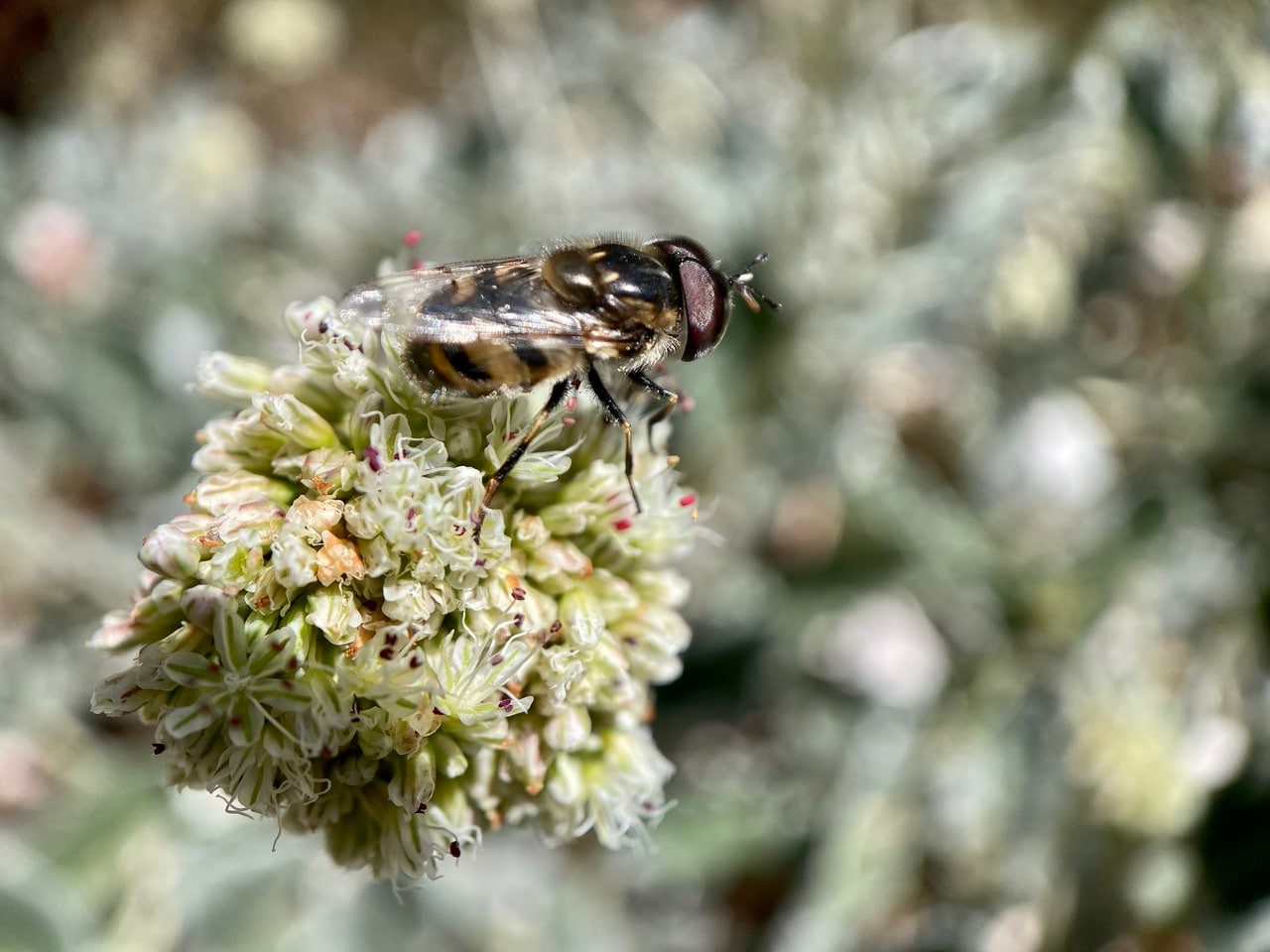
Ooh, I think that’s a new hover fly species for this garden! It is a Bromeliad Hover Fly, Copestylum marginatum (family Syrphidae).
Bromeliad Hover Flies, belonging to the genus Copestylum, are a group of Syrphidae flies that have a unique life cycle, developing as larvae in the water-filled leaf axils of bromeliad plants, Heliconia spp., and decaying organic matter such as saguaro, rotting banana stumps, paw-paw, etc. The larvae are known to be predators of aphids and other small insects, helping to control pest populations. Adults visit flowers for nectar and pollen. Copestylum is a New World genus, mostly tropical. It is found across the United States and southwestern Canada.
The abdomen of Copestylum marginatum is translucent, with almost a jelly-like appearance. It is marked with bold black markings.
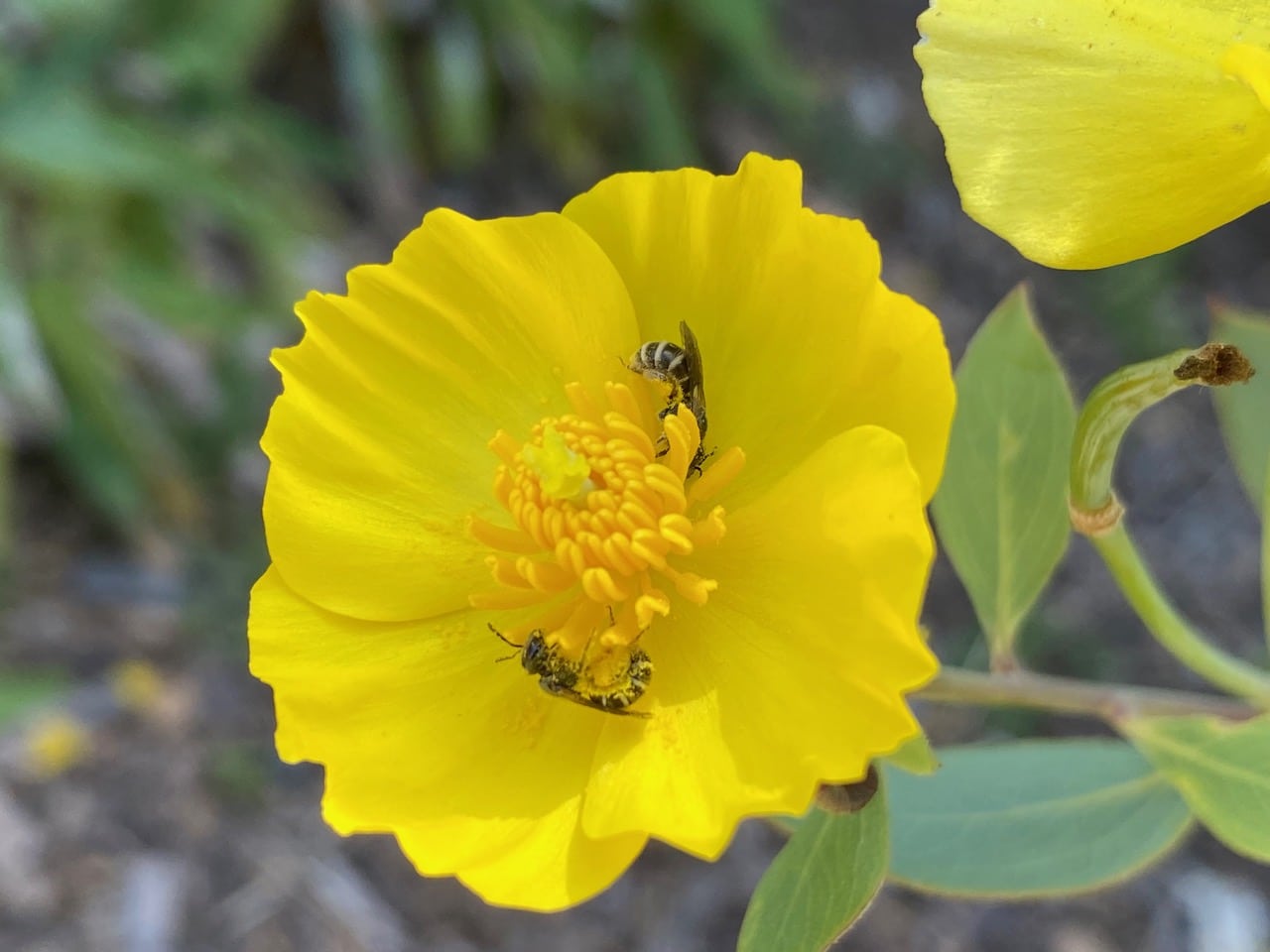
Two Tripartite Sweat Bees, Halictus tripartitus (family Halictidae) are gathering pollen on a Bush Poppy, Dendromecon rigida.
Poppy flowers generally do not produce nectar, but they offer generous amounts of pollen to pollinators.
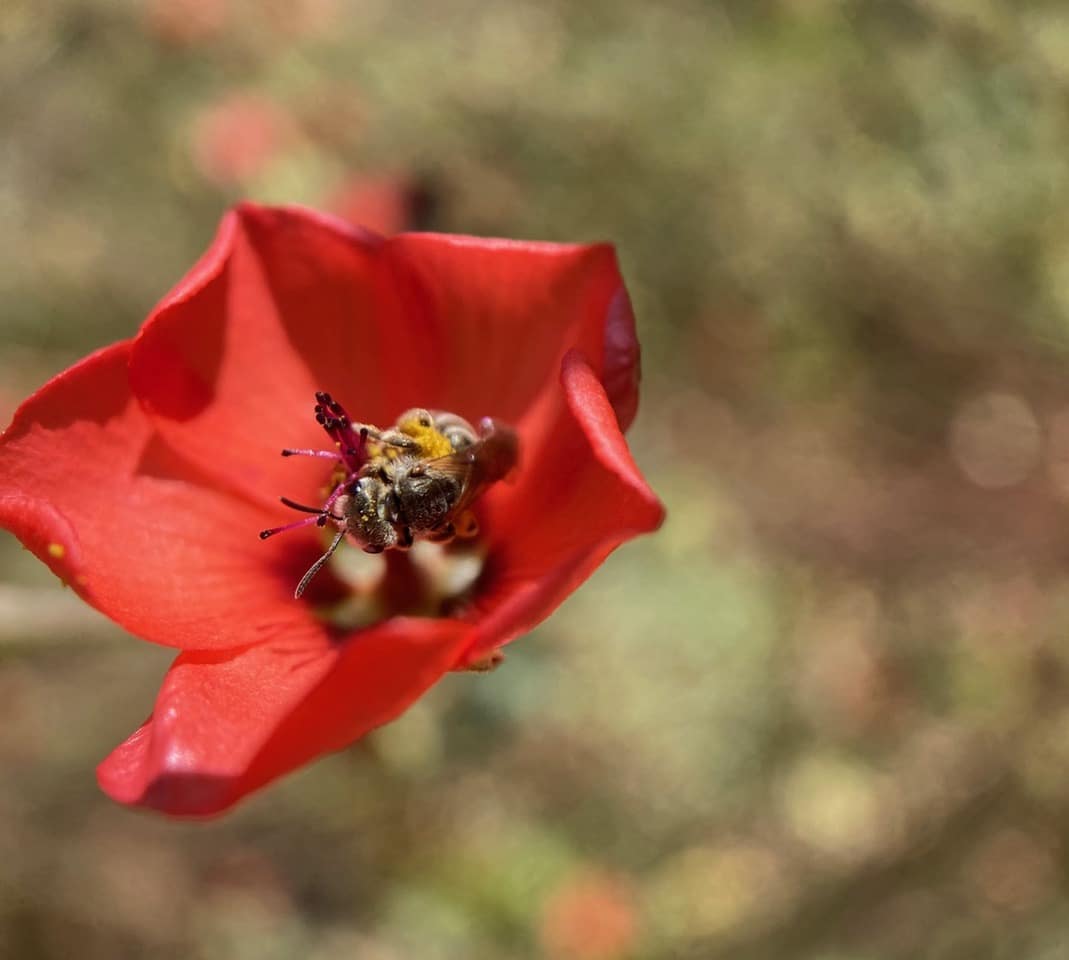
A Tripartite Sweat Bee, Halictus tripartitus (family Halictidae) is coming out of the flower of Desert Globemallow, Sphaeralcea “Louis Hamilton” after taking nectar at the base of the flower. As she crawls up the
central column formed by fused stamens surrounding the pistil, she is also collecting pollen from the anthers.
A Tripartite Sweat Bee, Halictus tripartitus (family Halictidae) is gathering pollen from the central column of fused stamens in the middle of the flower of Desert Globemallow, Sphaeralcea “Newleaze”. Both these varieties of the Desert Globemallow in Stefanie’s garden are cultivars of the Desert Globemallow, Sphaeralcea ambigua (family Malvaceae).
A Common Checkered Skipper, Burnsius communis (family Hesperiidae) flits around the pretty flowers in the garden and finally lands on the mulch along the foot path, of all places.
Because of its small size, bluish color, and spread-wing posture, the butterfly is often mistaken for one of the “Blues” in the family Lycaenidae. Skippers have the antennae clubs hooked backward like a crochet hook, while the typical butterflies have club-like tips to their antennae. Skippers also have generally stockier bodies and larger compound eyes.
Checkered Skippers belong to the subfamily Pyrginae, commonly known as spread-wing skippers, in the family Hesperiidae. Spread-wing skippers bask with their wings held wide open. The wings are held closed when they are at rest. Caterpillars make folded-leaf nests in which they live and feed on several plants in the mallow family, Malvaceae.
The Woolly Bluecurls, Trichostema lanatum is in glorious bloom against the back wall of the house. With their long, curving reproductive parts protruding way beyond the corolla, I had thought that these flowers were probably pollinated by larger pollinators such as hummingbirds, butterflies and moths.
After paying attention to the smaller visitors I realize that my view might be too limited. In the other gardens I visited recently, I have seen Bumble Bees and Honey Bees collect pollen very skillfully from the stamens of these flowers. The insects also made frequent contact with the style of the flowers in the process, obviously serving as pollinators.
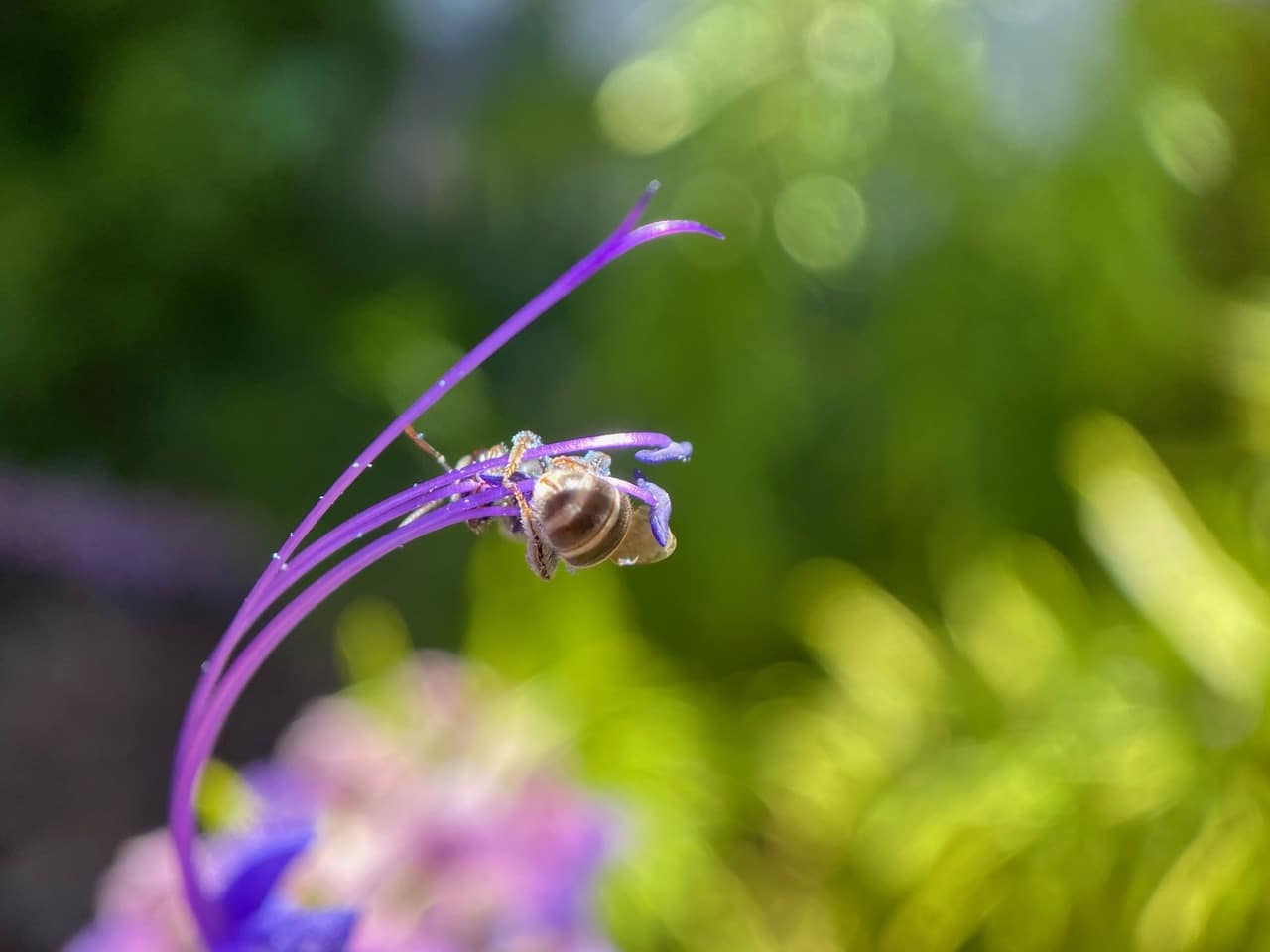
Here in Stefanie’s garden I am treated to another bee’s performance – the Tripartite Sweat Bee, Halictus tripartitus (family Halictidae). Hanging upside down while grasping all the four stamens at the same time, she is extracting the sky-blue pollen from the anthers and stuffing it into her scopae.
It is a full-body workout for the little bee, moving all parts of her body.
It is a performance worthy of standing ovation. The Tripartite Sweat Bee rules the day in this garden!