

Pollinator Post 7/4/25 (2)

Farewell-to-Spring, Clarkia amoena is putting up a show in Stefanie’s front garden. Few native plants can match the size and vibrancy of its blooms.

A young Jumping Spider, Phidippus sp. (family Salticidae) is hunting on a fading Clarkia petal.

Jumping spiders (family Salticidae) are free-roaming hunting spiders. They do not weave a web to catch prey. They stalk, then pounce on their prey. Just before jumping, the spider fastens a safety line to the substrate. It can leap 10-20 times their body length to capture prey. Their movement is achieved by rapid changes in hydraulic pressure of the blood. Muscular contractions force fluids into the hind legs, which cause them to extend extremely quickly. Jumping spiders are visual hunters. Their excellent vision has among the highest acuities in invertebrates. Since all their 8 eyes are fixed in place and cannot pivot independently from the body like human eyes can, jumping spiders must turn to face whatever they want to see well. This includes moving their cephalothorax up and down, an endearing behavior.

A Tripartite Sweat Bee, Halictus tripartitus (family Halictidae) is collecting pollen on a flower of Farewell-to-Spring, Clarkia amoena.
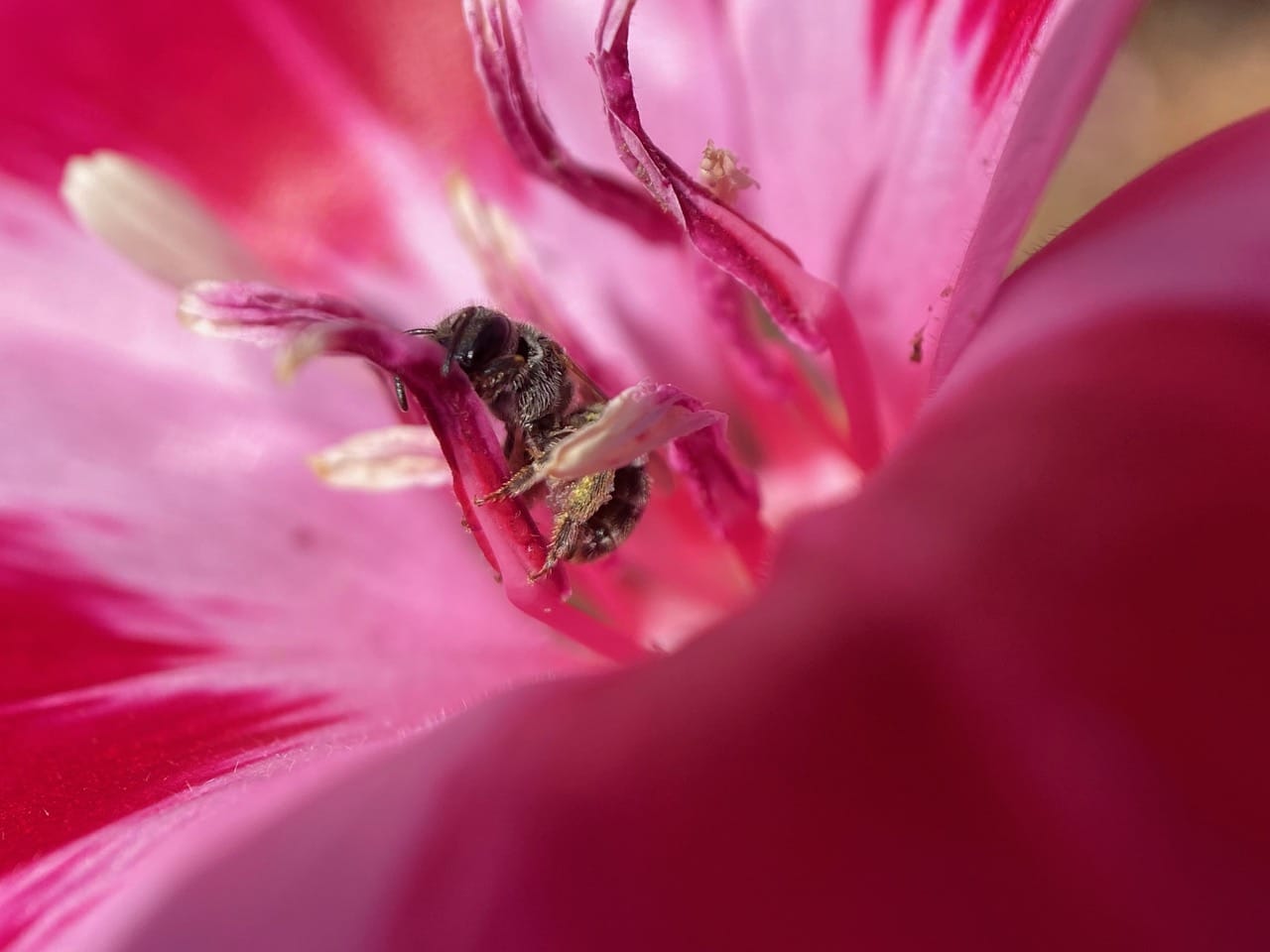
Using her mandibles, she is scoring one of the four anthers to release the pollen. The flower is in its male phase, with pollen being dispensed from the stamens, while the style and stigma (female parts) are still immature. You can see the immature stye in the fuzzy background to the left of the picture. The temporal separation of the male and female phases, called dichogamy, helps to prevent self-pollination. Clarkia flowers go through the male phase first – this kind of dichogamy is called protandry.

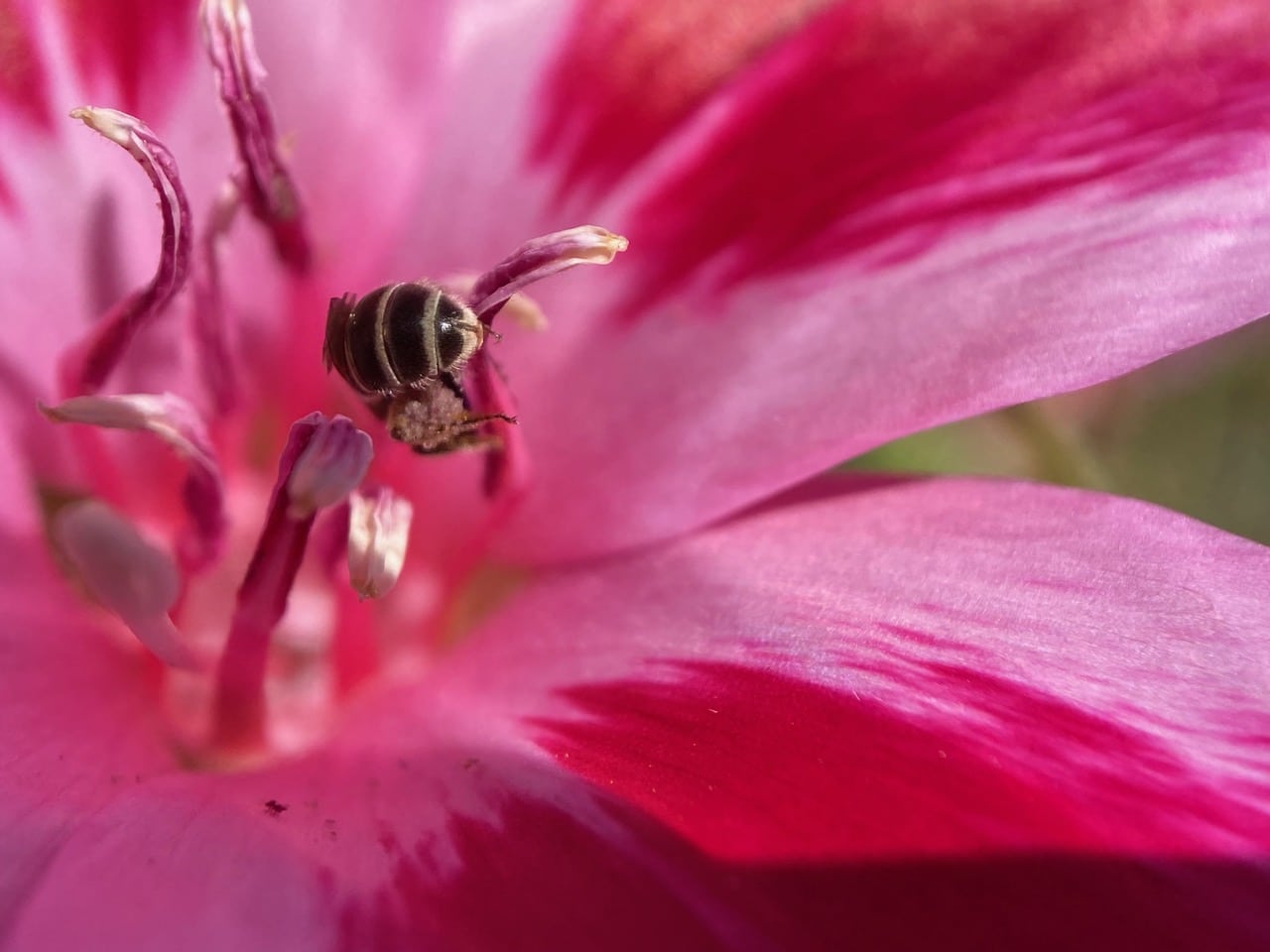
The little bee turns around to gather up the Clarkia pollen which is a translucent, dull purple color. See the groove-like feature on the last abdominal segment of the bee? It is sometimes referred to as a “rima”.
The “rima” on furrow bees (sweat bees belonging to the genera Halictus and Lasioglossum) refers to a microscopically haired, median furrow (a groove) located on the last abdominal tergite (segment) of the female bee. This furrow is often densely haired, and is a key characteristic in identifying furrow bee species. The purpose of the rima is unknown, but since it occurs in females only, it is believed to be related to egg laying. The two genera of sweat bees can further be distinguished by the hair bands on their abdomen. In the Halictus, these are on the hind margin of each tergite, while in Lasioglossum they are at the front of each tergite, often partly covered by the hind edge of the preceding tergite.
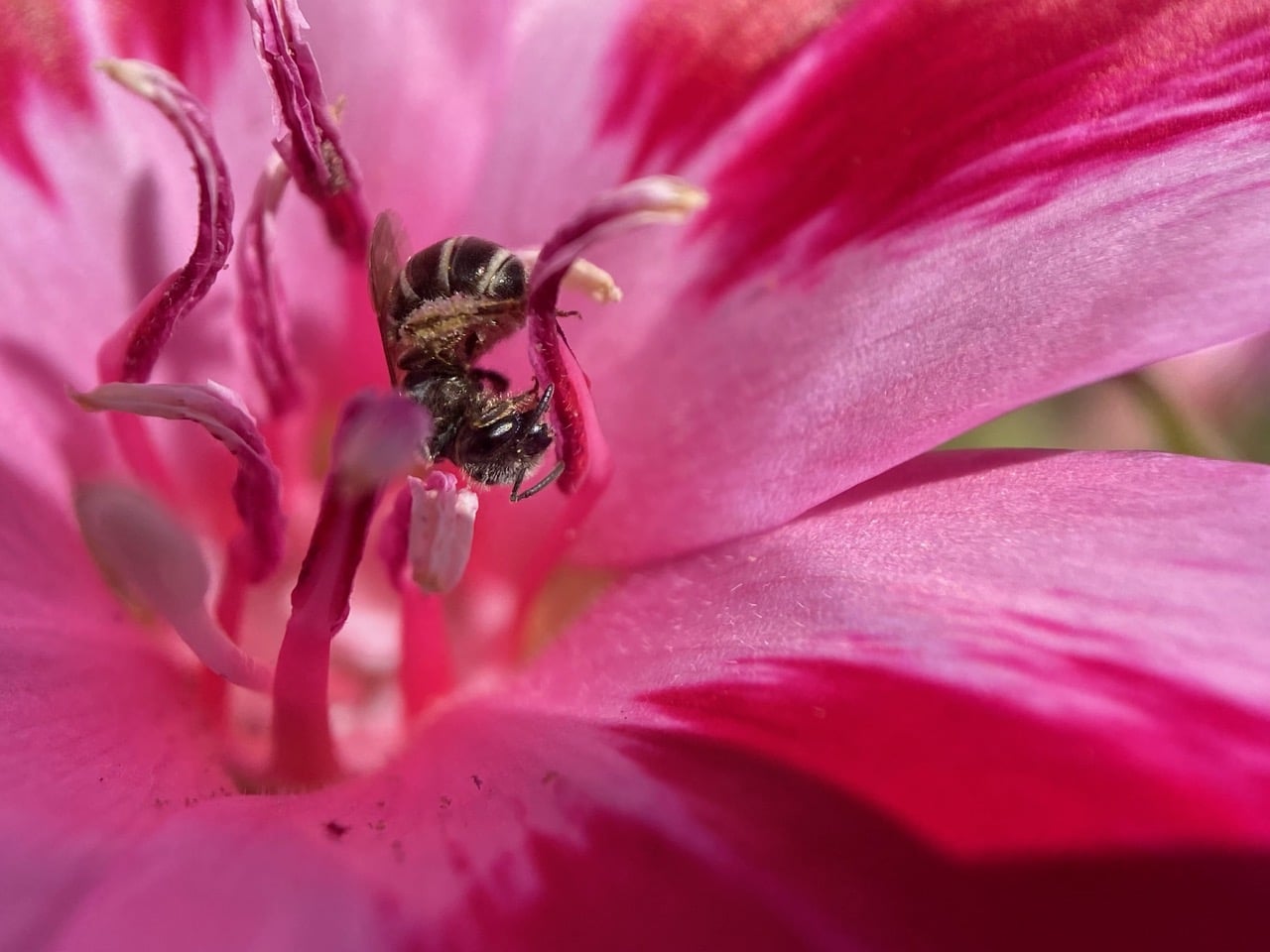

Note where the Tripartite Sweat Bee is stashing the pollen she has gathered – on the underside of her abdomen and the scopa on her hind legs.

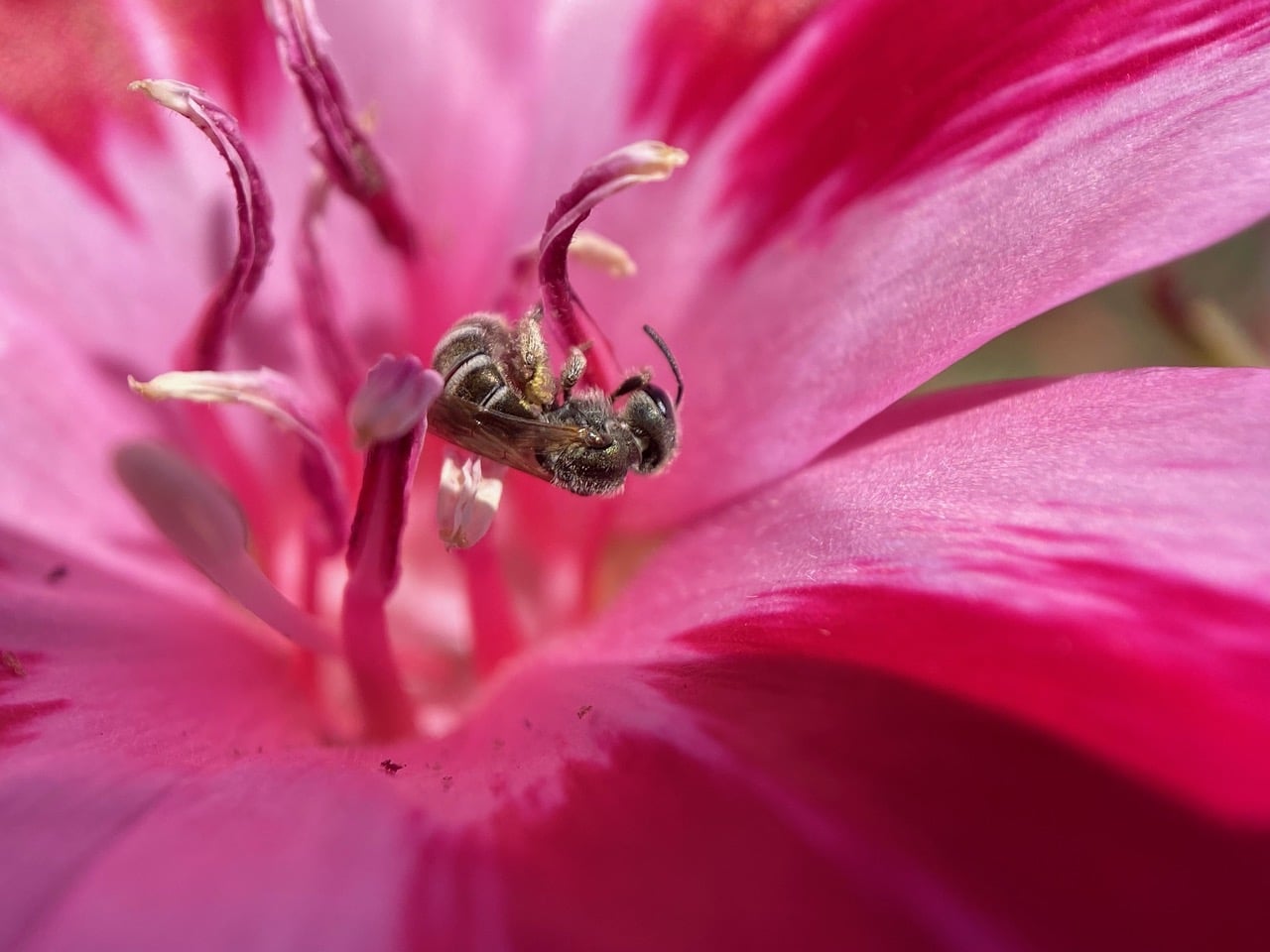
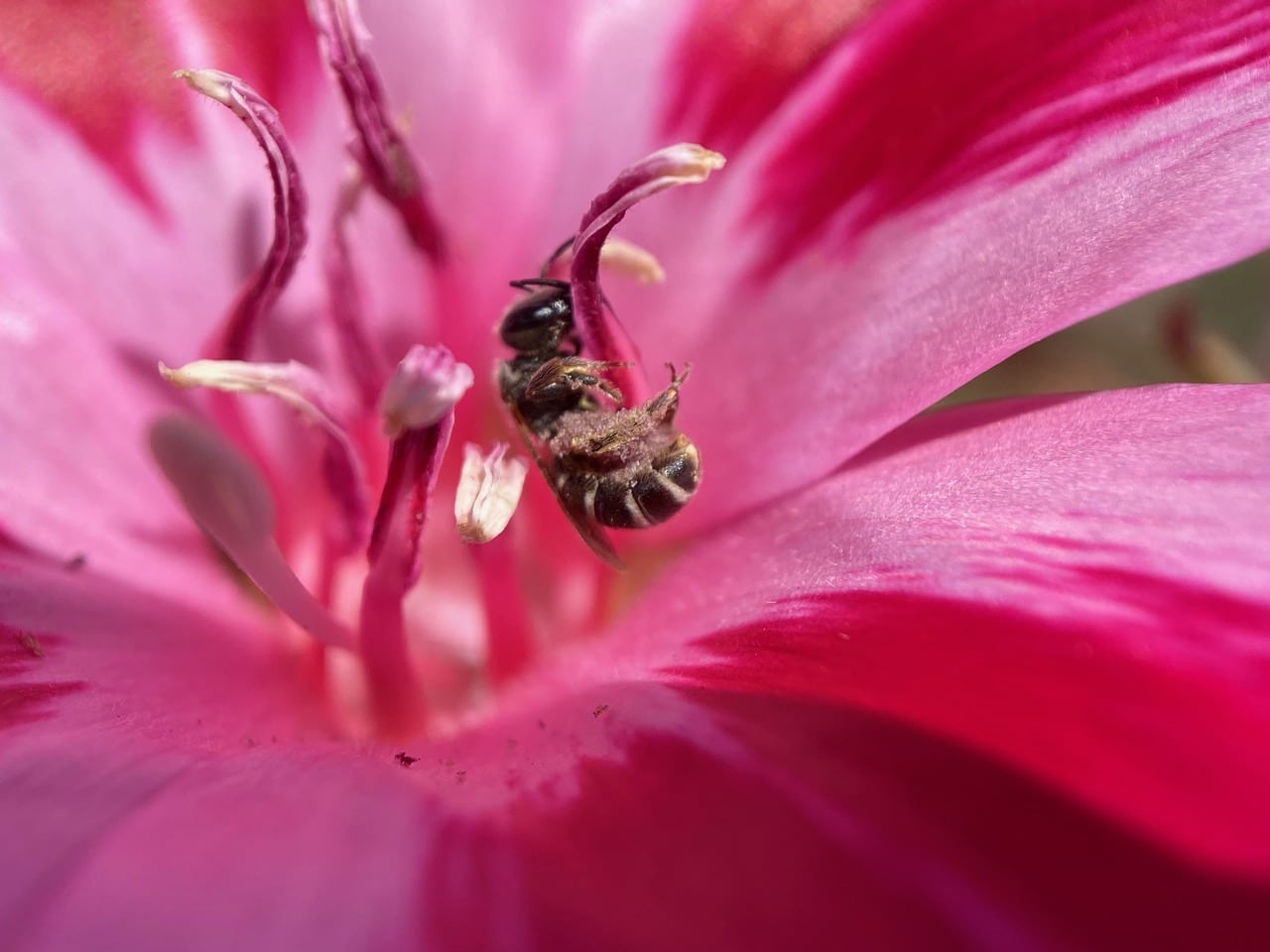
The bee is thorough about cleaning out the pollen on this single anther.
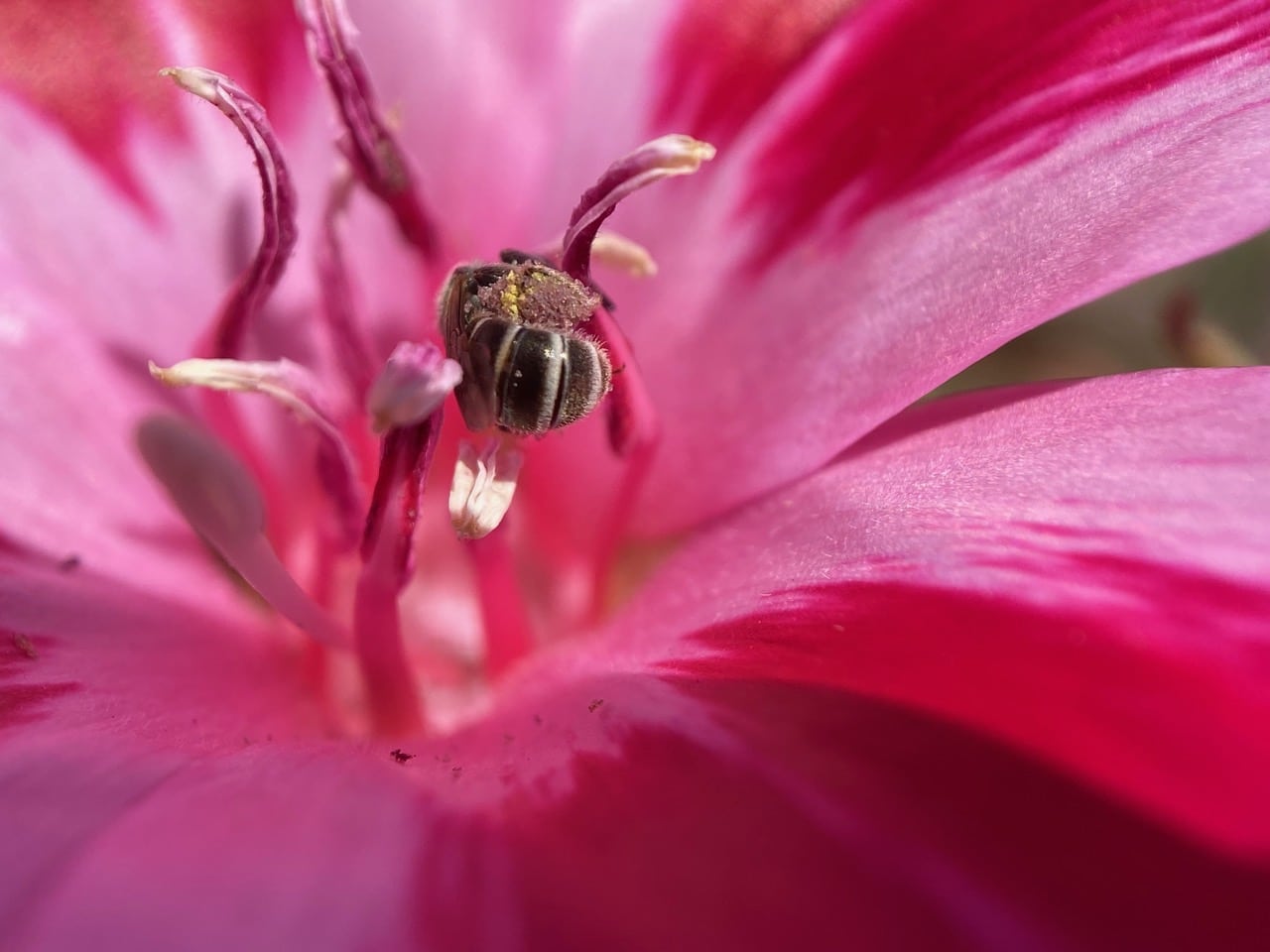
Clarkia pollen grains are actually quite big, but they are hard to see because of their dull color. That’s a pretty good harvest!

Its wings flashing in the sunlight, a male Thread-waisted Wasp, Sphex lucae (family Sphecidae) is taking nectar on an inflorescence of St. Catherine’s Lace, Eriogonum giganteum.
The Sphecidae are solitary wasps with elongated and narrow first abdominal segment, giving rise to the common name Thread-waisted Wasps. Sphex lucae is a widespread western species, ranging from WA in the north, south to CA, and east to TX. The species exhibits sexual dimorphism – females are black with a red abdomen, while the males are entirely black. Adults visit many types of flowers for nectar. Females hunt katydids and grasshoppers as food for their young. The wasp excavates a single-celled burrow in the soil in advance of hunting activities. She drags her paralyzed prey back to the burrow, laying a single egg on the victim. The nest entrance is then sealed and the process is repeated. Males of this species spend nights in sleeping aggregations in sheltered places such as beneath a rock overhang.

An Acmon Blue butterfly has landed on the flowers of St. Catherine’s Lace, Eriogonum giganteum.

This Acmon Blue butterfly is taking nectar from an inflorescence of Nude Buckwheat, Eriogonum nudum that hangs over the sidewalk.
Acmon Blue, Icaricia acmon (family Lycaenidae) is found along the west coast of North America, from Washington to Baja California. It is a small butterfly, with a wingspan of 0.75 to 1.125 in. It can be seen from March to October. Adults feed on nectar while caterpillars feed on a variety of plant species, including buckwheats, deer weed, lupines, trefoils, and milkvetches. Like many Lycaenid butterflies, Acmon Blue shares a mutualistic relationship with ants. The ants protect the caterpillars from predators in exchange for the sweet “honeydew” the caterpillars secrete from a nectary gland. The larvae are often protected and kept in the ant nest when not feeding.
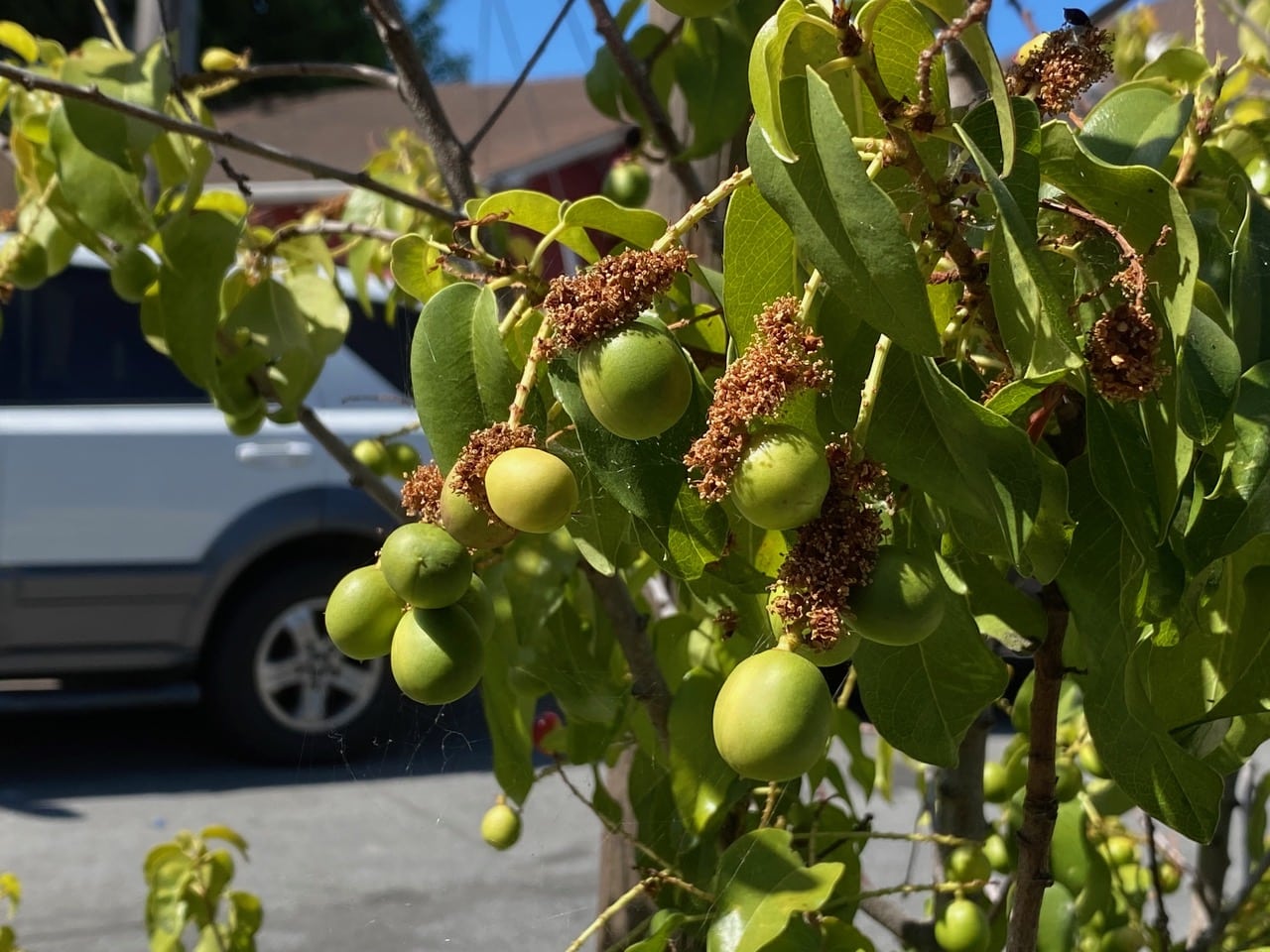
The Hollyleaf Cherry, Prunus ilicifolia that Stefanie has planted on the sidewalk strip is bearing fruits now.
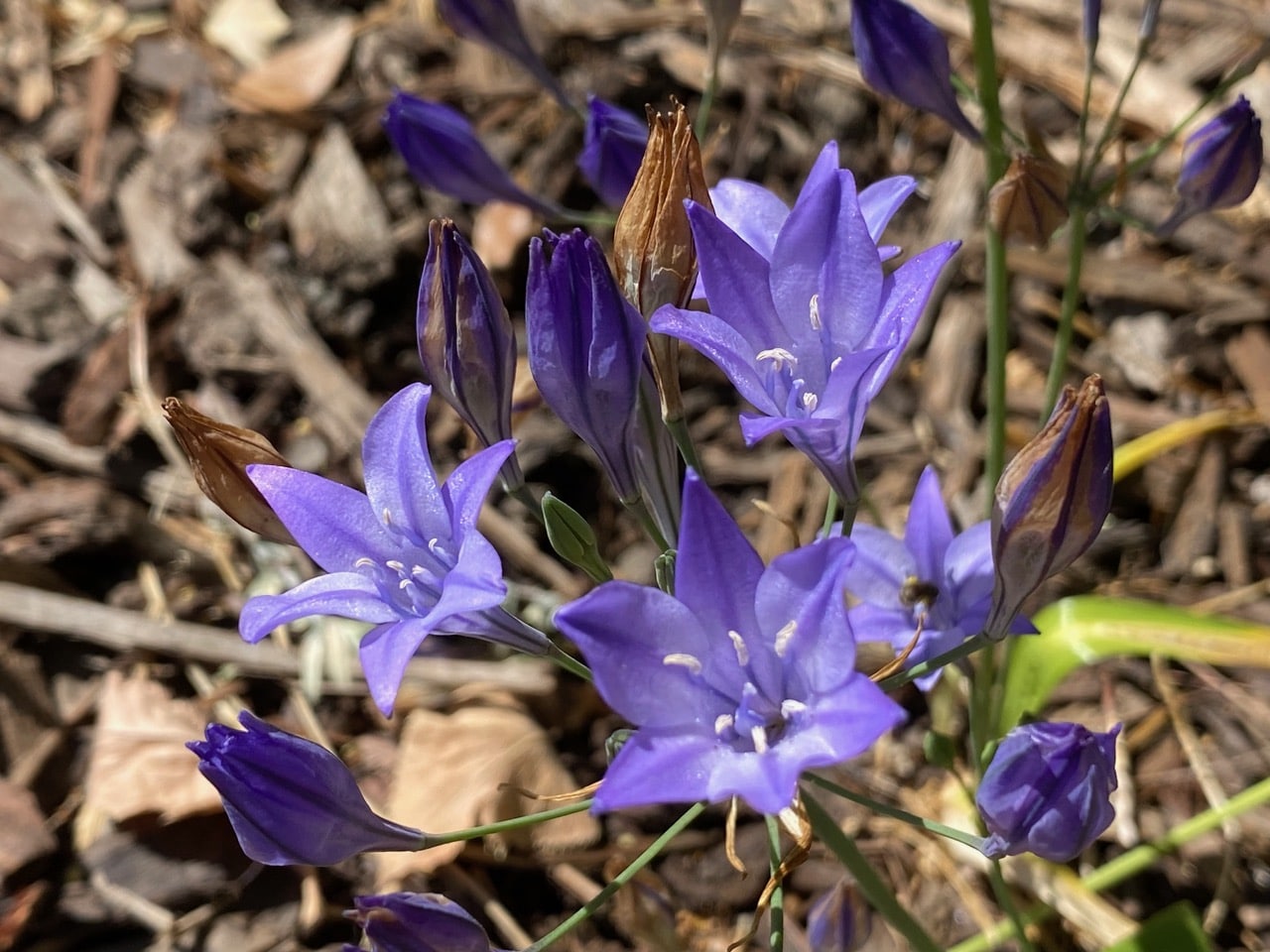
Entering Stefanie’s backyard through the side gate, I am delighted to see this beautiful Ithuriel’s Spear, Triteleia laxa in bloom. These must be new – I have never seen them here before.

A little bee is coming out of one of the trumpet-shaped flowers, her mouthparts still extended.
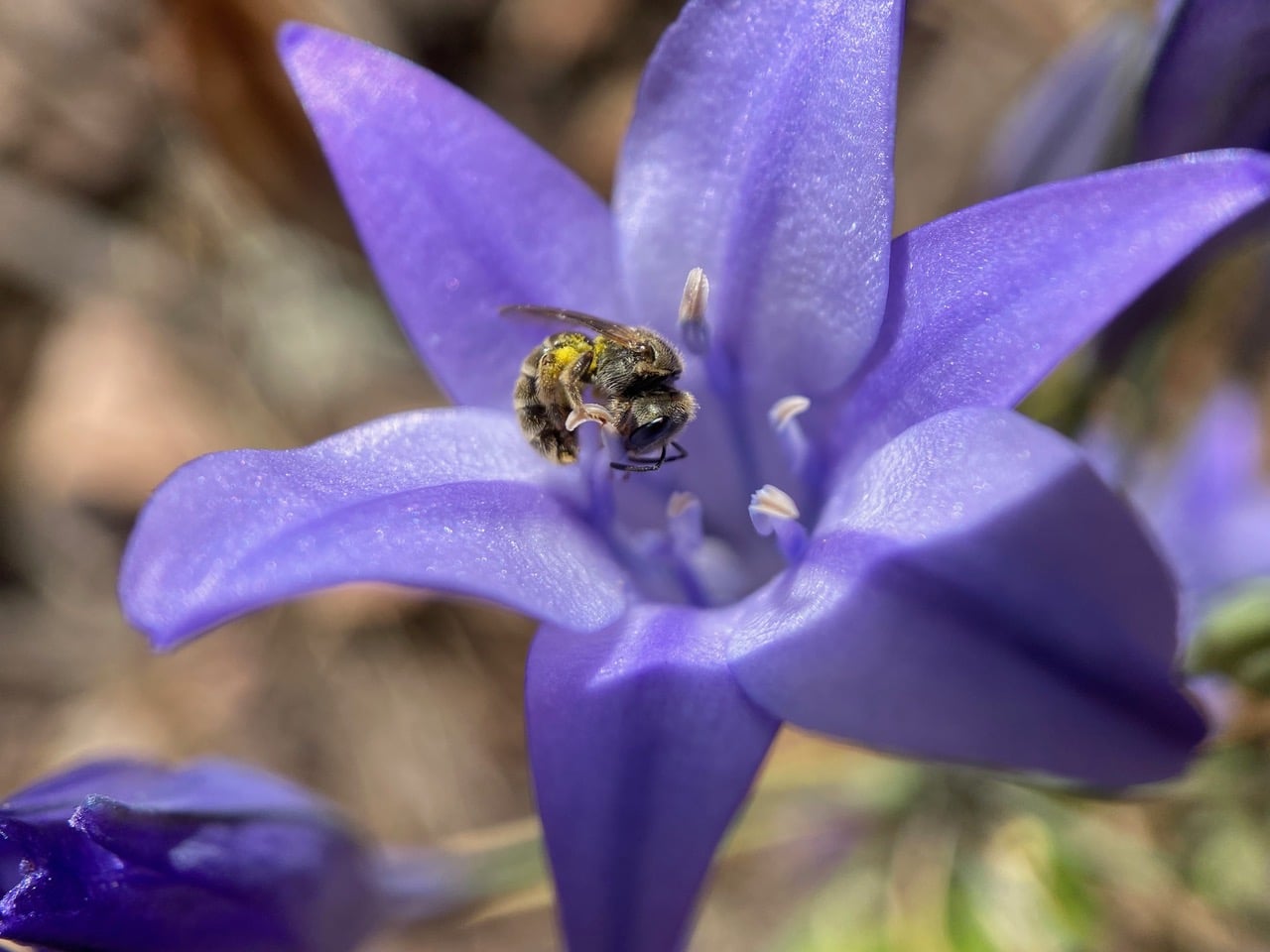
A similar bee is collecting pollen from one of the six stamens on another Ithuriel’s Spear flower. The bee is a Tripartite Sweat Bee, Halictus tripartitus (family Halictidae). The bee has a bit of yellow pollen on the scopa of her hind legs. She must have gathered that from some other flower. Ithuriel’s Spear’s pollen is blue. The Tripartite Sweat Bee is a generalist forager, able to gather floral resources from a wide range of flowers. This versatility, as well as their social organization contribute to the species’ phenomenal success in our area.
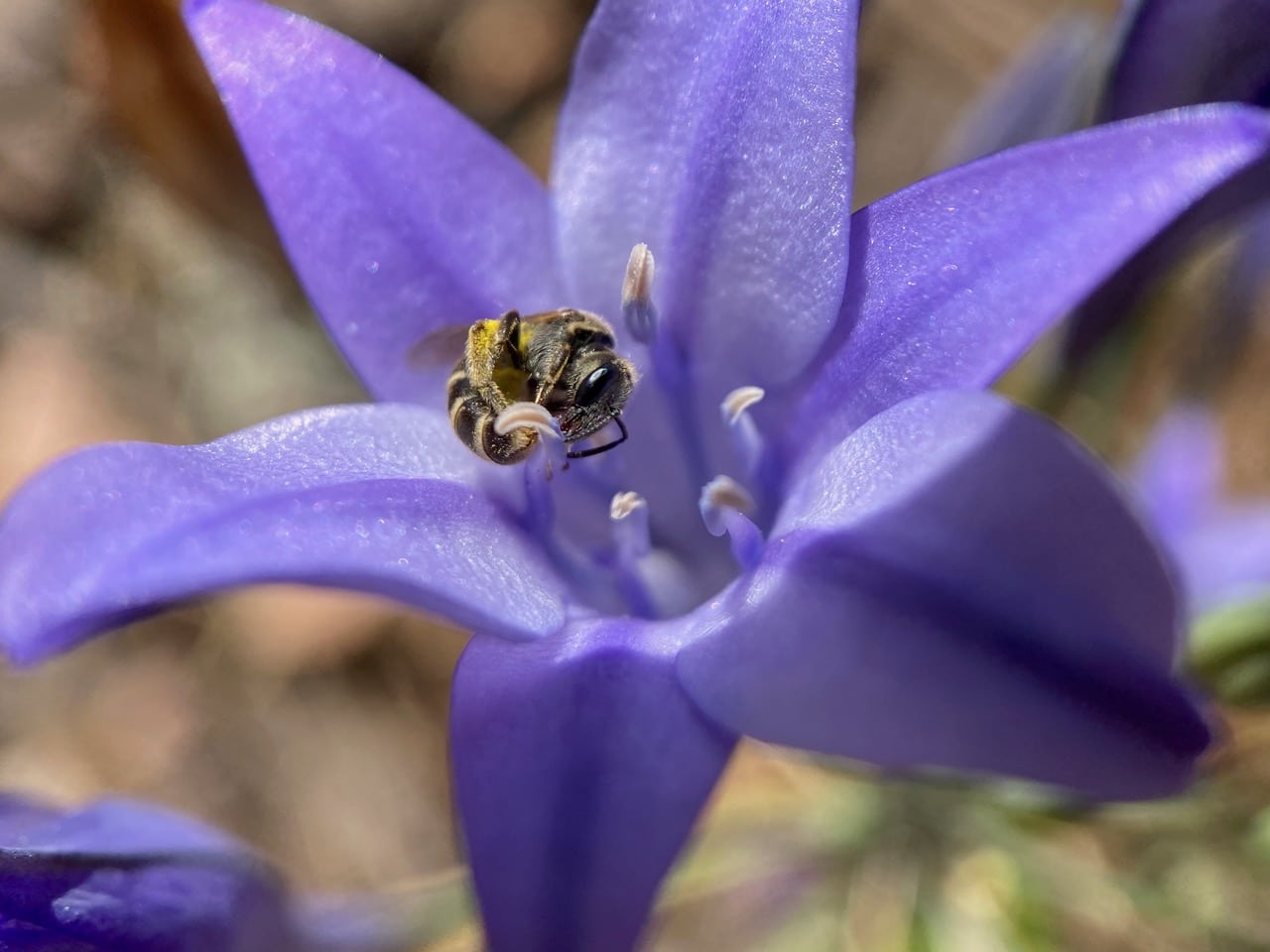
It’s fun to watch the little bee work the individual anthers one at a time. Their agility is only matched by their diligence.
Halictus is found worldwide; they are most common in the Northern Hemisphere. All are generalists, foraging from a wide variety of flowering plants. Many species are social and produce several generations per year. This is not surprising as most blooming plants are season-specific; a bee that requires pollen and nectar across multiple seasons would not thrive as a specialist. All Halictus in North America nest in the ground, often in aggregations; and they may nest in the same area for decades.
The species Halictus tripartitus (family Halictidae) is partially eusocial, with nests connected underground and some workers capable of reproducing. It is a very successful species in our area, making up the majority of bees in many gardens right now, collecting floral resources from a large variety of plants.

The bee uses her mandibles, her front legs and her antennae in extracting pollen from the individual anthers.
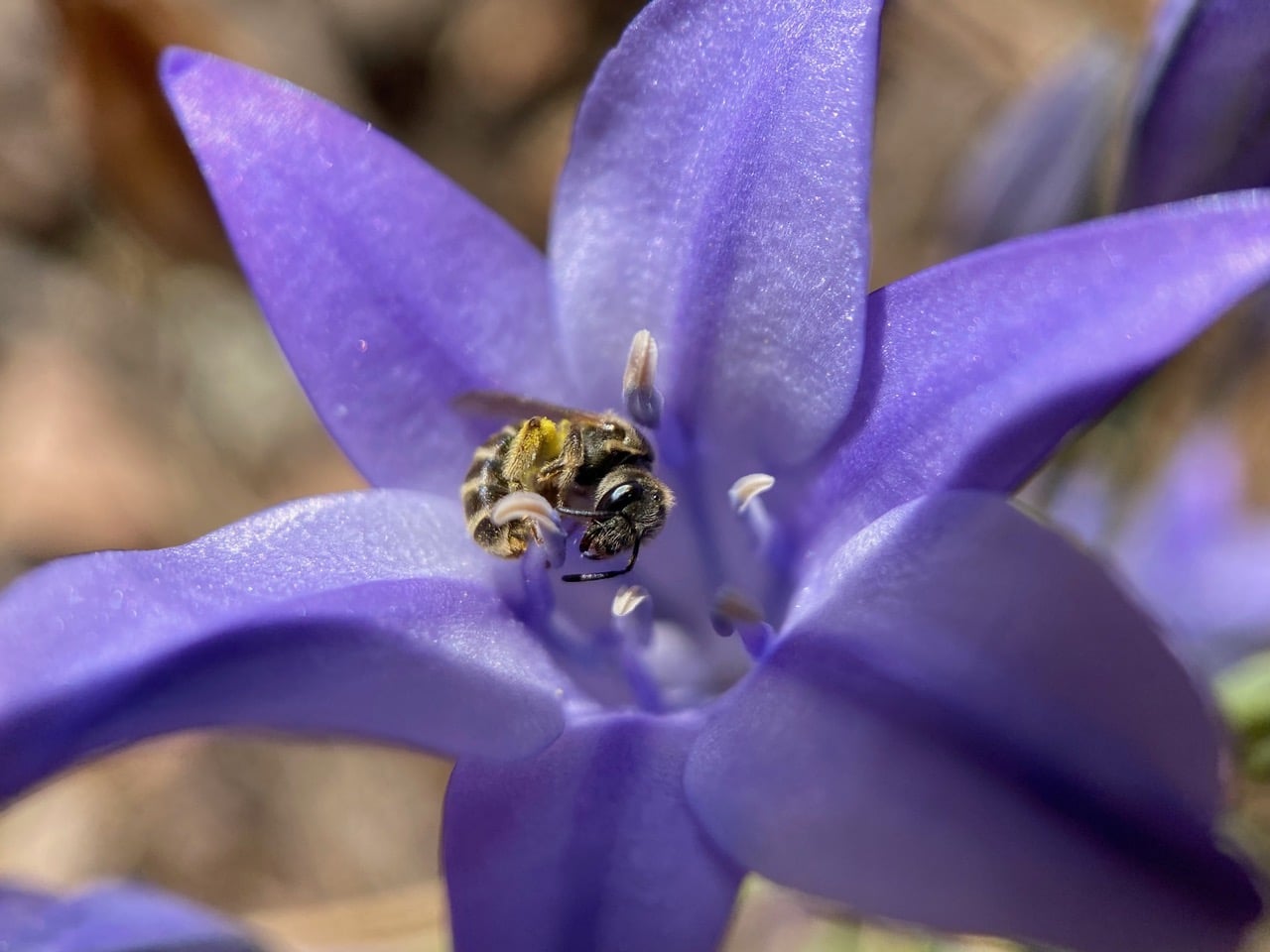
Then she has to transfer the pollen into her scopa using her middle legs.

Onto the next anther!

There’s now a bit of sky blue pollen on the bee’s scopa. It is slow, hard work!