

Pollinator Post 7/4/25 (1)
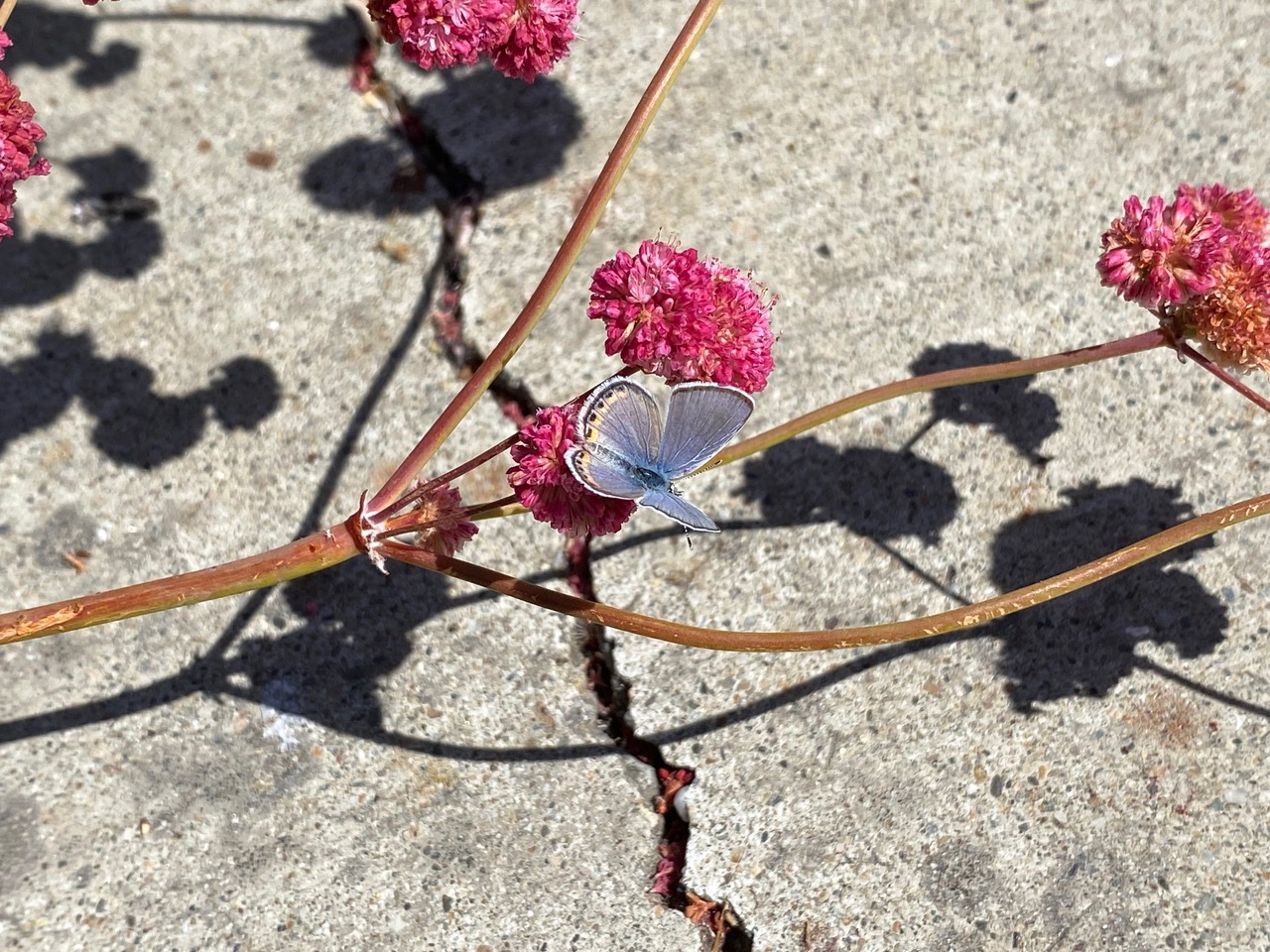
When I arrive at Stefanie’s garden in San Leandro this morning, the place is aflutter with dozens of Acmon Blue butterflies.
Acmon Blue, Icaricia acmon (family Lycaenidae) is found along the west coast of North America, from Washington to Baja California. It is a small butterfly, with a wingspan of 0.75 to 1.125 in. It can be seen from March to October. Adults feed on nectar while caterpillars feed on a variety of plant species, including buckwheats, deer weed, lupines, trefoils, and milkvetches. Like many Lycaenid butterflies, Acmon Blue shares a mutualistic relationship with ants. The ants protect the caterpillars from predators in exchange for the sweet “honeydew” the caterpillars secrete from a nectary gland. The larvae are often protected and kept in the ant nest when not feeding.

It’s no wonder. Stefanie’s garden is home to several species of Buckwheats all in bloom right now. Buckwheats are the major food plant for the Acmon Blue. Here in Stefanie’s front garden, the Red-flowered Buckwheat, Eriogonum grande ssp. rubescens is blooming profusely in varying shades of pink.
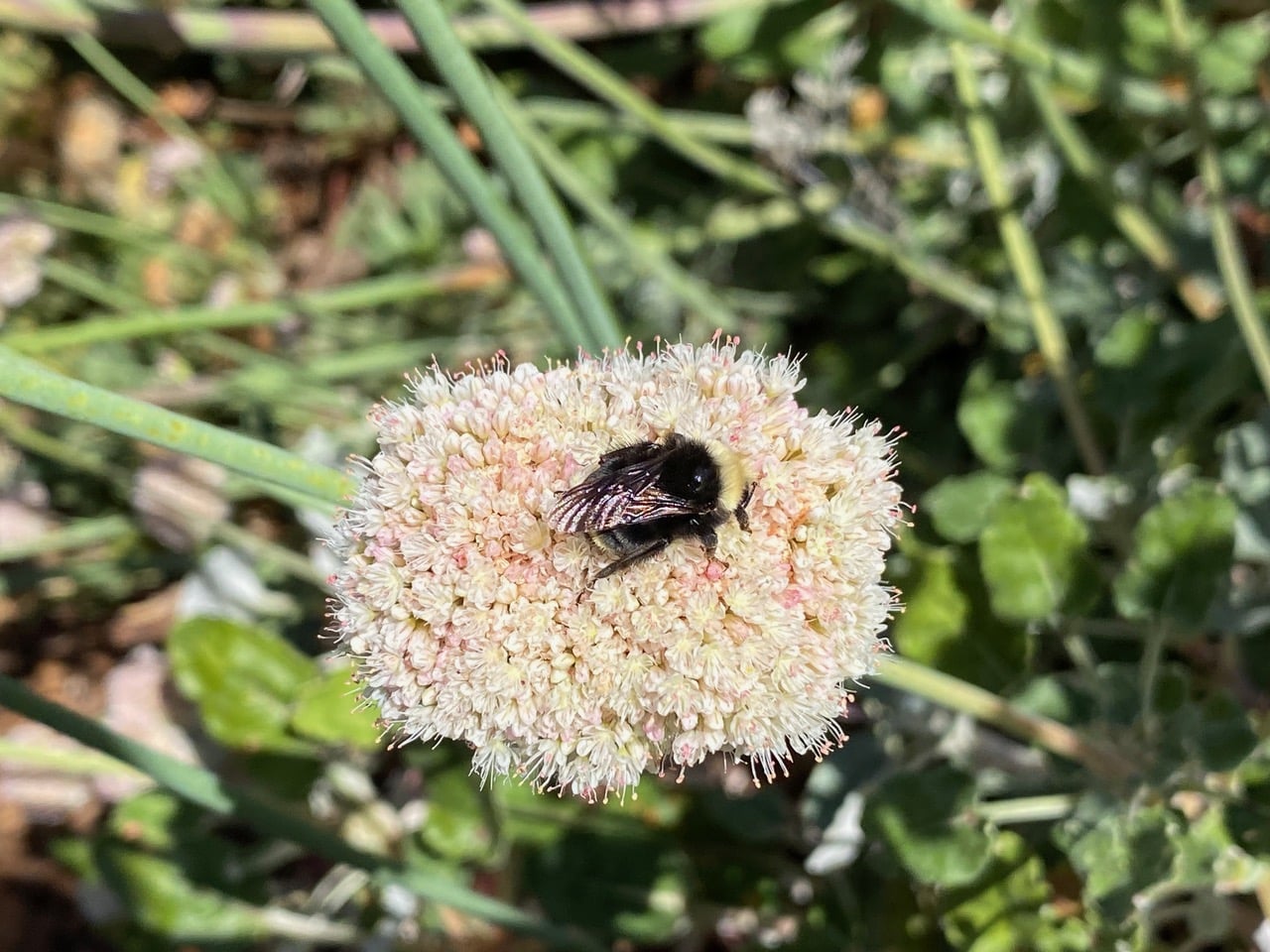
A Yellow-faced Bumble Bee, subgenus Pyrobombus (genus Bombus, family Apidae) is resting on an inflorescence of Nude Buckwheat, Eriogonum nudum on the side of the house.
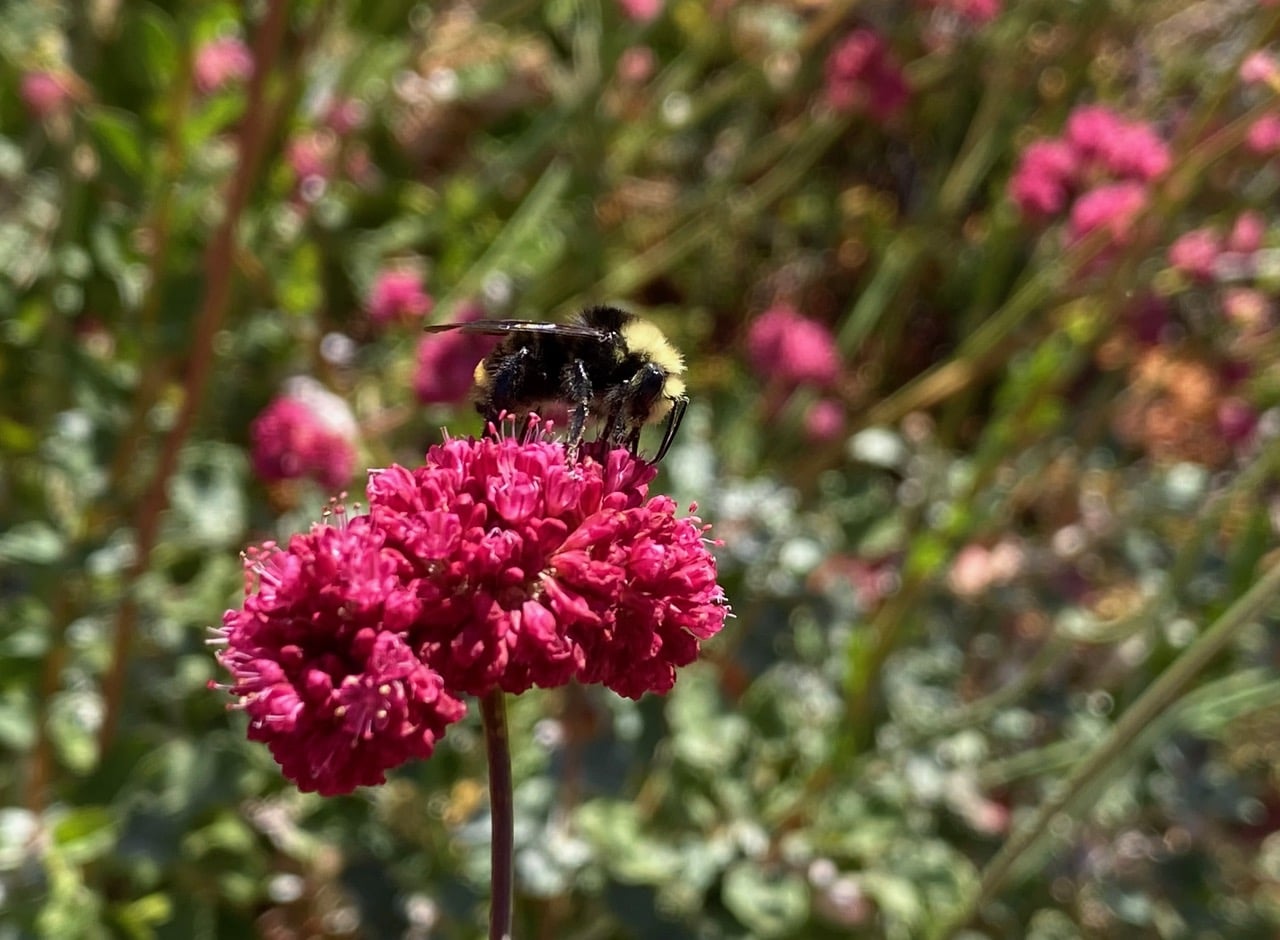
A Yellow-faced Bumble Bee, subgenus Pyrobombus (genus Bombus, family Apidae) is actively foraging on an inflorescence of Red-flowered Buckwheat, Eriogonum grande ssp. rubescens.
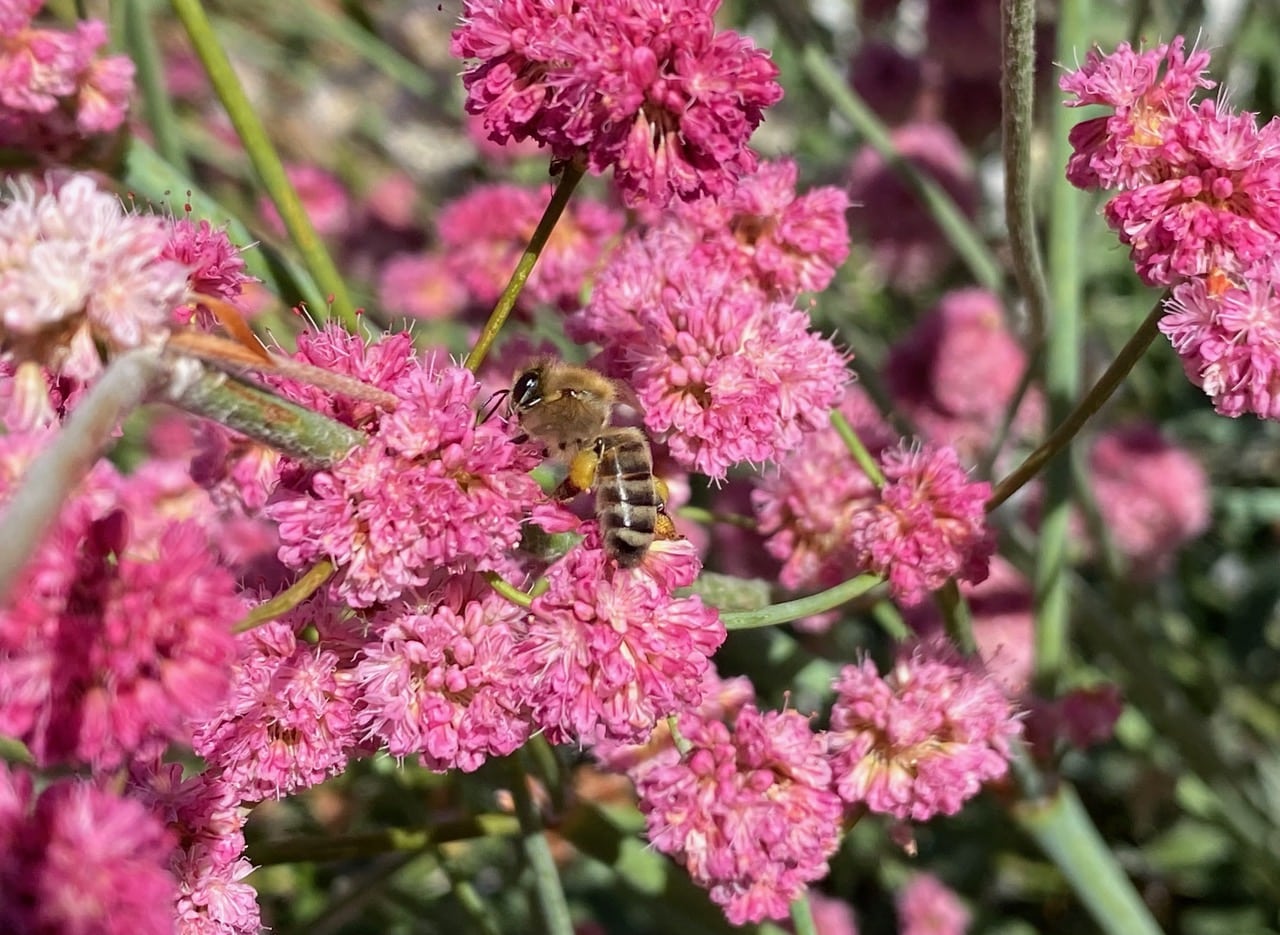
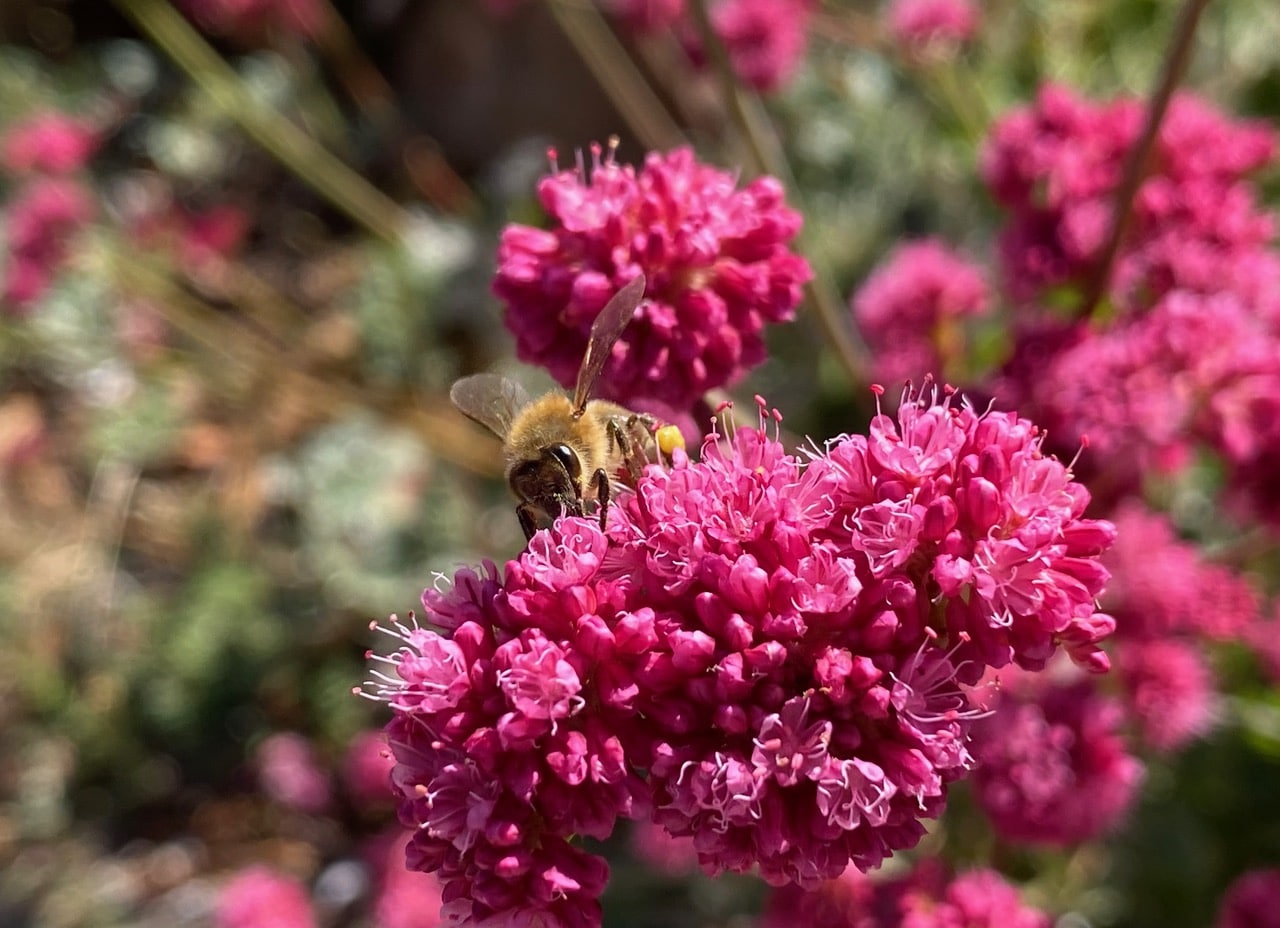
A Honey Bee, Apis mellifera (family Apidae) is surrounded by the floral abundance of the Red-flowered Buckwheat, Eriogonum grande ssp. rubescens.
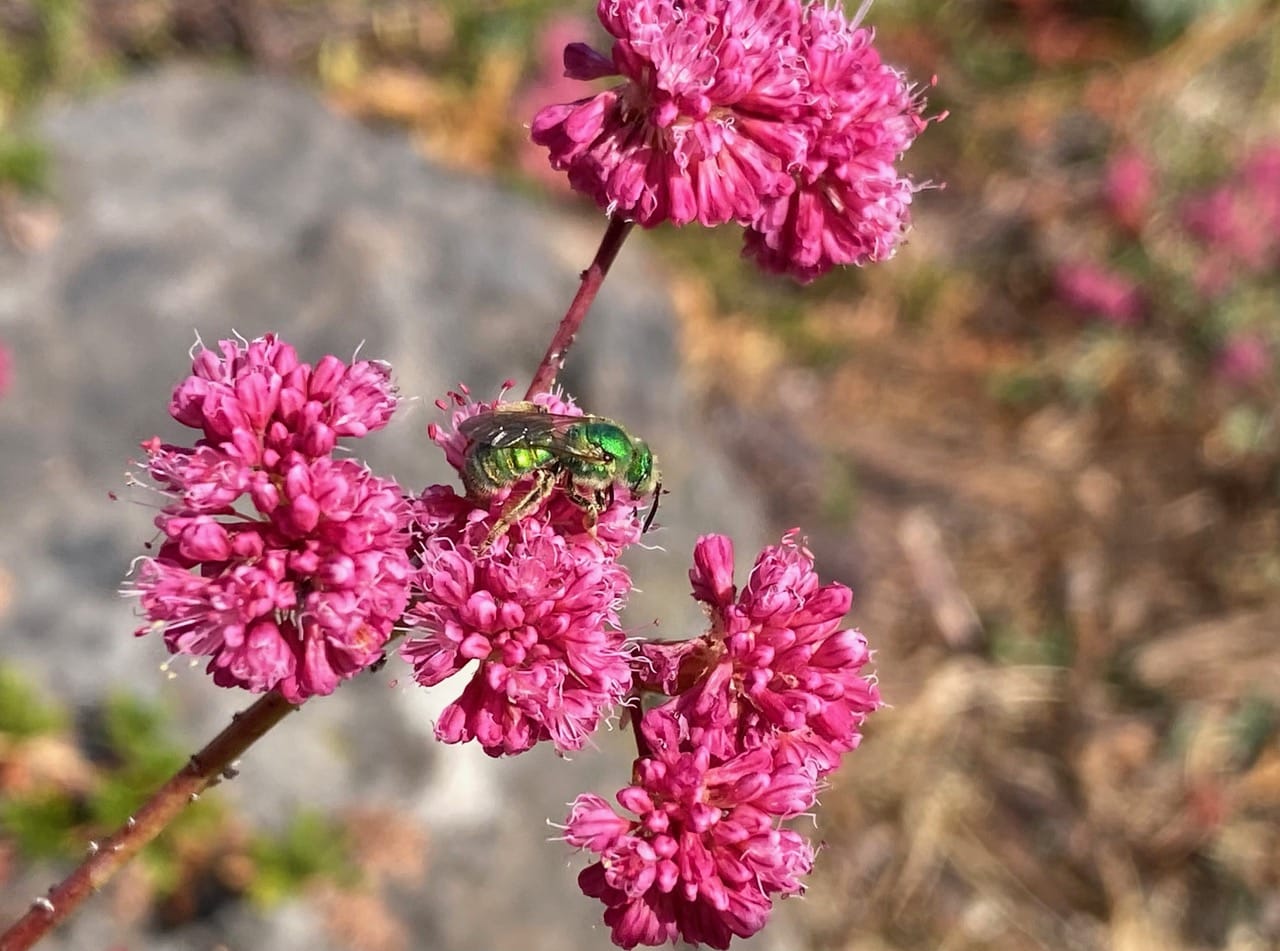
Aglitter in iridescent green, a female Fine Striped Sweat Bee, Agapostemon subtilior (family Halictidae) is foraging on the flowers of Red-flowered Buckwheat, Eriogonum grande ssp. rubescens.
Agapostemon are brightly colored metallic green or blue bees measuring 7 to 14.5 mm long. Most species have a metallic green head and thorax, and black-and-yellow striped abdomen; some females are entirely bright green or blue. Females carry pollen on scopal hairs located on their hind legs. Agapostemon are generalists. Like other members of the family Halictidae, they are short-tongued and thus have difficulty extracting nectar from deep flowers. Males are often seen flying slowly around flowers looking for females. The bees favor flowers with high densities. Females excavate nests in the ground. These are summer to fall bees.
Fine striped sweat bee (Agapostemon subtilior) · iNaturalist

A female Tripartite Sweat Bee, Halictus tripartitus (family Halictidae) is foraging on a cluster of flowers of the Red-flowered Buckwheat. The species is likely the most commonly seen bee in Bay Area gardens right now.
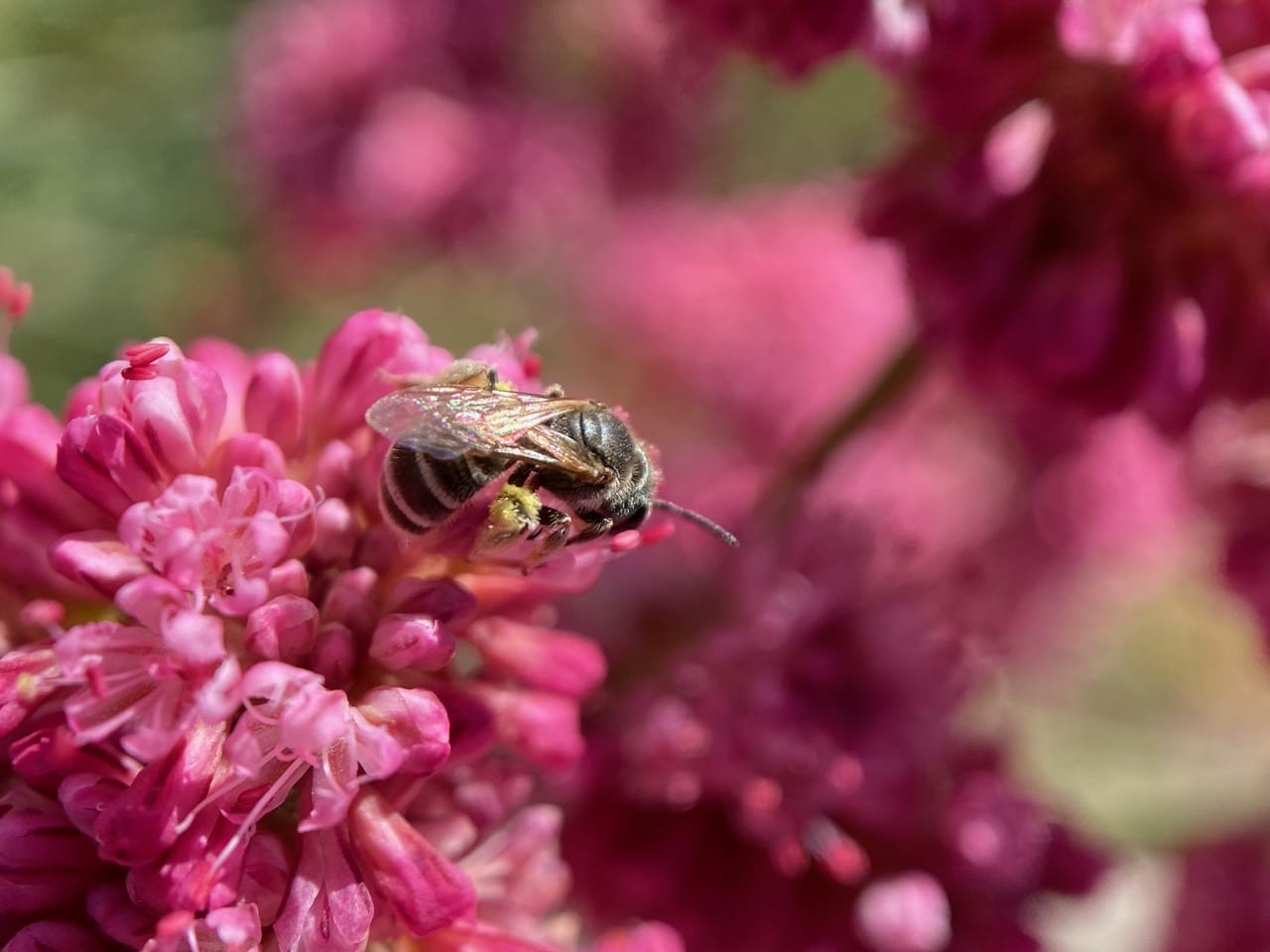
Halictus is found worldwide; they are most common in the Northern Hemisphere. All are generalists, foraging from a wide variety of flowering plants. Many species are social and produce several generations per year. This is not surprising as most blooming plants are season-specific; a bee that requires pollen and nectar across multiple seasons would not thrive as a specialist. All Halictus in North America nest in the ground, often in aggregations; and they may nest in the same area for decades.
The species Halictus tripartitus (family Halictidae) is partially eusocial, with nests connected underground and some workers capable of reproducing. It is a very successful species in our area, making up the majority of bees in many gardens right now, collecting floral resources from a large variety of plants.
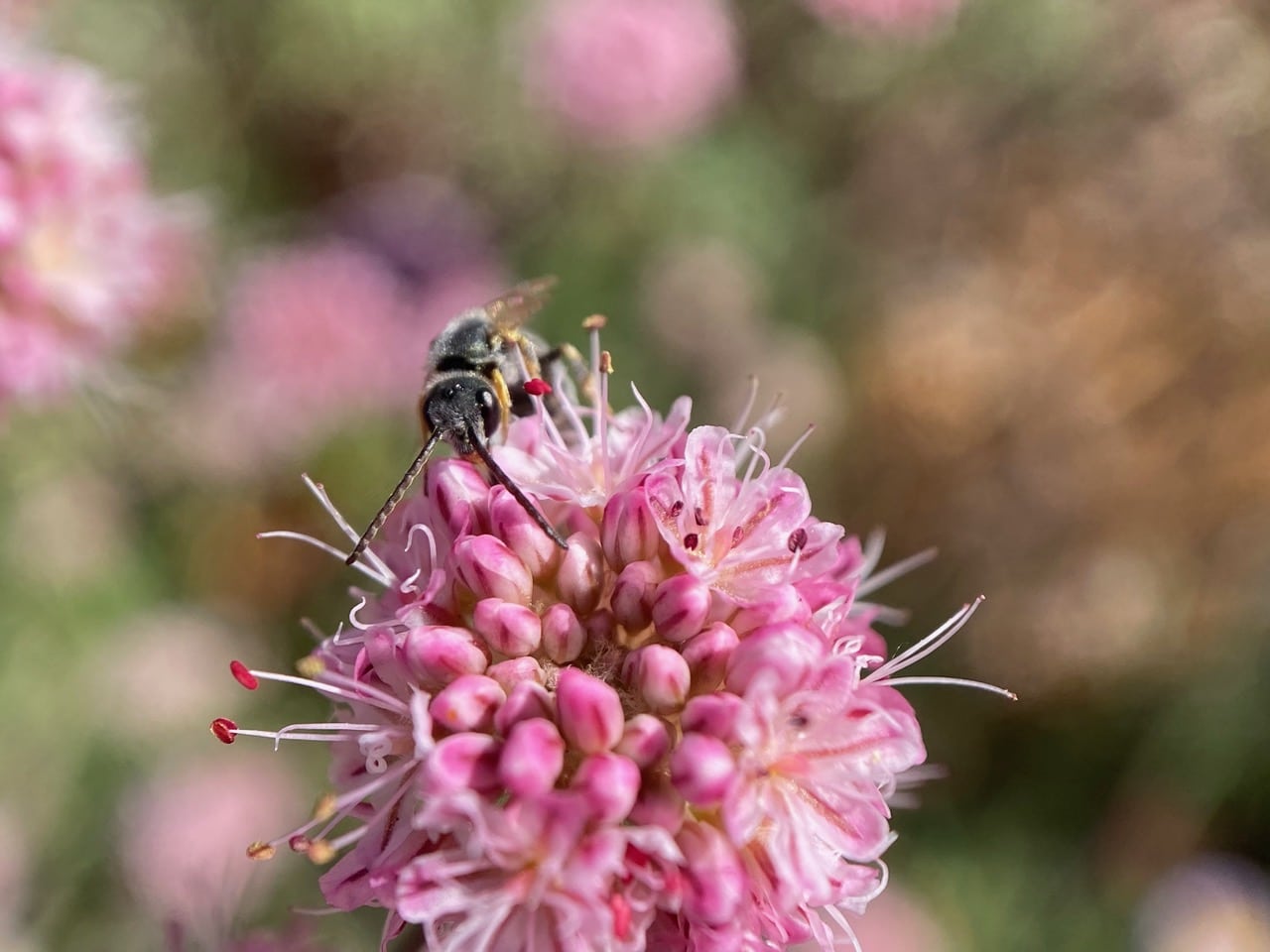
Whoa, a little bee with long antennae is coming into view over the top of a buckwheat inflorescence.
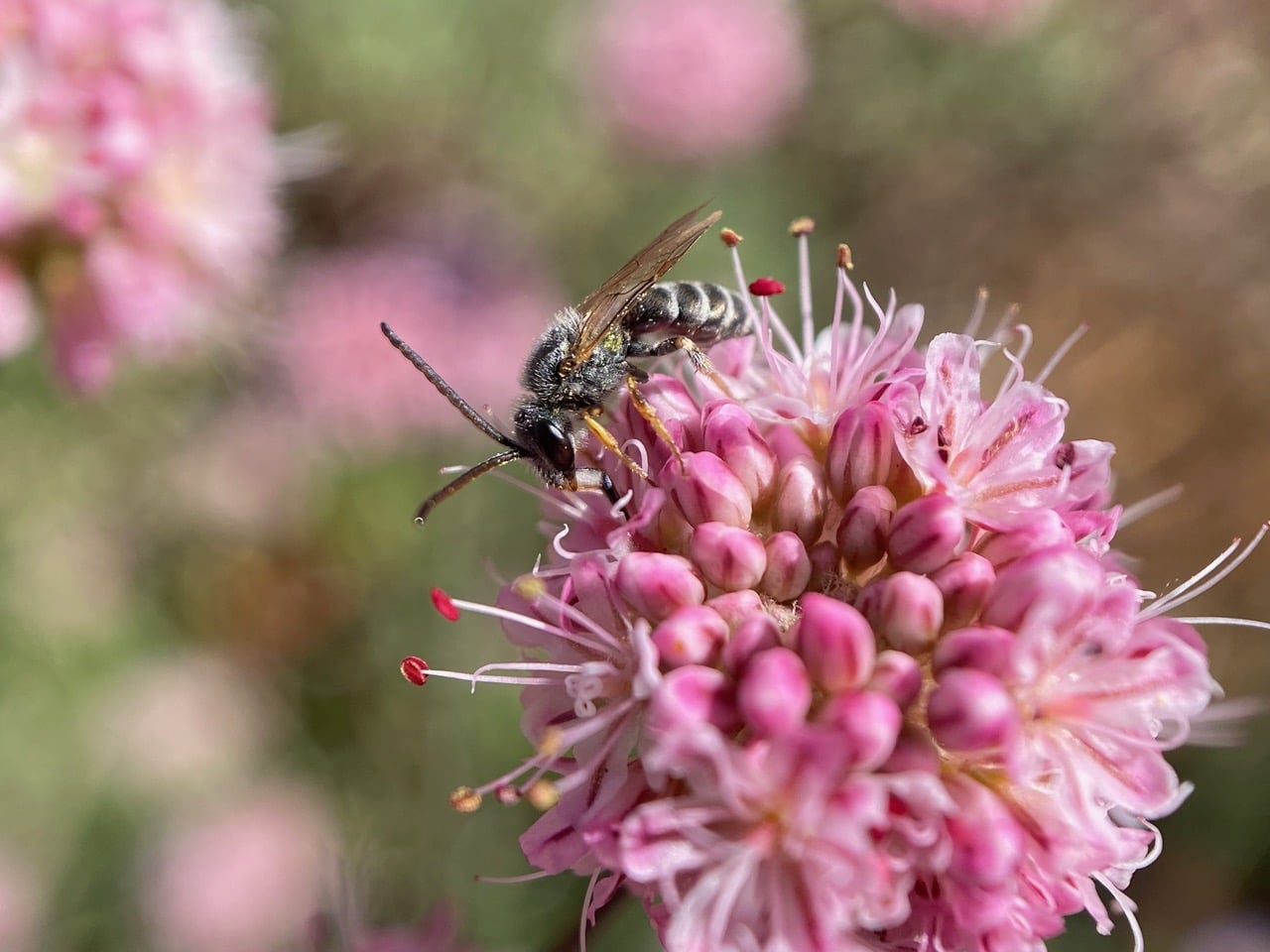
It is a male Tripartite Sweat Bee, Halictus tripartitus (family Halictidae). Besides the extra long antennae, he also has a slimmer build than the females. Note also the absence of scopae on his hind legs.
The antennae of male bees are often much longer than their female counterparts. Male antennae have an extra segment and the segments themselves are longer. This is because male antennae are specialized to pick up the subtle scent of female pheromones.
Male bees do not collect pollen to provision the nest; neither do they have the anatomical equipment for the job, hence the absence of scopae or pollen baskets on the males.
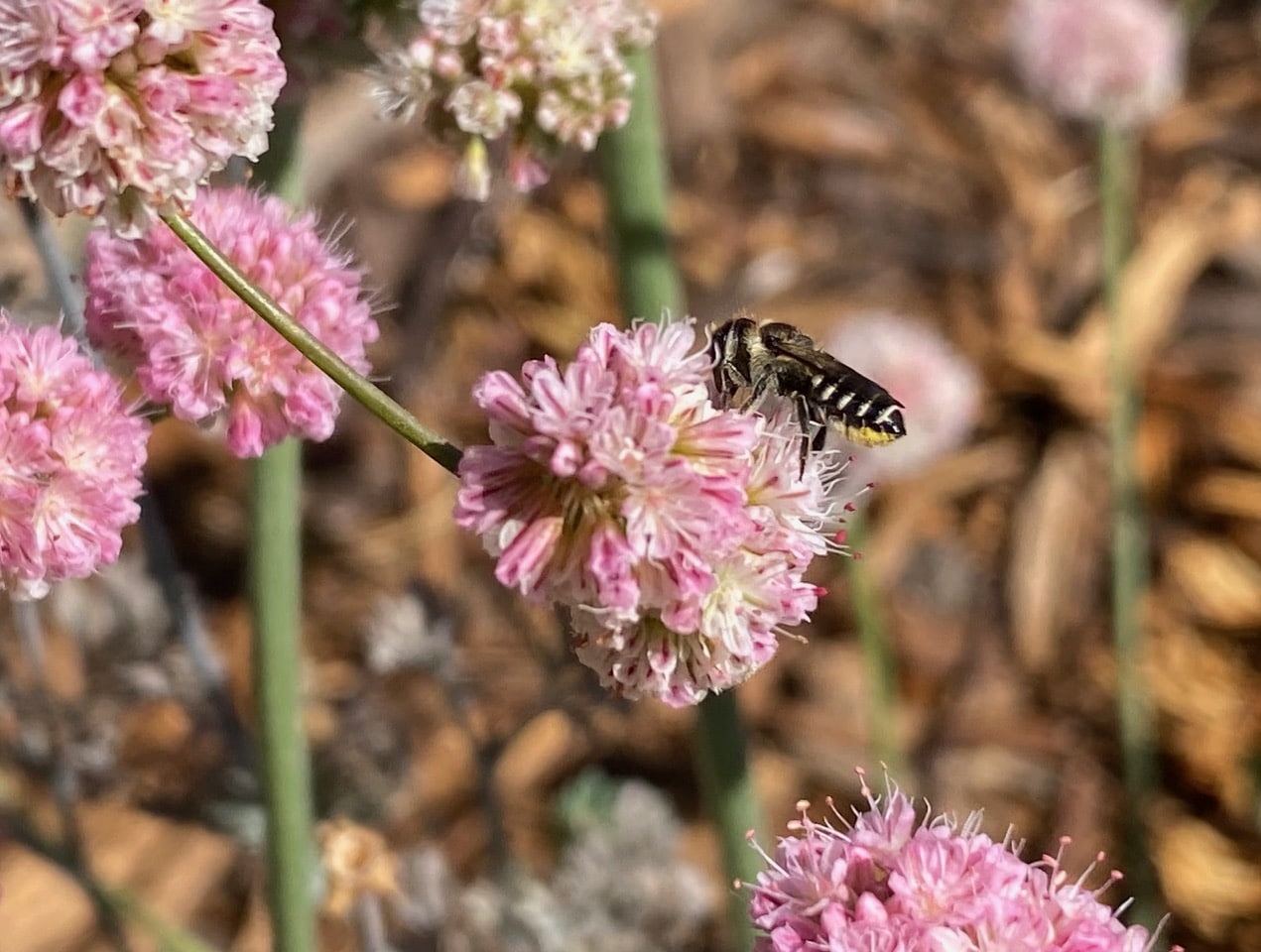
That is the tiniest Leaf-cutter Bee I have ever seen! iNaturalist has helped identify it as Megachile apicalis (family Megachilidae). Note the pollen on the brushes of hairs on the underside of her abdomen.
Leaf-cutter Bees, Megachile sp. (family Megachilidae) are stout-bodied, usually with pale hair on the thorax and stripes of white hairs on the abdomen. Females usually have a triangular abdomen with a pointed tip, and males’ faces are covered with dense, pale hair. Flight season is from May into September, with peak activity from June to August.
Solitary females construct nests in tubular cavities, including hollow stems, tree holes, and abandoned beetle burrows in wood. Many use holes drilled into wood, straws, or other manufactured tunnels. Females cut pieces from leaves or flower petals for use in the construction of brood cells. Most Megachile females are generalists when foraging for pollen. Pollen is transported in dense scopae on the underside of the abdomen.
Megachile apicaulis is an Old World species that is commonly found in Europe and the Mediterranean region. It has been introduced to both the east and west coasts of North America. It is established and spreading in the west, including California. It is now commonly seen on the U.S. Pacific coast. The bee is able to persist in semi-natural habitats surrounded by intensely modified landscapes. The bee nests in tree holes, hollow twigs, and above ground stems, cavities, or wood. Females are 8-9 mm, males 6-8 mm.

An Acmon Blue butterfly, Icaricia acmon (family Lycaenidae) has landed on a fading leaf of Nude Buckwheat, Eriogonum nudum.
Females of the species favor certain species of buckwheat plants, especially small, perennial varieties, as their host plants. They lay their eggs on various parts of the plant, including leaves and flowers. The larvae which hatch out feed on the flowers and foliage of the buckwheat. The buckwheat is also a popular nectar source for adult Acmon Blue butterflies.

A Thick-legged Hover Fly, Syritta pipiens (family Syrphidae) is feeding on pollen on Nude Buckwheat.
Syritta pipiens originates from Europe and is currently distributed across Eurasia and North America. They are fast and nimble fliers. The fly is about 6.5 – 9 mm long. The species flies at a very low height, rarely more than 1 m above the ground. Adults visit flowers – males primarily to feed on nectar, and females to feed on protein-rich pollen to produce eggs. The species is found wherever there are flowers. It is also anthropophilic, occurring in farmland, suburban gardens, and urban parks. Larvae are found in wetlands that are close to bodies of freshwater such as lakes, ponds, rivers, ditches. Larvae feed on decaying organic matter such as garden compost and manure. Males often track females in flight, ending with a sharp dart towards them after they have settled, aiming to attempt forced copulation.
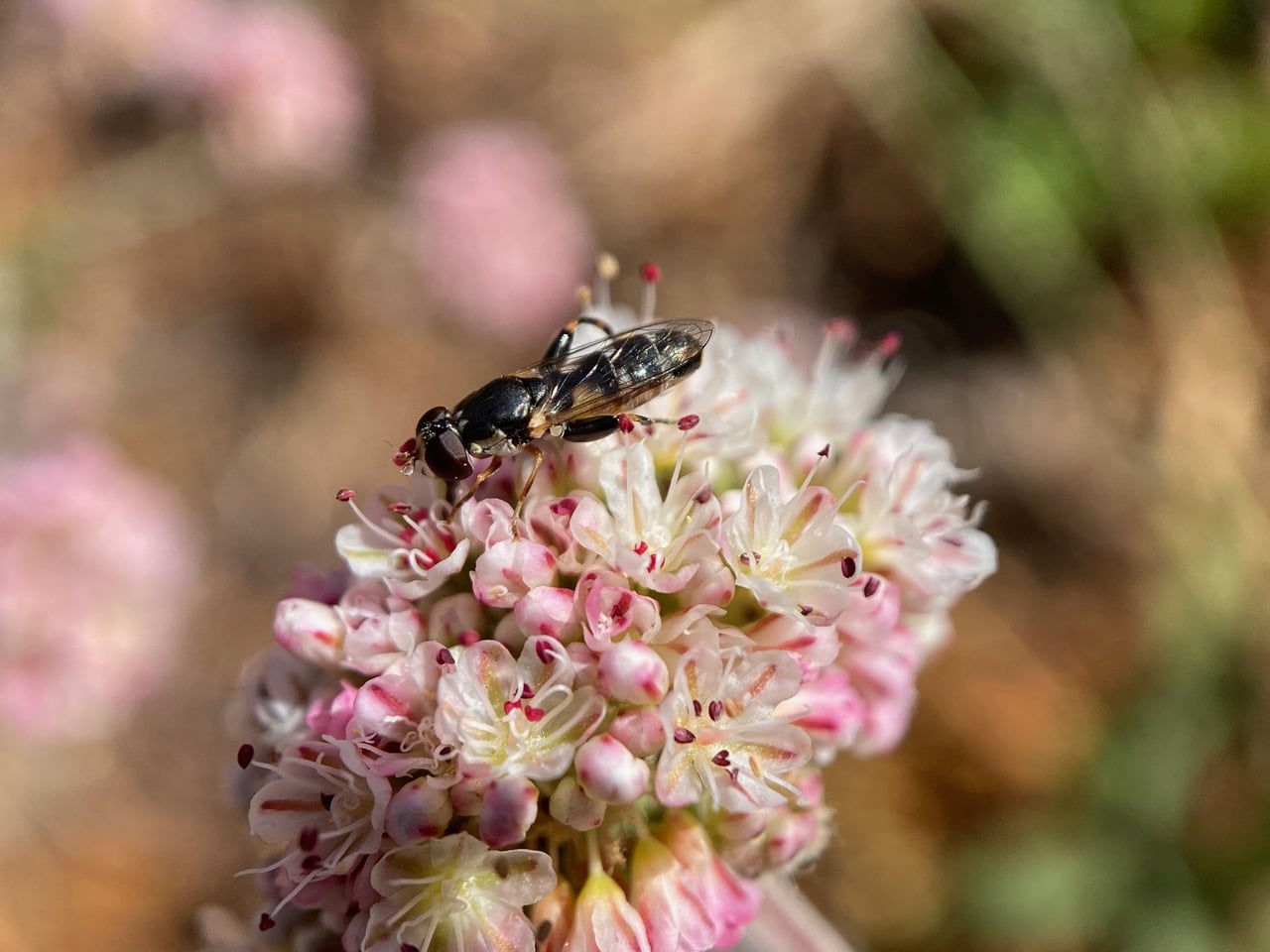
As I have observed on my regular visits, the Thick-legged Hover Fly is the most prevalent hover flies in Stefanie’s garden. I wonder if the water features in her garden favor the hover fly’s larval development. There is a water fountain, and Stefanie has installed a rain-collecting system with a giant barrel on the side of the house. Rain is also channeled from the roof to a simulated creek that runs through a small section of the garden.

A small isolated colony of dark, wax-covered aphids has established on a Red-flowered Buckwheat. There are aphids of different ages and sizes on the base of this cluster of flower buds.
Aphids are small sap-sucking insects in the order Hemiptera. A typical life cycle involves flightless females giving live birth to female nymphs, – who may also be already pregnant, an adaptation called telescoping generations – without the involvement of males. Maturing rapidly, females breed profusely so that the population multiplies quickly. Winged females may develop later in the season, allowing the insects to colonize new plants. In temperate regions, a phase of sexual reproduction occurs in the autumn, with the insects often overwintering as eggs.
The life cycle of some species involves an alternation between two species of host plants. Some species feed on only one type of plant, while others are generalists, colonizing many plant groups. Some ants have a mutualistic relationship with aphids, tending them for their honeydew and protecting them from predators.
Aphids usually feed passively on phloem of plants. Once the phloem vessel is punctured, the sap, which is under pressure, is forced into the aphid’s food canal. Aphids produce large amounts of a sugary liquid waste called “honeydew”. A fungus called sooty mold can grow on honeydew deposits that accumulate on leaves and branches, turning them black.
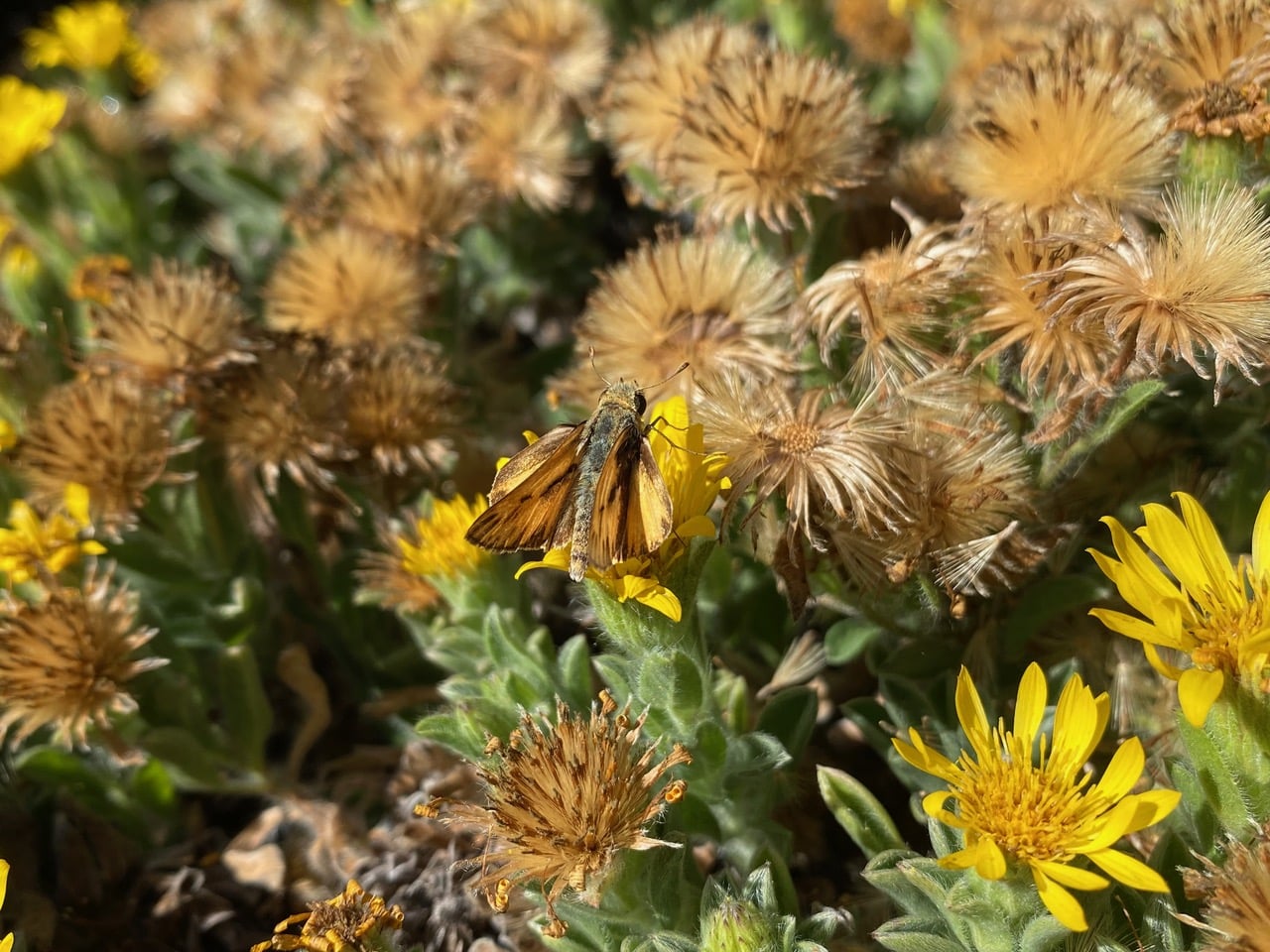
A Fiery Skipper, Hylephila phyleus (family Hesperiidae) nearly disappears from view when it lands on a flowerhead of San Bruno Mountain Sessileflower Goldenaster, Heterotheca sessiliflora ssp. bolanderi ’San Bruno Mountain’.
Skippers are a family, the Hesperiidae, of the order Lepidoptera (butterflies and moths). They are named for their quick, darting flight habits. Most have the antenna clubs hooked backwards like a crochet hook. They also have generally stockier bodies and larger compound eyes than the other butterflies. Their wings are usually small in proportion to their bodies. When at rest, skippers keep their wings usually angled upwards or spread out, and only rarely fold them up completely. Californian species are mostly brown or tan, with black, orange, or yellow markings.
Skipper caterpillars are usually green or brown, sometimes yellowish, never brightly colored. They have a distinctive “collar”, a narrow ring around the body right behind the head. Caterpillars are camouflaged and often hide during the day. Many species make nests of leaves and silk for additional protection. Most North American species feed on grasses, but some common species eat shrubs and trees, especially in the bean family. Most species are limited to a single group of food plants. Adult skippers are only active during the day, but Skipper caterpillars feed mainly when it is dark or partly light.
Fiery Skippers, Hylephila phyleus (family Hesperiidae) is a small butterfly, with a wingspan of 1.25 to 1.5 in. It can be seen from March to November. Host plants include various species of grasses.
Fiery Skipper is the most abundant grass skipper in California, mostly due to its dominance in urban areas, thanks to the ubiquity of the Great American Lawn. Originally found only in North and South America, it has been introduced into Hawaii and Bali
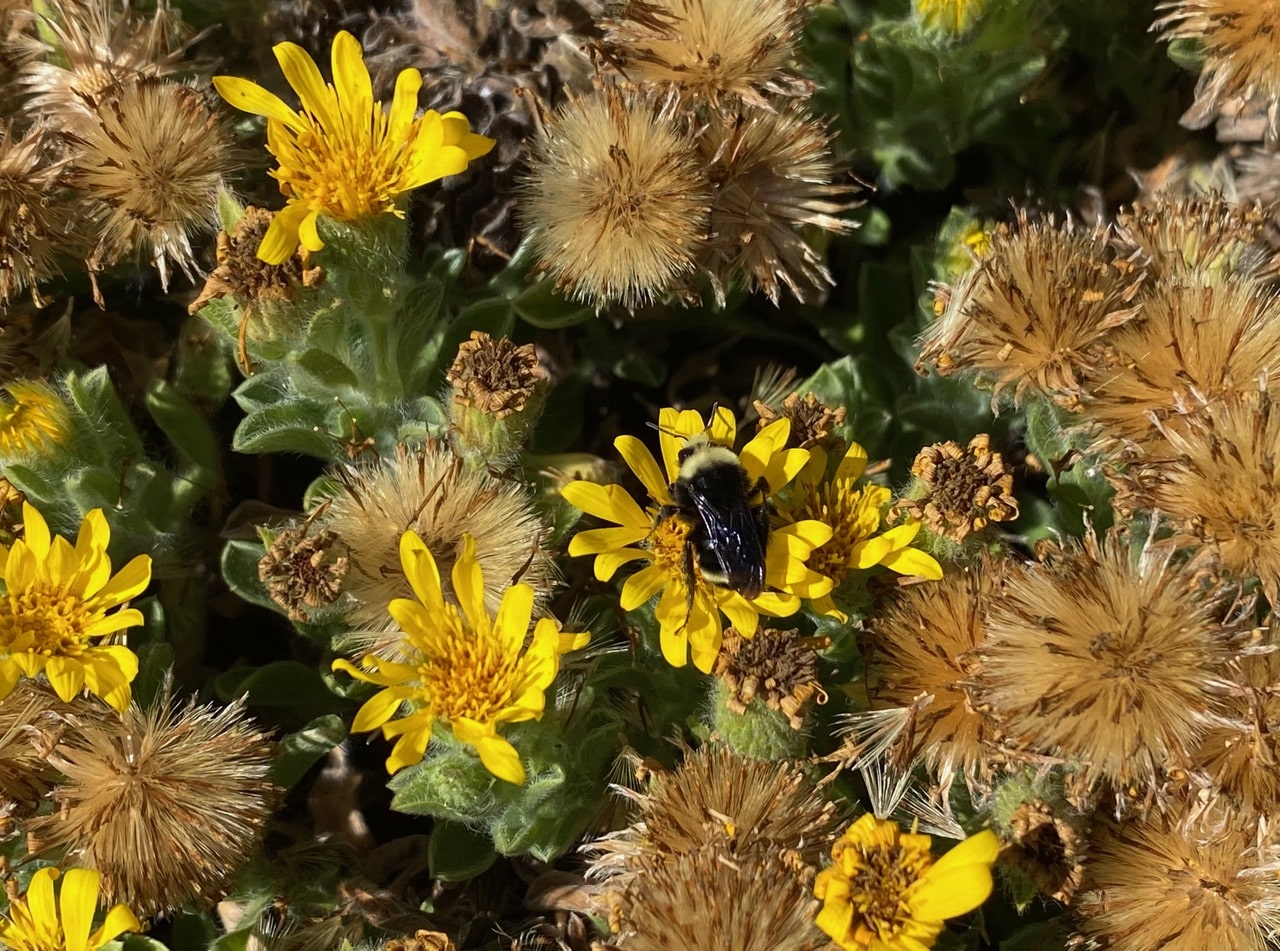
A Yellow-faced Bumble Bee, subgenus Pyrobombus (genus Bombus, family Apidae) is taking nectar from a flowerhead of the San Bruno Mountain Sessileflower Goldenaster. Many of the flowerheads of the plant have turned into dandelion-like seed heads. The mature seed head is characterized by a fluffy, feathery appearance, as the seeds are attached to small, fibrous structures that help with wind dispersal.

A Tripartite Sweat Bee, Halictus tripartitus (family Halictidae) is foraging on a flowerhead of the Goldernaster, her scopae filling up with yellow pollen.
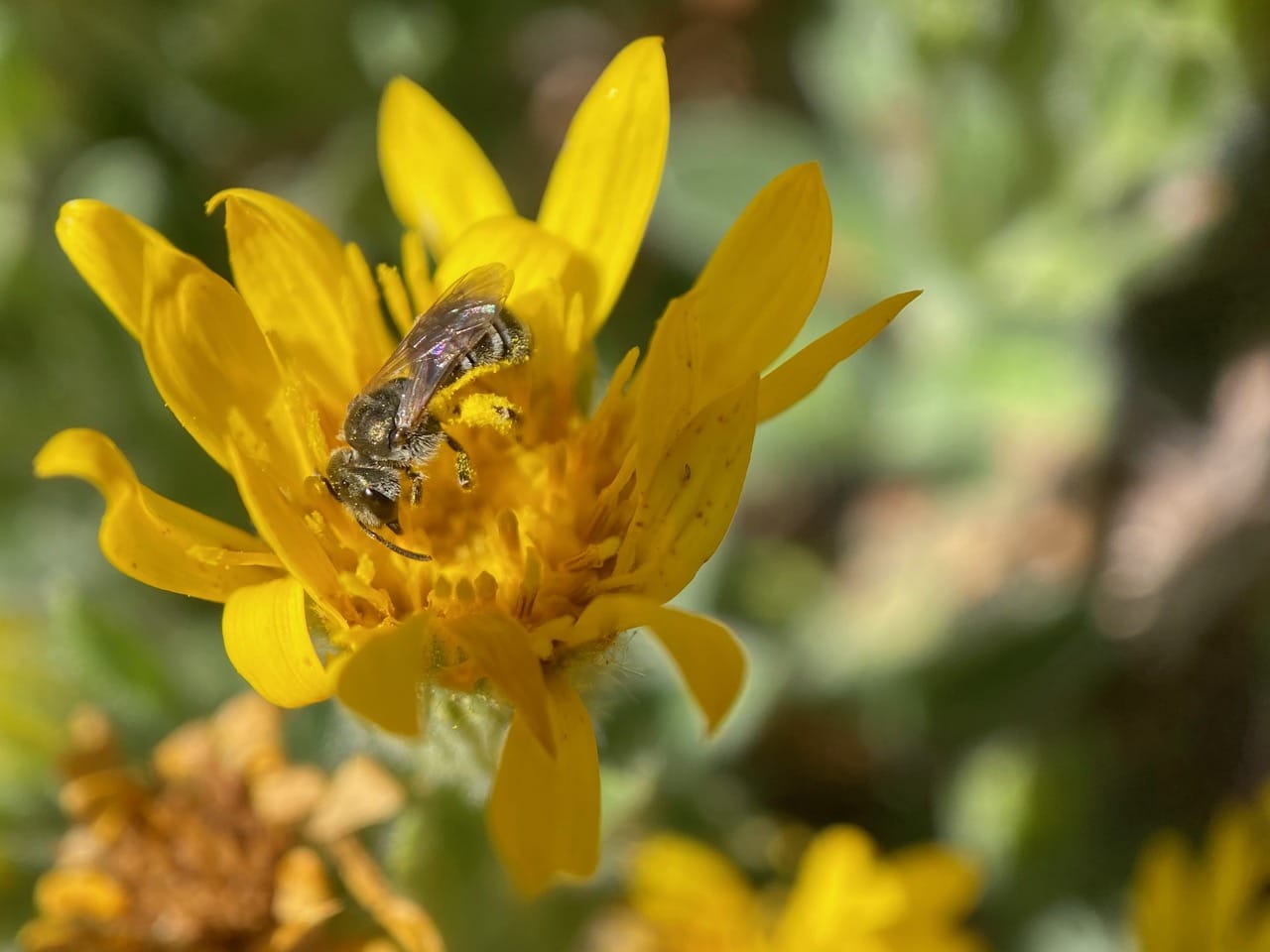
Note where the female sweat bee is carrying the pollen she has gathered – in the scopae of her hind legs, as well as under her abdomen. This is typical of the sweat bees (family Halictidae).
Different groups of bees have distinct ways of collecting and transporting pollen. Here are some of the ways:
– Pollen Baskets (corbiculae): Bees in four tribes of the family Apidae, including honey bees and bumble bees, have corbiculae. These are smooth, concave areas on their hind legs surrounded by a fringe of hairs, where they pack pollen that has been moistened with nectar.
– Scopa: Many bees have scopae, which are dense masses of branched hairs where pollen is loosely held by electrostatic attraction. These can be located in different areas:
– Hind legs: Most solitary female bees have pollen brushes or scopae on their hind legs. Mining bees (family Andrenidae), for example, have scopa covering most of the hind legs and sides of the
female.
– Abdomen: Bees in the Megachilidae family, such as Leafcutter and Mason Bees, carry pollen on scopal hairs on the underside of their abdomen. This is a unique trait that helps in their identification.
– Internal Transport: Some bees, such as the Masked Bees lack external pollen-carrying features. They transport pollen internally in a specialized organ called a crop.
– Incidental Transport: Male bees lack specialized pollen-collecting hairs but can still inadvertently transport pollen. While seeking nectar, pollen may cling to their electrostatically charged body hairs. This can lead to successful pollination as the males go from flower to flower.
– No Pollen Collection: Some bees, known as Cuckoo Bees, do not collect pollen at all. They are parasitic and lay their eggs in the nests of other bees where their young consume the host bee’s pollen stores.