

Pollinator Post 7/4/24

Since most other parks in the East Bay hills are closed due to heat and fire danger, I decide to return for a morning walk at the Reinhardt Redwood Regional Park. This gives me the opportunity to check on the two little Pale Swallowtail caterpillars as well.
What a happy sight – the brown caterpillar is still on its original leaf! It appears that the caterpillar has chewed on the edges of the leaf. This is rather surprising to me, as all the other Pale Swallowtail caterpillars I have observed in the past never fed on their “home” leaves. Their wandered off at night to feed on neighboring leaves, returning to their home leaves to rest during the day. Similar to this caterpillar, the others also rested on the upper surface of the leaf in plain sight, relying on their camouflage for safety. In the early instars, they look like bird poop. In later instars they turn green, blending in imperceptibly.

Close-up of the brown caterpillar. I will call it J4 for July 4th.

Side view of J4. Sadly, the younger, black caterpillar is no longer on its original leaf and I can’t find it anywhere. Maybe it has been taken by a predator?
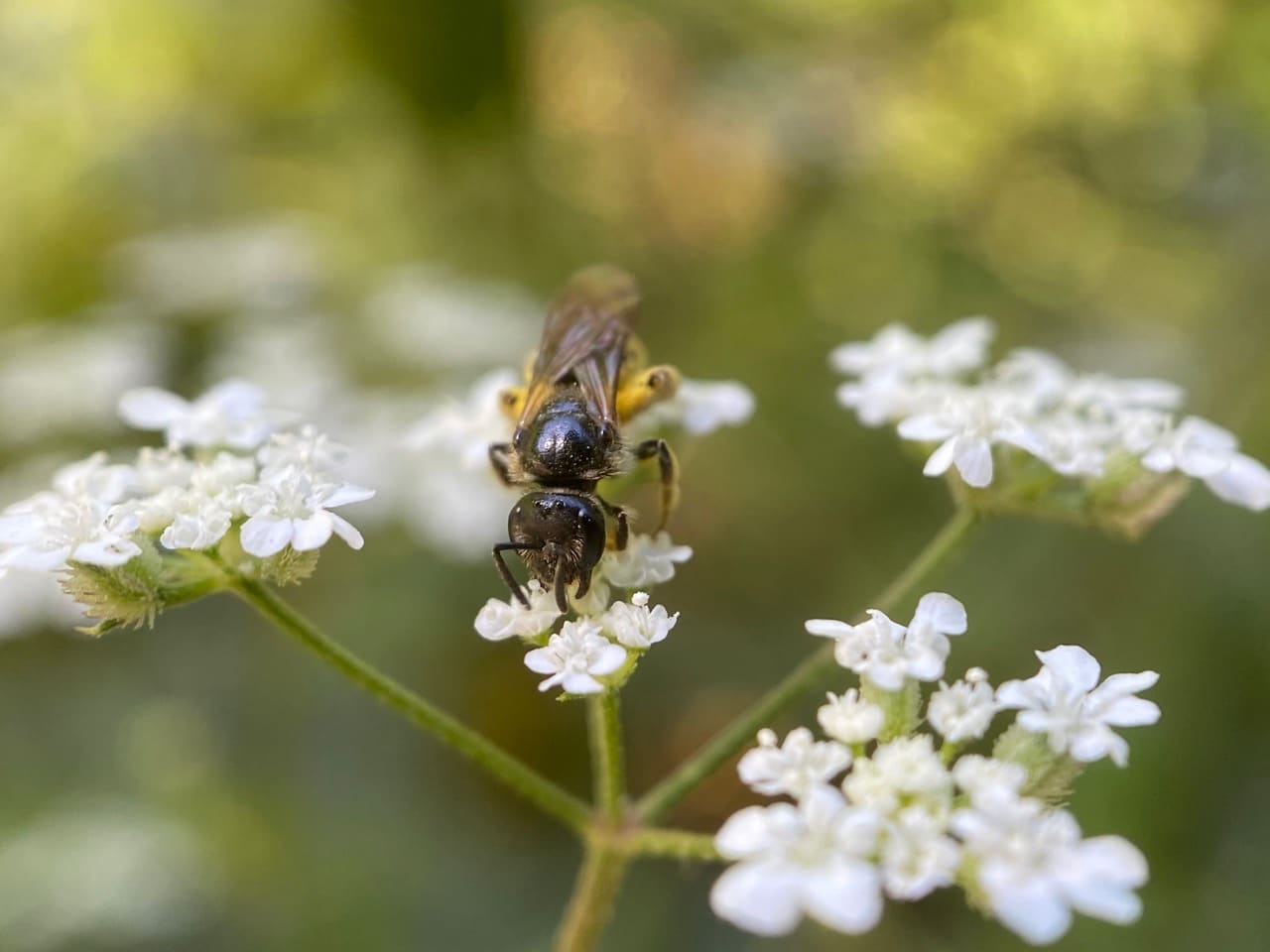
A small bee is foraging on the flowers of Common Hedge Parsley, Torilis arvensis (family Apiaceae).
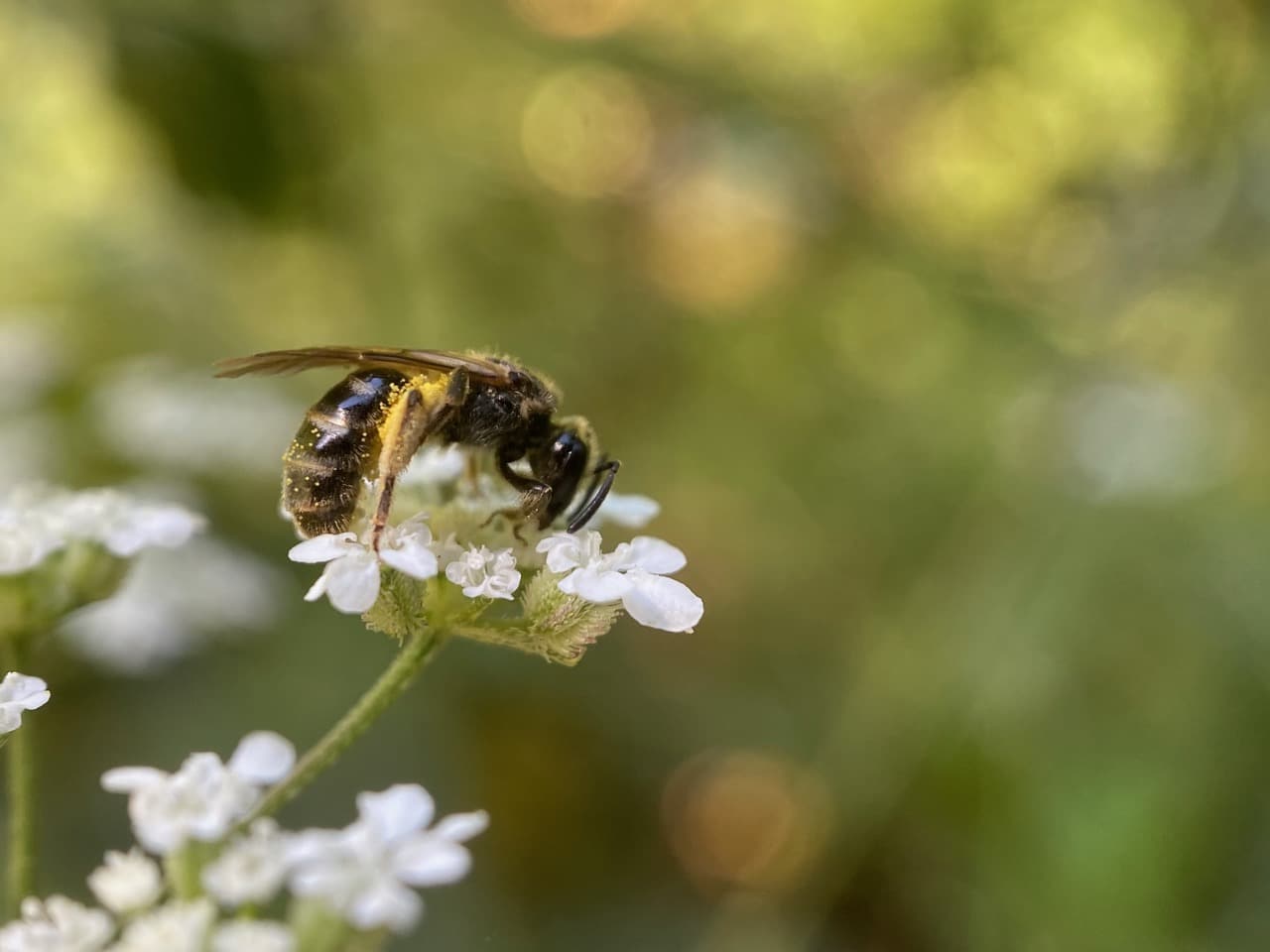
It is a Sweat Bee, Lasioglossum sp. (family Halictidae). The bee has been collecting yellow pollen from other flowers, probably the dandelions growing in the grassy field on the other side of the trail.

Lasioglossum species are found worldwide, and they constitute the largest bee genus. The subgenus Dialictus are the most likely to be seen in the U.S., with over 300 species of these tiny metallic bees. The majority of Lasioglossum are generalists. Because they are so abundant throughout the flowering season, the bees are often important pollinators. Their sheer numbers are enough to achieve excellent pollination of many wild flowers, especially of plants in the Asteraceae, which have shallow floral tubes that are easily accessed by these minute bees.
Lasioglossum exhibit a range of social behaviors; the genus includes solitary, communal, semi social, primitively eusocial, and even parasitic species. Almost all Lasioglossum in the U.S. nest in the ground. Generally these nests are built in the spring by fertilized females (called foundresses) that spent the winter in hibernation. In social species, the foundresses behave much like the queen Bumble Bees – they lay the first batch of eggs that develop into the first generation of female workers. The nest grows with each additional generation of bees. Later broods may consist of both males and females. They mate, and at the end of the season the fertilized females hibernate til the following spring, repeating the life cycle of the colony.

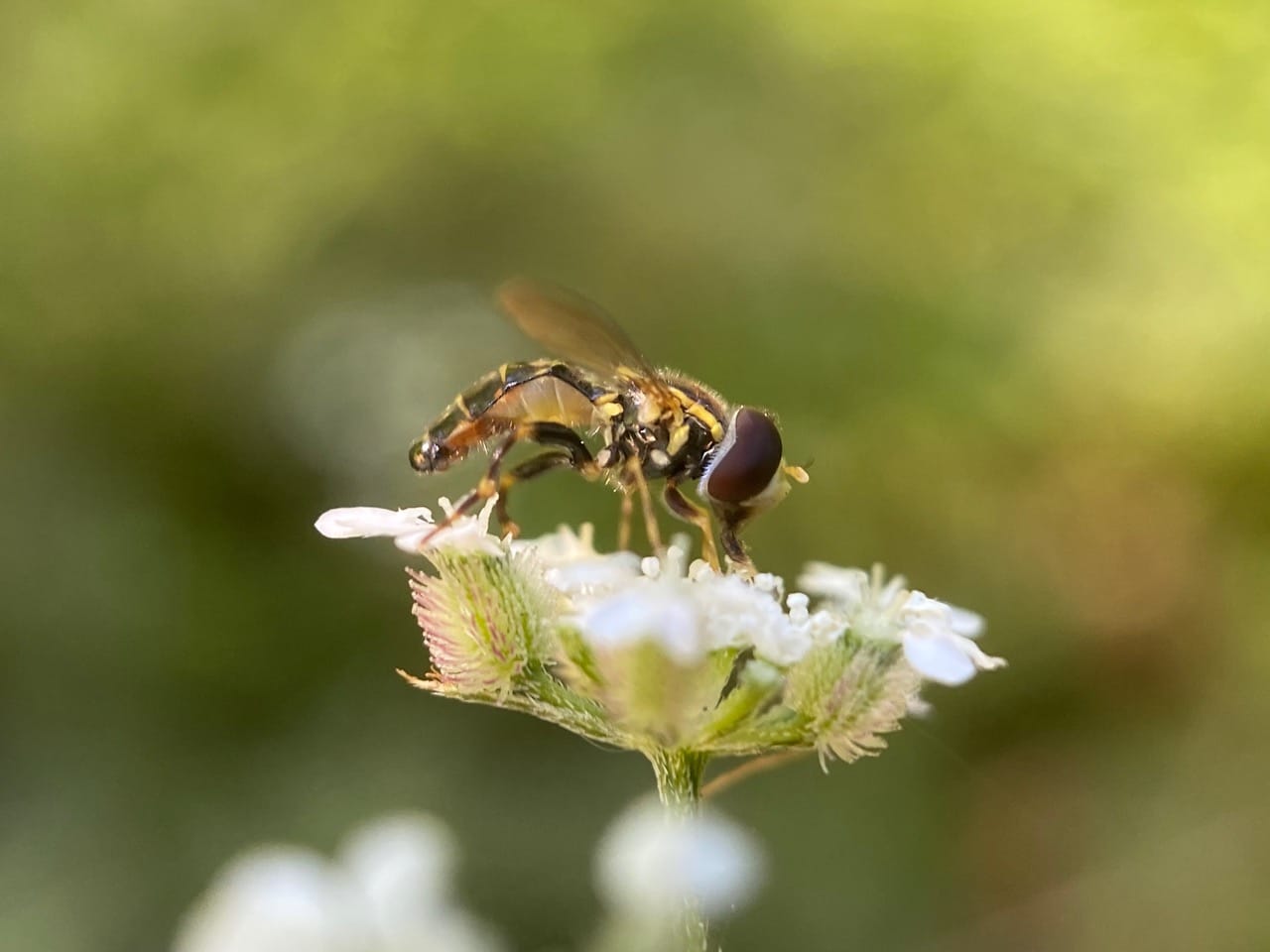
A tiny hover fly has landed on an umbel of Torilis flowers. It is male, as evidenced by its holoptic eyes that meet on top of the head.
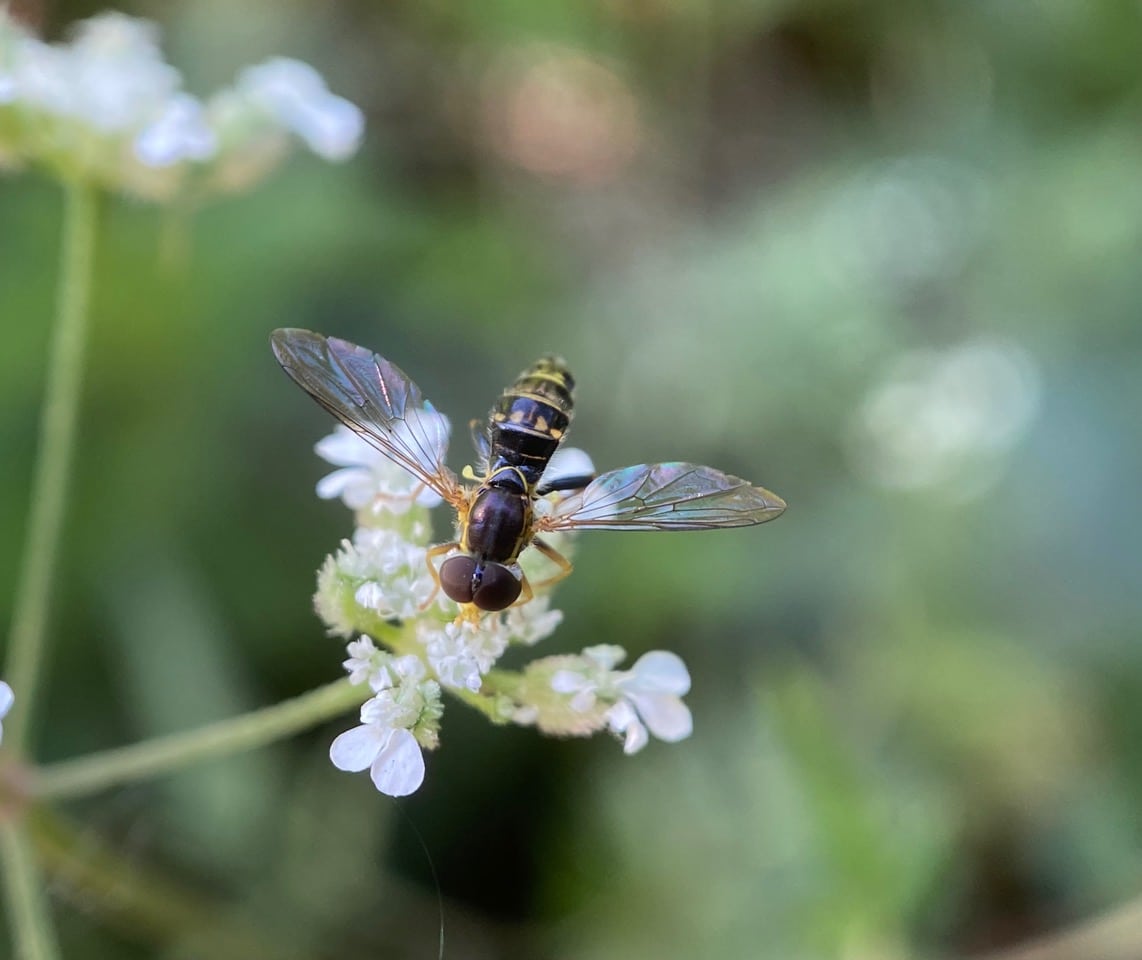

The pattern on the hover fly’s abdomen identifies it as the Western Calligrapher, Toxomerus occidentalis (family Syrphidae).
Toxomerus is a very large genus of Hover Flies. They are found in North and South America. The majority of species are only 6-9 mm in length. They are notable for their mimicry of stinging Hymenoptera to avoid predators. Their unique abdominal patterns are diagnostic at the species level within the genus. Most larvae feed on soft bodied insects, such as aphids; a few feed on pollen. Adults feed on the pollen of a wide range of flowers. A female can lay up to hundreds of eggs at a time and will place them where prey or pollen food sources are readily available. They can be found in a wide variety of habitats, often in dense ground cover.
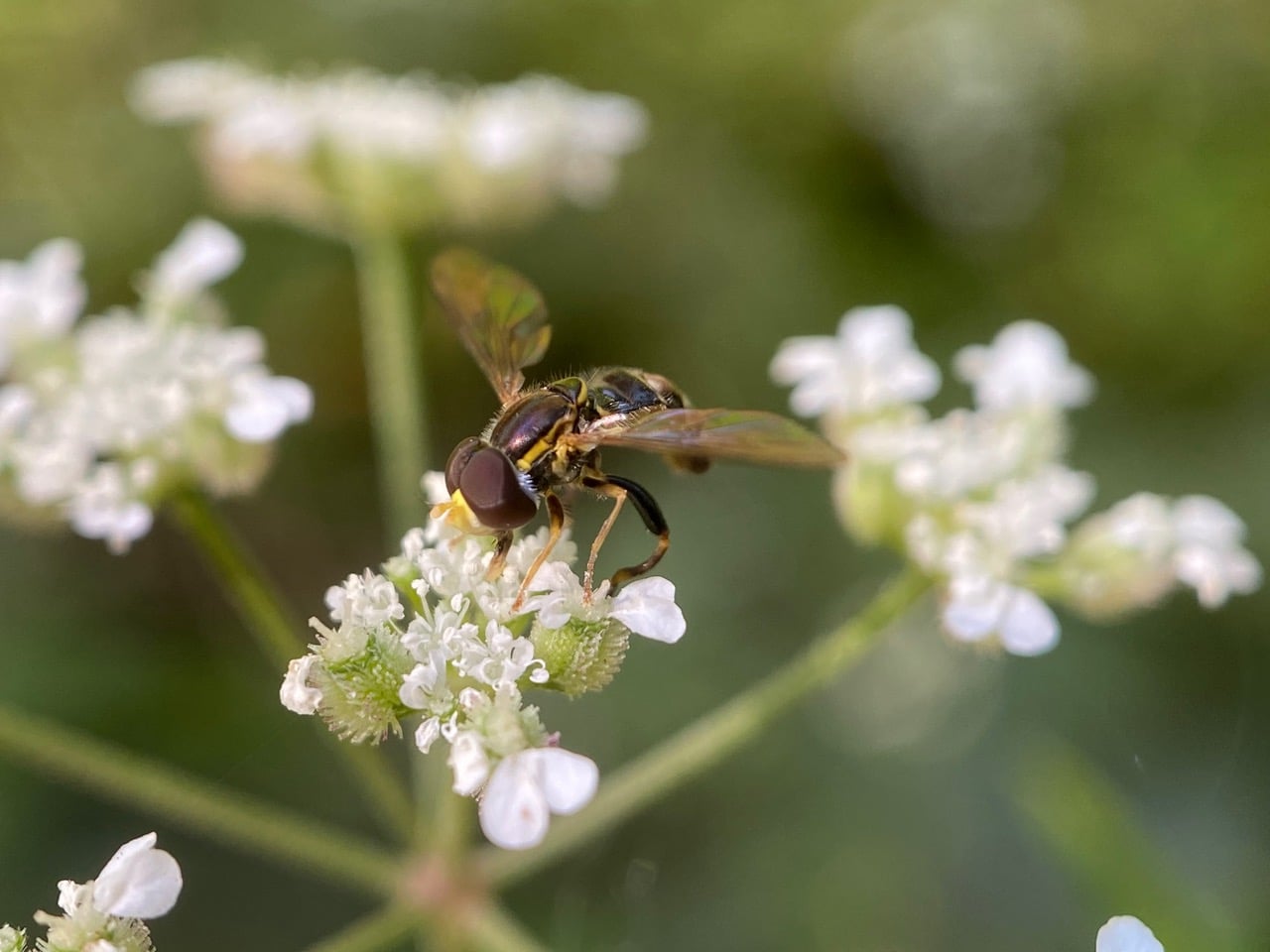
The name for this hover fly genus comes from Greek toxon ‘bow’ + meron ’thigh’ (referring to the bow-shaped hind femur).

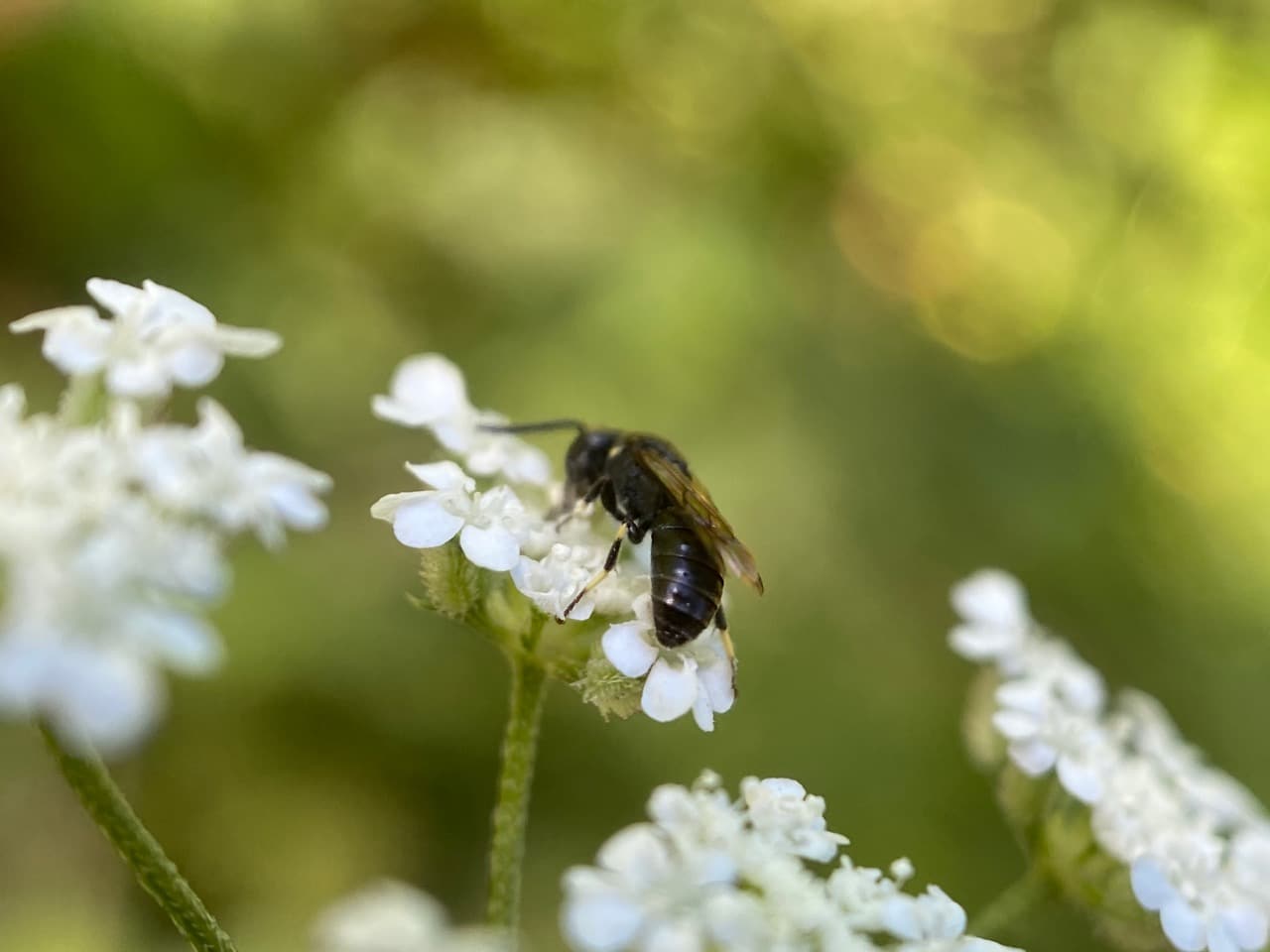
A tiny bee lands on an umbel of Torilis flowers. From its long antennae, I gather that it is a male. From its size and the yellow markings on its legs, I gather that it is probably a Masked Bee, Hylaeus sp. (family Colletidae).
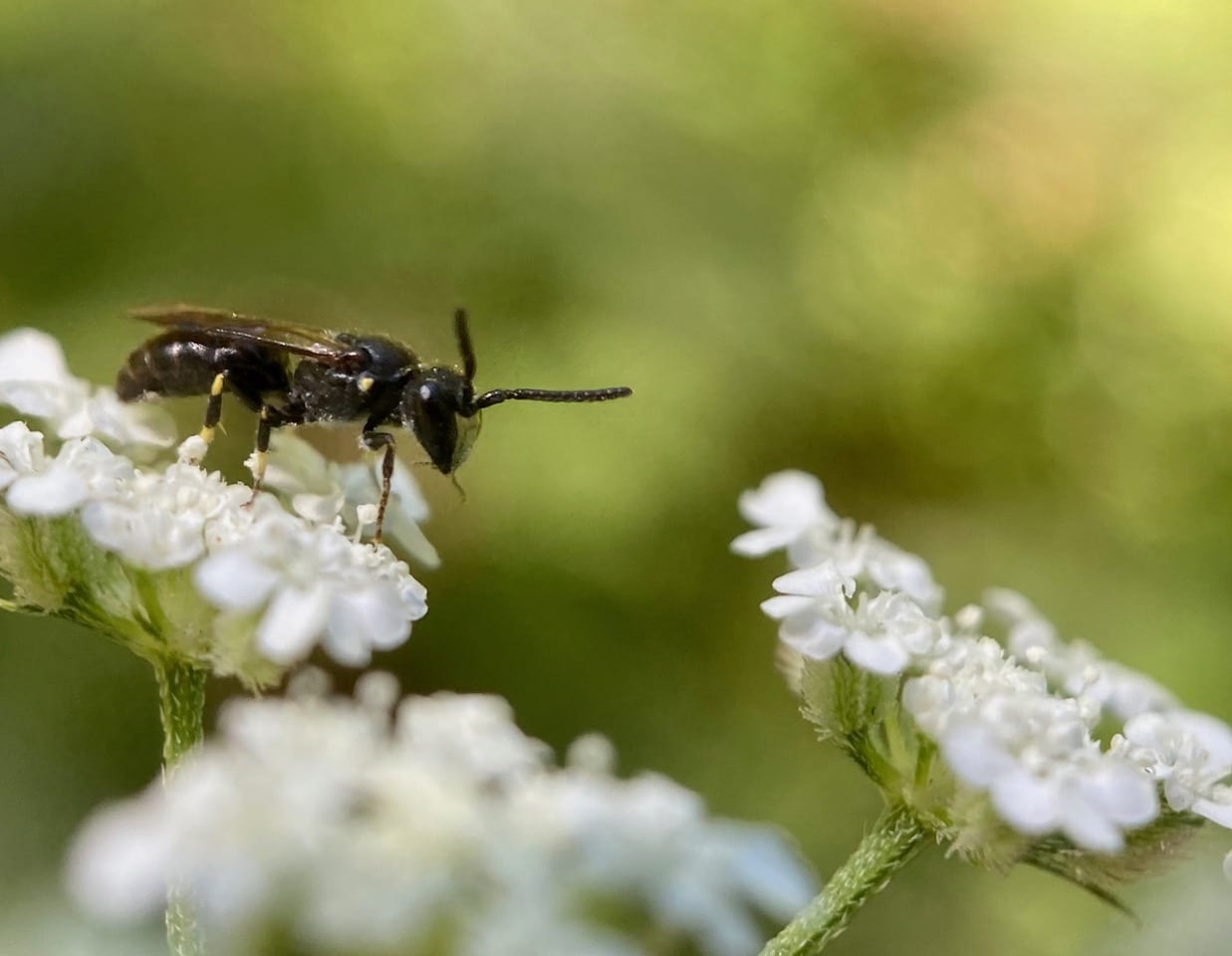
Ah, I am finally getting to see its face….

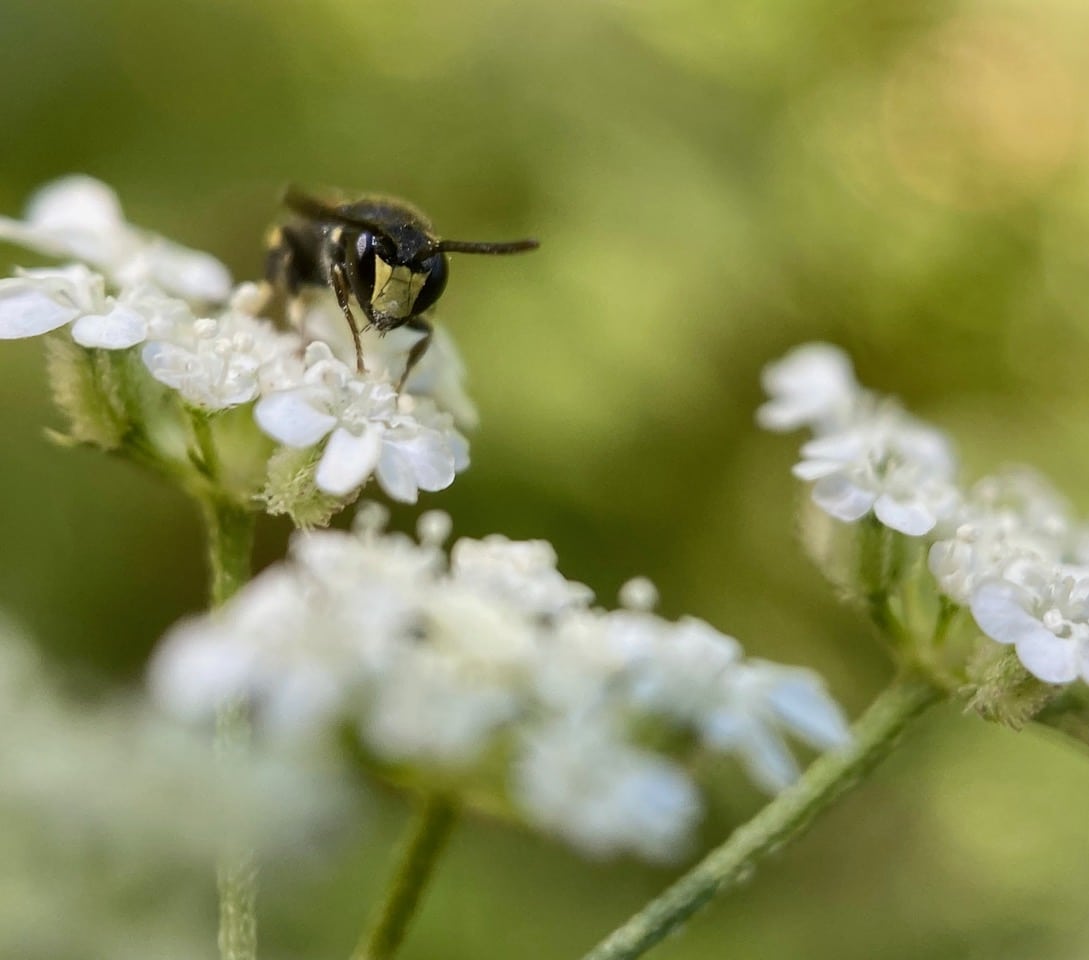
This view of the bee’s face confirms that it is indeed a male Masked Bee, Hylaeus sp. Males have a prominent yellow marking on the face, while those of the females are more subtle.
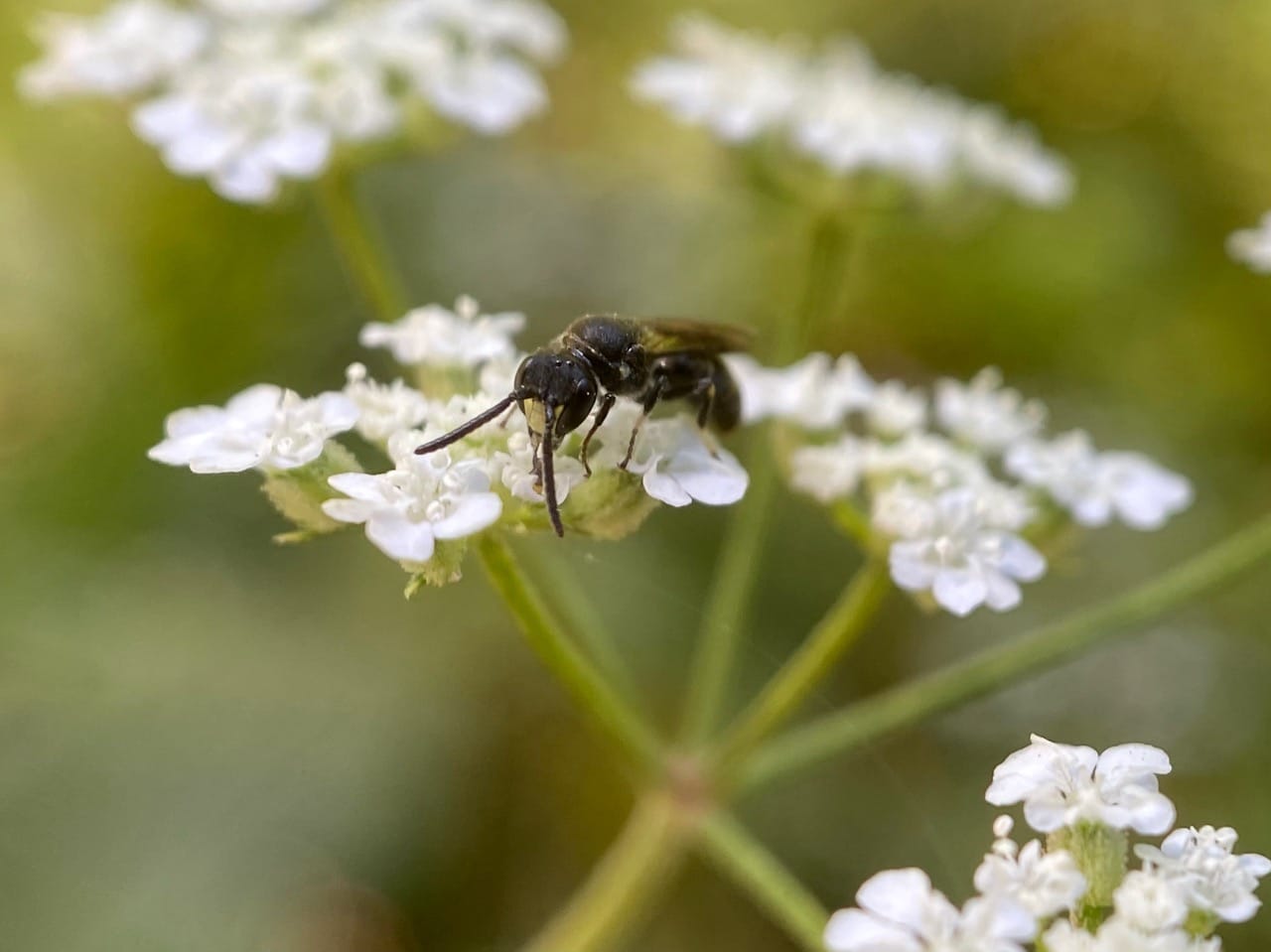
Hylaeus (family Colletidae) are shiny, slender, hairless, and superficially wasp-like bees. They are small, 5 to 7 mm long, usually black with bright yellow or white markings on their face and legs. These markings are more pronounced on the males. Hylaeus do not carry pollen and nectar externally, they instead store their food in the crop and regurgitate it upon returning to their nests. They are primarily generalist foragers. Hylaeus are short-tongued, but their small body size enables them to access deep flowers. Hylaeus nest in stems and twigs, lining their brood cells with self-secreted cellophane-like material. They lack strong mandibles and other adaptations for digging, using instead pre-existing cavities made by other insects.
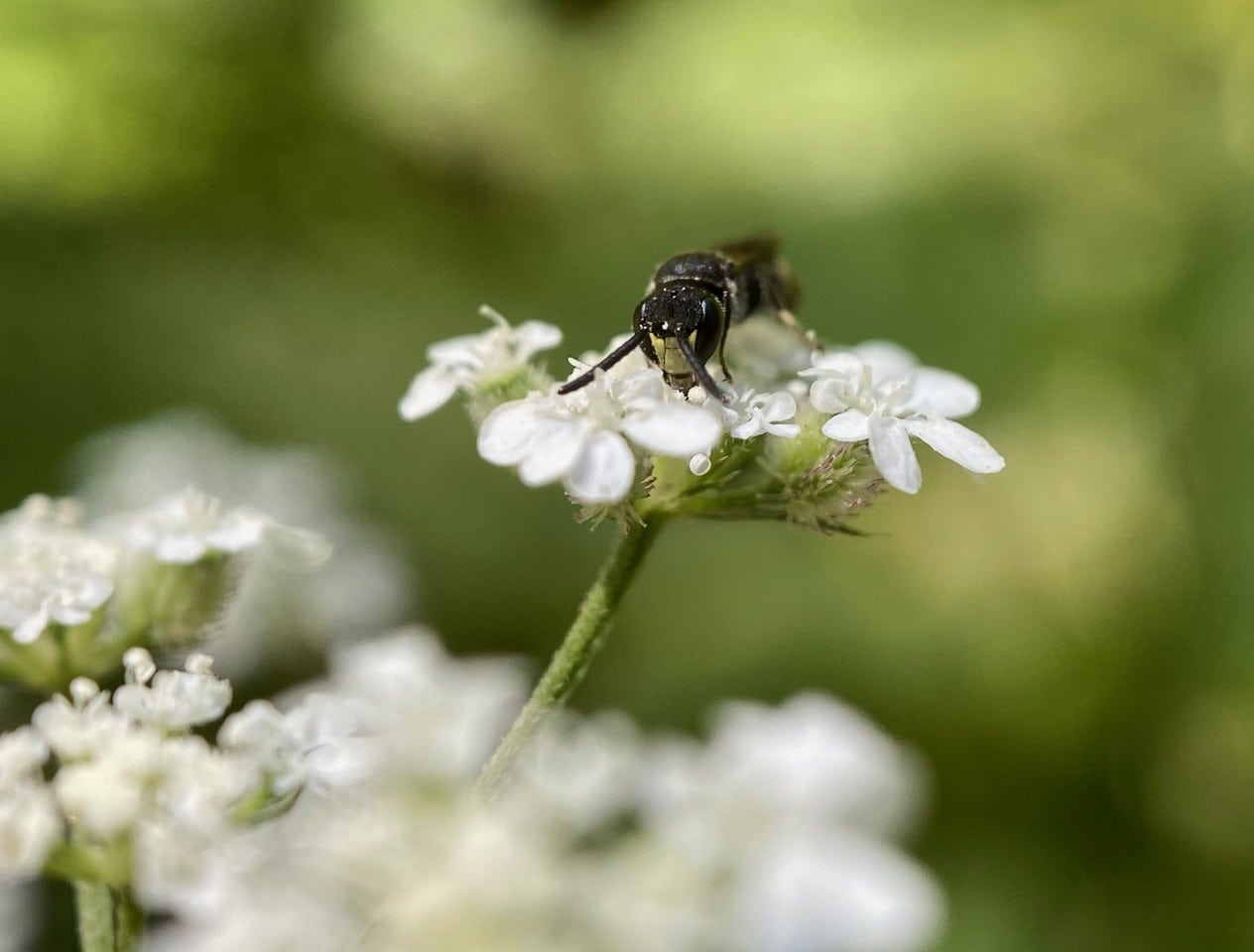

The male Masked Bee, Hylaeus sp. (family Colletidae) cleans his mouthparts before flying off.
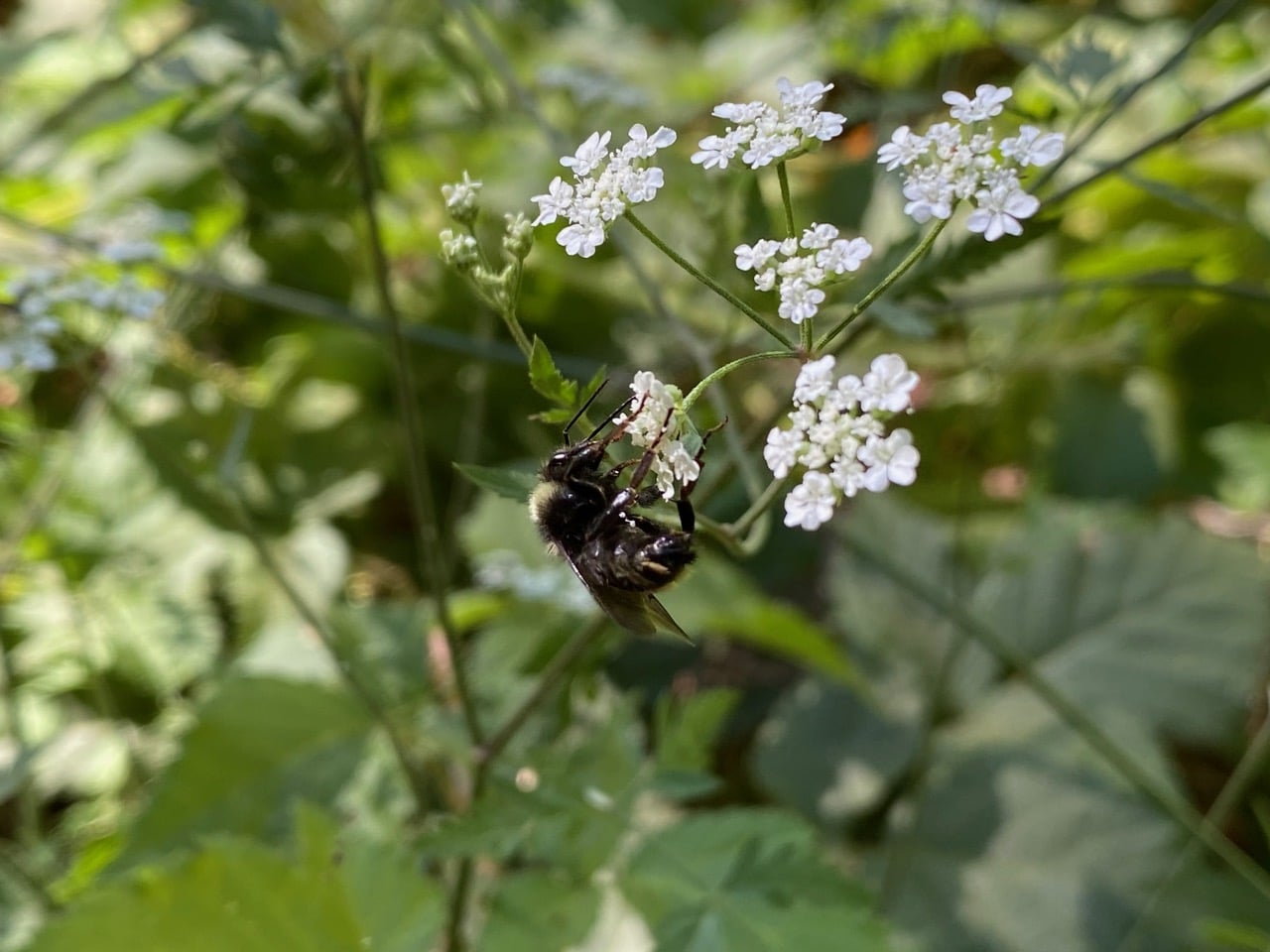
Its long tongue extended, a small bumble bee is taking nectar from an umbel of Torilis flowers.
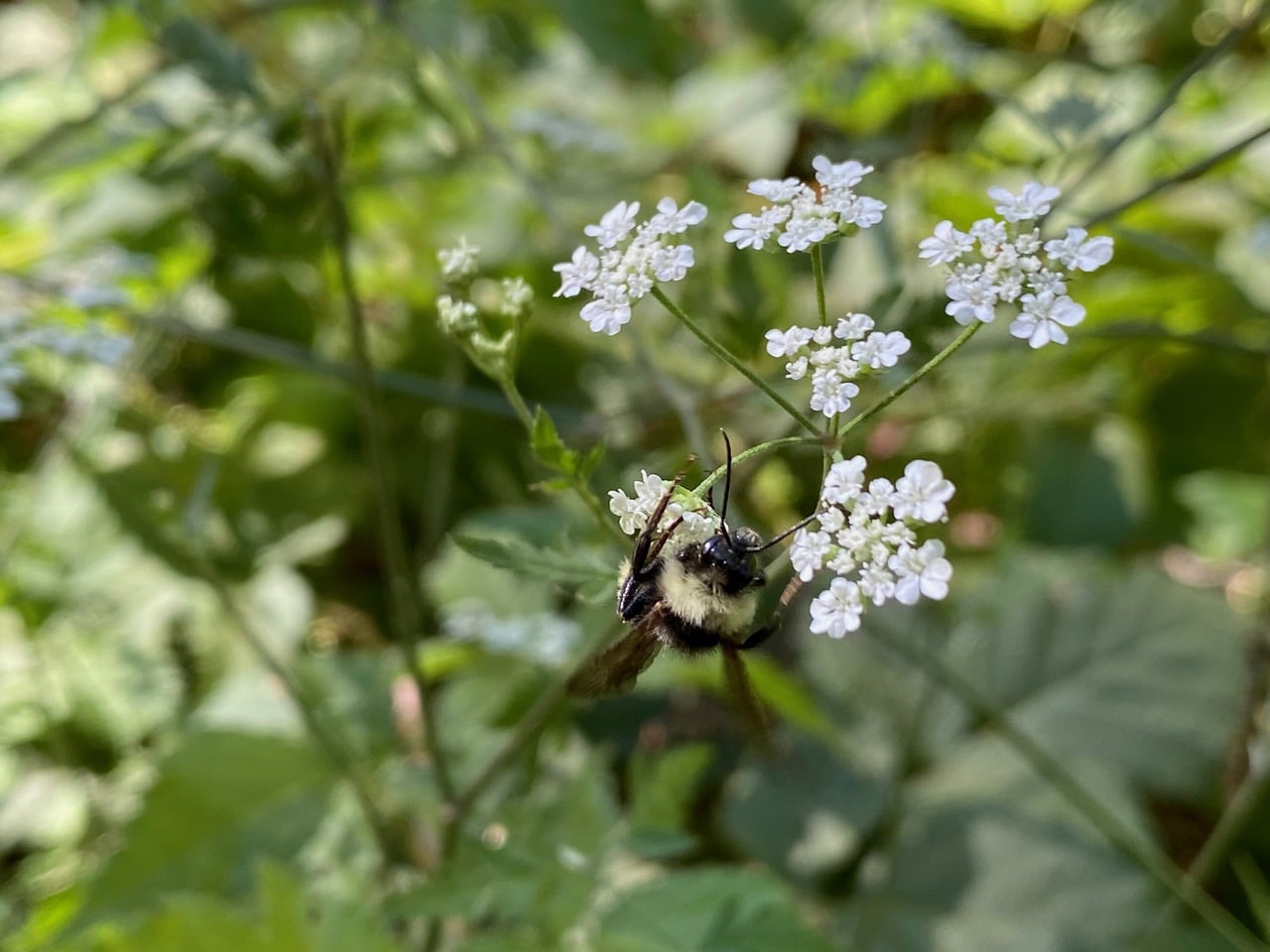
The bee has a black head. Is this a worker California Bumble Bee, Bombus californicus (family Apidae)? If so, it is the smallest individual of the species I have seen – are all the other ones I have encountered so far reproductives (drones and queens)? Those seem much bigger!

A tiny fly is foraging on the Torilis flowers. iNaturalist has identified it as Siphona sp. (family Tachinidae).
The family Tachinidae is by far the largest and most important group of parasitoid flies. All species are parasitic in the larval stage. Most adults have distinct abdominal bristles, hence the common name. Adults feed on liquids such as nectar and honeydew. They can be found resting on foliage, feeding at flowers or searching for hosts.
Most tachinids attack caterpillars, adult and larval beetles, true bugs, grasshoppers, and other insects. Females lay eggs in or on the host. Tachinid larvae live as internal parasites, consuming their hosts’ less essential tissues first and not finishing off the vital organs until they are ready to pupate. The larvae leave the host and pupate on the ground. Tachinids are very important in natural control of many pests, and many have been used in biological control programs.
Siphona is the only commonly encountered genus of Tachinidae with a long, thin, jointed proboscis. Most other genera have a straight or curved rigid proboscis. The fly is found worldwide. Where hosts are known, larvae are parasitoids of Lepidoptera (moths and butterflies).
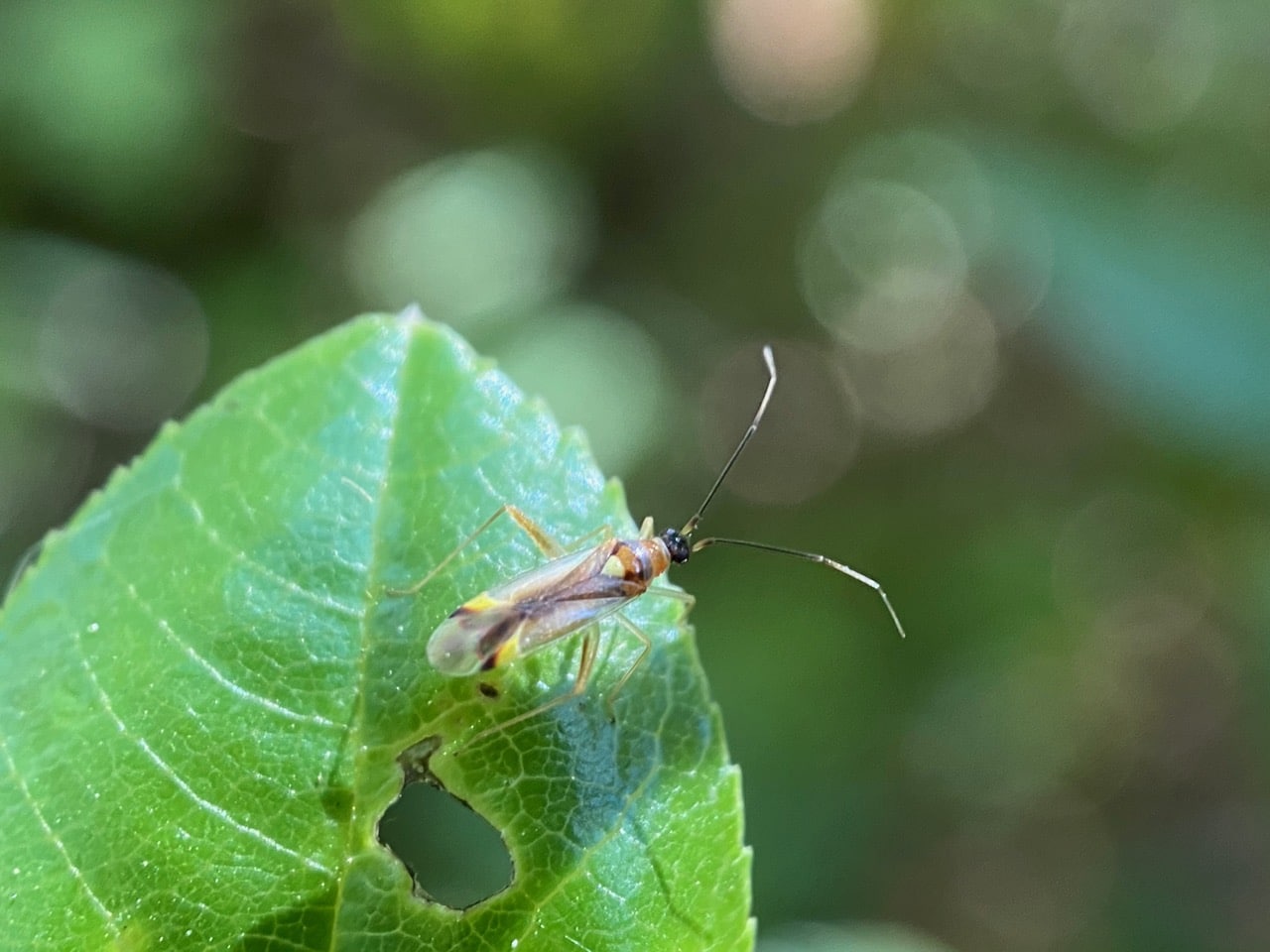
A small Plant Bug, Campyloneura virgula (family Miridae) is perched on a leaf of Coffeeberry, Frangula californica.
Campyloneura virgula is a species of bugs in Miridae family. It is the only species in the genus Campyloneura. Adults are about 4-5 mm long, with pale translucent hemelytra, a black head, a yellow scutellum, and bright yellow cuneus that are tipped with dark red. Legs are pale yellow. This common predatory bug hunts for small arthropods such as aphids and red mites. Adults’ flight time is from June to October during which they are found on numerous deciduous trees, including hazel, alder and oak. The adults overwinter and nymphs appear in May. In almost all of its range males are extremely rare, as C. virgula reproduces without mating (parthenogenesis). The species is widespread in Europe, and has been introduced in the U.S.

Another Plant Bug, Campyloneura virgula appears to be feeding on a tiny prey on a Coffeeberry leaf.