

Pollinator Post 7/31/25 (2)

My walks along the shoreline of Bay Farm Island have become infinitely more interesting ever since the Oregon Gumweed, Grindelia stricta has come into bloom. Grindelia’s flowers have triggered an explosion of insect activity around here.
Oregon Gumweed, also known as Coastal Gumweed, Grindelia stricta (family Asteraceae) is a perennial herb native to the west coast of North America from California to Alaska, where it is a resident of coastal plant communities such as those in marshes and beaches. The plant is variable in appearance, taking the form of low clumps to a sprawling subshrub up to one meter in height. The fleshy leaves are green, often with red edges and veining. The flower cluster holds one or more flowerheads each up to 5 cm wide. The flowerhead is a cup of thick erect or recurved green phyllries. Yellow disc florets fill the center of the flowerhead and there is a fringe of yellow ray florets around the circumference. The head produces copious white exudate, especially in the early stages of blooming. This sticky exudate was used by native Americans as an adhesive.
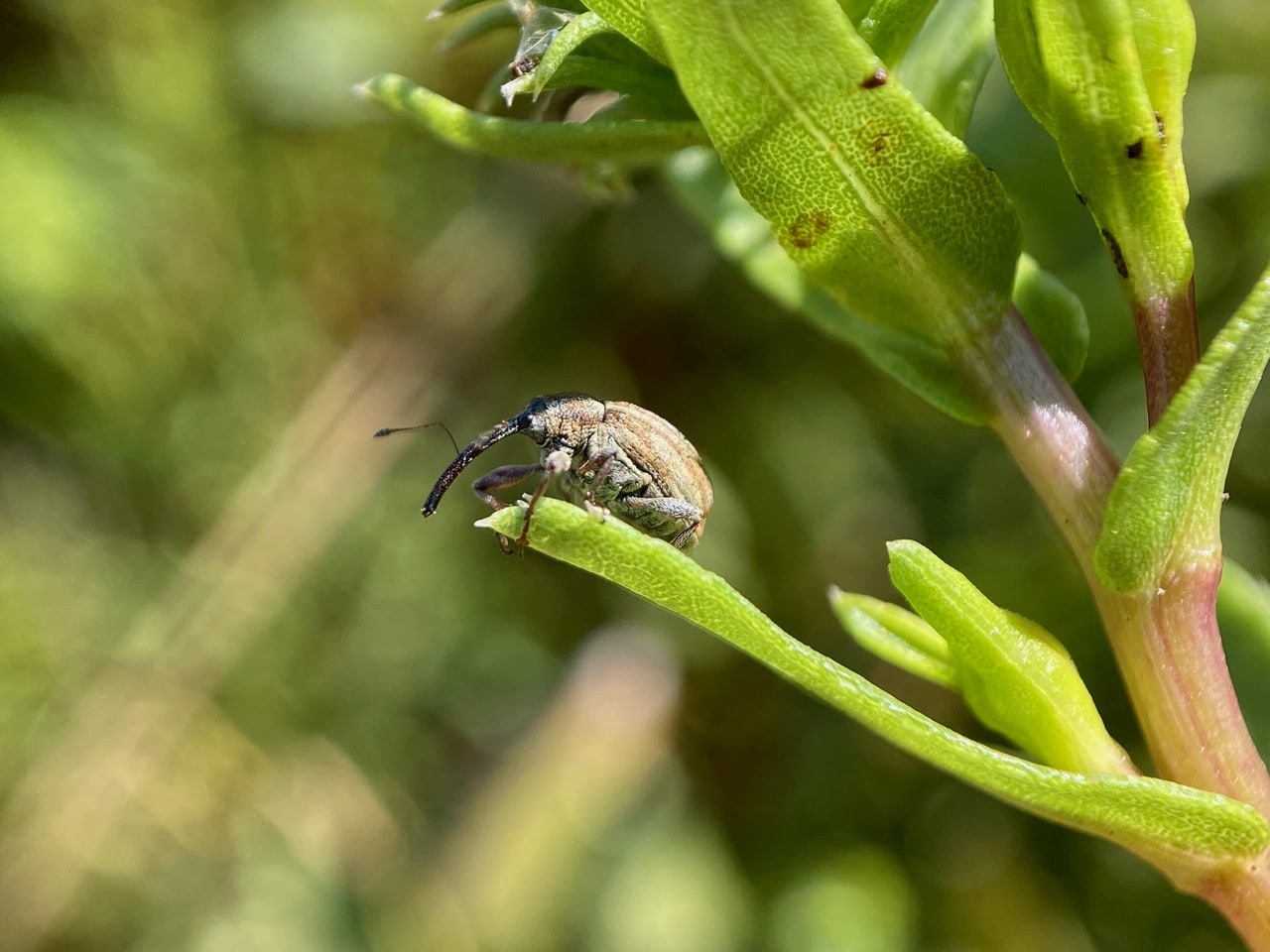
A Weevil (family Curculionidae) is perched on the tip of a Grindelia leaf. I often see this weevil on Grindelia and nowhere else, and wonder if it isn’t a Grindelia specialist.
Weevils, family Curculionidae, are also called snout beetles. Curculionidae is one of the largest beetle families (about 40,000 species). Most weevils have long, distinctly elbowed antennae that may fold into special grooves on the snout. The snout is used not only for penetration and feeding but also for boring holes in which to lay eggs. The mouthparts are quite small and located at the end of the rostrum (snout), designed for chewing. Many weevils have no wings, while others are excellent fliers. Most are less than 6 mm in length. The majority of weevils feed exclusively on plants. The fleshy, legless larvae of most species feed only on a certain part of a plant – i.e., the flower head, seeds, fleshy fruits, stems, or roots. Many larvae feed either on a single plant species or on closely related ones. Adult weevils tend to be less specialized in their feeding habits. The family includes some very destructive agricultural pests.

A tiny, shiny spider is hunting on a Grindelia leaf. It is the Buttonhook Leafbeetle Jumping Spider, Sassacus vitis (family Salticidae).
It is often difficult to tell whether a particular spider is an adult or an immature, judging by size alone. In the jumping spiders in the genus Sassacus, the adults are only about 3-5 mm. The genus name Sassacus was the last chief of the Pequot Indians, a Native American tribe of the Connecticut Valley that was vanquished in a war with English settlers in 1637. The iridescent color and very compact appearance of these spiders leads scientists to suspect that they are mimics of certain leaf beetles in the family Chrysomelidae. Many Chrysomelids don’t taste good, as they feed on poisonous plants and sequester those plant toxins for their own defense. They advertise their distastefulness to predators with bold black and white, yellow, orange, or red color patterns, or with brilliant metallic colors. One of the defining characteristics of the genus is the very short legs. The fourth pair of legs is still the thickest, with one or two pairs of spines, used in tackling prey. Like most jumping spiders, Sassacus engages in visual courtship displays. The twitching abdomen also produces an auditory stimulus as the male waves his front legs to garner the female’s attention.
Sassacus vitis is native to North America, with a range spanning from Canada to Panama. It is a small jumping spider with iridescent gold abdomen and white ring around the anterior surface of abdomen. Body is covered with golden scales. Males are 3.5 mm long, females 4.5 mm. The name vitis is Latin for “grapevine”. The spider is commonly found on shrubs and vines and in fields. Best known as a common resident of vineyards.

A female Western Leafcutter Bee, Megachile perihirta (family Megachilidae) has landed on a Grindelia flowerhead.
The family Megachilidae includes some of our charismatic bees such as the Leafcutter Bees (Megachile), the Mason Bees (Osmia), and the Woolcarder Bees (Anthidium). Their common names reflect the materials with which the bees build their nest cells (leaves, soil, plant fibers respectively). The scientific name Megachilidae translates as “large lipped” in Greek, referring to their large lips and strong jaws that are well-suited for collecting of nest-building materials. The family represents 15-20% of named species of bees. Most build their nests in above-ground cavities; they all are solitary bees. Characteristic traits of this family are their typically elongated labrum, and the way the females carry pollen – in a scopa (special pollen-collecting hairs) on the underside of the abdomen. (The labrum, often called the “upper lip”, is a flap-like structure that helps hold food in place during feeding. It is located at the front of the insect’s head, above the mouth opening.)

When a female Western Leafcutter, Megachile perihirta visits a flower, she holds her abdomen high in the air, probably to keep the pollen load from rubbing off. Her scopal hairs have a distinctly reddish cast, but when she’s foraging, the scopa bears the color of the current pollen load.

Megachilids are unusual among bees in the way the females carry pollen. While most bees have scopae (Latin for “broom”, dense, textured hairs that pollen collects on) on their legs, Megachilids have scopae on the underside of their abdomen. The pollen is held loosely by electrostatic attraction to the hairs. When the Leafcutter Bee scrambles over the flowers it lands on, the pollen on its abdominal scopa dusts each flower the bee visits. This is probably why the Megachilids are considered pollinators extraordinaire. They are important pollinators for commercial crops from alfalfa, blueberries to sunflowers.
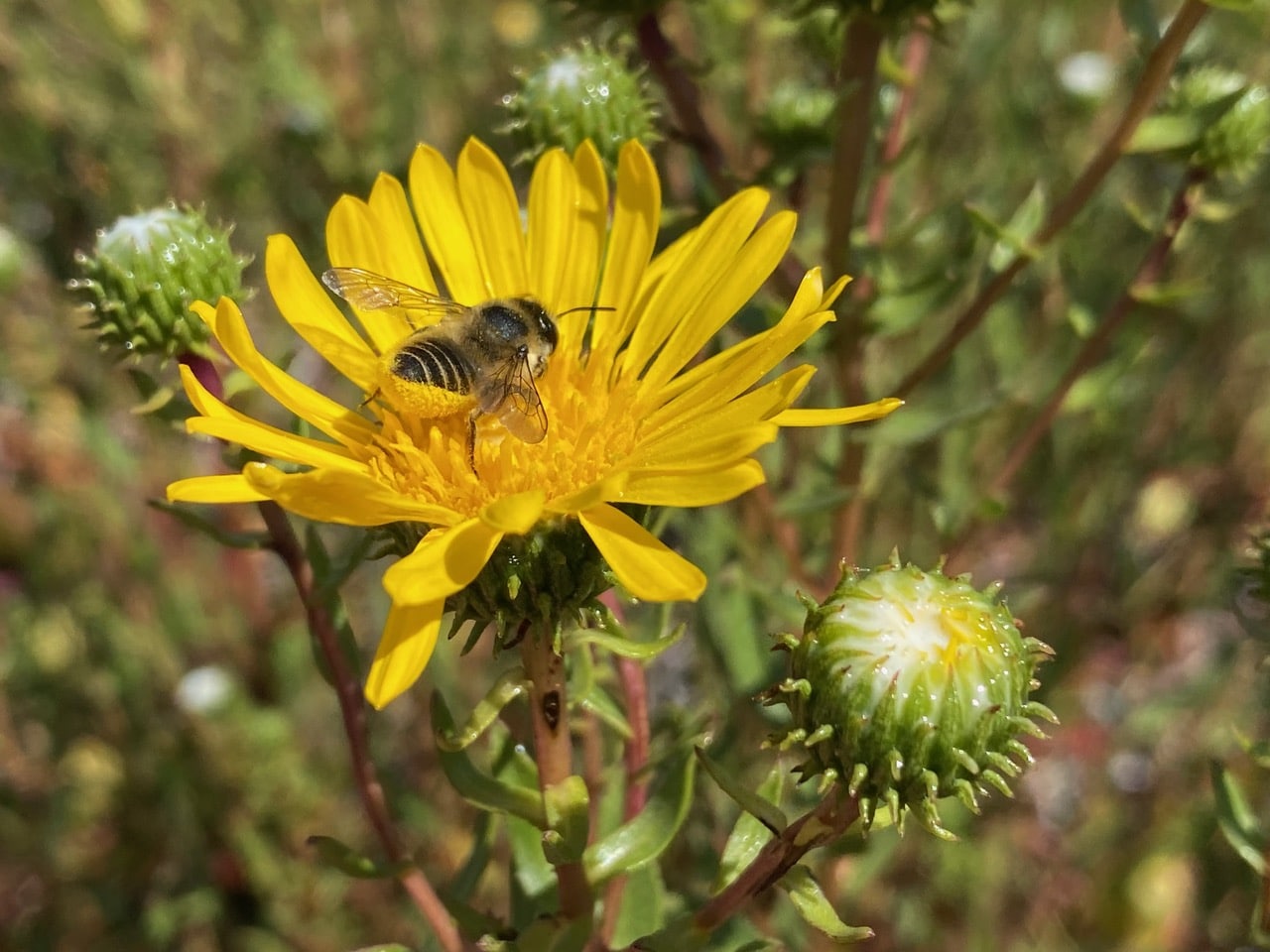
The Leafcutter Bees are best known, of course, for their leaf-cutting behavior.
Solitary females construct nests in tubular cavities, including hollow stems, tree holes, and abandoned beetle burrows in wood. Many use holes drilled into wood, straws, or other manufactured tunnels. Females cut pieces from leaves or flower petals for use in the construction of brood cells.
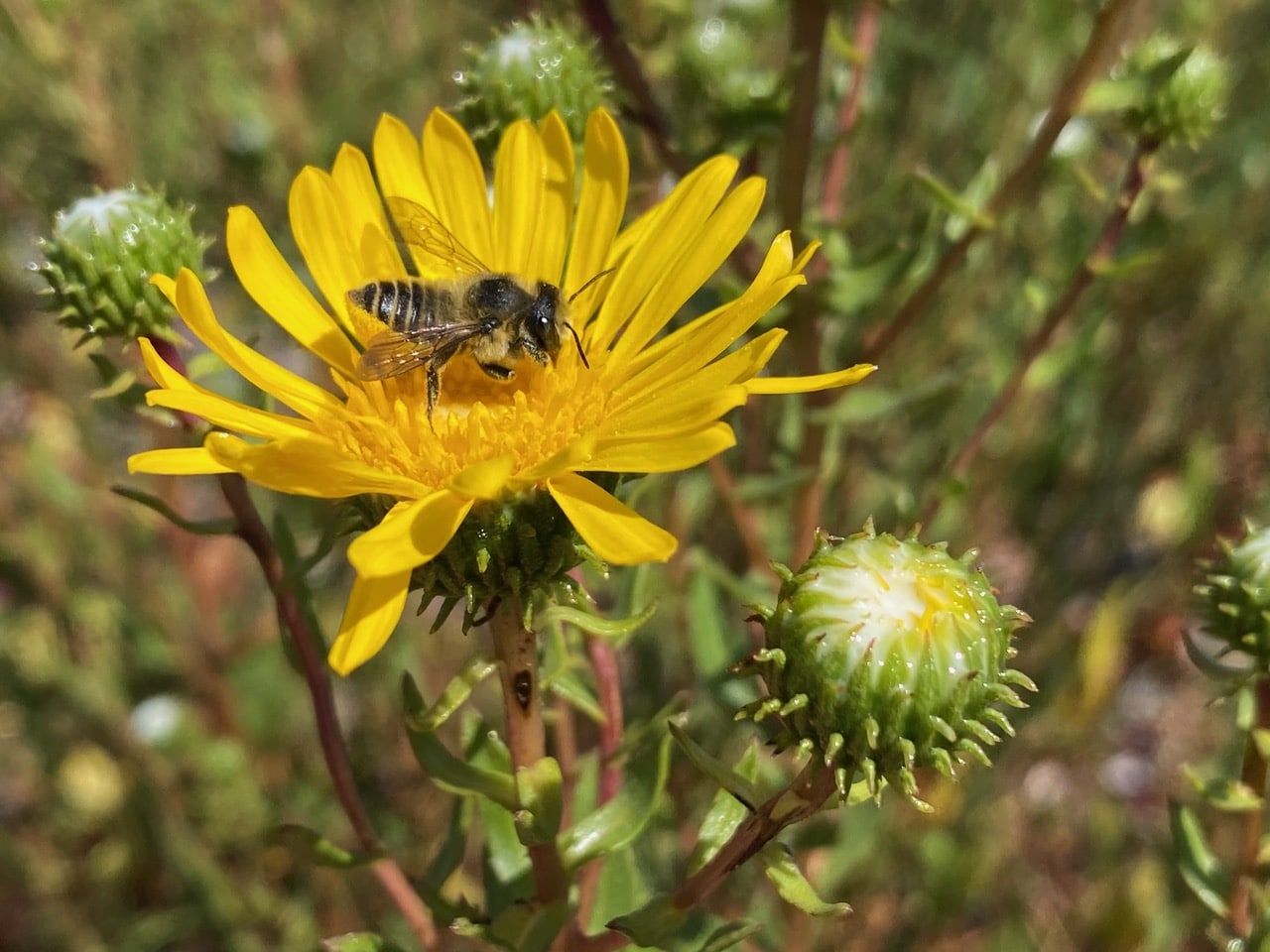
North America is home to many leafcutter bees, but the Western Leafcutter, Megachile perihirta is one of the largest. The species ranges on the west coast from British Columbia south to northern Mexico. From a distance, the female can be mistaken for a honey bee. She is about the same size as a worker honey bee and enjoys many of the same flowers, but her head is disproportionately large because it houses the bulky muscles that operate her large mandibles. While most leafcutter bees nest above ground in tubes and tunnels, the Western Leafcutter nests underground. Often a small group of females live in a community and burrow into soil, gravel, or sand.

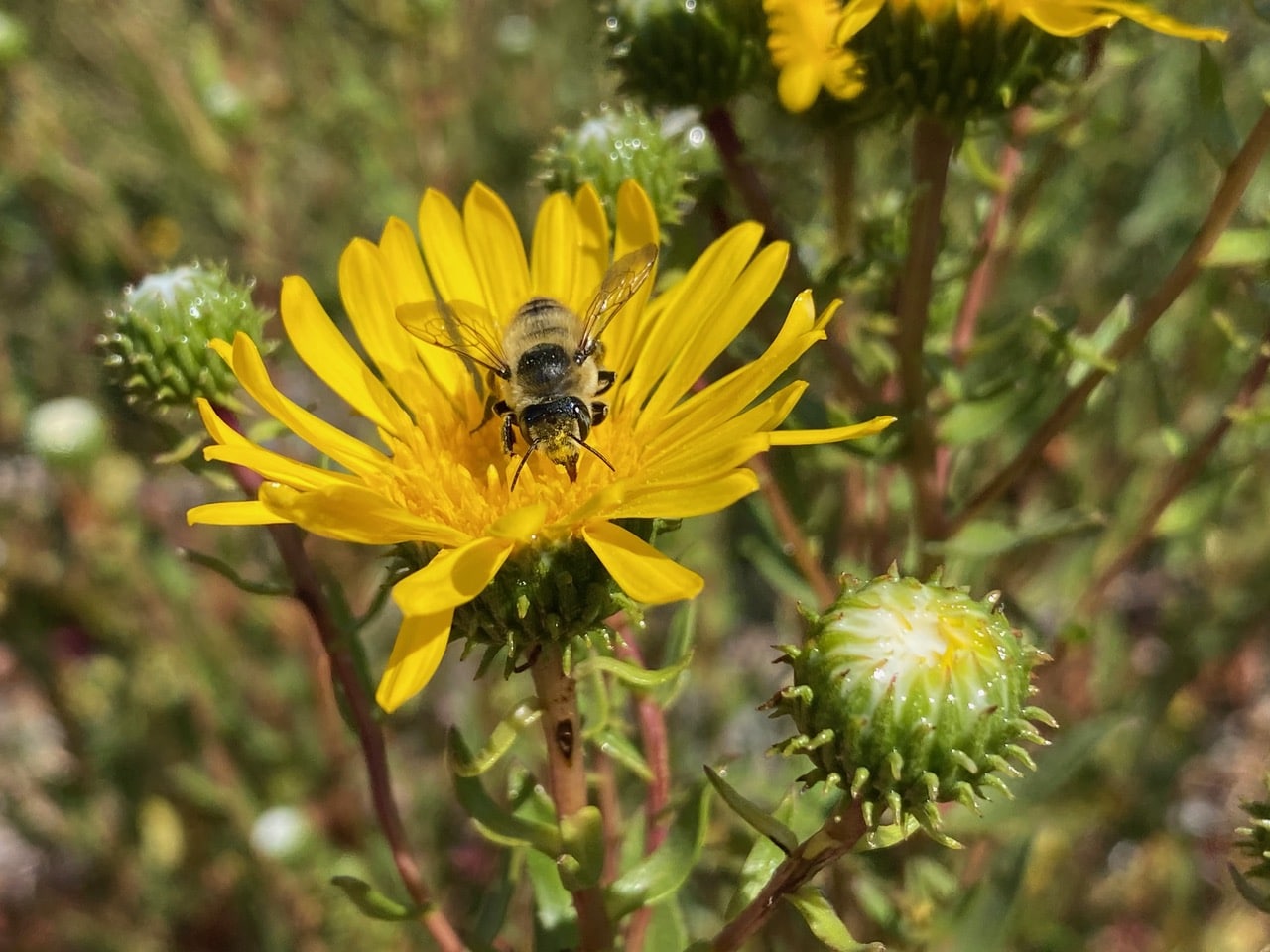
Adult Megachilids drink nectar from a wide variety of plants, and many species are long-tongued, which allows them to harvest nectar deep within a flower. Although they are generalist foragers, the Western Leafcutters, Megachile perihirta prefer flowers in the Asteracea family for nectar and pollen; the composite flowerheads offer a flat surface on which numerous florets are clustered. The bees are frequently seen foraging on Seaside Daisy, Grindelia, Asters, Sunflowers, Cosmos, and Dahlia.
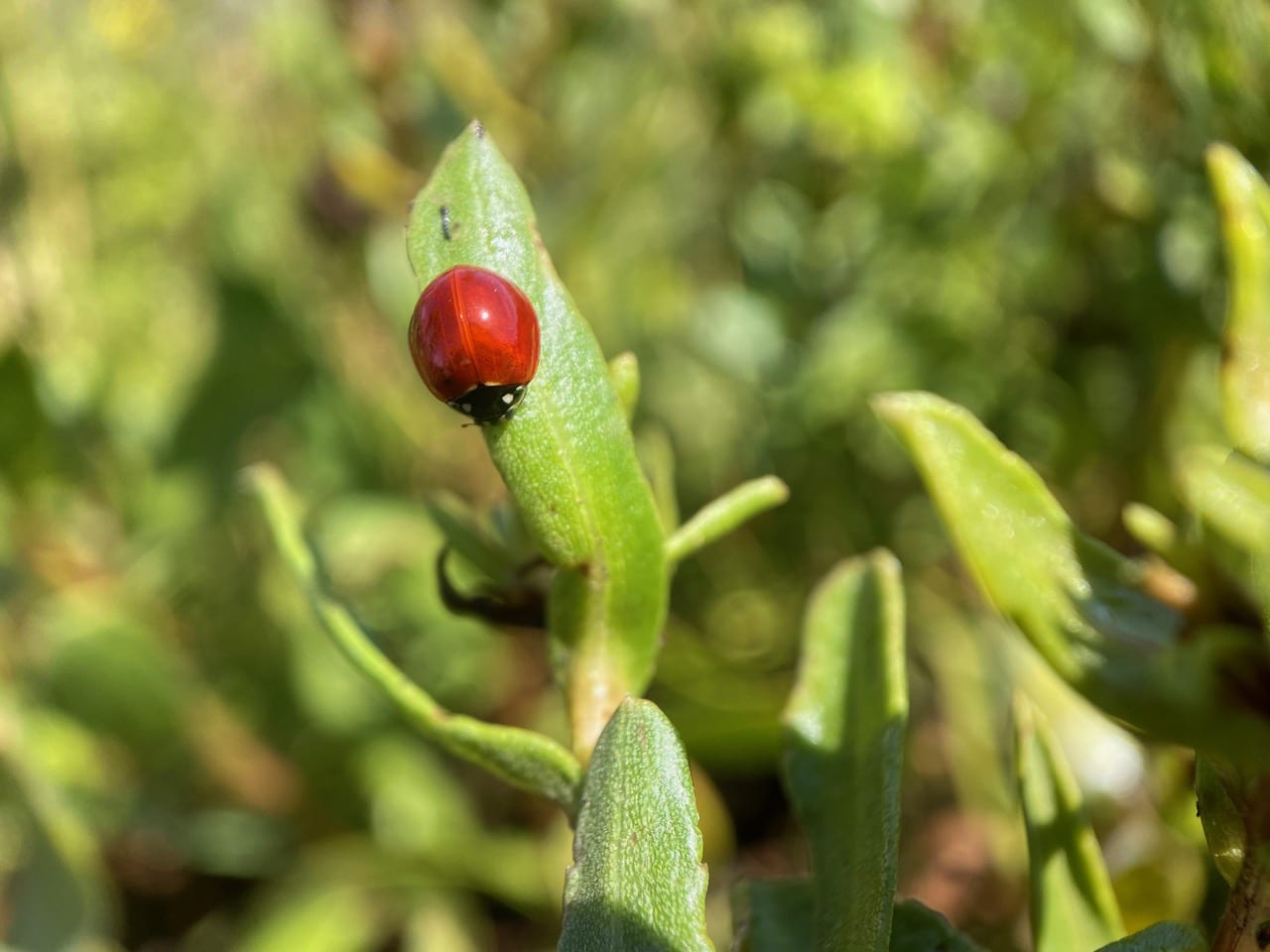
A Spotless Lady Beetle, Cycloneda sanguinea (family Coccinellidae) is perched on a Grindelia leaf.
The Spotless Lady Beetle, Cycloneda sanguinea is a widespread species of lady beetle in the Americas. It is a large lady beetle with red, unspotted elytra (wing covers) ranging from 4-6.5 mm long. The black and white marks on the head and pronotum are very distinctive, and they are also gender-specific. What we have here is a female. Males have a short white line between the two white spots on the pronotum. These lady beetles are very often found feeding on aphids on milkweeds, but also occur on a number of other plants. Both adults and larvae are voracious predators of aphids and other soft-bodied insects.

Hey, look, a small but beautiful Spittlebug, Complex Clastoptera lineatocollis (family Clastopteridae). The Grindelia at Shoreline Park had a huge infestation of these spittlebugs last summer. So far, the bugs seem to be few and far between this year.
Why the common name of “spittlebug”? The nymphs (immatures) of these bugs create foam masses on plants in which they live and feed. Like the adults, the nymphs use their piercing, sucking mouthparts to feed on plant juices. The nymph produces a cover of foamed-up plant sap reminiscent of saliva, hence the common name of spittlebug. Whereas most insects that feed on sap feed on the nutrient-rich fluid from the phloem, Spittlebugs tap into the much more dilute sap flowing upward via the xylem. The large amount of excess water that must be excreted and the evolution of special breathing tubes allow the young spittlebug nymphs to grow in the relatively protective environment of the spittle. Symbiotic bacteria in the insects’ digestive system provides them with the essential amino acids that their diet lacks. The foam serves a number of purposes. It hides the nymph from the view of predators and parasites, and it insulates against heat and cold, and protects the delicate nymphs from desiccation. Moreover, the foam has an acrid taste that deters predators.

Side view of the same Spittlebug. Don’t be fooled by the shiny fake eye – the bug is facing upwards. The eye spot is on its hind wing.
Adult spittlebugs are commonly called Froghoppers. The Froghopper is a “true bug” in the order Hemiptera. Froghoppers are champion jumpers among insects, out-performing even the fleas. The bug can leap the human equivalent of a skyscraper without a running start! The muscles in its hind legs act like a “catapult” to release energy explosively. Its athletic prowess not withstanding, the Froghopper is better known for its young, the “spittle bugs”. The nymphs produce foamy white masses on plants within which they feed on plant sap. Froghoppers have piercing-sucking mouthparts, and feed on plant sap as both nymphs and adults. A recent report claims, “Froghoppers are the super-suckers of the animal world. The tiny insects produce negative pressures equivalent to people sucking a 100-meter-long straw.” So the little bug has two titles under its belt – champion jumper, and super-sucker!
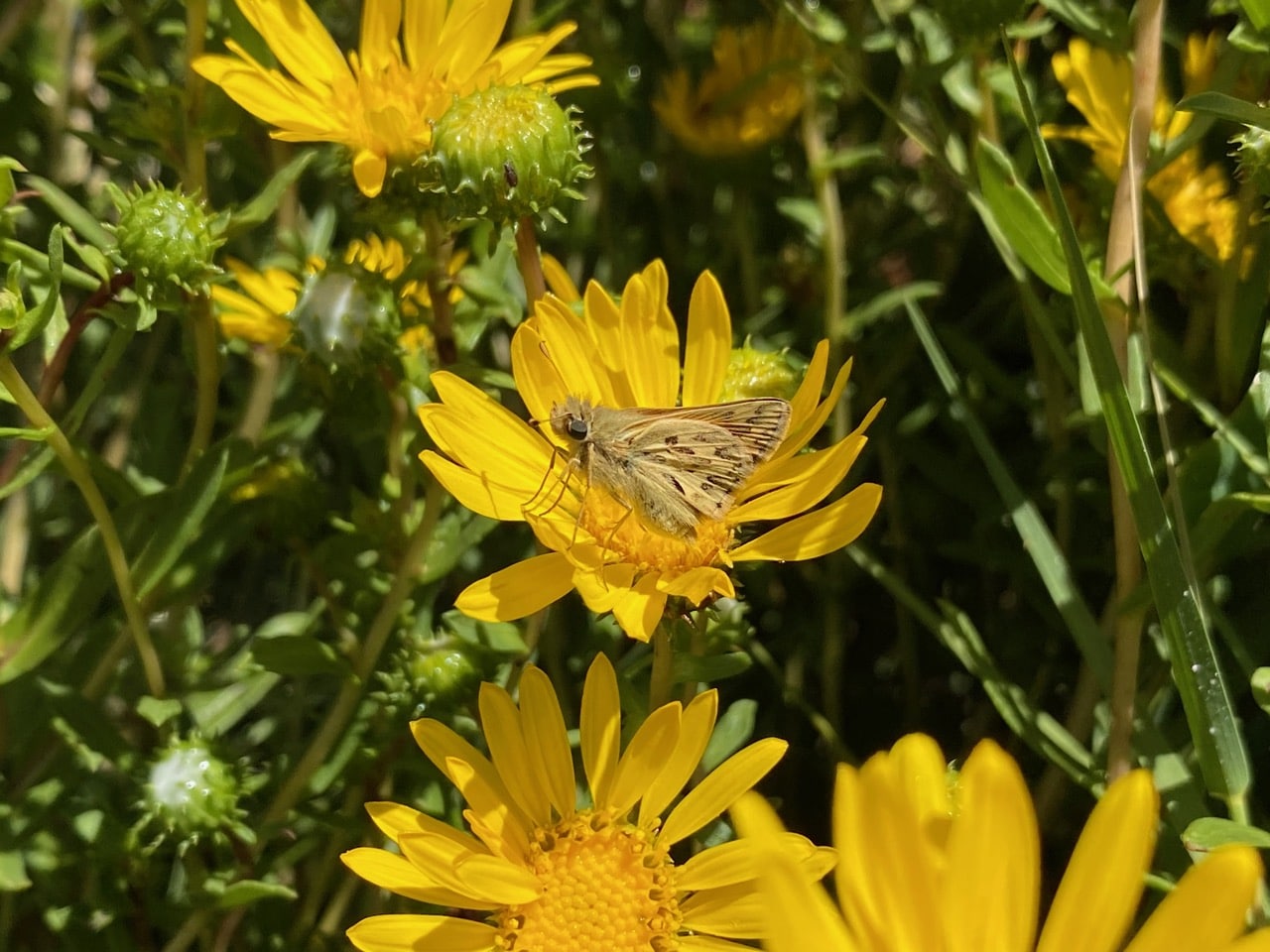
A Sandhill Skipper, Polites sabuleti (family Herperiidae) has landed on a Grindelia flowerhead.
Skippers are a family, the Hesperiidae, of the order Lepidoptera (butterflies and moths). They are named for their quick, darting flight habits. Most have the antenna clubs hooked backwards like a crochet hook. They also have generally stockier bodies and larger compound eyes than the other butterflies. Their wings are usually small in proportion to their bodies. When at rest, skippers keep their wings usually angled upwards or spread out, and only rarely fold them up completely. Californian species are mostly brown or tan, with black, orange, or yellow markings.
Skipper caterpillars are usually green or brown, sometimes yellowish, never brightly colored. They have a distinctive “collar”, a narrow ring around the body right behind the head. Caterpillars are camouflaged and often hide during the day. Many species make nests of leaves and silk for additional protection. Most North American species feed on grasses, but some common species eat shrubs and trees, especially in the bean family. Most species are limited to a single group of food plants. Adult skippers are only active during the day, but Skipper caterpillars feed mainly when it is dark or partly light.
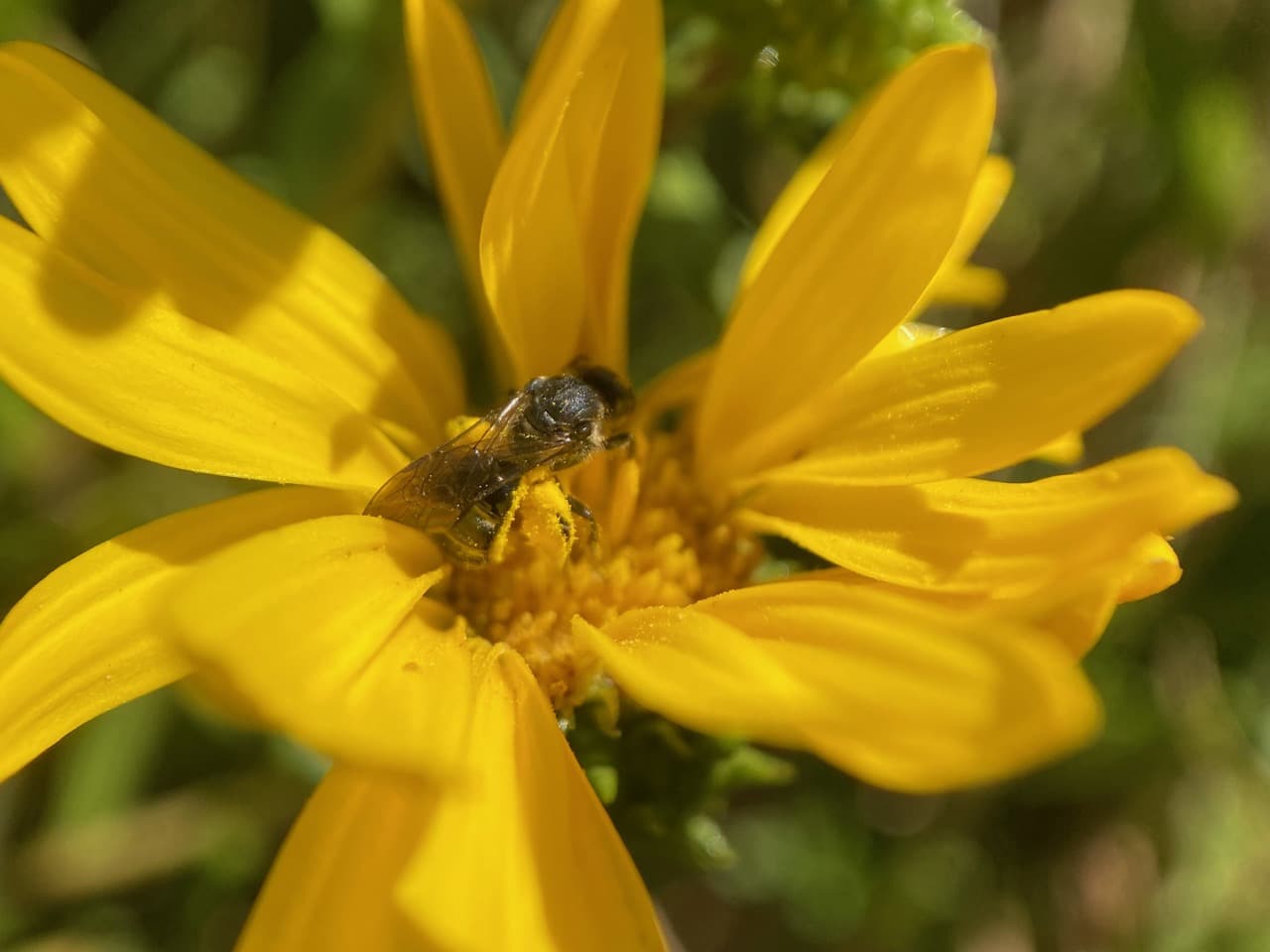
Her scopae bulging with pollen, a Tripartite Sweat Bee, Halictus tripartitus (family Halictidae) is foraging on a Grindelia flowerhead.

Halictus is found worldwide; they are most common in the Northern Hemisphere. All are generalists, foraging from a wide variety of flowering plants. Many species are social and produce several generations per year. This is not surprising as most blooming plants are season-specific; a bee that requires pollen and nectar across multiple seasons would not thrive as a specialist. All Halictus in North America nest in the ground, often in aggregations; and they may nest in the same area for decades.

The species Halictus tripartitus is primitively eusocial, meaning it has a social structure that is less complex than highly social insects like honey bees, but more advanced than solitary bees. The bees form annual colonies in the soil, where some workers are capable of reproducing. Only potential queens overwinter, then provision a worker brood in the spring, with at least one worker brood produced before males and new queens emerge. These bees are known to nest in aggregations, often in flat, bare ground. They visit and pollinate a wide variety of flowers.

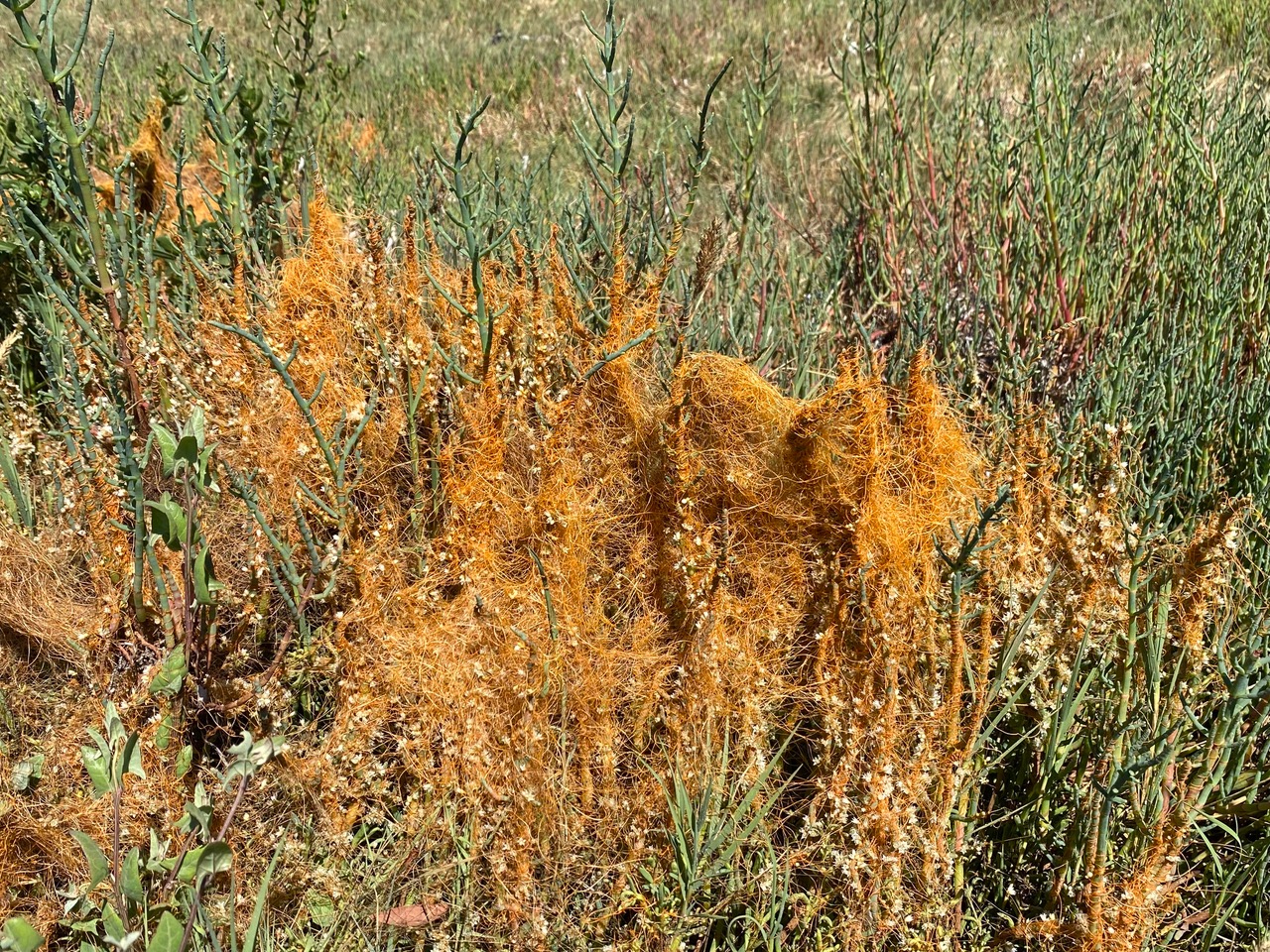
Large orange patches have appeared on the lower salt marsh. From a distance, they look like someone has thrown orange paint on the Pickleweed, Salicornia sp. These are actually dense masses of string-like stems of Dodder. Dodder is an annual parasitic vine in a single genus, Cuscuta in the family Cuscutaceae. Dodders are obligate parasites, meaning they can’t make a living without their plant hosts. The thin, thread-like, yellow or orange stems grow rapidly entwining and covering their host plants, in this case, the Pickleweed.
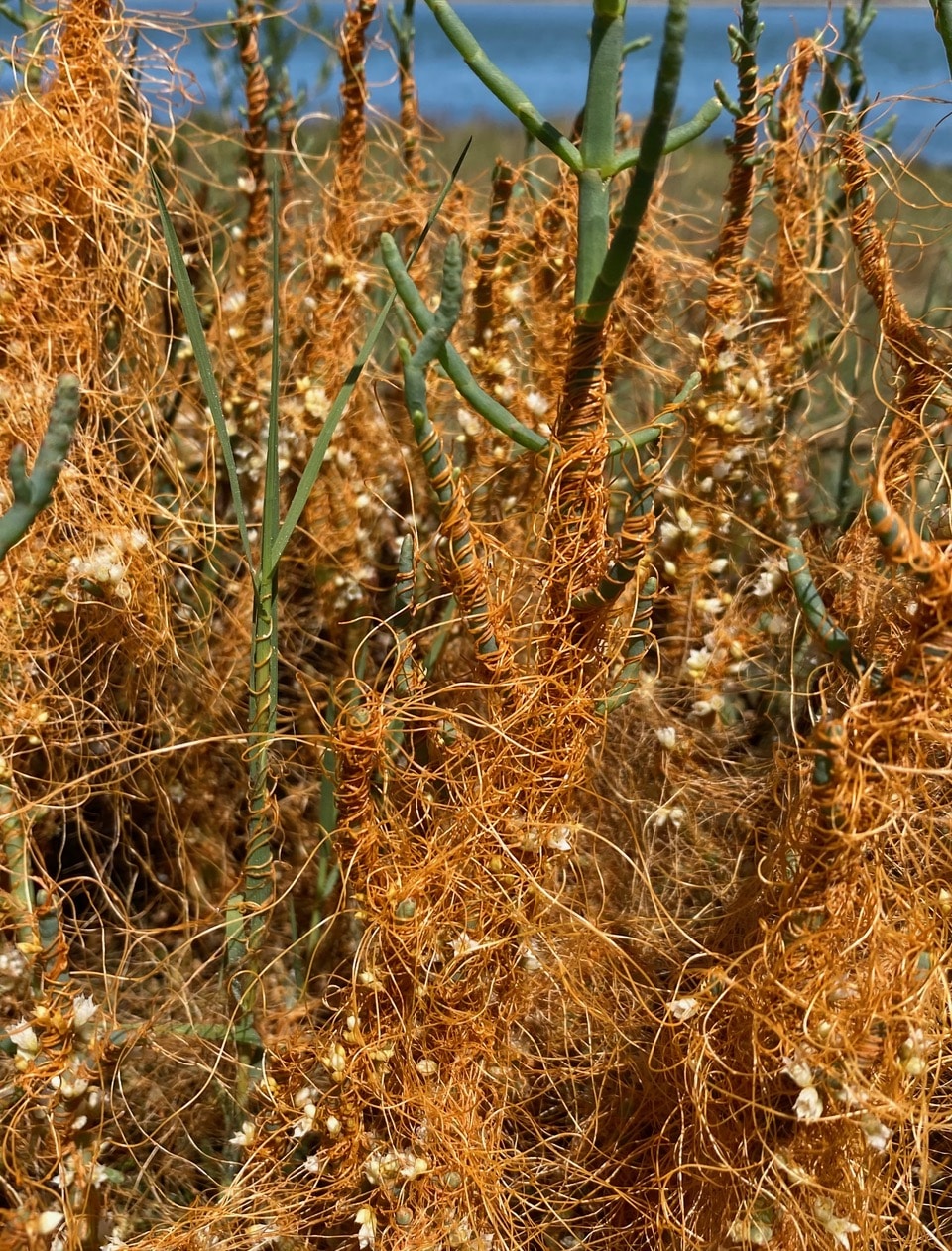
Dodder seeds germinate in the soil and can live on their own for 5-10 days. Dodder seedlings are capable of detecting plant volatiles released by prospective host plants. If they have not found a suitable host in time the seedlings will die. Seedlings that find a suitable host twine around the plant and insert haustoria (modified adventitious roots) into the tender stem. The haustoria penetrate and tap the host plant’s vascular system for water, minerals and nutrients. Dodder is weakly photosynthetic, but most produce very little food on their own. As the vine successfully taps the host plant, its connection to the soil is severed. Small, white, bell-shaped flowers form in late summer and early fall and can produce copious amounts of seeds.

Close-up of Dodder flowers.
The small inconspicuous Dodder flowers are primarily pollinated by wasps, particularly small, native wasp species that are attracted to the host plant’s flowers. Dodder uses its host plant’s flowering signals to synchronize its own flowering. The host plant’s leaves sense environmental cues and produce a flowering signal that travels through the plant’s vascular system. Dodder “eavesdrops” on it to produce its own flowers. Dodder flowers generally don’t produce much nectar, and lack their own strong floral scent. It relies on the proximity to its host plant’s flowers to attract pollinators.