

Pollinator Post 7/31/25 (1)

I walk the path along the shore at Bay Farm Island this clear, warm morning.

The Oregon Gumweed, Grindelia stricta is in bloom and abuzz with insect life.
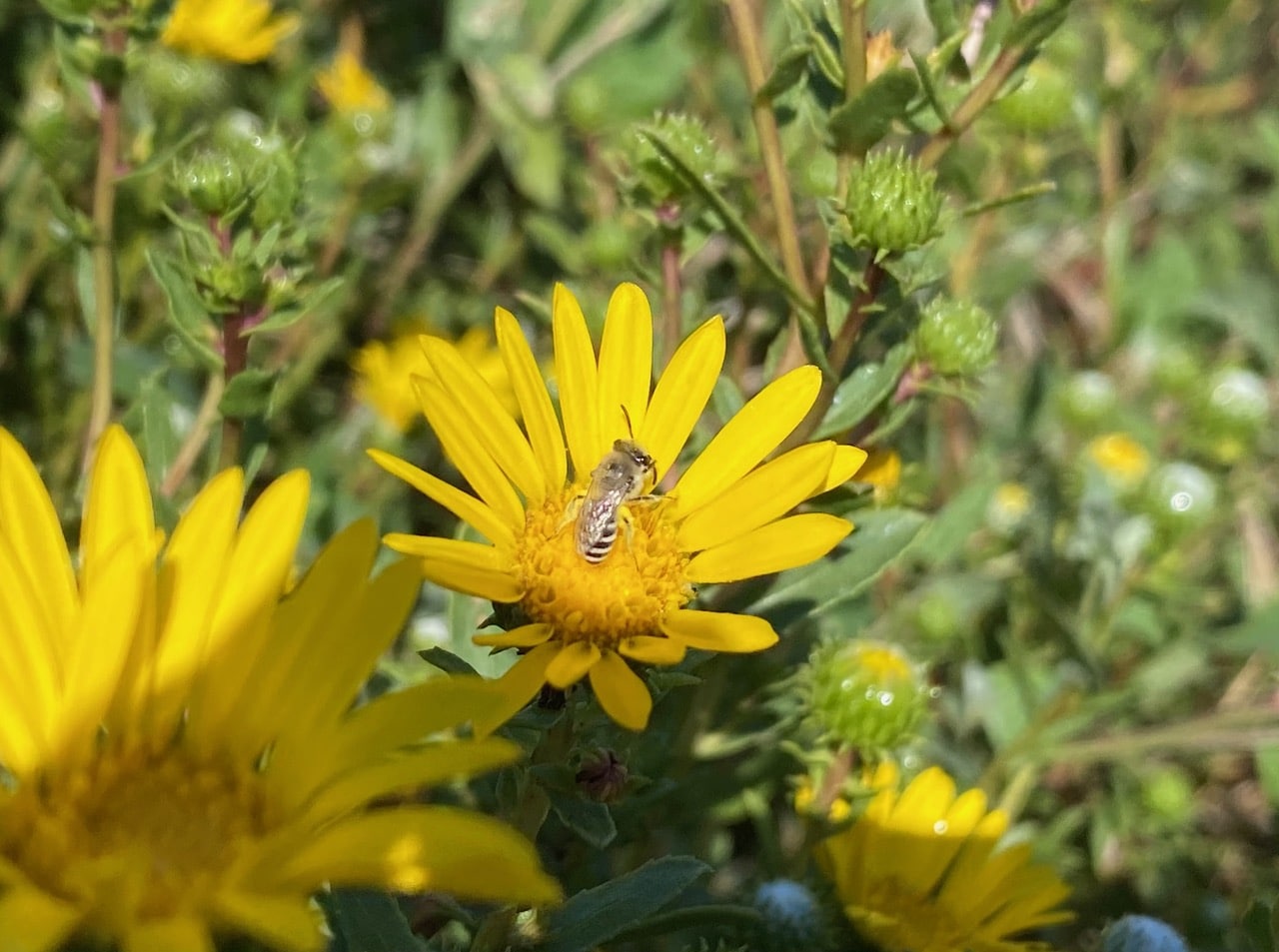
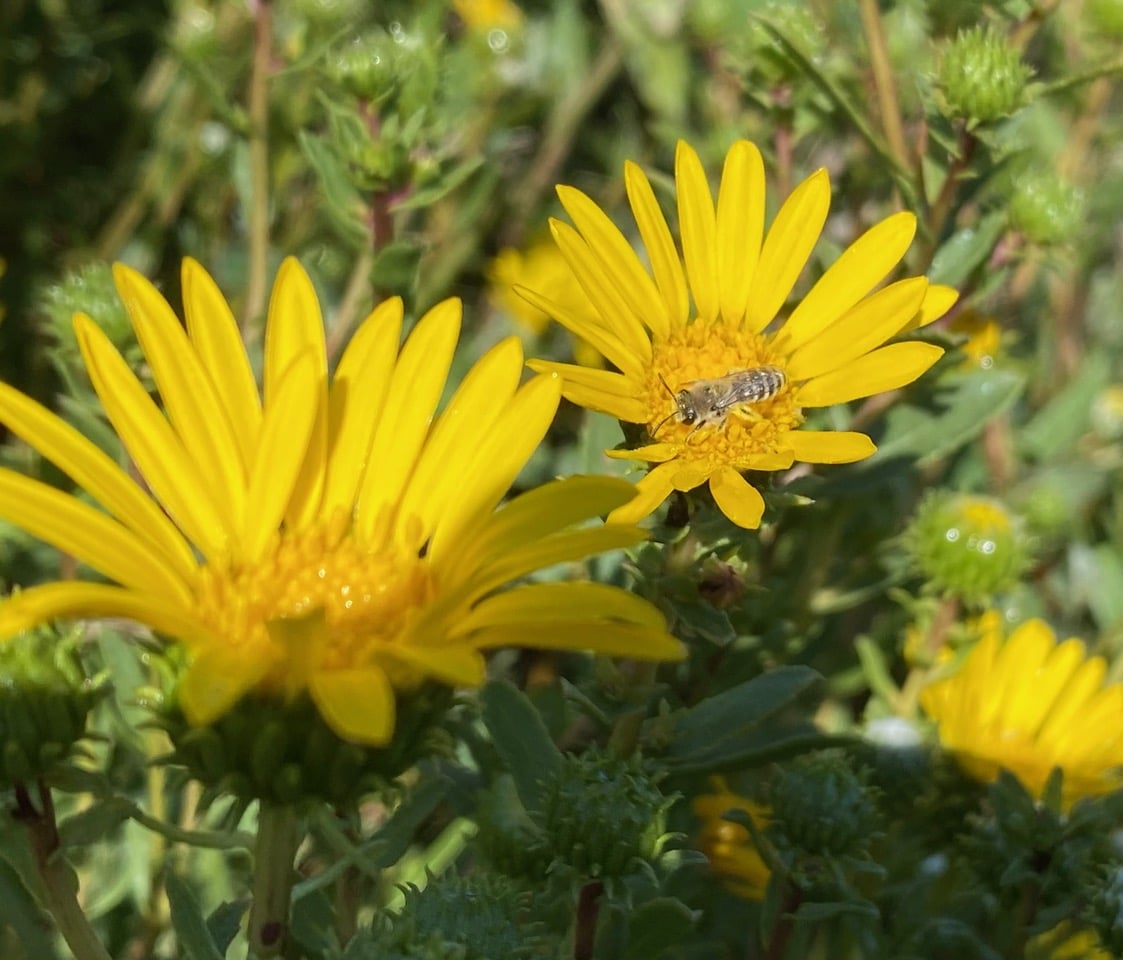
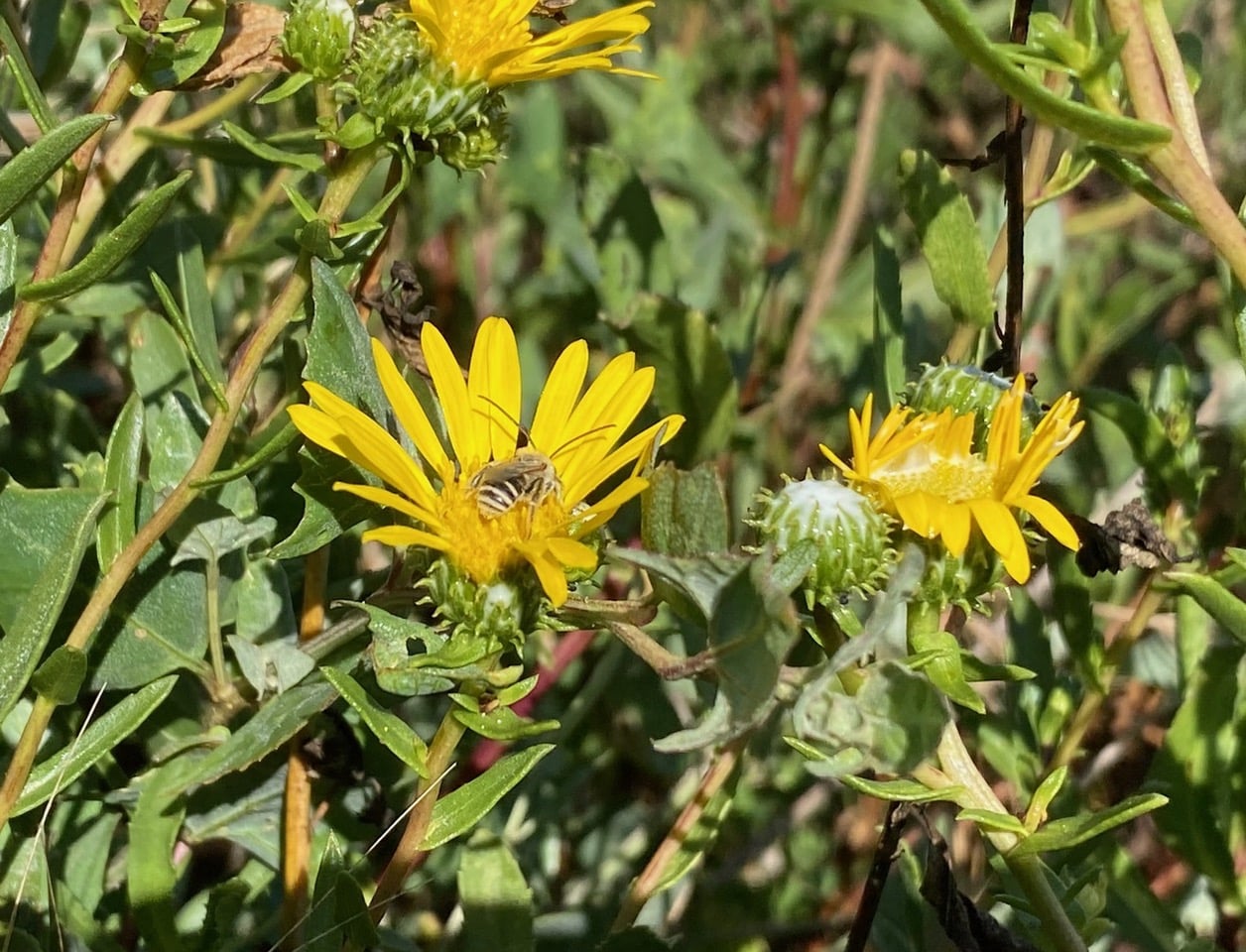
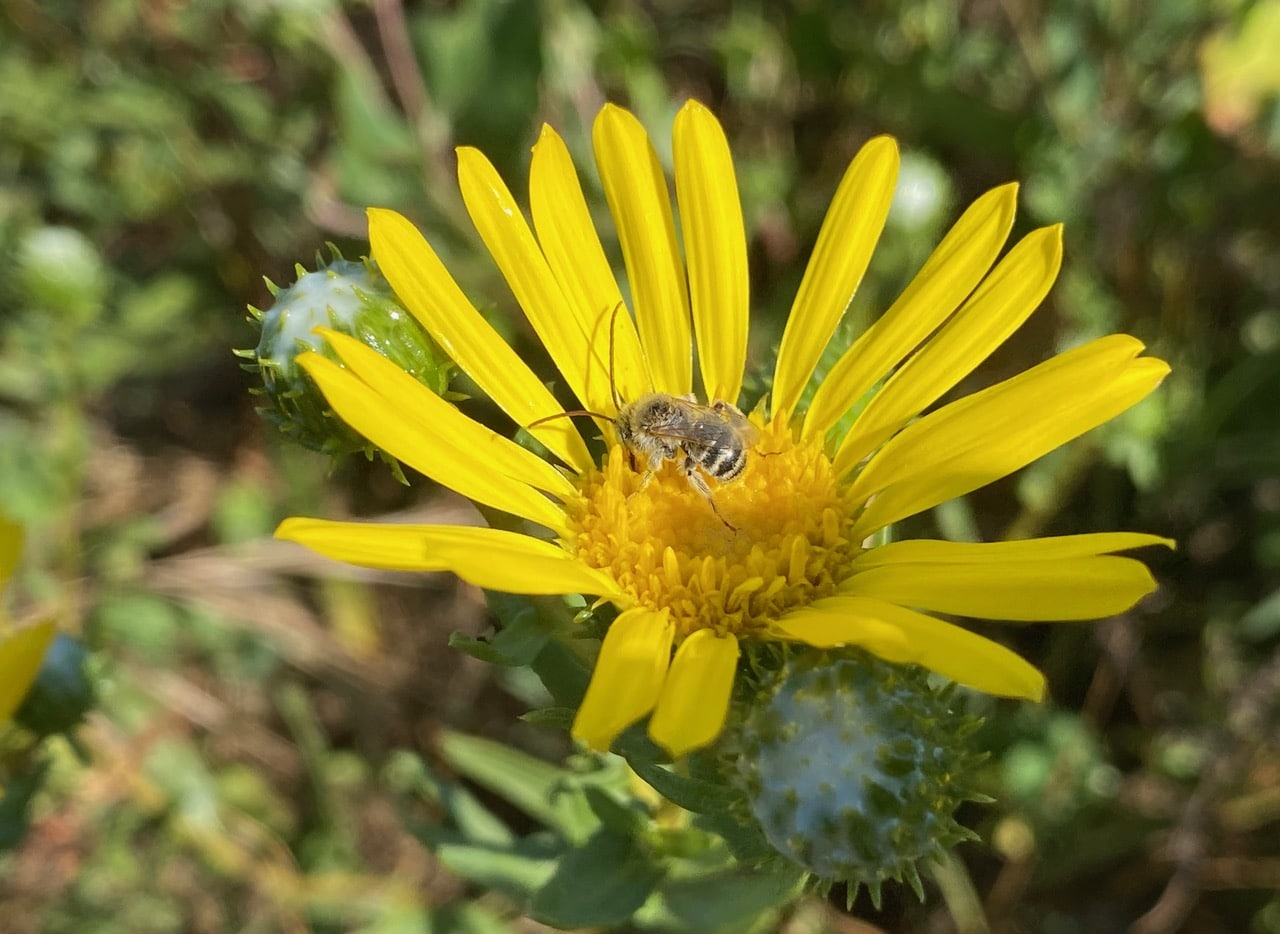
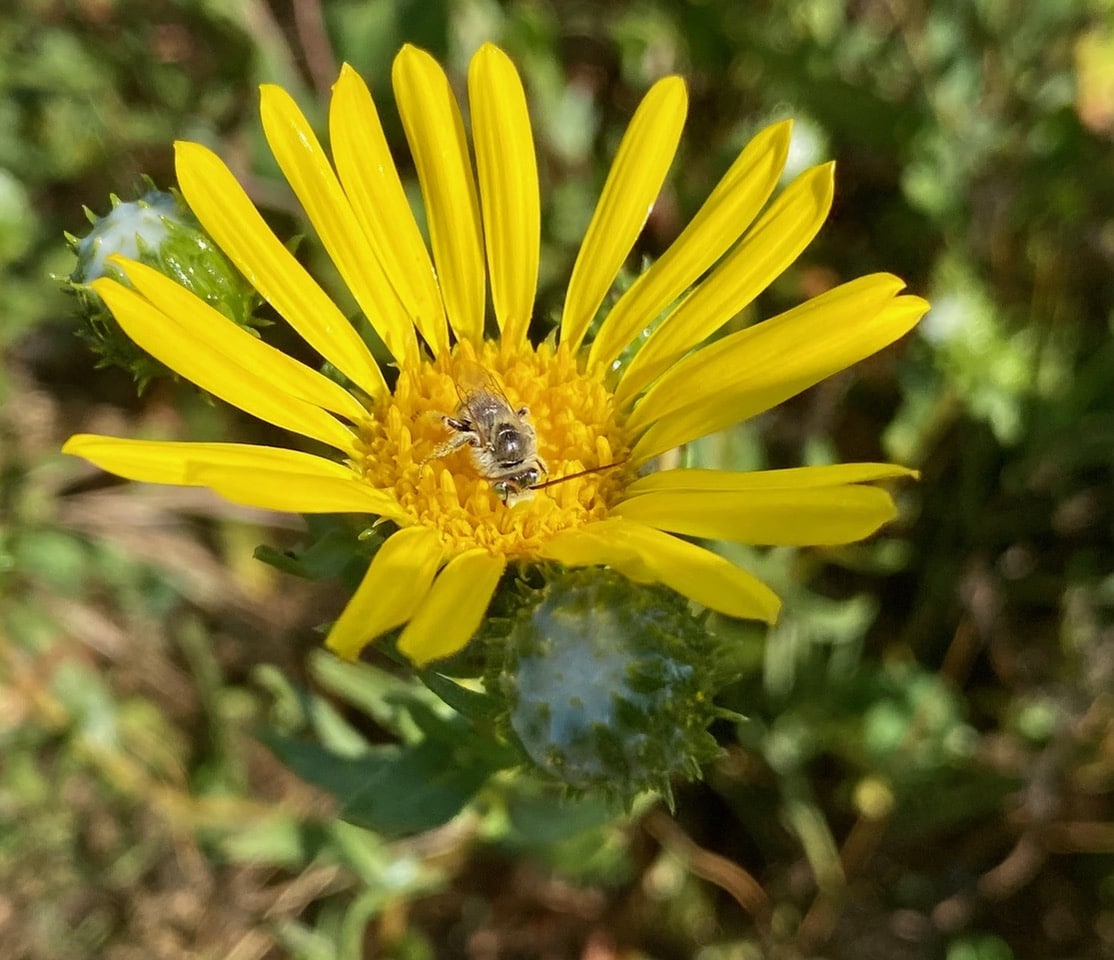





A Cellophane Bee, Colletes sp. (family Colletidae) is foraging on a flowerhead of Oregon Gumweed.
The bee family Colletidae includes generalists and specialists, and they are likely important pollinators of many wildflowers. All Colletidae in North America are solitary ground nesters, but some species nest in large aggregations. There are two major genera of Colletidae in North America: the Masked Bees (genus Hylaeus) and Cellophane Bees (genus Colletes). The most obvious shared characteristics of Colletidae is also the hardest to see: their short tongue. Colletes are moderately hairy, slender bees, ranging in size from 7 to 16 mm. Distinct features include a hairy head and thorax, pale bands of hair on the abdomen, and a heart-shaped head. The eyes of Colletes are angled (rather than being parallel), making the face slightly heart-shaped.
A male Summer Longhorn Bee, Melissodes sp. (family Apidae) has landed on a Grindelia flowerhead. The common name “longhorn” refers to the long antennae of the males of this genus.
The Summer Longhorn Bees, Melissodes sp. (family Apidae) are medium to large bees, stout-bodied, usually with gray/brown hair on the thorax and pale hair bands on the abdomen. Males usually have yellow markings on their faces and have very long antennae from which their common name is derived. They are active May to September, with peak flight in late June to early August. The females prefer flat, bare ground for digging their solitary nests, though they sometimes nest in aggregations. Pollen is transported in scopae on the hind legs. Pollen loads are often copious and brightly colored and thus very distinguishable. Melissodes are specialists on Asteraceae – females gather pollen from flowers of Aster, Bidens, Coreopsis, Cosmos, Encelia, Gaillardia, Helianthus, and Rudbeckia ssp.
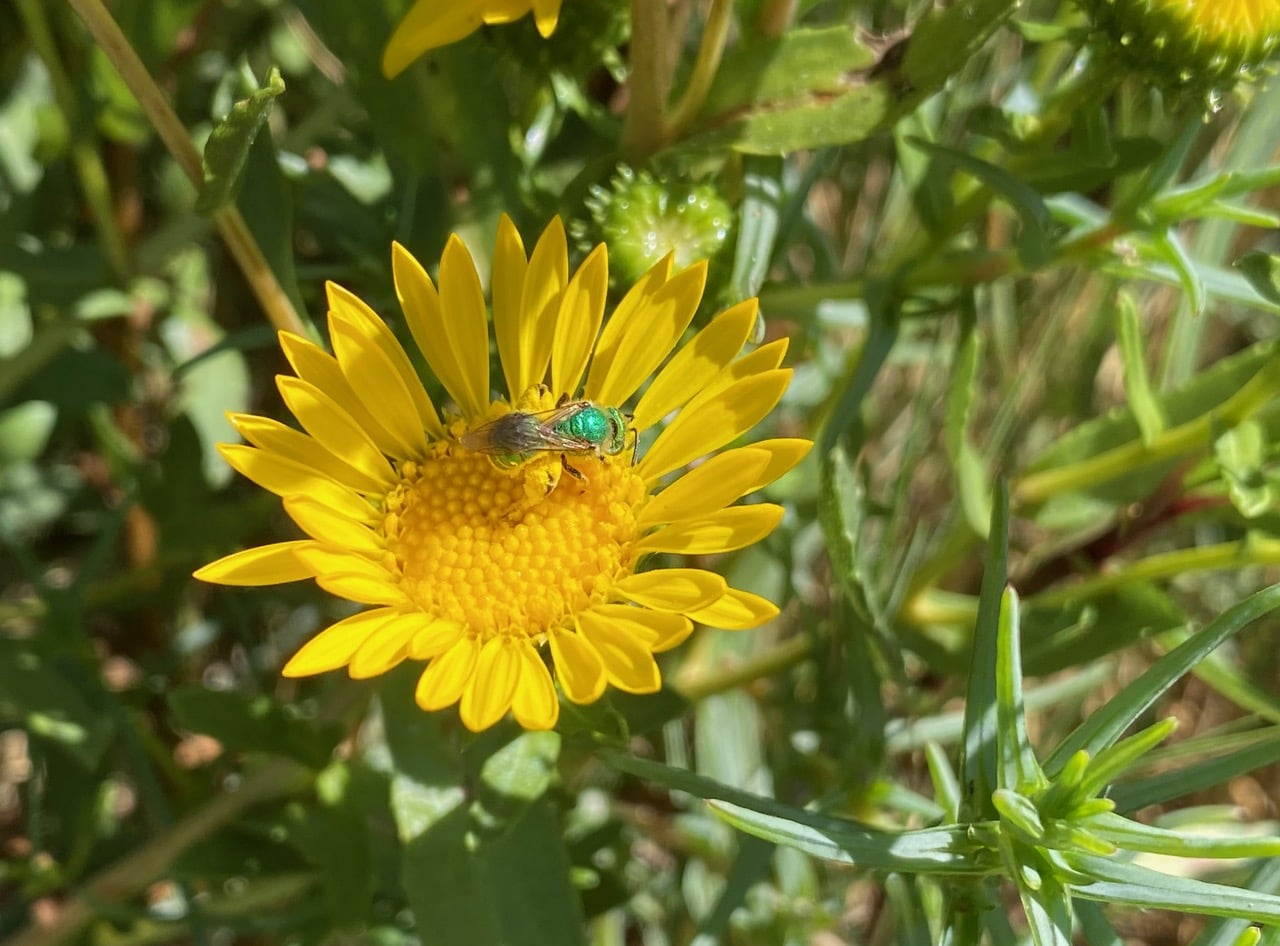
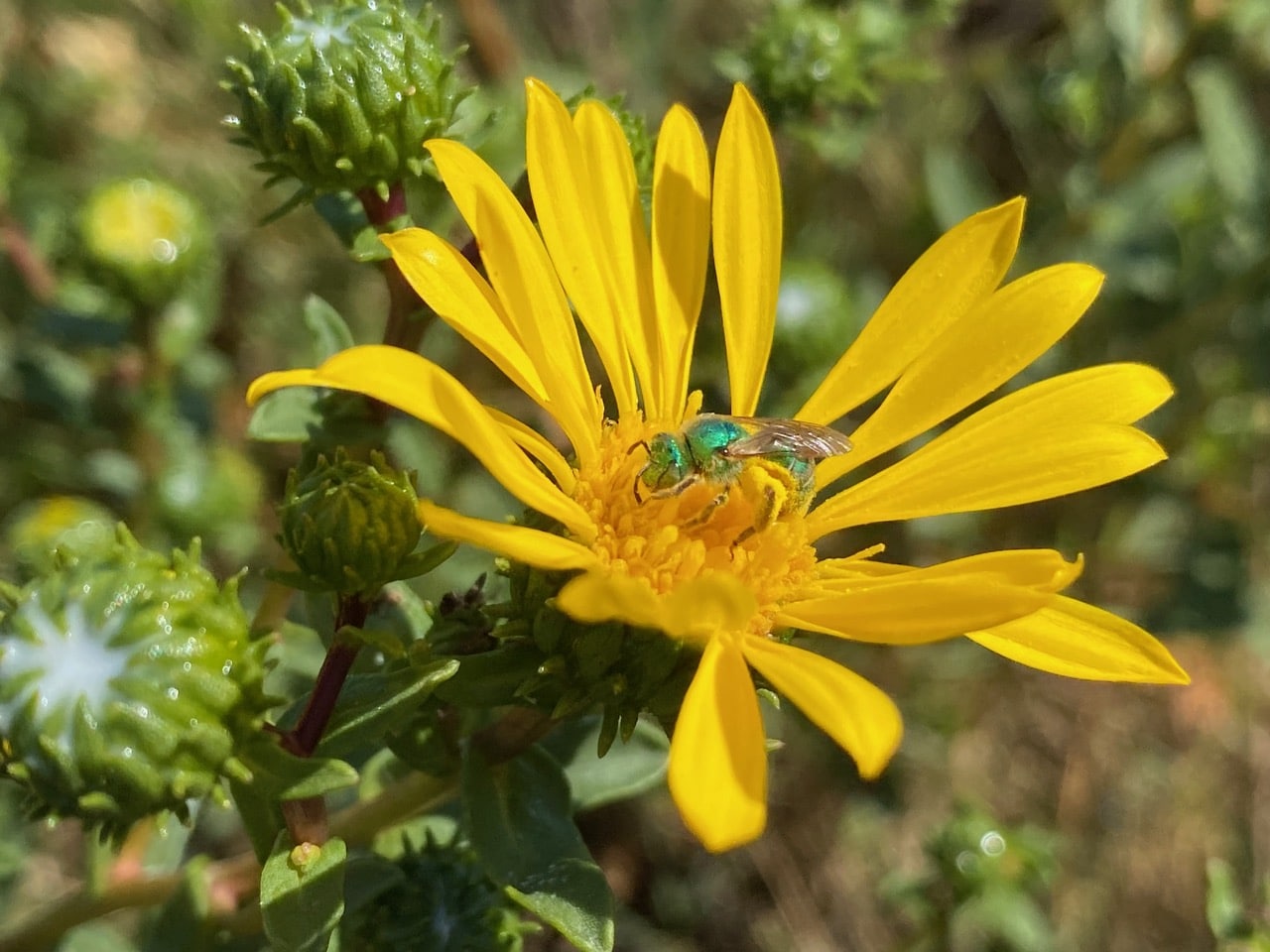
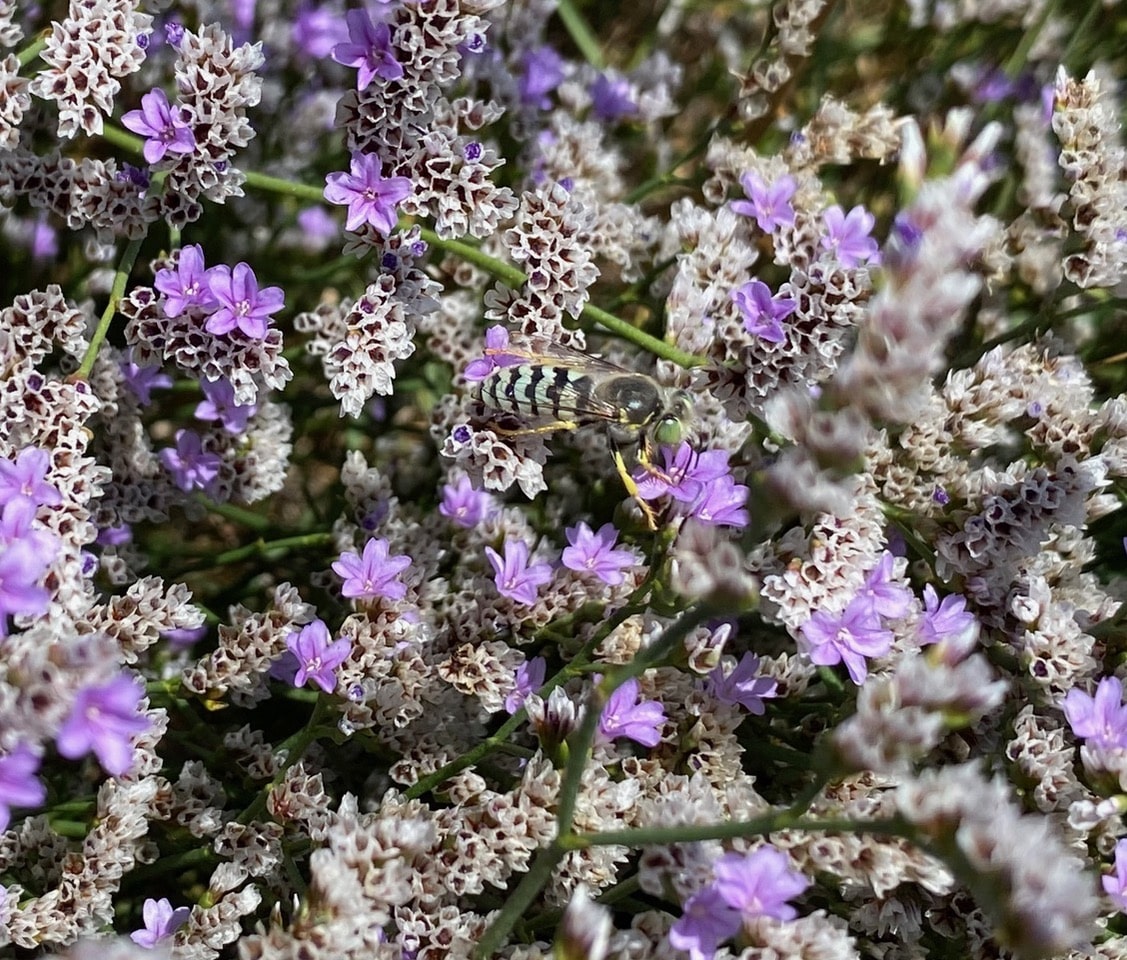
Her scopae bulging with pollen, a female Fine Striped Sweat Bee, Agapostemon subtilior (family Halictidae) is foraging on a Grindelia flowerhead.
Agapostemon are brightly colored metallic green or blue bees measuring 7 to 14.5 mm long. Most species have a metallic green head and thorax, and black-and-yellow striped abdomen; some females are entirely bright green or blue. Females carry pollen on scopal hairs located on their hind legs. Agapostemon are generalists. Like other members of the family Halictidae, they are short-tongued and thus have difficulty extracting nectar from deep flowers. Males are often seen flying slowly around flowers looking for females. The bees favor flowers with high densities. Females excavate nests in the ground. These are summer to fall bees.
Fine striped sweat bee (Agapostemon subtilior) · iNaturalist
Agapostemon females dig deep vertical burrows in flat or sloping soil, or sometimes in banks. Most species are solitary, but some species nest communally. Up to two dozen females may share a single nest entrance, but each individual builds and provisions its own cluster of brood cells. Where a communal nest gallery shares a single entrance, one bee usually guards the hole, with only her head visible from above ground. Unlike other social bees, in communal bees there is no reproductive division of labor. In cool temperate regions, there is one generation per year, with females active in the early summer and males and pre-diapausing females active in the late summer. Only mated females survive the winter. This is probably because unmated females cannot enter diapause (insect version of hibernation).
Most of the Fennel, Foeniculum vulgare along the shore have lost their leaves. I am not likely to find any Anise Swallowtail caterpillars on the wilting foliage.
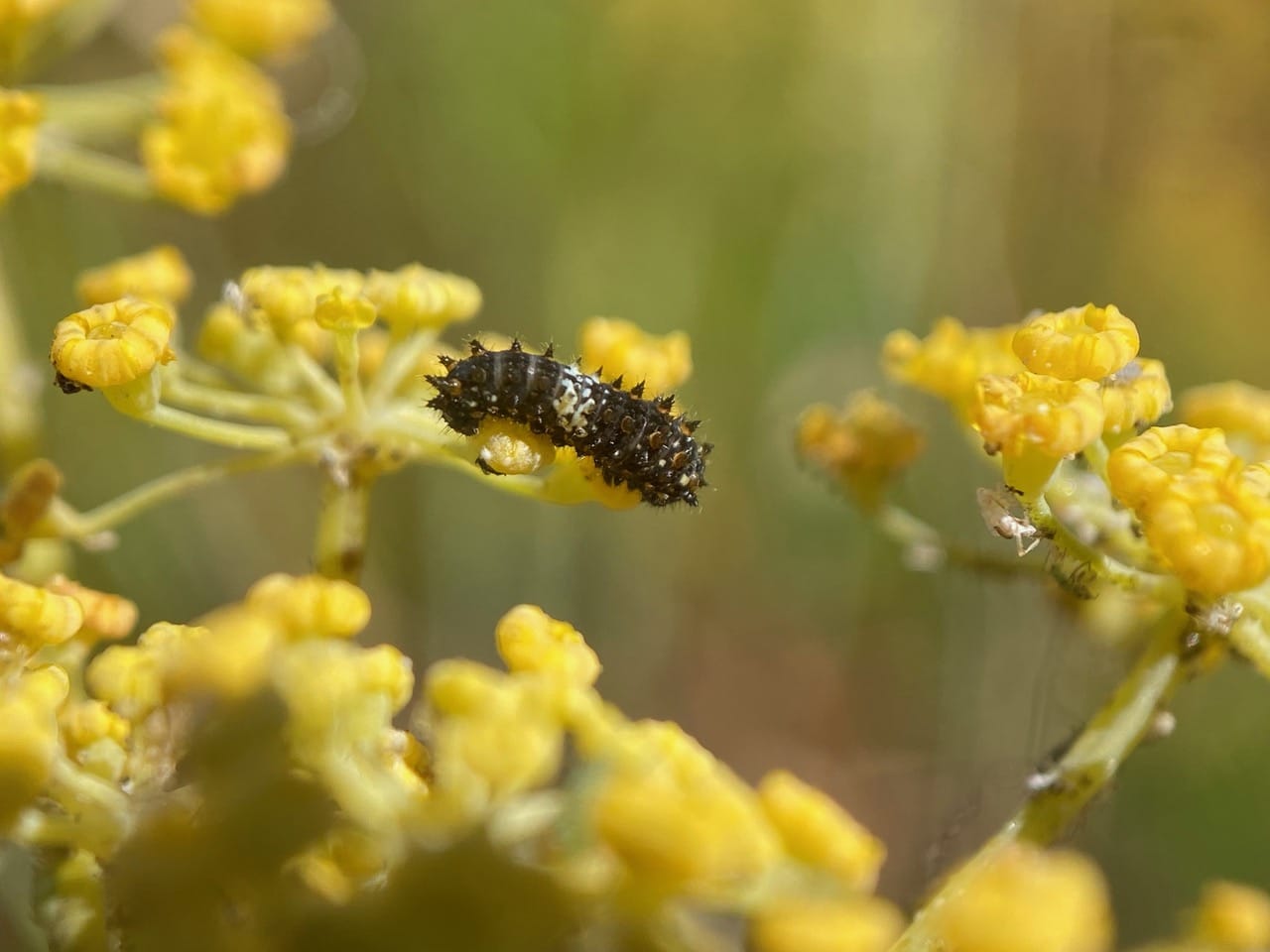
A young, second instar caterpillar of Anise Swallowtail is resting on an umbel of Fennel flowers.
Instar is the term given to the developmental stage of an insect between molts. For example, after hatching from the egg an insect is said to be in its first instar. When the insect molts it is then a second instar and so on. Anise Swallowtail caterpillars go through five instars, meaning they molt (shed their skin) four times as they grow and develop.
The Anise Swallowtail, Papilio zelicaon (family Papilionidae), is a common swallowtail butterfly of western North America. It is found in fairly open country, most likely seen on bare hills or mountains, in fields oar at the roadside. Adult females lay eggs singly on the underside of host plant leaves. In the first two instars, the caterpillar is a bird poop mimic – dark brown, almost black, with an irregular white band at its middle. After that it becomes more green at each successive molt until, in the fifth (last) instar, it is predominantly green, with markings in black, orange, and light blue. Its major food plants are members of the carrot family, Apiaceae (including fennel), and also some members of the citrus family, Rutaceae.
Along the wetter section of the trail, the Algerian Sea Lavender, Limonium ramosissimum is blooming in profusion among the Pickleweed and Sea Plantain.
Algerian Sea Lavender, Limonium ramosissimum is a perennial plant in the family Plumbaginaceae. It is an ornamental escape that is native to the coastal Mediterranean, and can grow in coastal marshes as well as inland wetlands. The species reproduces by seeds that can retain the ability to germinate after two weeks floating in salt water.
Can you see the American Sand Wasp, Bembix americana (family Crabronidae) among the busy Limonium flowers?
Sand wasps in the genus Bembix are familiar and common throughout North America, digging their burrows in dunes, on beaches, and other habitats with loose, deep sand. The female rapidly kicks out large quantities of sand using a “tarsal rake” of spines on each front leg. The burrow is excavated before the wasp goes hunting. Bembix are generalist, opportunistic hunters. True flies in the order Diptera are the usual prey. A victim is paralyzed or killed by the wasp’s sting, and is then flown back to the nest. Most species will lay an egg on the first victim, while some species lay an egg in the empty cell before starting to hunt. Once the egg hatches, mama wasp brings flies to her larva as needed. This “progressive provisioning” is rare in the insect world. When the larva reaches maturity, mama wasp closes the cell. Inside, the larva spins an oblong cocoon, weaving sand grains into the structure and resulting in a hardened capsule. Overwintering takes place as a prepupa inside this cocoon, but there are usually two generations a year.
Male sand wasps often engage in an elaborate flight ritual called “sun dances”. Males emerge before females, and fly erratically at dizzying speed one or two inches above the ground attempting to detect virgin females about to emerge from their underground nests. Both sexes are often seen taking nectar at flowers, especially from Asteraceae family. Bembix wasps are often victims of other insects such as cuckoo wasps (Chrysididae), velvet ants (Mutillidae), satellite flies (Sarcophagidae), bee flies (Bombyliidae), and thick-headed flies (Conopidae).
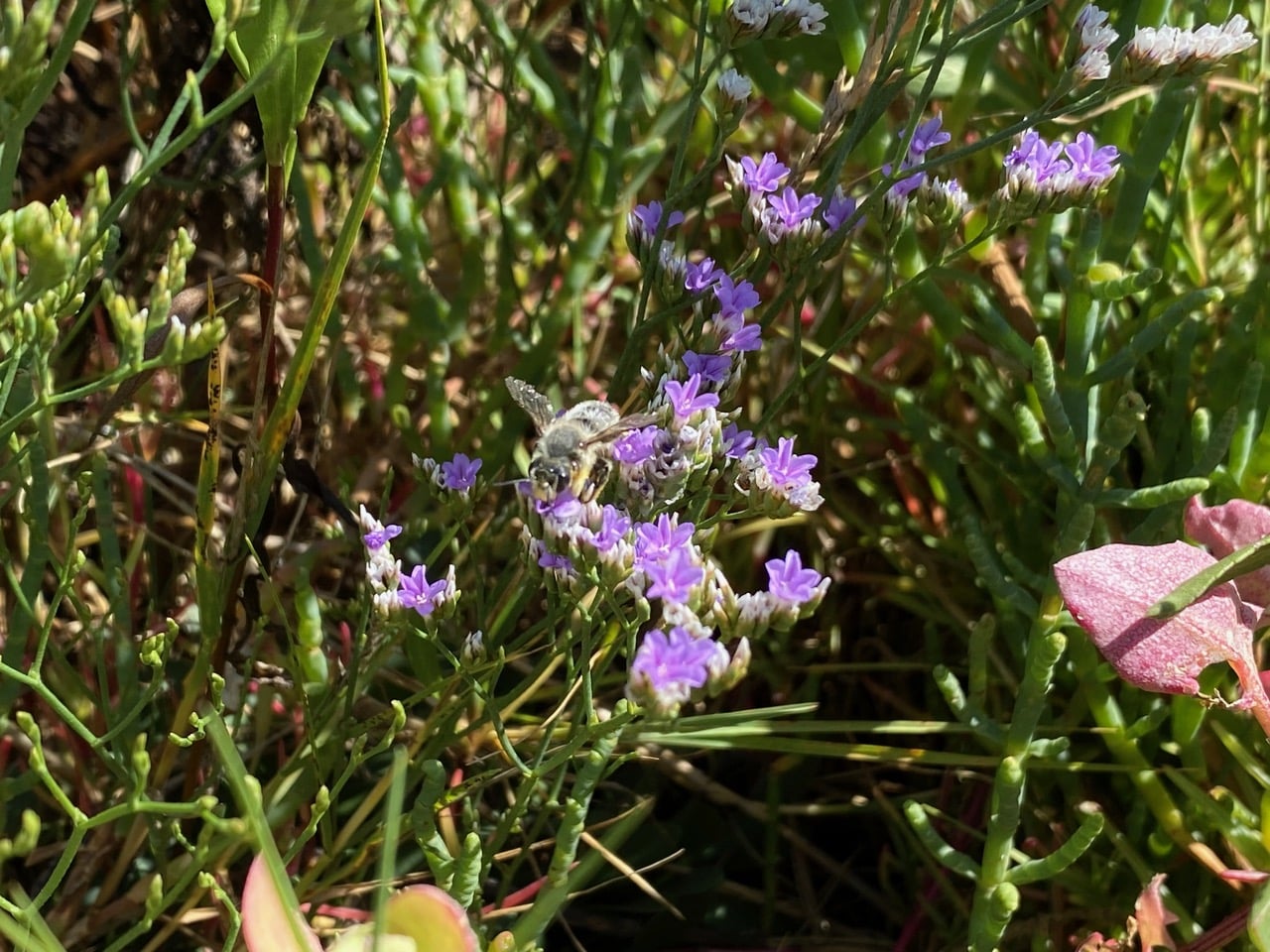
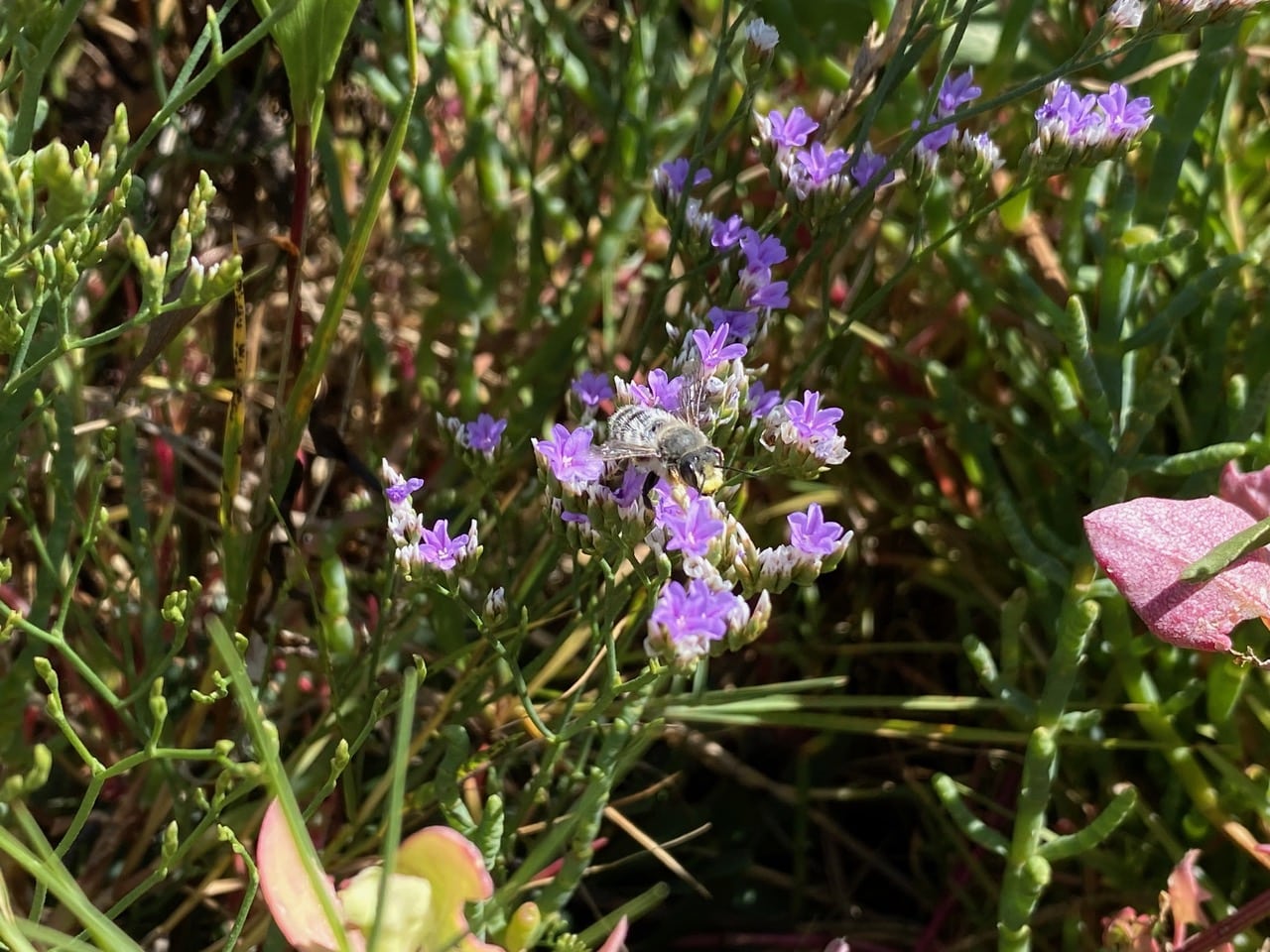
A small gray bee with black-and-gray banded abdomen is foraging among the small flowers of Algerian Sea Lavender. I recognize it as the Short Sun-digger Bee, Anthophora curta (subgenus Micranthophora, family Apidae).
The bee genus Anthophora, commonly known as Digger Bees, is one of the largest in the family Apidae. All species are solitary, though many nest in large aggregations. Nearly all species construct nests in the soil, either in banks or in flat ground; the larvae develop in cells with waterproof linings and do not spin cocoons. Males commonly have pale white or yellow facial markings, and/or peculiarly modified leg armature and hairs. Members of the subgenus Micranthophora are much smaller in size than the common Anthophora species. The Short Sun-Digger Bee, Anthophora curta (subgenus Micranthophora) is native to North America, and prefers dry, desert-like habitats.
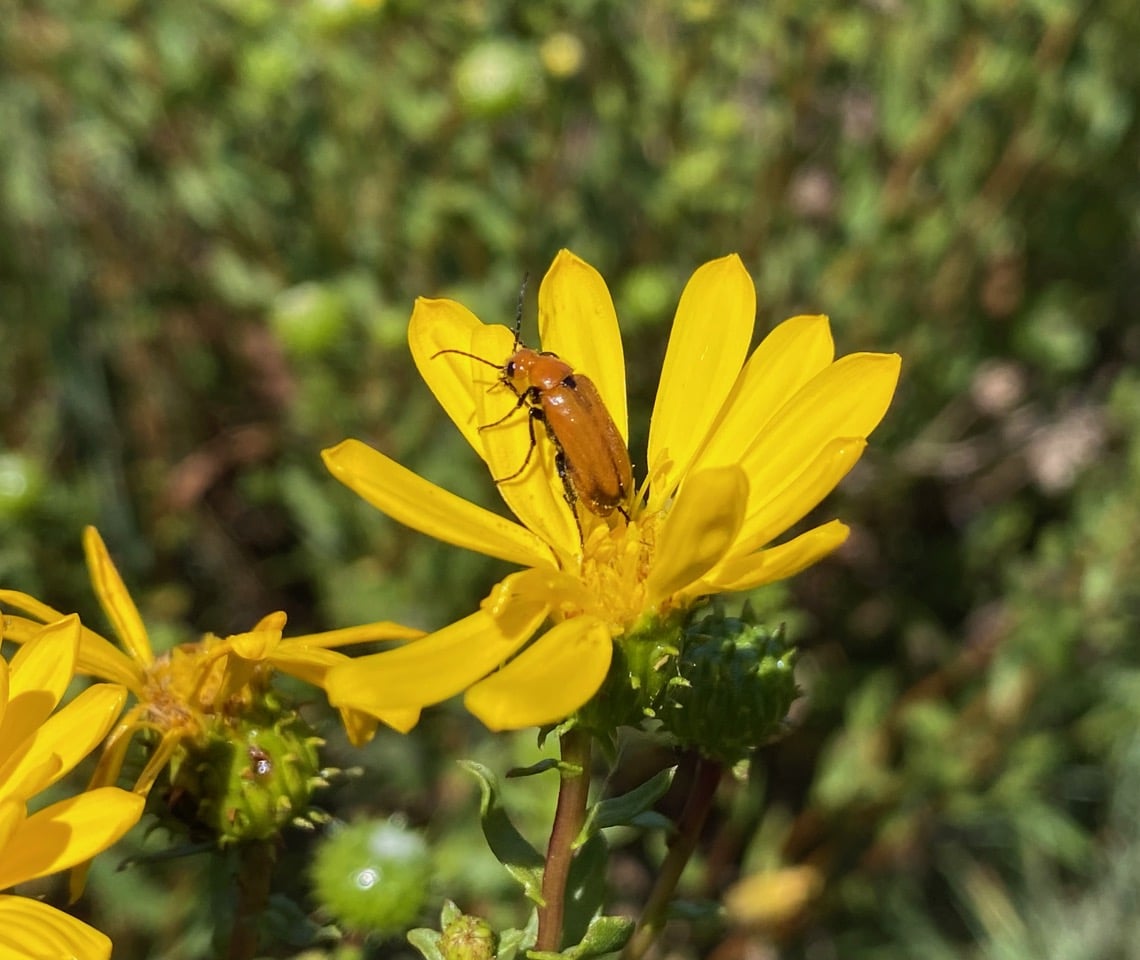
A rusty-orange beetle is perched on a Grindelia flowerhead. Note its long, needle-like mouthpart. iNaturalist has helped identify the insect as a Blister Beetle, Nemognatha sp. (family Meloidae).
Blister Beetles are beetles in the family Meloidae, so called for their defensive secretion of a blistering agent, cantharidin. Blister Beetles are hypermetamorphic, going through several larval stages, the first of which is typically a mobile triungulin. The larvae are insectivorous, mainly attacking bees, though a few feed on grasshopper eggs. The adults feed on flowers and leaves of plants.
Nemognatha Blister Beetles are leathery beetles often seen visiting flowers. There are nearly 30 species in North America, more often found in the southwest. The beetles are usually rusty orange, black, or both, and they typically visit sunflowers, thistles, and other members of the Asteraceae family. The adults are 3/16 to 5/8 in length. The outer lower mouth parts (galeae) are greatly elongated into a sucking tube, allowing the beetles to drink flower nectar. The genus name Nemognatha means “thread jaw”.
The female lays eggs on flowerheads. The newly hatched larvae, called triungulins, grab on to the legs of visiting solitary bees, and are carried unwittingly back to the bee’s nest. Once there, they feed on the bee’s provisions, eggs, and/or larvae before pupating themselves. Adult beetles can bee seen in mid to late summer feeding on nectar and pollen of various flowers, especially those in the sunflower family, Asteracea. Their bright color serves as a warning for predators to avoid them. Nemognatha blister beetles produce a highly toxic substance known as cantharidin, which blisters skin, causes digestive and urinary problems when swallowed, and can be lethal in small amounts. The male beetle produces this toxin and transfers some to the female during mating, enabling her to coat her eggs for protection against egg-eating insects.